
Clarity is one of the easiest places to overspend when buying a lab-grown diamond. A report may show VVS, VS, or SI, but the real question is simpler: can you see anything distracting when the diamond is worn in normal light? Many stones with lower clarity grades look completely clean without magnification, and a practical diamond carat guide can also help buyers weigh size against visible beauty, while some higher-graded stones still deserve a closer look because of where inclusions sit or how visible they are.
For the full framework, read Lab-Grown Diamond 4Cs Guide.
This guide helps you judge clarity the way it affects appearance and value. You’ll learn how to read a certificate without relying on the grade alone, when VS2 or SI1 may be enough, which inclusions need caution, and why shape, size, video, and setting all change the decision. The goal is to choose a diamond that looks clean to the eye without paying for clarity you cannot see.
Laboratory-grown diamonds should be clearly identified as laboratory-grown, and they should not be presented as mined diamonds. A lab-grown diamond is a diamond with a laboratory-created origin, while a natural diamond formed in the earth; that origin distinction should be clear in grading reports, seller descriptions, and purchase documentation.
| What You’re Checking | Usually Lower Risk | Needs Closer Review |
|---|---|---|
| Clarity grade | VS1 or VS2 for most buyers | SI1 without clear photos or video |
| Inclusion location | Small marks near the edge | Dark marks under the table |
| Diamond shape | Round brilliants hide marks well | Emerald and Asscher cuts reveal more |
| Carat size | Smaller stones mask inclusions better | 1.5 carats and above show more detail |
| Visual proof | Report plus face-up image and 360 video | Grade only, no seller verification |
Quick Questions Before You Read
Q: Does eye-clean mean flawless?
No. It means inclusions are not noticeable to the unaided eye in normal viewing, even if they appear under magnification.
Q: Is VVS clarity worth paying for?
Sometimes, but often not. If a VS1, VS2, or carefully checked SI1 looks eye-clean, the extra cost may not improve appearance.
Q: Can an SI1 lab-grown diamond be a good choice?
Yes, if the inclusions are light, off-center, or hidden by the setting and confirmed with clear images or video.
Q: What should I check before buying?
Review the grading report, face-up photos, 360 video, inclusion type, location, and whether the seller confirms eye-clean visibility.
What “Eye-Clean” Really Means in a Lab-Grown Diamond Purchase
An eye-clean diamond is a diamond that looks clean to the unaided eye in normal viewing conditions. It does not mean the diamond is flawless, and it does not mean the grading report will show no inclusions. It means that when the stone is worn in a ring or viewed at a realistic distance, the inclusions are not obvious enough to affect how the diamond looks.
This distinction matters because lab-grown diamond clarity is often overbought. A shopper may compare a VS2 stone and a VVS stone, see a large price difference, and assume the VVS must look meaningfully better. Sometimes it does under magnification. In normal wear, however, both stones may appear equally clean. If the visible result is the same, the higher clarity grade may not improve the experience of owning the diamond.
The practical goal is not to buy the cleanest report possible. The goal is to avoid visible inclusions that distract from the diamond’s face-up appearance, especially in the size, shape, and setting you plan to choose.
Eye-clean is also partly a practical tolerance question. Lighting, eyesight, viewing distance, and personal sensitivity all affect whether a buyer notices a small feature. A stone that one person considers comfortably eye-clean may still bother another buyer who knows exactly where to look. For that reason, clarity should be judged with both evidence and preference: the report identifies what exists, while photos, video, and the wearer’s expectations determine whether it matters.
Eye-clean Is a Visibility Standard, Not a Perfection Standard
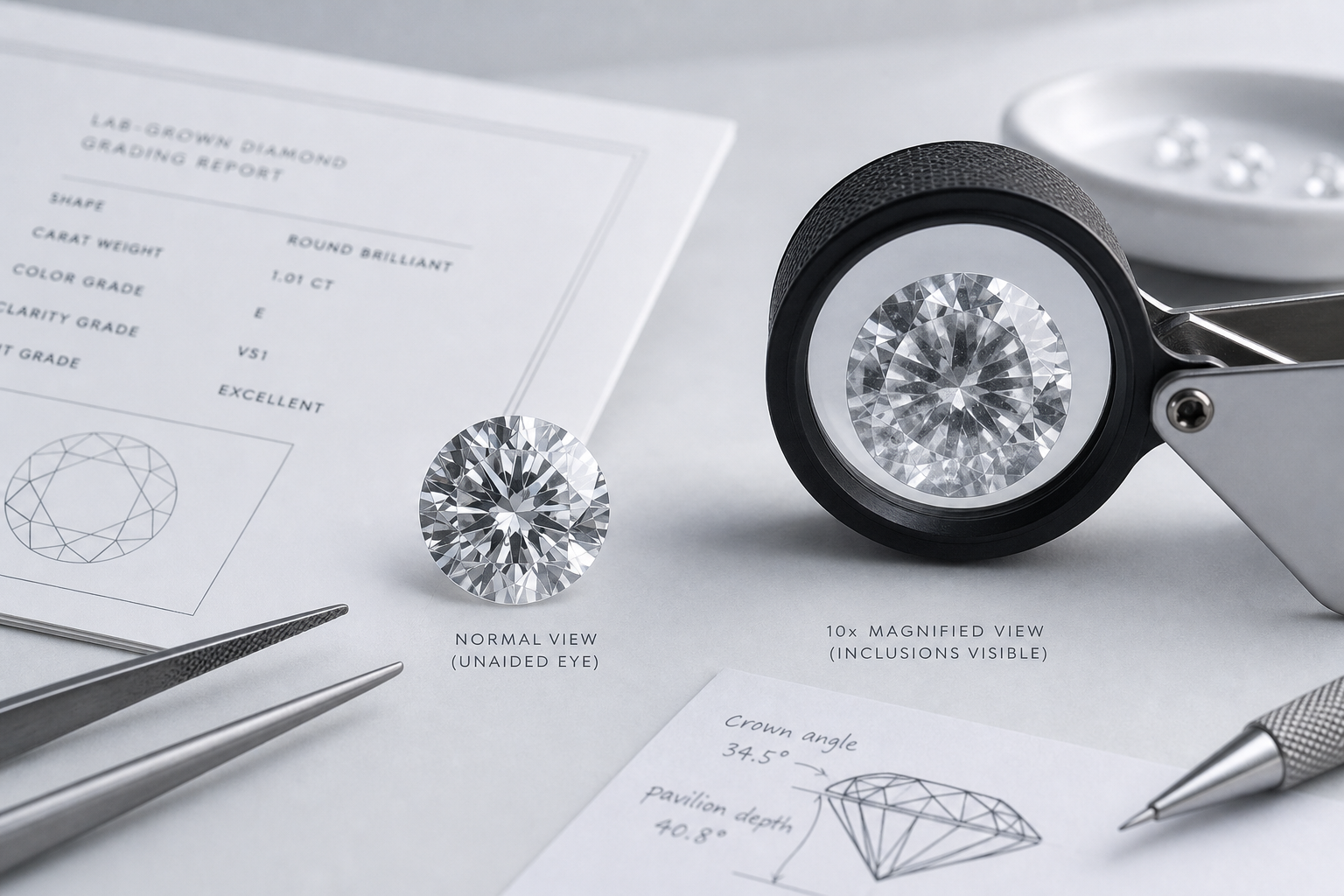
Clarity grades describe what a trained grader can identify under controlled conditions, usually with 10x magnification. Eye-clean is a buyer-facing standard. It asks a different question: can you see the inclusion without a loupe, in real life?
A diamond can be eye-clean even if the certificate lists crystals, pinpoints, feathers, or other internal features. That does not automatically make it a poor choice. In fact, many VS2 diamonds and some SI1 diamonds can look clean to the naked eye if the inclusions are small, light-colored, scattered, or positioned away from the center of the stone.
The mistake is treating the clarity grade as a status label instead of a visibility clue. VVS may be worth considering for certain buyers, especially for larger stones, step cuts, or personal preference. But if the only difference is visible under magnification, paying more for VVS can mean spending money on a feature you will rarely, if ever, see.
How the Naked Eye Sees Inclusions in Normal Wear
The naked eye does not inspect a diamond the way a grading lab does. In daily wear, a diamond is moving, reflecting light, picking up shadows, and being viewed from changing angles. Brightness, sparkle, and contrast often mask small inclusions that look obvious in a magnified image.
What tends to matter most is not whether an inclusion exists, but whether it is dark, centered, large enough to notice, or easy to find through the table of the diamond. A tiny white pinpoint near the edge is usually far less concerning than a dark crystal under the center of the table. The first may disappear in normal wear; the second may become the thing your eye keeps finding.
Viewing distance also changes the judgment. A diamond that shows a small mark in a highly zoomed online video may still be eye-clean from 8 to 12 inches away, which is much closer to how people actually see an engagement ring on the hand. Extreme magnification is useful for locating inclusions, but it can make normal features look more dramatic than they are.
What This Guide Will Help You Decide, and What It Will Not
This guide is designed to help you decide how much clarity you actually need. The main question is whether a diamond’s inclusions will affect what you can see, not whether the report has the highest possible clarity grade.
It will help you compare common clarity ranges such as VS1, VS2, SI1, and VVS with a practical buying lens. It will also explain why inclusion type, location, diamond size, and shape can matter more than the clarity label alone. A safe-looking grade can still deserve review if the inclusion is dark and central. A lower grade can still be a smart buy if the stone is visually clean and the inclusion is well hidden.
This is not a full 4Cs guide, a pricing guide, or a certification deep dive. Cut, color, carat weight, and grading lab still matter, but clarity has its own buying trap: many shoppers pay for technical cleanliness after they have already reached naked-eye cleanliness.
What the Buyer Should Confirm First
Before comparing clarity grades, decide which standard you are buying for: clean at normal viewing distance or clean under magnification. Those are not the same goal.
If you want the diamond to look clean in everyday wear, prioritize eye-clean verification through images, video, and seller confirmation. If you personally care about knowing the stone looks exceptionally clean under a loupe, then a higher clarity grade may have value even if no one else can see the difference. The wrong move is paying for magnified perfection while assuming it will automatically make the diamond look brighter, larger, or more beautiful.
Evidence-Based Clarity Review: Use Three Layers, Not One Claim
A more defensible clarity decision uses three separate layers of evidence: the grading report, the seller’s visual media, and the buyer’s intended use. The report identifies the clarity grade and listed characteristics. The visual media helps show whether those characteristics appear distracting in the actual stone. The intended use explains how much the inclusion matters once the diamond is set, worn, and viewed in real life.
This layered approach keeps the buyer from relying too heavily on a single statement such as “VS2 is safe” or “SI1 is risky.” Those shortcuts can be useful starting points, but they are not proof that a specific diamond is eye-clean. A more reliable review asks whether the listed inclusion is visible in the face-up image, whether it remains visible in video, and whether the setting will expose or minimize the area where the inclusion sits.
It also prevents evidence from being stretched too far. A grading report can support what was documented during grading, but it should not be treated as proof that the diamond will look perfect to every buyer. A video can show real visual behavior, but it can still be influenced by lighting, magnification, and camera angle. A seller’s eye-clean confirmation is helpful, but it should match the images and the buyer’s viewing standard.
Why the Clarity Grade on the Report Is Only the Starting Point
A clarity grade is useful because it narrows the field. It tells you the diamond was evaluated and assigned a position on a recognized clarity scale. But the grade is not the same as a real-world visibility test, and it should not be treated as the final answer.
Two lab-grown diamonds can both be graded VS2 and still look different in person. One may have small, pale inclusions near the edge. The other may have a darker inclusion closer to the center. On paper, they share a grade. On the hand, one may be easier to approve than the other.
At NUVU, we treat the grading report as a starting point for comparison, not a substitute for visual review. The report helps identify what needs attention, but photos, video, and setting context help determine whether the inclusion will matter to the buyer.
A grading report also should not be read as a promise of beauty, brilliance, or value. It documents selected characteristics of the diamond, including clarity, but it does not fully capture how the stone performs visually in motion or how it will look in a specific ring design. A careful buyer uses the report to reduce uncertainty, then checks whether the actual stone supports the report-based expectation.
A certificate-aware review is strongest when the report number, measurements, clarity characteristics, and visual evidence all support the same conclusion. If any part of that chain feels inconsistent, the next step is not to assume the grade is wrong; it is to ask for clearer images, a slower video, or a more specific explanation of where the grade-setting feature appears.
A grading report helps document key characteristics, but it should not be treated as a guarantee of beauty, value, or sourcing ethics. It is also not a substitute for checking whether the stone is clearly described as laboratory-grown, whether the report details match the seller’s media, and whether the diamond fits the intended jewelry design.
When a grading report is available, buyers should verify the report details through the issuing laboratory’s official report-check tool where available and compare those details with the stone’s actual photos or video.
What the Grading Report Actually Records
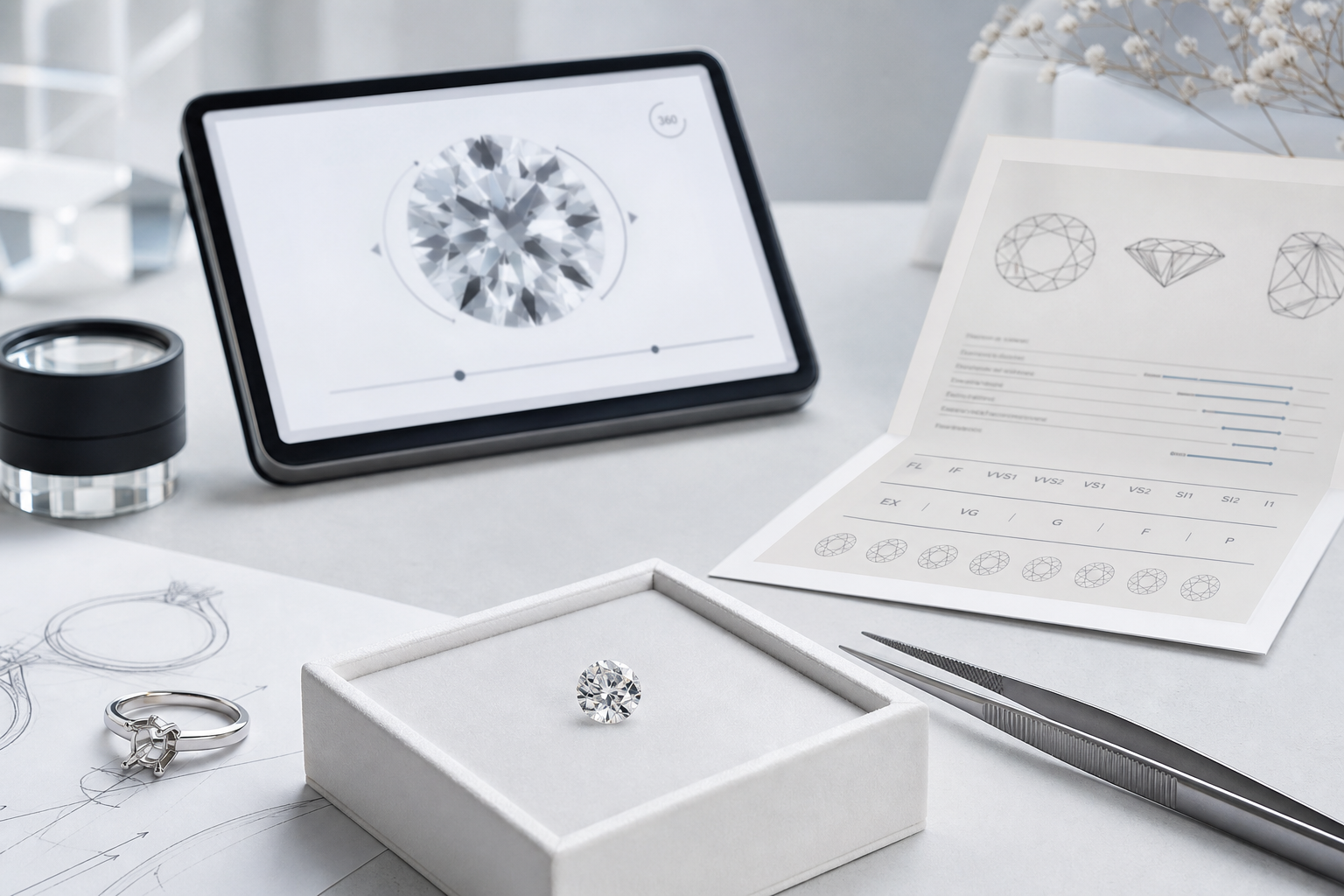
A grading report records the diamond’s clarity grade based on internal and external characteristics seen during professional evaluation. These characteristics may include crystals, clouds, feathers, needles, pinpoints, or surface features. Depending on the report format, it may also include a plotted diagram showing where some inclusions are located.
The key limitation is that clarity grading is based on trained inspection, not casual viewing. A grader is looking for characteristics under controlled conditions, often at 10x magnification. That is a stricter environment than a person looking at a ring during daily wear.
This is why a certificate can show inclusions that never become a practical problem. The report is doing its job by documenting them. Your job as a buyer is to decide whether those inclusions are visible, distracting, or relevant to durability in the diamond you are actually considering.
Why Two Stones With the Same Grade Can Look Different
Clarity grades group diamonds into broad categories. They do not guarantee identical visual behavior. Within the same grade, inclusion type, size, color, number, and placement can vary enough to change how the diamond appears.
For example, a VS2 diamond with a few small white inclusions near the girdle may look cleaner than another VS2 diamond with a darker mark under the table. An SI1 diamond with a well-placed inclusion may look better to the naked eye than a higher-graded stone with a more noticeable central feature. This is why asking “Is VS2 eye-clean?” is useful, but incomplete. The better question is whether this specific VS2 diamond is eye-clean.
Shape and size also change the answer. A clarity feature that is hard to spot in a 1.00 carat round brilliant may become easier to see in a larger oval or an emerald cut. The grade gives you a range of expectation, but the actual diamond still needs to be judged on its own.
What the Report Does Not Tell You About Naked-Eye Visibility
A grading report usually does not tell you whether the diamond appears eye-clean at normal viewing distance. It also does not show how the inclusion behaves as the stone moves, how visible it is through the crown, or whether it becomes noticeable once the diamond is set in a ring.
Magnified plots can also be misleading in both directions. They may make a minor feature look alarming because it is isolated on a diagram, or they may fail to communicate how noticeable a dark inclusion is in the actual stone. A plot tells you where to look. It does not always tell you how strongly your eye will notice it.
The most reliable buying approach is to use the report to identify risk points, then use visual evidence to judge whether those risk points matter. If the seller cannot provide clear images or video for a diamond with a borderline clarity grade, the buyer is taking on more uncertainty than necessary.
How to Read Report Comments Without Overstating Them
Report comments can be important, but they should be read carefully. A comment may point to additional characteristics, features not shown on a plot, or a condition that deserves visual review. It does not automatically mean the diamond is unattractive, and it does not automatically mean the diamond is safe. The comment is a prompt to ask better questions.
For clarity buying, the most useful question is whether the comment changes what the eye sees. If a report mentions clouds, additional pinpoints, graining, or other characteristics, ask whether the diamond still looks crisp and transparent in face-up media. If a report lists a feather, ask where it sits and whether it is near an exposed edge or corner. If the report shows no plotted diagram, ask the seller to identify the grade-setting feature in the actual image or video.
This is especially helpful when comparing stones with similar grades. A VS2 with a simple, easy-to-understand inclusion near the edge may be easier to approve than another VS2 with vague comments and limited visuals. The goal is not to reject every diamond with a comment, but to make sure the report language, visual evidence, and seller explanation all tell the same story.
Certificate and Visual Review Check
Before shortlisting a stone, confirm the report number, the clarity grade, and any plotted inclusions or comments related to clarity. Then ask for face-up images or video that show the diamond as it would be viewed in real life, not only at extreme zoom.
A report without visual confirmation is only part of the picture. It may tell you the diamond is VS1, VS2, or SI1, but it cannot fully answer whether the inclusion is visible to your eye, in that stone, at that size, in the setting you plan to wear.
When the report is issued by a laboratory with an online verification tool, checking the report details can help confirm that the document information matches the stone being considered. That step does not prove the diamond will be eye-clean, but it does make the comparison more disciplined because the buyer is working from the correct report details before judging the visuals.
Which Inclusion Types Are Most Likely to Affect What You See
Inclusion type matters because not all clarity characteristics behave the same way. Some are easy to ignore because they are small, pale, or scattered. Others deserve closer review because they may appear darker, create a hazy look, or sit in a place where the eye naturally lands.
The grade tells you severity in a broad sense, but the inclusion type helps explain the risk. A buyer comparing two SI1 diamonds should not only ask which one has the better price. The better question is whether the inclusions are the kind that disappear in normal wear or the kind that can affect the diamond’s face-up appearance.
With lab-grown diamonds, it is also worth avoiding assumptions based only on how the diamond was produced. HPHT and CVD growth processes can produce beautiful stones, and both can also produce stones that need closer review for clarity, transparency, or visual character. The useful buying question is not whether the stone belongs to a broad production category, but whether its specific report, images, and video show a clean-looking diamond for the intended use.
If sustainability or production-related claims are part of the shopping conversation, those claims should be specific and documented rather than broad. For clarity buying, the immediate evidence still comes from the report, the visuals, and the seller’s explanation of the individual stone.
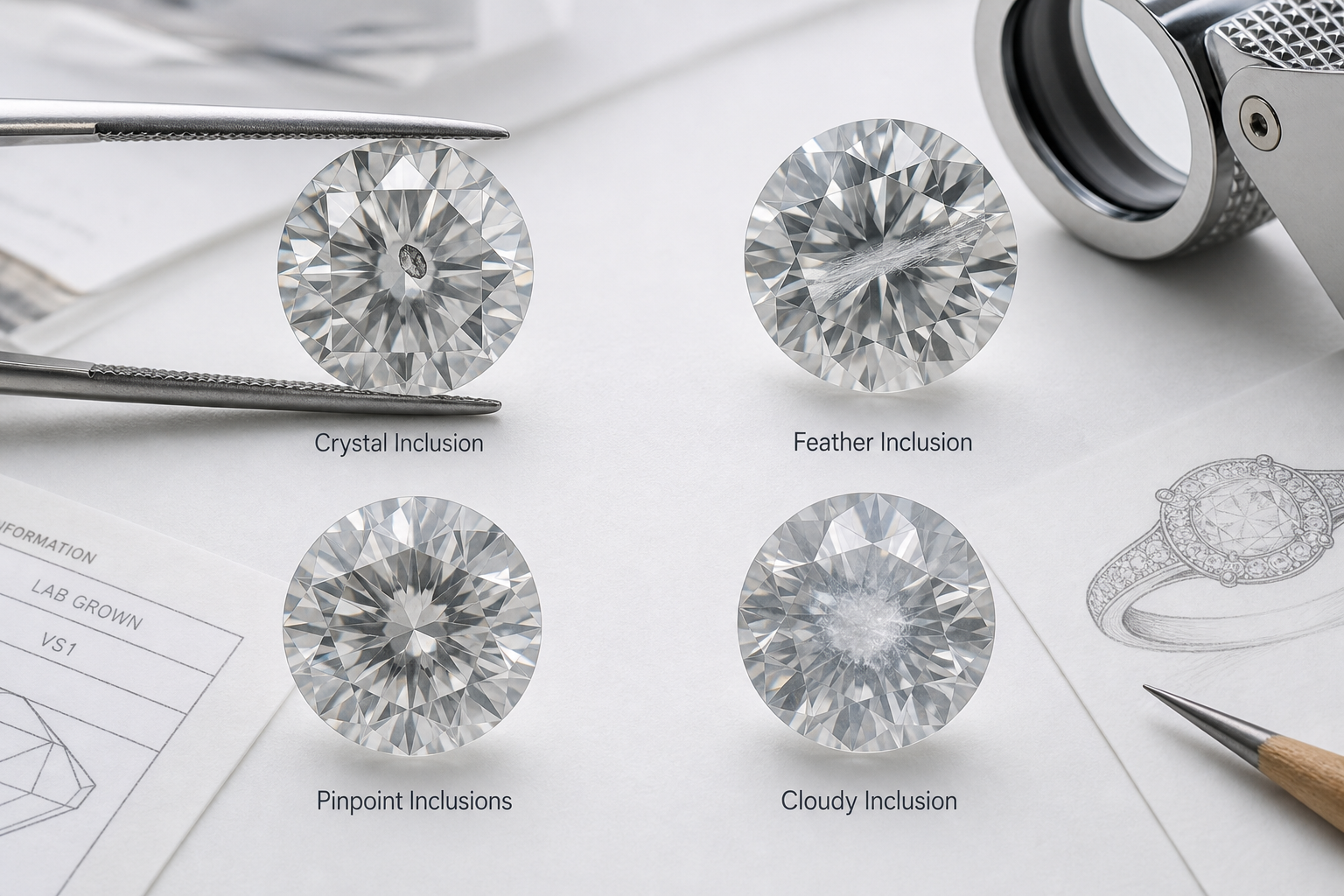
Crystal and Pinpoint Patterns: Small but Sometimes Noticeable
Crystals are small mineral inclusions inside the diamond. Pinpoints are tiny dot-like inclusions that may appear alone or in groups, and a lab grown diamond color guide can help separate body color perception from clarity observations during review. In many cases, these features are not a problem, especially when they are light-colored, small, and away from the center.
The caution is color and concentration. A small white crystal near the edge may be harmless from a visibility standpoint. A dark crystal under the table can be much more noticeable, even if the overall clarity grade sounds acceptable. Clusters of pinpoints can also become more relevant if they create a patchy or busy look in one area of the stone.
For most buyers, a scattered pattern of tiny inclusions is easier to live with than one obvious dark mark. The eye often ignores small, low-contrast details, but it tends to lock onto a single high-contrast spot near the center.
Feathers and Surface-Reaching Features: Appearance Versus Durability
A feather is a small internal fracture-like feature. Many feathers are minor and have no visible effect in normal wear. The concern increases when a feather is large, reaches the surface, sits near the girdle, or is positioned in an area that may be more exposed during setting or daily use.
From an appearance standpoint, a feather may look white, reflective, or barely visible depending on its angle and location. From a durability standpoint, the question is not simply whether the word “feather” appears on the report. It is whether that specific feature is significant enough to create a practical concern.
This is where buyers should avoid overreacting and underreacting. Not every feather is a problem, but dismissing all feathers as harmless is too casual. If the feature is near an edge, ask whether it is surface-reaching and whether the setting style leaves that area exposed or protected.
Clouds, Haze, and Diffused Areas: When Clarity Can Affect Overall Look
Clouds are groupings of tiny inclusions. A small cloud may not matter at all. A more extensive cloud, especially if mentioned as the grade-setting feature, can be more important because it may affect the diamond’s overall transparency rather than appearing as one distinct mark.
This is one of the less obvious clarity issues for buyers. A dark crystal is easy to understand because you can look for a spot. Haze or diffused cloudiness is different. The stone may not show one obvious inclusion, but it may look slightly less crisp or less lively than another diamond with the same grade.
If a report includes comments suggesting clouds are not shown or if clouds are a major reason for the grade, visual review becomes more important. The buyer should compare the stone against another diamond of similar size and cut quality to see whether it looks clean, bright, and transparent rather than merely acceptable on paper.
Visibility Check by Inclusion Type
When reviewing inclusions, ask three practical questions: where is the inclusion, is it dark or light, and can it be seen without magnification in the actual diamond size you plan to buy?
A light inclusion near the edge is usually less concerning than a dark inclusion under the table. A small isolated feature is usually easier to accept than a broad hazy area that affects transparency. If a seller describes a diamond as eye-clean, the claim should match the visual evidence, not just the clarity grade printed on the report.
When to Ask for a Second Review Before Rejecting or Accepting a Stone
Some clarity decisions are straightforward: a central dark mark is visible, or the diamond looks clean from every practical angle. Other cases sit in the middle. If the diamond is larger, the inclusion sits near the girdle, the report comment is hard to interpret, or the setting will place pressure near a clarity feature, it is reasonable to ask for an additional review before making a final decision.
A second review does not need to turn the purchase into a technical examination. It can be as simple as asking the seller to point out the inclusion in the actual media, confirm whether it is visible face-up without magnification, and explain whether the setting will cover, expose, or place stress near the feature. This creates a clearer record of what was evaluated and avoids relying on a broad statement like “the grade is fine.”
This is also useful when a diamond appears unusually attractive for its clarity grade. A strong SI1 or VS2 may be a real value, but the buyer should understand why the grade is lower and why the inclusion is not visually problematic. If the explanation is clear and the media supports it, the lower clarity grade may be easier to buy with confidence.
Why Inclusion Location, Size, and Stone Size Matter So Much
A clarity grade tells you the general level of inclusions, but it does not tell you whether the most noticeable mark is sitting in the worst possible place. In real buying decisions, inclusion location often matters more than the label on the report. A small dark crystal under the table can be easier to see than a larger pale inclusion near the girdle, even if both stones carry the same clarity grade.
This is where many buyers over-rely on the certificate. The report may list the same grade for two diamonds, but one has a visible center inclusion and the other has a minor edge feature that will be hidden by a prong. Those are not equal buying situations. If you are choosing a center stone for an engagement ring, the question is not only “What clarity grade is this?” It is “Where is the inclusion, how large is the diamond, and will the eye actually find it?”
Center Inclusions Versus Edge Inclusions
Center inclusions usually deserve the strictest review because the eye naturally goes to the middle of the stone. A dark mark near the center of the face-up view can become the one thing you notice every time you look at the ring, especially in a simple solitaire setting with no surrounding detail to distract from it.
Edge inclusions are often less concerning, but only when they are small, light in color, and positioned where the setting can visually minimize them. A tiny mark near the girdle may be a perfectly reasonable tradeoff if it helps you stay within budget without affecting the diamond’s face-up appearance. The mistake is assuming every edge inclusion is harmless. If the inclusion reaches the surface, sits near a vulnerable corner, or remains visible from the side, it still deserves a closer look.
As a practical rule, a small white inclusion near the edge is usually easier to accept than a black or reflective inclusion near the center. The grade matters, but the viewing experience matters more.
Why the Table and Face-Up Area Matter Most
The table is the large top facet of the diamond, and it has an outsized effect on clarity visibility. Inclusions under or near the table are more exposed because they sit in the part of the stone you see most directly. A mark that might be ignored near the outer edge can feel much more obvious when it appears under the main viewing window.
The face-up area matters because that is how the diamond will be seen in normal wear. Buyers sometimes get distracted by magnified side views or plotted diagrams, but the most important question is whether the inclusion can be seen when the diamond is viewed from above at a normal distance. If a mark only appears when the stone is tilted under strong magnification, it may not affect daily appearance. If it shows clearly in a standard face-up image, it should influence the decision.
This is especially important for engagement rings. A center stone is not examined like a loose diamond under a microscope in daily life. It is seen on the hand, from above, in motion, and in mixed lighting. A clarity issue that interrupts that face-up view matters more than one that exists only on a plot.
How Carat Size Changes What the Eye Can Pick Up
Stone size changes clarity visibility because the viewing area gets larger. The same type of inclusion that disappears in a 1.0 carat diamond may become easier to notice in a 1.5 carat or 2.0 carat diamond. This does not mean larger diamonds always need very high clarity grades, but it does mean the margin for obvious inclusions gets smaller as carat weight increases.
For example, a small dark crystal in a 1.0 carat round brilliant may be hard to find without magnification because the stone is smaller and the facet pattern breaks up the view. In a 1.5 carat stone, that same mark may become easier to locate once you know where to look. In a 2.0 carat diamond, especially if the inclusion sits under the table, it may become noticeable enough to affect whether the stone feels eye-clean.
The better way to think about this is scale, not grade alone. A VS2 diamond at 1.0 carat may be a very safe choice in many shapes. A VS2 diamond at 2.0 carats can still be excellent, but it needs stronger visual confirmation. A lower clarity stone may also work beautifully if the inclusion is pale, off-center, and not easy to locate in motion. The risk rises when a larger stone combines size, central placement, and contrast all at once.
Actual measurements also matter. Two diamonds with the same carat weight may not face up the same size. A diamond with a larger spread gives the eye more surface area to scan, which can make visible inclusions easier to catch. That is why the millimeter measurements are more useful than carat weight by itself when judging clarity visibility.
Buyer Verification Checklist
Before choosing based on clarity grade alone, ask for the visual evidence that matches how the diamond will be worn. A zoomed-in clarity plot can help you locate inclusions, but it cannot tell you whether they will bother you in real life.
- Ask for a clear face-up image, not only a magnified plot.
- Review side-angle images if the inclusion sits near the girdle or appears close to the surface.
- Confirm the actual measurements in millimeters, not just the carat weight.
- Look for dark inclusions under the table first; these are usually more important than small pale marks near the edge.
- For larger stones, especially around 1.5 carats and above, treat visual review as more important than assuming the grade is safe.
If the seller can show that the inclusion is not visible in a normal face-up view, a lower clarity grade may still be a smart value choice. If the only evidence is a certificate and a heavily magnified diagram, the clarity decision is still incomplete.
When VS1, VS2, SI1, and VVS Offer the Best Value
The best clarity for value is not always the highest clarity you can afford. It is the grade that gives you a clean-looking diamond without spending money on differences you will never see. For many lab-grown diamond buyers, the practical comparison is not “flawless versus included.” It is whether a VS1, VS2, or well-chosen SI1 looks the same to the naked eye as a more expensive VVS stone.
Clarity should be treated as a threshold decision. Once a diamond is eye-clean in the shape, size, and setting you want, paying for a higher grade may not improve the appearance of the finished ring. It may make the report look stronger, but that is not the same as making the diamond look better on the hand.
Price differences between clarity grades can reflect more than the grade alone, including shape, size, cut quality, color, availability, and seller presentation. That is why comparing two stones only by clarity can be misleading. A lower-clarity diamond is not automatically better value, and a higher-clarity diamond is not automatically wasteful; the value depends on whether the added cost changes the visible result or reduces a risk that matters to the buyer.
Prices can change with market conditions, report type, seller channel, and stone-specific details, so exact comparisons should be verified at the time of purchase. If two diamonds appear similar on paper, compare like-for-like specifications, visual evidence, documentation, and setting suitability before treating one option as the stronger value.
When VVS Makes Sense and When It Usually Does Not
A VVS diamond has inclusions that are very difficult to see under 10x magnification. For buyers who want a cleaner report, are choosing a large stone, or prefer a stricter clarity standard for personal reasons, VVS can be a reasonable choice. It can also make sense in shapes that reveal inclusions easily, especially if the buyer wants to reduce uncertainty.
Where VVS often becomes unnecessary is in typical engagement ring buying, where the goal is a bright, eye-clean stone. If a VS1 or VS2 diamond looks identical without magnification, the extra money spent on VVS may be better used toward cut quality, size, setting design, or a better overall stone match. This is one of the most common clarity overpayments: buying microscopic cleanliness when the real goal is visible beauty.
VVS is not a mistake by itself. It becomes poor value when the buyer assumes it will automatically look more brilliant, more premium, or meaningfully different in daily wear. Clarity does not create sparkle the way cut quality does, and a higher clarity grade cannot rescue a diamond with weak proportions or dull light performance.
Why VS1 and VS2 Are Often the Practical Starting Point
VS1 and VS2 are often the most practical clarity ranges to start with because they usually offer a strong balance between visual cleanliness and cost control. A VS1 diamond is typically a safer choice for buyers who want minimal risk without jumping to VVS. A VS2 diamond often offers even better value, provided the inclusion is not dark, centered, or easy to see in the face-up view.
For many round brilliant, oval, cushion, and radiant lab-grown diamonds, VS2 can be enough for an engagement ring if the stone is confirmed eye-clean. The important word is confirmed. A VS2 with a small feather near the edge may be an excellent buy. A VS2 with a black crystal under the table in a larger stone may be less appealing than the grade suggests.
VS1 is often worth considering when the stone is larger, the shape is less forgiving, or the buyer does not want to spend time sorting through borderline options. VS2 is usually where value shoppers should look carefully, not blindly. The best VS2 diamonds can look just as clean as higher grades in normal wear, but the weakest ones may reveal why they were graded there.
When SI1 Can Still Be Eye-Clean
An SI1 diamond can still be eye-clean, but it needs more scrutiny than VS clarity. This is where inclusion type, location, and stone size become decisive. A well-placed SI1 inclusion near the edge of a brilliant-cut stone may be hard to see without magnification. A dark SI1 inclusion under the table of a 2 carat diamond is a very different case.
SI1 can be a smart choice for buyers who are comfortable evaluating images and video rather than relying on the report alone. It is most attractive when the savings are meaningful and the visual evidence is strong. If the price difference between SI1 and VS2 is small, the safer VS2 option may be the better use of budget. If the SI1 stone is clearly eye-clean and allows you to choose a better size, shape, or setting, it can be a practical value decision.
The risk with SI1 is not that the grade is automatically bad. The risk is inconsistency. Some SI1 diamonds are visually clean in normal wear, while others show inclusions quickly once you know where to look. This is why SI1 should never be bought from the grade alone.
When to Be More Cautious With SI2 or Lower
SI2 or lower clarity can be tempting when the price looks attractive, but the tradeoff becomes harder to control. Visible inclusions are more likely, and the buyer has less room for error, especially in larger stones or shapes with open facet patterns. A lower clarity grade may still work for certain jewelry uses, smaller stones, or designs where the diamond is not the main visual focus, but it is a more difficult choice for a prominent engagement ring center stone.
The biggest mistake is treating a low clarity grade as a bargain before confirming visibility. A cheaper diamond is not better value if the first thing you see is the inclusion. In many cases, moving from SI2 to a carefully chosen SI1 or VS2 is a better decision than stretching for extra carat weight with a mark that will bother you every day.
Be especially cautious when the inclusion is dark, central, surface-reaching, or paired with haze that affects the overall look of the stone. At that point, the issue may no longer be a small clarity compromise; it may change how clean, bright, or durable the diamond feels in the finished piece.
What to Confirm on the Report
The report should support the visual review, not replace it. Before accepting a clarity recommendation, check whether the grade matches what you can see in the actual diamond images and video.
- Confirm the clarity grade and the listed inclusion types.
- Check whether inclusions are plotted near the center, table, girdle, or corners.
- Look for comments that may suggest clouds, additional pinpoints, or features not fully plotted.
- Compare the report with face-up visual evidence before deciding whether the grade is a good value.
- Be cautious if a seller recommends a lower clarity grade but cannot clearly show that the stone is eye-clean.
A strong value choice is not the lowest grade that fits the budget. It is the lowest clarity grade that still looks clean in the diamond you are actually buying.
How Diamond Shape Changes Clarity Expectations
Diamond shape changes clarity expectations because each cut handles light and visibility differently. Some shapes break up reflections and make small inclusions harder to locate. Others have broad, open facets that act almost like windows into the stone. This means the same clarity grade can be a safe choice in one shape and a risky one in another.
The key is not to memorize a different rule for every shape. The better approach is to understand which shapes are forgiving, which require stricter review, and which sit in the middle. A VS2 round brilliant and a VS2 emerald cut may carry the same clarity grade, but they should not be evaluated with the same level of comfort.
Round Brilliant: Often the Most Forgiving for Clarity
Round brilliant diamonds are usually the most forgiving for clarity because their facet pattern creates strong contrast, sparkle, and movement. Small inclusions are often harder to isolate because the eye is seeing flashes of light rather than large open areas. This does not make every round brilliant automatically eye-clean, but it gives buyers more flexibility.
For many round lab-grown diamonds, VS2 is a practical starting point, and SI1 can sometimes work if the inclusion is small, light, and away from the center. VVS is usually not necessary for a clean-looking round unless the buyer wants the report quality for personal reasons or is choosing a very large stone where scrutiny increases.
The main caution is dark inclusions under the table. Even in a forgiving shape, a black crystal in a central position can become noticeable. Round brilliants can hide more than many shapes, but they cannot hide everything.
Oval, Pear, Cushion, and Radiant: Why Visibility Depends on the Stone
Oval, pear, cushion, and radiant cuts sit in a more variable category. They can hide inclusions well, especially when they have lively facet patterns, but they are not as predictably forgiving as round brilliants, so lab grown diamond 4Cs considerations matter because their elongated outlines, larger face-up spread, and uneven facet behavior can make some inclusions easier to spot.
Ovals and pears often need special attention around the center and tips. A dark inclusion near the middle can be noticeable because these shapes draw the eye along their length. In pears, inclusions near the point may also matter if they sit close to a vulnerable area or remain visible after setting. Cushions vary widely; some have crushed-ice-style faceting that hides small marks well, while others have broader facets that reveal more.
Radiant cuts can be forgiving because their facet pattern is busy, but large stones still need careful review. A 2 carat radiant with an obvious dark inclusion under the table is not protected simply because the shape has sparkle. Shape helps, but it does not override contrast, placement, and size.
Emerald and Other Step Cuts: Why Buyers Usually Need Stricter Review
Emerald cuts, Asscher cuts, and other step cuts usually need stricter clarity review because their long, open facets reveal more of the diamond’s interior. Instead of breaking light into many small flashes, these shapes create broad reflections and a clear, glassy look. That elegance is exactly why buyers love them, but it also makes inclusions harder to hide.
For an emerald cut, VS2 may still be eye-clean, but it should be inspected more carefully than a VS2 round. VS1 is often a more comfortable starting point, especially in larger stones. SI1 can work in some cases, but it becomes a stone-by-stone decision rather than a category recommendation.
The common mistake with step cuts is buying the same clarity grade you would choose for a round brilliant and expecting the same visual safety. If the design goal is a crisp, clean emerald-cut engagement ring, clarity visibility deserves more weight. A visible inclusion in a step cut can interrupt the entire look because there is less sparkle to distract from it.
Stone-to-Setting Fit Check
Shape should be evaluated with the setting plan, not as a loose-stone decision only. Prongs, bezels, halos, and side stones can all change how the eye reads the center diamond. A small edge inclusion may be hidden by a prong, while a central inclusion will remain visible regardless of the setting.
For custom design, the diamond cannot be judged separately from the mounting. Prong placement, basket height, bezel coverage, side-stone layout, and the wearer’s lifestyle can all change whether an edge feature is protected, exposed, or visually distracting. At NUVU, this kind of comparison is treated as a fit question as much as a clarity question: the stone needs to make sense visually and physically in the finished design, not only as a loose diamond on a report.
For custom design, trust comes from matching the stone to the setting, budget, and wearer’s daily use, not from choosing grades in isolation. Measurements, prong placement, side profile, and the location of any inclusion should be reviewed together before the stone is finalized for a specific ring.
For custom jewelry, stone measurements and setting compatibility should be confirmed before finalizing a purchase. This includes checking the diamond’s length, width, depth, girdle area, corner shape, and any inclusion location that could affect prong placement or visible side profile.
- For round brilliants, confirm that any visible inclusion is not dark and central.
- For ovals and pears, review the center area and tips carefully, especially in larger stones.
- For cushions and radiants, judge the actual video rather than assuming the facet pattern will hide everything.
- For emerald and Asscher cuts, consider starting at VS1 or carefully verified VS2 if the goal is a clean, open look.
- Before finalizing the stone, ask how the prongs or setting style will interact with any edge or corner inclusion.
A diamond shape that hides inclusions well in a loose view may still need closer review once the stone is placed into a real ring design. The best clarity choice is the one that fits the shape, the size, and the setting together.
How to Judge Eye-Cleanliness from Photos, Video, and the Grading Report
Buying online does not mean guessing. A grading report, diamond photos, and 360 video each answer a different part of the eye-clean question. The report tells you what the grader identified under magnification. Photos help you pause the stone and inspect fixed areas. Video shows whether an inclusion catches attention as the diamond moves.
The mistake is treating any one of these as the whole answer. A clean-looking video can miss an inclusion hidden by lighting or motion. A magnified photo can make a tiny mark look worse than it will ever appear in daily wear. A grading report can list inclusions without telling you whether your eye will notice them at arm’s length. Eye-clean verification works best when all three pieces point in the same direction.
What to Look for in 360 Video
A good 360 video diamond review should show the stone rotating slowly enough for you to track the table, center area, and outer edges. Start by watching the diamond face-up, not tilted at an extreme angle. If a mark keeps appearing in the same spot as the diamond turns, especially near the center or under the table, it deserves closer attention.
Do not judge the stone only from the most zoomed-in view. Online videos are often magnified far beyond real-life viewing distance, which can make a VS2 or SI1 diamond look more concerning than it is. Use the zoom to locate inclusions, then mentally scale back: would that mark still stand out at normal ring-viewing distance, around 10 to 18 inches from the eye? If the answer is no, the inclusion may not matter in practice.
Motion is especially useful for spotting dark crystals, reflective feathers, and areas that interrupt sparkle. A small pale inclusion may disappear in movement, while a dark dot near the center can keep pulling the eye. For an engagement ring center stone, persistent visibility during movement matters more than whether the inclusion looks dramatic in one frozen frame.
What Still Photos Can Show Better Than Video
Still diamond photos are useful because they let you slow the decision down. A video may move past a problem area too quickly, but a sharp face-up image lets you check whether an inclusion sits in the visual center of the stone. This is where you compare the photo with the grading report: if the report plots a crystal under the table, the photo helps you decide whether it is actually visible without magnification.
Photos can also show contrast more clearly than video. Dark inclusions against a bright background are often easier to notice in still images, and surface-reaching features may be easier to inspect from side-angle photos. If the seller only provides a beauty-style image with flattering lighting, ask for a more direct visual review. Attractive photography is not the same as clarity evidence.
The best image set includes a face-up photo, a side or angled view, and a magnified view. The magnified view is not there to scare you away from every mark; it is there to help you identify what you are seeing. The practical question remains whether the same feature is noticeable in the face-up image at a realistic scale.
What Questions to Ask the Seller Before You Commit
Before buying, ask direct questions that force a visual answer rather than a grade-based answer. “Is this diamond eye-clean?” is helpful, but it is too broad by itself. A better question is: “Is this stone eye-clean face-up at normal viewing distance, without magnification?” That wording matters because a diamond can look clean from the top but reveal inclusions from the side, or look clean at a distance but not under close inspection.
If you are considering an SI1 or lower clarity grade, ask whether any inclusion is visible without magnification and where it appears in the stone. If you are considering VS2, ask whether the grade-setting inclusion is dark, central, or visible in video. If you are considering VVS, ask whether the higher clarity grade creates any visible benefit compared with a similar VS1 or VS2 option. Paying more only makes sense if the added clarity supports the look, the size goal, or the buyer’s personal comfort with microscopic features.
For a custom or engagement ring purchase, also ask how the planned setting affects the review. A prong may help cover a small edge inclusion, but it will not hide a mark under the table. A bezel or halo can change how much of the side profile is visible. The stone should be reviewed as it will be worn, not only as a loose diamond under studio lighting.
It is also reasonable to ask what documentation is available before purchase, including the grading report details, the exact media connected to that stone, and any written clarification about the viewing standard used for “eye-clean.” Buyers should also confirm the seller’s applicable return, resizing, and after-sales terms in writing before committing, because those are business policies rather than clarity characteristics.
Documentation to Save Before You Purchase
Before paying for a diamond, save the information that supports the clarity decision. This can include the grading report copy or report details, the seller’s face-up images, the 360 video link or screenshots, and any written confirmation about whether the diamond is eye-clean at normal viewing distance. These materials help keep the decision clear if you later compare the stone to another option or review it again before setting.
Written clarity notes are especially useful when the choice depends on a specific tradeoff. For example, if you choose an SI1 because the inclusion is pale and near the edge, save the explanation that led to that decision. If you choose a VS2 emerald cut because the video shows no distracting face-up mark, keep that visual evidence with the report. The point is not to create unnecessary paperwork; it is to make sure the purchase is supported by the same facts you used to approve it.
This habit also helps buyers avoid memory-based comparisons. After reviewing several diamonds, it is easy to forget which stone had the central crystal, which one had a cloud comment, and which one looked clean in motion. A short record of the report details, visible inclusion notes, and setting considerations makes the final decision more objective.
Certificate and Visual Review Check
Use the grading report first to confirm the report number, clarity grade, and plotted or listed inclusions. Then use seller images and video to check whether those inclusions are visible in the actual stone. If a seller describes a diamond as eye-clean, ask whether that claim applies face-up, at normal viewing distance, and without magnification.
For stronger visibility claims, written clarification is worth having before you commit. The goal is not to make the seller promise perfection; it is to make sure you and the seller are using the same standard. A diamond that is “clean under casual viewing” and a diamond that is “clean under close magnified inspection” are not the same purchase.
A Simple Decision Framework for Buying an Eye-Clean Diamond Without Overpaying
The simplest way to avoid overpaying for clarity is to make visibility the first filter, not the last. Start by asking whether the diamond looks clean in normal wear. Then check what kind of inclusion is present, where it sits, and whether the shape and carat size make it easier to see. Only after the visual question is answered should you compare the price difference between clarity grades.
This order matters. Many buyers compare a VS2, VS1, and VVS diamond by grade first, then try to justify the price difference afterward. That can lead to paying for clarity that exists only on the report. A better buying framework is to remove any stone with visible, distracting inclusions, then choose among the remaining eye-clean options based on cut quality, shape, size, and overall value.
If You Want the Safest Default
For many buyers, VS1 or VS2 is the safest starting point. These grades often provide enough clarity for an eye-clean engagement ring without pushing the budget into clarity levels that may not look different in real life. This is especially true for round brilliant, radiant, cushion, and many oval diamonds where facet pattern and sparkle can help mask small inclusions.
The safest default changes when the stone is large, the shape is less forgiving, or the inclusion sits near the center. A 1.00 carat round VS2 may be an easy yes if the inclusion is small and off to the side. A 2.50 carat emerald-cut VS2 needs stricter review because the larger face-up area and open step-cut pattern can make clarity features easier to notice. The grade is the starting point, but shape and size decide how safe that grade really is.
If You Want the Best Value
The best value is usually the lowest clarity grade that still looks eye-clean in the specific diamond you are buying. That often means VS2, and sometimes SI1, depending on the stone. SI1 can be a smart value choice when the inclusion is light, small, off-center, or hidden near the edge. It becomes a poor choice when the inclusion is dark, central, reflective, or easy to spot in normal viewing.
VVS can be worth choosing if you personally want a very clean report, are buying a step-cut shape, or are choosing a larger stone where tiny details become easier to inspect. But if two diamonds look the same face-up and the VVS option forces you to sacrifice size, cut quality, or design budget, the higher clarity grade may not improve the finished ring. For most buyers, cut and overall visual performance should outrank microscopic clarity once the diamond is already eye-clean.
If You Are Choosing Between Two Similar Stones
Imagine you are comparing a 2.00 carat VS2 oval and a 1.70 carat VVS2 oval at a similar price. If the VS2 has a small light inclusion near the edge and looks clean in face-up video, the larger VS2 may be the better choice because the visible result supports the size goal. If the VS2 has a dark crystal near the center that catches your eye every time the stone turns, the smaller VVS2 may be the stronger choice because the extra carat weight comes with a visible compromise.
The same logic applies when choosing between VS2 and SI1. A well-placed SI1 inclusion can be a better value than a higher-graded stone with no visible advantage. But an SI1 should not be chosen just because it is cheaper. Lower price only helps if the diamond still meets the visibility standard in the shape, size, and setting you plan to use.
When two stones both appear eye-clean, do not keep paying upward for clarity by default. Compare cut, proportions, face-up size, color compatibility with the setting metal, and overall appearance. Clarity should stop driving the decision once it no longer changes what you can see.
For buyers selecting multiple stones, such as matched side stones, earrings, or wholesale assortments, consistency can matter as much as a single clarity label. A group of diamonds may all be eye-clean individually but still look uneven if one has a darker visible feature, different transparency, or noticeably different face-up character. In those cases, documentation, matching images, and clear communication about acceptable inclusion visibility help prevent surprises after the stones are set together.
In sourcing or wholesale conversations, documentation, consistency, and communication often matter as much as the headline specification. The useful standard is not simply that every stone shares a clarity grade, but that the group meets the agreed visual expectations for matching, transparency, and acceptable inclusion visibility.
How to Keep the Final Decision Defensible
A defensible clarity choice is one you can explain without relying on a vague label. Instead of saying “I chose VS2 because VS2 is good,” the stronger explanation is: “I chose this VS2 because the inclusion is light, off-center, not visible face-up in video, and the setting will not make it more noticeable.” That kind of reasoning is more useful than the grade alone.
The same applies when choosing a higher clarity grade. VVS or VS1 can be a thoughtful choice when it solves a real concern, such as a larger stone, a step-cut shape, a very clean personal preference, or a buyer who does not want to evaluate borderline inclusions. It becomes less defensible when the only reason is fear of a lower label, even though the lower-graded stone looks equally clean and has stronger value elsewhere.
Before final approval, summarize the clarity decision in one sentence: the inclusion type, where it sits, whether it is visible without magnification, and how the setting affects it. If that sentence is clear and supported by the report and visuals, the diamond is easier to buy confidently. If the sentence depends on assumptions, missing images, or a seller’s unsupported reassurance, keep asking questions or choose a different stone.
Final Shortlist Check Before You Pay
Before purchase, narrow your shortlist to two or three diamonds and review them in the same order: grading report, inclusion type, inclusion location, face-up photos, 360 video, and setting plan. If one diamond has a cleaner report but no visible advantage, it should not automatically win. If another diamond has a lower grade but a visible mark you cannot unsee, it should not be treated as a bargain.
Ask for confirmation that the stone appears eye-clean at normal viewing distance in the real size you are buying. Make sure the review matches the intended setting, especially if the diamond has edge inclusions, a step-cut shape, or a larger carat weight. A good final choice is not the diamond with the most impressive clarity label; it is the one that looks clean where it matters and leaves more of the budget for features you can actually see.
When a grading report is provided, buyers should compare the report details with the issuing laboratory’s verification tools where available.
If a GIA report is provided, the report details can usually be checked through GIA’s official report verification system.
For buyers who want extra confidence before committing, the most useful next step is to align the report number, the diamond media, and the seller’s written clarity notes before payment. This is especially important when a value choice depends on a VS2 or SI1 diamond being eye-clean in a specific viewing condition. The reassurance should come from traceable documentation and a clear visual explanation, not from a generic promise that a grade is “safe.”
NUVU’s role in buyer education is to make comparison clearer, especially around grading reports, visual evidence, design fit, and documentation.
NUVU’s role in this kind of clarity decision is to help the buyer compare the report, visual media, and setting plan in a practical way. If a diamond has an inclusion near the edge, the review should explain whether the planned prong, bezel, or basket design will minimize or expose that area. If a diamond is recommended as eye-clean, the explanation should state the viewing standard being used, such as face-up appearance at normal viewing distance without magnification.
The strongest purchase decision is one where the buyer can keep the documentation and still understand the choice later: why this clarity grade was enough, where the inclusion sits, how the stone looks in motion, and how the setting supports the final appearance. That level of clarity in the process helps prevent overpaying while still protecting the buyer from avoidable surprises.
Disclosure: This article is for general educational purposes only. Diamond grading, pricing, availability, specifications, and seller policies can change, and readers should verify important details through grading reports, official laboratory tools, seller documentation, or qualified professionals before making a purchase decision. Laboratory-grown diamonds should be clearly distinguished from natural diamonds, and environmental or sourcing claims should be supported by specific documentation.