
Radiant lab-grown diamonds are often chosen by buyers who want noticeable sparkle without giving up a clean square or rectangular shape. The challenge, as with proportion tradeoffs discussed in a cushion lab-grown diamond guide, is that two radiants with the same carat weight can look very different once you compare their proportions, face-up size, light pattern, and setting fit. A grading report helps, but it does not fully show whether the stone looks bright, balanced, elongated, or visually heavy.
For the full framework, read Lab-Grown Diamond Shapes Guide.
This guide helps you judge a radiant cut by what you will actually see and wear: shape preference, length-to-width ratio, sparkle style, color and clarity priorities, and daily durability. It also compares radiant cuts with cushion, emerald, and princess shapes so you can decide whether radiant is the right balance of brilliance, structure, and practical design for your ring.
| Buying Question | What to Check | Why It Matters |
|---|---|---|
| Square or elongated? | Length-to-width ratio | Changes the ring’s style and perceived size |
| Does it sparkle well? | Video, photos, brightness in motion | Reports do not show light behavior fully |
| Is carat weight enough? | Measurements and face-up spread | Same carat can look smaller or larger |
| Will flaws be visible? | Eye-clean clarity, not just grade | Radiants can hide some inclusions better than step cuts |
| Which setting fits best? | Corner protection, prongs, band style | Good design improves durability and balance |
| Is radiant the right shape? | Compare cushion, emerald, princess | Each offers a different mix of sparkle and shape profile |
Quick Questions Before You Read
Q: Are radiant lab-grown diamonds very sparkly?
Yes, they are designed for strong brilliance, but the exact sparkle pattern varies by cut quality and facet style.
Q: Should I choose a square or rectangular radiant?
Choose square for a bold, centered look and elongated for a slimmer, often larger-looking appearance.
Q: Can I judge a radiant diamond from the grading report alone?
No. Use the report with measurements, photos, and video to understand real face-up appearance.
Q: Are radiant cuts practical for everyday rings?
Usually, yes. Their clipped corners help, but secure prongs and a suitable setting still matter.
Why Radiant Lab-Grown Diamonds Appeal to Buyers Who Want Sparkle With a Modern Outline
A radiant lab-grown diamond sits in a useful middle ground: it gives you the brightness many buyers want, but it keeps a more structured rectangular or square outline than a round stone. That combination is the reason this shape keeps showing up in engagement ring searches. It looks modern without feeling overly sharp, and it delivers strong brilliance without giving up the clean geometry that many shoppers want in a center stone.
For buyers comparing shapes, that balance matters more than it first appears. A radiant cut lab-grown diamond is not trying to look soft and romantic in the way some cushion cuts do, and it is not trying to look severe or glassy like an emerald cut. It has its own visual identity: active sparkle, defined edges, and a shape that feels flexible enough to work in classic and contemporary ring designs.
That flexibility is one of the shape’s biggest advantages. If you want a ring that still reads as polished and intentional from across the room, radiant can do that. If you want something that looks more distinctive than a round brilliant but still gives off plenty of light, it usually makes more sense than jumping straight to a step-cut shape. For many buyers, that is the real appeal: not just sparkle, but sparkle in a form that feels easy to wear and easy to style.
What makes the radiant cut different from other popular diamond shapes
The defining feature of a radiant is that it pairs a rectangular or square outline with a brilliant-style facet pattern. That matters because the shape does not behave like a step cut, where the look is cleaner and more mirror-like, and it does not soften into the rounder silhouette of a cushion. Instead, a radiant tends to feel sharper and more energetic at the same time, which gives it a distinct personality among fancy shapes.
For a buyer, the practical takeaway is simple: if you want the structure of a square or rectangular stone but do not want to give up sparkle, radiant is one of the stronger options. It gives you shape definition without asking you to accept a flatter visual effect.
Why lab-grown material makes this shape especially attractive to value-focused buyers
Radiant is often a smart choice in lab-grown form because the shape already offers a lot of visual presence. Buyers exploring lab-grown stones usually want a combination of strong appearance and practical flexibility, and radiant supports that goal well. It can look bold, contemporary, and visually lively without requiring the buyer to default to a round stone just to get brightness.
There is also a useful decision advantage here. Because the radiant shape can create a strong face-up presence, shoppers often find it easier to balance appearance, size, and style in one stone choice. That does not mean every radiant is a bargain or that every lab-grown radiant will fit every budget equally well. It does mean the shape gives buyers room to make tradeoffs more intelligently, especially when they want a ring that feels substantial and modern.
It is also worth separating “lab-grown” from broader assumptions about value, sustainability, or ethics. Lab-grown diamonds can offer a different sourcing path and may help buyers compare larger or higher-spec stones within a given plan, but the final decision should still be based on documentation, production transparency where available, visual performance, and setting fit. A lab-grown origin does not automatically make a radiant beautiful, well cut, or appropriate for every ring design.
Laboratory-grown diamonds should be clearly identified as laboratory-grown, and they should not be presented as mined diamonds. Lab-grown diamonds and natural diamonds are both diamonds, but they have different origins, and that origin should be clear in the product description, grading report where applicable, and final purchase documentation.
Because those broader claims can be easy to overstate, buyers should look for precise language rather than vague promises. A seller can describe a diamond as lab-grown when that origin is clearly disclosed, but claims about environmental impact, responsible production, or overall value should be supported with specific documentation rather than assumed from origin alone. In practical terms, the safest buying approach is to treat lab-grown origin as one verified feature of the stone, not as proof of every other benefit a seller might suggest.
Sustainability language is most useful when it is specific. If environmental or responsible-production claims appear in a listing, buyers should look for clear context about production method, energy information where available, and the seller’s basis for the claim. Broad green wording is less helpful than checkable details, especially when comparing stones from different suppliers or production sources.
Which buyers should consider a radiant first, and which buyers should look elsewhere
Radiant is a strong first stop for shoppers who want noticeable brilliance, a clear outline, and a shape that can adapt to different ring styles. It works especially well for someone who wants a center stone with presence but does not want the same look as a round brilliant. It also suits buyers who like a more architectural silhouette without moving into a shape that looks too strict or too formal.
It is less compelling for buyers who already know they want the crisp, hall-of-mirrors character of an emerald cut or the softer edges of a cushion. Those shapes have a different visual mood. If that mood is what the buyer wants most, radiant is not the best substitute. The better choice is the shape that matches the kind of light behavior and outline the buyer actually wants to see every day.
What This Shape Is Best At
A radiant is strongest when the buyer wants sparkle, a modern outline, and enough versatility to work across different ring styles without feeling generic.
Square vs Elongated Radiant Cuts: How the Outline Changes the Look on the Hand
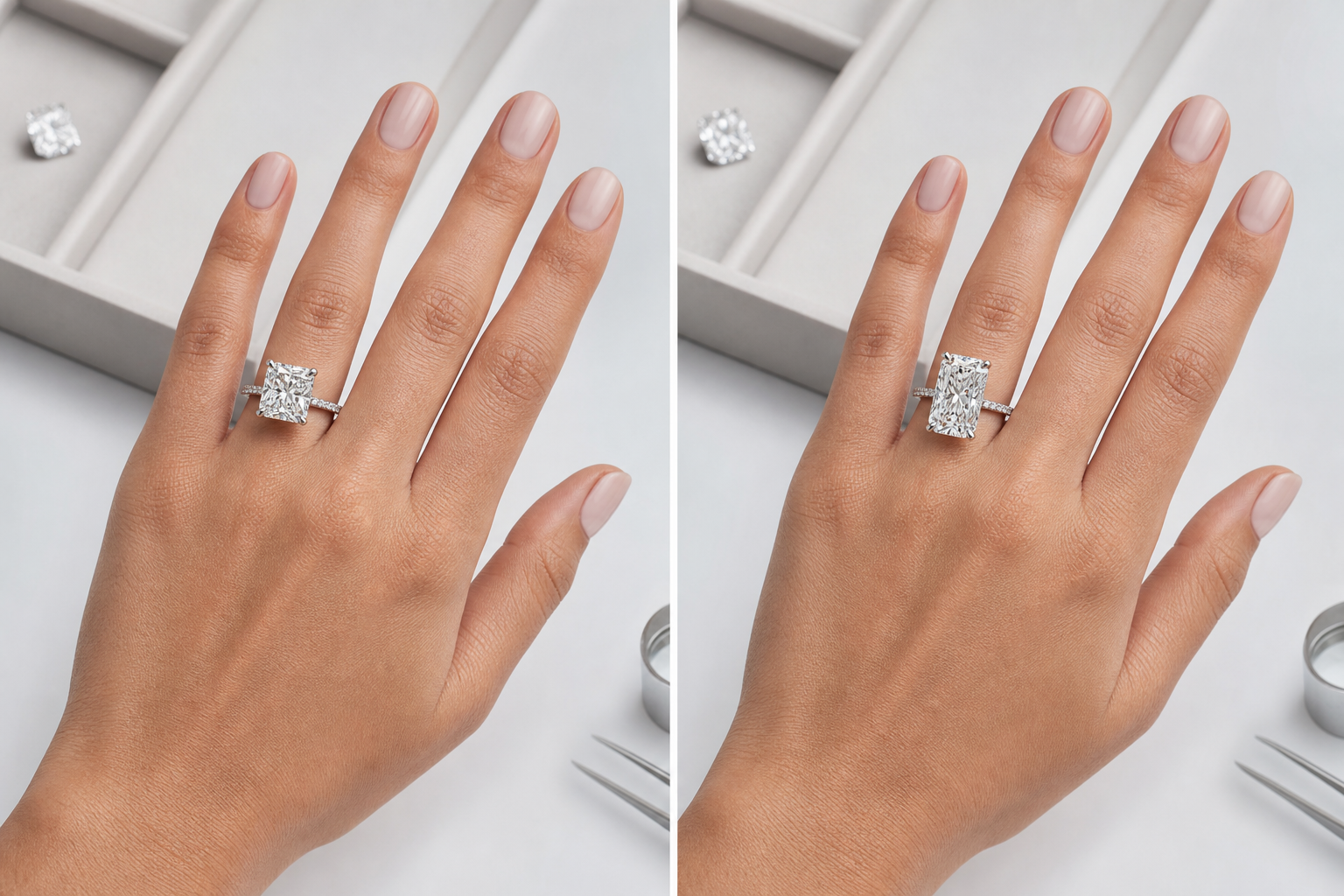
Once a buyer has decided radiant is worth considering, the next question is usually proportion. A square radiant diamond and an elongated radiant diamond can feel surprisingly different on the hand, even when the carat weight is similar. That is because the outline changes how the stone reads visually before the viewer ever notices the grading report.
For this shape, length-to-width ratio is the easiest way to talk about those differences. A ratio around 1.00 to 1.05 usually reads as square or nearly square. Around 1.06 to 1.15, the stone starts to look slightly elongated. By the time you reach roughly 1.16 to 1.30, the shape begins to feel noticeably rectangular. Those are useful shopping bands, not hard rules, because real stones can still vary in personality depending on cut style and overall proportions.
In practical buying, the ratio should be treated as a visual guide rather than a ranking system. A higher ratio is not automatically more elegant, and a lower ratio is not automatically more balanced. The useful question is whether the outline works with the wearer’s hand, the planned setting, and the way the stone carries its weight across the top view.
How length-to-width ratio changes the personality of a radiant cut
The ratio is not just a technical note. It changes how the stone feels in the ring. A square radiant tends to look balanced and centered, with a shape that feels stable and compact. That makes it a natural fit for buyers who want a bold center stone that holds its own without creating a long visual line.
An elongated radiant creates a different effect. It stretches the eye, which can make the stone feel more elegant and can sometimes create a larger face-up impression for the same carat weight, depending on the exact dimensions. That longer outline often appeals to buyers who want a ring that looks refined and a little more tailored rather than compact and symmetrical.
How a square radiant and an elongated radiant feel different on the finger
On the hand, a square radiant usually feels more anchored. It reads as full and balanced, which can be especially appealing if the buyer wants the diamond to look centered and direct. The visual weight sits more evenly across the finger, so the stone tends to feel substantial without drawing attention to length.
An elongated radiant changes the mood. It gives more horizontal or vertical presence, depending on orientation, and that can make the finger look longer and the ring look more deliberate. For some buyers, that is the more flattering choice because it adds line and movement. For others, it can feel too stretched if they prefer a compact look. The better shape is the one that matches the wearer’s eye, not just the larger number on paper.
How to choose the outline that fits the ring style and hand shape
The setting matters here more than many first-time buyers expect. A square radiant often feels especially natural in a classic solitaire or a halo, where the shape can stay centered and visually strong. An elongated radiant can work well in a slimmer band or a three-stone setting, where the longer outline has room to stretch without looking crowded.
Hand shape is part of the decision too, but it should not be treated like a rigid rule. Some buyers prefer a square outline because it feels compact and bold. Others prefer the longer line of an elongated radiant because it gives the ring a more elegant profile. The right answer depends on whether the buyer wants the stone to read as a strong focal point or as a longer, more graceful shape on the finger.
How to Verify the Outline
Do not choose by carat alone. Check the length-to-width ratio and confirm the actual appearance through image or video, because two stones with the same weight can still look very different once the outline is visible.
Radiant Sparkle Explained: Crushed Ice, Facet Pattern, and Light Performance
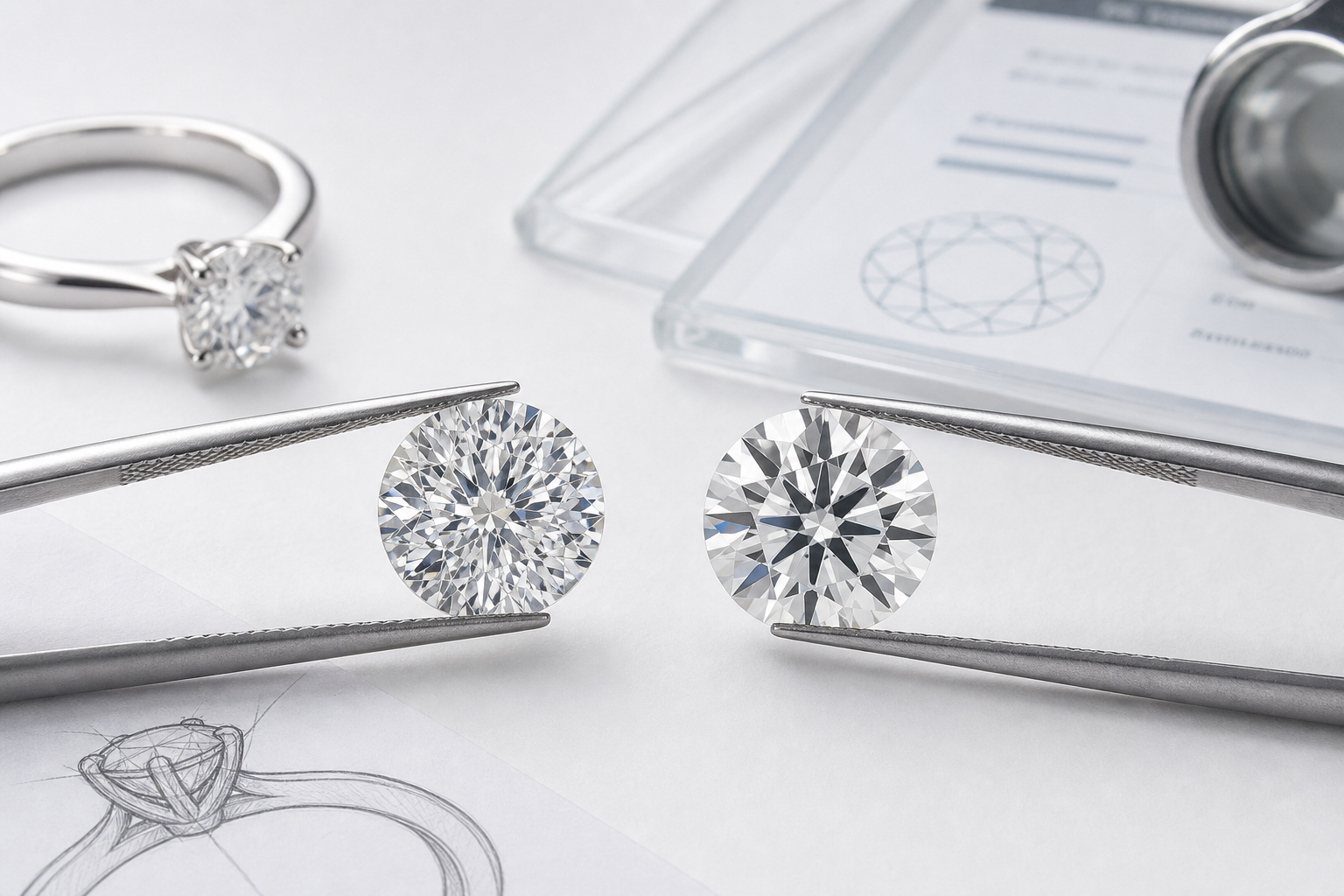
The sparkle of a radiant is one of the main reasons buyers choose it, but not all radiants look the same. Some have a more textured, glittery look, while others show brighter, cleaner flashes. That difference is usually what shoppers are responding to when they say one stone feels more lively than another. For a radiant cut, sparkle style is part of the buying decision, not just an extra detail.
What matters most is understanding the visual effect you prefer. Some buyers want a bright, active stone with lots of smaller flashes. Others want a more organized pattern that gives stronger, broader bursts of light. Both can be appealing. The better choice depends on whether the buyer values texture or clarity in the way the stone moves under light.
What buyers mean when they talk about a crushed ice look
When people describe a crushed ice radiant, they usually mean the facet pattern looks fragmented, almost like a field of tiny reflective pieces. Instead of large, obvious flashes, the stone shows a more broken-up sparkle that reads as busy and glittery. Some buyers love that because it feels lively and energetic. Others see it as less defined than they want.
The key point is that crushed ice is not a flaw by itself. It is a sparkle style. The real question is whether the buyer prefers a more textured look or a cleaner, more directional flash pattern. That distinction matters more than the phrase itself.
Why some radiant diamonds show cleaner flashes while others look more textured
The variation comes from cut proportions, facet arrangement, and the character of the individual stone. A radiant can lean toward broader flashes or toward a more broken-up appearance, and both are still valid interpretations of the shape. The difference is not usually about one version being “better.” It is about whether the pattern feels crisp, soft, dense, or more scattered.
Buyers should treat that as a preference question, not a hierarchy. If someone wants a stone with more obvious flashes of light, a cleaner-looking radiant may be the better fit. If the buyer prefers a glittery surface that feels active from every angle, a more textured stone may be the better choice. The right answer is the one that looks right in motion, not the one that sounds best in description.
A grading report can describe important characteristics, but it usually will not explain whether the radiant has a crushed-ice appearance, broader flashes, or uneven brightness across the center. This is where many comparisons become misleading: two stones can share similar grades while giving very different visual impressions. For buyers, the practical point is to use the report to confirm identity and specifications, then use media to judge the light behavior.
What to review in photos, 360-degree video, and side views before buying
Photos and video reveal more than a specification sheet does. Look for even brightness across the face of the stone, because uneven dark areas can make a radiant feel dull or patchy. Watch for obvious dead zones, and pay attention to whether the sparkle stays lively as the stone turns. A good radiant should still look active when it moves, not only when it is held at one perfect angle.
Side views help too, especially when the buyer wants to understand how the stone handles light at different positions. If the listing only shows one still image, that is not enough. Radiant sparkle is a visual experience, and more useful listings make it possible to judge the stone in motion before making a decision.
What to Check in Photos and Video
Rely on video, multiple angles, and the face-up view together. A grading report can support the decision, but it cannot replace seeing how the diamond actually looks under real viewing conditions.
How Color, Clarity, and Carat Weight Show Up in Radiant Lab-Grown Diamonds
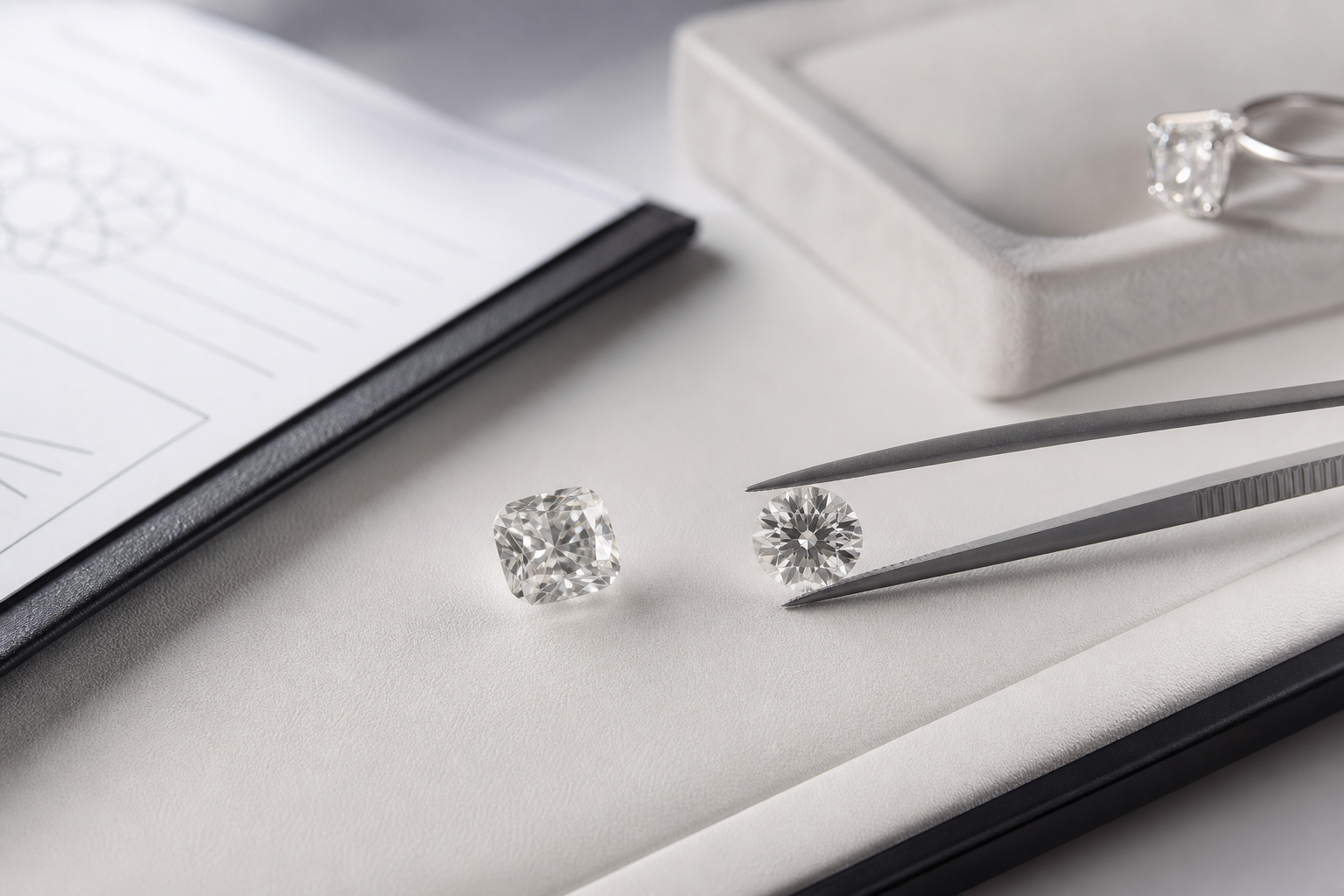
With a radiant lab-grown diamond, color, clarity, and carat weight do not work in isolation. The shape has enough brilliance and facet activity to help the stone look lively, unlike the more transparent evaluation priorities in an emerald cut clarity guide, where step-cut lines and proportion often reveal more detail, but not enough to make every grading detail irrelevant. For most buyers, the right decision comes down to which tradeoff matters most in the ring: a larger face-up look, a cleaner center, or a better balance of appearance across the whole stone.
How radiants can influence the way color and clarity appear
Radiants can be forgiving in the right areas because their facet pattern tends to break up light and draw attention to sparkle rather than tiny internal details. That can make some inclusions less noticeable than they would be in a more open step-cut stone. But that advantage has limits. A lab-grown radiant stone still shows color and clarity, especially when the setting is light-colored, the stone is viewed from the side, or the diamond has a more transparent-looking appearance.
That is why buyers should not assume the shape will hide everything. A lower color grade may be perfectly acceptable in a yellow gold setting, while the same grade can look more obvious in platinum or white gold. Clarity works the same way. An eye-clean stone is often the real goal, not the highest paper grade. If a diamond looks clean without magnification and still shows strong life in motion, that usually matters more than chasing a number that sounds better on a report.
Where buyers should prioritize size, brightness, or cleaner appearance
The smart choice depends on what the ring needs to do. If the goal is maximum visual presence for the budget, carat weight and face-up appearance usually deserve priority. A well-proportioned radiant can look substantial without needing to be the heaviest stone in the case, so the actual measurements matter as much as the carat figure.
If the buyer wants a cleaner-looking center, clarity moves up the list. That does not mean overpaying for grades that offer little visible benefit. It means choosing a lab-grown radiant diamond that looks clean in the size and setting being considered. Buyers who want a more balanced look, especially in white metal settings, may decide to favor color a little more heavily. In practice, the better decision is usually not to maximize one spec blindly, but to decide which one will be most noticeable once the stone is worn.
Prices can vary because of cut precision, report type, seller channel, size, shape, availability, and documentation. Buyers should compare like-for-like specifications before treating one stone as a better value. A larger radiant is not automatically the stronger purchase if it carries too much weight in depth, looks uneven in video, or does not fit the intended setting cleanly.
What specs are helpful and what specs should not be overread
A lab-grown diamond grading report is useful, but it does not tell the whole story. Carat weight is a starting point, not the full answer. Two radiant diamonds with the same carat weight can look noticeably different if one has stronger spread, a thinner outline, or a better-shaped face-up appearance. The report helps confirm what the stone is, but the video and the measurements show how it actually behaves.
Depth and table should be read with restraint. They matter because they affect proportion and appearance, but they are not a standalone verdict on quality. A buyer can overread a single number and miss a diamond that looks better in real viewing. For radiant shapes, the most useful review is usually the combination of report, dimensions, and visual performance. That combination is what tells you whether the stone looks bright, balanced, and worth considering.
It is also useful to compare the report details with the actual stone media rather than treating grades as interchangeable labels. A higher clarity grade may not improve the ring visually if the lower-graded option is already eye-clean, while a slightly different color grade may matter more in a white-metal design. The strongest purchase decisions usually come from matching the grade tradeoff to the setting and the wearer’s priorities, not from assuming the highest grade is automatically the smartest buy.
Buyer Verification Checklist
Confirm the grading report, then compare the actual measurements and the face-up look in video. Make sure the stone still appears clean and lively in the size you want, and do not let carat weight override what the diamond really looks like once it is viewed on screen or in person.
Corner Protection and Everyday Wear: Why Radiants Work Well for Active Buyers
Radiant lab-grown diamonds appeal to many buyers because they offer a durable shape with a more practical outline than some other rectangular cuts. The clipped corners are not a small detail. They change how the stone handles everyday wear, and for many engagement ring shoppers, that is a real advantage rather than an afterthought.
Why the clipped corners matter more than many first-time buyers expect
The clipped corners reduce the sharp points that tend to be more exposed on other fancy shapes. That means less vulnerability at the edges, less worry about snagging, and a shape that usually feels easier to live with day to day. It is not that the diamond becomes indestructible. It is that the shape itself gives you a more forgiving starting point.
For buyers comparing radiant diamond everyday wear against sharper cornered shapes, this can be the deciding factor. The radiant gives up a little of the rigid, pointed geometry in exchange for better practical balance. That tradeoff is often worth it if the ring will be worn constantly.
How prong style and setting height affect protection
Corner protection still depends heavily on the setting. Prong placement matters because the corners need to be supported, not left visually exposed. A good setting brings the protection closer to the stone instead of leaving the edges floating in open space. Profile height matters too. A higher setting can create a more dramatic look, but it may also leave the diamond more exposed to knocks and contact.
For active buyers, the better choice is usually the one that protects the corners without making the ring feel bulky or awkward. Low enough to wear comfortably, secure enough to handle daily use, and structured enough to keep the stone stable: that is the balance to aim for.
When a radiant is a strong choice for someone who wears the ring constantly
A radiant is often the right call for someone who wants a bold look but does not want a fragile-feeling outline. That includes people who type all day, move through a lot of daily tasks, travel often, or simply do not want to think about their ring every time they use their hands. In those situations, radiant diamond everyday wear makes sense because the shape offers presence without being overly delicate at the corners.
It is also a strong option for buyers who want something modern and clean but still practical enough for regular use. If the ring is going to live on the hand, not in a box, durability should matter just as much as style.
What to Check for Corner Security
Look closely at how the prongs meet the clipped corners and ask whether the setting leaves any edges overly exposed. If the corners look visually open in photos or video, that is worth questioning before you commit.
Best Settings for Radiant Lab-Grown Diamonds: Solitaire, Halo, Three-Stone, and More
Radiant setting compatibility is one of the shape’s biggest strengths. This cut works in several ring styles because it already has a structured outline and strong sparkle. The key is choosing a setting that supports those traits instead of competing with them. A good setting should make the diamond feel intentional, not busy.
Which settings tend to flatter square and elongated radiants most
A square radiant usually feels most balanced in a classic solitaire or a halo that echoes its compact outline. Those settings reinforce the symmetry and keep the stone looking centered and stable on the hand. An elongated radiant often works better in a slim band or a three-stone layout because the extra length creates a stronger visual line. That can make the ring feel more elegant and can also help the center stone appear larger in profile.
The match should follow the shape, not fight it. A setting that is too wide or visually heavy can flatten an elongated radiant, while a very narrow design can make a square radiant feel less grounded. The better setting is usually the one that respects the stone’s proportions.
How setting style changes the final look more than many buyers expect
Many shoppers focus almost entirely on the center stone, then underestimate how much the setting changes the final ring. A solitaire makes the radiant feel cleaner and more architectural. A halo can amplify sparkle and make the face-up look larger, but it can also shift attention away from the center if the halo is too dominant. A three-stone setting gives the ring more presence and can make an elongated radiant feel more deliberate and refined.
Even small design choices change the result. Metal color affects how bright the stone appears. Side details can either frame the diamond or distract from it. A hidden halo can add lift without overwhelming the shape. These are not cosmetic afterthoughts. They shape the way the ring is read at a glance.
How to balance security, comfort, and visual impact
Low-profile settings usually wear more comfortably, but they do not always show the stone as dramatically. Elevated settings can create more presence and make the center look larger, yet they also expose the diamond more to contact. The right choice depends on how the ring will actually be worn.
If comfort and daily practicality matter most, a secure, moderately low design is often the better decision. If visual impact is the priority and the wearer is comfortable being a bit more careful, a more open setting can work well. The important point is not to chase the most dramatic profile. It is to make sure the setting suits the stone’s shape, the wearer’s habits, and the amount of protection the corners need.
For custom design, the stone cannot be evaluated separately from the setting. The jeweler needs the exact measurements, corner shape, and intended prong placement before the design is finalized, especially for elongated radiants that can look elegant in one mounting and crowded in another. At NUVU, this kind of comparison is best treated as a practical fit question: the report narrows the field, but the final ring still depends on how the stone, setting, and wearer’s daily use work together.
For custom jewelry, stone measurements and setting compatibility should be confirmed before finalizing a purchase. This includes length, width, depth, corner shape, girdle information where available, and the planned prong or bezel layout. A design that looks appealing in a rendering should still be checked against the actual stone dimensions before production decisions are finalized.
A useful custom-design conversation should also identify what can change after the stone is selected and what should be decided before the ring is made. Band width, prong style, halo proportions, side-stone scale, and setting height can all change how a radiant appears. For that reason, buyers should confirm the design direction before treating one loose stone as the final answer.
Stone-to-Setting Fit Check
Before ordering or finalizing a custom design, confirm that the setting matches the stone’s width, length, and corner structure. A radiant can look right on paper and still feel wrong in the wrong mounting, so the fit should be checked as part of the decision, not after it.
Documentation and Purchase Assurance for Radiant Lab-Grown Diamonds
After the stone and setting have been narrowed down, documentation becomes the next layer of confidence. For a radiant lab-grown diamond, the most useful paperwork is not just a certificate image on a product page; it is a consistent chain of details that connects the grading report, measurements, inscription information where applicable, seller description, and final invoice. When those details line up, the buyer has a clearer basis for trusting that the stone being reviewed is the same stone being supplied.
For buyers working with NUVU on a radiant center stone or custom engagement ring, the practical support should feel specific rather than vague. That means confirming whether the stone has a recognized grading report, explaining how the length-to-width ratio affects the planned design, and checking that the chosen prong layout protects the clipped corners. Trust is strongest when the buying process makes the decision easier to verify, not when it relies on broad claims.
It is also reasonable to ask how the diamond will be documented at delivery. When a grading report is available, the buyer should understand whether a copy of that report, the stone’s listed measurements, any inscription details, and the final purchase description align with one another. Buyers should also confirm the seller’s return, resizing, and after-sales terms before purchase rather than assuming them from the product page.
How to connect the report, inscription, listing, and final paperwork
Traceability in a practical jewelry purchase is usually about matching details, not relying on one document in isolation. Start with the report number and recorded measurements, then compare them with the seller listing, stone media, invoice description, and any inscription shown in magnified images or video. Small presentation differences can happen across platforms, but the core identifying information should not feel inconsistent or unclear.
If a report number is provided, buyers should use the issuing laboratory’s official report-check tool where available and compare the displayed information with the stone being offered. This step does not prove that the diamond will look beautiful in a ring, and it does not replace inspection of photos or video. It simply helps confirm that the paperwork being referenced corresponds to the grading details the buyer is using to make the decision.
When a grading report is available, buyers should verify the report details through the issuing laboratory’s official report-check tool where available and compare those details with the stone’s visual evidence and final purchase documents.
A careful seller should be comfortable explaining what each document does and does not prove. A grading report can confirm recorded characteristics, but it does not replace visual review; a seller’s policies should still be read before purchase; and a custom design conversation helps make sure the radiant’s proportions work in the finished ring. Taken together, those steps create a more reliable buying path without turning the decision into a pressure sale.
A grading report helps document key characteristics, but it should not be treated as a guarantee of beauty, value, or sourcing ethics. Reports may include information such as measurements, color, clarity, carat weight, and laboratory-grown origin, but buyers still need to review visual evidence, seller documentation, and the intended jewelry use before making a final decision.
When growth method or post-growth treatment is relevant, buyers should look for clear disclosure in the grading report or seller documentation. HPHT and CVD can refer to laboratory diamond growth methods, and treatment language should be used only when the document or seller information clearly supports it. If a listing is unclear about origin, growth method, or treatment status, that uncertainty should be resolved before purchase.
For NUVU, the most useful role is not to act as a grading authority, but to help buyers organize the evidence: what the report shows, what the visuals reveal, and whether the stone’s shape and measurements suit the intended ring. That process keeps the focus on clear comparison rather than broad reassurance.
Radiant vs Cushion, Emerald, and Princess: Which Shape Fits Which Buyer Best
The easiest way to choose a radiant lab-grown diamond is to compare it against the shapes people usually cross-shop with it. Radiant is a strong option for buyers who want a lot of sparkle in a clean rectangular or square outline, but it is not the right fit for everyone. If your priority is softness, a more architectural step-cut look, or sharper geometric edges, another shape may suit you better.
The real decision is not which shape is “better” in general. It is which one matches the kind of brilliance, outline, and daily wear you actually want in a ring. Radiant tends to sit in a useful middle ground: more lively than emerald, less soft than cushion, and less sharp at the corners than princess. That balance is why it shows up so often in modern engagement ring searches.
Radiant vs cushion: sparkle style and outline softness
In a radiant vs cushion comparison, the main difference is visual personality. Cushion cuts usually feel softer and rounder, even when they are squared off, while radiants look more structured and defined. If you want a shape that feels a little gentler and more romantic in outline, cushion has the edge. If you want a shape that reads as sharper and more contemporary, radiant is usually the stronger pick.
Sparkle style matters here as much as outline. A cushion can look plush and mellow, with a softer spread of light. A radiant usually feels busier and brighter, with more obvious flashes. In a practical lab grown diamond shapes comparison, buyers who dislike a too-rounded look often prefer radiant because it keeps the geometry clearer. Buyers who want less angular energy usually drift toward cushion.
The practical judgment is simple: choose radiant when you want more visual crispness and cushion when you want a softer silhouette. If the ring has to feel feminine and gentle from across the room, cushion may win. If it needs to feel clean, modern, and noticeably bright, radiant is usually the better fit.
Radiant vs emerald: brilliance versus hall-of-mirrors effect
Radiant vs emerald is less about size and more about the type of visual experience. Emerald cuts are known for a step-cut look, which creates long, clean reflections instead of the more broken-up sparkle you see in a radiant. That gives emerald a calm, structured appearance. It can look elegant and refined, but it does not try to compete on brilliance.
Radiant is generally the better choice for buyers who want more light return and more obvious sparkle in everyday viewing. Emerald appeals to people who value clarity, long lines, and a more composed face-up look. In other words, emerald is usually chosen for presence and structure, while radiant is chosen for energy and brightness.
If you are unsure between the two, ask what bothers you more: a little less sparkle or a little less precision in the outline. If you want the stone to flash more strongly in motion, radiant is the more straightforward choice. If you want the stone to look calm, open, and almost architectural, emerald deserves serious consideration. This is one of the clearer shape tradeoffs in the whole category.
Radiant vs princess: corner durability and overall look
Radiant vs princess is often decided by corner preference before anything else. Princess cuts have a very sharp, angular look, which some buyers love because it feels modern and geometric. The downside is that those corners are more exposed and can feel more vulnerable in everyday wear. Radiant keeps a square or rectangular outline but softens the corners, which gives it a practical edge for many ring shoppers.
That added corner protection is one reason radiant is often the more forgiving choice for an engagement ring that will be worn often. It still looks crisp, but it does not carry the same sharp-corner profile as a princess. Visually, princess can feel a little more severe, while radiant usually feels slightly smoother without losing its modern shape.
If you want a bold square look and are willing to live with sharper edges, princess is still a strong option. If you want most of that geometry with a better balance of comfort and security, radiant is usually the smarter choice. For many buyers, that tradeoff is enough to make the decision.
Shape Comparison Shortcut
Choose the shape that best matches your preferred sparkle style, outline, and everyday comfort, not the one that only looks biggest in a photo.
When the goal is strong brilliance with a flexible, modern outline, radiant is often the most balanced choice. If you want softness, pick cushion. If you want structure and a quieter look, pick emerald. If you want sharper geometry and are comfortable with less corner protection, princess may still be the right call.
How to Evaluate a Radiant Lab-Grown Diamond Before You Buy Online or In Person
Once you know radiant is in the running, the next step is to judge the stone the right way. A grading report is useful, but it should not be treated as the whole answer. Radiant cuts can vary a lot in face-up appearance, so the buyer who checks the report, the measurements, and the real video together usually makes a better decision than the buyer who relies on one document alone.
This matters even more when you buy radiant diamond online. The shape can look very different depending on ratio, cut style, and how the stone behaves in motion. A listing that looks good on paper can still disappoint if the actual stone has a dull center, uneven brightness, or proportions that feel off once it is seen from above.
How to read the report without overtrusting it
A grading report can confirm the basic identity of the stone, including measurements and key grading details, but it cannot tell you whether the diamond is visually appealing. That is the limitation buyers often miss. The paper may show the numbers, but it will not tell you if the radiant has strong life across the face or whether the pattern looks balanced when the stone moves.
Use the report as a filter, not a finish line. It helps you rule out stones that do not meet your basic requirements, but it should not replace visual review. At NUVU, we usually treat the grading report as the starting point, not the final answer, because the shape’s real value depends on how it actually looks.
The better approach is to ask what the report can confirm and what it cannot. It can support trust, but it cannot judge beauty. If a seller leans too heavily on the certificate and avoids showing the stone clearly, that is a warning sign rather than a reassurance.
When reviewing documentation, make sure the details match across the report, the seller listing, the invoice, and any inscription information shown in images or video. Do not rely on a copied report image alone if the seller cannot explain how the document connects to the specific stone being offered. The goal is not to make the buying process complicated; it is to make sure the paperwork, the visual evidence, and the stone description are all pointing to the same diamond.
Which measurements and proportions deserve attention first
The first numbers to check are the actual radiant diamond measurements, the length-to-width ratio, depth, and table. Carat weight matters, but it does not tell you how the stone will look across the finger. Two stones with the same carat weight can face up very differently if one has a better outline or more efficient spread.
For a radiant, the length-to-width ratio is especially important because it shapes the entire look. A lower ratio tends to create a squarer outline, while a higher ratio creates a more elongated appearance. Depth and table matter too, but they should be read in context. A stone can have acceptable numbers and still look oddly narrow, too deep, or less lively than expected.
The most practical rule is to compare the measurements against the photos and video, not against carat alone. If the stone looks shorter or slimmer than you expected, the dimensions will usually explain why. Numbers should help you interpret the face-up appearance, not distract you from it.
What questions a buyer should ask before placing the order
Before committing, ask for clear photos and a full video that shows the stone in motion. A static image can hide dead zones, uneven brightness, or a sparkle pattern that feels too broken up. If the seller cannot provide a useful video review, that is a reason to slow down.
You should also ask whether the stone has been viewed in different lighting conditions, whether the seller’s return terms have been reviewed, and whether the diamond will fit the planned setting. A radiant that looks excellent loose can still be the wrong choice if its proportions do not suit the ring design. That issue becomes more common when buyers shop quickly and focus only on the headline carat weight.
If you are comparing stones side by side, ask which one has the cleaner face-up look, which one has the stronger brightness in motion, and which one looks most balanced from the top view. Those are the questions that move the decision forward. If you are using a custom design path, NUVU or another jeweler should be able to help you compare the stone and setting together instead of treating them as separate decisions.
Certificate and Visual Review Check
Before you buy, confirm that the report, the photos, the video, and the measurements all tell the same story. If one of them feels off, keep looking.
A good radiant should make sense on paper and in real viewing. If the documentation says one thing and the stone looks like something else, the visual evidence should win.
When a Radiant Lab-Grown Diamond Is the Smart Choice for Your Budget and Ring Plan
A radiant lab-grown diamond is usually the right choice when you want strong sparkle, a modern shape, and a lot of flexibility in how the ring wears and looks. It tends to work well for buyers who want a stone that feels more distinctive than a round diamond but still bright enough to hold its own in a center-stone setting. For many shoppers, that combination is exactly why it becomes the radiant cut lab-grown diamond option to narrow in on.
It is also a shape that makes sense for buyers who want a practical balance. Radiant can deliver a lot of visual impact without forcing you into the softer outline of a cushion or the quieter look of an emerald. That makes it useful for a modern engagement ring, especially when the buyer wants the ring to feel polished without becoming overly formal.
Who is most likely to be happiest with a radiant
Radiant is a strong match for buyers who want brilliance first, shape second, and a setting that can adapt easily to different styles. If you like rectangular or square outlines and you want the stone to look lively rather than reserved, radiant is usually a good fit. It also works well for shoppers who want something flexible enough to pair with solitaire, halo, or three-stone designs.
It is especially appealing for buyers who want a diamond that feels modern without being too sharp or too soft. That middle position is not glamorous in theory, but it is useful in practice. A lot of people simply want a stone that looks strong, clean, and easy to wear. Radiant does that job better than many first-time buyers expect.
The strongest use case is someone who wants a shape that supports both sparkle and structure. If that is the goal, radiant is often the right choice rather than a compromise.
When another shape may be the better decision
If you want a softer outline with a gentler visual feel, cushion may be the better fit. If you prefer a more restrained, step-cut look with a sense of clarity over sparkle, emerald is usually the smarter option. If you want sharper corners and a very angular profile, princess may still be the answer, provided you are comfortable with the extra corner exposure.
This is where honesty matters. Radiant is not automatically better just because it offers more brilliance than some other shapes. Some buyers will find it too active, too structured, or not soft enough. Others will decide that the sparkle is worth the tradeoff. The right shape is the one that matches the look you actually want, not the one that sounds most versatile in a vacuum.
That judgment becomes clearer when the buyer already has a specific ring idea in mind. A simple solitaire can change the emotional feel of each shape, and so can a three-stone or halo setting. If your preferred design pushes you toward a calmer or more sculpted look, another shape may fit better than radiant.
How to move from comparison to shortlist or custom design
The cleanest next step is to compare ratio, visual appearance, report, and setting together. Do not separate the shape from the ring it will live in. A radiant that looks perfect in one setting can feel too compact or too long in another, which is why this decision is often better made as a set rather than as a loose stone in isolation.
If you are still narrowing options, shortlist two or three stones and review them side by side in video. Then check which one has the strongest face-up balance, which one fits the ring style you want, and which one gives you the clearest overall fit for the budget. If you are building a custom ring, the stone and setting should be chosen together so the final result feels intentional rather than forced.
For buyers who want extra help, a curated radiant collection or a custom design conversation can make the process easier. The goal is not just to choose a diamond, but to choose the version of radiant that actually fits the wearer, the setting, and the everyday use of the ring.
What This Means in a Real Purchase
Imagine a buyer choosing between a square radiant in a classic solitaire and an elongated radiant in a three-stone setting. The deciding factors should be the visual line on the hand, the sparkle style in the video, the measurements, and how each stone fits the planned ring rather than which one has the larger carat number.
If the goal is a balanced, centered look, the square radiant often feels more direct. If the goal is a longer, more elegant line with a bit more finger coverage, the elongated stone usually wins. In a real purchase, that difference matters more than a small numerical gap in size.
Evidence-Based Buying Notes for Radiant Lab-Grown Diamonds
The most defensible radiant diamond decision combines three kinds of evidence: the grading report, the visual record, and the setting plan. The report helps document the stone’s listed characteristics, the images and video show whether the radiant actually looks bright and balanced, and the setting plan confirms whether the dimensions and clipped corners will work safely in the finished ring.
Be careful with claims that sound too absolute. A seller should not need to say that one grading document guarantees beauty, that one shape is always best, or that lab-grown origin alone proves a broad environmental or ethical claim. Strong buying decisions are usually built from narrower, checkable facts: what the stone is, how it looks, how it is documented, and how it will be mounted.
Prices can change with market conditions, report type, seller channel, and stone-specific details, so exact comparisons should be verified at the time of purchase. If a listing claims unusual savings, unusually high value, or a special sourcing advantage, compare stones with similar measurements, grades, report details, media quality, and setting requirements before relying on that claim.
If two radiant lab-grown diamonds appear similar on paper, choose the one with the stronger evidence package rather than the one with the most impressive headline description. Clear media, consistent measurements, transparent origin disclosure, and a setting that protects the corners are more useful than vague language about “maximum sparkle” or “best value.” For a radiant, trust is built through alignment between the paperwork and the actual appearance of the stone.
If you are still weighing the final choice, compare a few real stones in motion and judge them by sparkle style, outline, and setting fit together. That is usually the fastest way to tell whether radiant is the right shape or whether another option will suit the ring better.
Disclosure: This article is for general educational purposes only. Diamond grading, pricing, availability, specifications, and seller policies can change, and readers should verify important details through grading reports, official laboratory tools, seller documentation, or qualified professionals before making a purchase decision. Laboratory-grown diamonds should be clearly distinguished from natural diamonds, and environmental or sourcing claims should be supported by specific documentation.