
Cushion lab-grown diamonds can be harder to compare than they first appear because “cushion” describes a family of shapes, not one standard look, and the same kind of shape analysis is captured in a pear diamond symmetry and bow tie guide that helps buyers judge outline balance and tip protection. Two stones with similar carat weight, color, and clarity may look very different once you compare overall shape, corner softness, depth, facet pattern, sparkle style, and actual millimeter spread. That matters because a cushion diamond can appear balanced and bright, or it can face up smaller, look stretched, or feel visually busy despite strong grades on paper.
For the full framework, read Lab-Grown Diamond Shapes Guide.
This guide helps you judge the stone as a complete visual choice rather than a report alone. You’ll learn how square, slightly rectangular, and elongated cushions differ; how crushed ice, brilliant, and vintage-style facets affect appearance; and why setting choice should be considered before buying. The goal is to help you compare real options with more confidence and choose a cushion that fits your style, budget, and ring design.
Throughout this guide, “lab-grown diamond” means a laboratory-grown diamond, not a natural diamond and not a diamond simulant. Laboratory-grown diamonds and natural diamonds have different origins, and any seller description or grading report should clearly disclose laboratory-grown origin when that is the stone being discussed.
| Buying Choice | What to Check | Common Mistake to Avoid |
|---|---|---|
| Square cushion | Length-to-width near 1.00–1.05 | Assuming all square cushions face up the same |
| Elongated cushion | Ratio around 1.10–1.20 and balanced shape | Choosing length without checking for stretched corners |
| Crushed ice facets | Fine glitter and even light return in video | Buying a busy or dull stone from the label alone |
| Brilliant or vintage facets | Clear flashes, contrast, and organized pattern | Expecting every cushion to sparkle like a round diamond |
| Carat comparison | Millimeter length, width, depth, and face-up size | Paying for weight hidden in depth |
| Setting fit | Halo shape, prong placement, and side-stone scale | Choosing the diamond before considering the mounting |
Quick Questions Before You Read
Q: Is carat weight the best way to compare cushion lab-grown diamonds?
No. Cushions can carry weight in depth, so millimeter size, proportions, and face-up appearance are just as important.
Q: What length-to-width ratio looks best for a cushion?
Square cushions usually sit around 1.00–1.05, while many elongated cushions fall around 1.10–1.20. The preferred ratio depends on the look and setting.
Q: Are crushed ice cushions better than brilliant cushions?
Neither is automatically better. Crushed ice gives fine sparkle, while brilliant cushions show cleaner flashes and contrast.
Q: Can a grading report tell me if a cushion diamond will look beautiful?
Only partly. Reports help document key characteristics, but photos, 360-degree video, measurements, and setting fit reveal the actual look.
What the Report Can Confirm Before You Compare Cushion Diamonds
A grading report is useful because it gives you a shared language for comparing stones. It can help confirm the diamond’s identity, measurements, basic shape description, carat weight, and other listed specifications. That makes it an important first filter when you are sorting through multiple cushion lab-grown diamonds online.
What the report cannot do is show how the stone will feel in motion, how evenly the corners are rounded, or whether the visual pattern is attractive to your eye. For cushion diamonds in particular, that missing information matters because small differences in outline and faceting can change the whole character of the stone.
A practical way to use the report is to treat it as a consistency check. If the measurements, images, and video all point to the same shape and scale, the listing is easier to evaluate. If the numbers and the visual evidence seem out of sync, slow down and ask for more detail before making a decision.
When a grading report is available, buyers should verify the report details through the issuing laboratory’s official report-check tool where available, then compare those details with the stone’s photos, video, and measurements.
A grading report can narrow the comparison, but it should be read alongside the stone’s proportions, visual evidence, and intended jewelry use. This is especially important for cushion cuts because a report may list the same broad shape description for stones that look very different once viewed face-up.
A grading report helps document key characteristics, but it should not be treated as a guarantee of beauty, value, or sourcing ethics. It can confirm listed data such as carat weight, measurements, color, clarity, and laboratory-grown origin when stated, but the buyer still needs to check whether the stone’s actual appearance and documentation match the intended purchase.
Why Cushion Lab-Grown Diamonds Vary So Much From Stone to Stone
A cushion lab-grown diamond is not one fixed look. The word “cushion” describes a broad family of diamonds with rounded corners, a pillow shape, and a softer outline than sharp-cornered cuts like princess or radiant. Within that family, the exact shape, corner curve, side profile, length-to-width ratio, and faceting style can change the stone’s entire personality.
This is why two cushion diamonds with similar grades can look surprisingly different in real life. One may read as a soft square diamond with romantic, vintage character. Another may look longer, brighter, and more modern. A third may have a glittery crushed-ice texture that feels completely different from a cushion with broad, clean flashes.
The Cushion Cut Is a Shape Category, Not a Single Visual Formula
The biggest mistake is treating “cushion cut” as if it guarantees a specific appearance. Most cushions share rounded corners and a pillow-like outline, but the details vary. Some have gently bowed sides, while others look straighter and more boxy. Some appear almost square, while others are clearly elongated. Some have open, chunky facets; others have many smaller reflections across the stone.
That flexibility is part of the appeal, but it also means a grading report alone cannot tell you whether the stone has the look you want. A grading report may confirm carat weight, color, clarity, measurements, and cut description, but it will not fully show whether the cushion outline feels graceful, whether the corners look balanced, or whether the faceting style matches your taste.
For buyers, the practical point is not just what the report says, but how the stone performs visually and fits the intended design. A report can help confirm that you are comparing the right diamond and the right basic specifications, while images and video help answer the more personal question: whether this particular cushion has the softness, brightness, spread, and character you expect.
Same Carat and Grades, Different Face-Up Results
Two 2.00 ct cushion lab-grown diamonds with similar color and clarity grades can face up very differently. One may look broader for its weight, while another may carry more depth and appear smaller from the top. One may show strong contrast and lively flashes, while another may look softer, more scattered, or more textured.
This is where buyers should slow down. If you are asking why cushion cut diamonds look different, the answer is usually not color or clarity first. It is often the relationship between measurements, proportions, outline, and facet pattern. Photos, video, millimeter dimensions, and a clear face-up view matter because they show what the report cannot: the stone’s actual presence.
Vintage Softness Versus Modern Sparkle
Cushion diamonds sit between several design moods. Some buyers are drawn to their romantic softness: rounded corners, warmer visual character, and broader flashes that feel less sharp than a princess or radiant cut. Others want a cushion cut lab diamond with a cleaner, brighter, more modern sparkle pattern that works well in a simple solitaire or hidden-halo ring.
Neither direction is automatically better. The better choice is the one that fits the finished ring and the wearer’s style. A vintage-inspired cushion may look beautiful in a halo or antique-style setting but feel less crisp to someone who wants high-contrast brilliance. A modern brilliant cushion may look clean and lively but may not deliver the same old-world softness a buyer expects from the word “cushion.”
What to Check Before You Decide
Before choosing a cushion lab-grown diamond, review the actual stone image or 360-degree video, not only the grading report. Look at whether the outline is square, softly rectangular, or noticeably elongated. Check whether the corners are evenly rounded, whether the sides look balanced, and whether the facet pattern creates the type of sparkle you want.
The practical rule is simple: do not assume all cushion lab-grown diamonds share the same visual style. If you are learning how to choose a cushion lab diamond, start by comparing the visible shape and light behavior first, then use the grading report to confirm the technical details.
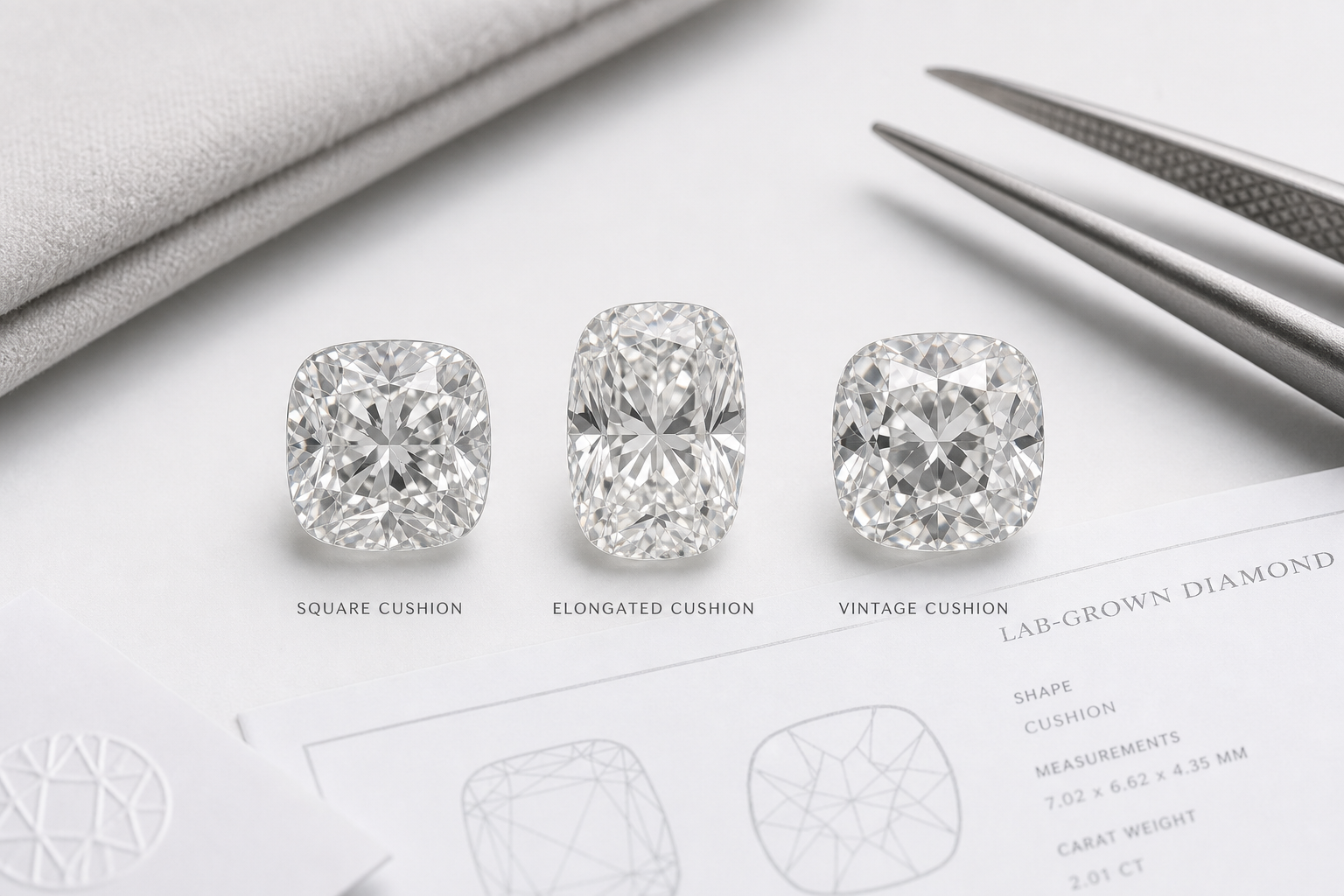
Shape Outline: Square, Elongated, Rounded, or Boxy Cushion Diamonds
The cushion cut diamond shape is defined as much by its outer silhouette as by its sparkle. Before comparing facet patterns or grades, look at the outline. A cushion lab-grown diamond shape can feel classic, romantic, modern, or stretched depending on whether it is square, slightly elongated, deeply rounded, or more boxy.
This matters because the outline affects how the ring feels on the hand. It influences finger coverage, setting fit, and the overall mood of the finished piece. A beautiful cushion on paper can still feel wrong if the shape does not match the design you have in mind.
Square Cushion Diamonds for a Balanced, Classic Look
A square cushion usually gives the most traditional cushion impression. It feels balanced from top to bottom and side to side, making it a natural fit for solitaire settings, halos, three-stone rings, and vintage-inspired designs. It can also be easier to center visually in a ring because the shape does not pull the eye in one direction.
Square does not mean sharp-edged. A square cushion still has rounded corners, which is why it looks softer than a princess cut. This is a strong choice for buyers who want symmetry and a pillow-like diamond shape without the extra length of an elongated cushion.
Elongated Cushion Diamonds for More Finger Coverage
An elongated cushion creates more direction across the finger. It can make the stone appear larger in one dimension and often gives a flattering lengthening effect, especially in solitaire and hidden-halo designs. For buyers comparing square vs elongated cushion diamond options, elongation is usually the better direction if finger coverage and a slightly more contemporary look are priorities.
The risk is that elongation can go too far. A well-shaped elongated cushion should look intentional, not narrow, stretched, or uneven. If the sides appear awkward or the corners do not match, the stone may lose the soft balance that makes cushions appealing in the first place.
Rounded Versus Boxy Corners
Corner shape changes the entire mood of a cushion. Softer, more rounded corners create a romantic, pillow-like appearance and tend to work well in vintage or halo settings. Boxier cushions feel more structured and modern, especially when the sides are straighter and the overall outline is cleaner.
Neither corner style is automatically superior, but unevenness is a warning sign. If one corner looks more rounded than another, or if the sides curve inconsistently, the stone can appear less refined once set. This is especially noticeable in halos, where the surrounding diamonds can exaggerate any mismatch in the center stone’s outline.
Outline Symmetry and Visual Balance
When reviewing photos or video, check the shape the way you would judge the finished ring: face-up and at a normal viewing angle. The corners should feel related to one another, the sides should curve consistently, and the table should appear centered within the outline. A cushion does not need to be mathematically perfect to look beautiful, but it should not feel visually lopsided.
For engagement rings, the preferred cushion diamond shape is the one that looks balanced in the intended setting. A slightly elongated cushion may be ideal for a clean solitaire, while a softer square cushion may suit a vintage halo better. The setting should support the stone’s outline rather than fight against it.
Stone-to-Setting Fit Check
Confirm that the setting is made or selected for the diamond’s exact measurements, not just its carat weight. This is especially important for elongated cushions and stones with very rounded corners, because generic settings may not hold the outline cleanly.
Prongs should protect the corners without covering too much of the shape. If the prongs are too heavy, the cushion can look cramped. If they are poorly positioned, the stone may not appear centered or secure. For a custom ring, the design should be built around the actual cushion’s length, width, corner shape, and orientation.
For custom design, trust comes from matching the stone to the setting, budget, and wearer’s daily use—not from choosing grades in isolation. A cushion that looks excellent in a loose-stone video may need a different prong style, halo curve, or side-stone scale once it is translated into a ring.
For custom jewelry, stone measurements and setting compatibility should be confirmed before finalizing a purchase. This includes not only length and width, but also depth, girdle position, corner shape, prong access, and whether the design plan uses the actual diamond’s proportions rather than a generic cushion template.
Length-to-Width Ratio: The Number That Changes the Cushion’s Personality
The cushion diamond ratio is one of the fastest ways to understand whether a stone will look square, softly rectangular, or clearly elongated. It will not tell you everything about beauty, but it helps narrow the search before you compare sparkle, corner shape, and setting fit.
For a cushion cut lab diamond ratio, the key number is the length-to-width ratio. A small change can make a noticeable visual difference. A cushion at 1.03 may feel like a classic soft square, while one at 1.16 will usually have a more directional, elongated presence.
How Length-to-Width Ratio Is Calculated
Length-to-width ratio is calculated by dividing the diamond’s length by its width. If a cushion measures 7.80 mm by 7.20 mm, the ratio is about 1.08. That places it in the slightly rectangular range rather than a true square look.
This is why diamond measurements matter more than carat weight alone. Carat tells you weight, not outline. Two cushions with the same carat weight can have different millimeter dimensions, and those measurements will affect how the diamond looks on the finger.
Practical Ratio Ranges for Cushion Lab-Grown Diamonds
For most buyers, these ratio ranges are a useful starting point:
- 1.00 to 1.05: A very square cushion. This range is useful for buyers who want symmetry, balance, and a classic cushion look.
- 1.06 to 1.10: A slightly rectangular cushion. This is a good range for buyers who want subtle elongation without losing the soft, balanced feel of the shape.
- 1.11 to 1.20: A clearly elongated cushion. This range works well for buyers who like a finger-lengthening effect and a more directional center stone.
- Above 1.20: A very elongated cushion. This can be attractive, but it needs careful visual review to avoid a stretched, narrow, or unbalanced appearance.
If you are looking for the best length to width ratio for cushion cut diamond designs, start with the look you want rather than chasing a single ideal number. A square cushion ratio may be better for a vintage halo or balanced three-stone ring, while an elongated cushion diamond ratio may be better for a solitaire where finger coverage is the main goal.
Why Ratio Alone Does Not Guarantee Beauty
Ratio is a screening tool, not a final decision. Two cushions with the same ratio can still look different because of corner roundness, side curvature, and facet layout. One 1.10 cushion may look softly rectangular and graceful, while another may look boxier or visually uneven.
This is where buyers often overvalue the number. A ratio can help you avoid shapes you clearly do not want, but it cannot tell you whether the diamond has a pleasing outline or attractive light behavior. The stone still needs to be judged visually.
In practical buying, ratio also needs to be read together with the intended orientation of the ring. A 1.15 cushion may feel elegant when set north-south in a solitaire, but the same shape may look more dramatic or wide if used east-west. If you are planning a custom design, the ratio should be considered alongside finger size, band width, halo shape, and side-stone layout rather than treated as an isolated target.
How to Verify This Before Buying
Compare the grading report measurements with the actual photo or video. If shopping online, review a face-up image where the diamond is not tilted and the outline is easy to judge. A tilted stone can make a balanced cushion look uneven or make an elongated cushion appear more dramatic than it really is.
Use the ratio to narrow your options, then compare the finalists side by side. The stronger choice is not always the one with the “better” number. It is the one whose measurements, outline, and real face-up appearance work together for the ring you want to create.
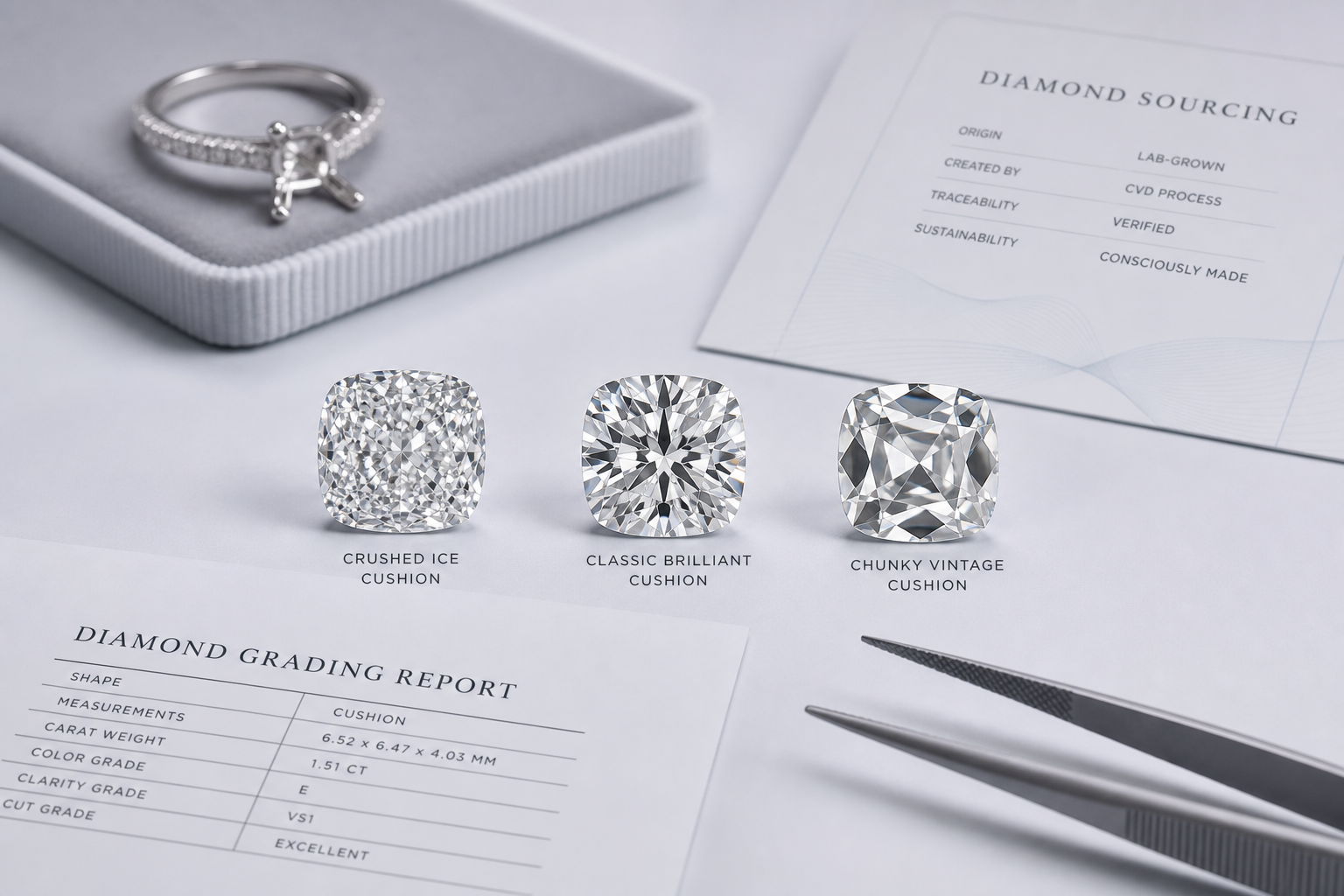
Facet Pattern: Crushed Ice, Brilliant, and Vintage Cushion Looks
The biggest visual difference between cushion diamonds is often not the outside shape. It is the internal facet pattern. Cushion cut diamond facets can create a glittery, scattered look, a cleaner brilliant flash, or a softer antique-style glow, even when the stones have similar carat weight, color, and clarity grades.
This is why cushion lab diamond sparkle should be judged visually, not assumed from the word “cushion” alone, much like a radiant cut sparkle guide explains how shape and light performance can vary. Two stones may share the same general outline but feel completely different once they move in light.
Crushed-Ice Cushion Diamonds
A crushed ice cushion has many small, broken-up reflections across the stone. Instead of broad flashes, it often gives a fine, glittery texture that looks active and sparkling in close-up views. Some buyers like this because it gives the diamond constant movement and a lively, modern feel.
The tradeoff is that crushed ice can look less crisp than other cushion styles. In some lighting, the reflections may appear busy rather than bright, especially if the stone has weaker contrast or carries too much depth. This does not make crushed ice a poor choice, but it does mean the buyer should not choose it only because it looks sparkly in a magnified video. It should also look appealing at normal viewing distance.
When comparing a crushed ice vs brilliant cushion diamond, the practical question is whether you prefer texture or definition. If you like a glittery surface with many small flashes, crushed ice may suit you. If you want larger flashes and more visible contrast, it may feel too soft or scattered.
Brilliant Cushion Diamonds
Brilliant cushion diamonds usually show a cleaner sparkle pattern, with more defined flashes of light and dark contrast. They can feel more structured than crushed-ice cushions, especially in a simple solitaire where the center stone has to carry the entire look.
This style is often a better fit for buyers who want a modern cushion with a brighter, more readable appearance. The risk is assuming that “brilliant” automatically means better performance. A brilliant-style cushion still needs strong proportions, balanced symmetry, and good light return. A poor example can look flat, leaky, or uneven despite having the right label on the report.
Video matters here. A strong brilliant cushion should show appealing flashes as it moves, not just a bright still image. If the center looks dull, the corners go dark, or the pattern appears lopsided, the stone may not deliver the clean sparkle that made the style attractive in the first place.
Chunky or Vintage-Inspired Cushion Facets
Chunky cushion facets create broader flashes of light. Instead of a fast glitter effect, the stone tends to show slower, larger reflections that can feel romantic, soft, and vintage. This is the style many buyers imagine when they think of an old-world cushion cut engagement ring or a vintage cushion cut lab diamond.
The appeal is mood. Chunkier facets can make a cushion feel warmer and more character-driven, especially in a halo, bezel, milgrain, or antique-inspired setting. The tradeoff is that this look is less about constant sparkle and more about shape, contrast, and charm. Buyers who expect nonstop brilliance may find it too quiet.
A good vintage-style cushion should still have life. Broad facets are not an excuse for a sleepy stone. Look for flashes that turn on and off clearly as the diamond moves, rather than a glassy appearance with little contrast.
How Faceting Affects Personal Preference
Facet pattern is not just a technical detail. It changes the personality of the diamond. A crushed-ice cushion may feel lively and textured. A brilliant cushion may feel cleaner and more modern. A chunky vintage cushion may feel softer, warmer, and more romantic.
The right choice depends on the ring you are trying to create. A buyer designing a refined platinum solitaire may prefer a brilliant cushion because the sharper contrast supports a clean, modern setting. A buyer planning a vintage halo may prefer chunky facets because the softer flashes work better with decorative detail. A buyer who wants maximum glitter in a fashion-forward ring may lean toward crushed ice, as long as the stone still looks bright in real viewing conditions.
The mistake is treating facet style as a minor preference after the 4Cs. For cushion diamonds, it should be one of the first visual decisions. If the sparkle pattern does not match your taste, a higher color or clarity grade will not fix the emotional mismatch.
Certificate and Visual Review Check
A grading report may describe a cushion as “cushion modified brilliant” or “cushion brilliant,” but that wording does not fully show how the diamond will look. Reports are useful for confirming identity, measurements, color, clarity, laboratory-grown origin when stated, and basic cut information, but they do not replace visual review.
Before deciding, compare magnified images, normal-distance video, and movement in different lighting when available. The most reliable choice is not the cushion with the most impressive label, but the one whose facet pattern, brightness, and contrast match the look you actually want in the finished ring.
Face-Up Size: Why Some Cushion Diamonds Look Smaller Than Their Carat Weight
One of the most common buyer questions is simple: do cushion cut diamonds look smaller than other shapes? Sometimes they can, especially when compared with shapes that spread longer across the finger, such as ovals, marquises, or some radiant cuts. The issue is not that cushions are bad value. It is that cushion diamond face-up size depends heavily on measurements and proportions, not carat weight alone.
Carat Weight Measures Weight, Not Visible Size
Carat weight tells you how much the diamond weighs. It does not tell you how large the diamond will look from the top. A cushion lab-grown diamond carat size can be misleading if the stone carries more of its weight in depth rather than length and width.
A deeper cushion may have the same carat weight as a wider-looking cushion but appear smaller on the hand because more weight sits below the surface. This is why buyers should look at length, width, depth percentage, table size, and actual face-up images together. If you only sort by carat, you may choose a heavier stone that does not deliver the visual size you expected.
Why Cushion Diamonds Can Have a Softer Spread
Cushion diamonds have rounded corners and a pillow-like outline, so they do not fill space the same way as sharper or longer shapes. The softened corners reduce the visual footprint compared with a more angular shape of similar measurements. Deeper proportions can further reduce diamond spread.
This is a shape-specific tradeoff. A cushion gives softness, warmth, and a less severe outline than a princess or radiant cut, but it may not look as large edge-to-edge as an oval or elongated radiant at the same weight. If finger coverage is your top priority, an elongated cushion or a slightly higher carat weight may be worth comparing. If you care more about softness and balanced shape, a cushion with moderate spread may still be the better visual choice.
Measurement Comparison Before Purchase
Compare millimeter measurements before you compare final prices or grades too closely. Two 2.00 ct cushion diamonds can look noticeably different if one measures around 7.4 x 7.4 mm and another is closer to 7.8 x 7.2 mm. These are illustrative examples, not fixed standards, but they show why cushion diamond measurements by carat can vary.
The second stone may look longer across the finger, while the first may feel more square and compact. Neither is automatically better. The better choice depends on whether you want balanced symmetry, finger coverage, or a particular setting style. A halo may add presence to a compact cushion, while a solitaire may make face-up size more noticeable.
Do not judge spread from a zoomed product image alone. Online diamond images are often scaled differently, so a smaller-looking listing photo may not represent the actual size relationship. Measurements are the more reliable starting point.
When a Slightly Larger Lab-Grown Cushion May Make Sense
Lab-grown diamonds often give buyers more flexibility to compare size, quality, and appearance within a planned budget. For cushion diamonds, that flexibility can be useful because moving slightly up in carat may help achieve the face-up presence the buyer wants, especially in a solitaire or minimal setting.
This does not mean bigger is always the smarter choice. A larger cushion with poor spread, weak light behavior, or awkward proportions may still be less appealing than a slightly smaller stone with better visual balance. Size should solve a real visual problem, not compensate for a stone that already looks off.
Price differences between cushion lab-grown diamonds can reflect more than carat weight. Faceting style, color, clarity, measurements, growth method disclosure where provided, grading documentation, supply availability, and seller presentation may all influence the comparison. If one stone appears unusually attractive on price, it is worth checking whether the tradeoff is visible in spread, sparkle, clarity characteristics, or documentation rather than assuming it is simply a better deal.
Prices can change with market conditions, report type, seller channel, availability, and stone-specific details, so exact comparisons should be verified at the time of purchase. Compare like-for-like specifications before treating one cushion as a stronger value, especially when two stones differ in measurements, visual media, grading report details, or setting compatibility.
Buyer Verification Checklist
Before choosing a cushion diamond, review carat weight, length, width, depth percentage, table percentage, and face-up images together. If a stone looks noticeably small for its weight, check whether the depth is high or whether the outline is compact in a way that reduces visual size.
The practical safeguard is side-by-side comparison. If two stones have similar grades but different measurements, prioritize the one that gives the right balance of spread, shape, and sparkle for the ring you are actually planning to wear.
Color, Clarity, and Cut Priorities for Cushion Lab-Grown Diamonds
Color, clarity, and cut all matter, but they do not carry equal weight in every cushion diamond. For many buyers, cushion lab diamond color and cushion lab diamond clarity should be evaluated after the stone’s facet pattern, proportions, and light performance are already promising. A high grade does not rescue a cushion that looks dull, busy, or poorly balanced.
Cut and Facet Pattern Should Lead the Decision
Cushion diamonds rely heavily on faceting and proportion. The difference between a lively cushion and a flat-looking one is often visible before you ever compare minor grade differences. This is why cut quality and visual performance should lead the decision.
A buyer can easily overpay for a higher color or clarity grade while ignoring the factor that changes the stone most: how it handles light. If the cushion’s sparkle pattern feels wrong, if the center looks dark, or if the reflections appear uneven, a cleaner clarity grade will not make it visually satisfying. Start with the look of the stone, then use color and clarity to refine the choice.
Color Visibility in Cushion Diamonds
Some cushion cuts can show body color more than round brilliants, especially in larger sizes or facet styles with broader flashes. This does not mean every cushion needs a top color grade. It means the best color for a cushion lab diamond depends on size, setting metal, facet style, and the buyer’s sensitivity to warmth.
Near-colorless grades can look white to many buyers once set, especially in yellow or rose gold. In platinum or white gold, warmth may be easier to notice because the metal creates a cooler frame around the stone. Larger cushions can also make subtle color more visible simply because there is more diamond to look through.
The common mistake is buying the highest color grade because it feels safest. If the stone already faces up white in the intended setting, the extra grade may not create a meaningful visual improvement. If you are color-sensitive or choosing a bright white metal setting, the higher grade may be worth it.
Clarity and the Eye-Clean Standard
For most cushion diamonds, the practical clarity question is whether the stone is eye-clean from normal viewing distance. A clarity grade on a report is helpful, but it does not tell the whole story. The location, size, color, and type of clarity characteristics matter.
A small inclusion near the edge may be less concerning than a dark inclusion under the table, even if the grade looks acceptable on paper. Some facet patterns can hide minor inclusions better, while broader facets may make certain marks easier to see. For lab-grown diamonds, review both the report and the actual image instead of assuming that a clarity grade alone guarantees the right appearance.
The best clarity for a cushion cut lab diamond is not automatically the highest available grade. It is the grade where the stone looks clean to the naked eye, the inclusions do not interfere with beauty, and the budget is not being pulled away from better cut, shape, or size priorities.
Metal Color and Setting Influence Perceived Color
Setting metal changes how color is perceived. White gold and platinum can make warmth easier to notice because they sit next to the diamond as a cool-toned reference point. Yellow gold and rose gold are more forgiving because a slight warmth in the stone often blends more naturally with the setting.
This matters most when the buyer is choosing between close color grades. If the cushion will be set in yellow gold, a near-colorless stone may look comfortably white in the finished ring. If the setting is platinum and the buyer wants a crisp, icy look, a higher color grade may be the safer direction.
What This Means in a Real Purchase
A buyer choosing a 2.20 ct elongated cushion for a yellow gold solitaire may be better served by prioritizing an eye-clean clarity grade, balanced proportions, and an appealing facet pattern rather than paying more for the highest color grade. In that design, the metal may soften slight warmth, while the shape and sparkle will drive the overall impression.
A different buyer choosing a very bright modern cushion in platinum may make the opposite decision. If they are sensitive to warmth and want a crisp white appearance, a higher color grade may matter more. The right purchase is conditional, not universal: match the grades to the stone size, setting metal, facet pattern, and the look you want to see every day.
Best Settings for Cushion Lab-Grown Diamond Engagement Rings
The best setting for a cushion cut engagement ring depends on more than style preference. A cushion lab-grown diamond ring needs a setting that works with the stone’s exact outline, corner shape, length-to-width ratio, and facet personality. A soft square cushion with chunky facets may look natural in a vintage ring, while a bright elongated cushion can feel cleaner in a solitaire or hidden halo design.
The main mistake is treating the setting as a separate decision. With cushion diamonds, the mounting can either sharpen the shape, soften it, make it look larger, or make it appear cramped. The right setting should support the center stone’s proportions instead of fighting them.
Solitaire Settings for a Clean Modern Cushion Look
A solitaire setting is often the strongest choice when the cushion itself has balanced proportions and attractive light behavior. Because there are no halos or side stones competing for attention, the outline, corner roundness, and facet pattern are easy to see. This works especially well for buyers who chose a cushion for its soft square or subtly elongated shape and want that shape to remain the focus.
Solitaire settings are less forgiving when the diamond has awkward proportions, uneven corners, or a facet pattern the buyer is not fully confident about. A simple mounting will not hide those issues. If the cushion looks lively and well-balanced in video, a solitaire can make it feel intentional and modern; if the stone already feels dull or uneven, the simplicity of the setting may make those weaknesses more obvious.
Halo Settings for Vintage Softness and Added Presence
A halo setting can reinforce the romantic side of a cushion diamond, especially when the center stone has rounded corners or a vintage-inspired sparkle pattern. It can also make the ring appear larger from the top view, which appeals to buyers who want more presence without choosing a much larger center stone.
The halo shape matters. A cushion-shaped halo should follow the center stone closely enough to look designed, not generic. If the halo is too square around a very rounded cushion, the center can look misplaced. If the halo is too rounded around a boxier cushion, the ring may lose definition. This is one of the clearest cases where the best setting for cushion cut diamond designs depends on the actual stone, not just the setting style shown in a sample photo.
Three-Stone and Side-Stone Designs
Three-stone and side-stone settings can shift the mood of a cushion diamond quickly. Tapered baguettes or trapezoids usually give the ring a more structured, architectural feel. Half-moon side stones soften the transition across the finger and can flatter elongated cushions. Round side stones make the design feel more classic and decorative, especially when paired with a soft square cushion.
The practical risk is scale. Side stones that are too large can make the cushion look less important, while side stones that do not match the center stone’s shape language can make the design feel busy. For most buyers, side stones should support the center cushion’s outline rather than create a second focal point.
Prong Placement and Corner Protection
Cushion diamonds have rounded corners, but they still need secure support. Prongs should hold the stone firmly while preserving the outline that made the buyer choose a cushion in the first place. If the prongs are too heavy, they can make a soft cushion look boxy. If they are placed awkwardly, they can interrupt the corner curve or make the stone appear slightly off-center.
Four-prong settings often create a clean look, while double claw prongs can add a more refined or vintage feel. The better choice depends on the stone’s shape and the ring design. What matters most is that the prongs protect the corners without covering so much of the diamond that the cushion outline disappears.
Stone-to-Setting Fit Check
Before a setting is made or selected, confirm the diamond’s exact length, width, depth, corner shape, and intended orientation. This is especially important for elongated cushions, halos, and custom designs, where a small mismatch can make the finished ring look less balanced than expected.
For custom rings, the CAD or design plan should reflect the specific cushion lab diamond, not a generic cushion template. A well-cut stone can still look wrong in a mounting that was built around different proportions. The safest approach is to choose the center stone and setting together, then confirm that the prong layout, halo shape, and side-stone proportions are designed around the actual measurements.
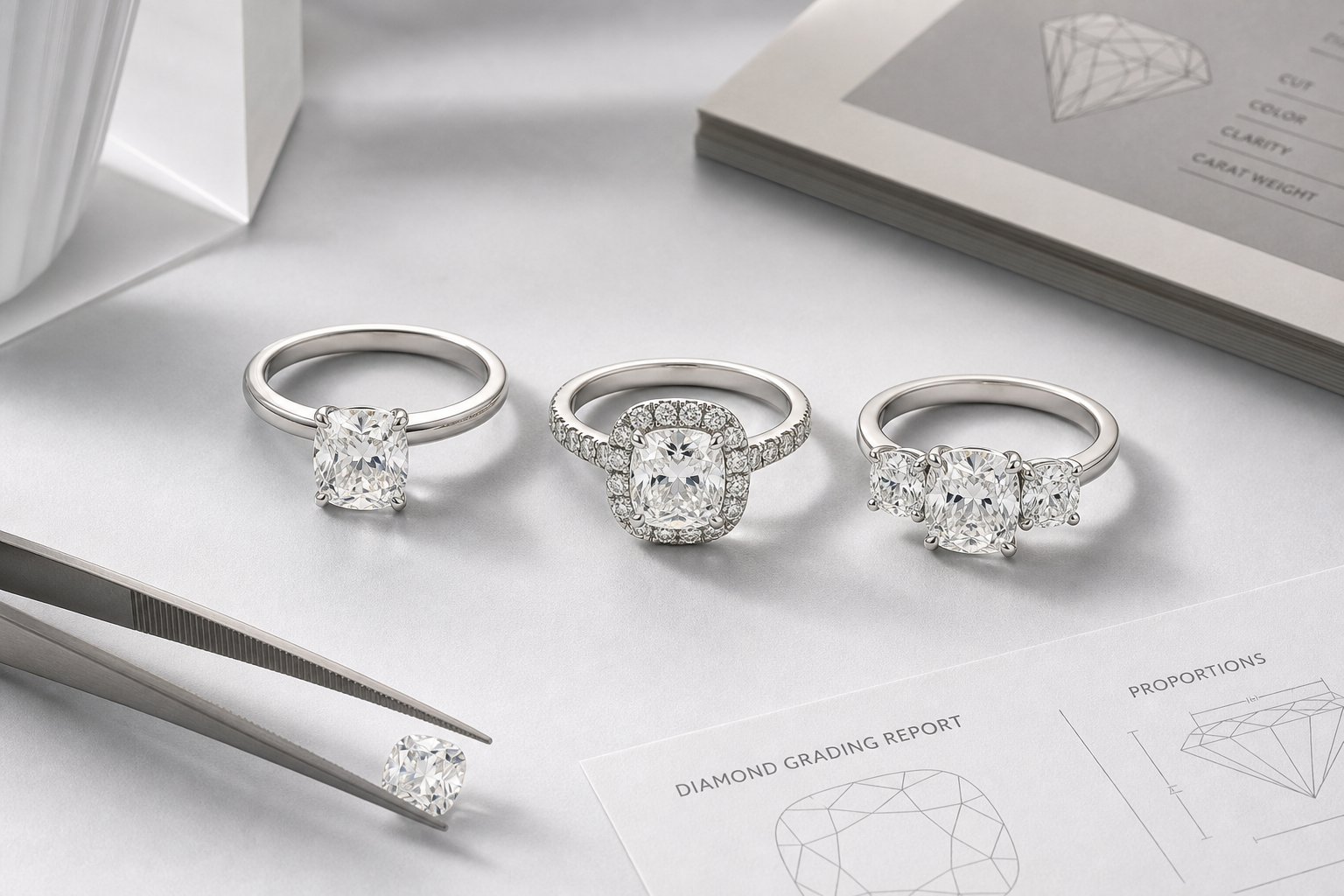
How to Compare Cushion Lab-Grown Diamonds Online
To buy cushion lab-grown diamond online with confidence, start by comparing stones in a controlled way. Cushion diamonds vary too much to judge by one grade or one photo, so a lab-grown diamond shapes guide can help frame how outline, visual spread, and wearability affect comparisons before a useful process narrows the field first, then compares measurements, video, report details, and setting fit before any final decision.
Online diamond buying becomes harder when every stone is compared at once. A square crushed-ice cushion, an elongated brilliant cushion, and a chunky vintage cushion may all be attractive, but they are not trying to do the same thing visually. The goal is not to find the highest grade on the page; it is to compare cushion lab diamonds that actually fit the look you want.
Step 1: Filter by Shape, Ratio, and Carat Range
Begin with the broad preferences that change the look most: square or elongated outline, target carat range, acceptable color and clarity range, and budget. This prevents a common online shopping problem, where the buyer spends hours comparing stones that would never belong in the same final shortlist.
For example, if you know you want a softly elongated cushion for a solitaire, a very square cushion with a different facet style may not be a useful comparison even if the carat and color look appealing. Filtering early keeps the search focused on realistic options.
Step 2: Compare Measurements and Face-Up Spread
After filtering, compare length and width closely. Carat weight can make two stones seem equivalent, but the measurements reveal how much diamond you will actually see from the top. A cushion with more depth may carry weight below the surface, while another stone of similar carat weight may appear broader or longer face-up.
This step is especially important for engagement rings because the visible size has to work with the wearer’s hand and the chosen setting. If a stone meets your carat goal but looks smaller than expected in millimeters, do not assume the setting will fix it. The better move is to compare it against another cushion with similar grades but stronger face-up presence.
Step 3: Review Images and Video for Facet Behavior
Images and 360 video are where cushion comparisons become more meaningful. Look for brightness, contrast, symmetry, and whether the sparkle style matches your preference. A crushed-ice cushion should be judged for whether its glittery texture looks lively rather than cloudy. A brilliant cushion should be checked for clean flashes and balanced contrast, not just the label on the grading report.
Do not rely only on magnified views. They are useful for inspecting details, but they can exaggerate characteristics that are not obvious in real life. If normal-distance video is available, use it to judge the stone the way it will actually be seen on the hand.
Step 4: Check Report Details and Seller Documentation
The diamond grading report should match the listed stone, including report number, carat weight, measurements, color, clarity, and shape description. Where possible, verify the grading report number through the issuing laboratory’s report lookup. This confirms that the listing and report are aligned, but it does not prove the diamond is visually beautiful.
At NUVU, we treat the grading report as a starting point, not the whole decision, because a report cannot show whether a cushion’s outline, sparkle pattern, and setting fit will meet a buyer’s expectations. The strongest online choice usually comes from matching documentation with actual visual evidence.
It is also worth checking that the listing language stays specific. Terms such as “premium,” “ideal,” or “excellent sparkle” are less useful than verifiable details such as measurements, report information, clear media, and setting compatibility. For lab-grown diamonds, any claims about origin, production method, or sustainability should be supported by documentation rather than assumed from the phrase “lab-grown.”
Environmental and sustainability claims should be specific and documented. Broad green language is less useful than clear information about production context, energy information where provided, sourcing transparency, and the seller’s willingness to explain what a claim does and does not cover.
When growth method or post-growth treatment is relevant, buyers should look for clear disclosure in the grading report or seller documentation. HPHT and CVD may refer to laboratory diamond growth methods; if a seller is discussing post-growth treatment, that treatment status should be documented rather than assumed.
Why Still Images Alone Can Be Misleading
A single still image is often the least reliable way to judge a cushion diamond. Lighting direction, camera angle, and image scaling can all make the same stone appear brighter, larger, or more symmetrical than it really is. A photo can be helpful, but it should not carry the whole decision.
This is especially true for cushions because the visual result changes a lot as the stone moves. A crushed-ice cushion may look lively in motion even if the still image seems flat. A brilliant cushion may show strong contrast only when it turns through light. The most practical comparison uses a top view, motion video, and measurements together.
If a listing gives you only one flattering photo and very little detail, treat it as incomplete. Ask for more evidence before you compare it seriously to other stones.
Buyer Verification Checklist
Before committing to a cushion lab-grown diamond, review the details that affect both appearance and purchase confidence:
- Grading report number and issuing laboratory
- Laboratory-grown origin disclosure
- Carat weight, length, width, and depth
- Length-to-width ratio
- Color and clarity grades
- Cut description or shape description if provided
- Photos, magnified video, or 360 video
- Seller’s return, resizing, or review terms to confirm before purchase
- Compatibility with the intended setting
If two stones are close on paper, choose the one that looks better in the actual evidence. For cushion diamonds, the stronger option is often the stone with the more appealing face-up shape and light behavior, not the one with the slightly cleaner-looking grade combination.
Common Mistakes When Choosing a Cushion Lab-Grown Diamond
Most cushion lab-grown diamond buying mistakes happen when buyers treat cushions like standardized shapes. They are not. A cushion cut diamond guide can help narrow the decision, but the final choice still depends on the specific stone’s outline, measurements, facet pattern, and setting compatibility.
A practical way to avoid regret is to compare real stones side by side instead of assuming the grading report tells the full story. A cushion can look romantic, modern, glittery, soft, elongated, compact, bright, or slightly dull depending on how all of those details come together.
Choosing by Carat Weight Alone
Carat weight does not guarantee that a cushion will look large or well-proportioned. A deeper stone may weigh more without giving the same face-up spread, while a better-balanced cushion can appear more satisfying at a similar weight.
The fix is simple: compare millimeter measurements and face-up images before treating carat as the deciding factor. If a stone looks small for its weight, investigate the depth and proportions before moving forward.
Ignoring the Difference Between Crushed Ice and Brilliant Facets
Facet pattern is one of the biggest drivers of how a cushion feels emotionally. A buyer who wants crisp, mirror-like flashes may be disappointed by a crushed-ice cushion, even if the grades look strong. A buyer who loves fine glitter and texture may find a brilliant cushion too structured or too clean.
The fix is to choose the sparkle style first, then compare stones within that style. Do not let a report description replace video review, because two cushions with similar labels can still behave differently in motion.
Assuming All Elongated Cushions Look Elegant
Elongation can be beautiful, especially for buyers who want more finger coverage or a more directional look. The risk is choosing a stone that is technically elongated but visually narrow, stretched, or uneven. In that case, the ring may look less graceful than expected.
The fix is to check the outline from a straight face-up view. The sides should feel balanced, the corners should relate to one another, and the elongation should look intentional rather than forced.
Forgetting the Setting Until After the Stone Is Chosen
A cushion’s setting should match its exact shape. This is especially important for halos, custom rings, and elongated cushions, where the wrong mounting can make the center stone look squeezed, misaligned, or less refined.
The fix is to think about the diamond setting before purchase, not after. If the goal is a halo, confirm that the halo can be built around the actual cushion outline. If the goal is a solitaire, make sure the prong style frames the stone without hiding the corners.
What to Check Before You Decide
Before choosing, compare two or three shortlisted cushions with similar carat weights but different ratios or facet styles. View them side by side using the same type of image or video whenever possible. The preferred choice is the diamond that delivers the look you want in real visual evidence, not the one that only appears strongest on paper.
Final Buying Framework: Which Cushion Lab-Grown Diamond Is Right for You?
The best cushion lab-grown diamond is the one whose shape, facet style, and setting fit work together. A strong grading report can help narrow the search, but it cannot tell you whether a cushion feels soft, crisp, vintage, elongated, balanced, or visually heavy. That decision comes from comparing real stones, not just grades.
If you are asking which cushion lab diamond should I buy, start with the look you want the ring to have. A cushion cut can feel classic, modern, romantic, or bold depending on small visual differences. The mistake is treating “cushion” as one fixed style when it is really a flexible shape family.
If You Want a Classic Soft Cushion Look
Choose a square cushion or slightly rectangular cushion with rounded corners, balanced sides, and a pleasing face-up outline. This is usually a practical direction for buyers who want a traditional cushion cut engagement ring that feels soft without looking overly antique or overly modern.
For this look, proportion matters more than maximum spread. A stone that is slightly smaller in visible size but has a better cushion outline may be the stronger choice than one that looks larger but uneven. If the corners feel natural, the sides are balanced, and the facet pattern does not distract from the shape, the diamond will usually look more refined in a finished ring.
If You Want a More Modern Sparkle
Look for a modern cushion with a brilliant-style facet pattern, visible contrast, and strong brightness in video. This style tends to work especially well in clean solitaire settings, hidden halos, and streamlined designs where the center stone carries most of the visual impact.
The main risk is choosing a stone that looks bright only in ideal lighting but flat or busy in normal video. A good modern cushion should not just sparkle; it should have a clear, organized pattern that looks lively without becoming chaotic. If two stones have similar grades, choose the one with better visual behavior over the one with a slightly higher clarity or color grade that does not look as engaging.
If You Want Vintage Romance
Consider a vintage cushion with chunkier facets, broader flashes, and a softer design context. This look pairs naturally with halos, milgrain details, warm metal tones, or settings that lean romantic rather than minimal.
The practical tradeoff is that vintage-style cushions may not look as sharp or glittery as modern brilliant cushions. That is not a flaw if you want slower flashes and a softer personality. It becomes a poor choice only if you expect the stone to behave like a high-contrast modern brilliant cut. For a vintage-inspired ring, emotional fit matters: the stone should support the design rather than fight it.
If You Want the Largest Visual Presence
Compare elongated cushion options carefully, especially their millimeter measurements and length-to-width ratio. An elongated cushion can give more finger coverage and a more directional look, which often makes it appealing as an engagement ring center stone.
Bigger-looking is not automatically better. A cushion that is too narrow, too stretched, or poorly balanced can lose the soft pillow-like character that makes the shape attractive in the first place. The better target is an elongated cushion that looks intentional: enough length to flatter the finger, enough width to feel substantial, and enough light performance to avoid looking dull at the ends or center.
Next Step Before Purchase
Before shopping seriously, narrow the decision to three preferences: square or elongated outline, crushed-ice or brilliant/vintage facet style, and the setting type you are most likely to choose. Those three choices will eliminate many stones that look acceptable on paper but do not match your actual design goal.
Then compare actual cushion lab-grown diamonds using reports, measurements, images, and videos together. At NUVU, this is the kind of selection process we encourage because a cushion diamond should be judged as a finished visual choice, not as a list of isolated grades. If you are planning a custom ring, the stone and setting should be evaluated together before the final decision is made.
When a grading report is provided, buyers should compare the report number, measurements, carat weight, color, clarity, laboratory-grown origin disclosure, and shape description with the issuing laboratory’s verification tools where available.
For cushion lab-grown diamonds, this documentation step is especially useful because the report details should align with the stone being reviewed. It does not replace judging the diamond’s outline, facet pattern, or face-up beauty, but it gives buyers a practical checkpoint before comparing visual details.
If a GIA, IGI, GCAL, or other laboratory report is provided, the report details should be checked through that laboratory’s own report verification system when such a tool is available.
NUVU’s role in buyer education is to make comparison clearer, especially around grading reports, visual evidence, design fit, and documentation.
When a cushion diamond is being considered for a custom ring, the practical review should focus on matching the report to the stone, reviewing millimeter spread, checking whether the cushion outline suits the intended setting, and making sure the selected prong, halo, or side-stone layout is designed around the actual diamond rather than a generic cushion template.
This kind of documentation-aware selection is meant to reduce uncertainty rather than pressure a buyer into one style. A square vintage-style cushion, an elongated brilliant cushion, and a crushed-ice cushion can all be valid choices when the report, visual evidence, and setting plan tell the same story.
FAQ: Cushion Lab-Grown Diamond Questions Buyers Often Ask
Are cushion lab-grown diamonds sparkly?
Yes, a cushion lab-grown diamond can be very sparkly, but the sparkle style depends on the facet pattern. A crushed ice cushion has many small, glittery reflections, while a brilliant cushion often shows clearer flashes and stronger contrast. Chunky or vintage-style cushions usually produce broader, slower flashes rather than a sharp glitter effect.
Do cushion cut diamonds look smaller than round diamonds?
Sometimes they can appear slightly smaller face-up at the same carat weight because cushion cuts may carry more weight in depth and have rounded corners instead of a full circular outline. This does not make them a poor choice, but it does mean millimeter measurements matter more than carat weight alone.
What is the best ratio for an elongated cushion diamond?
Many buyers like an elongated cushion diamond ratio around 1.10 to 1.20 because it creates visible length without usually looking too narrow. Ratios above 1.20 can still work, but they need closer visual review. If the stone looks stretched, uneven, or thin across the width, the number is not helping the design.
Is a cushion cut good for an engagement ring?
Yes, a cushion cut is a strong choice for an engagement ring if you want a softer outline than a princess or radiant cut. A cushion engagement ring can work well as a solitaire, halo, three-stone, or vintage-inspired design, as long as the setting is built around the stone’s actual measurements and corner shape.
Is crushed ice or brilliant cushion better?
Neither is universally better. A crushed ice cushion is better if you like a fine, glittery texture and do not need crisp flashes. A brilliant cushion is usually better if you want cleaner contrast, brighter flashes, and a more modern look. The better choice is the one that matches your eye in real images and video, not the one with the more appealing label.
Are lab-grown cushion diamonds the same as natural cushion diamonds?
No. A laboratory-grown cushion diamond and a natural cushion diamond may share diamond material and a similar cut style, but they have different origins. A lab-grown diamond should be clearly identified as laboratory-grown in the listing, seller documentation, and grading report when a report is provided. Diamond simulants are a separate category and should not be described as lab-grown diamonds.
Disclosure: This article is for general educational purposes only. Diamond grading, pricing, availability, specifications, and seller policies can change, and readers should verify important details through grading reports, official laboratory tools, seller documentation, or qualified professionals before making a purchase decision. Laboratory-grown diamonds should be clearly distinguished from natural diamonds, and environmental or sourcing claims should be supported by specific documentation.