
Pear lab-grown diamonds can be difficult to judge from a grading report alone. Their beauty depends heavily on face-up balance: whether the point lines up with the rounded end, whether the shoulders look even, and how elongated-shape evaluation principles from a marquise lab-grown diamond guide can help buyers understand coverage, symmetry, and visual drama. Whether the bow tie adds contrast or creates a dull center, and whether the overall form suits the final ring, pendant, or earrings, small differences in ratio, depth, and symmetry can change how large, bright, and graceful the stone appears.
For the full framework, read Lab-Grown Diamond Shapes Guide.
For buyers, the practical point is not just what the report says, but how the stone performs visually and how it will sit in the final setting. A pear that looks balanced loose may still need a different prong layout or orientation once the design is finalized.
This guide helps you look beyond carat weight and grade labels to evaluate what matters in a pear shape. You’ll learn how to compare proportions, read images and videos more carefully, judge tip protection, and connect the diamond choice to the setting design. The goal is not to find one “perfect” pear, but to choose a stone that looks balanced, performs well, and can be set securely for its intended use.
| What to Check | Good Sign | Watch For |
|---|---|---|
| Length-to-width ratio | Often 1.50–1.65 for a classic teardrop | Too wide, too stretched, or awkward shape |
| Shape symmetry | Centered tip, even shoulders, smooth rounded end | Flat base, swollen side, or leaning point |
| Bow tie | Soft contrast that moves in video | Fixed dark band across the center |
| Tip protection | V-prong, bezel, or precise prong layout | Exposed point, especially in rings |
| Grading report details | Used to verify color, clarity, and measurements | Choosing by paper grade without visual review |
| Setting fit | Stone chosen with final design in mind | Buying by carat weight before checking dimensions |
Quick Questions Before You Read
Q: Is a bow tie always a problem in a pear diamond?
No. Some contrast is normal and can add life, but a dark band that stays fixed can make the center look dull.
Q: What pear diamond ratio looks best?
Many buyers prefer about 1.50–1.65, but the right ratio depends on shape, brightness, and the jewelry design.
Q: Can a grading report tell me if a pear diamond is well shaped?
Not fully. Reports verify details, but photos, 360 videos, and measurements are needed to judge balance and bow tie.
Q: Does the pointed tip need special protection?
Yes, especially in rings. A V-prong, bezel, or carefully planned prong layout helps protect the most vulnerable part.
Why Pear Lab-Grown Diamonds Need Shape-Specific Evaluation
A pear lab-grown diamond is not just a round diamond with a point. It is a fancy shape diamond with an uneven visual structure: one end is rounded, the other narrows into a pointed tip, and the entire outline depends on balance. That teardrop diamond silhouette is the reason many buyers like it, but it is also why the shape needs more careful review than a round brilliant or a simple rectangular cut.
The main mistake is judging a pear shaped lab diamond by report grades alone. Carat, color, clarity, and measurements are useful, but they do not tell you whether the stone looks centered, graceful, bright, or secure in the setting. A pear can look impressive on paper and still feel slightly crooked, too squat, too narrow, or visually dark through the middle.
It is also worth separating the production method from the visual assessment. Lab-grown origin may affect documentation and pricing, but it does not tell you whether the pear outline is centered, whether the bow tie is controlled, or whether the stone will suit a ring, pendant, or earring design.
Evidence note: what a report can support
A grading report is strongest when it is used for the specific information it actually documents: measurements, carat weight, color grade, clarity grade, proportions listed on the report, and any lab-grown identification or inscription details included by the issuing laboratory. It should not be stretched into proof that the pear is visually beautiful, that its bow tie is acceptable, or that a particular setting will protect the tip well. Those judgments require imagery, video, and design review in addition to the document.
When comparing lab-grown pear diamonds, keep the terminology clear. “Lab-grown” describes origin, not cut quality or visual performance. A lab-grown pear can be beautifully cut, poorly balanced, or somewhere in between, just like any fancy shape. The safest buying process is to let the report verify identity and baseline characteristics, then let direct visual comparison decide whether the shape, contrast, and setting plan are strong enough.
Laboratory-grown diamonds should be clearly identified as laboratory-grown, and they should not be presented as mined diamonds. Natural diamonds and laboratory-grown diamonds are both diamonds, but they have different origins, and that origin should be disclosed clearly in seller descriptions, grading reports where available, and purchase documentation.
Diamond simulants are a separate category from lab-grown diamonds. Materials such as cubic zirconia or moissanite may resemble diamonds visually, but they are not laboratory-grown diamonds. If a listing, invoice, or product page uses unclear wording, buyers should ask whether the stone is a laboratory-grown diamond, a natural diamond, or a diamond simulant before comparing grades, price, or setting options.
When a grading report is available, buyers should verify the report details through the issuing laboratory’s official report-check tool where available, then compare those details with the stone’s photos, video, and measurements.
How to keep the comparison traceable
A traceable pear diamond comparison starts by keeping the same stone identifier, report number, measurements, and visual media together. If you are comparing several loose stones, record each diamond’s length, width, depth, ratio, color grade, clarity grade, and any inscription or report reference before making a visual judgment. This prevents a common online buying problem: liking a video or image but later mixing it up with a different report or similar carat weight.
Traceability is also useful when the diamond will be used in custom jewelry. The designer or jeweler should be working from the exact stone’s dimensions, not from an approximate carat category. A clear file of the report, measurements, selected orientation, and setting notes makes it easier to confirm that the prong layout, V-prong, basket, or bezel is being planned around the actual pear shape rather than a generic template.
The teardrop shape creates both beauty and risk
The pear diamond shape combines a rounded base with a pointed tip, creating a line that can feel elegant, elongated, and distinctive. This shape can flatter the finger in a ring and create a strong drop effect in a pendant. It also often gives more visual length than compact shapes of the same carat weight.
The tradeoff is that imbalance is easier to notice. If the tip sits slightly off-center, if one shoulder is fuller than the other, or if the rounded end looks flat, the entire diamond can look wrong even before a buyer knows why. Round diamonds are forgiving because the eye expects circular symmetry. Pear diamonds are less forgiving because the eye follows the outline from end to end.
Why lab-grown does not remove the need for visual inspection
Lab-grown diamonds should still be evaluated for the same shape-specific concerns buyers apply to any pear diamond: outline balance, bow-tie behavior, proportions, clarity visibility, and setting fit. Choosing lab-grown may offer advantages in budget flexibility and selection, but it does not automatically solve cut quality, bow tie, outline balance, or setting compatibility.
A grading report can confirm important basics such as measurements, carat weight, color grade, clarity grade, and sometimes a clarity plot. It cannot fully show whether the pear outline looks graceful in real life, how strong the bow tie appears as the stone moves, or whether the tip will look too sharp or too exposed in the finished piece. For this shape, visual judgment carries more weight than many first-time buyers expect.
The four pear-specific checks buyers should prioritize
To choose a pear lab-grown diamond well, start with the factors that affect the shape most directly: outline symmetry, length-to-width ratio, bow-tie effect, and tip protection. These should be reviewed before getting overly focused on small differences in color or clarity grades.
Outline symmetry tells you whether the diamond looks balanced from the pointed tip to the rounded end. Length-to-width ratio controls whether the stone appears fuller, classic, or very elongated. Bow tie affects how much darkness appears across the center. Tip protection determines whether the most vulnerable part of the stone will be properly secured in the final setting.
This is especially important for anyone trying to find a suitable pear diamond for engagement ring use. Rings receive more daily contact than pendants or earrings, so the decision is not only about beauty. The diamond needs to look right face-up and make sense physically inside the setting.
What to Check Before You Decide
- View the diamond face-up before judging the shape from measurements alone.
- Check whether the pointed tip lines up with the center of the rounded end.
- Compare both shoulders and make sure one side does not look heavier or flatter.
- Review 360-degree video instead of relying only on a still image.
- Confirm how the pointed tip will be protected in the final setting.
A pear diamond is not a risky choice by default. The risk comes from treating it like a standard shape where the report can do most of the work. With pear diamonds, the face-up appearance should lead the decision.
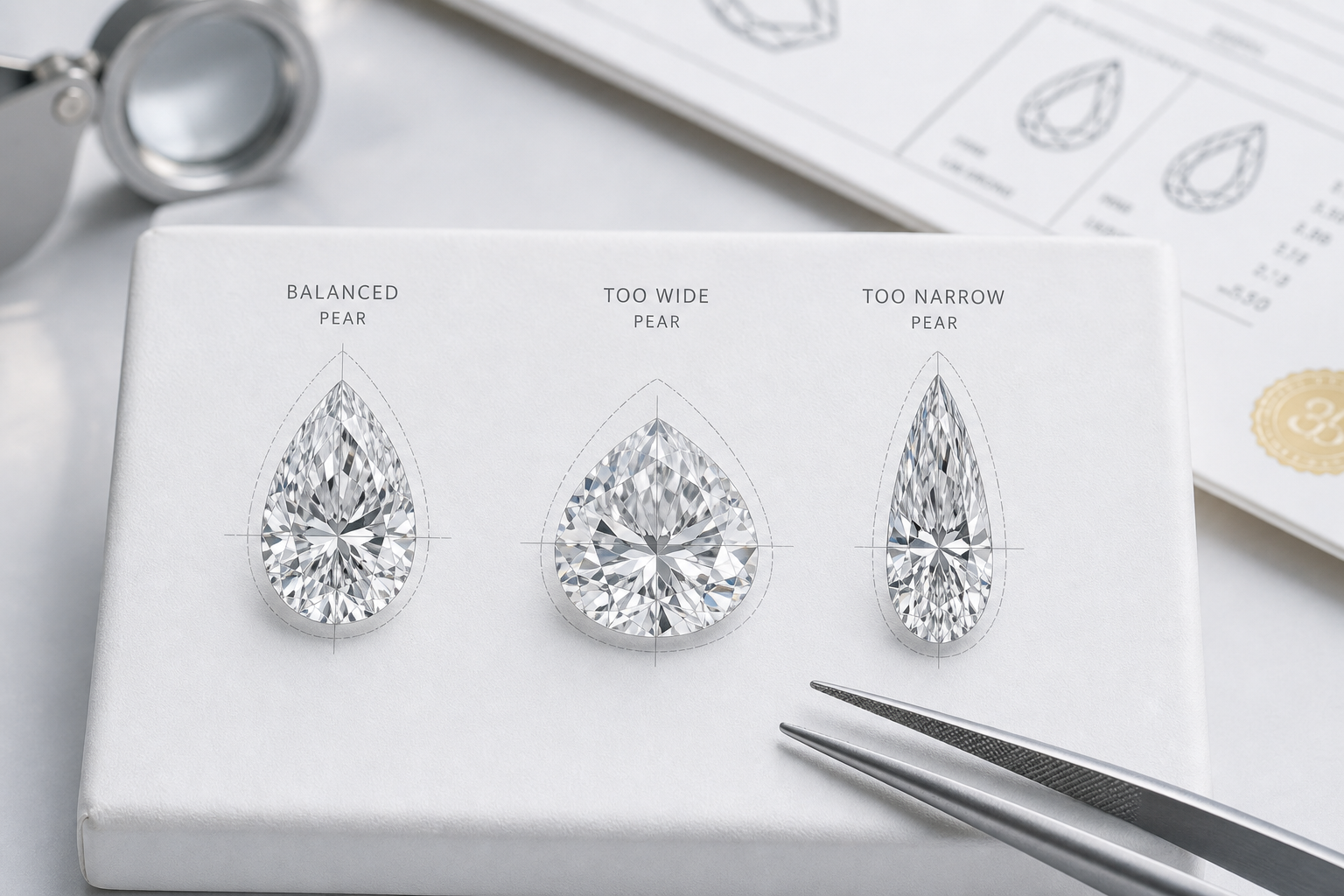
Length-to-Width Ratio: How Pear Diamond Proportions Change the Look
Pear diamond ratio is one of the clearest ways to predict the overall style of the stone before comparing videos. The ratio is the diamond’s length divided by its width. It does not prove that a diamond is beautiful, but it quickly tells you whether you are looking at a fuller pear, a classic teardrop, or a very elongated pear diamond.
Pear diamond proportions matter because this shape is judged by outline first. A small change in length-to-width ratio can make the same carat weight feel soft and rounded, balanced and elegant, or narrow and dramatic. None of these looks is automatically wrong, but each works better in different jewelry designs.
Common pear diamond ratio ranges
Many pear diamonds fall roughly between a 1.45 and 1.75 length-to-width ratio. A balanced classic look often appears around 1.50 to 1.65. This range usually gives enough length to create the teardrop effect without making the stone look stretched or thin.
Ratios below about 1.45 tend to create a wider pear diamond. This can suit buyers who like a fuller, softer shape, but if the stone becomes too wide, it may lose some of the elegant taper that makes pear diamonds appealing. Ratios above about 1.75 create a more elongated look. That can be striking, especially in a solitaire ring or pendant, but it can also make the tip and shoulders look more severe if the outline is not well balanced.
The preferred pear diamond ratio is not one fixed number. A 1.58 pear with uneven shoulders may look worse than a 1.70 pear with a clean, graceful outline. Use the ratio to narrow your preference, then let the actual face-up appearance decide.
How ratio affects finger coverage and visual size
An elongated pear diamond can appear larger face-up because its length spreads more visible area across the finger. This is one reason pear diamonds often appeal to buyers who want strong presence without moving dramatically higher in carat weight.
The warning is that length alone is not the same as beauty. If the diamond is too shallow, poorly proportioned, or strongly affected by a bow tie, the extra spread can come at the cost of brightness. A stone that looks long in the measurements may not look better in person if the middle appears dark or the outline feels awkward.
For pear diamond size appearance, compare the actual millimeter measurements along with the ratio. Two diamonds with the same carat weight can look meaningfully different if one carries more weight in depth and the other spreads more length and width face-up.
Interpreting measurements without overclaiming
Measurements help make the comparison more objective, but they should not be treated as a complete performance score. Length and width describe the visible footprint, while depth helps explain how the stone carries weight. They do not, by themselves, prove brightness, symmetry, bow-tie strength, or beauty. A buyer-friendly way to use measurements is to ask what they suggest, then confirm that suggestion with visual evidence.
This is especially useful when two stones have similar carat weights. If one pear is longer and narrower while another is shorter and wider, the report measurements can explain why they feel different on the hand. But the final choice should still come from the face-up view: the stronger stone for your purpose is the one whose outline, contrast, and setting fit make sense together, not simply the one with the most dramatic millimeter spread.
Choosing a ratio for rings versus pendants
For rings, a balanced outline often works well because the diamond has to sit naturally on the finger. A ratio around the classic range can give length without making the tip look overly dominant. Very elongated pears can be beautiful in rings, but they need better setting planning because the pointed end becomes more visually and physically important.
Pendants can sometimes handle a longer pear more easily. The vertical drop supports the teardrop proportions, and the stone does not face the same impact risk as a ring worn on the hand. A fuller pear can also work well in a pendant, especially if the goal is a visible, balanced shape from a normal viewing distance.
The practical decision is simple: if the diamond will be worn on the hand every day, prioritize balance and setting fit. If it will be worn as a pendant, you may have more room to choose a dramatic vertical silhouette.
Ratio Check Before Buying
To calculate pear diamond ratio, divide the length by the width using the measurements from the grading report. For example, a pear measuring 10.0 mm by 6.3 mm has a ratio of about 1.59. That falls within the classic balanced range for many buyers.
The number is only a starting point. After calculating it, compare the diamond against photos or video. A ratio can tell you the category of the shape, but it cannot tell you whether the shoulders are even, whether the rounded end is smooth, or whether the bow tie is distracting. Decide whether you prefer a fuller, classic, or elongated pear before comparing individual stones, then use visual review to choose among them.
Symmetry, Shoulders, and Outline Balance in Pear Lab-Grown Diamonds
Pear diamond symmetry is one of the most important quality checks because the entire shape depends on a clean visual line from the pointed tip to the rounded end. In a pear lab-grown diamond, even a small imbalance can make the stone look slightly twisted, heavy on one side, or less refined than its grades suggest.
This is not mainly about reading a symmetry grade on a report. It is about face-up symmetry: what the eye sees when the diamond is viewed from above. A balanced pear diamond should look intentional from end to end, with no obvious lean, flat spot, or uneven side pulling attention away from the overall silhouette.
The centerline test
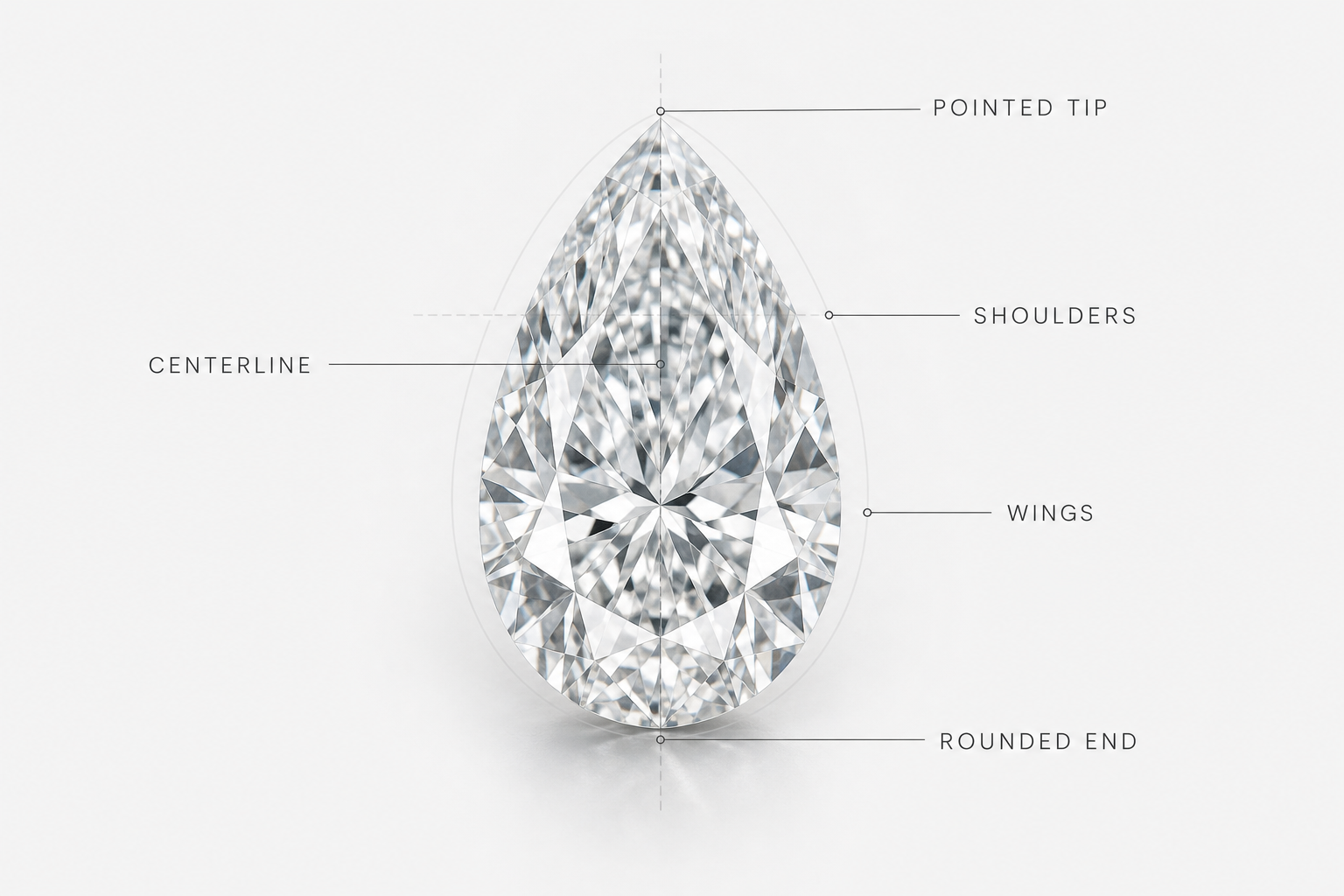
Start by imagining a straight line running from the pointed tip through the center of the rounded end. The tip should sit on that line, and the rounded base should feel evenly distributed on both sides. If the tip leans left or right, the diamond may look off-center once it is set, especially in a solitaire design where there are no side stones to distract the eye.
This test matters more than many buyers realize. A pear can have attractive color and clarity but still look awkward if the centerline is not convincing. The issue becomes even more visible in rings because the diamond is viewed repeatedly from the same top-down angle during daily wear.
Shoulder balance and wing shape
The shoulders are the curved upper areas that transition from the rounded end into the narrowing sides. They should feel like a matched pair. One shoulder should not appear higher, flatter, bulkier, or more collapsed than the other.
Wing shape also affects the outline. If one side narrows too sharply while the other carries more weight, the diamond can look lopsided even when the tip itself seems centered. This is where many average-looking pears fall short: the problem is not dramatic enough to be called defective, but it is visible enough to make the stone less pleasing.
Rounded end fullness
The rounded end should look smooth, complete, and naturally curved. If it appears squared off, flattened, or overly bulging, the diamond may lose the clean teardrop shape that makes pears attractive in the first place.
A rounded end that is too flat can make the stone feel blunt. One that is too swollen can make the pear look bottom-heavy. The better choice is usually the stone whose outline feels balanced without requiring the viewer to “forgive” one end of the shape.
Visual Review Checklist
- Review face-up video first, not only angled beauty shots.
- Pause the video at multiple points and check whether the tip stays centered.
- Compare both shoulders and look for uneven height, bulk, or flatness.
- Check that the rounded end looks smooth rather than squared or swollen.
- Look at still photos and the report plot if available, but do not let either replace visual inspection.
If you are deciding how to choose a pear diamond online, outline balance should come before minor grade differences. A higher-clarity stone with an awkward outline is usually a weaker choice than an eye-clean stone with a graceful, balanced shape.
Bow-Tie Effect: When It Adds Contrast and When It Becomes a Problem
The pear diamond bow tie is one of the easiest features to notice once you know what to look for, but it is also one of the most misunderstood. A bow tie effect is not automatically a flaw. In many pear-shaped diamonds, some contrast through the center helps the stone look lively rather than flat. The problem starts when that contrast becomes a dark, fixed band that dominates the diamond instead of moving with the light.
This is why bow tie should be judged visually, not assumed from the shape alone. Two pear diamonds with similar carat weight, color, clarity, and measurements can show very different light performance. One may have a soft contrast pattern that flashes as the stone moves. Another may hold a heavy shadow across the middle, making the diamond look dull even when the grading report looks strong.
Bow tie is best judged under neutral lighting and in motion. Strong showroom lights can hide a problem, while a still image can make a normal contrast pattern look worse than it is. If the shadow stays fixed across several angles, that is more concerning than a contrast band that appears and breaks up as the diamond moves.
What the bow-tie effect looks like in a pear diamond
In a pear diamond, the bow tie usually appears across the wider middle section of the stone, often as a horizontal or slightly diagonal shadow. It may look like two darker triangular areas meeting near the center, or it may appear as one broad dark zone stretching from side to side.
The strength of the bow tie can change depending on the diamond’s proportions, facet arrangement, cut quality, lighting, and viewing angle. A stone that looks balanced in one still photo may show a stronger dark bow tie in motion. The reverse can also happen: a still image may exaggerate a shadow that becomes much less noticeable once the diamond moves.
The key judgment is not whether you can find any darkness at all. Almost every brilliant-cut fancy shape diamond has some contrast. The more useful question is whether the dark area helps define sparkle or whether it blocks it.
Normal contrast versus distracting darkness
Normal contrast appears and disappears as the diamond moves. It gives the eye something to read and can make the flashes of light feel sharper, a principle also discussed in this cushion diamond sparkle guide when comparing soft outlines, vintage character, and modern brilliance. In a well-performing pear diamond, the center should not look like a dead zone. You should see a mix of brightness, contrast, and movement rather than a single dark patch that stays in place.
A problematic bow tie is different. It remains obvious across several angles and lighting conditions, especially in face-up view. If the center looks consistently gray, black, or lifeless while the ends of the stone look brighter, the bow tie is no longer just contrast. It is interfering with the diamond’s visual performance.
This matters most in engagement rings and solitaire designs because the center of the stone is constantly visible. In a pendant viewed from a little farther away, a mild bow tie may be less noticeable. In a close-up ring setting, a strong bow tie can become the first thing people see, even before size or color.
Why reports do not fully reveal bow tie
A grading report can confirm useful facts, including carat weight, color grade, clarity grade, and measurements. It cannot fully show how a pear diamond handles light in real viewing conditions. The report may give you the dimensions that influence the stone’s outline, but it will not reliably tell you whether the bow tie looks soft, moderate, or distracting.
This is a common buying mistake: choosing the “better” paper diamond and assuming the bow tie will be acceptable. A higher clarity grade does not remove a dark bow tie. A desirable color grade does not guarantee strong light return. Even a ratio that looks ideal on paper can still produce a center shadow if the cut and facet pattern do not work well together.
For pear diamonds, the grading report should narrow the search, not finish it. The final call should come from face-up images, video, and a direct comparison against other stones in the same size range.
How to Verify Bow Tie Before Buying
Use a pear diamond video review as a practical test. A 360-degree video is especially useful because it shows whether the dark area moves, breaks up, and flashes with the rest of the diamond. If the bow tie turns on and off as the stone rotates, it is usually normal contrast. If it stays heavy and fixed through most of the video, that is a warning sign.
Neutral lighting is better than overly dramatic showroom lighting or heavily edited imagery. Strong spotlighting can hide problems by creating intense flashes, while poor lighting can make a decent stone look darker than it is. If the bow tie is unclear, ask for additional face-up photos or video before deciding.
To avoid a distracting bow tie in a pear diamond, compare at least two or three stones side by side when possible. The better choice is not always the one with the highest grade or largest carat weight. It is the one where the contrast feels moderate, active, and balanced within the overall shape.
Pointed Tip Durability and Setting Protection
Pear diamond tip protection deserves serious attention because the pointed tip is the most exposed part of the shape. This does not mean pear diamonds are fragile overall. It means the tip needs a setting that respects how the stone will be worn, especially in a ring that may contact desks, door handles, countertops, and other hard surfaces throughout the day.
A well-planned pear diamond setting reduces that risk without taking away from the silhouette. The mistake is treating the setting as a style decision only. For a pear diamond engagement ring setting, the design has to protect the point, hold the stone securely, and still let the teardrop outline look clean.
If the wearer is active or prefers a lower-profile ring, the setting choice becomes even more important. A secure basket, well-placed prongs, and a modest setting height can make the diamond easier to wear without changing the overall pear shape too much.
Why the tip needs special attention
The rounded end of a pear diamond distributes visual weight and physical exposure more gently. The pointed tip does the opposite. It narrows into a small area, so impact risk is more concentrated there than along the curved side of the stone.
This matters most for rings because hands are active. A pendant or pair of earrings may face less direct impact, but a ring is worn in the most contact-heavy position. If the tip is left too exposed, even a beautiful diamond can become a poor practical choice for daily wear.
The goal is not to hide the tip completely. The point is part of what makes the pear shape elegant. The better judgment is to protect the tip enough that the stone can be worn confidently without making the setting look bulky or crowded.
V-prongs and protective setting choices
A V-prong is one of the most common ways to protect pear diamond tip. Instead of using a small round prong at the point, a V-prong wraps around the tip and shields it from direct contact. For many solitaire and three-stone ring designs, this is a practical protection because it preserves the outline while covering the most vulnerable area.
Standard prongs can still be used around the rest of the diamond, but the tip usually benefits from more coverage than the shoulders or rounded end. If the ring will be worn every day, a minimal setting that leaves the point visually exposed may look delicate but create an unnecessary durability concern.
For buyers who prioritize ring durability over an airy profile, a partial bezel or full bezel setting may be worth considering. A bezel can offer more continuous protection, but it also changes the look by adding more metal around the stone. That tradeoff is not good or bad by default. It depends on whether the wearer values a lighter, more open setting or a more protected, structured design.
Tip placement in custom design
Tip placement affects both appearance and security. A pear diamond set tip-up creates a different visual direction than one set tip-down, and the prong arrangement must support that orientation. The setting should be planned around the actual diamond, not around a generic carat size.
This is especially important in custom work. Two 1.50 ct pear diamonds may have different lengths, widths, depths, shoulder curves, and tip shapes. A setting made for one may not fit the other correctly. If the basket is too tight, the diamond can look cramped. If the prongs are poorly placed, the stone may not sit securely or the tip may remain underprotected.
For custom jewelry, the safer approach is to choose the stone and setting together. A pear diamond that looks graceful loose still has to work physically inside the design.
For custom design, trust comes from matching the stone to the setting, budget, and wearer’s daily use—not from choosing grades in isolation. Before finalizing a pear diamond, confirm that the design plan accounts for the actual measurements, the chosen orientation, the intended prong or bezel coverage, and the level of exposure the ring, pendant, or earrings will realistically face.
For custom jewelry, stone measurements and setting compatibility should be confirmed before finalizing a purchase. This includes the diamond’s length, width, depth, girdle outline, tip angle, and the exact position of prongs or bezel coverage. A design rendering can be helpful, but the final approval should still be tied to the selected stone’s real dimensions rather than a stock illustration.
Stone-to-Setting Fit Check
Before approving a pear diamond setting, confirm in writing that it is designed for the selected stone’s exact length, width, depth, and tip shape. Do not rely on carat weight alone. Carat tells you weight, not the physical outline the setting has to hold.
The jeweler should account for tip coverage, prong placement, stone height, and whether the diamond sits securely without looking forced into the mounting. For a pear diamond engagement ring setting, the V-prong or other protective detail should look intentional, not like an afterthought added after the design was already chosen.
A strong setting does not need to overpower the diamond. It should protect the most exposed point while allowing the pear shape to remain visually balanced from tip to rounded end.
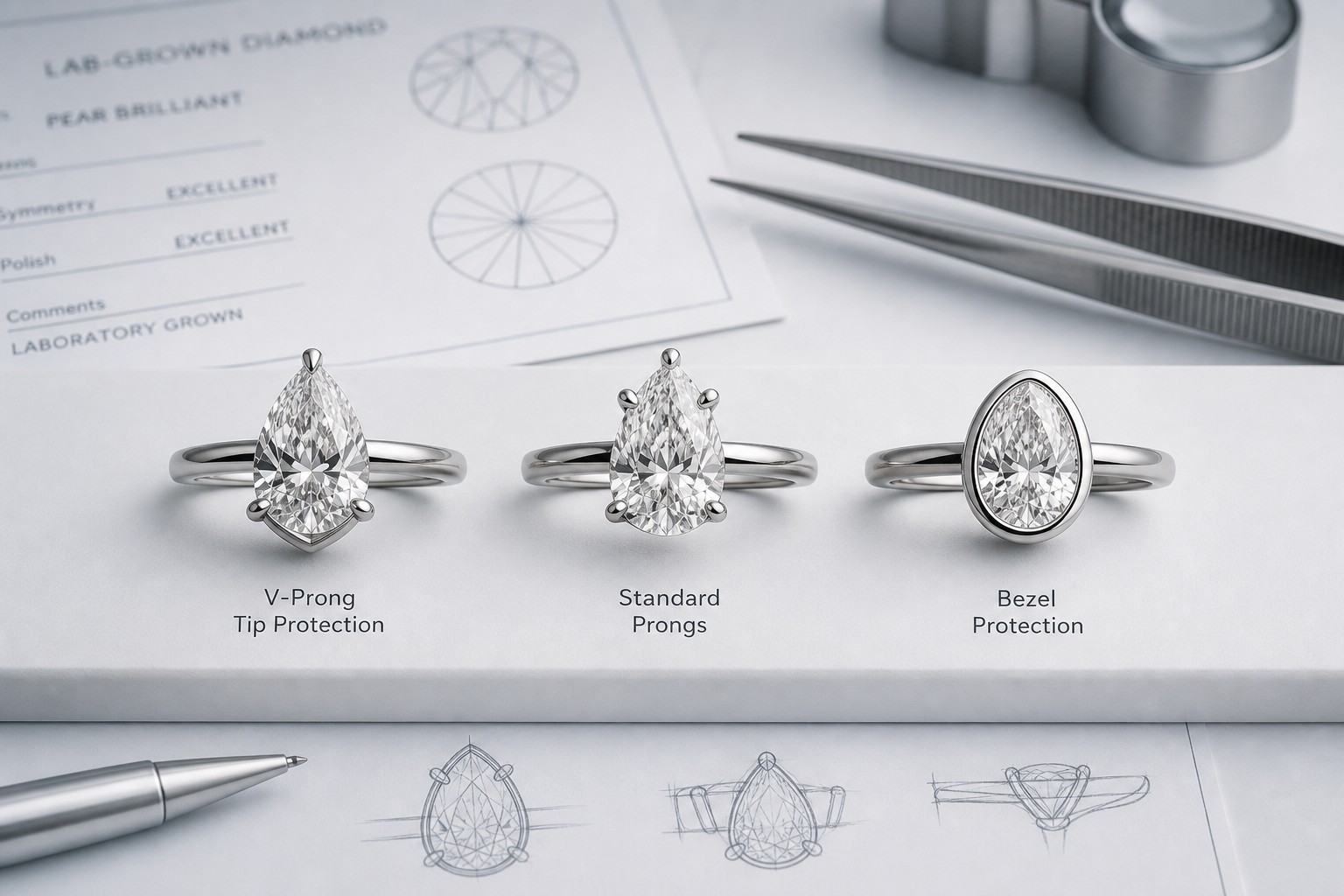
Orientation in Jewelry Design: Tip Up, Tip Down, East-West, Ring, or Pendant
Pear diamond orientation changes the entire personality of the finished piece. The same stone can look elongated, classic, modern, or sculptural depending on whether it is set tip up, tip down, horizontally, or vertically in a pendant design. This is why the preferred pear diamond is not only about the stone itself. It also depends on where and how it will be worn.
A pear diamond engagement ring places the shape in constant close-up view, so symmetry, tip protection, and finger coverage become more important. A pear diamond pendant is usually viewed from a little more distance, so the overall teardrop effect may matter more than tiny outline details. Earrings add another challenge: the stones need to look like a matched pair, not just two individually attractive diamonds.
Tip-up versus tip-down rings
In a tip-up ring, the point faces toward the hand. This can make the diamond appear to lengthen the finger and often gives the setting a clean, upward visual flow. It can be a strong choice for buyers who want the pear shape to feel sleek and elongated rather than traditional.
In a tip-down ring, the point faces toward the fingertip. This creates the more familiar teardrop direction and can make the stone feel centered toward the viewer. Some buyers find this orientation more intuitive because it follows the natural drop shape of the diamond.
Neither orientation is automatically better. The deciding factors are finger shape, setting style, comfort, and how the tip will be protected. If one orientation makes the point feel too exposed or visually sharp, the setting may need a stronger V-prong or a slightly different stone proportion.
East-west pear settings
An east-west setting turns the pear horizontally across the finger. This can look modern and distinctive, especially for buyers who want a pear diamond ring design that does not feel traditional. The tradeoff is that asymmetry becomes more noticeable when the shape is rotated. A slightly uneven shoulder or off-center tip may be easier to spot in an east-west layout than in a vertical solitaire.
Tip protection still matters in a horizontal setting. The point may sit toward one side of the hand, where it can be more exposed to side impact depending on the design. A low-profile setting, protective prong placement, or partial bezel can help, but the design has to be built around the stone’s actual outline.
East-west pears work best when the diamond has strong outline balance. If the stone already looks lopsided face-up, rotating it sideways usually makes the imbalance harder to ignore.
Pendants and earrings
Pear diamonds often work naturally in pendants because the teardrop silhouette follows gravity. A slightly elongated pear can look graceful in a vertical pendant, while a fuller pear may feel more balanced from a distance. Since pendants do not take the same daily impact as rings, tip protection is still relevant but usually less demanding than in an engagement ring.
Earrings require stricter matching. A pair should be close in size, length-to-width ratio, outline, and bow-tie strength. If one pear looks longer, darker, or more tilted than the other, the mismatch can become obvious once the stones are worn on opposite ears.
For custom pear diamond jewelry, stone selection should happen with the final piece in mind. A dramatic elongated pear may be ideal for a pendant drop but feel too sharp or unstable in a low-profile ring. A fuller pear may look soft and balanced in earrings but lack the finger-lengthening effect someone wants in a solitaire ring.
What This Means in a Real Purchase
Maya is choosing between two 1.50 ct pear diamonds. The first is more elongated and looks dramatic on the finger. It gives her ring more length and presence, but it also makes the pointed tip more visually prominent, so she chooses a setting with a clean V-prong and enough structure to protect the point.
The second 1.50 ct pear is slightly fuller. It does not look quite as long on the hand, but it appears balanced from a normal viewing distance and works beautifully as a pendant. Since the pendant will not face the same hand-wear impact as a ring, the design can focus more on the teardrop outline and less on heavy protective coverage.
That is the practical lesson: orientation changes the recommendation. A pear diamond should be selected for the piece it will become, not judged as if every ring, pendant, earring, or custom design needs the same proportions.
Color, Clarity, and Cut Priorities for Pear Lab-Grown Diamonds
For a pear lab-grown diamond, the strongest purchase logic is not always the highest grade on paper. Pear diamond quality depends heavily on how the stone looks face-up: whether the outline feels balanced, whether the brilliant faceting returns light evenly, and whether any bow tie or visual imbalance pulls attention away from the shape.
Color, clarity, and carat still matter, but they should not outrank cut quality and outline judgment. A technically higher color or clarity grade is a weak tradeoff if the diamond has uneven shoulders, a distracting center shadow, or proportions that do not suit the final setting.
Grading reports are most useful when they are treated as verification tools, not beauty guarantees. If sustainability or sourcing is part of the buying decision, it should be treated as a documentation question rather than a slogan, because the report by itself does not prove every production or handling claim.
Cut and outline should lead the decision
Pear diamonds are fancy shapes, so many grading reports do not provide a single cut grade in the same way buyers may expect with round brilliant diamonds. That makes visual evaluation more important. The report can tell you the measurements, weight, color grade, clarity grade, and sometimes polish and symmetry, but it cannot fully decide whether the pear shape looks graceful in real life.
The first priority should be brightness and outline together. A pear can have strong sparkle but still look awkward if one shoulder is heavier than the other. It can also have an attractive outline but feel dull if the faceting does not return enough light. The better choice is usually the diamond that balances both, even if another stone has a slightly higher paper grade.
For buyers trying to compare value among pear lab-grown diamonds, this is where restraint pays off. Do not spend extra on a small grade improvement if the more affordable stone has better face-up life, a cleaner bow-tie pattern, and a more pleasing silhouette. With pear diamonds, visual performance can matter more than chasing a label.
Color visibility at the tip and edges
Color can appear differently in a pear than it does in a round diamond. The pointed tip and thinner edges may show warmth more easily in some stones, especially in larger carat weights or in white metal settings where contrast is less forgiving. This does not mean every pear needs a very high color grade, but it does mean close grades should be compared visually rather than chosen by number alone.
Setting metal changes the decision. A near-colorless pear may look crisp in platinum or white gold, while a slightly warmer stone can still look intentional and attractive in yellow or rose gold. The mistake is assuming one color grade is automatically right for every pear diamond. Size, ratio, lighting, and personal color sensitivity all affect what the eye notices.
If you are deciding between two close color grades, video comparison is more useful than theory. Look at the diamond face-up and from slight angles, paying attention to the tip, edges, and rounded end. If the warmer grade is not noticeable in the setting style you want, that budget may be better used on stronger proportions or a cleaner visual bow tie.
Clarity and eye-clean evaluation
Clarity should be judged by visibility, not by grade alone. An eye-clean pear diamond is one where inclusions are not distracting in normal viewing, especially through the center of the stone. Inclusions near the middle can be more noticeable because the eye naturally follows the pear’s length from the rounded end toward the point.
Location matters as much as the clarity grade. A small inclusion near an edge or under a future prong may be far less important than a dark crystal near the center or close to the pointed tip. The tip deserves extra attention because it is already a focal point in the shape, and any visible mark there may draw the eye more than the same inclusion would in a less directional diamond.
Lab-grown diamonds can still have inclusions, strain patterns, or growth-related features, so clarity should not be assumed just because the diamond is lab-grown. A higher clarity grade can be worthwhile in larger stones or very open settings, but it is not always the smartest upgrade if the lower-graded stone is genuinely eye-clean and visually stronger overall.
Disclosure, sustainability, and sourcing language
Buyers should be cautious with broad claims such as “eco-friendly,” “sustainable,” or “ethical” unless the seller explains exactly what the claim means and what documentation supports it. Lab-grown origin is an important disclosure, but it does not automatically prove a specific environmental footprint, energy source, labor practice, or carbon claim. If these issues matter to you, ask for claim-specific documentation rather than relying on general marketing language.
The same careful approach applies to value claims. A lab-grown pear diamond may offer appealing budget flexibility, but price depends on many variables, including carat weight, proportions, color, clarity, report type, seller channel, and visual quality. Without current market data for the exact comparison, it is better to compare specific stones than to rely on broad price assumptions.
Sustainability claims should be specific and documented. Broad green language is less useful than clear information about production method disclosure, energy context where available, supplier transparency, and the exact claim being made. A careful seller should be able to separate what is documented from what is a general category statement about lab-grown diamonds.
When growth method or post-growth treatment is relevant, buyers should look for clear disclosure in the grading report or seller documentation. HPHT and CVD are commonly discussed as laboratory diamond growth methods, while any post-growth treatment should be described only when it is actually documented for the specific stone. Do not assume treatment status from the fact that a diamond is laboratory-grown.
Grading Report and Visual Review Check
Before committing, confirm the grading report number, measurements, color, clarity, and clarity plot if one is available. The report should match the stone being considered, and the measurements should support the shape and setting you want.
Then compare the report against actual imagery. Review face-up photos, 360-degree video, and any available setting renderings. The report supports the decision, but it does not replace visual inspection. For pear diamonds, the better purchase is the stone that combines reliable documentation with a balanced outline, controlled contrast, eye-clean appearance, and a setting plan that fits the diamond’s actual shape.
A grading report helps document key characteristics, but it should not be treated as a guarantee of beauty, value, or sourcing ethics. It is one part of the decision for a diamond shape guide, alongside visual evidence, seller documentation, measurements, and the intended jewelry use.
Why Pear Diamonds Can Look Larger Than Their Carat Weight Suggests
A pear diamond looks larger in many settings because its elongated diamond outline spreads visible surface area across both length and width. A pear lab-grown diamond can create more finger coverage than a compact shape of similar carat weight, but that does not mean every pear will face up large or look better by default.
The real question is how the diamond carries its weight. Two stones with the same carat weight can look noticeably different if one has better face-up size and the other hides more weight in depth. This is why millimeter measurements matter when comparing pear diamond carat size.
Length creates visual presence
The length of a pear diamond gives it a strong visual line. On a ring, that line can make the stone appear more substantial because it covers more of the finger from top to bottom. In a solitaire setting, where there are no side stones competing for attention, the effect can be especially clear.
This visual presence is one reason buyers often consider pear shapes when they want a larger looking lab-grown diamond without simply increasing carat weight. Still, length only helps if the outline remains balanced. A very stretched pear may look dramatic, but it can also make the tip feel overly sharp or the body too narrow.
The strongest result is usually not the longest stone available. It is the pear that has enough length to create elegance while still keeping a full, attractive body. If the diamond looks thin through the middle, the added length may work against the design rather than improve it.
Why millimeter measurements matter more than carat alone
Carat weight measures weight, not visible size. A 1.50 carat pear can look broad and full, long and slim, or smaller than expected depending on length, width, and depth. The face-up size comes from the millimeter measurements, not the carat number by itself.
When comparing stones, look at length and width side by side. A pear measuring 10.0 mm by 6.3 mm will appear different from one measuring 9.5 mm by 6.7 mm, even if both have a similar weight. The first may look more elongated; the second may look fuller. Neither is automatically better, but one may suit your ring, pendant, or hand shape more naturally.
Depth is the less obvious factor buyers often miss. If too much weight sits in the depth, the diamond may not look as large from the top as its carat weight suggests. If it is too shallow, it may gain spread but lose brightness or create a stronger bow tie. The number only helps when it is interpreted with the actual video.
When spread becomes a tradeoff
Spread is useful only when the diamond still performs well. A pear that faces up large but looks watery, dark through the center, or weak at the edges is not a better buy just because it appears bigger on a measurement chart. Visual size should not come at the expense of light performance.
The warning sign is a diamond that seems unusually large for its weight but looks flat or shows a persistent dark band across the middle. That can mean the proportions are pushing size at the expense of brightness. In a pear shape, this tradeoff is more noticeable because the eye already follows the long outline and central contrast pattern.
A larger-looking pear is worth considering when the outline is balanced, the bow tie is controlled, and the stone still flashes as it moves. If the diamond only looks impressive in the size column, keep comparing.
Price comparisons need like-for-like context
Prices can change with market conditions, report type, seller channel, and stone-specific details, so exact comparisons should be verified at the time of purchase. A pear lab-grown diamond with similar carat weight may differ in price because of outline quality, color, clarity, measurements, bow-tie behavior, availability, and the level of documentation provided.
When comparing options, avoid treating the lowest listed price as the complete answer. Compare stones with similar size, ratio, color, clarity, report type, and visual evidence before deciding that one is a better value. A stone that costs less but has a persistent dark bow tie, awkward outline, or poor setting fit may not be the stronger choice for the intended jewelry.
Size Comparison Check
Compare length, width, ratio, depth, and video together. If possible, view the diamond on a hand model or in a setting rendering, because the same measurements can feel different once prongs, metal, and orientation are added.
The goal is to judge real visual presence, not just carat weight. A slightly smaller pear with better brightness and a cleaner outline may look more refined than a larger stone that spreads poorly or carries its weight in the wrong places.
Common Pear Diamond Buying Mistakes to Avoid
To buy pear lab-grown diamond options wisely, the main risk is treating the shape like a simple spec comparison. A pear diamond guide can narrow the decision, but the final choice has to connect the stone’s appearance, measurements, and setting compatibility. Most poor purchases happen when one of those pieces is ignored.
Buying by grading report specs alone
A grading report is useful, but it cannot fully describe a pear diamond’s personality. It will not show whether the shoulders look even, whether the tip feels centered, or whether the bow tie is a minor contrast pattern or a distracting dark zone. A strong report can still belong to a stone that does not look balanced.
The prevention step is simple: use the report to filter, then use visuals to decide. If two diamonds have similar grades, choose the one with the better face-up appearance, not the one with the slightly more impressive line item. Pear diamonds punish report-only buying more than many simpler shapes because small outline issues are easy to see once the stone is set.
Choosing the largest carat without checking dimensions
Carat weight can mislead buyers into thinking they are getting more visible size than they are. A heavier pear may face up smaller if it carries excess weight in depth, while a slightly lighter stone may look larger because its length and width are better distributed. The wrong choice is paying for weight the eye does not see.
To avoid pear diamond mistakes, compare the actual measurements and ratio before comparing price or carat alone. Then watch the video to see whether the stone has enough brightness to support its spread. A large pear with a weak center or awkward outline is rarely the better value.
Ignoring the setting until after choosing the stone
Pear diamonds should be selected with the final design in mind. The pointed tip needs protection, the orientation affects the overall look, and the exact outline influences how the prongs or bezel should be placed. A beautiful loose diamond can become a poor match if the setting was not designed around its actual length, width, depth, and tip shape.
This matters even more when you choose pear diamond online, where the stone and setting may be evaluated separately. Before purchase, confirm whether the diamond will work with the intended ring or pendant design. If the setting cannot protect the tip cleanly or makes the stone look crowded, the match is not right even if the diamond itself is attractive.
Not confirming seller policies and documentation before purchase
Another mistake is assuming that documentation, resizing terms, return options, and after-sales support are the same across sellers. These details are business policies, not diamond grades, and they should be confirmed directly before purchase. A buyer should ask what documents will be provided, how the grading report is identified, and what written terms apply to the specific transaction before committing.
This is especially important for custom pear jewelry because a stone may be modified into a final design that depends on exact measurements and agreed setting details. Written confirmation of the selected diamond, report reference, setting orientation, tip protection method, and any applicable seller terms helps reduce confusion later. It does not replace visual inspection, but it makes the buying process clearer and easier to trace.
Final Buyer Checklist
Choose a preferred ratio range before comparing individual stones, so you know whether you want a fuller, classic, or elongated pear.
Check that the pointed tip is centered with the rounded end and that the shoulders look balanced.
Review the bow tie in motion, looking for contrast that flashes rather than a dark area that stays fixed.
Confirm the diamond appears eye-clean in normal viewing, especially through the center and near the tip.
Verify the grading report number, color, clarity, carat weight, and exact measurements.
Compare length, width, depth, ratio, and video instead of relying on carat weight alone.
Make sure the setting provides appropriate tip protection, such as a V-prong, bezel detail, or another secure design.
Confirm setting compatibility before purchase, especially for custom rings, east-west layouts, pendants, or matched pairs.
Ask the seller to clarify documentation, report access, return and resizing policies, and any custom-order terms before purchase.
A strong pear purchase is not about finding the most impressive single spec. It is about choosing a diamond whose outline, visual performance, measurements, and setting plan work together without creating a weakness you will notice later.
How NUVU Can Support a Pear Lab-Grown Diamond Purchase
Choosing a pear lab-grown diamond is easier when the decision is treated as both a stone selection and a design fit question. The diamond has to look balanced on its own, but it also has to work in the setting, orientation, and daily-wear context you have in mind.
NUVU’s role in this process is to help buyers compare the details that matter most for pear shapes: ratio, outline, bow tie, measurements, grading report information, and how the pointed tip will be protected in the final piece. A pear can look strong on paper and still be the wrong choice if the shoulders look uneven, the bow tie dominates, or the setting does not suit the stone’s exact shape.
Loose diamond selection support
When comparing loose pear lab-grown diamonds, start with the same framework used throughout this guide: length-to-width ratio, face-up outline, bow-tie behavior, millimeter measurements, and grading report details. The best candidate is not automatically the highest clarity grade or the largest carat weight. For pear shapes, a balanced outline and controlled contrast often matter more to the final look than a small difference in technical grade.
This is where side-by-side comparison is especially useful. Two pear diamonds with similar carat weight can look very different if one has a centered tip and graceful shoulders while the other looks wide, pinched, or visually heavy on one side. Before you buy a pear lab-grown diamond, the practical question is not only “Is the grade good?” but “Does this specific stone look balanced enough for the jewelry I want?”
Custom setting planning
A custom pear diamond ring should be planned around the actual diamond, not around carat weight alone. Pear shapes are less forgiving than many rounded shapes because prong placement, tip protection, orientation, and proportion all influence the finished design. A setting that works well for one 1.50 ct pear may not fit another 1.50 ct pear with a different length, width, depth, or tip angle.
For custom jewelry design, NUVU treats the stone and setting as connected decisions. A more elongated pear may need careful tip protection and visual balance on the finger, while a fuller pear may need a setting that avoids making the rounded end look bulky. If the goal is to design a pear diamond engagement ring, the safer approach is to confirm the setting fit before committing to the final stone.
When to ask for additional review
Ask for additional review whenever the available information leaves a practical question unanswered. If the video does not clearly show the face-up view, the bow tie appears uncertain, the measurements seem unusual for the carat weight, or the setting compatibility is not clear, it is worth pausing before purchase. Guessing is where many pear diamond mistakes happen.
Additional imagery or clarification can help separate a normal visual feature from a real concern. A bow tie that flashes in and out may be acceptable; a dark area that stays fixed across views may not be. A slightly elongated ratio may look elegant in a pendant but too narrow for the ring design you prefer. The decision should be based on how the diamond will actually appear and wear, not only on a report line item.
Documentation questions that build buyer confidence
Good support should make the purchase more transparent, not more complicated. Ask whether the report is available before purchase, whether the report details match the listed stone, and whether any inscription or identification information is consistent with the seller’s documentation. These checks do not prove that a pear has ideal beauty, but they help confirm that the stone being discussed is the same stone being evaluated.
If a claim goes beyond standard report information, ask what specifically supports it. For example, a statement about origin should be backed by lab-grown disclosure and documentation, while a statement about environmental impact should be backed by evidence related to that specific claim. Separating documented facts from visual preferences helps keep the buying conversation honest and easier to compare.
Keeping the selection process documented
For NUVU, the goal is to make diamond comparison easier to understand, especially when buyers are weighing report details, visual performance, setting fit, and budget together. A practical way to do this is to keep a simple decision trail: the report reference, measurements, selected imagery or video, setting notes, and the reasons one stone was preferred over another.
This kind of documentation is useful because pear diamonds often involve subjective visual choices. One buyer may accept a moderate bow tie in exchange for a stronger outline, while another may prefer a softer body shape over a more elongated look. Recording the reason for the choice helps make the final decision more transparent and prevents the purchase from being reduced to a single grade or carat number.
Questions to Ask Before Moving Forward
- Can I see a clear face-up video of this pear lab-grown diamond?
- What are the exact length, width, and depth measurements?
- Is the pointed tip centered with the rounded end?
- Do the shoulders look balanced from both sides?
- How visible is the bow tie in motion?
- How will the pointed tip be protected in the setting?
- Will this stone fit the ring, pendant, or custom design I want?
- Is the grading report available for verification?
These questions keep the purchase focused on the parts of a pear diamond that affect the final result most. If you are comparing loose stones or planning a custom pear diamond ring, bring the checklist into the conversation early. It helps keep the process grounded in clarity, measurements, visual review, and setting fit rather than relying on carat weight or grade labels alone.
When a grading report is provided, buyers should compare the report details with the issuing laboratory’s verification tools where available and confirm that the report information matches the stone under consideration.
For pear lab-grown diamonds, confidence should come from a clear chain of review: matching the report to the stone, comparing the stone through face-up imagery and video, and confirming that the final setting is designed around the diamond’s actual measurements. This process is especially important for pear shapes because visual balance, bow-tie behavior, and tip protection cannot be judged from a grading report alone.
When NUVU helps compare pear options, the goal is to keep the recommendation tied to visible evidence and practical design fit. A stronger choice is usually the stone that can be documented, visually reviewed, and set securely for the intended ring, pendant, or earrings—not simply the one with the largest carat weight or the most impressive single grade.
NUVU’s buyer-first approach is to make the comparison clearer: what the report shows, what the visuals reveal, and whether the stone fits the intended piece.
FAQ
What is the best length-to-width ratio for a pear diamond?
Many buyers prefer a pear diamond ratio around 1.50 to 1.65 because it usually gives a balanced, classic teardrop shape. Ratios below that range can look fuller and wider, while higher ratios can look more elongated and dramatic. The right choice depends on the jewelry type and the look you want. For rings, a balanced ratio often feels more stable on the finger; for pendants, a slightly longer pear can work well because the vertical shape supports the drop effect.
Do all pear diamonds have a bow tie?
Many pear diamonds show some contrast through the center because they are fancy shapes with elongated faceting. That does not automatically make the diamond a poor choice. The problem is a dark, fixed bow tie that stays obvious as the stone moves. A moderate bow tie that flashes on and off can add contrast; a heavy one can make the diamond look dull across the middle.
Are pear lab-grown diamonds good for engagement rings?
Yes, pear lab-grown diamonds can work very well for engagement rings when the stone is well proportioned and the setting protects the pointed tip. A V-prong is commonly used because it covers the most exposed part of the diamond. The main mistake is choosing the stone first and treating the setting as an afterthought. With pear shapes, durability and design should be considered together.
Should a pear diamond be worn tip up or tip down?
Both orientations can work. Tip-up settings can make the finger look longer toward the hand, while tip-down settings create a more traditional teardrop direction toward the fingertip. Neither is automatically better. The right choice depends on the wearer’s style, finger shape, setting design, and how prominent the pointed tip looks in that specific diamond.
Why do pear diamonds sometimes look bigger than round diamonds?
A pear diamond can look larger because its elongated outline creates more visible length and finger coverage. This is especially noticeable in solitaire rings. Still, carat weight alone does not tell the full story. Two diamonds with the same carat weight can face up differently depending on length, width, depth, and ratio. Compare millimeter measurements and video before assuming one stone will have stronger visual presence.
Disclosure: This article is for general educational purposes only. Diamond grading, pricing, availability, specifications, and seller policies can change, and readers should verify important details through grading reports, official laboratory tools, seller documentation, or qualified professionals before making a purchase decision. Laboratory-grown diamonds should be clearly distinguished from natural diamonds, and environmental or sourcing claims should be supported by specific documentation.