
A marquise lab-grown diamond can deliver impressive finger coverage and a distinctive elongated look, but it is also a shape where small visual issues matter. Shape-specific evaluation matters across fancy cuts, and a princess cut lab-grown diamond guide can clarify how square brilliance, sharp corners, and setting protection differ from elongated marquise priorities. Carat weight does not tell the full story because two marquise diamonds with the same weight can look very different in length, width, silhouette, bow tie, and overall balance. This guide helps you judge the stone as it will actually appear on the hand, not just as it appears on a grading report.
For the full framework, read Lab-Grown Diamond Shapes Guide.
Laboratory-grown diamonds should be clearly identified as laboratory-grown, and they should not be presented as mined diamonds. Lab-grown diamonds and natural diamonds are both diamonds, but they have different origins; diamond simulants are a separate category and should not be confused with lab-grown diamonds.
The key decision is whether a specific marquise offers the right mix of size impression, symmetry, light performance, and setting security for your style and daily wear. You will learn when extra length adds elegance, when it creates risk, how to read videos and grading reports together, and why tip protection and setting choice are especially important for this shape.
For buyers, the most useful comparison is usually not between labels on paper, but between the actual face-up appearance, the millimeter spread, and how confidently the stone can be protected in the chosen setting.
| Buying Check | What to Look For | Why It Matters |
|---|---|---|
| Length-to-width ratio | Often 1.85–2.10 for balanced appeal | Controls drama, finger coverage, and narrowness |
| Bow tie visibility | Review video in multiple lighting views | A dark center can dominate the stone |
| Shape symmetry | Aligned tips, even shoulders, balanced belly | Shape flaws are easy to notice in marquise cuts |
| Face-up size | Compare millimeter dimensions, not only carat | Carat weight can mislead on visual spread |
| Setting protection | Use V-prongs, bezel ends, or secure baskets | Pointed tips are vulnerable in daily wear |
| Setting orientation | North-south for length, east-west for modern wear | Affects comfort, band fit, and hand appearance |
Quick Questions Before You Read
Q: Does a marquise lab-grown diamond look larger than other shapes?
Often, yes. Its elongated silhouette can create more visible finger coverage than many shapes at the same carat weight.
Q: Is a bow tie always a dealbreaker?
No. Some bow tie is normal, but it becomes a concern when the dark center is strong and persistent in videos.
Q: Should I choose the highest color and clarity grades first?
Not necessarily. Cut appearance, shape balance, bow tie control, and eye-clean clarity usually matter more.
Q: Are marquise diamonds practical for daily wear?
They can be, if the tips are well protected and the setting suits your lifestyle and comfort needs.
Why Marquise Lab-Grown Diamonds Look Larger Than Their Carat Weight
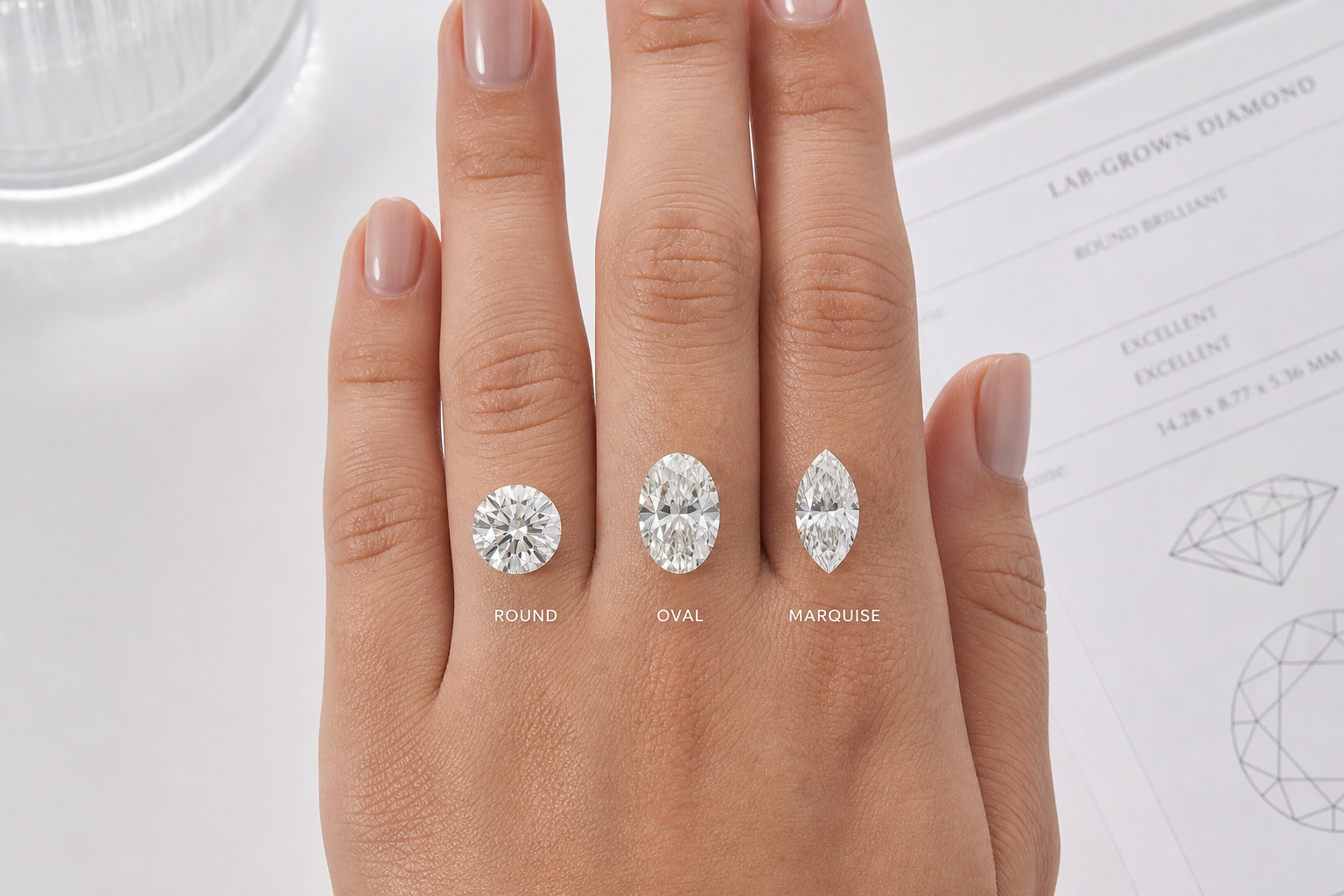
A marquise lab-grown diamond often looks larger than its carat weight suggests because the shape spreads visible surface area across a long, narrow outline. The stone does not contain more diamond than another shape of the same carat weight; it simply distributes that weight in a way the eye reads as longer and more finger-covering.
This is the main appeal of the marquise cut diamond. It gives buyers a strong size impression without always requiring a jump in carat weight. For someone who wants visible presence on the hand, especially in an engagement ring, that can be a real advantage. The caution is that visual size should not be treated as the same thing as beauty. A large-looking marquise with poor symmetry, a heavy bow tie, or awkward proportions can look less refined than a slightly smaller stone with better balance.
In practical buying, this advantage should be evaluated against the finished ring, not the loose stone alone. A marquise that looks generous on a tray can read differently once prongs, gallery height, and band width are added, so the final size impression depends on the entire design.
How the Marquise Outline Creates Strong Finger Coverage
The marquise outline works differently from rounder shapes. Its pointed ends extend the stone’s visible length, while the curved middle gives it enough width to avoid looking like a thin sliver when the proportions are right. This combination creates strong finger coverage because the eye follows the full end-to-end outline across the hand.
Compared with a round diamond, a marquise usually stretches farther along the finger at the same carat weight. Compared with many cushion cuts, it typically looks less compact because less of the outline is concentrated into a square or softly rectangular shape. That does not make marquise automatically better; it makes it better for a specific goal: maximizing face-up length and visual spread.
The mistake is assuming this size impression comes from “more diamond.” It does not. Carat measures weight, not visible diameter or length. A lab-grown marquise diamond can look larger because of geometry, not because the buyer is getting extra physical weight. That distinction matters when comparing stones across shapes, because the largest-looking option is not always the strongest-looking option.
Visual Size Versus Actual Carat Weight
Two 1.50 ct diamonds can appear very different once they are viewed face up. A 1.50 ct round diamond may have a balanced, centered look with strong overall brilliance, while a 1.50 ct marquise may appear longer and more finger-covering because its weight is stretched across an elongated outline. Both stones can weigh the same, but the hand presence can feel completely different.
This is why millimeter measurements matter. Carat weight tells you how much the diamond weighs; length and width tell you how much space it actually occupies visually. For a marquise cut diamond, the length measurement is especially important because it drives much of the shape’s visual impact. The width matters too, because a stone that is too narrow for its length can look sharp or strained rather than balanced.
A practical comparison makes this clear. If a buyer is choosing between a 1.50 ct round and a 1.50 ct marquise, the marquise may look more prominent on the finger even though both are the same carat weight. That may be exactly what the buyer wants. But if the marquise has an awkward outline or a dark center, the extra coverage may not translate into a better ring.
Where the Size Advantage Can Become a Compromise
The same stretched outline that makes marquise diamonds look large also makes their flaws easier to notice. On a compact shape, small outline issues may not draw the eye as quickly. On a marquise, the long center line, pointed tips, and curved sides create obvious reference points. If one tip is off-center, one shoulder is fuller than the other, or the middle looks dark, the problem can stand out immediately.
This is where buyers need to be careful. A marquise can deliver strong visual size, but it is not the most forgiving shape. The size advantage becomes less valuable if the stone looks uneven from end to end or if the center contrast dominates the diamond. A well-proportioned marquise looks intentional and clean; a poorly chosen one can look stretched mainly for size.
For buyers focused on finger coverage, the better target is not simply the biggest carat number within budget. The better target is a marquise that has strong measurements, a balanced outline, and a face-up appearance that still looks lively in motion.
What This Means in a Real Purchase
If size impression is one of your main priorities, compare length and width in millimeters before comparing carat weight alone. A slightly lower-carat marquise with better spread and cleaner shape may give you more of the look you want than a heavier stone that carries weight in less visible areas or looks unbalanced.
Photos and videos matter here. A product listing may show the carat weight clearly, but that does not tell you how the diamond looks on a hand or in a setting. Look for straight-on images, hand photos, or video that shows the stone moving under light. If you are comparing several lab-grown marquise diamond options, put their millimeter dimensions side by side and ask which one looks balanced, not just which one looks longest.
Yes, marquise diamonds can look larger than many other shapes at the same carat weight. Strong purchases happen when that size advantage is supported by proportion, symmetry, and a setting that makes the elongated outline look deliberate rather than overextended.
The Best Length-to-Width Ratio for a Marquise Diamond
The length-to-width ratio is one of the most useful numbers when evaluating a marquise diamond, but it should not be treated as a universal rule. It helps you understand whether the stone will look fuller, balanced, or sharply elongated. It does not tell you everything about beauty, and it cannot replace seeing the actual diamond.
For marquise diamonds, the ratio is calculated by dividing the length by the width. A diamond that measures 12.0 mm long and 6.0 mm wide has a 2.00 ratio. That number gives you a quick sense of shape direction, but the real decision depends on how the outline looks on the hand and how the diamond fits the intended setting.
Common Ratio Range: From Softly Elongated to Dramatic
Many marquise diamonds fall somewhere around a 1.75 to 2.25 length-to-width ratio. Within that range, many buyers find roughly 1.85 to 2.10 visually balanced because the stone looks clearly elongated without becoming overly narrow. This is not a grading standard; it is a practical screening range.
Below about 1.75, a marquise may start to look wider and shorter. That can work for buyers who want a softer, less sharp outline, but it may reduce the finger-lengthening effect that draws many people to the shape in the first place. Above about 2.20, the diamond may look very narrow and dramatic. That can be striking, especially in a minimal solitaire, but it can also make bow tie, tip alignment, and curve imbalance more noticeable.
The safest mistake to avoid is choosing the most elongated stone automatically. A high ratio can create impressive length, but if the stone looks too thin through the middle or visually weak at the tips, the effect can feel forced. For most buyers, balance matters more than pushing the ratio to an extreme.
How Ratio Changes the Mood of the Stone
A fuller marquise tends to feel softer and more traditional. It gives the eye more width through the center, which can make the stone look stable and substantial. This can be a good direction for buyers who like the marquise silhouette but do not want the diamond to feel too sharp or severe.
A narrower marquise creates more elongation and more shape drama. It can make the finger look longer and can feel more fashion-forward, especially in a north-south setting. The tradeoff is that narrow stones are less forgiving. If the curves are uneven or the center goes dark, those issues can become more obvious because there is less visual width to soften them.
Hand shape and setting style change the recommendation. A longer ratio may look elegant on someone who wants a slim, vertical effect, while a fuller ratio may suit a buyer who wants presence without a highly pointed look. In halo, bezel, or east-west settings, the ideal ratio can shift because the setting changes how the outline is framed.
Why Measurements Matter More Than Ratio Alone
Ratio is only a relationship between two numbers. It does not show the exact curve of the shoulders, the fullness of the belly, the alignment of the tips, or how the facets interact with light. Two marquise diamonds can both have a 2.00 ratio and still look noticeably different because one has graceful, even curves while the other looks pinched or uneven.
This is why actual millimeter measurements and visual media should carry more weight than the ratio by itself. The ratio helps narrow the search, but photos and 360-degree video show whether the stone has the right outline. A diamond that looks ideal on paper may feel awkward in motion if the body is too thin, the tips look misaligned, or the center contrast is too strong.
Use ratio as a filter, not as the final decision. If a stone falls in your preferred range, the next step is to judge the actual shape. If the listing offers only numbers and a single angled photo, there is not enough evidence to make a confident decision.
A grading report can support this comparison by confirming the stated length, width, carat weight, color, clarity, and lab-grown disclosure, but it should not be treated as a complete judgment of shape quality. For marquise diamonds, the most reliable selection process combines the report with straight-on visuals, video, and the intended setting. NUVU’s buyer-first approach is to make that comparison clearer: what the report shows, what the visuals reveal, and whether the stone fits the finished piece.
Buyer Verification Checklist
- Confirm the length and width in millimeters on the grading report or product details, not just the carat weight.
- Calculate or review the marquise diamond length-to-width ratio so you know whether the stone is fuller, balanced, or very elongated.
- Compare the ratio with hand photos, video, or setting renderings, because the same number can look different once worn.
- Check whether the diamond looks balanced from end to end, with neither tip appearing visually heavier or more off-center.
- Avoid choosing the longest-looking stone automatically if the curves, tips, or bow tie draw attention in a negative way.
Symmetry, Curve Balance, and Why Marquise Shape Quality Is Easy to Notice
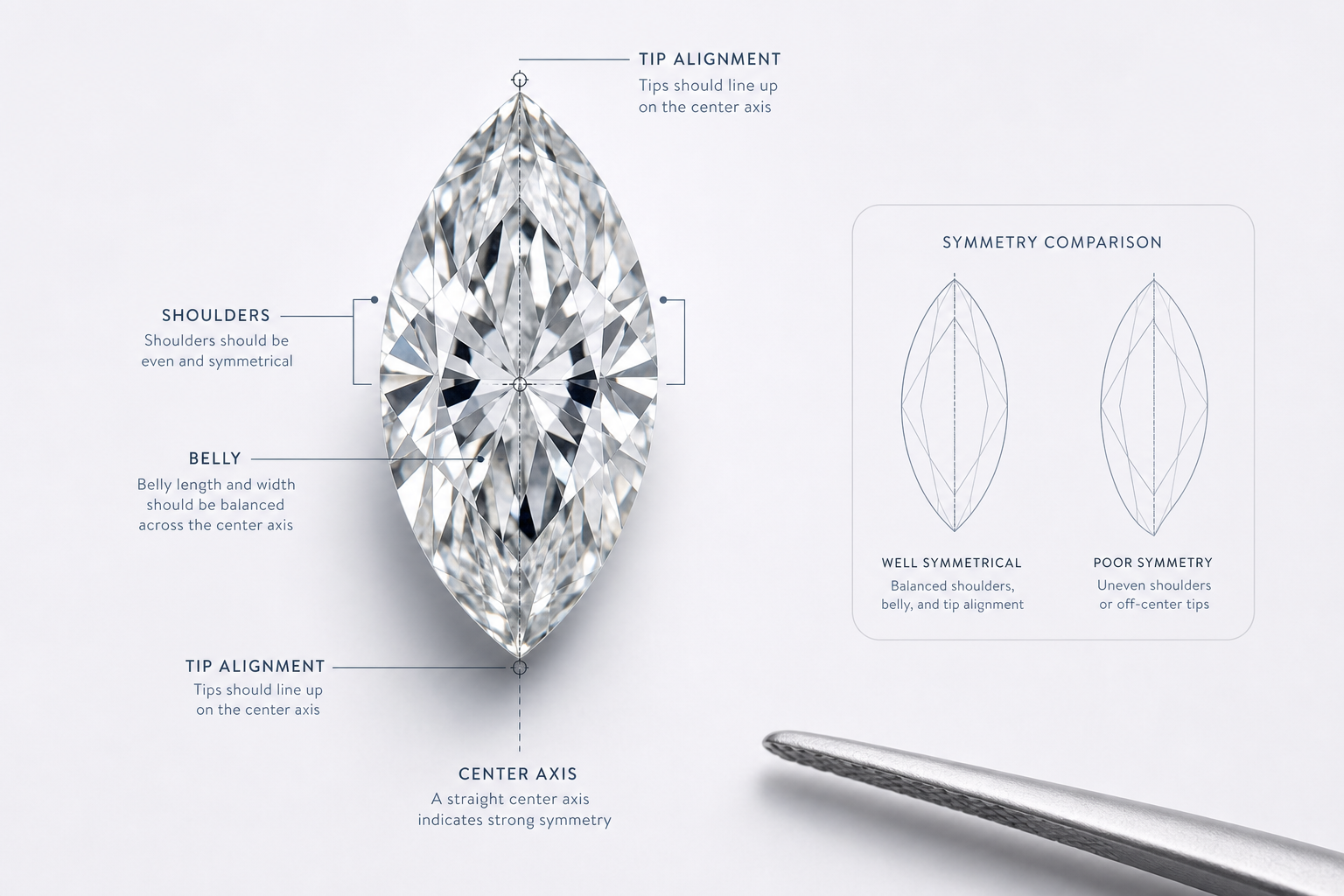
Marquise shape quality is easy to notice because the outline gives the eye several obvious reference points. The two pointed ends create a center axis. The curved shoulders guide the eye toward the middle. The belly gives the stone its visual weight. If one part feels off, the whole diamond can look less refined.
This is one reason a marquise diamond should not be judged only by carat, color, clarity, and a grading report. Those details matter, but they do not fully explain whether the shape itself looks clean. With a marquise, outline quality is not a minor design preference; it affects whether the diamond looks intentional or awkward once set in a ring.
The Two Tips Should Line Up Cleanly
The pointed ends of a marquise create a visual line through the center of the stone. When the tips line up cleanly, the shape feels balanced and controlled. When one point appears slightly higher, lower, thicker, or off-center, the diamond can look tilted even when it is sitting straight.
This problem matters more than many buyers expect. In a round or cushion shape, the eye is not tracking two sharp endpoints in the same way. In a marquise, the tips act almost like arrows. If they do not align, the asymmetry can follow the stone into the finished ring and become more noticeable when viewed on the finger.
A small natural variation may not be a dealbreaker, especially if it disappears in normal viewing. The concern is a tip imbalance that remains visible in face-up images or rotating video. If the stone looks slightly “pulled” to one side before it is set, a prong setting will not always hide that issue.
The Shoulders and Belly Should Mirror Each Other
The shoulders are the curved areas near the pointed ends, and the belly is the fuller middle portion of the marquise. These areas should feel like they belong to the same outline. If one shoulder rises faster than the other, or one side of the belly looks fuller, the diamond may appear twisted or lopsided.
This is not just a technical concern. Uneven shoulders can make a marquise look poorly cut even when the grading details seem acceptable. The eye expects the curves to flow evenly from tip to center and back again. If one side looks flatter or more swollen, the shape loses the clean “boat” outline that makes marquise diamonds appealing.
The common buying mistake is overlooking this because the stone has attractive grades elsewhere. A high color grade or strong clarity grade does not fix an outline that looks unbalanced. For marquise diamonds, shape discipline has to be part of the quality decision.
Why Symmetry Grade Does Not Replace Visual Review
A grading report can be useful, but it does not replace looking at the actual stone. Symmetry information on a report helps narrow the field, but it may not fully communicate how the outline feels to the eye. A marquise can have acceptable report details and still look less attractive if the curves or tips do not read evenly in real viewing.
This is especially important because marquise appeal is highly visual. The outline is part of the design, not just a technical boundary around the diamond. Buyers should treat visual review as required, not optional. If the diamond is being purchased online, a straight-on face-up image and rotating video are far more useful than one heavily lit glamour photo.
At NUVU, we treat the grading report as a starting point for comparison, not the full answer, because the report cannot show every outline issue or how the stone will look once paired with a specific setting.
How to Verify This Before Buying
Start with a straight-on face-up image. The two tips should sit on a clean center line, and the sides should look like they mirror each other. Then review a rotating video to see whether the shape remains balanced as the stone moves. If a setting mockup is available, use it to check whether prongs or bezel edges will emphasize or soften the outline.
Look for a balanced “boat” shape: centered tips, even shoulders, and a belly that feels full without becoming bulky. If one side looks flatter, one tip looks thicker, or the stone seems to lean visually, ask for clearer images before deciding. A seller who provides only one angled beauty shot is not giving enough information for a shape where outline quality matters this much.
Bow Tie in Marquise Diamonds: What Is Normal and What Is Distracting
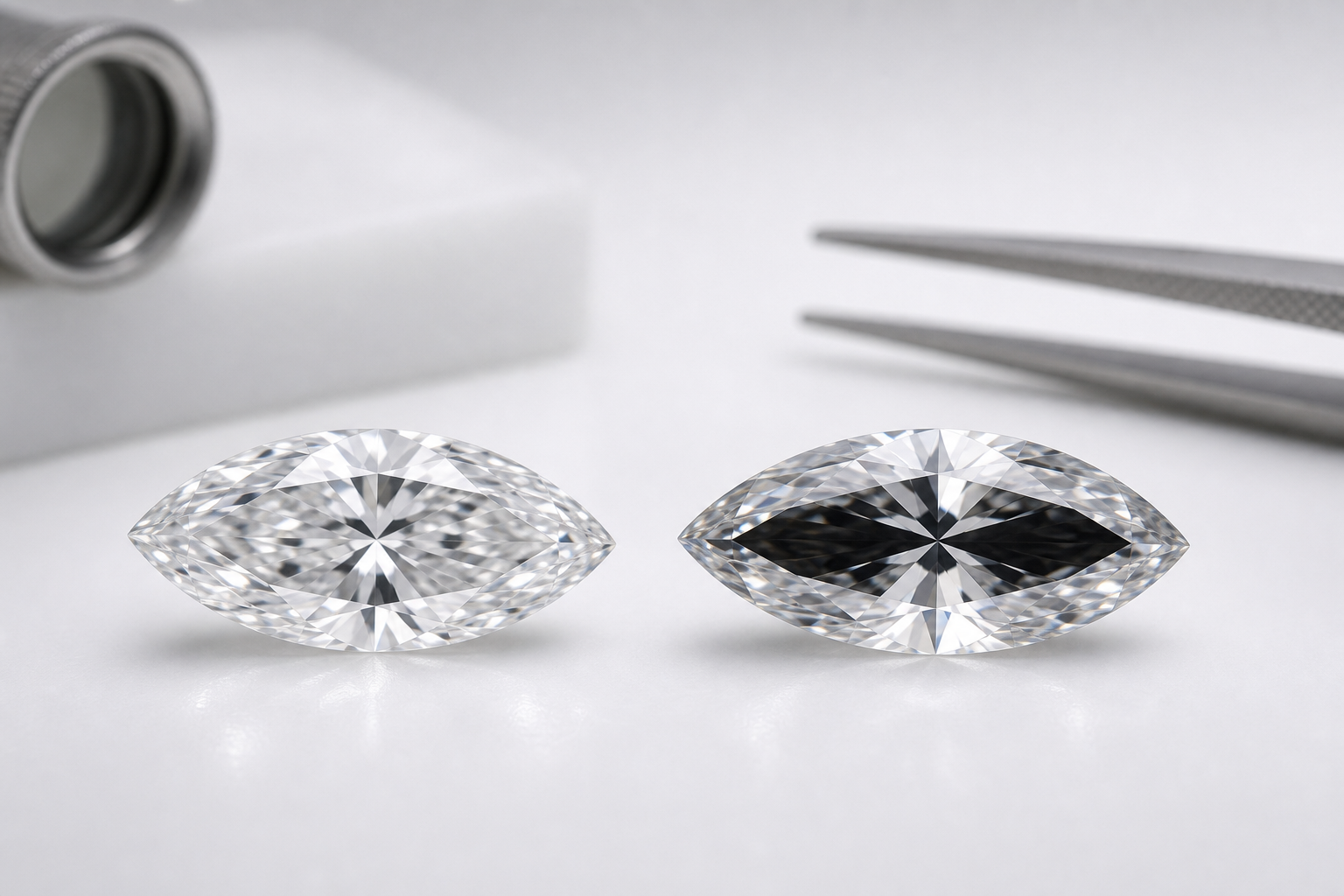
A bow tie is one of the most important visual checks in a marquise diamond because the shape’s long, narrow outline tends to concentrate contrast across the center. It usually appears as a darker band or pair of triangular shadows running across the middle of the stone. A little contrast is not automatically a flaw. In many elongated brilliant cuts, some dark-and-light patterning helps the diamond look dimensional rather than flat.
The problem is not the existence of a bow tie. The problem is severity. A marquise diamond with lively contrast can still look bright, crisp, and attractive. A marquise with a heavy, dark center can look dull across the exact area your eye notices first. This is why the bow tie effect should be judged visually, not treated as a simple yes-or-no issue.
It also helps to compare stones under similar lighting conditions. A marquise that looks acceptable in one bright studio image may still show a stronger center shadow in softer indoor light, which is why consistent video or side-by-side review is more reliable than isolated glamour shots.
Why Bow Tie Happens in Elongated Brilliant Cuts
Bow tie can appear in elongated brilliant shapes because of how the facets reflect light back to the viewer. Marquise, oval, and pear diamonds all share this risk because their stretched outlines do not distribute light in the same way as a round brilliant. The longer the shape becomes, the more important the facet pattern and cut execution become.
For buyers, the practical point is simple: some center contrast is normal, but the center should not look lifeless. A well-chosen marquise can show a bow tie in certain angles and still return enough light to feel balanced. If the contrast shifts as the stone moves and the diamond still flashes through the middle, it may be completely acceptable. If the dark area stays fixed and dominates the stone, it becomes a real buying concern.
When Bow Tie Becomes a Buying Problem
A marquise cut bow tie becomes distracting when it looks like a heavy black band across the center rather than a natural contrast pattern. This is especially noticeable in larger stones because the center area is more visible on the hand. If the middle of the diamond looks dark while the tips and outer edges look brighter, the stone may feel visually split in two.
The most concerning bow tie is one that remains obvious in more than one lighting environment. A stone may look acceptable in a bright studio image but show a dull center in softer indoor light. It may also look lively from one angle but turn flat as soon as it rotates. That kind of performance matters more than a small difference in color or clarity grade, because it affects the diamond’s appearance every time the ring is worn.
A useful rule for evaluating cut performance in elongated stones is to consult a pear diamond symmetry guide: do not reject every marquise diamond with visible contrast, but be cautious if your eye goes straight to the dark center before noticing the outline, sparkle, or overall shape. In that case, the bow tie is no longer adding depth; it is controlling the look of the stone.
Why Photos, Videos, and Lighting Matter
Bow tie visibility can change dramatically depending on lighting, camera angle, background, and how the stone is held. A single bright product photo can hide the issue, especially if the diamond is positioned to catch strong light from above. That is why a marquise diamond should be reviewed in motion whenever possible.
A rotating video is more useful than one polished image because it shows whether the center wakes up as the stone moves. Watch the middle of the diamond, not just the edges. The best signs are flashes that travel across the center, contrast that changes naturally, and a bow tie that does not sit like a permanent dark stripe. If several similar marquise diamonds are available, comparing them side by side is even better because bow tie severity becomes easier to spot when the stones are viewed under the same conditions.
Do not rely only on the most flattering image in the listing. If a seller provides only one angled glamour photo, ask for a straight-on face-up image and video of the exact stone. The risk is not just buying a diamond with a bow tie; it is buying one without knowing how visible that bow tie is in normal viewing.
Certificate and Visual Review Check
A grading report can confirm important details such as carat weight, measurements, color, clarity, and lab-grown origin, but it usually does not tell you how strong the bow tie appears. This is one of the clearest limits of certificate-based shopping. A marquise diamond can look strong on paper and still have a center that feels too dark in real life.
A grading report helps document key characteristics, but it should not be treated as a guarantee of beauty, value, or sourcing ethics. For marquise diamonds, report details are most useful when they are matched to visual evidence of the exact stone.
Before deciding, match the report to the listing, then use visual evidence to judge the stone’s actual performance. Look for a center that still returns light in motion. If the middle stays black or gray through most of the video, the diamond may not deliver the lively face-up look that makes the marquise shape worth choosing.
When a grading report is available, buyers should verify the report details through the issuing laboratory’s official report-check tool where available, then compare those details with the exact stone’s photos, video, and measurements.
Protecting the Pointed Ends: Setting Risks for Marquise Lab-Grown Diamonds
The pointed ends are the most exposed parts of a marquise diamond. They help create the shape’s dramatic length and finger coverage, but they also make the stone less forgiving than rounded shapes if the setting leaves the tips vulnerable. This does not mean marquise diamonds are unsuitable for daily wear. It means the setting needs to be chosen with the shape in mind.
The buying mistake is treating a marquise like a generic center stone. A setting that works well for a round, cushion, or oval may not give the same protection to two sharp ends. For an engagement ring, especially one worn every day, tip protection should be part of the decision from the beginning rather than an afterthought after the stone is selected.
Why the Tips Need Extra Protection
A marquise diamond’s tips can be more vulnerable to impact because they concentrate the outline into narrow points. The rest of the diamond may feel substantial, but the ends are where accidental knocks, snagging, or poor setting support can create problems. This is especially relevant for buyers choosing a larger stone, a high setting, or a minimal solitaire that leaves much of the outline exposed.
Protection matters most for people who wear their ring through active daily routines. Someone who regularly works with gloves, handles equipment, travels often, or prefers low-maintenance jewelry should be more cautious about exposed tips than someone who wears the ring more selectively. The stone itself may be durable, but the weakest part of the design is often where the diamond meets the setting.
V-Prongs, Bezel Ends, and Protective Setting Choices
V-prongs are a common choice for marquise diamond settings because they wrap around the pointed ends rather than touching them with a small standard prong. A well-made V-prong can help shield the tip while keeping the outline visible. For many buyers, this is the most balanced solution: protective enough for the shape, but still refined and open.
Bezel protection is another option. A full bezel surrounds the diamond with metal, while a partial bezel may protect the ends without enclosing the entire stone. These designs can be especially useful for buyers who want a smoother, more secure feel. The tradeoff is visual. A bezel can make the ring look more modern and substantial, but it may reduce the airy, delicate look that some people want from a marquise solitaire.
Standard prongs can work in some designs, but they need to be evaluated carefully around the tips. The concern is not the number of prongs alone; it is whether the pointed ends are actually secured and protected. A beautiful setting that leaves the tips exposed may look elegant in a photo but feel less practical over years of wear.
How Setting Style Changes the Look of the Stone
Prong settings usually show more of the marquise outline. They can make the stone appear lighter, more open, and more elongated because less metal interrupts the shape. This works well for buyers who want the diamond itself to be the clear focus, especially in a north-south orientation where the pointed ends define the entire look of the ring.
Bezel and semi-bezel settings create a different effect. They frame the marquise, often making the ring feel more architectural and contemporary. They can also make the edges feel smoother against clothing and daily movement. The tradeoff is that the diamond may look more enclosed, and the setting becomes a stronger part of the design rather than disappearing around the stone.
The better choice depends on lifestyle as much as taste. If the ring will be worn daily and the wearer prefers low-snag jewelry, added protection may be worth the slightly heavier visual frame. If the priority is a delicate profile and maximum outline visibility, prongs may be preferable, but the tips still need specific attention.
Stone-to-Setting Fit Check
A marquise setting should be built or selected for the diamond’s actual measurements, not just its carat weight. Two marquise diamonds with the same carat weight can have different lengths, widths, and tip shapes. A setting made for a generic size may not hold the chosen stone as securely or as cleanly as expected.
Before committing, confirm how the tips will be protected, whether the prongs or bezel ends align with the actual stone, and whether the diamond will sit at a practical height. A high-set marquise can look striking, but it may catch more easily during daily wear. A lower-profile setting can feel more secure and comfortable, though it may change the ring’s visual presence.
For custom work, the stone and setting should be evaluated together. At NUVU, this is one of the places where a transparent design conversation matters: the right marquise is not only the one with attractive measurements and grades, but the one that can be set securely in a design that fits the wearer’s routine.
For custom design, stone measurements and setting compatibility should be confirmed before finalizing a purchase. Trust comes from matching the stone to the setting, budget, and wearer’s daily use, not from choosing grades in isolation. Before finalizing a marquise center stone, confirm the exact length, width, tip shape, prong plan, ring height, and future band compatibility so the finished piece supports both the look and the practical wear needs.
When a grading report is provided, buyers should compare the report details with the issuing laboratory’s verification tools where available.
If a GIA, IGI, GCAL, or other laboratory report is provided, use the laboratory’s official report-check system when available rather than relying only on a screenshot or listing summary.
For marquise buyers, this documentation step is especially useful because it separates the factual identity of the diamond from the visual judgment you still need to make. A report can confirm measurements, grade information, and lab-grown disclosure, while the video and setting review confirm whether that particular stone has the outline balance, bow tie behavior, and tip protection you want.
When comparing NUVU marquise options or discussing a custom ring, ask that the report details, visual media, and setting plan all refer to the same exact stone. That simple cross-check helps prevent confusion between similar-looking diamonds and keeps the selection process focused on evidence rather than assumptions.
Color, Clarity, and Cut Priorities for Marquise Lab-Grown Diamonds
Color, clarity, and cut all matter in a marquise lab-grown diamond, but they do not deserve equal weight in the final decision. For this shape, cut behavior and outline quality usually have the greatest effect on what the buyer actually sees. A high color grade or clarity grade cannot rescue a stone with a distracting bow tie, uneven shape, or awkward visual balance.
The smarter approach is to use the 4Cs as filters, then let marquise-specific appearance decide the shortlist. A grading report helps narrow options, but the most suitable stone is often the one where proportions, light return, eye-clean clarity, and setting fit work together.
Cut and Shape Quality Should Lead the Decision
For marquise diamonds, cut quality is not just about sparkle. It includes the way the outline is shaped, how evenly the shoulders and belly are balanced, whether the tips align cleanly, and how much the bow tie affects the center. These are the details that determine whether the diamond looks elegant and intentional or stretched and uneven.
This is why chasing the highest color or clarity grade first can be misleading. A marquise with slightly lower paper grades but better visual performance may look more attractive than a technically higher-graded stone with a dark center or lopsided outline. The priority should be the face-up impression: balanced shape, lively center, controlled contrast, and proportions that suit the intended ring design.
Clarity: Check the Center and the Tips
Clarity should be judged by visibility and placement, not by the grade alone. Inclusions near the center of a marquise diamond may be easier to notice because the eye naturally lands there, especially if the stone already has some bow tie contrast. A small feature near the edge may be less important visually, but inclusions near the tips deserve closer review because the pointed ends are structurally sensitive areas in the setting.
Many buyers are better served by looking for an eye-clean diamond rather than paying more for a clarity grade they cannot appreciate without magnification. The key is verification. Review the magnified image to understand where inclusions are located, then review a normal-view photo or video to see whether they matter in real life. If an inclusion is only visible under magnification and does not affect the center, tips, or durability considerations, it may not be worth overpaying to avoid.
Color: Elongated Shapes Can Show Tone Differently
Marquise diamonds can show color differently from more compact shapes because the elongated outline changes how light and body tone appear across the stone. Some stones may show warmth more noticeably toward the tips or along the body, especially in certain lighting or metal settings. This does not mean every marquise needs an unusually high color grade, but it does mean the letter grade should not be the only deciding factor.
The metal choice also affects what looks acceptable. A stone that faces up bright in yellow gold or rose gold may not need the same color target as one being set in platinum or white gold. For lab-grown marquise diamonds, the practical move is to compare actual appearance against the chosen setting style rather than assuming one color grade is ideal for every buyer.
Evidence-Based Grade Prioritization
A useful way to avoid overbuying is to separate documented grades from visible outcomes. The report can tell you the stated color and clarity grades, but the finished ring is judged by what the wearer sees: whether the stone looks bright enough in the chosen metal, whether inclusions are visible without magnification, and whether the outline looks balanced. For marquise diamonds, this distinction is especially important because a paper upgrade may not improve the most noticeable parts of the stone.
When comparing two stones, keep the evidence organized. First, compare the report details and measurements. Second, compare the same type of visual media for each stone, ideally face-up video under similar lighting. Third, consider the setting design that will actually hold the diamond. This order keeps the decision from being controlled by one attractive grade or one flattering image.
What to Check Before You Decide
Review the grading report, magnified image, and video together. The report tells you the stated grade information. The magnified image shows the location and type of inclusions. The video shows whether the stone looks lively, balanced, and attractive in motion. None of those pieces replaces the others.
Before choosing a marquise lab-grown diamond, ask four practical questions: Is the stone eye-clean at normal viewing distance? Does the center return light, or does it stay dark? Do the tips look clean, aligned, and suitable for protection in the setting? Does the color face up well in the metal you plan to use?
If the answer is yes across those points, the stone is likely a stronger candidate than one chosen only for a higher grade on paper. With marquise diamonds, value is rarely found by maximizing a single 4C. It comes from choosing the stone that looks right, sets securely, and avoids the shape-specific risks that are easiest to regret later.
Choosing a Marquise Setting Based on Finger Coverage, Comfort, and Lifestyle
A marquise diamond ring is not only a stone choice. The setting controls how the shape sits on the finger, how much of the outline remains visible, how often the points catch, and whether the ring feels practical after the first week of wear. This matters more with marquise than with many rounded shapes because the long body and pointed ends create stronger visual direction.
The most suitable marquise ring setting is usually the one that balances three priorities: the coverage the buyer wants, the height they can comfortably wear, and the level of protection the pointed ends need. A setting that looks striking in a product image may be less satisfying if it sits too high, catches on sleeves, or makes stacking bands awkward.
North-South Marquise: Maximum Finger Elongation
A north-south marquise setting places the diamond vertically along the finger. This is the classic orientation, and it gives the strongest lengthening effect because the eye follows the stone from point to point. For buyers who want a marquise engagement ring to look elongated, dramatic, and visibly different from a round or cushion ring, this orientation usually delivers the clearest result.
The tradeoff is presence. In larger carat weights, a north-south marquise can look very prominent because the stone extends farther toward the knuckle and the hand. That is often the goal, but it can also feel too assertive for someone who prefers subtle jewelry or has smaller hands. The same feature that creates elegant finger coverage can make the ring feel visually large even when the carat weight is moderate.
North-south settings also need careful placement. If the stone sits too high, the tips can feel more exposed and the ring may catch more easily. If it sits too low without enough planning, the pointed ends or gallery design may interfere with a straight wedding band. Buyers who want the strongest elongating look should still check the side profile, not just the face-up view.
East-West Marquise: Modern Look With Different Coverage
An east-west marquise ring turns the stone horizontally across the finger. This gives the shape a more contemporary feel and changes the way the diamond covers the hand. Instead of drawing the eye up and down the finger, it creates width across the finger, which can feel cleaner, more architectural, and less traditional.
This orientation is a better fit for buyers who like the marquise outline but do not want the full dramatic length of a vertical setting. Depending on the design, an east-west setting can also feel lower-profile because the stone may sit closer to the finger and spread across the band rather than rising upward. That can make it appealing for daily wear, especially for someone who wants a distinctive shape without the height of a classic solitaire.
The limitation is that east-west placement reduces the finger-lengthening effect. If the main reason for choosing marquise is to make the finger appear longer, north-south is usually the stronger choice. East-west works best when the buyer values modern styling and horizontal coverage more than vertical elongation.
Ring Height, Snagging, and Daily Wear Practicality
Marquise diamonds have two pointed ends, and setting height determines how exposed those points feel in real life. A high-set solitaire can make the full outline visible and give the ring a lighter, more open appearance, but it can also catch more easily on sweaters, gloves, pockets, and hair. This is not a reason to avoid marquise; it is a reason to match the setting to the wearer’s routine.
For hands-on lifestyles, lower-profile settings are often more practical. A design with secure V-prongs, a partial bezel, or a more integrated basket can reduce the feeling that the diamond is perched above the hand. The important distinction is that protection does not have to mean a heavy-looking ring. A well-designed marquise setting can still look refined while giving the tips enough coverage for regular wear.
Stacking is another detail buyers often underestimate. A marquise engagement ring with a low or wide gallery may not sit flush with a straight wedding band. That may be acceptable if the buyer likes a small gap, wants a contoured band, or plans a custom stack. It becomes a problem only when the buyer assumes every band will fit neatly beside the ring. For marquise designs, the engagement ring and future band should be considered together before the setting is finalized.
What This Means in a Real Purchase
Consider a buyer like Emily, who wants a 2.00 ct marquise lab-grown diamond because she loves the finger coverage and elongated look. She also works in healthcare and wears gloves throughout the day. A high-set north-south solitaire may give her the most dramatic view of the stone, but the points and height could make the ring less convenient under gloves or during frequent hand movement.
For her, a lower-profile marquise setting with secure V-prongs or partial bezel protection may be the better decision. The ring may look slightly less airy than a minimal solitaire, but it will likely fit her routine more comfortably. That is the real tradeoff: the most delicate-looking setting is not always the strongest everyday setting, especially for a pointed elongated shape.
For a buyer who wears jewelry occasionally, works mostly at a desk, and wants maximum visual drama, the recommendation may change. A higher-set north-south design can make sense if the tips are still properly protected and the wearer accepts the extra presence. The setting should be judged by how the ring will actually be worn, not only by how impressive it looks in a close-up image.
Marquise Lab-Grown Diamond Pricing: Why Value Is Not Just the Lowest Price
Marquise lab-grown diamond price should be read through quality and risk, not only carat weight. Two stones can share the same size on paper and still offer very different value if one has stronger measurements, cleaner visual performance, better symmetry, and clearer documentation. With marquise diamonds, the cheapest option is not automatically poor, but a low price often deserves a closer look.
The mistake is treating all marquise diamonds within the same carat range as interchangeable. This shape is highly visual. A stone with a distracting bow tie, uneven outline, or awkward spread can look less attractive than a slightly smaller or differently graded stone that has better balance. Value is the relationship between price and visible result, not the lowest number in the filter.
Prices can change with market conditions, report type, seller channel, availability, and stone-specific details, so exact comparisons should be verified at the time of purchase. Buyers should compare like-for-like specifications before treating one stone as a better value.
For buyers comparing several stones for a custom project or a matched inventory, consistency can matter as much as the headline price. Small differences in ratio, length, or bow tie behavior may be acceptable in isolation, but they become more important when the goal is a repeatable look across pieces or a ring that has to pair cleanly with a future band.
Why Similar Carat Weights Can Have Different Prices
Carat weight is only one pricing factor, especially when a lab-grown diamond shapes guide is used to compare how outline, spread, and wearability affect perceived value. A marquise lab-grown diamond may also be priced according to color, clarity, measurements, grading report details, seller channel, and how desirable the stone looks in photos or video. A 1.80 ct marquise with strong face-up dimensions and an appealing outline may be a better value than a 2.00 ct stone that carries weight in a way that does not improve the look on the hand.
Measurements matter because marquise buyers often care about coverage. A stone that is technically heavier may not look meaningfully larger if the added weight is hidden in depth rather than visible length and width. For this shape, millimeter dimensions can tell the buyer more about real-world presence than carat weight alone.
Visual performance also affects value. A marquise with a lively center and balanced contrast will usually be more desirable than one with a dark, dominant center, even if both have similar grades. The grading report can narrow the comparison, but it does not replace actually judging how the diamond looks.
When a Lower Price May Hide a Tradeoff
A lower price can be reasonable if the buyer is intentionally accepting a tradeoff that does not affect their priorities. For example, a slightly warmer color grade may still look attractive in yellow gold, or a lower clarity grade may be fine if the diamond is eye-clean. The problem starts when the tradeoff is not obvious until after purchase.
Common hidden tradeoffs in marquise diamonds include a heavy bow tie, weak tip alignment, uneven shoulders, an overly narrow or wide ratio, limited product media, unclear grading report details, or measurements that do not create the expected finger coverage. These issues can matter more than a small difference in color or clarity because they affect how the stone looks immediately.
Poor visual assets are a warning sign, not because the diamond is automatically bad, but because the buyer cannot properly evaluate the risk. A single bright studio photo can hide bow tie severity, outline imbalance, or how the stone behaves in motion. If the listing does not give enough evidence to judge the actual diamond, the lower price is harder to interpret.
When a Higher Price Is Not Automatically Better
A higher-priced marquise diamond is not always the smarter purchase. If a stone already appears white in the chosen metal and eye-clean at normal viewing distance, paying more for a higher color or clarity grade may not improve the ring in a way the wearer can see. This is where buyers often overspend on paper upgrades while underweighting shape quality.
For marquise diamonds, a more useful upgrade may be better proportions, a more attractive outline, stronger video evidence, or a setting that properly protects the tips. These are not always the factors that look most impressive in a filter menu, but they are often the factors that decide whether the finished ring feels successful.
The strongest value usually sits where the diamond looks good, the documentation is clear, and the setting fit is realistic. A stone with the highest grades but a distracting bow tie is not a value win. Neither is a bargain stone that needs major compromise in the ring design to protect or balance it.
A Safer Way to Compare Price Evidence
Because lab-grown diamond pricing can change and vary by seller, this guide does not rely on fixed price examples. Instead, use a repeatable comparison method: compare stones of similar carat weight, then adjust for measurements, report details, visual quality, setting compatibility, and seller policies. That approach is more useful than anchoring on a single price claim that may not reflect the stone you are actually considering.
If one marquise is meaningfully less expensive than similar options, treat the lower price as a question to investigate rather than a problem by itself. The answer may be acceptable, such as a color or clarity grade that still works visually. Or it may reveal a tradeoff that matters more, such as a dark bow tie, limited media, or dimensions that do not create the expected finger coverage.
Buyer Verification Checklist
Before choosing a marquise lab-grown diamond by price, compare at least three stones with similar carat weights. The goal is not to find the cheapest one; it is to see which stone gives the strongest visible result for the money.
- Compare the grading report details, including carat weight, color, clarity, and measurements.
- Review the length and width in millimeters, not only the carat weight.
- Check whether the ratio creates the shape you actually want on the hand.
- Watch video for bow tie visibility and center brightness.
- Look at tip alignment, shoulder balance, and overall outline symmetry.
- Confirm that the intended setting can protect the tips and fit the stone’s actual dimensions.
- Factor in the full project cost, including the stone, setting, customization, and any services that affect the final ring.
A well-priced marquise diamond should make sense after this comparison. If the price only looks attractive before you inspect the visuals, measurements, and setting fit, it may not be the better value.
Certification, Visual Evidence, and Seller Questions Before Buying
A documented marquise diamond should come with grading information, but documentation is only one part of a safe purchase. The report helps confirm what the diamond is represented to be. Visual evidence helps show whether that specific stone is attractive enough to buy. Seller communication helps confirm whether the ring can be made properly around it.
This three-part check is especially important for marquise diamonds because the main buying risks are not fully captured by a grade line. A report can confirm measurable details, but it will not tell you whether the bow tie bothers you, whether the outline looks graceful, or whether the setting design will protect the points in daily wear.
For buyers who care about sustainability or sourcing, a lab-grown label by itself is not enough information. The practical question is what documentation the seller can provide about production, handling, and any claims being made, because broad environmental language should be treated as a claim to verify rather than a conclusion to assume.
Environmental and sustainability claims should be specific, documented, and limited to what can be substantiated. Broad green language is less useful than clear information about production, energy context, sourcing disclosures, and seller transparency. If an environmental or responsible-sourcing statement influences your decision, ask what it is based on and whether the seller can explain the scope of the claim.
What a Grading Report Can Confirm
A lab-grown diamond grading report can confirm basic characteristics such as carat weight, measurements, color, clarity, and whether the stone is lab-grown. It may also include a report number and other identifying details that should match the seller’s listing. For a marquise diamond, the measurements are especially useful because they help you understand the stone’s actual length and width, not just its weight.
The report should be treated as a consistency check. If the listing says one set of measurements and the grading report shows another, that needs clarification before purchase. The same applies to carat weight, color, clarity, and any identifying report number. A mismatch is not something to ignore, even if the product photos look attractive.
At NUVU, we treat the grading report as a starting point rather than the whole decision because it narrows the facts but does not settle the visual judgment. For marquise diamonds, that distinction matters.
What a Report Cannot Fully Show
A report does not fully show beauty. It does not explain whether the bow tie looks light and acceptable or dark and distracting. It does not show whether the shoulders feel balanced, whether the tips appear centered, or whether the diamond looks lively in normal viewing conditions.
This is where buyers can make a costly mistake: assuming a strong report means the stone will automatically look strong in a ring. A marquise can have appealing grades and still have a shape issue that is obvious once seen face-up. The reverse can also happen: a stone with modest grades may look excellent if it is eye-clean, well-proportioned, and visually balanced.
Real-life appearance needs visual proof. A face-up photo, rotating video, and setting view if available will usually tell the buyer more about marquise-specific appeal than the grading report alone. If those materials are missing, the decision carries more uncertainty.
Evidence Boundaries Buyers Should Understand
Good evidence does not mean collecting every possible document. It means matching each claim to the right type of proof. A grading report is useful for identifying stated diamond characteristics. A video is useful for judging bow tie, outline, and liveliness. A setting drawing or jeweler confirmation is useful for understanding tip protection and fit. No single item answers every question.
This matters when sellers use broad language such as “premium,” “ethical,” “sustainable,” or “best value.” Those phrases should be supported by specific details if they influence your decision. For example, a seller should be able to explain what report accompanies the diamond, what visual media represents the exact stone, how the setting protects the points, and what policies apply after purchase. If the language sounds confident but the evidence is vague, ask for clarification before treating the claim as meaningful.
Documentation also helps keep the selection traceable from loose stone to finished ring. Keep the report number, measurements, images, video links, setting notes, and written design decisions connected to the same diamond. This is especially useful when several marquise stones look similar in carat weight or ratio, because a clear record reduces the chance of comparing one stone’s report with another stone’s visuals.
Questions to Ask the Seller Before Purchase
Good seller questions should focus on the exact stone and the exact setting, not general promises about quality. Marquise diamonds are too shape-sensitive for vague reassurance. Ask for details that can be confirmed in writing and compared against the report or product media.
- Can I see a face-up photo and rotating video of this exact stone?
- Are the tips protected in the proposed setting?
- What are the exact length and width measurements?
- Does the stone show a strong bow tie in normal lighting?
- Can the setting be built or adjusted for this stone’s dimensions?
- What policies or purchase terms apply, and can they be confirmed in writing?
The most useful answers are specific. “The diamond is beautiful” is not enough. A stronger answer references the exact measurements, confirms the setting approach, and provides visual evidence that lets you judge the stone yourself.
Certificate and Visual Review Check
Before buying, match the report number, measurements, carat weight, and listed details to the actual product page or seller communication. Then compare that documentation with the visual evidence. The grading report should tell you what the diamond is represented to be; the video and images should help you decide whether it is the right one.
For a marquise diamond, the final check should include four practical questions: Do the report details match the listing? Does the video show an acceptable bow tie? Do the tips and curves look balanced? Can the setting protect the stone without fighting its shape?
If any of those answers are unclear, pause before purchasing. The right seller should be able to provide enough information to reduce uncertainty, especially for a shape where small details can make a large visual difference.
Marquise Lab-Grown Diamond Buying Framework: Who Should Choose It and Who Should Be Cautious
A marquise lab-grown diamond is a strong choice when the goal is visual impact. It gives more length and finger coverage than many shapes at the same carat weight, and its pointed outline makes the ring look intentional rather than generic. The tradeoff is that marquise is not a shape to buy casually from carat weight and grading report details alone. It rewards careful selection, and it exposes weak selection quickly.
The better buyer for a marquise diamond is someone who wants an elongated shape and is willing to review proportions, symmetry, bow tie, and setting fit before committing. If you want a stone that looks large on the hand and feels more distinctive than a round or cushion, marquise belongs near the top of the shortlist. If you want the easiest shape to choose with the lowest visual risk, it may not be the most forgiving option.
Choose Marquise If You Want Maximum Visual Impact
Choose a marquise lab-grown diamond if your priority is finger coverage, length, and a shape that immediately changes the look of the ring. A well-proportioned marquise can make a 1.50 ct or 2.00 ct diamond feel visually larger than expected because the outline stretches across more of the finger. That advantage matters most for buyers who care about face-up presence more than traditional round brilliance.
Marquise also works well when the ring design is meant to have a clear point of view. Solitaires, three-stone rings, hidden halo designs, and custom settings can all use the shape’s long center line to create a more dramatic profile. The key is restraint: if the center stone already has strong shape drama, the setting should support it rather than compete with it.
The clearest “yes” case is a buyer who likes elongated diamonds, wants a larger look without choosing only by carat weight, and is comfortable checking video before purchase. In that situation, marquise can offer one of the stronger combinations of size impression and visual character in a lab-grown diamond engagement ring.
Be Cautious If You Want the Most Forgiving Shape
Be cautious with marquise if you are sensitive to asymmetry or know that a dark center will bother you. The shape’s long axis makes crooked tips, uneven shoulders, and an obvious bow tie easier to notice than they might be in a more compact outline. A grading report can confirm measurements and grades, but it will not make a lopsided outline look balanced on the hand.
If you want a shape that is easier to buy with fewer visual variables, round is usually more forgiving. Oval can still have bow tie concerns, but its softer ends remove the pointed-tip issue. Radiant and cushion shapes may feel more practical for buyers who prefer squared or softened edges and want less concern around tip protection. These are not automatically better choices; they simply carry different risks.
Marquise is also less ideal for someone who wants the thinnest, most minimal setting possible and does not want to think about daily wear. The tips need protection, and a very exposed design can create unnecessary risk. If the wearer is hard on jewelry, works with gloves, or prefers low-maintenance rings, the setting decision becomes just as important as the stone.
The Final Pre-Purchase Checklist
Before you buy a marquise lab-grown diamond, use the checklist below to separate a strong option from one that only looks appealing at first glance:
- Length-to-width ratio fits your taste and hand. A balanced ratio often sits around 1.85 to 2.10, while wider or narrower stones should be chosen deliberately, not by accident.
- Tips align cleanly and appear symmetrical. If one point looks higher, thicker, or off-center, the entire diamond can feel visually tilted.
- Shoulders and belly look balanced. The curved sides should mirror each other closely enough that the outline feels smooth and controlled.
- Bow tie is acceptable in video, not just one image. Some contrast is normal, but a heavy dark band that stays visible in motion is a warning sign.
- Tips will be protected by the setting. V-prongs, bezel ends, or another protective design should secure the pointed ends for daily wear.
- Measurements fit the intended ring design. Do not assume a setting works because the carat weight sounds right; length and width matter more for physical fit.
- Grading report details match the listing. The report number, carat weight, measurements, color, clarity, and lab-grown disclosure should align with the seller’s product details.
- Total project cost includes stone, setting, customization, and applicable services. A lower stone price may not mean better value if the setting needs adjustments or visual risks are being ignored.
What to Do Next
If marquise still feels like the right direction, compare loose stones by actual measurements, ratio, face-up video, and setting compatibility before narrowing by price. The strongest option is rarely just the largest carat weight or the highest grade on paper. It is the stone that gives the size impression you want without obvious bow tie, uneven outline, or tip-protection problems.
For a custom marquise engagement ring, it helps to review the diamond and setting together from the beginning. At NUVU, this is where a transparent selection process matters: the center stone should fit the design, the wearer’s routine, and the intended budget at the same time. If one of those pieces does not fit, the project may need a different ratio, a different setting profile, or a different stone altogether.
Frequently Asked Marquise Diamond Questions
Do Marquise Diamonds Look Bigger Than Round Diamonds?
Often, yes. A marquise diamond usually gives more face-up length and finger coverage than a round diamond of the same carat weight because its weight is spread across an elongated outline. The practical check is millimeter size, not just carat weight. A poorly proportioned marquise may still look awkward even if it appears large.
What Is the Best Ratio for a Marquise Diamond?
Many buyers prefer a marquise length-to-width ratio around 1.85 to 2.10 because it usually looks elongated without becoming extremely narrow. Below that range, the stone can feel fuller and shorter. Above it, the shape becomes more dramatic and slender. The better choice depends on the hand, setting, and whether you want softness or maximum elongation.
Are Marquise Diamonds Durable Enough for Engagement Rings?
Yes, marquise diamonds can be suitable for engagement rings when the pointed ends are properly protected. The risk is not that the shape is unusable for daily wear; the risk is choosing an exposed setting that leaves the tips vulnerable. Buyers who are active with their hands should prioritize secure prongs, bezel protection, and a practical ring height.
Can You Avoid Bow Tie Completely in a Marquise Diamond?
You should not expect every marquise diamond to be completely free of bow tie. Some center contrast is common in elongated brilliant cuts and can add depth. The problem is a bow tie that looks dark, heavy, and distracting across the center in video. If it is obvious in multiple views, choose a different stone.
Use the Answers Alongside Visual Review
Use these answers as quick decision checks, not substitutes for visual review. A marquise diamond should still be judged by the actual stone: its ratio, outline, bow tie behavior, setting fit, and how it looks on the hand.
Next Steps for Your Marquise Diamond
Further Reading for Shape and Setting Decisions
After narrowing your marquise preferences, the next useful step is to compare related resources based on the decision you are still trying to make. If you are ready to evaluate stones, browse loose lab-grown diamonds and compare measurements, ratios, grading reports, and videos side by side. If the ring design is still open, review custom engagement ring options before choosing a final stone, because the setting can change what ratio and size make the most sense.
If you are still unsure whether marquise is the right shape, compare it with oval and pear diamonds. Oval keeps the elongated look with softer ends, while pear offers a pointed shape with a different weight distribution and orientation. A broader diamond shape guide can also help if your real decision is not “which marquise,” but whether marquise fits your style at all.
For buyers focused on documentation, a lab-grown diamond grading report guide is the better next stop. For buyers focused on daily wear, a diamond setting or engagement ring setting guide will be more useful than reading more about carat weight. The right next page should answer the question that is still unresolved.
Compare the Design and the Actual Stone
A soft next step after learning about settings is to compare marquise designs by height, tip protection, and comfort. This is especially useful if you already like the shape but are unsure whether a solitaire, bezel, east-west setting, or custom design will match your daily routine.
Near the end of the buying process, the stronger next step is to compare actual marquise lab-grown diamonds by ratio, measurements, video, grading report, and setting fit. This keeps the decision practical. A stone that looks impressive in one image but shows a heavy bow tie, uneven outline, or poor fit for the intended ring should not move forward just because the price or carat weight is attractive.
Keep Marquise-Specific Risks in View
This guide is specifically about choosing a marquise lab-grown diamond and controlling the shape’s main risks. It is not meant to replace a full lab-grown diamond education article, a complete 4Cs guide, a broad engagement ring style guide, a lab-grown versus natural diamond comparison, or a current pricing report.
That distinction matters because marquise has its own buying logic. General advice about color, clarity, or carat weight will not protect you from the most common marquise-specific problems: poor outline balance, distracting bow tie, awkward ratio, exposed tips, or a setting that does not match the stone’s measurements.
Reader Value Check
By this point, you should be able to decide whether a marquise lab-grown diamond fits your taste, hand, and lifestyle. You should also know how to screen the shape more carefully: start with ratio and millimeter measurements, inspect tip alignment and curve balance, review bow tie in video, confirm tip protection, and match the stone to the setting before purchase.
If you want to move from research to comparison, review loose marquise lab-grown diamond options with those checks in mind. If the goal is a custom marquise engagement ring, discuss the stone and setting together before committing, so the finished ring supports both the look you want and the way it will actually be worn.
Disclosure: This article is for general educational purposes only. Diamond grading, pricing, availability, specifications, and seller policies can change, and readers should verify important details through grading reports, official laboratory tools, seller documentation, or qualified professionals before making a purchase decision. Laboratory-grown diamonds should be clearly distinguished from natural diamonds, and environmental or sourcing claims should be supported by specific documentation.