- Shop
Diamonds & Jewelry
Loose Lab Diamonds Yellow Lab Diamonds Pink Lab Diamonds Blue Lab Diamonds Engagement Rings Fine Jewelry Shop All Loose lab-grown diamonds10 shapes · IGI, GIA or NGTC reports
- Wholesale
- Custom Design
- Education
- About
Radiant Lab-Grown Diamond Guide: How Radiant Cuts Balance Sparkle, Shape, and Size
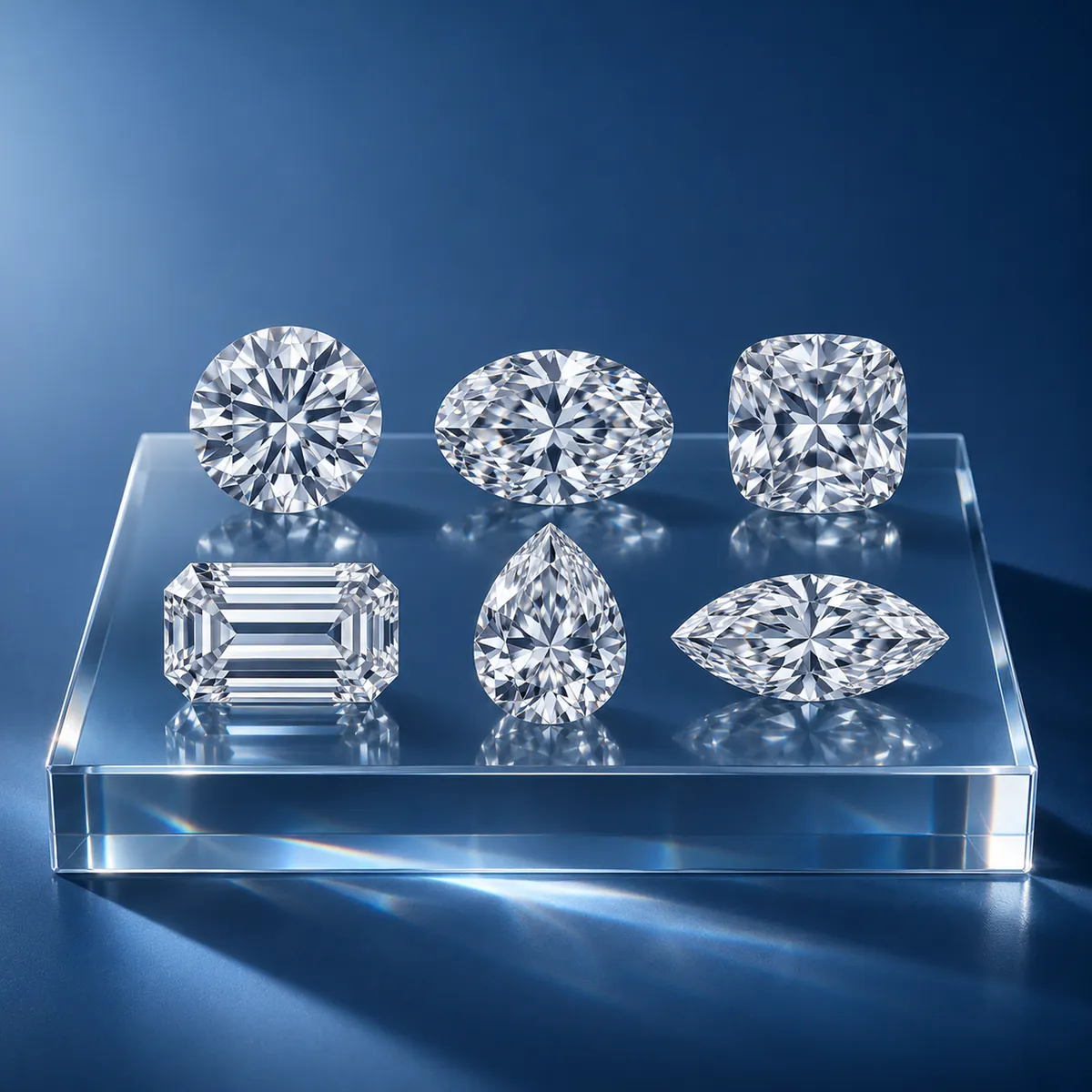
Two 1.50 ct radiants can sit side by side with identical grades and look a size apart. One is cut at about 64% depth and faces up at about 7.8 × 6.0 mm; the other, cut at 72% to hold on to weight, faces up noticeably smaller. Radiants are often cut deep, and the report’s depth figure is the first thing to read.
A radiant cut combines a rectangular or square outline with brilliant faceting, so it sparkles like a round but has the clean lines of an emerald cut. Its cut corners make it sturdy. Choose a ratio of about 1.00 to 1.05 for square or 1.20 to 1.40 for elongated, watch the depth (radiants are often cut deep and face up small), and check the facet pattern in video.
Radiant at a glance
Square vs elongated
Swipe the table to see more →
| Ratio | Look | Compared with |
|---|---|---|
| 1.00–1.05 | Square radiant | Princess, but softer corners |
| 1.10–1.20 | Slightly rectangular | Between square and classic |
| 1.20–1.40 | Elongated rectangle | Emerald outline with brilliant sparkle |
| Above 1.40 | Long, slim | Dramatic |
Depth and face-up size
Radiants are often cut deep to keep weight and brilliance. A deep radiant can look smaller than a round of the same weight. Compare measurements: a well-proportioned 1.00 ct elongated radiant is about 6.8 × 5.2 mm.
Facet pattern
Radiants vary from “crushed ice” (many small, fragmented sparkles) to “chunky” (larger, more defined flashes). Neither is better; it is taste. Video shows which you are looking at. Check also for dark areas from too-deep pavilions.
Color and clarity
Radiants hide inclusions well, but the corners can hold color, so for large stones in white metal one grade higher than for a round is a common choice. G to H color and VS2 to SI1 eye-clean clarity suit most radiants. Look at where inclusions sit: corners can be covered by prongs.
Durability
Cut corners make radiants less prone to chipping than princess cuts. Four prongs on the corners or a bezel give good protection.
Settings
Swipe the table to see more →
| Setting | Notes |
|---|---|
| Solitaire, claw prongs | Classic |
| Halo | Adds size and sparkle |
| Three-stone with trapezoids or baguettes | Geometric |
| Hidden halo | Clean face-up |
| East-west | Modern |
What a report shows for a radiant
On a report, a radiant gets measurements, polish and symmetry. An overall cut grade appears only on some reports: IGI can grade loose fancy shapes, while GIA grades cut on round brilliants only and plans fancy-shape grades for 2027. IGI and NGTC give full color and clarity grades. GIA, since October 1, 2025, gives lab-grown stones a Premium or Standard assessment instead, which for fancy shapes rests on color, clarity, polish and symmetry; see the GIA report guide. No report records the depth’s effect on face-up size, the corner shape or the faceting pattern, so judge that on video.
Radiants in jewelry
Elongated radiants suit solitaires and three-stone rings; square radiants suit halos and studs. Small calibrated radiants are used in bands and as side stones.
Common mistakes with radiants
- Choosing a very deep radiant that faces up small.
- Assuming crushed ice and chunky patterns look the same.
- Ignoring uneven corners in the outline.
Fancy colored radiants
The radiant is a popular cut for fancy colored lab-grown diamonds, because its faceting intensifies color. Check whether the color comes from growth or from treatment after growth; the report states it, and treatment must be disclosed when the stone is sold. See fancy color lab-grown diamonds.
Radiant questions
Is radiant or emerald better?
Radiant sparkles more and hides inclusions; emerald is calmer and needs higher clarity.
What ratio is best for a radiant cut?
1.00–1.05 for square, 1.20–1.40 for elongated.
Why does my radiant look small?
It may be cut deep. Compare measurements as well as carat weight.
Is a radiant cut good for colored diamonds?
Yes. Its brilliant faceting intensifies color, which is why many fancy colored stones are cut as radiants.
Find a radiant that faces up to its weight
Tell us the size, square or elongated ratio, and the color and clarity range, and we will suggest radiants with their measurements and reports. NUVU can arrange IGI, GIA or NGTC reports. Send your requirements or WhatsApp / WeChat +86 191 1840 3930.

12+ years in lab-grown diamond grading, identification and quality assurance for both HPHT and CVD stones.
About NUVU. NUVU is the international brand of New Perspective Superhard Materials Co., Ltd. in Zhecheng, Henan, China. We grow HPHT lab-grown diamonds in-house and cut, polish and match stones in our own workshop.
Related Guides
Shapes guide
Compare lab-grown diamond shapes: round, oval, emerald, radiant, cushion, pear, marquise, princess, Asscher, heart.
Read more →Diamond shapesEmerald cut guide
How to choose an emerald cut lab-grown diamond: clarity that looks clean, step symmetry, windowing, ratio, color in…
Read more →ShopLoose lab diamonds
Loose lab-grown diamonds in 10 shapes with IGI, GIA or NGTC reports.
Read more →