
An Asscher lab-grown diamond is a deliberate choice: it trades constant glitter for symmetry, depth, broad flashes, and a vintage geometric look, a priority that differs from the outline balance discussed in a heart lab grown diamond guide, where symbolic shape and visible symmetry carry more of the design. That makes it beautiful in the right stone, but less forgiving than many brilliant cuts. The same open step facets that create the hall-of-mirrors effect can also reveal inclusions, uneven patterning, color, or weight hidden in depth.
For the full framework, read Lab-Grown Diamond Shapes Guide.
This guide helps you judge whether an Asscher fits your taste and how to compare stones beyond carat weight. You’ll learn why millimeter spread, table and depth, length-to-width ratio, clarity visibility, center pattern, video review, and setting choice all matter. The goal is to help you choose a stone that looks balanced and intentional, not simply one that appears strong on paper.
Throughout this guide, “lab-grown diamond” means a laboratory-grown diamond with diamond crystal structure, not a mined diamond and not a diamond simulant. Laboratory-grown diamonds should be clearly identified as laboratory-grown, and they should not be presented as mined diamonds. If you are comparing lab-grown and natural diamonds, make sure the report, product page, invoice, and seller description use clear origin language.
| Buying Factor | What to Check | Why It Matters |
|---|---|---|
| Shape proportions | 1.00–1.05 length-to-width ratio | Keeps the Asscher looking square and balanced |
| Step pattern | Centered windmill and even contrast | Avoids dark, uneven, or lifeless areas |
| Clarity | VS2 as a cautious starting point | Broad facets make inclusions easier to see |
| Size impression | Compare millimeter measurements | Carat weight can sit in depth, not spread |
| Color choice | D-F for icy white, G-H for value-conscious comparison | Step cuts can show body color more clearly |
| Setting fit | Protect corners without hiding geometry | Preserves the clipped-corner Art Deco shape |
Quick Questions Before You Read
Q: Do Asscher lab-grown diamonds sparkle less than other shapes?
They sparkle differently. Expect broad flashes and depth rather than the glittery brilliance of round, radiant, or cushion cuts.
Q: Is carat weight the best way to compare Asschers?
No. Always compare millimeter size, depth, and video because some Asschers carry weight where you cannot see it face-up.
Q: What clarity grade is safest for an Asscher cut?
VS2 is a practical starting point, but VS1 can be safer for larger stones or inclusions near the center.
Q: Should I choose an Asscher over an emerald or radiant cut?
Choose Asscher for square symmetry and Art Deco structure; choose emerald for length or radiant for stronger brilliance.
Asscher Lab-Grown Diamonds: What Makes This Step-Cut Shape Different
An Asscher lab-grown diamond is best suited to someone who likes symmetry, depth, vintage geometry, and a calmer reflective sparkle rather than nonstop glitter. It is a square step-cut laboratory-grown diamond with cropped corners and a distinctive “hall-of-mirrors” effect, which means it behaves very differently from round, oval, cushion, or radiant cuts.
The most important expectation shift is this: an Asscher cut lab diamond is not trying to compete with a brilliant cut on sparkle volume. Its appeal comes from structure. The viewer sees broad flashes, clean lines, repeating reflections, and a centered geometric pattern. For buyers drawn to Art Deco design or architectural engagement rings, that restraint is often the point.
This shape also rewards closer inspection. Because the facets are broad and open, the diamond’s patterning is easier to read, but so are imperfections in cutting and visible inclusions. A strong Asscher looks deliberate and composed. A weak one can look flat, glassy in the wrong way, or uneven through the center.
Square Step-Cut Structure and Cropped Corners
The Asscher cut is usually square or very close to square, with cropped corners that create an octagonal outline once the stone is set. Those clipped corners are not just a small design detail. They help define the shape’s architectural personality and make the diamond feel more structured than a cushion, but less sharp than a plain square outline.
This geometry is why an Asscher cut often works well in clean, symmetrical ring designs. A solitaire can let the shape speak clearly, while more geometric settings can emphasize its Art Deco character. The risk is choosing the shape only because it is “square.” If the buyer actually wants soft curves or high-energy sparkle, a cushion or radiant may fit the preference better.
Terminology Matters: Lab-Grown, Natural, and Simulant Are Not the Same
A laboratory-grown diamond and a natural diamond are both diamonds, but they have different origins. A natural diamond forms in the earth, while a laboratory-grown diamond is produced in a controlled growth environment. A diamond simulant, such as cubic zirconia or moissanite, is a different material that may resemble diamond visually but should not be described as a lab-grown diamond.
For an Asscher cut, this distinction matters because the buying process often involves comparing reports, pricing, visual media, and setting plans across multiple sellers. The product description should clearly disclose laboratory-grown origin, and any grading report should be read for the specific stone being purchased. Clear terminology protects the buyer from assuming that one category has the origin, resale behavior, or documentation profile of another.
The Hall-of-Mirrors Effect
The hall-of-mirrors effect is the visual signature of an Asscher diamond. Instead of tiny flashes firing quickly across the stone, the eye sees wider reflections that seem to repeat inward toward the center. The effect can feel deep, crisp, and almost hypnotic when the cutting is balanced.
This is also where some buyers get surprised. In jewelry-store lighting or online videos, a round brilliant or radiant cut may appear more immediately sparkly. An Asscher usually looks quieter. That does not make it lower quality, but it does mean the buyer should prefer reflection, symmetry, and depth over maximum fire. If the goal is a diamond that looks lively from across the room in every lighting condition, this shape may not be the easiest match.
Why Lab-Grown Works Well for Asscher Buyers
Lab-grown diamonds can be especially useful for Asscher buyers because this cut places more pressure on visual cleanliness and careful specification. Within a given budget, some buyers may be able to consider higher clarity, a larger carat weight, or a more selective combination of color, proportions, and visual pattern than they might otherwise compare.
That does not mean every lab-grown Asscher is automatically a better value. A larger stone with poor face-up presence or a disorganized center pattern is still a compromised choice. The advantage is the ability to compare more deliberately. For an Asscher diamond guide, the practical lesson is simple: use the lab-grown category to be more selective, not just to chase the biggest carat weight available.
Environmental and sustainability claims should be specific, documented, and limited to what can be substantiated. Lab-grown diamonds offer a different sourcing path from mined diamonds, but that difference alone should not be treated as proof of a specific energy profile, carbon impact, or sourcing standard.
Evidence-Based Buying Note: What a Report Can and Cannot Prove
For a lab-grown Asscher, documentation should be treated as a verification layer rather than a promise of beauty. A grading report can help identify the stone and summarize recorded characteristics such as measurements, color, clarity, and other listed observations. It cannot fully capture whether the step pattern looks balanced, whether the center view feels calm, or whether the hall-of-mirrors effect is pleasing in motion.
This distinction matters because Asscher cuts are highly visual. A buyer may find two stones with similar report information but very different face-up personalities. When the diamond is lab-grown, the report may also include information related to laboratory origin, growth method, or treatment disclosure, depending on the issuing laboratory and report type. Those details are useful for comparison, but they should still be matched against the seller’s photos, video, inscription details when available, and the exact measurements of the stone being offered.
A grading report helps document key characteristics, but it should not be treated as a guarantee of beauty, value, or sourcing ethics. When growth method or post-growth treatment is relevant, buyers should look for clear disclosure in the grading report or seller documentation.
When a grading report is available, buyers should verify the report details through the issuing laboratory’s official report-check tool where available, then compare those details with the specific photos, videos, measurements, and inscription information provided for the stone.
What This Means in a Real Purchase
Before comparing reports, decide whether you want bold sparkle or quiet geometry. If you expect round-brilliant-level fire, an Asscher may disappoint even if the diamond has strong grades. If you like symmetry, vintage structure, cropped corners, and a glassy step-cut look, an Asscher lab-grown diamond can be one of the most distinctive choices for an engagement ring or fine jewelry piece.
The right buyer should enjoy looking into the diamond, not just at it. That is the difference between choosing an Asscher for its shape and choosing it for the visual experience it actually delivers.
For buyers, the practical point is not just whether the report lists attractive grades, but whether the stone’s visual behavior matches the intended style. A report can help confirm identity and basic characteristics, but it cannot decide whether the quieter step-cut look will feel lively enough to the wearer.
Step Symmetry: The First Quality Signal in an Asscher Cut Diamond
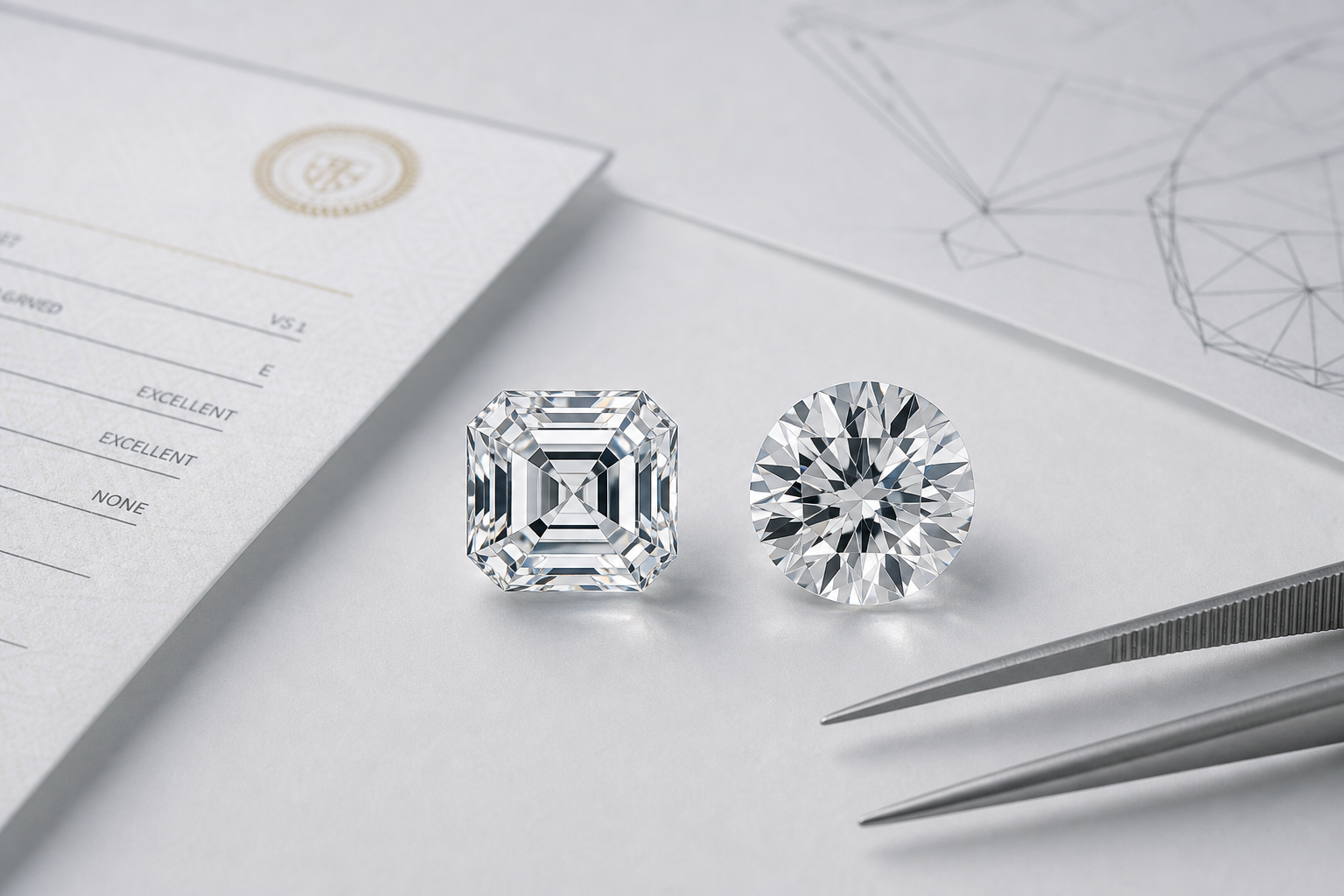
Step symmetry is the first thing to inspect in an Asscher cut diamond because this shape does not hide uneven cutting as easily as brilliant cuts do. A strong Asscher should look organized from the center outward, with steps that feel aligned, balanced, and intentional. If the pattern looks crooked, crowded, or visually unstable, strong report grades may not be enough to make the stone appealing.
This is where Asscher cut quality becomes more visual than numerical. A grading report can confirm useful details, but it cannot fully show whether the optical pattern feels calm and balanced in motion. A suitable Asscher cut lab-grown diamond is not simply the one with the highest listed grades; it is the one where the square outline, center pattern, corners, and light-dark contrast work together.
Concentric Step Pattern from Center to Edge
In a well-cut Asscher, the eye should move smoothly from the square center through the surrounding steps. The reflections should feel layered, almost like looking down through a series of framed geometric shapes. This organized movement is a major part of what makes an Asscher diamond look refined.
A disorganized step pattern can make the diamond feel less precise, even if the stone looks acceptable in a still image. The warning signs are uneven bands, a center that appears pulled to one side, or steps that seem to bunch up instead of opening cleanly. These issues matter because an Asscher depends on order. Without that order, the shape loses the disciplined Art Deco character buyers usually want from it.
Balanced Corners and Even Outline
The cropped corners should look even and intentional, not accidental or mismatched. Once set, those corners help create the Asscher’s octagonal face-up shape, so uneven corner treatment can throw off the whole outline. A slightly irregular outline may be harder to notice in a listing photo, but it can become more obvious in a solitaire or geometric setting where symmetry is exposed.
The square outline also deserves close attention. A small amount of variation is normal, but if the diamond reads as noticeably rectangular or off-square, it may not deliver the classic Asscher look. For buyers specifically choosing an Asscher for vintage geometry, this is not a minor detail. The outline is part of the style.
Light and Dark Patterning Without Dead Zones
Asscher diamonds naturally show contrast. Some areas will go bright while others appear dark as the diamond moves, and that light-dark pattern is part of the step-cut personality. The problem is not darkness by itself. The problem is a large lifeless area that sits in the stone and makes the diamond look flat.
Still photos can make this difficult to judge because lighting, angle, and editing may flatter the stone. A 360-degree video is more useful because it shows whether the pattern turns on and off evenly or collapses into dull patches. If a diamond only looks good from one angle, it deserves more scrutiny before purchase.
Certificate and Visual Review Check
Ask for a grading report, a face-up photo, and a 360-degree video whenever possible. The symmetry grade can help screen options, but it should be supported by what the eye sees. For an Asscher diamond symmetry check, look for a centered pattern, even corners, a square outline, and contrast that feels active rather than dead.
At NUVU, this is the kind of shape where the report is treated as a starting point, not the final answer. The report narrows the field, but the decision should still include visual pattern review because step-cut diamonds reveal their strengths and weaknesses face-up.
A report is most useful when it is matched to the exact stone being evaluated. Check that the report number, laser inscription when available, measurements, shape description, and any disclosed growth or post-growth treatment information align with the seller’s media. These details do not prove beauty, but they reduce confusion when comparing several similar Asscher lab-grown diamonds.
Depth, Table, and Face-Up Size: Why Asscher Diamonds Can Look Smaller
Asscher diamonds can look smaller than their carat weight suggests because more of the weight may be held in depth rather than spread across the face of the stone. This is not automatically a flaw. Depth contributes to the Asscher’s internal reflections and hall-of-mirrors look. The problem starts when extra depth adds weight without improving the face-up appearance.
For buyers, the practical issue is simple: carat weight tells you how much the diamond weighs, not how large it looks on the hand. Asscher diamond face-up size depends heavily on millimeter measurements, total depth, table percentage, and how well the stone’s proportions support its step pattern. A 2.00 ct Asscher can look meaningfully different from another 2.00 ct Asscher if one carries more weight below the girdle.
Practical Proportion Ranges to Review
The following ranges are useful screening tools, not rigid rules. An Asscher outside these ranges may still be attractive, but it should be reviewed more carefully in video and against its actual measurements. The goal is not to buy numbers. The goal is to avoid paying for hidden weight or choosing proportions that weaken the stone’s visual balance.
| Specification | Practical Buyer Range | What It Helps Evaluate |
|---|---|---|
| Length-to-width ratio | About 1.00 to 1.05 | Keeps the stone square or nearly square. |
| Table percentage | Often around 60% to 68% | Affects openness, step visibility, and balance. |
| Total depth | Often around 60% to 68% | Influences face-up size and internal depth. |
| Visual review | Always compare actual millimeter dimensions | Prevents overpaying for carat weight that does not show well face-up. |
A length-to-width ratio close to 1.00 gives the most classic square Asscher appearance. Once the ratio moves noticeably beyond that, the stone may begin to read less like an Asscher and more like a shortened emerald cut. That may still appeal to some buyers, but it changes the character of the diamond.
Table and depth need to be judged together. A table that is too broad may make the diamond look open but less layered, while a very deep build can reduce visible spread. The best depth for an Asscher cut diamond is not the shallowest number on the report. It is the depth that supports the step pattern without making the stone face up noticeably small for its carat weight.
When comparing measurements, keep the viewing context consistent. A zoomed product video can make a smaller stone look similar to a larger one, while a hand shot may exaggerate or reduce perceived size depending on finger scale and camera distance. Use the millimeter dimensions as the stable reference, then use photos and videos to judge whether those dimensions translate into a balanced face-up appearance.
Why Carat Weight Alone Can Mislead
Two 2.00 ct Asscher diamonds can have different visible sizes because they may have different millimeter dimensions. One might face up with a broader outline, while the other carries more weight in the pavilion and appears smaller from above. If both have similar color and clarity, the smaller-looking stone is not necessarily worse, but it needs to justify its deeper build through stronger visual depth, better patterning, or a more pleasing center view.
This is where buyers often make an avoidable mistake. They compare 1.80 ct, 2.00 ct, and 2.20 ct options by weight and price before looking at measurements. With Asscher diamonds, that order should be reversed. Compare the face-up dimensions first, then decide whether the added carat weight is actually visible enough to matter.
Price and Value Claims Need Like-for-Like Comparison
Prices can change with market conditions, report type, seller channel, availability, and stone-specific details, so exact comparisons should be verified at the time of purchase. A lower price does not automatically mean a better purchase, and a higher price does not automatically prove stronger visual performance. With Asscher cuts, the comparison must include measurements, pattern quality, clarity visibility, color, report details, and setting fit.
If two Asscher lab-grown diamonds look similar in headline specifications, compare the hidden variables before treating one as a stronger value. One stone may face up smaller, have a more distracting center pattern, show a visible inclusion under the table, or require a setting adjustment because of its dimensions. A practical value comparison is not about finding a universal “best deal”; it is about understanding what the buyer is receiving and what tradeoffs are attached to that specific stone.
When Depth Helps and When It Hurts
Some depth is part of the Asscher’s appeal. A stone that is cut too shallow may lose the sense of layered reflection that makes the shape interesting. It may look broad on paper but less dimensional in real life. For this cut, spread alone is not the goal.
Excessive depth becomes a problem when it reduces face-up size without adding beauty. If the stone looks smaller than comparable Asschers and the video does not show a more compelling hall-of-mirrors effect, the extra depth is likely working against the buyer. The tradeoff becomes unacceptable when the diamond costs more because of weight the eye cannot appreciate.
Measurement Evidence to Request Before Comparing Value
Because Asscher diamonds can hide or reveal value through their measurements, ask for the full length, width, and depth in millimeters rather than relying only on the carat weight and percentage figures. The millimeter dimensions are the clearest way to compare face-up presence between stones of similar weight. If the listing, invoice, or report information is incomplete, pause the comparison until the seller can confirm the exact measurements for the specific diamond.
When several Asschers appear similar, create a simple side-by-side comparison using the same fields: carat weight, length, width, depth, table, total depth, color, clarity, report type, and available media. This does not turn the decision into a spreadsheet exercise; it prevents a visually smaller or less balanced stone from looking competitive only because the headline weight is appealing. For step cuts, documentation and video work best together.
What to Check Before You Decide
Compare carat weight, total depth, table percentage, length-to-width ratio, and millimeter measurements together. If two stones have similar grades but one has noticeably smaller dimensions, ask whether the deeper build is improving the look or simply hiding weight, especially when evaluating princess cut proportions with sharp corners and strong corner protection. A deeper princess cut can be the better choice when the center pattern and reflections are stronger, but it should earn that choice visually.
The safer approach is to treat measurements as a value check. If the carat weight increases but the face-up size barely changes, the diamond may still be beautiful, but the reason for choosing it should be pattern quality rather than size.
Clarity Demands: Why Asscher Lab-Grown Diamonds Need Cleaner Stones
Asscher diamond clarity deserves stricter attention than clarity in many brilliant-cut shapes. The reason is simple: an Asscher cut does not use dense sparkle to disguise what is inside the stone. Its broad, transparent facets create a more open view into the diamond, so inclusions that might be easy to ignore in a round, oval, or radiant cut can become more noticeable in an Asscher.
For many buyers, the safest starting point is VS2 or higher, especially when the diamond is over 1.50 carats. That does not mean every VS2 Asscher lab-grown diamond is automatically eye-clean, and it does not mean every lower-clarity stone should be rejected. It means the margin for error is smaller. With an Asscher cut, the actual visibility, position, and contrast of the inclusion matter more than the grade label alone.
Why Step Facets Reveal More Than Brilliant Facets
Brilliant cuts break light into many smaller flashes. That visual activity can help hide small inclusions because the eye is constantly catching sparkle, contrast, and fire. Asscher cuts behave differently. Their step facets are broader and more transparent, so they act more like windows than glittering camouflage.
This is why step-cut clarity is less forgiving. A small crystal, feather, or dark inclusion under the table may be easier to spot because the center of the diamond is relatively open. If the inclusion interrupts the clean hall-of-mirrors look, the diamond may feel less crisp even if the grading report looks acceptable. The issue is not only whether the inclusion exists; it is whether it breaks the calm, glassy structure that makes the Asscher shape appealing in the first place.
Practical Clarity Guidance for Buyers
For most Asscher lab diamond clarity decisions, VS2 is a reasonable place to begin, but it should be treated as a screening grade rather than a guarantee. A well-positioned VS2 inclusion near an edge may be acceptable, while a more obvious VS2 inclusion near the center can be distracting. Above 1.50 carats, it is usually smarter to become more selective because the larger face-up view gives inclusions more room to show.
VS1 is often the more comfortable choice for buyers who want strong visual cleanliness without automatically moving into the highest clarity grades. VVS can make sense for someone who is especially sensitive to inclusions, choosing a larger Asscher, or designing a very clean solitaire where the stone will receive most of the attention. The tradeoff is cost efficiency: paying for VVS may improve peace of mind, but it may not always create a visible improvement over a clean-looking VS1.
SI clarity can be risky in an Asscher cut unless the specific stone has been carefully reviewed. Some SI diamonds may look acceptable in normal wear, but the grade carries more visual risk in a step cut than it would in a busy brilliant cut. If the price looks unusually attractive, assume there is a reason and verify whether the tradeoff is visible clarity, not just a lower grade on paper.
Inclusion Position Matters More Than the Grade Alone
The most important clarity question is not simply, “Is VS2 good for Asscher cut?” A better question is, “Where is the inclusion, and can I see it face-up?” An inclusion under the table or close to the center is usually more concerning because the viewer’s eye naturally goes there. Inclusions near a clipped corner or outer step may be less noticeable, especially once the diamond is set.
Dark inclusions also deserve more caution than faint or transparent ones. A small black crystal in the center can be more distracting than a larger light-colored feature near the edge. This is one reason buyers should avoid judging Asscher diamond clarity from the report alone. A clarity grade tells you the laboratory’s assessment of the inclusion characteristics, but it does not fully show how the diamond will look at normal viewing distance.
Magnified images are useful for identifying the type and location of inclusions, but they can also make minor features look more severe than they appear in real life. Standard-view photos and video are just as important because they show whether those inclusions actually affect the diamond’s face-up appearance. The goal is not to buy the highest clarity grade possible; it is to avoid paying for a stone whose open facets make flaws easier to see than expected.
Buyer Verification Checklist
Before choosing an eye-clean Asscher diamond, review magnified imagery, the grading report, and the inclusion plot if one is available. Then look at normal viewing photos or video to confirm whether inclusions are visible without magnification. If a seller describes the stone as eye-clean, ask what that means in practical terms: viewing distance, lighting, angle, and whether the assessment is face-up only.
The stronger choice is the diamond that stays visually clean in the way it will actually be worn. A technically higher clarity grade is not automatically better value if a lower grade looks equally clean face-up, but a lower grade becomes a poor tradeoff the moment an inclusion interrupts the center view.
Windmill Pattern and Center View: The Signature Asscher Look
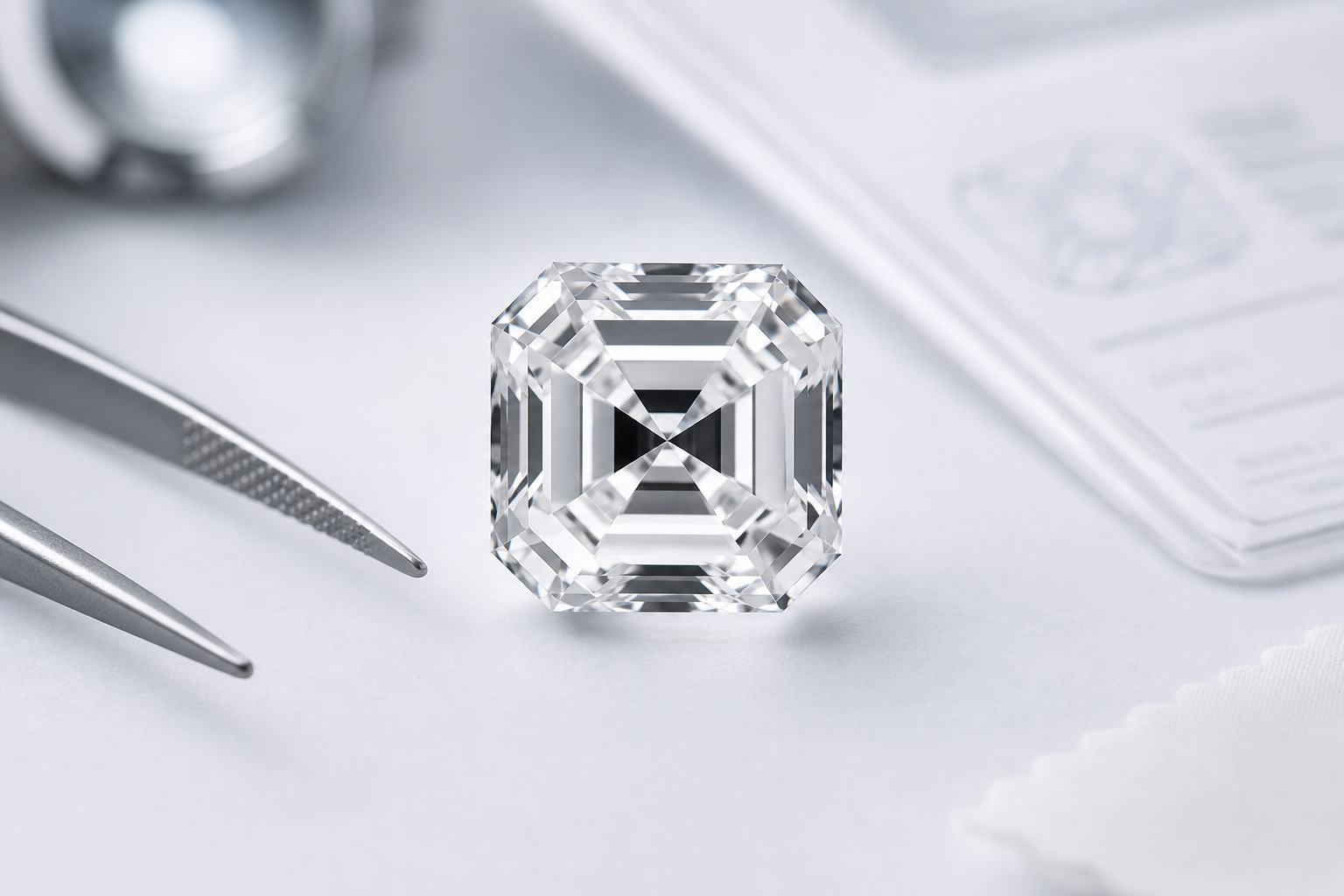
The Asscher diamond windmill is one of the shape’s most recognizable visual features. It appears as a cross-like or pinwheel-style pattern near the center of the diamond, created by the way the step facets reflect light and shadow. A good Asscher cut pattern should feel centered, deliberate, and integrated into the stone’s hall-of-mirrors effect.
This pattern is not a decorative add-on or a separate feature to request. It comes from the Asscher’s facet geometry. Because it sits near the visual center of the diamond, it has a strong effect on whether the stone looks elegant or distracting. Two Asscher diamonds with similar carat, color, and clarity can feel very different if one has a clean center pattern and the other looks uneven or overly dark.
How the Windmill Pattern Forms
The windmill effect forms from the central step-cut facet structure and the way those facets create contrast. Instead of scattering light into many small flashes, the Asscher cut creates larger reflections that repeat inward and outward. The center facets produce alternating light and dark areas, which the eye reads as the Asscher diamond windmill.
A well-cut center should draw the eye into the diamond without looking harsh. The pattern should support the square geometry and layered depth of the stone. If the center view looks jumbled, off-center, or visually heavy, the diamond may lose the clean architectural quality that makes an Asscher appealing.
Strong Pattern Versus Distracting Pattern
A strong Asscher center pattern looks balanced from several angles. The windmill should appear centered, proportional, and connected to the surrounding steps. It can show contrast, including darker areas, but that contrast should feel controlled rather than blotchy.
A distracting pattern often looks too dark, uneven, or dominant. If the center collapses into a large dark patch in video, the diamond may look flat in certain lighting. If one side of the windmill appears heavier than the other, the eye may keep returning to that imbalance. This is not a minor detail in an Asscher. Because the shape is built around symmetry and visual order, a poor center pattern can make the whole stone feel less refined.
The mistake is assuming that a brighter-looking still photo proves the pattern is strong. A single image may catch the diamond at its best angle. Motion reveals more: whether the contrast turns on and off cleanly, whether the center stays organized, and whether the stone has depth without looking dark.
Buyer Scenario: Choosing Between Two Similar Asscher Diamonds
Maya is comparing two 1.80 ct Asscher lab-grown diamonds with similar color and clarity grades. The first diamond has slightly better face-up measurements, so it looks like the stronger choice on paper. But in video, the Asscher center pattern appears uneven. One side of the windmill turns dark more heavily than the other, and the center never looks fully settled.
The second diamond is a little deeper and gives up a small amount of visible spread. On the report, that seems like a compromise. In motion, though, the windmill is cleaner, more centered, and better integrated with the surrounding step reflections. The stone looks calmer and more intentional face-up.
In that situation, the second diamond may be the better Asscher for Maya, even though it is not the largest-looking option by measurement. This is the kind of decision where Asscher buying differs from a simple size comparison. A slightly larger spread does not help much if the center view weakens the entire visual character of the stone.
How to Verify This Before Buying
Review the diamond face-up in motion, not only in a glamour photo. Pause the video at several angles and look at the center pattern. The windmill should remain balanced as the diamond moves; it should not collapse into large, lifeless dark patches or shift in a way that makes the stone look lopsided.
If you are comparing multiple stones, place the videos side by side and watch the center first before judging size. For an Asscher cut, a good center pattern can be more important than a small difference in millimeter spread.
Color and Sparkle Expectations: Why Asscher Diamonds Feel Quieter
Asscher diamond sparkle is quieter than the sparkle most buyers associate with round, oval, cushion, or radiant cuts. That is not a flaw when the stone is well chosen. It is part of the Asscher’s identity as a step-cut diamond. The visual appeal comes from broad flashes, mirrored depth, and geometric contrast rather than constant glitter.
This distinction matters before purchase because some buyers fall in love with Asscher proportions online, then expect the diamond to perform like a brilliant cut in person. If the priority is maximum sparkle across many lighting conditions, a radiant or round brilliant may be a better fit. If the priority is clean structure, vintage character, and a more composed face-up look, the Asscher can feel far more distinctive.
Broad Flashes Instead of Glitter
Asscher diamonds produce slower, larger flashes. The reflections move across the stone in broad steps rather than breaking into tiny sparks. In soft lighting, this can look elegant and glassy. In direct spotlighting, the diamond may show flashes of fire, but it still will not usually have the same glittering intensity as a brilliant-cut shape.
The practical takeaway is to compare sparkle style, not just sparkle amount. A buyer asking “do Asscher diamonds sparkle?” is usually asking the wrong version of the question. They do sparkle, but in a more restrained way. If a diamond looks dead or flat, that is a cut and light-performance concern. If it looks calm, reflective, and structured, that may be exactly what a strong Asscher is supposed to do.
Color Grade Considerations for Asscher Cuts
Asscher diamond color can be more noticeable than color in many brilliant cuts because the facets are broader and more open. The shape gives the eye longer, cleaner views through the diamond, which can make body color easier to detect, especially in larger stones.
D-F color grades are the safer direction for buyers who want a crisp, icy white diamond, particularly in platinum or white gold. G-H can still be a strong choice for many Asscher lab-grown diamonds, especially when the stone is well cut and the buyer is not highly color-sensitive. The decision becomes more important as carat weight increases because larger diamonds tend to show color more readily.
The best color for Asscher cut diamond buyers is not always the highest grade they can afford. A well-balanced G or H may be a smarter use of budget than pushing to D-F if the difference is not visible to the wearer. But if the buyer specifically wants a bright white look in a larger Asscher, dropping too far in color can become a regret, particularly in a white metal setting.
How Metal Choice Changes Color Perception
Metal color changes how warmth is perceived. Platinum and white gold create a bright, cool frame around the diamond, which can make warmth easier to notice by contrast. If an icy appearance matters, this is where D-F or a carefully selected G may feel more appropriate.
Yellow gold and rose gold are more forgiving with near-colorless stones because the warmer metal can make slight warmth feel intentional rather than mismatched. In those settings, G-H can often look harmonious, and some buyers may even prefer the softer look over a very icy stone. The key is to judge the diamond and setting together, not as separate decisions.
Color should also be judged separately from sourcing or sustainability language. A lab-grown diamond can offer a different production route from a mined diamond, but claims about environmental impact, energy use, or responsible sourcing should be supported by clear documentation rather than assumed from the word “lab-grown” alone.
Careful Language Around Lab-Grown, Sustainability, and Origin Claims
When comparing Asscher lab-grown diamonds, it is reasonable to ask how the diamond was represented, what the grading report says, and what the seller can document. However, the label “lab-grown” should not be treated as automatic proof of a specific environmental impact, energy profile, or sourcing claim. Those claims depend on details such as production practices, energy sources, supply chain records, and the exact language used by the seller.
A more defensible approach is to separate three questions. First, is the diamond clearly disclosed as lab-grown rather than natural? Second, does the grading or seller documentation match the specific stone being purchased? Third, if environmental or responsibility claims are part of the decision, are those claims specific and supported by documentation rather than broad marketing language? This keeps the buying process transparent without overstating what a diamond report or product label can prove.
For traceability, the most useful information is specific rather than emotional. Buyers can ask whether the report identifies the diamond as laboratory-grown, whether any growth or post-growth treatment disclosure is listed, whether the report number corresponds to the exact stone, and whether the seller can explain the chain of documentation from loose diamond selection to finished jewelry. These steps do not require broad sustainability promises; they simply make the information easier to verify.
What to Check Before You Decide
View the diamond in different lighting whenever possible. Store lighting, daylight, office lighting, and shaded indoor light can all make an Asscher lab-grown diamond appearance feel slightly different. A stone that looks bright in one environment may reveal more warmth or less liveliness in another.
Compare the diamond against the intended metal color before finalizing the choice. If the Asscher is larger, set in platinum or white gold, or chosen for a very crisp Art Deco look, be more selective with color. If the design uses yellow or rose gold, a near-colorless grade may offer a better balance of appearance and value.
Asscher Cut Versus Emerald, Cushion, and Radiant: Choosing the Right Square Look
An Asscher cut should not be treated as simply a square emerald cut. It has its own face-up personality: cropped corners, a square outline, a centered step pattern, and a more architectural look than most other diamond shapes. That distinction matters because many buyers are drawn to a “square diamond” without realizing that Asscher, cushion, and radiant cuts behave very differently on the hand.
The right choice depends less on which shape is more popular and more on what kind of visual experience you want every day. If you want crisp geometry and a vintage engagement ring feel, Asscher may be the strongest fit. If you want a larger-looking outline, softer edges, or brighter sparkle, another shape may serve you better.
Asscher Versus Emerald Cut
The Asscher vs emerald cut decision usually comes down to square structure versus elongated elegance. Emerald cuts are typically rectangular, so they create a longer, leaner line on the finger. Asscher cuts are square or nearly square, which gives them a more centered, symmetrical, almost architectural presence.
Emerald cuts may also look larger for the same carat weight because their elongated shape can offer more visible spread. Asschers often place more emphasis on depth, symmetry, and the center pattern. That can make them feel more dimensional, but it also means a buyer who wants maximum finger coverage may prefer an emerald cut.
Choose an Asscher or emerald cut diamond based on the silhouette you want first. If the ring should feel clean, linear, and elongated, emerald is the easier answer. If the ring should feel balanced, geometric, and Art Deco-inspired, the Asscher has the stronger identity.
Asscher Versus Cushion Cut
The Asscher vs cushion cut comparison is more about mood than measurements. Cushion cuts have rounded corners and a softer outline, which often gives them a warmer, more romantic look. They can be brilliant-cut or modified brilliant, so many cushions also produce more scattered sparkle than an Asscher.
Asschers feel sharper and more deliberate. The clipped corners, square geometry, and step-cut reflections create a cleaner, more structured look. This makes the Asscher a better fit for buyers who like symmetry, vintage-modern design, and a diamond that feels composed rather than soft.
A cushion may be the safer choice if you want a square diamond shape but still want a forgiving, sparkly, less formal appearance. An Asscher is better when the geometry itself is the point.
Asscher Versus Radiant Cut
The Asscher vs radiant cut decision is one of the most important expectation checks. Radiant cuts are brilliant-cut diamonds, so they usually deliver more intense sparkle, more movement, and more glitter across the stone. For buyers who want a square or rectangular diamond that catches attention quickly, radiant often makes more sense.
Asscher cuts are quieter. Their appeal comes from broad reflections, step symmetry, and the hall-of-mirrors effect rather than constant sparkle. A buyer who expects radiant-like brilliance from an Asscher may be disappointed, even if the Asscher is well cut.
For an Asscher or radiant engagement ring, decide how much sparkle matters before comparing carat weight or clarity. If sparkle is the priority, choose radiant. If structure, depth, and vintage geometry matter more, choose Asscher.
Quick Shape Decision Guide
- Choose Asscher if you want square geometry, step facets, cropped corners, and a strong Art Deco character.
- Choose radiant if you want a square or rectangular diamond with brighter, more energetic sparkle.
- Choose cushion if you want a softer square look with rounded corners and a more romantic feel.
- Choose emerald if you prefer an elongated step cut with a leaner outline and more finger coverage.
The best square lab-grown diamond shape is the one that matches your expectations before you see it in a setting. Asscher is distinctive, but it is not the most forgiving choice for buyers who are unsure about step cuts.
Best Settings for Asscher Lab-Grown Diamond Engagement Rings
An Asscher lab-grown diamond ring works best when the setting respects the stone’s geometry. The clipped corners, square outline, and step pattern are the main visual features, so a good setting should either frame them cleanly or add presence without burying the shape.
This is where setting choice becomes more than style preference. A poorly matched Asscher diamond setting can make the stone look smaller, hide the corners, or distract from the center pattern. A well-matched setting protects the stone, supports the proportions, and makes the design feel intentional.
Solitaire Settings for Clean Geometry
A solitaire setting is often the cleanest option for an Asscher engagement ring because it lets the diamond’s shape do the work, especially when a lab grown diamond shapes guide helps compare outline, visual size, and wearability across cuts. With fewer design elements around the center stone, the step pattern, square outline, and cropped corners remain easy to see.
This style works best when the diamond itself has strong visual balance. If the Asscher has an uneven center pattern or weak face-up presence, a solitaire will not hide it. For buyers choosing a solitaire, the stone needs to be strong enough to stand alone.
Halo Settings for More Face-Up Presence
A halo can help an Asscher lab-grown diamond ring appear larger, especially because Asscher cuts can face up smaller than some brilliant-cut shapes of the same carat weight. The practical benefit is real, but the design has to be handled carefully.
The best halo for an Asscher should follow the square-octagonal outline rather than turn the ring into a generic square cluster. If the halo is too bulky or too rounded, it can blur the clipped corners and weaken the very feature that makes the Asscher distinct.
Bezel and Art Deco-Inspired Settings
Bezel settings and Art Deco ring details can work especially well with Asscher cuts because they reinforce the stone’s geometric character. A slim bezel can frame the outline cleanly, while architectural side details can make the ring feel vintage without relying on heavy ornament.
The risk is overbuilding the setting. Too much metal around the stone can reduce visible light return, make the diamond feel boxed in, or cause the center to look smaller than expected. If the goal is a bold Art Deco look, the design should still leave the Asscher’s step pattern visible.
Side Stones and Three-Stone Designs
Side stones can complement an Asscher when they repeat or support the center stone’s geometry. Tapered baguettes, trapezoids, and other step-cut side stones often work better than overly rounded accents because they keep the design visually consistent.
A three-stone Asscher ring should not compete with the center diamond. If the side stones are too large or too bright, they can pull attention away from the Asscher’s quieter pattern. The strongest designs create width and presence while keeping the center stone clearly dominant.
Stone-to-Setting Fit Check
Confirm the diamond’s exact measurements before finalizing the setting. The length, width, corner structure, and depth affect prong placement, halo shape, bezel fit, and the final face-up appearance.
For a custom Asscher diamond ring, the stone should be selected before the design is locked. At NUVU, buyers are encouraged to look at the diamond and setting together because a strong stone on paper can still be the wrong physical fit for a specific ring design.
Pay close attention to whether the setting protects the clipped corners without hiding them. The best setting for an Asscher cut diamond should make the outline more recognizable, not less.
For custom jewelry, stone measurements and setting compatibility should be confirmed before finalizing a purchase. This includes prong placement, halo spacing, side-stone proportions, metal choice, and whether the finished design still leaves the Asscher outline visible.
If a GIA, IGI, GCAL, or other laboratory report is provided, buyers should check the report through the issuing laboratory’s official verification system where available and confirm that the report details match the exact stone being set.
For Asscher buyers, these verification steps are most useful when they are combined with a practical review of the finished design plan. A report can confirm the recorded diamond data, while design communication confirms whether the selected stone can be set securely, whether the corners remain visible, and whether the final ring proportions support the intended Art Deco look. This is especially important for custom work, where small differences in millimeter dimensions can affect prong layout, halo spacing, and the balance between the center stone and side details.
A careful seller should be able to explain which parts of the purchase are documented by the laboratory report and which parts are based on professional visual review, setting feasibility, and customer preference. That distinction gives buyers a clearer decision path: verify the diamond’s identity, evaluate its step-cut appearance, and then confirm that the ring design will protect and frame the stone properly.
Buying Checklist: How to Evaluate an Asscher Lab-Grown Diamond Before Purchase
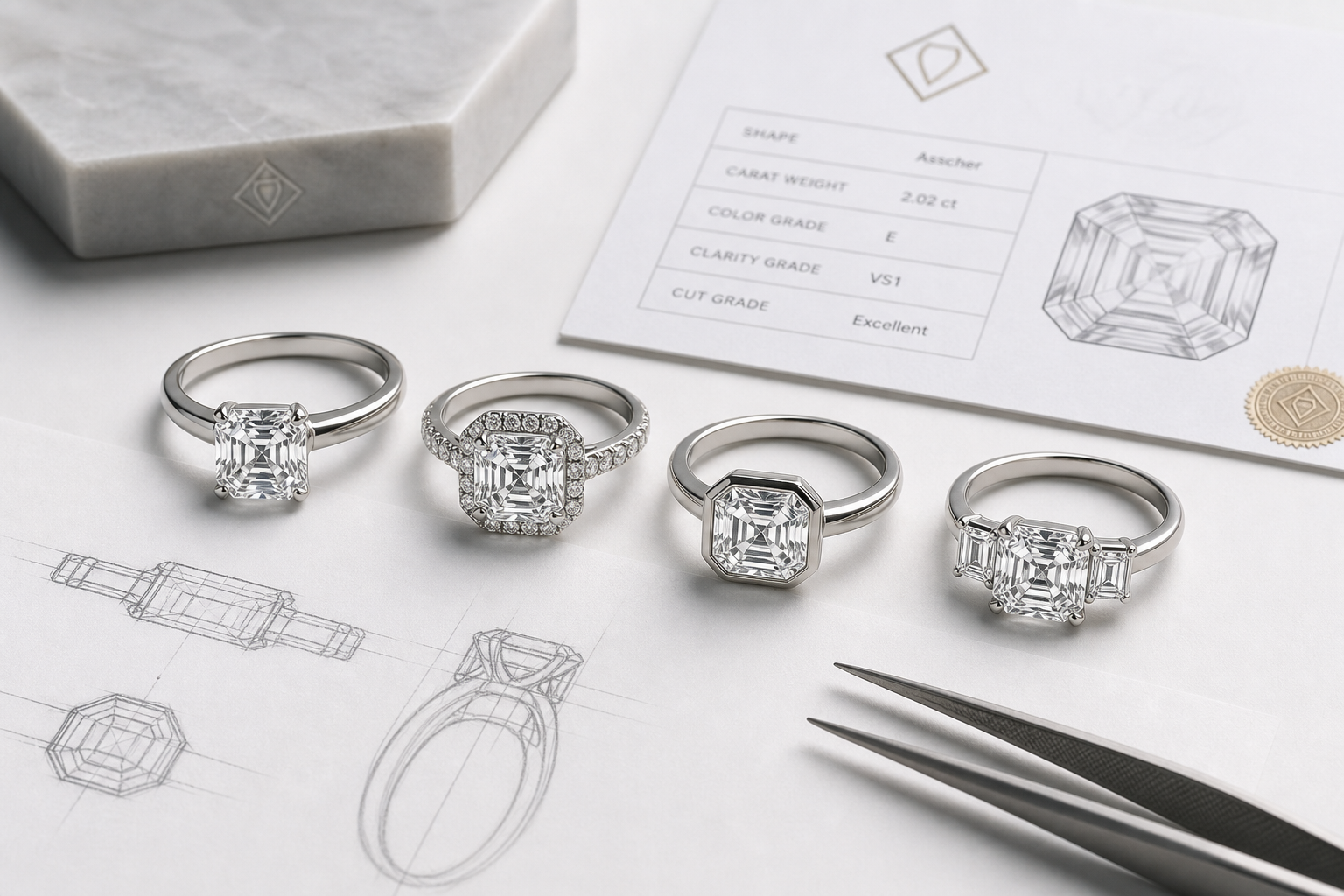
To buy an Asscher lab-grown diamond well, evaluate it as a step-cut stone first and a carat weight second. The strongest value for a particular buyer is not automatically the largest or the lowest priced stone. It is the one with the right balance of shape, pattern, clarity visibility, measurements, documentation, and setting fit.
A grading report is useful, but it cannot show the full face-up personality of an Asscher. Before purchase, the decision should include measurements, images, video, and a realistic view of how the stone will look in the intended ring.
Use documentation as a verification tool, not a substitute for judgment. The report can help confirm the diamond’s recorded characteristics, while seller-provided media helps you evaluate how those characteristics appear in real viewing conditions. If sustainability, origin, or production claims are important to your decision, ask what documents or supplier information support those claims rather than relying on broad marketing language.
Start with Shape and Pattern
Begin by checking whether the diamond looks square, centered, and balanced. The step pattern should feel organized from the center outward, not tilted, crowded, or visually uneven.
This matters because Asscher cuts depend on precision. A round brilliant can sometimes distract the eye with sparkle, but an Asscher makes pattern issues easier to notice. If the shape or center pattern bothers you in video, better grades on paper are unlikely to fix that reaction later.
Compare Proportions and Measurements
Compare the length-to-width ratio, table, total depth, and millimeter measurements before comparing price. Carat weight alone can be misleading because two Asscher diamonds of the same weight may look different in size once viewed face-up.
A practical Asscher diamond buying guide should always treat millimeter spread as part of value. If one diamond is deeper and faces up smaller, make sure the added depth is contributing to visual appeal rather than simply hiding weight where you will not see it.
Review Clarity Under Realistic Conditions
Clarity review is especially important with Asscher cuts because the broad step facets can reveal inclusions more clearly than many brilliant-cut shapes. Look closely under the table and near the center, where inclusions are hardest to ignore.
Give extra attention to stones above 1.50 ct. As the diamond gets larger, the open facets give your eye more area to inspect. A clarity grade that feels acceptable in a smaller stone may become more noticeable in a larger Asscher unless the inclusion position is favorable.
Match the Diamond to the Ring Design
The diamond should fit the ring design physically and visually. An Asscher chosen for a solitaire may need stronger face-up balance than one framed by a halo. A bezel or three-stone design may need more careful planning around clipped corners and exact measurements.
If you are designing a custom ring, finalize the stone before the CAD or production stage. Changing the diamond later can affect prong placement, halo proportions, side-stone alignment, and the overall balance of the ring.
Seller Policies, Services, and Promises Should Be Confirmed Directly
Before purchase, buyers should confirm documentation, return terms, resizing policies, warranty coverage, production timelines, shipping details, and after-sales support directly with the seller. These are business-policy questions rather than gemological characteristics, and they should not be assumed from a diamond report, product title, or general marketing language.
For custom Asscher jewelry, written confirmation is especially useful because changes to the stone, setting, ring size, side stones, or metal can affect feasibility and cost. A careful buying process separates the diamond’s documented characteristics from seller-specific services and policies, so the buyer knows which details are verified by the report and which details must be confirmed through the seller.
Documentation Questions That Protect the Buyer
Before committing, ask the seller to connect each piece of documentation to the exact diamond being sold. The report number, measurements, shape description, photos, videos, and any inscription information should all point to the same stone. This is especially important when comparing several Asschers that look similar on paper, because a small mismatch in measurements or media can lead to a very different face-up result.
It is also helpful to ask which claims are being made by the grading report and which are being made by the seller. A report may document gemological characteristics, while the seller may separately describe eye-clean appearance, setting compatibility, upgrade options, production origin, or sustainability-related information. Keeping those categories separate makes the purchase more transparent and prevents a buyer from assuming that one document proves every claim attached to the stone.
Traceability Steps for a Loose Asscher and Finished Ring
Traceability is easiest when the buyer follows the diamond from loose-stone comparison through the finished jewelry plan. Start with the report number and measurements, then confirm that the same stone appears in the listing media, selection notes, invoice or order details, and setting discussion. If the stone has a laser inscription, ask whether it can be matched to the report information before the diamond is set, because an inscription may be harder to view once the ring is finished.
For custom jewelry, the documentation trail should also connect the stone to the design decisions. The CAD or design notes should reflect the diamond’s actual length, width, depth, corner shape, and any side-stone or halo proportions being planned around it. This does not make the design better by itself, but it reduces the risk of choosing a beautiful Asscher that is poorly matched to the final mounting.
NUVU’s buyer-first approach is to make diamond comparison clearer: what the report shows, what the visuals reveal, and whether the stone fits the intended piece. That perspective is especially useful for Asscher cuts because a traceable decision is not only about confirming identity; it is also about preserving the specific geometry, center pattern, and setting fit that made the stone worth choosing.
Buyer Verification Checklist
- Confirm the grading report number and make sure it matches the diamond being shown.
- Review length, width, table percentage, total depth, color, and clarity together.
- Ask for face-up photos and a 360 video when available.
- Check whether inclusions are visible without magnification in normal viewing conditions.
- Compare actual millimeter measurements, not carat weight alone.
- Confirm that the setting can protect the clipped corners without covering the Asscher outline.
- Ask whether the seller can confirm eye-clean appearance, setting compatibility, and final design proportions in writing.
If a stone looks unusually attractive for the price, identify the tradeoff before committing. It may still be a smart purchase, but the reason should be clear: smaller spread, deeper build, warmer color, lower clarity, or a less balanced pattern. A good Asscher buying decision is not about avoiding tradeoffs; it is about choosing the ones you can see and accept.
Common Asscher Cut Buying Mistakes and How to Avoid Them
The most expensive Asscher diamond mistakes usually come from judging the stone as if it were a brilliant cut. An Asscher lab diamond has a different value logic: the appeal comes from clean geometry, step symmetry, visible depth, and a balanced center view. If those qualities are weak, a strong carat weight or attractive price will not fully rescue the stone.
Mistake 1: Expecting Brilliant-Cut Sparkle
An Asscher cut does not produce the constant glitter many buyers associate with round, oval, cushion, or radiant diamonds. Its beauty is slower and more architectural, with broad flashes, mirror-like reflections, and a structured hall-of-mirrors effect. This is not a flaw, but it can feel disappointing if the buyer expected bright, busy sparkle from every angle.
The practical fix is simple: compare an Asscher diamond video against a brilliant-cut diamond before committing. If the brilliant cut immediately feels more alive to you, an Asscher may not be the right shape. If your eye keeps returning to the symmetry, depth, and centered pattern, the quieter sparkle profile is likely part of the attraction rather than a compromise.
Mistake 2: Buying by Carat Weight Alone
One of the most common Asscher diamond buying tips is also one of the easiest to ignore: do not choose by carat weight without checking face-up size. Asscher cuts can carry more weight in depth, so two diamonds with the same carat weight may look noticeably different on the hand. This is why some buyers later ask, “Why does my Asscher diamond look small?” even though the listed weight seemed generous.
The fix is to compare millimeter measurements and visual spread, not just the carat number. A deeper Asscher is not automatically bad, because depth can support the shape’s internal reflections. The issue is whether that depth improves the look or simply hides weight below the surface. If a stone is priced attractively but faces up smaller than similar options, treat the lower price as a tradeoff to evaluate, not an automatic win.
Mistake 3: Going Too Low on Clarity Without Visual Proof
Clarity mistakes matter more in Asscher cuts because the step facets are broad and open. A small inclusion that would be harder to notice in a brilliant cut may be easier to see through the table of an Asscher, especially in larger stones. This does not mean every lower-clarity Asscher should be rejected, but it does mean the grade alone is not enough protection.
The fix is to review magnified imagery, standard-view photos, and diamond video before buying. Pay special attention to inclusions under the table or near the center, where the eye naturally lands. If a seller calls the diamond eye-clean, ask whether that means eye-clean face-up, at what viewing distance, and in what lighting. For an Asscher, vague clarity reassurance is not as useful as specific visual confirmation.
Mistake 4: Choosing a Setting That Hides the Shape
An Asscher’s clipped corners and square-octagonal outline are part of its identity. Bulky prongs, heavy halos, or poorly proportioned bezels can cover the very geometry that makes the stone distinctive. This is a common setting mistake because buyers often focus on making the ring look larger without asking whether the setting still respects the diamond’s shape.
The fix is to match the setting to the diamond’s exact measurements. Prongs should protect the clipped corners without swallowing them. A halo should follow the outline cleanly instead of turning the stone into a generic square center. A bezel can look sharp and Art Deco-inspired, but if the metal is too heavy, it may make the Asscher appear smaller and darker than expected.
What to Check Before You Decide
If an Asscher lab diamond looks like a great deal, identify the reason before you buy. Is it deeper than average, smaller face-up, lower in clarity, warmer in color, or less balanced in the center pattern? A lower price can still represent strong Asscher lab diamond value, but only when the tradeoff matches your priorities.
The safer buying mindset is not “find the biggest Asscher for the budget.” It is “find the Asscher whose compromises are visible, acceptable, and aligned with the ring design.” That distinction prevents many regrets, especially when buying an Asscher lab diamond online without seeing it in person first.
FAQ: Asscher Lab-Grown Diamond Questions Buyers Ask Most
Are Asscher lab-grown diamonds a good choice for engagement rings?
Yes, Asscher lab-grown diamonds are a good choice for engagement rings when the buyer likes geometric style, vintage character, and clean step-cut reflections. They are less ideal for someone who wants maximum sparkle or a diamond that looks bright and glittery in every lighting condition. The best candidate for an Asscher cut lab diamond is someone who sees structure and symmetry as part of the beauty.
Do Asscher diamonds look smaller than other shapes?
They often can. Asscher diamonds may carry more weight in depth, which can reduce visible face-up size compared with some brilliant or elongated shapes of the same carat weight. Before choosing, compare the millimeter measurements and the actual face-up video rather than assuming carat weight tells the whole size story.
What clarity is best for an Asscher lab-grown diamond?
VS2 or higher is often a safer starting point for an Asscher lab-grown diamond, especially above 1.50 carats. VS1 or VVS may be worth considering if you are sensitive to visible inclusions or want a cleaner center view. The actual stone still needs visual review, because inclusion location can matter more than the clarity grade alone.
What color grade should I choose for an Asscher cut?
D-F color works well for buyers who want a crisp, icy white Asscher, especially in platinum or white gold. G-H can also be a smart range for many buyers, depending on the diamond’s size, the setting metal, and personal color sensitivity. Larger Asscher cuts and white metal settings tend to make color more noticeable, so those situations deserve closer comparison.
Is an Asscher cut better than an emerald cut?
No. Asscher and emerald cuts are different, not better or worse in a universal sense. An Asscher is square, centered, and architectural, with a stronger geometric personality. An emerald cut is usually elongated and may offer a larger-looking spread for the same carat weight. Choose Asscher if you want a compact Art Deco look; choose emerald if you prefer a longer, leaner step-cut shape.
Does a grading report mean an Asscher will look beautiful?
No. A grading report is an important comparison tool, but it should not be treated as the whole buying decision. It can help document characteristics such as measurements, color, clarity, and other report-specific details, but it does not fully show the diamond’s face-up personality. For an Asscher, the report should be paired with video, photos, and a careful review of the center pattern, spread, and clarity visibility.
Can a lab-grown Asscher be described as sustainable?
Only if the claim is specific and supported. A lab-grown Asscher has a different origin from a natural mined diamond, but broad claims such as sustainability, responsible sourcing, or reduced environmental impact should be backed by relevant documentation. Buyers who care about these factors should ask what the seller can actually substantiate.
Final Buyer Takeaway
Choose an Asscher lab-grown diamond if you value pattern, symmetry, depth, and Art Deco structure more than constant sparkle. The strongest buying decision comes from comparing the grading report, millimeter measurements, clarity visibility, windmill balance, and actual face-up video together.
If you are comparing specific stones, look beyond the headline grades. NUVU can help buyers evaluate Asscher lab-grown diamonds by measurements, clarity visibility, center pattern, documentation, and setting fit so the final choice works on paper and in the finished ring.
Disclosure: This article is for general educational purposes only. Diamond grading, pricing, availability, specifications, and seller policies can change, and readers should verify important details through grading reports, official laboratory tools, seller documentation, or qualified professionals before making a purchase decision. Laboratory-grown diamonds should be clearly distinguished from natural diamonds, and environmental or sourcing claims should be supported by specific documentation.