
Choosing between HPHT and CVD can feel like a shortcut to judging the environmental impact of a lab-grown diamond, but the growth method alone does not tell the full story, especially when assessing renewable energy claims across different producers. Each process can differ in energy demand, growth time, yield, and possible post-growth treatment, yet those factors only become meaningful when they are tied to real facility practices and documented claims.
For the full framework, read Sustainable Jewelry Buying Guide.
This article helps separate useful evidence from vague sustainability language. Instead of assuming one method is automatically cleaner, the better question is whether the seller can show where the diamond was grown, what energy or production information is available, whether treatments were disclosed, and how specific the sustainability claims are. The goal is to help you compare stones with more confidence and choose the option with the strongest support, not just the most appealing label.
Laboratory-grown diamonds should be clearly identified as laboratory-grown, and they should not be presented as mined diamonds. HPHT and CVD describe laboratory diamond growth methods in this article, while natural diamonds have a different geological origin. Diamond simulants are a separate category and should not be confused with laboratory-grown diamonds.
| What to Check | Why It Matters | Buyer Takeaway |
|---|---|---|
| HPHT or CVD method | Influences production path, but not impact by itself | Use it as a starting question, not a final answer |
| Energy source | Electricity mix can change the footprint significantly | Ask for facility or supplier-level details |
| Production efficiency | Lower yield may mean more runs, waste, and energy use | Favor transparent producers with clear process data |
| Treatment disclosure | Extra steps can affect the production story | Confirm whether HPHT post-growth treatment or other processing occurred when relevant |
| Grading report | Documents diamond identity and grading details, not full sustainability | Match report details, then request separate claim support |
| Sustainability wording | Broad claims can hide missing evidence | Trust specific, current, written documentation over labels |
Quick Questions Before You Read
Q: Is HPHT more sustainable than CVD?
Not automatically. Either method can be better or worse depending on energy source, efficiency, treatments, and documentation.
Q: Does a grading report prove a diamond is environmentally responsible?
No. It can confirm origin, grading details, and sometimes method or treatment, but it is not a carbon or supply-chain audit.
Q: Should I avoid treated lab-grown diamonds?
Not necessarily. Treatments should be disclosed so you can understand the full production path and compare options fairly.
Q: What is the safest way to compare two similar stones?
Choose the one with clearer documentation, specific seller answers, suitable appearance, and a realistic fit for your budget.
Quick Answer: Should Sustainability Decide Between HPHT and CVD?
If you are comparing HPHT vs CVD sustainability, the short answer is this: the growth method can affect environmental impact, but it should not be treated as a stand-alone environmental score. For most buyers, the more useful question is not “which method is greener?” but “which diamond has the clearer evidence behind its lab-grown diamond sustainability claims?”
In practice, the method tells you something about how the stone was made, but it does not tell you enough about the energy source, production efficiency, or transparency of the facility. A buyer asking should I choose HPHT or CVD should first look for documentation, then decide whether the sustainability claim is specific enough to trust.
Environmental and sustainability claims should be specific, documented, and limited to what can be substantiated. A claim such as “made with renewable energy,” “lower-carbon production,” or “supplier-documented energy use” is more useful when it explains the facility, reporting period, boundary, and supporting documentation.
The Short Buyer-Facing Answer
Do not choose HPHT or CVD based on the label alone. A CVD diamond grown in a coal-powered, low-transparency facility may be less well documented from an environmental perspective than an HPHT diamond from a producer that can document lower-carbon energy use and clearer reporting. The reverse can also be true. For responsible diamond buying, the stronger claim is usually the one with better evidence, not the one with the more appealing method label.
What the Growth Method Can Influence
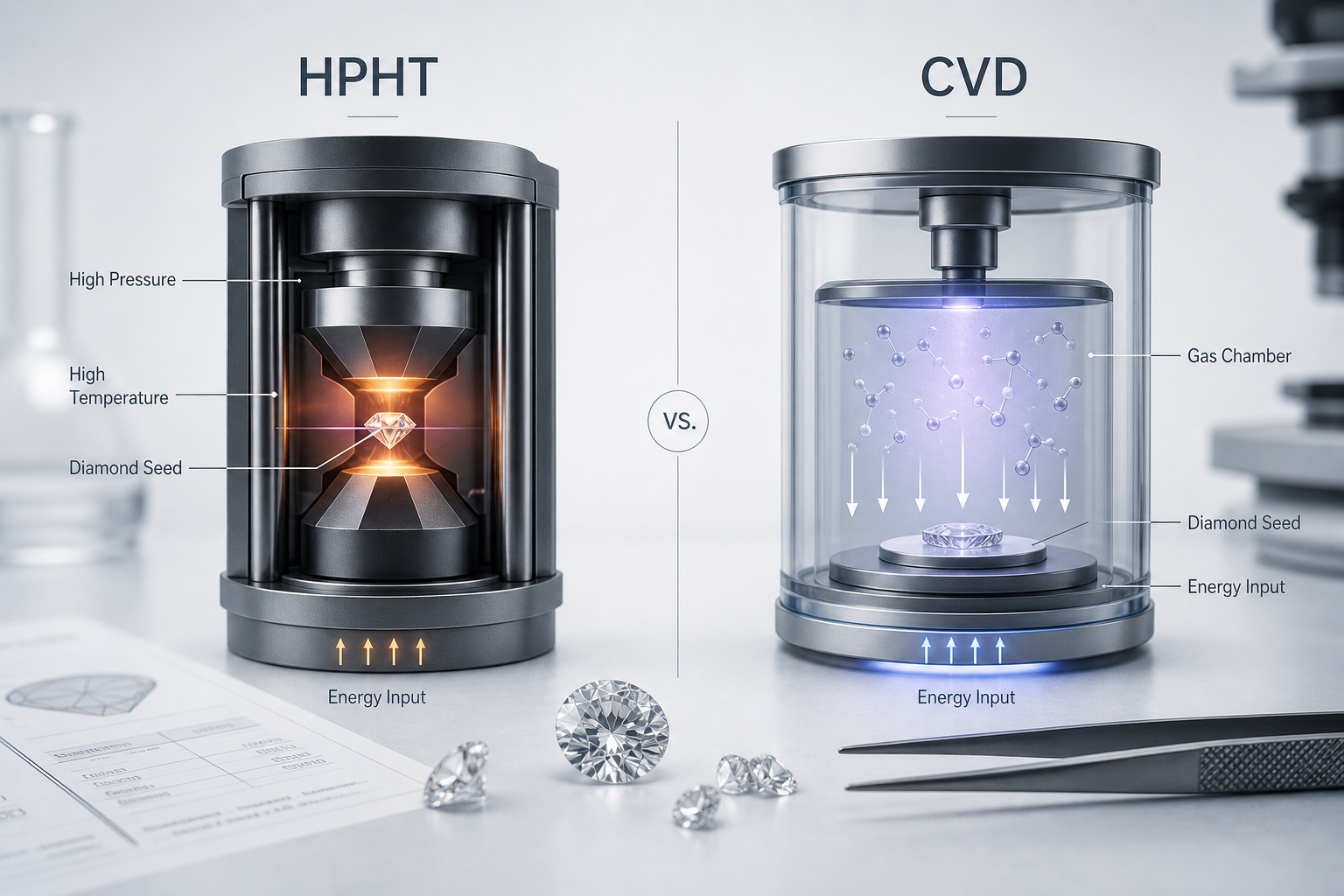
The growth method can shape the sustainability picture because HPHT and CVD use different conditions. HPHT relies on very high pressure and high temperature. CVD uses a carbon-rich gas in a controlled chamber where material builds up on a diamond seed. Those differences can affect energy demand, growth time, yield rate, post-growth treatment, and how the producer reports its process.
When growth method or post-growth treatment is relevant, buyers should look for clear disclosure in the grading report or seller documentation. HPHT and CVD should not automatically be described as “treatments” because, for laboratory-grown diamonds, they usually refer to growth methods unless a specific post-growth process is being discussed.
What Matters More Than the Method Label
The most important evidence is usually the energy source behind the facility, followed by measured energy use, yield, treatment disclosure, documentation, and seller transparency. If those details are missing, the method label by itself does not say much. If they are clear, you can make a more grounded comparison between a better-documented lab-grown diamond claim and a vague sustainability claim.
In practical buying, this is where many comparisons become misleading. A seller may present HPHT or CVD as if it were a complete environmental answer, while the buyer still lacks the details that would make the claim useful. Treat the method as a prompt for better questions: what powered the process, what was disclosed after growth, and how directly the claim applies to the specific diamond being considered?
Evidence Standard Used in This Article
Because sustainability language can become broad very quickly, this article treats evidence in layers. A method label such as HPHT or CVD is basic process information. A grading report is stronger for identity and grading comparison, but it still has limits. Supplier or facility documentation is more relevant to environmental claims, especially when it explains energy sourcing, reporting period, production site, or the scope of the claim. The strongest consumer-facing claim is one that clearly connects the diamond or supplier path to written support without overstating what has been verified.
This also means the article avoids treating ordinary words such as “green,” “ethical,” or “eco-friendly” as proof. Those words may express a seller’s positioning, but they do not give a buyer enough information by themselves. A more defensible claim tells you what is being claimed, who supports it, what period or facility it applies to, and what remains outside the claim.
| Evidence Layer | What It Can Support | What It Cannot Prove Alone |
|---|---|---|
| HPHT or CVD label | Basic growth-process category | Lower environmental impact |
| Grading report | Identity, grading characteristics, report matching, and sometimes growth or treatment details | Carbon footprint, renewable energy use, or full supply-chain impact |
| Seller written disclosure | What the retailer is willing to state before purchase | Independent verification unless backed by outside documentation |
| Supplier or facility documentation | More specific support for energy, production, or sourcing claims | Universal proof that every diamond from the same method has a lower impact |
What to Check Before You Decide
- Does the seller identify the growth method clearly?
- Is any post-growth treatment disclosed?
- Are sustainability claims backed by facility-level or supplier-level documentation?
- Do the claims go beyond generic “lab-grown is eco-friendly” language?
That is the right starting point for comparing HPHT vs CVD environmental impact without overreading the label.
How HPHT and CVD Differ Without Turning This Into a Beauty Comparison
HPHT and CVD are different lab-grown diamond growth methods, but for sustainability analysis, the important differences are about process, not appearance. HPHT, or high pressure high temperature, recreates the intense conditions under which diamond crystal can form. CVD, or chemical vapor deposition, grows diamond in a chamber from a carbon-containing gas that deposits onto a seed. Those are different production environments, and they can create different sustainability considerations.
HPHT in Sustainability Terms
HPHT uses high pressure and high temperature to grow diamond crystal. Those conditions can be energy-relevant because the process depends on maintaining demanding operating environments. Still, it is a mistake to assume that every HPHT diamond has the same impact. A modern, efficient facility with stronger energy management can tell a very different story from a less transparent one.
CVD in Sustainability Terms
CVD grows diamond in a controlled chamber where carbon-rich gas deposits material onto a diamond seed. Depending on the equipment and production goals, CVD may involve different energy patterns and longer growth cycles. That does not automatically make it better or worse. It simply means the sustainability question has to be evaluated at the facility level, not just at the method level.
Why Visual Quality Is Not the Point of This Article
This article is not deciding which method produces a prettier diamond. Cut quality, proportions, and grading matter for appearance, but they are separate from the sustainability question. If you want to compare visual performance or shopping value, that is a different decision path than comparing environmental impact.
Still, visual review should not be ignored in the final purchase. A grading report can narrow the shortlist, but it does not replace seeing how the stone performs in images, videos, or in person when possible. A diamond with stronger sustainability documentation still needs to make sense for the intended jewelry design, because poor cut performance, unsuitable measurements, or an awkward setting fit can make an otherwise well-documented choice less practical.
For custom design, trust comes from matching the stone to the setting, budget, and wearer’s daily use, not from choosing grades or sustainability language in isolation. Measurements, girdle condition, pavilion depth, shape outline, and setting style can all affect whether a diamond that looks good on paper will work well in the finished piece.
For custom jewelry, stone measurements and setting compatibility should be confirmed before finalizing a purchase. This is especially important when comparing elongated shapes, unusual proportions, or diamonds selected partly because of sustainability documentation.
Buyer Verification Checklist
Check whether the grading report or seller listing identifies the growth method. If it does not, ask the seller directly and request written confirmation if the method matters to your decision. For a buyer comparing HPHT or CVD for engagement ring shopping, that basic clarity is more useful than guessing from marketing language.
Why Growth Method Alone Does Not Prove Environmental Impact
The biggest mistake is treating HPHT vs CVD environmental impact like a simple ranking. The same method can produce very different results depending on factory practices, energy mix, equipment efficiency, growth success rates, and yield. That is why lab-grown diamonds with sustainability claims cannot be evaluated fairly from the method label alone.
The Same Method Can Produce Different Sustainability Outcomes
Two CVD producers can have different electricity sources, different equipment, different growth consistency, and different documentation standards. The same is true for HPHT. One facility may run on a lower-carbon grid and provide clearer reporting, while another may rely on vague claims and weak disclosure. Those differences matter more than the category name on the listing.
The Facility Often Matters More Than the Category
Where the electricity comes from, how often batches succeed, whether the equipment is modernized, and whether the producer tracks production data all shape the environmental picture. A responsibly evaluated lab-grown diamond is usually better judged by the quality of the facility’s disclosure than by the assumption that one growth method is always superior.
Marketing Claims Can Flatten a Complex Reality
Claims like “CVD is greener” or “HPHT is more energy-intensive” may be true in some cases, but they are not useful without support. The real answer depends on context. Use cautious language such as “may,” “can,” “depends,” and “should be verified” whenever a seller makes a broad sustainability claim without specifics.
How to Verify This Before Buying
Ask where the diamond was grown. Ask whether the seller can provide documentation for renewable energy use or emissions accounting. Ask whether the claim is tied to a specific facility, supplier, or batch, or whether it is just general brand language. That is how you compare a documented lab-grown diamond claim against a marketing line that sounds better than it is.
HPHT vs CVD environmental impact is a real question, but the answer only becomes meaningful when the seller can show evidence behind the claim.
Energy Source: The Most Important Sustainability Variable Buyers Usually Cannot See
For lab-grown diamond energy use, the electricity source often matters more than the HPHT or CVD label itself. A growth method can shape the production process, but it does not tell you what powered the facility, how efficiently it ran, or how current the sustainability claim is. That is why HPHT CVD energy demand is only part of the story. The better question is not “Which method is greener?” but “What evidence is behind the claim?”
In practice, a diamond grown with more electricity from a lower-carbon grid mix may have a different environmental profile than a similar diamond made in a more carbon-intensive facility, even if the same growth method is used. The reverse can also be true. A buyer looking for a lower-impact lab-grown diamond claim should focus on measurable information, not on the assumption that one method automatically wins.
Why Energy Mix Can Change the Sustainability Story
HPHT and CVD both rely on controlled industrial processes that use power, but the footprint depends heavily on where that power comes from. A facility operating with a higher share of renewable energy may create a different result than one running on a fossil-heavy electricity source. That does not make the diamond impact-free. It only means the same production method can have different environmental outcomes depending on the electricity behind it.
This is the main reason buyers should treat sustainability claims as facility-specific, not method-specific. Two diamonds can both be lab-grown and still reflect very different levels of emissions reporting, production efficiency, and energy sourcing. The method is a starting point. The electricity is usually the larger variable.
Why Energy Claims Need Boundaries
“Green energy” sounds clear, but it can cover very different realities. A seller might mean the facility uses some renewable power, buys renewable energy certificates, or participates in a broader corporate offset program. Those are not the same thing. A claim can be technically true and still be too vague to judge.
Buyers should ask what the claim actually covers. Does it refer to the full facility, only part of the operation, or just the company overall? Is the statement tied to the specific production site for the stone being sold, or is it a general brand message? If the answer is unclear, the claim is too broad to carry much weight.
The safest reading is simple: a strong sustainability claim should be specific, dated, and traceable. A vague label is not enough, especially when the buyer is trying to compare sustainable diamond questions in a real purchase decision.
How to Read an Energy Claim Without Overstating It
A useful energy claim should tell the buyer exactly what is covered. For example, there is a meaningful difference between “our company supports renewable energy,” “this supplier uses renewable electricity at a named facility,” and “this specific diamond is covered by documented production data.” Those statements may all sound positive, but they do not carry the same evidentiary weight. The narrower and more traceable the claim, the easier it is to evaluate.
Buyers should also watch for claims that combine several ideas into one attractive phrase. “Carbon neutral,” “renewable-powered,” “low-impact,” and “sustainable” are not interchangeable. One may refer to electricity procurement, another to offsets, another to a broader brand commitment, and another to a general positioning statement. Unless the seller explains the boundary, the buyer should avoid treating the phrase as proof that the diamond itself has a measured lower footprint.
| Claim Wording | What to Ask Next | How Much Weight to Give It |
|---|---|---|
| “Eco-friendly lab-grown diamond” | What specific environmental factor is being claimed? | Low until explained |
| “Made with renewable energy” | Which facility, what share of energy, and what documentation supports it? | Moderate if written support is available |
| “Supplier provides facility-level energy documentation” | Does the documentation apply to the production site or the broader company? | Higher if current and specific |
| “This diamond has a verified carbon footprint” | Who verified it, what boundary was used, and does it apply to this stone? | Potentially high if the evidence is product-specific and clear |
A Practical Energy Transparency Scorecard
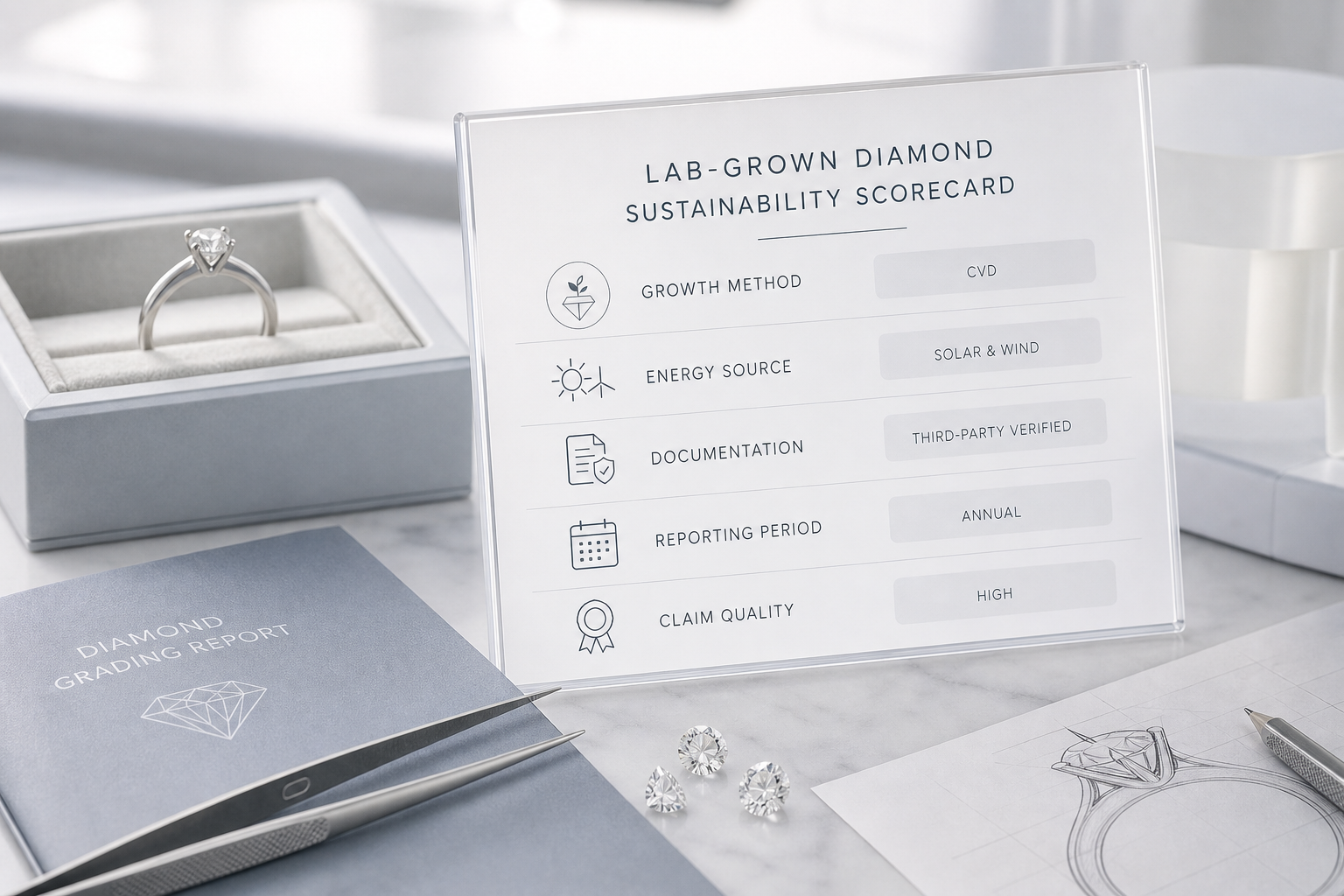
You do not need a scientific carbon audit to judge claim quality. You do need a way to separate strong disclosure from marketing language. This scorecard gives buyers a quick screen for comparing HPHT CVD energy demand claims without pretending that every seller will have the same level of data.
- Seller identifies the growth method clearly. Score 0, 1, or 2 depending on whether the listing or salesperson names HPHT or CVD without confusion.
- Seller provides facility-level or supplier-level energy information. Score higher when the claim is tied to a real production site, not a generic brand statement.
- Renewable or lower-carbon electricity claim is documented. A claim backed by written evidence is stronger than a slogan.
- The reporting period is clear and current. Recent information is generally more useful than old or undated language.
- The seller avoids absolute claims unless independently supported. “Zero impact” or “fully eco-friendly” should raise caution unless the evidence is unusually strong and clearly scoped.
Score the five items from 0 to 2 points each for a total of 10, especially when reviewing lab grown diamond carbon footprint claims tied to energy-source disclosure and manufacturing documentation. A score of 0 to 3 suggests weak transparency. A score of 4 to 7 suggests partial disclosure that still needs follow-up. A score of 8 to 10 suggests a more credible, better-documented claim. This is not an official certification system. It is a buyer screening tool for judging claim quality before you decide whether a diamond is actually a better fit for your values.
This kind of scorecard is helpful because it turns a vague sustainability conversation into specific questions, but it should not be treated as a replacement for judgment. A higher score means the claim is easier to evaluate, not that the diamond has no environmental impact. A lower score does not automatically prove poor production; it means the buyer has less evidence and should be more cautious about relying on the claim.
If a seller cannot answer these basic questions in writing, the sustainability claim is probably doing more work than the evidence. If they can answer clearly and specifically, the claim becomes more useful, even if it still does not prove a diamond is fully low-impact.
Yield Rate and Production Efficiency: The Hidden Sustainability Factor
Lab-grown diamond production efficiency is easy to overlook because buyers rarely see it, but it can affect how much energy and material are used to produce a finished stone. In simple terms, HPHT CVD yield is about how much usable diamond a process produces compared with what it consumes. If one run produces more usable rough with less waste, that can improve the resource story even if the growth method itself is not changed.
Why Yield Matters for Environmental Interpretation
Yield matters because a process that makes more usable material from the same input is generally more efficient. That does not automatically make it greener in every case, but it does change the comparison. A high-yield process may use the same power more effectively than a low-yield one, which means the environmental burden is spread across more finished diamond.
The important judgment here is that production efficiency can matter as much as the method label. A buyer who only asks whether a stone is HPHT or CVD may miss the larger issue: how much usable output the producer actually gets from each growth cycle.
Why Lower Yield Can Affect More Than Cost
Lower yield does not just affect price. It can also mean more repeated growth runs, more rejected material, more sorting, and more cutting loss before the diamond reaches retail form. Those extra steps can add to energy use and processing time. Even when the final stone is attractive and fully legitimate, the production path may have been less efficient than a higher-yield alternative.
That does not mean every low-yield stone is a poor choice. It means buyers should avoid assuming that a finished lab-grown diamond is automatically equal to every other one from a sustainability standpoint. Two diamonds can look similar and still have very different production histories.
Why Buyers Rarely See Yield Data
Yield is usually a factory-side metric, not a consumer-facing disclosure. Most listings will not tell you how many growth runs were required, how much material was rejected, or how much post-growth correction was needed. That is normal. The buyer’s job is not to demand full manufacturing access; it is to judge whether the seller is transparent enough to deserve trust.
One practical sign is how a seller handles sourcing and documentation. A transparent seller may not give you every production statistic, but they should be able to explain the origin of the stone, the growth method, and the basis for any sustainability statement. If they cannot do that, the claim is probably too thin to rely on.
What This Means in a Real Purchase
Imagine Maya comparing two 1.50-carat lab-grown diamonds. One is CVD and labeled “sustainable,” but the listing gives no energy details, no facility information, and no explanation of what the claim covers. The other is HPHT, comes with a grading report, and the seller can explain the supplier-level energy documentation behind the claim. Maya should not assume the CVD diamond is the more responsible choice just because of the method label. The better-supported claim is usually the more credible one.

Post-Growth Treatment: Why Sustainability Does Not End When the Diamond Grows
A diamond’s environmental story does not stop once the crystal finishes growing. Some stones receive post-growth treatment lab-grown diamond processing to improve color, stability, or appearance. That is not automatically a problem. The real question is whether the seller explains it clearly and whether the added processing is reflected in the overall sustainability claim.
Why Some Lab-Grown Diamonds Receive Additional Processing
Some diamonds benefit from additional steps such as color improvement or annealing. In the case of an HPHT treatment CVD diamond, HPHT may refer to a post-growth treatment rather than the original growth method, depending on the specific diamond and documentation. Buyers do not need to avoid treated stones by default. They do need to know what happened after growth, because it changes how the diamond should be evaluated.
The useful distinction is between treatment and hidden treatment. A disclosed process gives the buyer a fair basis for judgment. An undisclosed process can make sustainability claims harder to trust.
How Treatment Can Affect Sustainability Questions
Additional processing can mean more energy use, more handling, more transport between facilities, and more steps before the diamond is ready for sale. The exact impact depends on the specifics, so it would be misleading to assign a universal penalty to all treated stones. Still, treatment is part of the production path, and production path matters when buyers are trying to assess environmental impact.
This is why a single “lab-grown” label is not enough. If the stone required extra processing, that should be considered alongside growth method, electricity source, and documentation. Sustainability is not just about how the diamond began. It is about how it moved through the full supply chain.
Why Disclosure Matters More Than Alarm
Treatment is common enough that it should be treated as a transparency issue, not a defect. The buyer concern is whether the final price, description, and sustainability language match the actual production path. If the seller presents a treated stone as if it needed no additional processing, that weakens the claim. If the treatment is disclosed clearly, the buyer can decide whether the tradeoff still fits their priorities.
Certificate and Visual Review Check
Before buying, review the grading report for any notes about growth method or treatment where the lab provides them. Then ask the seller whether the sustainability claim depends on the stone being untreated, partially treated, or processed in a specific way. If the answer is vague, treat the environmental claim with caution. For buyers asking what to ask before buying a lab-grown diamond, the simplest rule is this: confirm the report, confirm the treatment disclosure, and do not let a simplified label replace the full production story.
The goal is not to make treatment sound concerning by default. The goal is to make sure buyers understand that sustainability does not end at the growth chamber. It extends through every meaningful processing step that follows.
Certificates and Reports: What They May Disclose and What They Usually Do Not Prove
A lab-grown diamond grading report is useful, but it is not a sustainability audit. This distinction matters because many buyers see a grading report and assume the diamond’s environmental claims have been independently verified. In most cases, the report confirms diamond identity and grading details. It does not prove how much energy was used, what powered the production facility, or whether the full supply chain was traceable.
For sustainability-minded buyers comparing an HPHT CVD report, the best use of documentation is to separate confirmed facts from marketing language. A report can help you verify lab-grown origin, match the stone to the listing, and sometimes understand whether the diamond was grown by HPHT or CVD. It should not be treated as proof that one diamond is automatically lower-impact than another.
A grading report helps document key characteristics, but it should not be treated as a guarantee of beauty, value, or sourcing ethics. It should be read alongside visual evidence, measurements, seller documentation, and the intended jewelry use.
What a Grading Report Can Help Confirm
A grading report can usually confirm the diamond’s basic identity: that it is lab-grown, its carat weight, color grade, clarity grade, cut grade where applicable, measurements, proportions, and report number. Many reports also include a plotted or digital clarity record, inscription information if the diamond is laser-inscribed, and identifying details that help match the physical stone to the document.
Some reports may include growth method disclosure, such as HPHT or CVD, and may also include treatment comments depending on the issuing laboratory, report format, and stone. This is useful because it gives the buyer a documented starting point. If a seller claims a diamond is CVD-grown, HPHT-grown, untreated, or treated in a specific way, the report may help support or challenge that claim.
The practical value is not just academic. If the report number, carat weight, measurements, and inscription do not match the seller’s listing, that is a warning sign. A reported lab-grown diamond should be traceable back to its report details before a buyer spends time evaluating broader sustainability claims.
What a Grading Report Does Not Fully Prove
A standard grading report does not usually verify carbon footprint, renewable energy use, factory working conditions, batch-level production efficiency, or complete supply-chain traceability. It can identify and grade the diamond, but it usually does not tell you whether the electricity came from renewable sources, whether energy claims apply to the exact stone, or whether a producer’s sustainability statements are current.
This is where buyers often overestimate what a certificate can do. A report showing “laboratory-grown” does not mean the diamond is impact-free. A report showing CVD does not prove the diamond was grown with cleaner energy. A report showing HPHT does not prove the opposite. The growth method may matter, but the report alone rarely supplies enough environmental context to rank the diamond responsibly.
The better judgment is to treat the report as one layer of evidence. It confirms what the diamond is and may reveal how it was grown or treated. Sustainability claims need a second layer: seller explanation, supplier documentation, energy information, or clear written limits on what is actually being claimed.
How to Separate Report Evidence From Sustainability Evidence
A practical way to avoid overreliance on certificates is to read each document for what it was designed to show. If the report identifies the diamond as laboratory-grown, that supports the origin category. If it lists color, clarity, cut, measurements, and inscription details, that supports stone matching and quality comparison. If it notes growth method or treatment, that supports process transparency. None of those points automatically verifies the electricity source, emissions boundary, or production efficiency behind the stone.
When a seller presents a report next to a sustainability badge, treat them as two separate evidence streams. First, confirm the report details. Then ask what supports the environmental language. If the seller can only point back to the grading report, the sustainability claim may be broader than the document actually supports.
| Buyer Question | Can a Normal Grading Report Usually Help? | What Extra Evidence May Be Needed? |
|---|---|---|
| Is this diamond lab-grown? | Yes, when the report identifies it as laboratory-grown | Report verification through the issuing lab when available |
| Is it HPHT or CVD? | Sometimes, depending on report format and lab disclosure | Seller clarification if the report does not state it |
| Was it treated after growth? | Sometimes, if treatment comments are included | Written seller disclosure and report review |
| Was it made with renewable energy? | Usually no | Supplier or facility-level energy documentation |
| Does it have a measured carbon footprint? | Usually no | Specific carbon or lifecycle documentation with clear boundaries |
Why Report Verification Still Matters
Even though a grading report is not a sustainability audit, verification still matters. Checking the report number through the issuing lab, when available, helps confirm that the document is real and that the listed details match the diamond being sold. This protects the buyer from relying on a product page that may be incomplete, outdated, or poorly matched to the stone.
Report verification is especially important when sustainability language is being used to justify a buying decision. If the basic diamond information cannot be verified, stronger claims about responsible sourcing should be treated with caution. A seller does not need to provide a full factory audit for every consumer purchase, but they should be able to support the basic documentation clearly.
At NUVU, this is why the grading report is treated as a starting point rather than the whole decision. It helps narrow the comparison, but it does not replace asking what the report does not show.
When a grading report is available, buyers should verify the report details through the issuing laboratory’s official report-check tool where available, then compare those details with the seller’s listing and any separate sustainability documentation.
How to Verify Documentation Before Buying
- Match the report number. Use the issuing lab’s online verification tool when available, and confirm that the number matches the report shown by the seller.
- Compare the carat weight and measurements. These should align with the product listing. Small formatting differences are normal; meaningful mismatches need explanation.
- Check the inscription if listed. If the report includes a laser inscription, ask whether it can be confirmed before purchase.
- Look for growth method disclosure. If HPHT or CVD matters to your decision and the report does not show it, ask the seller for written clarification.
- Review treatment comments. If the listing makes claims about untreated status, color improvement, or process simplicity, confirm whether the report supports that language.
- Request written support for sustainability claims. Product-page badges are not enough if the claim is broad, absolute, or used to imply environmental superiority.
The main risk is not buying a diamond without a complete sustainability file. The risk is treating a normal grading report as if it proves more than it actually does.
Factory Transparency: The Sustainability Factor Buyers Should Ask More About
Lab-grown diamond transparency is often more useful than the HPHT or CVD label by itself. The method tells you something about how the diamond was grown, but factory and supplier transparency tell you whether the claim behind the diamond can be evaluated. A supplier making sustainability claims should be able to explain what is known, what is documented, and where the limits are.
For most buyers, the goal is not to demand factory-level data that a retail seller may not realistically have for every individual stone. The goal is to avoid making a responsible purchase based on vague language. Strong sourcing transparency gives you enough information to compare claims. Weak transparency asks you to trust a label without showing what supports it.
What Credible Transparency Can Look Like
Credible transparency usually begins with basics: the diamond is clearly identified as lab-grown, the grading report can be verified, and the seller can state whether the diamond was grown by HPHT or CVD when that information is available. If post-growth treatment is relevant, it should be disclosed or explained without making the buyer chase unclear language.
Stronger transparency goes beyond the product listing. It may include supplier documentation, facility-level sustainability statements, information about energy sourcing, or a clear explanation of whether a claim applies to the individual diamond, the supplier, the production facility, or the seller’s broader sourcing standards. The most credible sellers also avoid overstating what they can prove.
That last point is important. A careful claim is often more trustworthy than a dramatic one. A seller saying, “This supplier provides facility-level energy documentation, but we cannot assign a precise carbon footprint to this individual stone,” is giving you a more useful answer than a seller who simply calls every diamond “eco-friendly.”
What Weak Transparency Looks Like
Weak transparency usually relies on attractive labels with little supporting detail. Phrases such as “zero impact,” “perfectly sustainable,” or “the greenest diamond” should raise questions unless they are backed by specific, independent, and current documentation. Lab-grown origin alone does not prove those claims.
Other warning signs include no access to a grading report, refusal to clarify HPHT or CVD when the method is part of the sales claim, vague treatment language, and sustainability claims that cannot be tied to any supplier, production facility, reporting period, or document. A badge on a product page may be useful as a signal, but it should not be the only evidence.
The most common buyer mistake is assuming that weak transparency means the diamond is necessarily irresponsible. That may not be true. The more precise concern is that the buyer cannot evaluate the claim. If two diamonds are similar in quality and price, the one with clearer documentation is usually the lower-risk choice for a sustainability-focused purchase.
How Much Transparency Is Realistic for a Consumer Purchase?
A consumer should not expect a full energy audit, batch-level yield data, or factory production logs for every diamond. Those details may exist in the supply chain, but they are not standard retail disclosures. Asking for them on every purchase can lead to frustration rather than better decision-making.
A more realistic standard is layered documentation. First, verify the grading report. Second, confirm whether the growth method and treatment status are known. Third, ask whether sustainability claims are based on supplier documentation, facility information, or general category claims. Fourth, judge whether the seller’s language matches the evidence provided.
This approach is practical because it recognizes the difference between imperfect information and empty marketing. You may not get every answer, but you should not have to accept unsupported environmental language as a substitute for basic sourcing transparency.
Seller Questions Worth Asking
- Was this diamond grown by HPHT or CVD?
- Is post-growth treatment disclosed on the report or by the seller?
- Can I verify the grading report through the issuing lab?
- Are your sustainability claims based on the supplier, the production facility, the product category, or this individual diamond?
- Do you have supplier documentation or facility-level information that supports the claim?
- What can you provide in writing before purchase?
If a seller can answer these questions calmly and specifically, that is a stronger sign than broad environmental language. If the answers become evasive once you ask for documentation, the sustainability claim should carry less weight in your decision.
Traceability Questions That Make the Claim More Useful
Traceability does not have to mean that every production detail is published on a product page. In a practical buying conversation, it means the seller can connect the diamond’s basic identity, report details, growth method, treatment disclosure, and sustainability language without contradictions. If one part of the story is documented and another part is only implied, the buyer should treat them as different levels of evidence.
A helpful traceability path usually starts with the grading report, then moves to seller disclosure, and then to any supplier or facility documentation that supports environmental claims. Those layers should be consistent with each other. For example, if a seller describes a diamond as CVD-grown and untreated, the report and written seller explanation should not suggest a different production story. If a sustainability statement refers to a supplier or facility, the buyer should understand whether it applies to the specific stone, a group of stones, or only the seller’s broader sourcing language.
In sourcing or wholesale conversations, documentation, consistency, and communication often matter as much as the headline specification. Buyers comparing larger selections should ask how stones are matched, how reports are tracked, how substitutions are communicated, and how sustainability claims are described across the group. Those operational details can make a claim easier to evaluate without requiring unsupported promises about every individual diamond.
China-linked supply chains can offer manufacturing depth and scale in some categories, but buyers still need to evaluate consistency, documentation, communication, and quality control. A country, factory, or wholesale label should not be treated as proof of lower impact, better value, or lower risk without specific supporting information.
Documentation Assurance for Buyers Comparing HPHT and CVD
For shoppers using NUVU as a selection resource, the most useful form of reassurance is not a broad sustainability promise. It is a consistent review process: confirming the grading report, checking whether HPHT or CVD is disclosed, reviewing any treatment notes, and separating diamond-quality evidence from environmental claims. This helps prevent a single attractive phrase from carrying more weight than the documents behind the stone.
When a lab-grown diamond is being considered for an engagement ring or custom design, documentation also protects practical decisions. Report details help confirm measurements, proportions, inscription information, and quality grades before the setting is planned. That matters because a credible purchase should be supported both by the diamond’s paperwork and by its suitability for the finished piece.
NUVU’s role in buyer education is to make comparison clearer, especially around grading reports, visual evidence, design fit, and documentation. The available paperwork should be read for what it actually supports, not stretched into claims it does not prove.
How to Make a Buying Decision When Sustainability Matters
A lab-grown diamond buying guide with sustainability in mind should not tell you to choose HPHT or CVD in isolation. The smarter decision is to compare the growth method alongside documentation, energy claims, treatment disclosure, visual quality, and ring suitability. If you are trying to choose HPHT or CVD for environmental reasons, the method only becomes decisive when the supporting evidence is meaningfully different.
A practical purchase is usually not the diamond with the strongest environmental slogan. It is the diamond that combines credible documentation, restrained claims, strong visual performance, and a practical fit for the piece of jewelry being made.
Prices can change with market conditions, report type, seller channel, and stone-specific details, so exact comparisons should be verified at the time of purchase. Buyers should compare like-for-like specifications before treating one stone as a better value, especially when sustainability language is being used to justify a price difference.
When HPHT or CVD Should Matter
HPHT or CVD should matter when the method is connected to real evidence. For example, if one diamond comes with clear growth method disclosure, treatment information, and supplier-level energy documentation, while another relies only on a generic sustainability claim, the better-documented option deserves more confidence regardless of method.
If both diamonds have similar documentation quality, the growth method alone should not dominate the purchase. A CVD diamond is not automatically the more responsible choice. An HPHT diamond is not automatically the less responsible one. The recommendation changes only when the method comes with verifiable differences in energy source, production transparency, treatment path, or supplier reporting.
A useful rule is this: let the method break a tie only after the evidence gives you a reason. If the evidence is thin, the method label is too weak to carry the sustainability decision by itself.
When Other Factors Should Come First
For an engagement ring buyer, sustainability should be integrated into the decision, not separated from how the diamond will look and wear. Cut quality, proportions, measurements, visual performance, setting compatibility, budget, and report verification still matter. A diamond with better environmental documentation but poor visual performance may not be the better overall purchase if it fails the design goal.
This is especially true for rings worn every day. A diamond must fit the setting securely, suit the wearer’s style, and deliver the appearance the buyer expects. If an environmental claim pushes you toward a stone that is poorly cut, awkwardly proportioned, or visually disappointing, the tradeoff may not support the actual purchase.
For custom design, the stone cannot be evaluated separately from the setting. A fancy shape, elongated outline, deep pavilion, or unusual measurement spread may affect prong placement, profile height, side-stone proportions, and how the finished ring wears. Sustainability documentation can help choose between responsible options, but the selected diamond still needs to work physically and visually in the design.
The mistake to avoid is treating sustainability as a separate checkbox that overrides every other factor. A responsible purchase still has to be a good diamond choice.
A Simple Decision Order for Buyers
- Confirm that the diamond is clearly identified as lab-grown with a verifiable report. This establishes the basic documentation before any sustainability claim is considered.
- Check whether the growth method is disclosed as HPHT or CVD. This supports process-level transparency, especially when the seller makes method-based claims.
- Review treatment comments and seller disclosures. This helps you understand whether additional processing is being communicated clearly.
- Ask whether energy or sustainability claims are specific and documented. This separates evidence from broad marketing language.
- Confirm that the diamond still meets quality, budget, and setting needs. This prevents sustainability from being evaluated in isolation from the actual ring or jewelry design.
This order is intentionally practical. It does not require perfect data, but it does require enough clarity to avoid buying based on a single label. If a seller cannot support the basic documentation, stronger sustainability language should not carry the decision.
Side-by-Side Claim Comparison Framework
When two stones appear similar, compare the claims in writing rather than relying on the most persuasive product description. Put the report details, growth method, treatment disclosure, and environmental language next to each other. If one diamond has a stronger claim but weaker supporting detail, and the other has a more modest claim with clearer documentation, the modest claim may be more useful for decision-making.
| Comparison Point | Diamond A | Diamond B | Better Question |
|---|---|---|---|
| Growth method | HPHT or CVD listed | HPHT or CVD listed | Is the method documented or only stated in marketing copy? |
| Treatment disclosure | Clear, unclear, or not mentioned | Clear, unclear, or not mentioned | Does the report or seller explain post-growth processing? |
| Energy claim | Specific or generic | Specific or generic | Is the claim tied to a supplier, facility, or reporting period? |
| Report verification | Report number and details match | Report number and details match | Can the listed document be checked before purchase? |
| Overall fit | Visual quality, measurements, setting compatibility | Visual quality, measurements, setting compatibility | Does the better-documented stone still work for the ring? |
This framework keeps sustainability from becoming a vague preference and turns it into a comparison of evidence quality. It also helps prevent a common mistake: choosing a diamond because a single phrase sounds better, even though the other stone may have clearer support.
What This Means for an Engagement Ring Purchase
If two diamonds are visually comparable and similarly priced, choose the one with clearer documentation and more restrained, verifiable sustainability claims. That is usually the lower-risk decision because you are comparing evidence rather than assumptions.
If one option has stronger environmental claims but weaker cut quality, poor proportions, or a questionable setting fit, slow down. The better choice may be to keep looking rather than accept a tradeoff that weakens the ring itself. For buyers planning a custom engagement ring, this is where a guided selection process can help: the diamond should fit the documentation standard, the design, the budget, and the wearer’s daily use.
The practical answer is balanced, not absolute. Choose the lab-grown diamond that gives you the strongest combination of verified information, visual quality, and personal priorities. Sustainability matters most when it improves the decision instead of narrowing it to a label.
Keep the Decision Record Clear
Before finalizing a stone, keep a simple record of the documents and claims used in the decision. Save the grading report, the seller’s written growth-method or treatment clarification, and any sustainability information that was provided. This is not about creating a legal file for every jewelry purchase; it is about making sure the decision is based on information you can review later rather than on a product-page phrase that may change or disappear.
Buyers should also confirm the seller’s return, resizing, and after-sales terms before purchase, because those are separate from sustainability and grading documentation. A clear environmental claim does not replace practical purchase terms, and a grading report does not explain service policies. Keeping these categories separate makes the whole buying decision more transparent.
Final Takeaway: The Greener Choice Is Usually the Better-Documented Choice
The Best Answer Is Evidence-Based, Not Method-Based
HPHT and CVD can create different sustainability considerations, but neither growth method automatically proves a lower environmental impact. The stronger decision is not “choose CVD” or “choose HPHT.” It is to choose the diamond with clearer documentation, a more specific energy story, transparent treatment disclosure, and claims that can be tied to something more concrete than a product-page label.
For HPHT vs CVD sustainability, the most useful takeaway is simple: method matters only when it is supported by context. A lab-grown diamond with sustainability claims should not be judged by process name alone. Energy source, facility practices, production efficiency, post-growth treatment, and seller transparency usually tell you more than the label itself.
The Most Useful Buyer Questions
Before relying on any sustainability claim, ask direct questions that reveal whether the seller is offering evidence or just reassuring language. The growth method is a good starting point, but it is not the finish line.
- Was this diamond grown by HPHT or CVD?
- What is known about the energy source or electricity mix behind production?
- Was any post-growth treatment used, and is that disclosed on the report or by the seller?
- Can the grading report be verified through the issuing laboratory?
- Are sustainability claims specific, documented, and tied to a supplier, facility, or product path?
If a seller can answer those questions plainly, the claim deserves more weight. If the answer stays vague, the safer assumption is that the sustainability language is general marketing rather than decision-grade evidence.
Compare Documented Diamonds, Not Just Method Labels
If you are ready to compare lab-grown diamonds, look for stones with grading reports and clear disclosure around growth method and treatment. For an engagement ring or custom ring, the better choice is usually the diamond that balances documentation, visual quality, setting compatibility, and budget rather than the one with the cleanest-sounding environmental phrase.
NUVU can help buyers review lab-grown diamonds with grading reports, ask the right questions about HPHT or CVD production, and consider how the stone fits the ring design as a whole. That matters because a responsible purchase is not only about how a diamond was grown; it is also about whether the information behind the purchase is clear enough to trust.
Before You Move Forward
Save the grading report, keep sustainability claims in writing, and compare claims with the same skepticism you would bring to price or quality. Labels such as HPHT, CVD, recycled, ethical, and eco-friendly can be useful starting points, but none of them should carry the whole decision by themselves.
FAQ Section
Is CVD always more sustainable than HPHT?
No. CVD may involve different energy patterns and processing considerations than HPHT, but that does not make it automatically more sustainable. The better question is whether the diamond’s energy use, facility efficiency, yield, treatment history, and documentation are specific enough to evaluate. A poorly documented CVD diamond should not be assumed to have a lower footprint than a better-documented HPHT diamond.
Is HPHT bad for the environment?
HPHT can be energy-intensive because it uses high pressure and high temperature, but “energy-intensive” is not the same as “always worse.” The actual environmental impact depends on the electricity source, equipment efficiency, production success rate, and how much the seller or supplier can disclose. A broad claim that HPHT is bad oversimplifies a process that varies significantly by facility.
Do diamond certificates show environmental impact?
Usually not in a complete way. A lab-grown diamond grading report may confirm that the diamond is lab-grown, list the 4Cs, show measurements, provide a report number, and sometimes identify the growth method or treatment comments. It generally does not prove carbon footprint, renewable energy use, factory conditions, or full supply-chain traceability. Treat the report as a verification tool, not a sustainability audit.
Should I ask for HPHT or CVD when buying an engagement ring?
Yes, if the growth method matters to you, but do not stop there. Ask whether the report can be verified, whether any treatment is disclosed, and whether energy or sustainability claims are backed by documentation. For a sustainability-minded engagement ring diamond purchase, the method should be one part of the decision alongside cut quality, visual appearance, setting fit, and budget.
Can a seller call every lab-grown diamond sustainable?
That wording should be treated carefully. Lab-grown diamonds offer a different sourcing path from mined diamonds, but broad sustainability claims still need specific support. Buyers should ask what is being claimed, whether the claim applies to the individual diamond or a broader supplier practice, and what documentation supports it.
Does HPHT or CVD affect resale or investment value?
This article does not treat lab-grown diamonds as investments. Prices and resale outcomes can vary by market conditions, seller channel, stone specifications, grading report, and buyer demand. If value matters, compare current like-for-like listings and avoid relying on unsupported claims that any growth method will hold value better.
Continue Your Diamond Research
Further Reading for Your Next Buying Question
To understand the production process, review an HPHT and CVD comparison. To evaluate a claim, review the grading report and request the separate supplier documentation that supports the environmental statement. The growth-method label and the evidence for sustainability answer different questions.
When you are ready to compare loose diamonds, review cut, measurements, color, clarity, carat weight, and actual-stone images or video together. For a ring or custom piece, confirm setting compatibility and the planned design before choosing a stone on its growth method alone.
Separate Environmental Evidence From Price and Resale
An HPHT-versus-CVD decision is a comparison between two laboratory-grown diamond growth methods. Comparing lab-grown and mined diamonds raises additional questions about extraction, origin, and sourcing documentation.
Keep price and resale questions separate from environmental claims. Compare like-for-like stones and the available documents for the question you are actually trying to answer; a process description does not replace that evidence.
Disclosure: This article is for general educational purposes only. Diamond grading, pricing, availability, specifications, and seller policies can change, and readers should verify important details through grading reports, official laboratory tools, seller documentation, or qualified professionals before making a purchase decision. Laboratory-grown diamonds should be clearly distinguished from natural diamonds, and environmental or sourcing claims should be supported by specific documentation.