
A lab-grown diamond can answer one important sourcing question, but it does not tell the whole story of a sustainable piece of jewelry, and SCS 007 certification can provide useful context without replacing evaluation of the metal, alloy, setting structure, repair options, and long-term wear that all influence whether a ring or fine jewelry piece remains useful for decades or becomes difficult to maintain. Recycled gold can reduce demand for newly mined material, but the claim is only as helpful as the documentation, alloy disclosure, and craftsmanship behind it.
For the full framework, read Are Lab-Grown Diamonds More Sustainable?.
For buyers, the most useful habit is to separate three questions: what the diamond report proves, what the metal documentation proves, and what the setting can realistically handle in daily wear. Those answers are related, but they are not interchangeable. A piece can be well documented in one area and still be weak in another.
Laboratory-grown diamonds should be clearly identified as laboratory-grown, and they should not be presented as mined diamonds. Lab-grown diamonds and natural diamonds are both diamonds, but they have different origins. A sustainability or sourcing discussion is clearer when the diamond origin, metal source, and finished-jewelry construction are evaluated as separate facts rather than blended into one broad claim.
This article helps you look beyond a single label and judge the finished piece more carefully. You will learn how recycled 14k and 18k gold compare with platinum, why karat and alloy choices affect durability and comfort, what a diamond report does and does not verify, and which questions to ask before choosing a ready-made or custom design.
| Decision Point | What to Check | Why It Matters |
|---|---|---|
| Recycled gold claim | Written recycled content or sourcing statement | Reduces guesswork, but does not prove full traceability |
| Gold karat | 14k for daily strength; 18k for richer color | Affects wear, color, cost, and maintenance |
| White metal choice | White gold plating needs vs platinum patina | Changes upkeep, feel, and long-term appearance |
| Setting durability | Prong thickness, band width, stone protection | Thin or exposed designs may need more repairs |
| Documentation | Diamond report plus separate metal details | Stone grading does not verify recycled metal or alloy |
| Future service | Resizing limits, inspections, repair access | A maintainable ring usually has a longer useful life |
Quick Questions Before You Read
Q: Does a lab-grown diamond make a ring sustainable by itself?
No. The metal source, setting quality, repairability, and expected lifespan also matter.
Q: Is recycled gold always traceable?
Not always. Ask what the recycled claim covers and whether the seller provides written documentation.
Q: Is platinum better than recycled gold?
It depends on the design, budget, wear habits, and maintenance preferences. Neither is best for every ring.
Q: Does a diamond certificate cover the entire piece of jewelry?
No. It identifies and grades the diamond, but metal sourcing, alloy details, and construction must be checked separately.
Why Sustainable Jewelry Is More Than the Lab-Grown Diamond
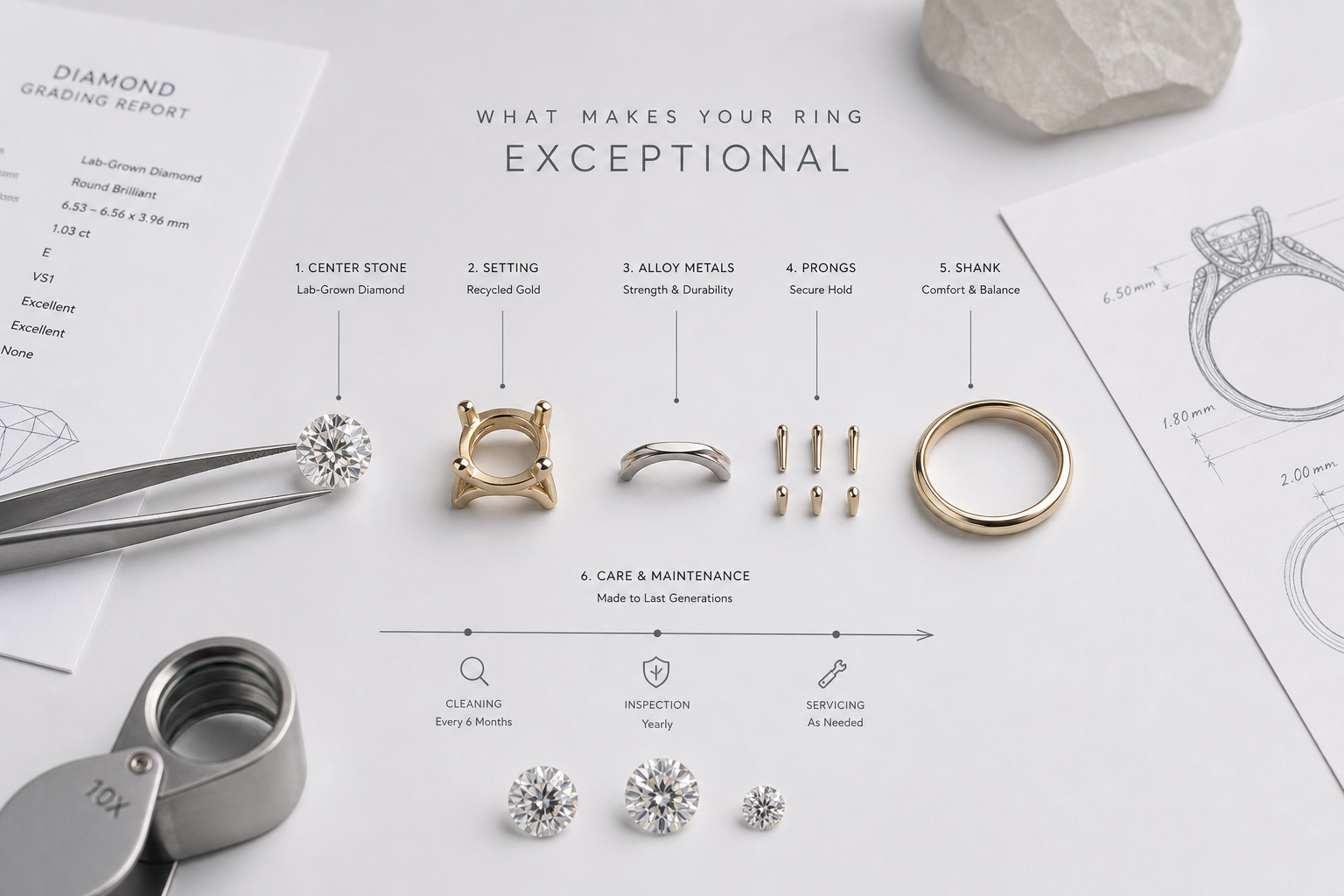
Sustainable jewelry is often discussed as if the center stone carries the whole decision. For lab-grown diamond jewelry, that is too narrow. The diamond matters, but the finished jewelry also includes the metal, alloy mix, setting structure, labor, finishing quality, future maintenance, and the likelihood that the piece can stay in use for decades. A sustainable lab-grown diamond ring should be judged as a complete object, not as a stone with a band attached.
This is why metal sourcing matters in sustainable jewelry. A lab-grown diamond may answer one part of the sourcing question, but it does not automatically explain where the gold came from, whether the alloy is appropriate for daily wear, whether the prongs are strong enough, or whether the ring can be resized later. A piece that cannot be repaired easily or wears out too quickly may have a weaker lifecycle outcome than a more thoughtfully built ring with clearer material choices.
The Diamond Is Only One Component of the Finished Piece
A ring is a small object, but it contains several decisions. The center diamond is one of them. The metal choice, karat, alloy blend, prong design, shank thickness, stone layout, polishing, and repair path all affect how the jewelry performs after purchase. These details are easy to overlook because they are less visible than carat size or diamond shape, but they often determine whether the piece ages well.
Lab-grown diamonds can make the stone-origin side of the purchase easier to evaluate, especially when the diamond has a grading report and clear specifications. That does not make the full ring automatically responsible jewelry. If the setting uses an unspecified metal, an overly delicate structure, or a design that is difficult to maintain, the sustainability claim becomes incomplete. The better question is not only “Is the diamond lab-grown?” but “Is the finished jewelry built, documented, and serviceable enough to justify the resources used to make it?”
Lab-Grown, Natural, and Simulant Terms Should Not Be Mixed
When discussing diamond origin, the words matter. A laboratory-grown diamond is a diamond created in a controlled production environment, while a natural diamond is formed through geological processes and mined from the earth. Diamond simulants are different again; they may resemble diamonds visually, but they are not lab-grown diamonds unless they are actually diamond material. Buyers should check that product descriptions and grading reports clearly disclose laboratory-grown origin when a lab-grown diamond is being sold.
This distinction does not make one option automatically the right choice for every buyer. It simply keeps the comparison accurate. A lab-grown diamond report can help document the stone’s characteristics, but it should not be stretched into a claim about mined origin, recycled metal, environmental impact, or the finished ring’s long-term durability.
Why the Metal Can Affect Sustainability Over Decades
Metal is not just a background material. It holds the diamond, absorbs daily wear, allows or limits resizing, and determines how practical future repairs will be. A durable setting can keep a piece in use longer, while a weak or unsuitable setting can create repeated repair needs, stone-loss risk, or early replacement. From a jewelry lifecycle perspective, longevity is not a minor detail; it is one of the most practical sustainability factors.
For example, a ring worn every day needs enough metal structure to resist bending and enough prong security to protect the stone. A delicate band may look refined in photos, but if it is too thin for the stone size or the wearer’s lifestyle, it can become a maintenance problem. The most responsible choice is often not the lightest-looking or lowest-cost setting. It is the one that balances material disclosure, comfort, durability, and realistic long-term care.
Where Marketing Language Can Become Too Simple
Terms like “eco-friendly jewelry,” “green ring,” or “zero-impact” can sound reassuring, but they are only useful when supported by specifics. Recycled gold jewelry may reduce demand for newly mined material and can support a circular material model, but the actual value of that claim depends on sourcing, refining, documentation, manufacturing practices, and the durability of the final design.
The same caution applies to lab-grown diamond jewelry. A lab-grown stone may reduce one set of sourcing concerns, but it does not certify the metal, the alloy, the setting construction, or the repairability of the ring. Stronger sustainability language should come with clearer information: what the metal is, whether recycled content is documented, how the setting is built, and what maintenance the buyer should expect.
Evidence Boundaries for Sustainability Claims
A more defensible sustainability claim usually has a defined subject, a defined scope, and a clear document behind it. “This ring uses recycled 14k yellow gold” is more useful than “this ring is sustainable” because it tells the buyer which material is being described. “The center stone has a lab-grown diamond report” is also more precise than saying the entire ring is certified, because a diamond report normally concerns the stone rather than the finished setting.
When comparing jewelry, treat each claim as a separate piece of evidence. A diamond report may help verify the diamond’s identity and grading details. A product specification may identify the metal, karat, and finish. A seller’s written statement may explain whether recycled gold applies to the whole setting or only selected components. None of those items should be stretched to prove something it does not actually document.
This evidence-first approach does not make the purchase complicated; it makes it clearer. If a seller cannot support a broad environmental phrase, ask for the narrower facts instead: metal type, recycled content scope, alloy information, setting construction, maintenance expectations, and repair options. Specific answers are more trustworthy than sweeping language.
Sustainability claims should be specific and documented. Broad green language is less useful than clear information about production, energy context, material sourcing, alloy disclosure, and seller transparency. When a claim cannot be narrowed to a material, process, or document, buyers should treat it as a general marketing statement rather than purchase evidence.
What This Means in a Real Purchase
Consider a buyer choosing a lab-grown diamond engagement ring because the stone feels more transparent and easier to evaluate than a mined alternative. The diamond has a report, the price fits the budget, and the design looks delicate and modern. But the setting uses an unspecified gold alloy, the band is very thin, and the pavé extends far enough around the shank that resizing could be difficult later.
In that situation, the more sustainable choice may not be the cheapest ring or the most minimal-looking design. It may be a ring with documented metal, a secure setting, a practical shank, and a maintenance plan the buyer understands before purchasing. The center diamond starts the conversation, but the finished piece determines whether the jewelry can be worn, repaired, and kept in service over time.
What Recycled Gold Actually Means in Fine Jewelry
Recycled gold is one of the most common material claims in sustainable gold jewelry, but it is often treated as more self-explanatory than it really is. In fine jewelry, recycled gold usually means existing above-ground gold has been collected, refined, and reintroduced into the supply chain rather than newly mined for that specific use. That can be a meaningful sourcing choice, but it is not the same as a complete history of every atom of metal in the ring.
A recycled claim can also vary in scope. Sometimes it refers to the main ring body, sometimes to the full setting, and sometimes only to metal sourced through a particular supplier. Buyers should not assume those meanings are identical, because a partial claim is less informative than a full-piece claim. The practical value of recycled gold jewelry is strongest when the seller can say exactly what is covered.
The practical value of recycled gold jewelry is that it gives buyers a clearer question to ask: what material is being used, how is the claim documented, and does it apply to the full setting or only selected components? Recycled gold is best understood as a transparency factor, not a moral guarantee. It can support a more responsible purchase, but only when it is paired with accurate disclosure and a well-built piece.
Recycled Gold Is Gold That Has Been Refined and Reintroduced
Recycled gold may come from old jewelry, industrial material, scrap metal, bench filings, manufacturing returns, or other reclaimed gold sources. Before it becomes new jewelry, that material is refined to remove impurities and then alloyed again to create the karat and color needed for the finished piece. Once properly refined, recycled gold is chemically equivalent to newly mined gold of the same purity.
This matters because recycled gold is not “secondhand quality” or weaker because it has been used before. A properly refined 14k or 18k gold ring should be evaluated by its alloy formulation, casting or fabrication quality, setting design, and finishing, not by the fact that the gold had a previous life. The mistake is assuming recycled gold is either automatically superior or somehow compromised; neither assumption is useful without looking at how the metal is processed and used.
Why Recycled Gold Can Reduce New Mining Demand
Gold is highly recyclable because it can be refined and reused without losing its basic material value. Choosing recycled gold can help keep existing above-ground gold in circulation and may reduce reliance on newly mined material. For buyers trying to lower the impact of a lab-grown diamond ring or fine jewelry piece, that is a reasonable and practical consideration.
Still, recycled gold does not make the rest of the process impact-free. Refining, alloying, casting, polishing, setting, packaging, and transportation all require energy and materials. A recycled gold setting that is poorly built, hard to resize, or likely to need frequent repair is not automatically the stronger sustainability choice. The better judgment is to pair recycled content with construction that supports long-term wear.
What Recycled Gold Does Not Automatically Prove
The word “recycled” does not always reveal the original source of the gold, the labor conditions connected to earlier material, the energy used in refining, or the full chain of custody. Some suppliers can provide more detailed metal documentation than others, and not every finished jewelry piece will come with source-level traceability for every component.
That does not mean recycled gold claims are meaningless. It means buyers should look for clear, written statements rather than broad language. A seller who can identify the recycled content claim, the metal type, the karat, and the scope of the claim is giving the buyer more useful information than one who relies only on vague sustainability wording.
How to Verify This Before Buying
Before buying recycled gold jewelry, ask whether the gold is recycled and whether that claim applies to the entire setting, the main ring body, or only certain components. Ask whether the seller can identify the metal supplier, refining standard, or documentation behind the claim. The answer does not need to be a long technical file to be useful, but it should be specific enough to distinguish a real material claim from a marketing phrase.
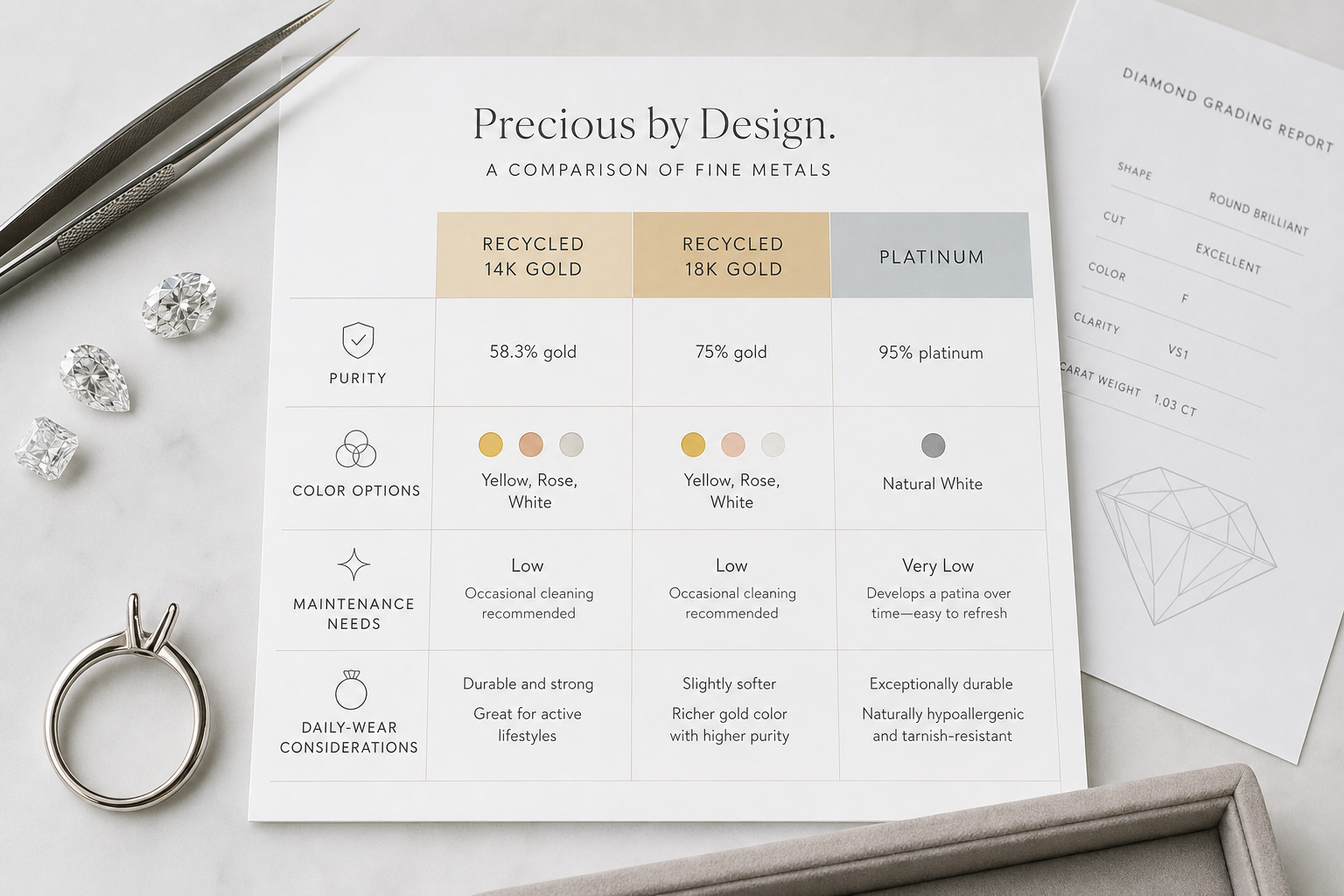
It is also worth confirming the karat, because karat affects both purity and performance. 14k gold contains 58.3 percent pure gold, while 18k gold contains 75 percent pure gold. The remaining percentage is alloy metal, and that alloy affects color, hardness, wear behavior, and sometimes wearer comfort. If recycled gold is part of the sustainability story, the alloy and finished construction still need to fit the way the jewelry will be worn.
When a recycled metal claim is important to the purchase, buyers should ask for the key wording to appear in a durable written place, such as the product specification, order summary, or written communication. This does not create perfect traceability, but it helps prevent confusion later about whether the claim applied to the full setting, only the main ring body, or only an available option that was not selected.
Gold Karat, Alloy Disclosure, and Why the Metal Mix Matters
Gold in fine jewelry is not a single material. Pure gold is too soft for most daily-wear settings, so it is mixed with other metals to create a gold alloy with the right color, strength, and workability. This is where many buyers miss an important point: the phrase “gold ring” does not tell you enough. Gold karat, color, alloy composition, and finish all affect how a lab-grown diamond ring metal performs over time.
For sustainable jewelry, the metal mix matters because durability and maintenance are part of the lifecycle. A ring that looks beautiful on day one but requires avoidable repair because the metal choice did not match the design is not an efficient use of materials. The best gold for an everyday engagement ring depends on the setting architecture, the wearer’s habits, color preference, and any metal sensitivity concerns.
14k Gold Versus 18k Gold for Daily-Wear Jewelry
14k gold contains 58.3 percent pure gold and a larger share of strengthening alloy metals. In many engagement ring settings, that can make 14k gold a practical option for daily wear, especially for people who want durability, slightly lower weight, and a setting that can handle routine use. It is not “less real” gold; it is a different balance between gold content and alloy performance.
18k gold contains 75 percent pure gold, giving it a richer gold content and often a warmer, more saturated appearance in yellow or rose tones. Depending on the alloy formulation, it may be somewhat softer than 14k gold, which can matter in thin bands, delicate prongs, or high-wear designs. The 14k vs 18k gold decision for a lab-grown diamond ring should not be treated as a prestige ranking. For an active wearer or a very delicate setting, 14k may be the more practical choice. For a buyer prioritizing richer color and a heavier gold presence, 18k may make sense if the design supports it.
White Gold, Rose Gold, and Yellow Gold Are Different Alloy Systems
Gold color is created through alloying. White gold typically uses whitening metals and is often finished with rhodium plating to create a bright white surface. Rose gold gets its pink tone mainly from copper. Yellow gold can vary in warmth depending on the specific alloy blend. These differences are not just cosmetic; they affect maintenance, color stability, and how the metal behaves in a setting.
White gold is the easiest example of why disclosure matters. A rhodium-plated white gold ring may need replating over time depending on wear, body chemistry, surface finish, and how bright the wearer wants the white appearance to remain. That is normal maintenance, not a defect, but buyers should know it before choosing white gold over platinum or yellow gold. Rose gold can be durable, but its copper content may matter for some wearers. Yellow gold is often lower maintenance visually because there is no white plating to refresh, though it still needs normal inspection and care.
Nickel Sensitivity and Alloy Transparency
Alloy disclosure becomes especially important for buyers with known metal sensitivity. Some white gold alloys may contain nickel, while others use nickel-free or palladium-based formulations. A buyer who has had discomfort with certain jewelry should ask about the alloy before ordering rather than relying on the general label “white gold.” This is a comfort and disclosure issue, not a medical diagnosis, but it can meaningfully affect whether the piece is wearable.
The non-obvious risk is that two rings with the same karat and color can have different alloy systems. One 14k white gold ring may not be identical to another 14k white gold ring from a different supplier. For buyers choosing recycled gold jewelry, the question is not only whether the gold is recycled, but what alloy is in the finished piece and whether the seller can provide enough information for the buyer’s needs.
How to Treat Alloy Claims as Buyer Evidence
Alloy information is not always presented in the same way across jewelers, so buyers should compare what is actually stated rather than assuming every “14k white gold” or “18k rose gold” ring is identical. A useful product description should identify the karat and color at minimum. A stronger answer may also clarify whether white gold is rhodium-plated, whether nickel-free options are available, or whether a different metal would be recommended for a wearer with known sensitivity concerns.
If a seller cannot provide the full alloy recipe, that does not automatically make the ring unsuitable. The more practical question is whether the seller can give enough information for the buyer’s use case. A buyer with no metal sensitivity and a simple yellow gold solitaire may need less alloy detail than a buyer choosing white gold for daily wear with a history of skin irritation. Evidence should be proportional to the risk.
Buyer Verification Checklist
Before committing to a gold setting, confirm the karat, gold color, and any alloy information the seller can reasonably provide. If metal sensitivity is relevant, ask whether the alloy is nickel-free or whether a palladium-based white gold option is available. If choosing white gold, ask whether it is rhodium-plated and what maintenance the finish may require over time.
For custom jewelry, these details should be settled before CAD approval or production begins. Changing metal, karat, or finish after the design is finalized can affect cost, appearance, durability, and sometimes the structure of the setting itself. A strong sustainability decision is not just choosing recycled gold; it is choosing the right gold alloy for the ring’s design and the wearer’s real life.
Platinum, Recycled Gold, and Choosing the Right Metal for Longevity
The practical question is not whether platinum or gold sounds more premium. It is whether the metal can support the design, protect the stones, fit the wearer’s lifestyle, and remain serviceable over years of use. For a sustainable engagement ring metal, longevity matters because a ring that needs major rebuilding too soon has not used its materials efficiently, even if the original sourcing claim sounded responsible.
The comparison of platinum vs gold should start with wear behavior. Gold alloys and platinum alloys do not age in the same way, and that difference affects prong strength, ring maintenance, finish changes, and long-term repair planning. A recycled gold engagement ring can be a strong and responsible choice when the alloy and construction are appropriate. Platinum jewelry can also support long wear, especially in high-contact areas, but it is not automatically the better option for every design or budget.
How Platinum Wears Differently From Gold
Platinum jewelry alloys used in fine jewelry are commonly high-purity, often around 90 to 95 percent platinum depending on the alloy. That higher purity gives platinum a different feel and wear pattern than gold. Platinum is dense, naturally white, and tends to develop a soft patina over time rather than maintaining a bright polished surface indefinitely.
One reason platinum is often considered for engagement ring settings is that it may displace under wear rather than wearing away in quite the same way gold can over time. In practical terms, a platinum prong that is bumped or abraded may be less likely to lose metal quickly, which can be useful for stone security, just as careful buyers assess renewable energy diamond claims by asking what evidence supports a material or sourcing statement. This does not mean platinum is scratch-proof. It scratches, dents, and changes finish; it simply ages differently. Buyers who expect platinum to stay mirror-bright without maintenance are likely to be disappointed.
Metal density also matters. Platinum usually feels heavier on the hand than gold, which some buyers like and others do not. That extra density can increase material use and may affect cost, especially in wider bands or substantial settings. The smarter question is not “Is platinum better?” but “Does platinum’s wear behavior solve a real problem in this specific ring?”
When Recycled Gold May Be the Better Practical Choice
Recycled gold may be the better practical choice when the buyer wants color flexibility, lower weight, easier coordination with existing jewelry, or more design flexibility within a given setting budget. Yellow gold and rose gold offer warmth that platinum cannot replicate, while white gold can create a bright look when properly alloyed and maintained. For many buyers, the metal that they will actually enjoy wearing every day is the more durable choice in real life.
A recycled gold engagement ring is especially sensible when the setting is well built: adequate shank thickness, secure prongs or bezels, and a design that can be resized or repaired without excessive reconstruction. The recycled content may support a circular material model, but the sustainability value becomes stronger when the ring is also built to stay in use. A delicate recycled gold setting that bends easily is not automatically a better lifecycle choice than a sturdier design made with careful material planning.
Gold also gives jewelers more familiar matching options when a wedding band, anniversary band, or existing daily jewelry is part of the picture. That matters more than many buyers expect. If the engagement ring metal clashes with everything else the wearer owns, the ring may be worn less often, modified sooner, or replaced earlier. Sustainability is affected not only by material origin, but by whether the piece remains desirable and practical over time.
When Platinum May Support a Longer-Wearing Setting
Platinum may be worth considering for buyers who want a naturally white metal without rhodium plating, or for rings where prong durability is a high priority. This is especially relevant for high-wear engagement rings, larger center stones, and settings where the prongs do a lot of protective work. If the wearer is active with their hands or wants a white metal that does not rely on periodic replating for color, platinum can solve problems that white gold may not solve as cleanly.
The tradeoff is that platinum is not maintenance-free. It can develop patina, show surface marks, and require professional refinishing if the wearer prefers a polished look. It may also cost more because of metal density, material cost, and labor considerations. For some buyers, that cost is justified by long-term wear behavior. For others, a well-made recycled 14k or 18k gold ring is the better balance of durability, appearance, and serviceability.
Platinum is most compelling when its advantages are tied to a specific design need. A naturally white solitaire with substantial prongs is a different case from a thin fashion-forward ring where the overall structure is still too delicate. Strong metal cannot fully compensate for an underbuilt design.
Metal Choice Decision Framework
Choose recycled 14k or 18k gold if color choice, design flexibility, lighter weight, and overall setting cost matter most. Recycled gold can be an excellent long-term metal when the alloy is appropriate, the ring is not built too thin, and the setting can be serviced over time.
Consider platinum if a naturally white metal, prong strength, metal density, and long-term wear behavior are higher priorities. This is often most relevant for buyers comparing platinum or gold for a lab-grown diamond ring with a larger center stone, a high-wear setting, or a design where rhodium replating would become an unwanted maintenance step.
The most reliable decision comes from asking how the chosen metal performs in the exact setting design. Recycled gold vs platinum sustainability cannot be judged from material origin alone. A sustainable ring needs a metal that fits the design, supports the stones, and can handle decades of real wear.
Setting Durability: The Hidden Sustainability Factor in Lab-Grown Diamond Jewelry
A durable engagement ring setting is one of the most overlooked parts of sustainable jewelry design. Buyers often focus on the lab-grown diamond, then choose the thinnest or most delicate setting because it looks refined in photos. The risk is that an underbuilt lab-grown diamond setting can require frequent repair, lose stones, or become difficult to maintain long before the diamond itself has any issue.
Visual delicacy has real tradeoffs. A ring can be elegant without being fragile, but it needs enough metal in the right places: the ring shank, prongs, basket, gallery, and areas that absorb daily impact. If sustainable jewelry is supposed to reduce waste and extend use, the setting cannot be treated as disposable architecture around the stone.
Why Thin Settings Can Create Long-Term Problems
Extremely thin bands and fine prongs can look appealing at first because they make the diamond appear prominent and the ring feel light. Under daily wear, though, thin metal has less margin for bending, abrasion, and accidental impact. A ring that is worn every day is exposed to door handles, countertops, gym equipment, luggage, and pressure from gripping objects. Small stresses add up.
There is no single safe width for every ring. Daily-wear engagement rings usually need enough shank width and depth to support the center stone, resist bending, and tolerate future polishing or repair. The right amount depends on the metal, design, finger size, stone size, and overall structure. Very thin designs may still be wearable in some cases, but the buyer should understand the tradeoff: a thinner profile usually means less metal available to resist bending and long-term wear.
The right threshold also depends on lifestyle. A ring that is worn occasionally and removed for physical work will face a different risk profile than a ring worn through commuting, typing, exercise, and hands-on tasks. This is why durable design should be judged in context rather than by appearance alone.
The mistake is assuming that minimal metal always means a more responsible piece. If the ring becomes misshapen, loses accent stones, or needs a major rebuild, the original material savings may not mean much. For daily jewelry, durability is not the opposite of sustainability; it is part of it.
Prongs, Bezels, and Pavé Require Different Maintenance Expectations
A prong setting is popular because it shows more of the diamond and allows strong light exposure. It is also a setting style that requires periodic inspection. Prongs can wear down, lift, snag, or loosen from impact. This does not make prongs a poor choice; it means buyers should treat prong checks as normal maintenance, especially for rings worn every day.
A bezel setting wraps metal around the edge of the stone, which can offer more protection for the diamond’s girdle and edges. This can be a strong option for active wearers or for shapes with vulnerable outlines. The tradeoff is visual. Bezels can make the ring look more modern, sculptural, or enclosed, and they may reduce the open, elevated look some buyers want.
Pavé settings add surface sparkle, but they also introduce many small stones and many small points of potential maintenance. Tiny accent stones can loosen over time, especially on thin bands or rings worn hard. Pavé can be beautiful and durable when well executed, but it is a poor match for buyers who want the lowest-maintenance ring possible. If the goal is the most durable setting for a lab-grown diamond ring, pavé should be evaluated carefully rather than added by default.
Diamond Shape Can Affect Setting Risk
The diamond’s shape changes what the setting needs to protect. Round and oval diamonds have no sharp corners, while pear, marquise, and princess cuts include points or corners that need more thoughtful coverage. A pear-shaped diamond usually needs protection at the tip. A marquise has two pointed ends. A princess cut has corners that can be vulnerable if prongs are too light or poorly placed.
Larger lab-grown diamonds add another layer of consideration. Because lab-grown stones can make larger carat weights more accessible, some buyers choose a bigger center stone than they would in a mined diamond. The setting must scale with that choice. A larger stone can create more leverage on the prongs, basket, and gallery, especially if it is set high. A design that looks safe for a one-carat stone may be underbuilt for a three-carat stone with the same visual style.
This is where stone security becomes a design issue, not just a craftsmanship issue. The diamond’s measurements, shape, setting height, prong count, and gallery support all need to work together. A secure ring does not have to look heavy, but it should not depend on barely visible metal to do serious structural work.
Stone-to-Setting Fit Check
Before choosing a setting, confirm the center-stone measurements, not just the carat weight. Two diamonds with the same carat weight can have different spreads, depths, and proportions, and those measurements affect whether the setting fits properly. The prong count, prong placement, basket size, and gallery support should match the actual stone.
For pointed shapes, ask how the vulnerable tips or corners will be protected. For larger stones, ask whether the basket and shank are proportioned for the diamond’s size and height. For pavé or delicate settings, ask whether the design is appropriate for daily wear or better suited to occasional use.
For custom work, CAD renderings are useful because they let the buyer review prong placement, gallery structure, band width, and setting height before production. The goal is not to make every ring bulky. The goal is to avoid a piece that looks sustainable in concept but is too fragile to live a long life.
Repairability, Resizing, and Maintenance Should Be Part of the Sustainability Decision
Repairable jewelry has a longer useful life. That makes repairability part of the sustainability decision, not an afterthought. A sustainable engagement ring should not only look responsible at the time of purchase; it should be possible to maintain, adjust, and service as the wearer’s life changes.
The hard part is that some of the most visually detailed designs are also the most difficult to resize or repair. Full pavé bands, eternity bands, tension settings, and complex mixed-metal designs may look impressive, but they can restrict future work. This does not make them wrong choices. It means the buyer should understand the serviceability tradeoff before committing.
Some Designs Are Easier to Resize Than Others
Plain solitaire shanks are usually the easiest rings to resize because there is uninterrupted metal at the bottom of the band. A jeweler has more room to cut, add or remove metal, reshape, and refinish the ring without disturbing stones or complex design elements. This is one reason a simple solitaire can be a strong long-term choice even when it looks less elaborate at first.
Eternity bands, full pavé bands, tension settings, and intricate mixed-metal designs are more restrictive. If stones continue all the way around the ring, resizing can disrupt spacing, stone seats, or the pattern itself. Tension settings depend on precise engineering and may not tolerate size changes easily. Mixed-metal designs can complicate soldering, finishing, and color matching.
Many rings can often be resized within a limited range, but this depends heavily on design, metal, stone placement, and jeweler evaluation. A buyer who expects major future size flexibility should be cautious with full eternity or heavily detailed bands. The better decision is to match the design to the likelihood of future resizing, not to assume every ring can be adjusted later.
Maintenance Is Normal, Not a Sign of Poor Quality
Daily-wear rings need maintenance because they are used, not because they are poorly made. Prong tightening, cleaning, polishing, and finish restoration are normal parts of ownership. White gold may also need rhodium replating if the buyer wants to maintain a bright white surface, since the plating can wear depending on body chemistry, wear habits, and finish quality.
Engagement rings worn every day may benefit from periodic professional inspection, especially if they have pavé, high-set stones, delicate prongs, or larger center diamonds. This is a practical habit, not an alarmist one. A loose prong found early is usually easier to address than a missing stone found late.
The more complex the design, the more maintenance points it has. A plain bezel-set ring and a thin pavé halo do not carry the same service profile. Buyers who want lower maintenance should prioritize simpler stone setting, protected edges, and enough metal structure. Buyers who love delicate detail should be prepared for more frequent checks.
Repair Access Matters Before You Buy
Before purchasing, ask who handles jewelry repair and whether the design can be serviced locally if needed. Some repairs are straightforward for an experienced local jeweler, while others may require the original maker or a specialist. If a ring has unusual accent stones, proprietary setting details, or complex construction, repair access becomes more important.
Replacement accent stones are another practical issue. If the design uses standard sizes, matching and replacement may be easier. If the design uses unusual shapes, tiny custom-cut stones, or a highly specific layout, repair may be more complicated. This can affect both cost and downtime, but more importantly, it affects whether the ring can realistically stay in use for decades.
For a repairable lab-grown diamond ring, serviceability should be discussed before production or purchase. A beautiful design that cannot be resized, repaired, or maintained without rebuilding the ring may still be the right choice for some buyers, but it should be chosen with open eyes.
Questions to Confirm in Writing
Ask whether the ring can be resized and, if so, by how much. Confirm whether the answer changes if the ring includes pavé, an eternity layout, mixed metals, or a specific stone shape. If future size changes are likely, avoid relying on a vague “usually yes” answer.
Ask whether the setting can be repaired without rebuilding the ring, whether replacement accent stones are standard sizes, and what maintenance is expected for the chosen metal and finish. For white gold, confirm whether rhodium replating is part of normal care. For prong-set rings, ask how often inspections are recommended based on the design.
Finally, ask what service terms are provided in writing. The point is not to demand perfect guarantees; it is to avoid buying a ring whose maintenance path is unclear. Repairability extends the useful life of jewelry, and useful life is one of the most practical measures of sustainability.
How to Evaluate Metal Documentation Without Expecting Perfect Traceability
Recycled gold documentation and jewelry transparency are useful, but they are rarely perfect. A strong seller should be able to put key claims in writing, yet buyers should not expect every finished ring to come with a source-level history for every gram of metal. The practical goal is to separate clear, accountable statements from vague sustainability language that sounds reassuring but does not tell you what is actually being sold.
This matters because metal claims are often more complex than diamond claims. A lab-grown diamond can usually be matched to a grading report with specific measurements and identifying details. A gold setting, by contrast, may involve refined metal, alloy metals, casting, finishing, and supplier documentation that sits behind the finished product. The more specific the written claim, the easier it is to judge whether the jewelry is being presented responsibly.
Useful Documentation Can Be Simple but Specific
Useful documentation does not have to be elaborate. For many buyers, the most important documents are the product specification, the seller’s written description, any recycled content claim, and the invoice or order summary that repeats the key details. If a ring is described as 14k recycled yellow gold, that claim should appear consistently across the product page, order record, or written communication. If it appears only in casual marketing copy but disappears from the purchase documents, that is a reason to ask follow-up questions.
Supplier disclosure can also help, even when full chain of custody is not available. A seller may be able to identify whether the metal comes from a refiner or supplier that offers recycled gold, whether the claim applies to the entire setting or only certain components, and whether alloy details are available for buyers with metal sensitivity concerns. The most useful answers are plain and specific. “Recycled 14k gold setting” is stronger than “eco-conscious metal.” “Nickel-free white gold alloy available on request” is more actionable than “hypoallergenic-inspired design.”
The warning sign is not always the absence of a formal metal certificate. Many finished jewelry pieces do not come with a separate metal certificate. The bigger issue is whether the seller can explain the claim clearly and repeat it in writing. If the language changes each time you ask, or if the claim is broad enough to mean almost anything, the documentation is not doing its job.
What a Diamond Report Does and Does Not Cover
A diamond grading report can be valuable, but it does not certify the whole ring. It may document the lab-grown diamond’s carat weight, measurements, color, clarity, cut information, growth method details, or inscription, depending on the laboratory and report type. It usually does not verify the recycled content of the gold, the alloy composition of the setting, the origin of the metal, or whether the finished jewelry was made with sustainable practices.
This is a common point of confusion. A buyer may see a lab-grown diamond report and assume the entire ring has been independently verified. That is not how most jewelry documentation works. The report follows the stone, not the finished piece. If the sustainability claim depends on recycled gold, platinum sourcing, nickel-free alloy, or repairable construction, those details need to be evaluated separately.
The practical takeaway is simple: use the diamond report to confirm the stone, then use product specifications and seller communication to evaluate the setting. Treat them as separate evidence streams. A well-documented diamond in an unspecified setting still leaves unanswered questions about metal sourcing, durability, and long-term maintenance.
A grading report helps document key characteristics, but it should not be treated as a guarantee of beauty, value, environmental impact, or sourcing ethics. When growth method or post-growth treatment is relevant, buyers should look for clear disclosure in the grading report or seller documentation without assuming that every report covers every treatment, production, or finished-jewelry issue.
When a grading report is available, buyers should verify the report details through the issuing laboratory’s official report-check tool where available, then compare those details with the stone’s measurements, visual evidence, and intended setting.
How to Read Claims Against Their Documents
A useful way to test any jewelry claim is to ask what document would reasonably support it. A stone identity or grading claim should connect to the diamond report or inscription information. A recycled gold claim should appear in a product specification, order summary, seller statement, or supplier-related disclosure. A durability claim should be tied to visible design details, construction choices, and maintenance guidance rather than only to a broad promise that the ring is “made to last.”
If the evidence does not match the claim, narrow the claim instead of ignoring the gap. For example, a ring can be described as having a documented lab-grown diamond even if the recycled content of the metal is documented separately. A seller can also say that a ring is designed for practical daily wear if the setting has appropriate structure and service guidance. What buyers should avoid is treating one document as proof for every part of the jewelry piece.
Why Transparency Is a Process, Not One Badge
Sustainable jewelry certification can sound like a single stamp of approval, but most real buying decisions require several smaller checks. A stronger transparency process includes the diamond report, metal and karat disclosure, recycled content claim if applicable, alloy or nickel information when relevant, setting details, maintenance expectations, and repair or resizing guidance. No single badge replaces that combined review.
This is where buyers should be careful with absolute claims. Phrases such as “fully sustainable,” “zero-impact,” or “certified ethical ring” deserve scrutiny unless the seller explains exactly what is being certified and what is not. A more credible claim is usually narrower: recycled gold may support reuse of existing material; a lab-grown diamond report may document the stone; a serviceable setting may extend product life. Each claim has a boundary.
At NUVU, we generally treat documentation as a way to reduce uncertainty, not eliminate it. That distinction matters because, in any discussion of lab grown diamond sustainability, a buyer looking for perfect traceability may become frustrated, while a buyer looking for clear written claims can make a much better comparison between options.
For NUVU, the goal is to make diamond and jewelry comparison easier to understand: what the report shows, what the metal specification says, what the design can realistically handle, and which details still need confirmation before purchase. This buyer-first process is especially useful when a piece combines a lab-grown diamond, recycled gold language, and custom or semi-custom setting choices.
Documentation Review Checklist
Before buying, check whether the diamond report matches the stone by shape, carat weight, measurements, and report number if available. Then look beyond the diamond. The product page or written specification should identify the metal, karat, and color, such as 14k recycled yellow gold, 18k white gold, or platinum. If recycled gold is part of the claim, confirm whether it applies to the full setting, selected components, or only certain available options.
Buyers with metal sensitivity concerns should ask whether alloy or nickel-free information is available, especially for white gold. If the piece uses rhodium plating, the seller should be able to explain that future replating may be part of normal maintenance. For rings with pavé, delicate prongs, or unusual construction, repair and resizing expectations should be stated before purchase rather than discovered after the ring has been worn.
A good review does not require every answer to be perfect. It requires the important claims to be clear enough that you know what you are buying, what remains uncertain, and which details should be confirmed before payment.
A Practical Lifecycle Checklist for Sustainable Lab-Grown Diamond Jewelry
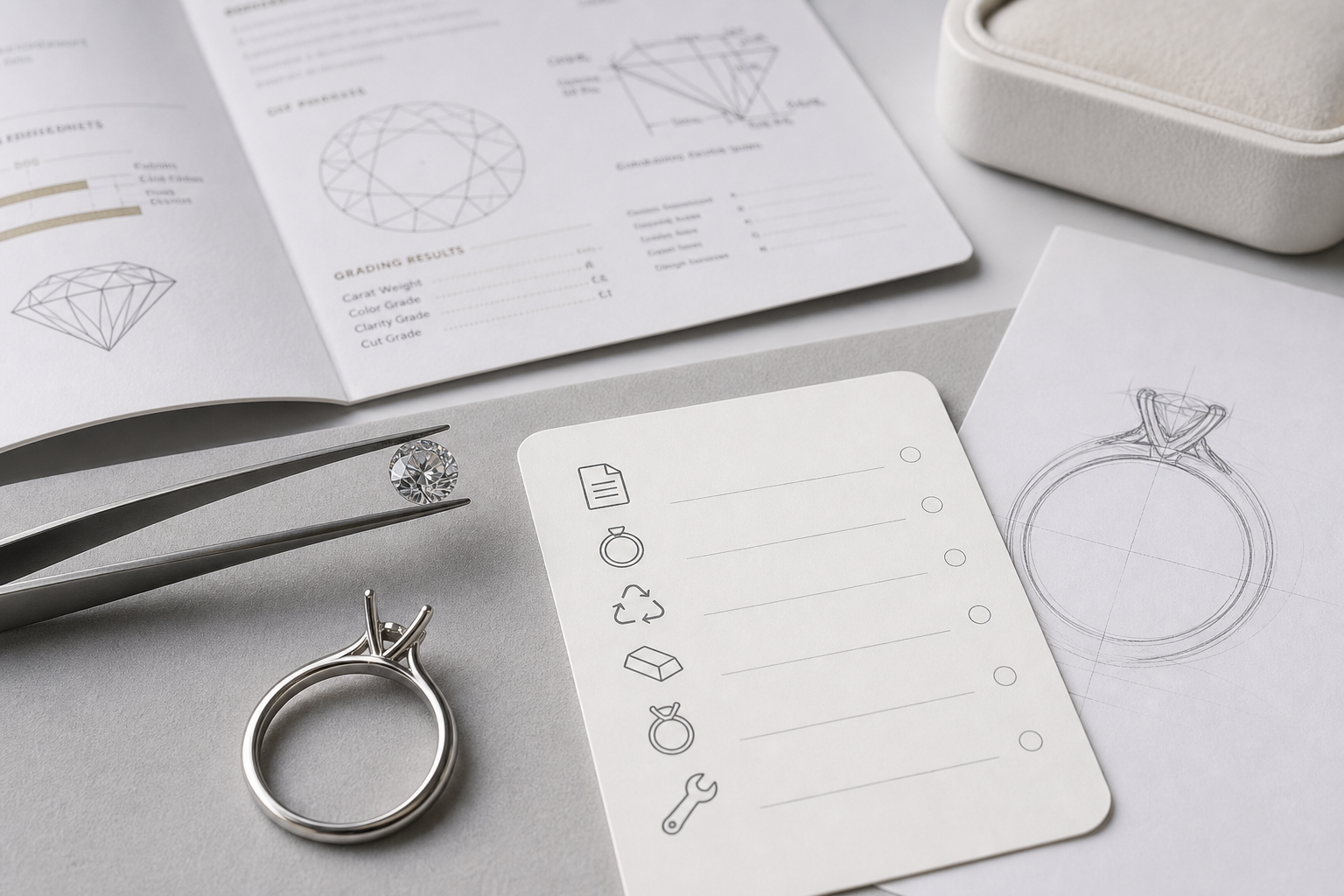
A sustainable lab-grown diamond jewelry decision should not stop at the stone. The stronger buying framework is a jewelry lifecycle checklist: confirm the diamond, evaluate the metal, judge the setting for long-term wear, and verify repair or resizing before purchase. This keeps the decision practical. Instead of searching for a flawless sustainability claim, you are looking for a piece that is documented, wearable, serviceable, and built to stay in use.
The highest-risk mistake is fragmented buying: choosing the diamond for transparency, the setting for appearance, and the metal for price without checking whether those choices work together. A ring can look responsible on the surface and still be hard to maintain if the shank is too delicate, the alloy is unspecified, or the design cannot be resized.
Step 1: Confirm the Diamond, Then Move Beyond the Diamond
Start with the lab-grown diamond basics: grading report, shape, measurements, inscription if applicable, and a visual review of the actual stone. The report should match the diamond being sold, and the stone should suit the design. A long oval, pear, emerald cut, or large round may require different setting support, so the diamond’s physical dimensions matter as much as its listed carat weight.
Once the diamond is confirmed, move on. Spending all your attention on color and clarity while ignoring the setting is a poor tradeoff for a daily-wear piece. A slightly more carefully built ring will often matter more over ten years than a marginal upgrade in a diamond grade that is hard to see without magnification.
Step 2: Evaluate the Metal and Alloy
Check the metal type, karat, recycled status, and finish requirements. For gold, confirm whether the ring is 14k or 18k and whether the recycled claim applies to the setting you are buying. For white gold, ask whether it is rhodium-plated and whether nickel-free or palladium-based alloy options are available if sensitivity is a concern. For platinum, confirm that the design and budget account for its density, weight, and maintenance behavior.
The right metal choice depends on use, not just ideals. Recycled gold can be a strong option when the alloy, construction, and documentation are clear. Platinum may be better for some buyers who want a naturally white metal and strong long-term prong performance. The weak choice is not one specific metal; it is a metal decision made without understanding how the ring will be worn and serviced.
Step 3: Evaluate the Design for Long-Term Wear
Look closely at shank width, prong structure, gallery support, setting height, and protection around vulnerable diamond shapes. For many daily-wear rings, extremely thin designs create avoidable risk. A delicate band may photograph beautifully, but if it bends, loosens stones, or limits resizing, it works against the lifecycle value of the piece.
Pavé, hidden halos, and intricate side-stone details should be treated as maintenance choices, not just style choices. They add visual detail but also add more small stones, more setting points, and more potential repair needs. That does not make them wrong. It means the buyer should know what they are accepting before choosing the design.
Step 4: Confirm Repair, Resizing, and Documentation Before Purchase
A sustainable engagement ring checklist should include serviceability. Ask whether the ring can be resized, by how much, and whether resizing becomes difficult because of pavé, an eternity band, tension elements, mixed metals, or unusual construction. Ask who handles repairs, whether accent stones are standard sizes, and what maintenance is expected for the metal and finish.
Written confirmation matters most when the design is custom, delicate, or high-value. Verbal reassurance is easy to forget and hard to compare. A product page, order confirmation, invoice, or specification sheet that records metal, stone, setting, and service expectations gives the buyer a better basis for future maintenance decisions.
Step 5: Treat Price and Value Comparisons as Time-Sensitive
Price can influence the final decision, but it should not be used as a shortcut for sustainability or quality. Prices can change with market conditions, report type, seller channel, metal weight, alloy choice, labor, stone-specific details, and design complexity, so exact comparisons should be verified at the time of purchase. A lower initial price may be less helpful if the setting is underbuilt, difficult to resize, or costly to maintain.
When comparing two lab-grown diamond rings, compare like-for-like specifications: diamond report details, stone measurements, metal type and karat, recycled content claim, setting structure, accent stones, and maintenance expectations. A ring that appears less expensive may simply have less metal, a simpler report, lighter construction, or less documentation. A ring that costs more is not automatically better either; the premium should connect to specific, visible, or documented features.
Fast Buyer Scoring Method
Use a simple 10-point framework before placing an order. Give the piece 2 points for clear diamond documentation, 2 points for metal sourcing disclosure, 2 points for a suitable alloy and metal choice, 2 points for durable setting construction, and 2 points for repair or resizing clarity.
A ring does not need a perfect score to be worth buying. The score is useful because it shows where the risk sits. A ring with strong diamond documentation but weak metal disclosure needs questions about recycled content, karat, and alloy. A ring with beautiful metal specifications but fragile construction needs a closer look at shank width, prongs, and maintenance. A low score in repairability is especially important for engagement rings because size changes, prong tightening, and finish maintenance are normal parts of long-term wear.
If two rings look similar, the better sustainable choice is usually the one with fewer unanswered questions and a more realistic path for maintenance. That is often more meaningful than choosing the option with the strongest marketing phrase.
When Custom Design Can Improve Sustainability and When It Can Add Complexity
Custom design can improve sustainability when it helps the buyer make the whole piece more coherent: the lab-grown diamond fits the setting, the metal choice fits the wearer’s habits, the construction is strong enough for daily use, and future maintenance has been considered before production. It can also add complexity if the buyer focuses on visual ideas without confirming the technical details that make the piece durable and repairable.
The strongest reason to consider a custom lab-grown diamond ring is control. A buyer can choose recycled gold or platinum, adjust band width, protect a pointed diamond shape, specify prong placement, and avoid design features that would make resizing difficult. The tradeoff is that custom work requires better decisions upfront because changes become harder once the ring moves into production.
Custom Design Can Align the Stone, Metal, and Setting
A custom design process can be useful when the stone is not a standard fit, when the buyer wants a recycled gold custom ring, or when the wearer’s lifestyle calls for a sturdier setting than many ready-made designs provide. A larger lab-grown diamond may need a stronger basket or lower profile. A pear, marquise, or princess cut may need more deliberate protection at the tip or corners. A buyer who works with their hands may need a design that prioritizes security over a very high, delicate setting.
This is where custom work can support sustainable custom jewelry in a practical way. The value is not simply that the piece is personalized. The value is that the design can reduce avoidable repair risk, match the metal to the intended use, and create a ring the wearer can realistically keep using for decades.
For custom design, trust comes from matching the stone to the setting, budget, and wearer’s daily use, not from choosing grades or labels in isolation. The center stone’s measurements, the metal’s wear behavior, and the setting’s maintenance path should be reviewed together before the design is finalized.
Custom Design Requires Better Upfront Questions
Before production, clarify the exact metal, karat, recycled metal availability, alloy concerns, setting height, prong style, stone protection, band width, resizing expectations, and maintenance needs. If CAD design is part of the process, use it to evaluate structure, not just style. Look at where the prongs sit, whether the gallery supports the stone, how high the diamond sits above the finger, and whether the shank looks proportionate to the center stone.
The most common custom design mistake is approving a look without understanding the consequences. A very thin band, a low-profile design with limited cleaning access, or pavé around the entire shank may be exactly what a buyer wants aesthetically, but those choices can affect repair, resizing, and long-term durability. A good specification should make those tradeoffs visible before the ring is made.
For custom jewelry, stone measurements and setting compatibility should be confirmed before finalizing a purchase. This is especially important when the diamond has a non-standard spread, a pointed shape, a high crown, a deep pavilion, or a larger carat weight that creates additional leverage on the setting.
For custom projects, NUVU’s approach is to look at the diamond and setting together rather than treating the stone as a separate purchase. A beautiful diamond still needs the right physical design around it, especially when the goal is a ring that feels both responsible and wearable.
Ready-Made May Be Simpler for Some Buyers
Custom is not automatically the better sustainability choice. A ready-made ring with clear metal disclosure, a durable setting, appropriate prong structure, and accessible repair support may be more practical than a complex custom design with too many delicate features. Simpler can be better when it reduces uncertainty.
Ready-made settings may also help buyers who want a faster, more straightforward decision path. If the metal, karat, setting dimensions, maintenance expectations, and resizing limits are already clear, there may be no need to redesign the piece. The key is not whether the ring is custom or ready-made; the key is whether the finished jewelry has been chosen with metal sourcing, durability, and serviceability in mind.
Custom Design Specification Checklist
Before approving a custom recycled gold engagement ring or any custom ring with recycled gold and a lab-grown diamond, confirm the center-stone measurements, exact metal and karat, recycled metal availability, alloy or nickel-related concerns, prong count and placement, band width, setting height, and protection for corners or points. Also confirm whether the ring can be resized, what finish maintenance may be needed, and which details will appear in the final written order.
The best custom design decisions are specific enough to guide production and practical enough to support long-term wear. If a design choice makes the ring harder to resize, clean, repair, or maintain, it should be a conscious tradeoff rather than a surprise after the piece is finished.
FAQ: Recycled Gold, Lab-Grown Diamonds, and Sustainable Jewelry Choices
Is recycled gold always more sustainable than newly mined gold?
Recycled gold can be a stronger choice when the goal is to reduce demand for newly mined material and keep existing gold in circulation. It is especially useful when the recycled claim is written clearly and applies to the setting itself, not just a general brand statement.
It is not an automatic guarantee of lower impact in every category. Refining, alloying, casting, polishing, and transportation still require resources, and the original source of the gold may not always be traceable. The better question is not only “is recycled gold sustainable?” but “how clearly is the recycled content documented, and how well is the finished piece made?”
Does a lab-grown diamond make the whole ring sustainable?
No. A lab-grown diamond addresses the stone-origin part of the decision, but it does not answer every question about sustainable jewelry. The metal sourcing, gold alloy, setting construction, repairability, resizing limits, and expected product lifespan all affect whether the finished ring is a responsible long-term purchase.
A lab-grown diamond ring with an underbuilt setting or unclear metal disclosure may be less practical than it appears. The strongest choice is usually the one that combines a documented diamond, an appropriate metal, a durable setting, and a realistic maintenance path.
Is platinum better than recycled gold for an engagement ring?
Not always. Platinum may be the better fit for buyers who want a naturally white metal, strong long-term wear behavior, and prongs that can support a daily-wear center stone well. It can be especially useful in high-wear designs or settings where rhodium plating maintenance is not desirable.
Recycled gold may be the better practical choice when color options, lighter weight, design flexibility, or total setting cost matter more. Well-alloyed 14k or 18k recycled gold can perform very well in an engagement ring when the design is properly built. The wrong decision is choosing by metal name alone instead of matching the metal to the setting style, stone size, and wearer’s habits.
What should I ask before buying sustainable lab-grown diamond jewelry?
Ask for the diamond documentation first, then move beyond the stone. Confirm the metal type and karat, whether recycled gold is used, whether the claim applies to the full setting, and whether alloy disclosure is available if nickel sensitivity or white gold maintenance matters to you.
Then ask about the structure of the ring: prong design, band width, protection for pointed diamond shapes, resizing limits, repair access, and expected maintenance. These questions matter because a piece that cannot be serviced easily may have a shorter useful life, even if the initial materials sound responsible.
Can a grading report prove a ring is sustainable?
No. A grading report can document key diamond characteristics, and some reports may identify laboratory-grown origin or other stone details depending on the report type. It does not usually document recycled gold, alloy composition, setting durability, labor practices, transportation, repairability, or the full environmental profile of the finished jewelry.
Use the report for what it is designed to support: diamond identification and grading information. For the ring’s broader sustainability story, ask for separate metal specifications, recycled content language where applicable, setting details, and maintenance expectations.
Conclusion: The Most Sustainable Jewelry Choice Is the One Built to Last
Evaluate the Whole Piece
Sustainable jewelry should be judged as a finished piece, not as a diamond alone. Recycled gold and lab-grown diamonds can both support a more considered purchase, but the stronger decision comes from looking at diamond documentation, metal sourcing, alloy choice, setting durability, repairability, resizing, and long-term wear together.
The most common mistake is treating sustainability as a single claim. A ring is not automatically more responsible because one component sounds better. If the setting is too fragile, the metal details are vague, or the design cannot be repaired realistically, the piece may not serve the buyer well over decades of wear.
Plan for Long-Term Wear
The practical next step is to compare lab-grown diamond jewelry with the same attention you would give to any long-term purchase: what it is made from, how it is built, how it can be maintained, and whether the design fits the wearer’s daily life. A recycled gold lab-grown diamond ring can be a strong choice when the metal, setting, and service path are as thoughtfully considered as the center stone.
If you are choosing a sustainable engagement ring or planning a custom piece, NUVU can help you compare lab-grown diamonds, recycled gold or platinum settings, and design details with long-term wear in mind. The goal is not to chase a perfect claim, but to choose a piece with clear information and a realistic path to lasting use.
Before purchase, buyers should confirm the seller’s documentation, return and resizing policies, maintenance expectations, and any service terms in writing. A grading report can support diamond comparison, but it should not be treated as proof of metal sourcing, recycled content, or finished-jewelry durability.
Further Reading for Your Jewelry Decision
Choose Your Next Area of Research
The most useful next reading depends on where the buyer still has uncertainty. If the diamond itself is the open question, continue with guidance on how to choose a lab-grown diamond. If the certificate is confusing, review how lab-grown diamond grading reports work and what they do not verify. If the setting is the main concern, compare engagement ring settings with durability, maintenance, and metal choice in mind.
For buyers who want more control over the full piece, custom lab-grown diamond ring design may be the better next step. Starting with loose lab-grown diamonds can also make sense when the center stone needs to be selected before the setting is finalized.
Consider the Diamond, Metal, and Setting Together
This topic is narrower than a general lab-grown diamond sustainability guide. The main issue here is not whether a lab-grown diamond has a different origin story than a mined diamond; it is whether the entire jewelry piece is built, documented, and maintained in a way that supports long-term use.
It is also broader than a recycled gold explainer. Recycled metal matters, but it should not distract from alloy choice, prong strength, resizing limits, repair access, and daily-wear suitability. Custom design is one possible way to align those details, but a well-built ready-made ring with clear specifications can be the more sensible option for some buyers.
Reader Value Check
Before accepting a sustainable jewelry claim, ask the questions that affect the finished piece: What metal is used? Is it recycled or otherwise disclosed? What alloy is in the setting? Is the design strong enough for daily wear? Can the ring be resized or repaired? Will the piece last long enough to justify the resources used to make it?
Disclosure: This article is for general educational purposes only. Diamond grading, pricing, availability, specifications, and seller policies can change, and readers should verify important details through grading reports, official laboratory tools, seller documentation, or qualified professionals before making a purchase decision. Laboratory-grown diamonds should be clearly distinguished from natural diamonds, and environmental or sourcing claims should be supported by specific documentation.