
Buying custom lab-grown diamond jewelry involves more risk than purchasing a ready-made piece. You commit to a design and a stone before seeing the finished ring, and the gap between what you approve and what you receive can be surprisingly wide—ranging from a different-quality diamond to a band that doesn’t match the CAD. The central problem isn’t quality; it’s verification. Without proper lab grown diamond supply chain transparency, you’re relying on trust alone at each critical stage.
For the full framework, read Lab-Grown Diamond Traceability, Certification, and Transparency Guide.
This article walks through the four critical checkpoints where transparency matters most: stone verification, CAD approval, production monitoring, and final inspection. It gives you the specific, verifiable details to request at each step—so you can confidently distinguish a jeweler who builds trust from one who asks for blind faith.
For buyers, the practical point is that these checkpoints are not about distrusting any single jeweler. They are about building a process where each stage produces its own verifiable evidence, so the final decision rests on what you can confirm rather than what you are told to assume.
| Stage | Verification Needed | Red Flag to Watch For |
|---|---|---|
| Stone selection | 360-degree video, grading report, laser inscription photo | Stock photos or generic specs instead of the actual diamond |
| CAD approval | Millimeter measurements for band, stone height, prongs | Renderings without scale or dimensions |
| Production | Milestone updates and measurement verification within 0.1–0.2mm tolerance of CAD | Vague timelines or no updates until shipping |
| Pre-delivery inspection | Final photos of the finished piece, inscription match confirmed | Stone sent without final approval photos |
| Jeweler overall | Proactively shares stone videos, CAD measurements, and production checkpoints | Resists sharing specific details; relies on reputation alone |
Quick Questions Before You Read
Q: Is a grading report enough to guarantee the exact diamond I choose?
No. Grading reports cover the diamond’s category but not its individual identity. You need the stone’s laser inscription to match the report, plus a video confirming you’re getting that specific diamond.
Q: Can I trust that the CAD rendering matches the final ring?
Only if you verify millimeter measurements on the CAD—band width, stone height, prong thickness—and confirm the finished piece stays within 0.1–0.2mm of those specs.
Q: What is the single biggest mistake buyers make in custom jewelry?
Skipping pre-delivery inspection. Without seeing final photos of the assembled ring before it ships, you lose the last chance to catch errors in color, symmetry, or inscription.
Why Custom Jewelry Requires More Trust Points Than Ready-Made Pieces
Ready-Made vs. Custom: Two Different Trust Structures
Imagine walking into a jewelry store, trying on a ring that is already finished, inspecting the stone under the counter lights, checking how it sits on your finger, and walking out with the exact same piece in a box. That is a ready-made purchase. You saw what you paid for before you paid for it. The trust decision was simple: does the ring in front of you meet your standards?
Now imagine a custom order. You select a loose diamond from an online inventory, approve a computer-generated rendering of a setting that does not exist yet, wait for the piece to be made, and then see the final result for the first time when it arrives at your door. At no point did you hold the finished product before committing. Every decision you made along the way relied on someone else being accurate, honest, and skilled. That is a fundamentally different trust structure.
Ready-made buying compresses the trust decision into a single moment — inspection before purchase. Custom buying spreads that trust across multiple stages, each one introducing its own risk of mismatch, miscommunication, or quality loss. This is not a problem if you know what to look for. But it is a risk if you treat a custom order the same way you would treat buying a finished piece off the shelf.
Where Trust Gaps Appear in a Custom Order
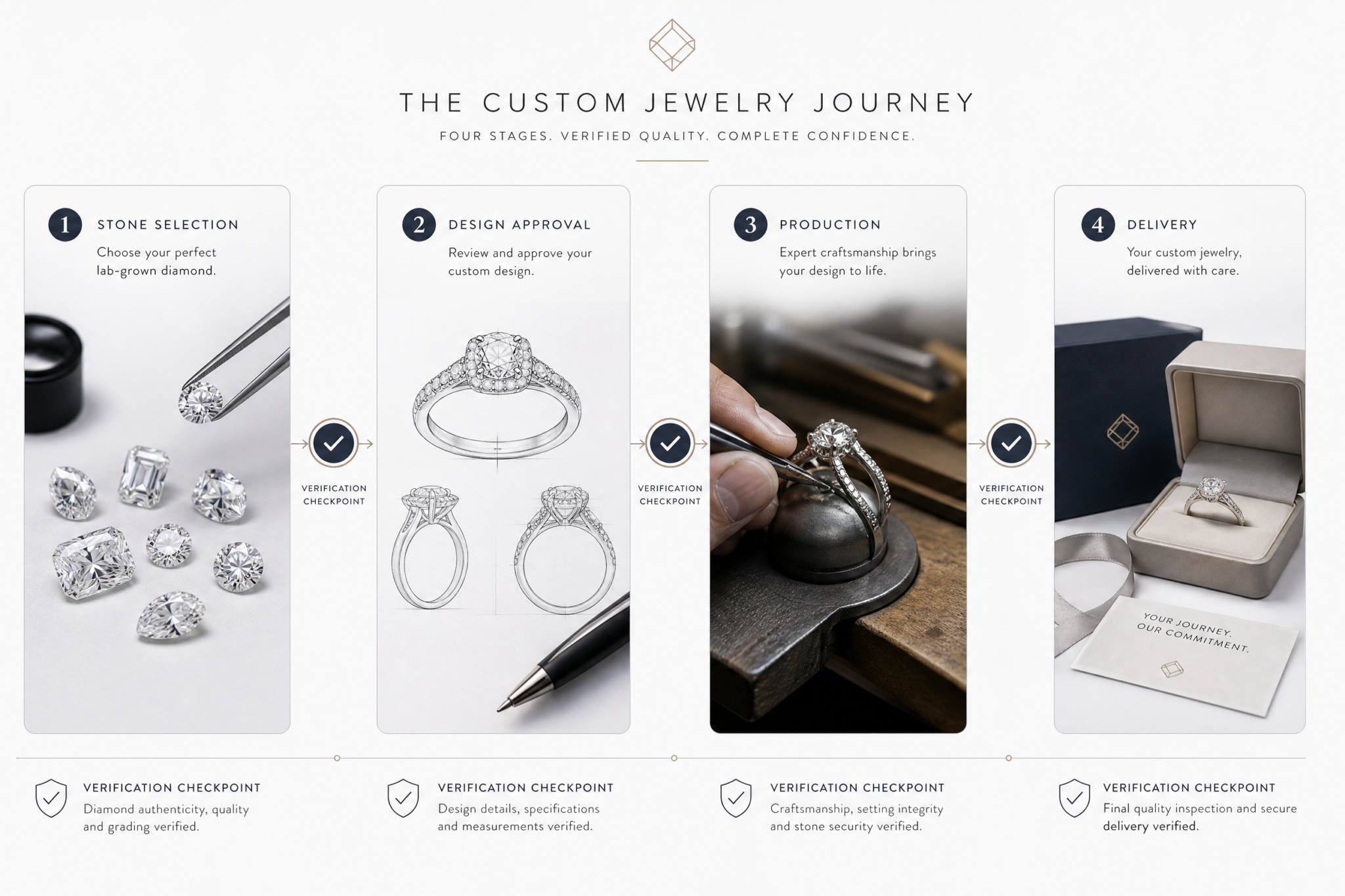
A typical custom jewelry order passes through at least four distinct phases: stone selection, design approval, production, and final delivery. Each phase requires a different kind of verification, and each one can go wrong in a different way.
At the stone selection stage, the question is whether the diamond you chose is the same diamond that gets set. Without proper documentation — a full grading report, laser inscription verification, and clear photographs or video — you cannot easily confirm this after the stone is mounted. At the design stage, the CAD rendering may look beautiful on screen but misrepresent actual metal thickness, stone height, or prong coverage. Approving a rendering without understanding its limitations means approving a design that may not match reality.
Once production begins, the process often goes dark. You send your stone to the jeweler, wait several weeks, and receive a finished piece without having seen any intermediate checks. Did the setter position the stone correctly? Did the metal finish match the polish sample? Was the band width held to the measurement you approved? Without production-stage transparency, these questions go unanswered until the package arrives.
The final gap appears at delivery. If the finished piece looks different from what you expected — the stone appears warmer, the setting sits higher than shown in the rendering, or the prongs feel bulkier — you have limited recourse. The piece was made to your specifications, or at least to the specifications you approved. Proving a mismatch between what you approved and what you received is difficult without documentation from each stage.
These are not hypothetical scenarios. They are the natural result of a process that asks buyers to commit before they can see the finished outcome. Transparency is not about distrusting jewelers. It is about having the information you need at each decision point so that when the piece arrives, the only surprise is how good it looks.
What to Check Before Choosing a Custom Jeweler
The best time to evaluate transparency is before you place an order, not after. A few simple questions can tell you a lot about how a jeweler handles the custom process. Ask whether they provide 360-degree video of the exact stone you are selecting, not just a stock image or a grade report. Ask whether they send CAD files with actual measurements in millimeters, not just stylized renderings. Ask whether they offer production updates or mid-process photography so you can verify the stone was set correctly before final polishing. And ask whether they allow a final inspection or pre-delivery approval before the piece ships.
A jeweler who can answer these questions clearly and without hesitation has likely built their process around transparency. One who seems vague or suggests that such checks are unnecessary may be asking you to trust them without giving you the tools to verify that trust. In custom jewelry, that is a gamble worth avoiding.
Stone Selection: Confirming What You Choose Is What You Get
The first real transparency test in a custom jewelry order happens before any metal is cast. It begins with the stone. You select a loose diamond based on its grading report, photos, video, and measurements. But until that stone is set into your finished piece, you are working on trust. Once it is mounted, close inspection becomes difficult. The stone you approved must be the exact stone that gets set — not one with similar specs and a different visual character.
What You Should See Before You Select a Stone
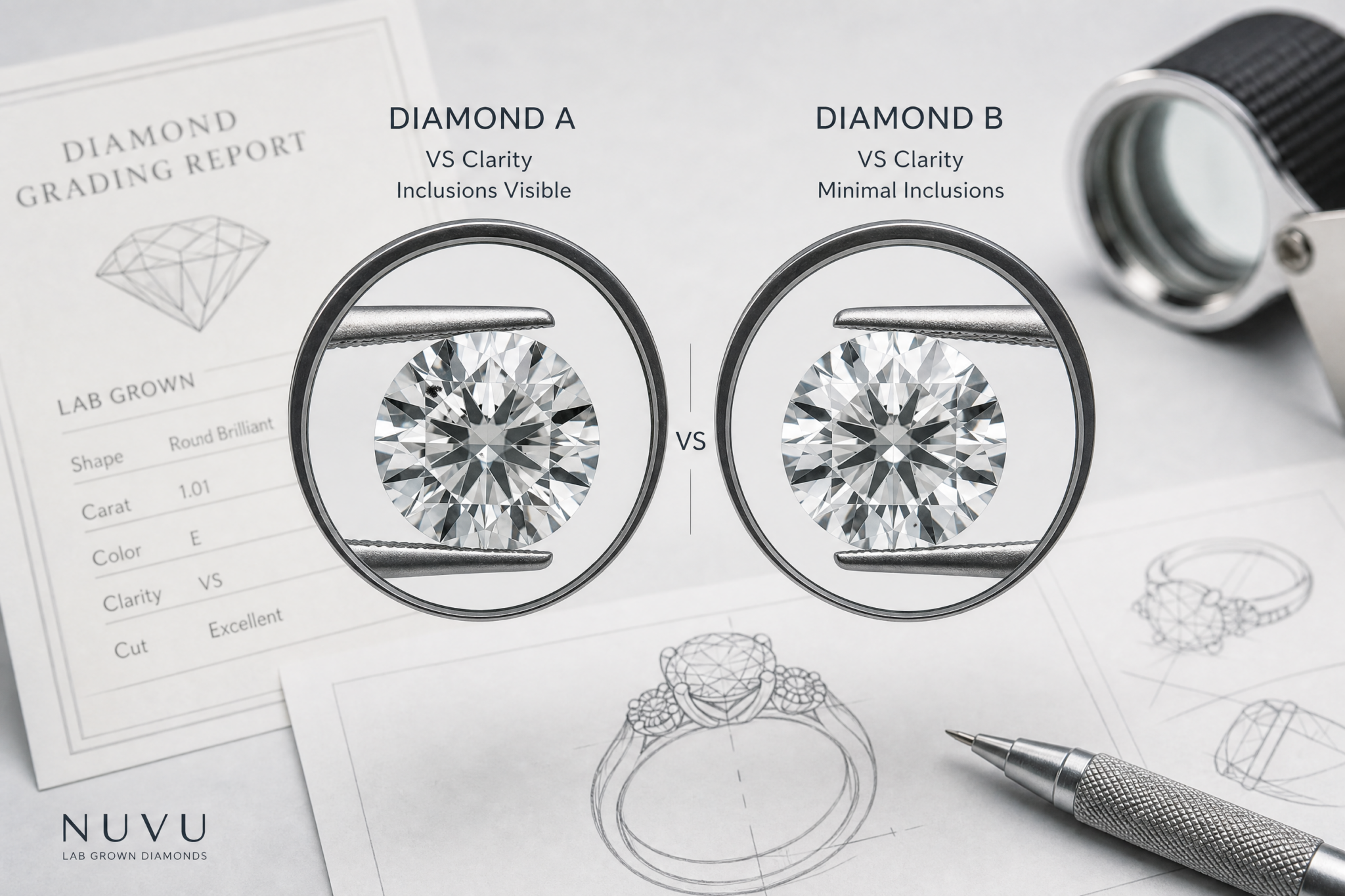
Before committing to a loose lab-grown diamond, you should have access to more than a grade summary. A full grading report from an independent laboratory like IGI or GCAL is the baseline. But the report tells you the category, not the character. Two diamonds with the same color and clarity grade can look noticeably different side by side.
What matters beyond the report is how the stone actually appears. High-resolution photos and 360-degree video let you see the stone from multiple angles, not just the face-up view. You want to inspect the faceting pattern, the brightness, and any inclusions visible to the naked eye. For larger stones or center diamonds in engagement rings, seeing the actual stone — not a generic representation — is the only way to confirm the visual quality matches the grade.
Precise measurements also matter more than most buyers assume. A diamond listed at 6.5mm round may measure 6.45mm or 6.55mm in reality. That small difference affects how the stone fits into a specific setting. If your custom design relies on a precise fit, exact dimensions should be confirmed before you proceed.
How to Confirm the Stone You Chose Is the Stone You Get
The risk at this stage is not that sellers intentionally deceive, but that the process has handoffs. A stone shown in one location may not be the stone transferred to the workshop. Transparency means the jeweler can track the stone by its serial number or laboratory report number from selection through final setting.
Most lab-grown diamonds from reputable manufacturers have a laser-inscribed girdle. The inscription is readable with a standard jeweler’s loupe and should match the report number. Before the stone is set, you should be able to verify that the inscription on the stone matches the documentation. After setting, the inscription remains readable in most settings as long as the girdle is not fully covered. Some jewelers will provide a photo or video of the inscription before setting as an additional verification point.
Why Grading Reports Alone Are Not Enough
A grading report assigns a letter or number to each of the 4Cs. But it cannot tell you how the stone looks in a specific piece of jewelry or under the lighting conditions where it will be worn.
Here is a practical example. An SI1 clarity grade means the stone has inclusions that are slightly visible under 10x magnification. But an SI1 with a large inclusion near the center of the table may look visibly flawed to the naked eye, while a well-placed SI2 with inclusions tucked near the edge may appear clean. The grade alone does not capture this. Transparency means seeing the actual stone and understanding how its specific characteristics affect visual performance.
Buyer Verification Checklist for Stone Selection
Before moving to the design stage, confirm the following with your jeweler. Can you see the full grading report, not just the summary? Are high-resolution photos and 360-degree video available for the exact stone you are considering? Can the inscription be verified before the stone is set? Are the precise measurements — diameter, depth, table width — provided, not just carat weight? If the answer to any of these is no, the transparency gap at this stage may create problems later.
A practical note: even with perfect documentation, two loose stones with identical grades may perform differently in a custom setting. The diamond’s proportions, the angle of its facets, and its interaction with the specific setting metal all affect the final look. The report helps narrow the shortlist, but it does not replace the buyer’s own visual judgment when comparing actual stones.
Design and CAD Approval: Making Sure Your Approval Reflects Reality
The design approval stage is where many custom orders drift from expectation to outcome. You review a CAD rendering, approve it, and assume the finished piece will match. But a rendering is not a finished product. It is a digital model that shows proportions, angles, and layout. What it does not show is how those proportions translate into physical wear, how the stone sits in the setting, or how the piece feels on the hand. Transparency at this stage means understanding what you are approving and knowing which details may change during production.
What Your CAD Shows and What It Does Not Tell You
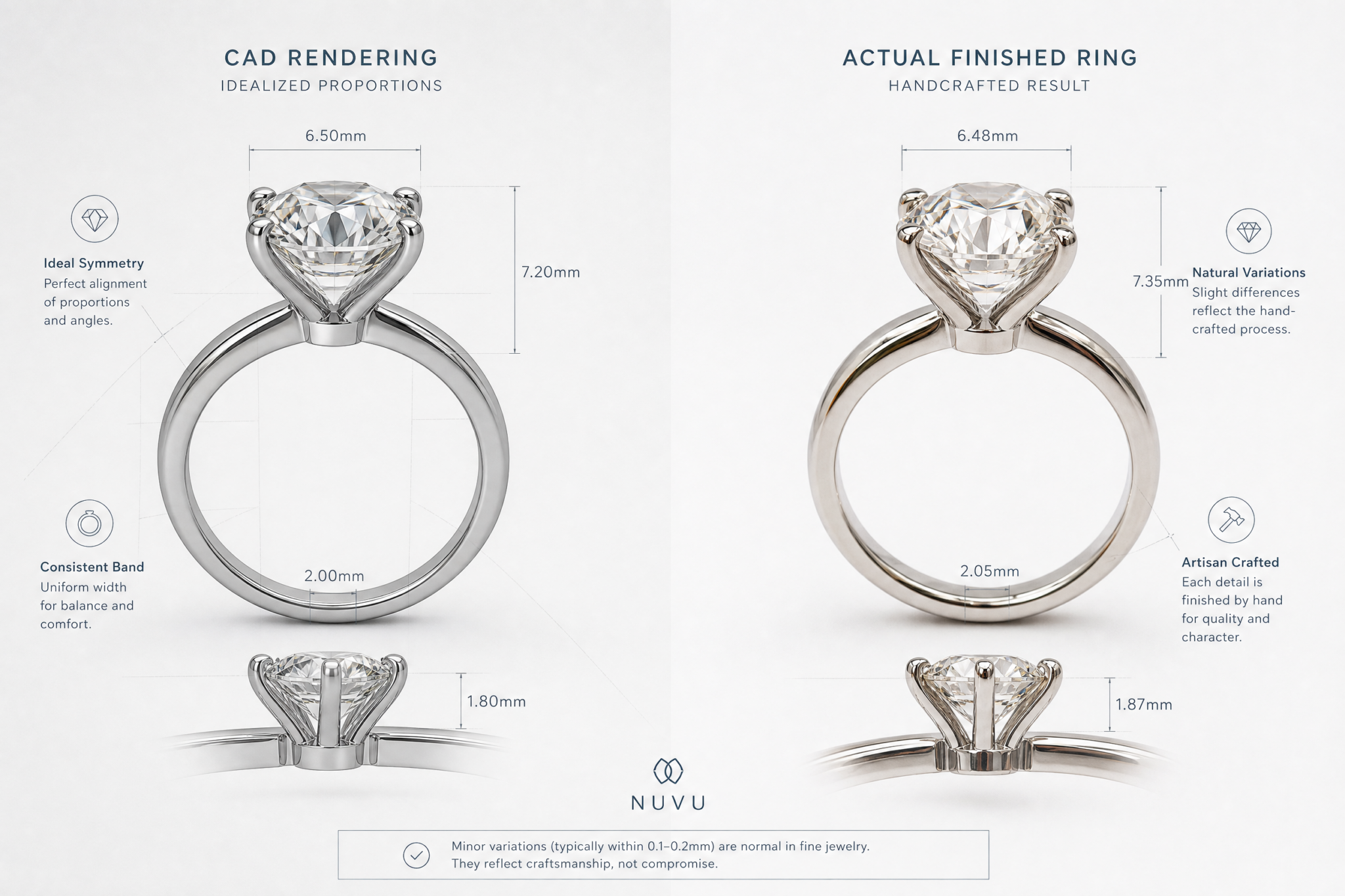
A CAD file is excellent for confirming the overall design direction. You can see the profile of the band, the position of the stone, the shape of the prongs or bezel, and how the elements relate to each other. But a CAD rendering often uses idealized geometry. Metal appears perfectly smooth. Prongs look symmetrical and flush. The stone sits at a precise angle. In production, small variations are normal. The goal is to understand which variations matter and which do not.
What the CAD does not show is how the piece will behave in daily use. A ring with a stone set high above the band may look elegant in the rendering but catch on clothing or bump into objects. A thin band may appear refined in the digital model but feel fragile once worn. The rendering also cannot show how the stone reflects light from different angles within the setting. The interaction between diamond and metal — how the setting frames the stone and how light enters from the sides — is difficult to predict from a CAD alone.
Critical Measurements to Confirm Before Approving
Before you approve a CAD, confirm the key measurements in millimeters. Band width and thickness are the most common mismatches. A rendering can make a 1.8mm band look substantial, but in reality, that width may feel too thin for daily wear. Band thickness — the distance from inner to outer surface — affects durability. A thicker band adds structural strength, especially for rings with larger stones.
Stone height above the finger is another measurement that matters more than most buyers realize. A diamond set high enough to clear a halo or side stones may protrude significantly. For engagement rings, this affects how the ring feels against adjacent fingers and how easily it slides under gloves or through pockets.
Prong coverage is often overlooked. The CAD may show prongs as small decorative bumps, but in production, they must cover enough of the diamond to secure it. Prongs that look minimal in the rendering may actually require more metal contact, reducing the visible diamond surface. Confirm the prong height and width measurements, not just their visual appearance in the model.
When a Rendering and the Finished Ring May Differ
The most common source of mismatch between a CAD and a finished ring is the stone itself. A rendering uses a generic digital stone with perfect proportions. Your actual diamond may be slightly deeper, slightly shallower, or have a different table size. If the CAD was built around an idealized stone, the setting may not fit your diamond as precisely as the rendering suggested.
Another common issue is metal shrinkage during casting. When molten metal is cast into a mold, it contracts slightly as it cools. A well-managed production process accounts for this, but the final band width can differ from the CAD by 0.1mm to 0.2mm. This is normal. What matters is whether the jeweler measures and confirms the final dimensions.
Verification Questions to Ask Before Finalizing Your Design Approval
Ask your jeweler these questions before approving the CAD. What are the exact band width and thickness in millimeters? What is the stone height above the finger? How much metal will cover the diamond at the prongs or bezel edge? Was the CAD built around your specific diamond’s measurements, or a generic stone? Can you see a rendering or photo of the actual diamond placed inside the setting model? If the jeweler cannot provide specific measurements in millimeters, you are approving a visual idea, not a producible design. Transparency at this stage means numbers, not just pictures.
Production and Quality Control: What Happens Between Approval and Delivery
After you approve the CAD, the process enters its longest and least visible phase. The stone and design move to the workshop. The setting is cast, shaped, and polished. The diamond is set. The piece is finished and inspected. Depending on the jeweler and complexity of the design, this process can take days to weeks. For the buyer, this period is often a black box. Transparency in production means knowing what is happening and confirming that the piece still matches the approved design before it ships.
Where the Process Goes Dark (and How to Keep It Visible)
Most custom jewelers do not provide stage-by-stage updates by default. The buyer approves the design and waits. During that wait, critical decisions are made by the setter and finisher. The stone is mounted. The prongs are tightened. The surface is polished. If any adjustment was needed — if the stone sat slightly high or the band required extra fitting — the buyer may never know.
Transparency at this stage does not require daily updates, but it does require checkpoints. A jeweler who offers milestone updates — when the setting is cast, when the stone is set, when the piece is polished — gives the buyer a way to confirm progress and catch issues early. A simple photo or video at each milestone is often enough to verify that the piece is on track.
What Quality Control Should Verify for Custom Jewelry
Quality control for a custom piece should go beyond checking that the ring looks acceptable. It should verify specific parameters against the approved design.
Stone security is the first priority. Prongs must be tight enough to hold the diamond securely but not so tight that they deform the setting or apply pressure to the stone. For four-prong settings, each prong should sit symmetrically against the diamond. For bezel settings, the metal should wrap evenly around the full circumference with no gaps.
Prong symmetry is often overlooked. After the stone is set and the prongs are tightened, minor unevenness can occur. A well-conducted QC inspection should catch this and correct it before final polish.
Measurement matching matters more than most buyers realize. The band width and thickness should be measured against the approved CAD. A deviation of more than 0.1mm to 0.2mm should be flagged and explained. The stone height above the finger should also be measured and confirmed.
Inscription verification should happen at final QC. Before the piece ships, the diamond’s laser inscription should be checked against the grading report to confirm the correct stone was set.
Common Issues That Can Arise During Setting and Finishing
Several issues commonly appear during the setting and finishing stages. The stone may sit slightly higher or lower in the setting than the CAD intended, requiring prong adjustment. The band may measure slightly thinner than the approved CAD due to metal loss during polishing. Surface finish may differ from the sample or rendering — a high-polish surface may have micro-scratches, or a matte finish may be uneven.
Most of these issues are correctable if caught during QC. The risk is when they are caught after the piece is finished and ready to ship. A transparent QC process catches these before polishing is finalized, when adjustments are easier and less risky.
For wholesale buyers or those ordering multiple custom pieces, consistency across items is an additional concern. Two pieces made from the same CAD can differ slightly in band thickness or stone height due to normal production variance. A transparent jeweler will measure each piece individually and flag any variance, rather than assuming identical results from identical designs.
Key Distinction for Custom Buyers: Laboratory-Grown vs. Natural Diamonds
Throughout the custom process, it is important for both the buyer and the jeweler to clearly distinguish laboratory-grown diamonds from natural diamonds. When a stone is described as “lab-grown” or “laboratory-created,” this refers to its origin — it was grown in a controlled laboratory environment rather than formed naturally over geological time. This is not a treatment or enhancement of a natural stone, but a distinct method of creation. The grading report for a lab-grown diamond should clearly disclose its laboratory-grown origin, and the terminology used by the jeweler should be consistent with that disclosure.
From a buyer’s perspective, this distinction matters because the documentation you rely on — the grading report, the laser inscription, and any seller descriptions — should be precise. Reports from established laboratories (such as GIA and IGI) include specific nomenclature for laboratory-grown diamonds, and the laser inscription on the diamond’s girdle typically includes an identifier that indicates its laboratory-grown origin. When verifying the stone at any stage of the custom process, confirming that the inscription matches the report number is also an opportunity to confirm that the origin description is consistent. This clarity supports the verification framework outlined in this article: traceability depends on accurate and consistent documentation at every stage, starting with the fundamental question of what kind of stone you are buying.
How Industry Terminology and Disclosure Standards Support Transparency
Transparency in a custom order is reinforced by the terminology and disclosure standards that laboratories and regulators have established around lab-grown diamonds. The Gemological Institute of America (GIA) has published clear guidance on how lab-grown diamonds should be described — distinguishing them from natural diamonds through specific nomenclature rather than misleading terms like “synthetic” in a promotional sense.[1] This matters for the custom buyer because the grading report you receive should use correct and consistent terminology. When a jeweler provides a GIA or IGI report that clearly identifies the stone as laboratory-grown, using the same report number as the laser inscription, you have a documented chain that connects the stone’s identity to its grading. The report becomes part of the transparency record, not just a separate document.
The U.S. Federal Trade Commission (FTC) has also addressed how jewelry should be advertised, particularly regarding environmental or sustainability claims.[2] The FTC’s guidance is relevant because some custom jewelers may present lab-grown diamonds as inherently “eco-friendly” or “sustainable” without offering substantiation. A buyer who understands the FTC’s position on substantiating environmental claims can ask more targeted questions: What specific documentation supports the sustainability language used on the jeweler’s website? Are the growth practices, energy sources, or material inputs verifiable? Transparency in a custom order extends beyond the stone’s physical characteristics to include the claims made about its origin and production, especially when those claims influence a buyer’s decision. Treating these claims as information to be verified, rather than assumptions to be accepted, is consistent with the verification framework outlined in this article.
Additionally, the grading process itself involves a standard set of criteria that buyers should understand when comparing reports. GIA and IGI, for example, both evaluate cut, color, clarity, and carat weight, but a report primarily documents observable characteristics under controlled conditions.[3] It does not account for every variable that affects how a stone performs in a custom setting. This reinforces why the custom buyer should not stop at the report. The combination of a properly identified lab-grown diamond, a verifiable laser inscription, and a grading report that follows established nomenclature creates a baseline of documentation that can be checked at each stage of the custom process — from loose stone selection through final assembly. That documented baseline is the foundation on which the other verification checkpoints in this article depend.
What to Ask Your Jeweler About Their Production Checkpoints
Before placing your order, ask what production checkpoints exist. Will you receive photos or video at any stage after the CAD approval? Can you confirm the stone’s inscription before it is set? What measurements are verified during final QC? Does the jeweler measure band width and stone height against the approved CAD? If the answer is that QC is internal only and no updates are provided, you are relying entirely on the jeweler’s internal standards. That may be fine for some, but it removes your ability to verify before delivery.
Final Certificate and Product Matching: Before You Accept Delivery
The final transparency checkpoint in a custom order happens right before you accept the finished piece. After weeks of waiting, the temptation is to open the box, confirm it looks good, and move on. But this is the moment when a few minutes of verification can confirm that everything you approved actually made it into the ring.
How to Verify the Stone in Your Ring Matches Its Report
Every lab-grown diamond from a reputable manufacturer has a laser inscription on its girdle. This is a small serial number — usually the grading report number — that is readable under a jeweler’s loupe. If you have a 10x loupe at home, or if the jeweler provides one with the ring, you can check this yourself. The number on the stone should match the number on the grading report exactly.
This is the most direct way to confirm the stone in your setting is the same stone you selected weeks earlier. Without this check, you are trusting that no substitution happened during the setting process. Most substitutions are not malicious — a jeweler may accidentally mix up similar stones in inventory. But the inscription is your hard proof.
Final Visual Inspection: What to Check Before You Say Yes
Once the inscription checks out, the next step is visual. Compare the finished piece to the CAD renderings and the stone photos or video you received during selection. Pay attention to the stone’s apparent color in different lighting. Does it match the video? Does the setting hold the stone at the height you approved? Are the prongs symmetrical and secure?
A useful test is to look at the ring under natural daylight, indoor lighting, and dimmer conditions. A lab diamond that looked bright in a jeweler’s showroom may appear warmer or cooler in your everyday environment. This is not necessarily a problem — different light sources affect how any diamond looks — but you should not be surprised. If the ring was photographed under controlled studio lighting, the difference can be significant.
Also check the band width and thickness against your approved specifications. A 2mm band that measures 1.8mm on calipers is within acceptable tolerance for some jewelers but not others. Know what you approved so you can confirm it was delivered.
Why Pre-Delivery Approval Is a Transparency Signal
Some jewelers send final photos or a short video of the finished piece before shipping. This is a strong transparency signal. It means the jeweler is willing to let you see the exact piece you are about to receive, rather than asking you to trust the process and inspect after arrival.
Pre-delivery approval is not yet standard across the industry, but it is becoming more common among jewelers who want to reduce returns and build confidence. If a jeweler offers this, it suggests they are confident in their work and comfortable with scrutiny. If they do not offer it, it is worth asking whether they can provide a final photo before shipping.
Buyers should also note that pre-delivery photos have their own limits. A final photo taken under studio lighting may not perfectly represent how the ring looks in daily conditions. It is a verification tool for physical details — prong symmetry, band width, stone position — not a guarantee of how the piece will appear in every light. The most reliable approach is to use the photo to confirm structural details and then rely on your own inspection under varied lighting when the piece arrives.
How to Build Transparency Into Your Custom Jewelry Buying Process
Knowing what transparency looks like at each stage is useful. The harder part is putting it into practice before you place an order. The clearest way to do this is to ask the right questions early, identify the signals that suggest a jeweler prioritizes transparency, and compare options before committing.
Questions to Ask Before You Place Your Custom Order
Before you send a deposit or approve a stone, ask the following:
– Can I see photos and video of the exact loose diamond I am selecting, not a stock image or stone with similar specs?
– Will you confirm the laser inscription on the stone matches the grading report number before setting?
– Can you show me the CAD file with measurements (band width, thickness, stone height) and explain any deviations from the rendering before I approve?
– Do you provide production updates or milestone photos while the ring is being made?
– Will you send a final photo or video of the finished piece before shipping?
– What measurements do you verify during quality control, and can I see those numbers?
These are not unreasonable questions. Jewelers who have a transparent process will answer them directly. Jewelers who do not may hedge or redirect.
Green Flags and Red Flags in a Custom Jeweler’s Process
Green flags include: the jeweler offers to show you the exact stone before setting. They send video rather than static photos. They provide detailed CAD renderings with callouts for critical measurements. They share their quality control process voluntarily. They offer pre-shipment approval without you asking for it.
Red flags include: the jeweler uses only stock photos or generic stone videos. They cannot confirm whether the stone you see online is the stone that will be set. They provide a CAD rendering without measurements. They are vague about production timeline and do not offer checkpoints. They ask for full payment before you see any production milestones.
How to Compare Transparency Across Custom Jewelers
If you are considering multiple jewelers, compare how much visibility each offers at every stage. One jeweler may show you the exact stone but offer no CAD measurements. Another may provide detailed CADs but no production updates. No jeweler will be perfect at every stage, but you should understand where the gaps are before you choose.
At NUVU, we treat transparency as a process, not a promise. The goal is not to claim openness but to give buyers concrete checkpoints at each stage — from stone video to final approval — so there are no surprises at delivery.
A final perspective worth considering: transparency is not only about what the jeweler provides, but also about what the buyer brings to the process. Asking the right questions, keeping a record of approved specifications, and taking time for final verification are all part of the buyer’s role in a successful custom order. The jeweler who supports that role with clear documentation and open communication is the one most likely to deliver a result that matches expectations.
How Traceability and Documentation Create a Verifiable Record Across the Custom Process
Beyond the individual checkpoints at each stage, a deeper layer of transparency involves how documentation links together across the entire custom process. Traceability, in a practical sense, means that every decision and verification point generates a piece of documentation that can be cross-referenced with the next. The stone’s grading report number should match its laser inscription. The inscription should be photographed before setting. The CAD files should reference the specific diamond’s measurements, not generic proportions. The final QC checklist should confirm that the inscription on the set stone matches the report, and that the band width matches the approved CAD. When these documents are connected, they form a chain of evidence that reduces reliance on memory or goodwill.
For the buyer, traceability is not about collecting paper. It is about having a coherent record that answers the question: “Can I trace this decision from start to finish?” A stone video from selection, a CAD file with measurements, a production photo showing the set stone, and a final inspection image — these four pieces of documentation, when linked by a consistent reference number (the grading report or an order ID), create a record that is verifiable at each step. Without that linkage, each document exists in isolation, and gaps in the process remain invisible until a problem surfaces.
The concept applies to sustainability claims as well. A buyer who sees a general statement about “eco-friendly production” can ask whether that claim is supported by traceable documentation — such as energy use records, material sourcing receipts, or manufacturer disclosures. In the same way that a grading report provides a baseline for a diamond’s characteristics, documented production practices provide a baseline for evaluating sustainability language. The principle is the same: specific, verifiable information is more useful than broad assurances, whether the topic is a diamond’s clarity grade or the energy source used to grow it. By applying the same verification mindset to documentation at every stage — from stone origin to final assembly — the buyer builds a complete picture of what they are receiving and how it was made.
Understanding the Role of Grading Reports in the Custom Process
A grading report from an independent laboratory can document key characteristics of a diamond — such as carat weight, color grade, clarity grade, and cut grade — under controlled conditions. However, a grading report should not be treated as a guarantee of a stone’s beauty, visual performance, or value in a specific custom setting. Two stones with the same report grades can appear noticeably different when viewed side by side, and a stone’s interaction with a particular setting metal or design can affect its final appearance in ways a report does not capture.
For custom jewelry buyers, the most useful approach is to treat the grading report as one piece of documentation within a larger verification process. The report provides a baseline for key specifications and a reference number for the laser inscription, but it should be evaluated alongside visual evidence (photos and video), precise measurements, and the intended design fit. Buyers who rely solely on report grades without seeing the actual stone or verifying its measurements may encounter mismatches between expectation and outcome, particularly in a custom design where the stone must fit a specific setting.
When a grading report is available, buyers should verify the report details through the issuing laboratory’s official report-check tools where available. For custom design, trust comes from matching the stone to the setting, budget, and wearer’s daily use—not from choosing grades in isolation. In sourcing or wholesale conversations, documentation, consistency, and communication often matter as much as the headline specification. Sustainability claims should be specific and documented. Broad green language is less useful than clear information about production, energy, sourcing, and seller transparency.
Before purchase, buyers should confirm the seller’s documentation, return policy, resizing terms, and after-sales support in writing. If a GIA report is provided, the report details can usually be checked through GIA’s official report verification system.
Disclosure: This article is for general educational purposes only. Diamond grading, pricing, availability, specifications, and seller policies can change, and readers should verify important details through grading reports, official laboratory tools, seller documentation, or qualified professionals before making a purchase decision. Laboratory-grown diamonds should be clearly distinguished from natural diamonds, and environmental or sourcing claims should be supported by specific documentation.
[1] Gemological Institute of America, “Distinguishing Natural from Laboratory-Grown Diamonds,” GIA.edu. Available at: GIA Lab-Grown Diamonds. Documents the established terminology and identification methods used by GIA for laboratory-grown diamonds.
[2] Federal Trade Commission, “Guides for the Jewelry, Precious Metals, and Pewter Industries,” 16 CFR Part 23. Available at: FTC Jewelry Guides. Includes guidance on substantiating claims related to environmental and sustainability attributes in jewelry marketing.
[3] Gemological Institute of America, “Diamond Grading,” GIA.edu. Available at: GIA Diamond Grading. Explains the standard criteria for diamond grading reports and the scope of what a report documents.