
Sending a vague inquiry to a lab-grown diamond wholesaler is the fastest way to receive a generic price list or no reply at all. Suppliers process hundreds of requests daily and prioritize buyers who demonstrate they know what they want, especially when lab-grown diamond wholesale inquiries involve small jewelry brands trying to avoid excess inventory. A poorly written message wastes everyone’s time and often results in inflated quotes or unavailable inventory being offered back to you.
For the full framework, read Lab-Grown Diamond Suppliers and Wholesale Buying Guide.
This article breaks down the exact parameters your inquiry must include—from shape ratios and certificate requirements to tolerances for matched pairs and realistic shipping timelines. You’ll learn how to structure a request that signals you are a serious buyer, how to evaluate supplier responses for red flags, and the specific follow-up cadence that keeps your order moving forward.
| Inquiry Element | What to Include | Common Mistake to Avoid |
|---|---|---|
| Stone specifications | Exact shape (with ratio for ovals), tight carat range, color/clarity floor, laboratory | Listing a broad range like “1–2 carat, any color” |
| Certificate requirement | State preferred lab (IGI, GCAL) and request report numbers | Accepting grade descriptions alone without report references |
| Matched pairs | Tolerances for carat weight (within 0.03ct), color/clarity (within one grade), and measurements (within 0.1mm) | Failing to specify measurement match, risking visible size difference |
| Budget communication | Let the supplier quote first, then share your target price | Stating a low budget upfront, which limits the quality offered |
| Deadline | Provide a concrete date or number of business days | Using vague terms like “need them soon” or “no rush” |
| Verification rights | Confirm return policy and third-party lab testing allowance | Accepting a discounted price without verifying stone specifications |
| Follow-up strategy | Send a polite reminder for missing photos or reports within 48 hours, re-send with a decision deadline after 5 business days | Waiting passively for a week without any follow-up |
Quick Questions Before You Read
Q: Can I just ask for a price list and then narrow down?
That approach usually backfires. Suppliers who sense a browsing request send high mark-up prices or no reply at all. A specific inquiry gets you a specific quote.
Q: How precise do my carat and color ranges need to be?
Very precise. Use a tight range like 0.90–1.10ct and a firm floor such as G+/VS+. Broad ranges signal inexperience and invite unreliable inventory offers.
Q: What if the supplier offers a great price but won’t share certificate numbers upfront?
That is a red flag. Reliable suppliers provide report numbers without pressure. Always reserve the right to verify stones through a third-party lab after receiving them.
Q: How long should I wait for a response before moving on?
If you get no reply after 5 business days and one follow-up, shift your focus to another supplier. Serious wholesalers respond within that window when a buyer is ready.
Why Most Wholesale Diamond Inquiries Get Weak Responses (and How to Fix It)
Sending a vague inquiry to a lab-grown diamond supplier is one of the fastest ways to waste your own time. A request that says only “best price on lab-grown diamonds” forces the supplier to guess what you actually need. Most suppliers receive dozens of these daily. They do not have the bandwidth to interpret unclear requests, so the response you get is often the least favorable pricing available — or no reply at all. The real cost is not just a slow email thread. It is losing access to the right inventory, overpaying for what you do get, and building a reputation as a buyer who is not worth prioritizing.
The Information Gap Between Buyer and Supplier
A supplier sitting on a large inventory of loose stones can give you a good price quickly — if they know exactly what to look for. Without shape, size range, color and clarity minimums, certificate preference, and quantity, they have to pick a generic option from their stock. That generic option is rarely the best match for your actual needs. More often, it is the stone the supplier has been trying to move. The gap between what you want and what you receive widens with every missing parameter. Closing that gap starts with sending a request that contains real information, not just an interest signal.
A key distinction that buyers should make clear in their inquiry is whether they are requesting laboratory-grown diamonds or natural diamonds. Laboratory-grown diamonds should always be explicitly identified as laboratory-grown in the correspondence, and the supplier should confirm this in their response. This avoids any confusion about what is being quoted and ensures the documentation received later — grading reports, invoices, or packing slips — uses the correct terminology. The Federal Trade Commission guides advise that clear disclosure of origin is a standard practice in the jewelry trade, and a well-framed inquiry helps reinforce that standard from the first exchange.
Common Inquiry Mistakes That Kill Supplier Interest
The most common mistakes are easy to spot once you know what to look for. Asking for “round lab-grown diamonds around 1 carat” tells the supplier almost nothing useful. You have not specified whether you need D–F or G–H color, VS or SI clarity, IGI or GCAL certification, or a single stone versus a matched pair. The supplier must either guess conservatively (resulting in an inflated quote) or ignore the inquiry entirely. Unrealistic budget signals also cause problems. If you ask for top-color, flawless stones at a price that only works for commercial-grade goods, serious suppliers will deprioritize your email. They assume you are either inexperienced or not ready to buy.
Buyer Verification Checklist
Before sending your next inquiry, confirm the following details are included: exact shape, acceptable size range (e.g., 0.90–1.10ct), color and clarity floor, preferred grading lab, quantity needed, and whether you need matched pairs or single stones.
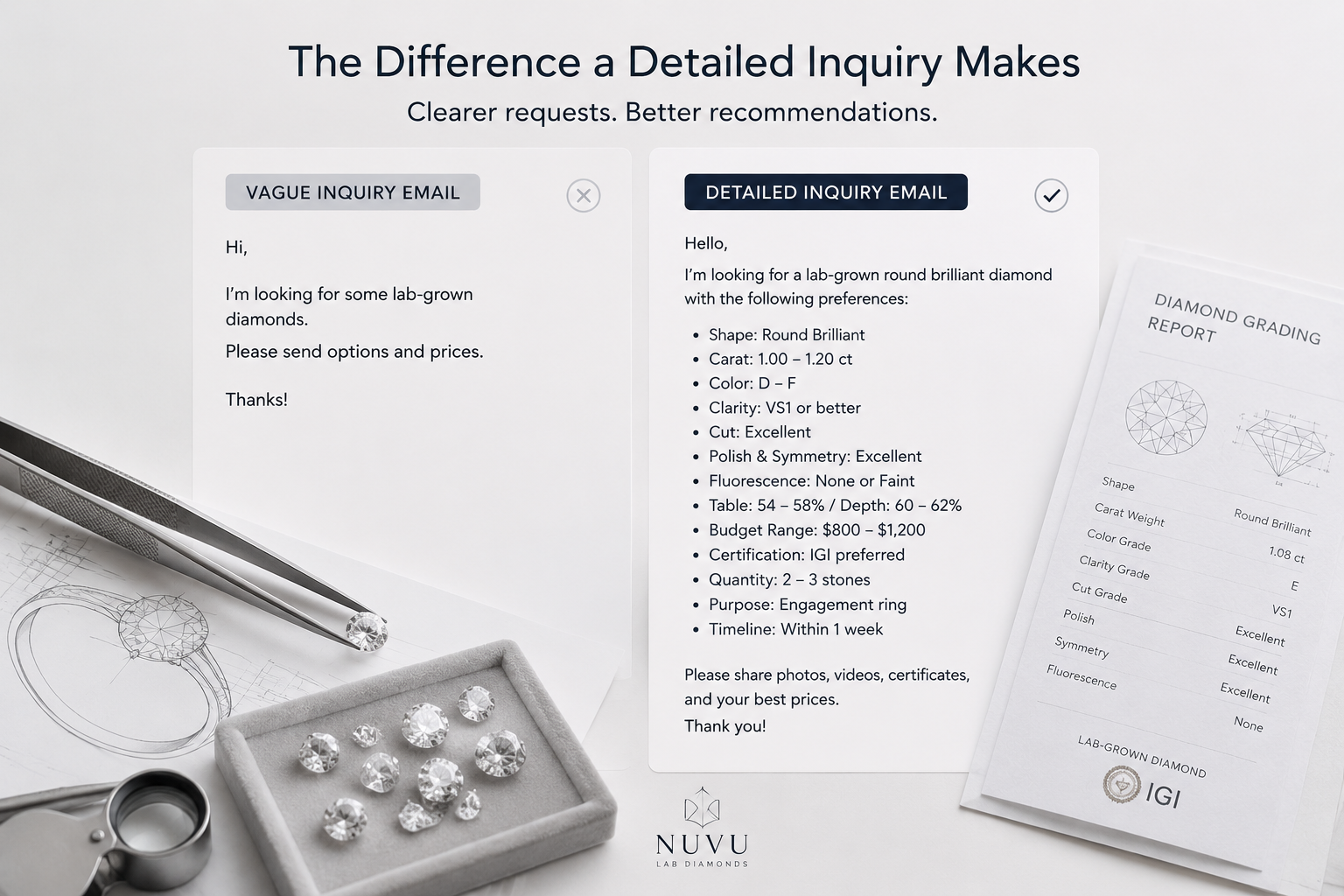
The Essential Components of a High-Response Inquiry
A well-written inquiry does more than ask for a price. It gives the supplier enough detail to pull specific stones from inventory, quote accurately, and respond quickly. Each missing field adds a round of back-and-forth emailing. The difference between a three-hour response and a three-day delay is usually how clearly the buyer communicated the first time.
Shape, Carat Range, and Color/Clarity Minimums
Shape selection is the foundation, but it needs more precision than just naming the shape. For ovals, specifying a preferred length-to-width ratio (e.g., 1.35–1.45) prevents the supplier from sending stones that look too round or too elongated. For cushions, clarifying corner sharpness avoids mismatches with setting designs. Carat range matters just as much. Writing “around 1 carat” invites a wide spread of sizes; writing “1.00–1.10ct” narrows the field to stones that actually fit your design or price target. Color and clarity minimums should be stated as a floor, not a suggestion. Saying “G+ color, VS+ clarity” signals that anything below those grades is not worth quoting.
Certificate Preference and Report Verification Standards
IGI is the most widely used grading lab for lab-grown diamonds, but GCAL and GIA also issue reports. Each lab has slightly different grading standards, and suppliers know which one their inventory favors. If you accept only IGI, say so. If you require report numbers for verification before shipment, state that clearly. Suppliers who can provide verifiable report numbers on request are more likely to be transparent about their inventory. Those who hesitate or offer only verbal grade descriptions should raise a flag. The grading report is the only objective document you have before seeing the stone in person. Do not leave this detail open to interpretation.
A grading report documents key characteristics — such as color, clarity, carat weight, and cut measurements — but it should not be treated as a guarantee of beauty, value, or sourcing ethics. A buyer’s inquiry that asks for a report number and a request to verify it on the lab’s official website is a practical step. It is not a sign of distrust; it is a sign that the buyer knows what documentation means and how to use it. Buyers should also be aware that a report describes a stone within a controlled grading environment, and that the same stone can appear slightly different under various lighting conditions or in a completed setting.
The terminology used by grading laboratories to describe lab-grown diamonds is itself a subject of official guidance. The Gemological Institute of America (GIA), for example, uses the term “Laboratory-Grown Diamond” in its reports to clearly distinguish these stones from natural diamonds.[1] When a supplier offers stones from a lab like GIA or IGI, the report itself serves as a standardized record of the stone’s characteristics. The Federal Trade Commission (FTC) has also addressed the importance of clear disclosure in jewelry advertising — a principle that reinforces the value of using formal grading reports to document a stone’s origin and qualities.[2] This regulatory context makes stating your certificate preference in an inquiry more than just a technical detail; it is a practical step toward ensuring the documentation you receive will be clear, standardized, and verifiable.
Quantity, Matching, and Application Context
If you are buying for stud earrings and need matched pairs, specify the allowed color and clarity tolerance across the two stones — for example, both within one grade of each other. For custom jewelry or repeat product lines, describe the final setting type. A pavé setting requires tighter measurement consistency than a solitaire because multiple stones sit side by side. A halo setting needs stones that match in height and diameter. The more the supplier understands the application, the better they can select stones that will actually work. Sending a vague quantity request without this context guarantees extra rounds of clarification.
For buyers assembling matched pairs, it is also important to understand that the growth method — either High Pressure High Temperature (HPHT) or Chemical Vapor Deposition (CVD) — can influence certain visual characteristics. GIA notes that lab-grown diamonds produced by different methods may exhibit distinct growth structures.[3] While the final grading report documents the polished stone’s quality, asking the supplier whether the stones in a matched pair originate from a consistent growth process can be an additional way to anticipate subtle differences in appearance, particularly for large or high-visibility pairs where cutters aim for an exact visual match.
What to Check Before You Decide
If you need matched pairs, confirm in the inquiry that the supplier can provide stones from the same production batch or with verified visual consistency beyond the report grades.
Documentation and Traceability: What the Inquiry Should Request
Beyond the grading report itself, buyers should consider what documentation trail will accompany the stones. A comprehensive inquiry can include a request for basic traceability information — such as the country of origin for the rough crystal, or the name of the growth facility if the supplier is willing to disclose it. While not all wholesalers maintain this level of granularity, those who do are often more invested in transparent supply chain management. For NUVU, the goal is to make the sourcing process clearer for buyers: asking for documentation that goes beyond the polished report, where available, can help differentiate between suppliers who track their inventory from a known production batch and those who source from mixed, anonymous channels.
In practice, a simple line in the inquiry can suffice: “Please confirm whether traceability records from the rough crystal stage to the polished report are available for the stones quoted.” This request does not assume every supplier can fulfill it, but it signals to the wholesaler that you care about the chain of custody. Even a partial answer — such as a known lab or factory name — provides more context than a stone with no background at all. For buyers managing brand risk or marketing claims, this documentation can be a meaningful, if optional, layer of verification.
Environmental and Ethical Claims: What Buyers Should Ask — and What They Should Verify
Some suppliers may include environmental or ethical language in their marketing — using terms such as “sustainable,” “eco-friendly,” or “conflict-free.” Buyers who rely on these claims as part of their own purchasing decisions should treat them with caution. These broad terms are not automatically backed by specific documentation, and their meaning can vary significantly between suppliers. A graded laboratory-grown diamond is a different product category from a natural diamond, but its environmental or ethical profile depends on the supplier’s actual production practices, energy sources, and transparency — not on a marketing phrase.
A useful approach is to include a simple question in your inquiry: “Please describe any documentation you can provide regarding the environmental or sourcing claims for these stones.” This does not force the supplier into a corner, but it invites a substantive answer. Suppliers who respond with vague generalities may be relying on unsupported claims. Suppliers who provide specific details — such as energy usage reports, certification from recognized environmental management systems, or a clear chain-of-custody statement — offer information that can be evaluated. For buyers who intend to make claims about their own products, having this documentation on file is often more meaningful than accepting a generic assurance at face value.
How to Structure a Loose Stone Inquiry (with Examples)
A structured inquiry saves both you and the supplier time. It also signals that you know what you are doing, which makes your request harder to ignore. The format differs slightly depending on whether you need single stones, calibrated sizes, or bulk lots, but the principle is the same: give the supplier every parameter they need to respond with a single, accurate quote.
Single-Stone vs Calibrated-Set Inquiry Logic
For calibre-sized stones, such as 4mm rounds or 6x4mm ovals, specify the exact millimeter dimensions and state whether you accept +/-0.1mm variation. Suppliers calibrate their inventory to specific measurements, so a precise dimension request gets a faster, more accurate response, while documenting tolerances helps you identify lab grown diamond supplier red flags before comparing quotes or reserving matched parcels. For single stones, prioritize cut quality and proportions over carat weight alone. A well-cut 0.90ct stone can outperform a poorly cut 1.00ct stone in brilliance and face-up appearance. Including target proportions — table percentage, depth percentage, and crown angle — helps the supplier eliminate stones that would look dull or misproportioned.
Example Inquiry Format for a Small Brand Buying Loose Stones
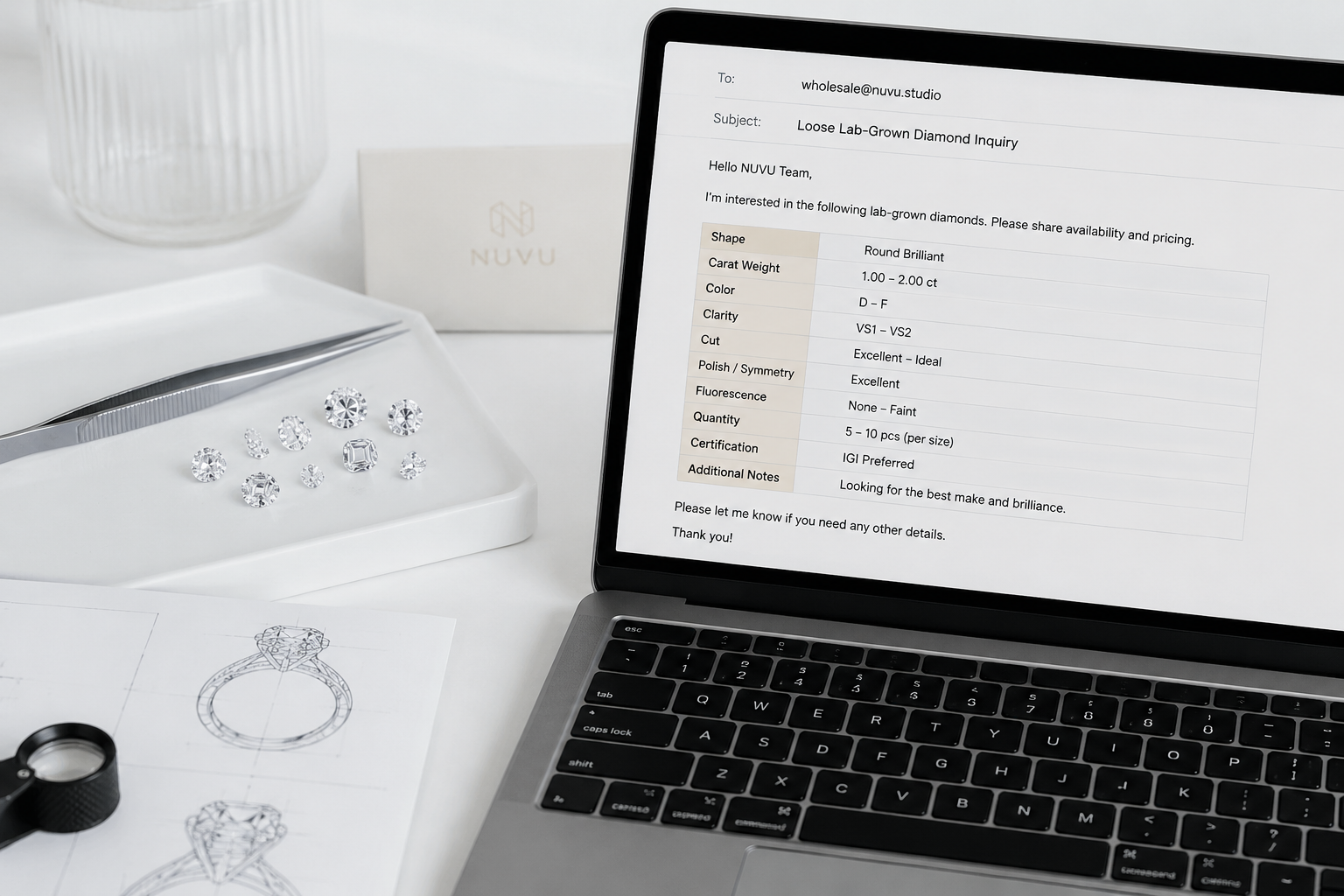
A clean inquiry should read as a straightforward list of requirements, followed by a request for media. Include the following line items: shape, size range (carat and millimeter), color range, clarity floor, certificate requirement, quantity, request for a quoted price per carat, and desired lead time. An example might look like:
“We are looking for 5 round brilliant lab-grown diamonds, 0.90–1.10ct each, G–H color, VS1–VS2 clarity, with IGI certification. Please quote a price per carat for the available stones. Needed within 10 business days. Please send photos or 360-degree video of available stones.”
This inquiry tells the supplier everything they need to pull specific stones and quote a real price. It also gives them a reason to respond quickly — the request is specific enough that they know whether they can fill it.
Certificate and Visual Review Check
Always request the full grading report number and a photo or video link for each stone under consideration. Do not rely on grade descriptions alone — visual performance varies within the same grade.
How to Structure a Matched Pair Inquiry (with Examples)
Matching two diamonds for earrings or a three-stone ring is one of the most difficult tasks a supplier handles. Unlike single-stone orders where you pick the best available diamond, a matched pair requires the supplier to hold inventory that satisfies multiple parameters simultaneously. A vague pair inquiry — “need two round stones, around 1 carat each, matched” — gives the supplier nothing to work with, and the response will likely be a generic price list that does not guarantee visual consistency.
Pair Matching Tolerance: What to Specify
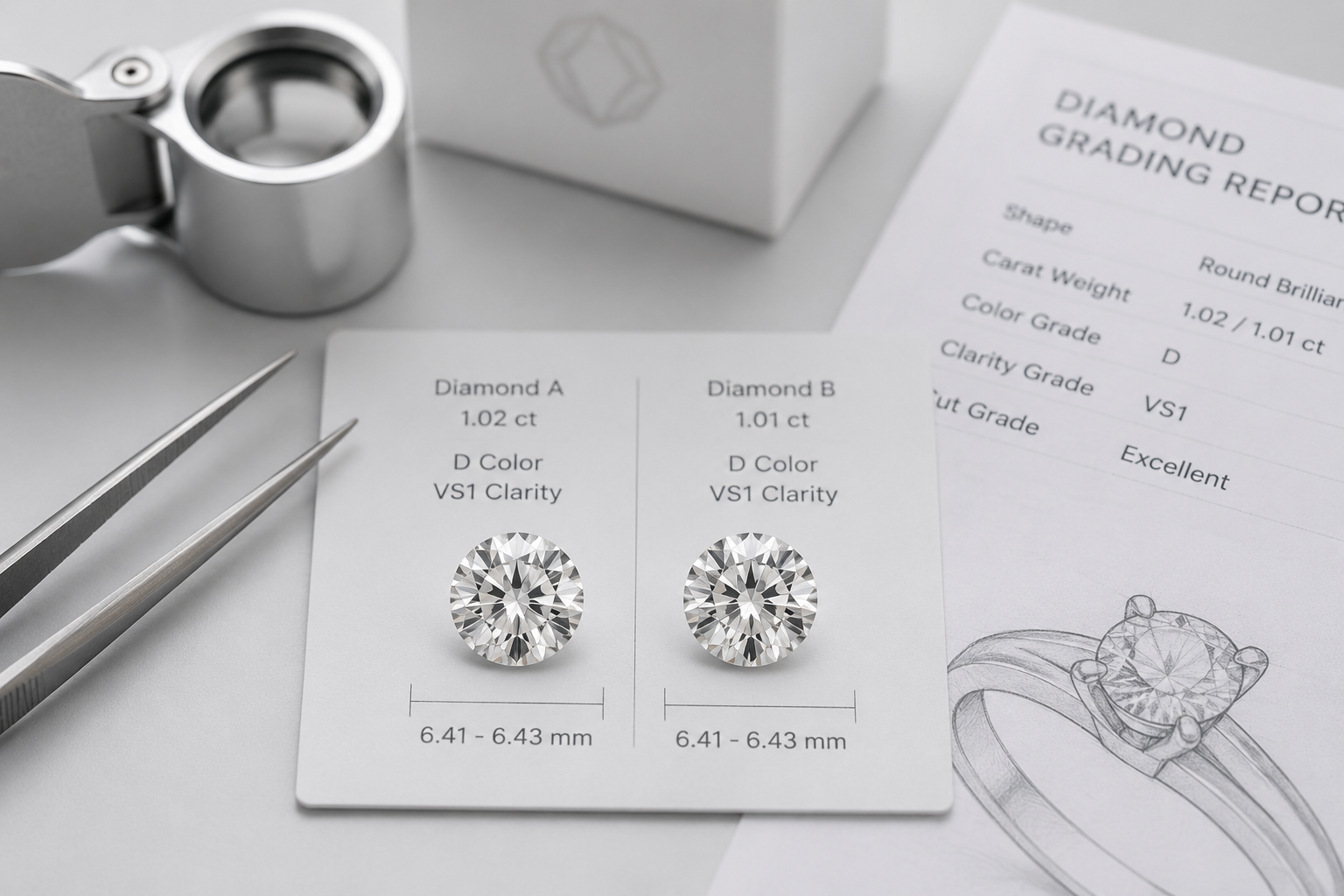
When you need a matched pair, your inquiry must define the maximum acceptable difference across four dimensions. Carat weight should be within 0.03ct between the two stones. Color should fall within one grade — D and E are usually acceptable together, but D and F may show a visible difference. Clarity should match within one grade as well. Measurements must be within 0.1mm in every dimension, because a pair of round brilliants that differ by 0.2mm in diameter will look mismatched when set side by side.
You also need to clarify whether both stones must come from the same grading report. Some suppliers can batch-certify a pair on one report, which guarantees matching dimensions and grades. Others will offer two stones from separate reports with overlapping grades. For stud earrings, a single report simplifies verification. For three-stone rings where the center stone is already selected, separate reports for the side stones are usually fine as long as the measurements align.
Example Inquiry Format for Trade Buyers Needing Matched Pairs
A matched pair inquiry should include a dedicated “pair matching tolerance” line in addition to the usual parameters. The following format gives the supplier enough detail to pull specific inventory:
– Shape: Round brilliant
– Carat weight per stone: 0.90–1.00ct, tolerance within 0.03ct between stones
– Color range: E–F, within one grade of each other
– Clarity floor: VS2, within one grade of each other
– Certificate requirement: IGI, single report preferred
– Pair matching tolerance: Carat within 0.03ct, color within one grade, clarity within one grade, measurements within 0.1mm in each dimension
– Intended jewelry use: Stud earrings
– Quantity: 5 pairs
– Target price per carat: Please suggest based on grade availability
– Desired lead time: 10 business days
– Request: Photos and video of each stone under natural and direct lighting
Ending with a “stone-to-setting fit check” line can prevent a costly mistake. For stud earrings, confirm total diameter tolerance — stone plus setting — against your mounting. A 0.2mm measurement difference between two stones becomes visible in side-by-side comparison, especially in a prong or bezel setting where the stones sit flush next to each other. If your mounting has a fixed diameter, state it explicitly so the supplier can filter stones that exceed the threshold.
When a grading report is provided, buyers should compare the report details with the issuing laboratory’s verification tools where available. This independent check helps confirm that the stone’s documented specifications match what the supplier has described.
Custom Jewelry and Repeat Product Line Inquiries
Buyers who order stones for a repeat product line face a different challenge than those buying a single piece. The question is not just whether the diamonds look good individually, but whether they remain consistent across multiple identical pieces over weeks or months. A single bad batch can disrupt production, delay orders, and force last-minute stone substitutions. The inquiry must communicate both current requirements and the expectation of batch consistency over time.
Single-SKU Consistency Requirements
For a repeat product line — say, ten identical rings shipped each month — specify the acceptable grade range and ask whether the supplier can maintain a consistent batch across multiple orders. Suppliers who control their own growth and cutting can often hold inventory from the same production run. Those who aggregate from different sources may shift between batches without notice, causing subtle differences in color, clarity, or fluorescence.
If your design uses shared prongs or a bezel setting, ask about post-polish cut consistency. Two stones may have identical grades on paper but differ in diameter by 0.1mm after setting, which can create visible gaps in a shared-prong mounting. The supplier should either confirm that their stones are cut to tight tolerances or provide measurement data before you commit to a volume order.
What to specify in your inquiry:
– Total number of pieces per order and expected monthly volume
– Acceptable grade range for the entire production run, not just the first batch
– Whether the supplier can hold dedicated inventory for your SKU
– Post-polish diameter tolerance for the specific mounting style
– Request for measurement data from previous similar orders
Custom Design Measurement Prerequisites
When ordering stones for a custom piece, the most common error is assuming the diamond will fit the setting without modification. Every custom mounting has fixed dimensions — head width, depth, seating angle — that determine which stones can be set. Provide these measurements in your inquiry and ask the supplier to confirm that candidate stones fit without modification.
For bezel settings, include the exact inner diameter of the bezel cup. For prong settings, specify the gap between prongs and the seating depth. If you need stones pre-tipped, grooved, or with any special culet preparation — such as a flattened culet for a flush setting — state this clearly. Not all suppliers offer these modifications, and those who do may need additional lead time.
For custom design, trust comes from matching the stone to the setting, budget, and wearer’s daily use — not from choosing grades in isolation. A grading report can help narrow the comparison, but it should be read alongside the stone’s proportions, visual evidence, and intended jewelry use. For custom pieces, stone measurements and setting compatibility should be confirmed before finalizing a purchase, as even a half-millimeter discrepancy can require re-cutting or a new mounting.
What This Means in a Real Purchase
A buyer ordering 15 identical bezel-set rings failed to specify post-polish diameter tolerance in their inquiry. The stones arrived matched on paper — all in the same grade range — but varied by 0.15mm in actual diameter, a measurement detail frequently noted in any lab grown diamond wholesale guide for calibrated jewelry production. Forty percent of the stones required re-cutting or replacement, delaying the order by three weeks and adding unexpected labor costs. A single line in the original inquiry requesting a maximum 0.05mm diameter variation would have prevented the entire error. For custom or repeat production, measurement data is not optional. It is the difference between a smooth production run and a costly rework cycle.
Before purchase, buyers should confirm the seller’s return and resizing policies as well as their process for handling grading report discrepancies. A straightforward policy is a stronger signal of reliability than a discounted price.
Budget Logic: How to Communicate Price Expectations Without Undercutting Yourself
Budget is the most mismanaged field in a wholesale inquiry. Some buyers hide it completely, expecting the supplier to quote their lowest price blindly, which usually results in inflated first-round numbers. Others state a target price too early, and the supplier simply prices up to that ceiling. The goal is to communicate enough to get accurate pricing without revealing a cap that reduces your negotiating room.
The Price-Per-Carat vs Total Order Value Distinction
Asking for “best price per carat” on a 10-stone lot without specifying total quantity and grade range invites the supplier to quote at the top of your acceptable range. After receiving a specification-based quote, provide a target price per carat and ask the supplier to show what grades are achievable at that level. For example: “We are targeting $X per carat for the following range — please confirm which grades you can supply at this price.” This shifts the conversation from open-ended pricing to a feasibility discussion, which suppliers are more willing to engage.
Total order value matters too. A $5,000 order and a $50,000 order receive different levels of supplier attention. If your order exceeds a certain threshold — typically $10,000 or more — mention the total value in your inquiry. Suppliers allocate their best inventory and fastest processing to higher-value requests. But do not inflate the number. A supplier who allocates inventory based on a stated volume that does not materialize will deprioritize your future inquiries.
When discussing price, it is important to remember that exact comparisons can shift with market conditions, report type, seller channel, and stone-specific details. A price that seems low on a per-carat basis may not include verification rights, shipping insurance, or the supplier’s documentation handling. Buyers should compare like-for-like specifications — including the grading lab and report type — before treating one quote as a better deal than another. The lowest price is not always the safest price, especially if the supplier cannot provide report numbers or photos for the stones in question.
In the initial inquiry, share a realistic price target only after the supplier has confirmed they can meet your grade and size requirements. The sequence matters. First, send a complete parameter inquiry without a budget number. When the supplier responds with available stones and pricing, you have a baseline. Only then introduce your target price to see if they can match it.
Suppliers who know your budget ceiling before showing their pricing will often quote just below that ceiling rather than at their actual bottom. The exception is when you are confident your target is below market rate — in that case, stating it early can save time by filtering out suppliers who cannot meet it. But for most wholesale buying, letting the supplier quote first gives you more information and more control.
Buyer Verification Checklist
Before negotiating final pricing, verify two policy points. First, what is the supplier’s return or exchange policy on grading report discrepancies? If a stone arrives with a different color or clarity grade than quoted, you need clear recourse. Second, does the supplier allow third-party lab verification before payment? Suppliers who resist independent verification may be hiding report inconsistencies. A straightforward verification policy is a stronger signal of reliability than a discounted price.
In sourcing or wholesale conversations, documentation, consistency, and communication often matter as much as the headline specification. A low price without verification rights is not a real saving.
Timeline and Lead Time Clarification (Why Speed Matters in Reply Quality)
Suppliers manage inventory and inspection schedules based on priority, and an inquiry with no timeline signals lower urgency. When you state when you need the stones, the supplier knows whether to pull from current stock, hold inventory for you, or plan a future production run. A vague “soon” rarely gets the same attention as “need by the 20th.”
Standard, Rush, and Project Lead Time Categories
For stones needed within five business days, say so explicitly. Suppliers can reprioritize internal inspection, photography, and report verification for a confirmed buyer who has a clear deadline. For future orders, provide a four-to-six-week window. This allows the supplier to hold suitable inventory rather than selling it to another buyer in the meantime. If you are planning a recurring purchase, mention the expected frequency. A supplier who knows you will order monthly is more likely to allocate consistent inventory than one receiving one-off requests.
Seasonal Volume Considerations for Wholesale Buyers
During Q3, as the pre-holiday buildup begins, supplier response times slow by two to three days globally across major production and distribution centers. Inquiries sent during this period need more than a price request. Embed a specific shipping question: “Can you ship by the first week of October?” This forces the supplier to check actual availability rather than quoting against a theoretical inventory list. Without a timing anchor, your inquiry may sit in a queue behind buyers who gave a concrete deadline.
What to Check Before You Decide
Confirm the supplier’s lead time for matching pairs versus single stones. Matching pairs require additional inspection and photography time because the supplier must verify visual consistency across both stones. A supplier who can ship singles in three days may need seven to ten days for a matched set.
How to Evaluate Supplier Responses (Beyond Just the Price)
A price alone tells you very little about whether the supplier can deliver what you actually need. The structure and completeness of the reply is often a better signal of reliability than the number at the bottom.
Response Completeness as a Trust Signal
A supplier who answers every parameter from your inquiry — shape, size range, color and clarity floor, certificate lab, quantity, lead time, and price per carat — is more likely to deliver accurately than one who quotes a price and adds “is this okay?” The detailed response shows they read your request, checked their inventory against your specifications, and are confident in what they can provide. A thin reply usually means the supplier is fishing for more information or quoting from a general list without verifying what they actually have in stock.
Red Flags in Wholesale Replies
Responses that avoid providing specific certificate numbers should be treated with caution. The same applies if the supplier refuses to confirm the grading lab, offers vague “best quality” claims without supporting details, or pressures you to make immediate payment before sending detailed inventory confirmation. A legitimate supplier can produce report numbers and photos for stones they actually hold. If the reply relies on general assurances rather than specific documentation, the risk of receiving mismatched or over-graded stones increases significantly.
Another red flag to watch for is the use of broad, unverifiable superlatives in a supplier’s response — such as describing their stones as “the best quality,” “always the highest grade,” or “guaranteed perfect.” These phrases do not describe specific, measurable attributes. A reliable supplier answers with concrete parameters: the exact color and clarity grades from a known lab, measurement data, and report numbers. Vague assurances should not override documented specifications. Buyers are better served by a response that is specific and verifiable than one that is enthusiastic but empty of data.
Certificate and Visual Review Check
Before committing to a purchase, request the grading report number and verify it on the issuer’s website — IGI, GCAL, or GIA. Cross-check the report details against the supplier’s photos. Inconsistencies in color or clarity description between the report and the images are serious warnings. A stone described as eye-clean on paper may show inclusions visible in video, and a color grade that looks warm in the photo should match the report’s stated range. Verify before you pay.
Follow-Up Sequences That Maintain Supplier Engagement
A single inquiry often needs a follow-up to convert into a transaction, but the timing and tone of that follow-up determine whether the supplier continues engaging or deprioritizes you.
The 48-Hour Soft Follow-Up
If the supplier provided a quote but no inventory photos or report numbers, send a brief note within two days: “Thanks for the pricing. Can you share available inventory photos or report numbers for the [shape/size] range you quoted?” This is not a negotiation. It is a request for the information you need to evaluate their offer. Most serious suppliers will respond within 24 hours with photos or an explanation of what they have available.
The 5-Day Hard Follow-Up with a Decision Window
If the supplier has not replied after five business days, resend the original inquiry with a note that your decision deadline is approaching. Keep it neutral: “I am finalizing my selection this week. Can you confirm availability for the specifications I sent?” If they still do not reply, consider it a signal that they either cannot meet your requirements or do not treat your inquiry as a priority. Move on to the next supplier rather than chasing a response that is not coming.
What to Check Before You Decide
Track supplier reply patterns. A supplier who responds quickly to a follow-up but ignored the initial inquiry may have different priorities than your timeline requires. The best suppliers respond within 24 hours to the first inquiry and maintain that pace through to delivery.
In practice, how a supplier handles the follow-up window can reveal more about their operations than the initial offer. A supplier who is communicative during follow-up but slow to provide inventory details may be working from a limited pool. For recurring wholesale needs, consistent communication across the entire process — from first reply to final shipment — matters more than a single fast response.
[1] Gemological Institute of America (GIA), “Laboratory-Grown Diamond Reports,” GIA.edu, accessed 2025. GIA Laboratory-Grown Diamond Dossier
[2] Federal Trade Commission (FTC), “Guides for the Jewelry, Precious Metals, and Pewter Industries,” 16 CFR Part 23, 2018. FTC Jewelry Guides
[3] Gemological Institute of America (GIA), “HPHT and CVD Diamond Growth Processes — How Lab-Grown Diamonds Are Made,” GIA.edu, accessed 2025. How Lab-Grown Diamonds Are Made
Disclosure: This article is for general educational purposes only and reflects common buyer practices in the lab-grown diamond wholesale trade. Diamond pricing, grading, availability, and supplier policies can change. Buyers should verify specific details — including grading report numbers, stone measurements, return policies, and sourcing documentation — directly with the supplier or through independent verification before making a purchase decision. Laboratory-grown diamonds should be clearly distinguished from natural diamonds in all correspondence. Any environmental, ethical, or sustainability claims should be supported by specific, verifiable documentation.