
A lower price on a lab-grown diamond can be a genuine opportunity, but only when the discount makes sense in context. The important question is not simply whether the diamond is cheap, but whether lab-grown diamond ring cost is explained by reasonable tradeoffs: a slightly lower color grade, an eye-clean clarity grade, a sub-milestone carat weight, or a shape that offers better face-up size for the money.
For the full framework, read Lab-Grown Diamond Price Guide.
This article helps you separate smart value from avoidable risk. You will learn how to compare similar stones, check measurements instead of relying on carat weight alone, read grading details carefully, and use photos or video to judge appearance. The goal is to decide when a lower-priced diamond is still suitable for the ring you want, and when missing evidence, weak visuals, poor proportions, or unclear return terms should make you pause.
Laboratory-grown diamonds should be clearly identified as laboratory-grown, and they should not be presented as mined diamonds. Lab-grown diamonds and natural diamonds are both diamonds, but they have different origins; diamond simulants are a separate category and should not be treated as lab-grown diamonds.
| What You See | Likely Meaning | What to Check Before Buying |
|---|---|---|
| Lower price with G-H color | Often a reasonable value tradeoff | Cut quality, setting metal, face-up brightness |
| VS2 or SI1 clarity | Can be fine if eye-clean | Photos, 360 video, inclusion location |
| Carat just under a milestone | May save money with little visual difference | Actual measurements and face-up spread |
| Very low price but limited images | Higher uncertainty | Request visuals, report details, return terms |
| Certificate listed but unclear match | Specs may not be fully verified | Confirm report number, shape, carat, grades |
| Deep or poorly proportioned stone | May look smaller or less lively | Depth, table, dimensions, video performance |
Quick Questions Before You Read
Q: Are cheap lab-grown diamonds automatically poor quality?
No. Some are lower priced because of sensible tradeoffs, but the stone still needs clear documentation and strong visual evidence.
Q: Is a grading report enough to trust the diamond?
It helps confirm basic specs, but it does not prove beauty, brightness, value, or sourcing ethics.
Q: Should I always choose the lowest price for the same carat weight?
No. Compare shape, color, clarity, measurements, proportions, visuals, and seller terms before judging value.
Q: When is paying slightly more worth it?
When the stone has better evidence, cleaner visuals, stronger proportions, and fewer unanswered questions.
Cheap Lab-Grown Diamonds Are Not All Cheap for the Same Reason
Cheap lab-grown diamonds can be a smart buy, but the price only means something if the diamond can be judged clearly. A lower price is not automatically a warning sign. It may reflect efficient sourcing, high supply, faster inventory turnover, a less expensive shape, or a practical tradeoff in color, clarity, or carat size. The problem begins when the low price is paired with weak evidence.
The useful question is not “Why is this diamond cheap?” The better question is “Can I compare this diamond fairly against similar stones?” If the answer is yes, the lower price may represent real lab-grown diamond value. If the answer is no, the price may be low because the buyer is being asked to accept uncertainty.
For buyers, the practical point is not just whether the price looks attractive, but whether the reason for that price can be explained and checked. A low price tied to visible, documented tradeoffs is different from a low price tied to missing images, incomplete grading details, or unclear seller terms.
Prices can change with market conditions, report type, seller channel, and stone-specific details, so exact comparisons should be verified at the time of purchase. A low price is more meaningful when it is compared against stones with similar shape, size range, grading context, measurements, and visual evidence.
When a Low Price Can Be Normal
Lower-priced lab diamonds often exist for ordinary market reasons. Lab-grown diamonds are produced at scale, and pricing can shift as supply changes, sellers adjust inventory, or certain sizes and shapes become more available. A seller with lower overhead or faster inventory movement may price aggressively without the diamond being fake, damaged, or undesirable.
Shape also matters. A round brilliant usually carries different pricing pressure than an oval, emerald, pear, radiant, or cushion cut. Size brackets matter too. A diamond just under a popular milestone, such as 1.90 carats instead of 2.00 carats, may look very similar on the hand while avoiding the price jump attached to the larger psychological number. That can be a rational tradeoff, not a compromise the wearer will notice.
Color and clarity can also lower the price without hurting appearance in every case. A near-colorless diamond may face up bright in the right setting, and a clarity grade below the higher paper range may still be eye-clean if the inclusions are small, well placed, or not visible without magnification. In these cases, an affordable lab-grown diamond can be cheaper because the buyer is paying for visible beauty rather than paper perfection.
When a Low Price Needs More Scrutiny
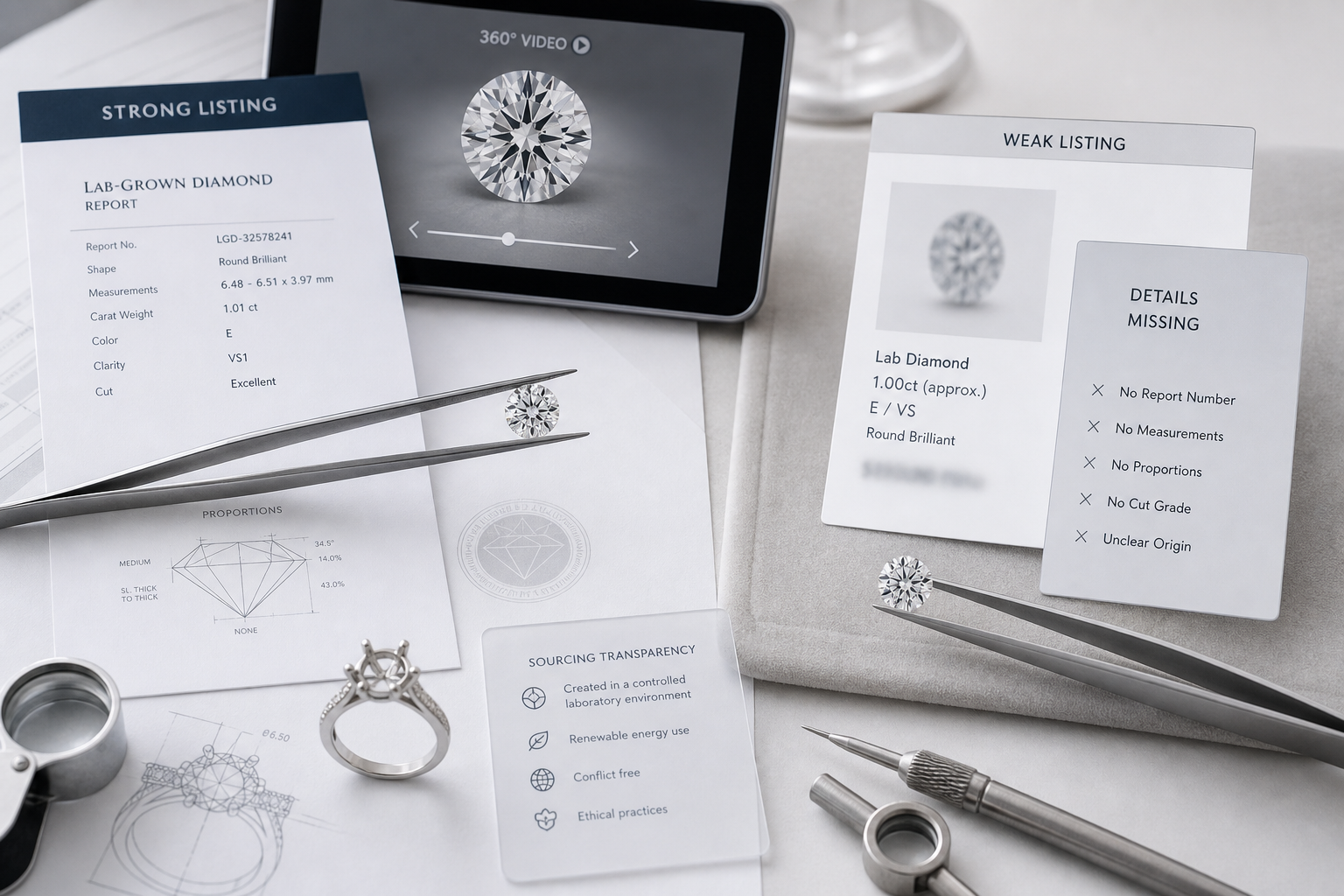
A low price deserves more attention when the listing does not give you enough to evaluate the diamond. Missing or weak images, no usable video, vague grading details, unclear measurements, or broad claims like “excellent quality” without specifics make diamond price comparison unreliable. The risk is not simply that the diamond costs less. The risk is that you cannot tell what you are actually buying.
This matters most when two diamonds appear similar on the surface. If both are listed as the same carat, color, and clarity, but one has a full grading report, clear measurements, and useful visual media while the other has only a short description, those listings are not equally comparable. The cheaper one may still be fine, but the buyer is taking on more uncertainty.
Price should fall for reasons you can understand. If the reason is a slightly lower color grade, a less popular carat point, or a shape with different market pricing, that is normal. If the reason is hidden behind missing information, the discount may not be a discount at all.
The Difference Between Low Price and Weak Comparability
Low price is a number. Weak comparability is a condition. A diamond can be inexpensive and still be easy to evaluate if the listing includes a grading report, clear specifications, measurements, and visual evidence. Another diamond can look attractive on price but be difficult to judge because the listing leaves out the details that would let you compare it to alternatives.
This distinction protects buyers from a common mistake: assuming the lowest price is automatically the strongest deal. In diamond buying, the cheapest listing often becomes tempting because the differences between stones seem small at first glance. But small differences in cut quality, face-up size, transparency, color appearance, or documentation can change the real value quickly.
A good price reduces cost without removing clarity. A risky price asks you to accept less information in exchange for paying less.
Quick First Test: Can You Actually Compare the Diamond?
Before treating any lower price as a serious deal, ask whether the diamond can be compared against similar stones in a practical way. You should be able to see the carat weight, shape, color, clarity, cut information where applicable, grading report details, measurements, and clear visual presentation. If those basics are present, the price can be evaluated. If several are missing, the diamond may be cheap because the listing is weak rather than because the value is strong.
The best first move is to compare like with like: same shape, similar carat range, close color and clarity grades, similar documentation, and enough imagery to judge appearance. Without that baseline, a cheap lab-grown diamond may only look like a deal because the competing information is incomplete.
What Makes a Cheap Lab-Grown Diamond a Good Deal
A cheap lab-grown diamond becomes a good deal when the lower price is supported by evidence. The diamond does not need to have the highest color grade, the highest clarity grade, or the largest possible carat weight. It does need to be clearly documented, visually reviewable, and priced in a way that makes sense compared with similar options.
This is the practical answer to how to tell if a cheap lab-grown diamond is a good deal: the savings should come from understandable tradeoffs, not from missing information. A lower price is easier to trust when the buyer can see what was traded, what was preserved, and whether the final appearance still meets the goal.
Clear Documentation Supports the Price
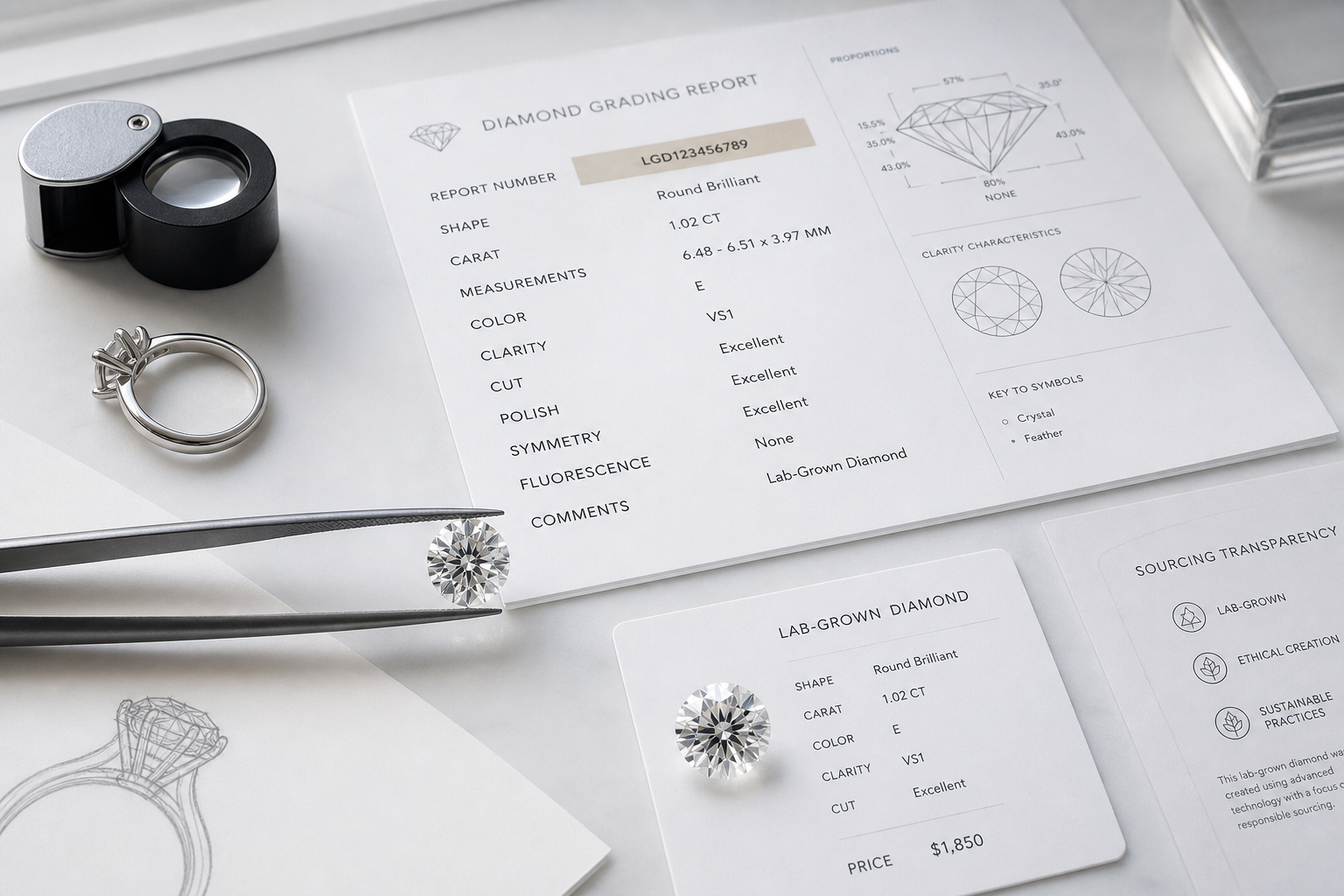
A good-value lab-grown diamond should usually come with a grading report from a recognized laboratory. The report gives you a baseline for carat weight, measurements, shape, color, clarity, and other identifying details. It does not tell you everything about beauty, but it helps prevent the listing from becoming a matter of trust alone.
The report should also match the listing. If a seller shows a diamond as a certain carat weight and color grade, the grading report should confirm those details. Measurements are especially useful because two diamonds with the same carat weight can face up differently. A stone that carries weight deep in the body may look smaller from above than another stone with better spread.
Documentation is not valuable because it makes a diamond automatically good. It is valuable because it gives the buyer a stable starting point for comparison.
A grading report helps document key characteristics, but it should not be treated as a guarantee of beauty, value, or sourcing ethics. It should be read alongside visual evidence, measurements, seller documentation, and the intended jewelry use.
It is also worth separating identity from desirability. A grading report can help identify the stone and document key characteristics, but it does not prove that the cut pattern is pleasing, that the diamond will look lively in the chosen setting, or that the price is automatically fair. Use documentation to narrow the shortlist, then use visual evidence and measurements to decide whether the stone deserves to stay on it.
When a grading report is available, buyers should verify the report details through the issuing laboratory’s official report-check tool where available and compare those details with the listing before relying on the price.
Smart Tradeoffs Can Lower Cost Without Hurting Appearance
The strongest affordable lab diamond choices often come from tradeoffs that affect the paper grade more than the everyday look. For many buyers, choosing near-colorless instead of colorless can free up budget without creating a visible problem, especially in certain settings and shapes. The same can be true for clarity if the diamond is eye-clean and the inclusions do not affect transparency or durability.
Carat weight is another area where buyers often overpay for a milestone. A diamond just below a full-carat or half-carat mark may appear nearly the same once set, yet cost less because it sits outside a highly searched size bracket. If the measurements are strong and the face-up appearance is satisfying, the slightly smaller number on the report may be the better value.
The tradeoff becomes poor when it affects what the buyer will actually notice. A lower clarity grade is not a smart saving if the inclusion is visible in the center of the stone. A cheaper fancy shape is not a good deal if it shows heavy darkness, windowing, or a distracting bow-tie effect. Price efficiency works only when the compromise stays within the buyer’s visual tolerance.
Comparable Listings Make the Deal Easier to Trust
A lower price becomes more meaningful when several comparable listings support it. If you are looking at a 1.50 carat oval with similar color, clarity, documentation, and measurements, the price should make sense within that group. One diamond may be lower because it is slightly warmer in color, another because it has a lower clarity grade, and another because the seller is pricing inventory aggressively.
The warning sign is a price that looks unusually low while the listing gives you fewer ways to compare. A comparable diamond should not require guesswork. You should be able to place it beside similar stones and understand why it costs less, whether that reason is specs, shape, size bracket, seller channel, or visual quality.
Diamond images and video matter here because grades alone can make two stones look equivalent when they are not. A diamond with the same report grades may appear brighter, cleaner, larger, or more balanced than another because of proportions and cutting. If visual performance is the reason one stone is less expensive, the buyer needs to see that before calling it a deal.
What to Check Before You Decide
Before deciding that a lower price is worth taking seriously, check whether the diamond has a grading report, clear specifications, accurate measurements, and useful images or 360-degree video. Then compare it with diamonds in the same shape and close size range rather than comparing it to the entire market.
A good cheap diamond should answer the basic questions before you have to ask them. What is it? How is it graded? How large does it measure? How does it look face-up? Why might it cost less than similar options? If the listing gives you enough information to answer those questions, the diamond deserves consideration. If the price is attractive but the evidence is thin, the buyer is not comparing value; they are comparing uncertainty.
When a Cheap Lab-Grown Diamond Becomes a Red Flag
A cheap lab-grown diamond becomes a red flag when the low price is paired with missing, vague, or inconsistent information. The issue is not that an affordable stone is automatically risky. The issue is that some listings use a low price to distract from the fact that the buyer cannot properly evaluate the diamond.
The most useful red flags when buying cheap lab-grown diamonds online are not dramatic. They are practical: poor diamond photos, unclear certificate details, vague seller claims, missing measurements, and uncertain buyer protection. Any one of these may be fixable. Several together should slow the decision down.
Poor Photos or No 360-Degree Video
Poor imagery is one of the clearest cheap lab diamond warning signs because appearance is where many value differences show up. A grading report can list carat, color, and clarity, but it will not fully show brightness, dark zones, haziness, visible inclusions, or how the diamond handles light when it moves.
A listing with only a stock-style image or one distant photo gives the buyer very little to work with. For fancy shapes, weak imaging is even more limiting because oval, pear, marquise, emerald, radiant, and cushion cuts can vary widely in face-up character. A low price is harder to trust if you cannot see whether the diamond has a distracting bow-tie, windowing, uneven brightness, or a shape outline you actually like.
No video does not always mean the diamond is bad, but it does increase uncertainty. If another similarly priced diamond offers clear visual evidence, that listing is usually easier to evaluate and often worth more serious comparison.
Unclear or Missing Certificate Information
An unclear certificate is a major low-price diamond risk. A seller may mention that a diamond is “certified” without showing the grading lab, report number, report date, measurements, or complete grade details. That is not enough information to support a confident purchase.
The listing should make it easy to connect the diamond to its grading report. If the report details are hidden, incomplete, or inconsistent with the listing, the buyer should not assume it is a harmless formatting issue. A mismatch in carat weight, measurements, shape, color, or clarity can change the value of the diamond and may indicate that the listing has not been prepared carefully.
A certificate does not guarantee that a diamond will look beautiful, but missing or confusing documentation removes one of the buyer’s most important comparison tools.
Traceability Starts With a Clear Paper Trail
For a low-priced lab-grown diamond, traceability is not about accepting a broad promise. It is about being able to follow the basic chain of information from the listing to the grading report and, where available, to the inscription or identifying details on the stone. The buyer should be able to see how the seller connects the online description to a specific diamond rather than a general inventory category.
A useful paper trail should make the identity of the stone specific: report number, shape, carat weight, measurements, color, clarity, and any listed inscription should line up. If the seller provides additional sourcing or production-related documentation, that information should be consistent with the report and the listing instead of introducing new unanswered questions. Traceability is strongest when each document supports the same conclusion.
This matters because low prices can move quickly across online inventory, and a certified lab grown diamond price comparison can become misleading when similar stones share the same shape, carat range, and grade combination, but they are not interchangeable. If the documentation does not clearly identify which diamond is being sold, the buyer may be comparing a specification rather than a traceable item.
Vague Quality Claims Without Specific Details
Broad phrases such as “premium quality,” “excellent value,” “best sparkle,” or “top grade” do not mean much unless they are backed by specific information. A strong listing should tell you what the diamond is, not just how the seller wants you to feel about it.
Vague seller claims become more concerning when the price is unusually low. If a diamond is described in glowing terms but lacks measurable details, the buyer has no way to separate marketing language from actual quality. For a lower-priced lab diamond, the listing should make the tradeoff visible. Is the price lower because of color, clarity, cut quality, size bracket, inventory positioning, or something else?
If the description sounds impressive but avoids specifics, the safe assumption is not that the diamond is a hidden bargain. The safer assumption is that more evidence is needed before the price can be trusted.
Limited Buyer Protection or Unclear Return Terms
Return and inspection terms matter more when a diamond is difficult to judge online. A low price can become expensive if the buyer has no reasonable way to evaluate the stone after delivery or resolve a mismatch between the listing and the actual diamond. Policy details should be clear before purchase, not discovered after a problem appears.
Buyers should confirm important terms in writing, especially for low-priced listings that have limited images or incomplete documentation. This includes whether the diamond can be returned, how the inspection period works, what condition requirements apply, and whether any fees or exclusions affect the decision. The goal is not to assume bad intent. The goal is to avoid relying on verbal or vague assurances when the purchase depends on details.
A cheap diamond with clear documentation, useful visual evidence, and understandable terms may be a real opportunity. A cheap diamond with missing proof and unclear protections is a different decision entirely.
How to Compare Cheap Lab-Grown Diamonds Fairly
A cheap lab-grown diamond comparison only works when the diamonds are close enough to judge against each other. If one stone is an oval and the other is a round brilliant, or one is 1.40 carats and the other is 1.70 carats, the lower price may not mean better value. It may simply mean you are comparing different products.
The goal is not to find the lowest number on the page. The goal is to compare lab-grown diamonds in a way that shows whether the price difference is justified by visible quality, documentation, proportions, or seller transparency.
Compare the Same Shape and Similar Carat Range
Start with shape. Shape affects pricing, face-up size, cutting style, and visual issues, so comparing a 2.00 ct oval to a 2.00 ct round is not a clean comparison. A round brilliant may be priced differently because of demand and cutting standards, while an elongated shape may look larger face-up but carry different risks, such as a stronger bow-tie effect or uneven light return.
Carat range matters too. If you are trying to understand how to compare two cheap lab-grown diamonds, keep the carat weight as close as practical. A difference of about 0.05 to 0.10 carat is usually a more useful comparison range than jumping across size brackets. Once you cross popular milestone weights, such as 1.00 ct, 1.50 ct, or 2.00 ct, prices can move for reasons that are not always visible in the diamond itself.
A 1.92 ct diamond can sometimes offer better value than a 2.00 ct diamond if the face-up measurements are similar and the visual performance is strong. The mistake is assuming the round number is automatically better. Buyers often pay for the milestone, not just the appearance.
Keep Color and Clarity Close Enough to Be Meaningful
Color and clarity should stay close enough that the comparison remains fair. Comparing an F VS1 stone to an I SI1 stone may show a large price gap, but that gap does not prove the I SI1 is a bargain or the F VS1 is overpriced. The diamonds are serving different buyer priorities.
For a more useful diamond price comparison, try to compare within one color grade and one clarity grade when possible. For example, compare G to H, or VS1 to VS2, rather than D to J or VVS1 to SI1. This keeps the focus on whether one listing is priced efficiently instead of letting grade differences explain the entire discount.
The practical judgment is simple: if the cheaper stone drops several grades at once, the price reduction needs to be evaluated as a tradeoff, not a deal. That tradeoff may still be smart if the diamond looks bright, clean, and well documented, but the specs alone no longer make it an apples-to-apples comparison.
Review Measurements, Not Just Carat Weight
Carat weight tells you how much the diamond weighs. Diamond measurements tell you how large it may look from the top. Two diamonds with the same carat weight can face up differently because weight can be distributed in depth, width, or length.
This matters more than many buyers expect. A lower-priced 2.00 ct diamond may look smaller than another 2.00 ct diamond if it carries too much depth. In that case, the buyer is paying for weight they do not fully see. On the other hand, a shallower stone can look large but may lose brightness or show windowing, especially in certain fancy shapes.
For round diamonds, buyers commonly review table percentage, depth percentage, crown angle, pavilion angle, girdle, and overall measurements. These numbers should be used as screening tools, not as a guarantee of beauty. A diamond can sit within familiar proportion ranges and still look less lively than another stone because videos, symmetry, transparency, and actual light performance still matter.
For fancy shapes, measurements need to be read with the outline in mind. Length-to-width ratio affects whether an oval looks softly rounded or elongated, whether a pear looks balanced, and whether a radiant feels square or rectangular. A low price may be less appealing if the proportions create a shape the wearer does not like, even when the carat weight and grades look attractive.
A Practical Comparison Range
When narrowing lower-priced lab diamonds, use a controlled comparison before deciding that one is the better buy:
- Shape: Compare the same shape first, such as oval to oval or round to round.
- Carat weight: Stay within about 0.05 to 0.10 carat when possible.
- Color: Compare within one color grade for a cleaner value judgment.
- Clarity: Compare within one clarity grade, then confirm whether the stone appears eye-clean.
- Certificate comparison: Use the same or similar grading lab context when possible, and check whether the report details match the listing.
- Measurements: Compare length, width, depth, and face-up spread, not only carat weight.
- Visual evidence: Review photos or video under similar viewing conditions when available.
If one diamond wins only because the comparison is loose, it may not be the better value. A fair comparison should make the price difference explainable. If it does not, the cheaper listing deserves a closer look before it becomes the default choice.
The Certificate Matters, But It Does Not Tell the Whole Story
A lab-grown diamond certificate is one of the first things to check when evaluating a lower-priced stone. It gives the buyer a shared reference point instead of relying only on a seller’s description. For cheap lab-grown diamonds, that matters because a low price without reliable documentation is hard to interpret.
Still, a diamond grading report is not the same as a complete buying decision. It can confirm important facts, but it cannot fully show how the diamond looks in motion, how bright it appears in normal lighting, or whether its shape and proportions suit the intended setting.
What a Grading Report Can Confirm
A grading report from a recognized lab such as IGI, GIA, or GCAL can help confirm basic diamond specs, including shape, carat weight, color, clarity, measurements, and sometimes additional details such as growth method, inscription, polish, symmetry, and fluorescence. These details make the listing easier to compare and reduce the risk of relying on vague claims.
For a lower-priced diamond, the report helps answer a basic question: is the discount attached to a clearly identified stone, or is the buyer being asked to trust a description without enough proof? A cheap diamond with a verifiable report is usually easier to evaluate than a slightly cheaper one with incomplete lab diamond documentation.
The report is especially useful when two stones look similar online. If both are 1.50 ct ovals with near-colorless grades, the measurements, clarity characteristics, and grading details can help explain why one costs less. Without that information, the price comparison becomes guesswork.
When growth method or post-growth treatment is relevant, buyers should look for clear disclosure in the grading report or seller documentation. HPHT and CVD may refer to laboratory-grown diamond growth methods; treatment status should not be assumed unless it is specifically documented.
What a Certificate Cannot Fully Show
Certificate limits become clear once you move beyond the basic specs. A report does not always tell you whether an oval has a distracting bow-tie effect, whether a radiant has uneven brightness, whether a stone appears hazy, or whether an inclusion is noticeable in normal wear. It also does not decide whether the diamond’s personality suits the buyer’s taste.
This is where many low-price mistakes happen. A buyer sees acceptable grades on paper and assumes the diamond is automatically a strong value. The grading report may be accurate, but the stone can still be visually disappointing if the cut pattern, transparency, or face-up appearance is weak.
A certificate should narrow the field. It should not replace photos, video, measurements, return-term review, or direct comparison against similar stones.
Why Report Verification Is Worth Doing
Report verification is a simple step that can prevent an expensive mismatch. When available, use the grading lab’s database to verify the report number. Then compare the report against the listing: shape, carat weight, color, clarity, measurements, and inscription details should align.
If a listing says one thing and the report shows another, pause before moving forward. Sometimes the issue is a listing error, but sometimes it signals weak inventory control or careless presentation. With lower-priced diamonds, that distinction matters because the discount is only useful if the buyer knows exactly what is being purchased.
Do cheap lab-grown diamonds need a certificate? For most buyers comparing center stones online, yes. The certificate does not make the diamond beautiful by itself, but without it, a low price is much harder to trust.
How to Read the Report Without Over-Relying on It
A grading report is most useful when it is treated as a structured reference rather than a final verdict. Start with the identity details, then move to the measurements, color, clarity, cut information where applicable, and comments. Comments can matter because they may point to features that are not obvious from the headline grades, such as additional clouds, surface characteristics, or other notes that deserve visual review.
Buyers should also pay attention to the relationship between the report and the intended jewelry use. A diamond with acceptable grades may still be the wrong choice if its measurements do not fit the setting, if the length-to-width ratio does not create the desired outline, or if a clarity feature sits in a visually sensitive area. The report helps narrow the comparison, but the final decision should include the stone’s appearance and the finished design plan.
Certificate and Visual Review Check
- Verify the report number through the grading lab’s lookup tool when available.
- Match the listing to the report by checking carat weight, shape, measurements, color, clarity, and inscription details.
- Look for complete documentation rather than relying on terms like “premium,” “excellent quality,” or “best value” without specifics.
- Use the report as a filter, then judge the diamond through images, video, and real measurements.
- Question mismatches before purchase, especially if the price is unusually low compared with similar stones.
The strongest low-price listings are not the ones with the most dramatic discount language. They are the ones where the certificate, listing details, and visual evidence all point to the same diamond.
Photos, Video, and Measurements Reveal What the Price Does Not
Diamond photos, a 360-degree diamond video, and accurate measurements often reveal the difference between an affordable diamond and a risky one. This is especially true when the price is low. A certificate may show acceptable grades, but the visual evidence shows how the diamond actually presents itself.
For anyone learning how to review a cheap lab-grown diamond before buying, the key is to look for what the specs do not fully capture: brightness, contrast, haziness, dark zones, inclusion visibility, and whether the diamond looks balanced face-up.
Why Clear Imaging Matters More at Lower Prices
Clear imaging matters because a low price can hide in the parts of the diamond that are hardest to judge from a grading report. A stone may have a respectable color and clarity grade, yet still look dull, glassy, overly dark in the center, or uneven across the face.
A 360-degree diamond video is useful because it shows movement. Still photos can make a diamond look cleaner or brighter than it appears in real life, especially if the lighting is controlled. Video can help reveal whether the diamond returns light evenly or whether certain zones stay dark as the stone turns.
The most useful comparison is not one beautiful video in isolation. It is two or three similar diamonds viewed under similar conditions. If one low-priced diamond looks noticeably weaker next to stones with similar specs, the discount may be explaining a real visual compromise.
Common Visual Issues That May Not Be Obvious from Specs
Some visual issues are easy to miss if the buyer focuses only on carat, color, and clarity. In elongated shapes such as oval, pear, marquise, and some radiant cuts, bow-tie effect can be a major factor. A slight bow-tie can be normal, but a strong, dark band across the center can dominate the appearance of the stone.
Fancy shapes can also show windowing, where parts of the diamond look see-through instead of bright. This can make a larger stone feel less lively than a smaller, better-cut option. In lower-priced listings, windowing is one of the tradeoffs that may not appear clearly in the certificate.
Clarity also needs visual confirmation. A diamond may have a clarity grade that seems acceptable, but the location, color, and type of inclusion determine whether it is visible. Eye-clean clarity is about what the buyer can see in normal viewing, not just the grade printed on the report.
Haziness is another issue worth watching for. If a diamond looks cloudy or lacks crisp contrast in video, a high clarity grade alone may not solve the problem. The warning sign is not a single soft photo; it is a repeated lack of sharpness across the available images and video.
How Measurements Affect Face-Up Size
Diamond measurements help explain whether the stone carries its weight well. Two diamonds with the same carat weight can look different in size because one may be deeper while the other spreads more across the top.
For round diamonds, compare the diameter along with the depth percentage. For elongated shapes, compare length-to-width ratio as well as total length and width. A 1.50 ct oval with attractive spread may look larger than another 1.50 ct oval that holds more weight in depth. The larger-looking stone is not automatically better, though. If the spread comes with weak brightness or windowing, the apparent size comes at a cost.
This is where buyers should avoid treating measurements as a shortcut. A bigger face-up look is valuable only if the diamond still has strong visual performance. If the low price comes from a stone that looks large but flat, the value is less convincing.
Buyer Verification Checklist
- Review face-up appearance: Check whether the diamond looks balanced, bright, and lively from the top.
- Watch the video carefully: Look for dark zones, uneven light return, haziness, or a strong bow-tie effect.
- Check inclusion visibility: Confirm whether inclusions are noticeable in normal viewing, not only under magnification.
- Compare similar stones: Judge the diamond against the same shape, similar carat range, and close diamond specs.
- Read the measurements: Look at length, width, depth, diameter, and length-to-width ratio where relevant.
- Do not rely on one image: A single flattering photo is not enough evidence for a low-price diamond.
A low price becomes easier to trust when the visuals support the specs. If the photos are weak, the video is missing, or the measurements suggest hidden tradeoffs, the better decision is to keep comparing rather than letting the price decide for you.
Price Efficiency Often Comes From Tradeoffs, Not Flaws
A low price does not automatically mean a cheap lab-grown diamond is a bad stone. In many cases, the price is lower because the listing is making a real tradeoff: slightly lower color, a less expensive shape, a size that misses a price jump, or a seller channel with lower overhead. The important question is not whether the diamond is inexpensive, but whether the discount comes from a rational cut in cost or from weak comparability that hides what the buyer is actually getting.
For lab-grown diamond value, stronger deals usually come from stones that give up something the eye will not strongly punish. A buyer may not need the highest color grade, the cleanest clarity grade on paper, or the exact carat milestone if the diamond still looks bright, clean, and balanced in real life. That is where affordable diamond tradeoffs can make sense. The mistake is assuming every lower number is a warning sign. Often, it is just a different allocation of budget.
In practical buying, stronger value choices usually preserve the factors that matter most to the wearer while relaxing the factors that matter mainly on paper. That balance is personal: one buyer may prefer a slightly smaller diamond with stronger visual performance, while another may accept a warmer color grade to reach the desired size. Neither choice is universally correct unless it matches the intended look, setting, and comfort level with the evidence.
Color Grades That May Still Look Bright in Real Life
Color is one of the easiest places to save money within a broader lab grown diamond price guide without making the diamond look weak. Dropping from D-F into G-H often brings a price advantage while still looking bright in many settings, especially when the diamond has strong cut quality and is shown in a white metal setting. In some cases, I color can be reasonable, particularly for buyers who care more about overall face-up beauty than paper perfection.
The judgment here is simple: if the stone will be set in platinum or white gold and the cut is strong, a slightly warmer color grade may be a smart value choice rather than a flaw. If the buyer is extremely sensitive to body color or wants the iciest appearance possible, that same grade may feel less satisfying. Color matters, but it should not override the whole value equation unless the buyer is specifically chasing top-end whiteness.
Clarity Grades That Can Work If the Diamond Is Eye-Clean
Clarity is another place where buyers often overpay for details they may never see. A VS2 or SI1 can be a rational choice if the stone is visually clean, the inclusion pattern is well documented, and the seller provides enough imaging to show what the naked eye will actually notice. The paper grade is only useful when it matches the visual result.
This is why a lower clarity grade is not automatically a risk. A well-presented, eye-clean stone can be a better buy than a higher-clarity diamond with poor documentation or a bad overall appearance. The reverse is also true: a low price paired with vague clarity claims is not a bargain just because the grade sounds acceptable. The real question is whether the buyer can see enough to judge the stone honestly.
Carat Milestones That Can Quietly Raise the Price
Exact carat milestones often carry more emotional weight than practical value. A diamond just under 1.00 carat, 1.50 carat, or 2.00 carat can be meaningfully less expensive than one that crosses the threshold, even when the visual difference is small. That price jump is not always tied to a visible improvement. Sometimes it is just how the market prices round numbers.
For buyers focused on budget allocation, this can create a useful opening. A diamond in a slightly lower carat bracket may look nearly the same face-up while freeing budget for better cut quality, stronger documentation, or a more attractive setting. The common mistake is fixing on the milestone and ignoring the rest of the stone’s presentation. If the goal is visible beauty, a slightly smaller diamond can be the smarter purchase.
Shape Choices That Change the Value Equation
Shape has a bigger impact on price efficiency than many buyers expect. Some shapes, such as oval, pear, and marquise, often face up larger for their carat weight than a round diamond. That can make them appear more substantial without requiring the same budget. Radiant shapes can also offer strong visual spread, though the look is different and the cut style matters more than the label alone.
Round diamonds remain the most familiar benchmark, but they are not always the most efficient way to stretch budget. If a buyer wants maximum face-up size or a more distinctive look, choosing a shape with stronger spread can improve the value equation. The key is to understand that diamond shape pricing is not just about preference; it changes how much visible size and presence the same budget can buy.
A Realistic Buyer Scenario: Two Cheap Lab-Grown Diamonds, Two Different Risks
The Lower Price That Looks Attractive at First
A buyer finds two 1.50 ct oval lab-grown diamonds online. The first is priced lower and looks appealing at a glance. The listing says “excellent value,” but the photos are small, the video does not clearly rotate the stone, and the grading information is incomplete. The seller gives a few broad claims about quality, but there is not enough detail to judge the diamond fairly.
At first, this looks like a bargain. In practice, it is hard to know whether the low price reflects true efficiency or just weak screening. Without clear evidence, the buyer is being asked to trust the price instead of compare the stone.
The Slightly Higher Price With Better Evidence
The second diamond costs a little more, but the listing includes a verifiable report number, clear 360-degree video, full measurements, and a face-up view that looks balanced and bright. The shape appears clean, the proportions are easy to review, and the seller gives enough information to compare it against similar stones. The price is not the lowest, but the buyer can actually evaluate what is being offered.
In many cases, that is the better value. A slightly higher price is easier to justify when the diamond can be checked properly. If the buyer is choosing between a vague discount and a stone that is more expensive but substantially clearer to assess, the second option often reduces risk far more than it raises cost.
What the Buyer Should Compare Before Choosing
The right value check is not “Which diamond is cheapest?” It is “Which diamond can I compare with confidence?” If one listing has better evidence, tighter measurements, and a more believable visual presentation, it may be the safer buy even at a higher price. If the cheaper stone eventually proves equally well documented, then the lower price can win. The price only matters after the comparison is fair.
What This Means in a Real Purchase
A low-price diamond is worth serious attention when the buyer can see enough to judge it honestly. If the cheaper listing cannot be compared clearly, the discount may be hiding the real cost of uncertainty. If the more expensive listing is only marginally higher and gives the buyer much better evidence, that extra amount may be money well spent.
How to Verify a Cheap Lab-Grown Diamond Before Buying
Match the Listing to the Report
Start with the report number and confirm that it matches the grading report exactly. Check the shape, carat weight, measurements, color, and clarity against the listing. If any of those details are missing, inconsistent, or vague, treat that as a warning sign rather than a small clerical issue. A cheap lab diamond checklist begins with identity, not price.
Verification should be specific. The report should describe the same diamond that appears in the listing, not a similar one. If the seller cannot make that connection clearly, the buyer is not comparing a real stone so much as a marketing claim.
Review Visual Evidence Before Trusting the Specs
Specs alone do not show how the diamond looks. Review photos and video before deciding that a low price is a good deal. Look for face-up brightness, visible inclusions, dark zones, and any distortion in the shape. If the video is too blurry, too short, or shot in a way that hides the stone, the listing is not ready for a serious purchase.
This step matters most when the price is unusually low. Strong documentation can explain a discount. Weak visuals make it harder to know whether the diamond is genuinely efficient or simply underrepresented.
Confirm Fit If the Diamond Is for a Setting
If the stone is meant for a ring, check whether the measurements actually fit the design you want. A diamond can look attractive on paper and still sit awkwardly in a setting if the dimensions are not right. Face-up size, shape outline, and depth all affect how the stone will work once mounted.
This is where budget decisions and design decisions meet. A low-priced diamond that does not fit the setting is not a good value, even if the report looks fine. The buyer should be thinking about the finished piece, not the loose stone in isolation.
For custom jewelry, stone measurements and setting compatibility should be confirmed before finalizing a purchase.
For custom design, the diamond should not be evaluated separately from the setting. Prong placement, halo proportions, side-stone balance, band width, and stone depth can all affect how the finished ring wears and looks. A cheap stone that forces awkward design compromises may cost less as a loose diamond but deliver less value in the finished jewelry.
For custom design, trust comes from matching the stone to the setting, budget, and wearer’s daily use, not from choosing grades in isolation. Measurements, stone depth, girdle condition, and outline should be reviewed before the diamond is treated as final, especially for elongated shapes, low-profile settings, halos, three-stone rings, or designs with tight tolerances.
Get Important Terms in Writing
Before paying, confirm any return or inspection terms in writing. Ask for clarity on anything that is vague, especially if the listing uses broad language instead of specifics. If the seller will not put important terms in writing, the buyer should assume the uncertainty is part of the risk.
That final check is often the simplest one. A cheap lab-grown diamond is only a rational buy when the listing is transparent enough to stand on its own. If the answer to a basic question is unclear, the price is not the main issue.
What a Transparent Listing Should Tell You
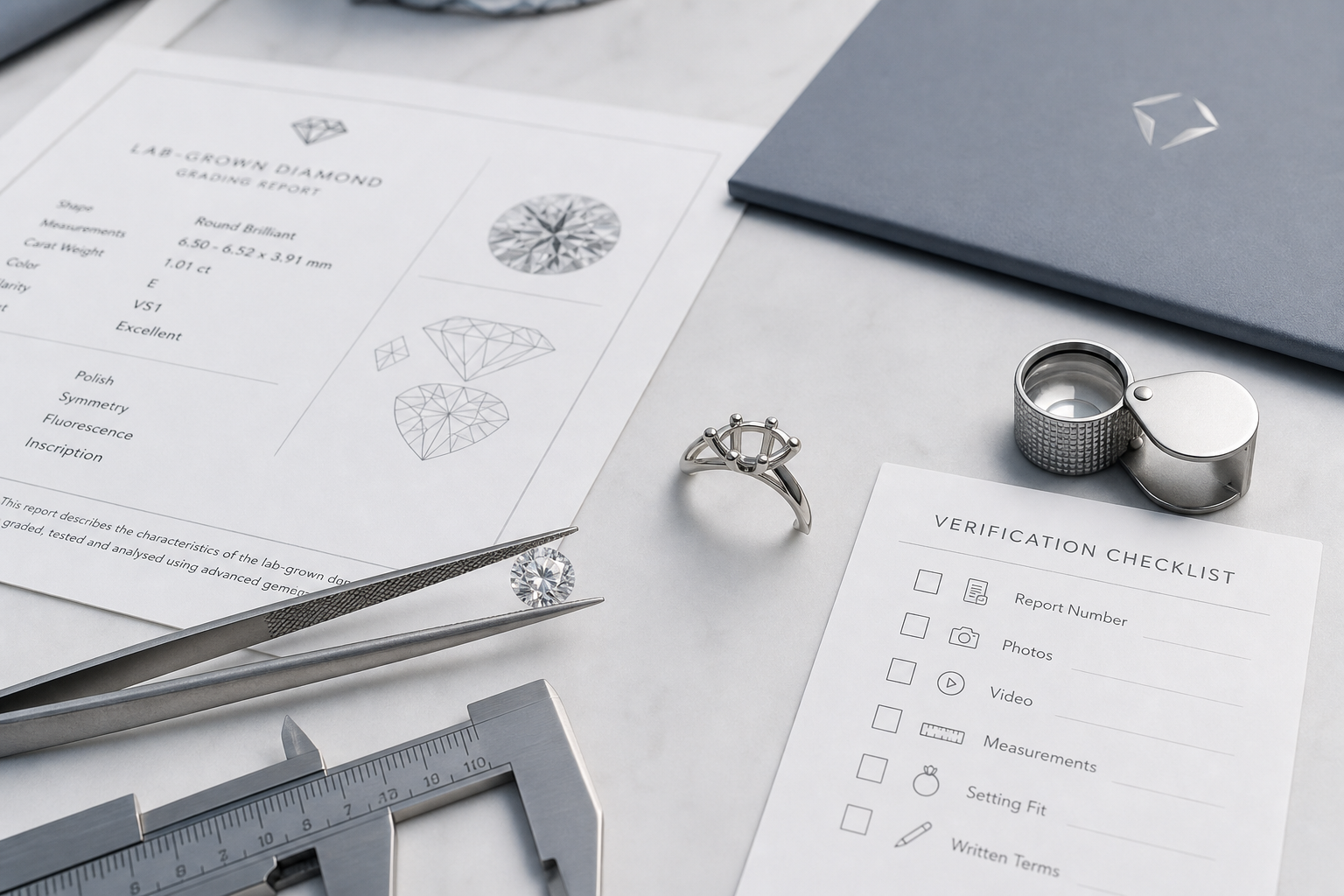
A lower price becomes easier to trust when the listing is structured in a way that lets you judge the stone quickly. A transparent listing does not need fancy language. It needs complete, readable information that helps the buyer understand what is being offered and what is not.
For lab-grown diamonds, that means the seller should make it easy to connect the price, the stone, and the evidence. If one of those pieces is missing, the comparison gets weaker. If all of them are present, even a cheaper diamond can be evaluated with much more confidence.
Useful Details Are More Valuable Than Marketing Language
Words like “beautiful,” “premium,” “luxury,” or “best value” do not help much unless they are attached to specific facts. Buyers do better when the listing spells out the shape, carat weight, color, clarity, measurements, and grading report details in a way that can be checked.
That level of detail does not guarantee the diamond is the right one. It simply makes the price easier to interpret. A clear listing gives you a basis for comparison. A vague one asks you to accept the seller’s judgment without enough evidence to make your own.
Ask the Same Questions Every Time
A simple question set can help keep the buying process disciplined, especially when the price looks unusually low:
- What exact diamond is this listing describing?
- Does the report match the stone shown online?
- Are the photos and video clear enough to judge appearance?
- What tradeoff explains the lower price?
- Would I still choose this stone if it were priced a little higher?
If the answer to those questions is easy to see, the listing is doing its job. If the answers are hard to find, the price may be doing too much of the persuasion.
Be Careful With Sustainability or Origin Claims
Some buyers are drawn to lab-grown diamonds because of ideas about sustainability, origin, or reduced environmental impact. Those topics can matter, but they should be treated carefully. A seller’s claim about being “more sustainable” or “better for the planet” is not the same thing as proof.
The practical rule is simple: use the documentation in front of you, and do not let broad environmental language replace diamond evidence. If a seller makes sustainability or sourcing claims, those claims should be specific and supported. If they are not, they should not be the reason you judge a cheap diamond to be a good deal.
Environmental and sustainability claims should be specific, documented, and limited to what can be substantiated. Lab-grown diamonds offer a different sourcing path from mined diamonds, but that difference alone does not prove every environmental, energy, or sourcing claim.
Sustainability claims should be specific and documented. Broad green language is less useful than clear information about production context, energy claims where substantiated, sourcing communication, and the seller’s willingness to explain what a claim does and does not cover.
Documentation Should Be Consistent Across the Conversation
A transparent buying process should not change depending on where the buyer asks the question. The listing, report details, email response, invoice description, and any design notes should all refer to the same stone in the same way. If a diamond is described as one carat weight in the listing and slightly differently in a later message, or if the measurements are not repeated consistently, the buyer should ask for clarification before proceeding.
This consistency is especially important for lower-priced stones because the buyer may be comparing many similar options at once. A clear documentation trail reduces confusion and helps prevent the wrong diamond, wrong size, or wrong expectation from entering the decision. In sourcing or wholesale-style conversations, documentation, consistency, and communication often matter as much as the headline specification.
A Simple Bottom-Line Rule
If the diamond is cheaper because the seller has shown you a clear tradeoff, that can be real value. If the diamond is cheaper because the seller has shown you less of the diamond, that is not value in the same sense. Strong low-price purchases are transparent enough that the buyer can see exactly what makes the price lower.
Where NUVU Fits Into a More Careful Comparison Process
Good Value Starts With Better Comparability
A careful diamond comparison starts with the simple question of whether two stones can actually be judged against each other. If one listing has a grading report, measurements, clear video, and a visible stone while another relies on broad claims and weak images, the lower number does not mean much by itself. Good value depends on comparability first.
That is the part buyers often miss. A cheap lab-grown diamond is only useful as a deal if you can understand why it is priced that way and whether the tradeoff is acceptable. NUVU’s role in that kind of buying process is not to push the cheapest option, but to support a more transparent lab-grown diamond buying mindset: compare the evidence, then decide whether the price makes sense.
Why the Cheapest Listing Is Not Always the Clearest Choice
The lowest price can be attractive because it feels efficient, but it can also hide the hardest-to-evaluate listing on the page. If the diamond is harder to inspect, harder to verify, or harder to compare, then the buyer is not really getting a clearer deal. They are taking on more uncertainty for less money.
That matters even more when the stone is being chosen for a ring. In loose lab-grown diamond selection and custom ring planning, the right choice is the one that fits the design, the budget, and the buyer’s comfort with the evidence. A slightly higher price can be the better value if it comes with stronger documentation, more usable visuals, and fewer unanswered questions.
Using a Structured Review to Make a More Confident Decision
The most reliable way to judge a low-priced listing is to review it in order: first the report, then the images and video, then the measurements, and finally the setting goal. Those pieces work together. A diamond that looks fine on paper may still be a poor fit if the face-up size, shape behavior, or visual quality does not support the intended use.
At NUVU, that kind of structured review is the point. The goal is not to make buying more complicated. It is to make it more legible. When buyers slow down enough to compare documentation, visual performance, specs, and setting expectations together, cheap stops being the main question. The better question becomes whether the diamond is actually the right one for the job.
For NUVU, the buyer-first comparison is practical rather than promotional: what the report shows, what the visuals reveal, how the measurements support the intended design, and which questions still need to be answered before a low price should influence the decision.
Buyer Assurance Should Support the Comparison, Not Replace It
Trust signals are most useful when they help buyers verify the same details discussed throughout this guide: grading information, report consistency, stone identity, visual review, and fit for the intended setting. They should not be used as a shortcut around careful comparison. A reassuring seller process still needs to leave the buyer with enough information to make an independent judgment.
For low-priced lab-grown diamonds, the strongest assurance is usually practical and document-based. That means the diamond can be matched to its grading report, the listing details can be checked against the report, and the buyer can request clarification when a specification, image, or measurement is not clear. This kind of transparency is especially important when the price is attractive, because it prevents the discount from becoming the only reason to buy.
When a grading report is provided, buyers should compare the report details with the issuing laboratory’s verification tools where available. Verification supports comparison, but it should still be paired with photos, video, measurements, and setting-fit review.
When a buyer is comparing several stones, this verification-first approach keeps the conversation grounded. Instead of relying on broad claims about quality, the decision can return to specific questions: Does the report match the listing? Do the measurements support the face-up size? Does the video show the stone clearly? Does the diamond fit the setting plan? Those answers are more useful than any single label or price tag.
NUVU’s role in buyer education is to make comparison clearer, especially around grading reports, visual evidence, design fit, and documentation. A careful process does not make every lower-priced diamond the right choice, but it helps buyers separate traceable value from listings that still need more explanation.
The best use of NUVU support is therefore not to make the cheapest diamond sound safer than it is. It is to help buyers identify which lower-priced diamonds are genuinely comparable, which tradeoffs are reasonable, and which listings still need more evidence before purchase. A good deal should still make sense after the documentation, visuals, proportions, and setting requirements have all been reviewed.
Disclosure: This article is for general educational purposes only. Diamond grading, pricing, availability, specifications, and seller policies can change, and readers should verify important details through grading reports, official laboratory tools, seller documentation, or qualified professionals before making a purchase decision. Laboratory-grown diamonds should be clearly distinguished from natural diamonds, and environmental or sourcing claims should be supported by specific documentation.