
Choosing between a lab-grown and a natural diamond is not really a question of which one is “real.” Both are diamonds, and both can look beautiful or disappointing depending on the individual stone. The harder decision is what kind of value matters most to you: geological rarity, tradition, budget efficiency, the lab-grown diamond price logic behind larger size options, stronger cut quality, or more freedom in the final jewelry design.
For the full framework, read Lab-Grown Diamond Certification Guide.
This comparison helps separate visible differences from market differences. Origin affects price, scarcity, resale expectations, and emotional meaning, but it does not automatically determine sparkle, quality, or suitability. By looking at reports, proportions, visual performance, disclosure, and setting context, you can judge each diamond more clearly instead of relying on assumptions about lab-grown or mined stones.
For a more defensible comparison, treat every claim about a diamond as belonging to one of three categories: what can be documented, what can be seen, and what is personal preference. Origin, carat weight, measurements, color grade, and clarity grade should be supported by a grading report or seller documentation. Brightness, shape appeal, transparency, and setting fit need images, video, or in-person review. Symbolism, tradition, and emotional value are real, but they should be recognized as personal priorities rather than technical proof that one diamond is universally better.
Laboratory-grown diamonds should be clearly identified as laboratory-grown, and they should not be presented as mined diamonds. Diamond simulants, such as cubic zirconia or moissanite, are a separate category and should not be confused with laboratory-grown diamonds.
| Buying Question | Lab-Grown Diamond | Natural Diamond |
|---|---|---|
| Is it a real diamond? | Yes, crystallized carbon with diamond structure | Yes, formed naturally over geological time |
| What mainly affects appearance? | Cut, proportions, color, clarity, and light performance | Cut, proportions, color, clarity, and light performance |
| Why is pricing different? | Scalable production and wider availability | Natural scarcity, tradition, mining, and demand |
| Good fit for | Size, design flexibility, and budget efficiency | Rarity, origin story, and traditional preference |
| Main mistake to avoid | Choosing size over cut and visual performance | Assuming higher price means better beauty |
| What to verify | Clear disclosure, grading report, images, video | Grading report, proportions, appearance, resale expectations |
Quick Questions Before You Read
Q: Can most people see the difference between lab-grown and natural diamonds?
No. Origin usually requires specialized testing or documentation; visible beauty depends on the specific stone.
Q: Does a grading report guarantee a diamond will look good?
No. A report is useful, but images, video, proportions, and light performance still need review.
Q: Are natural diamonds always better for resale?
They often have a more established resale market, but retail price should not be treated as investment value.
Q: Is a larger lab-grown diamond automatically the better choice?
Not if cut quality, proportions, or setting fit are weak. Size should support the overall design.
The Real Difference Is Not Whether Lab-Grown Diamonds Are “Real”
In the lab-grown vs natural diamonds conversation, the first point is also the easiest to overcomplicate: a lab-grown diamond can be a real diamond in material terms. It is not cubic zirconia, moissanite, glass, or a lookalike. It is crystallized carbon with the same basic diamond structure as a natural diamond.
The more useful comparison begins after that is clear. Lab-grown and natural diamonds can both be evaluated as diamonds, but they enter the market through very different paths. Those paths affect how people think about rarity, price, long-term expectations, and meaning. The origin does not make one “real” and the other “fake,” but it does change the value story attached to the stone.
What stays the same at the material level
Both lab-grown and natural diamonds are made of carbon atoms arranged in a diamond crystal structure. That structure is what gives diamond its hardness, durability, and ability to return light when cut well. From a jewelry-wearing standpoint, this matters because the stone can perform like a diamond, wear like a diamond, and be graded as a diamond when it meets grading standards.
The same core quality factors can apply to both: cut, color, clarity, and carat weight. A lab-created diamond can be poorly cut or beautifully cut. A mined diamond can have visible inclusions or be eye-clean. Origin does not automatically decide beauty. If a buyer treats “lab-grown” or “natural” as a shortcut for quality, they can easily overlook the individual stone’s actual strengths and weaknesses.
For lab-grown diamonds, buyers may also see references to growth methods such as HPHT or CVD. Those terms describe how the crystal was grown, but they do not by themselves prove that a diamond is attractive, durable in a ring, or fairly priced. In practical buying, the method is useful context only when it is paired with clear disclosure, a grading report, and a visual review of the individual stone.
It is also important not to treat technical vocabulary as proof of quality. A listing that mentions a growth method, a treatment disclosure, or a report number may be more transparent than a vague listing, but those details still need to be read carefully. The buyer should ask what the document actually confirms, what it leaves open, and whether the diamond’s real appearance supports the way it is being presented.
When growth method or post-growth treatment is relevant, buyers should look for clear disclosure in the grading report or seller documentation. HPHT and CVD may describe laboratory-grown diamond growth methods; treatment status should not be assumed unless it is clearly disclosed for the individual stone.
What origin changes before the diamond reaches the buyer
The origin changes how the diamond comes into existence and how it enters the supply chain. Natural diamonds form underground over long geological periods and are recovered through mining. Lab-grown diamonds are created in controlled growth environments using technology designed to reproduce the conditions under which diamond crystal can form.
That distinction matters less for how the diamond looks on the hand than for how the market frames it. A natural diamond carries a connection to geological scarcity and traditional mining supply. A lab-grown diamond carries a connection to controlled production, modern technology, and more flexible availability. Neither of those facts tells you whether a specific diamond is beautiful, but they do affect how buyers and sellers assign value around it.
Why “real versus fake” is the wrong comparison
The “real versus fake” framing creates the wrong decision. It pushes buyers into defending one side instead of asking what they are actually buying: visible performance, rarity, size, symbolism, documentation, budget efficiency, or long-term expectations.
A better question is not “Is a lab-grown diamond real?” but “Which kind of value do I want this purchase to carry?” If the priority is the largest well-cut diamond possible within a set budget, origin may matter differently than it does for someone who values geological rarity or a traditional diamond story. The mistake is assuming both buyers should reach the same answer.
What to Check Before You Decide
Before comparing origin, confirm that both stones being considered are actually comparable. Look at the diamond type, grading report, cut information, color, clarity, carat weight, measurements, and whether the stone appears clean and lively in real images or video. A high-quality lab-grown diamond is not automatically a better choice than a weak natural diamond simply because it costs less, and a natural diamond is not automatically superior because it formed underground.
Once the material question is settled, the decision becomes more practical: how the diamond looks, what the origin means to you, and whether the purchase fits your expectations beyond the first day you wear it.
A useful traceability habit is to keep the comparison tied to the same evidence from the beginning: the report number, the listed measurements, the origin description, the stone media, and any written design notes. This does not make a purchase risk-free, but it helps prevent the decision from drifting from documented facts into memory, assumptions, or verbal descriptions that are hard to check later.
Physical Appearance: Can You Actually See the Difference?
Most people cannot tell the difference between a lab-grown diamond and a natural diamond by looking at it without specialized testing. In everyday conditions, the visible impression usually comes from cut quality, proportions, shape, color, clarity, and lighting, not from origin alone.
This is where many buyers worry about the wrong thing. Friends, family members, and casual observers are far more likely to notice whether a diamond looks bright, balanced, and clean than whether it was grown above ground or formed underground. A dull diamond will look dull regardless of origin. A well-cut diamond with strong light return can look impressive whether it is lab-created or mined.
Why cut quality matters more than origin for sparkle
Sparkle is driven primarily by how well the diamond handles light. Cut quality, angles, symmetry, polish, depth, table size, and overall proportions influence whether light returns to the eye or leaks through the stone. This is especially important for round brilliant diamonds, but it also matters in fancy shapes such as oval, emerald, cushion, radiant, and pear.
A common buying mistake is using origin as the first visual filter. If two diamonds have the same carat weight but one has stronger proportions and better light performance, that stone will usually look more appealing in real life. The better decision is to compare actual appearance and cut-related details before assuming that lab-grown or natural tells you enough.
Color and clarity differences are stone-specific, not origin-specific
Color and clarity are not automatically better in one category. Lab-grown diamonds can be high color or lower color. Natural diamonds can be eye-clean or visibly included. The same is true in reverse. What matters is whether the individual diamond’s grade and appearance make sense for the design and budget.
For many engagement rings, an eye-clean diamond is more important than chasing the highest clarity grade on paper. If an inclusion is not visible without magnification and does not affect durability or transparency, paying heavily for a much higher clarity grade may not improve the ring in a way anyone will notice. Color works the same way: a near-colorless diamond may look bright and white in the right setting, while a higher color grade may matter more in platinum, white gold, or elongated shapes where tint can be easier to see.
Why most visual comparisons come down to the individual diamond
Photos and videos can be helpful, but they are not all equal. A diamond filmed in flattering lighting may look better than it does in a normal room. A stone shown in poor lighting may look weaker than it really is. The most useful comparisons use similar lighting, similar angles, and enough detail to judge brightness, contrast, transparency, and shape outline.
Measurements also matter. Two 2-carat diamonds can face up differently if their proportions differ. One may carry extra weight in depth and look smaller from the top. Another may have a better spread but weaker light return. For a center stone, millimeter dimensions often tell you more about the visual presence than carat weight alone.
Certificate and Visual Review Check
A grading report can confirm key details such as origin, carat weight, color, clarity, and measurements, but it does not fully show how attractive the diamond will be in real viewing conditions. Use the report to narrow your options, then use images, video, proportions, and setting context to judge whether the diamond actually performs well.
For buyers, the practical point is not just what the report says, but how the stone behaves in the intended design. A diamond with suitable grades may still show a bow-tie effect, dark areas, poor transparency, or an outline that does not suit the setting. This is especially important for fancy shapes, where face-up appearance can vary widely even among diamonds with similar grades.
When a grading report is available, buyers should verify the report details through the issuing laboratory’s official report-check tool where available, then compare those details with the diamond’s images, video, and measurements.
The strongest comparison is not lab-grown versus natural in the abstract. It is one specific diamond against another specific diamond, viewed with the same expectations and the same design goal.
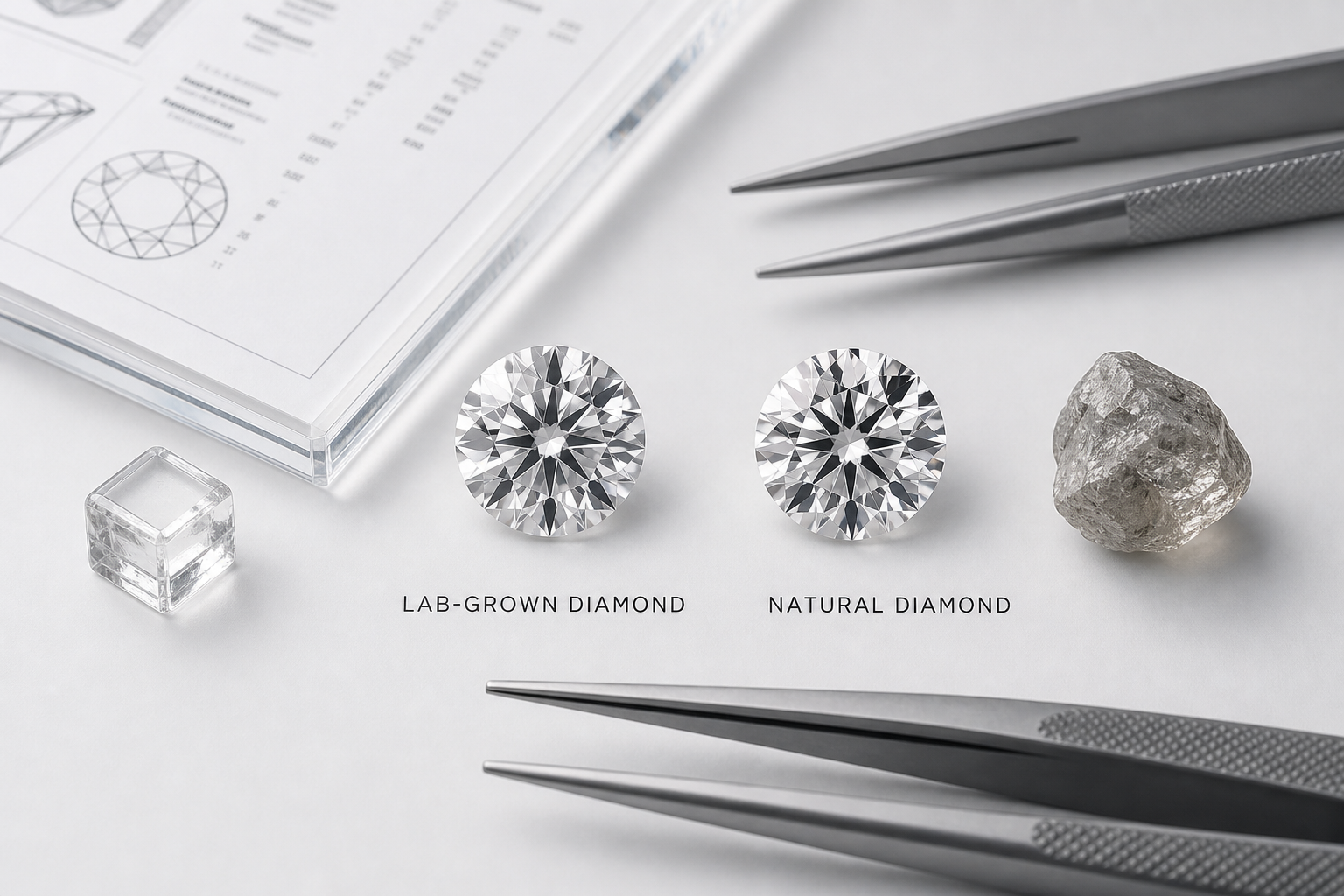
Rarity: Natural Scarcity Versus Controlled Production
Rarity is one of the clearest differences between natural and lab-grown diamonds, even when the stones look similar. Natural diamonds are tied to geological formation and mining supply. Lab-grown diamonds are tied to production capacity, technology, and manufacturing economics.
This distinction does not make one option emotionally superior in every case, but it does explain why the market treats them differently. Rarity is not just about beauty. It is about how difficult something is to create, recover, replace, and supply at scale.
Why natural diamonds carry geological scarcity
Natural diamonds formed deep within the earth under conditions that cannot be quickly repeated by human demand. Even after formation, they must be found, mined, sorted, cut, graded, and distributed. Larger natural diamonds with desirable color and clarity combinations are especially constrained because supply depends on what the earth produced and what mining operations recover.
This geological scarcity is part of the reason natural diamonds have long carried traditional luxury value. The practical takeaway is not that every natural diamond is rare in the same way. Small, commercial-grade natural diamonds are more available than exceptional stones. But natural origin places a hard limit on supply that controlled production does not follow in the same way.
Why lab-grown diamonds follow production economics
Lab-grown diamonds are not unlimited in a simple sense. They still require specialized equipment, skill, time, cutting, grading, and quality control. Size, color, clarity, growth outcome, and cutting yield all affect availability. A well-cut, high-quality lab-grown diamond is not the same as a generic manufactured item pulled from a shelf without variation.
The key difference is scalability. As technology improves and production expands, supply can respond more directly to market demand. That changes the value logic. Lab-grown diamonds are often easier to source in desirable sizes and specifications than comparable natural diamonds, which can be a major advantage for buyers focused on design impact. It also means scarcity is usually not the main reason to choose lab-grown.
How rarity affects perception even when appearance is similar
Two diamonds can look equally bright in a ring but still feel different to the buyer because rarity shapes perception. A natural diamond may appeal to someone who values origin, age, tradition, and the idea that the stone came from a limited geological supply. A lab-grown diamond may appeal to someone who values a cleaner buying logic: put more of the budget toward visible size, cut, or design rather than paying for natural scarcity.
The risk is choosing based on someone else’s value system. A buyer who strongly cares about geological rarity may later feel uneasy with a lab-grown center stone, even if it looks beautiful. A buyer who mainly wants a larger, well-cut diamond may feel frustrated paying more for a smaller natural stone if the origin story does not matter much to them. Rarity only matters if it connects to the kind of value the buyer actually wants to own.
What This Means in a Real Purchase
If natural scarcity matters to you, compare natural diamonds within a realistic budget and accept that size or grade may need to be more restrained. If visible presence and specification flexibility matter more, lab-grown diamonds can make it easier to reach a larger or more visually refined result without treating rarity as the central value.
Origin and environmental impact are related topics, but they are not the same question. Rarity explains supply and perception. Environmental claims require separate, specific evidence. For this comparison, the main point is simpler: natural diamonds are valued partly because supply is geologically constrained, while lab-grown diamonds are valued differently because production can be scaled and refined over time.
It is also worth separating sustainability language from origin language. A lab-grown diamond is not automatically the more sustainable choice in every case, and a natural diamond is not automatically irresponsible in every case. Energy source, production practices, mining standards, transportation, documentation, and seller transparency all matter. If environmental impact is part of the decision, ask what can actually be documented instead of relying on a broad category claim.
When a seller uses terms such as sustainable, ethical, eco-friendly, conflict-free, or carbon-neutral, the most important question is what specific evidence supports that wording. A general statement about lab-grown origin does not answer questions about energy source, facility practices, emissions accounting, or third-party verification. Likewise, a general statement about natural origin does not explain mining standards, traceability, or community impact. Treat environmental and ethical language as a separate claim that needs its own documentation.
Price: Why Lab-Grown and Natural Diamonds Separate So Sharply
Why similar-looking diamonds can have very different prices
The sharp price difference between lab-grown and natural diamonds is not mainly about what the eye can see. It is about how each diamond enters the market. Natural diamond prices reflect geological scarcity, mining costs, sorting, distribution, brand positioning, and long-standing consumer demand. Lab-grown diamond prices are shaped more by production capacity, technology, competition, and manufacturing efficiency.
This is why two diamonds with similar size, color, clarity, and cut can sit in very different price ranges. The natural diamond is priced within a market built around limited supply and historical desirability. The lab-grown diamond is priced within a market where supply can expand as production improves. For a buyer, the practical mistake is assuming the higher-priced stone must look better. Often, it does not. The premium may be tied more to origin and rarity than visible performance.
Price should be read as a signal, but not a verdict. A high natural diamond price may reflect genuine scarcity, but it can also reflect brand markup, retail setting, or less-than-ideal cut quality hiding behind impressive carat weight. A low lab-grown diamond price may create strong buying power, but HPHT vs CVD diamonds considerations still require careful review. A poorly cut lab-grown diamond is not a good deal just because it is less expensive than a natural one.
A fair price comparison should hold the important variables steady before drawing conclusions. Compare similar shape, measurements, cut information, color, clarity, report type, and visual performance, then consider origin. If one diamond has a better cut, cleaner appearance, stronger spread, or a more suitable setting match, the comparison is no longer only about lab-grown versus natural; it is about two different total purchase outcomes.
Prices can change with market conditions, report type, seller channel, availability, and stone-specific details, so exact comparisons should be verified at the time of purchase. A lower listed price should not replace a review of the report, visuals, measurements, and seller documentation.
What a lower lab-grown price may let you prioritize
The most practical advantage of lab-grown diamond pricing is flexibility. Within the same engagement ring budget, a buyer may be able to move up in carat size, choose a better cut, select a higher color or clarity grade, or reserve more of the budget for the setting. This matters because the most noticeable diamond is not always the largest one; it is often the one with the best balance of spread, brightness, proportions, and design fit.
For many buyers, lab-grown diamonds make the most sense when visible result is the priority. If the goal is a larger center stone, a cleaner look, or a more refined custom ring without stretching the budget, lab-grown pricing can create room to make those choices. The better judgment is not simply “buy the biggest stone you can afford.” It is to use the price advantage to avoid compromises that will be visible every day, especially weak cut quality, awkward proportions, or a setting that feels like an afterthought.
A common mistake is spending nearly the entire budget on carat weight and leaving too little for the ring itself. The setting affects durability, comfort, style, and how the diamond faces up on the hand. If a buyer wants a hidden halo, side stones, a platinum setting, custom design work, or a more secure prong structure, those costs should be considered before choosing the center stone. A lab-grown diamond can help make that full design feel more balanced, but only if the budget is planned as a complete ring purchase.
Why a higher natural diamond price is not automatically better value
A natural diamond can be the right choice when the buyer values rarity, tradition, or the idea of a mined diamond enough to pay for it. That does not mean every natural diamond is good value. A natural stone with a weaker cut, noticeable tint, or visible inclusions may cost more than a better-performing lab-grown diamond while looking less impressive in normal wear.
The higher price of a natural diamond should be treated as a tradeoff, not proof of superiority. If origin is central to the meaning of the purchase, the premium may feel worthwhile. If the buyer mostly cares about size, brightness, and design impact, that same premium may feel like money spent on something they cannot see. Neither reaction is wrong, but confusing the two leads to regret.
Natural diamond buyers should be especially careful not to let carat weight dominate the decision. A slightly smaller natural diamond with excellent cut quality can look better than a larger one with poor proportions. If the budget is fixed, the smarter move may be to accept a modest size difference rather than sacrifice visual performance just to stay in the natural category.
A Practical Budget Comparison
For an engagement ring, think in terms of the total finished piece, not only the center stone. A useful planning approach is to separate the budget into four parts: the diamond, the setting, practical finishing costs, and any design-specific upgrades. The exact split will vary, but the principle matters more than the percentage.
If the total budget is fixed, reserve enough for the setting before comparing diamonds. A simple solitaire may leave more room for the center stone, while a custom design, three-stone ring, pavé band, platinum setting, or specialty basket may require a larger setting allocation. Sizing, appraisal, insurance documentation, and future maintenance should also be considered instead of treated as surprises after the stone is chosen.
A practical comparison might look like this: first decide the desired ring style, then identify the millimeter size range that looks right on the hand, then compare diamonds that meet a cut and appearance standard. Only after that should origin become the deciding factor. If choosing lab-grown allows a better cut, better size, and a setting that matches the design goal, it may offer stronger practical value. If choosing natural supports the emotional and rarity value the buyer wants most, a smaller or more selective stone may be the better fit.
When price differences are large, it can help to write down what each option is actually buying. One stone may be buying natural scarcity, a familiar resale path, and traditional symbolism. Another may be buying larger face-up size, stronger specifications, and more room for the setting. Seeing the tradeoff in writing makes the decision more traceable and reduces the chance of later wondering whether the comparison was based on facts or on the strongest sales phrase at the time.
Resale and Long-Term Value: What Buyers Should Expect
Retail price is not the same as resale value
The price paid at retail is not what a diamond is likely to bring back in resale. Retail pricing includes sourcing, grading, setting, showroom or platform costs, seller margin, service, and the convenience of buying a finished piece. Resale pricing is different because the next buyer or dealer is usually evaluating the diamond as inventory, not as the same emotional purchase.
This distinction matters because many buyers hear “diamond value” and assume it means the ring can later be sold close to the original purchase price. That is rarely a safe assumption for consumer jewelry. Emotional value, insurance replacement value, trade-in credit, and open-market resale value are separate numbers. They can all refer to the same ring and still be meaningfully different.
The safest mindset is to buy a diamond for use, meaning, and enjoyment first. If long-term value matters, it should influence how carefully the diamond is selected and documented, but it should not turn the purchase into a simple investment decision. Diamonds are personal luxury purchases before they are financial assets.
Why natural diamonds usually have a more established resale path
Natural diamonds generally have a more developed resale structure because the market has been operating for a long time. Dealers, jewelers, estate buyers, auction platforms, and trade-in programs are more accustomed to evaluating natural stones. For larger, well-graded, desirable natural diamonds, that can create more resale options than a comparable lab-grown diamond might have.
More resale options do not mean strong resale performance is guaranteed. A natural diamond bought at retail can still resell for substantially less than the purchase price, especially if the original price included a large retail markup or the diamond has less desirable specifications. Size, cut quality, color, clarity, shape, report documentation, and current demand all affect the outcome.
The practical advantage of a natural diamond is not that it automatically “holds value.” The advantage is that more buyers and trade channels may recognize and price it within an established market. That difference matters most for buyers who expect a future upgrade, estate sale, trade-in, or liquidation possibility to be part of the decision.
Why lab-grown resale expectations should be conservative
Lab-grown diamond resale value should be approached with more caution because the retail market has changed quickly. As production technology improves and supply expands, prices can shift in ways that affect what previous purchases are worth on the secondary market. A lab-grown diamond may still have resale value, but buyers should not assume a stable or predictable path.
The best reason to buy a lab-grown diamond is not future resale. It is the ability to get a strong visual result, a larger or better-cut stone, or a more complete ring design within the current budget. If the diamond delivers what the wearer wants every day, that value is real, even if it does not behave like a financial asset later.
Documentation still matters for lab-grown diamonds, but it does not solve the resale issue by itself. A grading report can confirm key characteristics and origin, yet resale demand depends on what buyers are willing to pay at that time. A well-documented lab-grown diamond is easier to understand and compare, but it should still be purchased with conservative long-term expectations.
Questions to Ask Before You Treat Any Diamond as an Asset
Before assigning investment-like expectations to any diamond, ask what kind of value you actually mean. Are you thinking about emotional value, replacement value for insurance, upgrade credit with a seller, or cash resale in the open market? Those are not interchangeable.
It also helps to ask who would realistically buy the diamond later. A private buyer, jeweler, dealer, auction platform, and original seller may all value the same stone differently. The more narrow the buyer pool, the more conservative your expectations should be.
For a long-term-minded purchase, prioritize a grading report from a recognized lab, strong cut quality, desirable proportions, and specifications that are not difficult to resell within the category. Avoid buying any diamond mainly because someone implies it will appreciate. That is a risky reason to choose an engagement ring, and it can distract from the qualities that actually make the piece satisfying to own.
Symbolism: What Each Choice May Represent
Natural diamonds and the appeal of rarity, tradition, and time
For some buyers, a natural diamond carries meaning because of what it represents before it ever reaches a ring. It formed over deep geological time, came from a finite natural source, and sits inside a tradition that many people still associate with engagement rings and inherited luxury. That symbolism is not purely logical, but it can be powerful.
The important distinction is that this meaning comes from origin, rarity, and cultural history, not from superior visible beauty in every case. A natural diamond may feel more appropriate when the buyer wants the ring to connect with tradition, family expectations, or the classic idea of a diamond as something rare from the earth. In that situation, paying more for a smaller or more selective stone may feel consistent with the purpose of the purchase.
The risk is choosing natural only because it feels like the “proper” option without asking whether that meaning is personally shared. If the wearer does not care about geological origin or traditional market symbolism, the premium may not translate into greater satisfaction. Symbolism only matters when it matches the people wearing and giving the ring.
Lab-grown diamonds and the appeal of modern value and choice
Lab-grown diamonds often appeal to buyers who want the diamond look and material without attaching as much importance to natural scarcity. The symbolism is different. It may reflect modern practicality, transparency around origin, design flexibility, or a preference to put more of the budget toward visible impact rather than inherited market meaning.
For an engagement ring, that can be a meaningful choice rather than a compromise. A buyer may choose a lab-grown diamond because it allows a larger center stone, a more balanced setting, or a custom design that would be difficult to justify with a natural diamond at the same budget. The message is not necessarily “less traditional.” It can be “we chose the ring that fits our priorities.”
The weak version of this decision is choosing lab-grown only because it is cheaper. Price is part of the appeal, but it should not be the whole story. The better reason is that the lower price supports a ring the wearer genuinely prefers in scale, style, and daily presence.
When family expectations and personal priorities do not match
Consider a couple choosing between a smaller natural diamond and a larger, well-cut lab-grown diamond in the same setting style. One partner may feel that a natural diamond better honors tradition or family expectations. The other may care more about how the ring looks on the hand every day and prefer the size or brightness made possible by a lab-grown stone.
This is not really a debate about which diamond is “better.” It is a debate about which meaning should lead the decision. If the ring will be discussed often in a family where natural origin carries emotional weight, ignoring that may create friction. If the wearer is the one who will see the ring daily and strongly prefers the presence of the larger lab-grown diamond, choosing a smaller natural stone to satisfy outside expectations may create a different kind of regret.
The most useful conversation is direct: does origin matter to us, or does the finished design matter more? If both matter, the answer may be a compromise, such as choosing a slightly smaller lab-grown diamond with exceptional cut and a more refined setting, or choosing a natural diamond with realistic expectations around size. The wrong move is pretending the emotional tradeoff does not exist.
What This Means in a Real Purchase
Symbolism should be treated as part of the specification, not as an afterthought. A diamond can meet every technical requirement and still feel wrong if it does not match the buyer’s values. The reverse is also true: a stone with modest specifications may feel exactly right if its origin and story matter deeply to the couple.
Before choosing, decide whose opinion carries real weight. The wearer’s preferences should usually lead, especially for an engagement ring that will be worn daily. Family views, social perception, and tradition can matter, but they should not override the person who will live with the ring unless that person also shares those priorities.
For many buyers, a fitting choice becomes clear when they stop asking which diamond is more impressive in general and start asking which one they would feel most confident explaining five years from now. If that explanation feels natural, the symbolism is probably aligned with the purchase.
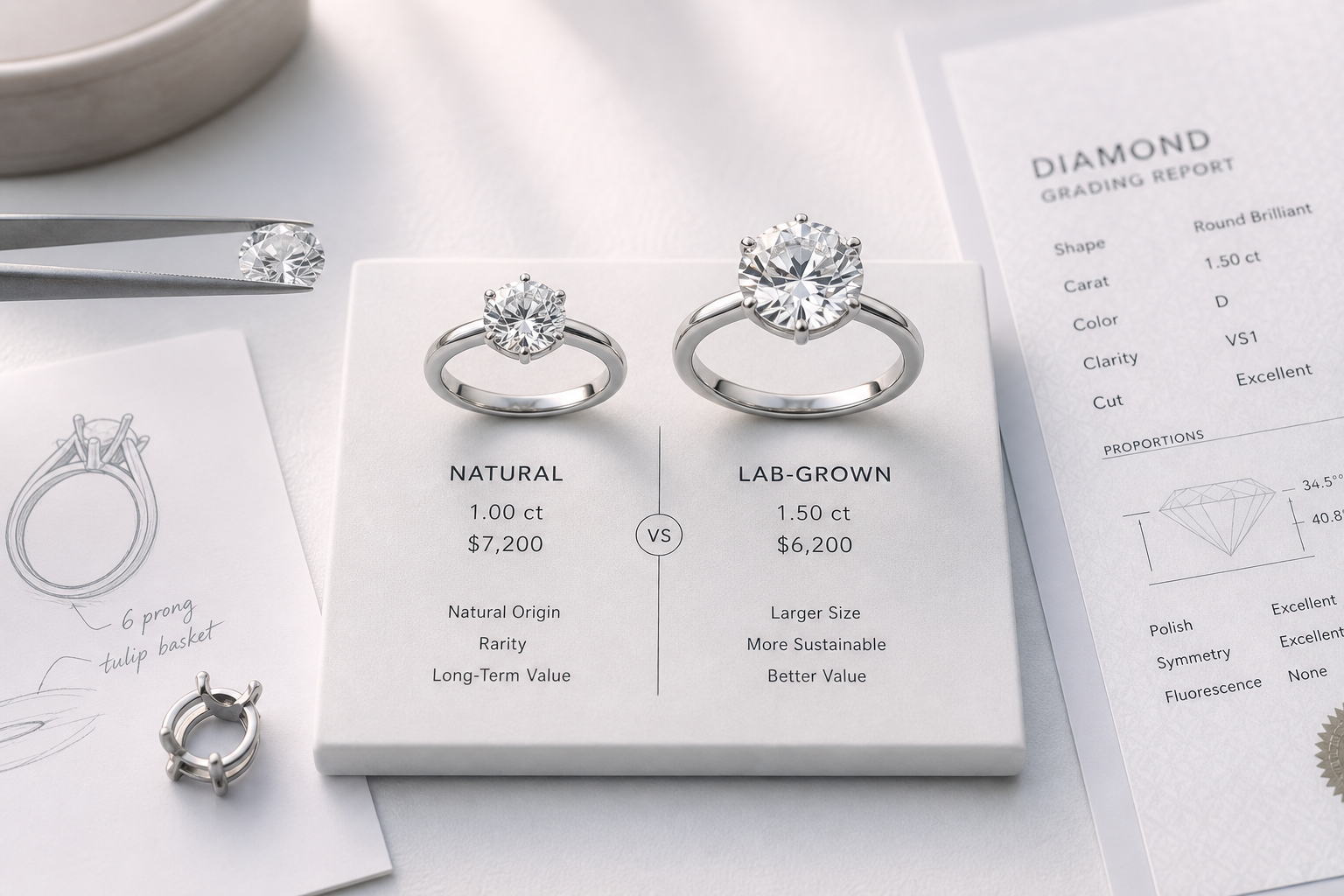
Buyer Psychology: Why the Same Diamond Look Can Feel Different
A diamond decision is rarely just a technical comparison. Two stones can look similar on the hand, yet feel different because the buyer is not only choosing sparkle. They are also choosing what they want to feel confident about later: the visible result, the origin story, the budget decision, the reaction from others, or the sense that they did not compromise on something important.
This is where many lab-grown vs natural diamond decisions become harder than they look on paper. The factual differences may be clear, but the emotional risk is personal. One buyer may worry about overpaying for a natural origin they cannot see. Another may worry that choosing lab-grown will feel less traditional over time. Neither concern is irrational. The mistake is pretending those concerns do not exist.
The buyer who wants the strongest visible result for the budget
Some buyers are primarily focused on what the ring looks like in daily life. For them, the strongest value may come from choosing a lab-grown diamond with a larger face-up size, stronger cut quality, or a cleaner appearance within the same budget. This mindset is not simply about “getting a bigger diamond.” It is about putting more of the budget toward visible performance instead of geological scarcity.
The risk for this buyer is assuming size solves everything. A larger diamond with weak proportions, poor light return, or an awkward fit in the setting can still be the wrong purchase. If visible beauty is the priority, cut quality and millimeter spread usually deserve more attention than carat weight alone. A well-chosen 1.80 carat diamond can look more balanced than a poorly selected 2.00 carat stone, especially in an engagement ring worn every day.
This buyer should compare diamonds by how they perform in realistic viewing conditions, not just by the most impressive number on the listing. If lab-grown allows a stronger overall combination of cut, size, color, clarity, and setting fit, it may be the more satisfying choice for someone who values the finished look above the origin story.
The buyer who values tradition and origin story
Other buyers feel more confident when the diamond carries a natural origin. For them, the appeal is not only visual. It may be connected to tradition, family expectations, rarity, or the idea that the stone formed naturally over geological time. Even if a lab-grown diamond looks similar, the origin itself may matter enough to shape the decision.
This buyer should be careful not to treat “natural” as a shortcut for better. A natural diamond can still be poorly cut, visibly included, overpriced for its quality, or mismatched to the ring design. If tradition matters most, the better decision is not simply any natural diamond. It is a natural diamond with quality, documentation, and proportions that justify the tradeoff in size or budget.
For a tradition-focused engagement ring buyer, the right question is not, “Can people tell by looking?” The better question is, “Will I still feel good knowing what this diamond is and why I chose it?” If the answer depends strongly on natural origin, then paying more for that origin may feel reasonable rather than wasteful.
The buyer who worries about explaining the choice to others
Social perception can quietly influence the decision. Some buyers worry that a lab-grown diamond will need explanation, especially around family members who associate engagement rings with natural diamonds. Others worry that choosing natural means they spent more than necessary for a difference most people will never notice. Both concerns are really about confidence under outside judgment.
The practical issue is not whether everyone approves. Most people will not inspect the report, and casual observers usually respond to the ring as a whole. The bigger issue is whether the buyer feels defensive about the choice. If someone feels the need to over-explain a lab-grown diamond every time it is mentioned, that discomfort may matter. If someone feels uneasy about paying a natural diamond premium mainly to satisfy other people, that also matters.
A partner-expectation mismatch is the clearest warning sign. If one person assumes a natural diamond is essential and the other assumes lab-grown is the obvious value choice, the decision should be discussed before the purchase. The origin choice may be less about the stone itself and more about whether both people feel represented in the ring.
A Simple Regret Test Before Choosing
Before choosing lab-grown or natural, ask which regret would bother you more. Would you regret choosing a smaller or lower-spec natural diamond when the same budget could have purchased a more visually impressive lab-grown stone? Or would you regret choosing lab-grown if natural origin, tradition, or long-term market perception keeps mattering to you?
Then make the decision around the regret you are actually trying to avoid. A visual-value buyer should not be pushed into a natural diamond just because it is traditional. A tradition-focused buyer should not be talked out of natural origin just because lab-grown offers more size for the money. A fitting choice is the one that still makes sense after the initial excitement of the purchase has passed.
Certification and Disclosure: How Origin Is Verified
Because most buyers cannot identify diamond origin by sight alone, disclosure matters. A lab-grown diamond and a natural diamond may both look bright, clean, and well-cut in a ring, but their market meanings are different. The buyer should not have to guess which one they are considering.
Documentation is especially important in a lab-grown vs natural engagement ring comparison because origin affects price, resale expectations, and personal meaning. A verbal description is not enough for a serious purchase, and a lab-grown diamonds guide can help clarify origin terms before value is assessed. The diamond should be clearly represented as lab-grown or natural before the buyer compares value.
Why disclosure matters when appearance is not enough
Visual appearance can tell you whether a diamond looks appealing. It cannot reliably tell you whether the diamond formed naturally or was grown in a controlled environment. That is why origin disclosure should happen early in the buying process, not after the buyer has already become attached to a stone.
The highest-risk situation is not a buyer knowingly choosing lab-grown or natural. It is a buyer comparing two diamonds as if they belong to the same value category when they do not. If one diamond is natural and the other is lab-grown, the price gap may be reasonable, but only if the origin is clear. Without disclosure, the comparison becomes misleading.
For online purchases, disclosure should be visible in the listing, the grading report, and the seller’s communication. For in-person purchases, the same standard should apply. If a seller is vague about origin, report details, or whether a diamond is lab-grown, that is a reason to slow down.
How to separate evidence from sales language
A reliable diamond comparison should not depend only on attractive product copy. Words such as premium, ideal, sustainable, rare, investment-grade, or exceptional can be meaningful only when the seller explains what they refer to and what document or visual evidence supports them. If the claim is about origin, look for a clear origin statement and a matching report. If the claim is about beauty, ask for images, video, proportions, and setting context. If the claim is about long-term value or environmental impact, be especially cautious unless the seller can explain the basis of that claim in specific terms.
This evidence-first approach protects both lab-grown and natural diamond buyers. It prevents a lab-grown diamond from being oversold through vague ethical or sustainability language, and it prevents a natural diamond from being oversold through vague investment or rarity language. The strongest presentation is usually the most specific one: clear origin, clear grading information, clear media, and no attempt to make one document prove more than it actually proves.
Building a traceable comparison file
For a significant diamond purchase, it is useful to save the information that shaped the decision before the stone becomes part of a finished ring. This may include the product listing, report number, laboratory name, measurements, images, videos, written origin description, and any notes about why the stone was selected over alternatives. The purpose is not to create unnecessary paperwork; it is to keep the purchase understandable later.
A traceable comparison file is especially helpful when several diamonds have similar grades. After a few options, it can become difficult to remember which stone had the better spread, which one showed a stronger bow-tie, or which report listed a treatment disclosure. Written notes make the selection logic clearer and reduce dependence on memory or broad impressions.
For NUVU, the buyer-first approach is to make diamond comparison easier to understand: what the report shows, what the visuals reveal, and whether the stone fits the intended piece. That kind of process is more useful than treating a single grade, origin label, or sales description as the whole answer.
What a grading report can confirm
A diamond grading report can confirm key information such as whether the diamond is natural or lab-grown, depending on the report type and issuing laboratory. Reports from organizations such as IGI or GIA may also include standard quality information, including carat weight, measurements, color grade, clarity grade, and cut-related details for certain shapes.
For lab-grown diamonds, the report may identify the stone as laboratory-grown and may include information related to the growth method or post-growth treatment when applicable. For natural diamonds, the report identifies the stone as natural and documents its graded characteristics. This matters because the report creates a reference point beyond the seller’s description.
The report number is also useful. When possible, buyers should verify the report number through the issuing laboratory’s online database. This does not make the diamond automatically beautiful or well-priced, but it helps confirm that the document corresponds to an actual grading record.
What a grading report cannot tell you by itself
A grading report is not a beauty guarantee. It can document measurements and grades, but it does not fully show how the diamond performs in every lighting environment, how lively it appears in motion, or whether it suits a specific ring design. Two diamonds with similar grades can still look different in person or on video.
A report also does not guarantee resale value, ethical sourcing, environmental impact, or that the listed price is fair. These are separate judgments. A reported diamond can still be a poor buy if the proportions are weak, the price is out of line, or the seller uses the report to distract from issues that affect real-world appearance.
At NUVU, the grading report is treated as a starting point, not the whole decision. It helps narrow the comparison, but buyers still need to look at the diamond’s visual performance, proportions, origin disclosure, and setting compatibility before deciding.
A grading report helps document key characteristics, but it should not be treated as a guarantee of beauty, value, sourcing ethics, environmental impact, or future resale outcome. It is one part of the evidence set, alongside visual media, measurements, seller documentation, and the intended jewelry design.
How to Verify This Before Buying
Before purchasing, check that the diamond’s origin is clearly stated in the product listing or sales documentation. Then review the grading report for the report number, measurements, carat weight, color, clarity, and any lab-grown or natural designation. If the issuing laboratory offers online verification, confirm that the report number matches the diamond details provided.
If a diamond has an inscription, it should be consistent with the report information and the seller’s description. This check is not a substitute for professional grading, and not every buyer will be able to inspect an inscription easily, but it is a useful verification step when available. The larger point is consistency: listing details, report details, invoice language, and seller communication should all describe the same origin and stone characteristics.
For a center stone, do not stop at the report. Ask for clear photos, video, or viewing support when available. Compare the measurements against the intended setting, especially if the diamond is an elongated shape, a fancy cut, or part of a custom ring. A diamond can be properly documented and still be the wrong visual or physical fit for the design.
When a grading report is provided, buyers should compare the report details with the issuing laboratory’s verification tools where available. This step supports consistency checking, but it should be read alongside the stone’s visual evidence, setting fit, and written origin disclosure.
A trustworthy buying process should make verification feel ordinary, not intimidating. The buyer should be able to see how the diamond is described, which laboratory issued the report, how the report details align with the listing, and whether the visual media supports the stated quality. When these pieces line up, the decision becomes less dependent on sales pressure and more dependent on documented facts and personal preference.
For lab-grown diamonds in particular, transparent communication helps prevent category confusion. The invoice, product page, report, and any custom design notes should consistently identify the stone as laboratory-grown when that is the case. For natural diamonds, the same consistency should apply to natural origin and graded characteristics. Clear paperwork protects the buyer, but it also protects the meaning of the purchase by making sure the ring can be understood accurately later.
If you are comparing several stones with similar grades, ask for a side-by-side explanation of why one may be preferred over another. A useful answer should mention practical details such as cut proportions, face-up size, color comfort in the chosen metal, visible clarity, bow-tie risk in elongated shapes, or setting compatibility. Vague reassurance is less helpful than a calm, specific explanation that connects the report to how the diamond will look and wear in the finished ring.
How to Decide Which Difference Matters Most to You
The right choice between lab-grown and natural diamonds depends on which kind of value you want the diamond to carry. If the stone looks beautiful, fits the design, and is properly disclosed, the remaining decision is not about whether one option is universally better. It is about which difference matters most in your purchase.
For most buyers, the decision should start with priorities rather than labels. Appearance, budget, rarity, resale expectations, symbolism, and confidence do not carry equal weight for every person. A buyer choosing an engagement ring for maximum visual impact may reasonably land in a different place than a buyer who strongly values natural origin and tradition.
Choose based on the value you actually care about
If your highest priority is visible beauty within a fixed budget, origin should not be the first filter. Start with the finished result: size on the hand, cut quality, color and clarity comfort, shape preference, and setting style. In that scenario, a lab-grown diamond may give you more room to prioritize the features people actually see.
If your highest priority is rarity, traditional market meaning, or the feeling of owning a naturally formed stone, then a natural diamond may justify a smaller size or higher cost. The key is being honest about that preference. Paying more for natural origin only makes sense if the origin itself adds value for you, not because it automatically makes the diamond more beautiful.
If resale is part of your thinking, stay conservative. Natural diamonds generally have a more established resale path, but that does not mean consumer buyers should expect to recover retail pricing. Lab-grown diamonds should be purchased mainly for wear, design, and budget logic rather than resale confidence. In both cases, documentation and quality still matter.
When lab-grown diamonds make the most sense
Lab-grown diamonds often make the most sense when the buyer wants a stronger visible result for the budget. This may mean a larger center stone, a better cut, a higher color grade, or a ring design that would feel financially stretched with a comparable natural diamond. For many engagement ring buyers, this is the most practical advantage.
They can also be a strong fit for buyers who are comfortable with modern diamond production and do not need geological rarity to feel emotionally satisfied. If the ring’s meaning comes from the relationship, the design, and the way the stone looks on the hand, lab-grown can be a clear and rational choice.
The caution is that lower price should not lead to careless selection. A lab-grown diamond still needs the right proportions, grading report, visual review, and setting fit. Choosing a larger stone with weak performance is not better value; it is just a different kind of compromise.
When natural diamonds may feel more appropriate
Natural diamonds may feel more appropriate when origin is central to the meaning of the purchase. Some buyers want the traditional diamond story, the geological timeline, or the established cultural association that comes with a mined diamond. If those qualities matter, they should not be dismissed as irrational simply because they are not visible to the eye.
A natural diamond may also be a better emotional fit when family tradition, heirloom thinking, or long-term market perception plays a major role. The buyer still needs realistic expectations, especially around resale. The stronger argument for natural is not guaranteed financial return; it is that the origin itself carries value for the person buying or wearing it.
The tradeoff is usually budget efficiency. A natural diamond may require accepting a smaller carat weight, a more modest color or clarity grade, or a simpler setting to stay within budget. That tradeoff is acceptable only if the buyer genuinely values what natural origin adds.
Your Final Comparison Checklist
If you are choosing a center stone, compare the diamond in the order that affects the final ring most. Start with shape and millimeter spread, because carat weight alone does not tell you how large the diamond will look. Then review cut quality or proportions, since sparkle and balance depend heavily on how the stone is made. After that, set a practical color and clarity target based on what is visible to your eye, not just what looks impressive on paper.
Next, confirm the grading report and origin disclosure. Make sure you understand whether the diamond is lab-grown or natural, and verify the report number when possible. Finally, consider the setting: prong style, band width, metal color, stone height, and daily wear all influence whether the diamond feels right once it becomes a ring.
For custom design, the stone cannot be evaluated separately from the setting. A very elongated diamond may need a different prong layout than a round brilliant, a large center stone may require a lower or more secure basket, and a warm metal color may change how the diamond’s color grade appears. This is why a practical selection process looks at the report, the stone media, the measurements, and the ring design together rather than treating the diamond as an isolated purchase.
Before finalizing a custom ring, confirm that the selected stone’s dimensions, depth, outline, and orientation work with the intended setting. This is especially important for elongated cuts, large lab-grown center stones, three-stone designs, and low-profile settings. For custom design, trust comes from matching the stone to the setting, budget, and wearer’s daily use—not from choosing grades in isolation.
The simplest decision rule is this: choose lab-grown if visible size, cut quality, design flexibility, and budget efficiency matter most. Consider natural if rarity, tradition, origin story, and established market familiarity matter more. If you are still torn, choose the option you can explain calmly without feeling defensive, because long-term satisfaction often depends on confidence as much as comparison.
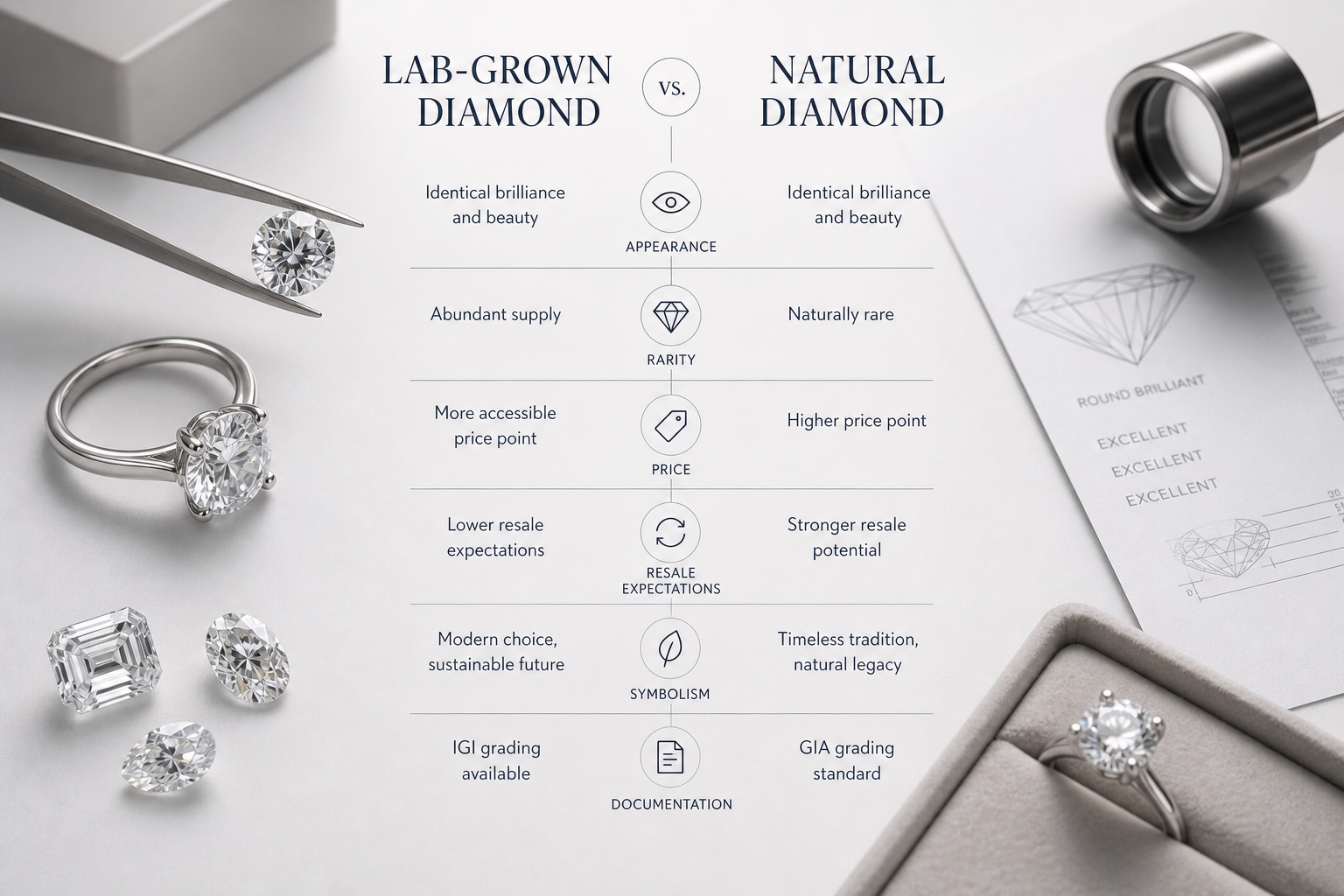
Common Misconceptions That Make the Comparison Harder
Most confusion in the lab-grown versus natural diamond conversation comes from treating one factor as if it answers every question. Origin matters, but it does not automatically settle authenticity, beauty, value, or suitability for an engagement ring. The better approach is to separate what can be verified from what is personal preference, market expectation, or sales language.
Misconception: Lab-grown diamonds are imitation diamonds
A lab-grown diamond is not an imitation in the way cubic zirconia or moissanite is. It is diamond material grown in a controlled environment rather than formed underground. Calling it fake usually creates more confusion than clarity, because the real distinction is origin, not whether the stone is diamond.
The practical risk is buying based on a label instead of understanding what the label means. If a seller uses vague wording such as “diamond alternative,” “diamond-like,” or “simulated diamond,” that may not mean lab-grown diamond. A properly disclosed lab-grown diamond should be identified clearly as lab-grown, lab-created, or laboratory-grown, with documentation that supports that disclosure.
Misconception: Natural diamonds are always a strong investment
Natural diamonds have a more established resale market than lab-grown diamonds, but that does not make every natural diamond a strong financial asset. Retail price includes margins, brand positioning, setting costs, and selling channel differences. A buyer who expects to resell a diamond later for close to the original purchase price is often setting the wrong expectation.
The more useful question is not “Will this diamond appreciate?” but “Am I comfortable with the difference between what I pay and what I might recover if I ever sell?” Natural origin may matter more if resale path, traditional market recognition, or heirloom perception is part of the decision. It should not be treated as a guaranteed investment outcome.
Misconception: Origin alone tells you which diamond is better
Origin does not make a dull diamond bright, and it does not make a poorly matched stone right for a specific ring. A natural diamond can have weak cut performance. A lab-grown diamond can have visible issues, an undesirable color tone, or proportions that make it look smaller than expected for its carat weight. The mistake is assuming the category itself does the quality control.
Cost can also distort judgment. A lower lab-grown price may allow a buyer to choose a larger or higher-spec stone, but bigger is not automatically better if the diamond lacks life in normal lighting or overwhelms the setting. A higher natural diamond price may reflect scarcity and market demand, but it does not automatically mean the stone is more beautiful on the hand. The winning choice is the one that fits the buyer’s priorities and survives a closer review.
Misconception: More documents always mean a safer purchase
Documentation is valuable, but only when it is relevant to the claim being made. A grading report can help confirm origin and recorded diamond characteristics, but it should not be used as proof of sustainability, future resale value, or emotional significance. A seller policy can explain service terms, but it does not prove diamond quality. An appraisal can be useful for insurance purposes, but it should not be confused with what a buyer could necessarily recover in resale.
The best evidence is specific, consistent, and proportionate. If the question is origin, the evidence should address origin. If the question is beauty, the evidence should help you see performance. If the question is long-term value, the answer should be cautious rather than absolute. This keeps the comparison honest and helps prevent a buyer from over-trusting a document that was never designed to answer the question they are asking.
What to Verify Instead of Relying on Assumptions
Before choosing either option, verify the details that actually change the purchase outcome: origin disclosure, grading report information, cut quality, measurements, color and clarity appearance, video or in-person visual performance, and whether the stone fits the intended setting. These checks matter more than broad claims about which category is “better.”
Be especially careful with absolute language. “Lab-grown diamonds always look better,” “natural diamonds always hold value,” and “certified means risk-free” are all oversimplifications. A grading report is useful, but it does not show every lighting condition, every design fit issue, or the personal meaning the buyer attaches to the stone. The safest decision comes from treating origin as one important factor, then confirming the diamond itself is the right one.
Before purchase, buyers should confirm documentation, origin disclosure, seller terms, resizing or service policies if relevant, and any after-sales support directly with the seller. Do not assume a policy, warranty, return option, upgrade term, or service promise unless it is stated clearly in the seller’s current written documentation.
Disclosure: This article is for general educational purposes only. Diamond grading, pricing, availability, specifications, and seller policies can change, and readers should verify important details through grading reports, official laboratory tools, seller documentation, or qualified professionals before making a purchase decision. Laboratory-grown diamonds should be clearly distinguished from natural diamonds, and environmental or sourcing claims should be supported by specific documentation.