
Choosing between HPHT and CVD lab-grown diamonds can feel more important than it usually is. Both methods create diamonds with the same basic crystal structure as diamond, but they are laboratory-grown rather than natural or mined diamonds. In the broader comparison of lab-grown vs natural diamonds, neither label automatically means a stone is brighter, cleaner, more valuable, or more suitable for an engagement ring. The growth method can sometimes help explain undertones, strain patterns, clarity features, or post-growth treatment, but it should not replace a careful look at the individual diamond.
For the full framework, read HPHT vs CVD Lab-Grown Diamonds Guide.
This article helps buyers move past simple method-based assumptions and focus on evidence that affects the final choice: cut quality, proportions, face-up appearance, color comfort, eye-clean clarity, grading report details, treatment disclosure, images or video, and setting fit. By the end, HPHT vs CVD should feel less like a winner-takes-all question and more like one useful detail in a broader buying decision.
| What to Check | Why It Matters | Buyer Takeaway |
|---|---|---|
| Growth method | May explain undertone, strain, or treatment history | Use as context, not as the main quality score |
| Cut and proportions | Strongly affects brightness, fire, and face-up beauty | Prioritize performance over HPHT or CVD labels |
| Color appearance | Grades do not always reveal tint or tone in real viewing | Review images, video, and setting compatibility |
| Clarity visibility | Inclusion type and location matter more than grade alone | Choose an eye-clean stone, not just a higher clarity grade |
| Treatment disclosure | Treatment is acceptable only when clearly stated | Avoid vague listings or missing documentation |
| Report and seller records | Reports document key characteristics but do not prove beauty | Match report details and request visual evidence |
Evidence note for this guide: HPHT and CVD are useful technical descriptions, but this article avoids treating either method as a universal quality ranking. Where a buyer cannot confirm a claim through a grading report, seller documentation, or visual evidence, the safer approach is to treat the claim as context rather than proof. That is especially important for treatment history, color undertone, origin language, and any broad claims about value or environmental impact.
Quick Questions Before You Read
Q: Is HPHT always better than CVD?
No. Either method can produce excellent or weak diamonds, depending on the individual stone.
Q: Should I avoid treated lab-grown diamonds?
Not automatically. The treatment should be disclosed, documented, and considered alongside the stone’s appearance, report details, and comparable options.
Q: Can I tell HPHT and CVD apart by looking?
Usually not. Specialized testing and reliable grading reports are needed for identification.
Q: What should matter most when choosing a stone?
Cut, visual performance, color appearance, eye-clean clarity, measurements, documentation, and setting fit.
HPHT vs CVD Lab-Grown Diamonds: The Short Answer for Buyers
If you are comparing HPHT vs CVD lab-grown diamonds, the practical answer is simple: neither growth method is automatically better. HPHT and CVD are both legitimate ways to grow a laboratory-grown diamond, and either method can produce a beautiful, durable, well-graded stone. The label alone does not tell you whether the diamond will look bright, face up white, hide inclusions well, or make sense for your budget.
The mistake buyers often make is treating the growth method like a quality grade. It is not. A poorly cut HPHT diamond can look less lively than a well-cut CVD diamond. A CVD diamond with clean appearance, strong proportions, and clear documentation can be a better purchase than an HPHT diamond with a higher color grade but weaker visual performance. The better buyer decision starts with the specific stone, not the manufacturing category.
For buyers, the practical point is not just what the report says, but how the stone performs visually and fits the intended design. A growth method can be useful background, but it should sit behind the evidence you can verify: the report details, the measured proportions, the appearance in video, and the way the diamond will be set and worn.
Laboratory-grown diamonds should be clearly identified as laboratory-grown, and they should not be presented as mined diamonds. Natural diamonds and laboratory-grown diamonds have different origins, even when both are diamonds. Diamond simulants, such as non-diamond lookalikes, are a separate category and should not be confused with laboratory-grown diamonds.
Neither Growth Method Automatically Means a Better Diamond
HPHT and CVD describe how the diamond crystal was grown. They do not guarantee beauty, rarity, brilliance, or value. A growth method may influence certain characteristics, such as color tone, strain patterns, or whether post-growth treatment was used, but those details still need to be judged through the grading report and the diamond’s actual appearance.
This is why “HPHT is better” or “CVD is lower quality” is too simplistic. Buyers who follow that rule can easily reject a strong diamond or overpay for a weaker one. The better question is not which process sounds more impressive, but whether the finished diamond has the right cut, color, clarity, proportions, transparency, and documentation for the intended ring or jewelry piece.
The Individual Stone Matters More Than the Label
For most buyers, cut quality deserves more attention than the growth method because it has the greatest effect on how bright and lively the diamond appears. Color and clarity matter too, but they should be judged in context. A diamond with a slightly lower color grade may still face up beautifully in the right setting, while a higher color grade may not save a stone with poor light return or awkward proportions.
The grading report is also essential, but it should not be treated as the whole decision. It helps document the diamond’s identity, grades, measurements, and any relevant comments, including possible treatment disclosure. It does not show every real-world visual detail. Images, videos, proportions, and setting fit can reveal differences that a report alone may not make obvious.
When a grading report is available, buyers should verify the report details through the issuing laboratory’s official report-check tool where available and compare those details with the seller’s listing and visual evidence.
When the Growth Method Deserves a Closer Look
The growth method becomes more important when it helps explain something you are seeing or reading. If a report includes treatment comments, if the diamond shows an unusual color nuance, or if two stones are otherwise very similar, HPHT or CVD information can help you ask better questions. It is especially relevant when disclosure is incomplete or when the seller gives vague answers about how the diamond was produced or improved after growth.
Growth method can also matter for buyers who want maximum transparency. Some shoppers are comfortable as long as the stone is accurately graded and visually strong. Others want a clearer paper trail, including growth method and treatment status, before they commit. Neither approach is wrong, but a buyer should not let curiosity about the process override more visible quality factors.
What to Check First
Before giving too much weight to HPHT or CVD, check the basics in the right order: confirm the grading report, look for any post-growth treatment comments, review cut and proportions, compare color and clarity against actual images or video, and make sure the measurements fit the setting style. If those points are strong and clearly documented, the growth method is usually a secondary detail rather than the deciding factor.
The clearest warning sign is not a specific growth method. It is missing information. If the seller cannot provide a reliable report, clear treatment disclosure, or enough visual evidence to compare the stone properly, the safer move is to keep looking.
How HPHT and CVD Diamonds Are Grown in Plain English
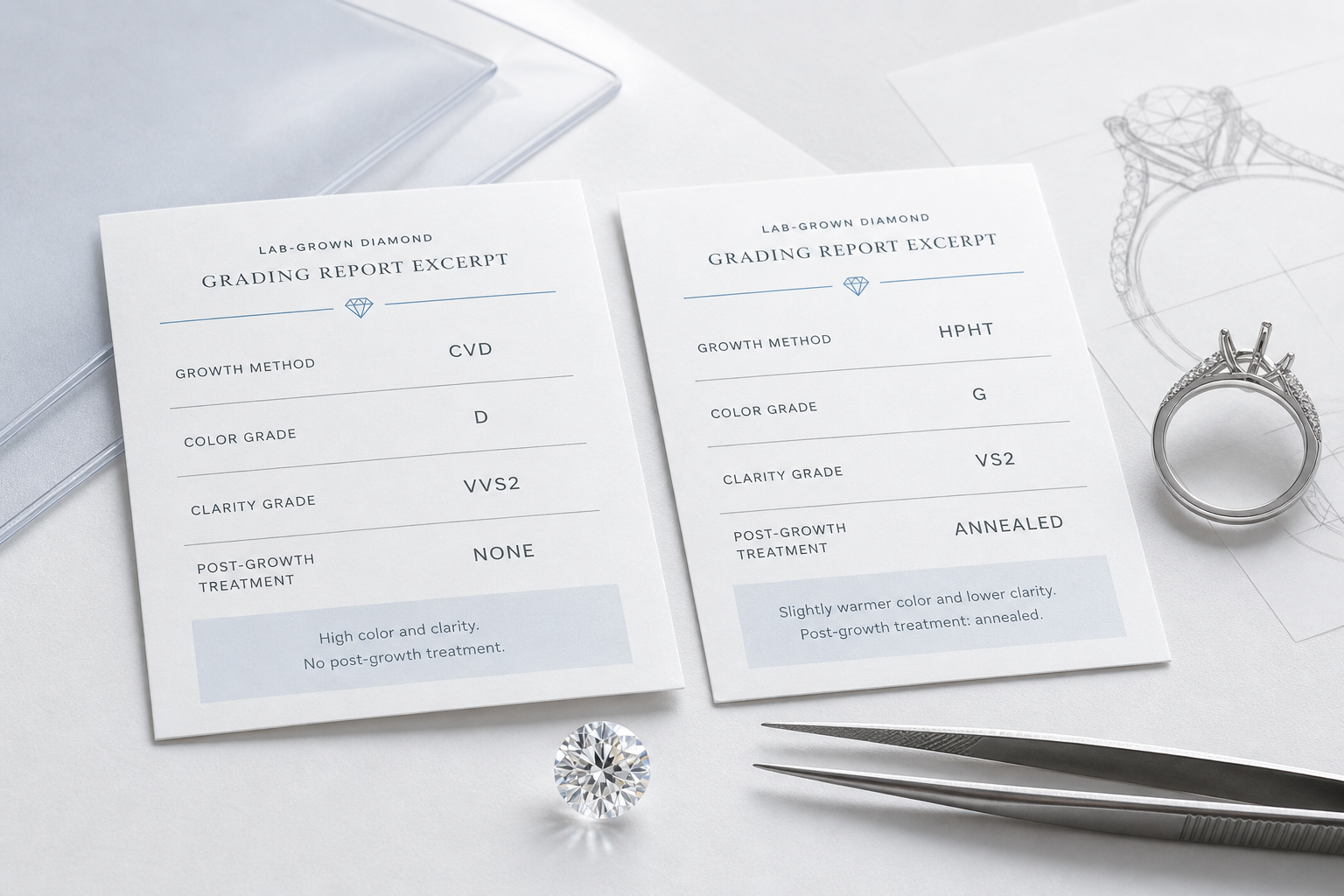
An HPHT diamond and a CVD diamond are both lab-grown diamonds, but they are created in different growth environments. The difference matters because the growth process can influence certain internal or visual characteristics, even though both methods can produce high-quality stones. For buyers, the goal is not to memorize the science. It is to understand why the method appears on some reports and why it may explain certain details about the finished diamond.
HPHT: High Pressure, High Temperature Growth
HPHT stands for High Pressure High Temperature. This method uses intense pressure and heat to create an environment where a diamond crystal can grow. In broad terms, it recreates the kind of conditions associated with diamond formation, but in a controlled laboratory setting rather than underground.
For a buyer, the useful point is not the machinery itself. HPHT growth can produce diamonds with excellent color and clarity, but the method alone does not promise either. Two HPHT diamonds can still differ dramatically in cut, proportions, inclusions, color grade, and overall appearance. The report and the visuals remain more important than the acronym.
CVD: Chemical Vapor Deposition Growth
CVD stands for Chemical Vapor Deposition. In this process, a diamond grows layer by layer inside a controlled chamber using carbon-rich gas. The carbon atoms build onto a diamond seed, forming a diamond crystal over time.
CVD is widely used in lab-grown diamond production because it allows controlled growth and can produce strong gem-quality diamonds. Some CVD diamonds may show growth-related characteristics or may receive post-growth treatment to improve color, but that does not make every CVD diamond questionable. The right way to judge one is to review the finished stone, not assume the process tells the whole story.
Why Two Methods Can Produce Different Growth Characteristics
Because HPHT and CVD diamonds grow in different environments, they may develop different patterns of strain, color tone, or clarity characteristics. These differences are often more relevant to graders and manufacturers than to everyday buyers, but they can show up in ways that affect comparison. For example, one diamond might have a subtle undertone, while another might appear cleaner or brighter in video despite similar grades on paper.
The key is that growth characteristics are not the same as final quality. A method may help explain why a diamond looks a certain way, but it does not replace the need to evaluate cut, color, clarity, and documentation. Buyers should be cautious of sellers who use the growth method as a shortcut for quality, because the finished diamond is what will be worn.
Buyer Translation
Think of HPHT and CVD as production paths, not final rankings. The method tells you how the diamond was grown. The grading report, proportions, images, video, and treatment disclosure tell you whether that particular diamond is a good candidate for purchase. If you remember only one thing from the science, make it this: different growth methods can create different clues, but they do not decide the diamond’s beauty by themselves.
In practical buying, this is also where language can become misleading. “HPHT-grown,” “CVD-grown,” and “HPHT-treated” do not all mean the same thing. One phrase may describe the original growth process, while another may describe an additional step after growth. If the listing, report, and seller explanation use these terms loosely, ask for clarification before treating the information as reliable.
When growth method or post-growth treatment is relevant, buyers should look for clear disclosure in the grading report or seller documentation. HPHT and CVD should usually be understood as growth methods unless the documentation specifically discusses a post-growth treatment.
Common Misconceptions About HPHT and CVD Diamonds
The HPHT vs CVD conversation is often made more confusing by oversimplified claims. Some sound reassuring, others sound alarming, but most are incomplete. A growth method misconception can push buyers toward the wrong stone if it distracts from what actually affects beauty, documentation, and value.
Misconception: HPHT Is Always Better
HPHT is sometimes presented as the superior option because it can produce diamonds with strong color results. That can be true in some cases, but it is not a universal rule. An HPHT diamond with weak proportions, visible inclusions, or a less appealing make is not better simply because of the way it was grown.
The practical risk is overvaluing the method and undervaluing the finished diamond. If two stones are being compared, the HPHT label should not outweigh cut precision, visual brightness, report clarity, or how well the stone fits the setting. A buyer who chooses by method alone may end up with a technically interesting diamond that is not the most attractive option on the hand.
Misconception: CVD Is Always Lower Quality
CVD diamonds are sometimes described as lower quality because some may show growth-related color tone or may undergo post-growth treatment. That reputation is too broad. Many CVD diamonds are visually clean, well graded, and suitable choices for engagement rings and fine jewelry.
The smarter approach is to ask what the specific CVD diamond looks like and what the report discloses. If the stone has strong proportions, appealing color appearance, eye-clean clarity, and transparent documentation, the fact that it was grown by CVD should not automatically count against it. The method deserves attention, not automatic rejection.
Misconception: Treatment Automatically Makes a Diamond a Bad Choice
Post-growth treatment can sound negative because buyers may associate “treated” with deception. In lab-grown diamonds, the issue is more specific. Treatment may be used to adjust or improve color after growth, and a treated lab-grown diamond can still be a legitimate purchase when it is properly disclosed and accurately graded.
The problem is not treatment by itself. The problem is unclear disclosure. If a seller avoids the topic, cannot explain the report comments, or presents a treated diamond as if no treatment occurred, buyer confidence should drop. A clearly disclosed treated diamond may be acceptable; an unclear one is where the risk begins.
Misconception: The Growth Method Matters More Than Cut
This is one of the most expensive misunderstandings. Cut has a direct effect on light performance, sparkle, and how large or lively a diamond appears. Growth method does not rescue a poorly cut stone. A diamond can have an appealing origin story and still look flat if the proportions and craftsmanship are weak.
For most buyers, cut should sit higher in the decision hierarchy than HPHT or CVD. This is especially true for round brilliant diamonds, where proportion differences can noticeably affect brightness and contrast. For fancy shapes, the same principle applies, but visual review becomes even more important because grades and measurements do not always predict appearance as neatly.
What This Means in a Real Purchase
If you are choosing between two lab-grown diamonds, do not start by asking which growth method is “best.” Start by asking which stone is better documented, better cut, more visually appealing, and better suited to the setting. HPHT or CVD can help explain differences once the main quality factors are on the table, but it should not be treated as a shortcut that replaces comparison.
A practical rule is to be skeptical of any diamond recommendation that depends too heavily on one label. The better purchase is usually the stone with the strongest combination of report transparency, visual performance, proportions, color appearance, clarity, and design fit.
When the Growth Method Actually Matters
The lab-grown diamond growth method matters most when it helps explain something you can see, something disclosed on the report, or something that affects confidence in the purchase. It should not be treated as a simple ranking system where HPHT or CVD automatically wins. The better question is whether the method connects to color appearance, clarity characteristics, post-growth treatment, or transparency in a way that changes how you judge the specific diamond.
Color Tone and Undertone Can Influence Appearance
Two diamonds with the same color grade can still look slightly different in person. One may face up crisp and neutral, while another may show a faint brown, gray, or blue nuance depending on the stone, growth conditions, and any treatment history. This is where growth method can become relevant, but only as a clue, not a verdict.
Some CVD diamonds may show brownish or grayish undertones if the growth process leaves certain color characteristics. Some HPHT diamonds may show a subtle blue nuance, especially in certain type IIb material, though this is not something buyers should assume across the board. The mistake is treating these possibilities as universal rules. A well-cut, well-documented CVD diamond can look cleaner than a poorly selected HPHT diamond, and the reverse can also be true.
For most buyers, the practical move is simple: do not stop at the letter grade. If you are comparing a D, E, or F color lab-grown diamond, check high-quality images or video to see whether the stone actually appears neutral in normal viewing. A technically higher color grade with an undertone you dislike may be a weaker choice than a slightly lower color grade that looks balanced and bright.
Color judgment is also affected by viewing conditions. A diamond may look different under daylight, warm indoor light, jewelry store lighting, or screen-based video. When possible, compare stones under similar lighting and against the metal color you plan to use, because a white-metal solitaire, yellow gold bezel, and rose gold halo can each change how color is perceived.
Clarity Characteristics May Have Different Origins
Clarity is another area where the growth method can provide context. HPHT and CVD diamonds may develop different types of growth-related features, such as metallic inclusions, pinpoint clouds, graining, strain patterns, or other internal characteristics. What matters to the buyer is not the technical origin by itself, but whether those characteristics affect appearance, durability confidence, or value comparison.
A VS1 or VS2 grade is often eye-clean in many lab-grown diamonds, but not always in the same way. One stone may have small inclusions near the edge that disappear in a setting. Another may have a feature under the table that is easier to notice in video, even if the clarity grade looks acceptable on paper. Growth method can help explain why certain features appear, and HPHT and CVD growth can add useful context, but the buying decision should still come back to visibility, placement, and the overall look of the diamond.
The most useful question is not “Is this inclusion from HPHT or CVD growth?” It is “Can I see it, does it affect the face-up beauty, and is the grade supported by a reputable report?” If the answer is no, no, and yes, the inclusion origin usually matters less than buyers first assume.
Post-Growth Treatment Should Be Disclosed Clearly
Post-growth treatment is one of the clearest reasons to pay attention to HPHT or CVD information. Treatment may be used to improve or adjust color appearance after the diamond is grown. That does not automatically make the diamond a poor choice, but it does make disclosure important.
A treated lab-grown diamond can still be attractive, accurately graded, and reasonable to buy if the treatment is clearly disclosed and reflected in the report and comparable pricing context. The risk is not treatment itself. The risk is ambiguity. If a seller cannot explain whether treatment occurred, or if the report language and product description do not match, that is a stronger warning sign than the growth method alone.
For a buyer choosing a diamond for an engagement ring, transparency matters because the purchase is not only about appearance on day one. It is also about knowing what you own. If two diamonds look equally strong and have similar grades, the one with clearer disclosure and cleaner documentation may deserve more confidence.
Some Buyers Simply Prefer More Documentation
Some buyers are comfortable judging primarily by appearance, proportions, and a grading report. Others want more detail about the lab-grown diamond growth method, treatment comments, and report verification before they commit. That preference is reasonable, especially for higher-budget purchases or custom designs where the stone becomes the center of the piece.
Documentation does not make a diamond beautiful by itself, but weak documentation can make comparison harder. If one diamond has clear grading, visible report details, and consistent seller information, while another requires guessing about treatment or growth method, the better-documented stone usually deserves more confidence even before price is considered.
What Traceability Can and Cannot Tell You
For lab-grown diamonds, traceability is most useful when it connects the stone in front of you to consistent records: the grading report, report number, product listing, laser inscription if present, growth method description, treatment comments, and seller communication. These records help reduce confusion during comparison, especially when two diamonds have similar grades but different visual behavior or disclosure language.
Traceability has limits. A report number or growth method note does not prove that a diamond is more beautiful, more valuable, or more responsible than another stone. It simply gives the buyer a clearer chain of information to evaluate. The strongest buying position is created when the documents, visuals, measurements, and seller explanation all support the same conclusion without requiring guesswork.
How to Verify This Before Buying
Before deciding whether HPHT or CVD should influence your purchase, check three things together: what the report says, what the diamond looks like, and what the seller can clearly explain. The growth method deserves more attention when there is a visible undertone, unusual clarity appearance, treatment language, or inconsistent information between the product page and the grading report.
If the diamond is visually strong, the report is easy to verify, and any post-growth treatment is clearly disclosed, the growth method usually becomes secondary. If the documentation is vague or the visual evidence raises questions, it becomes part of the decision rather than a detail to ignore.
What Matters More Than HPHT or CVD for Most Buyers
For most lab-grown diamond buying decisions, cut quality, proportions, color grade, clarity grade, visual performance, and documentation carry more weight than whether the stone is HPHT or CVD. Growth method can explain certain characteristics, but it rarely rescues a poorly cut diamond or makes a dull stone look lively.
The priority should be practical: choose the diamond that looks better, is better documented, fits the setting, and makes sense for the budget. A buyer who chooses by growth method first may miss the more important differences that determine how the diamond actually performs on the hand.
Cut Quality Usually Has the Biggest Visual Impact
Cut quality is often the strongest driver of beauty because it affects brightness, contrast, fire, and how lively the diamond looks in motion. A lab-grown diamond with excellent material but weak proportions can look flat. A diamond with slightly less impressive color or clarity grades can still look better if the cut is stronger.
This is especially true for round brilliants, where proportions and symmetry can be evaluated with more consistency. For fancy shapes such as oval, emerald, radiant, pear, cushion, and marquise, cut evaluation becomes more visual and shape-specific. Bow-tie effect, length-to-width ratio, windowing, crushed-ice appearance, and facet pattern often matter more than a generic cut label.
The common mistake is treating “Excellent” or “Ideal” as the end of the cut discussion. Those labels are useful screening tools, but they do not replace actual images, videos, and proportion review. If two diamonds are both well documented, the one with stronger visual performance should usually beat the one with the more preferred growth method.
Color and Clarity Should Be Judged by Appearance, Not Just Grade
Color and clarity grades help narrow the search, but they should not be read as automatic beauty scores. A G color diamond that faces up white in the chosen setting may be a smarter buy than a D color diamond with proportions or undertone issues. A VS2 diamond with a small, hidden inclusion may be a better fit than a VVS stone where the extra clarity is invisible to the naked eye.
For white-metal solitaire settings, some buyers may prefer the crispness of D to F color, especially in larger stones. For yellow gold or rose gold settings, a slightly warmer color grade may still look bright and balanced because the metal changes the visual context. The right grade depends on the setting, diamond size, shape, and the buyer’s sensitivity to color.
Clarity should be evaluated the same way. The grade matters, but inclusion location matters more in real viewing. Inclusions under the table are usually more important than small features near the girdle. A clarity grade that looks safe on paper can still be a poor choice if the video shows a distracting mark in the center of the stone.
Measurements and Proportions Can Explain Why Two Diamonds Look Different
Two diamonds with the same carat weight can look noticeably different because carat measures weight, not spread, brightness, or balance. Measurements and proportions explain how that weight is distributed. A deeper stone may carry more weight below the surface and appear smaller face-up. A poorly balanced stone may show leakage or a less attractive pattern even if the grade combination looks strong.
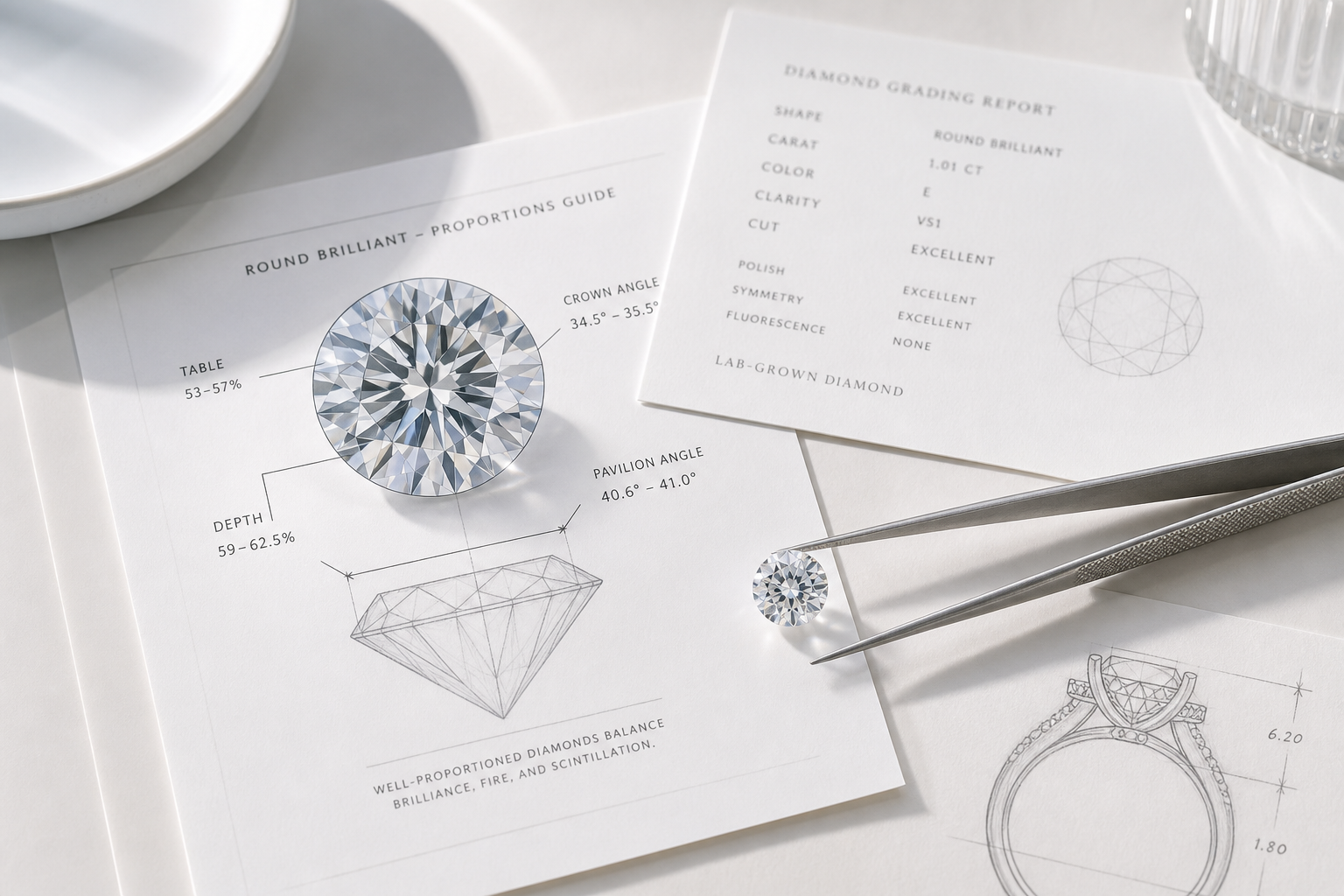
For round diamonds, table percentage, depth percentage, crown angle, and pavilion angle are especially useful checkpoints. They do not guarantee beauty on their own, but they can help you avoid obvious proportion problems before you spend time comparing videos. For fancy shapes, measurements are still important, but the right ranges depend heavily on shape and personal preference.
This is why a 1.50 carat diamond can look more appealing than a 1.70 carat diamond in the same setting. If the smaller stone has better spread, cleaner contrast, and livelier light return, it may deliver a stronger result than the heavier stone with less efficient proportions.
Carat Weight Is Not the Same as Visual Size
Carat weight is one of the easiest numbers to compare and one of the easiest to overvalue. Buyers often set a target such as 1.50 carats or 2.00 carats, then assume any diamond at that weight will create the same visual effect. It will not.
Visual size depends on face-up measurements, shape, cut, and setting style. An elongated oval or radiant can appear larger than a round diamond of the same carat weight because it spreads differently across the finger. A deep round diamond may look smaller than its weight suggests. A halo, bezel, or slim solitaire setting can also change how large the center stone appears.
The better decision is to compare millimeter measurements alongside carat weight. If the carat number increases but the face-up size barely changes, you may be paying for weight that does not meaningfully improve the look of the ring.
Useful Round Diamond Screening Ranges
For round brilliant lab-grown diamonds, the following ranges can be useful as a first-pass screen, not as a guarantee of beauty:
- Table percentage: about 54% to 58%
- Depth percentage: about 60% to 62.5%
- Crown angle: about 34° to 35.5°
- Pavilion angle: about 40.6° to 41°
These numbers are most helpful for eliminating weaker candidates. They should be interpreted together because one measurement can offset or worsen another. A pavilion angle near the edge of the range may work well with one crown angle and less well with another. This is why proportion screening should be followed by image or video review whenever possible.
For fancy shapes, avoid forcing round-diamond standards onto the wrong shape. An oval, emerald, cushion, or radiant diamond needs shape-specific evaluation. The better question is whether the stone has pleasing outline, balanced facet pattern, minimal distracting leakage, and a size profile that fits the intended setting.
How to Read HPHT and CVD Information on a Diamond Report
A diamond grading report can help answer whether a lab-grown diamond is HPHT or CVD, but report formats are not identical across every laboratory or report type. Major reports such as an IGI report or GIA report may identify the diamond as laboratory-grown and may include growth method, post-growth treatment comments, or other relevant notes. The key is to read the report as evidence, not as a substitute for judgment.
For buyers, the report is most useful when it documents identity, grade details, measurements, and disclosures in a way that matches the seller’s product information. If the report and the listing tell different stories, pause before buying.
A grading report helps document key characteristics, but it should not be treated as a guarantee of beauty, value, or sourcing ethics. It should be read alongside visual evidence, measurements, seller documentation, and the intended jewelry use.
Where Growth Method May Appear on the Report
Growth method information may appear in the comments section, identification section, or a dedicated field, depending on the issuing lab and report format. You may see wording that identifies the stone as laboratory-grown and references HPHT, CVD, or a related growth process. Some reports may provide more detail than others.
The important point is that “how to tell if a lab-grown diamond is HPHT or CVD” usually starts with the grading report, not a visual guess. Most buyers cannot reliably determine growth method by looking at a mounted diamond or even a loose stone without specialized testing. A seller’s description should align with the report, and if it does not, the report should carry more weight than marketing copy.
What Post-Growth Treatment Comments Mean
Post-growth treatment comments indicate that the diamond may have undergone an additional process after growth, often related to improving or modifying color appearance. The exact wording varies by lab and report type, so buyers should avoid overreading a single phrase without context.
A treatment comment is not the same as a warning label. It does not mean the diamond is fake, unstable, or automatically undesirable. It does mean the buyer should understand what was disclosed and compare the diamond accordingly. If two stones look similar but one has less clear treatment information, the better-documented option may be the more comfortable purchase.
The practical issue is consistency. The product page, report, and seller explanation should all point in the same direction. If the listing avoids mentioning treatment while the report includes a treatment comment, that gap deserves a direct question before purchase.
Why Report Verification Matters
Report number verification is a simple but important step. When possible, enter the report number directly on the issuing laboratory’s website and confirm that the online record matches the diamond being offered. Check the carat weight, measurements, color grade, clarity grade, report date, and identifying details.
This step matters because a report image alone can be incomplete, outdated, or mismatched to a listing. Verification does not prove that the diamond will look beautiful, but it reduces the risk of relying on incorrect documentation. For a higher-value purchase, skipping this step is unnecessary risk.
At NUVU, the grading report is treated as a starting point rather than the final answer. It narrows the comparison and supports transparency, but the diamond still needs to make sense visually and physically for the intended jewelry piece.
What a Report Still Cannot Show You
A lab-grown diamond grading report can document important facts, but it cannot show every part of the buying experience. It will not fully capture sparkle in motion, how the diamond looks in different lighting, whether an inclusion bothers you personally, or how the stone pairs with a specific setting.
A report also cannot tell you whether a diamond’s proportions create the visual style you prefer. Some buyers like sharp contrast and bold flashes. Others prefer a softer or more splintery appearance in certain fancy shapes. Those preferences require images, video, and sometimes comparison between similar stones.
This is where many buyers make the wrong tradeoff. They choose the stone with the cleaner-looking report and ignore the visual evidence. A strong report matters, but if the diamond looks dull, dark, off-tone, or poorly matched to the setting, the report does not fix the problem.
Build a Small Evidence File Before You Commit
For a meaningful purchase, it can help to save the diamond report, product listing, seller messages, images, videos, and any treatment explanation in one place before checkout. This is not about making the process complicated. It simply gives you a cleaner record of what was represented at the time of purchase and helps you compare stones without relying on memory.
A good evidence file should answer four buyer questions: what is the diamond documented to be, what does it look like, what has the seller disclosed, and does the setting fit the stone’s measurements? If any of those answers are missing, the decision may still be possible, but it becomes less supported. In that case, ask for the missing detail rather than filling the gap with assumptions about HPHT or CVD.
How to Match the Report to the Actual Stone
Traceability becomes practical when the report details can be connected to the stone being offered. Start with the report number, then compare carat weight, measurements, shape, color, clarity, and any inscription information shown in the listing. If the diamond is loose and an inscription is visible through magnification, that can be another useful cross-check, but buyers should not rely on a product title or report image alone.
It is also worth checking whether the seller’s description uses the same language as the report. For example, a listing should not casually describe a stone as untreated if the report includes treatment-related comments. Similarly, “HPHT” should not be used in a way that makes it unclear whether the term refers to growth method or post-growth treatment. Clear terminology is part of traceability because it keeps the buyer from comparing two different claims as if they were the same thing.
Certificate and Visual Review Check
Before buying, confirm that the report identifies the stone as lab-grown, review any growth method and post-growth treatment language, verify the report number with the issuing lab when possible, and compare the report details against the seller’s listing. Then look at the diamond itself through images, video, and measurements.
The better buying decision uses both forms of evidence. The report tells you what the diamond is documented to be. The visual review tells you whether it is the diamond you actually want to wear.
Post-Growth Treatment: What Buyers Should Understand
Treatment Is Not the Same as Fake
Post-growth treatment means a lab-grown diamond was adjusted after its initial growth to improve or refine its appearance, most often related to color improvement, a distinction often clarified in a lab-grown diamond guide for understanding treated versus untreated stones. It does not mean the diamond is fake, imitation, or not diamond. A treated lab-grown diamond is still a diamond if it has the same diamond crystal structure and is accurately identified and graded as laboratory-grown.
The mistake buyers should avoid is treating the word “treated” as an automatic rejection. Treatment can be a normal part of bringing some stones to a more desirable final appearance. The real question is not whether treatment exists in theory, but whether it has been disclosed clearly, reflected in the grading report, and considered appropriately compared with similar options.
Disclosure Is the Real Buyer Issue
Disclosure matters more than the treatment label itself. If a diamond has undergone HPHT treatment, CVD treatment, or another post-growth process, the buyer should not have to guess. Clear documentation allows you to compare the stone honestly against untreated or differently treated diamonds with similar grades.
A treated lab-grown diamond becomes a poor choice when the seller avoids the topic, the report language is unclear, or the comparison no longer makes sense once treatment is considered. Transparency protects the buyer because it keeps the decision tied to evidence rather than assumptions. If the stone looks strong, carries a reliable report, and the treatment is clearly disclosed, the concern level is very different from a stone with vague or missing information.
How Treatment Can Affect Confidence and Comparison
Treatment can affect how confident you feel when comparing two diamonds that look similar on paper. For example, one diamond may have achieved its final color through post-growth treatment, while another may not have a treatment comment on the report. That does not automatically make one better, but it does change the comparison. The treated stone should be evaluated with disclosure, final appearance, grading consistency, and comparable market context in mind.
The practical risk is overemphasizing the final color grade. A diamond with a higher color grade is not always the better option if its proportions are weaker, the video looks less lively, or the documentation leaves questions unresolved. Treatment should push you to look more carefully, not panic or dismiss the stone outright.
For buyers choosing an engagement ring diamond, this is especially important because the stone will be viewed every day in many lighting conditions. A report can document grade and disclosure, but it cannot fully show how the diamond behaves in daylight, office lighting, or warm indoor light. Images, videos, and an opportunity to review the stone carefully matter more when any uncertainty remains.
Questions to Resolve Before You Decide
- Does the grading report identify the diamond as laboratory-grown and include any post-growth treatment comments?
- If treatment is disclosed, is the seller explaining it plainly rather than avoiding the question?
- Does the final color appearance look neutral and attractive in real images or video, not just on the report?
- Have you compared similar stones by shape, size, grade range, report type, visual appearance, and documentation quality?
- Would you still choose this stone if the growth method and treatment note were treated as secondary details?
A Practical Scenario: Choosing Between Two Lab-Grown Diamonds
The Decision Point: Same Size, Different Growth Method
Imagine a buyer trying to choose between HPHT and CVD diamonds for a solitaire engagement ring. Both are round brilliant diamonds at 1.50 carats. One is a 1.50 ct F VS1 CVD diamond. The other is a 1.50 ct D VS2 HPHT diamond. At first glance, the HPHT stone may seem like the stronger option because D color sits higher on the grading scale than F color.
That first impression is too simple. In a real purchase, the better diamond is not the one with the most impressive single grade. It is the stone that combines strong documentation, attractive proportions, clean visual performance, and the right fit for the setting. If the F VS1 CVD diamond has better cut proportions, a cleaner video, and no unclear treatment language, it may be the better option even though its color grade is lower.
What the Buyer Should Compare First
The buyer should start with the evidence that most affects the diamond’s appearance in the ring. Cut and proportions come first because they influence brightness, contrast, and how lively the diamond looks. A D color grade cannot rescue a diamond that looks flat, leaky, or poorly balanced in motion.
Next, compare the videos and images. Does one diamond show better edge-to-edge brightness? Does one have a distracting dark center, hazy appearance, or strange color cast? Does the VS2 diamond have an inclusion that is visible in the video or located under the table? These details matter more than the growth method because they affect what the wearer will actually see.
The report notes also deserve attention. If the CVD diamond is clearly documented and visually strong, it should not be penalized simply for being CVD. If the HPHT diamond has a higher color grade but weaker proportions or less convincing video performance, the method label should not override those shortcomings.
Why the Better Choice May Not Be the Higher Color Grade
In a solitaire setting, a well-cut F color round diamond can look bright and white to most viewers, especially in white gold or platinum. The difference between D and F may be difficult to notice without direct comparison, while the difference between excellent and mediocre light performance is much easier to see.
This is where many buyers allocate budget in the wrong place. Paying more for the top color grade may feel safe, but it is not always the most visible upgrade. If the F VS1 CVD diamond has tighter proportions, better face-up performance, and cleaner documentation, it may deliver the stronger everyday result. The HPHT stone becomes the better choice only if it also holds up visually and proportionally, not merely because it has the higher color grade.
The same logic applies in reverse. A CVD diamond is not automatically the smarter buy because it appears attractive on paper. If it shows a noticeable tint, haze, weak cut performance, or unclear treatment disclosure, the HPHT diamond may be the safer choice. The decision depends on the specific stones, not the category label.
Prices can change with market conditions, report type, seller channel, and stone-specific details, so exact comparisons should be verified at the time of purchase. Before treating one diamond as the better value, compare like-for-like specifications, including cut, measurements, report details, treatment disclosure, images, and availability.
Stone-to-Setting Fit Check
Before deciding, the buyer should consider how the diamond will sit in the actual engagement ring. A round diamond with a slightly larger face-up measurement may look better in a simple solitaire, while a deeper stone with the same carat weight may appear smaller from the top. If the setting has a low profile, hidden halo, or delicate prongs, the measurements and girdle details can affect how balanced the finished ring looks.
For custom or semi-custom designs, the stone should be evaluated with the setting in mind, not as an isolated report. At NUVU, this is one of the points we usually encourage buyers to slow down on: a diamond can have attractive grades and still be less suitable for the ring design if the proportions, measurements, or visual character do not support the final look.
For custom jewelry, stone measurements and setting compatibility should be confirmed before finalizing a purchase. This includes millimeter dimensions, shape outline, depth, girdle condition, prong placement, metal choice, and whether the design can safely and attractively hold the selected stone.
Documentation Support Before You Finalize a Lab-Grown Diamond
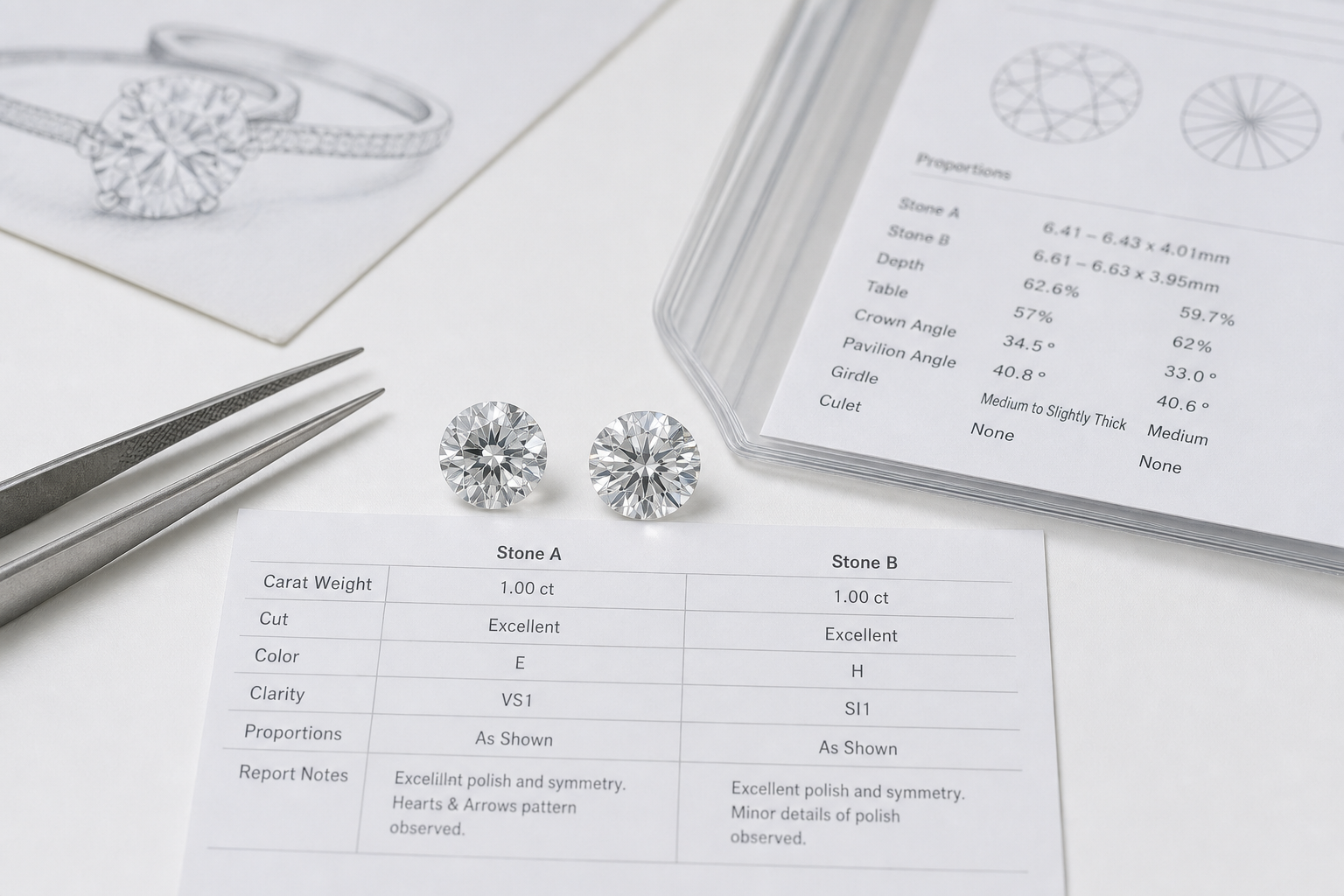
After a buyer has narrowed the choice to one or two strong candidates, the final step should be a calm documentation review rather than a rush to pick the most impressive label. This means checking that the grading report, seller description, visual media, measurements, and setting plan all describe the same diamond consistently. If a stone is being selected for a custom ring, this review also helps confirm that the diamond is not only attractive on paper but practical for the design.
When NUVU assists with lab-grown diamond selection, the goal is to help buyers compare evidence in a usable way: report details, growth method notes, treatment disclosure, proportions, face-up size, and visual performance. That process is especially useful when HPHT and CVD stones look similar by grade but differ in undertone, spread, video appearance, or how confidently the report information can be verified.
When a grading report is provided, buyers should compare the report details with the issuing laboratory’s verification tools where available. Report verification supports documentation review, but it should still be paired with visual evidence, measurement checks, and clear treatment disclosure.
For buyers comparing multiple stones or ordering for a specific jewelry project, clear communication is also a trust signal. Ask which report will accompany the diamond, whether the report number can be checked online, whether any treatment comments appear, and whether the final setting will be made around the actual measurements rather than only the carat weight. Straight answers to these questions are often more valuable than broad claims about HPHT or CVD being superior.
What Clear Communication Should Cover
A useful diamond conversation should leave a buyer with fewer assumptions, not more. Before finalizing, ask for the exact report reference, current images or video when available, measurement confirmation, growth method wording, and any treatment-related explanation that affects comparison. If the diamond is part of a custom design, also confirm that the setting plan is based on the stone’s actual millimeter dimensions, shape outline, girdle condition, and intended setting style.
For wholesale, pair, or multi-stone decisions, the same traceability logic becomes more operational. Documentation, matching standards, and communication expectations matter because buyers may need stones to coordinate in color appearance, measurements, report type, and visual style. A clear process does not require exaggerated promises; it simply helps everyone understand what is being compared, what has been documented, and which details still need confirmation.
The Decision Rule: How Much Should You Care About HPHT vs CVD?
Care About Growth Method When Disclosure Is Unclear
The HPHT vs CVD decision matters most when the growth method connects to a real question about disclosure, treatment, color appearance, or documentation. If the report is vague, the seller cannot explain treatment comments, or the diamond shows an odd tint that is not addressed clearly, the growth method deserves closer attention.
Unclear disclosure is a warning sign because it limits your ability to compare fairly. A buyer should not have to infer whether a diamond has been treated or rely on a product page that says little beyond carat weight and grade. If the documentation is incomplete, choose a better-documented stone or ask for clarification before moving forward.
Care Less When the Stone Is Well Documented and Visually Strong
If the diamond has a reliable grading report, clear lab-grown identification, understandable treatment disclosure, strong proportions, and convincing images or video, the growth method usually becomes secondary. At that point, the better question is not “which method is better?” but “which lab-grown diamond should I buy based on the full evidence?”
For most buyers, cut and visual review carry more weight than whether the stone began as HPHT or CVD. A well-cut, well-documented CVD diamond can be a better choice than a poorly proportioned HPHT diamond. A strong HPHT diamond can outperform a CVD stone with weak appearance or unclear notes. The label is useful context, not a quality grade.
Use HPHT or CVD as a Tie-Breaker, Not the Whole Decision
The simplest rule is this: do not choose by growth method alone. First confirm the grading report and disclosure. Then compare cut, proportions, color, clarity, measurements, and actual visual evidence. Only after two diamonds are similar in the factors that affect appearance and confidence should HPHT or CVD become a tie-breaker.
This approach prevents two common mistakes. The first is rejecting a good CVD diamond because of a broad assumption about the method. The second is overvaluing an HPHT diamond because the label sounds more reassuring. Neither shortcut protects the buyer as well as comparing the actual stone.
For wholesale or multi-stone buying, the same logic applies, but consistency becomes even more important. Matching reports, growth method disclosures, color appearance, measurements, and communication records can matter as much as the headline price, especially when stones need to be paired for earrings, bands, or repeated production. A single attractive sample does not prove that the full batch will match unless the documentation and visual review are consistent.
Be Careful With Broad Marketing Claims
When comparing HPHT and CVD stones, be cautious of claims that sound absolute: “always better,” “never treated,” “more ethical,” “eco-friendly,” “investment grade,” or “guaranteed higher value.” Some claims may be true for a specific stone or seller program, but they should be backed by specific documentation rather than assumed from the growth method alone.
This is especially important for sustainability or responsible-sourcing language. Lab-grown diamonds follow a different production path from mined diamonds, but that fact alone does not prove a broad environmental claim. If sustainability matters to your purchase, ask for specific information about production practices, energy use, supplier documentation, or any claim the seller is making. If the answer stays vague, keep the claim out of your buying decision.
Environmental and sustainability claims should be specific, documented, and limited to what can be substantiated. A laboratory-grown origin may appeal to buyers looking for an alternative to mined origin, but it does not automatically establish a lower environmental impact, responsible sourcing standard, or carbon-related claim without supporting information.
Buyer Verification Checklist
- Confirm the diamond is identified as laboratory-grown on the grading report.
- Check whether the report or seller discloses post-growth treatment.
- Compare cut quality and proportions before giving weight to growth method.
- Review real images or video for brightness, tint, haze, and visible inclusions.
- Compare face-up measurements, not just carat weight.
- Use HPHT or CVD as a final context point when two diamonds are otherwise close.
FAQ: HPHT vs CVD Lab-Grown Diamonds
Is HPHT Better Than CVD?
No. HPHT is not automatically better than CVD. A well-cut CVD diamond with strong proportions, clean appearance, clear disclosure, and a reliable grading report can be a better purchase than an HPHT diamond with weaker visual performance.
The better question is not “Is HPHT better than CVD?” but whether the specific diamond is attractive, properly documented, accurately graded, and suitable for the jewelry you are buying. Growth method can help explain certain characteristics, but it should not outrank cut quality, appearance, and transparency.
Are CVD Lab-Grown Diamonds Good Quality?
Yes, CVD lab-grown diamonds can be very good quality. They can receive high color and clarity grades and can perform beautifully when the cut and proportions are strong.
The mistake is assuming all CVD diamonds are the same. Some may show undertone, strain, or treatment history that deserves a closer look, while others may be visually excellent and fully documented. Judge the individual stone, not the method alone.
Can You Tell HPHT and CVD Diamonds Apart by Looking?
Most buyers cannot reliably tell whether a diamond is HPHT or CVD just by looking at it. In normal viewing, what you are more likely to notice is brightness, fire, face-up color, visible inclusions, size, and how the diamond fits the setting.
Specialized gemological testing can identify growth-related features, but that is different from casual visual comparison. For a buyer, the practical step is to review the grading report and verify any growth method or treatment information with the issuing lab when possible.
Does the Growth Method Affect Price?
It can, but usually not as much as buyers expect. Price is more directly affected by carat weight, shape, cut quality, color, clarity, proportions, availability, report details, and market demand.
Growth method may influence price when two diamonds are otherwise very similar, or when treatment disclosure, color tone, or buyer preference changes demand. It should not be used as a shortcut for value. A less expensive diamond is not automatically a better deal if the cut, appearance, or documentation is weaker.
Should I Avoid a Lab-Grown Diamond With Post-Growth Treatment?
Not automatically. Post-growth treatment does not mean the diamond is fake, and it does not make the stone unusable. The real issue is whether the treatment is properly disclosed, reflected in the grading report, and acceptable to you as the buyer.
You should be more cautious if treatment information is vague, missing, or difficult to verify. A treated lab-grown diamond can still be a reasonable purchase when it is clearly documented and visually strong. Lack of transparency is the warning sign, not treatment by itself.
Which Is Better for an Engagement Ring?
For an engagement ring, the better choice is the diamond that looks best in the setting, has reliable documentation, and fits the wearer’s preferences and budget. HPHT or CVD should be a secondary factor unless the report raises a specific concern.
Prioritize cut quality, face-up appearance, color comfort, eye-clean clarity, measurements, and setting compatibility. If two diamonds are nearly equal in those areas, growth method and treatment history can serve as a tie-breaker. They should not be the whole decision.
Disclosure: This article is for general educational purposes only. Diamond grading, pricing, availability, specifications, and seller policies can change, and readers should verify important details through grading reports, official laboratory tools, seller documentation, or qualified professionals before making a purchase decision. Laboratory-grown diamonds should be clearly distinguished from natural diamonds, and environmental or sourcing claims should be supported by specific documentation.