
Lab-grown diamonds are cheaper for reasons that go beyond a simple “better deal” label. They are real diamonds, but visible lab-grown diamond differences are often limited without professional testing, because they enter the market through controlled production rather than geological scarcity, which changes how supply, competition, and pricing work. That lower price can help buyers choose a larger stone, better specifications, or a more considered ring design, but it can also make weak stones look tempting if the comparison is too shallow.
For the full framework, read Lab-Grown Diamond Price Guide.
This article helps separate genuine value from misleading cheapness. You’ll see why lab-grown prices differ from natural diamond prices, how the 4Cs still affect appearance and cost, and why documentation, proportions, videos, and setting compatibility matter. The practical decision is not whether lower price means lower quality; it is whether a specific diamond is well verified, visually strong, fairly priced, and suitable for the jewelry being made.
| Buying Question | What to Check | Risk to Avoid |
|---|---|---|
| Is the lower price meaningful? | Compare similar lab-grown stones by cut, size, color, clarity, and report | Assuming all cheaper diamonds are equal value |
| Does carat weight tell the full story? | Review measurements, depth, spread, and face-up appearance | Paying for weight hidden in poor proportions |
| Will the diamond look good in real life? | Use images, video, cut quality, transparency, and visual balance | Relying only on headline grades |
| Is the stone properly verified? | Confirm lab-grown disclosure and matching grading report details | Buying with unclear origin or weak documentation |
| Should savings go to a bigger diamond? | Consider setting durability, comfort, metal, and total ring design | Choosing size over wearability and balance |
| Is natural or lab-grown the better fit? | Decide whether origin, rarity, budget, or visual size matters most | Buying based on resale assumptions alone |
Quick Questions Before You Read
Q: Are lab-grown diamonds cheaper because they are fake?
No. They are real diamonds, but their supply can scale differently from mined diamonds.
Q: Does a grading report guarantee the diamond is a good buy?
No. It helps verify details, but you still need to judge cut, proportions, appearance, and price.
Q: Should I use the savings to buy the biggest stone possible?
Not automatically. A balanced, well-cut stone that suits the setting is usually the stronger choice.
Q: Are lab-grown diamonds a good resale investment?
They should not be bought mainly for predictable resale value. Focus on beauty, fit, verification, and budget.
Lab-Grown Diamonds Are Cheaper, But They Are Still Real Diamonds
If you are wondering why are lab-grown diamonds cheaper if they are real, the answer is not that they are fake. The answer is that they are priced in a different market. A lab-grown diamond is made of crystallized carbon, just like a mined diamond, and reputable stones are graded for the same major quality factors: carat, cut, color, and clarity.
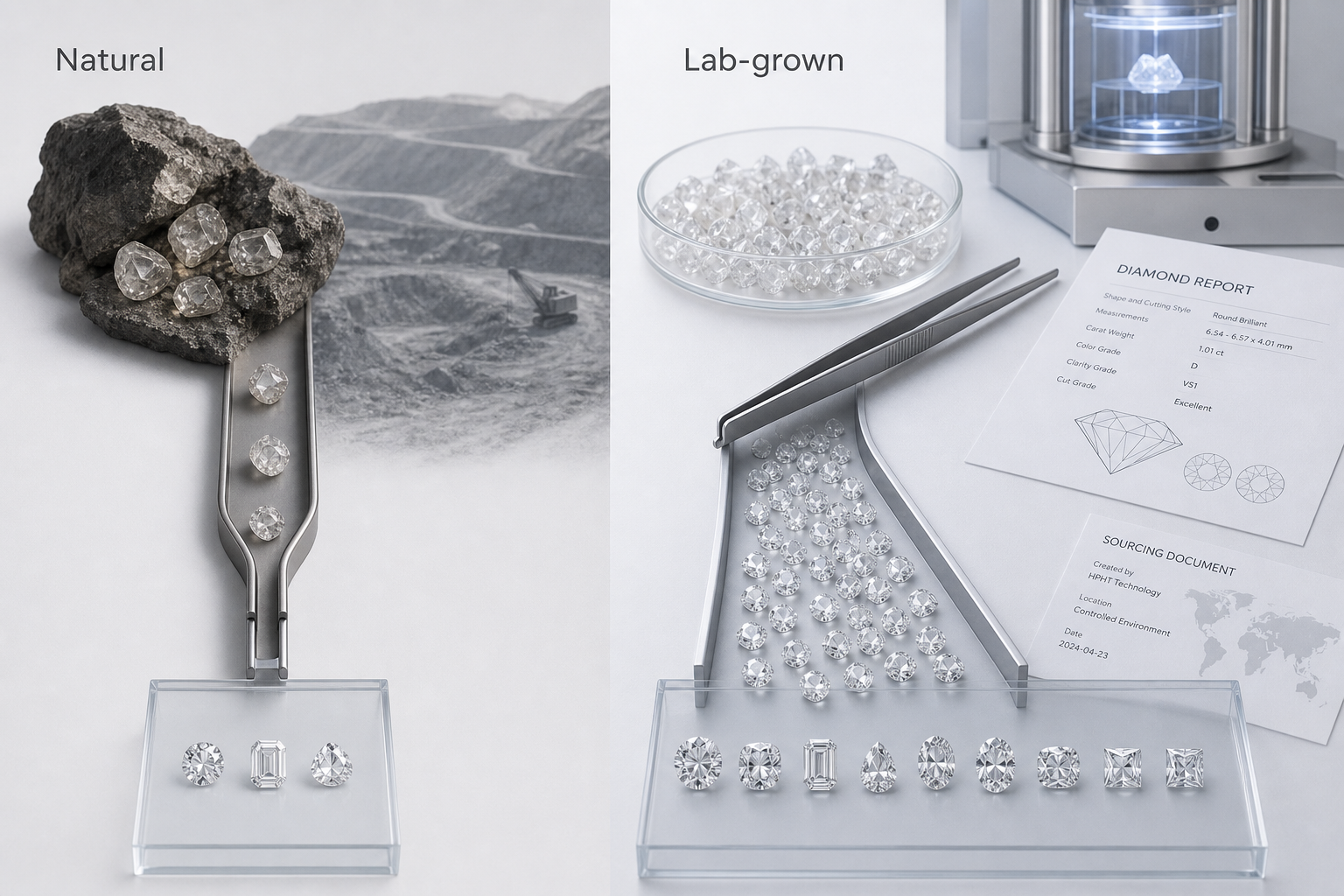
The lower diamond price comes from how these diamonds enter the market. Natural diamonds are tied to geological scarcity, mining economics, established distribution channels, and consumer expectations around rarity. Lab-created diamonds come from controlled production, where supply can expand more directly as technology, capacity, and competition increase. That changes the pricing logic.
This distinction matters because buyers often treat price as a shortcut for authenticity. With diamonds, that shortcut can be misleading. A lower price can reflect a more scalable supply model, not an imitation material. The smarter question is not “Is it real because it costs more?” but “What market forces are setting the price, and does this specific diamond offer good value?”
Compliance-Aware Terms Buyers Should Keep Straight
Laboratory-grown diamonds should be clearly identified as laboratory-grown, and they should not be presented as mined diamonds. A lab-grown diamond and a natural diamond can share the same diamond material, but they have different origins, different supply structures, and often different pricing expectations.
Diamond simulants are a separate category. Materials such as cubic zirconia or moissanite may be used in jewelry, but they are not lab-grown diamonds unless the seller is specifically describing a laboratory-grown diamond made of crystallized carbon. Clear product wording matters because price comparisons are only meaningful when the buyer is comparing the same type of product.
The Short Answer: Lower Price Comes From a Different Market Model
Lab-grown diamonds cost less mainly because their supply is not limited in the same way as natural diamond supply. They still require advanced equipment, skilled cutting, grading, and quality control, but they are not dependent on finding rare deposits underground. As production becomes more efficient and more sellers compete for the same buyer, prices tend to face more pressure.
That does not mean every lab-grown diamond is automatically a bargain. A poorly cut stone with weak visual performance can still be a bad purchase, even at a lower price. The real advantage is that buyers often have more room to compare options by specification, appearance, and budget rather than paying primarily for geological scarcity.
Authenticity and Rarity Are Not the Same Question
Authenticity asks what the diamond is. Rarity asks how scarce it is in the market. These two questions are often blended together, but they should be judged separately.
A lab-grown diamond can be physically real while being less rare in the commercial sense. A natural diamond can carry geological rarity and a longer-established market history, even if two stones look very similar to the naked eye. That difference affects price expectations, especially for buyers comparing lab-grown and natural diamonds for engagement rings or loose stone purchases.
The mistake is assuming that “real” must mean “priced like a mined diamond.” Price is shaped by scarcity, production cost, inventory availability, retail competition, branding, and what buyers are willing to pay. Material identity is only one part of the equation.
Why “Cheaper” Should Not Be Read as “Fake”
Cheaper should raise questions, but not the wrong one. The right concern is whether the individual diamond is well graded, visually attractive, and fairly priced against comparable stones. The wrong assumption is that a lower price automatically means the stone is not a diamond.
There are fake diamond simulants, such as cubic zirconia or moissanite, but those are different materials. A lab-grown diamond is not a simulant when properly identified and graded as a diamond. The buyer’s job is to confirm what is being sold, not to assume that all lower-priced stones fall into the same category.
This is where documentation and transparency matter. A seller should be able to state clearly whether the stone is lab-grown, whether it has a grading report, and how its quality compares with similar diamonds. Vague language such as “diamond-like,” “inspired by diamond,” or “premium alternative” deserves closer attention because those phrases may describe something other than a lab-grown diamond.
What to Check Before You Decide
Before judging the price, confirm the basics: the stone should be clearly described as a lab-grown diamond, not a diamond simulant; the grading report should match the listed carat weight, color, clarity, and measurements; and the seller should provide enough visual information to judge the actual stone, not just the grade combination.
If those pieces are missing, a low price is less useful because you are not comparing a verified diamond against another verified diamond. If they are present, the lower price becomes easier to understand: you are looking at a real diamond sold under a different supply and pricing model.
For buyers, the practical point is not just what the report says, but how the stone performs visually and fits the intended design. A report can support identity and comparison, but it does not prove that the diamond is the most attractive option, the best-priced option, or the right physical match for a ring. Treat documentation as the beginning of due diligence, then confirm appearance, measurements, and setting compatibility before deciding.
Evidence Check: What the Seller Should Be Able to Support
Because lower pricing can make a listing feel unusually attractive, the seller’s supporting information matters more, not less. A trustworthy listing should not rely only on broad labels such as “premium,” “high quality,” or “best value.” It should give the buyer enough concrete information to compare the stone: lab-grown disclosure, report details, measurements, shape, carat weight, color, clarity, finish information when available, and clear visuals of the actual diamond.
Be especially careful when a price explanation depends on claims that are hard to verify. Statements about sustainability, origin practices, resale expectations, or market timing should be specific and supported by documentation from the seller, not treated as automatic benefits of the category. If a seller cannot explain what is included in the price and what evidence supports the listing, the low price may be shifting uncertainty onto the buyer.
Environmental and sustainability claims should be specific, documented, and limited to what can be substantiated. Broad green language is less useful than clear information about production, energy context, sourcing practices, disclosure standards, and the seller’s ability to explain what is known and what is not known about the diamond being offered.
Scalable Production Changes the Supply Side of Diamond Pricing
One of the biggest reasons lab-grown diamond prices are lower is supply. Natural diamonds are limited by geology. Lab-created diamond supply can expand through controlled production, which gives the market a different kind of flexibility.
This does not mean lab-grown diamonds are effortless to produce or that every finished stone is high quality. Production still depends on specialized equipment, energy, stable growth conditions, cutting yield, polishing skill, grading, and quality control. The important point is that supply can respond more directly to manufacturing capacity than mined diamond supply can respond to nature.
Natural Diamond Supply Is Geologically Limited
Natural diamonds form deep underground over extraordinary time periods, and commercial supply depends on finding deposits that can be mined economically. Even after mining, rough diamonds must be sorted, traded, cut, polished, graded, and distributed before they reach a buyer.
That geological limit affects pricing. A natural diamond is not priced only by how it looks in a ring; it also carries the cost and market psychology of scarcity. Larger stones, higher color grades, cleaner clarity grades, and desirable shapes can command higher prices because there is a finite supply of rough material that can produce them.
For a buyer, this means natural diamond pricing often reflects more than visible beauty. Some of the price is tied to rarity and market history, not just what the eye sees once the stone is set.
Lab-Grown Supply Can Expand Through Controlled Production
Lab-grown diamonds are created through controlled methods such as CVD and HPHT. Those processes are technical, but the pricing impact is straightforward: supply is not limited to discovered deposits in the ground. Producers can invest in equipment, improve processes, and increase output over time.
CVD and HPHT describe growth methods, not automatic quality levels. A diamond grown by either method can still vary in color, clarity, transparency, growth features, and final cut quality. In practical buying, the method may be useful context, but it should not replace the more direct evidence: the grading report, measurements, images, video, and how the finished stone looks in the chosen setting.
When growth method or post-growth treatment is relevant, buyers should look for clear disclosure in the grading report or seller documentation. HPHT and CVD should not be treated as quality promises by themselves, and a listing should not imply treatment status unless that status is actually documented for the specific diamond.
That scalability changes the balance between supply and demand. When more rough lab-grown material enters the market, more finished stones can become available across popular sizes and grades. This is one reason buyers often see more accessible pricing for larger lab-grown diamonds than for comparable natural diamonds.
The key limitation is quality. Expanded supply does not guarantee every diamond will have attractive color, clean clarity, strong proportions, or good transparency. Some stones come out better than others, and cutting decisions still affect the final result. Scale lowers pressure on scarcity, but it does not erase the need to evaluate the individual diamond.
Better Production Efficiency Can Put Downward Pressure on Prices
As production technology matures, producers can often improve yield, consistency, and output. More efficient growth and better cutting pipelines can reduce cost pressure, and those savings can move through the market when sellers compete for buyers.
This is why lab-grown diamond prices can change more noticeably than many buyers expect. A price drop does not automatically mean something is wrong with the material. It can mean production capacity has improved, inventory has expanded, or sellers are adjusting to a more competitive market.
The practical takeaway is that lab-grown diamonds should be judged with current comparisons, not old assumptions. A price that seemed unusually low a few years ago may be normal in a more developed market, while an unusually high price today needs a clear reason, such as stronger cut quality, a more desirable specification mix, distinctive design context, or better documentation.
Why Production Method Alone Does Not Set Value
Buyers sometimes ask whether CVD or HPHT is “better” because they want one simple rule for price. In practice, the growth method alone is not enough to decide value. A well-selected diamond should be evaluated by its finished appearance, report details, transparency, proportions, and suitability for the ring, rather than by assuming that one growth route automatically produces a better purchase.
This distinction helps prevent a common pricing mistake. A seller may use technical production language to make a diamond sound more valuable, but the buyer still needs to ask what the finished stone actually shows. If the method is mentioned, it should be treated as background context. The decision should rest on the evidence available for that specific diamond.
Competition Makes Lab-Grown Diamond Pricing More Transparent
Lab-grown diamond pricing is also lower because the market is easier to compare. Many stones are sold online with searchable filters, grading reports, measurements, magnified images, and 360-degree video. That level of visibility makes it harder for vague claims to support large unexplained markups.
Price transparency does not make every listing trustworthy. It simply gives buyers more tools to question the price. If two diamonds appear similar in shape, carat weight, color, clarity, and report details, a large price gap should have a visible explanation. If the explanation is missing, the buyer should slow down.
Online Search Makes Similar Diamonds Easier to Compare
In a traditional jewelry case, comparison is limited to what one store has on hand. Online, a buyer can compare dozens of lab-grown diamonds with similar specs in minutes. That changes the seller’s pricing power because buyers are not relying only on presentation, lighting, or broad claims like “excellent quality.”
This is especially important for lab-grown diamonds because inventory can be more standardized at the search level. A buyer can filter by shape, carat weight, color grade, clarity grade, and grading lab, then compare measurements and visuals. That does not replace judgment, but it does reduce the chance of overpaying for a stone simply because there is no obvious reference point.
The risk is treating filtered results as identical. Two diamonds can share the same headline grades but look different because of cut precision, proportions, transparency, or inclusions. Online comparison is useful only when the buyer looks beyond the first row of specs.
More Sellers Competing Can Reduce Price Gaps
More sellers in the lab-grown diamond market means buyers can compare not only stones, but also service, setting options, documentation, and selection process. Competition tends to narrow price gaps when products are easy to compare, especially for common shapes and popular grade ranges.
That pressure is strongest when a stone has no obvious differentiator. If several sellers offer similar round brilliant lab-grown diamonds with comparable reports and visuals, an inflated price becomes harder to justify. If a seller charges more, the added value should be clear, such as a better cut selection, more complete visual review, a stronger setting design, or a more guided buying experience.
A lower price is not automatically better, though. Sometimes it reflects a stone with less desirable measurements, weaker visual assets, limited documentation, or a seller who provides little support after the listing. Strong value is usually not the lowest number on the screen; it is the clearest relationship between price, quality, and confidence.
Transparent Specs Put Pressure on Vague Markups
Diamond pricing becomes easier to challenge when the buyer can see the report number, measurements, proportions, color grade, clarity grade, and actual visuals, because lab grown vs natural diamonds comparisons make each specification easier to benchmark against comparable options. Specific information forces the price to stand next to comparable options.
This is where vague language loses strength. Phrases like “rare beauty,” “hand selected,” or “high brilliance” mean little unless they are supported by a grading report and visible performance. A diamond can be beautifully chosen, but the claim should show up in the stone’s proportions, images, video, and setting suitability.
For lab-grown diamonds, transparency often benefits the buyer because it turns the purchase from a trust-only decision into a comparison decision. The buyer can ask better questions: Is this price higher because the stone is visibly better, or because the listing is less transparent?
Certificate and Visual Review Check
A grading report is the starting point, not the final answer. It confirms key details, but it does not fully show how the diamond handles light, whether the inclusions are distracting, or whether the proportions work well for the intended setting.
A grading report helps document key characteristics, but it should not be treated as a guarantee of beauty, value, or sourcing ethics. Report language should be read carefully, especially where the report identifies laboratory-grown origin, measurements, color, clarity, cut information, inscriptions, comments, or any disclosed treatment information.
Before accepting a price as fair, compare the certificate details with the actual listing: carat weight, measurements, color, clarity, shape, and report number should align. Then review images or video for visual balance, dark areas, haziness, awkward shape outline, or inclusions that are more noticeable than the grade suggests.
At NUVU, this is why a transparent comparison process matters. A lower price only helps if the buyer can understand what is being traded for that price, and whether that tradeoff will still feel right once the diamond is set and worn.
When a grading report is available, buyers should verify the report details through the issuing laboratory’s official report-check tool where available and compare those details with the stone’s visual evidence.
When a grading report is provided, buyers should compare the report details with the issuing laboratory’s verification tools where available.
If a GIA report is provided, the report details can usually be checked through GIA’s official report verification system.
For buyers comparing lab-grown diamonds, this kind of report-aware process is a practical trust signal rather than a sales claim. A grading report should be checked against the diamond’s stated measurements, carat weight, color, clarity, growth origin, and report number before the stone is treated as a serious option.
When a diamond is accompanied by documentation from recognized laboratories such as GIA, IGI, or HRD Antwerp, the report gives the buyer a common language for comparison. It does not replace visual review, but it helps reduce uncertainty about what is being compared and whether the listed specifications are consistent with the supporting record.
Price Drops Do Not Mean Every Lab-Grown Diamond Has the Same Value
Lower average prices can make lab-grown diamonds easier to compare, but they can also create a misleading impression: that every stone with the same carat weight and grade should be treated as interchangeable. That is where buyers can make expensive mistakes. Lab-grown diamond quality still depends on the individual stone, not just the category it belongs to.
Two diamonds may both be lab-grown, both have grading reports, and both be listed with similar headline grades, yet look noticeably different once they are set in a ring. The difference may come from cut precision, proportions, tint, inclusions, growth characteristics, transparency, or the way the diamond handles light in real images and video. A lower price is not automatically a warning sign, but it should push the buyer to ask what tradeoff is being priced in.
Cut Quality Still Drives How the Diamond Looks
Cut quality is often the first place to look because it has the strongest effect on visible performance. A diamond with strong light return can look brighter, crisper, and more lively than a larger or higher-clarity stone with weaker proportions. This is especially important in lab-grown diamonds because buyers may be tempted to spend the savings on size alone.
The cut grade on a diamond grading report is useful, but it should not be treated as the whole answer. Within the same broad grade, proportions and facet alignment can still vary. A round brilliant with balanced table size, depth, crown angle, and pavilion angle may face up with better brightness than another stone that looks acceptable on paper but appears flat, dark in the center, or overly glassy in video.
For fancy shapes, cut evaluation becomes even more visual. Ovals, cushions, emerald cuts, pears, radiants, and marquise diamonds do not follow the same screening logic as round brilliants. Length-to-width ratio, facet pattern, bow-tie effect, windowing, symmetry, and outline matter more than chasing a single cut label. A cheaper fancy shape may be a good buy, but only if the actual appearance supports the price.
Color and Clarity Still Affect Price and Appearance
Color and clarity still influence lab-grown diamond value, but the smartest grade depends on the diamond and the setting. Many buyers overpay for grades they cannot see once the stone is mounted. Others go too low and end up with visible tint, haziness, or inclusions that affect the look more than the savings justify.
Color is not just a letter on a report. A stone graded near-colorless may look bright and clean in one setting, while another with the same grade may show a warmer tone depending on shape, size, cut style, and metal choice. Larger diamonds and step cuts, such as emerald and Asscher shapes, tend to reveal body color more easily than smaller round brilliants. Yellow or rose gold can also make slight warmth less noticeable, while platinum or white gold may make it easier to see.
Clarity works the same way. A technically higher clarity grade is not always worth paying for if a lower grade is eye-clean and transparent. The bigger risk is not a harmless tiny inclusion hidden near the edge; it is a stone that looks cloudy, strained, or visually dull despite having a respectable clarity grade. Some lab-grown diamonds can show growth-related features or transparency issues that are not obvious from the grade alone, which is why real images and video matter.
Two Diamonds With the Same Carat Weight Can Perform Very Differently
Carat weight tells you how much the diamond weighs, not how large it looks or how well it performs. A poorly proportioned 2.00 ct diamond may carry extra weight in depth and look smaller from the top than expected. Another 2.00 ct stone with better spread and balanced proportions may look larger, brighter, and more refined without costing much more.
This is one of the least obvious parts of lab-grown diamond shopping. Because prices are often more accessible, buyers may move up in carat weight quickly and assume the bigger number is the better value. That can work if the diamond is well cut and visually balanced. It can backfire if the stone has awkward measurements, a distracting bow-tie, poor light return, or a shape that does not suit the setting.
The more practical comparison is not “Which diamond is cheapest per carat?” but “Which diamond gives the strongest visual result for the design and budget?” A slightly smaller diamond with stronger cut, better face-up dimensions, cleaner video, and a more compatible setting can be a better value than a larger stone that needs explanation.
Useful Screening Numbers for Round Brilliant Lab-Grown Diamonds
For round brilliant lab-grown diamonds, basic proportion ranges can help narrow the search before visual review. They are screening tools, not guarantees of beauty.
- Table: Around 54% to 58% is often a useful starting range for balanced brightness and fire.
- Depth: Around 60% to 62.5% is commonly used as a practical screening range, though the full proportion set matters.
- Crown and pavilion relationship: These angles should work together. A single “good” crown or pavilion number can still perform poorly if the pairing is unbalanced.
- Measurements: Check the diameter, not just carat weight. A round diamond that is too deep may carry weight without showing as much visible size.
- Video review: Look for brightness across the stone, a clean pattern, and no persistent dark or washed-out areas that dominate the face-up view.
For non-round shapes, do not apply round brilliant numbers as if they are universal rules. A well-chosen oval or cushion depends more on outline, ratio, facet pattern, and whether the stone looks attractive in motion. The report helps narrow the field, but the final judgment should come from how the diamond actually appears.
The 4Cs Still Matter, But They Do Not Explain the Whole Price Difference
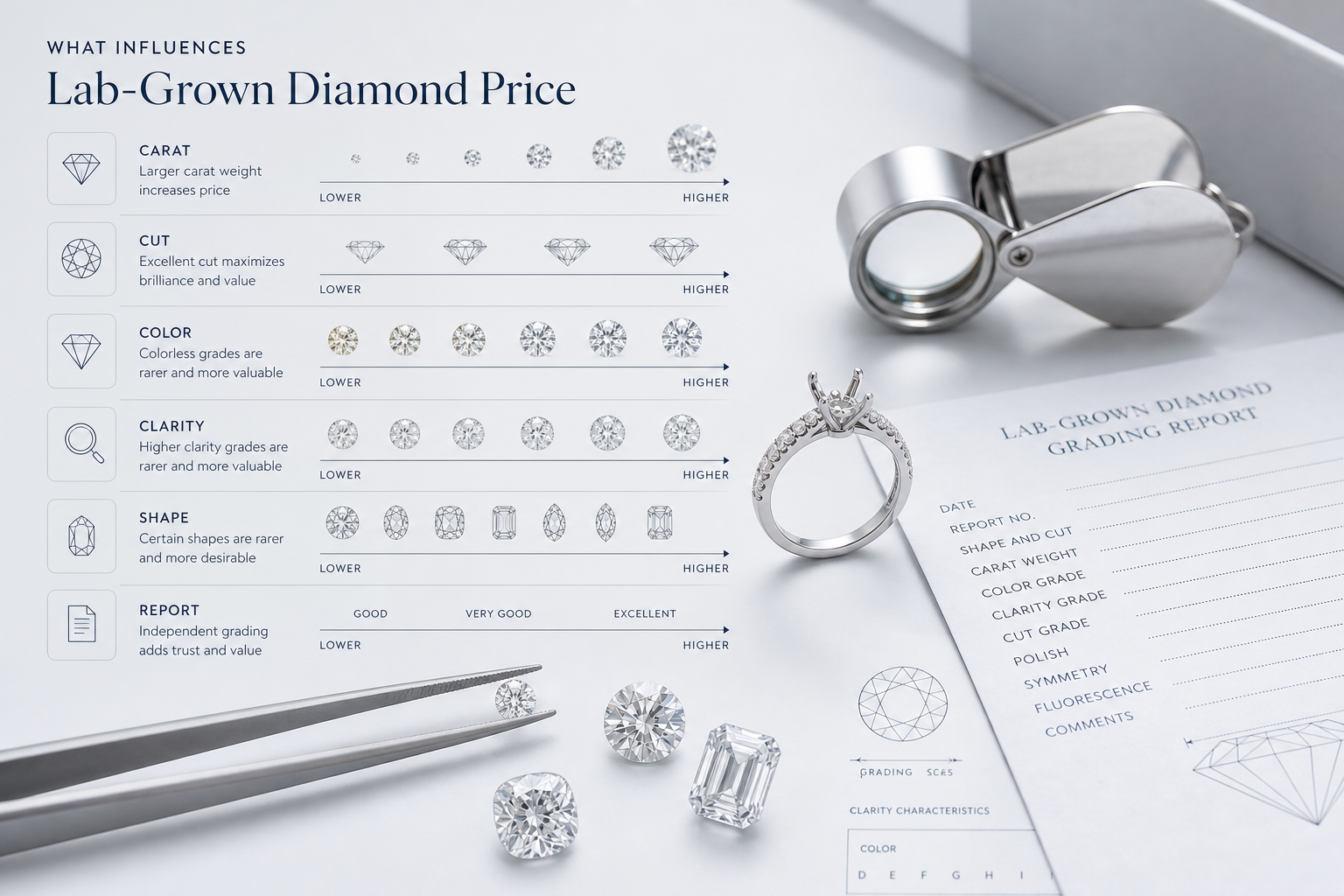
The lab-grown diamond 4Cs still affect price inside the lab-grown market. Carat weight, cut, color, and clarity help explain why one lab-grown diamond costs more than another. They do not, by themselves, explain the larger price difference between lab-grown and natural diamonds.
That distinction matters. If two lab-grown diamonds are priced differently, the 4Cs and the grading report may explain much of the gap. If a lab-grown diamond costs less than a mined diamond with similar grades, the bigger explanation is market structure: supply model, rarity expectations, production scalability, and competitive pricing. Treating the 4Cs as the entire story can lead buyers to misunderstand both price and value.
Carat Weight Raises Price, But Visual Size Also Depends on Measurements
Carat weight is one of the clearest price drivers because larger diamonds generally cost more than smaller ones with comparable quality. But a 2.00 ct lab-grown diamond is not automatically better value than a 1.80 ct stone. The question is whether the added weight produces a visible benefit.
Some diamonds carry weight in ways the eye does not reward. Extra depth, thick girdles, or less efficient proportions can make a diamond weigh more without looking meaningfully larger from the top. This is why measurements matter. A buyer comparing two stones should look at millimeter dimensions, not just the carat number on the listing.
This becomes especially relevant in engagement rings. A larger stone may create stronger presence, but it can also change the ring’s balance, height, comfort, and durability. If the added carat weight forces a less secure setting or makes the ring feel bulky for daily wear, the higher size grade may not be the best use of the budget.
Cut Can Be More Important Than Chasing the Highest Color or Clarity
Many buyers focus on color and clarity because the grades are easy to understand. Cut is harder to judge, but it often matters more to the finished look. A well-cut diamond can appear brighter and more lively even if it is not the highest color or clarity available.
For most buyers, the better decision is not to chase the top grade in every category. Paying for a D color and very high clarity may make sense for a specific preference, a large step cut, or a buyer who values those grades for personal reasons. But in many real purchases, the more noticeable improvement comes from stronger proportions, better light return, and an eye-clean appearance.
A practical approach is to set a quality floor, then prioritize visible performance. For example, a near-colorless, eye-clean lab-grown diamond with excellent cut characteristics may deliver a more convincing result than a higher-color, higher-clarity stone with weaker proportions. Strong value usually sits where the grades support the appearance instead of replacing judgment.
Shape Can Change Price Because Demand and Cutting Yield Differ
Diamond shape also affects lab-grown diamond cost. Round brilliants often price differently from fancy shapes because of demand, cutting standards, and how much usable material remains after cutting. Fancy shapes can sometimes offer more visual size for the same carat weight, but they also introduce shape-specific risks.
An oval may look larger on the finger than a round diamond of the same weight, but it may also show a bow-tie if the cut is poorly balanced. An emerald cut can look elegant and architectural, but it shows inclusions, color, and windowing more readily than many brilliant-cut shapes. A cushion can be soft and romantic, yet two cushions with the same carat weight may look completely different because facet patterns vary widely.
This is why shape should not be chosen on price alone. If a lower-cost shape gives the look the buyer wants and performs well visually, it can be a smart choice. If the lower price comes with awkward proportions, a weak outline, or a facet pattern that does not appeal to the wearer, the savings are doing too much work.
How to Treat the 4Cs as Evidence, Not a Shortcut
The 4Cs are most useful when they organize comparison rather than replace it. A buyer can use them to narrow the field, but each grade should be checked against the actual stone. Carat should be checked against measurements, cut should be checked against visual performance, color should be checked against setting metal and shape, and clarity should be checked against whether the inclusions are visible or affect transparency.
This is also why two diamonds with the same grades can reasonably have different prices. One may have stronger proportions, a cleaner video, a better outline, or more complete documentation. Another may have the same headline grade combination but require more compromise. The grades are evidence, but they are not the entire case.
A certificate-aware buying process works best when the report, visual review, and intended jewelry use are considered together. For NUVU, the goal is to make diamond comparison easier to understand, especially when buyers are weighing report details, visual performance, setting fit, and budget together.
Natural Diamond Rarity and Lab-Grown Availability Create Different Value Expectations
The lab-grown vs natural diamond price difference is not just a quality comparison. It is a value expectation comparison. Natural diamonds and lab-grown diamonds can be evaluated with similar grading language, but they do not operate under the same scarcity model.
Natural diamond pricing is influenced by geological rarity, mining supply, sorting, established market history, brand positioning, and long-standing consumer perception. Lab-grown diamonds are priced in a market where supply can expand more directly and where shoppers can compare specifications quickly across many sellers. That makes the value logic different, even when the stones share the same diamond material.
Natural Diamonds Carry Geological Scarcity
Natural diamonds come from deposits formed deep within the earth over long periods of geological time. That origin story is part of their market value. The supply cannot simply be increased because demand rises, and the mining process adds cost, risk, sorting complexity, and distribution layers.
This does not mean every natural diamond is rare in the same way. Some qualities, sizes, and combinations are far more scarce than others. A commercial-quality natural diamond in a common size does not carry the same rarity logic as a large, high-color, high-clarity stone with exceptional cut. Still, the broader natural diamond market is built around limited geological availability, and that supports a different pricing structure.
For buyers, the practical point is simple: part of what natural diamond buyers pay for is origin-based scarcity. If that matters emotionally, symbolically, or personally, it may justify the premium for that buyer. If the main priority is visible size, design flexibility, and a beautiful finished ring, lab-grown availability may align better with the purchase goal.
Lab-Grown Diamonds Compete More on Visual Result and Specification
Lab-grown diamonds compete more directly on what the buyer can see and verify: size, shape, cut quality, color, clarity, measurements, report details, and visual performance. Because supply is more expandable, the market puts more pressure on sellers to justify differences through specific attributes rather than broad scarcity claims.
This can be an advantage for a buyer who wants a larger or more refined-looking diamond within a fixed budget. The tradeoff is that lab-grown diamonds should be judged less as scarce assets and more as carefully selected jewelry components. A strong purchase is not the one with the most dramatic discount; it is the one where the diamond’s specifications, appearance, and setting work together.
A lab-grown diamond may offer excellent personal value when the buyer wants beauty, scale, and transparency more than geological rarity. It is a weaker fit if the buyer’s main reason for purchasing is long-term rarity perception or resale expectation. Those are different goals, and mixing them leads to disappointment.
Resale Expectations Should Be Treated Differently
Resale value should not be ignored, but it should be separated from the reason most people buy lab-grown diamonds. Lab-grown diamonds generally have different resale expectations from natural diamonds because the market has more expandable supply and prices can shift as production and competition change.
That does not mean a lab-grown diamond has no value. It means buyers should avoid thinking of it like a scarce collectible or a guaranteed financial store of value. For most consumers, the stronger reason to buy lab-grown is the ability to get a visually impressive, well-documented diamond for the intended jewelry use.
Natural diamonds also should not be treated as guaranteed investments. Resale depends on many factors, including the individual stone, market conditions, buyer demand, brand context, and selling channel. The safer rule is to buy either type of diamond for the ring or jewelry you want to own and wear, not because you expect a predictable resale outcome.
What This Means in a Real Purchase
If a buyer is comparing a natural diamond and a lab-grown diamond with similar grades, the right choice depends on what they want the purchase to represent. Choose natural if geological origin, tradition, and scarcity perception are central to the decision and worth the additional cost. Choose lab-grown if the priority is visual presence, specification control, budget flexibility, and a transparent comparison process.
The mistake is trying to make one purchase satisfy both sets of expectations. A lab-grown diamond should not be bought with the same rarity assumptions as a mined diamond. A natural diamond should not be judged only by whether it matches the size-for-price advantage of a lab-grown option. The better decision comes from knowing which value system you are actually buying into.
A Lower Price Can Create More Budget Flexibility, Not Just Savings
A lower lab-grown diamond engagement ring cost can be useful, but only if the budget is redirected with judgment and a clear lab-grown diamond guide for understanding material choices, value, and buying priorities. The mistake is treating the price difference as permission to buy the largest stone possible. Size is visible, but so are poor proportions, a setting that overwhelms the hand, or a ring that feels impractical for daily wear.
A smarter lab-grown diamond budget looks at the whole project: the center stone, the setting, the metal, side stones if any, design complexity, and how the ring will be worn. In many real purchases, a strong result comes from balancing these parts instead of pushing every dollar into carat weight.
More Carat Weight Is Not Always the Best Use of the Budget
Lab-grown pricing often makes a larger diamond more accessible, especially compared with a natural diamond at the same general budget level. That can be a real advantage. A buyer who once expected a modest center stone may be able to consider a larger diamond, a better cut, or a more refined setting without increasing the total ring cost.
The risk is visual imbalance. A larger diamond with weaker proportions can look flat, glassy, or awkward even if the carat weight sounds impressive. A large stone can also sit higher on the finger, catch more easily on clothing, or require a more protective setting. For someone with an active lifestyle or a preference for low-profile jewelry, a slightly smaller diamond with better cut and a secure setting may be the better choice.
Carat weight should be treated as one part of the design, not the main goal by default. If a larger diamond forces compromises in cut quality, setting durability, or everyday comfort, the budget is not being used well.
Setting Design Can Matter as Much as Stone Size
The setting determines how the diamond is worn, protected, and visually framed. A simple solitaire can make the center stone the focus, while a hidden halo, pavé band, bezel, or three-stone design changes both the look and the practical demands of the ring. A lower stone price can give buyers room to choose a setting that fits the wearer rather than settling for the cheapest mounting available.
This matters because a strong diamond in the wrong setting can feel wrong on the hand. A delicate pavé band may look beautiful but may not be the best fit for someone who works heavily with their hands. A high-set basket can create presence but may feel too exposed for daily wear. A thicker band may improve durability but change the visual proportions of the ring.
For a custom ring, the stone and setting should be chosen together. At NUVU, this is often where the decision becomes less about “how big can the diamond be?” and more about whether the diamond, setting, metal, and wearer’s routine make sense as one finished piece.
Custom design also changes the diamond selection order. A stone that looks impressive as a loose diamond may need different prong placement, basket depth, or band proportions once it becomes part of a ring. For elongated shapes, step cuts, and larger center stones, checking exact measurements early can prevent a design that looks good in theory but becomes too high, too exposed, or visually unbalanced in daily wear.
For custom jewelry, stone measurements and setting compatibility should be confirmed before finalizing a purchase. Measurements, profile height, prong placement, band width, and metal choice should be discussed before the diamond is treated as the final answer.
A Realistic Buyer Scenario: Bigger Stone or Better Overall Ring?
Consider a buyer comparing a 1.50 ct natural diamond with a 2.50 ct lab-grown diamond for roughly the same overall budget. The larger lab-grown diamond may look exciting on paper, and it may deliver the bold visual presence the buyer wants. But the better decision depends on the wearer’s style, finger size, setting preference, and comfort with a more noticeable ring.
If the 2.50 ct stone has strong proportions, faces up well, and fits a secure setting, it may be a good use of the budget. If it pushes the ring into a high setting, looks too wide for the band, or requires sacrificing cut quality to hit the size target, the apparent upgrade becomes less convincing. A 2.00 ct or 2.20 ct lab-grown diamond with stronger cut quality and a better setting could produce a more polished result.
The practical question is not whether the larger diamond is affordable. It is whether the larger diamond improves the finished ring. When the answer is uncertain, the stronger value is usually the option that looks balanced, wears comfortably, and protects the stone well over time.
Stone-to-Setting Fit Check
Before spending the extra budget on size, check how the diamond will physically work in the ring. The stone’s measurements matter as much as the listed carat weight. A diamond that faces up unusually large may need a sturdier setting, while a deeper stone may carry weight in ways that do not increase visible size.
- Check the measurements, not just carat weight. Two diamonds with similar carat weights can look different on the hand because spread and depth vary.
- Match the setting height to the wearer’s lifestyle. A high-profile ring may create presence, but it can also be less practical for daily wear.
- Consider band width and visual balance. A very large center stone on an extremely thin band can look dramatic, but it may not always be the most durable or proportionate choice.
- Leave room in the budget for the finished ring. A better setting, secure prongs, and thoughtful design details can add more real-world value than a small increase in carat weight.
NUVU’s role in buyer education is to make comparison clearer, especially around grading reports, visual evidence, design fit, and documentation.
Before purchase, buyers should confirm the seller’s documentation, return policy, resizing terms, and after-sales support in writing.
For NUVU lab-grown diamond and jewelry buyers, the most useful assurance is a clear process: documented stone details, careful comparison of suitable options, and communication about how the chosen diamond will work in the finished setting. This helps the buyer understand not only what the diamond is, but why it fits the intended design.
For wholesale or custom jewelry planning, consistency matters as much as a single attractive price. Matching stones, repeatable specifications, compatible measurements, and complete documentation can make the difference between a smooth production process and a design that needs avoidable revisions later.
Why the Cheapest Lab-Grown Diamond Is Not Always the Best Deal
Once buyers understand why lab-grown diamonds cost less, another mistake can appear: assuming the lowest listing is automatically the smartest purchase. Sometimes a lower price is simply a competitive deal. Other times, it reflects weaker documentation, less desirable proportions, poor visual performance, or limited seller transparency.
The strongest value lab-grown diamond is not necessarily the cheapest diamond. It is the diamond that offers a clear relationship between price, grading, appearance, measurements, and suitability for the intended setting. A low price only helps if the stone still performs well where it matters.
Compare Like-for-Like Before Judging Price
Lab-grown diamond prices are easy to compare online, but the comparison can be misleading if the stones are not truly similar. A 2.00 ct oval with excellent-looking symmetry, a pleasing length-to-width ratio, and clean video is not the same buying decision as a 2.00 ct oval with a dark bow-tie effect, awkward outline, or limited visual information.
Start by comparing diamonds of the same shape, similar carat weight, similar color and clarity range, comparable cut quality or proportions, and the same or comparable grading standard. If one stone is much cheaper, the next question is not “why pay more?” but “what is different?” The difference may be harmless, such as a slightly lower clarity grade that is still eye-clean. It may also be meaningful, such as poor spread, visible strain, undesirable tint, or a shape that does not suit the planned ring.
Price judgment only becomes useful after the comparison is controlled. Without that discipline, the cheapest diamond may be winning against stones it should not be compared with in the first place.
Watch for Tradeoffs Hidden Behind a Low Price
Very low prices often have a reason, and the reason is not always obvious in the headline specs. A diamond may have an attractive carat weight and color grade but weaker proportions. It may have a clarity grade that sounds acceptable but includes inclusions in a distracting location. It may have polish or symmetry that is technically acceptable but not ideal for the buyer’s expectations.
Images and video can also explain price differences. A stone with poor photography may be hard to judge, which creates risk. A stone with a clear 360 video may reveal issues such as haziness, uneven light return, windowing in fancy shapes, or a strong bow-tie pattern. None of these necessarily makes the diamond unusable, but they should affect how much confidence a buyer has in the price.
The most common mistake is overvaluing the lab report and undervaluing the visual review. A grading report is important, but it does not show how lively the diamond looks in motion or how well the shape will work in a specific ring.
Use Reports, Measurements, Images, and Video Together
A credible grading report helps confirm the basic identity and quality categories of the diamond. Measurements show how the stone carries its weight. Images and 360 video show how the diamond actually appears. None of these tools should be used alone.
For example, a diamond with strong color and clarity grades may still face up smaller than expected if it is cut too deep. A fancy shape may look attractive in a still image but show an uneven outline or distracting dark areas in video. A round brilliant may have the right general grade but still need closer review of proportions and optical performance before the price can be judged fairly.
Seller transparency matters here. The more clearly a seller provides the report, measurements, videos, and stone details, the easier it is to decide whether the price is genuinely competitive or simply low because the buyer is taking on more uncertainty.
Buyer Verification Checklist
- Confirm the grading report. Make sure the report details match the listed diamond, including carat weight, measurements, color, clarity, and report number.
- Compare similar stones only. Keep shape, size range, color, clarity, and grading standard as close as possible before judging the price gap.
- Review measurements carefully. Look for whether the diamond carries weight in visible spread or unnecessary depth.
- Use actual visuals. A 360 video or clear imagery can reveal performance issues that specs alone do not show.
- Check polish and symmetry. These are not the only quality signals, but weak finishing can explain why a stone is priced lower.
- Consider setting compatibility. A stone that is cheap but difficult to set well may not be the best value for the finished jewelry.
How to Read Lab-Grown Diamond Prices Without Getting Misled
A useful lab-grown diamond price guide should help buyers avoid two extremes: thinking a lower price means the diamond is not real, or thinking every low-priced diamond is automatically a bargain. The better approach is to read price as one signal among several. It tells you something about the market, but it does not replace quality judgment.
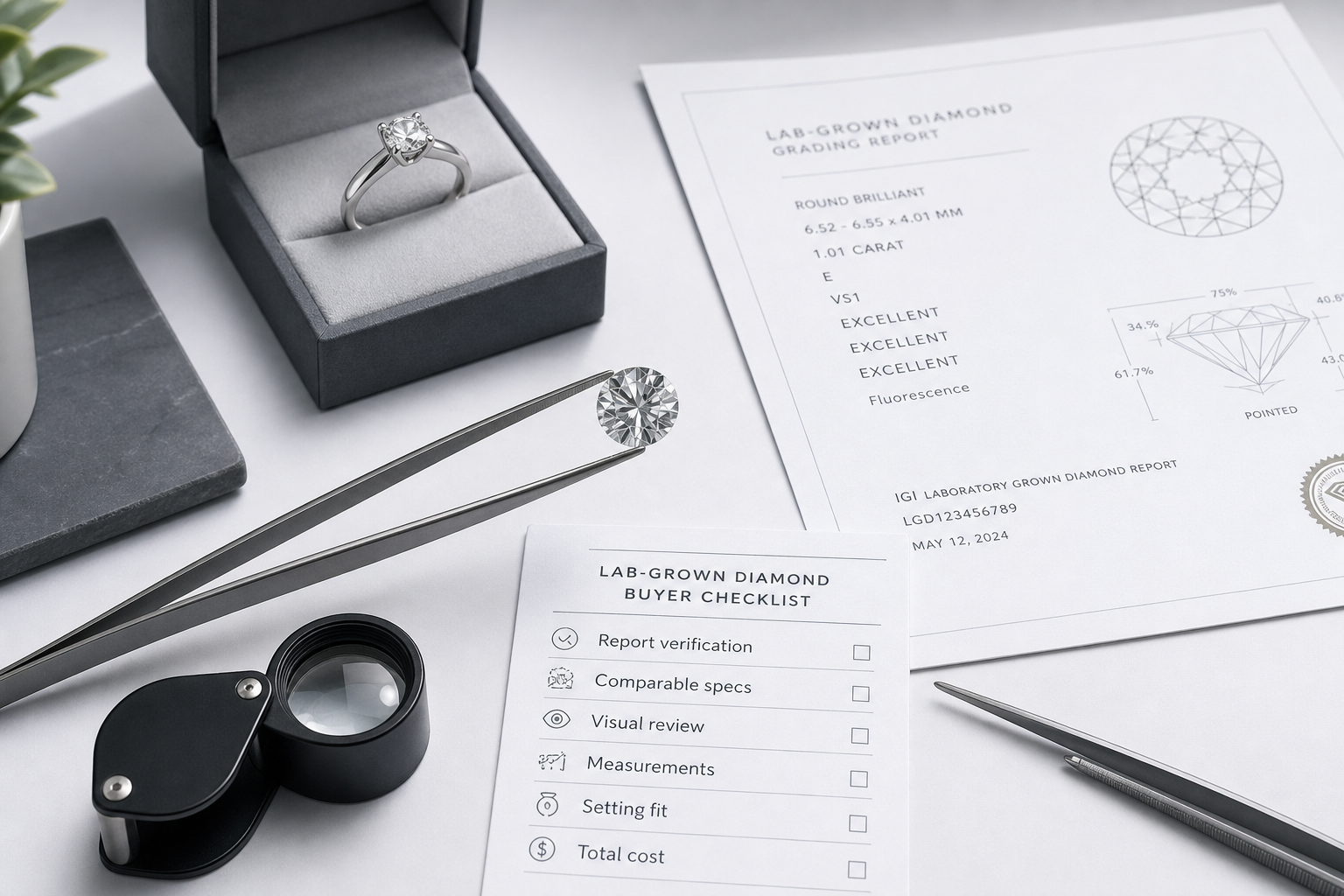
Fair pricing usually becomes clearer when the diamond is checked in sequence: report first, then comparable listings, then cut and measurements, then visual performance, then setting fit and total cost. Skipping that order is where buyers often get misled.
Start With the Report, Then Check the Actual Stone
The grading report should be the starting point because it gives structure to the comparison. It helps confirm the diamond’s stated carat weight, color, clarity, measurements, and other identifying details. Without a report, a buyer is being asked to trust a listing without enough independent context.
The report is not the finish line. It will not fully show whether the diamond looks bright, whether a fancy shape has an obvious bow-tie, whether the stone has a pleasing outline, or whether the proportions suit the setting. A diamond can look strong on paper and still be the wrong choice for a specific ring.
Use the report to narrow the field, then use images, video, and measurements to decide whether the listed price makes sense. This is the difference between buying a grade and buying a diamond.
Judge Price Against Comparable Diamonds, Not Isolated Listings
An isolated price can look impressive because there is no context. A diamond may seem inexpensive until it is compared with stones of the same shape, similar carat weight, similar color and clarity, stronger proportions, clearer visuals, and better documentation. It may also seem expensive until the comparison shows that it has better cut quality, more desirable measurements, or a more suitable appearance for the ring design.
The cleanest comparison uses a narrow range. If you are looking at a 2.00 ct round brilliant, compare it with other round brilliants close to that weight, not with ovals, radiants, or cushions. If you are looking at an elongated cushion, compare length-to-width ratio, facet style, and visual pattern, not just carat and color.
A fair lab-grown diamond value decision comes from comparing real alternatives, not reacting to the lowest number on a page.
Think in Terms of Total Value, Not Just Lowest Cost
Total value includes the diamond, the setting, the documentation, the visual result, and how well the finished piece fits the wearer. For an engagement ring, the cheapest center stone can become a poor decision if it forces a weak setting, creates an awkward profile, or does not deliver the look the buyer expected.
It is also worth separating purchase enjoyment from resale expectations. Most buyers choose lab-grown diamonds because they want diamond appearance, size access, design flexibility, and budget control. Those are valid reasons, but they are different from buying primarily for long-term resale value. Treating those goals as the same can lead to a confused decision.
A strong purchase is usually not the lowest-cost diamond available. It is the diamond that gives you the right combination of verified specs, attractive appearance, sensible setting fit, and a total ring cost that still feels comfortable.
Price Claims Should Be Current, Specific, and Comparable
Because lab-grown diamond pricing can vary by seller, report details, shape, cut quality, and available visual evidence, avoid relying on broad claims such as “this is the market price” unless the comparison is current and clearly defined. A useful price comparison should involve stones that are genuinely similar, not just stones that share one or two headline grades.
Prices can change with market conditions, report type, seller channel, and stone-specific details, so exact comparisons should be verified at the time of purchase. If a listing advertises a discount, buyers should ask what the discount is measured against and whether comparable stones support the final price.
When a seller presents a discount, ask what the discount is measured against. A markdown from a high list price does not automatically prove value. The more reliable question is whether the final price is reasonable compared with other available diamonds of similar shape, size, color, clarity, proportions, documentation, and visual quality.
In sourcing or wholesale conversations, documentation, consistency, and communication often matter as much as the headline specification. Buyers should clarify matching standards, report expectations, acceptable measurement ranges, visual review steps, and communication responsibilities before committing to a group of stones or a custom jewelry plan.
The Bottom Line: Lab-Grown Diamonds Cost Less Because the Market Works Differently
The clearest answer to why lab-grown diamonds are cheaper is not that they are fake, inferior by definition, or missing the qualities that make a diamond a diamond. The better answer is that their pricing is shaped by a different market. Supply can expand through controlled production, sellers compete in a more transparent environment, and buyers can compare similar stones more easily than they could in a less visible market.
That lower price can be a real advantage, but it should not be treated as the whole value story. A lab-grown diamond can be a smart purchase when the stone has credible documentation, strong visual performance, suitable proportions, and a setting that makes sense for the way it will be worn. It becomes a weaker purchase when the lower price distracts from poor cut, awkward measurements, unclear reporting, or a ring design that does not support the diamond well.
Lower Price Reflects Supply and Competition, Not Fake Materials
Lab-grown diamonds are real diamonds in the material sense, but they do not carry the same scarcity model as natural diamonds. That distinction matters. Authenticity answers what the stone is; price reflects how the market supplies, distributes, and compares it.
For most buyers, the practical takeaway is simple: do not reject a lab-grown diamond just because it costs less, but do not assume the discount automatically makes it the better buy. The lower price is logical when you understand supply scale, market competition, and price transparency. It is not a substitute for evaluating the actual diamond.
Quality Still Depends on the Individual Diamond
Price trends can make lab-grown diamonds more accessible, but individual stones still vary. Two diamonds with similar carat weight and grades can look different in real life because of cut precision, proportions, transparency, and how the stone interacts with the setting. The mistake is treating lab-grown diamonds as interchangeable just because the market has become more competitive.
A strong buying decision separates the market benefit from the quality decision. The market may give you access to a larger or better-specified stone for the budget, but the individual diamond still has to earn its place in the ring or piece of jewelry.
The Smartest Comparison Is Real Diamond, Real Specs, Real Tradeoffs
The right way to think about cheaper lab-grown diamonds is not “too good to be true” or “automatically the best value.” A better question is whether the price matches the stone’s specs, appearance, documentation, and intended use. That is where real value shows up.
Lab-grown diamonds are worth considering when the buyer wants diamond beauty, clearer comparison, and more flexibility within a budget. They are less suitable when the buyer’s main priority is geological rarity or long-term resale expectation. The smartest comparison accepts all three truths at once: the diamond is real, the market works differently, and the right choice still depends on the tradeoffs behind the price.
Disclosure: This article is for general educational purposes only. Diamond grading, pricing, availability, specifications, and seller policies can change, and readers should verify important details through grading reports, official laboratory tools, seller documentation, or qualified professionals before making a purchase decision. Laboratory-grown diamonds should be clearly distinguished from natural diamonds, and environmental or sourcing claims should be supported by specific documentation.