 Get a Quote
 Loose lab-grown diamonds10 shapes · IGI, GIA or NGTC reports
Asscher Lab-Grown Diamond Guide: Step-Cut Depth, Clarity, and Art Deco Style
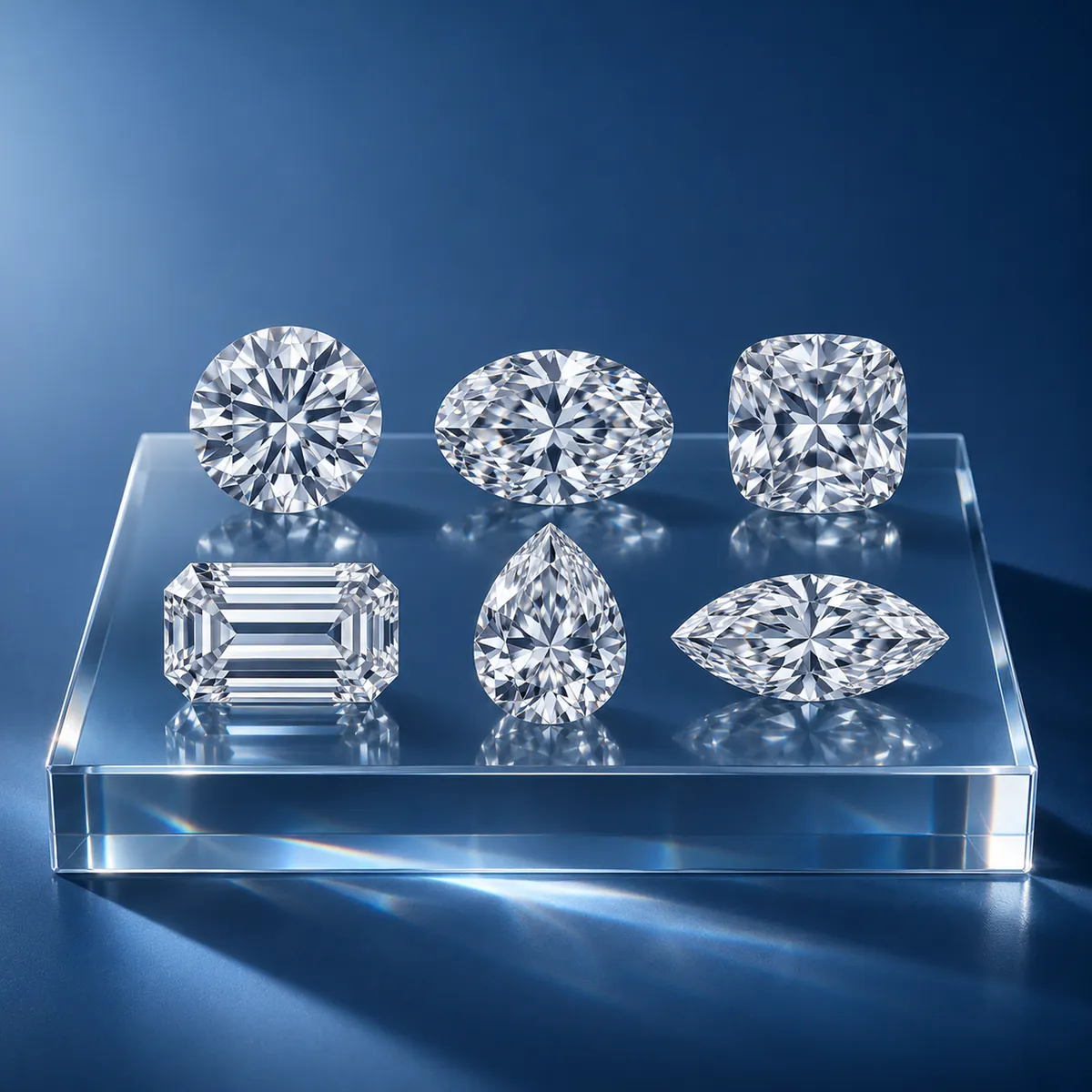
Look straight down into a well-cut Asscher and you see squares inside squares, with an X running from corner to corner. That pattern, first cut by the Asscher family in Amsterdam in 1902, is the reason to buy the shape, and it is also unforgiving: the same open facets that make the pattern let you see almost every inclusion and any hint of color.
The Asscher is a square step cut with cut corners, high crown and deep pavilion, giving a concentric “hall of mirrors” and an X or windmill pattern from corner to corner. Like the emerald cut, it shows inclusions and color more than brilliant shapes. Aim for VS1 or better clarity, F to G color in white metal, a ratio of 1.00 to 1.05, and even, concentric steps.
Asscher at a glance
The windmill pattern
A well-cut Asscher shows concentric squares and a visible X running from corner to corner, sometimes called a windmill. Uneven corners or misaligned steps break the pattern. Top-down video shows it best.
Clarity and color
The large, clear facets make inclusions easy to see. Check high-resolution video, especially under the table. Color is also more visible than in brilliant cuts.
Under GIA’s lab-grown assessment since October 2025, Premium needs D color, VVS clarity or better and Excellent polish and symmetry; Standard covers E to J and VS or better, with Very Good polish and Very Good symmetry (Good symmetry is accepted for fancy shapes). IGI and NGTC give full color and clarity grades, which are easier to compare for a shape this sensitive to both.
Depth and face-up size
A 1.00 ct Asscher is roughly 5.5 × 5.5 mm. Its depth gives the step pattern its look but makes it face up smaller than a round. Very shallow Asschers show a window in the center.
Asscher vs emerald vs princess
- Outline
- Square, cut corners
- Facets
- Step
- Look
- Art Deco, hall of mirrors
- Clarity needs
- High
- Outline
- Rectangle, cut corners
- Facets
- Step
- Look
- Elegant, elongated
- Clarity needs
- High
- Outline
- Square, sharp corners
- Facets
- Brilliant
- Look
- Sparkly, modern
- Clarity needs
- Moderate
Settings
Swipe the table to see more →
| Setting | Notes |
|---|---|
| Four claw prongs | Shows the corners |
| Art Deco halo with milgrain | Vintage style |
| Bezel | Clean, protective |
| Three-stone with baguettes | Step-cut harmony |
| Higher setting | Shows the depth |
Asscher vs royal Asscher
The original Asscher cut dates from 1902. Modern square step cuts with cut corners are sold as Asscher or square emerald cuts. Some branded variants add extra steps. Judge any of them by step symmetry and the windmill pattern.
Matching Asschers for earrings
Square step cuts make striking studs. Match outline, depth and step pattern as well as grades; step cuts show differences clearly.
Common mistakes with Asschers
- Choosing SI clarity without checking the table area.
- Accepting a shallow stone with a window.
- Comparing carat instead of measurements.
Asscher questions
What clarity should an Asscher be?
VS1 or better, or a VS2 confirmed eye-clean in video.
Is an Asscher the same as a square emerald cut?
Similar, but Asschers have larger cut corners, a higher crown and a deeper pavilion.
Does an Asscher look small?
It faces up smaller than a round of the same weight because it is deeper.
Find an Asscher with a clean pattern
Tell us the size and the color and clarity range, single stone or pair, and we will suggest Asschers with their measurements and reports. NUVU can arrange IGI, GIA or NGTC reports. Send your requirements or WhatsApp / WeChat +86 191 1840 3930.

12+ years in lab-grown diamond grading, identification and quality assurance for both HPHT and CVD stones.
About NUVU. NUVU is the international brand of New Perspective Superhard Materials Co., Ltd. in Zhecheng, Henan, China. We grow HPHT lab-grown diamonds in-house and cut, polish and match stones in our own workshop.
Related Guides
Shapes guide
Compare lab-grown diamond shapes: round, oval, emerald, radiant, cushion, pear, marquise, princess, Asscher, heart.
Read more →Diamond shapesEmerald cut guide
How to choose an emerald cut lab-grown diamond: clarity that looks clean, step symmetry, windowing, ratio, color in…
Read more →ShopLoose lab diamonds
Loose lab-grown diamonds in 10 shapes with IGI, GIA or NGTC reports.
Read more →