
Choosing clarity in a loose lab-grown diamond is not just about finding the highest grade on a grading report, and best color grade decisions can also shift with the metal and shape. The more useful question is whether the diamond looks clean to the eye in normal viewing conditions. Some inclusions that look obvious under magnification disappear in real life, while others become distracting because of their position, shape, size, or cut style.
For the full framework, read Loose Lab-Grown Diamonds Buying Guide.
This article helps you judge when clarity is worth paying for and when it is not. You will learn how viewing distance, lighting, diamond shape, carat size, facet pattern, photos, video, and grading reports all affect the decision. The goal is to compare individual stones more carefully, avoid overpaying for clarity you cannot see, and know when a higher grade may genuinely improve appearance.
| Buying Factor | What to Check | Practical Decision |
|---|---|---|
| Viewing standard | 10 to 12 inches, normal indoor light, no magnification | Ask the seller to define “eye-clean” clearly |
| Diamond shape | Round hides inclusions more often; emerald and Asscher reveal more | Use stricter clarity judgment for step cuts |
| Carat size | Larger face-up stones can make inclusions easier to notice | Recheck clarity carefully above 2 ct |
| Inclusion location | Center inclusions matter more than edge or hidden inclusions | A lower grade may work if flaws are well placed |
| Video review | Look for inclusions that stay visible as the stone turns | Prioritize real motion over magnified still images |
| Price difference | Compare stones that look equally clean face-up | Choose the better-matched stone, not automatically the higher clarity |
Quick Questions Before You Read
Q: Is “eye-clean” the same as a clarity grade?
No. It is a visual standard based on whether inclusions are visible without magnification in normal viewing conditions.
Q: Can a VS2 or SI1 lab-grown diamond be a good choice?
Yes, if the inclusions are not visible face-up and are not placed in distracting areas.
Q: Do photos tell the full story about clarity?
Not usually. Photos help locate inclusions, but 360-degree video is often better for judging real-life visibility.
Q: When should I pay for a higher clarity grade?
Consider it for larger diamonds, step cuts, open settings, or stones with visible center inclusions.
0. Before You Compare Clarity, Make Sure the Stone Is Described Correctly
For a lab-grown diamond purchase, the first layer of evidence is basic disclosure. GIA’s consumer guidance distinguishes laboratory-grown diamonds from natural diamonds, and FTC jewelry guidance expects environmental marketing claims to be specific and substantiated rather than vague marketing language.[1][2] That means the report, listing, and seller notes should all identify the same exact stone before you start debating whether it is eye-clean.
Laboratory-grown diamonds should be clearly identified as laboratory-grown, and they should not be presented as mined diamonds. Lab-grown diamonds and natural diamonds are both diamonds, but they have different origins. Diamond simulants are a separate category and should not be confused with laboratory-grown diamonds.
If the documentation is inconsistent, clarity comparisons become less reliable. A buyer can only evaluate whether a diamond is worth a premium when the stone’s identity, grading report, and video all line up. Once that is clear, the eye-clean question becomes much easier to answer in practical terms.
A useful traceability check is simple: compare the report number, shape, measurements, carat weight, color grade, clarity grade, and any listed inscription or identifying details against the seller’s listing and media. Small wording differences are not always a problem, but mismatched measurements, missing report references, or generic videos should be clarified before you compare prices. This step does not prove that one stone is better than another; it helps confirm that you are evaluating the correct diamond.
For NUVU, the buyer-first approach is to make the comparison clearer: what the report shows, what the visuals reveal, and whether the stone fits the intended piece. That process is especially useful for clarity decisions because a grade can narrow the search, while the exact inclusion location and real viewing evidence determine whether the diamond is truly eye-clean.
1. What “Eye-Clean” Actually Means for a Loose Lab-Grown Diamond
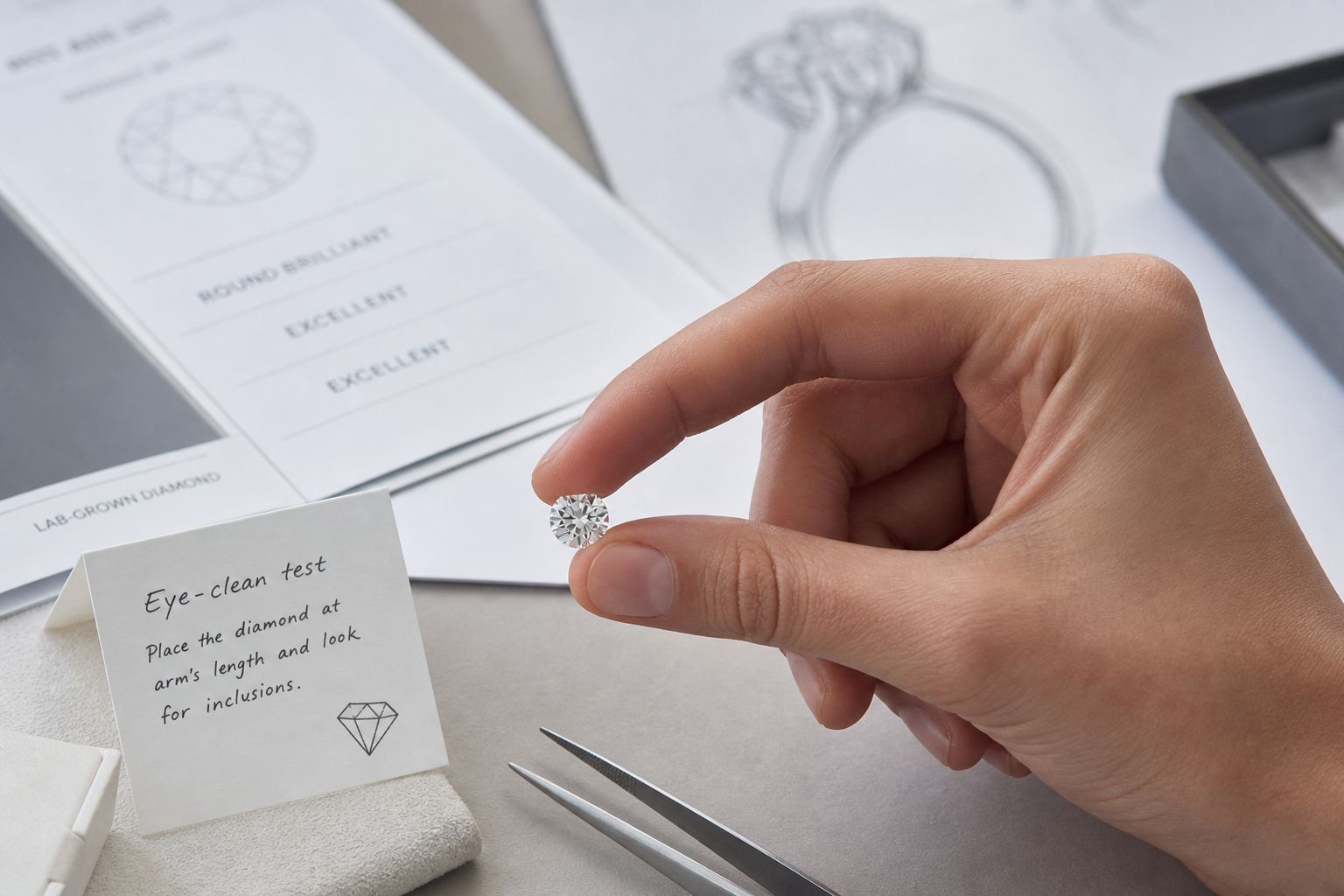
“Eye-clean” is a buying standard, not a lab grade. Two loose lab-grown diamonds can carry the same clarity label and still look different once they are in your hand, because the label only describes what was found under grading conditions. What matters to most buyers is simpler: does the stone look clean without magnification when you view it the way you normally would, at roughly 10 to 12 inches away under everyday indoor light? If the answer is yes, the diamond may be eye-clean even if it is not the highest clarity grade on paper.
For buyers, the practical point is that “eye-clean” is partly objective and partly personal. The objective part is whether an inclusion can be seen without magnification under a stated viewing condition. The personal part is how sensitive you are to small details once you know where they are. A careful seller should be able to separate those two ideas instead of treating one clarity grade as automatically right for everyone.
Why “eye-clean” is a buyer standard, not a lab grade
The phrase is useful because it shifts attention from paperwork to real-world appearance. A clarity grade can tell you that inclusions exist, but it does not tell you whether those inclusions will actually distract you. For a loose lab-grown diamond, that distinction matters. A stone can be technically lower graded and still look clean in normal use, while another with a higher grade may still show a detail if the inclusion sits in an obvious spot.
How viewing distance and lighting change what you can actually see
Eye-clean should not be judged in a vacuum. Move the diamond closer, and details that would never bother you at arm’s length can start to stand out. Switch from soft indoor lighting to a bright spotlight, and tiny features may become easier to spot. That is why the practical test is not “Can I find something under a loupe?” but “Can I see anything distracting when I look at the stone normally?” A practical clarity choice for a loose lab-grown diamond is the lowest grade that still passes that test in real viewing conditions.
Why sellers should define “eye-clean” in plain terms before the sale
Different sellers may use the phrase loosely, which creates unnecessary confusion. One seller may mean no visible inclusions at normal hand distance. Another may mean the stone looks clean only from the top view. Another may be assuming ideal lighting that does not match how most people will actually wear or inspect the diamond. If that standard is not stated clearly, the shopper has little to compare. A clear definition helps the buyer avoid paying for a higher clarity grade without getting a visible improvement.
What to Check Before You Decide
Before you treat a diamond as eye-clean, confirm the viewing distance, the light condition, and the angle used to make that claim. A stone that looks clean from one angle in soft light may reveal more when tilted or examined closer. Those details matter more than the phrase itself, because they tell you whether the seller is describing true everyday visibility or just a best-case presentation.
1.5. Compliance-Aware Clarity Language Buyers Should Understand
Because “eye-clean” is not a formal grading term, it should be supported by a clear viewing standard rather than used as a broad promise. A seller description is more useful when it says whether inclusions are visible without magnification, from which angle, in what lighting, and at what approximate distance. Without those details, “eye-clean” can become more of a marketing phrase than a reliable comparison tool.
A grading report helps document key characteristics, but it should not be treated as a guarantee of beauty, value, or sourcing ethics. It can support the buying decision by documenting measurable and assessed characteristics, while photos, video, seller communication, and setting compatibility help answer whether the exact diamond is right for the buyer’s intended use.
Prices can change with market conditions, report type, seller channel, availability, and stone-specific details, so exact comparisons should be verified at the time of purchase. If two lab-grown diamonds look equally clean to the eye, the lower clarity grade may be a reasonable option, but the final decision should still compare cut appearance, measurements, report details, and the planned setting rather than clarity alone.
4. How Diamond Shape Changes the Clarity You Can Get Away With
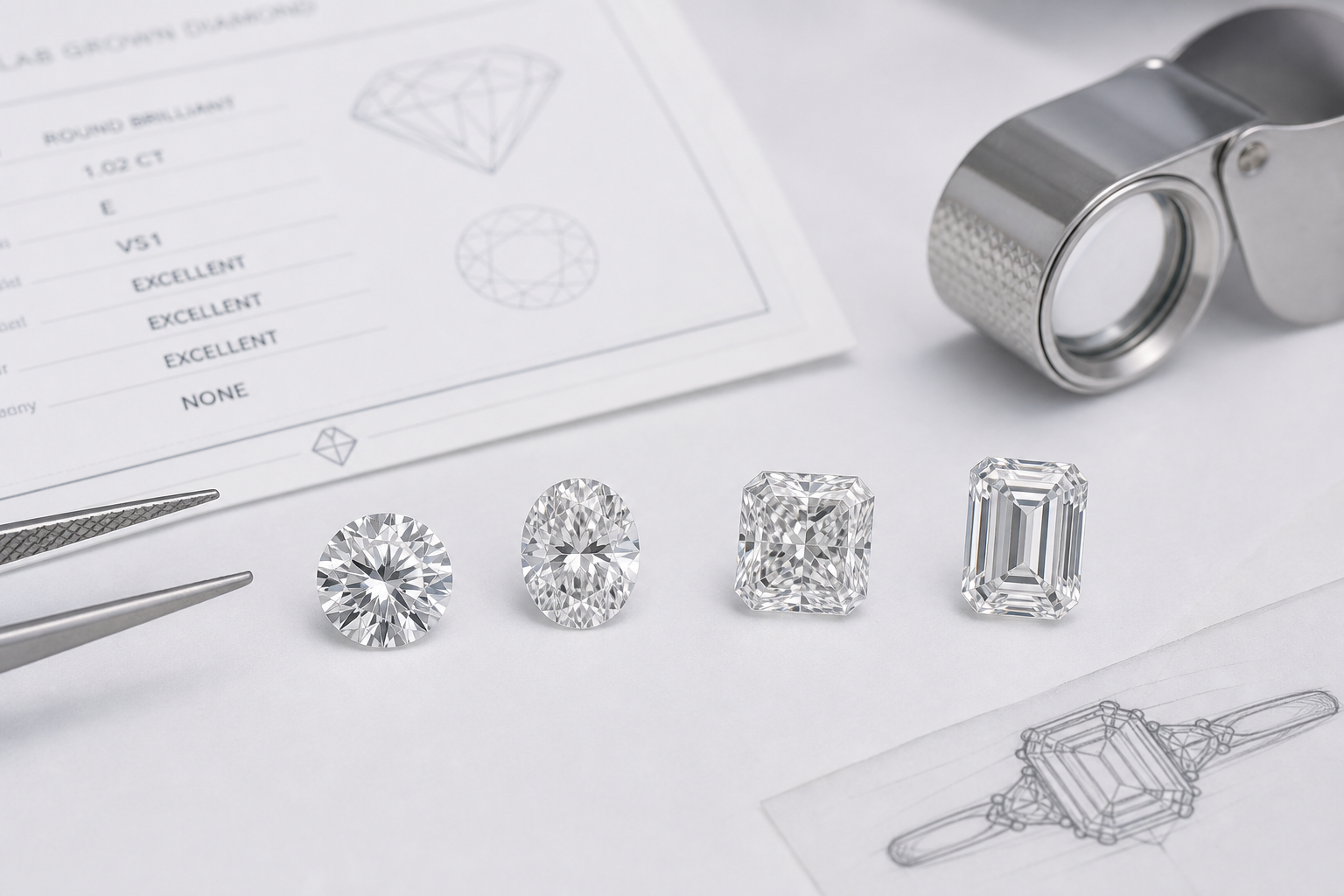
Shape changes how forgiving a diamond looks in real life. Two stones with the same clarity grade can behave very differently once you move from a round brilliant to a step cut, because the cutting style changes how much of the interior is hidden by sparkle. That is why “eye-clean” is not a fixed answer across every lab-grown diamond shape.
Why round brilliants are usually the easiest to keep eye-clean
Round brilliants are often forgiving for clarity because their faceting creates stronger light return and more visual movement. In practice, that sparkle can help mask small inclusions better than a cut that shows broad, open facets. For many buyers, a round brilliant gives a good chance of choosing a lower clarity grade without seeing anything distracting in normal viewing.
This does not mean every round brilliant is automatically clean to the eye. A poorly placed inclusion can still show up, especially if it sits near the center or becomes visible in certain lighting. But in many cases, round brilliants give you more room to prioritize overall balance over a top clarity label.
Why oval, cushion, and radiant cuts need more visual checking
Oval, cushion, and radiant cuts can still look excellent at strong clarity grades, but they deserve more review because the appearance of the stone depends heavily on where the inclusion sits and how the facets move light. An oval can hide small imperfections well in one position and reveal them in another. A radiant usually gives more forgiveness than a step cut, but it still has larger open flashes than a round brilliant, which can make a centered inclusion easier to spot.
The practical takeaway is simple: these shapes are often still eye-clean at modest clarity grades, but you should not assume the same clarity standard works across all three. A buyer choosing an oval lab-grown diamond should pay close attention to the exact stone, not just the grade on the report. That is especially true if the stone is larger or if the setting leaves a lot of the diamond exposed.
It is also worth separating clarity from other visual effects. In elongated shapes, for example, a buyer may notice facet contrast, dark areas, or a bow-tie effect and mistake it for a clarity issue. A higher clarity grade will not fix a shape-performance concern. When comparing these cuts, review the inclusion location and the overall light pattern separately so you do not pay for clarity when the real concern is cut appearance.
Why emerald and Asscher cuts usually demand a higher clarity standard
Emerald and Asscher cuts are step cuts, and step cuts are less forgiving because they emphasize structure instead of sparkle. Their broad, open facets make the interior of the stone easier to read, which means inclusions that would disappear in a round brilliant may be visible much sooner here. If you want an emerald cut to look clean to the eye, clarity often matters more than it does in most brilliant cuts.
This is where many buyers overcorrect. They either assume every step cut needs the highest clarity available, or they ignore the shape difference and choose the same grade they would for a round. Both approaches can lead to overspending or disappointment. A better approach is to accept that emerald and Asscher cuts often justify a higher clarity floor, but still judge the actual stone before paying for a large premium.
Stone-to-Setting Fit Check
Shape and setting style work together. An open setting with thin prongs or minimal metal can make inclusions easier to notice because more of the stone is exposed and there is less visual distraction around it. A more enclosed or visually busier setting may help soften what the eye catches, but it should not be used to hide a weak stone choice. For a buyer comparing loose diamonds, the right question is not just whether the diamond is eye-clean on paper. It is whether the shape still looks clean in the setting you plan to use.
For custom design, trust comes from matching the stone to the setting, budget, and wearer’s daily use, not from choosing grades in isolation. A stone that looks clean loose may still need a second look if the design exposes the pavilion, uses an east-west orientation, places side stones close to the center, or relies on a very open gallery. Measurements, prong placement, and viewing angles should be confirmed before finalizing the diamond.
For custom jewelry, stone measurements and setting compatibility should be confirmed before finalizing a purchase. This includes checking the stone’s millimeter dimensions, evaluating lab grown diamond cut quality alongside depth, girdle area, prong positions, and whether the design will expose an inclusion from the side or through an open gallery.
5. How Carat Size Changes What Counts as Eye-Clean
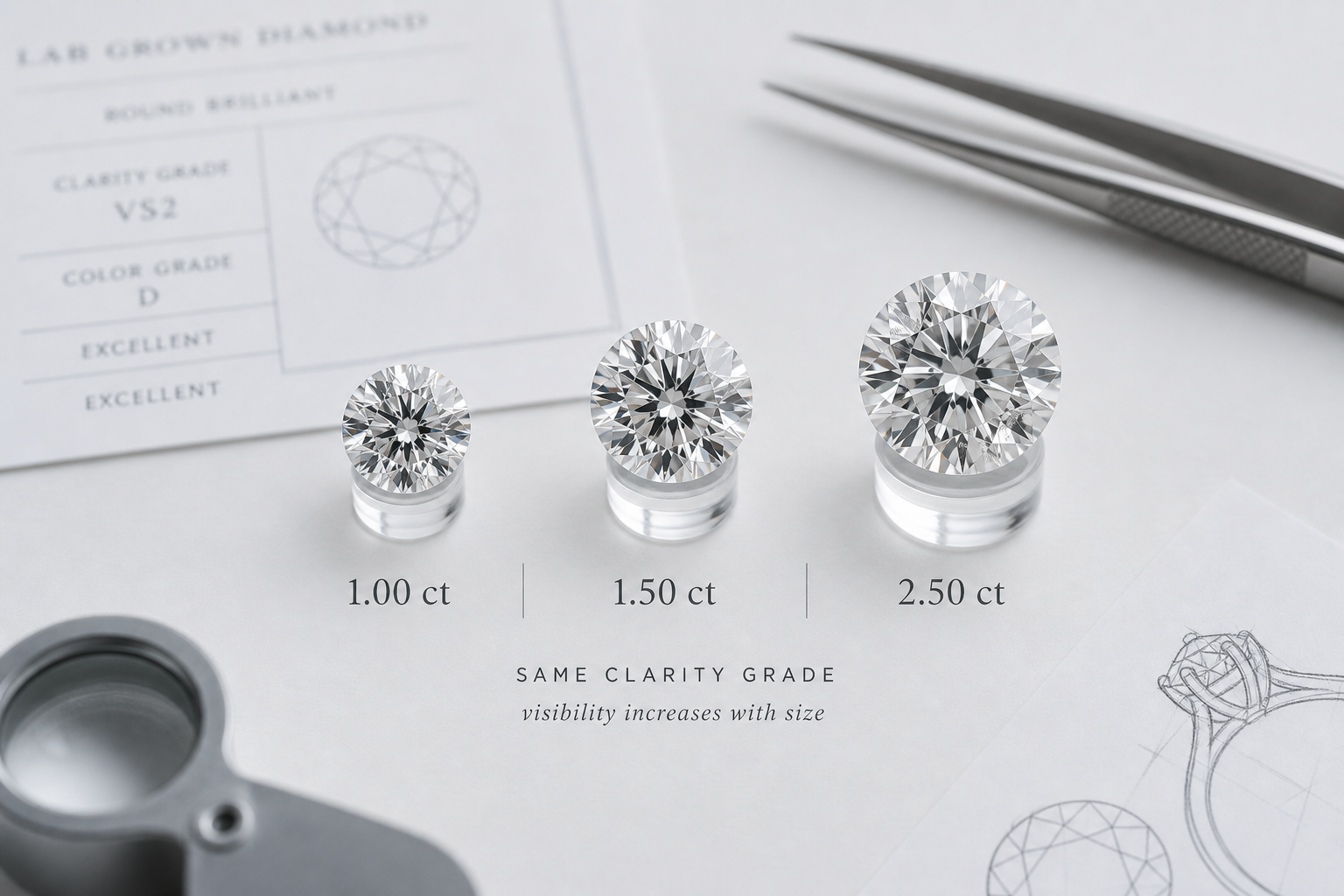
Carat size changes how strict you need to be about clarity. A small diamond can hide more simply because there is less surface area for the eye to inspect, while a larger stone gives imperfections more room to show. That means the same clarity grade can be a good option in one size and a weaker choice in another.
Why the same clarity grade can behave differently at 1 ct and 2 ct-plus
A 1.00 ct diamond and a 2.50 ct diamond should not be judged the same way. The larger stone usually presents a bigger face-up area, so a small inclusion has a better chance of drawing attention. A VS2 that looks clean in a 1.00 ct may still be fine in a much larger stone, but the buyer should verify it more carefully because the visual burden is different.
That is why clarity should not be chosen in isolation. Size changes the visibility of everything else. If you are shopping for an eye-clean 1 carat lab-grown diamond, the range of acceptable clarity grades may be broader than it would be for a 2 carat diamond clarity decision, where the same inclusion can become easier to see.
How face-up spread can make inclusions more noticeable than carat alone
Carat is weight, not just look. Two diamonds with similar weight can have different face-up spread depending on cut proportions, and that affects how clear they appear. A stone with more spread across the top can make inclusions more noticeable because the eye has a larger visible field to scan. This is one reason shoppers sometimes overfocus on carat and underfocus on the visual result.
If your goal is a clean-looking stone, face-up appearance matters more than the number itself. A 2.10 ct SI1 may look cleaner than expected if the inclusion is tucked away, while a smaller stone with a centered flaw may be more distracting than the grade suggests. The right move is to compare what the stone actually looks like, not just how large it is on paper.
How to keep the budget focused on the right upgrade
Clarity should get the budget only if it changes what you can see. If the stone already looks clean in normal viewing, pushing from SI1 to VS1 may deliver little visible benefit and a meaningful price jump. In that case, the better value may be to keep the clarity moderate and use the remaining budget on a better cut, a more suitable shape, or a slightly larger size.
For a buyer comparing a 1.20 ct VS2 and a 2.10 ct SI1, the bigger stone is not automatically the smarter buy or the weaker one. If both are eye-clean in normal viewing, the better choice depends on the design goal and how visible the inclusion is in the specific stone. That is the point where clarity becomes a tradeoff, not a ranking exercise.
For custom design, the loose stone should also be checked against the planned setting measurements. A prong position may cover a small edge inclusion, while a bezel, tension-style look, or high-profile setting may expose the stone from more angles. This does not mean a setting should be used to disguise a clarity problem, but it does mean that the same diamond can be a stronger or weaker choice depending on how it will be mounted.
What This Means in a Real Purchase
If two loose lab-grown diamonds both look clean from a normal hand distance, the more expensive clarity grade is often not the better value. A smaller, well-cut round brilliant may let you stay lower on clarity without any visible penalty, while a larger emerald cut may justify paying more because the stone reveals more of its interior. A practical choice is the one that keeps the diamond clean to the eye in the shape and size you actually want, not simply the one with the strongest label.
6. How to Read a Grading Report Without Paying Extra for Paper Quality
A grading report helps you narrow the field, but it does not replace seeing the exact stone. Buyers often overpay because they treat the report like proof of visual quality when it is really just one part of the decision. A recognized grading report can support confidence, but it cannot tell you everything about how a diamond will look in daily use.
What the report does confirm about clarity
The report gives you the clarity grade, measurements, and, when provided, a plotted map or description of where some inclusions are located. That is useful because it helps you compare stones consistently and check whether a seller’s description matches the document.[3] If a stone is labeled VS2 and the report shows a small inclusion near the edge, that is a very different buying signal from a stone with a more central plot pattern.
In practical terms, the report is most valuable when it helps you verify that the stone you are looking at is the stone being sold. GIA’s grading-report guidance is aimed at documenting a diamond’s measured characteristics and assessed quality factors, which is why report data should be read together with photos and video rather than treated as a standalone promise about appearance.[3]
For a lab-grown diamond grading report, the most useful job is verification. It tells you what the lab saw and how it classified the stone. It does not, by itself, answer the more important buyer question: will this exact diamond look clean to my eye in normal viewing?
What the report cannot tell you about real-world visibility
A report cannot show you how the stone behaves in motion, under different lighting, or at a normal viewing distance. It also cannot tell you how noticeable an inclusion feels once the diamond is set in a ring. That gap matters because a technically lower grade can still look excellent, while a higher grade can still be more than the actual appearance requires.
This is where paper quality gets overrated. A cleaner-looking report does not always mean a cleaner-looking diamond. If two stones are both eye-clean in practice, paying extra for a higher clarity label may not improve anything except the paper comparison.
Why report details should be matched against measurements and imagery
The report becomes much more useful when you read it alongside the stone’s measurements, photos, and video. Size affects how visible an inclusion can be, and the plotted position matters just as much as the grade. A small inclusion near the edge may be less of a concern than a similar mark directly under the table, especially in a larger stone or a step cut.
A grading report should also be read for what it does not claim. It can document characteristics such as clarity, measurements, and other graded details, but it does not guarantee beauty, long-term value, ethical sourcing, or that every buyer will perceive the stone the same way. Treat the report as a verification document, then use imagery, seller communication, and setting fit to decide whether the diamond is the right purchase.
When growth method or post-growth treatment is relevant, buyers should look for clear disclosure in the grading report or seller documentation. For lab-grown diamonds, HPHT and CVD commonly refer to growth methods; post-growth treatment is a separate issue and should not be assumed unless it is clearly disclosed or documented.
At NUVU, we treat the report as the starting point, not the final answer. The report helps narrow the options, but the visual check still decides whether the stone is worth the premium.
Buyer Verification Checklist
Before paying more for clarity, cross-check three things: the clarity grade on the report, the plotted inclusion location, and the actual photos or video of the exact stone. If the report shows a grade you are comfortable with and the images confirm that nothing is visible without magnification, there is usually no reason to move up a clarity tier just for comfort.
- Confirm the clarity grade on the report.
- Review the inclusion plot or clarity comments and note where the inclusion sits.
- Match the report to the stone’s measurements and shape.
- Check photos and video at normal viewing distance, not only magnified close-ups.
- Decide whether the visual result changes enough to justify a higher price.
When a grading report is available, buyers should verify the report details through the issuing laboratory’s official report-check tool where available, then compare those details with the exact stone’s photos, video, measurements, and seller description.
6.5. A Practical Traceability Path for One Exact Loose Diamond
Traceability in a clarity decision is not about adding more paperwork for its own sake. It is about making sure every piece of information points to the same individual stone. The report number, laser inscription if listed, carat weight, measurements, shape, color, clarity, and media should form one consistent record. If a listing shows a 2.01 ct oval but the report or video appears to reference a different measurement set, the clarity conversation should pause until the mismatch is explained.
Buyers should also distinguish between a sample image and exact-stone evidence. A sample image can help illustrate a shape or setting style, but it cannot confirm whether a particular VS2 or SI1 diamond is eye-clean. For clarity shopping, exact-stone video, magnified imagery, and a report that matches the listed specifications are more useful than general product photography.
This type of cross-check is especially important when comparing several similar lab-grown diamonds at once. Two stones may share the same color, clarity, and carat weight, but the inclusion plot, table size, depth, and visual behavior can be different. A clear comparison record helps prevent a buyer from choosing based on the best-looking label instead of the best-matched stone.
6.8. How to Compare Price Without Making Unsupported Value Assumptions
Clarity decisions often become price decisions, but price should be compared carefully. A lower clarity grade is not automatically the better deal, and a higher clarity grade is not automatically overpriced. The comparison only makes sense when the stones are similar in shape, carat weight, color, cut appearance, measurements, report type, and visual cleanliness.
Prices can vary because of cut precision, report type, seller channel, size, shape, availability, and documentation. Buyers should compare like-for-like specifications before treating one stone as a better value. If one diamond costs more, the right question is whether that added cost reflects a visible benefit, a preferred report, a harder-to-find size or shape, or simply a clarity label that does not change the face-up result.
It is also useful to separate personal reassurance from visible improvement. Some buyers prefer a higher clarity grade because it feels easier to own, compare, or explain. That can be a valid personal preference, but it should not be confused with a guaranteed improvement in beauty, resale value, or long-term financial outcome.
7. How to Use Photos, 360-Degree Video, and Seller Notes to Confirm Eye-Clean Quality
Photos and video are useful only if you know what to look for. A still image can make a diamond seem cleaner than it is, or more flawed than it will appear in normal viewing. The better test is how the stone looks as it turns, because inclusions that stay hidden from most angles are usually less of a concern than ones that flash into view every time the diamond moves. For a loose lab-grown diamond, that motion matters more than a polished product photo.
Start with the video, not the prettiest image. Watch the stone at several angles and look for whether any inclusion stays fixed in one spot or becomes obvious as the diamond rotates. A small feature near the edge may disappear in motion, while a similar feature under the center can draw the eye much faster. If the seller only shows one flattering angle, the stone has not really been vetted. Eye-clean verification should be based on the full view, not the best frame.
Magnified photos still matter, but for a different reason. They help you locate the inclusion, not judge it at the same scale you would use in real life. A close-up can make a pinpoint or tiny feather look dramatic, even if it is invisible at normal distance. That is why a buyer should use magnified images to answer one question only: where is the feature sitting, and is it likely to be noticeable when the stone is worn?
Media can also create false confidence if it is too compressed, too bright, or filmed in a way that hides the table area. A useful comparison uses consistent lighting and shows the exact stone, not only a sample image for the shape. If the report, video, and seller notes do not line up, slow down the decision and ask for clarification before treating the stone as eye-clean.
Seller notes should do more than repeat “eye-clean.” The useful version is specific: the inclusion is not visible without magnification at normal viewing distance, a standard often emphasized in a loose lab diamond clarity guide, or the feature is only noticeable from the side under close inspection. If the seller will not say what viewing distance they used, the claim is too vague to rely on. A stone that is called eye-clean at six inches under bright light is not the same as one that is clean at arm’s length in ordinary indoor conditions.
Before you decide, ask three things: whether the seller checked the stone in motion, what distance they used to make the call, and whether any inclusion can be seen without magnification. If the answer to any of those is unclear, treat the clarity grade as a starting point rather than a final verdict. At NUVU, we usually treat video and seller notes as the practical filter that separates a good paper grade from a stone that actually looks right.
What to inspect in 360-degree video
Watch for how the inclusion behaves as the stone turns. If it disappears from most angles, it is usually less important than a feature that stays centered and visible no matter how the diamond moves. Also pay attention to whether the video is high enough quality to show the whole stone without hiding the very area you need to inspect. A useful video reveals the inclusion’s position, not just the sparkle.
Why magnified photos help and mislead at the same time
Magnified images are best used as a map. They can confirm whether the inclusion sits under the table, near the edge, or off to one side, which helps you judge visibility. They can also overstate the problem by enlarging details that would be invisible in real use. A buyer who reacts to the enlargement instead of the actual viewing distance can end up paying for a higher clarity grade than the stone needs.
What to ask the seller before you decide
Ask whether the “eye-clean” claim was based on normal hand distance, whether the stone was checked in motion, and whether any inclusion can be seen without magnification. If the seller can answer clearly, you have something real to work with. If the answers stay vague, the more cautious move is to keep looking or request better evidence.
How to Verify This Before Buying
Request a motion video, confirm the viewing distance used for the eye-clean call, and ask for a direct yes-or-no answer on whether any inclusion is visible without magnification. If the stone passes those checks, the report and the media are working together. If they do not, the clarity grade alone is not enough to justify the price.
7.5. Why Sustainability Claims Should Stay Separate From Clarity Decisions
Lab-grown diamonds are sometimes marketed with broad environmental language, but those claims should be read carefully. FTC guidance warns that environmental marketing statements need to be adequately qualified and substantiated, so a phrase like “eco-friendly” should not be treated as a general assumption about every stone.[2]
For clarity shopping, the useful takeaway is that environmental language does not make a diamond look cleaner, and it does not reduce the need to inspect inclusion location, video, and report details. The better clarity decision is still the one based on what you can actually see in the exact stone you plan to buy.
Sustainability claims should be specific and documented. Broad language is less useful than clear information about production context, energy claims if made, seller transparency, and what evidence supports the statement. A responsible clarity decision keeps these topics separate: evaluate the stone’s visual quality through report and imagery, and evaluate environmental or sourcing language through documented, limited claims rather than assumptions.
Lab-grown diamonds may appeal to buyers looking for an alternative to mined origin, but environmental and sourcing claims should be specific, documented, and limited to what can be substantiated. A clarity grade or grading report does not prove sustainability, responsible sourcing, or energy impact.
8. When Higher Clarity Is Worth Paying For and When It Is Not
Higher clarity is worth paying for only when it changes the way the stone looks, not when it mainly improves the number on the report. That is the central decision buyers should keep in mind. A cleaner paper grade can be useful, but it is not automatically better value. The right question is whether the upgrade gives you a visible improvement or just a more expensive label.
For many buyers, a smaller round brilliant in a classic setting does not need a major clarity premium if the stone already looks clean in normal viewing. The cut style gives you some forgiveness, and the setting often hides part of the body of the stone. On the other hand, a larger emerald cut or an open solitaire can expose more of what is inside the diamond. In those cases, paying for better clarity may make sense because the extra cost has a real visual purpose.
The same logic applies when the stone is getting larger. As face-up size increases, the eye has more surface area to scan, which makes small features easier to notice. That does not mean every larger stone needs a top-tier clarity grade. It means the buyer should be more selective about where the inclusion sits and how obvious it becomes in motion. Spending more on clarity is smart only when the stone’s size makes the difference visible.
There is also a preference side to this decision. Some buyers feel more comfortable owning a higher clarity grade even if the difference is not visible day to day, and that preference is valid if it fits the budget. The important distinction is to know whether you are paying for visible appearance, personal reassurance, or future comparability on paper. Those are different reasons, and they should not be presented as the same value.
Paying more for clarity makes more sense when the stone is large, the cut style is less forgiving, or the setting leaves the diamond exposed from multiple angles. Emerald and Asscher cuts are the clearest example, but the same idea applies to any design where the interior of the stone is easy to inspect. If the buyer wants a very open look and knows they will notice even small details, the premium can be justified.
If the stone already looks eye-clean in normal viewing conditions, moving up one or two clarity grades may change very little in daily use. That is especially true for brilliant-style cuts in settings that do not spotlight the interior of the stone. In those cases, the extra money often buys reassurance rather than a visible upgrade. Reassurance has value, but it should not crowd out more meaningful decisions.
How to balance clarity with cut, size, and total project cost
Clarity should usually be judged after the cut and size decision, not before it. A buyer who spends too much on a higher clarity grade may end up compromising on the parts of the stone that matter more to how it looks, such as spread or shape performance. The smarter move is to choose the lowest clarity grade that still looks clean, then use the remaining budget where it will be seen more clearly. That often produces a better overall diamond choice than chasing the highest clarity number first.
What This Means in a Real Purchase
If two stones both look eye-clean, the better value is often the one with the lower clarity grade and the stronger overall balance of size, shape, and setting fit. Move up only when the specific stone makes that upgrade visible. If it does not, the premium is mostly paper quality.
8.5. Verification and Purchase Confidence
Before you finalize a loose lab-grown diamond purchase, it helps to have a simple verification path that ties the report, the images, and the seller’s description together. Clarity is a visual decision, so confidence should come from clear documentation and the ability to check the exact stone, not from pressure to buy a higher grade than you need.
A practical final review should connect four pieces of evidence: the grading report, the seller’s listing, the exact-stone imagery, and the intended setting. If those pieces support the same conclusion, the clarity decision is easier to defend. If one piece conflicts with the others, the buyer should ask for clarification before treating the stone as the right match.
Buyers should also confirm the seller’s return, resizing, documentation, and after-sales terms before purchase, because those are business policies that vary by seller. Those terms should be checked directly rather than assumed from the presence of a grading report or the use of the phrase “eye-clean.”
When a report number is provided, buyers should compare the report details with the issuing laboratory’s official verification tools where available. A report is useful evidence, but it should still be read alongside the exact stone’s visual performance and setting compatibility.
9. Common Questions Buyers Ask Before Choosing an Eye-Clean Lab-Grown Diamond
This is where the decision gets simpler. Most buyers are not trying to buy the highest clarity possible. They are trying to avoid paying extra for a difference they will not notice. The rule stays the same: if the stone looks clean in normal viewing conditions, the higher clarity label may not be worth the added cost.
What clarity grade is enough for most loose lab-grown diamonds?
For many buyers, a well-chosen VS2 is a strong starting point, and many SI1 stones can also look eye-clean if the inclusion is well placed. The right answer depends on the exact stone, but the key is not to start with the highest grade. Start with the lowest grade that still looks clean in normal viewing and work up only if the video or report gives you a reason to do so.
Is SI1 too risky for an engagement ring?
Not automatically. SI1 can be a very good option if the inclusion is small, off to the side, or difficult to see without magnification. It becomes riskier when the feature sits under the table or the stone is large enough that the eye has more room to find it. The grade alone does not tell you enough; the actual placement does.
Do I need VVS if I want the stone to look very clean?
Usually no. VVS can be useful if you want extra comfort or you are choosing a shape and setting that make inclusions easier to spot, but it is not required for a diamond to look clean to the eye. Many buyers pay for VVS when what they really want is confidence, not a visible improvement. That is a real preference, but it is not the same as necessity.
Can an eye-clean diamond still be a weak value?
Yes. A stone can look clean and still be priced in a way that does not match the benefit it delivers. Value depends on the full picture: how the stone looks, how much you are paying, and whether a lower clarity grade would look the same in real use. Eye-clean is the first test, not the only one.
Final Buyer Checklist
Before you buy, confirm three things: the stone looks clean at normal viewing distance, the video shows how it behaves in motion, and the report details match the visual evidence. If the clarity upgrade does not change what you can actually see, you probably do not need to pay for it. If it does, the premium is more defensible.
[1] Gemological Institute of America, “Lab-grown diamond terminology and identification guidance,” Gemological Institute of America, accessed 2026.
[2] Federal Trade Commission, “Guides for the Use of Environmental Marketing Claims (Green Guides),” Federal Trade Commission, current guidance.
[3] Gemological Institute of America, “Diamond grading report and lab-grown diamond report guidance,” Gemological Institute of America, accessed 2026.
Disclosure: This article is for general educational purposes only. Diamond grading, pricing, availability, specifications, and seller policies can change, and readers should verify important details through grading reports, official laboratory tools, seller documentation, or qualified professionals before making a purchase decision. Laboratory-grown diamonds should be clearly distinguished from natural diamonds, and environmental or sourcing claims should be supported by specific documentation.