
Lab-grown diamond certification is useful because it gives you a factual way to compare stones, but it does not tell the whole story. A grading report can confirm identity, measurements, color, clarity, cut data, and whether the diamond is lab-grown, yet an engagement ring buyers guide should also account for beauty, brilliance, and the best value for your setting. That is why the real buying decision is not simply “which report looks best,” but which diamond actually fits the ring, the budget, and the look you want.
For the full framework, read Lab-Grown Diamond Certification Guide.
This article shows how to read a grading report without overpaying for paper grades or missing visual issues that matter more in the finished stone. You will see which details should be verified first, when measurements matter more than carat weight, and how to use photos, video, and proportions to judge whether a diamond is a strong choice for your specific needs.
One useful habit is to treat the report as a comparison tool, not a verdict. It narrows the shortlist, but the final choice should still be checked against visual evidence, setting plans, and the buyer’s own priorities.
| What to Check | Why It Matters | Use It To Decide |
|---|---|---|
| Report number and lab-grown disclosure | Confirms the stone matches the document | Verify the listing before paying |
| Carat weight vs. measurements | Carat shows weight, not face-up size | Compare visual spread, not just weight |
| Color and clarity | Easy to overbuy on paper grades | Choose grades that look clean in context |
| Cut, proportions, polish, symmetry | Often affects sparkle more than small grade upgrades | Prioritize visible performance and balance |
| Photos and 360 video | Reveals bow-tie, brightness, and transparency issues | Use visuals to break close ties |
| Setting and shape match | Some stones suit certain designs better | Check whether the diamond fits the intended ring |
Quick Questions Before You Read
Q: Does a grading report guarantee a diamond will look better?
No. It verifies measurable details, but appearance still depends on cut, proportions, and how the stone looks in photos or video.
Q: Should I focus on carat weight or measurements?
For appearance, measurements and spread often matter more than carat weight alone.
Q: Is higher color or clarity always worth paying for?
Not always. Many buyers can choose grades that look clean and bright without paying for paper prestige.
Q: What should I check before trusting an online listing?
Match the report number, lab-grown disclosure, shape, measurements, and visual evidence to the seller’s listing.
What Lab-Grown Diamond Certification Means
Certification Is a Documented Description, Not a Guarantee of Beauty
Lab-grown diamond certification means a third-party grading lab has evaluated a diamond and recorded its key characteristics in a formal document. Most buyers call this document a diamond certificate, but the more accurate term is a diamond grading report. It describes the stone’s identity and measurable qualities; it does not promise that the diamond will look beautiful to you, be fairly priced, or be the right choice for a specific ring.
This distinction matters because beginners often treat certification as a quality stamp. A certified lab-grown diamond is not automatically a better-looking diamond than every uncertified or differently graded stone. The report gives you a standardized starting point, which is useful, but the buying decision still depends on how the diamond’s specifications, appearance, setting, and price work together.
A grading report helps document key characteristics, but it should not be treated as a guarantee of beauty, value, or sourcing ethics. It can tell you what the laboratory recorded about the stone under grading conditions; it cannot tell you whether the diamond suits your taste, your ring design, or your comparison set at the moment you buy.
Why Beginners Often See the Word “Certificate”
The word “certificate” is common in retail because it is easy to understand. It suggests documentation, verification, and a record that can be checked. In everyday shopping language, asking whether a diamond is “certified” usually means asking whether it comes with a report from a recognized grading laboratory.
Still, the word can create a false sense of finality. A grading lab is not certifying that the diamond is the best choice for your budget or that it will look larger, brighter, or cleaner than another stone with similar grades. It is documenting what the lab observed and measured under grading conditions. That makes the report valuable, but not personal. It cannot know whether you are choosing a solitaire engagement ring, a hidden halo, a three-stone design, or a loose diamond for comparison shopping.
How a Grading Report Helps You Compare Diamonds More Safely
A lab-grown diamond report helps you avoid comparing stones based only on sales descriptions. Instead of relying on vague terms like “premium,” “high quality,” or “excellent value,” you can look at documented information such as carat weight, measurements, color, clarity, cut data, polish, symmetry, fluorescence if listed, and lab-grown disclosure.
The practical value is consistency. If two diamonds are both described as 2.00 carat lab-grown diamonds, the report helps you see whether they are actually comparable. One may have a better face-up size, a stronger cut profile, a lower clarity grade that still looks clean, or a higher color grade that may not matter much in the intended setting. Lab-grown diamond certification is most useful when it keeps you from overpaying for one impressive grade while missing a more important tradeoff somewhere else.
A grading report can narrow the comparison, but it should be read alongside the stone’s proportions, visual evidence, and intended jewelry use. For NUVU, the goal is to make diamond comparison easier to understand, especially when buyers are weighing report details, visual performance, setting fit, and budget together.
Compliance-Safe Way to Think About Certification
For beginners, the safest reading is this: the report documents the diamond, while the buyer still evaluates the purchase. The report may confirm that a diamond is laboratory-grown, identify its grading results, and list measurable details, but it does not verify every claim a seller might make around the diamond. Claims about pricing, environmental impact, sourcing, return terms, warranties, or long-term value should be checked separately through seller documentation and current purchase terms.
This boundary is not meant to make the report less useful. It makes the report more useful because it keeps each claim in the right category. Identity and grading belong on the report. Beauty needs visual evidence. Price needs current comparison. Setting fit needs measurements and design review. Sustainability or sourcing claims need specific supporting documentation beyond the grading report itself.
What to Check First
When you first open a diamond grading report, do not start by looking for the highest grade on the page. Start with identity and comparability. Confirm that the report belongs to the diamond being offered, that the stone is disclosed as laboratory-grown, and that the basic specifications match what the seller is advertising.
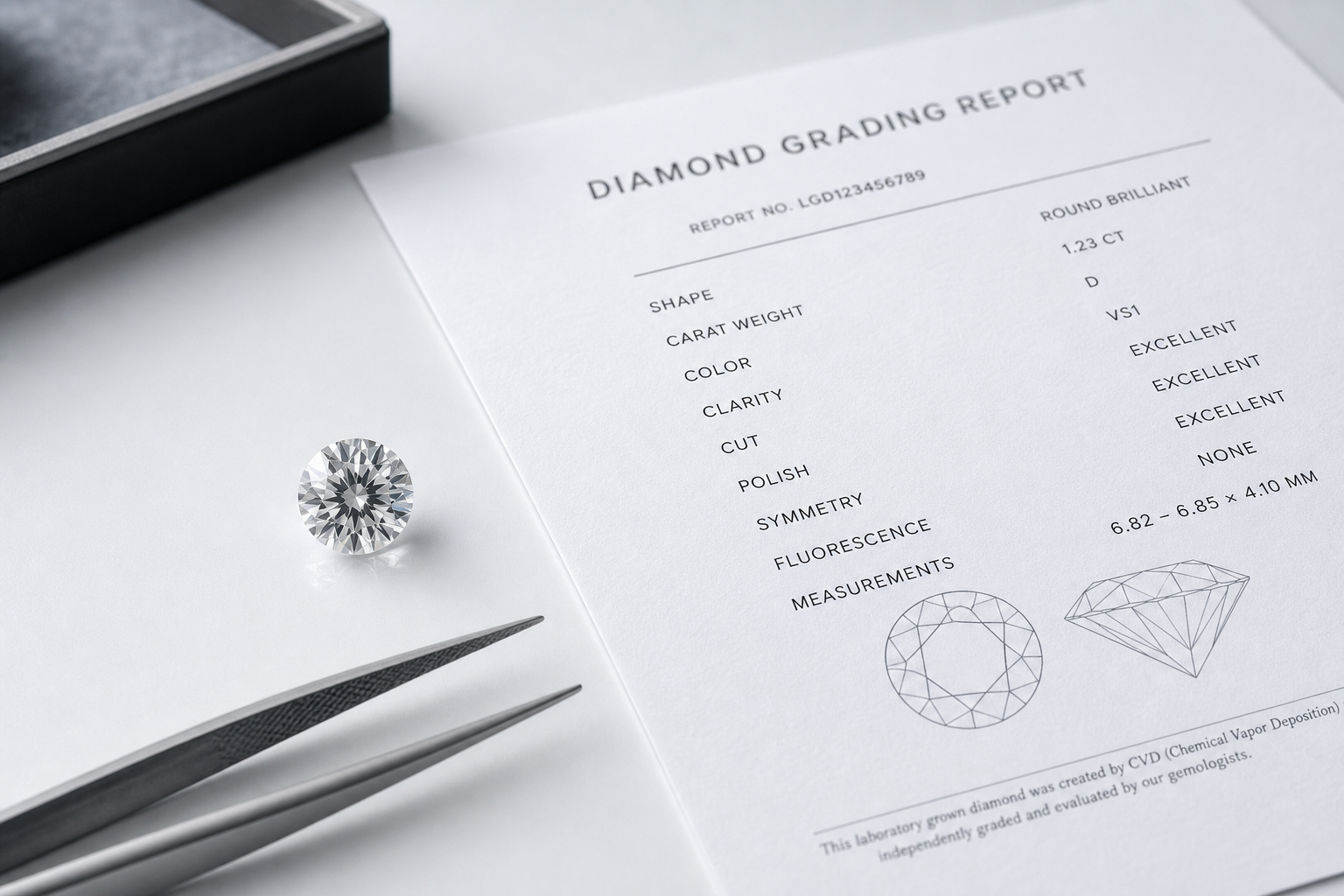
For a beginner, the first pass should focus on four things: the report number, the lab-grown disclosure, the shape and carat weight, and the measurements. These fields tell you whether you are looking at the right diamond and whether it is physically comparable to other options. Color, clarity, and cut details matter, but they are easier to judge once you know the report is legitimate and the diamond’s size profile makes sense.
The Report Number and Lab-Grown Disclosure
Why the Report Number Matters
The diamond report number is the identification anchor of the document. It connects the physical diamond to the grading report issued for that specific stone. Without it, you are mostly trusting that the document shown to you belongs to the diamond being sold.
Many grading labs allow buyers to enter the report number into an online verification tool to confirm that the digital record matches the document. This is a simple step, but it catches one of the easiest mistakes in diamond buying: comparing or purchasing based on a report that has not been verified against the actual stone. If the listed carat weight, shape, color, clarity, or measurements differ from the seller’s description, pause before moving forward.
Some certified diamonds may also have a laser inscription on the girdle that matches the report number. This can be helpful, especially for loose diamonds, but it should not be assumed in every case. The safer approach is to verify the report through the issuing lab and ask the seller how the stone is matched to the document.
When a grading report is available, buyers should verify the report details through the issuing laboratory’s official report-check tool where available.
How Lab-Grown Origin Is Disclosed on the Report
A lab-grown diamond report should clearly disclose that the diamond is laboratory-grown. Depending on the grading lab and report format, you may see wording such as “laboratory-grown,” “lab-grown,” “synthetic,” or similar language that identifies the diamond’s origin. The exact phrasing varies, but the point should be unmistakable.
This disclosure is not a minor detail. It tells you that the diamond was created in a controlled growth environment rather than mined from the earth. For a buyer, this keeps comparisons honest. A lab-grown diamond should not be priced, presented, or evaluated as if it were a natural diamond, even if the two can share the same basic grading categories for color, clarity, and carat weight.
Laboratory-grown diamonds should be clearly identified as laboratory-grown, and they should not be presented as mined diamonds. Natural diamonds and laboratory-grown diamonds have different origins, while diamond simulants are a separate category of non-diamond lookalikes. A grading report or seller listing should make those distinctions clear enough that the buyer is not left guessing what type of product is being offered.
What CVD, HPHT, or Growth Method Notes May Indicate
Some reports include growth method information, such as CVD or HPHT. These terms refer to the processes used to grow lab-created diamonds. CVD stands for chemical vapor deposition, while HPHT stands for high pressure, high temperature. For a beginner, the growth method is usually less important than the diamond’s finished appearance, grading details, and verification.
The mistake is assuming that one growth method automatically makes a diamond better. A well-cut, clean-looking CVD diamond can be a strong choice, and a well-made HPHT diamond can be a strong choice. A poorly selected diamond from either method can still have visual issues. If the report lists growth method or post-growth treatment notes, use that information as transparency context, not as a shortcut for judging beauty or value.
When growth method or post-growth treatment is relevant, buyers should look for clear disclosure in the grading report or seller documentation. HPHT and CVD may describe growth methods for laboratory-grown diamonds, and treatment status should not be assumed unless the report or seller documentation specifically states it.
How to Verify This Before Buying
Before buying, match three things: the seller’s listing, the grading report, and the lab’s verification record. The shape, carat weight, measurements, color, clarity, and report number should line up. If the diamond is shown with a magnified video or photo, the seller should be able to connect that visual evidence to the same report.
A practical verification sequence is simple: check the report number through the grading lab, confirm that the report states the diamond is laboratory-grown, compare the main specifications against the listing, and ask whether the report number is inscribed on the diamond if that matters to you. If any part of that chain is unclear, the risk is not necessarily that the diamond is bad; the risk is that you do not yet have enough confidence that the document and the stone match.
Carat Weight, Measurements, and Why Size Is More Than One Number
Carat Weight Tells You Weight, Not Face-Up Appearance
Diamond carat weight measures how much the diamond weighs. It does not directly tell you how large the diamond will look when viewed from above. This is one of the most common misunderstandings beginners bring to a grading report.
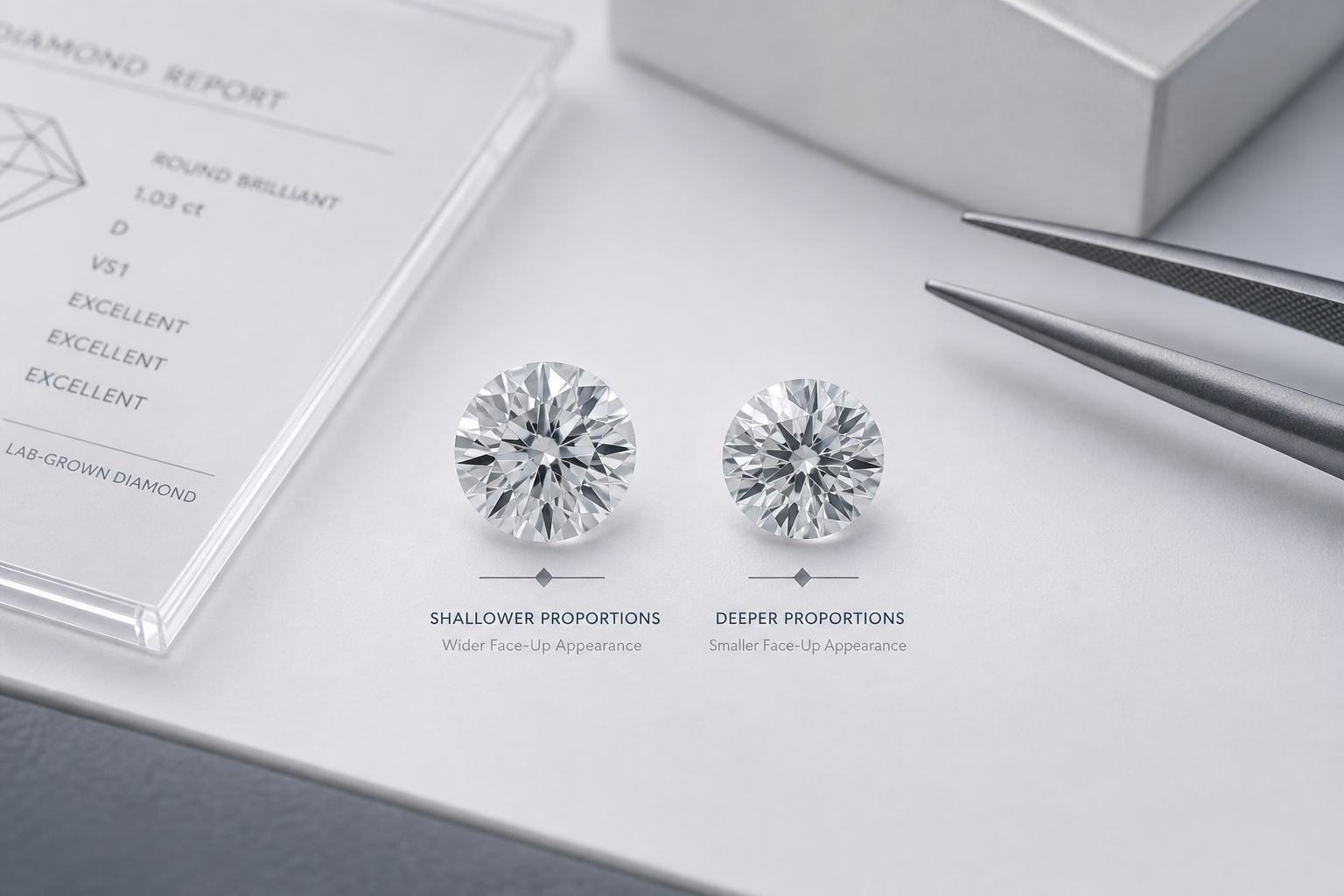
Two diamonds can both be listed as 1.50 carats and still look slightly different on the hand. One may carry more weight in its depth, while the other may spread more across the top. The deeper stone can weigh the same but appear smaller face-up. The wider stone may look larger, but if the proportions are pushed too far, it may sacrifice visual performance. Carat weight is important, but it should never be read without the measurements beside it.
Measurements Show Length, Width, and Depth
Diamond measurements show the stone’s physical dimensions, usually in millimeters. For round diamonds, the report typically lists diameter and depth. For fancy shapes such as oval, emerald, cushion, radiant, pear, or marquise, the report usually lists length, width, and depth.
These numbers help you understand how the diamond will occupy space in a setting. A 1.50 carat round diamond may measure around the low 7 millimeter range in diameter, but individual stones can vary depending on proportions. A difference of 0.10 to 0.20 millimeters may sound small on paper, yet it can be noticeable when two stones are compared side by side, especially in engagement ring center stones.
For elongated shapes, the length-to-width relationship also affects the visual style. A 2.00 carat oval with a 1.35 ratio will look softer and wider, while one closer to 1.50 may look longer and slimmer. Neither is automatically better. The better choice depends on the wearer’s preference, finger shape, and setting design.
Why Two Diamonds With the Same Carat Can Look Different
Same carat does not mean same visual size because weight can be distributed differently. If more weight sits below the girdle, the diamond may look smaller from the top. If more of the weight is spread across the face-up area, the stone may look larger, but it still needs enough depth and proportion balance to avoid looking flat or visually weak.
This is where the grading report helps you avoid buying by headline size alone. A buyer comparing two 1.50 carat round diamonds might see one measuring approximately 7.25 mm and another closer to 7.35 mm. The larger diameter may be appealing, but it is not automatically the better diamond. If the larger-looking stone has less balanced proportions, the smaller-looking option may still be the stronger visual choice.
The right judgment is not “choose the biggest spread.” It is “check whether the spread makes sense for the shape and whether the diamond still has the appearance you want.” Measurements are a warning system as much as a size guide.
Useful Measurement Checks for Beginners
Start by comparing diamonds within the same shape and similar carat range. A 1.50 carat oval and a 1.50 carat round will not face up the same way, so their measurements should not be judged by the same expectation. Shape changes how size appears.
For round diamonds, look at diameter in relation to carat weight and then consider depth percentage when available. If a round stone is noticeably smaller in diameter than similar stones of the same carat, it may be carrying extra weight in depth. If it spreads unusually wide for its weight, check whether the proportions still support good appearance.
For elongated shapes, compare length, width, and the length-to-width ratio. Many buyers focus only on carat weight and then feel surprised when one oval looks short and full while another looks narrow and long. The report gives you the numbers to catch that before the diamond is set.
A useful beginner habit is to compare at least three nearby options rather than reading one report in isolation. If several diamonds of the same shape and carat range cluster around similar measurements, an outlier deserves closer review. It may be a smart choice for a specific style, or it may be hiding a tradeoff that the carat weight alone does not reveal.
Color and Clarity Grades on a Lab-Grown Diamond Report
What the Color Grade Tells You
The diamond color grade tells you how much body color a diamond shows under controlled grading conditions. For most lab-grown diamonds, the scale starts at D color, which is considered colorless, and moves downward through near-colorless and faint-color ranges. On a lab-grown diamond report, this grade gives you a standardized way to compare one stone against another instead of relying on product photos alone.
The practical question is not always whether a diamond has the highest possible color grade. It is whether the color will be noticeable in the diamond’s actual shape, size, and setting. A D color diamond may look slightly cleaner on paper than an F or G color diamond, but many buyers will not see a meaningful difference once the stone is mounted, especially in smaller sizes or in yellow gold settings. In white gold or platinum, color differences may be easier to notice, particularly in larger stones and elongated shapes where color can concentrate toward the tips or edges.
Color sensitivity is also personal. Some buyers immediately notice warmth; others care far more about size, shape, or sparkle. The mistake is treating color grade as a universal status ranking. For many buyers, staying in a well-chosen near-colorless range can make more sense than paying for a top grade that does not change the way the diamond looks on the hand.
What the Clarity Grade Tells You
The diamond clarity grade describes the presence of internal characteristics, called inclusions, and surface characteristics, called blemishes. A lab-grown diamond clarity grade helps identify how clean the stone is under magnification, but it does not automatically tell you whether the diamond will look clean to the naked eye.
For everyday buying decisions, the key term is eye-clean. An eye-clean diamond has clarity characteristics that are not noticeable in normal viewing conditions. A VS clarity diamond is often a practical target because many stones in this range appear clean without requiring the buyer to pay for extremely high clarity grades. Some SI clarity stones can also be eye-clean, but they require more careful review because the type, size, color, and location of inclusions matter more at that level.
The report may list grade-setting characteristics such as crystals, needles, clouds, feathers, or pinpoints. This information is useful, but it has limits. A small inclusion near the edge may be hidden by a prong, while a darker inclusion under the table can be much more distracting even if the overall grade is the same. Two diamonds with the same clarity grade can look very different when viewed in video or under close-up photography.
Why “Higher Grade” Is Not Always the Most Practical Choice
Higher color and clarity grades can be desirable, but they are not always the smartest use of budget. The clearest example, especially in discussions of lab grown diamond differences, is a buyer choosing between a D color, VVS clarity diamond and an F color, VS clarity diamond with better overall appearance or a more suitable size. If both stones look colorless and eye-clean in the intended setting, the higher grades may add paper value without adding visible value.
This matters because color and clarity are easy to overbuy. Beginners often feel safer choosing the highest grades they can afford, but a diamond report should not be read like a trophy list. Once color is visually acceptable and clarity is eye-clean, other parts of the decision may have a bigger effect on how satisfied the buyer will be. A diamond that looks balanced in its setting is usually a better choice than one that wins on color and clarity but sacrifices more visible qualities.
The recommendation changes when the diamond is large, step-cut, or being set in a minimal design where the stone is highly exposed. Emerald cuts and Asscher cuts, for example, tend to reveal clarity characteristics more readily than brilliant cuts. Larger diamonds can also make both color and inclusions easier to see. In those cases, moving higher in color or clarity can be practical rather than decorative.
How Metal Color and Setting Style Change the Best Choice
The same color or clarity grade can look different once the diamond is set, which is why the intended jewelry design should influence the report reading. A stone that looks very white in platinum may read slightly warmer in yellow gold, but that warmth may be less noticeable or even desirable depending on the buyer’s taste. In the same way, a setting with a busy halo or detailed basket can hide some clarity concerns, while a minimalist solitaire leaves the stone more exposed and makes small details easier to see.
For practical buying, this means the better grade is not simply the highest grade on paper; it is the grade that still looks right in the chosen metal and design. That is also why a report should be read together with the setting plan, not after the ring is already fixed. If the buyer expects a low-profile solitaire, the diamond may need a more careful visual review than it would in a more decorative setting.
Certificate and Visual Review Check
When reading color and clarity on a lab-grown diamond report, start by asking whether each grade changes the real viewing experience. For color, compare the grade with the metal color, diamond shape, and stone size. For clarity, look beyond the letter grade and check whether the listed inclusions are likely to be visible face-up.
A useful beginner filter is simple: do not pay more for a color or clarity grade unless it solves a visible problem or supports a specific design goal. If the diamond already appears bright, clean, and appropriate for the setting, chasing a higher grade may not improve the final ring in a way the wearer can actually see.
Cut, Polish, and Symmetry: The Report Fields That Affect Appearance
Why Cut Often Matters More Than Beginners Expect
The diamond cut grade is one of the most appearance-sensitive fields on a grading report, especially for round brilliant diamonds. Cut affects how well the diamond returns light, which is why two stones with the same carat, color, and clarity can look noticeably different in brightness and sparkle.
Beginners often give too much attention to color and clarity because those grades feel easy to rank. Cut is less intuitive, but it usually has a stronger effect on what people notice first. A very high color diamond with weak light return can look flat, while a well-cut diamond with slightly lower color or clarity can appear livelier in normal wear.
For round diamonds, cut grading is more standardized, so an Excellent or Ideal-style cut grade, depending on the lab’s terminology, can be a useful first filter. For fancy shapes, such as oval, emerald, pear, radiant, and cushion cuts, the report may not provide the same kind of overall cut grade. In those cases, proportions, measurements, and visual review become more important because the report gives less of a complete appearance judgment.
What Polish and Symmetry Actually Describe
Polish and symmetry describe finish quality, not overall beauty. Polish refers to the smoothness and quality of the diamond’s facet surfaces. Symmetry refers to how precisely the facets align and how balanced the diamond’s shape and facet pattern are. Both can affect appearance, but they should not be treated as substitutes for cut performance.
For most buyers, Excellent or Very Good polish and symmetry are generally workable grades. The difference between Excellent and Very Good may not be obvious in normal viewing unless the diamond has other proportion or appearance issues. A buyer should be more cautious when finish grades drop lower, because poor finish can affect crispness, pattern balance, or the overall impression of the stone.
The important distinction is that polish and symmetry are supporting fields. They can help confirm that a diamond is well-finished, but they do not prove that the diamond has strong light performance. A stone can have Excellent polish and symmetry and still have proportions that make it look less lively than another diamond with better overall cut behavior.
How Proportions Help You Compare Similar Diamonds
Proportions give the report more practical value when two diamonds look similar on paper. Fields such as table percentage, depth percentage, crown angle, pavilion angle, and measurements help explain why one diamond may face up larger, brighter, or more balanced than another. These numbers are not decorative; they help you identify stones that deserve closer visual review.
Depth percentage is especially useful because it affects how the diamond’s weight is distributed. If too much weight is hidden in the depth, a diamond can look smaller from the top than its carat weight suggests. If proportions are too shallow, the diamond may spread well but lose light performance. The tradeoff is not simply “bigger is better.” A diamond should have enough spread without sacrificing brightness or pattern quality.
Table percentage also matters, particularly in round brilliant diamonds. A table that is very large or very small can change the balance of brightness, fire, and pattern. The report will not tell you whether you personally prefer that look, but it can flag when two diamonds with the same grade may perform differently enough to compare side by side.
Beginner Proportion Check for Round Diamonds
For round brilliant diamonds, beginners can use approximate proportion ranges as a first screen, not as a final verdict. Many well-cut round diamonds fall around a table percentage in the mid-50s to low-60s and a depth percentage around the low-60s. A round diamond with a table near 54–58% and depth around 60–62.5% is often worth closer consideration, while numbers far outside common ranges should prompt a more careful visual check.
These ranges are not universal rules. Crown and pavilion angles also interact with table and depth, and two diamonds with similar numbers can still look different. The practical judgment is to use proportions to avoid obvious mismatches, then rely on images or video to confirm whether the diamond actually looks bright, balanced, and appealing.
If two certified round lab-grown diamonds have the same carat weight and color grade, but one has a better cut grade, more balanced proportions, and a stronger face-up appearance, that stone will often be the more practical choice even if the other diamond has a slightly higher clarity grade. In real buying terms, a small clarity upgrade rarely compensates for a noticeably duller diamond.
What a Grading Report Verifies and What It Does Not Decide
What the Report Can Confirm
A diamond grading report confirms the characteristics the laboratory evaluated and documented for that specific stone. For a certified lab-grown diamond, this usually includes the report number, lab-grown disclosure, shape, carat weight, measurements, color grade, clarity grade, and finish details such as polish and symmetry. Depending on the lab and report type, it may also include cut grade, proportions, fluorescence, inscription details, and comments about growth method or post-growth treatment.
This information gives buyers a common language for comparison. Without a report, two diamonds can be described with similar marketing terms but have very different specifications. With a report, the buyer can compare documented facts rather than relying only on product names, photos, or seller descriptions.
The most useful reports are not valuable because they make the decision for you. They are valuable because they reduce uncertainty. They help confirm what the diamond is, how it was graded, and whether the seller’s description matches an independent document.
What the Report Cannot Decide for You
A grading report does not decide whether a diamond is beautiful, fairly priced, or right for a specific ring. It does not show how the diamond moves in light, whether an inclusion is noticeable to your eyes, whether a fancy shape has a distracting bow-tie, or whether the stone’s proportions suit the setting you want.
It also is not the same thing as an appraisal. A grading report describes the diamond’s characteristics. An appraisal typically estimates value for insurance or replacement purposes and may include the finished jewelry piece. Confusing the two can lead buyers to overestimate what certification is meant to prove.
The report also cannot decide emotional preference. Some buyers prefer a warmer diamond in yellow gold. Others want the crispest colorless look possible. Some want maximum size; others want tighter proportions and visual balance. The report can inform those choices, but it cannot rank personal priorities for you.
Why Certification Works Best as a Comparison Tool
Certification works best when it is used to compare diamonds with similar goals. If you are looking at two lab-grown diamonds in the same shape and carat range, the report helps you compare measurable differences: one may have better proportions, one may carry a higher clarity grade, and one may face up larger because of its measurements. Those differences are easier to judge when they are read together rather than one grade at a time.
The biggest mistake is letting a single impressive grade dominate the decision. A D color grade does not fix poor proportions. A high clarity grade does not guarantee a lively appearance. A larger carat weight does not always mean a better-looking diamond on the hand. The report should narrow the field, not create tunnel vision.
At NUVU, the grading report is treated as a starting point for comparison rather than the full answer. The stronger buying decision comes from combining the report with visual evidence, setting requirements, and a clear sense of which tradeoffs actually matter for the wearer.
Claims the Report Should Not Be Used to Prove
It is important not to stretch a grading report beyond its purpose. A report may identify a laboratory-grown diamond and document its grading characteristics, but it does not by itself prove that the diamond is more sustainable, ethically preferable, fairly priced, or likely to retain value. Those are separate claims that require separate support.
Prices can change with market conditions, report type, seller channel, and stone-specific details, so exact comparisons should be verified at the time of purchase. A buyer comparing two stones should avoid treating one report grade as a price guarantee. Instead, compare like-for-like specifications, visual evidence, availability, seller terms, and the setting plan before deciding whether one option is more appropriate.
What This Means in a Real Purchase
In a real purchase, the report should help you reject weak options and compare strong ones more carefully. If a diamond lacks a credible report, the buyer has less protection against vague or incomplete claims. If a diamond has a report but poor images, limited measurement context, or unclear setting fit, the buyer still does not have enough information to make a confident decision.
A practical approach is to treat the grading report as the document that confirms the diamond’s identity and specifications, then use visual review and design context to decide whether the stone is actually the right choice. The safest decision is rarely based on one grade. It comes from the relationship between the report, the way the diamond looks, and the way it will be worn.
Why Visual Review Still Matters After Certification
Photos and 360-Degree Video Reveal What the Report Cannot
A diamond grading report gives you documented specifications, but it does not show how the diamond behaves when it moves. Diamond photos and 360 video help reveal the parts of appearance that numbers cannot fully capture: brightness, contrast, patterning, transparency, and whether any feature draws the eye in an unflattering way.
This matters most when two certified lab-grown diamonds look nearly identical on paper. A report may show the same carat weight, color grade, clarity grade, and similar measurements, while the videos show a clear difference in liveliness. One diamond may return light evenly across the stone; another may look dull in the center or show uneven contrast that becomes obvious as it rotates.
For online buyers, 360 video is especially useful because it shows movement rather than a single best angle. Still photos can be helpful, but they may not reveal how a diamond handles light across the full stone. If a diamond has no video, no magnified image, and no clear visual documentation, the buying decision becomes more dependent on trust in the seller rather than evidence from the stone itself.
Eye-Clean Appearance Depends on Real Viewing Conditions
Clarity grade is not the same as eye-clean appearance. A certified lab-grown diamond with a VS2 grade may look clean to the naked eye, while another VS2 may have a dark inclusion near the center that is easier to notice. The grade tells you the overall clarity category; it does not always tell you whether the specific inclusion will bother you in daily wear.
Location matters more than many beginners expect. A small inclusion near the edge may be covered or visually softened by a prong, while a similar inclusion under the table can be more noticeable. Color, contrast, and inclusion type also matter. A white feather may be less distracting than a dark crystal, even if the report places both stones in the same clarity grade.
Eye-clean judgment also changes with size and shape. Larger diamonds give inclusions more visible area, and elongated shapes can make certain internal features easier to spot. If the diamond is intended for an engagement ring worn every day, the practical question is not whether the report grade sounds impressive. The better question is whether the stone looks clean from normal viewing distance and whether any visible feature will become distracting once set.
Shape-Specific Issues May Not Be Obvious from the Report Alone
Some visual issues are tied to shape, and they may not be fully described by the report. Oval, pear, and marquise diamonds can show a bow-tie effect, a darker band across the center caused by how light and shadow interact in the cut. A mild bow-tie can be normal and even add contrast, but a strong one can make the center look flat or dark.
Emerald and asscher cuts have a different risk. Their step-cut facets do not hide inclusions or body color as easily as brilliant cuts, so a clarity or color grade that works well in a round diamond may feel less forgiving in a step cut. Cushions and radiants can vary widely in facet pattern, with some looking crisp and lively while others appear crushed, watery, or uneven in video.
Visual review is also where diamond transparency becomes easier to judge. A stone can have acceptable grades and still look slightly hazy, milky, or low in contrast. The report may list fluorescence or clarity characteristics, but the buyer still needs images or video to see whether the diamond appearance is clean and lively enough for the intended setting.
Buyer Scenario: Two Certified Ovals, One Better Visual Choice
Consider a buyer comparing two certified 2.00 ct oval lab-grown diamonds for a solitaire engagement ring. Both reports show near-colorless grades, similar measurements, and clarity grades in a range many buyers would consider safe. On paper, the first diamond appears slightly stronger because it has the higher clarity grade.
In video, the difference changes the decision. The higher-clarity oval shows a strong bow-tie through the center, making the stone look darker when it tilts. The second oval has a slightly lower clarity grade, but its inclusions are off to the side and not visible at normal viewing distance. It also shows more even brightness across the face of the stone.
In that situation, the second diamond is often the better visual choice, even though one report field looks less impressive. The grading report narrowed the comparison to two credible options. The diamond visual review showed which one would likely look better in the ring.
How to Compare Two Certified Lab-Grown Diamonds
Start With Matching Basics Before Comparing Grades
To compare certified lab-grown diamonds well, start by making sure you are comparing the right things. Two reports are only meaningfully comparable if the diamonds share the same basic category: shape, approximate carat weight, grading laboratory context, and intended use. A 1.80 ct oval and a 1.80 ct round are not competing on the same terms, because their face-up size, cut standards, and visual risks are different.
Report verification should come before grade comparison. Check that each lab-grown diamond grading report has a valid report number and that the online verification details match the seller’s listing. If the report says one measurement, color, or clarity grade and the listing says another, treat that as a warning sign until it is explained clearly.
After verification, compare the basics in a controlled order: shape first, then carat range, then measurements. Beginners often jump straight to color and clarity because those grades are easy to understand, but measurements usually tell you more about how the diamond will present in the jewelry. If one diamond carries more weight in the depth and faces up smaller, the higher carat number may not deliver the size advantage the buyer expects.
It is also worth checking any comments or secondary notes on the report. Features such as fluorescence, growth-related comments, or additional remarks do not automatically make a diamond better or worse, but they can explain why two stones that look similar on paper behave differently in video or in specific lighting. Those notes are context, not a verdict, so they should be read alongside the main grades rather than treated as the whole story.
Compare Measurements and Cut Before Chasing Higher Color or Clarity
Once the basics match, cut and measurements should usually carry more weight than a one-grade difference in color or clarity. For many buyers, a well-proportioned G color, VS2 diamond will be a more practical choice than a D color, VVS stone that looks smaller, darker, or less balanced because of its proportions.
This is especially important when two diamonds are close in price. A buyer may assume the higher color or clarity grade explains better value, but that is not always true. If the lower-graded diamond has a better face-up spread, stronger visual performance, and no visible inclusions, it may be the more practical purchase. Paying for invisible grade improvements can leave less budget for the qualities that affect appearance every day.
For round brilliant diamonds, compare cut grade, table percentage, depth percentage, and measurements together. For fancy shapes, where report-based cut grades may be limited or less standardized, measurements and video become even more important. Length-to-width ratio, outline, brightness pattern, and center appearance often decide whether the stone feels elegant or awkward.
Use Visual Evidence to Break Close Ties
When two reports are close, visual evidence should break the tie. Look at magnified photos, 360 video, and any available real-light imagery. The goal is not to find a diamond that looks flawless under extreme magnification; it is to find one that looks balanced, clean, and appealing in realistic use.
If one diamond has a slightly better clarity grade but a more noticeable dark inclusion in the center, the grade should not win by default. If one has a higher color grade but looks less bright because of proportions, the color grade should not carry the decision. In practical evaluation, a broader lab grown diamonds guide framework can help separate report-based specifications from visible performance before final comparison. A certified diamond should still be judged as a physical stone, not as a collection of isolated report fields.
Price belongs at the end of the comparison, not the beginning. A lower price is only meaningful if the diamond still meets the visual and specification standards that matter for the purchase. A higher price is only justified if the difference is visible, useful, or relevant to the setting and buyer preference.
How to Keep Price Comparisons Fair
Price comparisons are most useful when the stones are truly comparable. A lower listed price may reflect different report details, availability, seller channel, measurements, cut precision, visual quality, or service terms. A higher listed price may or may not be justified depending on whether the difference is visible or relevant to the buyer’s design goals.
Before treating one lab-grown diamond as a better deal, compare the full context: report issuer, report date if shown, shape, carat weight, measurements, color, clarity, cut-related details, photos, video, and setting compatibility. Prices can vary because of cut precision, report type, seller channel, size, shape, availability, and documentation. Buyers should compare like-for-like specifications before treating one stone as a better value.
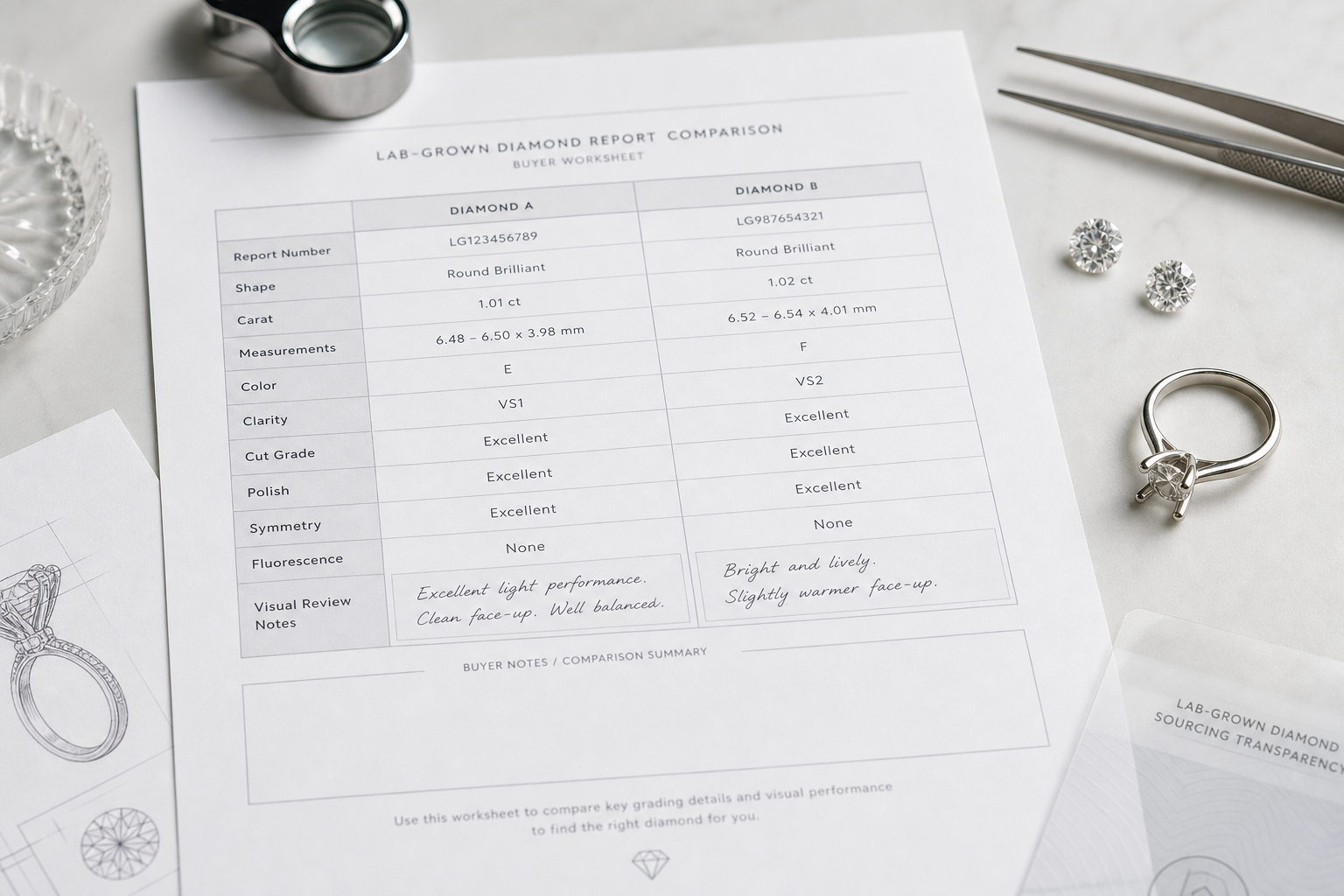
A Simple Report Comparison Order
Verify both report numbers. Confirm that each report matches the seller’s listing and that the lab-grown disclosure is clear.
Match the shape and carat range. Compare diamonds within the same shape and similar size category before judging grade differences.
Check measurements. Look at length, width, depth, and face-up spread so you do not mistake carat weight for visible size.
Review cut and proportions. For rounds, use cut grade and proportion data. For fancy shapes, give more weight to measurements, outline, and video.
Compare color and clarity in context. Decide whether the grade difference is likely to be visible in the diamond’s shape, size, and setting.
Study photos and 360 video. Look for brightness, transparency, eye-clean appearance, bow-tie effect, and any distracting visual features.
Evaluate price last. Judge cost against the full set of specifications and visual evidence, not against one grade alone.
This order keeps the diamond comparison grounded. It prevents a common beginner mistake: choosing the stone with the most impressive single grade while overlooking the details that affect how the diamond will actually look.
Extra Documentation That Helps You Trust the Report
When the Paper and the Stone Should Match Cleanly
A helpful grading report is strongest when the paper, the listing, and the diamond itself all point to the same stone. That means the report number should match the seller’s product page, the measurements should match the visual proportions shown in video, and any notes on the report should make sense with what you can see. If a seller uses stock images, generic descriptions, or vague language, the report becomes even more important because it is one of the few fixed reference points available to the buyer.
It is also worth checking whether the report looks current and complete. A screenshot of a report is not always enough by itself if the seller cannot explain how the document relates to the exact stone being offered. For an online purchase, the safer approach is to ask for the report, the stone’s identifying details, and clear images or video that show the same diamond from multiple angles.
When to Slow Down and Ask More Questions
Buyers should slow down if any part of the diamond story feels incomplete. That includes a missing report number, a lab-grown disclosure that is buried in small print, a visual presentation that does not look like the report description, or a seller who avoids direct questions about measurements and setting fit. None of those issues automatically mean the diamond is wrong, but they do mean the buyer does not yet have enough evidence to compare it confidently.
This caution matters even more when the diamond will be the center stone in a ring designed to be worn every day. A report can tell you the stone’s documented traits, but it cannot replace a clear answer about what is actually being sold. When the documentation is thin, the comparison becomes less about grading and more about trust, which is a weaker place to buy from.
How Traceability Works in a Practical Buying Conversation
For a beginner, traceability does not need to mean a complicated chain of documents. It starts with being able to connect one diamond to one grading report, one set of images or videos, and one listing description. If those pieces do not clearly refer to the same stone, the buyer should ask for clarification before focusing on price or grade differences.
In sourcing or wholesale conversations, documentation, consistency, and communication often matter as much as the headline specification. Buyers comparing multiple loose stones should ask how stones are identified, how reports are shared, how matching criteria are communicated, and how substitutions or specification changes would be handled before committing to a selection.
Disclosure Language Matters as Much as the Report
Read the Listing as Carefully as the Grading Report
Online listings sometimes use broad phrases that sound reassuring but do not add much factual clarity. Words like “premium,” “top quality,” or “best value” are marketing language unless they are backed by specific report details and clear visual evidence. The report is the part that should carry the factual load. The listing should support it, not replace it.
That is why a buyer should pay attention to how the stone is described. If the listing says “lab-grown,” “synthetic,” or “laboratory-grown,” it should be easy to connect that wording to the grading report. If the listing also makes claims about origin, ethics, or environmental benefit, those claims should be treated separately from the grading report itself. The report identifies the diamond; it does not prove a broader sustainability story.
Keep Sustainability Claims in a Separate Bucket
Buyers who care about environmental or ethical considerations should ask for specific documentation rather than assuming those ideas are automatically covered by certification. A grading report is not the same thing as a sourcing audit, an environmental assessment, or a business-practice certification. Those are different claims and should be evaluated separately.
A careful buyer can still value lab-grown diamonds for many reasons, including the appeal of a controlled production process and the ability to compare stones with documented reports. But that preference is different from proving that one diamond is more sustainable than another. The best habit is to ask what the seller can actually document and to treat any broader environmental language as a claim that needs support, not as a fact that the report itself settles.
Sustainability claims should be specific and documented. Broad green language is less useful than clear information about production, energy, sourcing, and seller transparency. A grading report may confirm that the diamond is laboratory-grown, but it should not be stretched into a claim about overall environmental impact unless separate, relevant documentation supports that claim.
Separate Product Facts From Business Policies
A grading report is product documentation, not a seller policy document. It does not establish return terms, resizing options, warranties, shipping timing, after-sales support, or upgrade programs. Those details can matter to the buying decision, but they should be confirmed directly with the seller and reviewed in writing before purchase.
This separation helps buyers avoid assuming that a well-documented diamond automatically comes with favorable service terms. A strong report can support confidence in the stone’s identity and characteristics, while seller policies must still be evaluated on their own. If a policy affects your decision, ask for the current terms rather than relying on general statements in a listing or sales conversation.
Common Beginner Mistakes When Reading Diamond Reports
Mistake 1: Treating Carat as the Same Thing as Visible Size
One of the most common diamond report mistakes is assuming the higher carat weight will automatically look larger. Carat is weight, not visual spread. A diamond can carry extra weight in its depth and still look similar, or even smaller, than another diamond with a slightly lower carat weight.
This mistake becomes expensive when a buyer pays for a larger number on the report without checking the measurements. If two diamonds are close in carat, the one with better face-up dimensions may deliver the stronger size impression. For a ring, visible size usually matters more than owning a slightly heavier stone that hides its weight below the girdle.
Mistake 2: Paying Attention to Color and Clarity Before Cut and Measurements
Color and clarity are easy to compare, which is why beginners often over-prioritize them. A D color or very high clarity grade can sound safer, but those upgrades are not always the best use of budget. If the diamond has weak proportions, poor face-up spread, or dull visual performance, the higher grade does not solve the real problem.
Cut, measurements, and visual appearance should usually be reviewed before chasing the highest color grade or highest clarity grade. This is not because color and clarity are unimportant. It is because their value depends on whether the difference is visible and relevant. A clean-looking VS diamond with strong proportions may be more satisfying than a technically higher-clarity diamond that looks less lively.
Mistake 3: Assuming the Report Is the Same as an Appraisal
A grading report is not an appraisal. It identifies and describes the diamond’s characteristics; it does not establish what the diamond should cost, what it will resell for, or what replacement value should be used for insurance. Confusing these documents can lead buyers to overestimate what certification proves.
This distinction matters because a certified diamond can still be overpriced, poorly matched to a setting, or visually weaker than another option with similar grades. The report is a tool for comparison and verification. It should not be treated as a promise of value.
Mistake 4: Skipping Report Verification and Visual Review
Beginners sometimes assume that if a seller says a diamond is certified, no further checking is needed. That is risky. The report number should be verified when possible, and the details on the report should match the listing. If there is a laser inscription, it may also help connect the physical stone to the report, but buyers should not assume every certified diamond has one.
The second part of this mistake is skipping visual review. A report can confirm that the diamond is graded within certain specifications, but photos and video help show whether the stone is actually appealing. If a diamond is being considered for an engagement ring or another important piece of jewelry, buying from the report alone leaves too much to chance.
Using Certification as Part of a Safer Buying Decision
When Certification Matters Most
Lab-grown diamond certification matters most when the diamond is being purchased as a loose stone, compared online, or selected as an engagement ring diamond. In those situations, the buyer is often choosing between stones that look similar at first glance but differ in documentation, measurements, cut-related data, or visual behavior. A grading report gives that comparison a fixed starting point.
For very small accent stones, certification may be less central because each individual diamond contributes less to the overall design. For a center stone, especially one near one carat or larger, buying without a grading report adds unnecessary uncertainty. The risk is not only overpaying; it is misunderstanding what is actually being purchased.
The strongest use of lab-grown diamond certification is not to chase the highest possible grade. It is to avoid comparing stones blindly. A certified lab-grown diamond gives you documented information you can check against images, video, setting needs, and price. Without that documentation, the buying decision depends too heavily on seller description alone.
How Reports, Images, and Setting Plans Work Together
A grading report should narrow the field. Images and video should test whether the diamond looks appealing in real viewing conditions. The setting plan should confirm whether the stone’s size, shape, and proportions make sense for the ring or jewelry piece being made. Leaving out any one of these steps creates a different kind of risk.
A report can show that a loose lab-grown diamond has the expected identity and specifications. It cannot show how the diamond will sit in a low-profile setting, whether an elongated shape looks balanced on the hand, or whether a slightly larger stone will overpower a delicate design. Those decisions depend on practical fit, not only grading data.
This is where diamond transparency becomes more than having a document. A safer process connects the grading report to what the buyer can actually see and how the diamond will be used. At NUVU, we treat documentation, visual evaluation, and selection logic as connected parts of the same decision rather than separate boxes to check.
If sustainability or sourcing is part of the buying reason, the report alone is not enough to verify that story. Buyers should ask what documentation exists, what the seller can actually confirm, and whether the claim refers to the stone’s origin, the production method, or broader business practices. Careful questions matter here because environmental and ethical language can be broader than the facts shown on a grading report.
For custom design, trust comes from matching the stone to the setting, budget, and wearer’s daily use—not from choosing grades in isolation. Measurements, prong placement, stone height, length-to-width ratio, and metal color can all affect whether a documented diamond becomes a practical finished ring.
Custom Jewelry Requires One More Layer of Confirmation
For custom jewelry, stone measurements and setting compatibility should be confirmed before finalizing a purchase. A grading report may list length, width, depth, and proportions, but the jewelry design still needs to accommodate the stone safely and attractively. This is especially important for elongated ovals, pears, marquise cuts, deep pavilions, very low-profile settings, and designs with tight halos or side stones.
A custom ring decision should connect the report to practical build details: prong placement, basket height, metal choice, accent stone layout, wedding band fit, and daily wear expectations. A diamond can be accurately graded and still be awkward for a specific design if the measurements, outline, or depth do not match the setting plan. Buyers should confirm these details before treating a loose stone as the final choice.
The Beginner’s Takeaway: Trust the Report, But Read Beyond It
A grading report deserves attention because it confirms details that should not be left vague. It is especially useful when comparing certified lab-grown diamonds across different sellers or narrowing several options into a final shortlist. The mistake is expecting the report to make the taste, design, and value judgment for you.
The better approach is simple: use certification to confirm what the diamond is, then use visual review and setting context to decide whether it is the right one. If two diamonds are close in documented quality, the better purchase is often the one with stronger face-up appearance, better proportions for the design, and clearer overall fit for the buyer’s priorities, not automatically the one with the highest single grade.
For beginners wondering whether they should buy a lab-grown diamond with a grading report, the practical answer is yes for any meaningful center stone or loose diamond purchase. The report does not guarantee a perfect choice, but skipping it removes one of the few objective tools buyers have.
Trust Signals That Support a Confident Purchase
For most buyers, confidence comes from documentation that can be checked, not from broad promises. A grading report should match the stone, the listing should describe the same specifications, and the seller should be able to explain how any visual review was done. When those pieces line up, the purchase becomes much easier to evaluate on facts rather than wording.
When a grading report is provided, buyers should compare the report details with the issuing laboratory’s verification tools where available and confirm that the seller’s listing, images, and measurements refer to the same stone.
That kind of verification is especially useful for online purchases, where the buyer may be comparing several stones across similar grades. It does not replace personal preference, but it does help confirm that the diamond being considered is the same diamond described in the report.
If a report is issued by a laboratory that offers an online report-check service, the buyer can usually use that tool to compare the main details shown on the document. If a report-check result is unavailable, incomplete, or different from the seller’s description, the next step should be clarification rather than assumption.
When a buyer can confirm the document, review the images, and connect the stone to a clear setting plan, the report becomes a practical tool instead of a marketing label. That is the most reliable form of reassurance for beginners: specific information, checkable records, and a purchase process that does not ask you to guess.
Final Buyer Verification Checklist
- Confirm the report number. Check that the number on the grading report matches the seller’s listing and, when available, the lab’s online verification record.
- Confirm lab-grown disclosure. Make sure the report clearly identifies the diamond as laboratory-grown rather than relying only on the product title.
- Compare the report to the actual stone listing. Carat weight, measurements, shape, color, clarity, and cut-related fields should align with what is being offered.
- Review images or video before deciding. Look for face-up appeal, transparency, visible inclusions, shape balance, and any distracting visual effects.
- Check whether the stone fits the intended setting. A diamond can be well graded and still be the wrong size, shape, or proportion for a specific engagement ring or jewelry design.
- Confirm seller terms separately. Buyers should confirm the seller’s documentation, return policy, resizing terms, and after-sales support in writing before purchase.
- Judge price against the full picture. Do not compare price by carat alone. Compare documentation, appearance, proportions, and suitability together.
Certification makes the buying process more grounded. The final decision still belongs to the buyer, but it should be made with verified information, visible evidence, and a clear sense of how the diamond will actually be worn.
Disclosure: This article is for general educational purposes only. Diamond grading, pricing, availability, specifications, and seller policies can change, and readers should verify important details through grading reports, official laboratory tools, seller documentation, or qualified professionals before making a purchase decision. Laboratory-grown diamonds should be clearly distinguished from natural diamonds, and environmental or sourcing claims should be supported by specific documentation.