
When you buy a lab-grown diamond online, the stone and its grading report arrive separately, and trusting that they belong together is the core problem. A tiny laser inscription on the diamond’s girdle—visible only under magnification—links the physical stone to its certificate number, a key element of the lab-grown diamond certificate fields, offering a direct way to confirm you received exactly what you paid for. But this mark is not a quality badge. It confirms identity, not cut precision, color accuracy, or ethical sourcing. This article explains how to read laser inscriptions across different labs, understand their limitations, and use them as one practical check in a broader verification process that includes certificate cross-checks, inclusion plotting, and pre-purchase imaging.
For the full framework, read Lab-Grown Diamond Traceability, Certification, and Transparency Guide.
Knowing what an inscription does and doesn’t prove helps you avoid confusion at checkout and gives you a clear method for confirming your stone after delivery.
| Verification Step | What It Confirms | What It Does Not Guarantee |
|---|---|---|
| Check laser inscription under 10x magnification | Certificate number matches the stone | Accuracy of the report’s color, clarity, or cut grades |
| Verify the number on the lab’s official website | The certificate exists and is current | Stone is not a duplicate, recut, or switched after grading |
| Request inscription photo from seller before purchase | You can see the inscription before the stone is mounted | Inscription will be visible after setting (bezel/claws may block it) |
| Compare plotted inclusions with the stone under loupe | Internal features match the certificate diagram | Stone is naturally grown vs. lab-grown |
| Measure weight and dimensions against certificate | Physical specs align with the report | Optical performance or light return |
| Review the full grading report (including proportions) | Cut angles, symmetry, and polish are acceptable | Stone will look bright in all lighting settings |
Quick Questions Before You Read
Q: Is a diamond without a laser inscription automatically fake or low quality?
No. Many uninscribed diamonds are perfectly genuine. Without a number, you verify the stone by comparing its weight, dimensions, and inclusion pattern against the grading report.
Q: Does a laser inscription guarantee the grading report is accurate?
No. The inscription only confirms which certificate belongs to the stone, not whether that certificate’s color, clarity, or cut grades are correct. Cross-check the report details separately.
Q: Will I see the inscription after my diamond is set in a ring?
It depends on the setting style. Prong and tension settings usually keep the girdle visible. Bezel, channel, and hidden-halo settings often block access. Ask for a photo of the inscription before the stone is mounted.
Q: If I see ‘LABORATORY GROWN’ in the inscription, does that affect resale value?
Inclusion of that phrase is standard for lab-grown diamonds from most major labs. It confirms origin but does not reduce the stone’s value within the lab-grown market. All equivalent lab-grown stones carry this label.
What Is Laser Inscription on a Lab-Grown Diamond
Laser inscription is a small identification mark applied to the outer edge of a diamond. It is not a decorative upgrade or a premium feature reserved for expensive stones. It is a practical tool that helps buyers connect a specific diamond to its grading report. On lab-grown diamonds, the inscription typically includes the laboratory name, the unique certificate number, and sometimes the letters “LG” or the phrase “Lab Grown.” The presence of this mark gives a buyer a way to confirm they are receiving exactly the stone they selected.
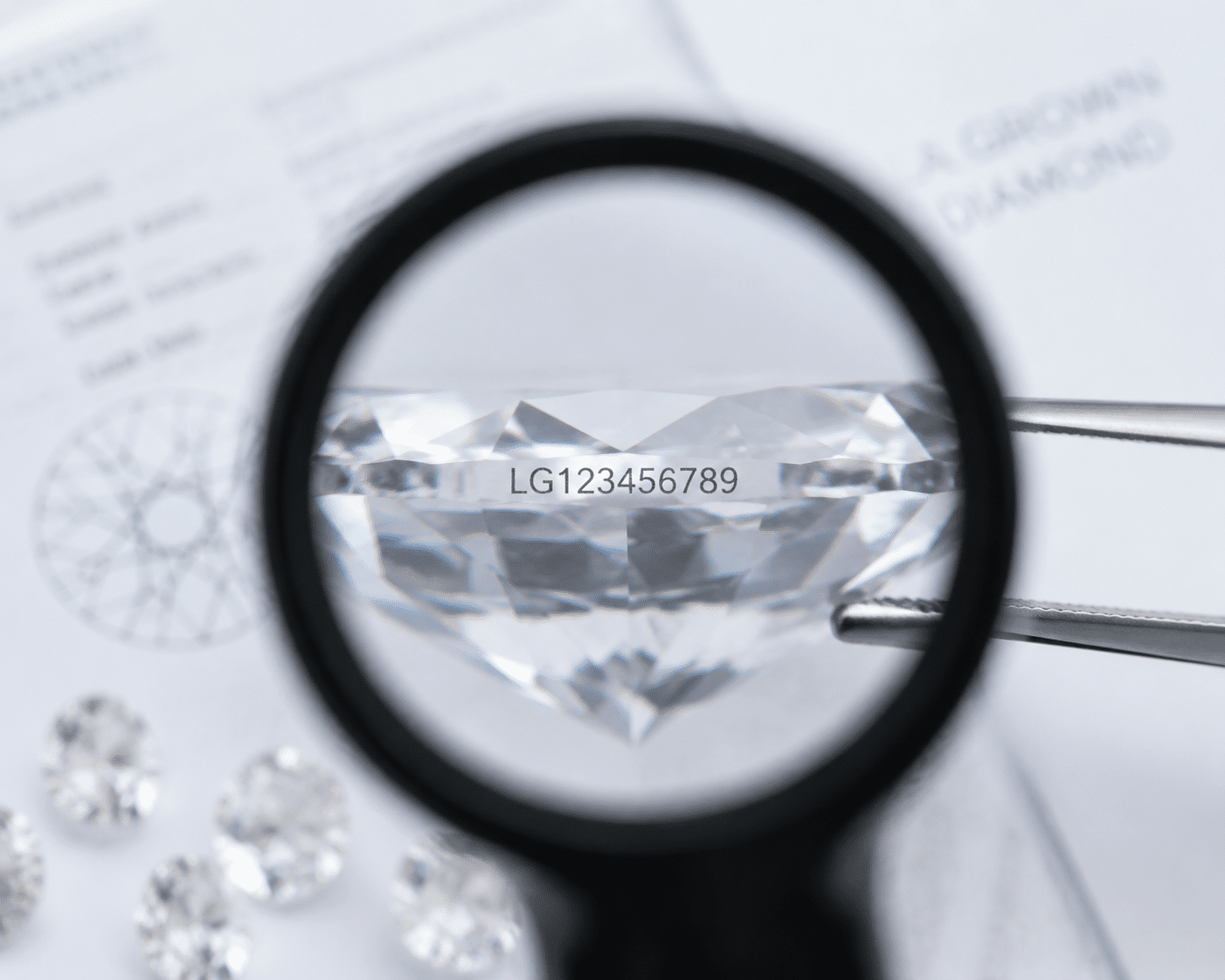
Where the Inscription Is Located and How It Looks
The inscription is placed on the girdle of the diamond, the thin outer band that separates the crown from the pavilion. A focused laser beam etches the characters directly onto the diamond surface. The text is microscopically small and is never visible to the naked eye. It does not affect the diamond’s weight, its cut precision, or its appearance in any setting. To read the inscription, you need at least 10x magnification, usually through a jeweler’s loupe or a gemological microscope. Under magnification, the text appears as a clean, fine line of characters that looks slightly frosted against the polished girdle.
How Inscription Relates to the Certificate Number
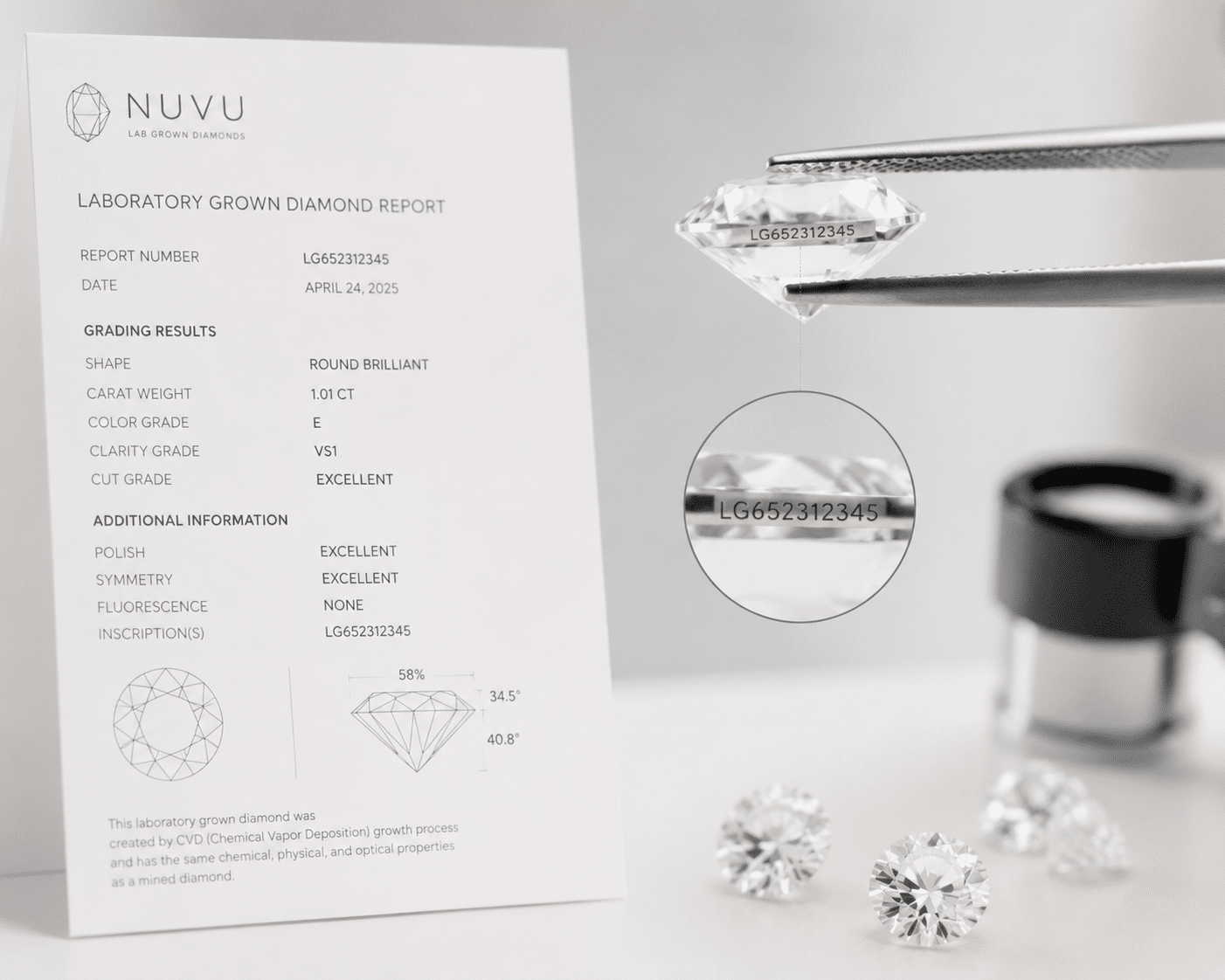
The standard practice across major grading laboratories — including IGI, GIA, and GCAL — is to inscribe the exact report number onto the girdle. This creates a direct physical link between the stone and its digital or printed grading report. When a buyer receives a diamond, they can inspect the girdle, read the inscription, and then look up that same number on the lab’s verification website. If the numbers match, the certificate belongs to that diamond. Some labs also add a logo, a security symbol, or a small QR code to make verification even faster. But the core value is simple: the inscription tells you which report belongs to this stone. The GIA, for example, maintains an online report check database where the inscribed report number can be entered and verified against the lab’s own grading records.[1]
What to Check Before You Decide
- Confirm the certificate number on the loose diamond matches the inscription exactly.
- Ask for a photo of the inscription viewed under a gemological microscope.
- Verify the inscription includes the laboratory’s name and the full certificate number.
Why Laser Inscription Matters for Loose Diamond Purchases
For loose diamond buyers, especially those shopping online, the inscription shifts verification from trust-based to evidence-based. You do not have to rely solely on a seller’s word or a package label. The stone itself carries a permanent identifier that you can check yourself.
Inscription as a Traceability Tool for Online Orders
When you buy a loose diamond remotely, you cannot hold the stone before purchase. The only information you have is the grading report, images, and whatever video the seller provides. The inscription gives you a physical checkpoint. Before buying, you can request a clear photo of the inscription from the seller. When the diamond arrives, you inspect the girdle under magnification and confirm the number matches the certificate you reviewed. A matching inscription means the stone in your hand is the same stone the lab examined. Without it, you are trusting that the paperwork and the diamond were never separated during packing and shipping.
Important Distinction in Verification Context
It is worth noting that while the inscription matches the stone to its certificate, the grading report itself is best understood as a documentation of key characteristics observed by the lab at a specific time. The report documents factors like carat weight, color grade, clarity grade, and cut proportions, but it should not be treated as a guarantee of the diamond’s beauty, performance in all lighting conditions, or long-term value. Buyers benefit from reading the report alongside visual evidence — such as high-resolution images and videos — to form a more complete picture of the stone. This layered approach to verification helps reduce the risk of relying too heavily on any single source of information.
How Inscription Supports Return and Exchange Verification
Reputable sellers rely on the inscription to manage returns and exchanges. When a buyer sends a diamond back, the seller checks the inscription to confirm it is the same stone originally shipped. This protects both sides. The buyer knows the refund will not be delayed by a mistaken identity, and the seller avoids the risk of receiving a substituted stone. Without an inscription, identifying a specific loose diamond becomes unreliable. Matching depends on weight, proportions, and inclusion patterns — details that can be checked but require more time and expertise.
Industry Context on Inscription Practice
Leading gemological institutes provide guidance on the purpose and limits of laser inscription. The GIA notes that a laser inscription can serve as a permanent identifier, linking a diamond to its grading report, but it emphasizes that the inscription is not a guarantee of the stone’s quality or the accuracy of its grades.[2] This distinction reinforces what well-informed buyers should already expect: the inscription is a confirmation of identity, not a quality certification. Similarly, the Federal Trade Commission (FTC) has issued guidance on the use of terminology in diamond advertising, including how lab-grown diamonds should be clearly described to consumers.[3] While the FTC does not regulate inscription content directly, its guidance is relevant because the inscription is part of the product description and should not be misleading.
Buyer Verification Checklist
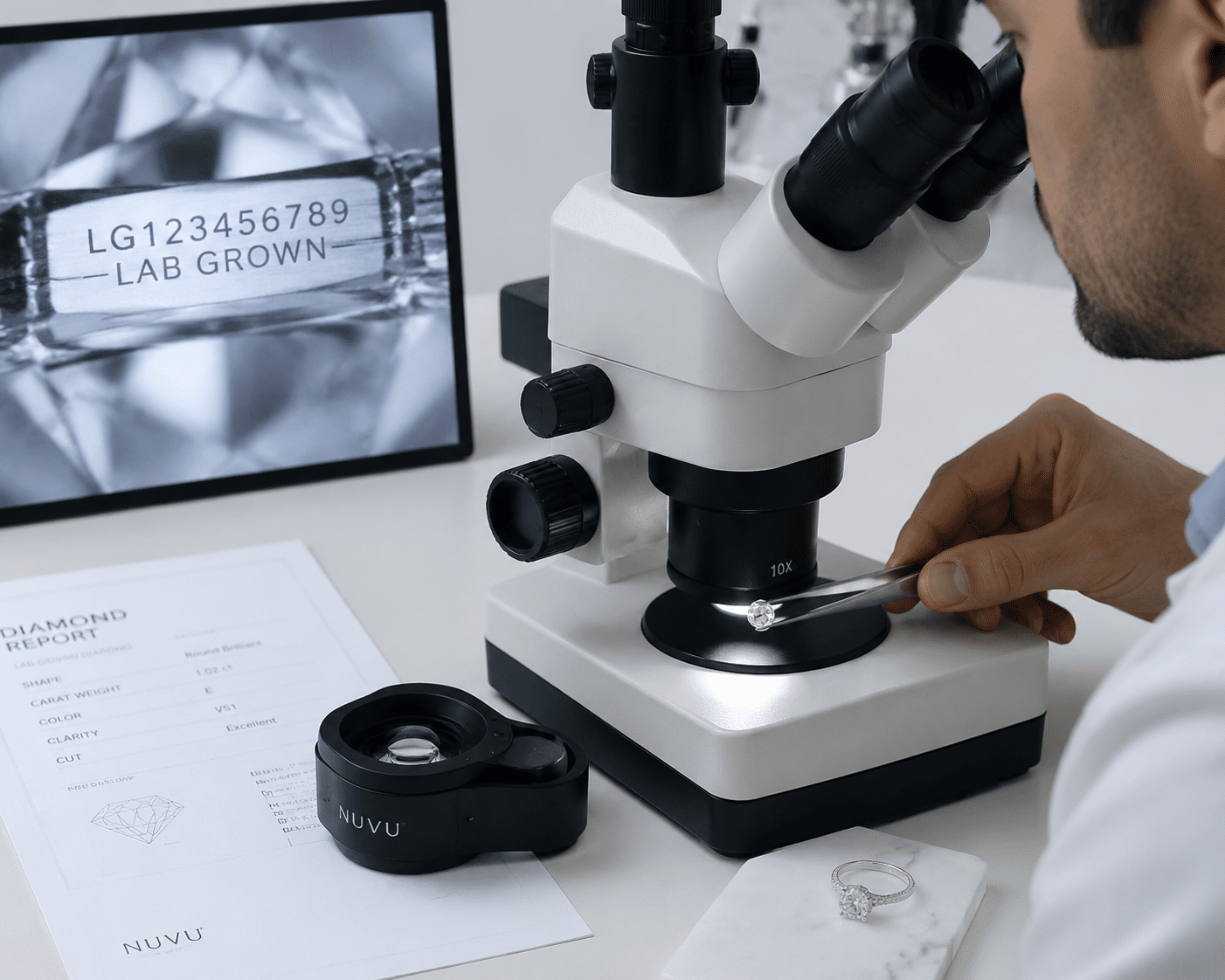
- Request a clear inscription photo from the seller before you buy.
- Upon delivery, inspect the inscription using a jeweler’s loupe or ask a third-party jeweler to confirm.
- Compare the inscription number to the certificate number, not a packing slip number.
What a Laser Inscription Does and Does Not Prove
An inscription is useful, but it has real limits. Over-relying on it as a complete guarantee creates blind spots. Understanding what the inscription can and cannot confirm helps you use it properly.
What the Inscription Confirms
The inscription confirms that the diamond’s grading report number matches the stone. That is its only function. If the number on the girdle matches the number on the certificate, you know the certificate belongs with this diamond. The inscription does not guarantee that the grading report itself is accurate. It does not confirm the diamond’s country of origin, the laboratory’s grading consistency, or the quality of the cut. A correct inscription tells you the stone is the one that was sent to that specific lab — nothing more.
For buyers, the practical distinction is between identity and quality. An inscribed stone with a perfect match to its certificate could still have a cut that does not perform well optically, or a clarity grade that relies on inclusions hidden by the setting. The inscription confirms the link, but the buyer still needs to evaluate the stone itself.
What the Inscription Cannot Verify
An inscription is not fraud-proof. It can theoretically be replicated or applied to a different stone, though this is uncommon in practice because reputable labs and sellers have processes in place to prevent it. The inscription alone does not prove the diamond is lab-grown unless the text explicitly includes “Lab Grown” or a recognized lab identifier. Even then, the inscription does not replace a visual review of the diamond’s proportions, fluorescence, or clarity characteristics. The grading report provides that detail. lab grown diamond report number guide The inscription simply tells you which report applies.
The Importance of Independent Verification as a Countermeasure
Because a laser inscription is not inherently tamper-proof, buyers benefit from layering their verification. The most effective step after confirming the number on the girdle is to cross-check that report number directly on the issuing laboratory’s official website. This is the only way to confirm that the certificate registered to that number is genuine and has not been altered or revoked. GIA, IGI, and GCAL all offer free online report check systems that allow any buyer to enter the inscription number and retrieve the official grading data.[1] Relying solely on a seller-provided screenshot or a copy of the certificate without this independent step leaves the buyer exposed to potential discrepancies.
When a grading report is available, buyers should verify the report details through the issuing laboratory’s official report-check tool where available. This step confirms that the certificate exists and has not been altered, providing a baseline of trust that goes beyond the inscription itself.
How to Verify This Before Buying
- Cross-check the report number on the grader’s official verification website.
- Ask for a brief video of the diamond under natural and dark-field lighting.
- Confirm the seller offers a return policy that allows third-party inspection.
How Laser Inscription Differs Across Major Grading Labs
Not all laser inscriptions are identical. The format, content, and verification features depend on which laboratory graded the diamond. For a buyer comparing loose stones, understanding these differences helps avoid confusion when inspecting the girdle.
IGI Inscription Standard
IGI inscribes the full report number along with the notation “LABORATORY GROWN” on the girdle. Most IGI-graded lab-grown diamonds also include a small security logo that becomes visible only under magnification. Inscription is standard on the majority of IGI-graded stones, so an uninscribed IGI diamond is relatively uncommon unless specifically requested.
GIA Inscription Standard for Lab-Grown Diamonds
GIA inscribes the report number and the phrase “LABORATORY GROWN” on the girdle of lab-grown diamonds. Unlike IGI, GIA does not add a separate security logo. Instead, GIA relies on its online report lookup database for verification. The absence of a logo is not a red flag — it simply means GIA uses a different verification method. GIA’s official guidance on lab-grown diamond identification clarifies that these inscriptions are a permanent part of the grading process for all submitted stones.[4]
GCAL Inscription and Enhanced Verification
GCAL offers laser inscription with additional verification layers, including a unique serial number and a complementary digital record. The inscription typically includes the GCAL logo and the full report number. GCAL’s digital record provides an extra reference point that some buyers find useful when verifying a stone remotely.
When comparing diamonds from different labs, a useful approach is to verify the inscription format beforehand. If a buyer expects a security logo and does not find one, or expects a certain phrase and sees a different one, the discrepancy can cause unnecessary concern. Knowing each lab’s standard inscription practice prevents that confusion.
Certificate and Visual Review Check
– Identify which lab graded your diamond before you search for inscription format expectations.
– Use the lab’s official website to verify the report number — do not use third-party verification tools for final confirmation.
– Ask whether the seller includes a free inscription verification loupe or viewing service.
Inscription and the Diamond Setting: What Changes After Mounting
A common question buyers ask after purchasing a loose diamond is whether the inscription remains readable once the stone is set. The answer depends entirely on the setting style. Understanding this before the ring is assembled prevents frustration later.
How Setting Style Affects Inscription Visibility
A prong setting may partially or fully obscure the inscription, especially if the stone is set low or the prongs cover the girdle area. Halo settings, bezel settings, and channel settings can also block access to the inscription. A full bezel or flush setting nearly always prevents inscription reading because the girdle is completely enclosed. The simpler the setting, the better the chance that the inscription remains accessible.
This is where pre-purchase documentation becomes essential, rather than optional. A buyer who relies on the inscription as the sole verification method may find themselves unable to confirm the stone after it is set. Photographing the inscription before mounting is a straightforward safeguard that removes that risk entirely.
Why Pre-Setting Documentation Matters
Once the stone is set, the only reliable identification may be the original certificate, the purchase receipt, and a pre-set inscription photo. Some jewelers can read the inscription through a microscope if the setting allows partial girdle access, but this is not guaranteed. Buyers should photograph the inscription before the diamond is set into any mounting.
Compatibility and Measurement Considerations for Setting
Before the stone is set, it is important to confirm that the diamond’s measurements, including its girdle thickness and overall diameter, are compatible with the intended setting. The inscription itself does not affect the fit, but the girdle area where the inscription is located must be accessible during the setting process to avoid damage. A jeweler can advise whether the inscription will be partially or fully covered by the setting. For buyers who want to retain the ability to read the inscription after setting, a prong or tension setting is often a more practical choice than a bezel or channel setting. Confirming these details with the jeweler before work begins helps avoid the need for re-setting later.
Stone-to-Setting Fit Check
– Before the ring is assembled, take a clear photo of the inscription with a loupe or microscope.
– Confirm with your jeweler whether the setting will block access to the girdle.
– Keep the original certificate, the unset photo, and the purchase documentation together.
Traceability is a fundamental aspect in the creation of custom jewelry, as it ensures that every diamond can be traced back to its origin, guaranteeing authenticity and ethical standards. This is particularly important for lab-grown diamonds, where certification reports provide detailed information about the diamond’s characteristics. To read these reports with more confidence, jewelers often refer to specialized guides. The lab grown diamond certification guide serves as an invaluable resource, explaining how to interpret the 4Cs and other report details accurately. By understanding these reports, designers can make informed decisions for settings such as diamond pendants, earrings, or bracelets, ensuring that the final piece meets both aesthetic and quality expectations.
For those having a custom piece made, the inscription plays a role beyond initial verification. If the stone is ever removed and reset — for resizing, repair, or redesign — the inscription provides a way to match the diamond back to its original grading report. This traceability function is especially valuable for lab-grown diamonds, where multiple stones of similar appearance may be handled during the manufacturing process. Recording the inscription number in the design order documentation ensures the stone can be identified even years later, without relying on memory or receipts. Buyers should confirm with their jeweler that the inscription will be noted in the work order before the setting process begins.
Custom Design Verification Checklist
- Request that the jeweler note the inscription number in the work order.
- Confirm the setting style allows for girdle access if post-setting verification is desired.
- Keep a record of the inscription photo alongside the design specifications.
When a Diamond Has No Inscription: Should You Worry?
An uninscribed diamond is not automatically a red flag. Buyers who understand why a stone might lack an inscription can evaluate the situation without unnecessary concern.
Why Some Lab-Grown Diamonds Are Not Inscribed
Not all grading labs inscribe every stone. Some laboratories allow the seller to request no inscription. Loose diamonds sold without a certificate naturally lack an inscription. Smaller diamonds and lower-cost stones may also exclude inscription to keep the price down. None of these reasons indicate a problem with the diamond itself.
For buyers considering an uninscribed stone, the evaluation shifts from checking a number to confirming physical alignment. The weight, dimensions, and inclusion plot from the certificate become the primary verification tools. As long as those details match the stone, the absence of an inscription is not a concern.
How to Verify an Uninscribed Diamond
An uninscribed diamond can still be verified by comparing its weight, proportions, and clarity characteristics to the certificate. A jeweler with a gemological microscope can locate inclusion maps and confirm the match. Buyers purchasing from trusted sellers with transparent return policies can accept an uninscribed stone with confidence, as long as the certificate and the stone’s physical measurements align.
The Role of Clear Terminology in the Verification Process
For both inscribed and uninscribed stones, clear terminology is essential. The FTC has issued guidance on the use of terms like “laboratory-grown” or “lab-created” to ensure consumers are not misled about a diamond’s origin.[3] This guidance is relevant for inscription content as well because the text on the girdle effectively describes the product to the buyer and future appraisers. An inscription that uses the correct, non-misleading terminology — such as “LABORATORY GROWN” — helps maintain transparency and aligns with consumer protection expectations. This is particularly important for uninscribed stones, where the lack of a clear identifier places greater reliance on the seller’s documentation and disclosures.
Documentation Considerations for Uninscribed Wholesale Transactions
In wholesale or bulk sourcing contexts, the absence of inscriptions across multiple stones changes the verification approach. Wholesale buyers should request documentation that ties each stone to its respective grading report through weight, dimensions, and clarity plots. Without individual inscriptions, batch-level matching requires clear communication between buyer and seller about how stones are organized and identified during packing. A packing list that cross-references report numbers with physical dimensions reduces the risk of a mismatch. In these transactions, documentation, consistency, and communication often matter as much as the headline specification on the certificate.
What This Means in a Real Purchase
– Ask why the diamond has no inscription — the seller should explain clearly.
– Request close-up images of the stone’s inclusions or the plot diagram from the certificate.
– Confirm the seller provides a verifiable grading report from a recognized lab.
Laser Inscription as a Buyer Confidence Tool in the NUVU System
How NUVU Uses Inscription to Match Certificate to Stone
Every loose lab-grown diamond listed through NUVU is accompanied by a grading report from a recognized laboratory. The inscription on each stone is matched to that specific certificate number at the sourcing level. When a buyer requests inscription verification before purchase, NUVU provides a magnified image showing the girdle marking. This allows the buyer to confirm the link between the physical stone and the grading report before any payment or shipping occurs. The goal is not to add ceremony to the process, but to remove ambiguity. A buyer should never have to guess whether the stone they are evaluating is the same one described in the certificate.
Why Inscription Is One Layer, Not the Whole System
At NUVU, the inscription is treated as a verification convenience, not a standalone guarantee. The inscription confirms that the certificate number on the stone matches the document in hand. It does not confirm that the grading report is accurate. It does not show how the diamond performs under different lighting. It does not reveal whether the proportions or clarity characteristics match what the buyer expects for the price. The inscription is useful, but it operates inside a larger verification system that includes the grading report, high-resolution images, measurement data, and video.
For NUVU, the goal is to make diamond comparison easier to understand, especially when buyers are weighing report details, visual performance, setting fit, and budget together. The inscription provides a starting point, but the buyer’s confidence should come from reviewing the full package of evidence — not from relying on one marking on the girdle.
What This Means in a Real Purchase
A practical approach treats the inscription as the starting point, not the final check. Before setting the stone, review the full grading report, compare the plotted inclusions to any provided images, confirm the measurements against the setting requirements, and examine the diamond under video or magnification. If anything does not align, ask questions before committing. The inscription makes the system more transparent, but the buyer still benefits from looking at the whole picture rather than relying on one marking on the girdle.
Disclosure: This article is for general educational purposes only. Diamond grading, pricing, availability, specifications, and seller policies can change, and readers should verify important details through grading reports, official laboratory tools, seller documentation, or qualified professionals before making a purchase decision. Laboratory-grown diamonds should be clearly distinguished from natural diamonds, and environmental or sourcing claims should be supported by specific documentation.
Last updated: November 2025
[1] GIA, “GIA Report Check,” Gemological Institute of America, https://www.gia.edu/report-check.
[2] GIA, “Laser Inscription on Diamonds,” Gemological Institute of America, https://www.gia.edu/laser-inscription.
[3] Federal Trade Commission, “Guides for the Jewelry, Precious Metals, and Pewter Industries,” FTC, 2018 (as amended).
[4] GIA, “Identifying Lab-Grown Diamonds,” Gemological Institute of America, https://www.gia.edu/lab-grown-diamond.