
A diamond report can make a purchase feel safer, but it is easy to expect more from it than it actually provides. Whether you are comparing a lab-grown diamond with a natural diamond in an engagement ring diamond comparison or checking a seller’s claims, the report is mainly a verification document: it records origin, measurements, carat weight, shape, color, clarity, cut details, and identifying information. It does not automatically prove beauty, value, ethical sourcing, or that every statement in a listing is accurate.
For the full framework, read Lab-Grown Diamond Certification Guide.
This article helps you read a report with the right level of confidence. You will see what details should match the stone and listing, which claims need separate written support, and when a mismatch should make you pause. The goal is not to make certification sound complicated, but to help you judge whether the diamond, the paperwork, and the seller’s description all support the same purchase decision.
Evidence note: throughout this guide, treat the report as one layer of proof, not the whole proof package. A report can support claims about the stone’s identity and documented grading characteristics. Claims about sourcing, environmental impact, resale value, country of origin, warranty coverage, or seller service should be supported by separate written material from the seller or relevant documentation outside the grading report.
| What to Check | What the Report Can Confirm | What Still Needs Verification |
|---|---|---|
| Diamond origin | Lab-grown or natural identification | Seller wording matches the report |
| Report number | Unique grading document reference | Number verifies with the issuing lab |
| Measurements and carat | Stone size and weight details | Fit for the intended setting |
| Color, clarity, cut details | Baseline grading information | Actual appearance in photos or video |
| Ethical or sourcing claims | Usually not fully proven by grading alone | Separate written documentation |
| Seller listing | Data to compare against the report | No mismatches, stock-photo reliance, or pressure tactics |
Quick Questions Before You Read
Q: Does a diamond report prove a diamond is worth the asking price?
No. It gives grading and identification details, but price also depends on appearance, market context, seller terms, and buyer priorities.
Q: Can you tell lab-grown and natural diamonds apart by looking?
Not reliably. Origin should be confirmed through a proper report or qualified testing, not visual inspection alone.
Q: Is “certified” enough proof to trust a listing?
No. The report number, origin language, measurements, and grades should match the actual stone and seller description.
Q: Do reports prove ethical or conflict-free claims?
Usually not by themselves. Those claims need separate written support beyond standard grading information.
Start Here: What a Diamond Report Can and Cannot Prove
A diamond report is useful because it gives you something concrete to verify. It can tell you whether a stone is lab-grown or natural, record its basic grading details, and give you a report number you can check against the issuing lab when that service is available. What it cannot do is prove every claim a seller makes about value, beauty, ethics, or whether the diamond will actually satisfy you once it is in hand.
For buyers comparing lab-grown diamond certification and natural diamond certification, that distinction matters. The report is a documentation tool first. It is not a promise that the entire listing is accurate, the pricing is justified, or the seller’s marketing language should be taken at face value. A strong report helps you compare. It does not make the purchase decision for you.
Traceability starts with matching evidence, not with trusting one label. The report number, the seller’s product page, the stone’s measurements, any inscription details, and the visual media should all point to the same diamond. If one part of that evidence trail does not match, the buyer should ask for clarification before treating the stone as verified.
The fast answer for buyers
Yes, a reliable grading report can identify whether a diamond is laboratory-grown or natural. If you are asking what does a diamond certificate prove, the short answer is that it proves what the issuing lab has documented about the stone, not everything a salesperson may say about it.
The careful habit is to verify the report number directly with the issuing lab whenever possible. That extra check matters because a report only helps when it matches the actual stone being sold. A diamond with a grading report is not automatically the right buy just because it has paperwork. The paperwork has to line up with the diamond, the listing, and the seller’s written description.
When a grading report is available, buyers should verify the report details through the issuing laboratory’s official report-check tool where available, then compare those details with the seller’s listing and visual evidence.
What the report usually confirms
A good diamond report usually gives you the core facts needed for comparison. That includes whether the stone is lab-grown or natural, the carat weight, color grade, clarity grade, and cut-related information when the lab provides it. It also lists measurements, shape, and a report number. Some reports include inscriptions or comments as well.
Those details matter because they give you a baseline. Carat weight tells you how much the stone weighs, but measurements tell you more about how it may look in real life. The origin designation tells you whether the diamond is lab-grown or natural. The grading details help you compare two stones that may look similar in a listing but differ in quality or proportions.
What the report does not confirm
A diamond report does not prove that the stone is fairly priced. It does not prove that the diamond is especially beautiful to your eye. It does not prove that the stone is sustainably produced, ethically superior, or the right fit for your setting. It also does not prove that the seller’s return policy, warranty, or service terms are buyer-friendly.
That restraint is important. A report tells you what has been measured and identified. It does not replace judgment. Two diamonds can share similar grades and still feel very different once you look at their video, compare proportions, or place them into a ring design. At NUVU, we treat the report as the starting point, not the whole decision.
For buyers, the practical point is not just what the report says, but how the stone performs visually and fits the intended design. A report can narrow the shortlist, but the final choice still depends on the buyer’s priorities: size, shape, budget, setting style, and tolerance for visible inclusions or color.
Terms that need careful reading
Some words in jewelry listings sound more definite than they really are. “Certified,” “verified,” “responsibly sourced,” “conflict-free,” “factory direct,” and “investment quality” can all influence a buyer’s confidence, but each phrase needs context. If the statement is based on a grading report, the report should actually contain the relevant information. If the statement is about sourcing, policies, environmental impact, or resale, it should be supported by separate written documentation rather than assumed from the presence of a report.
A grading report helps document key characteristics, but it should not be treated as a guarantee of beauty, value, or sourcing ethics. This is especially important when a seller’s wording moves from objective facts, such as carat weight or origin designation, into broader conclusions, such as “better value” or “ethical choice.” Those conclusions may matter to the buyer, but they require evidence beyond the grade sheet.
Buyer Verification Checklist
- Compare the report number with the issuing lab whenever possible.
- Check that the stone’s measurements, shape, and carat weight match the listing.
- If an inscription is listed, confirm that it aligns with the report and the stone.
- Ask for photos or video before buying, especially for a loose diamond.
- Make sure the seller’s written description matches the report language.
- Do not rely only on a verbal claim about origin or quality.
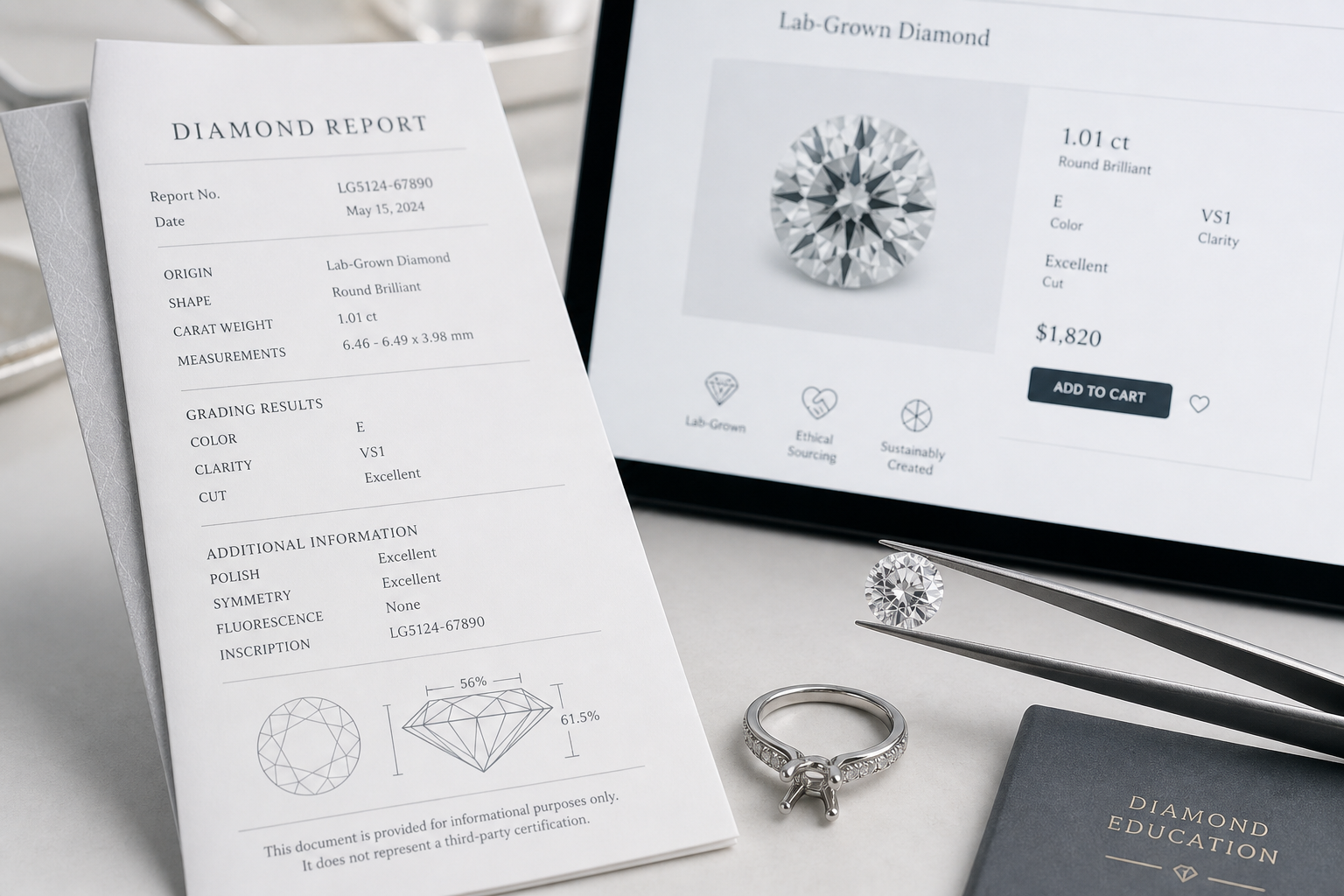
How Grading Labs Identify Lab-Grown and Natural Diamonds
The key point is simple: a grading lab is not only judging appearance. It is identifying origin. That is why lab-grown vs natural diamond certification is useful for buyers who want more than a seller’s word. The report separates how a diamond was formed from how it is graded.
If you are wondering how do labs identify lab-grown diamonds, the answer is that they use testing and examination methods that go beyond what most buyers can do with the naked eye. The point is not for shoppers to learn the technical process. The point is to understand why a visual guess is not enough.
Origin identification is different from beauty grading
Origin identification answers how the diamond was formed. Beauty grading describes its observable characteristics, such as carat, color, clarity, and cut-related information. Those are related, but they are not the same thing.
That distinction matters because a stone can look attractive and still be misrepresented in a listing. A diamond grading lab is helping confirm whether the diamond is laboratory-grown or natural, while also documenting the quality factors that help buyers compare stones. Both functions matter, but origin should not be confused with style or appeal.
Why visual inspection is not enough
Lab-grown and natural diamonds can share the same basic chemical composition and can look very similar to the unaided eye. That is why jewelers cannot always tell lab-grown diamonds apart just by looking.
For buyers, the practical takeaway is straightforward: appearance alone is not a reliable way to identify diamond origin. A stone that looks natural in a photo may still be laboratory-grown, and a stone that looks similar in person may not tell you anything about its report language. Documentation is what gives the comparison structure.
Common report language buyers may see
On a report, you may see language such as “laboratory-grown diamond,” “lab-grown,” or, in some older or more technical contexts, “synthetic diamond.” A natural stone will usually be labeled as a natural diamond when that is the lab’s conclusion.
Not every grading organization uses identical wording, so buyers should not assume the phrasing will look exactly the same from one report to another. What matters most is the origin designation itself and whether the seller’s description matches it.
Some lab-grown reports may also refer to growth-related information, such as HPHT or CVD, while others may not present that detail in the same way. For most buyers, the growth method is not a standalone proof of beauty or quality; it is one piece of context to read alongside the stone’s color, clarity, cut information, measurements, and actual visual evidence.
Laboratory-grown diamonds should be clearly identified as laboratory-grown, and they should not be presented as mined diamonds. A diamond simulant is different again: it may look diamond-like, but it is not the same as a laboratory-grown diamond or a natural diamond. If a listing uses unclear wording such as “diamond alternative,” “created stone,” or “real look,” buyers should ask whether the item is a laboratory-grown diamond, a natural diamond, or a non-diamond simulant.
How to read growth-method details without overreading them
If a report or seller document mentions HPHT or CVD, read that as production context rather than a simple quality ranking. A growth method can help explain how the diamond was created and why certain comments may appear on a report, but it does not automatically tell you whether the stone is more beautiful, more valuable, or more responsible than another diamond. Buyers should still judge the individual stone through its grading information, visual evidence, and seller documentation.
This is especially important when marketing language turns a technical term into a selling shortcut. A listing that says “CVD,” “HPHT,” “post-growth treatment,” or similar language should be clear enough for the buyer to understand what is being claimed. If that wording affects your decision, ask the seller to explain it in writing and confirm whether the report itself supports the statement.
When growth method or post-growth treatment is relevant, buyers should look for clear disclosure in the grading report or seller documentation. HPHT and CVD are commonly discussed as lab-grown diamond growth methods, but treatment-related wording should not be assumed unless the report or seller documentation states it. If a treatment or enhancement claim affects your buying decision, the useful question is not whether the term sounds technical; it is whether the claim is documented for that specific stone.
How to Verify This Before Buying
Compare the seller’s product listing with the report’s origin language. If the listing says natural but the report says laboratory-grown, that is a serious mismatch and should be resolved before any payment is made. If there is no report or no report number for a significant purchase, ask for it before moving forward.
That is especially important with loose stones and engagement ring purchases, where the report often becomes the main reference for comparing options. The report should support the seller’s claims, not replace them.
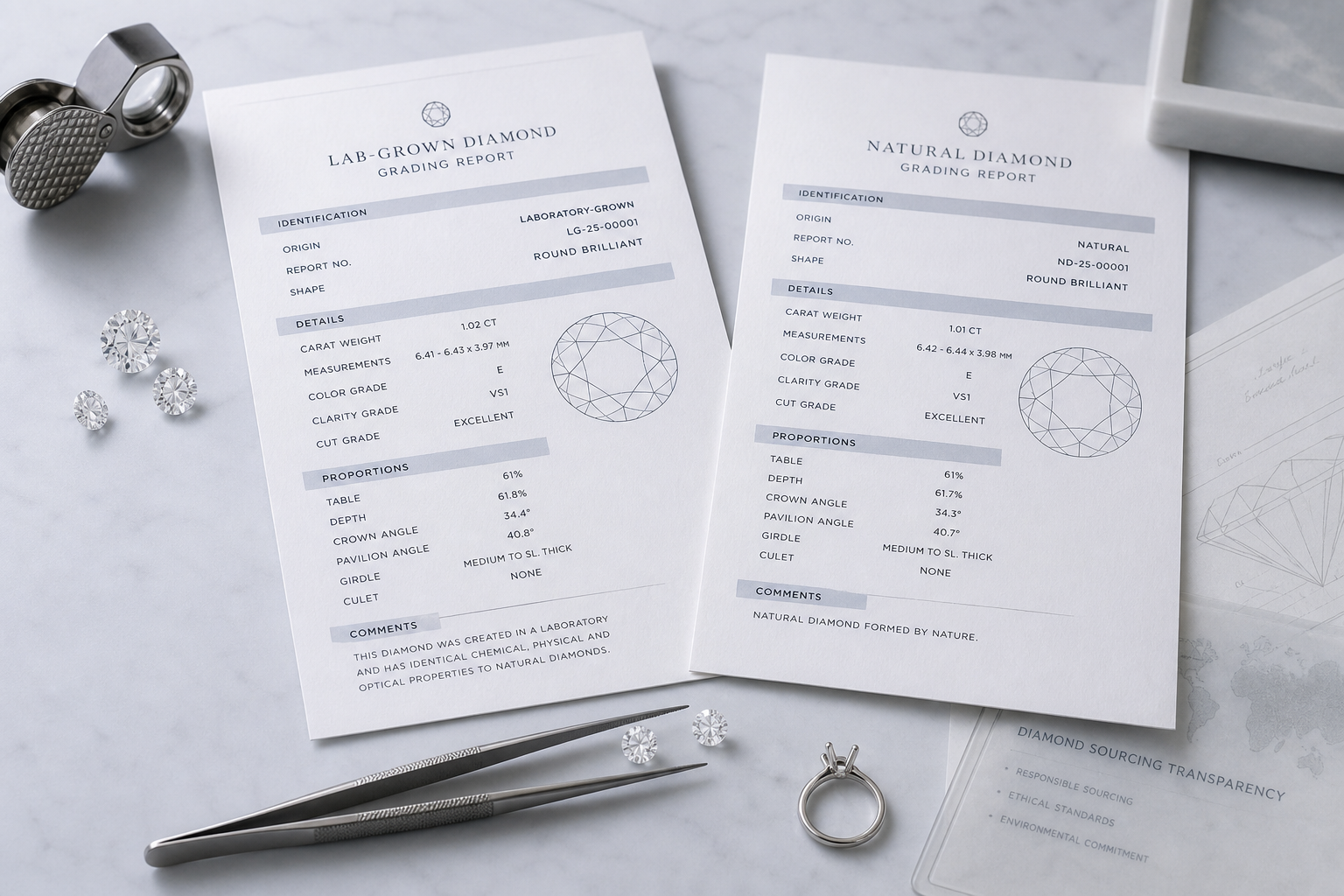
What Information Appears on a Lab-Grown Diamond Report
When people ask how to read a lab-grown diamond certificate, a practical place to start is not with every possible grading term. Start with the fields that tell you what the stone is and whether the listing is accurate. A lab-grown diamond report is most useful when you know which details to check first.
Origin designation and report number
This is the first thing to read. The origin designation tells you whether the diamond is lab-grown, and the report number gives you a reference point for verification. If the lab offers an online lookup tool, that number is what lets you confirm the document against the stone.
Do not assume every report works the same way. Some issuing labs make verification easy online, while others may handle it differently. The important part is that the report number should exist, and it should match the diamond being sold.
Carat, measurements, and shape
Carat weight tells you how much the diamond weighs, but it does not tell you how large it will look face-up. That is where measurements matter. They help you compare apparent size, shape outline, and whether the stone is likely to fit a setting as expected.
This is one of the common mistakes buyers make. A 1.50 ct diamond can look noticeably different from another 1.50 ct diamond if the proportions are different. If you are choosing between stones, the millimeter measurements are often more useful than carat alone.
These fields help you compare one stone against another. Color and clarity give you a sense of visible appearance and internal characteristics. Cut-related grading is especially useful on round brilliant diamonds, where it is often more standardized.
For fancy shapes, report data still matters, but it usually does not tell the whole story. The numbers can narrow the field, but the visual result still needs review.
Comments, inscriptions, and growth method references
Some reports include comments, laser inscription details, or terminology that refers to lab-grown origin, while diamond appearance differences may remain separate from the grading notes. Others do not. Growth method references may appear, but they are not guaranteed on every report.
That is why buyers should read the document carefully instead of assuming all reports contain the same level of detail. A report can be informative without being exhaustive.
Document fields that deserve a second look
Pay close attention to comments sections, footnotes, or any line that qualifies the main grading information. Buyers often scan only the headline grades, but the smaller fields may contain useful context about inscriptions, treatment-related observations, growth-related wording, or limitations in how information is presented. If a field is unclear, ask the seller to explain it before you treat the document as fully understood.
Also compare the report date and the seller’s current listing details without assuming that newer automatically means better or older automatically means unreliable. The practical question is whether the document still matches the stone being offered. If the diamond has been reset, recut, damaged, repolished, or relisted with changed details, the original report may no longer describe the current condition as precisely as the buyer needs.
Certificate and Visual Review Check
Make sure the report fields match the listing and the visual materials. If the stone has a report but no usable photos, no video, and no clear measurements in the listing, you still do not have enough information to judge the purchase well. A report helps, but it should sit beside the photos and video, not replace them.
The practical order is simple: confirm the origin, check the report number, compare measurements, then review the grading details against the seller’s presentation. If any of those pieces do not line up, pause before buying.
What Information Appears on a Natural Diamond Report
A natural diamond report does one important job well: it records what the grading lab concluded about the stone and how that stone grades on the standard comparison points buyers actually use. For anyone wondering how to read a natural diamond certificate, the key is to treat it as a verification document first and a buying tool second. It can confirm natural origin and outline the stone’s measurable characteristics, but it does not tell you everything you would need to know about value, sourcing, or whether the diamond is the right choice for your ring.
Natural origin confirmation
On a natural diamond report, the lab’s conclusion should identify the stone as natural if that is what the examination supports. That is the main certification point most buyers are looking for when they ask, does a certificate prove a diamond is natural? In practical terms, the report can answer that origin question when the grading lab has made that determination and issued the document accordingly.
What it does not do is prove every broader claim that may be attached to the sale. A report that says “natural” is not the same thing as a full statement about where the diamond was mined, how it moved through the supply chain, or whether it meets a specific seller’s ethical sourcing promise. If those claims matter to you, they need separate documentation.
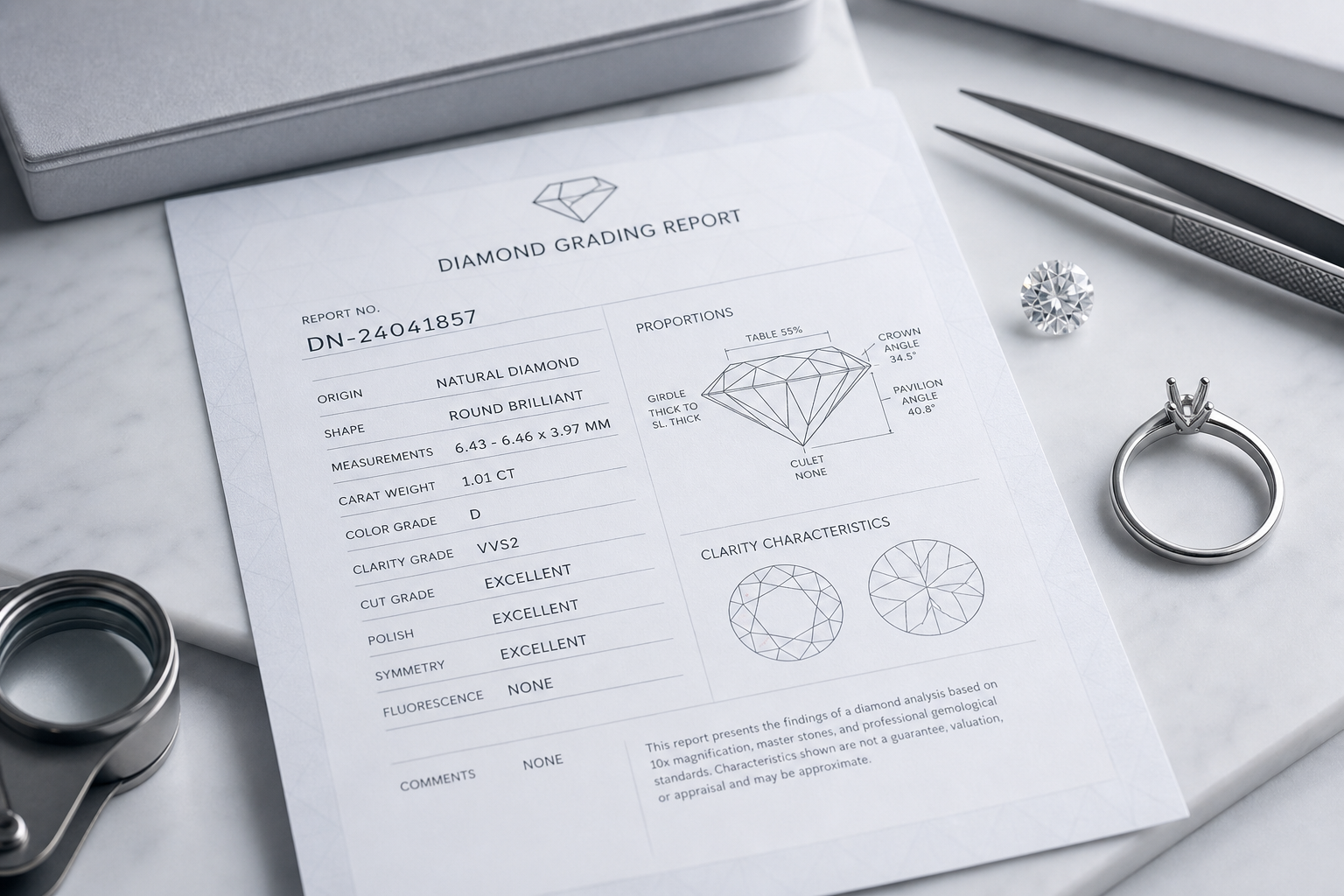
Grading details that affect comparison
A natural diamond report also gives buyers the comparison data that matters most before purchase. The main fields usually include carat weight, color, clarity, cut where applicable, measurements, proportions, polish, symmetry, and sometimes fluorescence. Those details do not replace visual review, but they give you a baseline for comparing one stone against another without relying on a sales pitch.
The most useful way to read these fields is to focus on what they change in real buying terms. Carat affects weight, but not always apparent size. Measurements help you judge how the stone will look face-up and whether it may fit the setting you have in mind. Color and clarity help narrow the field, but they do not tell the whole story of how a diamond will appear once you see it in video or under different lighting. Polish, symmetry, and fluorescence can also matter, but they should be interpreted in context rather than treated as automatic dealmakers or dealbreakers.
Fluorescence is a good example of why report details need context. It may be relevant to appearance in certain lighting, but the word alone does not tell you whether the diamond will look better, worse, or unchanged to your eye. If fluorescence appears on a report, it is worth comparing the stone’s actual video or viewing conditions instead of treating the field as an automatic reason to accept or reject the diamond.
Why provenance and certification are not the same thing
This is the distinction buyers often miss. A diamond grading report can identify a stone as natural, but it usually does not provide a full mine-to-market history. It is a grading document, not a complete provenance record. If a seller says the diamond came from a specific country, followed a particular ethical sourcing path, or meets a traceability standard, that claim should be supported by something beyond the grading report.
That separation matters because certification and provenance answer different questions. Certification tells you what the lab concluded about the stone’s identity and grading. Provenance tells you where it came from and how it was handled. Those may overlap, but they are not the same thing, and one should not be assumed from the other.
How to assess a traceability claim
Traceability claims should be read as evidence claims, not as marketing descriptions. A useful traceability statement should explain what is being traced, who provided the information, and how the details connect to the individual stone being sold. For a natural diamond, that may involve documents outside the grading report. For a lab-grown diamond, it may involve production or supplier information that is separate from the grading lab’s identification work.
The buyer’s question should be specific: does the documentation identify this diamond, or does it only describe a general sourcing approach? General statements may help explain a seller’s values, but they do not prove the history of a particular stone. If traceability is important to the purchase, ask for the written materials before committing and check whether the documents refer to the same report number, stone description, order reference, or other identifying detail.
What to Check Before You Decide
Before moving forward, compare the report number against the stone being sold and make sure the listed measurements match what you are actually reviewing. If the report includes an inscription, check that as well. Then look at the photos or video and confirm they match the report in shape, size, and overall appearance.
If the seller makes origin-country, ethical sourcing, or traceability claims, ask for separate written documentation. A natural diamond report can support your purchase decision, but it should not be used as the only proof for claims that go beyond grading.
Report Limits: Why Certification Is Not the Same as a Complete Buying Decision
A diamond certificate is useful, but it is not enough by itself to decide whether a diamond is the right purchase. That is the central limit buyers need to understand. A grading report can help you compare stones on paper, yet it cannot tell you everything about visual performance, price fairness, seller terms, or how the diamond will work in the finished piece. If you are asking, is a diamond certificate enough, the answer is no for any serious purchase.
A report does not guarantee visual beauty
Two diamonds can carry similar grades and still look different once you see them. Proportions, cut precision, inclusions, shape, and how light moves through the stone all affect appearance. That is why a grading report should be treated as a filter, not a final verdict.
This matters because buyers sometimes overestimate what the grade sheet can tell them. A strong report can narrow the field, but it cannot show you whether a diamond has a pleasing outline, whether it faces up well, or whether its personality fits your preference. For that, you still need photos, video, and a careful look at the actual stone.
A report does not prove the price is fair
Certification supports price comparison, but it does not determine value on its own. Two diamonds with similar report details can be priced differently because of seller channel, brand positioning, availability, service level, setting package, and market timing. A lower price can be attractive, but it is not automatically the safer choice.
This is where buyers often make the wrong assumption. A diamond certification report can confirm that you are comparing similar specifications, but it cannot tell you whether one seller is offering stronger support, better visuals, or more reliable documentation. Price should be evaluated after the report, not before it.
Prices can change with market conditions, report type, seller channel, and stone-specific details, so exact comparisons should be verified at the time of purchase. When comparing two diamonds, look for like-for-like specifications: origin, shape, carat, measurements, color, clarity, cut information, report type, visual evidence, and setting package. A price that seems attractive may still need more context if the listing lacks photos, a verifiable report number, or written seller terms.
A report does not replace seller documentation
Return terms, warranty details, resizing policy, shipping, setting specifications, and after-sales support all sit outside the grading report. Those points matter especially for engagement ring buyers and anyone ordering online. They should be confirmed in writing before payment, not assumed from a listing headline or a verbal promise.
A report tells you what the diamond is. Seller documentation tells you what happens after you buy it. Those are related, but they are not interchangeable.
How to separate report facts from seller promises
A helpful way to read any listing is to divide the information into three categories. First are report facts, such as origin designation, measurements, carat weight, shape, and grading characteristics. Second are visual judgments, such as whether the stone looks bright, clean, elongated, balanced, or suited to a particular setting. Third are seller promises, such as policies, service terms, production timing, sourcing statements, or after-sale support.
Only the first category is usually covered directly by the grading report. The second category needs photos, video, and design review. The third category needs written seller documentation. If a seller uses the presence of a report to imply that all three categories are already proven, the buyer should slow down and ask for the missing evidence in writing.
What This Means in a Real Purchase
Imagine a buyer comparing two 1.50 ct oval lab-grown diamonds with similar color and clarity grades. One stone comes with verified measurements, a clear video, and a report number that matches the listing. The other is lower priced, but the seller only offers a verbal description and a stock photo.
The lower price may look appealing at first, but the first option may provide a clearer basis for comparison because the buyer can actually verify what is being sold. In a real buying decision, incomplete documentation and weak visual evidence are not small issues. They are often the difference between a confident purchase and a guess.
The Numbers Buyers Should Compare on a Diamond Report
The most useful diamond report numbers are the ones that help you screen stones quickly without pretending that numbers alone solve the decision. Carat weight matters, but so do measurements, proportions, and shape-specific dimensions. If you are trying to figure out what numbers matter on a diamond certificate, start with the fields that help you judge size, fit, and likely appearance, not just the headline weight.
Carat weight versus millimeter measurements
Carat is weight. Millimeter measurements describe the diamond’s actual size. Those two things are related, but they are not the same. A stone can carry a strong carat weight and still look smaller or larger face-up depending on its proportions and shape.
That difference is easy to miss, especially for fancy shapes. For an engagement ring or custom setting, millimeter measurements are often more useful than carat alone because they help you understand face-up appearance and how the stone will sit in the setting. If you only compare carat, you are not comparing the full picture.
Useful proportion ranges for initial screening
These are screening ranges, not absolute quality guarantees. They help buyers ask better questions before narrowing down the final choice.
For a round brilliant, a table around 54 percent to 58 percent and a depth around 59 percent to 62.5 percent are common starting points for initial screening. A length-to-width ratio near 1.00 to 1.03 is also typical for a round shape, since the goal is a balanced circular outline.
For an oval, a length-to-width ratio around 1.30 to 1.50 is often a useful starting point, depending on the shape you prefer. Depth and table are less useful on their own because bow-tie visibility cannot be judged from numbers alone. Video matters here.
For an emerald cut, a length-to-width ratio around 1.30 to 1.50 often gives a classic rectangular look. Clarity and step visibility matter more than many first-time buyers expect, because inclusions can be easier to notice in this shape.
These numbers should help you screen, not decide everything. Their job is to narrow the field before you look at the diamond itself.
In practical buying, these ranges should not be treated as a substitute for taste. A slightly different ratio may be exactly what a buyer wants if it creates a longer oval, a softer cushion outline, or a bolder emerald-cut silhouette. The better question is whether the proportions support the intended look and whether the visual evidence confirms that the stone performs well.
Why fancy shapes need more than report numbers
Oval, pear, marquise, cushion, radiant, and emerald cuts all need visual review because report numbers cannot fully show the bow-tie effect, windowing, outline, crushed-ice appearance, or facet pattern preference. Two stones can look very different even when the paperwork looks similar.
That is why buyers should not overtrust the grading report on fancy shapes. The report can tell you the shape, size, and grading information, but it cannot tell you whether the stone will look lively, balanced, or visually clean in person. For these shapes, the report is the starting point, not the answer.
Stone-to-Setting Fit Check
Before choosing a setting, confirm the millimeter dimensions with the jeweler. A 1.50 ct diamond can vary meaningfully in face-up size depending on shape and proportions, and that difference can affect prong placement, halo sizing, and the overall look of the ring. The setting should be chosen around the actual stone, not the carat number alone.
For custom jewelry, this is one of the most practical checks a buyer can make. The report gives you the dimensions you need to avoid a mismatch, but the final fit still depends on how the stone and setting work together.
For custom jewelry, stone measurements and setting compatibility should be confirmed before finalizing a purchase. This includes the stone’s length, width, depth, girdle information where relevant, prong style, halo or bezel dimensions, and how high the stone will sit. A report can provide measurements, but the jeweler or design team still needs to confirm that those measurements work with the intended setting.
Why Verbal Claims Are Not Enough When Buying Lab-Grown or Natural Diamonds
A diamond purchase gets risky when the buyer is asked to trust descriptions alone. Terms like “real diamond,” “ethical diamond,” “certified,” “high quality,” or “conflict-free” can all sound reassuring, but they do not mean much unless they are tied to a grading report or other written confirmation. A seller may be honest and still be incomplete. The problem is that verbal claims are easy to misunderstand, and they are even easier to repeat in a way that sounds stronger than the actual evidence.
This is why diamond certification matters before buying. A diamond with a grading report gives the buyer a documented basis for comparison in any lab grown vs natural diamonds evaluation. Without that paper trail, you are not really comparing stones. You are comparing sales language, and that is a much weaker foundation for a purchase that may involve significant cost.
Verbal descriptions can be misunderstood or misrepresented
In everyday shopping, a phrase can sound specific when it is actually vague. “Conflict-free” may describe a seller’s sourcing policy, but it does not tell you what document supports that claim. “Certified” may mean there is a grading report, or it may be used loosely to suggest quality without proving anything in particular. Even “high quality” is only meaningful if the buyer can see the grades, measurements, and origin language behind it.
This is not the same as assuming every seller is misleading. It is simply a buyer-protection issue. Diamonds are too expensive, and too similar in appearance, to rely on impressions alone. If the claim matters to the decision, it should be written down somewhere a buyer can verify.
Written documentation creates a comparison baseline
A grading report gives the buyer a common reference point. It shows the stone’s origin designation, carat weight, measurements, and grading characteristics in a way that can be checked against another diamond. That matters because two stones can sound similar in a listing and still be very different in size, shape, or visual outcome.
Once the details are documented, the comparison becomes much clearer. A buyer can ask better questions, spot inconsistencies faster, and separate actual value from polished wording. That is why diamond report verification matters before buying: it lets you compare evidence, not just phrasing.
Red flags before purchase
A few warning signs should make any buyer slow down. No report for a significant diamond purchase is one of the clearest red flags, especially when the seller is asking for a serious commitment. A missing report number is another problem, because it prevents easy verification. If the seller’s description says one thing and the report says another, the mismatch should be treated as a real issue, not a minor detail.
Other concerns include stock photos only, unclear origin language, pressure to decide quickly, or a refusal to put claims in writing. A seller who will not document what they are promising is asking the buyer to absorb unnecessary risk. That is rarely the right choice for a diamond purchase involving grading claims.
Buyer Verification Checklist
Before payment, request the grading report and compare the report number if verification is available through the issuing lab. Save the product listing exactly as shown. Confirm in writing whether the diamond is lab-grown or natural. Check that any policy or sourcing claim is documented, not just said over the phone or in chat. If a claim changes the value of the purchase, it belongs in writing.
The careful approach is not distrustful, just disciplined. Serious diamond purchases deserve written evidence, because that is what gives the buyer real clarity.
Comparing Lab-Grown and Natural Reports Without Turning It Into a Diamond Type Debate
Lab-grown vs natural diamond certification is easiest to understand when the focus stays on the report, not the argument around the diamond type. The point of the document is to help buyers compare origin, grading standards, measurements, and verification details in a controlled way. It does not decide which diamond type is “better” for everyone. It only makes the choice easier to evaluate honestly.
The most useful comparison is not emotional. It is practical. A lab-grown diamond report and a natural diamond report both help the buyer understand what is being sold, but they serve slightly different buying goals. Once that is clear, the report becomes a tool for decision-making instead of a source of confusion.
What both report types help buyers compare
Both report types support the same basic buying questions. They identify the stone, document grading data, and provide measurements that help the buyer compare one diamond against another. They also give a report number that can usually be checked through the issuing lab, which adds a layer of accountability that a verbal claim cannot provide.
That shared function is the main reason reports matter. Whether the diamond is lab-grown or natural, the buyer still needs a way to compare origin, size, shape, and grading on equal terms. Without that, the decision quickly becomes subjective in the wrong way.
Where the reports differ most
The biggest difference is origin language. A lab-grown report should identify the diamond as laboratory-grown, while a natural diamond report should identify it as natural. That distinction is the core point of the document. Some lab-grown reports also include growth-related comments, though that is not universal. Natural diamond reports may confirm origin and grading without offering a full geographic history.
That last point matters. A natural diamond report is not the same thing as a complete provenance record. It can confirm that the diamond is natural, but it does not automatically prove a mine-to-market story unless the seller provides separate documentation. Buyers often overread what the report can do here, and that is where mistakes happen.
Sustainability language should be handled with the same care. Lab-grown diamonds can offer a different production path from mined diamonds, but that does not automatically prove a specific environmental or ethical outcome. If sustainability is part of the purchase decision, buyers should look for clear written information about production, sourcing, and seller transparency rather than relying on the diamond type alone.
How to evaluate sustainability or ethics claims carefully
If a seller describes a diamond as sustainable, ethical, eco-friendly, conflict-free, carbon-neutral, or responsibly sourced, ask what specific evidence supports that exact wording. A grading report may identify the stone and document its characteristics, but it usually will not prove a broad environmental or social claim on its own. Stronger support would normally be claim-specific, written, and tied to the seller’s actual supply chain or production practices.
A careful buyer does not need to reject every values-based claim. The point is to separate clear documentation from broad marketing language. “Lab-grown” and “natural” describe origin categories; they do not, by themselves, answer every question about energy use, sourcing practices, labor conditions, traceability, or environmental impact. If those points matter to the purchase, they deserve evidence that is as clear as the grading report itself.
Environmental and sustainability claims should be specific, documented, and limited to what can be substantiated. A statement about a laboratory-grown diamond’s origin is not the same as a statement about its energy source, emissions profile, labor practices, or overall environmental impact. Buyers who care about these issues should ask for claim-specific documentation rather than treating any single diamond category as automatically more responsible in every situation.
Sustainability and sourcing claims should be specific and documented. Broad green language is less useful than clear information about production, energy context, sourcing records, and seller transparency.
How buyer priorities change the meaning of the report
A buyer focused on size and budget will usually use lab-grown certification to compare more specifications at a given price point. In that case, the report is most useful as a value-checking tool. A buyer focused on natural rarity will care more about origin confirmation and consistent grading, so the natural diamond report becomes the anchor point for identity and comparison.
Neither report type makes the decision for the buyer. It only supports the priority the buyer already has. That is the right way to think about certification: it helps narrow the field, but it does not choose the field.
What to Check Before You Decide
Before comparing reports, decide what matters most: origin, size, visual performance, budget, documentation, or final setting outcome. If that question is still unclear, the report will not solve it for you. Once the priority is defined, the certification becomes much more useful because you can judge whether the stone actually fits the goal.
The report is strongest when it is used for the right decision. If the buyer wants a transparent comparison, certification helps. If the buyer wants the report to settle the entire debate, it will fall short.
How to Use a Diamond Report Alongside Photos, Video, and Seller Information
A diamond report is useful, but it should never be the only source of information. A careful buying process combines diamond report verification with photos, 360-degree video, measurements, and written seller details. That combination matters because a diamond with a grading report can still be a poor fit if the visual evidence is weak or the listing does not match the report.
For online purchases in particular, this is the difference between a careful decision and a guess. A report tells you what the diamond is on paper. Photos and video show how it actually presents. Written seller information fills in the terms that the report does not cover.
Step 1: Match the report to the listing
The first check is simple: the report number, carat weight, shape, measurements, color, clarity, and origin should match the product page or seller quote. If one of those details is off, the buyer should pause. Small inconsistencies can signal a listing error, but they can also mean the stone being sold is not the stone being described.
This is one of the most basic forms of diamond report verification, and it is often skipped. It should not be. A mismatch at this stage undermines the entire purchase.
Step 2: Review actual visual evidence
Photos and 360-degree video help the buyer see what a report cannot show. They can reveal inclusions that are more noticeable in real life, shape outline issues, transparency concerns, bow-tie effect in certain shapes, and the general look of the stone under different lighting. That visual review is especially important when the diamond is being considered for a ring or a custom piece.
Two stones with similar grades can still look meaningfully different. The report will not tell you which one feels cleaner, brighter, or better balanced to the eye. Video often does more to clarify that than another sentence from the seller ever will.
Step 3: Confirm fit for the intended jewelry
Loose diamond measurements matter because the setting has to fit the actual stone, not just the carat weight on the report. This is especially important for engagement rings and custom design work, where a few tenths of a millimeter can affect how the stone sits in the setting or how the finished piece looks on the hand.
The report should be shared with the jeweler or design team before the setting is finalized. At NUVU, this is the kind of detail that helps avoid expensive surprises later. A diamond can be well graded and still be the wrong physical fit for the design.
For custom design, trust comes from matching the stone to the setting, budget, and wearer’s daily use, not from choosing grades in isolation. The report can give the measurements and grading framework, but the final decision should also consider prong placement, stone height, band style, hand proportions, and whether the selected shape supports the intended design.
Step 4: Put important claims in writing
Origin, report details, setting specifications, and any policy-related terms should all be confirmed in writing before purchase. If a seller is making a claim that affects your decision, it should not remain a verbal promise. The report and the written listing should work together, not compete with each other.
This is where many buyers gain or lose confidence. Clear documentation makes the purchase easier to evaluate, while vague reassurance leaves too much room for avoidable error.
Trust signals to expect from a careful diamond selection process
A trustworthy buying process should feel organized rather than rushed. The seller should be able to explain why a particular diamond was shortlisted, how the report supports the recommendation, and what still needs to be judged visually. For a lab-grown diamond, that may include confirming the origin language, checking whether the report number can be verified, and comparing the stone’s measurements against the design. For a natural diamond, it may also include clarifying which claims are grading-based and which require separate sourcing documentation.
When NUVU helps a buyer evaluate a diamond with a grading report, the practical aim is to connect the report to the finished jewelry decision. That means discussing shape preference, face-up size, visual cleanliness, setting style, metal color, budget, and any documentation the buyer wants to review before approving the stone. The reassurance comes from a transparent process: the buyer should understand what is known from the report, what is visible from photos or video, and what is covered by the seller’s written terms.
NUVU’s role in buyer education is to make comparison clearer, especially around grading reports, visual evidence, design fit, and documentation. Buyers should still verify report details with the issuing laboratory where tools are available and confirm seller terms in writing before purchase.
Final evidence check before payment
Before you pay, do a final document-to-stone check rather than relying on memory. Open the report, the listing, and the visual media at the same time. Confirm the origin wording, shape, measurements, carat weight, color, clarity, and any inscription or report number that appears in the documents. If the seller has made a claim that goes beyond grading, such as sourcing, sustainability, warranty, upgrade, or return terms, make sure that claim appears in writing somewhere outside a casual conversation.
If anything is inconsistent, ask for clarification before moving forward. A legitimate correction should be clear and documented. A vague answer such as “do not worry” or “that is normal” may not be enough when the issue affects origin, identity, measurements, or purchase terms. A more confident purchase is the one where the report, visuals, listing, and written seller commitments all describe the same diamond in the same way.
Certificate and Visual Review Check
Use a simple workflow: verify the report number, compare the listing details, review the video, ask one question about setting fit, and save the written confirmation before paying. That is usually enough to filter out many preventable problems without overcomplicating the process.
The point is not to make the purchase feel heavy. It is to make it specific. When the report, the visuals, and the seller’s written details all line up, the buyer has a much stronger basis for moving forward.
Compliance-Aware Buying Summary
The cleanest way to use diamond certification is to keep each type of evidence in its proper lane. A grading report can help confirm whether the stone is laboratory-grown or natural, record its measurements, and document grading characteristics. It should not be stretched into proof of beauty, guaranteed value, environmental impact, ethical sourcing, seller policies, or future resale performance.
For lab-grown diamonds, the origin disclosure should be clear in both the report and the seller’s description. For natural diamonds, the report can support natural origin identification, but it should not be treated as a complete provenance record unless separate traceability documentation is provided. For both categories, buyers should compare the report with the listing, visual media, seller documentation, and intended jewelry design.
NUVU’s buyer-first approach is to make comparison clearer, especially around report details, visual evidence, setting fit, and documentation. That approach does not require treating one diamond type, one lab name, or one grade combination as the right answer for everyone. It means asking whether the evidence supports the specific diamond, the specific design, and the buyer’s stated priorities.
Disclosure: This article is for general educational purposes only. Diamond grading, pricing, availability, specifications, and seller policies can change, and readers should verify important details through grading reports, official laboratory tools, seller documentation, or qualified professionals before making a purchase decision. Laboratory-grown diamonds should be clearly distinguished from natural diamonds, and environmental or sourcing claims should be supported by specific documentation.