
Certification, traceability and transparency answer different questions. A grading report describes a diamond’s examined characteristics. Traceability connects a product to records about its handling or production path. Transparency describes how clearly the seller explains the scope, limits and responsibility behind those records. A credible buying decision uses all three without treating any one document as proof of everything.
| Question | Useful evidence | Limit to keep in mind |
|---|---|---|
| What is this stone? | External grading report, report number, measurements and disclosure | The report is a snapshot, not a complete supply-chain history. |
| Where did it move? | Order, batch, intake, cutting or matching records where applicable | Records may cover only the stages the seller controls or can document. |
| Who was responsible? | Named legal entity, supplier role and written scope of responsibility | A brand name does not mean every process was performed by one company. |
| Can the claim be checked? | Official lookup pages, dated documents and consistent stone identifiers | Logos and summaries are not a substitute for the underlying record. |
Certification is a starting point
A grading report can identify laboratory-grown origin and record the characteristics covered by that laboratory’s service. Fields and rating systems vary: for example, GIA’s current laboratory-grown assessment uses Premium or Standard designations for eligible stones. Check the applicable service and use the issuing laboratory’s report-check tool, then confirm that the document belongs to the stone in the listing or order.
The report does not normally establish the complete journey from growth material to finished jewelry. It also does not establish a factory’s environmental performance, the identity of every upstream supplier, or the commercial terms of a purchase. Those questions require additional records and a seller willing to state what is inside and outside the claim.
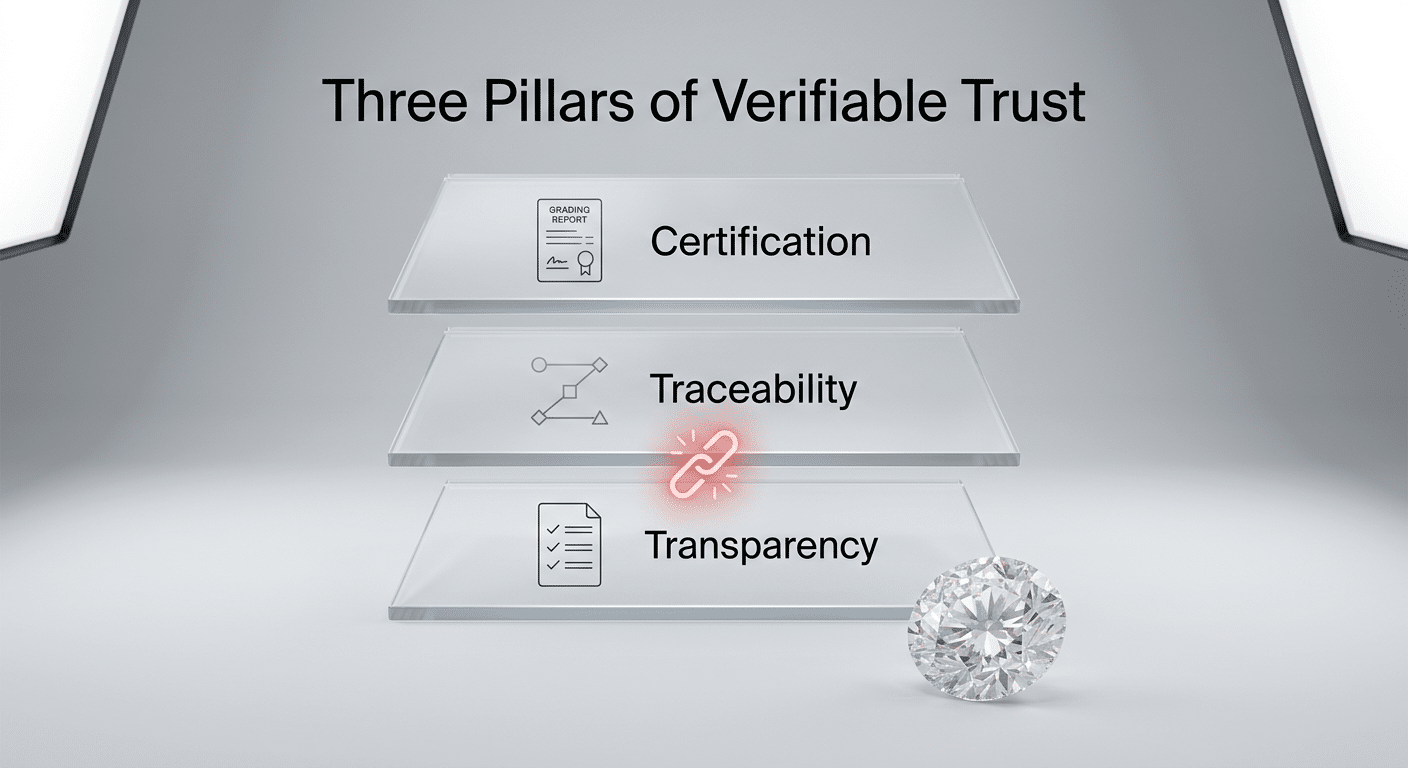
What a traceability record can connect
Traceability is most useful when the link between records is explicit. Depending on the order, a documentation path may connect an intake or growth reference, rough or polished inventory, cutting and matching records, an external grading report, and the finished jewelry or parcel. The record should identify the relevant item, date or batch, responsible entity and handoff. It should also say when a step was performed by a supplier rather than by the brand.
Do not assume that a batch number proves every upstream detail. Ask what the identifier actually links to, who created it, how changes are logged, and whether the record is available for the item you are buying. A useful traceability statement is specific about scope and limitations.
Separate NUVU’s roles from supplier roles
NUVU is the international commercial brand of New Perspective Superhard Materials Co., Ltd. Its operating model includes owned HPHT production and order-specific CVD sourcing. Ask which production or sourcing route applies to your purchase; a brand name alone does not identify all the companies handling a stone.
For a NUVU inquiry, agree on requirements, document review, physical checks, matching and finished-piece inspection before shipment. Confirm the contracting entity and any external laboratory or supplier at the stage where each is involved. Read the company background alongside the order-specific records.
How retail buyers can test a traceability claim
- Ask for the report number and verify it with the issuing laboratory.
- Confirm that the report, listing, measurements and actual stone are the same item.
- Ask what origin or process information is covered by the seller’s traceability statement.
- Ask whether the record covers the stone, the finished jewelry, or only a supplier batch.
- Keep the order, report, photos and written answers together so the scope is not lost after purchase.
How B2B buyers can define the evidence package
Retailers and private-label brands should put the requested evidence into the purchase order or supplier questionnaire. Useful fields include the item or parcel identifier, grading laboratory, report status, shape and size tolerances, matching requirements, treatment disclosure, responsible legal entity, inspection point, packing list and change-control process. If a supplier uses an external CVD source, say so and identify what the supplier is responsible for.
Confirm the minimum order quantity, availability, report arrangements and schedule in the current quotation. Keep those terms with the order so that an earlier estimate is not mistaken for a commitment covering later purchases.
Red flags in documentation
- A report number that cannot be found or does not match the listing.
- A generic batch or “factory certificate” with no defined scope or responsible entity.
- Marketing language that calls a grading report proof of environmental performance or full origin.
- Images, sample identifiers or location labels presented as the buyer’s actual production record without confirmation.
- A refusal to explain which steps are performed in-house and which are sourced or outsourced.
Read a limited claim literally
For example, a seller may provide a grading report and records from polished-stone intake through dispatch. That supports identification and the documented downstream handling. It does not establish where the rough was grown if the earlier records are missing. Ask the seller to identify the first documented stage and any gaps, and keep that boundary with the file instead of treating “traceable” as an all-or-nothing label.
Build a one-page verification file
For a simple order, keep the verified report, item photos, measurement notes, quotation and written scope in one file. For a B2B programme, add the approved specification, supplier roles, batch or parcel records, inspection checkpoints and revision history. This makes a later claim easier to investigate and prevents a general brand statement from being mistaken for an item-level guarantee.
For a report-reading primer, see how to read a lab-grown diamond grading report. For sustainability evidence, read how to evaluate sustainability claims. B2B buyers can also review the wholesale route before sending an inquiry.