- Shop
Diamonds & Jewelry
Loose Lab Diamonds Yellow Lab Diamonds Pink Lab Diamonds Blue Lab Diamonds Engagement Rings Fine Jewelry Shop All Loose lab-grown diamonds10 shapes · IGI, GIA or NGTC reports
- Wholesale
- Custom Design
- Education
- About
Custom Jewelry Budget Guide: How to Allocate Money Between Lab-Grown Diamond, Metal, and Design Work
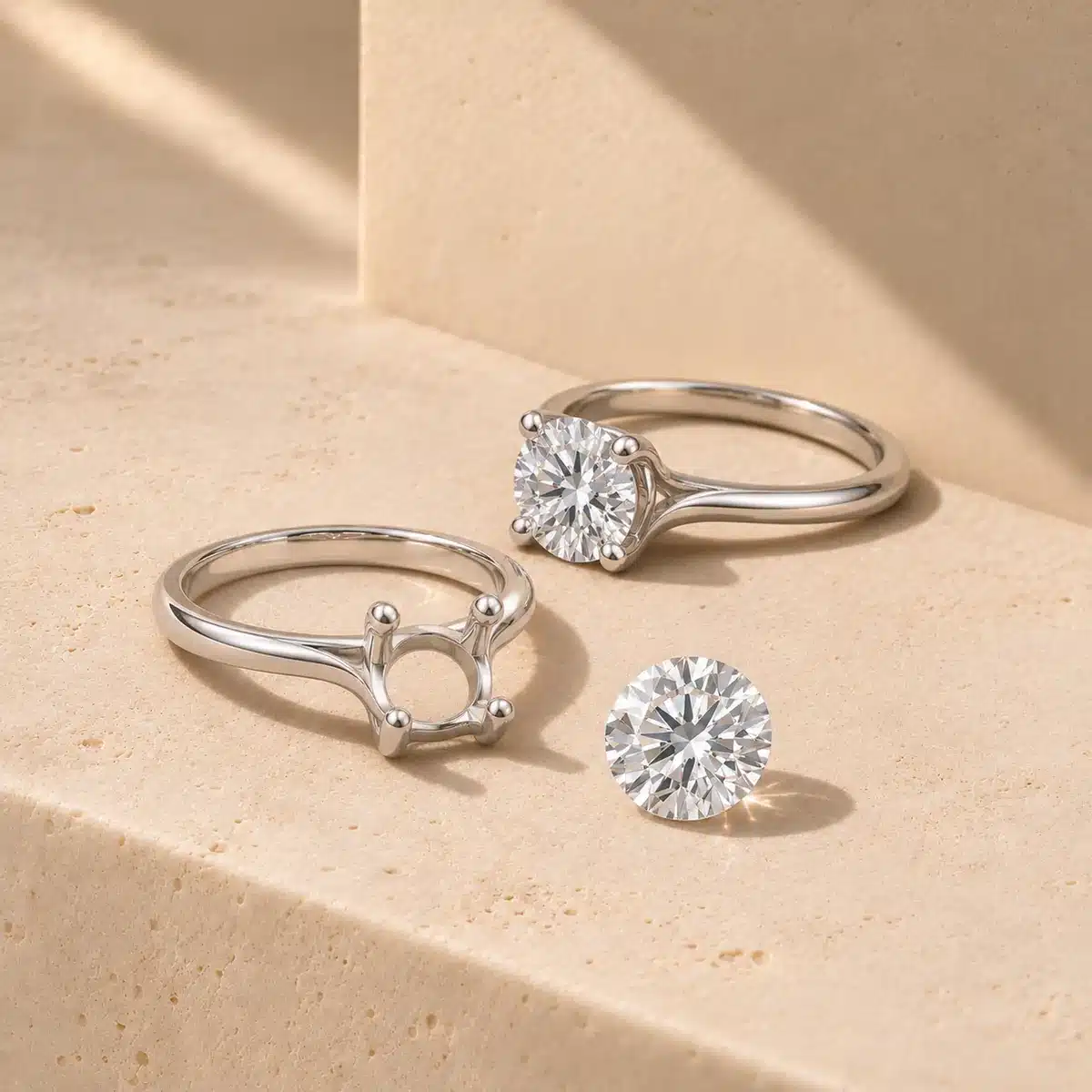
A 1.00 ct round brilliant measures about 6.4 mm across. A well-cut 0.95 ct measures about 0.1 mm less, a difference no one sees on the hand. Yet prices step up at whole and half carats, so the 0.95 ct usually costs noticeably less. That one decision can pay for the move from 14K to 18K gold, or for a hidden halo.
Budgeting a custom piece is a series of choices like that. A quote has five parts: the center stone, the metal, design and labor, side stones, and finishing, reports and shipping. Because a lab-grown center stone costs far less than a mined stone of the same size, metal and workmanship take a bigger share than buyers coming from natural diamonds expect. Pay first for cut quality and a setting strong enough for daily wear, then spend the rest where it shows.
Where the money goes
Choose a cost part:
The center stone
- Cut first. It decides brightness and how large the stone faces up. On rounds, the cut grade is the best single guide.
- Color and clarity to what you can see. GIA notes that most SI stones are eye-clean, though each needs checking, and that J–K color can look fine in yellow or rose gold. Many custom rings use G–H and eye-clean VS stones.
- Shape. In lab-grown, rounds and fancy shapes now cost about the same per carat, so an oval, which faces up larger than a round of the same weight, gives more look for the money.
- Weight thresholds. 0.90–0.99 ct and 1.40–1.49 ct stones look almost the same as the next full size and usually cost less.
- Report. IGI and NGTC give full grades; GIA gives lab-grown stones a Premium or Standard assessment. A report adds a fee, which is small next to the price of a center stone.
See the lab-grown diamond price guide.
The metal: 14K, 18K or platinum
Swipe the table to see more →
| Metal | Fine metal content | Relative cost | Wear | Color |
|---|---|---|---|---|
| 14K gold | 58.3% gold | Lowest of the three | Harder; good for daily wear | Yellow, white, rose |
| 18K gold | 75% gold | Higher | Softer; richer color | Yellow, white, rose |
| Platinum 950 | 95% platinum | Usually highest | Dense; holds stones well | Naturally white |
Metal is priced by weight. Platinum is much denser than gold, so the same design uses more metal by weight. Gold and platinum prices move daily, which is why quotes are valid for a limited period and why the metal line can change between quote and order.
Design and labor
Labor rises with the number of stones to set, pavé, hidden halos, engraving, milgrain, complex galleries and repeated CAD revisions. A clear brief with measurements and references keeps revisions, and labor, down. See what to check in a CAD.
Side stones
Small stones add sparkle and setting work in equal measure. A hidden halo or a half-pavé band gives sparkle for less than a full halo plus full pavé, and a plain band is easier to resize later.
What changes the price most
Swipe the table to see more →
| Change | Effect on cost |
|---|---|
| Crossing a weight threshold (0.99 → 1.00 ct) | Large for very little visible size |
| Higher color or clarity | Moderate, often invisible face-up |
| Round instead of a fancy shape | Little difference in lab-grown; large in natural |
| 18K instead of 14K | More gold in the same weight |
| Platinum instead of gold | Denser metal, more weight |
| Halo, hidden halo, pavé | More stones and more setting work |
| Engraving, milgrain, complex gallery | More labor |
| Extra CAD revisions or a resin model | Small to moderate |
Where to save, and where not to
Save on things nobody sees: a 0.95 instead of a 1.00 ct, eye-clean VS or SI instead of VVS, G–H instead of D–F (especially in yellow or rose gold), a hidden halo instead of a full one, a simple band with a strong head.
Do not save on cut quality, prong and band strength, a report you have looked up for the center stone, or an approved CAD with measurements. Each of those is cheap compared with fixing the result.
Three ways to weight the same budget
Swipe the table to see more →
| Priority | Center stone | Metal | Labor and side stones |
|---|---|---|---|
| Stone first | The largest share | Plain 14K band | Small |
| Design first | Medium | 18K or platinum | A larger share |
| Balanced | Similar weight across all three |
The actual split depends on stone and metal prices on the day of the quote. The table shows direction, not percentages.
Getting a quote you can compare
Give the stone’s shape, size range and quality range, the metal and karat, the ring size, the setting and side stones, and your total budget. An itemized quote, stone, metal, labor and side stones on separate lines, shows what each change does and lets you compare two makers line by line. Note how long the quote is valid, because metal moves.
Budgeting a brand collection
For a brand, budget per SKU and per order: samples, a CAD for each design, the report policy for center stones, packaging, and the documents each piece ships with. Agree how quotes are updated on reorders when metal prices have moved. See private label and OEM.
Budget questions
How much should go on the diamond vs the setting?
There is no fixed rule. Protect cut quality and the setting’s strength first, then decide by what you care about more, size or design.
Is 14K or 18K better for a lab-grown diamond ring?
14K is harder and costs less; 18K has a richer color and more gold.
What is the cheapest way to make a ring look bigger?
A well-cut stone, an elongated shape such as an oval, a slim but sound band, or a halo.
Why did my quote change after a week?
Gold and platinum prices move daily, and quotes are valid for a set period.
Price your custom piece
Send the stone or its report number, the metal, ring size, setting and your budget, and say which parts of the design are fixed and which are open. Start your custom design or message us on WhatsApp / WeChat at +86 19118403930.
Sources

11+ years supporting global clients with lab-grown diamond product consultation and market analysis.
About NUVU. NUVU is the international brand of New Perspective Superhard Materials Co., Ltd. in Zhecheng, Henan, China. We grow HPHT lab-grown diamonds in-house and cut, polish and match stones in our own workshop.
Related Guides
Custom jewelry guide
How custom lab-grown diamond jewelry is made: when custom makes sense, the brief, stone selection, CAD approval…
Read more →Custom jewelryRing design guide
How to design a custom lab-grown diamond ring: choose the stone first, match shape to prongs and setting height…
Read more →ShopShop by metal
Lab-grown diamond jewelry in platinum and 14K or 18K white, yellow and rose gold.
Read more →