
A lab-grown diamond bracelet is a significant purchase, but the value is not just in the total carat weight. The real difference between a bracelet that lasts and one that fails comes down to structural choices, as detailed in lab grown diamond jewelry guide for selecting meaningful pieces beyond engagement rings: how the stones are set, how thick the metal is, and how the clasp works. This article breaks down the three main styles—tennis, bangle, and station—and explains why a consistent cut grade, a minimum band thickness of 1.5 mm, and a tested safety clasp matter more than the number of diamonds. It also covers what to look for in a certificate and how repair costs differ by style. By the end, you will know which construction details to prioritize and which trade-offs are worth making for your lifestyle.
For the full framework, read Custom Lab-Grown Diamond Jewelry Guide.
For buyers, the practical point is that this is not a single category. Each bracelet style solves a different design problem, and the best choice depends on how the piece will be worn, not just how many carats it carries.
| Feature | What to Look For | Why It Matters |
|---|---|---|
| Stone continuity | Tennis: consistent cut & color across all stones; Station: deliberate spacing (12–18 mm gaps) | Mismatched stones in a tennis bracelet ruin uniformity; station bracelets rely on spacing for balance |
| Metal thickness | At least 1.0 mm at connection points; 1.5 mm for bangles | Thinner metal bends or breaks under daily wear, risking stone loss |
| Clasp type | Safety clasp with secondary latch (e.g., box clasp with trigger or screw lock) | Mechanical failure is more common than stone loss; a weak clasp means losing the entire bracelet |
| Stone setting | Prong settings for bold look (but vulnerable); channel settings for durability | Prongs require regular inspection; channel settings protect edges but need annual loupe checks |
| Repair ease | Station bracelets: easy to replace individual stones; Tennis: hard to match color/cut | Matching lab-grown stones can be difficult later; station designs avoid this problem |
| Daily wear suitability | Clasp test every 6 months; re-polishing every 1–3 years; remove before swimming or chemicals | Routine maintenance prevents metal fatigue and preserves brilliance |
Quick Questions Before You Read
Q: Can I resize a diamond bracelet if it is too loose?
Bangles require precise sizing and cannot be easily adjusted. Station and tennis bracelets can be resized by a jeweler, but the cost depends on the chain type and stone placement.
Q: Do I need a certificate for every stone in a multi-stone bracelet?
No. For most tennis and station bracelets, a certificate for the lead stone plus a matching grade range for the others is sufficient. Certification for every small stone is unnecessary.
Q: Is a lab-grown diamond bracelet less durable than a natural diamond one?
No. Lab-grown diamonds are physically identical to natural diamonds in hardness and durability. The durability of the bracelet depends on metal thickness, clasp quality, and setting type, not the origin of the stones.
Q: What is the most common damage to diamond bracelets?
Mechanical failure of the clasp is more common than losing a stone. Prongs can also bend or snag, which is why regular inspection every six months is recommended.
Lab-Grown Diamond Bracelets: Why the Style, Stone, and Structure Matter More Than the Carat Total
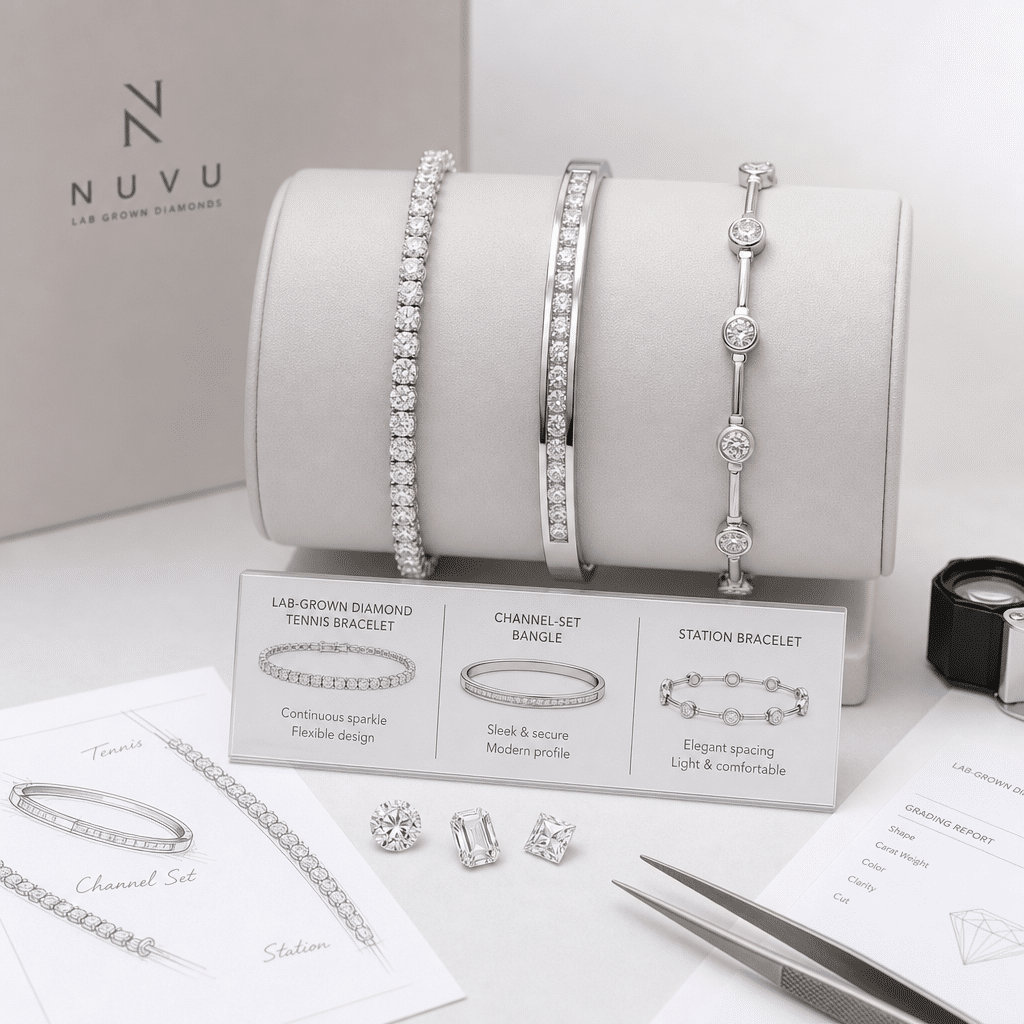
Buying a lab-grown diamond bracelet is not one decision. It is a decision between three fundamentally different product categories, each with its own engineering logic, wear behavior, and value structure. The total carat weight tells you very little about whether the bracelet will work for your wrist, your lifestyle, or your budget. The style, the stone placement, and the structural build determine that.
Moving Past the Assumption That All Diamond Bracelets Are Tennis Bracelets
In retail conversation, the term “tennis bracelet” gets applied loosely to almost any line bracelet with continuous diamonds. Structurally, a true tennis bracelet requires a specific link construction — usually a box-and-toggle design — with high flexibility and a clasp engineered for security under normal arm movement. A double-lock or safety clasp is not decorative; it is the difference between a bracelet you wear confidently and one you worry about losing. A bangle or cuff has no flex at all. It relies entirely on precise internal diameter and material stiffness. For gold bangles, a wall thickness of 1.2 mm to 1.8 mm is the range that provides structural integrity without feeling overly heavy. A station bracelet takes a third approach: periodic stone settings — prong, bezel, or channel — spaced along a metal chain or rope. Each of these styles imposes different constraints on stone size, weight distribution, and what maintenance will look like over time.
For buyers, the real distinction is not just how the bracelet looks, but how it behaves on the wrist. A piece that seems similar in a photo can wear very differently depending on whether the structure is designed for flexibility, rigidity, or distributed weight.
The Three Core Decision Variables That Differentiate Bracelet Styles
Three variables separate these categories in practice. The first is fit. A tennis bracelet must flex and wrap around the wrist curve. A bangle must slide over the hand and then sit without rotating. A station bracelet depends on chain length and the weight distribution of the stone modules. The second variable is stone coverage ratio — the relationship between stone carat weight and total bracelet weight. A 3-gram bangle with 2 carats of diamonds has a fundamentally different price composition than a 10-gram bangle with the same 2 carats. The lighter piece spends more of its cost on stones; the heavier piece spends more on metal. The third variable is maintenance exposure. A tennis bracelet has multiple failure points — each link and the clasp. A bangle has few failure points, but when one occurs, the entire piece is compromised. A station bracelet offers the easiest repair path: individual stations can be replaced independently.
How Wrist Fit and Wear Frequency Transform the Decision
Daily wear and occasional wear are not the same purchasing problem. A bracelet worn every day needs clasp engineering that survives repeated stress: a lobster clasp with a safety catch for tennis bracelets, or a sucker-latch hinge for bangles. An occasional piece can use a simpler closure because it faces fewer cycles. Bangles require precise inner circumference sizing — typically 54 mm to 62 mm in diameter for standard to large wrists — and a high-polish finish to avoid snagging on clothing. A station bracelet with larger stone intervals, such as 3 mm to 5 mm of spacing between settings, often holds up better under daily wear than a channel-set line bracelet, where the integrity of the entire channel depends on perfectly uniform stone placement and bezel wall thickness. The more continuous the stone line, the more vulnerable the piece is to a single point of failure.
Buyer Verification Checklist: The Three Structural Tests
Before buying any lab-grown diamond bracelet, confirm three things. First, the clasp type and whether it includes a safety feature for active wear. Second, the metal wall thickness at the clasp connection points — a minimum of 1.0 mm is recommended for security in 14k gold. Third, the stone-to-metal ratio description, not just the total carat weight, so you can assess how much of the bracelet is diamond versus metal. These three checks will tell you more about the bracelet’s real value than the carat number alone.
Distinguishing Lab-Grown from Natural in Bracelet Shopping
When evaluating a bracelet, it is worth noting that laboratory-grown diamonds should be clearly identified as laboratory-grown, and they should not be presented as mined diamonds. This distinction is not just a matter of terminology — it affects how the stones are graded, priced, and matched across a set. In a tennis bracelet where dozens of stones sit side by side, a clear origin declaration helps the buyer verify that the set is consistent and that any grading reports provided accurately reflect the stones in the piece. A seller who transparently discloses the growth method — whether HPHT or CVD — is generally providing a more reliable basis for comparison than one who uses vague or promotional language. For multi-stone bracelets, this kind of clarity is especially useful, because the visual consistency of the set depends on stones coming from controlled production contexts rather than assembled from disparate sources.
Lab-Grown Tennis Bracelets: Flexibility, Continuity, and the 4Cs in Motion
A tennis bracelet is the most visually demanding application for lab-grown diamonds because the same light behavior must repeat across 30 to 50 stones. In a solitaire ring, a single stone carries the entire visual impression. In a tennis bracelet, the eye traces the light performance from stone to stone, and any inconsistency breaks the line. This changes how cut, color, and clarity should be evaluated.
Cut Quality Requirements for a Continuous Line of Diamonds
In a tennis bracelet, diamond girdle thickness and crown angle become more visible because the eye compares each stone against its neighbor. Batch-matching round brilliant or princess-cut diamonds for consistent spread — the apparent size of each stone — is a production discipline that rarely comes up in single-stone buying but is essential here. A variation of more than 2% to 3% across table percentage or a difference of 1 degree in crown angle becomes noticeable in a continuous channel or prong setting. Lab-grown diamonds offer a real advantage in this area. Because stones can be produced in controlled growth batches, the cut consistency across a multi-stone set is often tighter than what is available from natural diamond parcels, where each stone comes from a different source.
Color and Clarity Matching Across Multiple Stones
For a tennis bracelet, a color grade of D-E-F is more common than for a single stone in a pendant. Side-by-side comparison makes even a one-grade difference visible. If one stone is F and the next is G, the warmer stone will stand out against the cooler line. Clarity tolerance is broader. SI1 to VS2 is usually acceptable because inclusions are smaller relative to the number of stones and are less noticeable when the bracelet is in motion than in a static solitaire. The real requirement is visual matching, not just matching the grade on the certificate. A bracelet with 40 diamonds all graded F-VS2 will deliver consistent visual performance. A bracelet with the same grades but stones sourced from different production runs may not.
For buyers, this means that the certificate is a useful starting point, but it does not guarantee visual uniformity. Two stones with the same grade on paper can still look different in a line setting. Asking for a photo or video of the bracelet laid flat under consistent lighting is one way to verify whether the set actually matches before purchase.
Why Grading Consistency Matters for Light Performance in Motion
Because a tennis bracelet is in nearly constant motion on the wrist, the interplay of light across the diamond line is what creates its visual impact. The Gemological Institute of America (GIA) defines cut quality for round brilliants using specific criteria: brightness, fire, and scintillation.[1] In a multi-stone bracelet, a consistent cut grade across all diamonds ensures that each stone performs similarly as the bracelet moves. If one stone has a cut grade of Excellent and the next is Good, the difference in light return becomes visible during movement, breaking the fluid visual line that defines a tennis bracelet. For buyers comparing lab-grown diamonds, this means cut grade should be treated as a matching requirement across the entire set, not evaluated stone by stone.
The Clasp and Link Engineering That Prevents Catastrophic Failure
Tennis bracelets have a well-known weakness. If the clasp opens or a single link breaks, the entire bracelet can slide off and be lost. Modern manufacturing addresses this with double-lock safety clasps that require two discrete actions to open, screw-in chain links for added security, and integrated safety chains that connect the clasp to the main body. These are not design flourishes. They are functional requirements that determine whether the bracelet is safe for daily wear. A bracelet without a secondary closure is an evening piece, not an everyday piece, regardless of how it looks.
What to Check Before You Decide: Clasp and Link Documentation
Ask the seller to confirm three things. First, whether the clasp includes a safety latch or secondary closure. Second, the link construction type — box-and-toggle is preferred over hollow jump rings for durability. Third, whether replacement links or repair service are available for that specific bracelet. For lab-grown diamonds, some manufacturers provide matching loose stones from the same production batch for future repairs. That is a meaningful advantage if you plan to wear the bracelet regularly for years.
How to Use a Grading Report for a Tennis Bracelet
A grading report can document key characteristics such as carat weight, color, clarity, and cut for an individual stone. In a tennis bracelet, however, the report for a single stone does not tell the full story of the set. The buyer still needs to verify that the stones placed in the bracelet match each other visually. Some sellers provide a “matching grade range” — a statement that all stones in the piece fall within a defined color and clarity bracket, such as F-G color and VS clarity. This can be a practical alternative to individual reports for every stone, but it should not be treated as a guarantee of beauty, value, or sourcing ethics. For a bracelet with many small diamonds, the most useful documentation is often a written confirmation of the grade range combined with a clear photograph of the set under controlled lighting.
Lab-Grown Bangles and Cuffs: Structural Integrity, Wrist Fit, and Stone Placement
Bangles and cuffs represent the opposite design logic from tennis bracelets. They are rigid, not flexible. Stone placement, metal weight, and fit must be exact at the point of manufacture because nothing can be adjusted later. These pieces are often heavier in both metal and labor cost relative to their visible stone weight, and that weight distribution matters more than the carat total.
The Engineering Challenge of Setting Diamonds into a Rigid Band
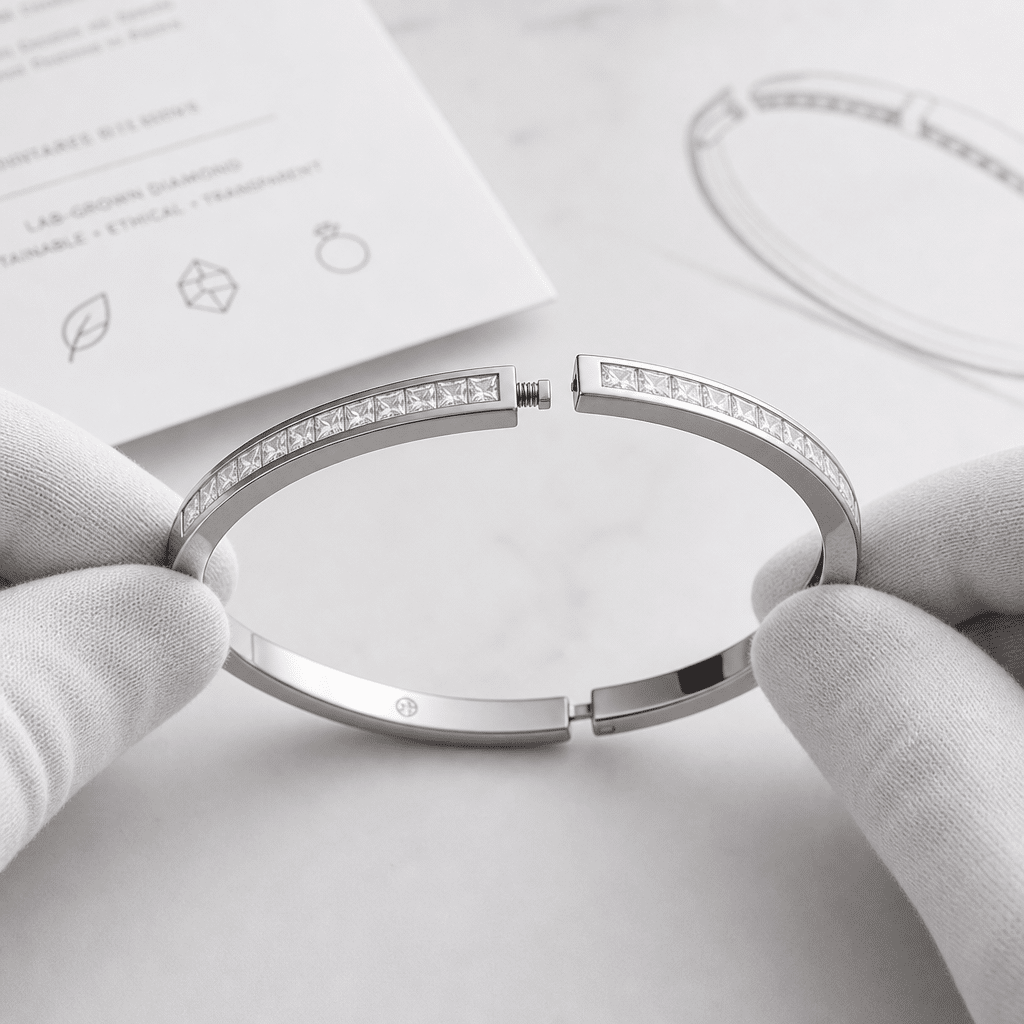
A bangle with a channel-set row of diamonds requires the band to be cast or fabricated as a single piece, or as a hinge joint. The metal wall thickness behind the stones must support the setting without flexing, because any movement in a rigid band will stress the stone seats. For a hinged bangle, the hinge mechanism — typically a small steel pin embedded in gold — must be strong enough for repeated opening and closing over decades. Tension-set or flush-set diamonds in a cuff require deep metal construction to hold the stone under load. That increases total bracelet weight significantly. A cuff with flush-set diamonds will almost always weigh more than a tennis bracelet with the same carat total, and the extra gram weight is structural, not decorative.
How Wrist Circumference and Opening Mechanism Affect Suitability
Bangles are sized by inner diameter and wrist circumference. A bangle that is 2 mm to 3 mm too small becomes uncomfortable to slide over the hand. One that is 2 mm too large rotates and shifts, making the stone orientation unpredictable. Cuffs offer more flexibility. A cuff with a spring gap can adapt to slight wrist size variation, but it imposes a limit on how many stones can safely be set near the open area, because stress concentrates at the gap. A full-closure hinged bangle provides the most secure stone setting but requires precise sizing at the point of purchase. There is no adjustment after manufacturing.
Metal Selection and Wear Durability for Everyday Use
Platinum and 18k gold are common for high-end bangles because of their weight and scratch resistance. But for a lab-grown diamond bracelet intended for daily wear in a less formal setting, 14k gold offers a better balance of weight, cost, and durability. Hollow-link construction is problematic for bangles because they can dent under impact. Solid construction with a minimum band thickness of 1.5 mm is recommended for any bangle with diamonds set above the band surface. Below that thickness, the setting points become structurally vulnerable.
For buyers considering a bangle for regular wear, it is worth noting that a thicker band, as per the lab grown diamond tennis bracelet guide, also provides a more comfortable weight distribution. A very thin rigid band tends to dig into the wrist, while a properly proportioned band sits more evenly.
Stone-to-Setting Fit Check for Bangles and Cuffs
For a bangle, verify that the stone setting method matches your intended wear frequency. Channel-set stones are more secure than prongs on a rigid band, and flush-set stones are the most durable option for active wear. Prong-set stones on a rigid band create stress points that can loosen over time because the band does not absorb shock the way a flexible tennis bracelet does. Ask the seller for the metal wall thickness at the setting points, not just the total gram weight. That number tells you whether the structure supports the stones.
Lab-Grown Station Bracelets and Symbolic Wrist Jewelry: Personalization, Spacing, and Charm Dynamics
Station bracelets occupy a different territory than tennis bracelets or bangles. They are not trying to create a wall of light or a solid metal presence. Instead, they rely on deliberate spacing, allowing the eye to pause between stones. This makes them more adaptable to personal taste, but it also introduces a different set of decision points that buyers often overlook.
How Stone Size and Spacing Define the Visual Profile
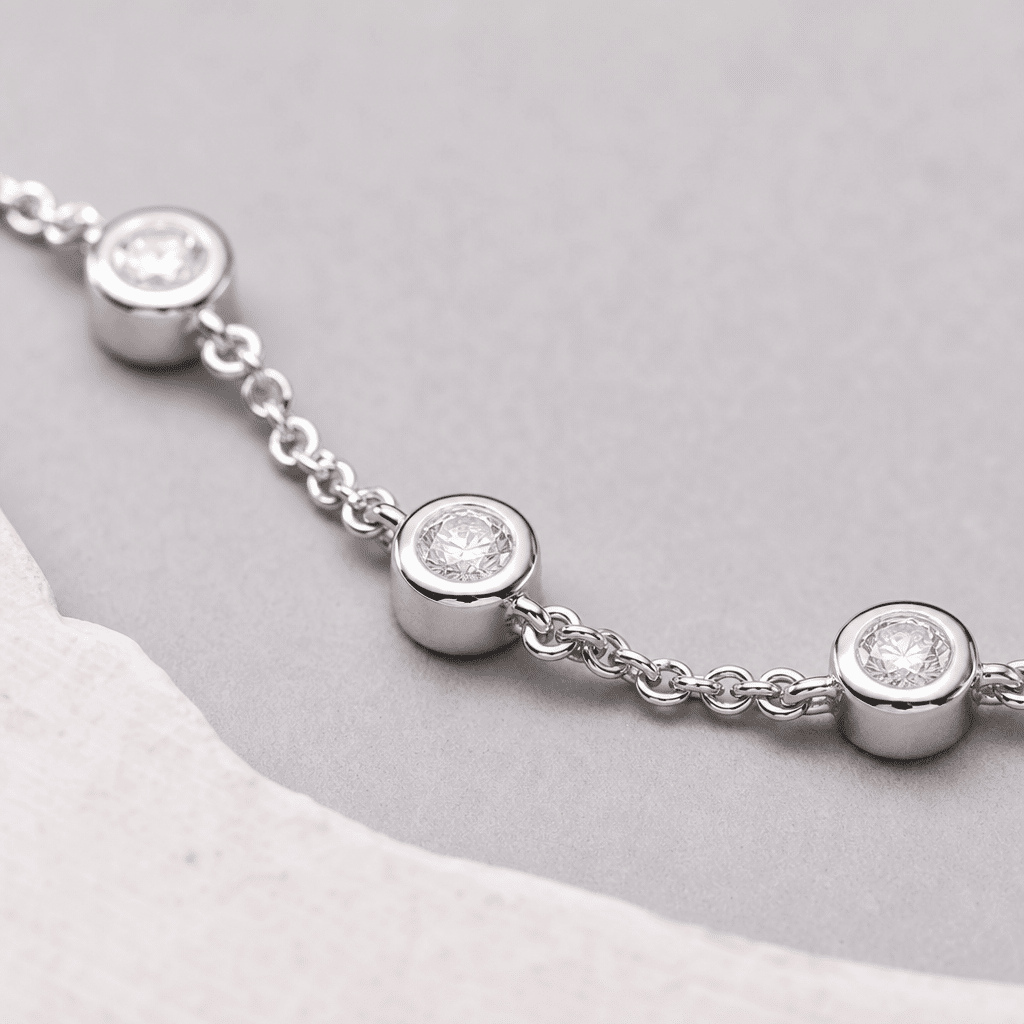
The distance between set stones, known as the station spacing, is the single strongest variable in how a station bracelet reads on the wrist. A 4-inch bracelet with eight stations spaced 12 mm apart looks noticeably denser, almost like a continuous line from a distance. One with six stations spaced 18 mm apart reads more like individual accent points, with visible chain separating each stone. Neither is inherently better, but they produce different effects. The denser layout feels more formal and closer to a tennis bracelet in visual weight. The wider spacing feels lighter and more casual, and it tends to draw more attention to each individual stone rather than the overall line.
Because the bracelet is not trying to achieve continuity, the individual stones can be smaller. A common sweet spot for lab-grown diamonds in station bracelets is 0.15 to 0.30 carats per station. At that size range, each stone still reads clearly, and the spacing gives it room to catch light on its own terms. Going larger than 0.50 carats per station on a standard chain can create a visual imbalance, where the stones outsize the chain and the bracelet starts to look cluttered rather than deliberate.
Combining Stones, Birthstones, or Symbolic Motifs in a Single Piece
Station bracelets are the most natural format for mixed-stone designs. A common custom request is alternating lab-grown diamonds with colored gemstones, or a single larger diamond center-stone with smaller diamonds on either side. The manufacturing challenge here is not the stone types themselves but the settings. If one station uses a prong setting and another uses a bezel, the tension across the bracelet becomes inconsistent. The prong-set stone is more exposed and may loosen faster than the bezel-set stone, creating a repair imbalance that follows the bracelet for its entire life.
The better approach is to use the same setting method across all stations, even if the stone types differ. For symbolic designs, zero-margin links, where the chain link is integrated directly into the station body rather than soldered on as an afterthought, provide the most durable connection point. This is especially relevant when heavier stones or larger carat weights are used, because the station-to-chain joint is where mechanical failure most often occurs.
The Chain as a Structural Element, Not Just a Decorative Backdrop
In a station bracelet, the chain is doing real work. It must support the weight of each stone module, resist twisting, and survive daily wear at the connection points. A cable chain at 2 mm thickness is adequate for stations in the 0.25-carat range. Above that, the chain gauge needs to increase. For 0.50-carat or larger stations, the chain should be at least 3.0 mm, and a rolo or link-and-bar construction is preferable to a simple cable because it distributes load more evenly.
A common mistake is to choose a fine, delicate chain to keep the bracelet looking light, then overload it with stone modules that cause the bracelet to flip, twist, or sag. The chain should look proportional to the stations, not hidden by them. For lab-grown diamonds, a slightly heavier chain gauge is often advisable, because the stones themselves are lighter than natural equivalents, and the overall weight balance can shift toward the chain feeling insufficient if not accounted for.
Certificate and Visual Review Check for Station Bracelets
For station bracelets, a full individual grading report for every stone is rarely necessary, but a consistent grade declaration across the set is essential. Request a written statement that all stones fall within a defined color and clarity range, such as “G+ color, VS+ clarity.” More important than the paperwork is the visual check. Ask for an overhead photo with all stones laid out in a single line. This lets you assess whether color and cut actually match across modules. Two stones can both be graded G-color on paper and still appear mismatched if one has a warmer tint and the other a slightly gray undertone. The photo will reveal that. The certificate alone will not.
For buyers, this distinction between grade consistency and visual consistency is worth understanding. The certificate documents measurable characteristics, but it does not capture subtle hue differences or light behavior. A photo or video is often the more reliable tool for final approval.
What to Consider When Evaluating Environmental or Sourcing Claims
Lab-grown diamonds are often chosen as an alternative to mined origin, but environmental or sustainability claims should still be supported with specific information about production, energy use, and seller documentation. Broad terms such as “eco-friendly,” “sustainable,” or “ethical” are not automatically substantiated by the growth method alone. For a buyer comparing bracelets, the most reliable approach is to ask whether the seller provides documentation about the production process — such as the energy source used in the growth facility or any third-party verification of environmental practices. If such documentation is not available, the claims should be treated as general marketing language rather than verified facts. This does not diminish the appeal of lab-grown diamonds, but it helps the buyer separate substantiated benefits from promotional phrasing.
Custom Lab-Grown Diamond Bracelet Design: Personalization Paths, Timeline, and Cost Allocation
Custom design for a bracelet is not the same as picking a setting for an engagement ring. The bracelet has to move, flex, or hold rigid across a curved joint. It has to survive contact with desk edges, car doors, and bags. And the metal-to-stone ratio is often inverted compared to a ring, meaning the metal cost can dominate the total price. Understanding how these factors interact before starting a custom project saves both time and money.
Adapting Existing Jewelry, Heirloom Stones, or Worn Models into a New Bracelet
Reusing stones from an existing pendant, earring, or old bracelet in a new custom piece is a practical path, but stone geometry imposes limits. The critical measurement is not carat weight but depth in millimeters. A stone that sits too deep will press against the skin in a bracelet, making the piece uncomfortable to wear. Shallow stones, those with lower depth percentages, integrate more easily because the back of the setting can be kept flush with the bracelet body.
For lab-grown diamonds, one structural advantage is availability of matching stones from the same production batch. If you are converting an existing piece and later need a replacement stone or want to expand the bracelet with additional stations, the same batch yield provides a much closer match than trying to source a natural diamond with similar proportions years later. This is worth asking about during the design phase, even if you do not need it immediately.
The Metal Work Decision Points: Weight, Finish, and Bracelet Class
A custom tennis bracelet requires calculating the correct number of links and selecting a clasp that matches the bracelet width and stone size. A custom bangle requires precise wrist measurement and a decision between a solid cast piece and a hinged design. These are different manufacturing paths that affect the budget in different ways.
The finish choice, high-polish versus satin, will determine how the bracelet ages visually. High-polish shows scratches readily but is easier to re-polish. Satin or matte finishes hide daily wear better but require a full refinish when they eventually look tired. This is not a minor aesthetic preference; it directly affects long-term maintenance cost.
The most common oversight in custom bracelet quotes is the metal weight budget. For a tennis bracelet with many small stones, the metal cost may be relatively low compared to the stone cost. For a bangle or cuff with few stones, the metal weight can easily equal or exceed the stone cost. A 3-gram bangle with 2 carats of diamonds has a very different cost split than a 10-gram bangle with the same stone weight. The metal weight budget should be discussed in grams alongside the stone budget in carats. If the seller cannot provide both numbers, the quote is incomplete.
For buyers evaluating multiple custom quotes, separating stone cost, metal cost, and labor cost into distinct line items is the only way to compare proposals fairly. A quote that lumps everything into a single price makes it difficult to judge where the budget is actually going.
Timeline, Communication, and the Custom Design Workflow
A typical custom bracelet timeline runs 8 to 16 weeks. The main variables are stone sourcing, 3D modeling, casting, setting, and finishing. Lab-grown diamonds simplify the sourcing phase because inventory is more predictable, but the physical manufacturing steps are the same as for natural diamond pieces.
The key deliverable during the design phase is a CAD rendering, not a sketch. A sketch can suggest the overall look, but it cannot confirm fit, stone placement, or metal thickness. The CAD must be shown from all angles, including the back side or underside of the bracelet. This is the only way to verify that the stone height will not press against the wrist and that the metal wall thickness is adequate for daily wear. If the CAD is provided as a single top-down view, request additional angles before approving.
What This Means in a Real Custom Order
A written quote for a custom bracelet should separate stone cost by carat weight and grade, metal cost by gram weight and metal type, and labor cost covering setting and finishing fees. These three categories make up the total price. If any one of them is missing from the quote, the comparison between different jeweler proposals becomes unreliable. Before manufacturing begins, ask specifically for a CAD rendering from the side or back. This shows the stone height relative to the bracelet body and the metal thickness at the setting points. Those two measurements determine whether the bracelet will be comfortable and durable over time. For custom jewelry, stone measurements and setting compatibility should be confirmed before finalizing a purchase.
When a grading report is provided, buyers should verify the report details through the issuing laboratory’s official report-check tool where available, and compare those details with the stone’s visual evidence. This step helps confirm that the written grade aligns with what the eye sees in the actual bracelet.
Lab-Grown Diamond Bracelet Wear and Maintenance: Clasp Inspection, Prong Checking, and Re-polishing Cycles
Bracelets endure more mechanical stress than rings or necklaces. The wrist bends, rotates, and comes into contact with hard surfaces throughout the day. The clasp is the weakest point, and the settings are exposed. Maintenance for a bracelet is not optional; it is the difference between a piece that lasts decades and one that fails within a few years.
Clasp Inspection Frequency for Tennis Bracelets and Hinged Bangles
For a tennis bracelet, the clasp latch mechanism should be inspected every six to twelve months. The spring tension wears gradually, and a clasp that still closes may no longer hold securely under the light tug of daily movement. If you notice the clasp opening more easily than when new, it is already past the point of optimal service. For a hinged bangle, the hinge pin should be checked yearly for binding or side play. A hinge that develops looseness will eventually wear the pin seat, requiring a more expensive repair. If the bracelet includes a safety chain, inspect the soldered connection points where the chain meets the bracelet body. These points are under repeated tension and are a common failure location.
Prong and Channel Inspection for Stone Security
Prong-set stones on a tennis bracelet are the most vulnerable. Each prong is exposed on all sides, and a single bent prong can lead to stone loss within days. The most common cause is catching on fabric: a sleeve, a sweater, a coat lining. After the clasp, raised prongs are the most likely reason a bracelet ends up at a jeweler for repair.
Channel-set bracelets have a different failure pattern. The channel walls can lift or separate at the ends, particularly where the channel meets a clasp or hinge. This is not always visible without magnification. An annual inspection with a jeweler’s loupe will reveal whether the channel edges are still tight. For bezel-set station bracelets, the bezel edge should be checked for burrs or thinning. A burr indicates that the metal is wearing down around the stone, and thinning means the stone setting is becoming less secure.
For buyers, the practical takeaway is that a low-cost annual inspection prevents higher-cost repairs later. The metal and settings will show wear gradually, and catching it early avoids the kind of structural failure that requires full re-setting.
Re-polishing and Refinishing Cycles for Different Metal Choices
For 14k gold bracelets worn regularly, re-polishing is needed every one to three years. High-polish finishes show scratches quickly but are straightforward to restore. Satin or matte finishes hide wear better day to day but require a specialized refinishing process; a standard polish will remove the texture, so the buyer should confirm the jeweler can restore the original finish before committing to that surface treatment.
Platinum bracelets need less frequent polishing. The metal develops a natural patina over time, and many buyers prefer the softened look. For lab grown diamond jewelry guide, lab-grown diamond bracelets, the stones themselves are chemically inert and harder than any common metal. The metal will always trigger a service event before the stones do. This is true for both lab-grown and natural diamonds. The difference is that the metal is repairable and the stone setting can be restored, but only if the owner stays ahead of the wear.
Buyer Verification Checklist: Maintenance and After-Sales
Before purchasing any bracelet, confirm the seller’s policy on four points. First, what does routine inspection and re-polishing cost, and is it covered under any maintenance program. Second, are replacement stones available for the specific bracelet model and grade match. For lab-grown diamonds, some manufacturers hold matching inventory; others do not. Third, what is the typical repair timeline for a broken clasp or hinge. A clasp replacement should not take months. Fourth, for custom orders, whether a holding fee or deposit is required and under what conditions it is refundable. These questions are not about warranty marketing. They reveal whether the seller is set up to support the bracelet after the sale.
Lab-Grown Diamond Bracelet Buying Decisions and Frequently Asked Questions
Even after reviewing the structural differences between tennis bracelets, bangles, and station styles, most buyers still have a few unresolved questions before making a final decision. The following FAQs address the most common sticking points, from daily-wear practicality to cost breakdown and warranty coverage.
FAQ: Bracelet Style Selection
How do I choose between a tennis bracelet and a station bracelet for daily wear?
Tennis bracelets are more visually uniform but require more careful clasp maintenance and are less forgiving to sizing adjustments. Station bracelets are more adaptable to wrist size variation and easier to repair because individual stations can be replaced independently.
Which bracelet style has the lowest invisible clasp profile?
Slide-on or spring-opening cuffs with flush-set diamonds have no visible clasp at all. Hinged bangles have a visible hinge line but no external clasp body. Tennis bracelets require a visible clasp, but a hidden safety chain can be integrated into the main bracelet body for a cleaner look.
FAQ: Cost and Value
Does a lab-grown diamond bracelet cost less than a natural diamond bracelet in the same style?
Yes, primarily because the stone cost per carat is lower. However, the metal weight and labor cost are identical regardless of diamond origin. A lab-grown diamond bracelet does not necessarily cost less than a gold bangle without diamonds; the cost comparison is between stones, not metal.
What percentage of the bracelet cost is the setting and labor versus the stones and metal?
For a tennis bracelet with 40 stones, setting labor can be 20–30% of total cost. For a bangle with few stones, setting labor is a lower percentage, while metal weight and casting cost dominate. Request a line-item breakdown from the seller to understand this allocation. Prices can change with market conditions, report type, seller channel, and stone-specific details, so exact comparisons should be verified at the time of purchase.
FAQ: Certification and Guarantee
Should I ask for a grading report for every stone in a multi-stone bracelet?
Not necessarily. For a line or station bracelet, a certificate for the lead stone (largest or center stone) plus a statement of matching grade range for the other stones (e.g., “all stones match F+ in color and VS+ in clarity”) is typical and sufficient. Request a visual photo under two lighting sources to verify consistency.
Does a clasp warranty need to be stated separately?
Yes. A clasp or hinge mechanism is a mechanical component, not a stone setting. Ask the seller if the clasp or hinge is covered under the same guarantee as the stones or if it has a separate warranty term. Structural failure of a clasp is more common than stone loss, so this is a meaningful guarantee. Before purchase, buyers should confirm documentation, return terms, resizing policies, and after-sales support directly with the seller.
Lab-Grown Diamond Bracelet Care, Storage, and Travel Recommendations
Bracelets endure more physical stress than most other jewelry because the wrist moves constantly and contacts surfaces throughout the day. Proper care depends less on the diamonds themselves and more on the metal structure, clasp mechanism, and how the bracelet is stored between wears.
Storage That Prevents Bracelet-on-Bracelet Scratches and Tangle
Bracelets should be stored flat, not coiled or hanging. If a bracelet is stored next to other bracelets, a soft divider or bracelet roll separates them. For a chain bracelet, a plastic tube or anti-tangle sleeve stores the chain extended. Loose stones do not scratch against each other if storage prevents movement.
Swimming, Showering, and Household Chemical Exposure
Chlorine and cleaning chemicals can gradually weaken gold structural integrity by dissolving binders used in casting. For lab-grown diamond bracelets, the stones are chemically inert but the metal is not. Remove bracelets before swimming or applying heavy lotions. Gold scratches moderately over time from cleaning agents; platinum is more resistant.
For buyers, a useful habit is to treat the bracelet as a piece of precision engineering, not just an adornment. The stones are nearly indestructible, but the metal, clasp, and settings are not. Regular care ensures that the mechanical components last as long as the diamonds do.
Understanding how lab-grown diamonds are created helps clarify why they can be selected and matched with such precision for multi-stone bracelets. The two primary methods used to produce these diamonds are High Pressure-High Temperature (HPHT) and Chemical Vapor Deposition (CVD).[1] Both processes replicate the conditions under which natural diamonds form, resulting in stones that are chemically, physically, and optically identical to mined diamonds. The Gemological Institute of America (GIA) has published guidance explaining how these methods work and can be identified through distinct growth features.[1] For a buyer considering a tennis bracelet with dozens of stones, the controlled production of HPHT and CVD diamonds allows manufacturers to deliver consistent color and cut across an entire set — a level of uniformity that is far more difficult to achieve with natural diamond parcels assembled from different sources.
How Growth Methods Influence Stone Selection for Bracelets
The two production methods produce diamonds with different growth structures. HPHT diamonds often show a distinct cuboctahedral shape and can exhibit stronger fluorescence, while CVD diamonds tend to grow in flat plates and may show layered growth patterns under magnification.[1] For multi-stone bracelet applications, a good manufacturer will select stones from the same growth batch and method to minimize visual variation across the set. The GIA notes that identifying these features requires specialized equipment, but for the buyer, the key takeaway is that all lab-grown diamonds sold by reputable retailers should be disclosed as lab-grown and, at the buyer’s request, documented by a grading report that confirms their origin.[2]
The Importance of Clear Disclosure and Terminology
The Federal Trade Commission (FTC) has provided guidelines for how lab-grown diamonds should be described in advertising and sales. According to the FTC’s Jewelry Guides, a diamond created in a laboratory should be clearly identified using terms such as “laboratory-grown,” “lab-created,” or “[manufacturer name]-created.”[2] The guidance specifically advises against abbreviations that could be misleading, such as “LG” or “lab-grown” without additional context, and cautions against using terms like “cultured” or “synthetic” unless they are accompanied by a clear explanation.[2] For buyers evaluating bracelets from different sellers, this means that a retailer’s terminology is not just a marketing choice — it is a compliance signal. A seller who uses accurate, FTC-aligned descriptions is more likely to follow proper disclosure practices, which in turn makes it easier for the buyer to compare products and verify claims.
Citing the Source: What the GIA and FTC Guidance Means for Bracelet Buyers
These sources matter because they provide an objective benchmark for evaluating product descriptions. When a seller claims that their lab-grown diamonds are “identical to natural,” the GIA’s educational materials support that statement by explaining the physical and chemical equivalence of the stones.[1] When a seller describes their stones as “lab-created,” the FTC’s Jewelry Guides provide the regulatory framework that defines acceptable disclosure language.[2] A buyer who sees a consistent, FTC-compliant terminology across a retailer’s product pages can feel more confident that the stones are what they claim to be. Conversely, language that seems vague or promotional — such as “eco-friendly diamonds” or “sustainable gemstones” — should prompt a request for more specific documentation, as neither GIA nor FTC guidance supports broad environmental claims without substantiation.
Practical Verification: How to Cross-Check Documentation and Claims
Beyond understanding terminology, a buyer can take a few practical steps to verify the traceability of the stones in a bracelet. First, ask the seller whether the diamonds in a multi-stone piece come from a single production batch. A single-batch source is the strongest indicator of visual consistency across the set. Second, request the grading report number for the lead or representative stone, if one is provided. That number can be checked against the issuing laboratory’s online verification system — for example, GIA’s Report Check — to confirm the grade and growth method match what was advertised. Third, ask for a written statement that the remaining stones fall within a defined grade range and are from the same growth method. This documentation, while not a full certificate for every stone, provides a verifiable baseline. These three steps — batch confirmation, report verification, and grade range declaration — form a practical traceability check that is especially useful for multi-stone bracelets where individual certification of every stone is impractical.
Understanding Sourcing and Supply Chains for Lab-Grown Diamond Bracelets
For buyers who are considering custom or higher-carat bracelets, it can be useful to understand the broader sourcing landscape. China-linked supply chains, for example, can offer manufacturing depth and scale in some jewelry categories, but buyers still need to evaluate consistency, documentation, communication, and quality control on a per-supplier basis. A lower-priced option from an overseas source may not always reflect lower quality, but it does require more careful verification of grading reports, visual evidence, and setting quality. Conversely, a higher-priced piece from a domestic or Western retailer may include more thorough quality assurance processes, but the buyer should still verify the stone specifications independently. The key is to compare like-for-like documentation: report numbers, metal gram weights, setting types, and stone grade ranges. Without these details, price comparisons between different sourcing channels are not reliable.
Traceability from Growth to Finished Bracelet: What the Buyer Should Expect
For lab-grown diamonds used in jewelry, traceability typically means being able to confirm the origin method (HPHT or CVD), the grading report details for key stones, and the production context — such as whether stones were batch-matched. A reputable seller should be able to provide this information without hesitation. For a bracelet with dozens of small stones, traceability also includes knowing that the stones were sorted for visual consistency, not just graded on paper. In sourcing or wholesale conversations, documentation, consistency, and communication often matter as much as the headline specification. Buyers should feel comfortable asking how the diamonds were grown, whether they were batch-matched, and what documentation supports those claims. A seller who can answer these questions clearly is more likely to stand behind the quality of the finished piece.
[1] Gemological Institute of America (GIA), “HPHT and CVD Diamond Growth Processes,” GIA.edu, accessed 2025. GIA Lab-Grown Diamond Identification
[2] Federal Trade Commission (FTC), “Guides for the Jewelry, Precious Metals, and Pewter Industries,” 16 CFR Part 23, FTC.gov, updated 2018. FTC Revised Jewelry Guides
Disclosure: This article is for general educational purposes only. Diamond grading, pricing, availability, specifications, and seller policies can change, and readers should verify important details through grading reports, official laboratory tools, seller documentation, or qualified professionals before making a purchase decision. Laboratory-grown diamonds should be clearly distinguished from natural diamonds, and environmental or sourcing claims should be supported by specific documentation.