
Many lab-grown diamond buyers assume that choosing between HPHT and CVD methods determines quality—but the growth method is a production detail, not a grade. In discussions of HPHT vs CVD diamond price, both methods produce diamonds across the full spectrum of color and clarity, from exceptional to poor. What actually determines a diamond’s appearance is its cut quality, proportions, and the specific characteristics documented in its grading report. This article clarifies what the growth method does and doesn’t tell you, helping you focus on the factors that genuinely affect brilliance, value, and long-term satisfaction.
For the full framework, read Lab-Grown Diamond Shapes Guide.
By the end, you’ll understand why two diamonds with identical 4Cs specifications look virtually the same regardless of how they were grown, when post-growth treatments matter (and when they don’t), and how to prioritize your buying decisions around what you can actually see and verify rather than method labels.
| Buying Factor | What Actually Matters | What to Check |
|---|---|---|
| Visual Appearance | Cut grade and proportions, not growth method | Light performance images, 360° videos, Excellent/Very Good cut grades |
| Color & Clarity | Individual stone grade, not production method | Grading report color and clarity grades, in-person or video comparison |
| Treatment History | Disclosure transparency, not treatment presence | Report comments section, direct seller questions |
| Grading Report | Evaluates finished stone, not growth process | 4Cs, proportions, fluorescence, inscription verification |
| Growth Method | Secondary tiebreaker only, not quality indicator | Consider only when all other factors are equal |
Quick Questions Before You Read
Q: Does HPHT or CVD produce better-quality diamonds?
Neither method guarantees quality. Both can produce excellent or poor diamonds. Focus on the specific stone’s grades and visual evidence, not the method label.
Q: Should I avoid diamonds with post-growth color treatments?
Treatments aren’t inherently negative—they’re common in both methods. What matters is disclosure. Check the grading report comments and ask the seller directly.
Q: Will I be able to see a difference between HPHT and CVD diamonds?
Not if they have similar cut, color, and clarity grades. Two D-color, VS1, Excellent-cut diamonds will look virtually identical regardless of growth method.
Q: When should growth method influence my decision?
Only as a tiebreaker between two otherwise equal diamonds. Never let method override superior cut, clarity, or visible quality.
What HPHT and CVD Actually Mean for Buyers
The Core Difference in Plain Terms
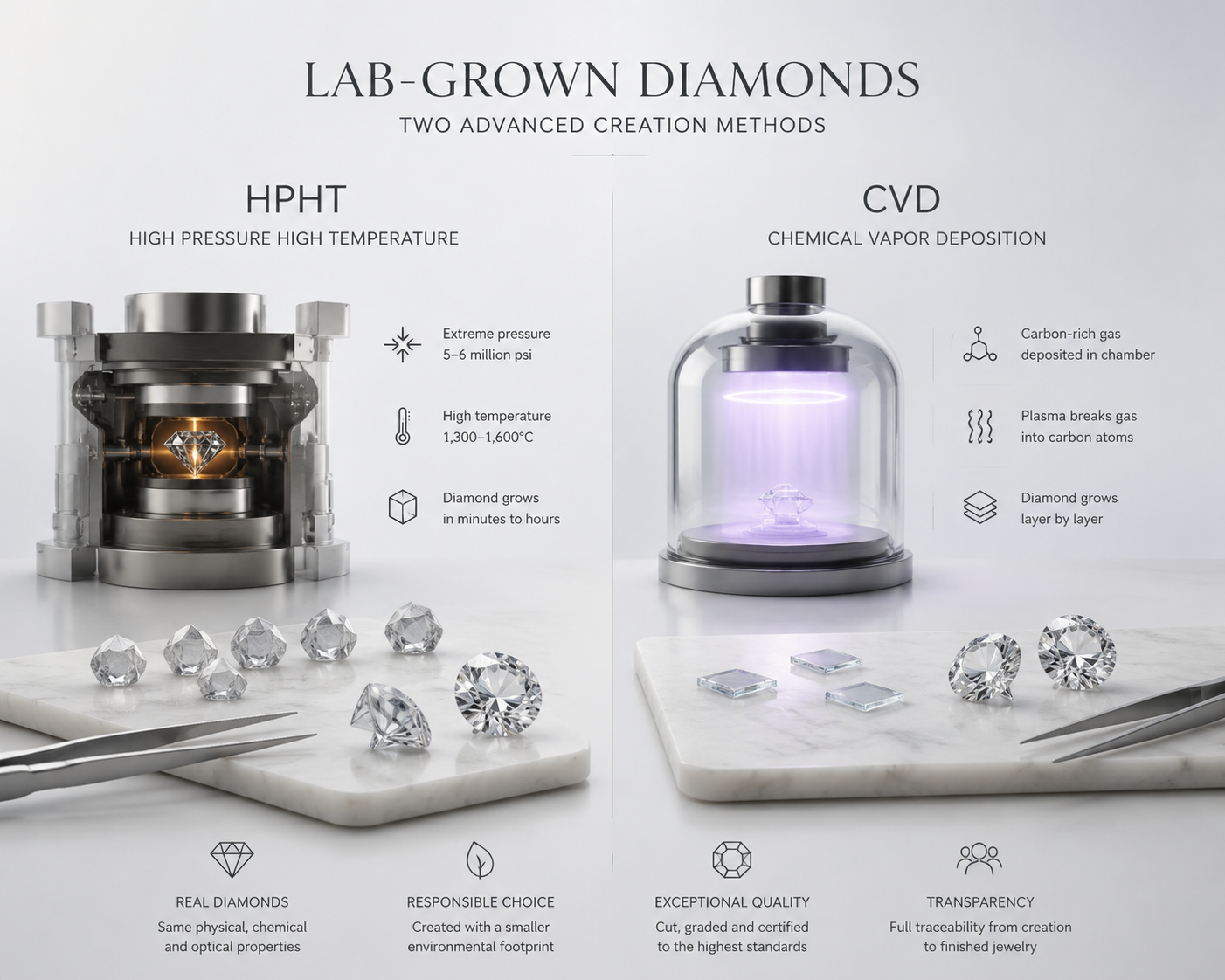
HPHT and CVD are the two primary methods used to create lab-grown diamonds. HPHT stands for High Pressure High Temperature, which mimics the extreme conditions deep within the Earth where natural diamonds form. CVD stands for Chemical Vapor Deposition, which builds diamond crystal layer by layer in a controlled gas environment.
Both methods produce genuine diamond material. The carbon atoms arrange in the same crystal structure as mined diamonds. Neither method creates a simulant or a “fake” stone. The difference lies in how the diamond forms, not in what it ultimately is.
Laboratory-grown diamonds should be clearly identified as laboratory-grown, and they should not be presented as mined diamonds. The Federal Trade Commission and major gemological laboratories require clear disclosure of laboratory-grown origin, which is why growth method appears on grading reports and seller listings. This transparency serves buyers by ensuring they understand what they are purchasing, but it does not indicate that one method produces inherently superior stones.
Growth method is a production detail, not a quality grade. Knowing whether a diamond is HPHT or CVD tells you nothing about its color, clarity, cut, or visual beauty on its own. A poorly grown diamond from either method will underperform. A well-grown diamond from either method can be exceptional.
Why the Method Label Appears on Listings
Sellers disclose growth method for several reasons. Transparency is one: buyers increasingly want to know how their diamond was created. Marketing differentiation is another: some brands emphasize one method over the other in their positioning.
Disclosure itself is positive. Buyers deserve to know what they are purchasing. But the method label is a starting point, not a verdict. It does not indicate whether a specific diamond will look better, perform better, or hold value differently than another.
The label tells you how the diamond was made. It does not tell you whether that diamond is worth buying.
The Real Question Buyers Should Ask
Instead of asking whether HPHT or CVD is better, the more useful question is: what does this specific diamond actually look like, and what does its documentation confirm?
A grading report provides measurable data about color, clarity, cut, and carat weight. Visual evidence—photos, videos, 360-degree views—shows how the diamond actually performs in light. Seller transparency about treatments, inclusions, and sourcing practices reveals whether you can trust what you are seeing.
These factors matter far more than the growth method label. Two diamonds with identical grades can look different in person. Two diamonds from different growth methods can look nearly identical if they share similar cut quality and proportions.
In practical buying, this is where many comparisons become misleading. A buyer who eliminates an entire production method from consideration may unintentionally pass over well-cut, well-graded stones that would have outperformed their preferred-method alternatives.
What to Check Before You Decide
When a listing shows HPHT or CVD, treat it as background information, then move immediately to what actually determines appearance and value:
Review the grading report. Check the color grade, clarity grade, cut grade, and any notes about treatments or fluorescence.
Examine visual evidence. Look at photos and videos under different lighting conditions. A diamond that looks clean in one image might reveal different characteristics in another.
Ask about post-growth treatment. Some diamonds from both methods undergo additional processes to improve color. This is not inherently negative, but you deserve to know.
Compare actual stones. If you are choosing between an HPHT and a CVD diamond with similar specs, focus on which one looks better to your eye, not which method label appears on the listing.
When growth method or post-growth treatment is relevant, buyers should look for clear disclosure in the grading report or seller documentation. This information helps you understand what you are purchasing, but it does not predict whether the diamond will meet your visual expectations or perform well in your chosen setting.
How Growth Method Relates to Color Characteristics
Typical Color Tendencies for Each Method
Growth method can influence the types of color characteristics a diamond might exhibit during formation, but these are tendencies, not guarantees.
HPHT-grown diamonds may sometimes show warmer tones or subtle metallic hues due to contact with the metal catalyst used during the growth process. In some cases, this can result in faint coloration that affects the stone’s face-up appearance. However, well-executed HPHT growth can produce diamonds that achieve colorless grades without any visible issue.
CVD-grown diamonds may sometimes exhibit brownish or grayish tints related to specific growth conditions or variations in the deposition process. These characteristics can often be addressed through post-growth treatment, but untreated CVD diamonds can also achieve excellent colorless grades when grown under optimal conditions.
Neither method has a monopoly on better color. Both can produce diamonds across the full spectrum of color grades, from D-colorless to lower color ranges. The method is one factor among many that influences the final product, but it does not predetermine the outcome.
For buyers, the practical point is not just what the report says, but how the stone performs visually. A grading report assigns a color grade under controlled laboratory conditions, but real-world appearance can vary depending on lighting, setting, and the viewer’s own color perception. Two diamonds with the same color grade may present slightly differently when viewed side by side in natural daylight, especially near the boundary between grades.
Why Color Grade Matters More Than Method
The color grade on a grading report—D, E, F, and so on—reflects the actual face-up color of the specific diamond you are evaluating. It does not reflect how the diamond was grown.
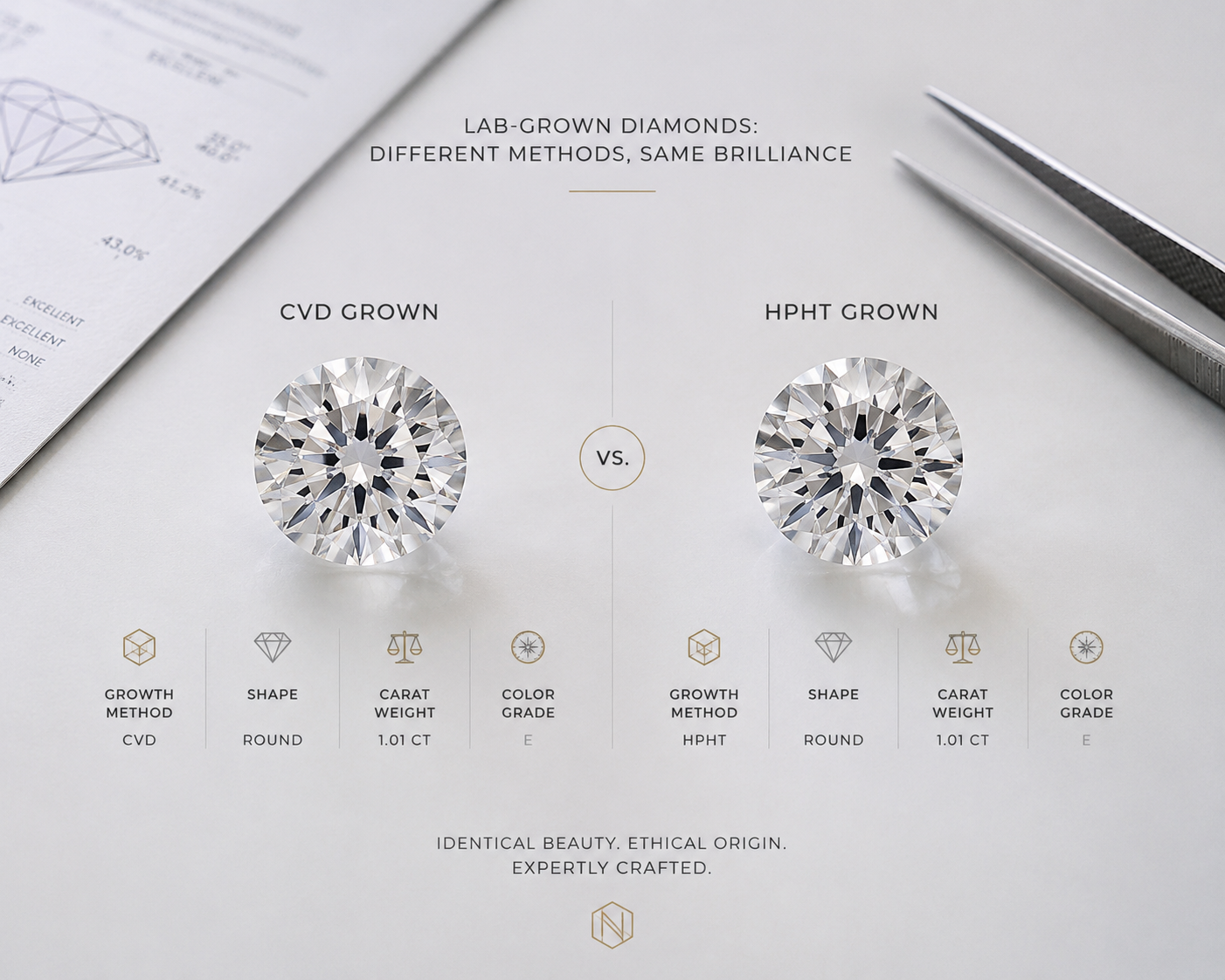
A D-color HPHT diamond and a D-color CVD diamond, both correctly graded, should look essentially identical to the naked eye in normal lighting conditions. The growth method becomes irrelevant once the diamond has been graded. The grade itself tells you what you need to know about color appearance.
This is why fixating on method can mislead buyers. A buyer who assumes HPHT diamonds always have better color might overlook an excellent CVD diamond with superior color grade and cut. A buyer who assumes CVD diamonds are cleaner might miss the fact that an HPHT diamond with the same grade offers better value.
The color grade is the reliable indicator. The method label is background context.
The Role of Post-Growth Treatments
Some lab-grown diamonds undergo treatments after the initial growth process to improve their color. This can apply to diamonds from either method.
Treatments are not inherently negative. They can produce beautiful, stable results that meet buyer expectations. What matters is transparency. You deserve to know whether a diamond has been treated, and you should expect that information to be disclosed clearly—ideally noted on the grading report or confirmed by the seller.
If treatment is a concern for you, ask directly. A reputable seller will provide a straightforward answer. If the response is vague or evasive, consider that a warning sign regardless of how attractive the price or specifications appear.
Buyer Verification Checklist for Color
Compare the stated color grade. If you are deciding between two diamonds, check whether the color grades are equivalent. A higher color grade generally indicates less visible warmth, regardless of growth method. Review the diamond in different lighting. If photos or videos are available, use the CVD diamond growth guide as context and look at the stone under various conditions. Some color characteristics become more visible in natural daylight; others appear different under jewelry store lighting. Check for treatment disclosure. Look at the grading report comments or ask the seller directly. Treatment is not a dealbreaker for many buyers, but nondisclosure is. Trust your eye over the label. If two diamonds have similar color grades but one looks better to you, prioritize what you see over theoretical preferences about growth method.
Environmental and sustainability claims related to lab-grown diamonds should be specific, documented, and limited to what can be substantiated. While some buyers may prefer laboratory-grown diamonds as an alternative to mined origin, the environmental impact of production varies depending on energy sources, manufacturing practices, and other factors that are not determined by growth method alone. Buyers interested in sustainability should request specific information from sellers about production practices rather than assuming one method is inherently more environmentally favorable.
How Growth Method Relates to Clarity Characteristics
Common Inclusion Types by Method
Growth method can influence the types of inclusions that may appear during diamond formation, but this does not mean one method produces cleaner diamonds than the other.
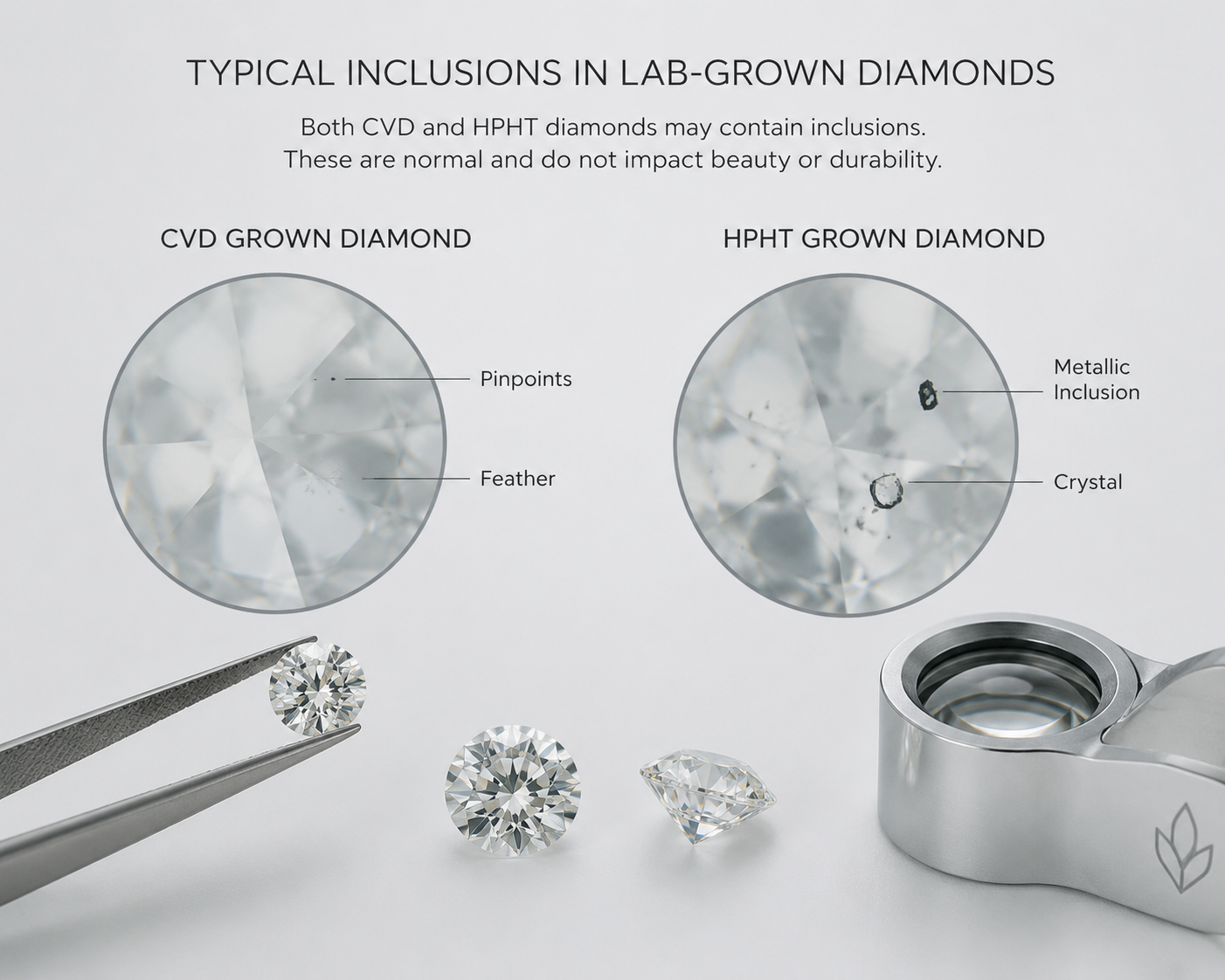
HPHT diamonds may sometimes show metallic inclusions. These occur when small amounts of the metal catalyst used during the high-pressure process become trapped inside the diamond. In most cases, these inclusions are microscopic and do not affect the diamond’s appearance or durability. In rare instances, larger metallic inclusions can impact transparency or even cause the diamond to respond to magnets—a curiosity, but not typically a practical concern for jewelry wear.
CVD diamonds may sometimes show graphite or other internal features related to the gas deposition process. These inclusions tend to be non-metallic and can appear as small dark spots or internal graining. As with HPHT inclusions, well-grown CVD diamonds often achieve high clarity grades with minimal visible characteristics.
Neither method guarantees better clarity. Both can produce diamonds ranging from flawless to heavily included. The clarity grade assigned by a reputable laboratory reflects what is actually present in the stone, regardless of how it formed.
Why Clarity Grade and Visual Review Matter More
A VS1 clarity grade means the same thing whether the diamond is HPHT or CVD: the inclusions are minor and difficult to see under 10x magnification. The grade describes the diamond’s actual condition, not its history.
This is why clarity grade and visual inspection should drive your decision, not growth method. A VS1 HPHT diamond and a VS1 CVD diamond with similar cut and color will have comparable clarity performance to the naked eye. The method label adds no useful information beyond what the grade and visual evidence already provide.
What matters more is whether inclusions are visible without magnification, where they are located within the diamond, and whether they affect the stone’s overall appearance or structural integrity. These factors are evaluated through the clarity grade and through direct visual review, not through assumptions about growth method.
A grading report documents clarity at a specific moment under controlled magnification, but it does not always capture how inclusions interact with different lighting angles or how they might appear once the diamond is set in a mounting. For custom design work, the stone cannot be evaluated separately from the setting—prong placement, bezel edges, and metal color can all influence whether an inclusion becomes more or less visible in the finished piece.
When Inclusion Type Might Influence Choice
In most buying situations, inclusion type is a secondary consideration. The clarity grade tells you whether inclusions are likely to be visible, and visual review confirms it.
However, some buyers have specific preferences. If you know that metallic inclusions would bother you—even if invisible to the naked eye—you might prefer to ask about inclusion characteristics before purchasing an HPHT diamond. If you are concerned about how certain inclusions might appear under magnification, request detailed photos or 360-degree video.
These concerns are legitimate but uncommon. For most buyers, the clarity grade and visual evidence provide sufficient information. If you have specific sensitivities or preferences, a reputable seller should be willing to discuss inclusion details before you commit.
What to Check Before You Decide
Review the clarity grade. Understand what VVS, VS, SI, and I grades mean in terms of visibility. Higher clarity grades generally mean fewer visible inclusions, but even SI diamonds can be eye-clean depending on inclusion location.
Examine magnified photos or video. Look for inclusions that might be visible without magnification. Pay attention to where inclusions are located—inclusions near the table or pavilion may be more visible than those near the girdle.
Ask about inclusion type if it matters to you. If you have specific concerns about metallic inclusions, graphite, or other characteristics, ask the seller for more detail. Most buyers do not need this level of detail, but it is reasonable to ask.
Prioritize what you can see. If a diamond looks clean to your eye and the clarity grade supports that impression, the specific inclusion type is unlikely to affect your enjoyment of the stone.
For custom jewelry, stone measurements and setting compatibility should be confirmed before finalizing a purchase. Inclusion location becomes especially important when a stone will be set in a specific orientation, as prongs or bezels may either hide or draw attention to certain internal characteristics.
Why Cut Quality Overpowers Growth Method for Appearance
Cut as the Primary Driver of Brilliance and Fire
A diamond’s ability to catch light and return it to the eye depends almost entirely on how it was cut. Proportions, symmetry, and polish dictate whether a stone looks brilliant and alive or flat and lifeless. This is not a subtle difference. A well-cut diamond will visibly outperform a poorly cut one, even if the poorer stone has higher color and clarity grades.
Growth method gets a lot of attention in buyer discussions, but it has no direct influence on the single factor that matters most for appearance. An excellently cut CVD diamond will have more brilliance and fire than a poorly cut HPHT diamond, and the reverse is equally true. If your primary goal is a diamond that looks striking in real life, cut quality should be your first filter, not the method listed on the report.
Method Does Not Determine Cut
HPHT and CVD refer to how the rough diamond crystal is formed. Cutting that rough into a finished stone is a separate process, performed by skilled cutters who make deliberate decisions about proportions, facet angles, and polish. Both HPHT and CVD rough can be cut to exceptional standards. Both can also be cut poorly in pursuit of maximum carat weight.
The method label tells you nothing about how the stone was cut. A buyer who assumes an HPHT diamond will automatically look better than a CVD diamond—or vice versa—is relying on the wrong metric. The cut grade on the report is what reveals the quality of the cutter’s work, and that grade has far more impact on what you actually see.
For buyers evaluating fancy shapes—ovals, cushions, emerald cuts, pears—cut grading becomes less straightforward. Many fancy shapes do not receive a standardized cut grade on grading reports, which means proportions, depth percentage, and length-to-width ratio become even more important to review. In these cases, visual evidence such as 360-degree video and light performance imagery can help fill the gap that a missing cut grade leaves open.
How to Prioritize Cut in Your Search
Start by narrowing your options to diamonds with Excellent or Very Good cut grades. If you are comparing round brilliants, an Ideal or Excellent cut grade is a reliable indicator that the proportions are in a strong range. For fancy shapes, where cut grading is less standardized, look closely at proportions and depth percentages.
Light performance images and 360-degree videos are especially useful here. They show you how the diamond behaves in motion, which a static grade alone cannot fully capture. If appearance is your main concern, prioritize cut over method every time. A real-world example: a buyer choosing between an Ideal cut CVD diamond and a Good cut HPHT diamond at similar prices should almost always select the Ideal cut. The difference in visual performance will be obvious; the difference in growth method will not.
How to Verify Cut Before Buying
Check the cut grade on the grading report first. For round diamonds, this is straightforward. For other shapes, review the depth, table percentage, and length-to-width ratio to assess whether the proportions fall within a desirable range. Ask the seller for ASET or light performance images if available—these reveal how the diamond handles light from different angles. Review 360-degree video to see how the stone performs in motion. Compare diamonds with similar cut grades regardless of whether they are HPHT or CVD, and let the visual evidence guide your choice.
A grading report can document key characteristics, but it should be read alongside visual evidence, measurements, seller documentation, and the intended jewelry use. The report provides a professional assessment under controlled conditions, but it cannot fully predict how a diamond will appear in your specific setting, under your typical lighting conditions, or against your skin tone. These factors are best evaluated through direct comparison and, when possible, in-person viewing.
What Grading Reports Actually Tell You
Reports Grade the Stone, Not the Process
A grading report from a reputable laboratory—IGI, GIA, GCAL, and others—evaluates the finished diamond sitting in front of the grader. It measures color, clarity, cut, carat weight, polish, symmetry, and fluorescence. The growth method may appear as a line item, but the grades themselves reflect the actual stone, not how it was produced.
This distinction matters because some buyers treat the method line as a quality indicator. It is not. Two diamonds with identical D color, VS1 clarity, and Excellent cut grades can look remarkably similar in person, even if one was grown using HPHT and the other using CVD. The report tells you what the diamond is; the method line tells you one detail about where it came from.
Different grading laboratories may apply slightly different standards or grading conventions, and this can sometimes result in borderline stones receiving different grades depending on the lab. For buyers, this means that comparing two diamonds graded by different laboratories requires a bit more care—particularly near grade boundaries such as F/G color or VS1/VS2 clarity. When possible, comparing stones graded by the same laboratory removes one variable from the decision.
What to Look For on a Report
Focus on the 4Cs first. Then check proportions, polish, and symmetry grades. Look at the fluorescence comment, as strong fluorescence can sometimes affect face-up appearance in daylight. Read the comments section for any notes about treatments—this is where post-growth color or clarity enhancements should be disclosed if they were applied.
The method line is worth noting, but it should not dominate your evaluation. Treat it as background information rather than a decisive factor. The grades and measurements on the report are what determine how the diamond will look and perform.
Why Report Verification Still Matters
A grading report is only useful if it actually belongs to the diamond you are considering. Verification is straightforward but important. Match the report number to the laser inscription on the diamond’s girdle. Confirm that the seller provides the full report, not just a summary or a verbal claim about the grades. If a listing describes a diamond as VS2 with Excellent cut but does not provide the report, those claims are unverified.
At NUVU, we treat the grading report as the starting point of a buying decision, not the whole picture. The report gives you reliable data, but it does not replace visual review, proportion checks, and your own judgment about how the stone looks in different lighting conditions.
When a grading report is available, buyers should verify the report details through the issuing laboratory’s official report-check tool where available. Matching the report number to the laser inscription on the diamond’s girdle provides additional confirmation that the document and stone belong together.
Certificate and Visual Review Check
Before purchasing, match the report number to the stone’s inscription. Review the listed grades against what you see in photos or video—does the diamond look consistent with its stated color and clarity? Confirm that any treatments are disclosed in the report comments. If something does not add up, ask the seller for clarification. A transparent seller will provide the full report and answer specific questions without hesitation.
Prices can vary because of cut precision, report type, seller channel, size, shape, availability, and documentation. Buyers should compare like-for-like specifications before treating one stone as a better value. A lower price may reflect differences in cut quality, grading laboratory, treatment disclosure, or seller policies rather than a straightforward bargain.
Transparency About Treatments and Disclosure
Common Post-Growth Treatments
Some lab-grown diamonds undergo additional treatments after the growth process to improve their color or clarity. These treatments are not limited to one method. HPHT and CVD diamonds can both be candidates for post-growth enhancement, depending on the characteristics of the rough stone and the producer’s decisions.
The most common treatments involve high-temperature processes to reduce brown or gray tints, or to improve apparent color grade. These are industry-standard practices, but they are not always disclosed clearly. For buyers, the issue is not whether treatments exist—it is whether they are communicated honestly.
Why Treatment Disclosure Matters
A treated diamond is not inherently inferior. Many treated lab-grown diamonds achieve excellent visual results and perform well over time. But treatment status can affect how you evaluate the stone’s value, how it compares to untreated alternatives, and what you should expect if you ever resell it.
Buyers deserve to know what they are purchasing. In discussions of HPHT vs CVD diamonds, a diamond that reached its D color grade through post-growth treatment is a different product than one that achieved the same grade as-grown, even if they look similar in a ring. Transparency about this distinction is a matter of basic buyer trust, not a judgment about quality.
In practical buying, this distinction often surfaces when comparing prices between stones with identical grades. If one D-color diamond is priced noticeably lower than another with the same grade and similar proportions, treatment history may be one of the factors behind that difference. It is worth asking the question directly rather than assuming the lower price is simply a better deal.
How to Ask the Right Questions
If treatment disclosure matters to you—and it should—ask specific questions before you buy. “Has this diamond been treated after growth?” is direct and reasonable. “Is the treatment noted on the grading report?” helps you verify the answer independently. “Can you provide written confirmation of the diamond’s characteristics?” ensures you have documentation rather than a verbal assurance.
A seller who cannot or will not answer these questions clearly is a red flag, regardless of whether the diamond is HPHT or CVD.
What This Means in a Real Purchase
If treatment status is a concern, start by checking the comments section of the grading report. Reputable labs typically note post-growth treatments when they are detected. Ask the seller for explicit disclosure if the report is ambiguous. Confirm the return policy before purchasing, so you have recourse if the diamond does not meet your expectations once you see it in person. Treatment transparency is one area where the seller’s behavior tells you as much as the diamond’s paperwork does.
When Growth Method Might Influence Your Choice
Some buyers arrive with a strong preference for HPHT or CVD. That preference is usually rooted in something they have read, a recommendation they received, or a value they associate with one method over the other. These preferences are valid, but they should be kept in perspective. A preference for a growth method is not the same as a guarantee of quality.
Situations Where Method Might Matter
A buyer might prefer HPHT because it has a longer production history and a track record spanning decades. Others might gravitate toward CVD because it is a newer technology that avoids the metal catalysts used in HPHT growth. Some buyers have heard that one method is more likely to produce certain color tones or clarity characteristics, and they want to steer toward or away from those tendencies.
These considerations can be part of a thoughtful decision. But they are starting points, not conclusions. A buyer who prefers CVD for its growth process still needs to evaluate whether the specific stone in front of them has the cut, color, and clarity they want. A buyer who favors HPHT for its history still needs to check the grading report and review the diamond visually. Method preference can inform the search, but it cannot replace evaluation.
When Method Should Not Be the Deciding Factor
If two diamonds have similar color grades, clarity grades, cut quality, and face-up appearance, choosing between them based solely on growth method is unlikely to produce a visible difference in the final piece of jewelry. The method label does not determine how the diamond will sparkle, how it will look in different lighting, or how it will perform over time. Those outcomes depend on cut, proportions, and the specific characteristics of the individual stone.
A buyer who selects a lower-quality diamond because it carries a preferred method label is making a tradeoff that will show. A better-cut diamond with a less-preferred method will almost always outperform a poorly cut diamond with the preferred label. The method is one data point. The stone itself is what you wear.
Balancing Method Preference with Practical Priorities
Most buyers are working within a budget, have specific aesthetic goals, and need to feel confident about transparency and documentation. Growth method can be part of the conversation, but it should not crowd out the factors that directly affect appearance and value. A balanced approach treats method as a secondary consideration—one that might break a tie between two otherwise equal stones, but not one that overrides cut, clarity, color, or visual evidence.
For wholesale buyers and jewelry professionals, consistency and documentation often matter as much as the headline price. When sourcing multiple stones for a collection or production run, reliable grading, consistent treatment disclosure, and clear communication from the supplier can carry more weight than whether the rough was grown through HPHT or CVD. A supplier’s ability to deliver uniform quality across a batch is a practical concern that method labels alone cannot address.
Decision Framework for Buyers
Before letting growth method drive your decision, list your top three priorities. For many buyers, those priorities are appearance, budget, and confidence in what they are purchasing. Then evaluate each diamond against those priorities. Check the cut grade. Review the color and clarity. Look at photos or video. Confirm that the grading report matches the stone. Ask about treatments. If two diamonds meet your priorities equally and one carries your preferred method, that preference can tip the decision. But if one diamond is clearly better on the factors that matter most, method should not override it.
How to Actually Compare HPHT and CVD Diamonds
When buyers are actively shopping, the most useful approach is to compare individual stones rather than method categories. A well-cut, well-graded CVD diamond and a well-cut, well-graded HPHT diamond will often look nearly identical to the eye. The differences that matter show up in the specific characteristics of each stone, not in the label alone.
Compare Stones, Not Labels
The fastest way to make a confident decision is to compare actual diamonds with similar specifications. Look at two or three stones that match your preferred carat weight, shape, color grade, clarity grade, and cut quality. Then examine them side by side. The differences you see will almost always come down to cut, proportions, and individual clarity characteristics—not the growth method. If one stone looks better, sparkles more, or sits more attractively in a setting, that observation matters more than whether it was grown through HPHT or CVD.
Use the Same Evaluation Criteria
Apply consistent criteria to every diamond you consider, regardless of method. Look at color grade, clarity grade, cut quality, proportions, polish, symmetry, and price. Check whether fluorescence is noted. Review the comments section of the grading report for any mention of treatments. These factors tell you what the stone actually is. The method line is one piece of information, not a shortcut that replaces evaluation.
If a seller emphasizes method over the details that appear on the grading report, that is a signal to ask more questions. A transparent seller should be able to discuss cut, color, clarity, and documentation—regardless of how the diamond was grown.
Ask for Visual Evidence
Photos, videos, and 360-degree views matter more than theoretical discussions about growth technology. Request magnified images that show inclusions. Ask for video that captures the diamond in motion, where you can see how it handles light. Look at the stone in different lighting conditions if possible. Visual evidence will tell you whether a diamond is lively, whether inclusions are visible to the eye, and whether the cut is doing its job. Method discussions cannot give you that information.
If a seller cannot provide clear visual materials, that is a limitation worth noting. At NUVU, we encourage buyers to review video and magnified images before making a final decision, because the way a diamond looks in real conditions is what you will live with every day.
Before purchase, buyers should confirm the seller’s documentation practices, return policy, and after-sales support in writing. A transparent seller will provide clear answers about treatment history, grading report verification, and what recourse is available if the diamond does not meet expectations.
Buyer Verification Checklist
When comparing HPHT and CVD diamonds, use a consistent process. Compare at least two stones with similar specs. Review all available visual materials. Confirm that the grading report matches the diamond—check the report number against the laser inscription if present. Ask whether the diamond has been treated after growth. Confirm the seller’s return policy so you can evaluate the stone in person if needed. Then make your decision based on what you can see, verify, and feel confident about—not on the method label alone.
Understanding What Grading Labs Actually Document
One source of confusion for many buyers is understanding what a grading report actually confirms versus what it does not. Major grading laboratories such as GIA, IGI, and GCAL evaluate the physical characteristics of the finished diamond and document those findings in a standardized format. The report identifies whether a diamond is natural or laboratory-grown, and may note the growth method when it can be determined, but the core grading work focuses on the stone’s measurable attributes.[1]
This distinction is important because some buyers assume that a report from a particular laboratory guarantees certain quality standards beyond what the document actually states. A grading report confirms color grade, clarity grade, cut grade, carat weight, and other measurable characteristics at the time of evaluation. It does not guarantee future performance, investment value, or superiority over diamonds graded by other laboratories. The report is a snapshot of the stone’s condition, not a warranty or endorsement.
Why Report Verification Matters
Most grading reports include a report number that can be verified through the issuing laboratory’s online database. This verification step allows buyers to confirm that the document matches the laboratory’s records and that the diamond they are considering corresponds to the report they have been shown.[2] Matching the report number to a laser inscription on the diamond’s girdle provides an additional layer of confirmation that the stone and document belong together.
Verification is straightforward but often overlooked. A seller’s verbal description of grades is not a substitute for a documented report. If a listing claims a diamond has certain characteristics but does not provide the full report or a way to verify it, the buyer has no independent confirmation of those claims.
What Comments Sections Actually Reveal
The comments section of a grading report can contain important information that does not fit into the standard grading categories. This section may note post-growth treatments, identification of the diamond as laboratory-grown, or other observations the grader determined were relevant. For buyers specifically concerned about treatment history, the comments section is often where this information appears when it has been detected or disclosed.[3]
However, the absence of a treatment comment does not guarantee that no treatment occurred—only that none was detected or required to be noted according to that laboratory’s protocols. This is why direct questions to the seller remain important even when a report is provided.
For buyers navigating the lab-grown diamond market, understanding what documentation can and cannot confirm is essential. A grading report provides a professional assessment of the stone’s measurable characteristics at a point in time, but it does not tell the complete story of how that stone will perform in a specific piece of jewelry or under particular lighting conditions. The report is a tool for comparison and verification, not a substitute for visual inspection and seller communication.
Key Takeaways
After reviewing color tendencies, clarity characteristics, the dominance of cut quality, and the role of grading reports, the core message is clear: growth method is one factor among many, and it does not determine whether a diamond will be beautiful, valuable, or right for your needs.
Growth Method Is One Factor, Not a Verdict
HPHT and CVD are production methods. Both can produce stunning diamonds. Neither guarantees better color, cleaner clarity, or superior appearance. A well-cut, well-graded diamond from either method can be an excellent choice. A poorly cut or lower-graded diamond from either method will underperform. The method label tells you how the diamond was created, not whether it is the right stone for you.
Prioritize What You Can See and Verify
Cut quality has a stronger effect on appearance than growth method ever will. Grading reports provide documented evidence of color, clarity, and cut. Visual materials—photos, videos, magnified views—show you what the diamond actually looks like. Seller transparency about treatments and documentation gives you confidence in what you are purchasing. These factors should drive your decision. Method can inform it, but it should not dominate it.
Ask Questions and Compare Stones
The best way to choose a lab-grown diamond is to compare actual stones, ask questions, and verify information. Ask whether the diamond has been treated. Review the grading report carefully. Look at the diamond in different lighting conditions. Compare multiple options with similar specifications. Make your decision based on the stone in front of you, not on assumptions about how it was grown.
Final Buyer Checklist
Before you commit, run through a quick verification process. Check the cut grade—prioritize excellent or very good cut when appearance is your main goal. Review the color and clarity grades to ensure they match your expectations. Ask about post-growth treatments and confirm whether they are disclosed. Compare visuals across multiple diamonds. Verify that the grading report matches the stone. Then choose the diamond that looks best, fits your budget, and comes from a seller who provides clear, documented information. Growth method matters, but it is not the factor that will determine whether you love your diamond for years to come.
[1] GIA, “Laboratory-Grown Diamond Reports,” Gemological Institute of America, describing how GIA reports identify diamond origin and document growth method when determinable.
[2] IGI, “Report Verification,” International Gemological Institute, providing online report verification for issued grading documents.
[3] GIA, “How to Read a GIA Grading Report,” Gemological Institute of America, explaining the purpose and content of report comments sections.
Disclosure: This article is for general educational purposes only. Diamond grading, pricing, availability, specifications, and seller policies can change, and readers should verify important details through grading reports, official laboratory tools, seller documentation, or qualified professionals before making a purchase decision. Laboratory-grown diamonds should be clearly distinguished from natural diamonds, and environmental or sourcing claims should be supported by specific documentation.