
Buying a lab-grown diamond means navigating claims about CVD versus HPHT, treatment disclosures, and certification differences—yet HPHT vs CVD diamond quality is only one framing, and most of what matters for appearance and value has little to do with the production method itself. This guide clarifies what CVD actually tells you about a stone, where it tends to perform well, and where marketing labels can obscure more useful comparisons.
For the full framework, read HPHT vs CVD Lab-Grown Diamonds Guide.
After reading, you will be able to evaluate CVD diamonds based on the factors that drive real visual performance—cut quality, grading report details, and verified documentation—rather than relying on method labels alone. The goal is a clearer, more confident buying decision grounded in what you can see and verify.
| Buying Factor | Common Assumption | What Actually Matters |
|---|---|---|
| Growth method (CVD vs. HPHT) | One method produces better diamonds | Quality depends on growth management, not method label |
| Type IIa classification | Guarantees superior visual performance | Cut quality affects appearance far more than crystal type |
| Grading report | All certificates carry equal weight | Prioritize GIA, IGI, or GCAL for reliable assessment |
| Post-growth treatments | If treated, it will be obvious | Check report for treatment disclosures—some are subtle |
| Price differences | Higher price means better stone | Price should reflect cut quality and documentation, not just grades |
| Visual assessment | Certificate grades predict beauty | Always request 360° video to judge real-light performance |
Quick Questions Before You Read
Q: Should I specifically seek out a CVD diamond over HPHT?
Not necessarily. CVD tends to dominate larger colorless stones, but HPHT excels at fancy colors. Evaluate individual stones rather than choosing by method.
Q: Does a CVD diamond look different from a natural diamond?
No. CVD diamonds are chemically and optically identical to natural diamonds. They are genuine diamonds, not simulants. Laboratory-grown diamonds should be clearly identified as laboratory-grown, and they should not be presented as mined diamonds.
Q: What is the single most important factor when choosing a CVD diamond?
Cut quality. It drives visual performance more than growth method, color grade, clarity, or crystal classification.
Q: How do I know if a CVD diamond has been treated after growth?
Check the grading report from a reputable lab for treatment disclosures, and verify the laser inscription matches the certificate at purchase and delivery.
What CVD Actually Means for Diamond Buyers
When you see “CVD” in a diamond listing, the practical question is whether that label tells you anything useful about the stone in front of you. The short answer: it tells you how the diamond was grown, not whether it’s good. CVD stands for Chemical Vapor Deposition, one of the two primary methods used to create lab-grown diamonds. The other is HPHT (High Pressure High Temperature). Neither method is inherently superior. What matters is how well the growth was managed and what the resulting diamond actually looks like.
CVD has become the dominant production method for larger lab-grown diamonds in the current market. If you’re shopping for a 1.5 carat or larger stone in VS clarity or better, you’ll encounter CVD options frequently. This isn’t because CVD is automatically better—it’s because the method scales efficiently for larger sizes and produces fewer metallic inclusions, making it easier to achieve high clarity grades at competitive prices. The CVD label alone doesn’t guarantee quality, but it does explain why you’ll see it often.
For buyers, the practical point is not just what the report says about growth method, but how the stone performs visually and fits the intended design. Two CVD diamonds with identical grades can look noticeably different depending on how precisely each was cut and how the internal growth features interact with light.
Understanding the distinction between laboratory-grown and natural diamonds is essential context for any buyer. Both are genuine diamonds with identical chemical composition and physical properties. The difference lies entirely in origin: natural diamonds formed in the earth over geological time, while laboratory-grown diamonds were created in controlled production environments. This origin difference should be clearly disclosed in any grading report, seller listing, or purchase documentation. A CVD diamond is not a simulant, not a coating, and not a “fake” diamond—it is a diamond with a different growth history.
Why CVD Dominates Modern Lab Diamond Supply
CVD reactors can grow larger diamonds with fewer metallic inclusions than HPHT equipment, which aligns with what most buyers want: size and clarity. The method has become particularly important for stones over 1.5 carats in VS and VVS clarity ranges. Major suppliers in India and China have expanded CVD capacity significantly faster than HPHT in recent years because it meets this market demand more efficiently. For buyers, this means more options in the size and clarity combinations that matter most for engagement rings.
The production advantage is straightforward: CVD grows diamonds from gas without metal catalysts, so there’s nothing metallic to get trapped inside the stone. HPHT uses metal solvents that sometimes leave tiny metallic inclusions. For a buyer prioritizing VS or VVS clarity, CVD simply makes those grades easier to reach consistently. But easier doesn’t mean automatic—a poorly managed CVD growth can still produce included or strained crystals.
What the CVD Label Tells You and What It Does Not
A grading report that identifies a diamond as CVD is confirming origin, not quality tier. A CVD diamond can be exceptional or poor depending on how the growth process was controlled. The label tells you the method, not the outcome.
This distinction matters because some sellers market CVD as if it were a premium category. It isn’t. CVD is a production method that, when well-executed, produces excellent diamonds. When poorly executed, it produces diamonds with strain patterns, graining, or clarity issues. The certificate’s cut, color, clarity, and carat grades tell you what you’re actually buying. The CVD label explains how it was made.
What to Check Before You Decide
When a seller emphasizes CVD origin, ask what quality indicators support the price. Review the grading report for cut grade, polish, symmetry, and fluorescence. Request 360-degree video or high-resolution photos. Check whether the diamond is Type IIa—most CVD diamonds are—and understand that this purity classification doesn’t automatically translate to better visual performance if the cut is mediocre. The CVD label is one data point. The certificate and visual evidence tell you whether the diamond is worth buying.
How CVD Diamond Growth Actually Works
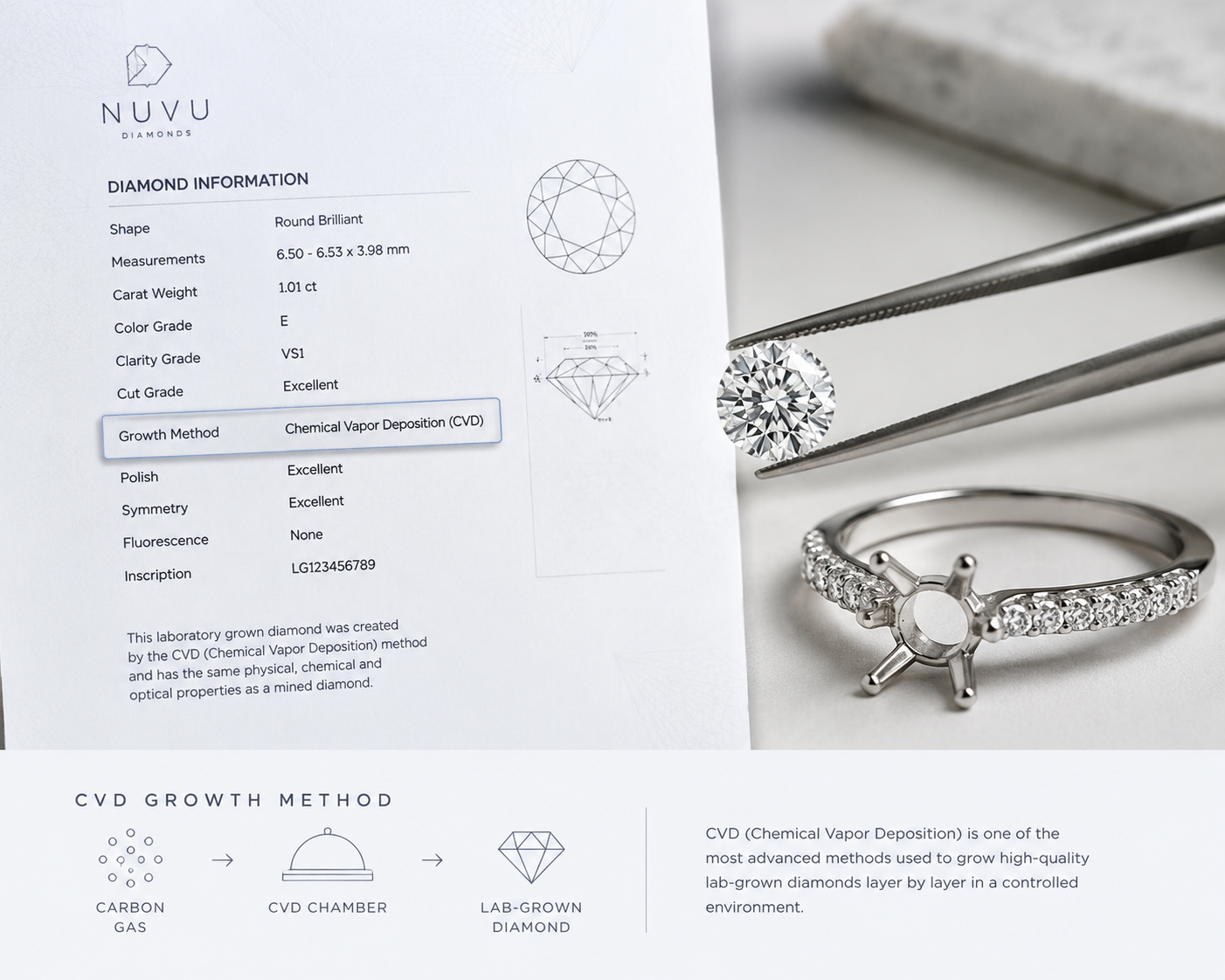
CVD diamond growth is a controlled, layer-by-layer process. A thin diamond seed is placed in a vacuum chamber. Carbon-rich gas—typically methane—is introduced. Energy, usually microwave plasma, breaks down the gas molecules, and carbon atoms deposit onto the seed in crystalline structure. The diamond grows upward in horizontal layers, slowly building mass over time.[1]
This is not a fast process. Growth time varies by size and quality targets, but larger stones typically require weeks to months. The slower and more controlled the growth, the cleaner the resulting crystal. Rushed growth—pushing for faster production—can introduce strain, graining, or clarity issues that become visible under magnification or, in severe cases, to the naked eye. Price differences between CVD diamonds often reflect these production choices, not just carat weight and grades.
In practical buying, this is where many comparisons become misleading. A price difference between two CVD diamonds with the same carat weight and color grade may reflect how carefully each stone was grown and whether the producer prioritized speed over crystal quality. The grading report captures the result, but it does not reveal whether the stone was grown in a controlled cycle or a rushed one—only the visual evidence can hint at that difference.
Understanding the growth process helps buyers recognize why CVD diamonds from different producers can vary significantly in quality despite carrying similar grades. The technology itself is consistent across the industry, but reactor calibration, gas purity, temperature control, and growth duration all affect the final crystal. A manufacturer investing in longer growth cycles and stricter quality control will produce stones with fewer internal stresses and more consistent color, even if the headline grades match those of a faster-grown competitor. This variation is one reason why visual inspection matters as much as documentation—two diamonds with identical certificates may have arrived there through very different production paths.
For buyers who want to trace a diamond’s origin beyond the grading report, some producers now offer additional documentation about the growth facility and production batch. This level of traceability is not yet standard across the industry, and the information available varies by supplier. When origin documentation is provided, buyers should ask what it actually verifies—whether it confirms the growth method, the facility, the production timeframe, or simply the seller’s chain of custody. Not all “origin” documentation carries the same weight, and understanding what is being certified helps separate meaningful traceability from marketing language.
The Layer-by-Layer Growth Structure
Because CVD diamonds grow in horizontal layers, some stones show subtle graining or strain patterns under magnification. These are structural features of the growth process, not defects in the traditional sense. Well-managed growth minimizes visible strain; poorly controlled growth can produce stones with noticeable graining that affects both clarity and durability. This is why two CVD diamonds with identical grade reports can look different in person—the grade captures the outcome, not the growth quality.
Why CVD Produces Fewer Metallic Inclusions
HPHT diamond growth uses metal catalysts to dissolve carbon and transport it to the growing crystal. Sometimes small amounts of that metal get trapped inside the diamond as metallic inclusions. CVD grows from gas without any metal contact, so metallic inclusions don’t occur. This doesn’t mean every CVD diamond is clean—graphite inclusions, pinpoint clusters, and strain-related features can still appear. But the absence of metal makes high-clarity grades more achievable, which is why CVD dominates the VS and VVS market for larger stones.
Buyer Verification Checklist
On a grading report, look for clarity characteristics typical of CVD: graphite inclusions, pinpoint clusters, or strain-related graining noted in the comments. These are not defects; they’re normal outcomes of the growth process. What matters is whether they’re visible without magnification or whether they affect the diamond’s structural integrity. If a report notes inclusions, ask for magnified images. A VS1 diamond with strain graining is still a VS1 diamond—the question is whether those features bother you visually, not whether they exist.
Common Misconceptions About CVD Diamonds
Buyers encounter conflicting information about CVD diamonds, often from sources that conflate production method with quality tier or that confuse lab-grown diamonds with diamond simulants. The misconceptions break down into a few categories: whether CVD diamonds are “real,” whether CVD is inferior to HPHT, whether CVD diamonds have hidden problems, and why they cost less than natural diamonds.
CVD diamonds are chemically and physically diamonds. They are not simulants like cubic zirconia or moissanite. They are not diamond-coated materials. They are 100% carbon in crystalline structure, with the same hardness, refractive index, and thermal conductivity as natural diamonds. The difference is origin: one grew in the earth over millions of years, the other grew in a reactor over weeks or months. If you’re deciding between CVD and natural, that’s a question of value and preference, not authenticity.
One common source of confusion involves the terminology itself. Diamond simulants such as cubic zirconia, moissanite, or other lookalike materials are not lab-grown diamonds. A simulant may resemble a diamond visually, but it has entirely different chemical and physical properties. A lab-grown diamond, whether produced through CVD or HPHT, is a genuine diamond—same crystal structure, same hardness, same optical properties. The Federal Trade Commission requires clear disclosure so that buyers understand what they are purchasing, but this disclosure distinguishes origin, not authenticity. A laboratory-grown diamond is not a “fake” diamond; it is simply a diamond with a different production history.
CVD Diamonds Are Real Diamonds, Not Simulants
The distinction matters because some buyers conflate “lab-grown” with “fake.” A CVD diamond is not an imitation. It will test as diamond on any standard diamond tester because it is diamond. The Federal Trade Commission recognizes lab-grown diamonds as diamonds, with the requirement that their origin be clearly disclosed to consumers.[2] A seller advertising a CVD diamond as “lab-grown” or “laboratory-created” is not hiding anything—they’re accurately describing what it is.
This FTC guidance matters because it establishes what buyers should expect from transparent sellers. Any business marketing lab-grown diamonds must clearly distinguish them from natural diamonds in advertising and at point of sale. The disclosure requirement protects consumers from confusion, and it also gives buyers a way to verify that a seller is following industry standards. If a listing does not clearly state whether a diamond is natural or lab-grown, that omission itself is a warning sign—regardless of which type you ultimately prefer to purchase.
CVD Does Not Mean Lower Quality Than HPHT
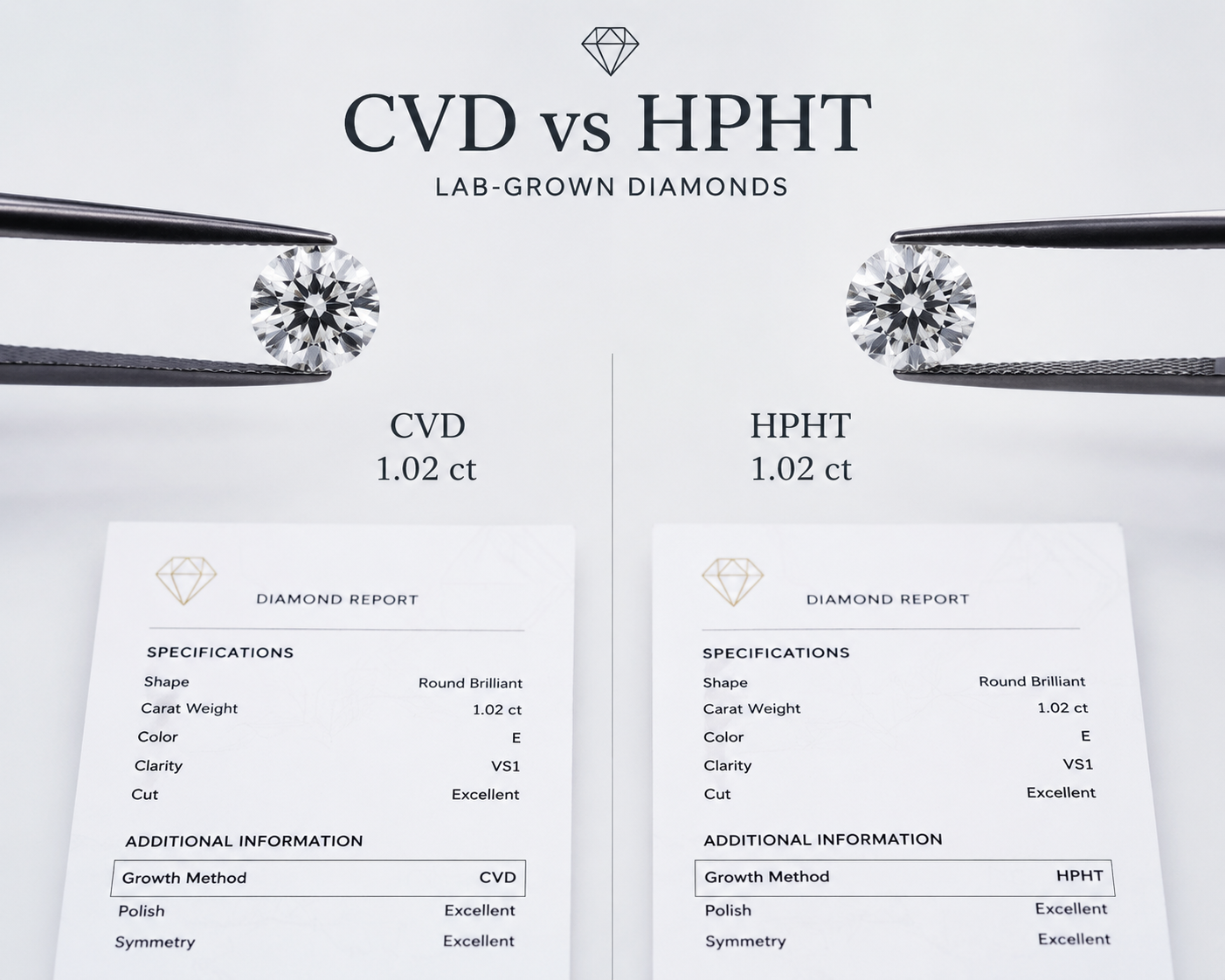
Both CVD and HPHT can produce excellent diamonds. Both can produce poor ones. HPHT has advantages for certain fancy colors—yellow, blue, pink—because the method introduces color-causing elements more easily. CVD has advantages for larger, colorless stones because it scales efficiently and avoids metallic inclusions. Neither method wins across all categories. If you’re comparing a CVD diamond and an HPHT diamond with similar cut, color, clarity, and carat, the growth method should not be the deciding factor. Look at the actual stones.
Post-Growth Treatment Is Not Hidden
Some CVD diamonds undergo post-growth treatment to improve color. This typically involves HPHT processing to remove brownish or grayish tints. Reputable grading laboratories—GIA, IGI, GCAL—disclose this treatment on the report. If a certificate doesn’t mention treatment, the diamond is untreated. Treatment is not a defect, and it doesn’t make the diamond fake. It does affect how you should value the stone, and it should be reflected in the price. Ask for the full grading report, not a seller summary, and check the comments section.
A grading report helps document key characteristics, but it should be compared with visual evidence, proportions, and the intended setting. Treatment disclosure on a report is a starting point—understanding how that treatment interacts with the stone’s actual appearance under different lighting is what completes the evaluation.
Treatment disclosure practices vary by laboratory, but major grading institutions maintain consistent standards. GIA and IGI both require that post-growth treatments be identified on reports for lab-grown diamonds, just as they do for natural diamonds that have undergone treatments like laser drilling or fracture filling.[3] This consistency means buyers can rely on the major laboratories to provide transparent documentation. However, it also means that certificates from smaller or less-established labs may not follow the same disclosure protocols—another reason to prioritize reports from recognized independent laboratories when making a significant purchase.
When growth method or post-growth treatment is relevant, buyers should look for clear disclosure in the grading report or seller documentation. A reputable seller should provide complete information about any treatments the diamond has undergone, and this information should be verifiable through an independent laboratory report.
When a grading report is available, buyers should verify the report details through the issuing laboratory’s official report-check tool where available. This confirms that the document matches the laboratory’s records and has not been altered.
What to Check Before You Decide
Request the complete grading report. Look specifically for comments about “post-growth treatment” or “HPHT processed” for color improvement. If treatment is disclosed, understand that this is standard industry practice—it doesn’t mean the seller is hiding something. But treated diamonds should be priced accordingly. Untreated CVD diamonds in D-F color exist and are increasingly common as growth technology improves. If you’re comparing a treated and untreated stone at similar prices, the untreated diamond may offer better long-term value, though the visual difference may be negligible.
CVD vs HPHT: What Buyers Should Actually Compare
Many buyers assume they need to choose between CVD and HPHT as if one method produces better diamonds. This is the wrong framework. Both methods create genuine diamonds. Both can produce excellent stones or mediocre ones. The growth method is one factor among many, and it matters far less than the specific diamond’s cut, clarity, color, and documented specifications.
What actually differs between CVD and HPHT is availability, typical inclusion patterns, and where each method excels in the current market, so an HPHT lab grown diamonds guide can help you navigate options, but it should not override what your eyes and the certificate tell you about a specific stone.
Most buyers never notice the growth method until they read the grading report. If two diamonds look identical and perform equally well, the method label becomes irrelevant. The comparison that matters is between individual diamonds, not between production categories.
Availability and Market Position
CVD currently dominates production for larger colorless diamonds. If you are shopping for a 1.5 carat or larger stone in D-H color with VS or better clarity, you will likely see more CVD options simply because manufacturers have scaled CVD capacity for this segment. The method scales efficiently for larger sizes without the metallic inclusions that can complicate HPHT growth.
HPHT remains the dominant choice for fancy colored lab diamonds. Yellow, blue, and pink diamonds often come from HPHT growth because the method introduces specific elements during formation that create these colors more predictably. Buyers seeking fancy colors will encounter more HPHT options; buyers seeking larger colorless stones will encounter more CVD.
This market split is practical, not qualitative. It reflects manufacturing economics, not a hierarchy of quality. A well-grown CVD diamond and a well-grown HPHT diamond in the same color and clarity grade will look virtually identical to any observer.
Clarity and Inclusion Patterns
The most noticeable difference between CVD and HPHT diamonds appears under magnification, not to the naked eye. HPHT diamonds grow under high pressure with metal catalysts, and tiny metallic inclusions sometimes become trapped inside. These are not visible without magnification and do not affect durability, but they can influence clarity grading. A buyer prioritizing VVS or flawless clarity may find it easier to locate CVD options because the method avoids metal contact entirely.
CVD diamonds have their own characteristic inclusions: graphite pinpoints, feather-like features parallel to growth layers, and occasionally strain-related graining. These are natural outcomes of the growth process, not defects. In well-graded stones, they remain invisible to the naked eye. What matters is whether the specific diamond’s clarity grade matches your visual expectations, not which type of inclusion appears on the report.
For buyers focused on high clarity grades, CVD often provides more options at competitive prices. But a VS1 HPHT diamond and a VS1 CVD diamond are both VS1 diamonds. The inclusion type is a technical detail, not a practical distinction for wear.
Color Characteristics and Treatment
Color performance varies more by individual stone than by growth method. CVD diamonds in their as-grown state sometimes show faint brownish or grayish tints in lower color grades. Some producers apply post-growth treatment to achieve D-F color. This treatment is standard practice, not a flaw, but it should be disclosed on the grading report.
HPHT diamonds often achieve high color grades without additional treatment because the growth conditions naturally produce colorless results. However, both methods can produce excellent D-F colorless diamonds. The question is not which method was used, but whether the diamond reached its color grade through growth alone or with post-growth treatment, and whether that treatment is documented.
Treated diamonds are not inferior. They are simply different in origin of color. What matters is that the treatment is disclosed, the price reflects it appropriately, and you understand that treated stones may have different long-term value perceptions in the resale market. A transparent seller provides this information upfront.
How to Verify This Before Buying
When comparing CVD and HPHT diamonds with similar specifications, start with the grading report’s comments section. Look for any mention of post-growth treatment. If treatment is disclosed, ask how it affects the price compared to untreated options. Then compare the actual cut grades, proportions, and visual documentation.
Request photos or 360-degree video of both stones. The diamond that looks better in real viewing conditions is the better choice, regardless of whether it grew through CVD or HPHT. If cut quality differs, prioritize the better-cut stone. Cut drives visual performance far more than growth method ever will.
At NUVU, we encourage buyers to compare specific diamonds, not categories. The right stone is the one that delivers the appearance, documentation, and value you want, not the one that matches a preferred production label.
What CVD Means for Diamond Quality and Appearance
CVD diamonds are evaluated using the same 4Cs framework as all diamonds: cut, color, clarity, and carat weight. The growth method does not create a separate quality standard. What determines how a CVD diamond looks is the same as any other diamond: how well it was cut, how clean it is, how colorless it appears, and how these factors interact.
The CVD label tells you about origin, not performance. A poorly cut CVD diamond will look dull. A well-cut CVD diamond will show strong brilliance and fire. The method is background context; the cutting skill is what you actually see.
One technical characteristic worth understanding: most CVD diamonds are Type IIa, meaning they contain almost no nitrogen impurities. This is the same chemical purity found in the rarest natural diamonds. While Type IIa is often associated with exceptional transparency, it does not guarantee better appearance on its own. A Type IIa diamond with mediocre cut will still underperform a lower-purity diamond with excellent cut.
For custom design, the stone cannot be evaluated separately from the setting. A CVD diamond that performs beautifully as a loose stone may interact differently once mounted—deep prongs can shadow light return, and certain setting styles may highlight or obscure inclusions that seem minor on the report. The diamond’s measurements and proportions should be checked against the setting’s specifications before committing to the purchase.
When a diamond is being considered for a specific piece of jewelry, the documentation should work alongside practical measurements and design conversations. The grading report tells you what the stone is; the setting compatibility tells you whether it will work. A diamond with deep proportions may sit too high in a low-profile setting. A stone with a thin girdle may be vulnerable in a tension setting. These are not flaws in the diamond, but they are reasons to verify fit before finalizing a custom design.
For custom jewelry, stone measurements and setting compatibility should be confirmed before finalizing a purchase. A diamond that looks ideal on paper may present challenges in execution—proportions that affect how the stone sits in a specific mounting, girdle thickness that influences durability in certain settings, or depth that creates profile issues in a ring meant to sit low on the finger. These practical considerations are separate from the grading report and deserve direct conversation with the jeweler or seller before moving forward.
Cut Quality Matters More Than Growth Method
Cut is the single most important factor for visual performance. A diamond’s ability to reflect light, show brilliance, and display fire depends on proportions, symmetry, and polish. These are results of human craftsmanship, not growth method. A well-cut HPHT diamond will outperform a poorly cut CVD diamond every time, and vice versa.
When evaluating CVD diamonds, prioritize cut grade above all other factors. Excellent or Ideal cut should be the baseline for any diamond you are considering seriously. If you are choosing between a Very Good cut diamond and an Excellent cut diamond, the better cut will almost always deliver more visual impact, even if the other specifications favor the lower-cut stone.
Growth method becomes relevant only when comparing two diamonds with identical cut quality. Even then, differences in clarity, color, and individual stone character usually matter more than whether the diamond grew through CVD or HPHT.
Type IIa Purity and What It Means
Type IIa diamonds contain virtually no nitrogen, which is the impurity that causes color in most diamonds. This purity is rare in natural diamonds but common in CVD lab-grown diamonds. Type IIa is often marketed as a premium characteristic, and it can contribute to exceptional transparency.
However, Type IIa classification is not a guarantee of superior appearance. A Type IIa diamond still relies on cut quality for brilliance. The chemical purity is a technical detail that matters more to collectors and gemologists than to most buyers evaluating a stone for an engagement ring or jewelry piece.
If a certificate notes Type IIa, understand this as confirmation of chemical purity, not as a reason to overlook cut or clarity issues. The diamond still needs to perform visually.
Clarity Characteristics Specific to CVD
CVD diamonds show characteristic clarity features that differ from natural or HPHT diamonds. These include graphite pinpoint inclusions, feather-like features aligned with growth layers, and strain-related graining visible under polarized light. These are not defects; they are natural results of the growth process.
In well-graded diamonds, these features are invisible to the naked eye. A VS1 CVD diamond with strain graining noted on the report is still a VS1 diamond. The clarity grade already accounts for what is visible under 10x magnification. What you see without magnification is what matters for wear.
If a grading report notes significant inclusions or strain, request magnified photos or video. Understand what you are buying, but do not assume that characteristic CVD inclusions indicate lower quality. Every diamond, natural or lab-grown, has internal features. The question is whether they affect appearance or durability.
Grading laboratories document these CVD-specific features consistently because they help gemologists identify the growth method during examination.[4] Under magnification and with specialized equipment, trained gemologists can distinguish CVD growth structures from HPHT and natural diamond formation patterns. This identification process is one reason why major laboratories can confidently state the growth method on reports—and why buyers can trust that a CVD-labeled diamond has been properly identified through technical analysis, not just assumed based on seller claims.
Certificate and Visual Review Check
When reviewing a CVD diamond, start with the grading report. Check the clarity characteristics listed. If strain or graining is mentioned, ask whether it affects the diamond’s appearance or structural integrity. Reputable labs note these features for transparency, not as warnings.
Then request visual documentation. High-resolution photos and 360-degree video show what the certificate cannot: how the diamond handles light, whether any inclusions are visible without magnification, and how it appears under different lighting conditions. If you are buying in person, ask to see the diamond in natural light and multiple indoor lighting environments.
Cut quality will determine brilliance more than any clarity feature noted on the report. A well-cut diamond with minor characteristic inclusions will outperform a poorly cut diamond with higher technical clarity. Trust your eyes and the documentation together.
Certification and Transparency for CVD Diamonds
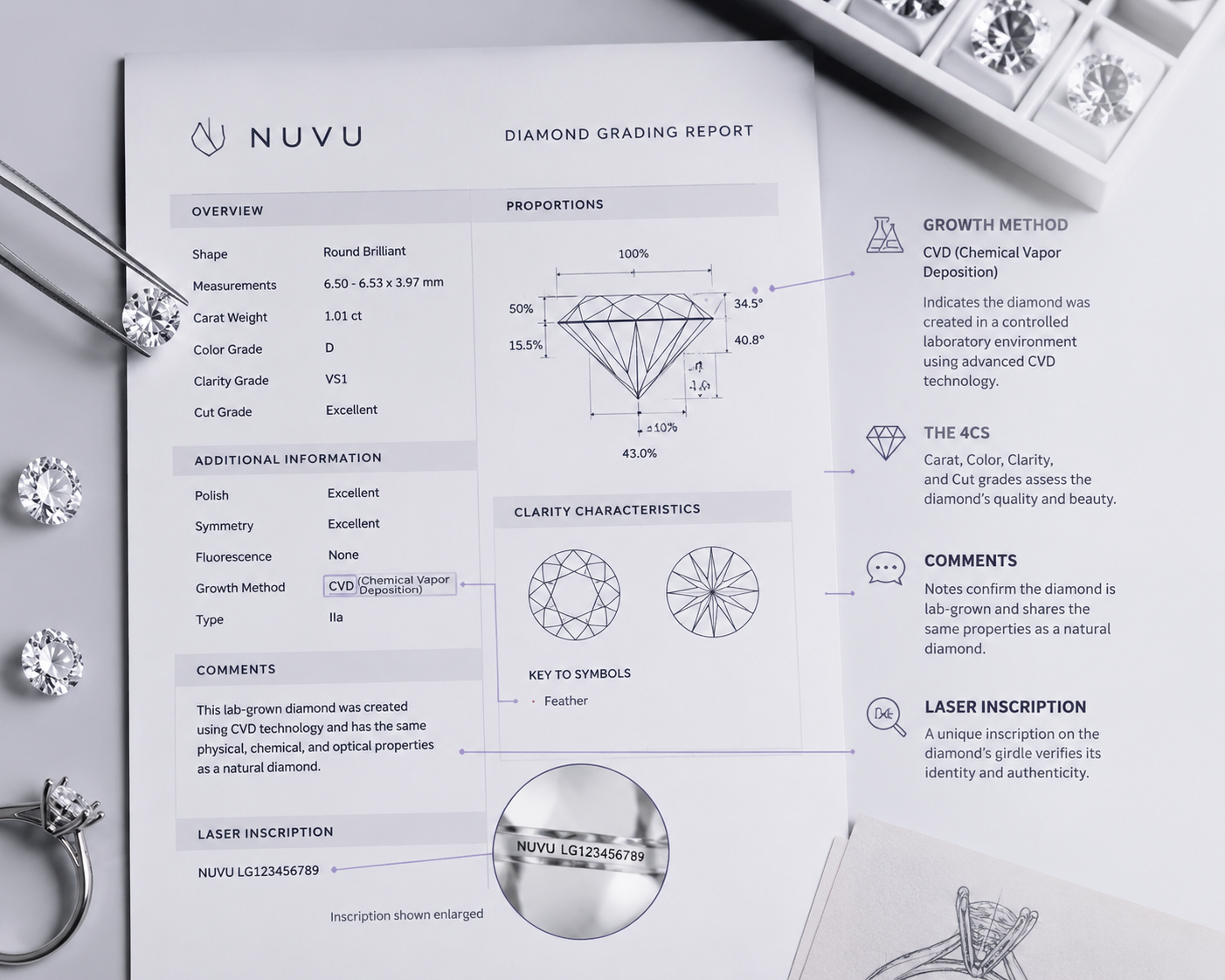
A grading report from a reputable laboratory is essential for any CVD diamond purchase. The report confirms that the stone is a laboratory-grown diamond, identifies the growth method as CVD, and provides the quality specifications that determine value: cut, color, clarity, carat, polish, symmetry, fluorescence, and proportions.
The CVD disclosure on a certificate is not a warning label. It is standard transparency about origin. What matters is the quality data that accompanies this disclosure. The certificate tells you what you are buying; visual inspection tells you how it looks.
Not all grading reports are equal. Major independent laboratories like GIA, IGI, and GCAL maintain consistent standards and full disclosure. Unknown or seller-affiliated labs may apply inconsistent grading or omit important details. A diamond with a weak certificate is harder to evaluate and harder to trust.
A grading report helps narrow the shortlist, but it does not replace visual review. Two diamonds with identical report specifications can present differently in person—one may appear lively and bright while the other seems flat—because the report does not capture how proportions and facet angles interact with real-world lighting. The certificate is a screening tool; your eyes make the final call.
A grading report can document key characteristics, but it should be read alongside visual evidence, measurements, seller documentation, and the intended jewelry use. The report provides a snapshot of the diamond’s graded attributes at a point in time, but it does not guarantee future value, resale potential, or how the stone will perform in a specific setting. Understanding what the report does and does not cover helps buyers use it as one tool among several rather than as a complete answer.
What a CVD Diamond Certificate Shows
A complete grading report for a CVD diamond includes several key elements. The report identifies the stone as laboratory-grown and specifies CVD as the growth method. It provides the full 4Cs grading: cut, color, clarity, and carat weight. Additional details include polish, symmetry, fluorescence, and proportions. The comments section may note post-growth treatment, Type IIa classification, or clarity characteristics like strain or graining.
The diamond’s girdle should carry a laser inscription matching the report number. This allows you to verify that the stone in hand matches the documentation. Never assume the certificate belongs to the diamond without checking the inscription.
If a seller provides only a summary or abbreviated report, request the full document. A complete grading report is your primary tool for evaluating whether the price matches the quality.
Comparing GIA, IGI, and GCAL for CVD Diamonds
GIA is widely recognized for strict grading standards and is often considered the benchmark for natural diamonds. For lab-grown diamonds, GIA provides reliable grading, and distinctions such as HPHT vs CVD diamonds can influence how buyers interpret growth-method disclosures, though it sometimes applies slightly different report formats. IGI is common in the lab-grown market and offers detailed reports with full disclosure of growth method and treatment. GCAL provides additional verification features including 360-degree imaging.
All three major labs disclose growth method and any post-growth treatment. What matters most is consistency and independence. The lab should have no financial interest in the diamond’s grade. If you encounter a certificate from an unfamiliar lab, research whether it is independent and whether its standards align with major industry benchmarks.
At NUVU, we treat the grading report as essential documentation, but we also recognize that the report does not show how a diamond performs in real lighting conditions. A certificate describes specifications; visual review confirms appearance.
Why Visual Review Still Matters
A certificate provides data, not experience. It tells you that a diamond is D color, VS1 clarity, and Excellent cut. It does not show you how the diamond looks under restaurant lighting, in natural daylight, or against your skin tone. It does not show you whether inclusions are visible from certain angles or how the stone performs in low-light environments.
Visual documentation bridges this gap. High-resolution photos, 360-degree video, and ideally in-person inspection show you what the certificate cannot. You can see how the diamond handles light, whether it appears bright and lively or slightly flat, and whether it matches your expectations.
For significant purchases, visual review is not optional. A diamond is something you will see every day. The certificate confirms you are getting what you paid for; visual review confirms you are getting something you will enjoy wearing.
Major laboratories like GIA and IGI provide online report verification tools that allow buyers to confirm a certificate’s authenticity.[5] This verification step adds a layer of security beyond simply reading the document. By entering the report number on the laboratory’s website, you can confirm that the grading data matches what the lab has on file and that the certificate is genuine. This is particularly important when purchasing from secondary sellers or when a significant amount of time has passed between the original purchase and a resale—situations where documentation errors or misrepresentation become more likely.
The verification process also helps establish a chain of documentation that can be useful if the diamond is ever resold or passed down. A grading report that can be independently verified through the laboratory’s database has more long-term credibility than a document that exists only on paper. For buyers who value traceability, this digital verification link is a practical advantage of purchasing diamonds graded by established laboratories with robust online systems.
What This Means in a Real Purchase
Before purchasing a CVD diamond, confirm that the certificate comes from a recognized independent laboratory. Verify that the laser inscription on the girdle matches the report number. Read the full grading report, including all comments. If post-growth treatment is disclosed, understand what this means for value and long-term perception.
Request high-resolution photos or 360-degree video. If buying online, ensure the seller offers a return period that allows you to inspect the diamond in person. If the diamond is treated for color, confirm that the price reflects this appropriately compared to untreated options.
Do not rely on seller summaries or abbreviated reports. The full certificate is your verification tool. Visual documentation is your confirmation that the diamond looks the way you want. Both are necessary for a confident purchase.
Practical Buying Guidance for CVD Diamonds
Buying a CVD diamond requires the same disciplined approach as any diamond purchase: focus on the specific stone in front of you, not the label attached to it. The growth method tells you how the diamond was created, but the 4Cs, certification, and visual appearance tell you whether it is worth buying. A poorly cut CVD diamond will underperform a well-cut HPHT diamond every time, and vice versa. The framework below prioritizes what actually affects beauty and value, not marketing narratives.
For wholesale buyers, consistency often matters as much as the headline price. A supplier who delivers well-documented CVD diamonds with reliable grading, clear treatment disclosure, and predictable visual quality across batches reduces the risk of customer returns and reputation issues. The cheapest option per carat is not always the most cost-effective when documentation gaps or grading inconsistencies create downstream problems.
In wholesale or sourcing conversations, asking the right questions before committing can prevent misunderstandings later. Buyers should clarify what documentation accompanies each shipment, how grading consistency is maintained across batches, what the communication process looks like if issues arise, and whether sample approval is possible before larger orders. These operational details often matter more than the headline specifications when building a reliable supply relationship.
Prices can vary because of cut precision, report type, seller channel, size, shape, availability, and documentation. Buyers should compare like-for-like specifications before treating one stone as a better value. The listed price of a CVD diamond reflects multiple factors beyond carat weight—cut quality, color grade, clarity grade, laboratory reputation, treatment status, and seller overhead all contribute. A lower price does not automatically mean better value if the documentation is thin, the grading is inconsistent, or the visual performance is weak. Price comparison only works when the stones being compared share similar specifications across all relevant attributes.
Prioritize Cut Over Growth Method
Cut grade has more influence on visual performance than any other factor, including growth method. An Excellent or Ideal cut CVD diamond will show more brilliance, fire, and scintillation than a Good cut diamond with identical specifications elsewhere. When comparing CVD diamonds, start with cut quality and filter from there. A lower color or clarity grade can be acceptable if the cut is strong and the price reflects it. A weak cut is rarely worth compromising on, regardless of how attractive the other specifications look on paper.
Review the Full Certificate
Seller summaries often highlight the best specifications and omit details that matter. Request the complete grading report from an independent laboratory—GIA, IGI, or GCAL are the most reliable options. Check the comments section for treatment disclosure, particularly any mention of post-growth color treatment. Look at clarity characteristics: graphite pinpoints, strain-related graining, or feather-like inclusions parallel to growth layers are common in CVD diamonds and are not defects, but you should understand where they are and whether they affect visibility. Verify that the laser inscription on the diamond’s girdle matches the report number before completing a purchase.
Request Visual Documentation
A certificate describes specifications; it does not show how a diamond behaves in real lighting. High-resolution photos, 360-degree video, or an in-person viewing reveal what the report cannot: how the stone handles light, whether inclusions are visible without magnification, and how it performs across different lighting conditions. At NUVU, we encourage buyers to request this documentation before making any decision. A diamond that looks strong on paper can disappoint in person if cut proportions are borderline or inclusions fall in visible zones. Visual evidence fills that gap.
Buyer Verification Checklist
Before finalizing a CVD diamond purchase, confirm the following:
- Independent lab certification: GIA, IGI, or GCAL—avoid stones with no report or reports from unknown laboratories.
- Laser inscription verification: The inscription on the girdle must match the report number exactly.
- Full grading report review: Read the entire document, including comments, not just the summary page.
- Treatment disclosure check: Confirm whether post-growth color treatment is noted and whether the price reflects it.
- Visual documentation request: Obtain high-resolution photos or 360-degree video showing the diamond under multiple lighting conditions.
- Cut quality vs. price comparison: Ensure the price aligns with cut grade, not just carat weight or color.
- Return policy and warranty in writing: Understand the terms before purchasing, not after.
- Final inscription match at delivery: When you receive the diamond, verify the inscription again before accepting it.
Before purchase, buyers should confirm documentation, return terms, resizing policies, and after-sales support directly with the seller. Policies vary significantly between retailers and online sellers, and what is assumed to be standard may not apply to every transaction. Getting these details in writing before the purchase eliminates ambiguity if questions arise later.
When CVD Is the Right Choice
CVD diamonds are not inherently better or worse than HPHT diamonds, but they do align well with certain buyer priorities. Understanding where CVD excels helps narrow the search without oversimplifying the decision. The method has practical advantages for specific scenarios, but the final choice still depends on the individual stone’s quality and documentation.
CVD Excels in Larger Colorless Diamonds
Buyers seeking diamonds above 1.5 carats in the D-H color range with VS clarity or better will find more CVD options than HPHT in the current market. The CVD process scales more efficiently for larger sizes without introducing metallic inclusions, which can limit HPHT clarity in bigger stones. If your priority is a substantial colorless diamond with high clarity, CVD supply will likely offer more choices at competitive prices. That does not mean every large CVD diamond is good—it means you have more options to evaluate.
CVD Offers Strong Value for High-Clarity Stones
Because CVD growth avoids metal catalysts entirely, achieving VVS and VS clarity is often more straightforward than with HPHT. Buyers who prioritize clarity—whether for aesthetic reasons or because they want the cleanest possible stone under magnification—will find CVD diamonds frequently deliver on this front. However, clarity grade alone does not guarantee visual appeal. A VS1 diamond with poor cut will look worse than an SI1 with Excellent cut. Clarity is a factor, not the deciding factor.
CVD Aligns With Modern Transparency Expectations
CVD diamonds from reputable sources come with clear documentation: origin, growth method, and any treatments are disclosed on the grading report. For buyers who value traceability and want to understand exactly what they are purchasing, this transparency is an advantage. The CVD label itself is not a selling point—it is simply verified information. What matters is how the seller uses that information to support the buying decision, not whether the label appears in marketing materials.
Lab-grown diamonds can offer a different sourcing path, but sustainability and ethics should still be discussed through documentation, energy use, production practices, and seller transparency. The CVD label alone does not verify responsible manufacturing—buyers who prioritize these values should ask for specific sourcing documentation and production disclosures rather than assuming that lab-grown automatically means sustainable.
The environmental impact of lab-grown diamond production varies significantly depending on the energy sources and practices of individual manufacturers. Some CVD facilities operate primarily on renewable energy, while others draw from grids powered by fossil fuels. Buyers who want to understand the sustainability profile of a specific diamond should ask sellers for information about the producer’s energy sources and environmental practices, rather than assuming that all lab-grown diamonds share the same footprint. The CVD method describes how the diamond formed, not the full picture of its production context.
Sustainability claims in the lab-grown diamond market have proliferated faster than standardized verification. A producer may legitimately source renewable energy for its reactors, but that claim becomes meaningful only when it is documented and specific. Buyers who care about environmental impact should ask for details: what percentage of energy comes from renewable sources, is there third-party verification of energy claims, does the producer publish any environmental reporting? Vague statements about being “eco-friendly” or “sustainable” are less useful than concrete information about energy sourcing, water use, and production practices.
Environmental and sustainability claims should be specific, documented, and limited to what can be substantiated. A seller who makes environmental claims about CVD diamonds should be able to point to verifiable information about production practices, energy sources, or third-party certifications rather than relying on general statements about lab-grown diamonds being “greener” than mined alternatives. Not all production facilities operate the same way, and the environmental footprint of a particular diamond depends on factors that may not be captured by the growth method label alone.
What to Check Before You Decide
If your priorities include larger size, high clarity, colorless appearance, and documented origin, CVD offers strong options worth exploring. Verify that the specific diamond you are considering has Excellent or Ideal cut, clean visual appearance under magnification, and complete documentation from a recognized laboratory. Do not assume that all CVD diamonds meet these standards—evaluate each stone individually. The method is a starting point, not a conclusion.
Key Takeaways for CVD Diamond Buyers
The core message of this guide is straightforward: CVD is a production method, not a quality guarantee. What determines whether a CVD diamond is worth buying is the same as any other diamond—cut quality, color, clarity, carat weight, certification integrity, and visual performance. The growth method label provides useful context, but it does not replace the work of evaluation.
CVD Is a Method, Not a Quality Tier
The CVD label tells you how the diamond was grown, not whether it is good. A CVD diamond can be exceptional or poor depending on how the growth process was managed, how the stone was cut, and how it was graded. Evaluate each diamond on its own specifications and appearance, not on assumptions about the method.
Certificate and Visual Review Matter Most
A grading report provides essential data about the diamond’s measured characteristics, but it does not show how the stone performs in real lighting or how inclusions appear to the naked eye. Visual documentation—photos, video, or in-person inspection—bridges that gap. Both are necessary for a confident decision. Relying on the certificate alone is incomplete; relying on visual impression without documentation is risky.
Compare Stones, Not Just Labels
When choosing between CVD and HPHT options with similar specifications, prioritize the diamond with better cut quality, cleaner visual appearance, and stronger documentation—not the growth method. Neither method wins universally. The right choice is the stone that meets your visual and budget priorities, backed by proper certification and transparent seller communication.
Final Decision Framework
Before purchasing any CVD diamond, run through this checklist:
- Method context: CVD is a valid, widely used production method for lab-grown diamonds—it is neither a red flag nor a premium tier.
- Quality driver: Quality depends on how the growth was managed and how the stone was cut, not on the method itself.
- Visual priority: Prioritize cut quality above all other factors for visual performance.
- Certificate review: Read the full grading report, including comments on treatment and clarity characteristics.
- Visual evidence: Request photos or 360-degree video before purchasing.
- Inscription verification: Confirm the laser inscription matches the report at purchase and delivery.
- Cross-seller comparison: Compare similar stones across sellers to ensure price aligns with quality.
- Individual evaluation: Choose based on the specific diamond, not the CVD label alone.
Following this framework reduces the chance of a poor decision and increases the likelihood that the diamond you choose delivers on what matters: appearance, value, and confidence in what you are buying.
[1] GIA, “Lab-Grown Diamonds,” Gemological Institute of America, accessed 2025.
[2] Federal Trade Commission, “Jewelry Guides: Guides for the Jewelry, Precious Metals, and Pewter Industries,” FTC Business Guidance, 2018.
[3] GIA, “How to Read a GIA Lab-Grown Diamond Report,” Gemological Institute of America, accessed 2025.
[4] GIA, “Identification of Lab-Grown Diamonds,” Gemological Institute of America, accessed 2025.
[5] GIA, “GIA Report Check: Verify Your GIA Report,” Gemological Institute of America, accessed 2025.
Disclosure: This article is for general educational purposes only. Diamond grading, pricing, availability, specifications, and seller policies can change, and readers should verify important details through grading reports, official laboratory tools, seller documentation, or qualified professionals before making a purchase decision. Laboratory-grown diamonds should be clearly distinguished from natural diamonds, and environmental or sourcing claims should be supported by specific documentation.
Last updated: January 2025