
Choosing a lab-grown diamond is mostly about deciding where your budget will actually show. The article explains why cut usually deserves first priority, because it drives sparkle, brightness, and overall beauty more than a higher color, clarity, or carat grade can, especially when evaluating diamond 4Cs by shape across round, oval, emerald, radiant, and pear styles. From there, the real question becomes how to balance the rest of the 4Cs so the stone still looks white, clean, and appropriately sized in the setting you want.
For the full framework, read Lab-Grown Diamond 4Cs Guide.
This matters because many lab-grown diamonds look similar on paper but not in person. The guide helps you judge when a better cut is worth more than extra weight, when eye-clean clarity is enough, when higher color is useful, and how shape changes what you should pay attention to. It also helps you avoid spending on upgrades that are hard to see and focus instead on the combination that fits your ring, your budget, and your visual standard.
Laboratory-grown diamonds should be clearly identified as laboratory-grown, and they should not be presented as mined diamonds. Lab-grown diamonds and natural diamonds are both diamonds, but they have different origins, and a buyer should be able to see that origin clearly in the seller description and supporting documentation.
A grading report is useful, but it is only one part of the decision. For buyers, the practical test is whether the stone also looks bright, balanced, and appropriate in the intended setting and lighting.
| Buying Goal | Best 4C Priority | What to Check |
|---|---|---|
| Maximum sparkle | Cut first | Light performance, symmetry, proportions |
| Largest face-up look | Cut plus spread | Measurements, shape, hidden weight |
| White-metal setting | Higher color | How warmth shows in the setting |
| Practical everyday ring | Eye-clean clarity | Inclusion type and placement |
| Fancy shape purchase | Visual review | Bow-tie, facet pattern, symmetry |
| Premium-profile buy | Certificate and grade balance | Whether the higher grade is visible to you |
Quick Questions Before You Read
Q: Is cut really more important than the other 4Cs?
Usually yes, because cut has the biggest effect on sparkle and overall appearance.
Q: Do I need the highest color grade for a lab-grown diamond?
Not always. Many buyers find G-H still looks white enough, depending on shape and setting.
Q: What clarity level is enough for most rings?
Eye-clean is the practical target; VS1-VS2 often works well, but placement matters more than the label alone.
Q: Does a larger carat mean a bigger-looking stone?
No. Face-up size depends on proportions, shape, and how much weight is hidden.
Before You Compare Grades, Confirm the Stone and the Paper Match
One of the most useful evidence checks in lab-grown diamond buying is making sure the loose stone, the grading report, and the seller description all refer to the same item. That sounds obvious, but it is easy to lose track when listings use polished marketing language or when several similar stones are being compared at once.
Start with the basics: confirm the shape, measurements, carat weight, color, clarity, and any report details shown by the seller. Then check whether the visuals match the description. If the report says one thing and the video suggests another, slow down and ask for clarification before treating the stone as a finished candidate.
This check is especially helpful for buyers who are balancing the 4Cs by goal. A stone that looks strong in the listing still needs to support the goal in real life. If you are shopping for sparkle, the visuals should confirm it. If you are shopping for size, the measurements should support the face-up look. If you are shopping for a premium profile, the grades should make sense together rather than just sounding impressive separately.
A grading report can narrow the comparison, but it should be read alongside the stone’s proportions, visual evidence, and intended jewelry use. The report identifies and describes the diamond; it does not replace checking whether the specific stone looks right for the setting, finger coverage, and daily-wear expectations.
A grading report helps document key characteristics, but it should not be treated as a guarantee of beauty, value, or sourcing ethics. When growth method or post-growth treatment is relevant, buyers should look for clear disclosure in the grading report or seller documentation.
- Verify that the report details and the loose diamond match.
- Compare measurements, not just carat weight.
- Check whether photos and video show the visual qualities the listing promises.
- Make sure the stone still fits the intended setting and metal color.
When a grading report is available, buyers should verify the report details through the issuing laboratory’s official report-check tool where available.
The Best 4C Priority for Most Lab-Grown Diamonds: Cut First
For most buyers, the best 4C priority for lab-grown diamonds starts with cut. Not because color, clarity, and carat do not matter, but because cut has the most direct effect on what people actually notice first: brightness, sparkle, and how alive the diamond looks in motion.
Cut does not mean the diamond’s shape. A round, oval, cushion, or emerald cut describes the outline and facet style. Cut quality refers to how well the diamond’s facets are proportioned and aligned to return light. A diamond can have a desirable shape, high color, strong clarity, and impressive carat weight, yet still look flat if the proportions and light performance are weak.
If you are asking which diamond C matters most, the practical answer is usually cut. A higher color grade cannot make a poorly cut diamond sparkle more. A higher clarity grade cannot fix dull light return. Even carat weight can disappoint if the stone carries weight in the wrong places and faces up smaller or darker than expected.
In practical buying, the report is a filter, not a full verdict. It can help eliminate obvious mismatches, but it does not replace side-by-side comparison, especially when you are deciding between two stones that look close on paper but not necessarily equal in the hand.
Why Cut Has the Biggest Visual Impact
Cut affects the diamond’s brightness, fire, scintillation, contrast, and overall “life.” Brightness is the white light returned to the eye. Fire is the flashes of rainbow color. Scintillation is the pattern of sparkle as the diamond, light, or viewer moves. Contrast gives the stone visual structure instead of making it look glassy or flat.
This is why a well-cut diamond can look more impressive than a larger diamond with weaker light return. In real life, diamonds are not viewed under grading lamps all day. They are seen in restaurants, offices, cars, bathrooms, daylight, and mixed indoor lighting. A strong cut is more likely to keep the stone lively across those conditions, while a weak cut may only look decent in carefully controlled lighting.
The mistake is assuming that a lab-grown diamond with excellent-looking grades on paper will automatically look beautiful in person. The certificate may show color, clarity, and weight, but the stone still has to perform visually. Cut is the part of the 4Cs balance that most often separates a diamond that simply has good specifications from one that actually looks good on the hand.
Why Lab-Grown Buyers Still Need to Be Selective
Lab-grown diamonds often let buyers reach higher grades than they might consider in natural diamonds at the same budget level. That can be useful for buyers comparing options, but it can also encourage the wrong kind of spending. When D color, VVS clarity, or a larger carat becomes more accessible, it is tempting to treat every upgrade as equally useful.
Many upgrades are not equally visible. Moving from a visibly included stone to an eye-clean stone can matter a lot. Moving from an already eye-clean diamond to a much higher clarity grade may matter mostly on the report. The same applies to color: some buyers will value the documented whiteness of a colorless grade, while others will see little practical difference once the diamond is mounted and viewed normally.
The bigger risk is under-prioritizing diamond proportions because the certificate looks strong elsewhere. A lab-grown diamond with high color and clarity but poor light performance is not a better buy just because the grades look more premium. If the goal is a beautiful diamond, the lab-grown diamond cut priority should come before grade-chasing.
Recommended Starting Rule
The starting rule is simple: protect cut first, then decide whether color, clarity, or carat deserves the next dollar based on your goal. This keeps the decision focused instead of trying to maximize every category at once.
For most round brilliant shoppers, a practical hierarchy is cut quality first, then carat or visual size, then color, then clarity once the diamond is clean to the naked eye. This does not mean clarity is unimportant or color should be ignored. It means that after a diamond looks white enough and clean enough for the setting, additional upgrades may be less visible than improving size, shape fit, or overall design.
The recommendation changes when the design or shape changes. Step cuts, larger stones, and very minimal settings can make color or clarity more noticeable. Fancy shapes may require more attention to outline, symmetry, and pattern. But even then, visual performance should not be treated as optional.
What to Check Before You Decide
For round diamonds, start with the grading report, but do not stop there. Review the cut grade, proportions, measurements, table and depth percentages, polish, symmetry, photos, and 360-degree video when available. “Excellent” or “Ideal” cut labels are useful filters, but they are not a substitute for checking whether the stone looks bright and balanced across the face.
For fancy shapes, the process requires more visual judgment because a simple cut grade may be unavailable or less predictive. Ovals, cushions, radiants, pears, emerald cuts, and marquise diamonds can vary widely even with similar grades. Measurements, facet pattern, length-to-width ratio, and light return patterns can matter more than a single label.
The safest approach is to compare diamonds that meet a strong cut or visual-performance baseline before weighing the other 4Cs. Once the underperforming stones are removed, color, clarity, and carat become much easier to balance intelligently.
For NUVU, the goal is to make diamond comparison easier to understand, especially when buyers are weighing report details, visual performance, setting fit, and budget together. A useful shortlist should make the tradeoff clear: what improves the finished look, what mainly improves the report, and what still needs visual confirmation before a decision is made.
How to Choose Your 4C Priority Based on Your Main Goal
Learning how to prioritize diamond 4Cs becomes much easier when you choose the goal first. The best 4Cs for lab-grown diamonds are not identical for every buyer because “best” depends on what you are trying to achieve: maximum sparkle, the largest appearance, strong value, or a premium certificate profile.
The wrong move is shopping as if every C needs to be pushed as high as possible. That approach usually drives the budget upward faster than it improves the visible result. A better method is to choose the one outcome that matters most, then use the other grades to support that outcome without overpaying for differences you may not see.
If Your Goal Is Maximum Sparkle
If sparkle is the main goal, cut comes first, followed by proportions and real visual performance. Color and clarity still matter, but they should not be upgraded at the expense of light return. A slightly smaller diamond with stronger cut quality can look brighter and more energetic than a larger diamond that leaks light or has uneven contrast.
The better lab-grown diamond for sparkle is usually not the stone with the most impressive grade stack. It is the stone that looks lively in motion and stays bright across the face. For round brilliants, this means taking cut grade, proportions, and video seriously. For fancy shapes, it means checking whether the diamond has a pleasing light pattern rather than relying on color and clarity alone.
Sparkle-focused buyers should be especially careful with size tradeoffs. Increasing carat while accepting weaker cut can create a diamond that looks larger in the listing but less compelling in real life. If the diamond is meant for an engagement ring, that tradeoff is often not worth it.
If Your Goal Is the Largest Appearance
If the goal is the largest look, carat matters, but it should not be the only measure. The right lab-grown diamond for size is often the one with the right combination of cut, spread, shape, and measurements. Two diamonds with the same carat weight can look different on the hand because one may carry more weight in depth while the other has a larger face-up footprint.
Shape choice can help. Ovals, pears, marquise cuts, and some elongated cushions can appear larger per carat than rounds because they cover more finger length. That advantage only works if the outline is attractive and the stone does not show distracting darkness, severe bow-tie, or awkward proportions.
For size-driven buyers, the priority should be cut and spread first, then shape choice, then carat, then a practical color and clarity balance. This prevents the common mistake of buying the heaviest diamond rather than the diamond that actually looks best at its size.
If Your Goal Is Strong Value
Strong lab-grown diamond value usually comes from avoiding invisible upgrades, not from choosing the lowest price. Value does not mean compromising everywhere. It means protecting the features that affect appearance and being disciplined about the ones that mostly improve the report.
A strong value path is to start with a well-cut stone, choose a color range that looks white enough in the intended setting, and select clarity that is clean to the naked eye. For many buyers, that creates a better result than paying heavily for top colorless and ultra-high clarity grades while reducing size or design flexibility.
The key is knowing where “enough” begins. If a diamond already looks bright, white, and clean in normal viewing, the next upgrade may not change the experience of wearing it. That saved budget may be better used for a more balanced carat size, a better setting, or a custom detail that affects the finished piece more visibly.
Prices can change with market conditions, report type, seller channel, and stone-specific details, so exact comparisons should be verified at the time of purchase. Buyers should compare like-for-like specifications before treating one diamond as a stronger value than another.
If Your Goal Is a Premium Certificate Profile
A premium certificate profile is a valid goal when the buyer values documented high grades, gifting optics, or the personal confidence of owning a top-spec stone. In that case, the priority should still begin with cut, then move toward higher color and clarity grades, then carat within the remaining budget.
This path is not wrong, but it should be chosen knowingly. A D color or VVS clarity diamond can be appealing because the report carries a certain prestige, yet the visible difference from a slightly lower but still excellent-looking stone may be subtle in daily wear. The buyer is paying partly for documentation and specification strength, not always for a proportional visual improvement.
For some purchases, that makes sense. For others, especially when size, setting, or overall ring design matters more, a premium-grade stack can consume budget that would have created more visible impact elsewhere.
Buyer Goal Matching Checklist
Before comparing stones, choose one main statement that fits your purchase: “I want the most sparkle,” “I want the largest look,” “I want strong value,” or “I want a premium-grade profile.” If more than one feels important, rank them instead of treating them equally.
This choice should guide every tradeoff. A sparkle buyer should not sacrifice cut for carat. A size buyer should compare measurements, not just weight. A value buyer should avoid paying for upgrades that do not change the visible result. A premium-profile buyer can justify higher color and clarity, but should understand that the benefit may be as much about the report as the look.
Trying to maximize every C at once usually pushes the budget higher without improving the finished diamond proportionally. The smarter approach is to make the 4Cs serve the purchase goal, not compete against it.
Cut Quality: The First Place to Protect Your Budget
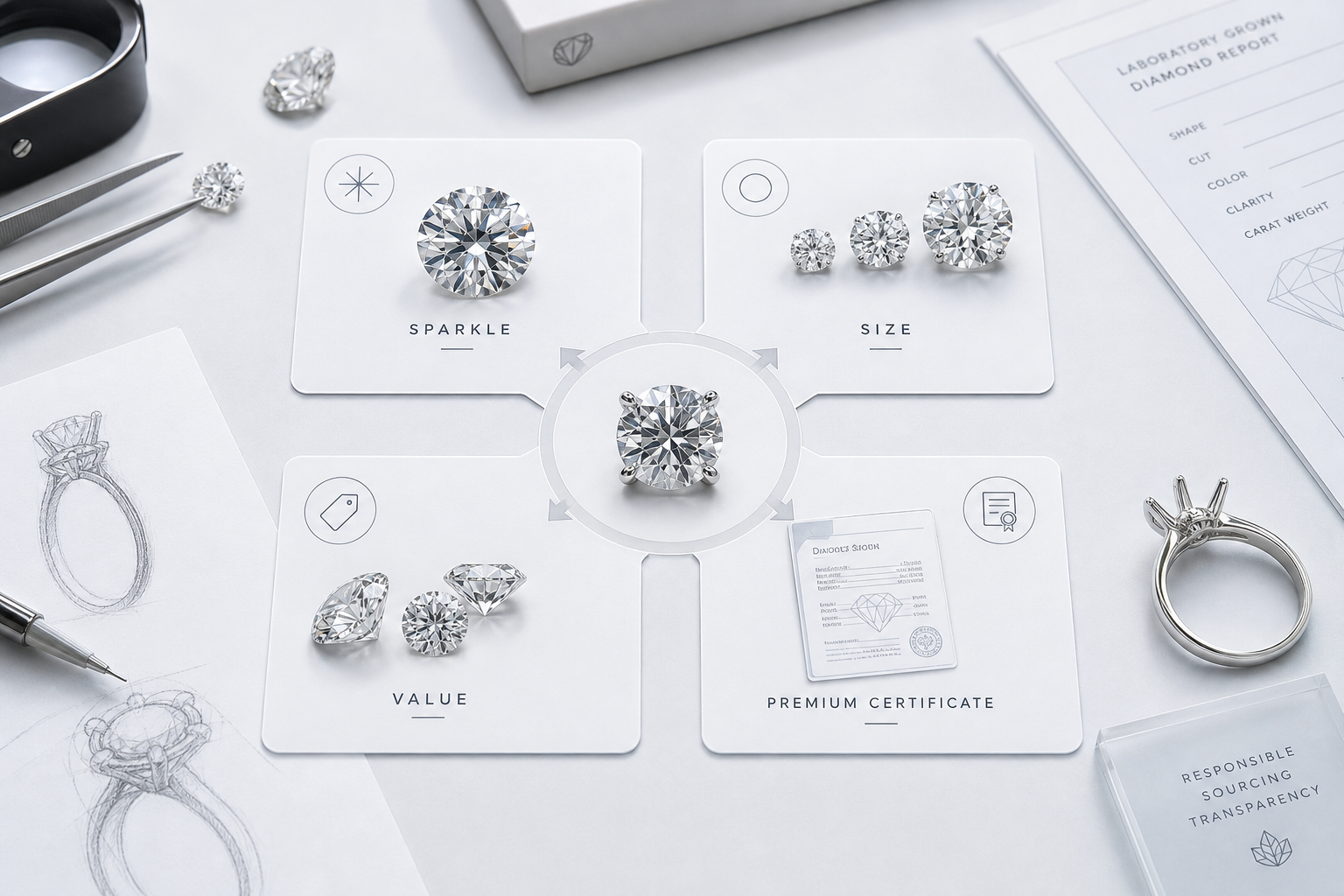
Lab-grown diamond cut quality is the first place to protect your budget because it controls whether the diamond uses light well. A higher color, higher clarity, or heavier carat weight can make a listing look stronger, but none of those upgrades will rescue a stone with weak brilliance, uneven contrast, or poor face-up performance.
The goal is not to memorize gemology formulas. The goal is to know how to judge diamond cut quality well enough to avoid obvious mistakes. Proportion ranges can help narrow the field, but they are screening tools, not guarantees. A diamond still needs to be reviewed visually before it earns the final yes.
That is also why report language should be read carefully. A grade can narrow the options, but it does not confirm that the stone will feel lively, balanced, or flattering once it is worn.
Round Brilliant Cut: Practical Screening Ranges
Round brilliant diamonds have the most standardized cut evaluation, which gives buyers a useful advantage. If you are looking for a well-cut lab-grown diamond engagement ring, begin by filtering for a strong cut grade, then check whether the proportions fall within a practical range.
- Table percentage: approximately 54 percent to 58 percent. This range often supports a balanced mix of brightness and fire, while very large or very small tables may change the diamond’s personality.
- Depth percentage: approximately 60 percent to 62.5 percent. Too much depth can hide weight and reduce face-up size; too little can create leakage or a shallow look.
- Crown angle: approximately 34 degrees to 35 degrees. This helps influence fire and the way the diamond gathers light.
- Pavilion angle: approximately 40.6 degrees to 41 degrees. The pavilion is critical for light return, and small mismatches can have visible consequences.
- Girdle: thin to slightly thick is often practical. Extremely thin girdles may raise durability concerns, while overly thick girdles can hold unnecessary weight.
- Symmetry and polish: Excellent or equivalent is generally preferred because poor finishing can undermine an otherwise promising stone.
These numbers should not be treated as absolute rules. Some diamonds outside a preferred range can still look attractive, and some inside the range may be less impressive than expected. The value of the range is that it helps buyers avoid stones with obvious proportion mismatches before spending time comparing images and videos.
Fancy Shapes Need Shape-Specific Judgment
Fancy shapes need more shape-specific judgment because the certificate may not provide a simple cut grade, and even when it does, the grade may not explain the diamond’s full visual character. Ovals, emerald cuts, cushions, radiants, pears, marquise cuts, and princess cuts can vary dramatically from one stone to another.
For elongated shapes such as oval, pear, and marquise, bow-tie visibility matters. A slight bow-tie can be normal, but a dark, dominant bow-tie across the center can distract from the diamond’s beauty. Length-to-width ratio also matters because it changes whether the stone looks slender, balanced, short, or overly stretched.
For emerald and asscher cuts, the open facet pattern makes clarity, color, and symmetry more visible. For princess, radiant, and cushion cuts, corner protection, facet pattern, and the balance between brightness and contrast become important. Two cushions with the same grades can look completely different if one has a crushed-ice appearance and the other has broader flashes of light.
This is where a certificate-only decision becomes risky. Fancy shapes have personality, and that personality is not fully captured by the 4Cs.
When a Bigger Carat Can Look Worse
A bigger carat can look worse when the added weight does not translate into better face-up beauty, a key point in any lab grown diamond carat guide because some diamonds carry extra weight in depth, which can make them look smaller from the top than their carat weight suggests. Others are cut too shallow and may appear wide but glassy, with weaker light return.
This is one of the most expensive mistakes in diamond buying: paying for weight that does not improve the visible result. A large diamond with awkward proportions may look dull, dark in the center, watery, or visually smaller than expected. In an engagement ring, those problems are not hidden by the fact that the report shows a higher carat number.
If the choice is between a slightly larger stone with compromised cut and a slightly smaller stone with stronger light performance, the better-cut diamond is often the smarter buy. Size has impact, but only when the diamond still looks bright, balanced, and well-proportioned.
Certificate and Visual Review Check
Before deciding, review the grading report for measurements, depth, table, polish, symmetry, and cut grade where available. For round diamonds, check whether the proportions make sense together rather than judging one number in isolation. For fancy shapes, pay close attention to measurements, outline, symmetry, and the way the facet pattern appears in motion.
Then confirm the report with actual visuals. Photos and 360-degree video should show a diamond that looks bright across the face, without distracting darkness, obvious leakage, or uneven contrast. A strong certificate can narrow the shortlist, but the final decision should depend on whether the diamond performs visually in a way that supports your goal.
Color Priority: When to Pay for Whiter Grades and When Not To
Color is one of the easiest 4Cs to overspend on because the grade sounds more important than it may look in real life. A higher lab-grown diamond color grade can matter, especially in certain shapes, larger stones, and white metal settings, but the smartest diamond color priority is not always “go as high as possible.” The better question is whether the color difference will be visible in the finished ring or jewelry piece.
For many buyers, color should come after cut and overall visual performance. A well-cut G or H diamond can look bright and white in normal viewing, while a poorly chosen higher-color stone may still feel flat if the cut is weak. Color becomes worth upgrading when it supports the design, the buyer’s sensitivity, or the kind of certificate profile they want. It becomes less useful when the extra grade is mostly a paper improvement.
Colorless Grades: Best for Premium Appearance
D, E, and F are the colorless grades. They create the strongest certificate profile for buyers who want the whitest documented range and do not want to second-guess the choice later. If the ring is going into platinum or a white gold setting, if the diamond is larger, or if the buyer is especially sensitive to warmth, this range can be a good fit.
The tradeoff is that the visible difference within D-F can be subtle. Many buyers will not reliably see a meaningful face-up difference between D, E, and F once the diamond is set, especially in brilliant cuts with strong light return. D color is not automatically the best color grade for a lab-grown diamond; it is best for buyers who value the top documented range enough to pay for it. If the goal is maximum visible value, an F or even a well-selected G may be a more efficient choice than chasing D.
Near-Colorless Grades: Often the Value Sweet Spot
G and H are often the practical sweet spot for lab-grown diamond buyers who want a white appearance without automatically paying for the colorless range. If someone asks, “Is G color good for lab-grown diamonds?” the answer is usually yes, provided the diamond is well cut, visually reviewed, and appropriate for the setting. In many engagement rings, a G-color diamond can appear clean and bright without the price pressure of D-F.
H can also be a strong value choice, especially in brilliant cuts and settings that do not emphasize side-view body color. I and J can work in some cases, particularly with yellow gold or rose gold settings, vintage-inspired designs, or buyers who prefer a slightly warmer look. They require more caution, though. Warmth may be more noticeable in larger stones, elongated shapes, step cuts, or minimalist white metal settings. This is where visual review matters more than the grade alone.
The mistake is assuming near-colorless means visibly tinted. It often does not. The practical risk runs in both directions: some buyers overpay for a colorless grade they cannot see, while others go too low for a design where warmth becomes obvious. The right range depends on the diamond’s shape, size, setting metal, and how much the wearer personally notices color.
Shape and Setting Can Change Color Tolerance
Shape affects how color shows. Round brilliant cuts tend to hide color better because their facet pattern returns more light and breaks up body tone. Radiant, cushion, oval, pear, and marquise cuts vary more, so the individual stone needs to be reviewed. Step cuts such as emerald and asscher usually reveal color more clearly because their large, open facets show the body of the diamond instead of masking it with intense sparkle.
Size also changes the decision. A one-carat G may look comfortably white to many buyers, while a much larger G or H may show more body color simply because there is more diamond to look through. This does not mean larger stones must always be D-F, but it does mean the buyer should be less casual about color as carat weight increases.
Setting metal can either sharpen or soften the impression. Platinum and white gold settings can make warmth easier to notice, especially from the side or in designs with open baskets. A yellow gold setting or rose gold setting can be more forgiving because the metal itself introduces warmth, making a near-colorless diamond look balanced rather than mismatched. For mixed-metal designs, the prongs matter too; white prongs can help the diamond face up brighter even if the band is yellow gold.
Stone-to-Setting Color Check
Before paying for a higher color grade, compare the diamond against the intended metal color. For platinum or white gold, check whether the stone looks white enough from both the top and side, not just in isolated studio lighting. If the design has a high setting, open gallery, or exposed side profile, body color may be more noticeable than it would be in a low-profile or bezel-style design.
For yellow or rose gold, a slightly warmer near-colorless diamond may still look intentional and attractive. The key is not whether the certificate grade sounds impressive on its own; it is whether the diamond and setting look coherent together. A G-H diamond in the right design can be a smarter allocation than a D-F diamond that forces compromises in size, cut, or the finished ring.
For custom design, trust comes from matching the stone to the setting, budget, and wearer’s daily use—not from choosing grades in isolation. Before finalizing a center stone, confirm the measurements, basket style, prong placement, side-stone proportions, and metal color so the diamond’s color and shape work with the finished piece rather than against it.
Clarity Priority: Aim for Eye-Clean, Not Automatically Flawless
Clarity matters, but not in the way many buyers first assume. The goal is not always to buy the highest lab-grown diamond clarity grade available. The practical goal is to choose a diamond that looks clean to the naked eye, has no distracting inclusions in important viewing areas, and does not carry clarity characteristics that interfere with beauty or durability.
This is where clarity differs from cut. A cut issue can affect the whole diamond every time it moves. A clarity issue may not matter at all if it is small, light-colored, hidden near the edge, or impossible to see without magnification. Paying for VVS or IF can make sense for certain buyers, but it is often less visually important than securing strong cut, appropriate color, or a better face-up size.
The Practical Goal: Clean to the Naked Eye
An eye-clean lab-grown diamond has no distracting inclusions visible without magnification at a normal viewing distance. That does not mean the diamond is internally flawless. It means the clarity characteristics are not interfering with how the stone looks in real wear. For many buyers, that is the point where additional clarity upgrades become less important visually.
VS1 and VS2 are common practical targets because they often provide a clean appearance without requiring the buyer to pay for the prestige of VVS or flawless grades. A well-selected VS2 can be a very smart choice, especially in round brilliant, oval, cushion, radiant, pear, or princess cuts where the faceting helps hide small inclusions. The important phrase is “well-selected.” Not every VS2 is equally clean, and the certificate grade alone does not tell you how noticeable the inclusion will be.
If a buyer is asking for the best clarity for a lab-grown diamond, the better answer is usually not a single grade. For most people, the best clarity is the lowest grade that still looks clean in the chosen shape, size, and setting. That leaves more budget for the qualities people actually notice first.
When Higher Clarity Is Worth Considering
Higher clarity becomes more valuable as the diamond gets larger, because inclusions have more space to be seen. It also matters more in step cuts such as emerald and asscher, where broad, open facets act almost like windows into the stone. In those shapes, VS1, VVS2, or VVS1 may be easier to justify than they would be in a brilliant round.
High-transparency facet styles also make clarity more noticeable. Minimalist solitaire settings, larger center stones, and designs that invite close inspection can make a clean certificate profile feel more appropriate. Some buyers also value the documentation itself. If the goal is a premium report profile for personal confidence, gifting optics, or a top-spec purchase, VVS or higher can be a reasonable choice even if the visible gain is limited.
The key is to understand what is being purchased. Higher clarity can buy visual security, cleaner documentation, and personal confidence. It does not automatically make a diamond sparkle more, and it should not be used to compensate for weak cut or poor proportions.
When Lower Clarity May Still Work
Some VS2 diamonds and carefully selected SI1 diamonds can be visually clean, especially in brilliant cuts. This is where buyers can find strong value, but it is also where careless shopping becomes risky. A low-clarity diamond is only a good value if the inclusions are not distracting, not concentrated in the center, and not obvious in normal viewing.
SI1 should not be treated as automatically safe. One SI1 may look clean because the inclusion is small, pale, or near the edge. Another may show a dark crystal under the table that the eye keeps finding. The grade tells you the general clarity category; it does not tell you whether the specific stone is pleasing.
If the diamond is for an engagement ring, the tolerance for visible inclusions is usually lower because the center stone receives daily attention. For earrings or certain pendant designs, a slightly lower clarity may be more acceptable because the diamond is viewed from farther away. Context changes the recommendation.
Inclusion Placement Review
Placement matters as much as the clarity grade. Inclusions under the table are more likely to be noticed because the table is the central viewing area. Dark crystals, obvious feathers, or marks near the center can be more distracting than several smaller features near the edge. Edge inclusions may be less visible and can sometimes be hidden by prongs, depending on the setting and the type of inclusion.
Review magnified images, 360-degree video, and seller notes when available. Do not rely only on a clarity label such as VS2 or SI1. The better decision is to ask: can I see anything distracting without magnification, does the inclusion sit in a visually sensitive area, and will the setting make it more or less noticeable?
Carat Priority: Size Matters, But Measurements Matter Too
Carat is the 4C most buyers feel immediately because it connects directly to size expectations. The problem is that lab-grown diamond carat size is a weight measurement, not a face-up measurement. A heavier diamond is not always the larger-looking diamond, and a larger-looking diamond is not always the better diamond if the proportions are working against light performance.
The smartest diamond carat priority is to pursue size without letting weight consume the whole budget. If the goal is a bigger look, compare measurements, shape, spread, and cut quality together. A diamond that carries too much weight in depth may cost more but look smaller than expected from the top.
Carat Is Weight, Not Diameter
Two diamonds with the same carat weight can look different in size because their weight is distributed differently. One may have efficient proportions and a strong face-up size. Another may be deeper, hiding weight below the girdle where the viewer cannot see it. This is one reason diamond carat vs measurements is such an important comparison.
For round diamonds, millimeter diameter gives a clearer sense of visible size than carat alone. For elongated shapes, length and width matter even more because they determine the outline and finger coverage. A buyer comparing two 2-carat stones should not assume they will look identical; the measurements may tell a different story.
The warning sign is a stone that reaches a desirable carat number but looks smaller than other diamonds in the same weight range. In that case, the buyer may be paying for hidden weight instead of visible presence.
Shapes That Often Look Larger Per Carat
Oval, pear, marquise, and emerald cuts often create a larger face-up impression than a round of similar carat weight, depending on their proportions. Elongated shapes can also visually lengthen the finger, which is one reason they are popular with buyers trying to get a larger-looking lab-grown diamond without simply increasing carat.
That larger look comes with tradeoffs. Ovals, pears, and marquise cuts need careful review for bow-tie effect, outline symmetry, and pleasing length-to-width ratio. A stretched shape may look elegant, but if it becomes too narrow, too shallow, or uneven, the size advantage can start to look like a compromise. Emerald cuts can appear broad and elegant, but they also tend to reveal color and clarity more readily than brilliant cuts.
Length-to-width ratio is a style decision as much as a technical one. Some buyers prefer a softer oval, while others want a longer, slimmer outline. The best choice is not the shape with the biggest measurement on paper; it is the one that looks balanced on the hand and still performs well in motion.
Size Strategy Without Losing Sparkle
Buyers who want size should be careful not to fund carat by cutting too deeply into cut quality. A larger diamond with weak light return can look dull, glassy, or dark in everyday lighting. That tradeoff is usually more noticeable than choosing a practical clarity grade or a near-colorless color range.
A better strategy is to keep cut and visual performance protected, then look for efficiency elsewhere. Choose a shape that offers the face-up presence you like. Consider an eye-clean clarity grade instead of automatically paying for VVS. Use a color range that looks white enough in the intended setting rather than paying for the highest possible grade. This is often how buyers find a practical carat size without making the finished piece look underpowered.
Setting design can also support visual size. A slim band, well-proportioned prongs, halo, hidden halo, or elongated center stone can change the overall impression. The center diamond should still be strong on its own, but the finished ring is what the eye sees, not the carat number printed on the report.
Measurement and Proportion Check
Compare millimeter dimensions for stones within the same carat range. For rounds, check diameter along with depth percentage so you are not choosing a stone that hides too much weight below the face-up view. An overly deep round may reach the desired carat number while looking smaller and returning light less efficiently.
For elongated shapes, review length-to-width ratio against the look you actually want. A ratio that works beautifully for one buyer may feel too long or too compact for another. Photos and video are especially useful because they show whether the outline, symmetry, and spread feel balanced rather than simply large.
The strongest size decision is not “buy the biggest carat you can afford.” It is to buy the diamond that gives the right face-up presence, protects visual performance, and fits the setting without forcing unnecessary compromises elsewhere.
Four Buyer Scenarios: How the 4C Priority Changes in Real Purchases
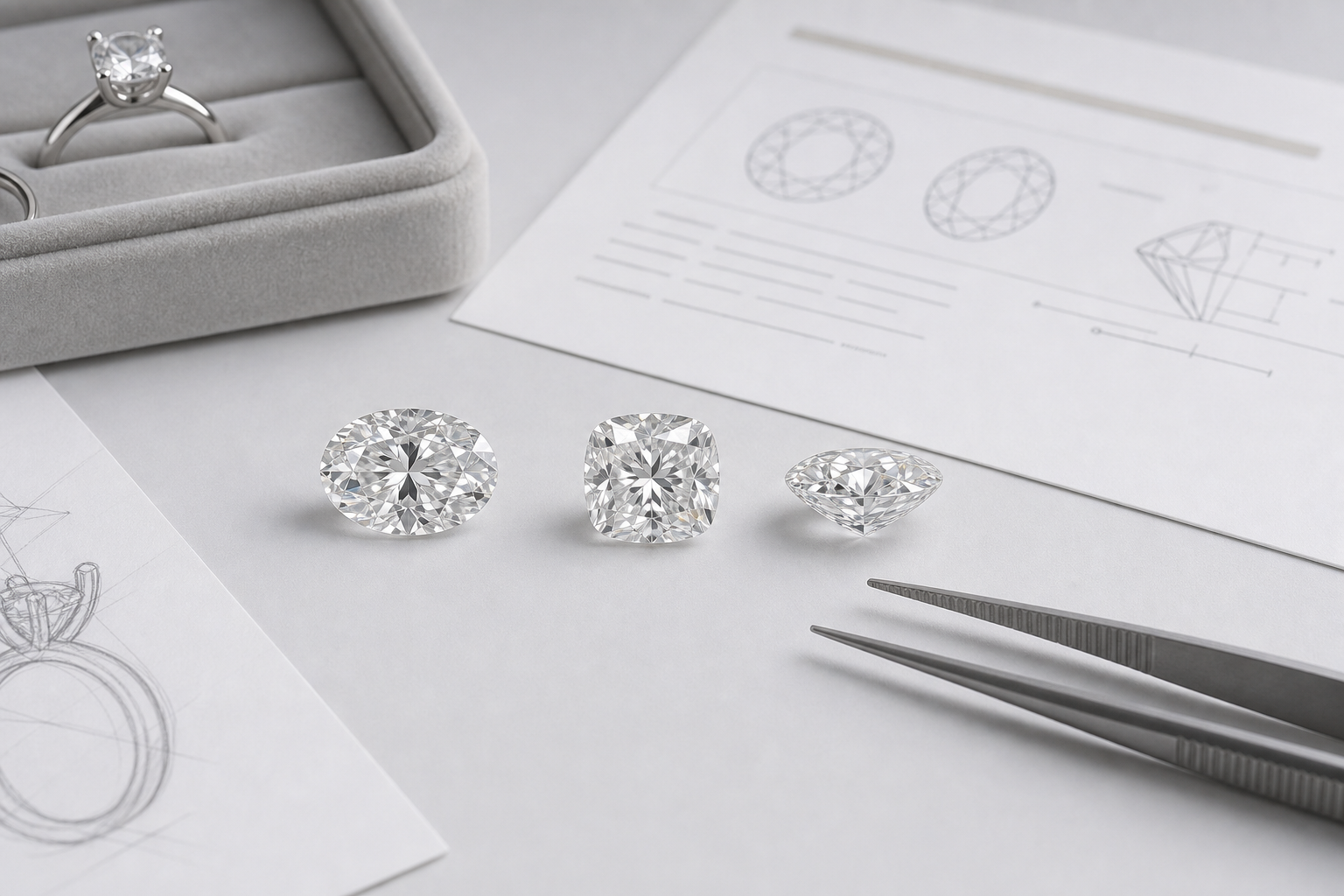
A useful lab-grown diamond buying guide should not treat every shopper as if they want the same stone. The same engagement ring budget can produce very different results depending on whether the buyer cares most about sparkle, visible size, a clean premium look, or the strongest certificate profile. This is where a 4C priority framework becomes practical: it helps buyers decide which upgrade is worth paying for and which one may look better on paper than on the hand.
Scenario 1: Maya Wants the Most Sparkle for an Engagement Ring
Maya is comparing two round lab-grown diamonds for a classic engagement ring. One is slightly larger, with respectable grades but average proportions. The other is a little smaller, with stronger cut quality, better light return in video, and balanced color and clarity grades that still look clean and bright.
The larger stone is tempting because carat weight is easy to understand. But once Maya watches both diamonds in motion, the tradeoff becomes clear. The slightly smaller diamond looks brighter across the face, shows more consistent sparkle, and has less dead space under everyday lighting. For her goal, the stronger lab-grown diamond specs for an engagement ring are not the biggest numbers across the report. They are the specs that protect visual performance first.
Maya chooses the better-cut stone because sparkle is her non-negotiable. This is the right call when the difference in size is modest but the difference in light performance is visible. A diamond that looks lively in mixed lighting will usually feel more impressive over time than one that only wins on carat weight.
Scenario 2: Daniel Wants the Largest Look Without a Premium Grade Stack
Daniel wants a larger face-up look, but he does not care about having D color and VVS clarity if those grades do not noticeably improve the finished ring. Instead of forcing a premium grade stack, he considers an oval and an elongated cushion because both can create more finger coverage than a round diamond of similar carat weight.
His main risk is choosing size too aggressively and ending up with a stone that looks stretched, dark through the center, or visually uneven. For an oval, he pays close attention to outline symmetry, bow-tie visibility, and length-to-width ratio. For an elongated cushion, he compares videos to see whether the facet pattern looks bright and organized rather than watery or crushed in a way he dislikes.
Daniel’s lab-grown diamond value strategy is to protect cut impression and outline first, then use a practical color and clarity combination. He accepts that a near-colorless, eye-clean stone may serve him better than a smaller diamond with top color and clarity grades. In his case, the smartest upgrade is visual spread, not certificate prestige.
Scenario 3: Priya Wants a Clean, Premium-Looking Stone for a Minimal Setting
Priya is choosing a solitaire in white gold or platinum. Because the setting is minimal, the center stone has nowhere to hide. The metal color may make warmth easier to notice, and the clean design puts more attention on the diamond’s transparency, outline, and overall face-up appearance.
For Priya, color and clarity move higher in the decision after cut is protected. She does not need to chase the highest possible grades automatically, but she does need a stone that looks crisp in a bright white setting. A slightly warmer diamond that looked fine in isolation may feel less ideal once placed next to white metal, especially in a simple solitaire where there are no side stones or design details to soften the contrast.
Her best decision is to keep cut as the baseline, then choose a higher color range and clean clarity that support the style of the ring. This is a good example of how to balance diamond 4Cs around the finished piece, not just the loose stone. A diamond can be a strong value in one setting and the wrong match in another.
Scenario 4: Alex Wants the Strongest Certificate Profile
Alex values documented high grades. He may be buying for personal confidence, gifting presentation, or the satisfaction of knowing the diamond has a colorless grade and very high clarity on the report. This is a valid priority as long as he understands what he is paying for.
His tradeoff is efficiency. Once a diamond already appears white, clean, and well cut, moving higher in color or clarity may not change the visible result very much in normal viewing. The upgrade can still matter to Alex because the certificate profile matters to him. The mistake would be assuming those upgrades always create an equal visual improvement.
Alex chooses a colorless, high-clarity diamond after confirming the cut and visual performance are strong. That order matters. A premium certificate profile should enhance a good diamond, not distract from weaker proportions, dull light return, or a shape that does not look right in motion.
What These Scenarios Prove
These examples show why the “best” 4C priority depends on the buyer’s goal. Maya should protect sparkle before size. Daniel should use shape and measurements to gain presence without overpaying for invisible grade upgrades. Priya should consider how color and clarity behave in a minimal white-metal setting. Alex can justify higher grades because the certificate profile itself is part of what he values.
Smart buying is not about lowering standards. It is about spending where the difference will actually matter for that purchase. The wrong move is trying to maximize every C at once without asking which one changes the final look, the finished ring, or the buyer’s confidence the most.
Recommended 4C Priority by Diamond Shape
The best 4Cs by diamond shape are not identical because each shape handles light, color, inclusions, and face-up size differently. A lab-grown diamond shape guide should help buyers avoid applying round-brilliant logic to every stone. A clarity grade that works well in a round diamond may feel risky in an emerald cut, while a carat strategy that looks efficient in an oval may not work if the outline or bow-tie is distracting.
Round Brilliant: Cut Is the Strongest Lever
For a round diamond, cut should usually carry the most weight because round brilliants have the most standardized cut evaluation and the clearest relationship between proportions and light performance. If a buyer asks for the best color for a round lab-grown diamond before checking cut, a lab grown diamond 4Cs guide would treat the order as backward. A higher color grade will not make a poorly performing round look lively.
Once cut is secured, color and clarity can often be balanced more flexibly. Many round brilliants hide small inclusions well because of their facet pattern, and strong brightness can make modest color differences less obvious from the top. The practical priority is cut first, then face-up size, then color and clarity at levels that support the intended setting and budget.
Oval, Pear, and Marquise: Shape Appeal and Bow-Tie Control Matter
Oval, pear, and marquise diamonds can be excellent choices for buyers who want a larger-looking stone, but they require more visual judgment than a grade sheet can provide. The best 4Cs for oval lab-grown diamond shopping should include shape appeal as part of the decision, not as an afterthought. A stone can have strong color and clarity grades and still look unbalanced if the outline is awkward or the bow-tie is too dark.
For these elongated shapes, buyers should prioritize a pleasing outline, controlled bow-tie effect, good symmetry, and a length-to-width ratio that fits the design. Color may be slightly more noticeable near pointed ends or along the body of the stone, especially in larger sizes. Clarity still matters, but visible shape issues are often more damaging to the final appearance than a small clarity difference that cannot be seen without magnification.
Emerald and Asscher: Clarity and Color Move Up in Priority
Emerald and Asscher cuts have open, step-cut facets that create a cleaner, hall-of-mirrors look rather than the busy sparkle of a brilliant cut. That style is elegant, but it is less forgiving. Inclusions are easier to spot, and body color can be more noticeable because there is less facet activity to disguise it.
For buyers asking about the best clarity for emerald cut lab-grown diamond selection, the answer is usually higher than it would be for a round brilliant. VS clarity or better is often a safer starting point, though the actual placement of inclusions still matters more than the grade alone. Color also deserves more attention, especially in white metal or larger stones. The tradeoff is clear: step cuts can look refined and architectural, but they punish casual grade selection more than brilliant cuts do.
Cushion, Radiant, and Princess: Balance Facet Pattern, Spread, and Cleanliness
Cushion, radiant, and princess cuts vary widely in personality. Two cushions with the same carat, color, and clarity can look completely different if one has a crushed-ice pattern and the other has broader, more defined flashes. Radiants can appear bright and lively, but some show uneven contrast or a busy center. Princess cuts can offer strong brilliance, but corner durability and setting protection matter more than many buyers expect.
For these shapes, video comparison is more useful than grade comparison alone. Buyers should look for a facet pattern they actually like, a face-up size that feels appropriate for the carat weight, and an eye-clean appearance without distracting central inclusions. The best choice is not automatically the highest-graded stone. It is the one whose pattern, spread, and cleanliness work together in the finished design.
Shape-Specific Review Checklist
Before comparing grades alone, check the diamond’s length-to-width ratio, face-up measurements, outline symmetry, facet pattern, and video performance. For elongated stones, make sure the shape does not look too narrow, too bulky, or visibly uneven. For step cuts, inspect clarity and color more carefully. For brilliant and mixed cuts, watch how the stone behaves in motion rather than relying only on still photos.
A certificate can confirm important details, but it cannot fully describe shape personality. The report may tell you the measurements and grades; it will not tell you whether an oval has a graceful outline, whether a cushion’s facet pattern feels elegant or chaotic, or whether an emerald cut has the clean, glassy look you expected.
Common 4C Mistakes Lab-Grown Diamond Buyers Should Avoid
The most common lab-grown diamond buying mistakes come from treating the 4Cs as a scorecard instead of a decision tool. Higher grades are not automatically wrong, but paying for upgrades that do not improve the visible result can drain budget away from the parts of the diamond that matter more. The best way to avoid 4C mistakes is to connect every upgrade to a real visual or personal reason.
Mistake 1: Paying for Invisible Grade Upgrades
Some diamond grade upgrades are more meaningful on paper than in normal viewing. Moving from one high clarity grade to an even higher one may not change the way the diamond looks if both are already eye-clean. The same can be true within the colorless range, where differences may be subtle unless the stones are compared side by side in controlled lighting.
The action is simple: compare the visual impact before paying more. If two diamonds look equally white, clean, and bright in the intended setting, the higher grade may still be valid for certificate preference, but it should not be mistaken for guaranteed visible improvement.
Mistake 2: Choosing Carat Before Cut
Size-first buying can produce a diamond that looks impressive in a listing but underwhelming in real life. A larger lab-grown diamond with weak proportions, poor light return, or excess depth may look dull or smaller face-up than expected. This is one of the most expensive mistakes because the buyer pays for weight without getting the full visual benefit.
The better move is to protect cut quality and useful measurements before increasing carat. If a larger stone only works by sacrificing sparkle, outline, or proportion, the upgrade is not really an upgrade. Carat should add presence without weakening the diamond’s life.
Mistake 3: Treating the Certificate as the Whole Story
A grading report is useful for verification, but it is not the whole buying decision. It does not fully show sparkle, bow-tie effect, facet personality, or how the stone looks as it moves. Two diamonds with similar grades can perform differently because proportions, facet arrangement, transparency, and shape execution all affect the final appearance.
At NUVU, we treat the grading report as a starting point, not the final answer, because a strong certificate still needs to be supported by photos, video, measurements, and setting compatibility. The practical action is to review the report and the diamond together. If the paperwork looks strong but the video looks flat, uneven, or dark, keep looking.
That same verification logic is useful for any seller claim that goes beyond the report. If a diamond is described as white, clean, or well-proportioned, the supporting visuals should make that easy to confirm.
Mistake 4: Using the Same 4C Standards for Every Shape
One of the easiest ways to misjudge a lab-grown diamond is to use the same standards for every shape. A VS2 clarity grade that looks completely clean in a round brilliant may be more noticeable in an emerald cut. A color grade that feels white enough in yellow gold may look warmer than expected in platinum. An oval with attractive carat weight may still disappoint if the bow-tie dominates the center.
The action is to adjust priorities by shape and setting. Step cuts usually need more clarity scrutiny. Elongated shapes need more attention to outline and bow-tie. White-metal minimalist settings can make color and clarity more obvious. The right 4C balance is not universal; it depends on what the diamond shape reveals and what the setting emphasizes.
Pre-Purchase Verification Checklist
Before buying, confirm the grading report number, measurements, cut or proportion information where available, actual images or video, and compatibility with the intended setting. Check whether seller claims about eye-clean appearance, color impression, or performance are supported by the visuals and report details.
Avoid relying on a single grade as the entire decision. The safest purchase is the one where the report, the visual evidence, and the intended design all point in the same direction.
How to Verify a Shortlisted Diamond Before You Commit
Once you have narrowed the shortlist, the next step is not to look for more diamonds endlessly. It is to verify the candidates you already like. Start by matching the report details to the listing: shape, carat weight, measurements, color, clarity, polish, symmetry, fluorescence if stated, and any inscription or report number information available. If the listing leaves out details that affect your decision, ask for clarification before treating the stone as comparable to another option.
Then compare the report with the visual evidence. A report can tell you the diamond’s measured characteristics, but video and images help reveal whether the stone has even brightness, distracting darkness, a strong bow-tie, visible inclusions, or a face-up outline that feels balanced. If a seller describes a diamond as eye-clean, bright, or premium-looking, the supporting visuals should make that description understandable rather than requiring the buyer to assume it.
For a custom ring or jewelry project, also verify fit before focusing only on the loose stone. The center stone’s measurements, depth, girdle, corner shape, and length-to-width ratio can affect basket design, prong placement, side-stone alignment, and how high or low the finished piece sits. A diamond that is attractive on its own can still be a poor match if the setting cannot protect it properly or if the proportions disrupt the intended design.
For custom jewelry, stone measurements and setting compatibility should be confirmed before finalizing a purchase. This is especially important for fancy shapes, step cuts, elongated stones, and designs with side stones, halos, bezels, or unusually low-profile baskets.
How to Read Seller Claims Without Over-Relying on Them
Seller descriptions can be helpful, but they should be treated as starting points rather than final proof. Phrases such as “premium,” “excellent sparkle,” “eye-clean,” or “white appearance” are easier to trust when the listing also provides report details, measurements, magnified images, and video that support the claim. If the evidence is missing or unclear, ask for more information before comparing the stone against better-documented options.
It is also worth separating gemological facts from marketing conclusions. A grading report may document color, clarity, carat weight, proportions, and laboratory-grown origin, but it does not prove that the diamond is the most beautiful option for your setting or the strongest value in the market. Beauty, value, and fit still depend on the specific stone, the design goal, and the buyer’s preferences.
NUVU’s buyer-first approach is to make comparison clearer, especially around report details, visual evidence, setting fit, and documentation. That approach does not require chasing the highest grade in every category; it requires knowing which details are verified, which details are subjective, and which claims still need confirmation.
How to Treat Sustainability and Origin Claims Carefully
Lab-grown diamonds are often discussed in terms of sourcing, production method, and environmental impact, but those topics should be handled carefully. A lab-grown diamond is not automatically better or worse on those questions just because it is lab-grown. The responsible approach is to ask what exactly is being claimed and what documentation, if any, supports it.
That means being cautious with broad statements like “eco-friendly,” “low-impact,” or “ethical” unless the seller explains the basis for the claim. Different production methods, energy sources, and business practices can change the answer. If a seller mentions sustainability, the useful follow-up question is simple: what specifically is being measured or disclosed?
For buyers, this is mostly a trust issue, not a technical debate. If the diamond is being marketed with origin or environmental language, ask for clear, narrow support rather than assuming the claim covers everything. A careful buyer should separate the beauty decision from the sustainability claim and evaluate each on its own terms.
The same caution applies to origin language. If a seller describes a stone as lab-grown, that should be part of the basic product description. If the seller goes further and makes claims about ethical sourcing or environmental benefit, those claims deserve closer scrutiny than the simple fact that the diamond was grown in a lab.
Environmental and sustainability claims should be specific, documented, and limited to what can be substantiated. Broad green language is less useful than clear information about production, energy context, sourcing disclosures, and seller transparency. A restrained claim that explains its limits is more helpful to buyers than a sweeping promise that cannot be evaluated.
How to Build a Smart 4C Budget Strategy
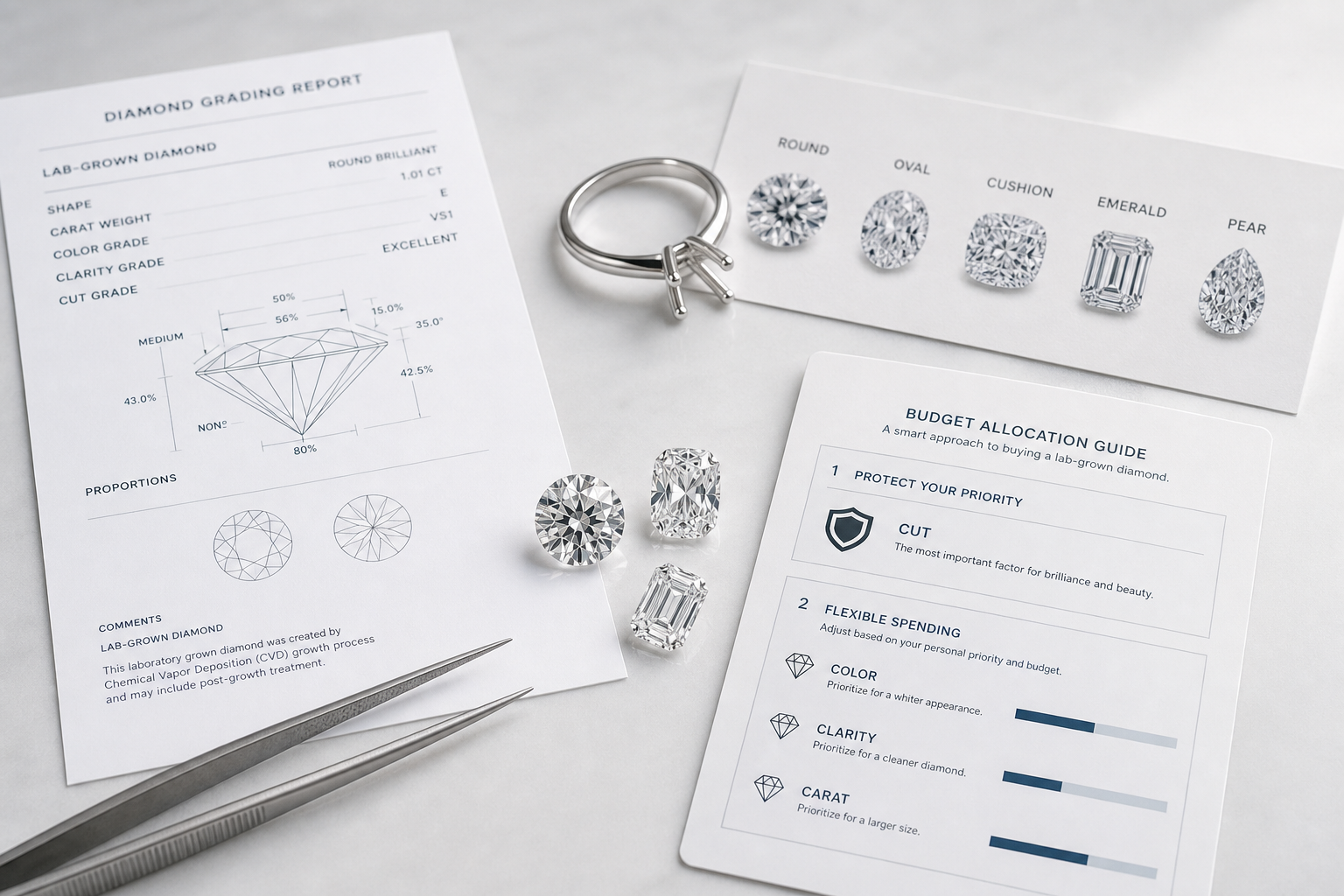
A smart lab-grown diamond budget strategy starts with one rule: protect cut first, then spend the next dollar where it changes the look you actually want. For most buyers, a strong-value lab-grown diamond is not the one with the highest grades across the board. It is the one that makes the strongest visual impact without wasting budget on upgrades you will not notice once the stone is set.
If you are shopping for an engagement ring, loose diamond, or custom piece, think in terms of the full project, not just the center stone. The diamond, setting, metal, side stones, and design complexity all compete for the same budget. A slightly more balanced center stone often leaves more room for a better finished ring than a heavily upgraded stone that forces you to compromise elsewhere.
Step 1: Set the Non-Negotiable Standard
For most buyers, cut quality should be the first non-negotiable. If the stone does not return light well, the rest of the 4Cs cannot fully compensate for it. That is especially true for round diamonds, where sparkle and light performance are easy to notice in normal viewing.
For fancy shapes, the standard should be a little broader but still firm. Pay attention to visual performance, outline, and proportion, not just the grade on paper. A diamond that looks awkward, too deep, or uneven from face-up is not a good use of budget no matter how strong the certificate looks.
Step 2: Choose One Upgrade Category
Once cut is protected, choose one main upgrade path instead of trying to maximize everything at once. That might be more carat, higher color, higher clarity, or a stronger certificate profile. The mistake many buyers make is treating every higher grade as equally important, which spreads the budget too thin.
A focused lab-grown diamond budget strategy keeps the decision cleaner. If you care most about size, direct more budget toward carat and face-up spread. If you want a cleaner, more premium look, spend more on color or clarity after cut is secured. Trying to push all four categories upward at the same time usually leads to a higher total cost without a proportional visual gain.
Step 3: Use “Enough” Grades Where the Eye Cannot Tell
This is where many buyers get better value. Once a diamond looks white enough in its setting and clean enough to the naked eye, extra grade upgrades often become harder to justify. Near-colorless grades can look excellent in many designs, and many eye-clean clarity grades perform just as well as much higher ones in normal wear.
The right question is not whether a diamond has the highest grade possible. It is whether the current grade already meets the visual standard for your ring, metal color, and viewing distance. If it does, the smarter move is often to stop upgrading and protect the rest of the budget.
Step 4: Leave Room for the Setting
A good engagement ring budget accounts for more than the center stone. The setting, metal choice, side stones, craftsmanship, and customization all affect the final result. A diamond that looks slightly less aggressive on paper can sometimes produce a better overall ring if it gives you room to improve the setting.
This matters even more in custom ring planning. If the design is complex, the setting may matter almost as much as the center stone because it changes the finished look and feel of the piece. In that situation, a balanced stone can be the better allocation than a larger or higher-graded one that forces the design to be simplified.
What This Means in a Real Purchase
The practical move is to compare two or three stones side by side instead of browsing endlessly. The best candidate should meet your cut and visual standard, fit the intended setting, and support your main goal without paying heavily for low-impact upgrades. At NUVU, that is usually the point where the certificate becomes useful, but the visual judgment still decides the final pick.
Before committing to a custom design, confirm the seller’s documentation, communication process, measurements, and setting compatibility in writing. This does not replace personal preference, but it reduces avoidable misunderstandings about what the selected stone can realistically achieve in the finished piece.
FAQs About Prioritizing the 4Cs in Lab-Grown Diamonds
Which of the 4Cs is most important for lab-grown diamonds?
Cut is usually the most important because it has the strongest effect on sparkle and light performance. A diamond with strong cut quality will usually look more lively and attractive than a stone that is larger or higher in clarity but weaker in how it returns light.
Is D color worth it for a lab-grown diamond?
It can be worth it if you want a premium certificate profile or the whitest documented range. For many buyers, though, near-colorless grades look bright and clean enough once the stone is in its setting, which makes them a better value.
Do I need VVS clarity in a lab-grown diamond?
Not always. If the diamond is eye-clean and the inclusions are not distracting, a lower clarity grade may offer better value. Higher clarity can make more sense for step cuts, larger stones, or buyers who want a stronger report profile.
Should I choose a bigger lab-grown diamond or a better-cut one?
If sparkle matters most, choose the better-cut stone first. If size is the priority, look for a shape and proportion set that gives you a larger face-up appearance without giving up too much visual performance.
Are the best 4C priorities different for engagement rings?
Yes, they often are. The center stone carries most of the visual impact, so cut and face-up appearance matter heavily. Metal color, setting style, and daily wear should also shape how you balance color, clarity, and carat.
FAQ Buying Note
These answers are meant to help you decide quickly, not to replace the full comparison process. If you want a deeper look, go back to the section that matches your main goal or review the stone details side by side before buying.
Conclusion and Next Step: Choose the 4C Balance That Matches Your Goal
The best 4C priority for lab-grown diamonds is not fixed across every buyer. Cut should usually come first, then you decide whether color, clarity, or carat deserves the next dollar based on what matters most to you. That is the core of a smart lab-grown diamond buying guide: spend where the difference is visible, not where the grade simply looks stronger on paper.
Final Priority Summary
For sparkle, protect cut. For size, compare measurements and shape, not just carat weight. For value, avoid invisible upgrades that do not change the look. For a premium appearance, consider higher color and clarity after cut is secured.
Next Step with NUVU
Use this framework as a checklist before choosing a stone. Compare loose lab-grown diamonds, review certificate details, or explore custom ring options with the same question in mind: which combination gives you the best result for your goal, not just the highest grades overall?
Trust and Verification Notes
Before finalizing a purchase, it helps to slow down and make sure the visible stone, the grading report, and the intended setting all line up. That step is especially useful when you are comparing diamonds with similar grades but different face-up performance, because the report alone cannot explain why one stone feels brighter or more balanced than another.
For buyers who want a more transparent comparison, documentation and communication matter just as much as the grading label. A clear report number, consistent measurements, useful images or video, and responsive seller answers help reduce confusion when you are deciding between close options.
When a grading report is provided, buyers should compare the report details with the issuing laboratory’s verification tools where available, then confirm that the visuals and setting plan support the same decision.
Before purchase, buyers should also confirm the seller’s return policy, resizing terms, documentation, and after-sales support in writing. Those details are separate from the 4Cs, but they can affect how comfortable the buyer feels when choosing between similar stones or finalizing a custom piece.
Reader Value Check
The smartest lab-grown diamond is not automatically the highest-graded one. It is the diamond whose cut, color, clarity, and carat balance fits the intended look, setting, budget, and personal priorities.
Disclosure: This article is for general educational purposes only. Diamond grading, pricing, availability, specifications, and seller policies can change, and readers should verify important details through grading reports, official laboratory tools, seller documentation, or qualified professionals before making a purchase decision. Laboratory-grown diamonds should be clearly distinguished from natural diamonds, and environmental or sourcing claims should be supported by specific documentation.