- Shop
Diamonds & Jewelry
Loose Lab Diamonds Yellow Lab Diamonds Pink Lab Diamonds Blue Lab Diamonds Engagement Rings Fine Jewelry Shop All Loose lab-grown diamonds10 shapes · IGI, GIA or NGTC reports
- Wholesale
- Custom Design
- Education
- About
Pear Lab-Grown Diamond Guide: How to Evaluate Symmetry, Bow Tie, and Tip Protection
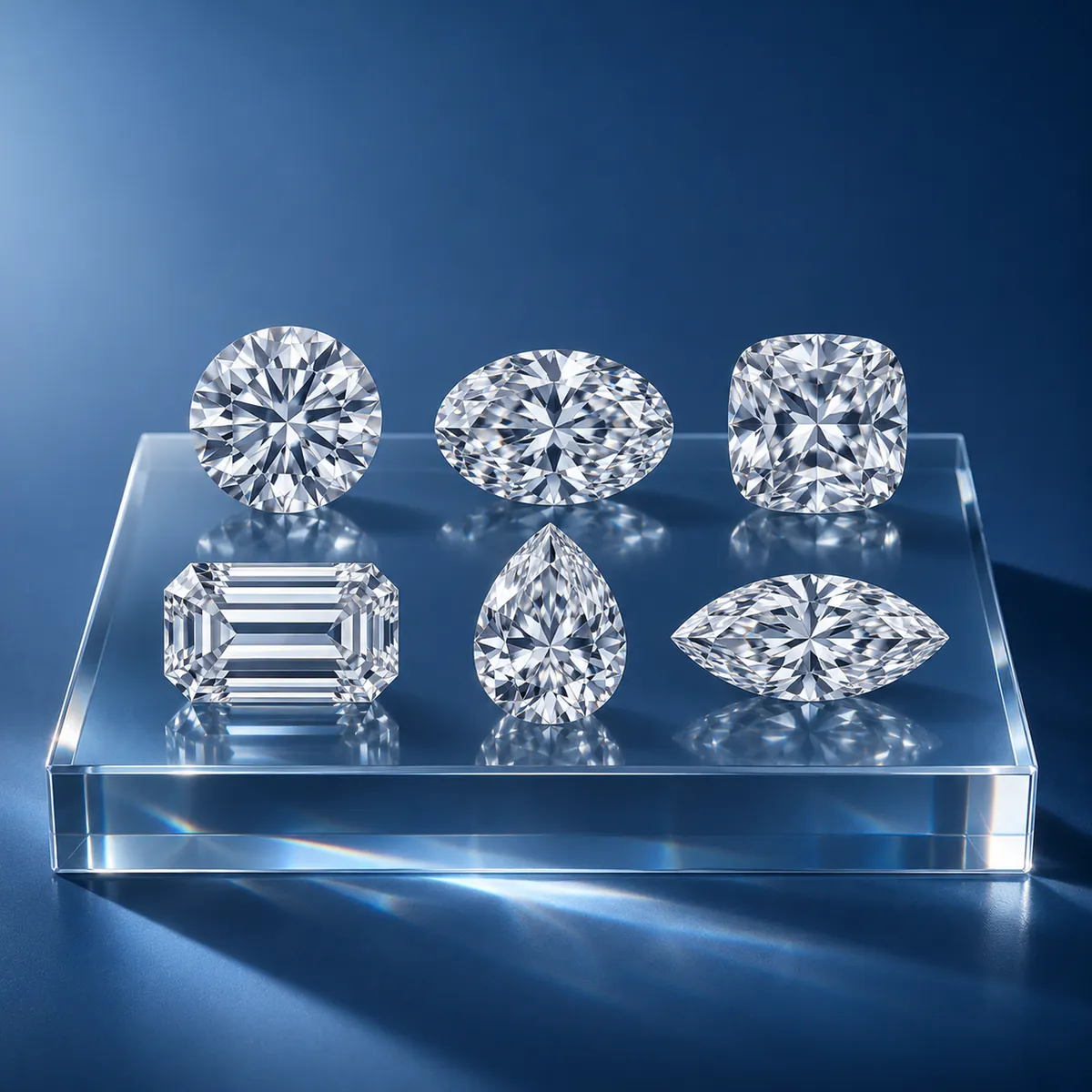
A 1.00 ct pear is roughly 8.5 × 5.5 mm, longer than a 1.00 ct round is wide by about 2 mm. Draw a line from its point to the middle of the rounded end, and the two halves should mirror each other. When they do not, when one shoulder sits higher or the point leans to one side, no grade on the report will tell you, but everyone who looks at the ring will see a lopsided stone.
A pear combines a rounded end and a point. It looks large for its weight, elongates the finger and suits rings, pendants and drop earrings. Check four things: a ratio you like (about 1.45 to 1.75), a symmetrical outline with even shoulders, a mild bow-tie, and a protected point. Color can gather at the tip, so check it in video.
Pear at a glance
Ratio
Swipe the table to see more →
| Ratio | Look |
|---|---|
| 1.40–1.50 | Fuller, wider |
| 1.50–1.70 | Classic |
| Above 1.75 | Slim, dramatic |
A 1.00 ct pear is roughly 8.5 × 5.5 mm.
Symmetry and outline
Draw an imaginary line from the point to the center of the rounded end. Both halves should mirror each other. Watch for:
- Off-center point.
- Flat or high shoulders (the “wings” below the rounded end).
- Rounded end too narrow or too wide.
Top-down photos show this best.
Bow-tie
Like ovals and marquises, pears often show a dark band across the widest part. A mild one that shifts as the stone moves is normal. Check video.
Color and clarity at the point
Color can look more saturated at the narrow tip. Inclusions near the point are a durability concern. Choose stones with a clean tip.
Protecting the point
Pears need a V-prong (or a bezel) at the point. Two or three prongs at the rounded end hold the stone. Halo and bezel settings also protect the tip.
Orientation
In rings, the point usually faces the fingertip. In pendants and earrings, it points down. Some designs reverse or turn the stone east-west.
Settings
Swipe the table to see more →
| Setting | Notes |
|---|---|
| Solitaire with V-prong | Classic |
| Halo following the outline | Larger look, protected tip |
| Toi et moi with another shape | Modern |
| Three-stone (pear sides) | Pears as side stones for ovals and rounds |
| Pendant or drop earring | Natural orientation |
What a report shows for a pear
On a report, a pear gets measurements, polish and symmetry. An overall cut grade appears only on some reports: IGI can grade loose fancy shapes, while GIA grades cut on round brilliants only and plans fancy-shape grades for 2027. IGI and NGTC give full color and clarity grades. GIA, since October 1, 2025, gives lab-grown stones a Premium or Standard assessment instead, which for fancy shapes rests on color, clarity, polish and symmetry; see the GIA report guide. No report records the bow-tie, the symmetry of the shoulders or the shape of the point, so judge that on video.
Matched pairs for earrings
Pear earrings need a mirrored pair: same ratio, outline, shoulder shape and bow-tie strength. Compare the measurements of both stones and watch the pair side by side on video.
Common mistakes with pears
- Accepting an off-center point.
- Ignoring an inclusion near the tip.
- Using thin prongs that leave the point exposed.
- Choosing a ratio from a photo without seeing it in the intended jewelry.
Pear questions
What ratio is best for a pear diamond?
1.50 to 1.70 for the classic look.
Do pear diamonds chip easily?
The point is vulnerable. A V-prong or bezel protects it.
Which way should a pear point on a ring?
Usually toward the fingertip.
Find a symmetrical pear
Tell us the size, the ratio you like and the color and clarity range, and whether you need a single stone or a pair, and we will suggest pears with their measurements and reports. NUVU can arrange IGI, GIA or NGTC reports. Send your requirements or WhatsApp / WeChat +86 191 1840 3930.

12+ years in lab-grown diamond grading, identification and quality assurance for both HPHT and CVD stones.
About NUVU. NUVU is the international brand of New Perspective Superhard Materials Co., Ltd. in Zhecheng, Henan, China. We grow HPHT lab-grown diamonds in-house and cut, polish and match stones in our own workshop.
Related Guides
Shapes guide
Compare lab-grown diamond shapes: round, oval, emerald, radiant, cushion, pear, marquise, princess, Asscher, heart.
Read more →Diamond shapesMarquise guide
How to choose a marquise lab-grown diamond: ratio, symmetry of both points, bow-tie, color at the tips, protecting…
Read more →ShopLoose lab diamonds
Loose lab-grown diamonds in 10 shapes with IGI, GIA or NGTC reports.
Read more →