
One of the most important early choices in buying lab-grown diamond jewelry is whether to select the loose diamond first or buy a finished piece. That decision affects how much control you have over the stone’s appearance, how clearly you can compare value using a loose lab grown diamond certificate, how accurately the setting fits, and how simple the buying process feels. It matters most when one diamond is the main visual and financial focus, such as an engagement ring, solitaire pendant, three-stone ring, or custom design.
For the full framework, read Loose Lab-Grown Diamonds Buying Guide.
This article helps you judge when the stone should lead the purchase and when the finished design should. You’ll see why carat weight alone is not enough, how measurements and proportions influence appearance, what documentation to check, and when convenience, matching, construction, or gift-readiness may matter more than choosing one specific center stone.
The practical goal is not to prove that one buying path is always superior. It is to identify which part of the purchase creates the most risk, value, and visual impact, then ask for the right evidence before you commit.
| Buying Situation | Better Starting Point | What to Check First |
|---|---|---|
| Engagement ring or solitaire pendant | Loose diamond | Certificate, millimeter size, cut, shape, images |
| Oval, pear, emerald, radiant, or marquise center | Loose diamond | Length-to-width ratio, depth, face-up spread |
| Custom bezel, halo, or three-stone design | Loose diamond | Exact dimensions before setting approval |
| Pavé band, tennis bracelet, or station necklace | Finished jewelry | Total carat weight, matching, metal, construction |
| Gift-ready earrings or small diamond pendant | Finished jewelry | Clear lab-grown status, photos, metal details |
| Listing with vague stone information | Pause before buying | Missing measurements, unclear carat breakdown, no visuals |
Evidence note: In this guide, “better” means better for evaluation and fit, not automatically cheaper, more beautiful, or more responsible. A loose diamond gives you more stone-level evidence, while finished jewelry gives you a completed design to inspect. The right path depends on which evidence matters most for the specific purchase.
Quick Questions Before You Read
Q: Is buying a loose lab-grown diamond always better?
No. It is usually better when one main stone drives the look and cost, but finished jewelry can be smarter for matched, design-led, or gift-ready pieces.
Q: Why not just compare carat weight?
Carat weight does not show how large a diamond looks. Millimeter measurements, depth, shape, and proportions can change face-up size significantly.
Q: Can a loose diamond be set later?
Yes, but the setting should be made or selected around that diamond’s exact shape, dimensions, depth, and orientation.
Q: Should finished jewelry include a grading report?
Major center stones should have clear documentation. Small accent stones may not, but the listing should still explain stone type, carat weight, and metal.
Read Listings Carefully: Lab-Grown, Natural, and Simulant Are Not the Same
When you compare loose lab-grown diamonds with finished jewelry, the first compliance check is simple: the material should be named clearly. A laboratory-grown diamond should be disclosed as laboratory-grown, and it should not be described as mined or natural. If a listing uses wording such as “diamond alternative,” “diamond look,” or “created stone,” confirm whether it is referring to a lab-grown diamond or a diamond simulant before comparing price or appearance.
This matters because the buying logic changes depending on what is actually being sold. Lab-grown diamonds are diamonds with a laboratory origin, while simulants are different materials that may only imitate the look of a diamond. A clear listing should let the buyer understand which category applies without guessing from the photos alone.
For finished jewelry, that same clarity should extend to the stone breakdown. If a ring has a lab-grown center stone and natural diamond accents, or vice versa, the seller should disclose that distinction. Mixed descriptions can make the item harder to compare and can also affect how the piece is evaluated against other listings.
- Check whether the listing says lab-grown diamond, natural diamond, or diamond simulant.
- Confirm whether the stated carat weight refers to one stone or the whole piece.
- Ask for photos or report details that match the actual item being sold.
Start With the Real Decision: Are You Buying a Diamond or a Finished Jewelry Piece?
The real question is not simply whether a loose lab-grown diamond or finished jewelry is “better.” It is whether you want to choose the most important stone first, then build the ring, pendant, or custom jewelry around it, or whether you want to buy a completed piece where the stone and setting have already been matched for you.
For most buyers, it makes sense to buy the stone first when the diamond is the visual and financial center of the piece. That is especially true for engagement rings, solitaire pendants, custom designs, and larger center stones where shape, size, certification, and appearance drive the whole purchase. Finished jewelry is often the better path when convenience, a ready-made look, and fewer decisions matter more than controlling every detail of the diamond.
The short answer for most buyers
If the diamond is the main reason you are buying the piece, start with the loose lab-grown diamond. A center stone affects how the jewelry looks, how the budget is allocated, and whether the final design feels balanced. Choosing the diamond first gives you the chance to compare shape, carat weight, measurements, grading report details, and actual appearance before the setting limits your options.
If the finished design is the main reason you like the piece, buying finished jewelry can be smarter. A ready-made diamond ring, pendant, bracelet, or pair of earrings may already have the look you want, without requiring you to evaluate every stone individually. This is especially practical when the diamonds are smaller, decorative, or part of a multi-stone design where the total composition matters more than one certified diamond.
Why the buying sequence changes the outcome
Buying the diamond first changes the order of control. The stone becomes the anchor, and the diamond setting is chosen around its exact shape, length, width, depth, and visual personality. That can help prevent a common mistake: falling in love with a setting first, then realizing the diamond that fits it is not the size, shape, or quality you actually wanted.
The sequence also changes how you judge value. With a loose stone, you can review the certificate, compare measurements, inspect photos or video, and decide how much of the total budget should go toward the diamond before adding the setting. With finished jewelry, those elements are often bundled together. That can be convenient, but it may make it harder to know how much of the price reflects the center stone, the metal, the labor, the accent stones, or the design itself.
This matters most in purchases where small differences change the final result. A slightly elongated oval may look more elegant in a slim solitaire, while a deeper stone may sit higher than expected. A round diamond may be easier to place in standard settings, while emerald, pear, radiant, and cushion cuts can require more attention to proportions. These are not abstract details; they affect how the finished piece looks on the hand, neck, or ear.
In practical buying, this is where marketing language can oversimplify the decision. A phrase such as “large look” or “premium sparkle” is less useful than specific measurements, real images, report details, and a clear explanation of how the stone is set.
A simple rule of thumb for deciding
If one diamond carries most of the value or visual focus, consider buying the loose stone first. This applies to most center-stone engagement rings, solitaire pendants, and custom pieces built around a specific diamond shape. The more the final piece depends on one important stone, the more you benefit from reviewing that stone separately before committing to the setting.
If the design carries the purchase, finished jewelry may be enough. A pavé band, tennis bracelet, station necklace, small pendant, or fashion ring may depend more on stone matching, metalwork, comfort, and overall style than on selecting one loose diamond. In that case, inspecting the completed design and confirming the product details may be more useful than trying to separate every component.
What to Check Before You Decide
Ask whether the piece depends on one important center diamond or many smaller design elements working together. If one stone carries the visual and financial weight of the piece, review that stone separately through a grading report, measurements, photos, and preferably video before committing to the setting.
Also check whether the listed diamond information is specific or general. “1.50 ct oval lab-grown diamond with report number, measurements, color, clarity, and video” gives you a much stronger basis for comparison than a vague listing that only gives total carat weight. If you cannot tell whether the stated carat weight refers to the center stone or the entire piece, pause before treating the offer as comparable.
When Buying the Loose Lab-Grown Diamond First Gives You More Control
Buying the loose lab-grown diamond first is not about making the purchase more complicated for its own sake. It is about controlling the part of the jewelry that usually affects value, appearance, and long-term satisfaction the most. Once a diamond is already mounted, certain details can be harder to inspect, compare, or change.
This approach is strongest when you are choosing a certified lab-grown diamond for an engagement ring, solitaire pendant, or custom jewelry project. The stone-first path lets you evaluate the diamond before the design decision is locked in, then choose a setting that supports the specific stone rather than forcing the stone to fit a preselected design.
Shape and size become deliberate choices
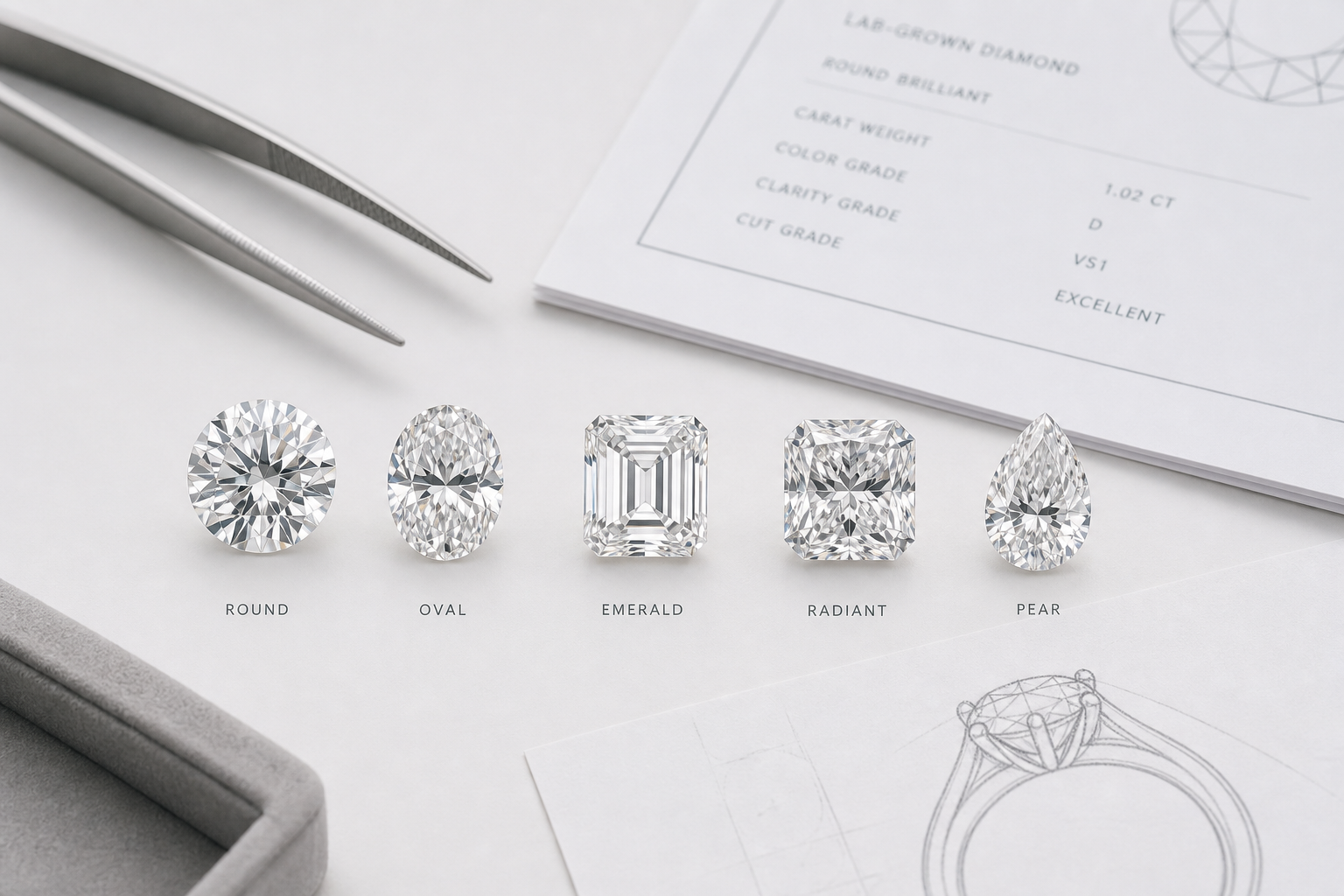
Loose diamond selection lets you compare shapes before a finished mounting narrows the field. A round diamond, oval, emerald cut, pear, radiant, cushion, and marquise can each create a very different impression at the same carat weight. If you start with finished jewelry only, you may be choosing from what has already been assembled rather than what best suits the wearer’s hand, style, and design goal.
Carat weight is often overemphasized because it is easy to understand, but it does not tell you how large the diamond will look. Face-up measurements matter. A well-proportioned 1.50 ct oval can sometimes appear larger on the finger than a 1.70 ct oval that carries more weight in depth rather than spread. That does not automatically make the smaller stone better, but it shows why measurements should be checked before treating carat weight as the final answer.
Shape also affects setting compatibility. An elongated oval may need different prong placement than a round diamond. An emerald cut may look best with a design that protects corners and supports its clean geometry. A pear shape needs attention to orientation and tip protection. Buying loose gives you time to choose the shape first, then make the setting decision with fewer compromises.
Cut quality and visual performance are easier to evaluate
A diamond’s appearance depends heavily on cut quality, proportions, symmetry, and how it handles light. These factors influence whether the stone looks lively, flat, bright, glassy, crisp, or dull. The problem with some finished jewelry listings is not that the diamonds are necessarily poor; it is that the buyer may not have enough stone-level information to judge what is actually being offered.
Loose-stone review gives you a clearer look at the diamond before metal, prongs, bezels, or halos influence the impression. Photos and video can reveal how the stone performs as it moves, whether the shape looks balanced, and whether any inclusions or color are visible in a way that matters for the final design. A grading report helps, but it cannot show every visual effect a buyer will notice in real life.
This is where buyers should avoid a common shortcut: assuming that the highest grade on paper is always the best choice. A diamond with strong practical appearance, good proportions, and the right measurements for the design may be a better purchase than a stone chosen only because one grade looks slightly higher. The goal is not to chase specifications in isolation; it is to choose a diamond that will look right in the jewelry you plan to wear.
Certification can be reviewed before the design decision
A grading report gives structure to the decision. It can confirm carat weight, color, clarity, measurements, polish, symmetry, proportions, and lab-grown origin. For a significant center stone, that information should be reviewed before the diamond is built into a ring or pendant, not treated as an afterthought.
Certification still has limits. A report does not replace visual review, and it does not guarantee that a stone is the best match for a specific setting. Two diamonds with similar grades can look different because of shape outline, depth, table size, facet pattern, or how the inclusions appear. The report narrows the comparison; it does not finish the comparison.
At NUVU, this is the kind of decision where we treat documentation and visuals as working together. A certified lab-grown diamond should be checked on paper, but the buyer should also look at how the stone actually presents itself and whether its measurements make sense for the intended ring or pendant.
What documentation can and cannot prove
A useful report supports identity and comparison: it helps you connect the listed stone to documented characteristics such as weight, measurements, color, clarity, and lab-grown status. It should not be used as a shortcut for every buying decision. A report does not tell you whether the ring will sit comfortably, whether the stone looks flattering on the wearer’s hand, or whether a specific setting is the best design for that diamond.
For that reason, the strongest evidence package is layered. The report should align with the seller’s listing, the images or video should show the actual diamond where possible, and the setting discussion should reference the stone’s exact dimensions. If one layer is missing, the purchase may still be valid, but the buyer should understand which assumptions are being made.
How traceability should be checked in practice
When a report number is listed, compare it with the seller’s images and the stone itself if the diamond is in hand. Confirm whether the report describes the same shape, measurements, and visible characteristics you are seeing. If report-check tools exist for the issuing laboratory, use them as one verification step, but do not assume the report alone tells the whole story.
For custom or wholesale-style orders, ask which documents will travel with the stone and which details will be recorded at each handoff. The most useful records are usually the ones that link the specific stone to the specific project: report number, measurements, setting notes, and approval confirmations.
When a grading report is available, buyers should verify the report details through the issuing laboratory’s official report-check tool where available, then compare those details with the seller’s photos, video, and measurements.
Budget can be assigned to the stone before the setting
Buying the diamond first lets you decide how much of the total project should go toward the stone before spending on the setting, metal, side stones, design labor, or customization. That helps prevent the budget from being consumed by a setting before the most visible part of the jewelry has been chosen.
For a center-stone-focused engagement ring, the diamond often deserves the largest share of attention and budget. For a design-heavy ring with a halo, side stones, engraving, or a more complex mounting, the setting may justifiably take a larger share. The important point is not that one allocation is always correct; it is that buying loose makes the tradeoff visible.
Finished jewelry can hide that tradeoff because the price is presented as one complete number. That can be convenient, but it can also make comparison harder. A lower-priced finished ring might have a lighter setting, fewer details, a less documented center stone, or a diamond with less desirable proportions. A higher price is not automatically better either, which is why separating the stone decision can make the purchase more disciplined.
Certificate and Visual Review Check
Before buying the stone, compare the grading report with the seller’s listing details, confirm the report number where possible, review actual images or 360-degree video, and check measurements rather than relying only on carat weight. The strongest buying decision usually comes from matching the certificate to the visual evidence and the intended setting.
Pay special attention to whether the diamond’s shape and measurements support the design you have in mind. A stone can look appealing in isolation and still be the wrong fit for a low-profile ring, a bezel pendant, or a delicate band. The right loose diamond is not just the one with attractive grades; it is the one that works physically and visually in the final piece.
When Finished Jewelry Is the Simpler and Smarter Choice
Finished jewelry is not a compromise by default. In many cases, it is the more practical choice because the design has already been assembled, the proportions have already been decided, and the buyer can evaluate the piece as a complete object. That matters when the jewelry’s appeal comes from the total look rather than one individually selected center stone.
The key is knowing when stone-level control is worth the extra decision-making. If the diamond is small, decorative, or one of many matched stones, finished lab-grown diamond jewelry may give you a cleaner buying path with fewer unnecessary comparisons.
The design matters more than one center stone
For tennis bracelets, pavé bands, station necklaces, smaller pendants, huggie earrings, and fashion jewelry, the overall design often matters more than selecting one loose diamond. In these pieces, the quality of stone matching, metalwork, setting security, comfort, and wearability can have more impact than the specifications of any single stone.
This is especially true for multi-stone jewelry. A tennis bracelet with well-matched stones can look more refined than a piece with slightly larger stones that do not match well in brightness, size, or color. A pavé band needs clean setting work and even sparkle across the surface. A station necklace needs spacing and balance. In these cases, reviewing the finished piece as a whole may be more useful than trying to isolate each diamond.
Finished jewelry is also sensible when the design itself is the reason for the purchase. If someone wants a specific pendant silhouette, a gift-ready pair of earrings, or a ring style that already looks right, the value may be in the completed design rather than the ability to customize the main stone.
The buyer wants speed and fewer decisions
Some buyers do not want to compare ratios, measurements, certificates, prong styles, and setting adjustments. That is a valid buying preference, not a lack of care. Finished jewelry reduces decision fatigue because the stone, setting, proportions, and design have already been combined.
This can be especially helpful for gifts or straightforward purchases. A finished pendant, bracelet, or pair of earrings lets the buyer focus on style, metal, size, and overall appearance instead of managing a multi-step process. For shoppers who feel overwhelmed by loose diamond comparisons, a transparent finished piece can be the more confident choice.
The mistake is assuming that simplicity always means less control in a harmful way. If the design is clear, the product details are specific, and the jewelry matches the intended use, fewer decisions can be an advantage. Extra control is only useful when it improves the final outcome.
The stone details are already transparent enough
Finished jewelry can be a strong choice when the seller provides enough information to understand what you are buying. At minimum, the listing should clearly identify the stone type, metal, total carat weight, setting details, photos, and any relevant color or clarity ranges. If there is a major center stone, it is reasonable to look for more specific diamond details and, where applicable, a grading report.
For smaller accent stones, individual grading reports may not be realistic or necessary. A pavé band or tennis bracelet with many small diamonds is usually judged by matching, craftsmanship, durability, and overall appearance rather than separate certificates for every stone. Asking for individual reports on tiny stones can distract from the more important question: whether the finished piece is well made and clearly described.
Where buyers need to be careful is with vague listings. “1 ct diamond ring” may sound clear, but it can mean total carat weight across many stones, not a 1 ct center diamond. “Diamond jewelry” should also specify whether the stones are lab-grown diamonds, natural diamonds, or another material. If those basics are unclear, the convenience of finished jewelry starts to become a risk.
Transparency does not require every small diamond to have its own report. It does require the seller, consistent with a loose diamond verification checklist, to describe the piece in a way that lets the buyer understand what is being priced, what is being documented, and what is being assumed.
What to request when the listing is still vague
If the finished piece is still under consideration, ask for the stone type, the center-stone carat weight if applicable, the total carat weight, the metal karat, and whether the visual material shows the exact item being sold or a representative example. Vague listings are less useful than clear item-by-item disclosure.
For jewelry with a loose center stone and mounted accents, compare the center stone’s dimensions with the setting style before committing. A buyer should not have to guess whether the piece was made for a round, oval, or other outline. The more directly the listing ties the stone to the setting, the easier it is to verify that the item matches the description.
Disclosure language that protects the buyer
Clear finished-jewelry listings should avoid vague diamond language. A buyer should be able to tell whether the stones are lab-grown diamonds, natural diamonds, or diamond simulants, and whether the stated carat weight refers to one center stone or the entire piece. If a product page uses broad language such as “diamond look,” “diamond style,” or “created stone” without explaining the material, ask for clarification before comparing it with a documented lab-grown diamond purchase.
The same caution applies to broad quality phrases. Words like “premium,” “high quality,” and “brilliant” may describe the seller’s opinion, but they do not replace measurable details. For finished jewelry, the useful evidence is specific: metal type, stone type, total carat weight, center-stone weight if applicable, color and clarity ranges when stated, photos, construction details, and any grading report for a significant main diamond.
Finished Jewelry Transparency Check
Before choosing a finished piece, confirm whether the listed carat weight is total carat weight or center-stone carat weight, what metal is used, whether the stones are lab-grown diamonds, and whether any main stone includes a grading report. These details matter more than broad claims about beauty or value.
Also look at the piece in terms of use. A delicate ring may be beautiful but less practical for daily wear. A pendant may look larger or smaller depending on chain length and setting style. Earrings may depend heavily on matching rather than individual stone grades. Finished jewelry is the smarter choice when the completed design is transparent enough to judge and the buyer does not need stone-first control to feel confident.
How Stone-First Buying Changes Custom Ring and Pendant Design
Buying a loose lab-grown diamond before choosing the setting changes the design process because the stone becomes the anchor, not an afterthought. Instead of trying to fit a diamond into a finished look, the ring or pendant can be built around the stone’s actual shape, size, depth, and visual presence. This matters most for custom jewelry where small proportion differences can affect comfort, balance, and how polished the final piece feels.
For a custom engagement ring or pendant, the best design is not simply the one that looks good in a reference photo. It is the one that works with the specific diamond being used. An elongated oval solitaire, an emerald-cut bezel pendant, and a radiant-cut hidden halo ring each place different demands on the setting. Choosing the diamond first gives the jeweler the information needed to design around reality instead of assumption.
The diamond’s measurements determine setting fit
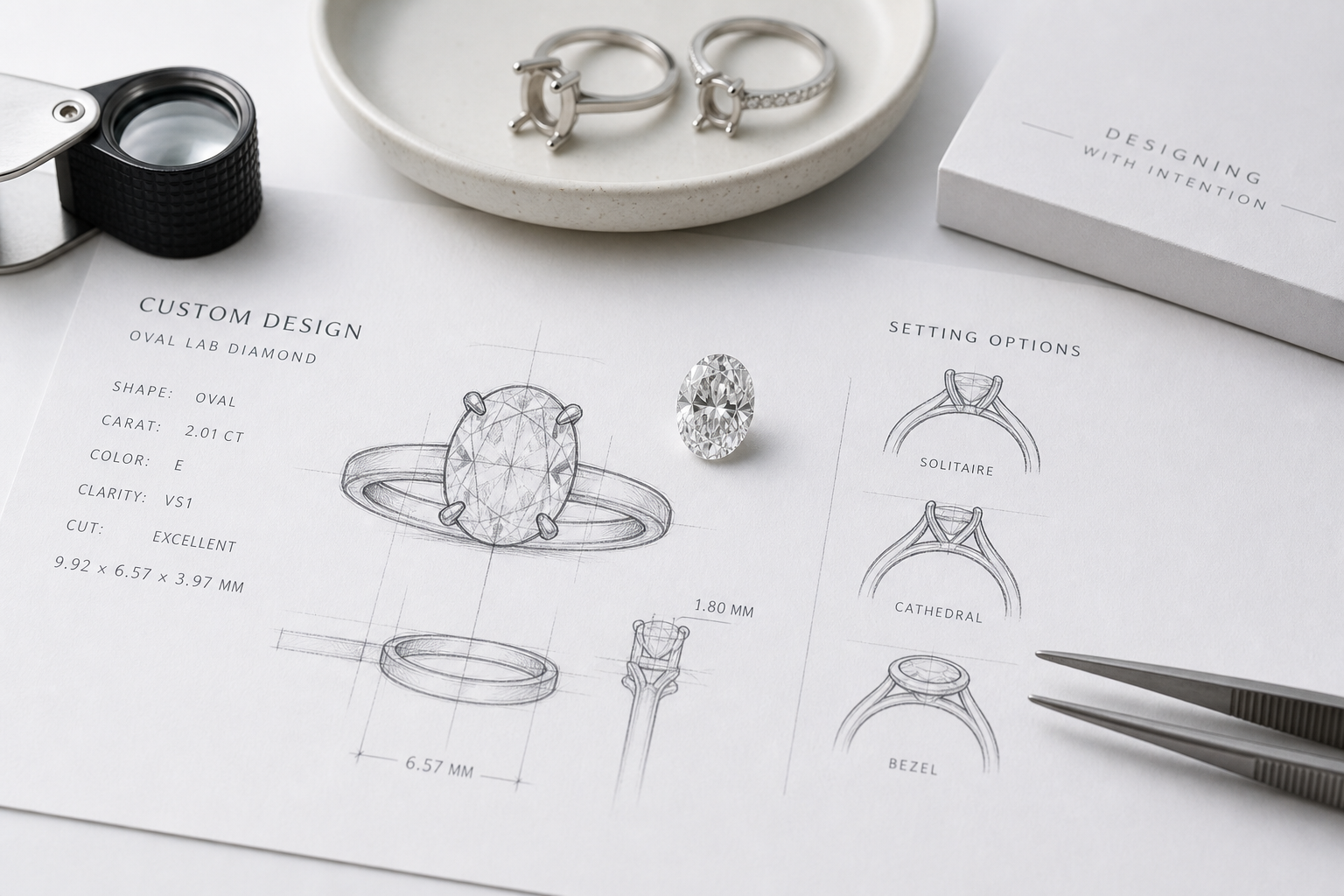
Carat weight tells you how much the diamond weighs, but millimeter measurements tell you how it will actually fit. Length, width, depth, and outline shape affect where prongs sit, how a basket is built, whether a bezel can wrap cleanly around the stone, and how much room a halo needs to look intentional rather than crowded.
This is especially important with fancy shapes. A 2.00 ct elongated oval may need a different prong layout than a round diamond of the same carat weight. A pear shape needs secure support at the point. An emerald cut in a bezel pendant requires clean edge alignment so the setting does not look heavy or uneven. With a radiant-cut hidden halo ring, the diamond’s corner shape and depth can affect how visible the halo appears from the side.
A finished setting may not adapt well to every diamond, even when the carat range sounds compatible. Two diamonds with the same stated weight can have different spreads, depths, and ratios. If the setting was built for a general stone size rather than that exact diamond, the result may require compromises in stone height, prong position, or overall balance.
Design references become more realistic once the stone is chosen
Inspiration photos are useful, but they can be misleading if the chosen diamond has different proportions from the example. A slim oval solitaire in a photo may use a long, narrow oval, while the diamond a buyer selects may be wider and softer in shape. Both can be beautiful, but they will not create the same ring silhouette.
This is where buying the loose diamond for a custom ring gives the design conversation more precision. Once the jeweler knows the stone’s exact dimensions, the setting can be scaled correctly. Band width, prong style, halo size, cathedral height, and side-stone proportions can all be judged against the actual center stone instead of a generic carat estimate.
The same logic applies to a lab-grown diamond custom pendant. A round diamond may sit well in a simple basket pendant, while an elongated emerald cut may look better with a vertical bezel or a bail placement that keeps the pendant from tilting. The decision is less about copying a style and more about making the selected stone look balanced when worn.
Custom design can protect budget discipline
Choosing the diamond first can also prevent the budget from drifting in the wrong direction. The center diamond is often the largest cost variable in a custom engagement ring or pendant. Once that decision is made, the remaining budget can be assigned more realistically to metal choice, setting complexity, accent stones, finishing details, and future adjustments if needed.
This does not mean the stone should consume the entire budget. A strong diamond in a poorly built or under-proportioned setting is not a good outcome. The practical advantage is separation: the buyer can decide what matters most about the diamond, then choose a setting that supports it without letting every design detail expand the project.
For example, a buyer who selects a visually strong oval may choose a clean solitaire to keep the focus on finger coverage and shape. Another buyer may choose a slightly smaller radiant cut so there is room in the budget for a hidden halo and a more detailed gallery. The better choice depends on whether the buyer values center-stone presence, design detail, or a balance of both.
Stone-to-Setting Fit Check
Before approving a custom design, confirm the diamond’s exact millimeter measurements, not just the carat weight. Ask whether the setting is being made for that specific stone, how the stone will be secured, and whether the design would change if a different diamond were selected later.
The most important warning sign is a design that treats all diamonds of the same carat weight as interchangeable. They are not. A custom setting should respond to the diamond’s actual outline, depth, ratio, and intended orientation, especially for elongated or angular shapes.
What documentation matters in custom and multi-piece orders
In custom, private-label, or multi-piece orders, traceability depends on consistency. Keep the report number, stone measurements, written approval notes, and final design description together so everyone involved is referring to the same diamond and the same version of the setting.
If sample images or reference pieces are used, clarify whether they show the exact item being sold or only a style example. That distinction matters because the finished piece may differ in proportion, stone size, or orientation. Clear records make it easier to match expectations to the final jewelry rather than relying on memory or broad descriptions.
Price Transparency: What You Can Compare More Clearly With a Loose Diamond
A loose lab-grown diamond makes price comparison cleaner because the stone can be evaluated before the setting is added. That does not automatically make it cheaper than finished jewelry, but it does make the value drivers easier to see. The buyer can compare carat weight, cut quality, color grade, clarity grade, measurements, and documentation without trying to separate those factors from metal, labor, design, and finishing.
Finished jewelry pricing can be convenient because everything is bundled into one number. The tradeoff is that the bundle may hide where the money is going. For a simple gift item, that may be acceptable. For a center-stone-focused ring or pendant, the lack of itemization can make it harder to judge whether the diamond value, setting quality, and documentation match the price.
The stone price and setting price can be separated
When you buy a loose lab-grown diamond first, the diamond price stands on its own. You can compare similar stones by shape, size, cut quality, color, clarity, certificate details, and face-up measurements before deciding how much to spend on the mounting. This is useful because two diamonds with similar carat weights can differ meaningfully in appearance and value.
With finished jewelry, the price usually includes the diamond, setting, metal, design labor, assembly, and seller margin in one figure. That can be a good fit when the completed design is the priority. It becomes less helpful when the center stone is the main reason for the purchase and the listing does not clearly explain the diamond’s individual specifications.
A practical way to compare loose diamond and finished ring price is to ask what part of the price is attached to the center stone and what part is attached to the setting. If that cannot be answered clearly, the buyer may still choose the piece, but the decision is being made with less visibility.
Lower total price does not always mean better value
A lower finished jewelry price can be attractive, but it may reflect tradeoffs the buyer does not immediately see. The center diamond may have less desirable proportions, limited documentation, a lower color or clarity range, or a smaller face-up appearance than the carat weight suggests. The setting may use less metal, simpler finishing, or construction that is acceptable for light wear but not ideal for daily use.
The reverse is also true: a higher price is not automatic proof of better value. A finished ring can cost more because of branding, design complexity, retail channel, or bundled services, not necessarily because the center diamond is stronger. The point is not to chase the lowest price. The point is to understand what the price is actually buying.
Total carat weight is a common place where buyers get misled. A finished ring listed as 2.00 ct total weight may include a smaller center stone plus accent diamonds. That is not the same value proposition as a single 2.00 ct center diamond. For engagement rings and solitaire pendants, center-stone carat weight usually matters more than total carat weight because it drives the main visual impression.
Price comparisons are most reliable when the compared items are actually similar. A certified loose center stone plus a custom setting should not be compared only against a finished ring described by total carat weight, because the documentation, construction, and center-stone role may be different.
Use total project cost instead of stone price alone
A loose lab-grown diamond price is only one part of the final purchase. The better number to plan around is total project cost: diamond, setting, customization, metal choice, accent stones, applicable taxes, and any after-purchase adjustments that may apply. A buyer who focuses only on the diamond price may choose a stone that leaves too little room for a secure, well-proportioned setting.
For example, a buyer planning a custom engagement ring might divide the project into four buckets: the center diamond, the setting, any customization or accent details, and practical finishing needs such as sizing or future maintenance. The exact amounts depend on the design, but the exercise helps prevent a common mistake: overbuying the diamond and then compromising the part that has to hold it safely.
If current prices are being compared, they should be verified against live listings and current market conditions. Lab-grown diamond pricing can change, and broad price claims become outdated quickly. What remains useful is the comparison method: separate the stone from the setting, then judge the completed piece as a whole.
Evidence standard for price claims
Be careful with price comparisons that sound precise but do not show what is being compared. A loose stone price and a finished jewelry price may reflect different report types, different setting construction, different metal weights, different seller services, and different levels of visual documentation. Without those details, a price gap may look more meaningful than it really is.
For a defensible comparison, put the offers into the same format: center-stone specifications, center-stone documentation, face-up measurements, setting metal, setting style, accent stones, service details if relevant, and total project cost. If one option provides far less detail, treat that as part of the comparison rather than assuming it is equal to the more documented option.
Useful budget allocation ranges for planning
For a center-stone-focused engagement ring, many buyers may choose to allocate the majority of the budget to the diamond because that is where the visual focus and documentation usually sit. This can make sense for solitaire, cathedral, bezel, and simple three-stone styles where the center diamond carries most of the impact.
For a more design-heavy ring, the balance may shift. A detailed halo, pavé band, engraved gallery, mixed-metal design, or custom pendant setting can justify assigning a larger share of the budget to the mounting. In those cases, choosing the largest possible diamond may not be the smartest move if it forces the setting to become thinner, less refined, or visually out of proportion.
A useful planning range is directional rather than fixed: if the diamond is the centerpiece, let it take the leading share of the budget; if the design work is the reason the piece exists, protect enough budget for the setting to be made well. The mistake is treating every ring budget as if the diamond should always win by default.
Budget Comparison Checklist
Before deciding between a loose diamond and a finished piece, compare at least three things: the center diamond specifications, the setting material and construction, and the documentation provided. A finished piece should not be judged only by total carat weight, and a loose diamond should not be judged only by carat size.
The stronger comparison is not “loose diamond versus finished ring” in the abstract. It is whether the total project cost gives you the right balance of diamond quality, setting durability, design fit, and transparency for the way the jewelry will actually be worn.
What a Grading Report Helps You Know — and What It Does Not
A grading report documents key characteristics such as weight, measurements, color, clarity, and sometimes cut-related information. That makes it useful for comparison, especially when one center stone drives the purchase. But a report is not a promise of beauty, and it does not guarantee value, durability, or how the diamond will look once mounted.
Two diamonds can share similar report descriptions and still appear different in person because of proportions, facet pattern, light performance, or visible inclusions. That is why it is better to read the report alongside photographs, video, and the intended setting design. A report supports the decision; it should not replace the decision.
For buyers comparing loose stones and finished jewelry, this distinction is important. The more central the diamond is to the piece, the more useful the report becomes. The more decorative or small the stone is, the more the finished construction and overall design may matter instead.
Decision Complexity: What Extra Work Comes With Buying the Stone First?
Buying the stone first gives the buyer more control, but it also creates more responsibility. More control usually means more decisions. That tradeoff is worthwhile when the diamond is the main visual and financial part of the jewelry, but it may feel unnecessary when the buyer simply wants a complete design without managing separate choices.
The loose diamond buying process is not difficult if the steps are handled in order. The risk comes from treating the stone and setting as separate decisions that will automatically work together. A good stone still has to fit the design, the wearer, and the final piece.
You need to evaluate more diamond details
A stone-first buyer needs to review more than the headline carat weight. Shape, cut quality, color, clarity, measurements, length-to-width ratio, certificate details, and actual visuals all affect whether the diamond is a good fit. This does not mean the buyer needs to become a diamond expert. It means the buyer should know which details can change the outcome.
The most practical priority is to focus on the details that affect the final jewelry piece. For elongated shapes, ratio and millimeter spread can change the look more than a small difference in carat weight. For a bezel setting, outline and depth matter because the stone needs to sit cleanly. For a solitaire, cut and visual performance are more exposed because there are fewer design elements to distract from the center diamond.
At NUVU, we treat the grading report as a starting point rather than the whole decision because the report does not show every aspect of how a diamond will appear once it is set. Certificate details, images, video, and setting compatibility need to work together.
You may need coordination between stone and setting
If the diamond and setting are purchased from the same source, the compatibility conversation is usually simpler because the seller can evaluate the stone and mounting together. If they come from different sources, the buyer should get written confirmation that the setting can safely hold the exact diamond selected.
This matters because small fit problems can become expensive or frustrating. A prong setting may need adjustment for a deeper stone. A bezel may not fit a diamond with slightly different dimensions from the expected range. A stock ring head may not suit an elongated oval or radiant cut with an unusual ratio. The issue is not whether the diamond is “good.” The issue is whether it works in that specific setting.
Buyers should also clarify who is responsible if the stone does not fit, who handles setting adjustments, and what information will be retained in the final record. These are not romantic questions, but they are the questions that prevent confusion later.
The timeline may involve more steps
Stone-first buying often has a longer decision path than finished jewelry. A typical sequence is to select the diamond, confirm the report and visuals, choose or design the setting, approve the design details, produce or set the jewelry, and inspect the finished piece. Each step adds control, but each step also requires attention.
This is manageable when the buyer is prepared for the process. It becomes stressful when the buyer expects a custom ring or pendant to behave like a ready-made item. A finished piece is already assembled; a stone-first project has to be coordinated. The buyer should avoid making timing assumptions unless the seller has provided clear written expectations.
The extra steps are most justified when the stone needs to be chosen carefully, the setting is custom, or the design depends on exact proportions. If the jewelry is a simple gift with small stones or a style where the full look matters more than one diamond, the finished jewelry buying process may be the better use of time.
Finished jewelry reduces decisions but may reduce visibility
Finished jewelry simplifies the purchase because the stone, setting, proportions, and overall design have already been matched. For many buyers, that is the point. There are fewer approvals, fewer compatibility questions, and less need to compare individual diamond details.
The tradeoff is reduced visibility. The buyer may not have the same level of control over the main diamond’s measurements, certificate, visual performance, or setting adjustments. That is acceptable when the piece is transparent enough and the design is the priority. It is less acceptable when the center stone carries most of the price and the listing does not provide enough information to evaluate it.
Coordination Questions to Ask in Writing
Before moving forward with a stone-first purchase, consult a loose lab diamond buying guide to ask who is responsible for confirming the diamond fits the setting, whether the stone will be protected during setting, whether the setting is made for that exact stone, and what happens if the stone does not fit the selected design.
The clearest warning sign is vague responsibility. If one party sells the diamond and another handles the setting, the buyer should not rely on verbal assumptions. Compatibility, setting responsibility, and adjustment expectations should be confirmed before the diamond is handed off or the design is approved.
How to Treat Sustainability and Origin Claims
Some buyers look at lab-grown diamonds because they want a different sourcing path from mined diamonds. That is a reasonable preference, but broad claims about being sustainable, eco-friendly, ethical, or low-impact should be treated carefully unless the seller provides specific support. Lab-grown origin alone does not automatically prove a better environmental outcome, and the relevant facts can vary by production method, energy source, supply chain, and documentation.
If sustainability matters to you, look for specific information rather than general wording. Useful details may include how the stone was produced, what documentation accompanies the piece, and whether the seller explains the basis for any environmental or sourcing statement. The safer approach is to compare documented facts, not assume that all lab-grown diamonds or all mined diamonds fit a single environmental category.
When the article or product description mentions responsible sourcing, consider that a claim to verify rather than a guarantee. A buyer can still prefer one origin over another, but the choice is stronger when the reason can be explained in concrete terms instead of marketing language.
A Real Buyer Scenario: Choosing Between a Loose Oval Diamond and a Finished Ring
The situation
Maya is shopping for an oval lab-grown diamond engagement ring with a slim yellow gold setting. She finds a finished ring that looks close to what she wants, but the listing gives only broad details about the center stone and does not clearly show the oval’s measurements, length-to-width ratio, or certificate information. She also finds two loose oval diamonds that could be used for a custom ring: one has a slightly smaller carat weight but better face-up spread, while the other is heavier on paper but looks narrower and deeper.
The decision point
The finished ring gives Maya the easiest path. She can see the completed look, avoid choosing every detail separately, and make a faster decision if the design already feels right. The risk is that she may be accepting the center diamond without enough information about why it looks the way it does.
The loose-diamond-first path asks more of her upfront, but it gives her better control over the part of the ring that carries the most visual and financial weight. By comparing the loose oval diamonds, she can choose the outline she prefers, confirm the actual millimeter spread, review the certificate, check inclusions in images or video, and then build the engagement ring setting around that exact stone.
The tradeoff
If Maya values speed, simplicity, and the finished ring already matches her expectations, buying the completed piece can be a reasonable choice. Finished jewelry is not automatically a compromise when the seller provides enough detail and the design matters more than fine-tuning the center diamond.
If she cares about the oval’s shape, finger coverage, and documentation, buying the loose lab-grown diamond first gives her a stronger decision base. This is especially true when two stones have similar carat weights but very different visual presence. In that situation, the better choice is not necessarily the larger number on the listing; it is the stone that fits the ring design, the wearer’s hand, and the budget with fewer unknowns.
Concrete parameters to include
For oval diamonds, many buyers compare length-to-width ratios around 1.30 to 1.50, depending on the look they want. A lower ratio tends to appear rounder and softer, while a higher ratio looks more elongated and can create a slimmer visual line on the finger. This range is a style and fit guideline, not a quality guarantee; an oval still needs to be judged by its cut, proportions, measurements, and appearance.
Carat weight can mislead buyers here. A 1.70 ct oval may not always look larger than a 1.50 ct oval if more of its weight sits in the depth rather than the face-up dimensions. For elongated shapes such as oval, pear, emerald, radiant, and marquise, millimeter measurements and length-to-width ratio often affect the final look as much as the carat number does.
What This Means in a Real Purchase
The buyer should not choose only by carat weight. If the diamond is the focal point, the smarter comparison is carat weight plus measurements, ratio, certificate details, and actual visuals. For a loose oval lab-grown diamond for an engagement ring, that extra review can prevent a common mistake: paying for size on paper without getting the shape or finger coverage expected in the finished ring.
Decision Framework: Buy Loose First or Choose Finished Jewelry?
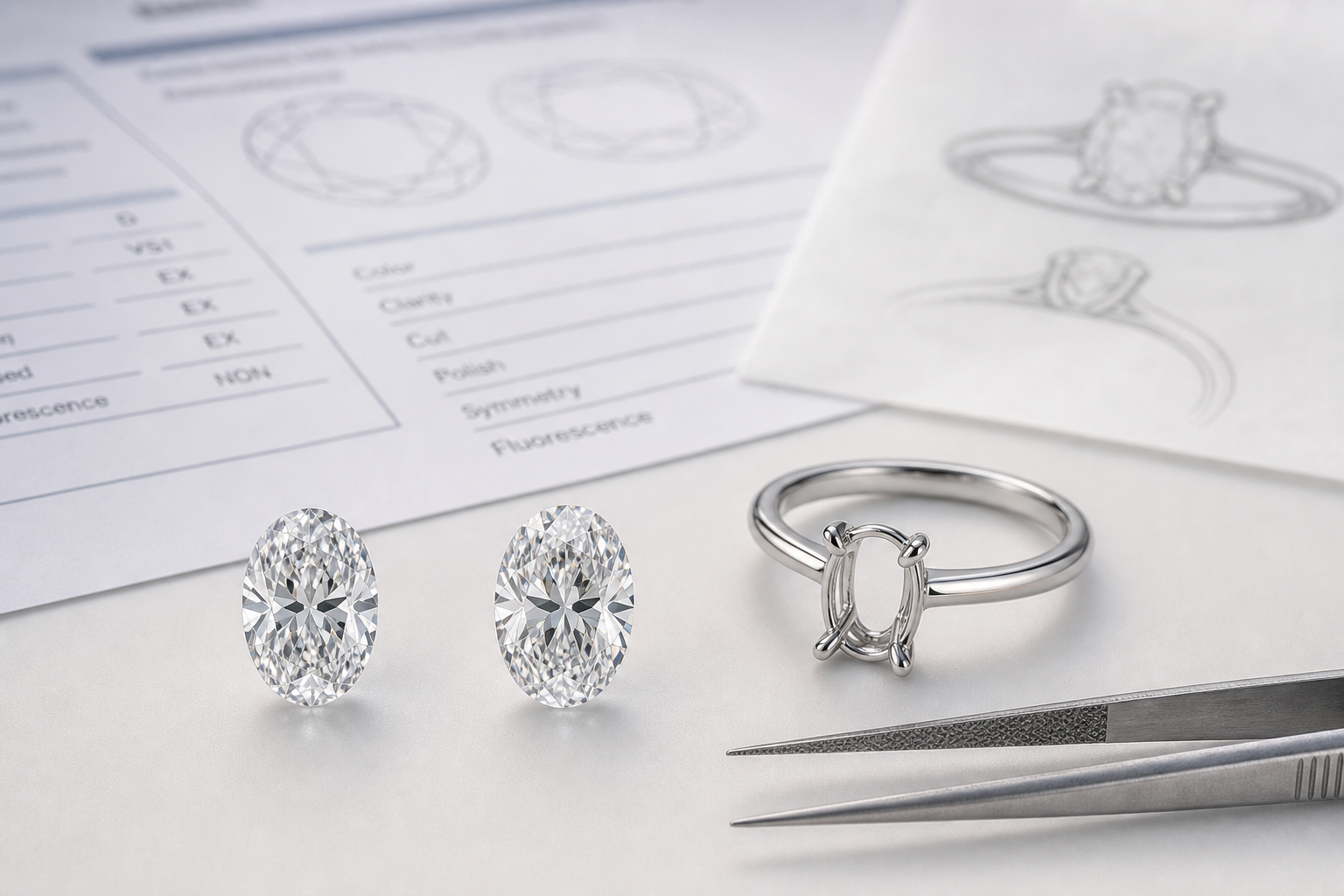
The cleanest way to decide between loose diamond vs finished jewelry is to ask what carries the decision. If the center stone drives the look, cost, and emotional weight of the piece, buy the loose lab-grown diamond first. If the completed design is the main reason you want the item, finished lab-grown diamond jewelry may be the more practical path.
This framework is meant to guide evaluation, not replace personal preference. A buyer who values simplicity may reasonably choose a transparent finished piece, while a buyer who values control may reasonably spend more time comparing loose stones.
Buy the loose lab-grown diamond first if…
- You want a specific shape, such as oval, emerald, radiant, pear, cushion, or marquise, and small differences in outline matter to you.
- The jewelry depends on one important center stone, especially for an engagement ring, solitaire pendant, three-stone ring, or custom design.
- You want to review a certified diamond before committing to the setting.
- You care about measurements, proportions, visual size, and how the stone will face up in the final piece.
- You want better budget control by deciding first how much to spend on the diamond, then adjusting the setting choice around the remaining budget.
- You are planning a custom ring with a loose diamond and want the setting built around that exact stone.
This path is usually better for buyers who would regret not knowing more about the main diamond. If you are comparing two center stones and the difference affects the final look, the loose-stone route gives you the information needed to make that call.
Choose finished jewelry if…
- You want a complete design without managing a separate stone and setting decision.
- The piece uses smaller diamonds where individual stone selection is less important than matching, layout, and craftsmanship.
- You are buying earrings, a tennis bracelet, a pavé band, a station necklace, or a gift-ready pendant where the whole design matters more than one center stone.
- The seller already provides clear details about the stones, metal, total carat weight, photos, and any report for a main diamond.
- You prefer convenience over granular control and are comfortable with the information provided.
Finished jewelry is the smarter choice when extra control would not meaningfully improve the purchase. For example, choosing every small accent diamond in a pavé band would add complexity without giving most buyers a better result. In that case, stone matching, setting quality, and wearability matter more than individual reports for each small stone.
Be cautious if…
- The listing gives total carat weight but does not explain whether there is a distinct center stone.
- A ring is described as having a large diamond look, but the center stone measurements are missing.
- The metal description is vague or does not clearly state the metal type and karat.
- There are no actual images, video, or meaningful views of the piece or main stone.
- A main diamond is promoted heavily, but no grading report or detailed specifications are provided.
- You feel pressured to decide before reviewing documentation.
The biggest warning sign is not the absence of a loose diamond; it is the absence of enough information to understand what you are buying. A finished ring can be a good purchase, but a finished ring with unclear stone details, unclear metal details, and no meaningful visuals leaves too much to assumption.
Useful comparison criteria
- Control: Choose loose first if you want to control the center stone. Choose finished jewelry if you mainly want the completed look.
- Convenience: Finished jewelry usually wins when fewer decisions matter more than customization.
- Transparency: Loose diamonds are easier to compare stone by stone. Finished jewelry can still be transparent if the listing is detailed.
- Customization: A loose diamond is better when the setting should be built around exact measurements, shape, or ratio.
- Budget clarity: Buying loose first separates the diamond cost from the setting cost, which helps when the center stone is the main investment.
- Timeline complexity: Finished jewelry is usually simpler. Loose-first buying can involve more approvals and coordination.
- Documentation: A certified diamond matters most when one stone carries the main value of the piece.
At NUVU, this is often the practical split: compare loose lab-grown diamonds first when the center stone is the decision, and evaluate finished jewelry carefully when the full design is the decision. Neither path is automatically better; the right one depends on where the value and risk sit in the purchase.
When a grading report is available, buyers should verify the report details through the issuing laboratory’s official report-check tool where available, then compare those details with the seller’s photos, measurements, and the finished setting.
For buyers comparing loose stones with finished jewelry, the most useful question is still the same: what can be verified, what can be seen, and what still needs confirmation before purchase?
How to treat claims that are not fully documented
If a listing makes a claim that cannot be checked from the information provided, treat it as a prompt for a question rather than as proof. For example, “excellent value,” “larger appearance,” or “premium quality” may be useful descriptions, but they should be supported by measurable or visible details when they affect the buying decision. Ask what the seller can show: report details, dimensions, photos, video, metal specifications, and center-stone breakdown.
This approach keeps the decision fair. A finished piece does not need the same documentation as a loose center stone in every case, and a loose stone does not become perfect just because it has a report. The buyer’s goal is to match the level of evidence to the level of importance. The more one diamond drives the look and price, the more specific the evidence should be.
Buyer Verification Checklist
Before deciding, confirm five basics: the center stone specifications, the grading report if applicable, the actual diamond measurements, the setting material, and whether the final piece is built around that exact stone or a general stock design. If any of those details are unclear, pause before treating the item as fully comparable to another ring or jewelry piece.
How to Move From a Loose Diamond to the Final Jewelry Piece
Once you decide to buy the stone first, the next step is to keep the process organized. The goal is not to make the purchase more complicated; it is to make sure the loose lab-grown diamond, custom setting, and final jewelry piece are planned around the same measurements and expectations.
Step 1: Confirm the diamond details
Finalize the diamond only after reviewing the grading report, measurements, seller-provided specifications, and actual images or video when available. The report should support the listing details, but it should not be the only thing you rely on. For a center stone, the most useful check is whether the certificate, dimensions, and visuals all tell the same story.
Pay close attention to millimeter measurements, not just carat weight. This matters for rings and pendant settings because the stone’s length, width, depth, and outline affect how it will sit, how much space it will cover, and what type of setting can hold it securely.
Step 2: Choose the setting style around the stone
After the diamond is chosen, setting decisions become more practical. A solitaire may show the stone with minimal distraction, a halo may need careful proportioning around the diamond’s outline, and a three-stone ring has to balance the center stone with side stones that do not overpower it. A bezel setting must fit the diamond closely, while a pendant setting has to account for orientation, movement, and how the stone hangs when worn.
This is where buying the diamond first can prevent design mismatch. A setting that works for a round diamond may not suit an elongated oval, and a stock halo designed for one ratio may look awkward around another. The more specific the stone shape, the more important it is for the setting to be chosen or built around the actual diamond.
Step 3: Confirm metal, dimensions, and wearability
Metal choice affects both appearance and daily wear. Yellow gold can warm the overall look, white metals can create a cleaner contrast, and rose gold can soften the design. Beyond color, the buyer should confirm ring size, band width, prong style, stone height, and whether the design fits the wearer’s lifestyle.
A tall setting may look dramatic in photos but feel less practical for someone who uses their hands all day. A very slim band may look delicate but may not suit every stone size or setting style. These are not just aesthetic choices; they affect comfort, durability, and how the final jewelry piece performs in real use.
Wearability is part of value. A ring that photographs well but catches easily, sits too high for daily routines, or feels underbuilt for the stone may disappoint even if the diamond itself was chosen carefully.
Step 4: Review the final design before production or setting
Before approving production or setting, confirm the final design in writing. The approval should identify the exact diamond being used, the setting style, the metal type, the stone orientation, and any measurements that determine fit. If the design is for a ring, confirm ring size and key proportions. If it is for a pendant, confirm how the stone will be positioned and how the bail or chain connection affects the look.
The most important mistake to avoid is approving a design based on a general idea rather than the specific stone. A custom setting for a lab-grown diamond should be planned around the actual diamond’s dimensions, not simply the carat weight or shape name.
Keep the paper trail with the finished piece
Save the report, product page, approval images, and final design notes in one place. That record makes it easier to check whether the finished jewelry matches the stone that was originally selected and gives the buyer a reference if the piece is ever reset, resized, or compared later.
For buyers handling custom or multi-piece orders, that same record also helps reduce confusion between quoting, production, and final delivery. The more clearly the stone is identified in writing, the easier it is to connect the final jewelry to the original decision.
Pre-Approval Checklist
Before approving the final jewelry piece, confirm the exact stone being used, the design details, the metal type, the setting style, the stone orientation, and any written documentation that identifies the diamond and final design. If you are exploring loose lab-grown diamonds through NUVU, use the stone’s measurements and documentation as the starting point, then choose or customize the setting around the diamond that fits your design, budget, and wearability needs.
FAQ: Loose Lab-Grown Diamond vs Finished Jewelry
Is it better to buy the diamond or the setting first?
For jewelry built around one important center stone, it is usually better to buy the diamond first. A loose lab-grown diamond lets you review the shape, measurements, grading report, and visual appearance before the setting limits your options. This matters most for engagement rings, solitaire pendants, three-stone rings, and custom ring projects where the center diamond carries most of the value and attention.
If the design is the main reason for the purchase, the setting or finished jewelry may come first. Pavé bands, tennis bracelets, station necklaces, and smaller gift pieces often depend more on overall design, stone matching, metalwork, and wearability than on one individually selected diamond.
Can I buy a loose lab-grown diamond now and set it later?
Yes. Many buyers choose a loose lab-grown diamond first and decide on the diamond setting later, especially when they want time to compare custom ring styles or pendant designs. The key is to keep the grading report, seller documentation, and exact measurements with the stone so the future setting can be built or selected accurately.
The main risk is assuming that any setting will fit any diamond. Shape, length-to-width ratio, depth, and outline all affect compatibility. Before committing to a future setting, confirm that it is designed for that specific stone or can be adjusted safely for its dimensions.
Does a finished lab-grown diamond ring always include a certificate?
No. A finished lab-grown diamond ring does not always include a grading report for every stone. Larger center stones are more likely to have an individual report, while small accent diamonds usually do not. That is normal for many finished jewelry pieces, but the listing should still be clear about the stone type, metal, total carat weight, and any stated color or clarity range.
For a ring with a significant center stone, lack of documentation is a bigger concern. If the main diamond drives the price and appearance of the piece, ask whether the center stone has a grading report and whether the report details match the listing.
Is a loose diamond cheaper than a finished ring?
Not necessarily. A loose diamond makes the stone price easier to compare because you can evaluate the diamond separately from the setting, metal, labor, and design work. That does not mean the final jewelry will automatically cost less once the setting and customization are added.
A finished ring may look cheaper because everything is bundled, but that bundle can hide tradeoffs: a lower-grade center stone, lighter metal construction, limited documentation, or fewer design details. The better comparison is total project cost, not loose diamond price alone.
What matters more: carat weight or measurements?
Both matter, but measurements often tell you more about how the diamond will look in the final jewelry piece. Carat weight measures weight, not visible size. Two diamonds with the same carat weight can face up differently depending on their shape, depth, and proportions.
This is especially important for elongated shapes such as oval, pear, emerald, radiant, and marquise. A buyer comparing finished jewelry should not rely only on total carat weight, and a buyer choosing a loose lab-grown diamond should check the millimeter dimensions before assuming one stone will look larger than another.
How do I know the stone in the ring is the one I approved?
Check that the report number, shape, measurements, and any identifying notes match the stone that was approved, and ask for written confirmation that those details were used in the final setting step. For custom or wholesale work, a clear approval trail is more reliable than broad verbal reassurance.
If the stone is moved between seller, setter, and final delivery, keep the same identifiers in every record. That makes later comparison easier and reduces the chance of confusing one diamond with another that only appears similar on paper.
Explore the Stone First, Then Build Around It
If the diamond will be the visual and financial center of the piece, start by comparing loose lab-grown diamonds before committing to a ring, pendant, or custom setting. This gives you the clearest view of the stone itself: its shape, measurements, grading report, face-up appearance, and how well it fits the design you have in mind.
NUVU can help you approach that decision in the right order. Compare certified loose lab-grown diamonds first, then choose or customize the setting around the stone that fits your design goals, budget, and documentation preferences. If the finished design matters more than one specific center diamond, a completed jewelry piece may still be the simpler choice.
What This Guide Helps You Separate
This decision is not only about loose diamonds versus finished jewelry. It is about which part of the purchase should lead the process. A loose diamond buying guide focuses on evaluating the stone in depth. A finished jewelry guide focuses on completed pieces. A custom ring guide focuses on the full design workflow. This guide sits between those decisions and helps you choose the right starting point.
The practical distinction is simple: buy the stone first when the center diamond controls the look, value, fit, and documentation of the piece. Choose finished jewelry when the completed design, convenience, and overall wearability matter more than selecting one diamond separately.
Make the Next Decision Based on What Carries the Value
If one diamond carries most of the visual attention and budget, review that stone on its own before approving the setting. Look at the certificate, measurements, shape, proportions, photos or video, and how the diamond will sit in the final design. This is especially important for engagement rings, solitaire pendants, and custom pieces built around a larger center stone.
If the value comes from the complete design, such as a pavé band, tennis bracelet, station necklace, or small diamond pendant, finished jewelry may be the better path. In that case, focus on metal quality, total carat weight, stone matching, construction, photos, and whether any main stone has enough documentation to support the purchase.
The strongest next step is the one that matches the role of the diamond. Compare loose lab-grown diamonds first if the center stone matters most. Evaluate finished jewelry carefully if the completed design is the priority.
Disclosure: This article is for general educational purposes only. Diamond grading, pricing, availability, specifications, and seller policies can change, and readers should verify important details through grading reports, official laboratory tools, seller documentation, or qualified professionals before making a purchase decision. Laboratory-grown diamonds should be clearly distinguished from natural diamonds, and environmental or sourcing claims should be supported with specific documentation.