
Lab-grown diamonds are often described with reassuring language, but phrases like “eco-friendly,” “ethical,” or “carbon neutral” do not tell you enough on their own. A meaningful sustainability claim should address the lab-grown diamond carbon footprint in relation to energy source, production scope, and verification method, while explaining what it covers, whether it applies to the specific diamond or finished ring, who verified it, and what documentation supports it. Without that detail, a claim may be more about branding than about the actual product you are considering.
For the full framework, read Are Lab-Grown Diamonds More Sustainable?.
This article helps you separate useful evidence from vague promises before you buy. You will learn why a grading report confirms diamond identity and quality but does not prove sustainability, what to ask about energy use, recycled metals, packaging, and shipping, and how to compare claims at the stone, ring, facility, or company level. The goal is not to find a perfect claim, but to make a clearer, better-supported jewelry decision.
| Claim or Document | What It Can Tell You | What to Verify Before Trusting It |
|---|---|---|
| IGI or GIA grading report | Diamond identity, 4Cs, report number | It does not verify energy use or emissions |
| Renewable energy statement | Possible production-related information | Facility, date, scope, and issuer |
| Recycled gold or platinum claim | Setting metal may use reclaimed sources | Supplier documentation or sourcing statement |
| Carbon-neutral shipping or packaging | Secondary operational effort | Do not treat it as proof for the diamond or ring |
| “Eco-friendly” or “100% ethical” language | Usually a broad marketing claim | Ask for written scope, method, and evidence |
| Product- or batch-level proof | More relevant to the item being purchased | Confirm it matches the specific stone or ring |
Quick Questions Before You Read
Q: Does a lab-grown diamond automatically have a low environmental impact?
No. Energy source, production practices, cutting, setting, and supply-chain scope all matter.
Q: Does a diamond certificate prove sustainability?
No. It verifies identity and grading details, but sustainability claims need separate evidence.
Q: What is the strongest kind of sustainability evidence?
Written, current documentation tied to the specific diamond, batch, facility, ring, or material claim.
Q: Should packaging or carbon-neutral shipping influence the purchase?
They can be positive, but they should not replace proof about diamond production and metal sourcing.
Start With a Claim You Can Verify
Many lab-grown diamond listings use words that sound reassuring: eco-friendly, green, ethical, responsible, or sustainable. The problem is that those words do not tell you what was measured, who checked it, or whether the claim applies to the actual diamond or ring you are about to buy.
The better question is not whether a seller uses sustainability language. It is whether the claim is specific enough to verify. A meaningful claim should point to something concrete: the energy source used for production, where the diamond was grown or finished, whether the grading report can be verified, whether the setting uses documented recycled metal, and whether any sustainability statement is backed by written documentation.
This guide is not a debate about lab-grown diamonds versus mined diamonds. It does not assume every lab-grown diamond is automatically low impact, and it does not ask you to accept broad marketing language on trust. The goal is narrower and more useful: to help you separate lab-grown diamond sustainability claims that are specific, documented, and meaningful from claims that may be attractive but incomplete.
Before buying, you should be able to answer a few practical questions. What exactly is being claimed? Does the claim apply to the diamond, the ring, the packaging, the company, or only one part of the supply chain? Who documented it? Can the seller confirm it in writing? If those answers are missing, the claim may still be part of the brand’s story, but it should not be treated as proof.
For buyers, the practical point is to separate three things that are often blended together: the diamond’s identity, the seller’s sustainability statement, and the documentation that connects the two. A beautiful stone with a legitimate grading report may still have an unverified environmental claim, while a limited sustainability statement may still be useful if it is honest about its scope.
Compliance Boundary: Lab-Grown Origin Is Not the Same as Sustainability Proof
Laboratory-grown diamonds should be clearly identified as laboratory-grown, and they should not be presented as mined diamonds. That origin disclosure is important for consumer clarity, but it does not automatically answer environmental, labor, energy, emissions, or sourcing questions. A lab-grown diamond and a natural diamond have different origins; sustainability claims about either category still need specific documentation.
Buyers should also keep lab-grown diamonds separate from diamond simulants. A laboratory-grown diamond is diamond material grown in a controlled setting, while simulants are non-diamond lookalikes such as cubic zirconia or moissanite. If a product page blends these categories or uses unclear wording, ask the seller to confirm exactly what is being sold and what documentation supports that description.
Environmental and sustainability claims should be specific, documented, and limited to what can be substantiated. A seller may accurately describe a stone as laboratory-grown while still needing separate evidence for claims about renewable energy, carbon accounting, recycled metals, packaging, or supply-chain practices.
Evidence Boundary: What This Guide Treats as Proof
For this article, “proof” does not mean a pleasant statement on a product page. It means documentation that can be matched to a defined claim. A grading report can support identity and grading details, a supplier letter may support a metal or production statement, and an environmental document may support a narrow energy or emissions claim if it clearly explains its scope. These documents should not be blended together unless they actually address the same issue.
This matters because U.S. Federal Trade Commission guidance warns marketers against making broad, unqualified environmental benefit claims that may be difficult to substantiate, and it emphasizes that environmental claims should be clear enough for consumers to understand the specific benefit being claimed.[1] For jewelry buyers, that principle translates into a practical rule: if a seller uses broad language such as “green,” “eco-friendly,” or “sustainable,” the next step is to ask what specific environmental attribute is being claimed and what evidence supports it.
Traceability Map: Connect Each Claim to a Product Stage
A useful way to test any sustainability statement is to draw a simple traceability map in your mind. Start with the grown diamond, then add cutting and polishing, grading, jewelry manufacturing, setting metal, accent stones, packaging, and shipping. A claim should sit clearly on one or more of those stages. If the seller cannot place the claim on the map, the claim may be too broad to guide a buying decision.
This traceability approach also helps prevent overreach. A verified grading report may belong to the center stone only. A recycled-metal statement may apply to the ring shank but not to the diamonds. A shipping-related claim may apply to delivery logistics but not to production. The strongest communication does not pretend one document covers everything; it tells you where the documentation begins, where it ends, and what remains outside the claim.
Start With the Claim Itself: Is It Specific Enough to Be Checked?
The first step in verifying sustainability claims is not looking at a diamond certificate. It is reading the wording of the claim carefully. If the statement is too broad to check, the documentation that follows may not solve the problem.
A useful sustainability claim should tell you three things: what is being claimed, where it applies, and how it can be verified. If a product page only says “sustainable lab-grown diamond” without explaining whether that refers to energy use, production location, recycled metal, packaging, shipping, or company operations, the claim is incomplete.
Vague Claims That Should Trigger More Questions
Words like “eco-friendly,” “green,” “ethical,” “responsible,” “sustainable,” and “low impact” are not automatically false. They are just not enough by themselves. The risk is that these phrases can create confidence without giving you anything specific to evaluate.
For example, “ethical lab-grown diamonds” could refer to avoiding mining, using certain suppliers, reviewing labor practices, offering traceability, or simply positioning the product as a modern alternative. Those are very different claims. If the seller does not explain which one they mean, you cannot fairly compare that claim against another seller’s documentation.
The strongest move as a buyer is to treat vague language as a starting point, not a conclusion. A seller that has meaningful support for a claim should be able to clarify it without making you chase basic details.
Specific Claims Are Easier to Verify
Specific wording gives you something to check. “Sustainable diamond” is broad. “Grown using renewable electricity,” “accompanied by a third-party sustainability assessment,” or “set in recycled gold” gives you a clearer path to verification. These examples are not automatically superior in every case, but they show the difference between a mood and a measurable claim.
A better claim usually narrows the scope. It may say the diamond growth process used renewable electricity, but not the cutting and polishing. It may say the ring is made with recycled gold, but not that every accent stone has the same documentation. That kind of limitation is not necessarily a weakness. In fact, clear limits often make a claim more trustworthy because they show the seller understands what can and cannot be proven.
A vague claim asks you to believe the overall impression. A specific claim lets you ask for evidence.
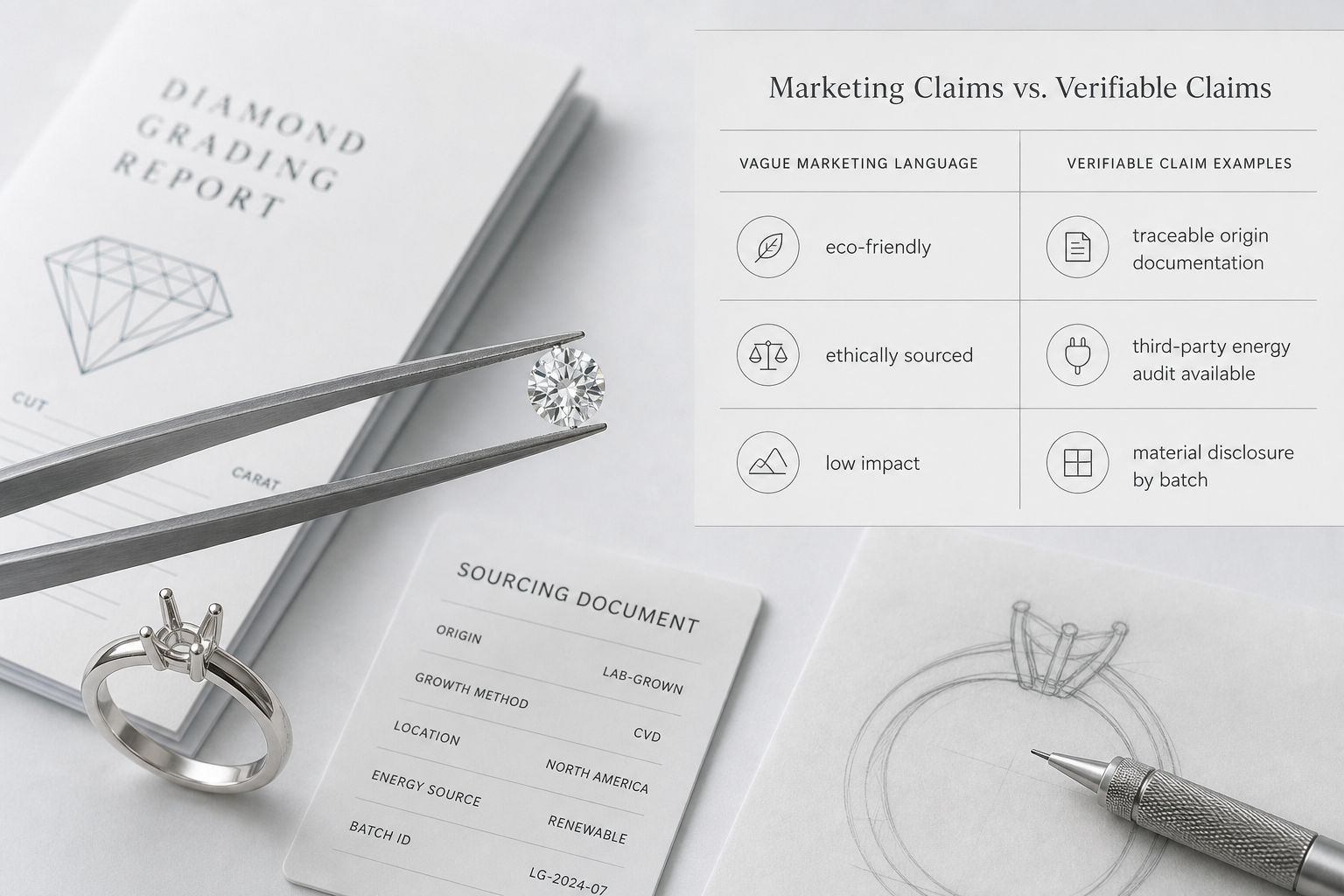
Ask: What Exactly Is Being Claimed?
Lab-grown diamond sustainability claims can refer to several different parts of the product journey. The diamond may be grown in one facility, cut and polished somewhere else, set into jewelry by another manufacturer, packaged by the retailer, and shipped through a separate logistics provider. A claim about one part of that chain does not automatically cover the rest.
This distinction matters most when buying finished jewelry. A seller may have information about the center stone but much less detail about the setting metal, pavé diamonds, hidden halo stones, or shipping materials. If the product is a ring, not just a loose diamond, the sustainability question becomes broader.
Before you decide, ask three direct questions: What part of the product does the claim apply to? Who documented it? Can I see or receive that documentation before buying? If the answer stays vague after those questions, the claim should be treated as unverified rather than decision-grade information.
Check Energy Source Claims Without Assuming “Lab-Grown” Means Low Impact
Energy use is one of the most important sustainability questions for lab-grown diamonds because diamond growth requires controlled industrial conditions. The environmental impact of that production can look different depending on the electricity source, the facility, and what part of the process the seller is describing.
This is where buyers should be careful with assumptions. “Lab-grown” describes how the diamond was created, not automatically how clean the energy source was. A seller making a sustainability claim should be willing to give more detail than the category name itself.
Why Energy Source Matters
Lab-grown diamonds are produced through methods such as CVD or HPHT, both of which require specialized equipment and electricity. GIA describes CVD and HPHT as methods used to grow laboratory-grown diamonds, which is useful production information but not, by itself, proof of environmental performance.[2] The growth method can be relevant for transparency, but it does not prove low impact on its own. What matters more in practice is the energy context behind the production claim.
A diamond grown with electricity from a documented renewable source presents a different sustainability story from one where the electricity mix is undisclosed. That does not mean the buyer needs to become a manufacturing expert. It means the energy claim should be specific enough that you know whether the seller is talking about direct renewable electricity, a facility-level program, offsets, renewable energy certificates, or a general company goal.
What a Useful Energy Claim Should Include
A useful energy claim should identify the scope. Does it apply to the diamond growth process only, the production facility, the seller’s offices, or the company’s broader operations? A claim about office electricity is not the same as a claim about diamond growth, and a company-wide statement may not tell you much about the specific stone in your cart.
Better documentation may include a facility statement, supplier documentation, sustainability report, or third-party review that explains what is covered. At minimum, the seller should be able to say whether the energy claim applies to the specific diamond, a batch of diamonds, a production partner, or the brand as a whole.
Region can also matter, but it should be handled carefully. A country or production region may give context, yet it does not prove the electricity source by itself. The stronger signal is not the location alone; it is whether the seller can connect the claim to a documented energy source or facility-level disclosure.
Be Careful With “Carbon Neutral” or “Renewable” Language
“Carbon neutral” and “renewable” are not interchangeable terms. Carbon neutral may involve offsets, emissions calculations, renewable energy certificates, operational accounting, or a combination of methods. Renewable electricity may mean direct use at a facility, purchased renewable power, or certificate-based matching. These differences matter because they do not all prove the same thing.
The mistake is treating the phrase as the proof. A stronger buyer question is: What does this claim include, and what document supports it? If a seller says a diamond is carbon neutral, ask whether that applies to the diamond growth stage, the finished ring, shipping, or the company’s operations. If the seller says renewable energy was used, ask whether the claim is tied to the production facility or stated only at a brand level.
Before you rely on an energy claim, check whether the seller discloses the energy source used for diamond growth, whether the claim applies to the specific diamond or only the company generally, and whether there is a supporting document such as a facility statement, third-party document, or sustainability report. If those pieces are missing, the claim may still be a positive intention, but it is not strong verification.
Sustainability claims should be specific and documented. Broad green language is less useful than clear information about production, energy, sourcing, and seller transparency.
Look for Production Disclosure: Where and How Was the Diamond Made?
A sustainability claim becomes more useful when the seller can explain the diamond’s production path at a level that a buyer can actually evaluate. That does not mean every seller must reveal proprietary factory contracts or every handoff in the supply chain. It does mean the claim should be more specific than “responsibly made” if the buyer is expected to treat it as meaningful.
Good lab-grown diamond production disclosure helps answer a practical question: what part of the diamond’s journey is visible, and what part is still being left to trust? A seller that can identify the growth method, give a reasonable origin statement, and clarify whether cutting, polishing, and setting are included is giving the buyer more to work with than a seller that only uses broad sustainability language.
Growth Method: CVD, HPHT, or Not Disclosed
CVD and HPHT are the two main diamond growth methods used for lab-grown diamonds. Knowing whether a diamond was grown by CVD or HPHT can support transparency, but it should not be treated as a sustainability verdict by itself. A CVD diamond is not automatically more sustainable, and an HPHT diamond is not automatically less sustainable. The environmental relevance depends on factors such as energy source, facility practices, production efficiency, and what claim the seller is actually making.
The stronger buying takeaway is this: disclosed growth method is a transparency signal, not proof of lower impact. If a seller names the diamond growth method and can explain how that information connects to its sustainability claim, the claim is easier to evaluate. If the method is not disclosed, that does not automatically make the diamond a poor choice, but it does limit how much weight a buyer should give to broad environmental language.
When growth method or post-growth treatment is relevant, buyers should look for clear disclosure in the grading report or seller documentation. HPHT and CVD are commonly discussed as laboratory-grown diamond growth methods; HPHT can also appear in treatment discussions in some contexts, but buyers should not assume a treatment status unless it is specifically disclosed and documented for the stone being considered.
Facility, Country, or Supplier-Level Disclosure
Production disclosure can appear at different levels. The most specific version may identify an exact facility or production partner. A more common version may identify the country or region where the diamond was grown. A weaker version may say only that the diamond is “ethically produced” or “sustainably sourced” without giving any useful origin detail.
The point is not to rank countries as automatically good or bad. A country name alone does not prove responsible production, just as the absence of a facility name does not prove anything negative. For categories such as sustainable engagement rings, what matters is whether the seller’s disclosure is consistent with the claim being made. If the claim depends on renewable electricity, cleaner production, or traceability, then a vague origin statement is not enough. The buyer needs some connection between the sustainability claim and the place, supplier, or production system behind it.
Reasonable transparency has limits. Some jewelers may not disclose every supplier relationship for commercial reasons, and that can be legitimate. But if a brand uses strong sustainability language while refusing to clarify even the basic level of production disclosure, the buyer should treat the claim as incomplete rather than verified.
Chain-of-Custody Logic for Lab-Grown Diamond Claims
Traceability does not always require a public list of every supplier, but it does require a logical connection between the product and the claim. For a loose diamond, that connection may be the grading report number, the supplier statement, batch reference, or production disclosure that ties the stone to a stated growth method or source. For a finished ring, the chain becomes wider because the center stone, setting metal, accent stones, and manufacturing process may each have different documentation.
When comparing sellers, look for consistency across the documents. The carat weight, shape, measurements, report number, inscription information, product SKU, batch reference, or order description should not contradict each other. Small formatting differences are normal, but unexplained mismatches should be clarified before purchase. Traceability is strongest when each document supports the same product story instead of creating separate fragments the buyer has to guess at.
Cutting, Polishing, and Jewelry Manufacturing Also Matter
A lab-grown diamond may be grown in one country, cut and polished in another, graded elsewhere, and set into a ring in a separate jewelry workshop. That matters because a sustainability claim may apply only to the growth stage, while the finished product includes more than the grown stone.
This is where buyers often over-assume. A statement about the diamond’s production does not automatically cover cutting and polishing, metal casting, accent stones, packaging, or final jewelry manufacturing. If you are buying a loose diamond, the production claim may be limited to the stone. If you are buying an engagement ring, the better question is whether the claim applies to the full ring or only to the center diamond.
Traceability is strongest when the seller can explain which stages are covered and which are not. A partial claim can still be useful if it is honest about its limits. The risk comes from broad wording that makes a finished ring sound fully documented when only one step of the supply chain has actually been described.
How to Verify This Before Buying
Before relying on a sustainability claim, ask the seller whether it applies to the grown diamond only, the finished ring, or the company’s general operations. If the product page mentions origin, growth method, or responsible production but does not define the scope, ask for written clarification before purchase.
Useful questions include: Was this diamond grown by CVD or HPHT? Is the country, region, facility, or supplier known? Does the sustainability claim apply to growth only, or also to cutting, polishing, setting, and jewelry manufacturing? If the seller can answer clearly and consistently, the claim carries more practical value. If the answer stays vague, the safer judgment is to treat the claim as marketing language rather than documented sustainability.
Understand What Diamond Certificates Can and Cannot Prove About Sustainability
A lab-grown diamond certificate is useful, but it is often misunderstood. A grading report can help verify the identity and characteristics of a diamond. It usually does not prove that the diamond was produced with renewable energy, lower emissions, responsible labor practices, recycled metals, or a fully documented supply chain.
This distinction matters because many buyers see an IGI report, GIA report, or other diamond grading document and assume it supports every claim on the product page. It does not. A grading report and sustainability documentation answer different questions. One helps confirm what the diamond is. The other should support how a sustainability claim was measured, scoped, or documented.
A grading report helps document key characteristics, but it should not be treated as a guarantee of beauty, value, or sourcing ethics. It should be read alongside visual evidence, measurements, seller documentation, and the intended jewelry use.
What a Grading Report Usually Helps Confirm
A standard lab-grown diamond grading report may confirm details such as lab-grown status, shape, carat weight, color grade, clarity grade, measurements, proportions, polish, symmetry, and sometimes fluorescence. GIA describes the 4Cs as color, clarity, cut, and carat weight, which are formal diamond quality factors rather than sustainability measurements.[3] It may also include a report number and, in many cases, an inscription reference that can be matched to the diamond.
These details are important because they help protect the buyer from confusion or substitution. If a listing says the diamond is a 1.50-carat oval with a specific color, clarity, and report number, the grading report gives you a way to check whether the listing and document are describing the same stone. That is a real verification step, but it is diamond identity verification, not sustainability verification.
In practical buying, it is also worth remembering that the 4Cs and measurements help compare diamonds, but they do not fully describe how a stone will look in a setting. Cut style, shape, proportions, and light performance can make two stones with similar reports appear different in real use. This is why a certificate-aware purchase should still include photos, video, measurements, and setting compatibility rather than relying on the report as the only decision tool.
What a Grading Report Usually Does Not Prove
A standard diamond grading report usually does not prove the energy source used during growth, the carbon footprint of production, labor conditions, supplier practices, metal sourcing, packaging materials, shipping impact, or whether a company’s environmental claim applies to the specific diamond being purchased.
This is the mistake to avoid: do not accept a grading report as proof of a broad environmental claim unless the report itself specifically addresses that claim, which standard grading reports typically do not. If a seller says a diamond is “sustainable” and then points only to the grading report, the buyer should ask for separate diamond documentation that supports the sustainability statement.
Why Report Verification Still Matters
Even though a grading report does not prove sustainability, report number verification still matters. When possible, check the report number directly through the issuing grading laboratory’s verification tool. This helps confirm that the document exists and that the core details match the diamond being considered.
At NUVU, we treat grading information as a starting point for clarity, not as a substitute for every other buyer question. A verified report can help confirm the stone’s identity and grading details, but sustainability claims need their own support. Keeping those two roles separate prevents a common buying error: trusting the right document for the wrong purpose.
When a grading report is available, buyers should verify the report details through the issuing laboratory’s official report-check tool where available.
Lab Names Should Not Be Turned Into Sustainability Claims
A recognized grading laboratory can provide useful documentation about diamond characteristics, but the lab name itself should not be used as a shortcut for sustainability, ethical sourcing, investment value, or finished-jewelry quality. Buyers should avoid assuming that a GIA, IGI, HRD, GCAL, or other report proves anything beyond the report’s stated scope.
It is also worth avoiding unsupported lab rankings. One buyer may prefer a particular report format, while another may care more about video, measurements, setting fit, or seller documentation. The practical question is not which lab name sounds strongest in the abstract; it is whether the report can be verified, whether the details match the diamond, and whether any separate sustainability claim has separate evidence.
Certificate and Visual Review Check
Before buying, compare the report number, carat weight, shape, measurements, and inscription details with the seller’s listing. If product photos or videos are available, use them alongside the report rather than relying on the document alone, since the report does not show every visual impression a diamond will create in real lighting.
If the seller makes a sustainability claim, ask for the separate document, statement, audit, or supplier information that supports that claim. A grading report can help you confirm which diamond you are buying. It should not be stretched into proof of environmental performance unless it clearly includes that specific information.
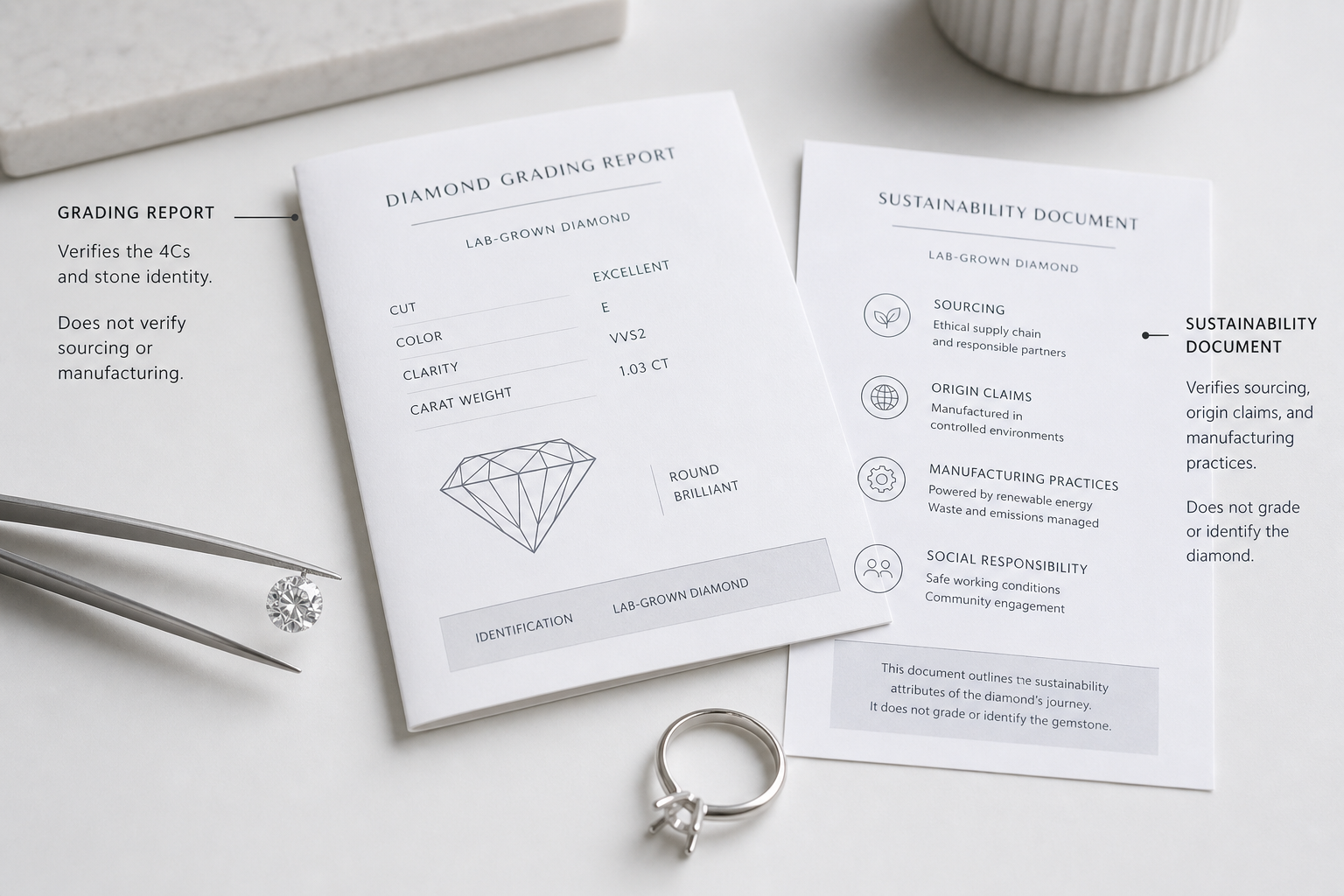
Evaluate Third-Party Audits, Sustainability Reports, and Brand Documentation
Once a seller provides documentation, the next step is to judge whether that documentation actually supports the claim. Not every sustainability report, audit, supplier letter, or brand statement carries the same weight. The strongest documents are clear about what they cover, who issued them, when they were created, and how the claim was evaluated.
A document does not need to be perfect to be useful. But it should make the claim easier to check, not harder. If a report is vague, outdated, self-declared, or disconnected from the diamond or ring being purchased, it may still provide context, but it should not be treated as strong proof.
Match the Document to the Exact Claim
The most important evidence test is matching. If the seller claims “recycled gold,” the supporting evidence should address the metal, not only the lab-grown center stone. If the seller claims “renewable energy,” the document should explain the energy source or accounting method, not only the diamond’s color and clarity. If the seller claims “carbon neutral shipping,” the document should define the shipping scope and should not be treated as proof that the diamond itself was grown with lower-impact energy.
This is also why a long sustainability page can still be weak evidence. Length is not the same as relevance. A buyer should look for a direct line between the claim, the document, and the product being purchased. When that line is missing, the document may be useful background, but it does not verify the specific claim.
Stronger Documentation Has a Clear Scope
The first thing to check is scope. A sustainability document should say whether it applies to one specific product, one batch of diamonds, one production facility, one supplier, one jewelry collection, or the company as a whole. This is one of the most important distinctions because broad documents can sound stronger than they are.
Product-level or batch-level documentation is generally more relevant to a buying decision than a general company statement. A facility-level document may also be meaningful if the seller can reasonably connect the diamond to that facility. A company-wide sustainability report can be helpful background, but it may not prove that the exact diamond or ring in your cart was produced under the same conditions described in the report.
Look for Dates, Issuers, and Methodology
A useful document should be current enough to matter. A sustainability report from several years ago may not reflect today’s suppliers, energy contracts, production locations, or manufacturing practices. The document should also identify who issued it. A third-party audit generally carries more verification value than a self-declared marketing statement, but buyers should still read what the audit actually covered.
Methodology matters because environmental claims depend on definitions. For example, a document may discuss renewable electricity, carbon accounting, recycled materials, chain of custody, or supplier standards. Those are not interchangeable. If a claim says “carbon neutral,” but the document only discusses packaging materials, the documentation does not support the full claim. The buyer’s job is to match the claim to the evidence, not simply to collect impressive-looking files.
Be Careful With Company-Wide Claims
Company-wide sustainability reports can show that a brand is thinking seriously about environmental claims, but they can also create a false sense of product-level certainty. A report may describe overall initiatives, selected suppliers, office operations, packaging programs, or future goals without proving the production path of a specific lab-grown diamond ring.
This does not make the report useless. It means the buyer should assign it the right level of confidence. A company-wide document can support general trust, while product-level or batch-level documentation supports a specific purchase more directly. If you are choosing between two sellers, the seller that connects documentation to the actual diamond or ring is giving you a stronger basis for comparison.
Documentation Quality Score
Use this simple scoring framework as a practical buyer tool, not as an official certification standard. The score helps you separate unsupported language from documentation that can actually be evaluated.
- 0 points: only vague marketing language, with no supporting document.
- 1 point: a seller explanation or company statement is provided, but the scope is unclear or there is no third-party review.
- 2 points: the document names the scope, date, issuer, and specific claim being verified.
- 3 points: product-level or batch-level documentation connects the claim to the actual diamond or jewelry item being purchased.
A 1-point claim is not automatically false, but it should not be treated as strongly verified. A 2-point claim gives the buyer something concrete to evaluate. A 3-point claim is more purchase-relevant because it narrows the gap between the marketing statement and the item being sold. If a seller cannot move beyond 0 points while using strong sustainability language, that is a reason to keep asking questions or compare other options.
How to Read Documentation Without Over-Trusting It
Documentation is useful only when it answers the same question the seller is asking you to trust. A report with professional formatting, technical language, or a recognized issuer can still be limited in scope. Read the title, date, scope statement, product reference, and exclusions before relying on the document. If the document says it applies to a facility, do not automatically treat it as proof for every product sold by the company. If it applies to packaging, do not treat it as proof for diamond growth or metal sourcing.
It is also reasonable to ask how documents are connected. For example, if a seller provides a grading report, a recycled-metal statement, and an energy statement, ask whether each one applies to the specific ring or whether some documents are general background. This is not an accusation; it is basic verification. A careful seller should be able to explain the relationship between the documents and the item without stretching one document beyond its purpose.
Do Not Forget the Setting: Metal Sourcing Can Change the Sustainability Picture
A sustainability claim becomes more complicated once you move from a loose diamond to a finished ring. The center stone may be the focus of the listing, but the final piece also includes metal, small accent diamonds, manufacturing work, polishing, casting, setting, and sometimes multiple suppliers. If a seller calls a ring sustainable but only explains the center diamond, the claim is incomplete.
Ask Whether the Claim Applies to the Stone or the Finished Ring
The first question is simple: is the claim about the lab-grown diamond, or is it about the entire ring? A sustainability claim for a lab-grown diamond ring should not leave that unclear. A seller may have documentation for the center stone but no meaningful information about the setting metal or jewelry manufacturing process. That does not make the claim false, but it does narrow what the claim can reasonably prove.
This distinction matters most for engagement rings because the setting is not a minor accessory. A platinum solitaire, a recycled gold pavé band, and a halo ring with dozens of small stones all carry different sourcing questions. If the listing uses broad language such as “ethical lab-grown diamond jewelry,” the buyer should expect the seller to explain whether that language covers the stone only, the metal only, or the finished piece.
Recycled Gold and Platinum Claims Need Documentation Too
Claims about recycled gold, platinum, or responsible metals should be treated the same way as diamond sustainability claims: useful when specific, weak when vague. “Recycled gold” is more checkable than “responsibly crafted,” but it still needs context. The seller should be able to provide a clear sourcing statement, supplier documentation, or at least a written explanation of how the metal claim is handled.
Perfect chain-of-custody proof is not always available for every finished jewelry item, especially in custom or small-batch production. The practical standard is not perfection. It is whether the seller can explain the claim without hiding behind soft language. A recycled gold lab-grown diamond ring with a clear metal sourcing statement is easier to evaluate than a ring described as “green” with no supporting detail at all.
Small Accent Stones Should Not Be Ignored
Accent stones are easy to overlook because they are smaller than the center diamond, but they still matter when a ring is marketed with sustainability language. Pavé bands, halos, side stones, hidden halos, and gallery accents can include many small diamonds. If the sustainability claim only applies to the center stone, the product page should not imply that every diamond in the ring has the same level of documentation.
This is one of the most common gaps in finished jewelry claims. A buyer may carefully verify the main diamond, then assume the rest of the ring follows the same standard. That assumption can be wrong. The better question is whether the seller can clarify if accent stones are lab-grown, whether they are covered by the same sourcing policy, and whether any documentation exists for them as a group.
Stone-to-Setting Fit Check
Before buying a finished ring, ask whether the sustainability claim applies to the center diamond only, all diamonds in the setting, the metal, and the jewelry manufacturing process. If the seller can only document one part of the ring, the claim should be understood as partial rather than full-product verification.
For custom design, the stone cannot be evaluated separately from the setting. A larger center stone, a delicate pavé band, a hidden halo, or a low-profile design can change which measurements, shapes, and accent stones make sense. If sustainability documentation is part of your decision, ask how design changes may affect the materials used, the accent stone sourcing, and whether the finished piece still matches the original claim.
Custom Design Claim Boundaries
For custom jewelry, stone measurements and setting compatibility should be confirmed before finalizing a purchase. A sustainability statement tied to one proposed design may not automatically apply if the buyer changes the metal, adds accent stones, selects a different center diamond, or requests a different manufacturing approach. The final documentation should match the final item, not only the first concept sketch or initial quote.
Custom design can be a useful route when the buyer has a specific stone, setting, proportion, or design goal that finished jewelry does not satisfy. But it should not be described as inherently more responsible, lower impact, or better value unless the seller can document the exact claim. In a custom process, clear communication matters: ask which materials are being used, which stones are covered by reports, which claims apply to the finished piece, and which seller policies should be confirmed before payment.
Check Packaging and Shipping Claims Without Letting Them Distract From Bigger Issues
Packaging and shipping are visible, easy to explain, and often easier for brands to improve. They can be part of a responsible jewelry program, but they should not carry the entire sustainability story. A recyclable box does not answer questions about diamond growth, energy source, metal sourcing, or manufacturing transparency.
Packaging Claims Should Be Specific
“Eco packaging” is too vague to mean much on its own. More useful claims identify what has actually changed: recycled paper content, recyclable materials, reduced plastic, reusable jewelry boxes, or FSC-certified paper where applicable. The claim becomes stronger when the seller explains whether the packaging applies to all orders or only certain product lines.
The main mistake is giving visible packaging details more weight than they deserve. More carefully documented jewelry packaging can be a positive sign, especially when the details are specific, but in lab grown diamond sustainability assessments it is usually a secondary factor. It should support the broader transparency story, not replace it.
Shipping Claims Need Scope
Shipping language needs the same level of scrutiny. “Carbon-neutral shipping” may refer to offsets, a logistics provider’s program, renewable fuel initiatives, or a company calculation. Those are not identical. A buyer should ask whether the claim covers domestic shipping only, international shipping, expedited shipping, returns, or the full order lifecycle.
This matters because shipping claims often sound complete when they are actually narrow. A brand may offset outbound domestic shipments but not returns, repairs, exchanges, or international delivery. That may still be a legitimate effort, but the buyer should know what is included before treating the claim as a broad environmental statement.
Packaging Is Helpful but Not a Substitute for Product-Level Transparency
Packaging details can make an order less wasteful, but they do not prove that the diamond was grown with renewable energy, that the metal was responsibly sourced, or that the ring’s supply chain was documented. Packaging is easiest for the buyer to see, which is exactly why it can become a distraction.
What This Means in a Real Purchase
If a brand gives detailed information about recyclable packaging and carbon-neutral shipping but says little about diamond production, energy source, grading documentation, or metal sourcing, the sustainability story should be treated as incomplete. The packaging claim may be valid, but it should not be allowed to answer bigger questions it does not actually cover.
Red Flag Words and Claim Patterns That Deserve Extra Caution
Weak sustainability claims usually have a pattern. They sound broad, polished, and reassuring, but they do not tell the buyer what was measured, who checked it, or which part of the product the claim applies to. These are not always signs of dishonesty, but they do deserve more questions before purchase.
Absolute Claims Without Evidence
Phrases such as “zero impact,” “completely sustainable,” “100% ethical,” and “best for the planet” should be treated carefully unless they are backed by clear documentation. Absolute language creates a high burden of proof. Most real supply chains involve tradeoffs, so a claim that leaves no room for limits, scope, or uncertainty needs stronger evidence than a softer, more specific claim.
A more credible statement usually narrows the point: renewable electricity for a named facility, recycled metal for a specific setting, documented packaging materials, or a third-party review for a defined operation. Broad perfection claims are often less useful than modest claims that can actually be checked.
Claims That Do Not Say What They Cover
A major lab-grown diamond sustainability red flag is a claim with no scope. If a seller says “sustainable” but does not clarify whether that means the diamond, the growth facility, the jewelry setting, packaging, shipping, or company operations, the buyer has no way to evaluate the statement.
Scope is not a technical detail. It determines whether the claim is relevant to the item being purchased. A company-wide sustainability statement may not prove anything about a specific ring. A packaging claim may not say anything about the diamond. A grading report may confirm the stone’s identity while proving nothing about environmental performance.
Emotional Language Replacing Documentation
Nature imagery, soft moral language, and beautiful storytelling can make ethical diamond marketing feel persuasive, but they are not evidence. Words like “conscious,” “kind,” “clean,” or “planet-friendly” should lead to documentation, not stand in for it. The buyer should look for dates, sources, reports, supplier statements, and written explanations.
The practical test is whether the claim still makes sense after the imagery is removed. If the page loses most of its meaning once the lifestyle language is stripped away, the sustainability claim is probably under-documented.
Too Much Emphasis on One Easy Detail
Another common pattern is overemphasizing one easy-to-explain improvement. A recycled jewelry box, plastic-free mailer, or carbon-neutral delivery option can be positive, but it cannot carry the sustainability claim for an entire diamond or engagement ring. The larger questions remain: how was the diamond produced, what energy claim is being made, what metal was used, and what documentation connects those claims to the item?
This is where greenwashing becomes a risk. The problem is not that the detail is bad; the problem is when a small verified detail creates confidence in larger claims that were never actually verified.
Buyer Verification Checklist
If a claim uses absolute language, lacks scope, has no date, names no supporting document, or cannot be confirmed in writing, treat it as unverified. A stronger claim does not have to answer every sustainability question perfectly, but it should tell you what is being claimed, what proof exists, and what remains outside the claim.
A Real Buyer Scenario: Comparing Two “Sustainable” Lab-Grown Diamond Rings
Scenario Setup
Maya is comparing two 1.50-carat oval lab-grown diamond rings, and both sellers describe their rings as “sustainable.” Seller A says the ring is “eco-friendly and ethical,” but provides no diamond documentation beyond the product listing. Seller B provides a grading report, identifies the diamond growth method, gives a written energy-source statement, and states that the setting is made with recycled gold.
Decision Point
Maya is not trying to find a flawless sustainability story. She is trying to verify sustainability claims well enough to know which seller is giving her something checkable. Seller B’s claim is stronger because it breaks the ring into parts: the diamond identity, the production disclosure, the energy claim, and the metal sourcing. Even if Seller B has not proven every environmental detail, the information is easier to question, compare, and confirm.
Outcome and Tradeoff
The better choice is not automatically the seller with the most emotional language or the most polished sustainability page. Maya should still ask whether the energy disclosure applies to that specific diamond, a batch of diamonds, a facility, or the company overall. If the ring includes a halo or pavé band, she should also ask whether accent diamonds are covered by the same sustainability claim or only the center stone.
She should also keep the jewelry decision separate from the sustainability score. If Seller B’s oval diamond has documentation but shows a visual pattern, proportion, or setting fit that she does not like, the stronger paperwork does not automatically make it the better ring for her. A responsible purchase still needs to balance documentation, appearance, durability, comfort, budget, and the wearer’s design preferences.
What This Means in a Real Purchase
A lab-grown diamond ring described with sustainability language does not need perfect proof for every detail to be worth considering, but the claim should be specific enough to separate documented facts from seller statements. The most useful claim tells the buyer what is known, what is supported by documents, and what remains unverified before money changes hands.
Before-You-Buy Checklist: What Proof to Ask For
A good lab-grown diamond sustainability checklist should help you slow down before checkout. The goal is not to make the purchase complicated; it is to avoid accepting broad language as proof. Before buying, look for documents and written answers that connect the sustainability claim to the actual diamond, ring, or jewelry item you are considering.
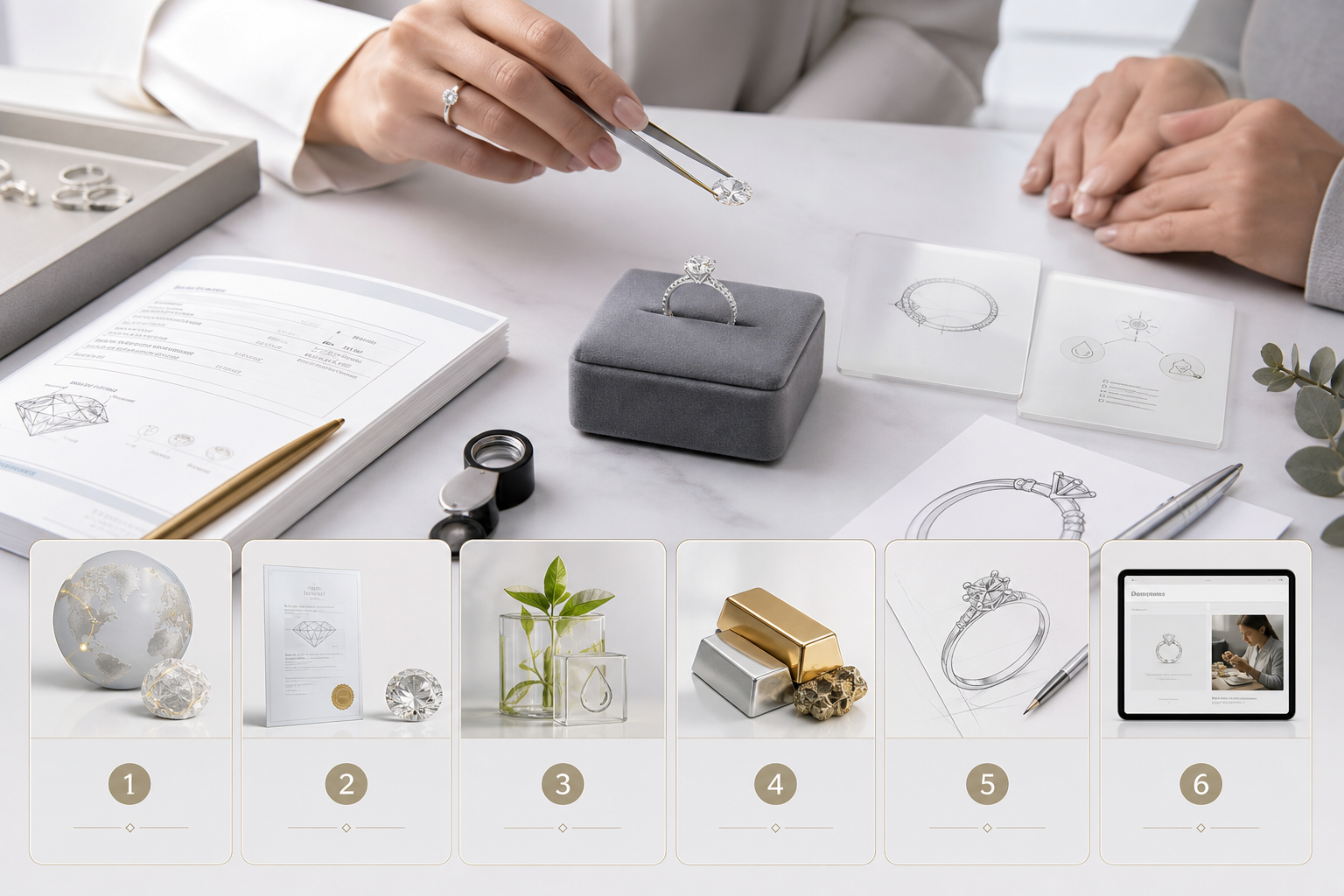
The Six Proof Categories to Check
- Specific wording of the claim: The claim should say what is being described, not just use words like “green,” “eco-friendly,” or “ethical.”
- Energy source or production-related disclosure: Look for information about energy source, production facility, region, or whether the claim applies to diamond growth only.
- Diamond grading report and report-number verification: Use the grading report to verify diamond identity, not as proof of environmental performance.
- Third-party audit, sustainability report, or supplier documentation where available: Stronger documents name the scope, date, issuer, and claim being reviewed.
- Metal sourcing and accent stone coverage for finished jewelry: For rings, ask whether the claim covers the center diamond only, the setting metal, and any side stones or pavé accents.
- Packaging and shipping claims, kept in proper proportion: Packaging can support a better sustainability story, but it should not distract from missing product-level transparency.
Questions to Send the Seller Before Purchase
Written answers matter because they reduce ambiguity. If a seller uses sustainability language, ask direct questions before you buy:
- Can you clarify exactly what your sustainability claim applies to?
- Is the claim product-level, batch-level, facility-level, supplier-level, or company-level?
- Can you provide the grading report and report number for the diamond?
- Do you have documentation for the energy source, production disclosure, audit, or supplier statement behind the claim?
- Does the claim cover the setting metal, accent diamonds, and finished jewelry manufacturing, or only the center stone?
- Can you confirm these details in writing before purchase?
The most useful response is not necessarily the longest one. A short, specific answer with a named document is more valuable than a broad sustainability explanation with no scope, no date, and no way to connect it to the ring you are buying.
How to Keep a Written Verification Record
When a claim influences your decision, keep the relevant listing details, report number, seller explanation, and any supporting documents together before purchase. This does not need to be complicated. A simple record of the product page, grading report, email replies, and sustainability documents can help you compare options and remember exactly what was claimed.
The key is to keep identity documents and sustainability documents in separate categories. One file may confirm the diamond’s grading details, while another may explain a recycled-metal claim or energy statement. If you later compare two rings, this separation makes it easier to see which seller provided product-level evidence and which seller provided only general brand language.
When to Walk Away or Keep Looking
You may want to reconsider if the seller refuses to clarify basic claims, relies only on vague eco language, or treats a grading report as proof of sustainability. A diamond certificate can help confirm what the diamond is, but it does not usually prove renewable energy use, recycled metal sourcing, labor practices, packaging impact, or full supply-chain responsibility.
A missing document is not always a dealbreaker, especially for smaller sellers or claims that are clearly framed as limited. The bigger warning sign is resistance to basic clarification. If a seller makes a strong claim but cannot explain what it covers, who documented it, or whether it applies to the specific item, treat the claim as unverified and compare other options.
Keep Lab-Grown Disclosure Separate From Sustainability Disclosure
A seller should clearly disclose that a diamond is laboratory-grown when that is the case. FTC jewelry guidance addresses the importance of avoiding misleading diamond descriptions and using qualifying language for laboratory-grown diamonds so consumers are not confused about whether a stone is mined or laboratory-created.[4] That disclosure is important, but it is not the same as an environmental claim.
In practice, this means “lab-grown” tells you the diamond’s origin category, while “sustainable,” “renewable,” or “carbon neutral” needs separate support. A product can be correctly disclosed as lab-grown and still have an unsupported sustainability claim. Conversely, a seller can provide careful sustainability documentation but still needs clear lab-grown terminology so the buyer understands what type of diamond is being sold.
Price and Value Should Not Be Used as Sustainability Evidence
Price can influence a jewelry decision, but it should not be used as proof of sustainability. A lower or higher price does not automatically show better energy sourcing, better documentation, recycled metal use, or stronger supply-chain traceability. Prices can change with market conditions, report type, seller channel, and stone-specific details, so exact comparisons should be verified at the time of purchase.
If a seller connects price to sustainability, ask for the missing bridge: what practice, material, report, audit, or supplier documentation explains the claim? Buyers should compare like-for-like specifications such as carat weight, shape, color, clarity, cut information, measurements, report type, setting metal, accent stones, and documentation before treating one option as a better-supported purchase.
Final Buyer Verification Checklist
Before purchase, you should have at least one identity document for the diamond, one clear explanation of the sustainability claim, and written clarification of what the claim does and does not cover. If those pieces are missing, the claim should not be treated as proof, even if the ring itself is beautiful and the language around it sounds responsible.
When a grading report is provided, buyers should compare the report details with the issuing laboratory’s verification tools where available.
This verification step is intended to support identity and grading confidence, not to overstate what a grading document can prove. When a report number is available, the practical value is that the buyer can compare the report details with the listed diamond’s carat weight, shape, measurements, color, clarity, and inscription information before relying on the listing.
If a GIA report is provided, the report details can usually be checked through GIA’s official report verification system.
For diamonds graded by other recognized laboratories, such as IGI or HRD Antwerp, buyers should use the relevant laboratory’s own report-verification process where available. The important habit is the same in every case: confirm the document with the issuing lab first, then evaluate any separate sustainability claim with its own supporting evidence.
Frequently Asked Questions About Sustainability Claims
Does a Lab-Grown Diamond Certificate Prove Sustainability?
Usually no. A lab-grown diamond certificate or grading report can help verify diamond identity, carat weight, shape, color, clarity, measurements, and report number. Sustainability claims need separate documentation because a grading report does not normally prove energy source, carbon impact, metal sourcing, packaging practices, or broader supply-chain responsibility.
Is “Eco-Friendly” a Reliable Diamond Claim?
Only if the seller explains what “eco-friendly” means and provides evidence to support it. The word itself is too broad to verify. A stronger claim identifies the part of the product being discussed, such as diamond growth, recycled gold, packaging, shipping, or company operations.
Should I Ask About Renewable Energy?
Yes, especially if the seller promotes sustainable lab-grown diamonds or lower-impact production. Ask whether the renewable energy claim applies to the specific diamond, the production facility, a supplier, or the company generally. Those are not the same claim, and they should not be treated as equal without documentation.
Does Recycled Gold Make a Ring Sustainable?
Recycled gold can support a stronger sustainability story, but it does not prove everything about the ring. It does not automatically verify the center diamond, accent stones, jewelry manufacturing, shipping, or packaging. Treat it as one meaningful category, not a complete answer.
What Is the Biggest Red Flag?
The biggest red flag is a broad claim with no scope, no document, no date, and no willingness to clarify in writing. A claim does not have to be perfect to be useful, but it should be specific, documented, and meaningful enough for a buyer to verify before purchasing.
Make the Claim Prove Itself Before You Buy
A sustainability claim should make your decision clearer, not harder to verify. If a seller describes a diamond, ring, or jewelry collection as sustainable, the next step is not to accept or reject the claim on instinct. The better move is to ask what the claim covers, what document supports it, and whether it applies to the specific product you are considering.
If you are still comparing options, use this verification process alongside a broader lab-grown diamond buying guide so you are not judging sustainability in isolation from cut, certification, visual quality, setting fit, and budget. For loose lab-grown diamonds, start with stones that have clear grading information and report numbers you can check. For custom engagement rings, ask how the center stone, accent diamonds, metal, and manufacturing details are handled before treating the finished ring as responsible jewelry.
NUVU’s approach is to treat documentation as part of the buying conversation, not as fine print after the sale. A diamond certification can help confirm identity and grading details, but sustainability claims need their own support. If a claim cannot be explained in writing, scoped to the product, or connected to current documentation, it should be treated as unverified marketing rather than a reason to buy.
For NUVU, the goal is to make diamond comparison easier to understand, especially when buyers are weighing report details, visual performance, setting fit, documentation, and budget together. That means a sustainability claim should never be isolated from the practical jewelry decision: the stone still needs to suit the design, the setting should match the wearer’s daily use, and the documents should support the exact claim being made.
The goal is not to demand perfection from every seller or assume every vague claim is false. The goal is to separate meaningful claims from attractive language. A stronger claim is specific, documented, current, and tied to the actual diamond or jewelry item in front of you. Ask better questions before you buy, and the stronger options become much easier to recognize.
[1] Federal Trade Commission, “Guides for the Use of Environmental Marketing Claims,” 16 CFR Part 260, current guidance context.
[2] Gemological Institute of America, “Laboratory-Grown Diamonds,” GIA educational material on HPHT and CVD growth methods, access context.
[3] Gemological Institute of America, “The 4Cs of Diamond Quality,” GIA educational material, access context.
[4] Federal Trade Commission, “Guides for the Jewelry, Precious Metals, and Pewter Industries,” 16 CFR Part 23, current guidance context.
Disclosure: This article is for general educational purposes only. Diamond grading, pricing, availability, specifications, and seller policies can change, and readers should verify important details through grading reports, official laboratory tools, seller documentation, or qualified professionals before making a purchase decision. Laboratory-grown diamonds should be clearly distinguished from natural diamonds, and environmental or sourcing claims should be supported by specific documentation.