
Choosing between a lab-grown diamond and a mined diamond is not as simple as choosing the “clean” option versus the “traditional” one. Lab-grown diamonds avoid direct mining and often reduce land disturbance, but their overall impact, especially in lab-grown diamond traceability, depends on electricity sources, production efficiency, cutting, transport, and supplier transparency. Mined diamonds involve extraction, yet their social and environmental profile can vary widely depending on origin, regulation, rehabilitation, labor practices, and how clearly the supply chain is documented.
For the full framework, read Are Lab-Grown Diamonds More Sustainable?.
This comparison helps you look past broad claims and judge each diamond on evidence. Instead of asking which category is always better, the more useful question is: which stone best matches your priorities, budget, documentation standards, and comfort level with the claims being made? The article will help you read reports correctly, ask sharper questions, and compare sustainability statements without assuming that one label tells the whole story.
| Buyer Priority | What to Check | Common Mistake to Avoid |
|---|---|---|
| Reduced land disturbance | Lab-grown origin, production disclosure, supplier details | Assuming “no mining” means no impact |
| Lower carbon concerns | Energy source, facility claims, third-party evidence | Treating a grading report as a carbon document |
| Natural origin | Mine or country traceability, sourcing policy, report match | Assuming all mined diamonds have the same impact |
| Social or community impact | Labor standards, supplier practices, documented sourcing | Relying on vague ethical language |
| Size within budget | Compare at least three stones, measurements, videos, reports | Choosing by carat weight alone |
| Claim verification | Report number, invoice wording, written sustainability claims | Accepting claims that are not stone-specific |
Quick Questions Before You Read
Q: Are lab-grown diamonds always more sustainable than mined diamonds?
No. They usually avoid extraction-related land disturbance, but their total impact depends on energy use, production practices, and transparency.
Q: Does a diamond certificate prove sustainability?
Usually not. A grading report confirms identity and quality details, but it rarely proves carbon footprint, labor standards, or full traceability.
Q: Can a mined diamond still be a responsible choice?
It can be, especially when origin, labor practices, regulation, and community or rehabilitation claims are clearly documented.
Q: What is the safest way to compare options?
Compare specific stones, not categories. Review reports, images, measurements, written claims, and how each diamond fits your top priorities.
Start With the Honest Answer: Sustainability Is Not a One-Line Comparison
Lab-grown diamonds can be the more practical sustainability choice for many buyers, especially if the main concern is avoiding direct land disturbance from diamond extraction. But the answer is not as simple as “lab-grown is clean” or “mined is bad.” A lab-grown diamond still requires electricity, production equipment, growth materials, cutting, polishing, grading, transportation, and retail handling. A mined diamond comes with extraction-related impacts, but some regulated mining operations also support employment, infrastructure, public revenue, and formal supply chains.
The better question is not whether one category is automatically sustainable. The better question is which impact matters most to you, and whether the seller can support its claims with clear information. A buyer choosing an engagement ring for sustainability reasons should compare evidence, not slogans.
For buyers, the practical point is to separate facts from preferences. “Lab-grown” and “mined” describe origin; they do not, by themselves, prove beauty, ethics, carbon performance, or long-term value. A more reliable decision compares the stone’s report, visual performance, measurements, written sourcing claims, and how confidently the seller explains the limits of each claim.
The Short Answer for a Practical Buyer
From a production-origin standpoint, lab-grown diamonds are usually easier to understand. They are created in controlled facilities and should be clearly disclosed as laboratory-grown on the grading report or sales documentation. That does not prove a full environmental profile, but it gives buyers a clearer starting point than a diamond with little origin information.
Mined diamonds require more scrutiny because the sustainability picture depends heavily on where and how the diamond was extracted, what labor standards applied, how the stone moved through the supply chain, and what documentation is available. A mined diamond with stronger origin information may be more credible than a mined diamond sold with broad claims and no supporting details.
For most buyers, “more sustainable” depends on the priority. If your top concern is reducing physical extraction, lab-grown diamonds often have the advantage. If your priority is documented natural origin, community-linked sourcing, or traditional rarity, a mined diamond may still be considered, but the documentation needs to be stronger.
Why Simple Claims Usually Miss the Point
Two common claims distort the conversation: “lab-grown diamonds are always green” and “mined diamonds are always unethical.” Both are too broad to be useful. Lab-grown diamond sustainability depends heavily on the electricity mix behind production, facility efficiency, growth method, cutting and polishing practices, and how transparent the supplier is about those factors.
Mined diamond sustainability also varies widely. Open-pit, underground, alluvial, and marine mining do not create identical impacts. Regulation, site management, land rehabilitation, labor standards, local governance, and traceability all matter. Treating every mined diamond as the same ignores the difference between a regulated operation with formal documentation and a poorly documented supply chain.
The common mistake is judging the diamond only by its category. Category matters, but it is not enough. A vague “sustainable” label on a lab-grown diamond is not stronger than clear documentation, and a natural origin claim does not answer questions about mining conditions or supply-chain responsibility.
The Comparison Framework Used in This Article
A useful sustainability comparison has to separate the major impact categories instead of collapsing everything into one answer. Origin matters because lab-grown and mined diamonds begin in different systems. Energy matters because laboratory growth can be electricity-intensive. Land disturbance matters because mining requires access to geological deposits. Water use, emissions, waste, labor conditions, traceability, certification, and buyer priorities all change the final judgment.
Not every factor deserves equal weight for every buyer. For someone choosing a sustainable engagement ring, reduced land disturbance may matter more than natural origin. For another buyer, documented sourcing and social impact may outweigh size-for-budget. The right comparison starts by deciding which two or three factors carry the most weight, then asking whether the diamond’s documentation supports those priorities.
In practical buying, the weighting matters because two diamonds can both be reasonable choices for different reasons. A lab-grown diamond with clear disclosure may better answer an extraction concern, while a mined diamond with stronger origin documentation may better answer a natural-origin concern. The goal is not to force one universal ranking, but to make sure the evidence you receive actually matches the claim that influenced your decision.
Evidence Standard Used Throughout This Comparison
This article treats sustainability language as something that needs a clear boundary. A claim is stronger when it identifies what is being compared, what part of the supply chain is included, and whether the evidence applies to one diamond, one supplier, one production batch, or only a general brand policy. Without that boundary, even a true statement can become misleading because the reader may assume it covers more than it actually does.
For that reason, this guide does not treat a grading report, a sourcing statement, and an environmental claim as interchangeable documents. A grading report can support identity and gemological details. A sourcing statement may support origin or supplier practices. An environmental statement may support a narrower claim about energy, emissions, facility practices, or offsets if it defines its scope. The more important the claim is to your decision, the more closely the document should match that claim.
When exact evidence is not available, the safest buying approach is to reduce the weight of the claim rather than stretch it. A lab-grown diamond can still be attractive, well documented, and aligned with a buyer’s values even if it does not come with a full carbon analysis. A mined diamond can still carry personal meaning even if mine-level traceability is not available. The key is not pretending that missing evidence proves the opposite; it simply means the buyer should not rely on that claim as heavily.
Sustainability claims should be specific and documented. Broad green language is less useful than clear information about production, energy context, sourcing boundaries, and what each document actually supports.
Compliance-Safe Reading of Diamond Claims
When comparing lab-grown and natural diamonds, the origin language should remain clear from the first product listing through the final invoice. Laboratory-grown diamonds should be clearly identified as laboratory-grown, and they should not be presented as mined diamonds. Natural diamonds should not be described in a way that implies laboratory production, and diamond simulants should not be confused with either lab-grown or natural diamonds.
A grading report helps document key characteristics, but it should not be treated as a guarantee of beauty, value, environmental performance, or sourcing ethics. The report is strongest when it is used for what it is designed to support: diamond identity, measurements, grades, and relevant report comments. Sustainability, origin traceability, labor, and carbon claims need their own appropriate documentation.
Environmental and sustainability claims should be specific, documented, and limited to what can be substantiated. If a seller uses terms such as “carbon neutral,” “responsibly sourced,” or “low impact,” ask what boundary is being measured, who prepared the information, and whether it applies to the individual diamond, a production batch, a supplier, or the seller’s general practices.
What to Check Before You Decide
Before shopping, identify your top two sustainability priorities. The most common priorities are lower land disturbance, traceable origin, lower carbon footprint, stronger social impact, price transparency, and symbolic preference for natural origin. Trying to optimize every factor at once usually leads to confusion, because the strongest choice in one category may be weaker or less documented in another.
A practical buyer should ask: What claim is being made, what evidence supports it, and does that evidence apply to this specific diamond or only to the seller’s general brand standards? If the answer is unclear, the claim should carry less weight in the decision.
Origin Difference: Grown Above Ground vs Formed and Extracted From Earth
Lab-grown and mined diamonds are both diamonds, but their origin pathways create different sustainability questions. A lab-grown diamond is created in a controlled production environment using methods such as CVD or HPHT. A mined diamond is a natural diamond formed underground and recovered from geological deposits through mining.
This distinction matters because origin determines the first major impact category. Lab-grown diamonds avoid extracting diamond-bearing ore from land or seabeds. Mined diamonds require access to natural deposits, which can involve land movement, water management, heavy equipment, transportation infrastructure, and community considerations. The sustainability comparison begins there, but it does not end there.
What “Lab-Grown” Means in Sustainability Terms
In sustainability terms, “lab-grown” means the diamond was produced without digging for diamond-bearing rock. That is a meaningful distinction for buyers who want to reduce direct extraction impact. It also tends to make origin disclosure more straightforward: the diamond should be identified as laboratory-grown on the grading report, invoice, or product listing.
The limitation is that laboratory growth is still industrial production. It relies on specialized equipment, controlled growth chambers, electricity, growth inputs, skilled labor, cutting and polishing, grading, packaging, and distribution. A buyer should not treat “grown in a lab” as proof of low impact unless the seller can explain the production and documentation behind the claim.
What “Mined” Means in Sustainability Terms
“Mined” does not describe one single environmental or social model. Diamonds may come from open-pit mines, underground mines, alluvial deposits, or marine mining operations. Each setting creates different impact questions. Open-pit mining can involve substantial land movement. Underground mining changes the surface footprint but has its own infrastructure and safety considerations. Alluvial and marine mining raise different questions around sediment, water systems, and habitat management.
This is why broad judgments about mined diamonds are often weak. The impact of a mined diamond depends on mine type, operator practices, local regulation, labor protections, rehabilitation planning, and how much origin information follows the stone into the jewelry market. A mined diamond with no meaningful sourcing information asks the buyer to accept more uncertainty.
Why Origin Alone Does Not Settle the Sustainability Question
Origin sets the starting point, not the full answer. A lab-grown diamond produced with a fossil-fuel-heavy electricity mix and little supplier transparency may raise different concerns than one produced with clearer energy documentation and stronger manufacturing standards. A mined diamond from a regulated, documented supply chain may be more credible than one sold with only a generic natural diamond claim.
The decision becomes stronger when buyers compare origin with evidence. If a seller can clearly show that a diamond is lab-grown, provide a grading report, and explain what sustainability claims do and do not cover, the buyer has a more reliable basis for judgment. If a seller offers a mined diamond, origin information and responsible sourcing documentation become especially important because the category alone does not reveal mining conditions.
Buyer Verification Checklist
For lab-grown diamonds, confirm that the stone is clearly disclosed as laboratory-grown and review the grading report for report number, carat weight, color, clarity, cut information where applicable, measurements, and any inscription details. The report should match the listing and any sales documentation.
For mined diamonds, ask what origin information is available and whether responsible sourcing documentation applies to the individual stone, a supplier program, or the seller’s general policy. Not every seller can provide mine-level traceability, and buyers should be cautious of anyone who implies complete proof without showing what the documentation actually covers.
A simple traceability file can make the comparison clearer. Keep the grading report, product listing, invoice wording, written origin or production statements, and any environmental claim together, then check whether the language stays consistent across all of them. If one document says only “lab-grown” while another suggests a broader environmental claim, treat those as different levels of evidence rather than one combined proof point.
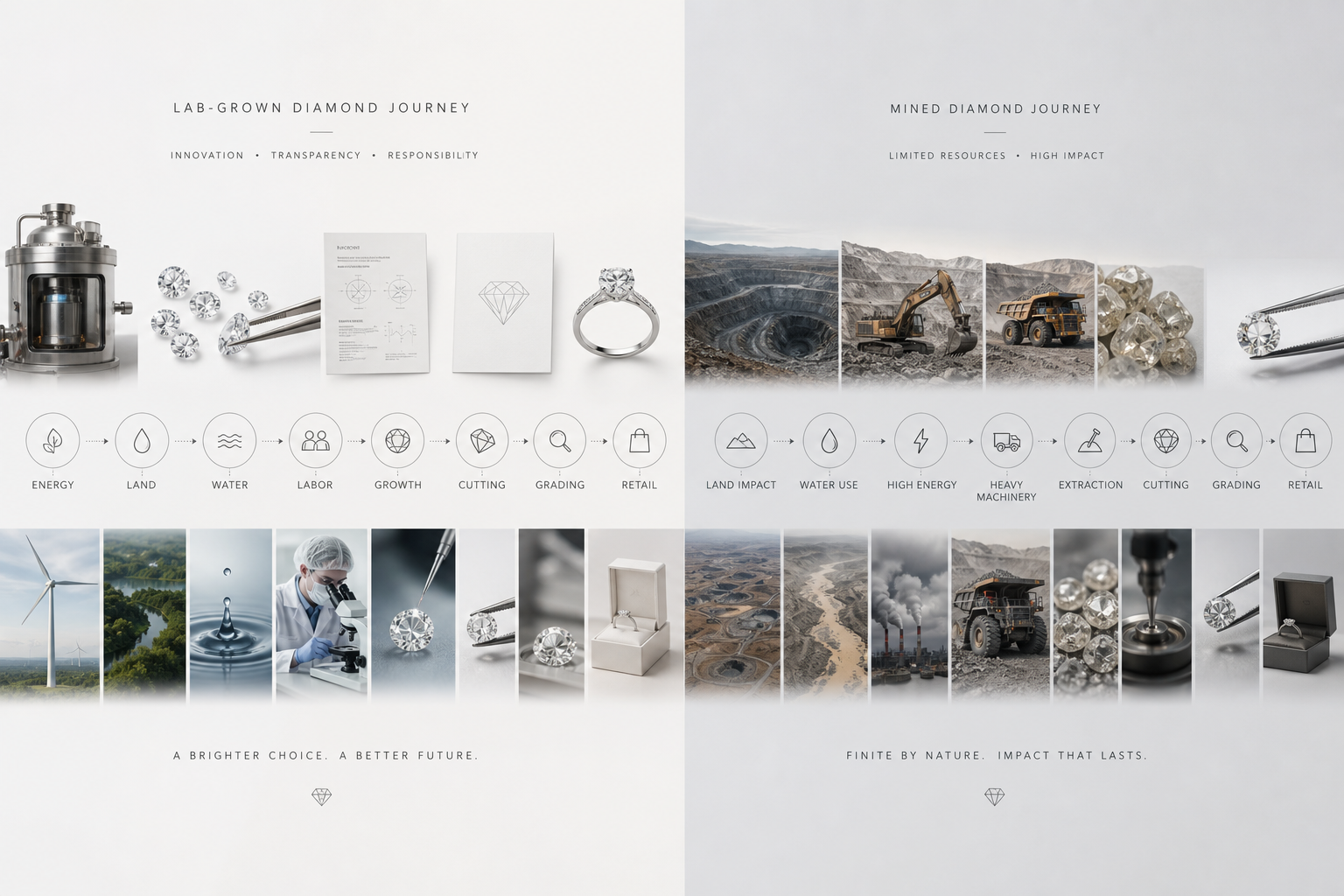
Energy Use and Carbon Footprint: The Most Important Variable for Lab-Grown Diamonds
Energy use is the most important sustainability variable for lab-grown diamonds because laboratory production depends on controlled manufacturing conditions. A lab-grown diamond avoids excavation, but it does not avoid electricity. Growth equipment must create and maintain the conditions needed for diamond formation, and the resulting carbon footprint can change significantly depending on the facility, production method, growth time, energy source, and post-growth processing.
This is where many comparisons become too confident. A lab-grown diamond is not automatically low carbon simply because it is grown above ground. It may have a favorable profile when produced with lower-carbon electricity and efficient systems, but vague claims are not enough. Buyers should look for transparency around energy use rather than relying on words like “green” without context.
Why Electricity Mix Matters
The same type of lab-grown diamond can have a different carbon profile depending on where and how it is produced. A facility using renewable or lower-carbon electricity may create a different impact than one operating on a grid that relies heavily on fossil fuels. This does not mean buyers need to audit the entire power system before choosing a ring, but it does mean energy claims should be specific.
The practical warning sign is vague language. If a seller says a diamond is “sustainable” but cannot explain whether that refers to electricity source, production method, carbon offsets, facility practices, or only the absence of mining, the claim should be treated as incomplete. Stronger claims usually define what is being measured.
CVD and HPHT: Different Methods, Different Energy Profiles
CVD and HPHT are both commonly discussed methods for producing lab-grown diamonds. CVD grows diamonds in a controlled chamber using carbon-rich gas, while HPHT uses high pressure and high temperature conditions. From a buyer’s perspective, the method matters less as a simple label and more as part of the broader production context.
It would be misleading to say one method is always more sustainable. Energy demand can vary with equipment, growth time, facility efficiency, production scale, yield, and post-growth treatment. A well-run facility using one method may have a stronger profile than a less efficient facility using the other. Buyers should avoid choosing based only on CVD or HPHT unless the seller provides meaningful information about how the diamond was produced.
When growth method or post-growth treatment is relevant, buyers should look for clear disclosure in the grading report or seller documentation. HPHT and CVD may describe growth methods for laboratory-grown diamonds; treatment status should not be assumed unless the report or seller documentation specifically states it.
Method also should not distract from the diamond’s finished quality. A CVD or HPHT label does not automatically tell you whether the diamond is well cut, visually lively, compatible with the setting, or supported by clear sustainability evidence. Use the growth method as one context point, then return to the report, images, measurements, and the specific environmental claim being made.
Carbon Claims Buyers Should Treat Carefully
Terms such as “carbon neutral,” “low carbon,” and “sustainable” can be useful only if the seller explains what they include. A claim may refer only to diamond growth, or it may include cutting and polishing, grading, shipping, jewelry manufacturing, packaging, and offsets. Those are very different scopes.
The most important question is whether the claim applies to the individual diamond, a production batch, the supplier, or the jewelry brand as a whole. A brand-level statement may still be valuable, but it is not the same as stone-specific evidence. If offsets are involved, buyers should ask what emissions were measured before the offset was applied.
How to Judge an Environmental Claim Without Overreaching
A careful environmental claim should answer three questions: what is being measured, what time or production boundary is included, and who is responsible for the supporting information. For example, a claim about electricity used during growth is narrower than a claim about the full finished ring. A claim about one facility is narrower than a claim about every diamond a retailer sells. Narrow claims can still be useful, but they should not be expanded in the buyer’s mind beyond what they actually cover.
Buyers should also distinguish between reduction claims and offset claims. A reduction claim suggests that some part of the process used less energy, lower-carbon power, improved efficiency, or a different practice. An offset claim may mean emissions were calculated and then balanced through a separate project. These are not the same thing, and a seller should be able to explain which type of claim is being made before a buyer relies on it.
How to Verify This Before Buying
Ask whether the seller provides an energy-use statement, renewable energy documentation, a life-cycle assessment summary, or third-party support for any carbon claim. If the answer is no, that does not automatically mean the diamond is a poor choice, but it does mean the sustainability claim should be weighted carefully.
A grading report is not a carbon report. It can help confirm that the diamond is lab-grown and document quality characteristics such as carat weight, color, clarity, measurements, and sometimes growth-related details. It usually does not prove renewable energy use, total emissions, labor standards, or full supply-chain impact. For a sustainability-minded buyer, the grading report is a starting point, not the entire answer.
Land Disturbance, Habitat Impact, and Physical Extraction
Physical extraction is one of the clearest areas where lab-grown and mined diamonds differ. A mined diamond has to be recovered from a geological deposit, which means some level of access to land, seabed, river sediment, or underground rock. Depending on the mine type, that can involve moving earth, building roads, managing waste rock, changing drainage patterns, and planning for site closure or rehabilitation.
This does not mean every mined diamond carries the same land impact. An open-pit mine, an underground mine, an alluvial operation, and marine mining affect the environment in different ways. Regulation, operator quality, rehabilitation planning, and local ecosystem sensitivity all matter. The mistake is treating “mined” as one uniform category, when the actual diamond mining environmental impact can vary widely by place and practice.
Why Extraction Creates a Different Impact Category
Mining creates a physical footprint before the diamond ever reaches cutting or grading. Land may need to be cleared, roads may be built, and large volumes of non-gem material may be moved to access diamond-bearing ore. In sensitive habitats, the concern is not only the size of the mine but also how the surrounding ecosystem is disrupted by noise, access routes, water management, waste storage, and long-term restoration work.
The highest-risk situation for a buyer is not simply “a mined diamond.” It is a mined diamond with unclear origin and no meaningful sourcing explanation. Without origin transparency, the buyer cannot judge whether the stone came from a highly regulated operation, a region with weaker oversight, or a supply chain where the environmental claims are too general to verify.
Where Lab-Grown Diamonds Reduce This Specific Concern
Lab-grown diamonds do not require digging for diamond-bearing ore, and that is a real structural difference. For buyers who place reduced land disturbance near the top of their sustainability priorities, this is one of the strongest arguments for considering a lab-grown diamond. The stone is created in a controlled production environment rather than extracted from a natural deposit, so it avoids the direct land movement, habitat disruption, and site rehabilitation questions tied to diamond mining.
This advantage is most relevant when the buyer’s concern is specifically physical extraction. If the priority is avoiding newly mined material for an engagement ring or fine jewelry piece, lab-grown diamonds answer that concern more directly than a mined diamond can. The decision becomes less about whether the stone is “perfectly sustainable” and more about whether it removes the impact category the buyer cares about most.
The Limitation: “No Mining” Does Not Mean “No Industrial Impact”
Lab-grown diamonds still come from an industrial supply chain. Growth equipment must be manufactured and maintained. Facilities require electricity, and SCS 007 certification does not eliminate the fact that diamonds still need cutting, polishing, grading, transport, packaging, and setting into jewelry. Some of those steps may also involve materials, consumables, water use, and labor conditions that deserve scrutiny.
This is where vague language can mislead buyers. “No mining” is a meaningful claim when discussing mined diamond land disturbance, but it should not be stretched into “no environmental impact.” A lab-grown diamond may reduce extraction-related concerns while still raising questions about energy source, manufacturing standards, and documentation. The better judgment is to separate the claim: lab-grown diamonds generally reduce direct land extraction impact, but they do not eliminate the need to evaluate the rest of the supply chain.
What This Means in a Real Purchase
If your main concern is avoiding direct extraction from land or seabeds, a lab-grown diamond will often be the more aligned choice. That is especially true if you are comparing stones of similar visual quality and want the sustainability discussion to center on reduced physical disturbance.
If you are considering a mined diamond, do not assume all mined stones carry the same land impact. Ask what origin information is available, whether the seller can explain responsible sourcing standards, and whether any documentation is stone-specific or only a broad brand policy. A mined diamond with stronger origin disclosure gives you more to evaluate than one sold only with general assurances.
Water Use and Waste: A Comparison That Needs More Context
Water and waste are often discussed as if they were simple scorecard items, but they are more useful when broken into separate questions. How much water is used? Where does it come from? Is the region water-stressed? Is water recycled or treated? What waste is produced, and how is it managed? Those questions matter more than a broad claim that one diamond category is automatically better.
Both lab-grown and mined diamonds can involve water-related impacts, but the type of impact is different. Mining may involve water use for processing, dust control, sediment management, or site operations. Lab-grown production may involve industrial cooling, cleaning, facility operations, and later cutting and polishing steps. The practical issue for a buyer is not whether water exists somewhere in the supply chain; it is whether the seller’s claims are specific enough to be trusted.
Why Water Impact Depends on Local Context
A gallon of water does not carry the same environmental weight everywhere. Water use in a region with strong availability, recycling systems, and treatment infrastructure is not the same as water use in an area already facing scarcity or weak wastewater controls. Local water stress can make a moderate amount of use more significant than a larger amount used in a better-managed context.
This is why unsupported water comparisons can be misleading. If a seller or article gives a water claim without explaining location, method, recycling, or treatment, the number may not help you make a better decision. For sustainability-minded buyers, documented management practices usually matter more than broad category-level statements.
Mining Waste vs Manufacturing Waste
Mined diamonds can involve large-scale material movement. Not every ton moved is hazardous, but waste rock, sediment, tailings management, and site runoff can become serious concerns if poorly controlled. The key question is how the operation manages disturbed material, water flow, rehabilitation obligations, and long-term environmental monitoring.
Lab-grown diamonds create a different waste profile. The concern is not excavated ore but industrial inputs, equipment components, consumables, polishing waste, packaging, and the broader manufacturing footprint. Cutting and polishing also matter for both lab-grown and mined stones because those steps often happen after the diamond’s origin stage and can involve separate facilities and labor practices.
The non-obvious takeaway is that “less visible waste” is not the same as “no waste.” A lab-grown diamond avoids mining waste, but it still moves through a production and jewelry-making system. A mined diamond carries extraction-related waste concerns, but the severity depends heavily on mine management, regulation, and closure planning.
What Buyers Can Realistically Ask
Most buyers will not receive a detailed water-use profile for an individual diamond, and that is normal. A realistic request is to ask whether the supplier discloses production location, whether the brand has environmental management standards, and whether sustainability claims are backed by documentation rather than general wording.
For lab-grown diamonds, useful questions include whether the seller can share anything about production practices, energy and facility standards, or supplier-level sustainability information. For mined diamonds, ask whether origin information is available and whether the operation or sourcing program has documented environmental management standards. If the answer is only “it is sustainable” without any explanation of what that means, treat the claim as marketing, not evidence.
Buyer Verification Checklist
Do not expect every diamond listing to include detailed water data. Instead, look for sustainability reports, supplier disclosures, third-party documentation, or clear brand-level sourcing standards. The absence of water data does not automatically prove poor practice, but vague claims should not be treated as proof of responsible practice either.
A practical approach is to ask three focused questions before placing much weight on a water or waste claim: what part of the supply chain does the claim cover, who is making the claim, and is there documentation you can review? If those answers are unclear, the claim should carry less weight in your decision.
Social Impact and Labor: The Hardest Part of a Simple Sustainability Story
Sustainability is not only about land, carbon, water, or waste. It also includes the people connected to the supply chain. This is where simple lab-grown versus mined comparisons often become weakest, because both categories involve workers, communities, manufacturing partners, logistics providers, and sellers who may operate under very different standards.
Mined diamonds can be associated with serious concerns when governance, labor protections, environmental management, or revenue transparency are weak. They can also support employment, infrastructure, local services, tax revenue, and community development in some regions. Lab-grown diamonds avoid certain mining-related risks, but they still depend on factory labor, cutting and polishing work, quality control, jewelry manufacturing, and supplier accountability. A responsible diamond conversation has to include both sides of that reality.
Why Mined Diamonds Have a Social Dimension Beyond Extraction
Mining is not just an environmental activity; it is also an economic and social presence. A mine may bring jobs, roads, training, public revenue, and local business activity. It may also create pressure on land use, water access, worker safety, community stability, or local governance. The difference often comes down to oversight, employment quality, revenue management, environmental controls, and whether communities have meaningful protections.
The mistake is assuming that mined diamonds are automatically unethical or automatically beneficial. Both claims erase the details that matter. A mined diamond with stronger origin documentation and responsible sourcing support gives a buyer more to evaluate than a stone with no clear sourcing path. For a buyer who values natural origin but also cares about ethics, documentation is not a bonus; it is the basis for making the choice credible.
Why Lab-Grown Diamonds Still Require Labor Scrutiny
Lab-grown diamonds remove the mine from the equation, but not the human supply chain. Production facilities require skilled labor and industrial standards. Cutting and polishing may happen in specialized centers. Jewelry manufacturing, setting, inspection, packaging, and logistics all involve people whose working conditions are part of the product’s broader ethical profile.
This is why “lab-grown” should not be treated as a shortcut for “fully ethical.” It can reduce certain extraction-related concerns, and for many buyers that is important. But if the seller offers no clarity about production standards, manufacturing partners, or documentation, the ethical case is incomplete. Labor standards matter whether the diamond began underground or in a growth chamber.
A Buyer Scenario: Two Responsible Priorities, Two Different Choices
Imagine a couple in Chicago shopping for an engagement ring with a fixed budget. They want the visual presence of a 2-carat diamond, but they also care about responsible sourcing. One partner prefers lab-grown because it avoids direct extraction and makes the larger size more accessible. The other is cautious about broad sustainability language and wants to know whether the diamond comes with a grading report, clear lab-grown disclosure, and any supplier-level information about production practices.
They compare two options. The first is a lab-grown diamond with a grading report, strong visual performance, clear laboratory-grown disclosure, and seller information about supplier standards. The second is a mined diamond with a smaller carat weight but stronger origin documentation and a responsible sourcing explanation tied more closely to its supply chain. Neither option is automatically the “ethical” winner. The better choice depends on which evidence matches their priorities: reduced extraction and size-for-budget, or documented natural origin and community-linked sourcing claims.
The practical lesson is that responsible buying is not only a values statement. It is an evidence comparison. If one option has clear documentation and the other relies on vague category claims, the documented option deserves more confidence, regardless of whether it is lab-grown or mined.
What to Ask a Seller
Ask whether the seller can explain sourcing standards for both the diamond and the finished piece of jewelry. For lab-grown diamonds, ask whether the stone is clearly disclosed as laboratory-grown, whether it has a grading report, and whether any information is available about production transparency or manufacturing partners. For mined diamonds, ask what origin information is available, whether responsible sourcing documentation exists, and whether the claim applies to the specific stone or only to the seller’s general policies.
The strongest sellers should be able to answer without turning the conversation into slogans. If a claim is broad, ask what it actually covers. If it is stone-specific, ask to see the document. If it is brand-level, understand that it may still be useful, but it should not be mistaken for full traceability on an individual diamond.
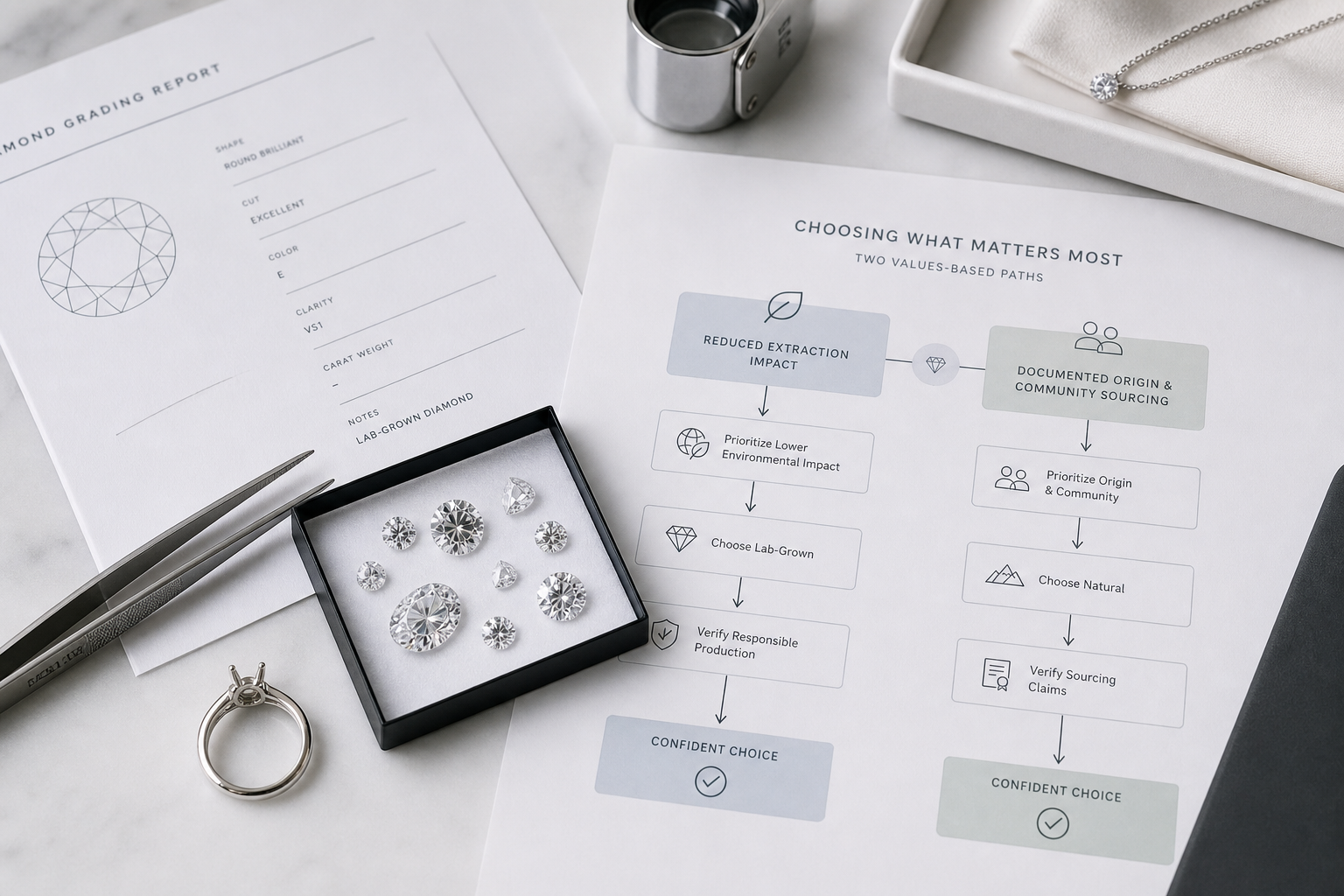
Traceability, Certification, and What Documents Can Actually Prove
Documents are useful, but they are often asked to do more than they were designed to do. A diamond grading report can help confirm what the stone is and whether the listing matches the report. It can also reduce the risk of buying a diamond based only on a seller’s description. What it usually cannot do is prove that a diamond is fully sustainable, ethically sourced in every respect, or produced with a specific carbon footprint.
For sustainability-minded buyers, the practical value of documentation is not that one certificate answers every question. The value is that each document should be matched to the claim being made. A grading report supports gemological claims. A sourcing statement supports origin or supply-chain claims. A carbon or environmental statement, if available, supports a narrower environmental claim. Treating all of these as the same thing is one of the easiest ways to overestimate what a diamond certificate proves.
When a grading report is available, buyers should verify the report details through the issuing laboratory’s official report-check tool where available, then compare those details with the listing, visual media, and sales documentation.
What a Diamond Grading Report Helps Confirm
A standard diamond grading report helps confirm the stone’s identity and quality characteristics. For a lab-grown diamond, the report should clearly disclose that the diamond is laboratory-grown rather than mined. It may also include details such as carat weight, color grade, clarity grade, cut information for round diamonds, measurements, proportions, polish, symmetry, fluorescence where applicable, and a report number that can often be verified through the issuing laboratory.
These details matter because they let buyers compare the diamond against the listing instead of relying on marketing language. If a diamond is listed as 2.00 carats, F color, VS1 clarity, and excellent cut, the report should support those claims. Measurements are especially useful because two diamonds with the same carat weight can face up differently depending on proportions. A 2.00-carat diamond that carries weight too deeply may look smaller than expected in an engagement ring, even if the grade looks strong on paper.
Some reports also include a laser inscription number, growth method information, or comments that help connect the physical stone to the document. Those details are not a substitute for visual review, but they give the buyer a stronger way to verify that the diamond being shown is the diamond being sold.
What a Grading Report Usually Does Not Confirm
A grading report is not a complete sustainability report. It usually does not confirm whether renewable electricity was used, how efficient the production facility was, what labor standards applied during cutting and polishing, how the finished jewelry was manufactured, or what emissions were associated with shipping and packaging. For mined diamonds, a grading report may confirm natural origin, but it generally does not prove full mine-to-market traceability unless supported by separate documentation.
This distinction matters because broad claims such as “responsible,” “sustainable,” or “low impact” can sound more complete than they are. If a seller points only to a grading report to support a sustainability claim, the buyer should ask what part of the claim the report actually proves. The report may prove that the stone is lab-grown, but not that it was produced with low-carbon energy. It may prove that a diamond is natural, but not that the mine origin, labor practices, and community impact are fully documented.
A strong buying process separates proof of identity from proof of impact. At NUVU, we treat the grading report as a starting point for comparison, not the whole decision, because the report tells you a great deal about the diamond but much less about the supply chain around it.
Traceability Claims Need Specific Evidence
“Traceable” is one of the most important words to question carefully. It can mean stone-level origin, supplier-level sourcing, batch-level production records, brand-level standards, or simply that the seller knows which vendor supplied the diamond. Those are not equal levels of evidence. Stone-level traceability is more specific than a general sourcing policy, while a brand-level policy may still be useful but should not be mistaken for proof tied to one individual stone.
For lab-grown diamonds, traceability may refer to production disclosure, manufacturer information, growth method, grading report verification, or documentation from a supplier. For mined diamonds, it may refer to country of origin, mine of origin, a responsible sourcing program, or chain-of-custody documentation. In both categories, the best question is not “Is it traceable?” but “Traceable to what level, and through which document?”
Buyers should be cautious when a claim sounds precise but the evidence is general. A phrase like “responsibly sourced diamonds” may describe a company standard rather than the individual stone. That does not make the claim meaningless, but it changes how much weight it should carry in a sustainability comparison.
Evidence Hierarchy for Diamond Documents
Not every document has the same evidentiary value. A stone-specific grading report is stronger for confirming the diamond’s identity than a product page description. A written supplier statement is stronger than a verbal assurance. A claim that names its scope, such as a facility-level or batch-level statement, is easier to evaluate than a broad phrase like “eco-friendly” with no supporting explanation.
A helpful way to rank evidence is to ask whether it is stone-specific, batch-specific, supplier-specific, or brand-general. Stone-specific evidence is usually the most relevant to the individual diamond. Brand-general evidence can still matter, especially when it reflects consistent policies, but it should not be treated as proof that one exact diamond carries every claim made by the brand.
If two diamonds look similar on paper, the one with clearer documents may be the safer choice for a sustainability-minded buyer. That does not mean more paperwork always equals a better diamond. It means documentation should reduce uncertainty in the exact area the buyer cares about: origin, report match, environmental claim, sourcing practice, or setting suitability.
Report Language, Seller Language, and Invoice Language Should Match
A useful compliance check is to compare the same diamond across three places: the grading report, the product listing, and the final sales documentation. The origin description should not shift from “laboratory-grown diamond” in one place to vague wording such as “diamond” in another if that vagueness could confuse the buyer. For natural diamonds, the seller should avoid language that implies laboratory production or unsupported sourcing certainty.
Consistency also matters for environmental and sourcing claims. If the product page says “low carbon,” the written documentation should explain whether that claim refers to growth, facility energy, shipping, offsets, or the finished jewelry item. If the invoice only records gemological details and does not include the sustainability claim, the buyer should understand that the claim may not be documented at the same level as the grading information.
Before relying on a claim, ask whether the seller can put the relevant wording in writing without overstating it. Clear, limited language is often more trustworthy than broad assurances. A statement such as “laboratory-grown diamond with a grading report” is more precise than a phrase that tries to imply beauty, value, ethics, and environmental performance all at once.
Certificate and Visual Review Check
Before relying on any document, verify the report number with the issuing lab when possible and compare the report details against the diamond listing. The carat weight, color, clarity, measurements, fluorescence, and report number should align. If a laser inscription is offered, ask whether it matches the report number and whether it can be confirmed before or after purchase.
Visual review still matters. Photos, magnified images, and 360-degree video can reveal how the diamond looks beyond the grade, especially for fancy shapes where cut grading is less standardized. A certificate can narrow the field, but it cannot show every performance detail, every inclusion pattern, or how the stone will appear in the intended setting.
For sustainability claims, ask whether the claim applies to the individual diamond, the supplier, the production batch, or the jewelry brand’s general standards. The more specific the claim, the more specific the evidence should be.
For NUVU, the goal is to make diamond comparison easier to understand, especially when buyers are weighing report details, visual performance, setting fit, sustainability language, and budget together. A useful comparison should show what the report confirms, what the visuals reveal, and which claims still need separate documentation.
Practical Comparison Table: Which Diamond Has the Advantage by Impact Category?
A useful comparison does not need to declare a universal winner in every category. Lab-grown and mined diamonds create different pressure points, and the better choice depends on which impacts the buyer prioritizes and what documentation is available for the specific stone. The table below is designed as a shopping tool, not a moral scorecard.
Recommended Comparison Categories
| Impact Category | Lab-Grown Diamonds | Mined Diamonds | Practical Buyer Takeaway |
|---|---|---|---|
| Origin | Created in a controlled production environment and should be clearly disclosed as laboratory-grown. | Formed naturally and extracted from geological deposits. | Origin is easy to label, but the sustainability judgment depends on what happens around that origin. |
| Land Disturbance | Often lower concern because no diamond-bearing land or seabed is excavated for the stone. | Can involve open-pit, underground, alluvial, or marine extraction, with impacts that vary by site and management. | Lab-grown usually has the clearer advantage for buyers focused on avoiding direct extraction. |
| Energy Use | Depends heavily on electricity source, equipment, growth method, and facility efficiency. | Energy is used in extraction, processing, transport, and cutting, with variation by mining method and location. | For lab-grown diamonds, energy transparency is one of the highest-priority questions. |
| Carbon Footprint | Can vary significantly depending on electricity mix and whether claims measure only growth or a broader life cycle. | Varies by mine type, distance, processing, and supply-chain practices. | Do not accept “low carbon” without asking what is measured and who supports the claim. |
| Water Context | Depends on facility practices, industrial processes, cutting, polishing, and local water conditions. | Depends on mining method, water management, local scarcity, and waste controls. | Water impact is not just volume; location, treatment, and contamination risk matter more than a simple claim. |
| Labor and Community Impact | Reduces mining-related labor exposure but still involves manufacturing, cutting, polishing, jewelry production, and logistics. | May involve labor and governance risks, but can also support employment, infrastructure, and community revenue in regulated contexts. | Neither category should be treated as automatically ethical without labor and sourcing transparency. |
| Traceability | Can be easier to identify by production category, but supplier-level or stone-level evidence still varies. | Can be strong when origin documentation is available, but mine-level traceability is not always provided. | Ask what level of traceability is being claimed: stone, batch, supplier, country, or brand policy. |
| Certification Usefulness | Helpful for confirming lab-grown disclosure, grades, measurements, and report verification. | Helpful for confirming natural origin and quality characteristics, but not full sourcing impact by itself. | A grading report confirms gemological details; it usually does not prove sustainability. |
| Price Accessibility | Often allows a larger or higher-specification diamond within the same budget. | Often carries a higher price for comparable size and grade because of natural scarcity and market structure. | Prices vary by stone, report, seller channel, and availability; lower price alone is not the same as stronger sustainability evidence. |
| Symbolic Preference | May appeal to buyers who value modern production, reduced extraction, and visual size flexibility. | May appeal to buyers who value geological origin, rarity narrative, and traditional natural-diamond symbolism. | Symbolism is personal, but sustainability claims should still be evidence-based. |
How to Interpret the Table Without Oversimplifying
The table shows likely pressure points, not fixed outcomes. Lab-grown diamonds often have the clearest advantage on direct land disturbance, while mined diamonds may remain relevant for buyers who value natural origin and can access stronger sourcing documentation. Energy and carbon are more conditional, especially for lab-grown diamonds, because the production footprint can change with electricity source and facility practices.
The mistake to avoid is treating category labels as proof. “Lab-grown” does not automatically mean low carbon. “Mined” does not automatically mean irresponsible. A better comparison asks which diamond has the clearest evidence for the impacts that matter most to the buyer.
Specific Parameters Buyers Can Use
For a practical comparison, review at least 3 diamonds before deciding. Looking at only one stone makes it harder to tell whether the price, measurements, documentation, and visual performance are competitive. For each diamond, review 1 grading report per stone and compare the report against the seller’s listing.
Measurements deserve close attention. Check length, width, and depth to the nearest 0.01 mm where available, especially for engagement rings where face-up size and setting fit matter. A diamond with a strong carat weight can still be a poor fit if the dimensions do not work with the intended design.
Allow 10 to 15 minutes per stone for report review, image or video review, and basic claim checking. That may sound slow, but it is usually enough time to catch mismatched report numbers, vague sustainability claims, missing media, or proportions that do not support the intended look.
Limit your sustainability priorities to 2 to 3 factors rather than trying to optimize every possible variable. For most buyers, the useful priorities are reduced land disturbance, energy or carbon transparency, traceability, labor standards, price accessibility, or natural-origin preference. Trying to maximize every category at once often leads to confusion instead of a better purchase.
Prices can change with market conditions, report type, seller channel, availability, and stone-specific details, so exact comparisons should be verified at the time of purchase. Buyers should compare like-for-like specifications before treating one diamond as a stronger value choice.
How to Use the Table While Shopping
Mark each category as high priority, medium priority, or low priority before comparing stones. If reduced land disturbance and size-for-budget are high priorities, a well-documented lab-grown diamond may fit your decision path. If documented natural origin, rarity, and community-linked sourcing matter more, a carefully sourced mined diamond may remain a serious option.
The strongest choice is usually not the diamond with the most appealing claim. It is the one where the claim, certificate, visual evidence, measurements, and seller explanation point in the same direction.
Buyer Values: When Lab-Grown, Mined, or Either Can Make Sense
Sustainability is not the only value people bring to a diamond purchase, and it should not be treated as separate from the rest of the decision. Budget, visual size, origin preference, documentation, setting design, and long-term personal meaning all affect what “responsible” feels like in a real purchase. The goal is not to force every buyer into the same answer. The goal is to match the diamond to the values that matter most and the evidence available.
Lab-Grown May Make Sense If Your Priority Is Reduced Extraction
Lab-grown diamonds are often the more practical fit for buyers who want to avoid direct diamond mining impact. If reduced land disturbance is a high priority, this is the category where lab-grown diamonds have a clear structural advantage because the diamond is not extracted from a natural deposit.
They may also make sense when the buyer wants a larger visual size within a fixed budget. For example, a couple comparing engagement ring options may find that a lab-grown diamond allows them to consider a larger center stone, a higher color grade, or a more precise shape preference without stretching the budget in the same way a mined diamond might. That can be a valid decision, as long as price is not used as a shortcut for sustainability.
The condition is documentation. A lab-grown diamond should still have clear disclosure, a reliable grading report, visual media, and, where sustainability claims are made, support beyond vague language, with lab-grown diamond sustainability treated as an evidence-based standard rather than a marketing shortcut. A poorly documented lab-grown diamond is not automatically the stronger choice for a buyer who cares about transparency.
Mined May Make Sense If Natural Origin Matters to You
A mined diamond may make sense for buyers who place real value on natural geological origin, traditional symbolism, rarity narrative, or a documented natural supply chain. Those preferences should not be dismissed as outdated or irrational. For some buyers, the fact that the diamond formed naturally over geological time is part of what they want the ring or jewelry piece to represent.
The tradeoff is that mined diamonds require more scrutiny around origin and sourcing. A buyer who chooses mined for symbolic or natural-origin reasons should not stop at “natural” as the only proof point. The better question is what information is available about origin, responsible sourcing programs, chain-of-custody claims, or seller standards. If those claims are general rather than stone-specific, they may still be useful, but they should be weighed accordingly.
Mined diamonds are less compelling for sustainability-minded buyers when the origin is unclear and the seller cannot explain what their responsible sourcing claims mean. Natural origin may carry personal value, but it does not replace documentation.
Either Can Make Sense If Documentation Is Strong
A well-documented diamond in either category is usually more convincing than a poorly documented diamond with a better-sounding label. For a lab-grown diamond, strong documentation may include a grading report, clear lab-grown disclosure, report verification, visual media, and transparent explanation of any environmental or sourcing claims. For a mined diamond, it may include a grading report, origin information where available, responsible sourcing documentation, and a seller who can explain the limits of what is known.
This is where buyer judgment matters. If your top priority is reduced extraction, lab-grown will often be the more direct fit. If your top priority is natural origin with supporting sourcing evidence, mined may still be appropriate. If your top priority is simply avoiding vague claims, either category can work only when the seller provides clear documents and does not overstate what they prove.
The weakest choice is not necessarily lab-grown or mined. It is the diamond where the seller asks you to trust broad language without giving you enough evidence to evaluate the claim.
Policy, Warranty, and Service Claims Should Be Confirmed Separately
Buying decisions often involve more than the diamond itself. Return terms, resizing options, warranty coverage, shipping timing, exchange eligibility, and after-sales support can all influence confidence, but those details should be confirmed directly with the seller before purchase. They should not be assumed from general brand language or from the presence of a grading report.
This matters especially when sustainability or custom design is part of the purchase. A buyer may feel confident about the stone but still need written clarity on setting approval, production steps, repair responsibility, or what happens if the finished piece does not match expectations. Seller policies are separate from diamond grading, and they should be reviewed as their own decision factor.
Stone-to-Setting Fit Check
Before choosing, confirm that the diamond’s measurements work with the intended setting, especially for an engagement ring. Sustainability may guide the category decision, but the finished ring also depends on cut quality, proportions, durability, prong coverage, metal choice, and whether the stone can be set securely.
A diamond can look responsible on paper and still be the wrong physical choice for a specific design. Elongated shapes need proportion review. Larger stones may need more secure setting styles. Lower-profile designs may require careful depth and basket planning. For custom jewelry, the best decision is rarely the diamond alone; it is the relationship between the stone, the setting, the wearer’s daily habits, and the budget.
For custom jewelry, stone measurements and setting compatibility should be confirmed before finalizing a purchase. That confirmation should include the diamond’s shape, length-to-width ratio where relevant, depth, girdle considerations, prong or bezel coverage, and whether the chosen setting can safely hold the stone.
At NUVU, this kind of comparison is treated as a practical design question as much as a sourcing question. The report can narrow the shortlist, but the final stone still needs to make sense visually, physically, and financially for the intended ring or jewelry piece. A sustainability-minded choice is stronger when it also fits the design securely and avoids avoidable compromises in wearability.
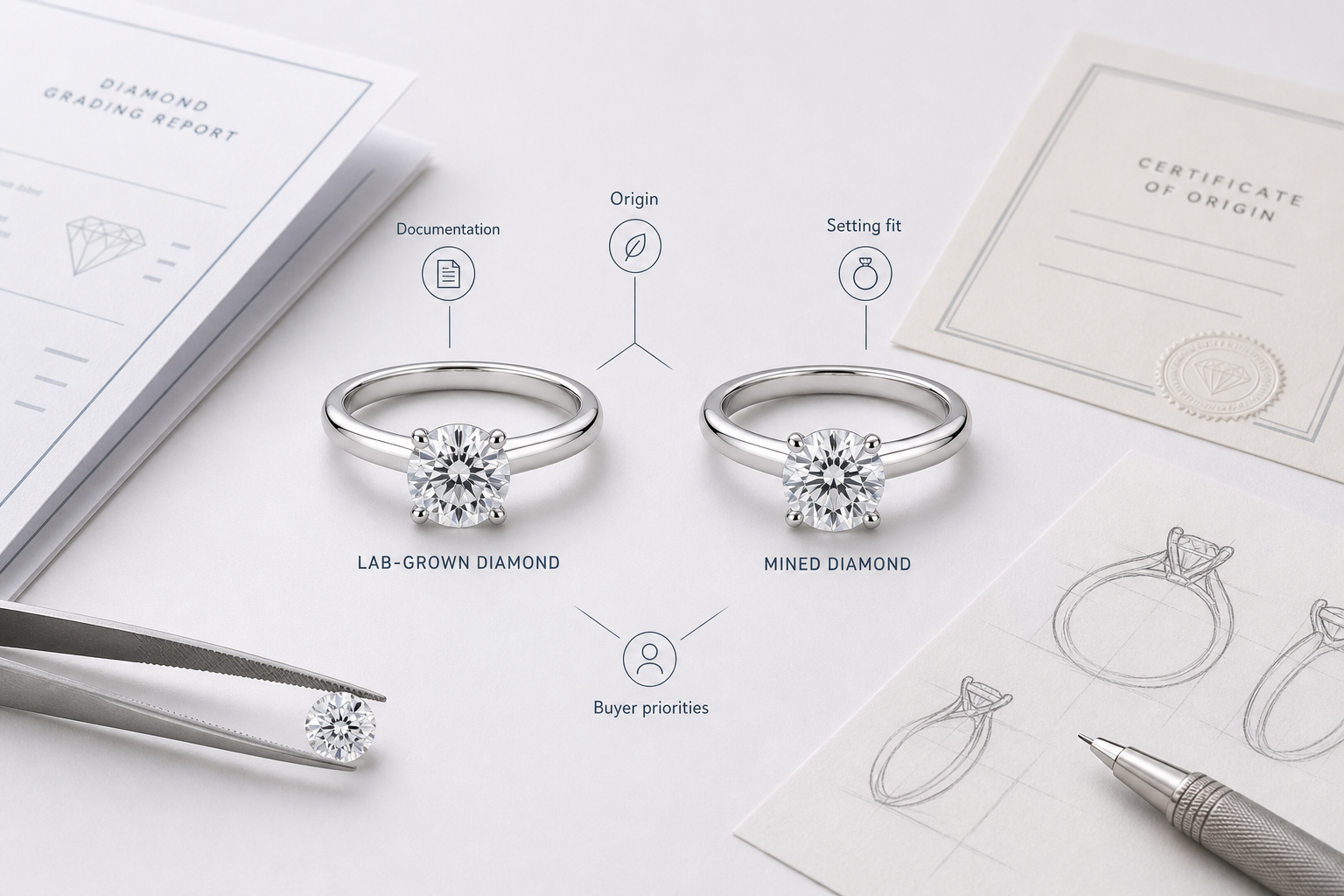
How to Ask Better Sustainability Questions Before Buying
Good sustainability questions do not need to sound confrontational. The goal is to understand what the seller can actually support with documentation, not to make every jeweler prove an entire global supply chain on the spot. A practical question is specific, easy to answer, and tied to the diamond you are considering.
The most useful approach is to separate claims by type. Origin, energy use, sourcing standards, certification, traceability, and finished jewelry manufacturing are different issues. If a seller answers one clearly but avoids the others, that does not always mean something is wrong, but it does tell you where the evidence is strongest and where the claim is more general.
Questions About Origin and Disclosure
Start with the basics before moving into broader sustainability claims. A diamond should be clearly described as lab-grown or mined, and that disclosure should match the grading report, invoice, and product listing. If the category is not obvious in writing, that is a warning sign.
- Is this diamond lab-grown or mined?
- Is that disclosure clearly stated on the grading report, invoice, and product page?
- If it is lab-grown, is the growth method listed or available?
- If it is mined, is any origin information available beyond the fact that it is natural?
- Are any sourcing claims tied to this specific diamond, or are they general brand standards?
For lab-grown diamonds, origin disclosure is usually more straightforward because the report should identify the stone as laboratory-grown. For mined diamonds, mine-level origin is not always available, so the practical question becomes whether the seller can explain what level of origin or sourcing information they do have. A vague answer is less useful than a limited but clearly defined one.
Questions About Environmental Claims
Words like “sustainable,” “responsible,” “carbon neutral,” and “low impact” can mean very different things depending on what is being measured. The strongest claims define their scope. The weakest ones rely on broad language without explaining whether the claim applies to diamond growth, mining, cutting, shipping, jewelry manufacturing, packaging, or the full finished piece.
- What does the environmental claim refer to specifically?
- Is the claim tied to the individual diamond, the supplier, the production facility, or the jewelry brand?
- If the diamond is lab-grown, is any information available about energy source or production practices?
- If the diamond is mined, is any information available about responsible sourcing standards or environmental management?
- Is there third-party documentation, a sustainability report, or a written policy supporting the claim?
The most common mistake is treating a category label as proof. “Lab-grown” does not automatically prove low carbon, and “responsibly sourced” does not automatically prove full traceability. A better answer names the claim, defines the boundary, and shows what evidence supports it.
Questions About Certification and Visual Review
A grading report is one of the most useful documents in the buying process, but it should be treated as a quality and identity document first. It helps confirm the diamond’s type, carat weight, color, clarity, measurements, and other gemological details. It usually does not prove the diamond’s complete environmental or labor profile.
- Which grading lab issued the report?
- Can I verify the report number directly with the issuing lab?
- Do the carat weight, color, clarity, measurements, and report number match the product listing?
- Are photos, video, or 360-degree media available before purchase?
- Can the diamond’s measurements work with the intended setting?
- If there is a laser inscription, can it be confirmed before or after purchase?
Visual review matters because two diamonds with similar grades can perform differently in real viewing conditions. For an engagement ring, measurements also affect setting fit. A diamond that looks attractive on paper may still be a poor choice if the proportions, outline, or physical dimensions do not suit the design.
Questions That Reveal Whether Evidence Matches the Claim
When a seller makes a sustainability or sourcing statement, ask them to connect the claim to a document. This can be as simple as saying, “Which document supports that?” or “Does that statement apply to this diamond or to your company policy?” A credible answer may still be limited, but it should clarify the boundary of the claim instead of relying on reassuring language.
It is also reasonable to ask what a document does not cover. A seller who can explain limits is often more helpful than one who treats every document as total proof. For example, a grading report may be excellent for confirming the diamond’s identity while still saying very little about energy use. A supplier policy may say something useful about standards while still not proving mine-level or facility-level traceability for every stone.
What to Get in Writing
Important claims should not live only in a conversation. Before buying, request written confirmation of the diamond type, grading report number, carat weight, color, clarity, measurements, and any sustainability or sourcing claim the seller is making. If return policies, service policies, resizing, setting compatibility, or custom design terms matter to your decision, those should also be documented before payment.
This does not mean every buyer needs a full supply-chain dossier. It means the claims that influenced your decision should be clear enough to review later. If a seller uses sustainability language confidently but will not define it in writing, treat that claim as marketing rather than evidence.
For custom design, documentation should also connect the loose diamond to the intended setting. Ask for the stone measurements, shape, prong or bezel considerations, and any design constraints to be confirmed before finalizing the stone. Trust in a custom ring comes from matching the report, the visual evidence, the setting plan, the wearer’s daily use, and the budget rather than choosing grades in isolation.
NUVU’s Balanced Position: Transparency First, Category Claims Second
NUVU’s position is simple: a transparent diamond decision is stronger than a broad category claim. Lab-grown diamonds can be a strong option for buyers who want reduced extraction impact, clear lab-grown disclosure, and more size flexibility within a set budget. They still deserve the same careful review applied to any meaningful jewelry purchase.
A better buying process does not ask, “Which category is perfect?” It asks which diamond has clear documentation, strong visual performance, appropriate measurements, and claims that are specific enough to trust. That standard is fair to both lab-grown and mined diamonds, and it helps buyers avoid decisions based only on slogans.
Why Transparency Matters More Than Slogans
Sustainability language is useful only when it helps a buyer make a clearer decision. A grading report, verified report number, diamond media, measurement review, and written explanation of claims give the buyer something concrete to evaluate. A slogan does not.
At NUVU, we treat documentation as a starting point rather than the whole answer. The report helps confirm what the diamond is, but buyers still need to look at how the stone appears, whether it fits the intended setting, and which sustainability claims are supported by actual information.
Where Lab-Grown Diamonds Fit in a Modern Buying Path
Lab-grown diamonds often make sense for buyers who want strong visual presence, clear laboratory-grown disclosure, and less concern about direct land extraction. They can also make a larger diamond or higher specification range more accessible within a fixed budget, which matters for many engagement ring and fine jewelry purchases.
The tradeoff is that buyers should not stop at the phrase “lab-grown.” Energy transparency, grading quality, cut performance, measurements, and seller clarity still matter. A well-documented lab-grown diamond is much more compelling than one sold with vague environmental language and little supporting detail.
Helpful Next Reads
If you are still comparing options, the most useful next step is to narrow the decision by evidence. A lab-grown diamond buying guide can help you understand how to compare stones beyond carat weight. A diamond certification guide can clarify what reports do and do not prove. A loose diamond selection guide can help you evaluate cut, measurements, and visual performance before choosing a setting.
For engagement rings, setting fit is just as practical as diamond choice. A setting guide or custom design process page can help you understand how diamond shape, metal, prong style, and daily wear affect the final piece. If sustainability or transparency is a priority, review any brand-level sourcing information without assuming it replaces stone-level documentation.
Compare Diamonds With Your Priorities in Mind
Explore lab-grown diamonds with grading reports, compare stone options with transparent documentation, or speak with NUVU about matching a diamond to your engagement ring design and values. The right choice should be clear in its documentation, realistic in its claims, and suitable for the piece you actually want to wear.
When a grading report is provided, buyers should compare the report details with the issuing laboratory’s verification tools where available. Before purchase, buyers should also confirm documentation, seller policies, setting compatibility, and any custom design terms in writing.
FAQ: Nuanced Answers to Common Sustainability Questions
Are lab-grown diamonds always more sustainable than mined diamonds?
No. Lab-grown diamonds often reduce extraction-related impacts because they do not require digging for diamond-bearing ore, but that does not make every lab-grown diamond automatically low impact. Energy source, production efficiency, cutting and polishing, transportation, labor standards, and documentation still matter.
For buyers focused mainly on reducing land disturbance, lab-grown diamonds often have a clear practical advantage. For buyers focused on carbon footprint, the better question is whether the seller can explain energy use or provide credible support for any environmental claim.
Are mined diamonds always unethical?
No. Mined diamonds vary widely depending on origin, mining method, regulation, labor standards, community impact, environmental management, and traceability. Treating all mined diamonds as identical overlooks both the risks and the legitimate role that regulated mining can play in some communities.
A sustainability-minded buyer considering a mined diamond should ask for origin information, responsible sourcing documentation, and clarity about whether claims are stone-specific or general. If the seller cannot provide much detail, the buyer has to decide whether the symbolic value of natural origin still outweighs the documentation gap.
Does a diamond certificate prove sustainability?
Usually not. A grading report helps confirm gemological details such as diamond type, carat weight, color, clarity, measurements, and report number. For lab-grown diamonds, it should also disclose that the stone is laboratory-grown.
What it usually does not prove is full environmental impact, renewable energy use, labor conditions, supply-chain ethics, or a complete carbon footprint. If sustainability claims matter to your purchase, ask what documentation supports those claims beyond the grading report.
What is a practical diamond choice for a sustainability-minded engagement ring?
A practical choice is the one that matches your priorities and has credible evidence behind the claims that matter most to you. For many buyers, a well-documented lab-grown diamond is a practical choice because it can reduce direct extraction concerns while offering strong visual size and clear grading information.
A responsibly sourced mined diamond may still make sense for someone who values natural origin, geological rarity, or documented community-linked sourcing. The weaker option in either category is the one sold with broad claims, unclear documentation, and no willingness to explain tradeoffs.
Reader Value Check
The better sustainability question is not which diamond category is perfect. It is which individual diamond gives you the clearest evidence for the impacts you care about most. If you can identify your top two or three priorities before shopping, the comparison becomes more useful, more honest, and less vulnerable to marketing shortcuts.
Putting the Sustainability Comparison to Work
Choose the environmental and sourcing questions that matter most to you, then compare the evidence for each individual diamond. Keep origin, energy use, land disturbance, water context, labor, and traceability separate so that a strength in one area does not stand in for proof in another.
Ask what each claim covers, whether it applies to the specific stone or the supplier more broadly, and which documents support it. Review the grading report alongside the stone's measurements, images, and video; a grading report should not be treated as proof of the full environmental or labor profile.
Natural origin may carry personal meaning, while reduced extraction may be a higher priority for another buyer. Compare those preferences with the available documentation, setting fit, and purchase terms. An unanswered question is a reason to request more detail, not to assume either diamond category is perfect.
Disclosure: This article is for general educational purposes only. Diamond grading, pricing, availability, specifications, and seller policies can change, and readers should verify important details through grading reports, official laboratory tools, seller documentation, or qualified professionals before making a purchase decision. Laboratory-grown diamonds should be clearly distinguished from natural diamonds, and environmental or sourcing claims should be supported by specific documentation.