
Choosing a more thoughtful engagement ring is not as simple as picking a label that says sustainable. The better question is whether the ring’s diamond, metal, setting, and long-term care needs make sense together, with sustainability claim verification treated as part of the same technical review. A lab-grown diamond may offer clearer origin information and more room in the budget for cut quality or design, while a natural diamond calls for stronger sourcing documentation. Either way, the report is only part of the decision; proportions, appearance, and wearability still need careful review.
For the full framework, read Are Lab-Grown Diamonds More Sustainable?.
This article helps you judge an engagement ring as something meant to be worn every day, not just admired once. You’ll see how metal choice affects durability, why setting height and band width matter, when custom design is useful, and how to avoid fragile details that create future repair costs. The goal is to choose a ring that feels beautiful, transparent, comfortable, and realistic for the wearer’s life.
| Decision Area | What to Check | Common Mistake to Avoid |
|---|---|---|
| Diamond choice | Origin, grading report, cut, proportions, visual appeal | Choosing by carat weight alone |
| Metal | Daily durability, color preference, maintenance needs | Assuming recycled metal fixes a weak design |
| Setting style | Profile height, stone protection, snag risk | Prioritizing height or sparkle over security |
| Band structure | Practical width, resizing options, repairability | Going too thin for long-term wear |
| Decorative details | Pavé density, cleaning access, future stone loss risk | Ignoring upkeep before choosing extra sparkle |
| Custom vs ready-made | Lifestyle needs, stone shape, protection, fit | Customizing only for appearance, not wearability |
Quick Questions Before You Read
Q: Is a lab-grown diamond automatically the more responsible choice?
Not automatically. It can offer clearer origin and budget flexibility, but documentation, production details, and ring durability still matter.
Q: What matters more than carat size?
Cut quality, proportions, visible appearance, and whether the setting protects the stone well in daily wear.
Q: Which setting is easiest to maintain?
Simple solitaires and bezels are usually easier to clean and service than dense pavé or highly delicate designs.
Q: When is custom design worth considering?
When lifestyle, stone shape, profile height, comfort, or protection needs are too specific for a standard ready-made ring.
What “Sustainable” Should Mean for an Engagement Ring Purchase
Sustainable engagement rings are often described as if one label can answer every concern. In a real purchase, that is rarely how the decision works. A more thoughtful ring is usually the result of several choices working together: a center stone with a clear origin, a metal that makes sense for long-term wear, a setting that can handle daily use, and a buying process that does not hide behind vague claims.
Think of a buyer who wants an elegant ring, prefers traceable materials, needs the design to survive everyday wear, and still has a real budget. That buyer is not helped by a broad promise that a ring is “ethical” or “eco-friendly.” They need to know what can be verified, what affects durability, and where tradeoffs are being made. A more responsible engagement ring is not necessarily the one with the most sustainability language around it. It is the one whose materials, construction, and documentation can stand up to practical questions.
For buyers, the practical point is to separate evidence from intention. A seller may have good intentions, but the purchase still needs checkable information: what the diamond is, what the metal is, how the setting is built, and what care the finished ring will require. When those details are missing, the buyer is being asked to rely on wording rather than evaluation.
Sustainability claims should be specific and limited. A stronger claim explains what it refers to, such as stone origin, recycled metal content, production information, packaging, or repairability. Broad green language is less useful because it does not tell the buyer what was actually verified, what remains unknown, or how the finished ring will perform over time.
Environmental and sustainability claims should be specific, documented, and limited to what can be substantiated. For example, a claim about recycled metal is different from a claim about energy use, packaging, labor practices, or carbon emissions. If a listing combines all of those ideas into one broad phrase, the buyer should ask for the specific basis of the claim before giving it much weight.
Why “sustainable” is a set of choices, not a single label
The word “sustainable” can point in several directions at once: environmental impact, labor practices, material sourcing, durability, repairability, and waste reduction. Those concerns are connected, but they are not identical. A ring can use a traceable stone and still have a fragile setting. It can use recycled metal and still be poorly suited to the wearer’s lifestyle. It can have responsible-looking branding and still provide very little information about what was actually chosen.
This is why the better approach is to treat sustainability as a decision framework rather than a badge. Ask what the ring is made from, how clearly those materials are documented, how long the design is likely to remain wearable, and whether it can be maintained instead of replaced. A ring that lasts, can be serviced, and fits the wearer’s daily life often has more practical value than a ring chosen mainly for a single claim on a product page.
There is no perfect engagement ring. Every option involves tradeoffs. The goal is to make those tradeoffs visible before you buy, not discover them later when the ring is uncomfortable, difficult to resize, expensive to maintain, or less transparent than it first appeared.
The three ring decisions that matter most
The first major decision is the stone. For many buyers, this is where questions about origin, traceability, and value begin. A lab-grown diamond, a natural diamond with stronger sourcing documentation, or another gemstone can all be part of a thoughtful purchase, depending on the buyer’s priorities. The key is not to assume that the category alone answers every ethical or environmental question. Documentation, grading, and visual quality still matter.
The second decision is the metal. Metal choice affects more than color. It influences durability, maintenance, resizing, and how the ring ages over years of wear. Recycled gold or platinum can be a useful part of a responsible purchase, but recycled content does not automatically make a ring a good choice if the alloy, finish, or structure is wrong for the person wearing it every day.
The third decision is the setting. This is the part many buyers underestimate. The setting determines how the ring sits on the hand, how exposed the center stone is, how often small stones may need attention, and how easy the ring is to clean or repair. A delicate setting may look beautiful in photos but become a poor fit for someone who works with their hands, travels often, or does not want frequent maintenance.
What to care about less than the marketing suggests
Be cautious with sustainability language that is broad but not specific. Phrases like “ethical,” “conscious,” “responsible,” or “eco-friendly” are only useful when they are tied to something concrete. If a seller cannot explain what the claim refers to, the phrase should not carry much weight in your decision.
Also be careful not to overvalue a single feature. A recycled metal ring is not automatically the most thoughtful option. A lab-grown diamond is not automatically the full answer. A minimalist setting is not always more durable. A custom ring is not automatically less wasteful. Each choice has to be judged by how it performs in the finished ring.
The least useful approach is to chase the cleanest-sounding label while ignoring the details that affect ownership. A responsible engagement ring should still be beautiful, wearable, and structurally sensible. If the ring needs constant repairs, feels impractical, or does not fit the wearer’s lifestyle, the sustainability claim becomes much less meaningful.
What to Verify Before You Define Your Priorities
Before comparing rings, separate your priorities into what can be verified and what is mainly a preference. Stone origin, grading documentation, metal type, recycled content, and setting structure can usually be discussed in concrete terms. Style, symbolism, and emotional preference matter too, but they should not be confused with proof.
A useful first step is to ask four questions: What do I want documented? What must hold up to daily wear? What am I willing to maintain? What part of the ring matters most to the wearer? If the wearer values a low-maintenance ring, durability should outrank delicate detailing. If traceability is the priority, documentation should carry more weight than vague branding. If the budget is fixed, money should go toward the features that affect long-term satisfaction rather than the most marketable claim.
This mindset makes the rest of the purchase clearer. Instead of asking whether a ring is sustainable in the abstract, you can compare how well each option handles the specific decisions that shape the finished piece.
Start With the Diamond: Origin, Documentation, and Value Tradeoffs
The center stone is usually the first place buyers look when they want a more responsible engagement ring, but origin alone does not tell the whole story. A diamond’s source can help you understand the broad category you are buying into, while documentation helps confirm the stone’s identity and quality characteristics. Neither one replaces judgment about how the diamond actually looks or how well it fits the ring being made.
A better question than “Which diamond is automatically the most ethical?” is “What can I verify, and what tradeoff am I accepting?” That shift keeps the decision practical. It also helps avoid the common mistake of treating one label, whether lab-grown or natural, as a complete answer.
Lab-grown vs. natural diamond in a purchase context
For many buyers, a lab-grown diamond engagement ring offers a compelling path because it can provide visual size and quality options for the budget, with a known laboratory-created origin. That matters if the buyer wants a diamond without choosing a newly mined center stone. It can also open room in the budget for cut quality, a more durable setting, or a design that fits the wearer more precisely.
Natural diamonds are a different purchase path. Some buyers value geological origin, rarity, or a specific type of sourcing documentation. The challenge is that “natural” does not automatically mean better or worse from a responsibility standpoint. The actual sourcing trail, seller transparency, and supporting documents matter. A natural diamond with weak information may be less reassuring than its marketing suggests, while a documented stone from a reputable supply path may better fit a buyer who specifically wants natural origin.
The important judgment is this: if your priority is visual impact, budget control, and clear man-made origin, lab-grown usually deserves serious consideration. If your priority is natural formation and rarity, you need to be more demanding about sourcing information rather than relying on the word “natural” itself.
Laboratory-grown diamonds should be clearly identified as laboratory-grown, and they should not be presented as mined diamonds. They are diamonds with a laboratory-created origin, while natural diamonds formed geologically. Diamond simulants, such as non-diamond lookalikes, are a separate category and should not be confused with lab-grown diamonds.
It is also worth remembering that lab-grown diamonds are produced through different methods, commonly described as HPHT or CVD. Those terms identify growth processes, but they do not automatically tell you whether a specific diamond is beautiful, well-cut, or suitable for a ring. When growth method or post-growth treatment is relevant, buyers should look for clear disclosure in the grading report or seller documentation.
What origin and traceability can actually tell you
Origin tells you where the diamond category begins. Traceability tells you how much of that path can be followed and supported. These are not the same thing. A diamond can be identified as lab-grown, but buyers should still ask for grading documentation and basic information that supports confidence in what they are purchasing. A natural diamond can have origin-related assurances, but those assurances may vary in strength depending on the seller, reporting, and supply chain.
Traceability is useful because it reduces ambiguity. It does not make every broader environmental or social question disappear. A document can confirm characteristics, origin category, and grading details, but it may not prove every claim made in a marketing description. This is where careful language matters. The more specific the claim, the more useful it is. “Lab-grown diamond with an independent grading report” is more meaningful than “sustainable diamond” by itself.
At NUVU, the grading report is treated as a starting point rather than the whole decision. It can narrow the field, but it does not show every visual nuance, nor does it tell you whether the stone is the right physical match for the setting.
For NUVU, the goal is to make diamond comparison easier to understand, especially when buyers are weighing report details, visual performance, setting fit, and budget together. A buyer-first comparison should make clear what the report shows, what the visuals still need to confirm, and which design constraints may affect the final ring.
What a grading report can verify—and what it cannot
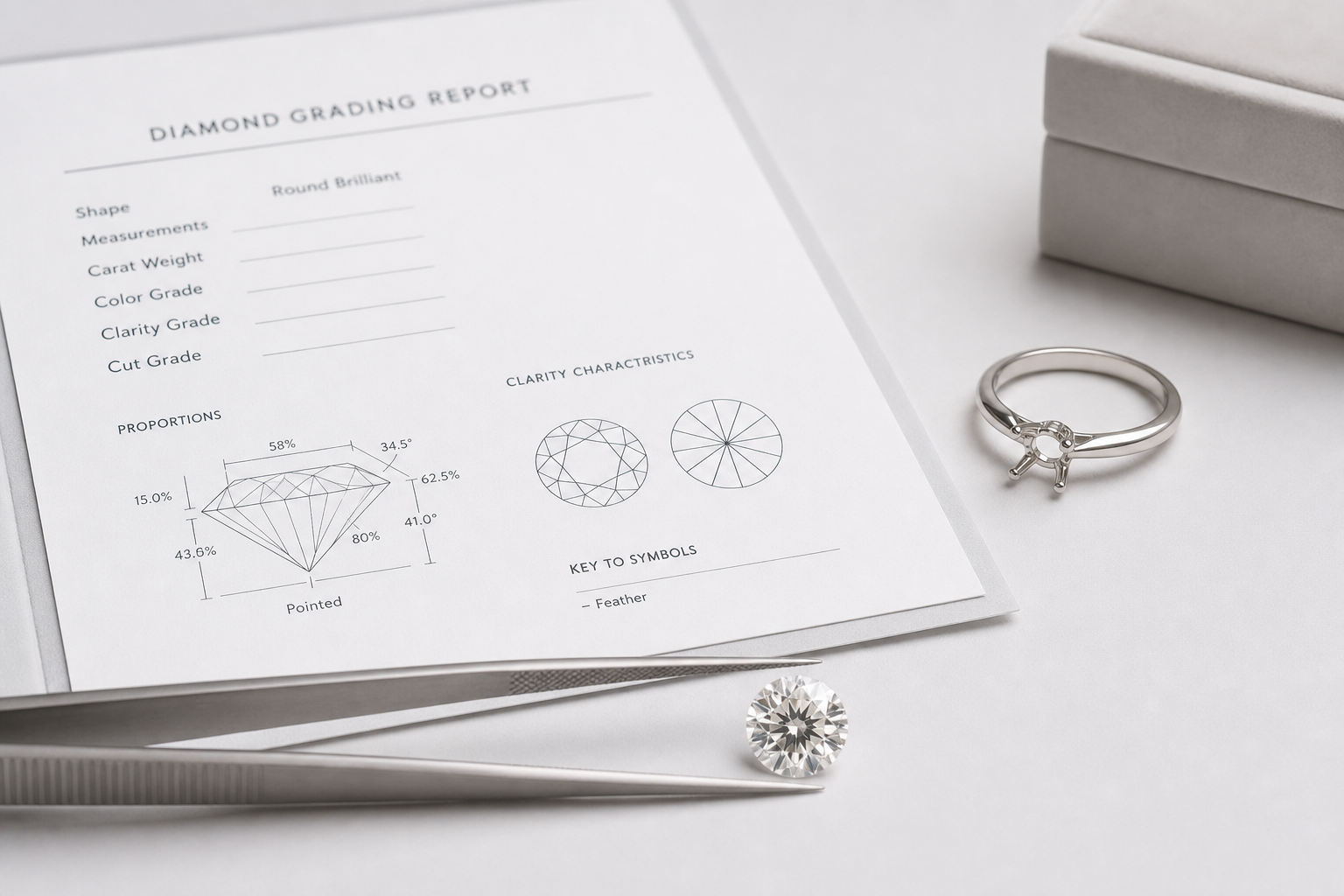
A grading report is most useful when it describes the stone you are actually buying. It can help confirm basic identity details and give you a structured way to compare options, but it does not tell you whether the diamond will feel balanced in the chosen setting or whether the finished ring suits the wearer’s hand.
That distinction matters because buyers sometimes treat paperwork as if it were the same as evaluation. It is not. Two diamonds with similar report language can still differ in face-up appearance, light performance, and how they look once mounted. For that reason, report details should be used to screen options, then final selection should be based on video, measurements, and the ring’s design requirements.
A cautious buyer should also ask whether the seller’s description matches the report exactly. If the ring is marketed with big claims but the underlying document is missing, unclear, or hard to compare with the actual stone, the buyer should slow down. Clear documentation is valuable because it reduces guesswork, not because it removes the need for judgment.
A grading report helps document key characteristics, but it should not be treated as a guarantee of beauty, value, or sourcing ethics. Report language should be read alongside the diamond’s images, videos, measurements, seller documentation, and the intended jewelry use. A report can support comparison, but the buyer still needs to decide whether the stone looks right and works physically in the setting.
When a grading report is available, buyers should verify the report details through the issuing laboratory’s official report-check tool where available, then compare those details with the stone’s measurements, images, video, and intended setting.
Which grading details matter most for visual value
For an engagement ring, the grading details that affect what the wearer sees every day deserve the most attention. Cut quality and proportions often matter more than small differences in color or clarity, especially once the diamond is set. A diamond that is technically high in clarity but poorly cut may look less lively than a lower-clarity stone with stronger light performance.
Color and clarity still matter, but they should be evaluated in context. A near-colorless diamond may look bright and clean in many settings, especially in yellow or rose gold. Clarity should be judged by whether inclusions are visible to the unaided eye, not by whether the grade sounds impressive. Paying heavily for a clarity grade that produces no visible improvement is often a poor use of budget.
Carat weight is another area where buyers can overspend for the wrong reason. The visible size of a diamond depends on shape, cut, and measurements, not carat weight alone. Two stones with the same carat weight can face up differently. For a more thoughtful purchase, it is usually better to compare millimeter dimensions, proportions, and videos rather than chasing the largest number on the report.
Certificate and Visual Review Check
Before choosing a center stone, confirm that the report matches the diamond being offered and that the key details support the ring you want to build. Look for the diamond’s origin category, carat weight, measurements, color, clarity, cut information where applicable, and any notes that may affect appearance. The report should make the stone easier to evaluate, not harder to understand.
Then review the diamond visually. A certificate cannot show how the stone performs in motion, how the facet pattern looks, or whether the shape feels balanced. For fancy shapes, such as oval, emerald, pear, or cushion, visual review becomes especially important because two diamonds with similar grades can look very different. If the diamond will be set low, surrounded by side stones, or paired with a specific metal color, those design details should influence the final choice.
A careful buying path is to use documentation to filter options and visual review to make the final judgment. If either piece is missing, the purchase depends too heavily on trust or too heavily on numbers.
Choose the Metal for Longevity, Not Just the Story
Metal choice is often discussed through color and symbolism, but for a sustainable engagement ring, longevity matters more. The metal has to hold the setting, tolerate daily contact, support future maintenance, and, like scrutiny of lab grown diamond greenwashing, separate durable performance from marketing claims while still looking appropriate for the wearer’s style. A responsible choice is not just the metal with the best story. It is the metal that makes the ring easier to keep, repair, and wear over time.
This is where buyers should be practical. If a ring will be worn every day, the metal choice affects more than appearance. It can influence how quickly the band shows wear, how often the finish needs attention, how secure the setting feels, and how flexible the ring may be for future resizing.
14k gold vs. 18k gold: where durability and color begin to separate
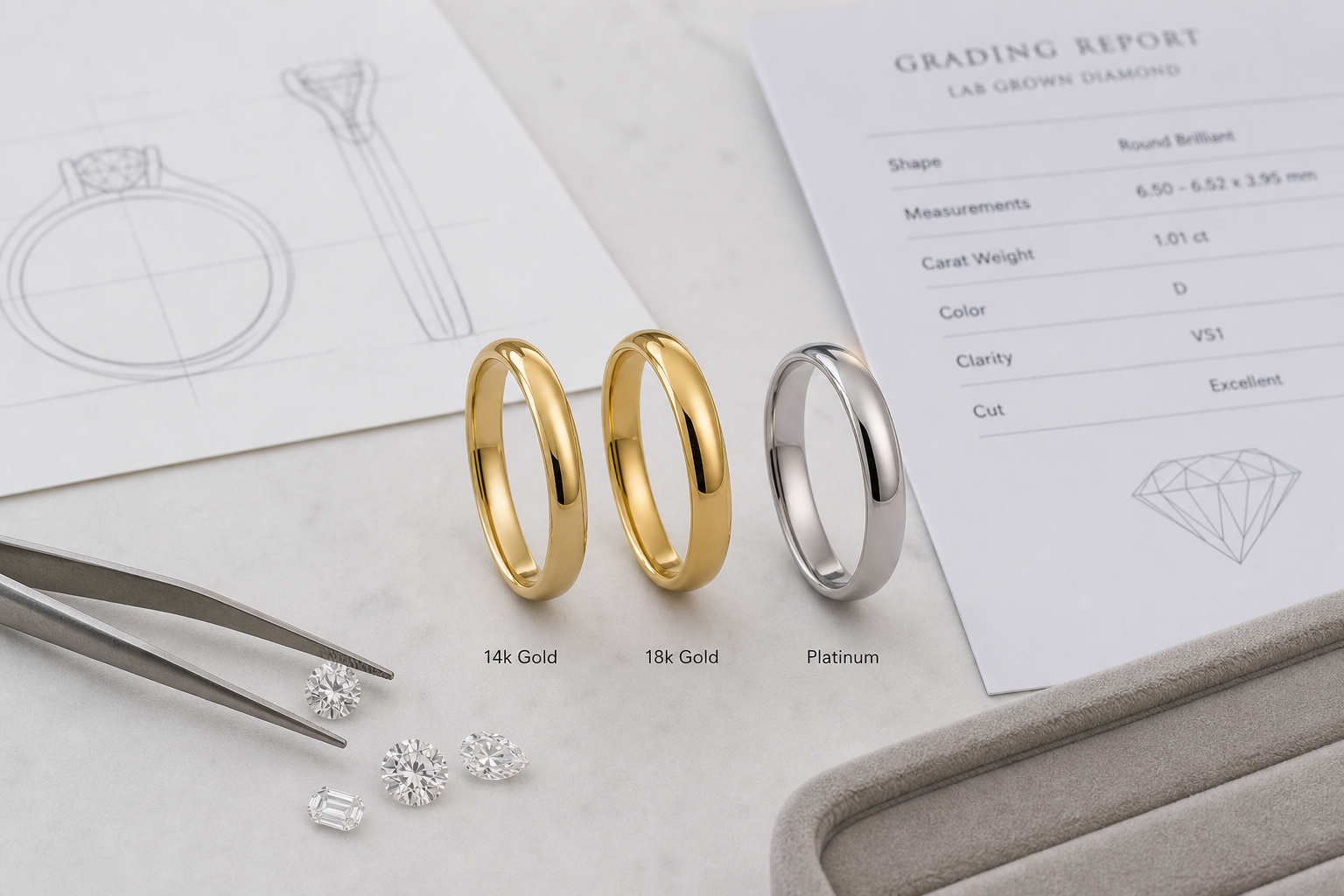
Both 14k and 18k gold are common choices for engagement rings, but they behave differently. 14k gold contains a lower percentage of pure gold and a higher percentage of alloy metals, which usually makes it more resistant to everyday wear. For someone who wants a ring that can handle constant use, commuting, childcare, office work, and ordinary knocks, 14k gold is often the more practical choice.
18k gold has a richer gold content and often a warmer, more saturated color in yellow and rose tones. It can be a beautiful choice when color depth matters and the wearer is comfortable with slightly softer metal behavior. The tradeoff is that 18k may show wear more readily depending on the design and lifestyle. In a delicate ring with thin prongs or fine pavé, the metal choice and structure need to be considered together.
The mistake is assuming that higher karat automatically means better. For long-term daily wear, “better” depends on the ring’s job. If durability and lower maintenance are top priorities, 14k gold often deserves more attention than buyers expect. If warmth, richness, and a finer jewelry feel matter more, 18k can be the right choice when the setting is designed with enough structure.
Platinum and white gold: maintenance, wear, and tradeoffs
Platinum and white gold can look similar when new, but they age differently. Platinum is dense, naturally white, and often chosen for its durability in fine jewelry. It tends to develop a patina over time rather than losing metal in the same way softer-looking surface wear can appear on gold alloys. Some buyers like that lived-in finish; others prefer a brighter polished look and may want occasional refinishing.
White gold is typically plated with rhodium to create a bright white surface. That bright finish is attractive, but it is a maintenance consideration, not a permanent state. Over time, the plating can wear, especially on areas that touch skin or surfaces frequently. If the wearer wants a consistently bright white look with minimal upkeep, platinum may be more logical. If budget control matters more and occasional replating is acceptable, white gold can still be a sensible choice.
This is a good example of how sustainability and practicality overlap. A metal that requires predictable maintenance is not automatically a bad choice, but the buyer should understand that maintenance before committing. A ring that disappoints because it ages differently than expected is more likely to be altered, neglected, or replaced.
How recycled metal fits into a responsible purchase
Recycled metal can be a meaningful part of a more responsible engagement ring, especially for buyers who want to reduce reliance on newly mined material. It is a practical material choice, not a complete guarantee that the entire ring is sustainable. The finished ring still needs the right alloy, sufficient structure, and a design that can be maintained over years of wear.
A useful way to evaluate recycled gold or recycled platinum is to ask what the claim means in the actual ring being sold. Is the metal described clearly? Is it available in the color and karat that suits the design? Does the seller explain the choice in a way that connects to durability and ownership, or is recycled content used as a broad marketing shortcut?
A recycled gold engagement ring can be a strong option when the material choice supports both the buyer’s values and the ring’s daily performance. It becomes less persuasive if recycled content is used to distract from a fragile design, unclear stone information, or a metal choice that does not fit the wearer’s lifestyle.
For recycled metal claims, the most useful buyer question is not simply “Is it recycled?” but “How is that claim communicated for this specific ring?” Some sellers may provide clearer material descriptions than others. If the information is vague, recycled content should be treated as a positive intention rather than a fully verified decision factor, and it should not outweigh structure, alloy suitability, or long-term wearability.
How to read environmental and responsibility claims without overpaying for language
When a listing emphasizes responsibility, the useful question is what part of the ring that claim actually refers to. Does it refer to the diamond origin, recycled metal content, manufacturing process, packaging, or some mix of the above? If the description does not say, the claim is too broad to guide a purchase.
The most defensible approach is to favor specific wording over totalizing claims. “Recycled gold setting,” “lab-grown center stone,” or “independent grading report provided” are all narrower and easier to evaluate than a generic promise that the ring is ethical or sustainable. Narrow claims are easier to compare, easier to confirm, and less likely to distract from design quality.
- Ask what the claim applies to: the diamond, the metal, the workshop, or the packaging.
- Ask whether the claim changes the ring’s durability, serviceability, or maintenance needs.
- Ask whether the seller can show the information in writing before you place the order.
If the answer remains vague, the safest response is to treat the claim as a marketing preference rather than a deciding factor.
Metal Choice Verification Checklist
Before finalizing the metal, confirm the exact metal type, karat or alloy, color, finish, and any recycled content claim. Ask how the metal is expected to age and what maintenance may be needed to keep the ring looking the way you want. For white gold, understand whether rhodium plating is part of the finish. For platinum, decide whether the natural patina is acceptable or whether periodic polishing matters to the wearer.
Also consider the setting design before choosing the metal. A thin band, delicate prongs, or heavy center stone may change what makes sense. Metal should not be chosen in isolation from the ring’s structure. If the ring is intended for everyday wear, the safer choice is usually the one that balances appearance, strength, repairability, and realistic upkeep rather than the one with the most appealing material story.
Pick a Setting That Supports Everyday Wear
A setting can make a responsible engagement ring either easier to live with or easier to damage. The most thoughtful choice is not always the most minimal, the most protective, or the most elaborate. It is the setting that matches the wearer’s daily habits, the diamond’s shape, and the level of upkeep the buyer is realistically willing to accept.
This is where “sustainable” becomes practical. A ring that snags constantly, loses small stones, traps dirt, or needs frequent repair may have a beautiful origin story but a frustrating ownership life. A durable engagement ring setting should protect the center stone, sit comfortably on the hand, and be serviceable if wear eventually shows up.
Low-profile vs. elevated settings: what changes in daily wear
Setting height affects daily wear more than many buyers expect. An elevated setting can make the center diamond look prominent and allow more light to move around the stone, especially in classic solitaire designs. It can also make it easier to stack a wedding band flush against the engagement ring. The tradeoff is exposure. A higher-set diamond is more likely to knock against door frames, countertops, car doors, gym equipment, or the inside of a bag.
A low-profile setting usually feels more secure for someone with an active routine. It sits closer to the finger, which can reduce snagging and make the ring feel less intrusive during commuting, childcare, travel, or work that involves frequent hand movement. The limitation is that very low settings may restrict wedding band pairing or require a curved band later. If a flush wedding band matters, the buyer should check that before committing to the design.
The better choice depends on behavior, not just style. If the wearer rarely removes jewelry and wants a ring that can handle constant wear, a lower setting usually deserves priority over a dramatic elevated profile. If the wearer loves a taller, airy silhouette and is comfortable being more careful, an elevated setting can still work, but it should have strong prong structure and enough metal support under the stone.
Solitaire, bezel, pavé, and channel: the practical differences
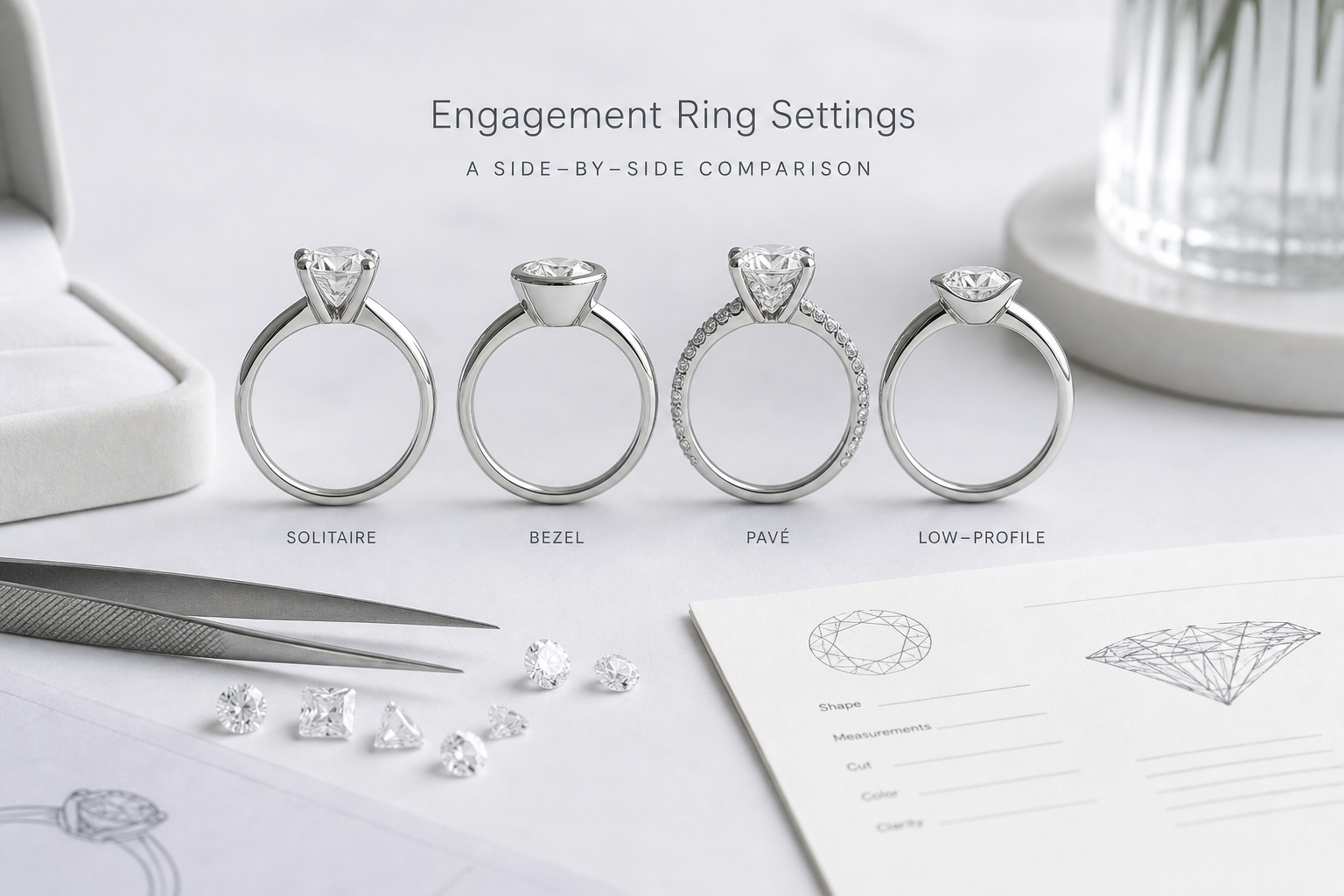
A solitaire is often the easiest setting to maintain because there are fewer small parts to inspect and fewer areas where dirt or damage can hide. A well-built solitaire with four or six prongs gives a clean look and keeps attention on the center diamond. Four prongs show more of the stone and can look lighter; six prongs add more contact points around the diamond and may offer a little more security, especially for round stones. The practical warning is that prongs are not permanent armor. They can wear, bend, or catch over time, so thin, delicate prongs should be judged carefully if the ring will be worn every day.
A bezel setting wraps metal around the diamond’s edge, making it one of the strongest choices for buyers who prioritize security and a low-maintenance feel. It can be especially useful for active wearers or for shapes with vulnerable points, such as marquise, pear, and princess cuts. The tradeoff is visual. A bezel can make the diamond appear slightly more contained and may reduce the open, lifted look some buyers want. A refined bezel can still feel modern and elegant, but it should be chosen intentionally, not as an afterthought.
Pavé settings add sparkle across the band, but they also add maintenance risk. The smaller stones are held by tiny beads or shared metal, and those details can wear with friction. Pavé is not a poor choice, but it is less forgiving for someone who wants a ring they rarely need to think about. If the wearer works with their hands, removes gloves often, or tends to bump jewelry, pavé should be limited to protected areas of the band or avoided in favor of a cleaner shank.
Channel settings protect accent stones between strips of metal, which can make them more secure than very delicate pavé. They tend to have a smoother surface, so they are less likely to snag. The tradeoff is cleaning and repair complexity. Dirt can collect along the channel, and replacing a damaged stone may be more involved than replacing a single exposed accent. For buyers who want side sparkle with fewer snag points, channel-set accents can be a practical middle ground.
A useful rule is to look at how much of the ring’s beauty depends on small, exposed details. The more the design relies on tiny stones, thin prongs, hidden halos, micro-pavé, or intricate under-gallery work, the more the buyer should ask about future serviceability. Delicate does not mean irresponsible, but it does mean the ring needs a wearer who accepts the care that comes with it.
How stone shape and setting shape need to work together
Diamond shape changes the setting decision. A round brilliant is structurally easy to set because it has no sharp corners or pointed ends. Oval, emerald, cushion, and radiant cuts also work well in many settings, though elongated shapes need careful alignment so they do not look tilted or overly exposed on the hand.
Pointed shapes need more protection. Pear, marquise, and princess-cut diamonds have tips or corners that can chip if they are left too exposed. A V-prong, bezel, or protective corner structure is usually more sensible than a setting chosen only for openness. If the design makes the stone look floating but leaves a vulnerable point uncovered, the style may be working against the ring’s long-term durability.
Band width also matters. Very thin bands can look delicate and make the center diamond appear larger, but there is a practical limit. For an everyday engagement ring, a band that is too thin may be more prone to bending, warping, or feeling unstable under a larger stone. Many buyers find that a band around 1.8 mm to 2.0 mm offers a better balance between a refined look and daily strength, although the right number depends on metal, setting style, and center stone size.
The center stone should not be evaluated separately from the setting. A larger diamond may look impressive in a delicate mount, but if the proportions make the ring top-heavy, the ring can spin, catch, or feel awkward. A slightly smaller stone in a more stable setting often wears better than a larger stone placed into a structure that was chosen for appearance alone.
Stone-to-Setting Fit Check
Before choosing a setting, compare the design against the stone’s actual shape, size, and daily use. The right fit should answer four practical questions: Does the setting protect the diamond’s most vulnerable areas? Does the height make sense for the wearer’s routine? Is the band substantial enough for the center stone? Can the ring be cleaned, inspected, and repaired without unusual difficulty?
For custom design, trust comes from matching the stone to the setting, budget, and wearer’s daily use—not from choosing grades in isolation. Measurements, prong placement, band width, wedding band fit, and the stone’s vulnerable points should be discussed before the design is finalized.
For custom jewelry, stone measurements and setting compatibility should be confirmed before finalizing a purchase. This is especially important for elongated shapes, pointed stones, low-profile settings, and designs that need to sit beside a wedding band. A design that looks balanced in a rendering should still be checked against the actual stone dimensions and the wearer’s daily habits.
If the answer is unclear, the safer move is usually to simplify the structure rather than add more detail. A cleaner setting with sound proportions will often feel more thoughtful over time than a visually complex design that needs constant caution.
Think Beyond the Proposal: Repairability, Maintenance, and Resizing
An engagement ring is not finished when it is purchased. It enters years of contact with skin, soap, fabric, desks, luggage, weather, and hard surfaces. A more responsible ring should be able to stay in use, be repaired when needed, and adapt to reasonable life changes without becoming difficult or expensive to maintain.
This is the ownership side of sustainability that marketing often skips. A ring that can be serviced is usually a better long-term choice than one that looks impressive at first but becomes fragile, hard to resize, or impractical to restore. The goal is not to choose a ring that never needs care. The goal is to avoid a design where normal wear becomes a recurring problem.
What makes a ring easier or harder to maintain over time
Simple structures are generally easier to maintain. A solitaire, bezel, or clean three-stone design gives a jeweler fewer small parts to inspect and fewer areas where dirt or damage can hide. Prongs can be tightened or retipped, bands can often be refinished, and the ring’s condition is relatively easy to evaluate during routine checks.
Maintenance becomes more demanding when the ring includes many small stones, ultra-thin metal, hidden halos, intricate galleries, or pavé running far down the band. These details can be beautiful, but they create more points of failure. A tiny accent stone may loosen from ordinary friction. A very thin band may distort over time. A hidden detail under the center stone may collect buildup and be harder to clean properly.
The most common mistake is assuming that a more delicate ring is simply a matter of being careful. Care helps, but structure still matters. If the setting depends on very little metal to hold many stones, the wearer’s lifestyle has less room for error. For daily wear, durability should be designed into the ring rather than left entirely to cautious behavior.
Why resizing and repair access matter before you buy
Resizing should be considered before the ring is ordered, especially if the design has stones around the band. Plain metal bands are usually the simplest to resize. Designs with pavé, eternity stones, engraving, or complex side details may have limited resizing flexibility because changing the ring size can disturb stone seats or distort the pattern.
A full eternity band is a good example of a design that can be less flexible than it looks. Diamonds around the entire finger create a continuous sparkle, but they also make resizing harder and can expose stones on the palm side to more impact. For an engagement ring that needs long-term adaptability, partial pavé or a plain lower shank is often more practical than stones all the way around.
Repair access matters for the same reason. If a prong wears down, a stone loosens, or the band becomes misshapen, the ring should be repairable without rebuilding half the design. Before buying, ask how the setting can be serviced and whether its design limits future repair. A ring that is hard to maintain may still be worth choosing, but it should not be mistaken for a low-effort everyday piece.
How routine wear changes the sustainability conversation
Routine wear turns sustainability from a sourcing question into a lifespan question. If a ring can be cleaned, checked, repaired, and resized when needed, it is more likely to remain in use instead of being replaced or redesigned prematurely. That long-term usability is a concrete form of responsible buying.
A reasonable care rhythm is to have the ring professionally checked about once or twice a year, with an earlier inspection if the ring takes a hard hit, feels loose, catches differently, or starts making a faint clicking sound near the center stone. These signs can indicate movement in the setting. Waiting too long can turn a small prong adjustment into a lost stone or a larger repair.
Daily habits also matter. Removing the ring for heavy lifting, harsh chemicals, swimming pools, or workouts is not about being precious with jewelry. It reduces stress on the metal and helps preserve the setting. A ring meant for everyday wear still benefits from limits; “durable” should not be interpreted as indestructible.
What to Confirm About Repairs and Resizing
Before committing to a ring, confirm whether the design can be resized, how much size adjustment is realistic, and whether accent stones or engraving limit that flexibility. Ask how prongs, bezels, or channels can be serviced if they wear. If the design includes pavé or small side stones, ask which areas are most exposed to impact and whether the lower part of the band has enough plain metal for future work.
The strongest choice is usually the one that combines beauty with repair logic, a practical evidence-based view of lab grown diamond sustainability when two rings look equally appealing, the one that is easier to inspect, clean, resize, and restore is often the more thoughtful purchase.
Ready-Made vs. Custom: Which Path Gives You More Control?
The buying path affects how thoughtful the ring can be. A ready-made engagement ring offers speed, simplicity, and fewer decisions. A custom engagement ring offers more control over the diamond, metal, proportions, setting height, and design details. Neither path is automatically more responsible. The better choice depends on how specific the buyer’s priorities are and how much complexity they are prepared to manage.
If the goal is a ring that balances responsible materials, daily wear, and a precise look, the purchase process should reduce guesswork. A ring that seems convenient but misses a key lifestyle need may not be the better choice. A custom project that adds endless revisions without improving fit or durability may not be better either.
When custom design adds value and when it adds friction
Custom design adds value when the buyer has a clear need that standard designs do not meet. For example, someone who wants a low-profile bezel-set oval diamond in recycled gold may find custom more efficient than compromising with a higher setting or a less protective mount. The exact height, bezel thickness, band width, and wedding band fit can be considered together from the start.
Custom also helps when the diamond shape needs a more intentional setting. Pear, marquise, emerald, and elongated cushion cuts can look very different depending on prong placement, orientation, and proportion. A made-to-order design can protect vulnerable areas and avoid the awkward look that happens when a stone is forced into a generic setting.
The friction is decision load. Custom work requires clearer specifications, review steps, and sometimes tradeoffs between what looks best in a rendering and what works best on the hand. If the buyer is uncertain about every detail, custom can become stressful. It is most useful when the main priorities are already defined: stone shape, setting style, metal, profile height, and daily wear needs.
In custom design conversations, the most useful question is rarely “Can this be made?” Many designs can be made. The better question is whether the design should be made for the way the ring will be worn. A beautiful sketch still needs enough structure to survive real use.
At NUVU, this kind of decision is best treated as a practical comparison rather than a custom-versus-ready-made slogan. A custom design can improve the fit between the diamond, setting, and wearer, but only if the design brief is specific enough to address height, protection, proportions, metal choice, and maintenance expectations.
When a ready-made ring is the more rational choice
A ready-made ring can be the more rational choice when the desired design is classic, the timeline is short, or the buyer does not need unusual proportions. A simple solitaire, clean bezel, or straightforward three-stone ring may already exist in a strong configuration. In that case, custom design may add time and decisions without improving the final ring in a meaningful way.
Ready-made also gives the buyer a more concrete view of the finished piece. Renderings and CAD images are useful, but they still require imagination. A finished ring can be evaluated for height, comfort, sparkle distribution, and finger presence immediately. For some buyers, seeing the actual ring reduces the risk of over-designing.
The limitation is fit. A ready-made ring may use a setting height, prong style, band width, or accent layout that is not ideal for the selected diamond or the wearer’s lifestyle. If the buyer is already making multiple compromises, ready-made convenience may come at the cost of long-term satisfaction.
What to ask if you want the ring to feel intentional without overcomplicating it
The best way to avoid overcomplication is to define the non-negotiables before looking at design details. For a responsible engagement ring, those usually include documented stone origin, a metal that fits daily wear, a setting that protects the diamond, and a design that can be maintained over time. Once those are clear, aesthetic choices become easier to judge.
Ask whether the design choice solves a real problem or only adds visual detail. A lower profile may solve a wearability issue. A bezel may protect a pointed or exposed stone. A thicker band may support a larger center diamond. Extra pavé, hidden accents, and ultra-fine details may look appealing, but they should earn their place if everyday durability is a priority.
If choosing custom, fewer well-defined revisions are usually better than an open-ended process. Clear specifications can reduce wasted effort and help the finished ring stay close to the buyer’s actual goals. If choosing ready-made, the buyer should still ask why that specific setting suits the stone and lifestyle rather than treating the finished design as automatically settled.
What This Means in a Real Purchase
A buyer who wants a low-profile bezel ring for daily wear may be better served by custom design, because the exact setting height, stone protection, and band pairing matter. A buyer who wants a classic round solitaire and has no unusual lifestyle constraints may be better served by a ready-made ring with solid proportions and a verified diamond.
The more specific the priorities, the more useful custom becomes. The more standard the goal, the more ready-made may make sense. The thoughtful choice is the path that gives the buyer the right amount of control without adding unnecessary decisions.
When a grading report is provided, buyers should compare the report details with the issuing laboratory’s verification tools where available. A report can narrow the comparison, but it should be read alongside visual evidence, measurements, and the intended jewelry design.
For buyers considering a NUVU lab-grown diamond or custom engagement ring, documentation should be part of the selection conversation from the beginning rather than something requested only at checkout. A useful consultation should connect the report, stone measurements, shape, setting structure, metal choice, and budget so the finished ring can be judged as a complete piece of jewelry, not just as a reported stone placed into a mount.
NUVU’s role in buyer education is to make comparison clearer, especially around grading reports, visual evidence, design fit, and documentation. Buyers should still confirm the seller’s documentation, return policy, resizing terms, and any after-sales support in writing before purchase, because those practical details affect ownership as much as the ring’s specifications.
These steps are not meant to replace the buyer’s own review. They simply make the process easier to verify: the diamond should be identifiable, the paperwork should match the stone, and the purchase terms should be clear before the ring is worn. When those points are settled in writing, the buyer can focus more confidently on the personal decisions that still matter most: comfort, proportion, style, and long-term wearability.
Match the Ring to Real-World Budget and Lifestyle
How daily habits should influence ring design
A thoughtful engagement ring is not just the one that looks best in a product photo. It is the one that still makes sense after six months of commuting, cooking, childcare, travel, office work, gym routines, and everyday hand movement. If the ring has to be removed constantly to feel safe or comfortable, the design may be more fragile than the buyer’s lifestyle can support.
Start with the wearer’s real habits before deciding where the engagement ring budget should go. Someone who works with their hands, wears gloves often, lifts weights, gardens, or is hard on jewelry should usually prioritize a secure, lower-profile design over extra visual delicacy. A ring that sits closer to the finger is less likely to catch on clothing, bags, towels, or hair. A highly elevated setting can look striking, but it may become frustrating if the wearer is always aware of it.
The same logic applies to people who remove their ring frequently. If the ring comes off for workouts, healthcare work, ceramics, cooking, or travel, the risk is not only wear and tear; it is misplacement. In that situation, an everyday wear engagement ring should be easy to put on, comfortable enough to keep on during normal routines, and not so delicate that the owner feels anxious wearing it outside special occasions.
A useful test is to imagine the ring during a normal Tuesday, not the proposal. If the wearer types all day, a bulky underside may bother them. If they care for children or pets, sharp edges and snag-prone details may become annoying. If they prefer low-maintenance jewelry, a design with many tiny stones may create more cleaning and inspection needs than they want to manage.
Where a fixed budget usually has the most impact
With a fixed budget, the biggest mistake is spending too much on the most visible feature while underfunding the parts that keep the ring wearable. A larger center stone can be appealing, but size alone does not make the ring feel better on the hand. If choosing a slightly smaller diamond allows for a better setting, more suitable metal, stronger proportions, or a design that fits the wearer’s routine, that tradeoff often creates better long-term value.
Prices can vary because of cut precision, report type, seller channel, size, shape, availability, metal choice, and documentation. Buyers should compare like-for-like specifications before treating one ring or diamond as a better value. Exact comparisons should be verified at the time of purchase rather than assumed from broad category claims.
For many buyers, the most useful budget hierarchy is simple: first protect durability and comfort, then optimize the center stone, then decide which decorative details are worth paying for. The ring has to hold the stone securely and feel good enough to wear daily. After that, diamond size, accent stones, hidden halos, engraving, and other design details can be judged more honestly.
A practical example: if the choice is between a 2.00 carat diamond in a setting that feels too high and a 1.70 carat diamond in a lower, better-balanced design, the smaller option may be the smarter daily ring. The visual difference may be modest once the ring is worn, but the comfort difference can be obvious every day. Numbers matter, but they should be interpreted through the ring’s use, not treated as status markers.
Budget flexibility also matters. A buyer with a firm ceiling should avoid designs that create hidden future costs: very thin bands, complicated pavé layouts, or delicate details that may need more frequent service. A buyer with more room in the budget may choose those elements intentionally, but they should understand the ownership tradeoff. Responsible buying is not always about spending less; it is about not paying for fragility by accident.
What not to overspend on if the ring will be worn every day
For a daily-wear ring, do not overpay for features that are hard to see, difficult to maintain, or chosen mainly because they sound impressive. Extremely high color or clarity grades may not change the look meaningfully once the diamond is set, especially if the stone already appears bright and clean to the eye. The smarter move is to pay for beauty that shows and construction that lasts.
Decorative complexity is another area where restraint can be useful. Tiny accent stones, hidden details, and intricate galleries can add personality, but they also add surfaces that collect debris and small components that may need attention over time. If the wearer loves detailed jewelry and accepts the upkeep, that can be a good choice. If they want a ring that quietly handles daily life, simpler design often wins.
It is also easy to overspend on symbolic claims without enough practical support. A ring marketed as responsible, ethical, or sustainable should still be judged by how clearly its materials are documented, how well the design suits the wearer, and whether it can be maintained over time. A vague sustainability story does not compensate for a ring that is uncomfortable, poorly matched to lifestyle, or unnecessarily difficult to repair.
The best budget decision is usually the one that improves daily satisfaction. Spend where the wearer will notice it repeatedly: secure fit, comfortable proportions, a stone that looks lively in normal lighting, and materials that match the owner’s maintenance expectations. Spend less on features that only matter on paper or in close-up photography.
Buyer Verification Checklist
- Daily wear test: Can the wearer realistically keep the ring on during ordinary routines, or will the design make removal frequent?
- Comfort check: Does the ring sit well on the finger without feeling top-heavy, sharp, bulky, or distracting?
- Budget priority check: Is the budget supporting durability and fit before extra size or decorative detail?
- Stone size check: Would a slightly smaller center stone allow for a better setting, better proportions, or a more wearable design?
- Maintenance tolerance check: Is the wearer comfortable with the cleaning and service needs of the design?
- Claim check: Are any sustainability or responsibility claims backed by specific information, not just attractive wording?
A simple verification routine before you commit
Once you have narrowed the ring choices, use a short verification routine. First, confirm that the center stone document matches the stone being shown and that the key identifiers are consistent with the listing. Second, check that the metal, setting, and dimensions fit the wearer’s routine. Third, ask how the ring will be cleaned, checked, resized, or repaired if normal wear changes its condition.
This routine matters because many disappointments only appear after the purchase. A ring can look responsible on a product page but still be hard to maintain, awkward to resize, or too delicate for daily life. Verifying the practical details before purchase helps ensure that the ring’s story and its ownership experience actually align.
When in doubt, favor the option that answers more questions directly. A thoughtful engagement ring should not require a buyer to guess about the stone, the build quality, or the maintenance burden.
A Final Buyer Checklist for Comparing Sustainable Engagement Rings
How to compare two ring options side by side
When comparing sustainable engagement rings, do not start by asking which one sounds more ethical. Start by asking which one is more specific. A responsible engagement ring should be clear about the center stone, the metal, the setting, and the ownership expectations. If one ring gives you verifiable details and the other relies on broad language, the more transparent option deserves more weight.
Compare each ring in four practical categories: documentation, wearability, durability, and budget logic. Documentation tells you what can be verified. Wearability tells you whether the design fits real life. Durability tells you how likely the ring is to hold up with ordinary use. Budget logic tells you whether the money is going toward things the wearer will actually see, feel, or benefit from over time.
If two rings look similar, choose the one with fewer unanswered questions. A ring with a slightly smaller center stone, clear grading information, a sensible setting, and a metal choice that matches the wearer’s habits is usually a better decision than a larger or more elaborate ring surrounded by vague claims. The better option is not always the one with the strongest marketing; it is the one with the fewest weak points.
Red flags that usually mean the ring is less thoughtful than it looks
Be cautious when a ring is described as sustainable without explaining why. Words like ethical, conscious, responsible, and eco-friendly are only useful when tied to concrete choices. If the seller cannot explain the stone origin, grading documentation, metal information, setting construction, or care expectations, the claim is too thin to guide a purchase.
Another warning sign is a design that looks delicate but is presented as effortless for everyday wear. Very fine bands, elevated settings, dense pavé, and exposed corners can be beautiful, but they should be sold with clear maintenance expectations. The issue is not that these designs are wrong; the issue is pretending they carry the same ownership burden as a simpler ring.
Price can also mislead. A lower price is not automatically better value if the ring cuts corners on structure, clarity of documentation, or setting suitability. A higher price is not automatically more responsible if the extra cost is tied to branding, over-specified grades, or design details the wearer does not need. The right comparison is not cheap versus expensive; it is useful value versus avoidable compromise.
The simplest decision framework for a more responsible final choice
If the wearer values low upkeep, favor a simpler setting, a comfortable profile, and materials that match normal maintenance expectations. If the wearer wants a distinctive design, accept that custom details or delicate accents may require more planning and care. If the main priority is traceability, focus on documentation and clear seller communication before being persuaded by style language.
If the budget is tight, reduce complexity before reducing structural quality. A cleaner design with a well-chosen diamond will usually age better than a larger ring built around compromises. If the budget allows more flexibility, spend it on the elements that improve the ring’s life on the hand: better proportions, better stone-to-setting fit, and a design that the wearer will not feel the need to protect constantly.
The most thoughtful choice is the ring where the story and the structure agree. The materials should be explained, the design should fit the wearer’s routine, the budget should be allocated with intention, and the ring should be practical enough to be worn for the life it is meant to mark.
Before making the final decision, check whether each important claim changes what you would actually buy. If a claim is specific, documented, and connected to the ring’s performance, it can help guide the choice. If it sounds appealing but does not explain the diamond, metal, setting, care needs, or tradeoffs, it should carry less weight than what you can verify directly.
Final Comparison Check
- Choose the ring with clearer documentation if two options look similar but only one explains the stone and materials well.
- Choose the simpler setting if the wearer wants easy daily use and minimal upkeep.
- Choose the more secure design if the wearer is active, works with their hands, or does not want to remove the ring often.
- Choose better proportions over maximum size if a larger center stone makes the ring feel too high, heavy, or impractical.
- Walk away from vague claims if sustainability language is not supported by specific, checkable details.
Disclosure: This article is for general educational purposes only. Diamond grading, pricing, availability, specifications, and seller policies can change, and readers should verify important details through grading reports, official laboratory tools, seller documentation, or qualified professionals before making a purchase decision. Laboratory-grown diamonds should be clearly distinguished from natural diamonds, and environmental or sourcing claims should be supported by specific documentation.