
Most people cannot look at a well-cut diamond in a ring and reliably tell whether it is lab-grown or natural. The visible differences buyers notice usually come from cut quality, proportions, shape, color, clarity, transparency, size, and the setting, which is why a diamond grading report helps separate measurable quality factors from origin alone. That distinction matters because a diamond can have an impressive carat weight or grading report and still appear dull, tinted, deep, cloudy, or poorly suited to the design.
For the full framework, read Lab-Grown vs Natural Diamonds Guide.
This article helps separate what the eye can judge from what documentation must confirm. You will learn how to compare diamonds more practically: checking sparkle, face-up size, bow-tie effects, visible inclusions, color in the chosen metal, and whether extra weight is actually visible. It also explains when to rely on grading reports, inscriptions, seller records, or testing so you can choose based on beauty, documentation, and confidence rather than assumptions about origin.
| Buying Question | What to Judge by Eye | What to Confirm on Paper |
|---|---|---|
| Can origin be seen? | No reliable visual difference in normal jewelry | Report, inscription, database, or testing |
| Will it sparkle well? | Brightness, fire, contrast, scintillation | Cut details, proportions, measurements |
| Is the clarity acceptable? | Face-up visible inclusions and reflections | Clarity grade and inclusion plot if available |
| Will the color show? | Tint in real lighting and chosen metal | Color grade, shape, and size context |
| Does carat weight match size? | Face-up spread and setting presence | Diameter, length-width, depth percentage |
| Is the shape attractive? | Bow-tie, silhouette, symmetry, design fit | Measurements and grading report images |
Quick Questions Before You Read
Q: Can a jeweler tell lab-grown and natural diamonds apart by sight?
Usually not by casual visual inspection. Origin needs documentation or proper testing.
Q: If two diamonds have the same grade, will they look the same?
Not necessarily. Cut balance, transparency, inclusion placement, and proportions can change the appearance.
Q: Is a higher carat weight always more visible?
No. Some weight can be hidden in depth, so measurements and face-up size matter.
Q: Should I choose by report or by appearance first?
Use the report to verify facts, but compare the actual diamond’s look before deciding.
The Short Answer: Most Buyers Cannot See the Difference by Eye
Do lab-grown diamonds and natural diamonds look different in everyday jewelry? In normal viewing conditions, most buyers cannot tell the difference by eye when the diamonds are well cut, properly graded, and viewed without specialized equipment.
That answer matters because many people worry that a lab-grown diamond will somehow look synthetic, flat, or “fake.” A lab-grown diamond is a real diamond with laboratory-grown origin. It has the same basic crystal structure and core optical properties as a natural diamond, which means the visible difference is usually not about origin. What people notice first is brightness, sparkle, shape, size, color, and how the stone looks in its setting.
For buyers, the practical point is not just what the report says, but how the stone performs visually and fits the intended design. A grading report can help verify identity and key characteristics, but it cannot replace judging the actual diamond in realistic lighting, comparing its measurements, and checking whether the stone makes sense in the ring or jewelry piece being planned.
Why origin is not usually visible in everyday jewelry
Diamond origin is not something most people can see across a table, under office lighting, or on someone’s hand. A natural diamond formed underground over a very long period of time. A lab-grown diamond formed in a controlled growth environment. That difference is important for documentation and personal preference, but it does not create an obvious visual label that appears in a finished ring.
Laboratory-grown diamonds should be clearly identified as laboratory-grown, and they should not be presented as mined diamonds. A diamond simulant is a different category: simulants may resemble diamonds visually, but they are not the same as lab-grown diamonds or natural diamonds. This distinction matters when reading listings, reports, and seller descriptions.
In practical terms, a well-cut lab-grown diamond can look bright, crisp, and lively. A well-cut natural diamond can look the same way. If both stones have comparable cut quality, color, clarity, shape, and size, the average person is not going to identify which one is lab-grown just by looking at the ring.
The common mistake is comparing “lab-grown” with “natural” as if origin alone controls beauty. It does not. A poorly selected diamond of either origin can look underwhelming, while a carefully chosen diamond of either origin can look excellent.
Another helpful way to think about this is to separate material identity from visual selection. Lab-grown and natural diamonds can both be diamonds, but an individual stone still has to be evaluated on its own merits. A buyer is not choosing an abstract category on the hand; they are choosing a specific diamond with specific measurements, proportions, clarity characteristics, color appearance, and setting requirements.
Why diamond quality still changes what you see
Although origin is not usually visible to the naked eye, quality absolutely is. A dull diamond does not look dull because it is lab-grown or natural. It usually looks dull because of cut, proportions, transparency issues, lighting, or a mismatch between the stone and the setting.
This is where buyers should be more careful. If one diamond looks brighter than another, the better question is not “Which one is lab-grown?” The better question is “Which one has stronger visual performance?” Two diamonds can share the same origin and carat weight but look noticeably different because one returns light better than the other.
A lab-grown diamond should not be judged only by the fact that it is lab-grown. A natural diamond should not be assumed to look better simply because it is natural. The eye responds to the diamond in front of it, not the story of where it formed.
The difference between “looking different” and “being identifiable”
There is a major difference between a diamond looking different and a diamond being identifiable. Buyers can often see differences in sparkle, color, shape, size, and clarity. Those are appearance differences. Identifying whether a diamond is laboratory-grown or natural is a verification question, not a casual visual guess.
A jeweler or gemological lab may use documentation, inscriptions, screening devices, or advanced testing to confirm origin. That does not mean a friend, coworker, or even a salesperson can reliably identify origin just by glancing at a ring. Casual viewing and professional identification are not the same task.
This distinction protects buyers from two bad assumptions: first, that lab-grown diamonds automatically look fake; second, that natural diamonds automatically look better. Neither assumption is a reliable way to choose a beautiful stone.
Report language buyers should read carefully
When a grading report is available, read the wording around origin, growth method, and any stated post-growth treatment carefully. HPHT and CVD may describe laboratory diamond growth methods; they should not automatically be treated as post-growth treatments unless the report or seller documentation specifically says so.
When growth method or post-growth treatment is relevant, buyers should look for clear disclosure in the grading report or seller documentation. The important point is not to assume details that are not documented. If a listing uses vague wording, ask whether the diamond is laboratory-grown or natural, whether any treatment is disclosed, and how the seller connects the report to the specific stone being offered.
What This Means in a Real Purchase
If your priority is appearance, focus first on the diamond’s visible qualities: brightness, shape, size, color impression, clarity visibility, and how it works in the jewelry design. If your priority includes origin, verify that through the grading report and supporting documentation.
The strongest buying decision separates the two questions. Use your eyes to judge beauty. Use documentation to confirm origin.
What Actually Controls How a Diamond Looks
The biggest visual factor in most diamond comparisons is diamond cut quality, not whether the stone is lab-grown or natural. Cut controls how well the diamond handles light, which is why two stones with the same carat weight can look completely different on the hand.
This is the part many buyers underestimate. They may compare carat weight first, then color and clarity, while treating cut as just another grade on a report. In daily wear, cut is often the factor that decides whether the diamond looks bright and lively or flat and heavy.
Cut quality affects brightness more than origin
A diamond looks bright when its proportions and facet arrangement return light effectively to the viewer. If the cut is too deep, too shallow, or poorly balanced, light can leak out instead of reflecting back. The result can be a diamond that has decent grades on paper but does not look especially alive in person.
This applies to both lab-grown diamond sparkle and natural diamond sparkle. Origin does not rescue a weak cut. A natural diamond with poor light return can look dull. A lab-grown diamond with strong proportions can look crisp and brilliant. For buyers, this means cut quality deserves more attention than origin when the main goal is beauty.
The practical judgment is simple: if two diamonds are close in size and grade, choose the one with stronger visual performance, not the one that only sounds better in a category label.
In practical buying, this is where many comparisons become misleading. A cut grade, table percentage, depth percentage, or shape label can help narrow the shortlist, but these details work together rather than separately. A stone that looks strong on one number may still have weak contrast, uneven brightness, or a face-up size that does not match the carat weight, so the most useful review combines the report, measurements, and actual visual evidence.
Brilliance, fire, and scintillation in plain English
Diamond sparkle is not one single effect. It is a combination of several visible behaviors, and understanding the difference helps buyers judge what they are actually seeing.
Brilliance is the white light that comes back from the diamond. This is what makes a stone look bright rather than sleepy. Fire is the colored flash you see when light breaks into rainbow-like sparks. Scintillation is the pattern of sparkle and contrast that appears as the diamond, hand, or light source moves.
A diamond with strong brilliance but weak contrast may look bright but less dynamic. A diamond with strong fire may look impressive under spot lighting but less dramatic in softer indoor light. A diamond with balanced scintillation tends to feel more lively in real movement, which is why video can be more useful than a single still photo.
Color and clarity only matter visually when they can be seen
Color and clarity matter, but buyers often overpay attention to them in the wrong way. A higher color or clarity grade is not automatically more beautiful if the difference is not visible in the finished jewelry. The smarter question is whether the grade affects what the eye can actually see.
Color becomes more noticeable in larger stones, certain elongated shapes, and white metal settings. A slightly warmer diamond may still face up beautifully in yellow or rose gold, while the same tint may be more obvious in platinum or white gold. Clarity works the same way: many inclusions are hidden unless magnified, but a dark crystal near the center can be distracting even if the overall grade sounds acceptable.
For most engagement ring buyers, the goal is not the highest possible grade. The goal is a diamond that looks clean, bright, and balanced in the setting where it will actually be worn.
Useful Screening Numbers for Round Brilliant Diamonds
For round brilliant diamonds, proportions can help buyers screen for better candidates before looking more closely. These numbers are not guarantees, but they can help flag stones worth reviewing more carefully.
- Table percentage: Often around 54% to 58% for many well-performing round brilliants.
- Depth percentage: Often around 60% to 62.5% for a balanced face-up look and light return.
- Crown and pavilion relationship: More important than either number alone because the angles need to work together.
- Diameter: Important for visual size because two diamonds with the same carat weight can face up differently.
Use these as a first filter, not a final decision. A diamond can fall within a common range and still have weak visual performance, while another may sit slightly outside a preferred range and still look attractive. The report narrows the field; the actual diamond image, video, and light behavior decide whether it is worth choosing.
Shape, Size, and Proportions Can Make Two Diamonds Look Different
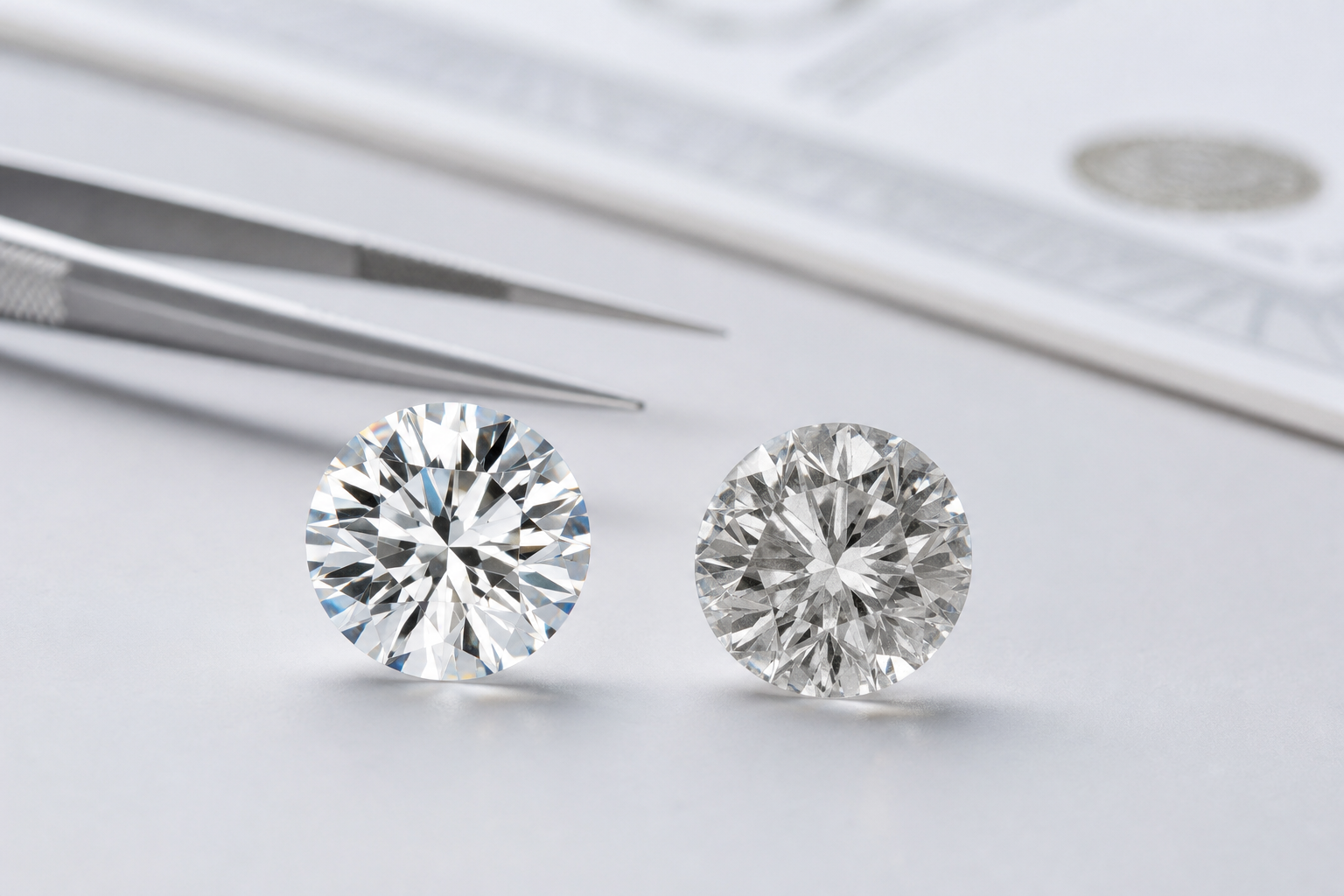
Many differences buyers notice between diamonds come from shape, size, and proportions rather than origin. A lab-grown oval and a natural round diamond will not look the same, but the reason is geometry, not the fact that one is lab-grown and the other is natural.
This is a common source of confusion in lab-grown vs natural diamond appearance. Buyers may compare two stones with different shapes and assume the origin is creating the visual difference. In reality, the outline, facet pattern, depth, length-to-width ratio, and face-up measurements are doing most of the work.
Why a round diamond and an oval diamond do not reflect light the same way
A round brilliant diamond is designed for balanced light return from a symmetrical outline. It often gives a classic mix of brightness, fire, and sparkle across the stone. Oval, pear, marquise, and radiant cuts can look larger for their carat weight, but their elongated shapes may create more variation in brightness from one area to another.
This does not make one shape better in every case. It means the buyer is choosing a visual personality. A round diamond is often the safer choice for consistent sparkle. An oval diamond can offer a longer, elegant look and strong finger coverage, but it needs closer review for bow-tie effect, uneven light return, and proportion balance.
A bow-tie is the darker area that can appear across the center of some elongated shapes. A slight bow-tie is common and may not be a problem. A strong, distracting bow-tie can make the diamond look less lively, especially in video or everyday movement.
Fancy shapes also require more visual judgment because their appeal is less easily reduced to one cut label. Two ovals, cushions, or radiants with similar grades can have very different outlines, corner shapes, depth distribution, and light patterns. For these shapes, the report is useful for confirming dimensions and identity, but the buyer still needs images or video to decide whether the stone looks balanced rather than stretched, bulky, watery, or uneven.
Face-up size can matter more than carat weight alone
Carat weight tells you how much a diamond weighs, not exactly how large it looks from above. Two diamonds with the same carat weight can have different face-up sizes depending on depth and proportions, and lab grown diamond pricing adds another comparison layer when buyers evaluate weight, spread, and value together. A deeper stone may carry more weight below the surface and appear smaller on the hand.
This matters especially for buyers comparing lab-grown diamonds and natural diamonds within a budget. If one option gives you more carat weight but poor spread or weak light return, the size advantage may not be as meaningful as it first appears. A slightly smaller diamond with better proportions can look more balanced, brighter, and more intentional in the finished ring.
For elongated shapes, length-to-width ratio also changes the look. A 1.35 ratio oval feels softer and rounder, while a 1.45 ratio oval looks longer and slimmer. Neither is automatically correct. The better choice depends on finger shape, setting style, and the visual effect the wearer prefers.
Step cuts and brilliant cuts show beauty differently
Brilliant cuts, such as round, oval, cushion, pear, radiant, and many elongated styles, are designed to create more sparkle and smaller flashes of light. Step cuts, such as emerald cuts and Asscher cuts, show broader flashes, cleaner lines, and a more open view into the diamond.
This changes how buyers should judge them. A brilliant cut can hide small inclusions more easily because the facet pattern is busier. An emerald cut is less forgiving because its large, open facets can make inclusions, color, and transparency easier to see. If you want a step cut, clarity and overall crystal appearance often deserve more attention than they would in a very sparkly brilliant cut.
The mistake is expecting every shape to perform like a round brilliant. An emerald cut that shows calm flashes and mirror-like depth is not failing because it does not sparkle like a round. It is offering a different kind of beauty, and it should be evaluated by the standards of that shape.
Stone-to-Setting Fit Check
Before choosing a diamond, consider how the stone will sit in the actual jewelry design. A diamond that looks impressive loose may feel too wide, too narrow, too deep, or visually unbalanced once it is placed in a ring.
For a solitaire, proportions and outline are highly visible because there is little to distract from the center stone. In a halo, the center diamond’s face-up size and shape need to work with the surrounding stones. In a three-stone ring, the center stone must also harmonize with side stones, not just look good by itself.
The better choice is not always the largest diamond on the page. It is the diamond whose shape, measurements, light performance, and setting design work together without creating a visual compromise the buyer will notice later.
For custom design, trust comes from matching the diamond to the setting, budget, and wearer’s daily use—not from choosing grades in isolation. Before a stone is finalized, the buyer should confirm whether its depth, girdle outline, prong placement, and face-up dimensions are compatible with the intended design, especially for elongated shapes, bezels, halos, and low-profile settings.
For custom jewelry, stone measurements and setting compatibility should be confirmed before finalizing a purchase. This includes not only the center diamond’s length and width, but also depth, girdle thickness, prong access, accent-stone alignment, and whether the finished design will protect the stone appropriately for the wearer’s routine.
What the Eye Can See: Sparkle, Color, Clarity, and Cloudiness
Eye-clean does not mean flawless
An eye-clean diamond is not a flawless diamond. It simply means the inclusions are not noticeable to the unaided eye under normal viewing conditions. That distinction matters because many buyers overpay for clarity grades they cannot see, while others ignore a visible flaw because the grade sounds acceptable on paper.
With diamond clarity, the practical question is not “Does this diamond have inclusions?” Most diamonds do. The better question is whether those inclusions affect what you see face-up in the finished jewelry. A small inclusion near the edge may disappear once the stone is set. A dark crystal under the table, by contrast, can be visible every time the diamond catches still light, especially in larger stones or open settings.
If you are reviewing photos or a 360-degree video, look for obvious dark marks, distracting white feathers, or inclusions that sit in the center of the diamond. Do not judge only from highly magnified images, because magnification can make harmless characteristics look alarming. The mistake is treating every inclusion as equally important. Location, contrast, size, and whether the inclusion reflects inside the stone matter more than the presence of a plotted mark on a report.
Color differences are easier to notice in some settings and shapes
Diamond color is visible only when it creates a tint your eye can pick up in the actual design. A diamond that looks white in one ring may show a warmer tone in another, depending on shape, size, lighting, and metal color. This is why asking “What diamond color looks white?” has no single answer that works for every buyer.
Round brilliant diamonds tend to hide warmth better because their facet pattern returns a lot of light. Step cuts such as emerald and Asscher cuts are less forgiving because their broad, open facets reveal body color more easily. Larger diamonds can also show tint more clearly than smaller ones. If you are choosing a yellow or rose gold setting, a slightly warmer diamond color may still look balanced; in platinum or white gold, the same warmth can be more noticeable.
The key is to avoid paying for a higher color grade just because it sounds safer. If the diamond faces up white in the setting you want, the visual benefit of going higher may be small. On the other hand, if you are sensitive to warmth, choosing a lower color grade in an elongated or step-cut stone can become a decision you notice every day.
Cloudiness is a transparency issue, not an origin label
A cloudy diamond looks hazy, milky, or muted instead of crisp and lively. This is not a lab-grown diamond problem by definition, and it is not exclusive to natural diamonds either. Cloudiness is a transparency issue. It can appear when certain clarity characteristics, growth features, graining, or overall material quality interfere with how cleanly light moves through the stone.
The warning sign is not simply less sparkle. A diamond can have a quieter sparkle pattern because of its shape or cut style. Cloudiness is different: the stone may look like it has a soft film over it, even when it is clean. In photos, this can show up as a lack of sharp contrast. In video, the diamond may look flat while similar stones beside it appear brighter and more defined.
For buyers comparing lab-grown diamond sparkle, this is where side-by-side review helps. A well-cut lab-grown diamond should not look fake, glassy, or dull simply because it is lab-grown. If it does, the issue is more likely cut, proportions, transparency, or lighting presentation than origin alone.
Certificate and Visual Review Check
Use the grading report to understand the diamond’s stated color and clarity, then use photos and video to decide whether those grades translate into a good-looking stone. The report can help you screen options, but it will not show you whether an inclusion bothers your eye, whether the color feels too warm in your chosen metal, or whether the diamond has the crisp transparency you want.
A practical review should include a face-up image, a side view when available, a 360-degree video, and comparison against at least one similar diamond. If two stones have similar grades but one looks brighter, cleaner, and more transparent, the better-looking stone is usually the stronger choice for jewelry, even if the paper difference seems minor.
What You Usually Cannot See Without Professional Identification
Why origin is a verification question, not a visual guess
Diamond origin is usually not something a person can confirm by looking across a table, in a jewelry case, or at an engagement ring on someone’s hand. A lab-grown diamond and a natural diamond can share the same visible beauty traits: brightness, fire, clarity appearance, and color. If both are well cut and properly selected, origin is not normally the feature your eye is detecting.
This is where buyers often mix up two different questions. “Does this diamond look good?” is a visual judgment. “Is this diamond lab-grown or natural?” is a verification question. A jeweler may be able to raise suspicions from documentation, inscriptions, or testing, but a casual visual inspection is not the same as lab-grown diamond identification.
The risk is relying on confidence instead of proof. Someone saying they can “just tell” by looking is not enough for a purchase decision. Origin should be confirmed through appropriate documentation or professional diamond testing, not social guesses or assumptions about size, price, or sparkle.
How reports and inscriptions help identify lab-grown diamonds
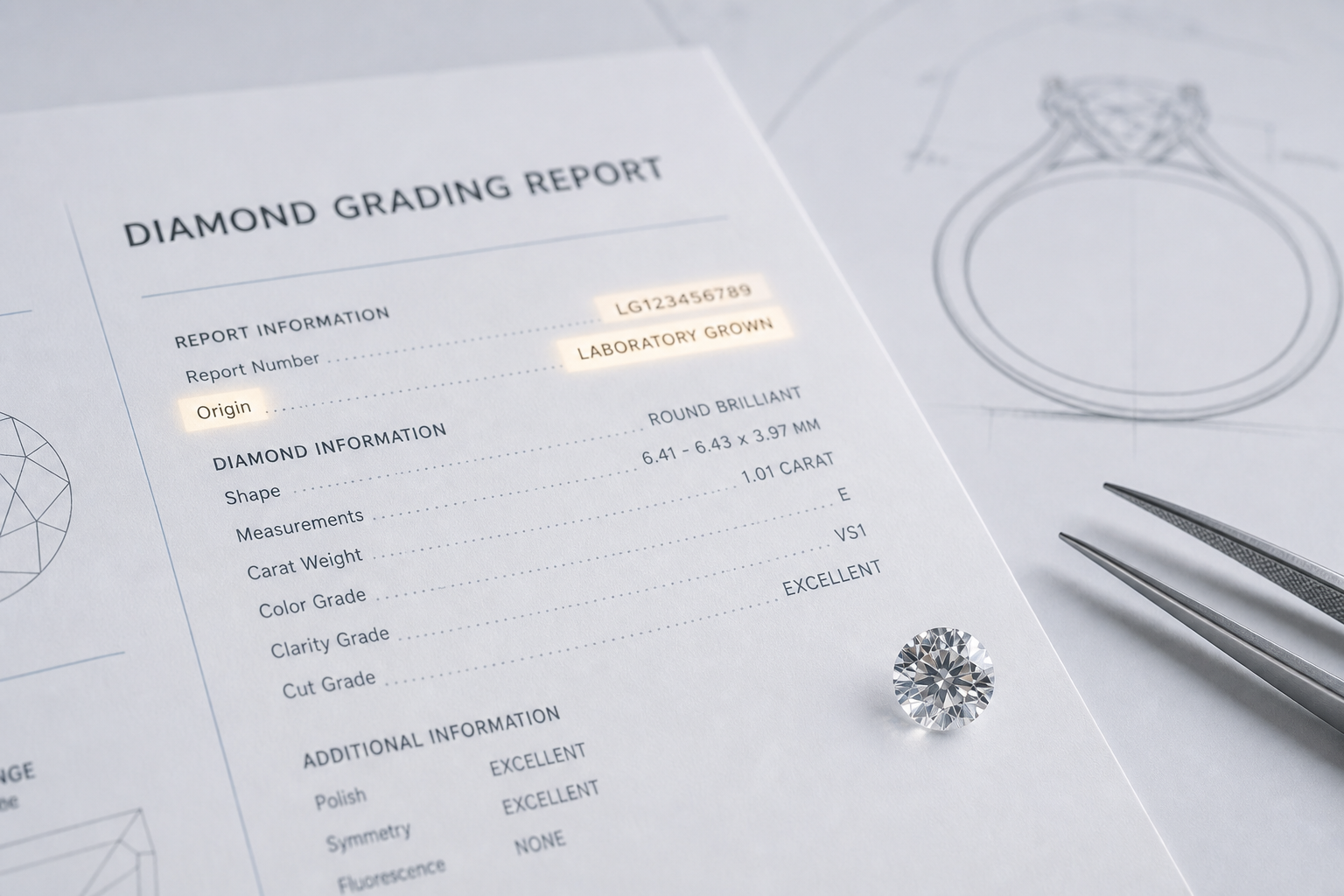
A diamond grading report issued for a diamond should state whether the stone is laboratory-grown or natural when origin is part of the report. For buyers, this is the clearest starting point. The report also gives you a way to confirm that the diamond being offered matches the documented stone.
Many diamonds have a laser inscription on the girdle that corresponds to a report number. This inscription is small and typically requires magnification to see. It can be useful, but it should not be treated as a complete substitute for checking the report itself. When possible, verify the report number directly with the issuing laboratory’s database so the details match what you are being shown.
The report tells you what was assessed and recorded. It does not guarantee that the diamond will look beautiful in every setting, and it does not replace visual evaluation. At NUVU, we treat documentation as the starting point for trust, then compare the actual diamond’s appearance before judging whether it is the right choice.
It is also worth checking consistency between every piece of information: report number, inscription, measurements, carat weight, shape, and any seller-provided media. A mismatch does not always prove a problem, but it should be clarified before purchase. If a diamond is already set and the inscription is hard to view, the buyer should understand how the seller connects the mounted stone to the report.
A grading report can narrow the comparison, but it should be read alongside the stone’s proportions, visual evidence, and intended jewelry use. Reports are especially useful for identity and baseline characteristics; they are less useful for predicting personal preferences such as whether an oval’s bow-tie feels distracting, whether a warmer tone feels acceptable, or whether the stone has the presence the buyer wants in a finished ring.
When a grading report is available, buyers should verify the report details through the issuing laboratory’s official report-check tool where available.
What a grading report can and cannot prove
A grading report helps document key characteristics, but it should not be treated as a guarantee of beauty, value, or sourcing ethics. It may document items such as carat weight, measurements, color, clarity, polish, symmetry, fluorescence, and origin disclosure, depending on the report type and laboratory. Those details are useful, but they are not the same as seeing how the diamond performs in the intended jewelry design.
Buyers should also avoid assuming that a report from any laboratory proves more than it actually states. A report does not automatically confirm a seller’s return policy, after-sales support, environmental claims, or whether the stone will match personal taste. The safest reading is specific: look at what the report documents, check whether the report can be verified through the laboratory’s tools where available, and then compare that information with the actual diamond media and seller documentation.
NUVU’s buyer-first approach is to make comparison clearer, especially around report details, visual evidence, setting fit, and documentation. That means a recommendation should explain why a specific stone fits the design and the buyer’s priorities, not rely on report language alone as a shortcut.
Why normal viewing is different from gemological testing
Professional diamond testing uses tools and methods designed to detect growth-related characteristics that are not obvious to the naked eye. Some screening devices can help separate diamonds that need further testing, while gemological laboratories can perform more detailed identification. This is very different from looking at a diamond under restaurant lighting or even with a basic loupe.
A loupe can reveal inclusions, inscriptions, and some clarity characteristics, but it does not automatically prove origin in every case. The more reliable path is to use the grading report, inscription, seller documentation, and professional testing when needed. This is especially important for buyers comparing higher-value stones or purchasing from a source where documentation is incomplete.
For everyday jewelry buyers, the practical takeaway is simple: judge beauty with your eyes, but verify origin with documents and appropriate testing. Those two steps protect you from two different mistakes: buying a diamond that looks disappointing, or buying a diamond that is not represented accurately.
How to Verify This Before Buying
Before purchasing, ask for the grading report and confirm whether it identifies the diamond as laboratory-grown or natural. Check that the report number, measurements, carat weight, and inscription details match the diamond being offered. If the diamond is already set and the inscription is difficult to view, ask how the seller confirms the match between the stone and the report.
If documentation is missing, unclear, or inconsistent, treat that as a warning sign. A beautiful diamond can still be a poor purchase if the origin is not represented clearly. For buyers who care about lab-grown versus natural origin, verification should happen before payment, not after the ring is finished.
How Lighting, Setting, and Jewelry Design Change Perception
Why diamonds look different in store lighting, daylight, and indoor light
A diamond can look dramatically different from one environment to another, even when nothing about the stone has changed. Jewelry-store lighting is often designed to maximize sparkle. Bright spotlights, focused LEDs, and controlled display angles can make many diamonds look more lively than they will in an office, kitchen, car, or shaded outdoor setting.
Daylight can reveal body color more honestly, especially in larger stones and shapes that show warmth easily. Diffused indoor light may make contrast and transparency easier to judge because the diamond is not being flooded with sparkle-producing light. Direct sunlight can create intense flashes but may also make it harder to evaluate whether the diamond looks balanced in normal wear.
The mistake is choosing a diamond based only on its best lighting moment. A strong diamond should still look attractive in ordinary conditions, not just under showroom lights. If you are buying online, review videos under neutral lighting when available, and avoid making the decision from a single glamour image.
How metal color can influence perceived whiteness
The diamond setting can change how white or warm a diamond appears. White gold and platinum create a cool frame around the stone, which can make warmth easier to notice if the diamond has a visible tint. Yellow gold and rose gold can soften that contrast, sometimes making a slightly warmer diamond look more intentional and harmonious.
This does not mean yellow gold automatically hides all color, or that white metal always requires a high color grade. The shape, size, and viewer’s sensitivity still matter. A round brilliant in a near-colorless range may look crisp in white metal, while an emerald cut of the same grade may show more warmth because of its open facet pattern.
For an engagement ring appearance that feels bright and balanced, evaluate the diamond and metal together. A color grade that works well in a solitaire yellow gold ring may not give the same impression in a platinum halo with bright accent stones.
How setting style changes size, sparkle, and contrast
Setting style affects how the diamond is perceived once it becomes jewelry. A solitaire setting keeps attention on the center stone and makes cut quality more obvious. A halo setting can increase the visual footprint and make the ring look larger from a distance, but it can also create more visual activity around the center diamond. A bezel setting gives a clean, modern outline, though it may change how much light reaches the stone from the sides.
Prong style matters too. Slim prongs can make the diamond look more open, while heavier prongs or protective designs may add metal presence. This is not automatically good or bad; it depends on the wearer’s style and daily use. For someone who wants maximum visible sparkle, an open setting may be appealing. For someone with an active lifestyle, protection and durability may matter more than the last small gain in light exposure.
Accent stones can also influence contrast. Bright side stones may make a center diamond’s color or cut weakness more noticeable. If the center stone is slightly warm, pairing it with very white accents can exaggerate the difference, especially when comparing grading considerations in a lab grown diamond guide. Matching the full design matters more than choosing the center stone in isolation.
What to Check Before You Decide
View the diamond in more than one lighting condition, and if possible, see it next to the metal color and setting style you plan to use. For online purchases, compare videos of similar diamonds rather than judging one stone alone. Pay attention to whether the diamond still looks bright, clean, and balanced when the lighting is not overly flattering.
The better visual choice is not always the highest grade on paper. It is the diamond that performs well in the actual ring design, suits the wearer’s taste, and avoids visible issues that will become hard to ignore in daily wear.
A Real Buyer Scenario: Two Diamonds That Look Similar but Are Not Equal Choices
The comparison that seems simple at first
Maya is choosing between two oval diamonds for an engagement ring: a 1.50 ct lab-grown diamond and a 1.20 ct natural diamond. At first glance, both look white, both appear clean to the naked eye, and both have enough sparkle to feel convincing in a quick viewing. The larger lab-grown oval gives her more visible size for the budget, while the natural oval carries the origin preference she had originally imagined. If she stops there, the buyer comparison looks like a simple choice between size and origin.
The problem is that lab-grown vs natural diamond appearance is not the detail that changes the decision. The 1.50 ct lab-grown oval has a more noticeable bow-tie across the center and slightly shorter measurements than expected for its carat weight. The 1.20 ct natural oval has a smaller face-up presence, but its proportions look more balanced in video and the bow-tie is less distracting. Neither diamond is automatically the better choice because of origin; the stronger choice depends on which visual tradeoff matters more in the finished ring.
The details that change the decision
The grading report gives Maya the baseline facts: carat weight, color, clarity, measurements, cut-related information, and origin. But the report does not tell her whether the bow-tie will bother her every time she looks at the ring, or whether the larger stone will sit well in the setting she wants. That is where visual evaluation becomes more important than the headline grade.
For an elongated shape like an oval, measurements can matter as much as carat weight. A heavier diamond can carry weight in depth instead of spread, which means it may not look as large from the top as the carat number suggests. A lower-carat diamond with better face-up dimensions can sometimes look surprisingly close in size, especially once it is set. This is one of the most common places buyers make an emotional mistake: they chase the bigger number without checking whether the extra weight actually shows.
The setting choice also changes the recommendation. If Maya wants a delicate solitaire, the bow-tie and outline of the oval will be easy to notice because the center stone has no visual distraction around it. If she wants a halo or a more detailed setting, the larger lab-grown diamond may create the overall presence she wants, even if the stone itself is not as visually even. The right decision is not just “which diamond is better,” but which diamond works better for the ring she is actually building.
The practical takeaway for buyers
A diamond that looks similar in a quick comparison may not be an equal choice after closer review. Carat weight, grading report details, and origin are useful, but they do not replace looking at the stone’s proportions, movement, contrast, and fit with the setting. A strong-looking diamond for a given budget is usually the one with a good relationship between size, visual performance, and design compatibility, not the one with the most impressive single number.
If you are choosing between lab-grown and natural diamonds, compare the two as finished-jewelry candidates rather than abstract stones. Ask which one looks brighter in real movement, which one faces up better, which one has the fewer distracting visual issues, and which one supports the ring style you actually want to wear.
Prices can change with market conditions, report type, seller channel, and stone-specific details, so exact comparisons should be verified at the time of purchase. When comparing a lab-grown diamond with a natural diamond, compare like-for-like specifications and current seller information rather than assuming that one category automatically provides the better financial outcome for every buyer.
How to Evaluate a Lab-Grown Diamond Visually Before Buying
Start with the report, then look at the actual diamond
To evaluate a lab-grown diamond well, start with the grading report but do not stop there. The report should confirm that the stone is laboratory-grown, list the graded color and clarity, show the measurements, and provide the basic identity of the diamond. It helps you avoid comparing stones that only seem similar because the listing titles look alike.
The report is a filter, not a final verdict on beauty. Two diamonds with the same carat weight, color, and clarity can look different because their proportions, shape details, and light return are not identical. For round brilliant diamonds, cut grade carries more direct visual value than many buyers realize. For fancy shapes, the report may give useful measurements, but video and photos become even more important because visual balance is less standardized.
At NUVU, we treat the grading report as the starting point for comparison, not the whole decision. A report can confirm important facts, but it cannot fully show how bright, lively, or well-suited the diamond will look in a specific ring design.
Use photos and video to check brightness, contrast, and visible inclusions
Good diamond visual review depends on seeing the actual stone, not just reading its grades. Photos should show the diamond face-up, and a 360-degree video should show how it behaves as it moves. Look for even brightness across the stone, clean contrast patterns, and sparkle that does not disappear when the diamond rotates.
Do not judge only by a single bright frame. Online diamond videos are often taken under controlled lighting, and almost any diamond can look appealing at the right angle. Watch for areas that stay dark, a strong bow-tie in elongated shapes, a watery or glassy look, or a hazy appearance that makes the diamond seem less crisp. These issues are more useful to catch before buying than after the stone is already set.
Clarity should be judged by visibility, not just grade. An eye-clean diamond does not mean flawless; it means the inclusions are not distracting in normal viewing. A small inclusion near the edge may be easy to hide under a prong, while a darker inclusion under the table can be much harder to ignore. If a stone has strong grades but the video keeps drawing your eye to one flaw, trust what you are seeing.
Compare measurements, not just carat weight
Carat weight tells you how much the diamond weighs, not exactly how large it will look. For round diamonds, compare diameter. For ovals, pears, emerald cuts, radiants, and cushions, compare length, width, and length-to-width ratio. These numbers help you understand whether a diamond’s weight is showing face-up or hidden in depth.
A 1.50 ct oval with a 1.35 length-to-width ratio will look different from a 1.50 ct oval with a 1.50 ratio, even if the grading report details are similar. The first may feel softer and wider; the second may look longer and more slender. Neither is automatically better, but one may suit the wearer’s hand or setting style more naturally. For rings, that visual fit often matters more than chasing a small grade improvement that no one will notice.
Setting compatibility should be part of the visual review. A low-profile bezel, a delicate four-prong solitaire, and a halo setting can make the same diamond feel very different. Before choosing, think about whether the stone’s outline, depth, and proportions will work with the design rather than treating the diamond as a separate purchase.
Buyer Verification Checklist
- Confirm the report details. Check origin, carat weight, color, clarity, measurements, and report number before comparing appearance.
- Review the actual stone. Use photos and 360-degree video to judge brightness, contrast, sparkle pattern, and visible inclusions.
- Check for transparency issues. Be cautious with stones that look hazy, milky, or dull even when the listed grades seem attractive.
- Compare face-up size. Look at diameter for rounds and length, width, and length-to-width ratio for fancy shapes.
- Match the stone to the setting. Consider metal color, prong placement, stone depth, outline, and whether the design will emphasize or soften visual traits.
- Compare similar options side by side. Two or three close choices will usually reveal which diamond has the strongest visual balance.
A useful diamond buying checklist is not the longest one. It is the one that forces you to compare what will actually be visible: brightness, proportions, clarity visibility, color impression, and how the diamond will look once it becomes jewelry.
Documentation Support After You Narrow the Choice
Once you have narrowed the selection to one or two diamonds, the trust step is to make sure the visual choice and the paperwork agree. Ask for the report number, full measurements, stated origin, and any available inscription information before final approval. If a seller is helping you compare options, the explanation should connect the visual recommendation to specific details such as cut behavior, face-up dimensions, clarity placement, color in the intended metal, and setting fit.
This is especially useful for online or custom jewelry purchases, where the buyer may not hold the loose diamond before production begins. Clear communication should reduce uncertainty: which diamond is being used, why it was selected, how it compares with alternatives, and what documentation will accompany the finished piece. A careful process does not need dramatic claims; it needs consistent records and a seller willing to explain the tradeoffs honestly.
For NUVU, the goal is to make diamond comparison easier to understand, especially when buyers are weighing report details, visual performance, setting fit, and budget together. A useful recommendation should explain the tradeoff clearly: why one stone may be brighter, why another may face up larger, why a grade difference may or may not be visible, and what still needs to be confirmed before the piece is finalized.
When a grading report is provided, buyers should compare the report details with the issuing laboratory’s verification tools where available.
Before purchase, buyers should also confirm the seller’s documentation, return policy, resizing terms, and after-sales support in writing.
When Origin Still Matters Even If Appearance Looks the Same
Appearance is only one part of the decision
Even if a lab-grown diamond and a natural diamond look the same in everyday jewelry, origin can still matter. Appearance answers one question: “Will this look beautiful on the hand?” Origin answers a different question: “Does this purchase match what I value?” Confusing those two questions often leads buyers into an argument that does not help them choose.
Some buyers are most satisfied when they can maximize size, cut quality, and visual performance within a specific budget. For them, lab-grown diamond origin may be completely acceptable because the finished ring delivers the look they want without forcing the same tradeoff in carat weight or setting design. Other buyers feel more attached to natural diamond origin because of its geological history, rarity association, or personal symbolism. Neither priority is wrong, but pretending they are the same priority creates unnecessary doubt.
If sustainability, sourcing, or production method is part of the decision, treat those points as documentation questions rather than assumptions. A lab-grown diamond can offer a different sourcing path from a mined diamond, but that does not automatically prove every sustainability claim. Buyers who care about these issues should look for clear seller communication, relevant documentation where available, and careful wording rather than relying on broad claims such as “eco-friendly” or “ethical” without support.
Sustainability claims should be specific and documented. Broad green language is less useful than clear information about production context, energy information where available, sourcing records, and seller transparency. A responsible comparison should avoid assuming that origin alone proves the full environmental or social profile of a diamond.
This same caution applies to any value-based claim connected to origin. A buyer may prefer one option because of budget, personal meaning, sourcing preference, or long-term expectations, but those preferences should be named clearly instead of being disguised as visual facts. The more precisely the buyer separates appearance, documentation, and personal priority, the easier it becomes to make a decision that still feels right after purchase.
Documentation helps align the purchase with your preference
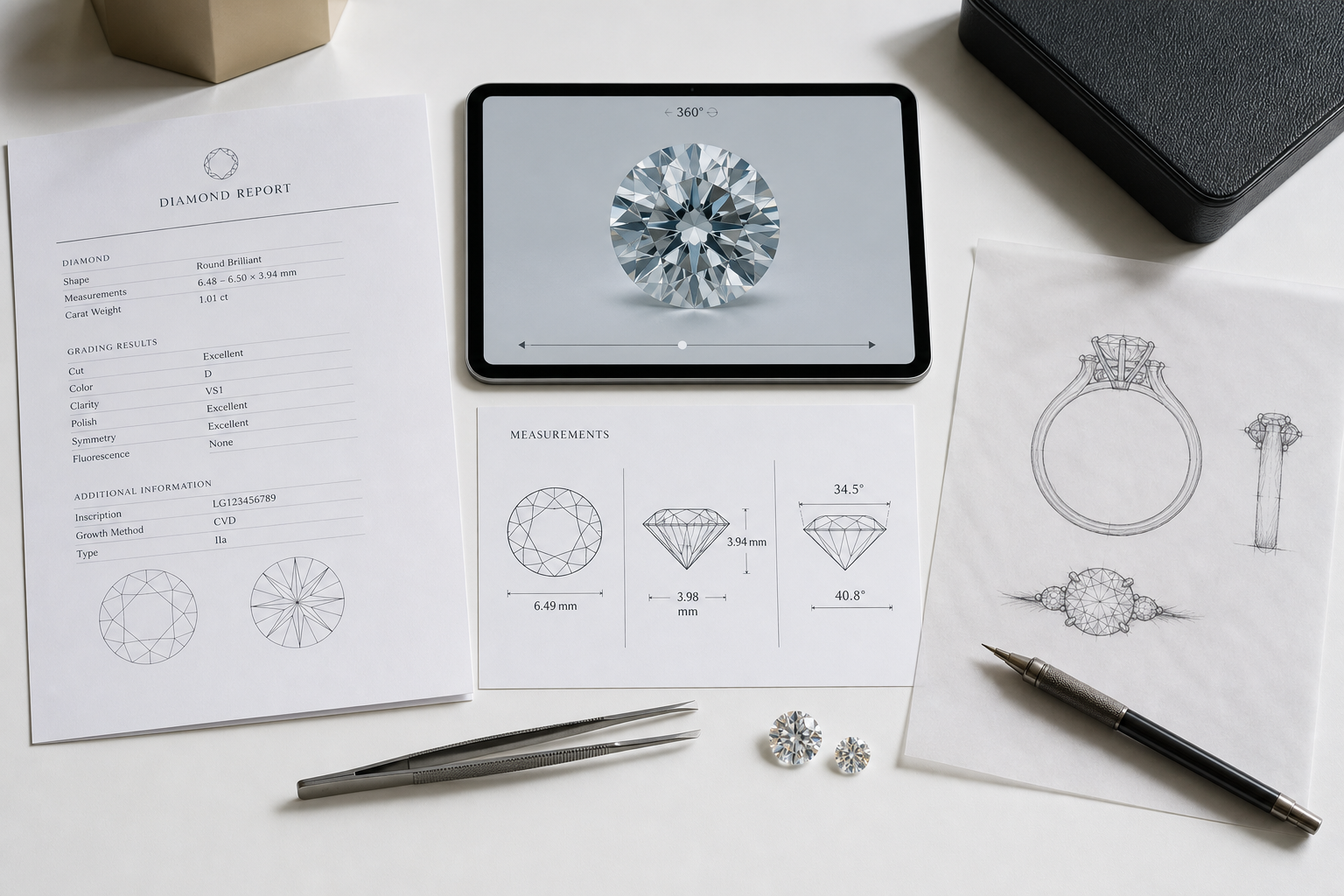
If origin matters to you, documentation is what keeps the decision clear. A grading report should identify whether the diamond is laboratory-grown or natural when issued for that purpose. The report number and any corresponding inscription can help connect the physical stone to the paperwork, although the details should still be reviewed carefully.
This matters because origin is not something most people can confirm by casual viewing. A diamond may look exactly like what you hoped for, but the buying decision should still be supported by the right report. Documentation does not make one origin better for every buyer; it makes sure the stone you buy matches the preference you are paying for.
Value priorities differ from buyer to buyer
Diamond value is not only a question of what looks largest or brightest. It can include budget allocation, resale expectations, symbolic preference, documentation confidence, and how much the buyer cares about natural origin versus visual result. Resale should be treated cautiously for both categories; no buyer should assume a diamond purchase will behave like a guaranteed investment.
The practical judgment is simple: if your main priority is everyday jewelry appearance, focus first on cut, proportions, visible clarity, color impression, and setting fit. If natural origin, rarity association, or long-term value expectations are central to your decision, then origin deserves more weight even when the visual difference is not obvious. A strong purchase is one where the diamond’s appearance and its documentation both support the reason you chose it.
How to keep origin-based claims in perspective
Origin can support a personal preference, but it should not be used as a shortcut for every other claim. A laboratory-grown diamond is not automatically the right choice for every buyer, and a natural diamond is not automatically more beautiful in a finished ring. The more reliable comparison is to identify what the buyer is actually prioritizing: appearance, size, documentation, personal symbolism, production origin, or budget allocation.
Environmental and sustainability claims should be specific, documented, and limited to what can be substantiated. If a seller describes a diamond or jewelry piece with broad sourcing or environmental language, buyers should ask what information supports the claim and whether that information applies to the specific stone, setting, or production process being discussed.
Pricing claims also need context. Prices can vary because of cut precision, report type, seller channel, size, shape, availability, and documentation. Buyers should compare like-for-like specifications before treating one stone as a better value, and they should avoid assuming that resale or long-term market behavior is predictable from origin alone.
The Bottom Line: Judge Beauty With Your Eyes and Origin With Documentation
What you can see
Most people cannot tell whether a diamond is lab-grown or natural by looking at it in normal jewelry. Across a dinner table, in an engagement ring, or under everyday lighting, diamond origin is not the visual feature that usually stands out.
What buyers can see is diamond appearance: brightness, sparkle pattern, face-up size, color impression, visible inclusions, transparency, and how the stone works with the setting. A well-cut lab-grown diamond can look bright and lively. A poorly cut natural diamond can look flat. The reverse can also be true. Origin does not rescue weak cut quality, and it does not replace careful visual evaluation.
The most useful judgment is simple: if two diamonds look different to your eye, the reason is more likely cut, shape, proportions, color, clarity visibility, or setting design than whether one formed underground and the other formed in a laboratory.
What you need documentation to confirm
Origin should be confirmed through a diamond report, inscription, seller documentation, or appropriate professional testing. It should not be treated as a visual guessing game. A casual look, even from someone familiar with jewelry, is not the same as verifying whether a diamond is laboratory-grown or natural.
This is where the report matters most. It helps confirm what the stone is being represented as, including whether it is a lab-grown diamond or a natural diamond when the report is issued for that purpose. The report also gives the buyer a reference point for carat weight, measurements, color, clarity, and cut information, but it should not be mistaken for a full prediction of beauty in every lighting condition.
The practical mistake to avoid is using documentation to judge appearance or using appearance to confirm origin. They answer different questions. Your eyes tell you whether the diamond looks good to you. The paperwork helps confirm what you are buying.
The smartest way to compare diamonds visually
The strongest comparison combines both sides: visual review and documentation. Start with diamonds that are properly represented, then compare how they actually look. Prioritize cut quality and proportions first, because those have the greatest effect on everyday jewelry appearance. Then check whether the color looks right for the shape and setting, whether the clarity is clean to the eye, and whether the measurements support the visual size you expect.
If you are asking, “Do lab-grown diamonds look the same as natural diamonds?” the most accurate buyer-focused answer is this: they can look the same in the ways people normally notice, but individual diamonds do not all look equally good. The better question is whether the specific stone in front of you has the brightness, balance, transparency, and fit that make sense for the ring or jewelry piece you are choosing.
Use your eyes to judge beauty. Use the diamond report to confirm origin. Use cut quality, proportions, photos, video, and setting context to decide which diamond is actually the stronger choice.
Disclosure: This article is for general educational purposes only. Diamond grading, pricing, availability, specifications, and seller policies can change, and readers should verify important details through grading reports, official laboratory tools, seller documentation, or qualified professionals before making a purchase decision. Laboratory-grown diamonds should be clearly distinguished from natural diamonds, and environmental or sourcing claims should be supported by specific documentation.