
Buying a lab-grown diamond is not really a question of whether it is “better” than a natural diamond, but understanding real lab-grown diamonds can help clarify what separates natural, laboratory-created, and imitation stones. It is a question of fit: what you want the stone to do visually, emotionally, and financially. Some buyers care most about size, cut quality, setting design, and staying within a clear budget. Others place more weight on geological rarity, tradition, family expectations, or the story behind a natural stone.
For the full framework, read What Are Lab-Grown Diamonds? A Complete Guide.
This article helps you sort those priorities before you compare prices or choose a shape. It looks at who tends to benefit most from lab-grown diamonds, where the tradeoffs appear, how grading reports and visual checks should be used together, and why the setting matters as much as the diamond for daily wear. The goal is to help you choose the option you will still feel good about later.
One useful way to read the comparison is to separate facts from preferences. Lab-grown and natural diamonds can share the same basic diamond material and many of the same grading categories, but they do not carry the same origin story, market perception, or emotional signal for every buyer. A trustworthy decision comes from knowing which differences are visible, which are documented, and which are personal.
Laboratory-grown diamonds should be clearly identified as laboratory-grown, and they should not be presented as mined diamonds. Natural diamonds and laboratory-grown diamonds have different origins, while diamond simulants are a separate category and should not be confused with either type of diamond.
| Buyer Priority | Lab-Grown May Fit If | Natural May Fit If |
|---|---|---|
| Visible size | You want more spread or carat presence within budget | You prefer rarity even if the stone is smaller |
| Emotional meaning | Design, practicality, and personal style matter most | Geological origin or heirloom symbolism matters most |
| Quality comparison | You will review grading, photos, video, and measurements | You value natural origin alongside graded quality |
| Ring design | You want flexibility for shape, setting, and larger center stones | You want a traditional choice tied to long-term family expectations |
| Daily wear | You choose a secure setting with practical proportions | You still need the same setting durability checks |
| Responsibility claims | You ask for production details and seller transparency | You ask about sourcing, documentation, and traceability |
Quick Questions Before You Read
Q: Who is a lab-grown diamond well suited for?
Someone who prioritizes visual size, design flexibility, documented quality, and budget control over natural origin.
Q: Is a lab-grown diamond durable enough for an engagement ring?
Generally, yes. The bigger concern is the setting: prong security, band width, profile height, and lifestyle fit.
Q: Should I judge value by carat weight alone?
No. Measurements, cut, proportions, shape, and visible performance often matter more than the number on the report.
Q: When might a natural diamond be the better choice?
When rarity, tradition, family expectations, or the emotional meaning of geological origin are central to the purchase.
Evidence note for buyers: The most defensible diamond decisions usually separate three kinds of information: what a grading report documents, what visual inspection shows, and what the buyer personally values. A report can help describe a diamond’s measured and graded characteristics, but it does not prove that a specific ring design will feel comfortable, that a sustainability claim is complete, or that a buyer will feel emotionally satisfied with the origin choice. Treat documentation as a foundation, not as a substitute for judgment.
Start With the Real Question: What Do You Want the Diamond to Do for You?
The better question is fit, not superiority
Who should buy a lab-grown diamond? The clearest answer is this: a lab-grown diamond is a strong fit for buyers who want the look, durability, and graded quality of a diamond while prioritizing size, design flexibility, and budget efficiency over natural geological origin.
The weaker question is whether lab-grown diamonds are “better” than natural diamonds. Better for what? A buyer choosing an engagement ring for visual impact may make a different decision than someone buying a family heirloom where natural origin carries deep emotional weight. Both choices can be reasonable. The mistake is treating the decision like a universal ranking instead of a personal fit question.
Lab-grown diamonds solve some buying problems especially well. They can make it easier to consider a larger center stone, a higher color or clarity range, or a more detailed setting within the same overall project budget. They also fit buyers who like a modern, report-aware buying process and want to compare diamonds with clear specifications rather than vague romance language.
They do not solve every priority. If the meaning of the purchase depends heavily on geological rarity, long natural formation, or traditional family expectations, a natural diamond may feel more satisfying even if a lab-grown option looks similar in normal wear. That emotional difference should not be dismissed. It is often the real decision.
Traceability can help make this fit question clearer, but it should be understood correctly. A grading report, report number, inscription information, seller listing, and visual media should all point to the same stone. That alignment does not decide whether lab-grown or natural is emotionally right for you, but it does reduce avoidable uncertainty when comparing real options.
The main priorities that usually shape the decision
Most diamond decisions come down to a few priorities, but not all of them carry the same weight for every buyer. For many lab-grown diamond buyers, the leading priority is visual result: how the diamond looks on the hand, how much presence it has, and how well it fits the ring design. If that is your main goal, lab-grown often deserves serious consideration.
Budget is another major driver, but value should not be reduced to the lowest price. A better way to think about value is allocation. Are you trying to put more of the budget toward carat size? A more refined setting? A specific shape? A better color or clarity range? A lab-grown diamond can change those tradeoffs, but the final choice still depends on cut quality, measurements, documentation, and the craftsmanship of the finished piece.
Prices can change with market conditions, report type, seller channel, and stone-specific details, so exact comparisons should be verified at the time of purchase. Buyers should compare like-for-like specifications before treating one stone as a stronger value.
Origin is the priority that most often changes the recommendation. If you want a diamond because of what it physically is in the earth’s history, natural origin matters. If you want a diamond because of how it looks, wears, and supports a design goal, lab-grown may match your priorities more directly. Neither buyer is confused; they are simply buying for different reasons.
Why two smart buyers may choose differently
Two buyers can look at the same lab-grown vs natural diamond comparison and make opposite decisions without either one being wrong. One may choose lab-grown because a larger, well-cut diamond in a thoughtfully designed engagement ring feels like a better use of the budget. Another may choose natural because the origin story is central to the meaning of the purchase.
The key is to avoid borrowing someone else’s priority list. A larger diamond is not automatically the better choice if you will always wish it were natural. A natural diamond is not automatically the better choice if its smaller size or simpler setting leaves you disappointed with the finished ring. The right diamond is the one that supports the part of the purchase you will care about after the initial decision is over.
This is also why a buyer-fit approach is more useful than a sales argument. Lab-grown diamonds are not a compromise for every buyer, and natural diamonds are not the more meaningful choice for every buyer. The better decision starts with knowing which tradeoff would bother you more.
What to Clarify Before Comparing Diamonds
Before comparing individual stones, clarify what the diamond needs to do in the real purchase. If this is an engagement ring, are you optimizing for finger coverage, long-term wearability, setting style, or tradition? If it is an anniversary piece or fine jewelry gift, does the recipient care more about visible beauty, origin, or the story behind the piece?
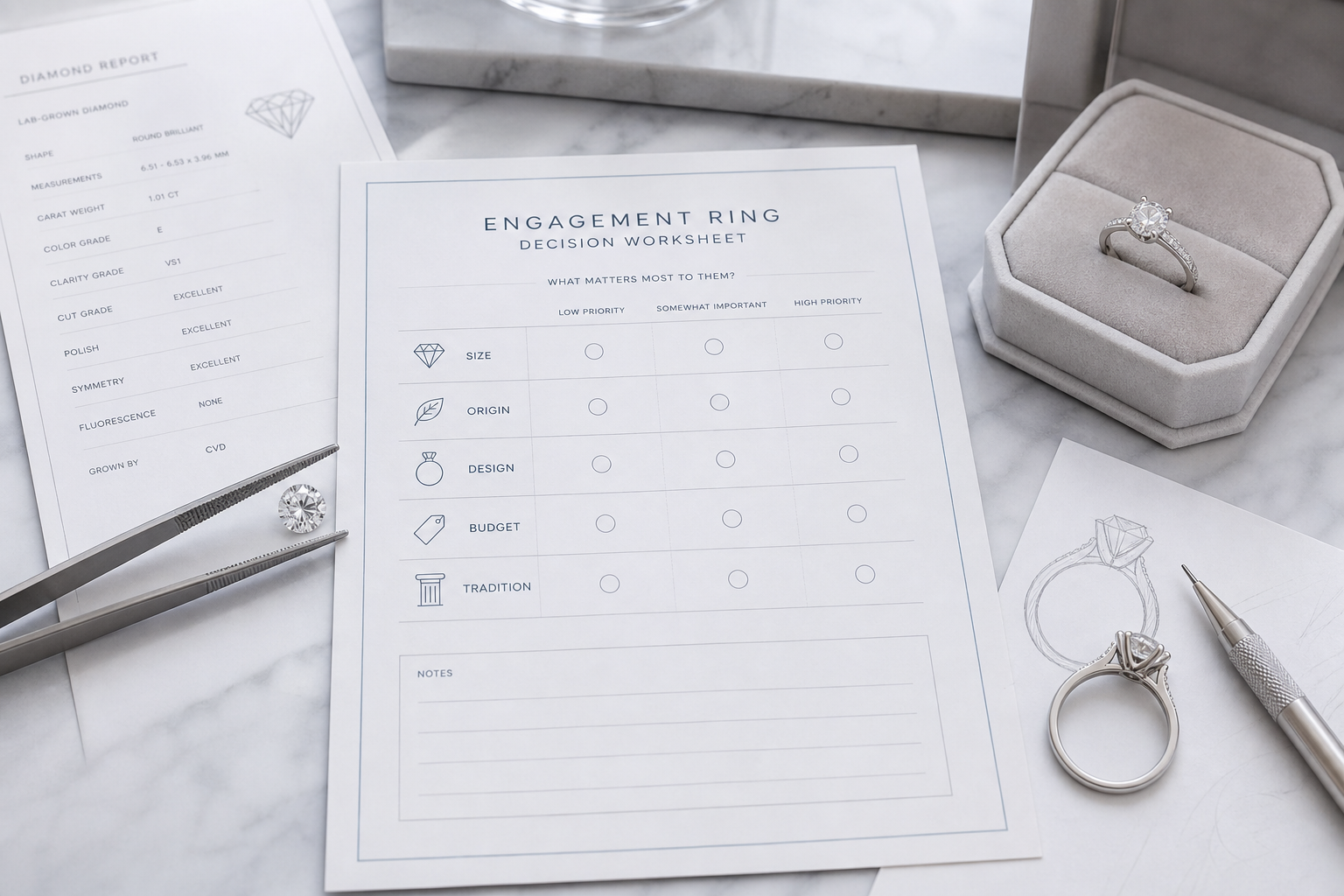
A useful starting point is to rank your top three priorities before looking at diamonds. If size, design, and budget control are at the top, lab-grown may be the more practical direction. If natural origin, rarity, and heirloom tradition rank highest, natural may deserve more weight. If your priorities are split, the next step is not to force an answer immediately, but to compare real options side by side and see which tradeoff feels acceptable.
The Size-Focused Buyer: When Visual Presence Matters Most
Why lab-grown often appeals to size-focused buyers
Lab-grown diamonds often appeal to buyers who want more visible size without treating the diamond purchase as an unlimited budget exercise. For an engagement ring, that usually means a stronger center-stone presence, more finger coverage, or the ability to consider shapes that create a larger face-up look.
This is one of the clearest buyer-fit cases for lab-grown diamonds. If the emotional success of the ring depends more on how it looks on the hand than on natural origin, lab-grown can give the buyer more room to work. The tradeoff is that size still has to be earned through good selection. A larger lab-grown diamond with weak proportions, poor light return, or an awkward outline can look less attractive than a smaller stone chosen with better judgment.
The common mistake is assuming that “bigger” and “better” move together. They do not. Size increases visibility, but it also makes proportion problems easier to notice. A poorly cut two-carat stone does not become impressive simply because the report says 2.00 ct.
Carat weight is not the same as visual size
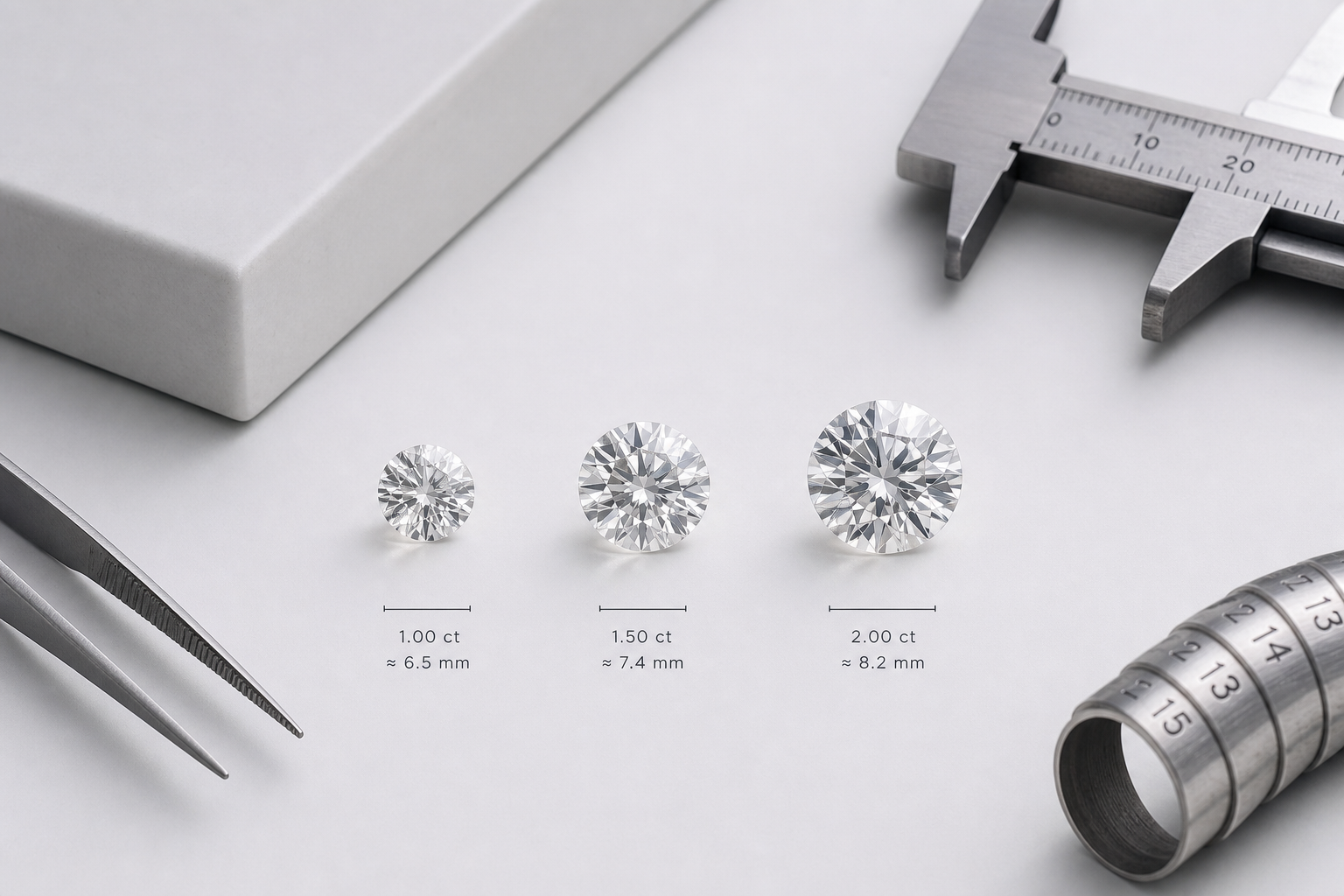
Carat weight measures weight, not spread. Two diamonds with the same carat weight can look different in size depending on their depth, diameter, length-to-width ratio, and shape. This matters because buyers often shop by carat number first, then discover that the stone does not face up the way they expected.
For round brilliant diamonds, common diameter references are approximately 6.5 mm for 1.00 ct, 7.4 mm for 1.50 ct, and 8.1 mm for 2.00 ct. These are useful benchmarks, not guarantees. Actual measurements vary based on cut proportions, and the grading report should be checked rather than assumed.
Elongated shapes can also change the visual equation. Ovals, pears, marquise cuts, and some emerald cuts may appear larger face-up than other shapes at the same carat weight because they spread length across the finger. That can be an advantage if the goal is presence, but it introduces new judgment points: outline symmetry, bow-tie effect in elongated brilliants, corner protection for step cuts, and whether the shape works with the wearer’s hand and setting style.
In practical buying, this is where many size comparisons become misleading. A diamond that looks larger on a spreadsheet may look less pleasing if it is too deep, too shallow, uneven in outline, or poorly matched to the setting. The most useful comparison is not just carat-to-price, but measurement-to-appearance: how much visible spread the diamond gives, how evenly it returns light, and whether that face-up look still feels balanced on the hand.
When going bigger can create new tradeoffs
A larger lab-grown diamond can make inclusions, color tone, and cut issues more visible, especially in shapes with broad facets or open tables. This does not mean larger stones should be avoided. It means the quality threshold often becomes less forgiving as size increases.
For a size-focused buyer, cut and measurements should usually outrank chasing the next carat milestone. A well-proportioned 1.80 ct diamond may look more balanced and lively than a 2.00 ct stone that carries weight in the wrong places. The report number may feel less exciting, but the ring may look better in real life.
The setting also changes how size is perceived. A solitaire puts most of the attention on the center diamond, so the stone’s cut and outline carry more responsibility. A halo or three-stone design can increase overall presence without requiring the center diamond to do all the visual work. If the goal is a larger look, the smartest choice may be a balanced combination of center stone, shape, and setting rather than simply the highest carat weight available.
Size Reference Points to Check on the Report
When comparing lab-grown diamond size, start with the measurements, not only the carat weight. For a round brilliant, check whether the diameter is in a normal range for the carat size. If the stone is noticeably smaller face-up than expected, it may be carrying too much weight in depth. If it is unusually spread, confirm that the cut still supports brightness and durability.
For elongated shapes, look at length, width, and the length-to-width ratio together. A stone can be technically large but look too narrow, too short, or poorly balanced for the intended ring. This is where photos and video become more useful than the carat number alone.
The better size-focused choice is not simply the biggest stone you can find. It is the diamond that gives you the visual presence you want while still looking bright, balanced, and appropriate for the setting.
The Design-Focused Buyer: When the Setting and Overall Look Come First
Why the finished piece matters more than the center stone alone
A design-focused buyer is not only buying a diamond. They are buying the finished ring or piece of jewelry. For this buyer, the center stone matters, but it has to work with the setting, metal, proportions, side stones, and daily wear expectations. A beautiful diamond can still be the wrong choice if it fights the design.
This is where lab-grown diamonds can make sense. If your goal is a complete visual composition, lab-grown may allow more room to balance the center stone with the rest of the piece. Instead of spending nearly all of the budget on origin and carat weight, you may be able to consider a more intentional setting, a different metal, or design details that materially change the finished look.
The strongest design decisions usually come from balance. A large center stone on a band that is too thin can feel visually top-heavy and may not suit daily wear. A detailed hidden halo can add interest, but if the center stone sits too high or the prongs are poorly planned, the ring may become less practical. Design value comes from the relationship between elements, not from adding every feature possible.
How lab-grown can support more flexible design choices
For buyers planning a lab-grown diamond engagement ring, the practical advantage is often flexibility. A solitaire may allow more of the budget to go toward the center stone. A halo or hidden halo may create extra presence without needing a much larger diamond. A three-stone ring may shift the focus toward proportion and matching rather than center-stone size alone.
Metal choice is part of the same decision. Platinum can offer a different feel and durability profile than gold, but it can also change the budget. A buyer choosing lab-grown may have more freedom to compare these design options without reducing the center stone below the size or quality range they want.
Custom lab-grown diamond ring projects especially benefit from this wider planning space. The buyer can think in terms of the whole piece: whether an oval needs a delicate cathedral setting, whether an emerald cut needs cleaner lines, whether a thicker band would better support the stone, or whether side stones should be scaled back so the center diamond remains the focus.
For custom design, the stone cannot be evaluated separately from the setting. The same oval, cushion, or emerald cut can feel elegant in one mounting and awkward in another if the proportions, height, prong placement, or side-stone scale are not planned together. At NUVU, this kind of comparison is best treated as a practical design question: the report helps describe the diamond, but the finished ring depends on how the diamond’s measurements and visual character work inside the intended setting.
For custom design, trust comes from matching the stone to the setting, budget, and wearer’s daily use—not from choosing grades in isolation. Before finalizing a loose stone, buyers should confirm the measurements, shape tolerance, prong or bezel plan, side-stone scale, and ring profile so the selected diamond can be traced from report details to the finished piece.
For custom jewelry, stone measurements and setting compatibility should be confirmed before finalizing a purchase. This is especially important for fancy shapes, unusually large center stones, delicate bands, flush-fit wedding band goals, or designs that depend on exact side-stone proportions.
Setting compatibility still matters
Lab-grown does not remove the need for good setting judgment. The diamond still has physical measurements, corners, girdle details, and proportions that affect how it should be mounted. A stone that looks appealing in a video may require a setting that protects it properly or frames it more carefully.
Some shapes need more attention than others. Princess cuts and emerald cuts have corners that should be protected. Pear and marquise shapes need well-placed tips and prongs. Ovals can look elegant in many settings, but the length-to-width ratio should match the ring style rather than simply follow a trend.
For a design-focused buyer, the wrong move is choosing a diamond in isolation and treating the setting as an afterthought. The diamond and setting should be selected together, especially when the design includes side stones, halos, flush wedding band goals, or a low-profile setting. A design that looks impressive in a rendering can become awkward if the stone’s dimensions do not support it.
Stone-to-Setting Fit Check
Before committing to a design, compare the diamond’s actual measurements with the setting plan. Look at length, width, depth, shape, and how the stone will sit on the finger. A ring that needs to be worn every day should not be judged only from the top view; height, prong placement, and band proportion matter just as much.
If the setting includes side stones, check whether they support the center stone or compete with it. For lab grown diamond engagement rings, the setting should balance durability, proportion, and visual focus without overwhelming the main diamond. If the ring has a halo, make sure the halo follows the diamond’s outline cleanly instead of making the shape look bulky. If the band is very delicate, ask whether the design still makes sense for the wearer’s lifestyle and the size of the center stone.
The best design-focused choice is the diamond that helps the entire piece work. For this buyer, lab-grown is often appealing not because it makes one feature possible, but because it can make the whole design feel more considered.
NUVU’s role in buyer education is to make comparison clearer, especially around grading reports, visual evidence, design fit, and documentation.
For buyers considering a NUVU lab-grown diamond or custom ring, the selection process should be understood in practical terms: the diamond selection, report details, measurements, and setting plan should all be discussed together before the piece is finalized. A helpful retailer should be able to explain why a specific stone suits the chosen design, not simply present a carat weight and price.
This is especially important for custom work, where the finished result depends on communication as much as inventory. Shape, setting height, metal choice, prong protection, side-stone scale, and budget should be reviewed as connected decisions so the buyer understands what is being prioritized and what tradeoffs remain.
The Budget-Conscious Buyer: When Value Means More Than the Lowest Price
Why lower price does not automatically mean better value
A lab-grown diamond can be a strong fit for a budget-conscious buyer, but only if “value” means more than paying less. The better question is not whether the diamond costs less than a natural diamond. It is whether the final purchase gives you the size, appearance, documentation, setting quality, and long-term satisfaction you actually care about.
The common mistake is treating lab-grown diamond value as a simple discount story. A lower-priced diamond with weak cut, poor proportions, an awkward face-up appearance, or a setting that feels too delicate may not be a good buy at all. The same is true if the buyer chooses a larger stone but sacrifices the details that make it look bright, balanced, and wearable.
For most buyers, the stronger value comes from using the budget more intelligently, not simply reducing the total spend. That may mean choosing a better cut grade, a more visually balanced shape, a slightly larger center stone, a sturdier setting, or a design that feels complete rather than compromised. If the diamond looks impressive on paper but underperforms in real life, the lower price did not solve the right problem.
Where lab-grown can change the budget conversation
Lab-grown diamonds often change what is possible within a fixed budget. Instead of choosing between a visibly smaller natural diamond and a larger but poorly graded stone, buyers may be able to compare diamonds with stronger visible qualities while keeping the overall project within range. This is where lab-grown can be especially useful for engagement rings and other pieces where the finished look matters more than origin alone.
The budget conversation should include the whole ring or jewelry piece, not just the center diamond. A buyer may want a cleaner-looking stone, a more substantial setting, a platinum mount instead of gold, side stones, a hidden halo, or a custom design detail. If choosing lab-grown leaves room for those priorities without pushing the purchase beyond budget, the value may be practical and visible.
Still, there is a limit. Lab-grown does not make every upgrade worth it. Paying more for a clarity grade that looks identical to the naked eye may not improve the finished piece. Chasing a higher color grade than the setting requires may also be unnecessary, especially in yellow or rose gold. The better use of budget is usually cut quality, attractive proportions, appropriate size, and a setting that supports daily wear.
Price differences can also reflect more than the diamond category. Report availability, cut precision, inventory source, seller service, setting workmanship, and the amount of custom planning can all affect the final number. For that reason, a fair value comparison should use similar quality targets and the same finished-piece expectations, rather than comparing one loose stone price against a fully planned ring.
A realistic buyer scenario with a fixed ring budget
Consider a buyer choosing an engagement ring with a set budget. One option is a smaller natural diamond with good visible quality and the emotional appeal of geological origin. Another is a larger lab-grown diamond with a grading report, comparable face-up appearance, and enough room left in the budget for a more refined setting.
Neither choice is automatically better. If the buyer or recipient strongly values natural origin, the smaller natural diamond may feel more meaningful even if it has less visual presence. If the buyer cares more about how the ring looks on the hand, how balanced the design feels, and how much design flexibility the budget allows, the lab-grown option may feel like the better fit.
The risk is choosing based on a single number. A larger carat weight can be tempting, but it should not crowd out cut, proportions, and setting quality. A smaller natural diamond can also be a thoughtful choice, but it should not be assumed to carry better value simply because it is natural. The decision depends on which tradeoff the buyer will still feel good about years later.
What to Compare Before Calling One Option a Better Deal
- Total finished cost: Compare the complete ring or jewelry piece, including the center stone, setting, side stones, metal, craftsmanship, and any customization.
- Visible appearance: Look at face-up size, brightness, proportions, color appearance, and whether the clarity is eye-clean in normal viewing.
- Documentation: A grading report helps confirm key details, but it should be paired with images, video, and measurement review.
- Design fit: A diamond that is affordable but poorly matched to the setting can make the final piece feel less intentional.
- Emotional priority: If origin, rarity, or tradition matters more than size or design flexibility, the lower-cost option may not feel like the better choice.
The Quality-Focused Buyer: When Cut, Clarity, and Documentation Matter
Lab-grown diamonds still vary in quality
Lab-grown diamonds are real diamonds, but that does not mean every lab-grown diamond is equally beautiful or equally well chosen. Quality still varies by cut, color, clarity, proportions, measurements, and the way the stone performs in real lighting. A buyer who cares about quality should treat lab-grown diamonds with the same level of review as any serious diamond purchase.
The biggest misconception is assuming that a lab-grown diamond is automatically clean, bright, and visually ideal because it was made in a controlled environment. In practice, two diamonds with similar grades can look different. One may appear crisp and lively, while another may look flat, dark in the center, or poorly balanced because of its proportions or cutting style.
For quality-focused buyers, lab-grown can be attractive because it may allow more room to prioritize visible performance within the budget. But the benefit only holds if the buyer does not use the savings as an excuse to ignore evaluation. A lab-grown diamond with a grading report is easier to compare than an undocumented stone, but the report is the starting point, not the final decision.
Why cut should not be treated as a minor detail
Cut is usually the first quality factor to protect because it has the strongest effect on sparkle, brightness, and overall visual life. Color and clarity matter, but a diamond with strong grades can still look underwhelming if the cut does not return light well. This is especially true for engagement rings, where the diamond will be seen in many lighting conditions rather than under showroom lights alone.
For round diamonds, cut grade and proportions give useful guidance. For fancy shapes such as oval, emerald, pear, cushion, radiant, and marquise, the report may not tell the full story. Buyers should pay closer attention to symmetry, bow-tie effect, windowing, length-to-width ratio, and how evenly the stone lights up across the face.
Clarity should also be interpreted visually. A higher clarity grade may not be necessary if the inclusions are not visible without magnification. On the other hand, some inclusions, strain patterns, or growth-related features can affect appearance if they are noticeable in photos or video. The practical goal is not to buy the highest grade available; it is to avoid paying for upgrades that do not improve the diamond while protecting the traits that actually show.
What a grading report can and cannot tell you
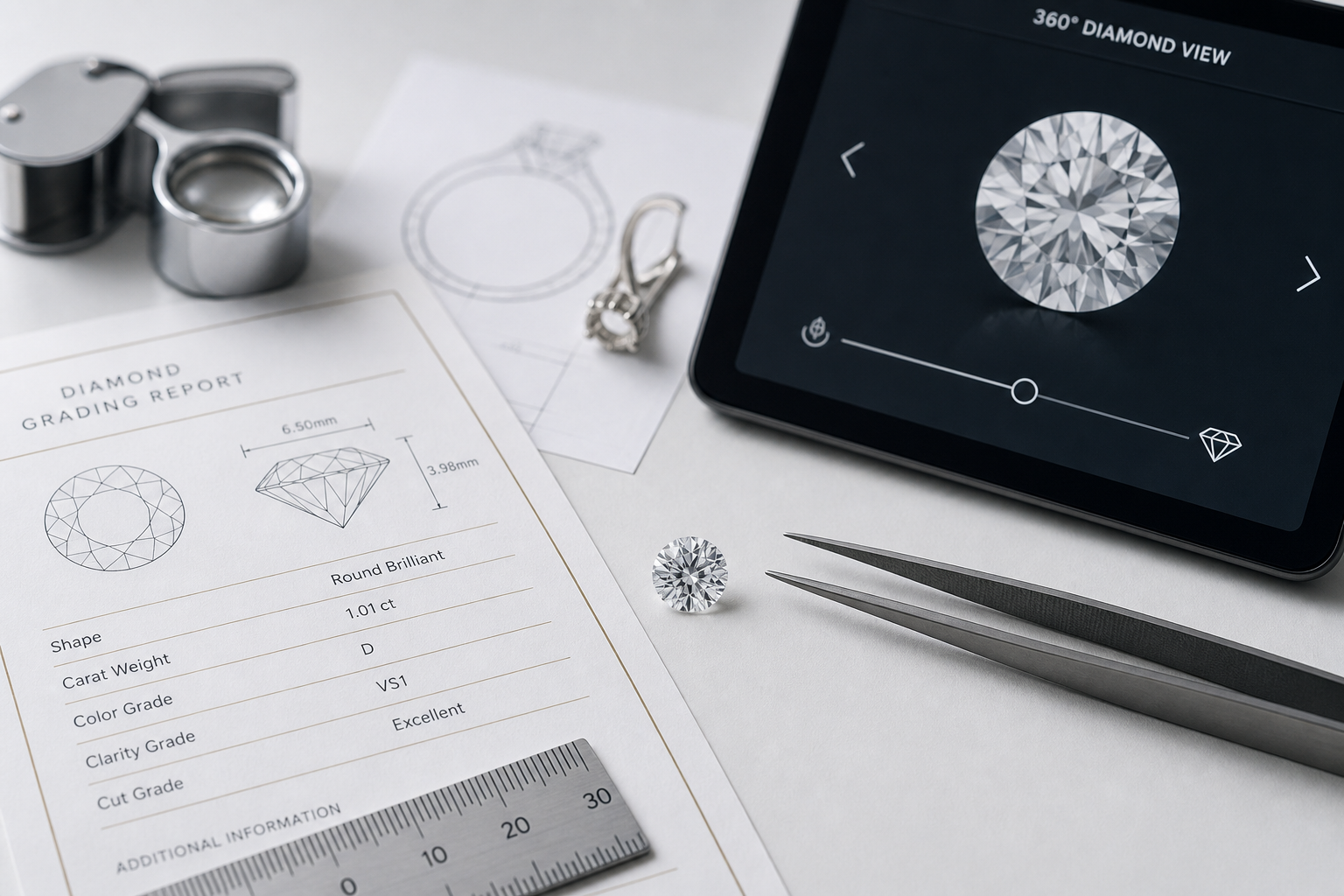
A grading report helps confirm the diamond’s basic identity and characteristics, including carat weight, measurements, color, clarity, and sometimes growth method or additional comments depending on the laboratory and report format. Reports from recognized grading organizations such as IGI or GIA give buyers a more structured way to compare stones than seller descriptions alone.
What a report cannot fully show is how the diamond looks to the eye. It will not always reveal whether an oval has a distracting bow tie, whether an emerald cut has appealing hall-of-mirrors contrast, or whether a cushion has the kind of sparkle pattern the buyer prefers. It also does not replace seeing high-quality photos, video, and measurement details.
At NUVU, the grading report is best treated as a useful filter rather than the whole answer. The report can narrow the field, but a smart buyer still checks how the stone appears visually and whether its proportions make sense for the intended setting.
Some reports may also identify a lab-grown diamond as HPHT or CVD grown, depending on the report format and laboratory. That growth-method note can be useful context, but it is not a beauty grade by itself. A buyer should not assume that one method automatically looks better in every case; the practical review still comes back to the individual diamond’s color appearance, clarity characteristics, cut quality, measurements, and visual performance.
When growth method or post-growth treatment is relevant, buyers should look for clear disclosure in the grading report or seller documentation. HPHT and CVD may describe laboratory diamond growth methods, and buyers should avoid assuming treatment status unless the report or seller documentation specifically supports that conclusion.
Documentation should also match the actual stone being purchased. Buyers should confirm that the report number, carat weight, measurements, shape, and any inscription information line up with the seller’s listing and the physical diamond when verification is available. If the report describes one set of measurements and the listing emphasizes another, that mismatch should be resolved before purchase. A trustworthy buying process makes it easy to connect the document, the visuals, and the finished jewelry plan.
A grading report helps document key characteristics, but it should not be treated as a guarantee of beauty, value, or sourcing ethics. It should be read alongside visual evidence, measurements, seller documentation, and the intended jewelry use.
When a grading report is available, buyers should verify the report details through the issuing laboratory’s official report-check tool where available.
Certificate and Visual Review Check
- Verify the report number: Match the report number with the grading laboratory’s online database when available.
- Review measurements: Face-up size matters, especially when comparing stones of the same carat weight.
- Check real visuals: Use photos or 360-degree video to look for darkness, uneven light return, bow tie, windowing, or visible inclusions.
- Do not overpay for invisible upgrades: Higher clarity or color is not always useful if the difference cannot be seen in the final setting.
- Match quality to use: A daily engagement ring may justify stricter review than a lower-contact jewelry piece.
When a grading report is provided, buyers should compare the report details with the issuing laboratory’s verification tools where available.
If a GIA report is provided, the report details can usually be checked through GIA’s official report verification system.
For buyers, the practical benefit of verification is confidence in alignment: the report number, diamond measurements, listed specifications, and selected stone should refer to the same item. When a diamond is being used in a ring, that documentation should also be connected to the final setting plan so the buyer can understand both the stone’s graded qualities and its real-world fit.
The Sustainability-Curious Buyer: When Responsible Buying Matters, But Claims Need Care
Why lab-grown may appeal to responsibility-minded buyers
Lab-grown diamonds often appeal to buyers who want a more modern and traceable way to purchase diamond jewelry. For some shoppers, the appeal is not only price or size. It is the idea of choosing a diamond whose production path may feel easier to understand than a mined stone with a longer and more complex supply chain.
This can make lab-grown a good fit for buyers who care about documentation, production disclosure, and a more direct conversation about sourcing. The strongest responsible-buying case is not based on vague moral language. It is based on whether the seller can explain what is known about the diamond, what is documented, and where the limits of that information are.
A responsibility-minded buyer should be careful with any claim that sounds too simple. “Lab-grown” can be a meaningful part of the decision, but it should not be treated as a complete answer to environmental impact, labor practices, energy use, or supply-chain transparency. Better information leads to a better judgment than broad labels alone.
Why “lab-grown” does not answer every sustainability question
Lab-grown diamonds and natural diamonds have different impact profiles, and neither category should be reduced to a slogan. Lab-grown production requires technology, facilities, materials, and energy. Natural diamond mining involves extraction, land use, labor systems, and a broader chain of handling and distribution. The comparison depends on specific practices, not just the category name.
For a buyer asking whether lab-grown diamonds are more sustainable, the honest answer is that it depends on what is being measured and what information is available. Energy source, manufacturing practices, transportation, documentation, and seller transparency all matter. Without those details, a sustainability claim may be more marketing language than useful evidence.
The practical takeaway is to look for specificity. A seller who can explain the diamond’s grading, provide available documentation, and answer sourcing or production questions carefully is more useful than one relying on broad terms like “ethical” or “eco-friendly” without support. Responsible buying is not about finding a perfect claim; it is about avoiding unsupported certainty.
For buyers comparing suppliers, consistency of communication can be as important as the claim itself. If a seller can clearly separate what is verified, what is supplier-provided, and what is not known, the buyer gets a more realistic basis for judgment. That kind of transparency is more useful than a broad promise that sounds reassuring but cannot be checked.
What kinds of claims deserve verification
Any claim about environmental impact, renewable energy, traceability, origin, or responsible sourcing should be treated as something to verify, not something to assume. This does not mean every buyer needs a technical audit. It means the strongest claims should come with clear information, not just attractive wording.
Be especially cautious with absolute language. Claims such as “zero impact,” “completely sustainable,” or “the most ethical choice” should raise questions unless they are backed by specific, credible documentation. More measured claims are often more trustworthy because they leave room for the complexity of production and sourcing.
For sustainability-curious buyers, lab-grown may still be the better personal fit if it aligns with their preference for modern production, documentation, and a clearer buying path. But the decision should be based on what can be reasonably known, not on the assumption that one word solves every ethical or environmental concern.
A good responsible-buying question is narrow, not vague. Instead of asking whether a diamond is “ethical” in a broad sense, ask what the seller can specifically document: the grading report, the disclosed origin category, any available production information, and the limits of what is known. This keeps the conversation grounded in evidence rather than relying on words that may mean different things to different sellers.
Environmental and sustainability claims should be specific, documented, and limited to what can be substantiated. Broad green language is less useful than clear information about production, energy, sourcing, and seller transparency. If the available documentation only supports a limited claim, the language used to describe the diamond should stay limited as well.
Questions to Ask About Transparency
- What documentation comes with the diamond? A grading report does not prove every sustainability claim, but it does help establish basic diamond details.
- Is any production or sourcing information available? The more specific the answer, the easier it is to judge the claim.
- Are energy-related claims supported? If renewable energy or lower impact is mentioned, ask what evidence supports it.
- Does the seller avoid absolute promises? Careful language is usually more credible than sweeping claims.
- Can the seller explain what is known and what is not? Transparency includes acknowledging limits, not just presenting benefits.
The Practical Engagement Ring Buyer: When Daily Wearability Comes First
Why lab-grown diamonds work for everyday engagement rings
A lab-grown diamond engagement ring can be a strong choice for daily wear because the center stone is still diamond. For most buyers, the practical question is less about whether lab-grown origin makes the stone suitable for an engagement ring and more about whether the finished ring is designed well enough for everyday use.
The bigger issue is the ring around it. A durable diamond can still be set in a fragile design. A thin band, exposed corners, delicate pavé, or high-profile setting can make a ring more vulnerable even when the center stone is hard enough for daily wear. Buyers sometimes overfocus on diamond origin and underfocus on the structure that actually takes the daily knocks.
This matters most for engagement rings because they are not occasional jewelry. They go through handwashing, door handles, gym bags, steering wheels, desk work, travel, and daily routines. A lab-grown diamond can handle that role well, but the final ring needs to be designed for the wearer’s real life, not just for a clean photo on a product page.
The setting may matter more than the diamond origin
For daily wear, setting security often matters more than whether the diamond is lab-grown or natural. Prongs should hold the stone securely without feeling overly bulky, and the design should protect vulnerable edges where needed. This is especially relevant for shapes with corners or points, such as princess, pear, marquise, and some emerald-cut designs. Those shapes can be beautiful, but exposed corners are easier to chip or loosen than a rounded outline in a well-built setting.
Band width is another practical detail that deserves attention. Very thin bands below roughly 1.6 mm can feel delicate depending on the metal, setting style, and hand size. Many everyday engagement ring buyers prefer something closer to about 1.8 to 2.0 mm or more for a better balance of elegance and durability, though the right answer depends on the full design. A narrow band can still work, but it should not be chosen only because it makes the diamond look larger by contrast.
Low-profile settings can be easier to live with for people who use their hands constantly, while higher settings may create more presence and allow certain wedding band pairings. Neither is automatically better. The mistake is choosing a setting for appearance alone without asking how often it will catch, tilt, snag, or feel intrusive during normal movement.
Wearability also includes maintenance expectations. A ring with fine pavé, small accent stones, or very delicate prongs may look refined, but it may also need more regular checking than a simpler solitaire or bezel-style design. This is not a reason to avoid detailed settings; it is a reason to choose them knowingly, especially if the wearer wants a ring that feels low-maintenance in daily life.
How lifestyle should shape the final choice
If the wearer works with their hands, lifts weights often, travels frequently, or prefers low-maintenance jewelry, practical expectations from a lab grown diamonds guide can help inform a secure ring construction. That may mean a sturdier band, protective prongs, a bezel or partial bezel, a lower profile, or a center stone shape that is less exposed in the setting. The goal is not to make the ring look heavy. The goal is to avoid a design that requires constant caution.
Delicate designs can still be reasonable for someone who is careful with jewelry and comfortable removing the ring during higher-risk activities. The tradeoff is maintenance. Thin pavé, fine prongs, and airy galleries may need more inspection over time. A buyer who wants a “wear it and forget it” ring should not choose the most delicate setting just because the center diamond fits the budget.
A lab-grown diamond can be an especially practical engagement ring choice when the buyer wants daily beauty without pushing the entire budget into the center stone alone. But the better daily-wear decision is made by treating the diamond, setting, metal, and lifestyle as one system. A strong stone in the wrong setting can still become a frustrating ring.
Daily Wear Compatibility Check
- If the wearer is active with their hands: prioritize secure prongs, protected edges, and a band that does not feel overly thin.
- If the ring will be worn almost all day: consider comfort, profile height, snag risk, and how easily the ring pairs with a wedding band.
- If the design includes pavé or fine details: understand that smaller stones and delicate metalwork may require more inspection and care over time.
- If the center stone has corners or points: make sure the setting protects those areas rather than leaving them fully exposed.
- If the band is below roughly 1.6 mm: ask whether the design and metal can support daily wear, rather than assuming slim always means refined.
The Rarity-Focused Buyer: When Natural Origin Still Matters
When origin is part of the emotional value
Some buyers should think carefully before choosing lab-grown, not because lab-grown diamonds lack beauty or durability, but because origin may be central to what they want the diamond to represent. A natural diamond’s geological formation is part of its appeal for many people. The idea that the stone formed deep within the earth over immense time can carry emotional weight that a laboratory-grown origin does not replace.
This preference is not less modern or less rational. It is simply a different priority. If the story of natural formation is the part of the purchase that feels most meaningful, a lab-grown diamond may satisfy the visual goal but not the emotional one. That gap matters more in sentimental purchases than in purely design-driven jewelry.
The key judgment is straightforward: if rarity of origin matters more than size, budget efficiency, or design flexibility, natural may feel more satisfying. If the buyer keeps returning to the question of where the diamond came from, that is not a minor detail to brush aside.
Why tradition can still matter in a modern purchase
Tradition is another reason some buyers still lean natural. Engagement rings and heirloom jewelry often carry family expectations, cultural assumptions, or personal ideas about what a diamond should be. Even when the buyer understands that lab-grown and natural diamonds are physically diamond, the emotional framing may still differ.
This is especially relevant when the ring is expected to become an heirloom. Some families may value natural origin as part of the object’s long-term story. Others may care far more about the relationship, design, or wearability of the piece. Neither view is universal, which is why the decision should be based on the people involved rather than a broad claim that one choice is more meaningful.
Future resale perception can also enter the conversation, though it should be handled carefully. A diamond ring should not be treated as a simple investment purchase, and no buyer should assume guaranteed long-term value from either option. Still, if the buyer is highly sensitive to future market perception or family discussions around value, natural diamonds may feel more familiar within that framework.
It is also worth separating rarity from beauty. Natural origin can be rare and meaningful, but that does not automatically make a particular natural diamond more attractive than a particular lab-grown diamond. The buyer still needs to evaluate cut, proportions, condition, documentation, and setting fit. Origin can guide the category choice, but it should not replace quality judgment.
When lab-grown may not fully satisfy the buyer’s goal
Lab-grown may be the wrong fit when the buyer wants the diamond itself to feel rare in the traditional geological sense. It may also be less satisfying when the buyer worries they will keep explaining or defending the choice to family members, or when the recipient has already expressed a clear preference for natural. In those cases, the lower cost or larger size of lab-grown may not compensate for the emotional mismatch.
This is where the lab-grown vs natural diamond decision becomes less about technical facts and more about priority ranking. If the top priority is visual appearance within budget, lab-grown often makes strong sense. If the top priority is natural origin, lab-grown may leave the buyer feeling that they compromised on the one factor they cared about most.
A buyer who feels torn should not dismiss that hesitation. The wrong decision is not choosing lab-grown or natural. The wrong decision is choosing one while pretending the tradeoff does not matter.
What This Means in a Real Purchase
In a real engagement ring purchase, the rarity-focused buyer should start by asking what would still feel meaningful ten years from now. If the answer is a larger, beautifully designed ring that fits the budget and daily life, lab-grown may still be the better fit. If the answer is the knowledge that the diamond is naturally formed and traditionally rare, natural may be the more emotionally durable choice.
This is also a useful place to separate private preference from outside pressure. Choosing natural only because someone else expects it can lead to overspending on a priority the wearer does not actually share. Choosing lab-grown only because it appears more practical can backfire if the recipient deeply values natural origin. The better purchase is the one that matches the values attached to the jewelry, not just the specifications on the report.
The Gift Buyer: When Meaning, Expectations, and Communication Matter
Buying for yourself is different from buying for someone else
Buying a lab-grown diamond gift is not the same as choosing one for yourself. When you are the wearer, your priorities are clear enough to rank: size, design, origin, budget, daily wear, or documentation. When the diamond is for someone else, the most important priority may be one you do not personally share.
This is especially true for engagement rings. A buyer may see lab-grown as a practical way to choose a larger or better-designed ring within budget, while the recipient may care more about natural origin, family tradition, or simply having been consulted. The issue is not whether lab-grown is acceptable for a proposal. For many couples, it is. The issue is whether it fits the recipient’s expectations.
A surprise purchase carries more risk when the buyer assumes that their own value system is universal. If the recipient has never expressed a preference, the safest path is not necessarily to default to natural or lab-grown. The safer path is to gather better signals before making an irreversible-feeling decision.
Good gift buying is often less about guessing correctly and more about reducing the chance of a values mismatch. A recipient may care deeply about details the buyer considers minor, such as shape, origin, metal color, profile height, or whether the ring can sit flush with a wedding band. Those preferences are part of the gift’s meaning, not just design details.
When lab-grown is likely to feel aligned
Lab-grown is often a strong gift choice when the recipient values the finished look of the jewelry more than the geological origin of the stone. If they care about a larger center diamond, a specific shape, a custom setting, or a more design-forward ring, lab-grown may allow the gift to match their visual priorities more closely.
It can also feel aligned when the recipient has shown interest in modern sourcing, practical budget use, or report-backed selection. Some buyers and recipients see the appeal in putting more of the budget toward the overall ring, wedding plans, a future home, travel, or another shared goal. In that context, lab-grown does not feel like a compromise. It feels like the choice that reflects how they make decisions together.
For anniversary jewelry or fine jewelry gifts, lab-grown may be even easier to match to the occasion because the symbolism is often more flexible than in an engagement ring. A pair of diamond studs, a pendant, or a right-hand ring may be judged more by beauty, wearability, and design than by origin story.
When uncertainty should slow the decision
Uncertainty matters most when the recipient has hinted at or clearly stated a preference for natural diamonds. It also matters when family heirloom expectations are strong, when the proposal is likely to involve family opinions, or when the buyer is choosing lab-grown mainly to increase size without knowing whether size is actually the recipient’s priority.
The highest-risk situation is a hidden mismatch: the buyer is excited about value and visual impact, while the recipient quietly values natural origin or tradition. That does not mean lab-grown should be avoided. It means the buyer should avoid making the choice in a vacuum.
Communication does not have to ruin a surprise. A buyer can ask broad questions about diamond preferences, look at styles together, involve a trusted friend, or pay attention to how the recipient talks about jewelry. If the answer remains unclear, choosing a more flexible design or delaying the final diamond decision may be better than guessing on the one factor the recipient may care about most.
Expectation Check Before Choosing
- Has the recipient clearly said they are open to lab-grown? If yes, the decision can focus more on design, size, quality, and daily wear.
- Have they expressed a strong preference for natural? If yes, do not treat lab-grown as an equal substitute without a conversation.
- Do they care more about the look of the finished piece? Lab-grown may be a strong fit if shape, setting, and visual presence are the priorities.
- Are family expectations part of the purchase? Consider whether those expectations matter to the recipient, not just to relatives.
- Are you choosing lab-grown mainly for a larger stone? Make sure larger size is actually something the recipient wants.
A thoughtful lab-grown diamond engagement ring choice depends on shared expectations, not just good specifications. The better the buyer understands the recipient’s priorities, the less likely the gift is to feel like a technical win but an emotional miss.
A Practical Self-Check: Should You Choose Lab-Grown or Natural?
If you are still asking, “Should I choose lab-grown or natural diamond?”, the most useful answer starts with your priorities, not with a universal rule. Both choices can make sense. The difference is whether you want the diamond to serve a visual, practical, design-driven purpose, or whether its natural origin is central to what makes it meaningful.
A lab-grown diamond decision is usually strongest when the buyer is clear-eyed about the tradeoff. You are not choosing between “real” and “fake.” You are choosing between two diamond options with different origins, pricing logic, emotional signals, and long-term expectations. The better fit is the one that matches the reason you are buying the diamond in the first place.
Lab-grown may fit you best if these priorities matter most
Lab-grown is likely a strong fit if you care most about the visible result: size, shape, design flexibility, and a high-quality look within a defined budget. This is especially true for buyers who want the finished ring or jewelry piece to feel balanced and impressive without treating natural origin as the main source of value.
It may also fit well if you are comparing diamonds in a practical way. If you are looking at grading reports, measurements, cut quality, color, clarity, setting style, and total project cost, lab-grown often gives you more room to refine the final choice. The key is not simply buying the largest stone available. The smarter move is choosing a diamond that looks right, fits the design, and leaves enough budget for craftsmanship.
Lab-grown may be the better direction if you would feel satisfied knowing the diamond has the same core appearance and material identity as a diamond, while accepting that its origin is not geological. For many modern buyers, that is not a compromise. It is the point: they want the look, durability, and design possibilities of diamond without making natural rarity the center of the purchase.
Natural may fit you best if these priorities matter most
Natural may feel more satisfying if the origin story matters as much as the appearance. Some buyers want a diamond because it formed in the earth over immense time, and that geological rarity is part of the emotional value. If that feeling is important to you, a lab-grown diamond may look beautiful but still not fully answer what you are trying to buy.
Natural can also be the better fit when tradition, family expectations, or heirloom symbolism carry real weight. This does not mean natural diamonds are more meaningful for everyone. It means that if the recipient, family, or occasion is strongly tied to conventional diamond symbolism, choosing natural may avoid a mismatch between the object and the expectation around it.
Be careful not to choose natural only because it feels like the “safer” default. If the only reason is habit, you may be paying more for a priority you do not actually hold. But if natural origin is genuinely central to the meaning of the piece, that preference deserves to guide the decision.
If you are still unsure, rank your top three priorities
When the choice feels close, write down your top three priorities before comparing more stones. Do not rank what sounds impressive. Rank what would still matter after the purchase. A buyer who ranks size, design, and budget efficiency first is usually leaning toward lab-grown. A buyer who ranks origin, rarity, and tradition first is usually leaning toward natural.
The difficult cases are mixed-priority buyers. For example, you may want a larger center stone but also feel emotionally drawn to natural origin. In that situation, the decision is not about which diamond is objectively better. It is about which compromise you would notice more: choosing a smaller natural diamond than you hoped for, or choosing a lab-grown diamond that does not carry the same geological story.
For engagement rings, the most important practical step is to separate your personal preference from the recipient’s likely preference. If the wearer values the look, design, and daily experience most, lab-grown may be an easy fit. If the wearer has expressed a clear preference for natural, that should carry more weight than a spreadsheet comparison.
Before making the final choice, compare the actual options you would realistically buy, not abstract categories. A well-cut lab-grown diamond in a secure, well-proportioned setting may be a better fit than a natural diamond chosen only to satisfy tradition; a thoughtfully selected natural diamond may be a better fit than a larger lab-grown diamond chosen only because it looks like a better deal. The decision becomes clearer when the comparison is specific, documented, and tied to the finished jewelry.
Final Buyer Fit Framework
Choose lab-grown if your highest priorities are visual size, design flexibility, documented quality, and making the most of a set budget. It is a strong fit for buyers who want the diamond to perform beautifully in the finished piece and do not need natural origin to carry the emotional meaning.
Choose natural if your highest priorities are geological rarity, traditional symbolism, and the feeling that the diamond’s origin is part of the gift or heirloom value. It is a better fit when the story of where the diamond came from matters as much as how it looks.
Pause before choosing either option if you are relying on assumptions. Do not assume lab-grown is automatically the better value just because it costs less, and do not assume natural is automatically the more meaningful choice just because it is traditional. The right decision is the one where the tradeoff still feels acceptable after the excitement of the purchase has passed.
If you are asking, “Should I choose lab-grown or natural diamond?”, the clearest answer is this: choose the option that protects your most important priority, not the one that wins a generic comparison.
Final Evidence-Based Buying Checklist
Before you commit, make sure each major claim in the purchase is supported by the right kind of information. Diamond identity and grading should be supported by a grading report or comparable documentation. Visual performance should be supported by images, video, measurements, and direct comparison. Setting durability should be supported by design details such as prong style, band width, stone protection, and metal choice. Responsibility or sustainability claims should be supported by specific seller documentation rather than broad language.
This checklist matters because different questions require different evidence. A grading report can help confirm diamond characteristics, but it cannot prove a ring will be comfortable. A beautiful video can show face-up appearance, but it cannot prove a sustainability claim. A seller’s design rendering can help visualize the ring, but it cannot replace checking proportions and wearability. The strongest purchase is not the one with the most persuasive single claim; it is the one where the documentation, visuals, design, and emotional priorities all point in the same direction.
Before purchase, buyers should also confirm the seller’s documentation, return terms, resizing terms, and after-sales support directly with the seller. These practical details are separate from diamond grading, but they affect how confidently a buyer can move from comparison to commitment.
Compliance-Aware Buying Boundaries That Protect the Decision
Because lab-grown diamond buying often involves comparisons, reports, origin language, and responsibility claims, the most useful approach is to keep each claim in its proper lane. A grading report can document characteristics such as carat weight, measurements, color, clarity, shape, and sometimes growth method, but it should not be treated as proof that the diamond is the most beautiful option, the strongest value, or the most responsible choice. Those judgments require additional evidence and buyer-specific priorities.
Origin language should also stay clear. A laboratory-grown diamond is a diamond produced through a laboratory growth process, while a natural diamond is formed by geological processes. Both can be evaluated with diamond grading language, but they should not be marketed as the same origin category. If a seller description, report, invoice, or product page is unclear about laboratory-grown origin, ask for clarification before relying on the listing.
Price and value language should be handled with the same care. A lab-grown diamond may allow a buyer to consider a different size, setting, or grade range within a defined budget, but that does not make every lab-grown option a better deal. Compare total finished cost, report details, measurements, cut appearance, setting quality, and seller documentation before deciding whether one option is more suitable than another.
Responsibility and sustainability claims deserve narrow wording and specific support. If a seller mentions traceability, renewable energy, carbon claims, responsible sourcing, or environmental impact, the buyer should ask what documentation supports that specific statement. A careful claim with clear limits is usually more useful than a broad promise that cannot be checked.
NUVU’s buyer-first perspective is to make comparison clearer rather than to replace the buyer’s judgment. The practical goal is to help connect the diamond’s report details, visual evidence, setting fit, and documentation so the final choice reflects the buyer’s priorities without overstating what any report, seller statement, or category label can prove.
Disclosure: This article is for general educational purposes only. Diamond grading, pricing, availability, specifications, and seller policies can change, and readers should verify important details through grading reports, official laboratory tools, seller documentation, or qualified professionals before making a purchase decision. Laboratory-grown diamonds should be clearly distinguished from natural diamonds, and environmental or sourcing claims should be supported by specific documentation.