
Lab-grown diamonds have fundamentally changed the rules of fine jewelry design, particularly in fashion-forward pieces that aren’t centered on engagement rings. By removing the steep price premiums tied to carat weight and rarity in mined stones, lab diamonds allow designers and buyers to think differently about scale, shape, and arrangement. Larger stones, unconventional cuts, and graduated multi-stone layouts become practical choices rather than budget-breaking exceptions. The lab grown diamond jewelry budget guide cuts through the general 4Cs noise to focus on what actually matters for fashion jewelry: how lab diamonds enable bolder design decisions, why visual consistency across multiple stones is more important than individual grades, and how to evaluate pieces like tennis bracelets and geometric pendants with confidence.
For the full framework, read Lab-Grown Diamond Jewelry Guide.
Laboratory-grown diamonds should be clearly identified as laboratory-grown, and they should not be presented as mined diamonds. This distinction is not merely a matter of terminology — it affects how buyers evaluate the origin, documentation, and performance of the stones in their jewelry. Throughout this guide, the term “lab-grown diamond” refers to a diamond produced in a controlled laboratory environment, with the same chemical composition and physical properties as a natural diamond, but a different formation path.
| Design Aspect | With Lab-Grown Diamonds | What to Check |
|---|---|---|
| Stone size in pendants/earrings | Larger carat weights are affordable without sacrificing quality | Proportion to the setting and wearer’s preference, not just carat number |
| Unusual shapes (hexagon, kite, marquise) | Available without rarity markups typical for mined fancy shapes | Cut precision, especially for open or visible-prong settings |
| Multi-stone layouts (tennis bracelets, clusters) | Matched sets from a single growth batch ensure uniform color | Visual consistency across all stones in natural and artificial light |
| Modular or stackable designs | Long-term color matching is reliable across separate purchases | Return policies and ability to add matching pieces later |
| Certificate priority | Less critical than visual performance for fashion pieces | Setting quality and security of stone placement |
Quick Questions Before You Read
Q: Is this guide about engagement rings or the 4Cs?
No. This guide is specifically for non-bridal fine jewelry like pendants, earrings, and tennis bracelets. It addresses design and evaluation choices unique to fashion pieces, not ring shopping or full diamond grading.
Q: Do I need a grading certificate for a lab diamond fashion piece?
Not as a primary concern. For fashion jewelry, visual consistency across stones and the quality of the setting matter far more than an individual grade on paper. Focus on how the piece looks in person.
Q: Can lab diamonds really match in color across a tennis bracelet?
Yes, often better than mined diamonds. Because lab diamonds can be produced in a single growth batch, they offer more reliable color and clarity uniformity for multi-stone layouts, reducing the visible mismatches common with natural stones.
Q: Are unconventional shapes like hexagons or kites risky for fashion jewelry?
They are accessible now without added cost premiums, but the risk lies in the setting and cut. Choose a design that secures the stone well and inspect cut precision, especially in open-back or tension settings where flaws are visible.
Why Lab-Grown Diamonds Are Changing Fine Jewelry Design Beyond Bridal
For decades, fine jewelry design has been shaped by a single major constraint: the price of natural diamonds. That constraint pushed most non-bridal diamond jewelry toward small accent stones, conservative layouts, and familiar silhouettes. Lab-grown diamonds have shifted this logic entirely. By breaking the direct link between carat weight and scarcity pricing, they have opened fine jewelry to design approaches that were previously impractical or unaffordable.
This shift also brings a compliance consideration for buyers and designers. Laboratory-grown diamonds and natural diamonds have different origins. Understanding this distinction helps buyers evaluate sourcing documentation, grading reports, and seller descriptions accurately. Designers who clearly disclose the origin of their stones — whether lab-grown or mined — provide a clearer basis for comparison, which in turn supports more confident purchasing decisions.
The Design Constraint of Natural Diamond Pricing
Natural diamond pricing follows a curve that penalizes size, especially above one carat. A designer working with mined stones faces a clear tradeoff: either use small accent diamonds distributed across a piece, or concentrate the budget into a single small center stone. Large stones, matched pairs, and graduated size progressions become cost-prohibitive quickly. As a result, most traditional diamond fashion jewelry—tennis bracelets, linear necklaces, cluster earrings—relies on many small stones rather than fewer, larger ones.
This pricing structure also discourages experimentation with geometric or asymmetric layouts. If every stone carries a significant cost premium, there is little room to explore unconventional arrangements, negative space, or designs that require larger diamonds in non-traditional positions. The design ends up serving the budget, not the idea.
How Lab-Grown Economics Unlock New Layout Possibilities
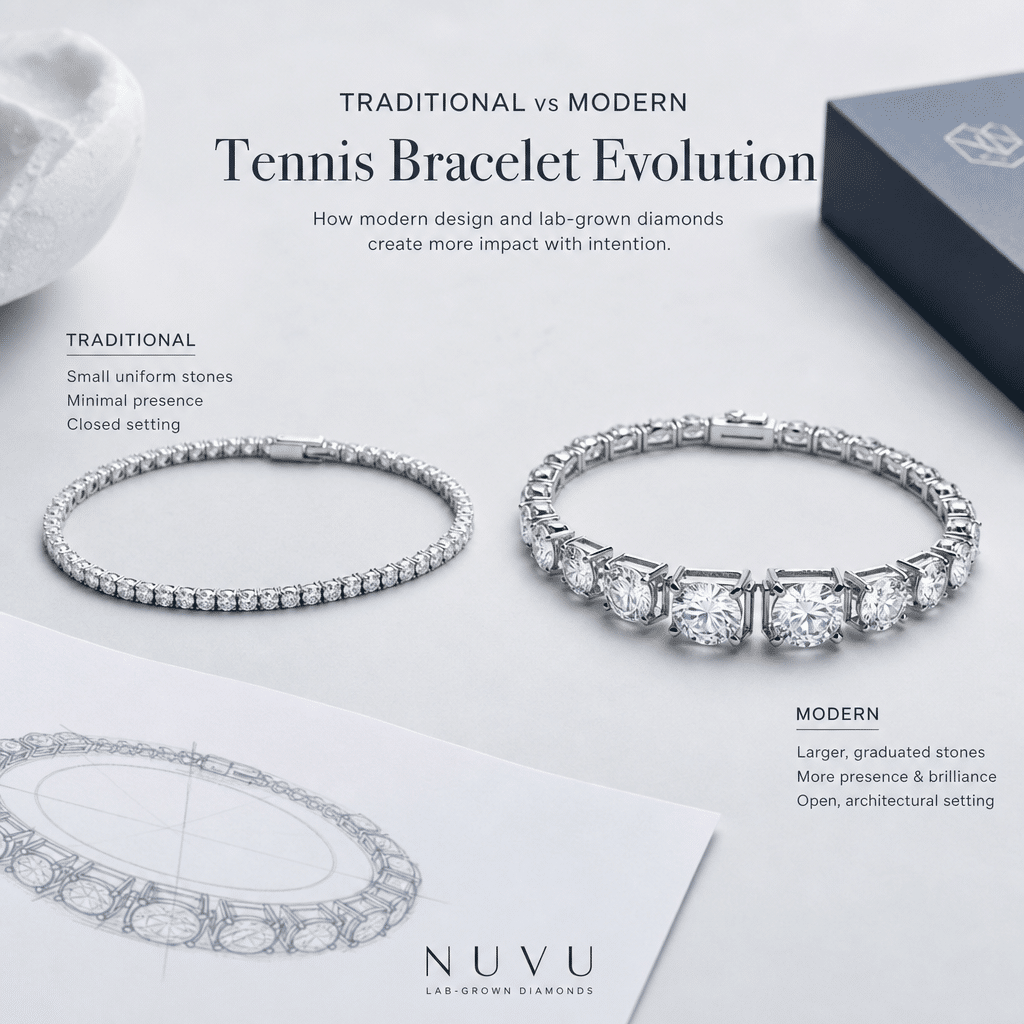
Lab-grown diamonds reduce the per-carat cost enough that the design logic flips. Instead of asking “how many small stones can I fit in this piece,” a designer can ask “what is the most interesting layout for this shape and size of diamond.” Larger center stones become feasible for earrings and pendants, not just rings. Matched pairs for studs or linear designs are easier to source without price shocks. Graduated arrangements—where stones increase in size along a bracelet or necklace—are no longer reserved for high-budget commissions.
This matters most for everyday fine jewelry. A pair of 2-carat stud earrings or a 3-carat pendant becomes a normal design option rather than an exceptional one. Stacking rings, linear bracelets, and open settings with single larger stones all benefit from the same shift. The design focus moves from cost management to visual intent.
A practical observation: For buyers evaluating such pieces, the useful question is not simply “how much does the carat weight cost” but “does the stone’s size and shape serve the intended design.” Larger stones demand careful proportion to the setting and the wearer’s frame; a 4-carat pendant may look balanced on one necklace length but oversized on another. The design freedom is genuine, but it still depends on fit, orientation, and how the piece will be worn.
Stone-to-Setting Fit Check
When evaluating a lab-grown diamond piece outside bridal, confirm the stone measurements match the setting’s intended layout. For graduated designs, request a side-by-side photo or video of all stones to verify size progression and color consistency before purchase.
What “Modern Fine Jewelry” Actually Means for Diamond Selection
Modern fine jewelry is not the same as classic or bridal jewelry, and the difference affects how diamonds should be selected. Bridal pieces prioritize cut grade, color grade, and certificate standards above nearly everything else. Modern fine jewelry—minimalist, geometric, asymmetric, or personalized—prioritizes shape, layout, and visual coherence. This changes which diamond characteristics matter most.
For modern jewelry designs, the distinction between lab-grown and natural diamonds becomes particularly relevant when discussing sourcing and documentation. A grading report can help document key characteristics, but it should be read alongside visual evidence, measurements, seller documentation, and the intended jewelry use. In fashion-forward pieces, the report is one input among several, not the final word on whether the stone suits the design.
Shape Freedom Beyond Round Brilliant
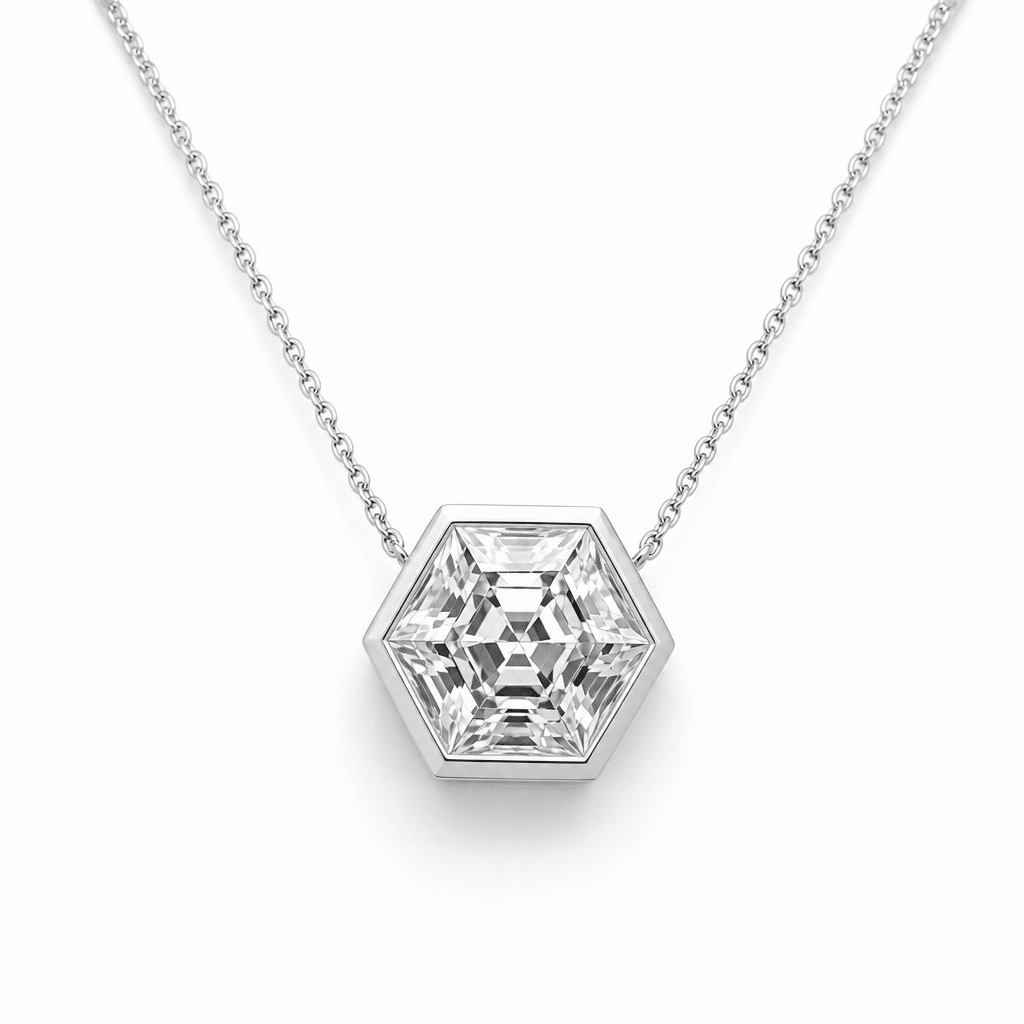
In the mined diamond market, round brilliants dominate supply and fancy shapes carry inconsistent price premiums. Some shapes cost more per carat than rounds; others trade at a discount but are harder to find in precise sizes. Lab-grown production flattens this variation. Nearly every fancy shape—emerald, oval, pear, marquise, hexagon, kite, baguette, trillion—is available without shape-based price distortion. A hexagon or kite diamond does not cost more to produce than a round of the same carat weight.
This allows designers to build pieces around unusual silhouettes rather than defaulting to round brilliants. A pendant with a hexagonal center stone, a ring with baguette side stones set in parallel, or earrings using marquise diamonds in mirrored orientations all become straightforward design options.
Layouts That Depend on Consistent Color and Clarity Matching
Multi-stone designs expose inconsistency quickly. A tennis bracelet with stones ranging from G to K color, or from VS to I clarity, looks mismatched in natural light. The same problem affects cluster pendants, linear earrings, and any design where multiple diamonds sit close together.
Lab-grown manufacturing produces diamonds with more predictable color and clarity ranges within the same production batch. This is especially noticeable in the near-colorless range (G-H-I) and the VS to SI clarity range, where most fashion jewelry sits. A matched set from a single growth run will show less visible variation than a set curated from different mined sources. For the buyer, this means the piece looks coherent rather than assembled.
A buyer-facing nuance: While batch consistency reduces the risk of mismatch, it does not eliminate it entirely. Even stones from the same growth run can show subtle differences under daylight or fluorescent lighting. For this reason, it is worth requesting a photo of the entire set of stones laid out together before setting, rather than relying on a single representative image. The buyer’s eye under normal lighting is the final test of uniformity.
Minimalist and Geometric Design Language
Minimalist settings—open bezels, thin prongs, floating stone arrangements, negative space—put the diamond on display. There is no secondary metalwork or halo to distract from the stone’s appearance. This requires diamonds with clean facet patterns, precise proportions, and no visible inclusions near the edges.
Step-cut shapes (emerald, asscher, baguette) are particularly demanding because their open table and broad facets reveal windowing and extinction more readily than brilliant cuts. Lab-grown suppliers often provide detailed optical data—crown angle, pavilion depth, table percentage, and light return measurements—that helps designers verify a stone’s suitability for an open setting before committing to the layout.
What this data does not guarantee: Measurements and angles help narrow the field, but they do not replace visual evaluation. Two stones with nearly identical proportions can perform differently depending on facet alignment and internal strain. For minimalist designs, a video of the loose stone rotating under direct and diffuse light provides more useful information than a set of numbers on a report. The practical rule is to treat optical data as a screening tool and visual footage as the final check.
Certificate and Visual Review Check
For minimalist designs with exposed stone edges, request an enlarged photo or video of each diamond’s facet pattern. Check for windowing or extinction in step-cut shapes (emerald, asscher, baguette) and confirm the cut grade supports the intended light performance in an open setting.
How Designers and Buyers Can Use Larger Carat Weights Creatively
Larger lab-grown diamonds are not just cheaper versions of larger natural diamonds. They allow designers and buyers to reconsider what size means outside the engagement ring context. When a 3-carat stone costs a fraction of its mined equivalent, the question shifts from “can I afford it” to “where does this size work best.”
When considering larger stones, it is worth noting that pricing can vary because of cut precision, report type, seller channel, size, shape, availability, and documentation. Buyers should compare like-for-like specifications before treating one stone as a better value. The design freedom that larger carat weights provide is genuine, but the value of any specific piece depends on the complete set of characteristics — not simply the carat number.
Why “Too Big for an Engagement Ring” Works Perfectly for Earrings and Pendants
Engagement rings tend to stay within a certain size range for practical and traditional reasons. Above two carats, a solitaire ring becomes harder to wear daily without snagging, and the visual weight can overwhelm the hand. But earrings and pendants handle larger stones naturally. A 3-carat stud earring or a 4-carat pendant reads as bold, but not impractical.
Lab-grown pricing makes these sizes accessible without dedicating an entire jewelry budget to a single stone. The design intent also changes. A larger pendant or earring is not a status signal in the same way a large engagement ring is. It functions more as personal style expression—unusual, intentional, and chosen for its visual effect rather than its implied cost.
Mixed Stone Size and Graduated Arrangements
Graduated diamond layouts—where stones increase in size from the clasp toward the center of a bracelet or necklace—have traditionally been expensive because each larger stone carries its own price premium. With lab-grown diamonds, the same progression is achievable without exponential cost increases. A designer can source five matched diamonds in deliberate 0.25-carat increments for a fraction of what a mined graduated set would cost.
This opens up cluster designs, halo arrangements, and linear bracelets with intentional size contrast. The graduated effect is visual, not financial, meaning it can be used more freely across different price points.
How to evaluate graduated layouts: For a necklace or bracelet with increasing stone sizes, it is useful to request the piece photographed against a plain background with a ruler or reference object in the frame. This allows you to see the size progression clearly. Graduated designs rely on the visual rhythm of the size change, as outlined in the everyday lab grown diamond jewelry guide; if the increments are too small, the progression may not read as intentional, and if the color shifts between stones, the design can look accidental rather than deliberate. Confirming both the size steps and color consistency across the set helps avoid the most common visual disappointment in graduated pieces.
Stackable Rings and Modular Jewelry Systems
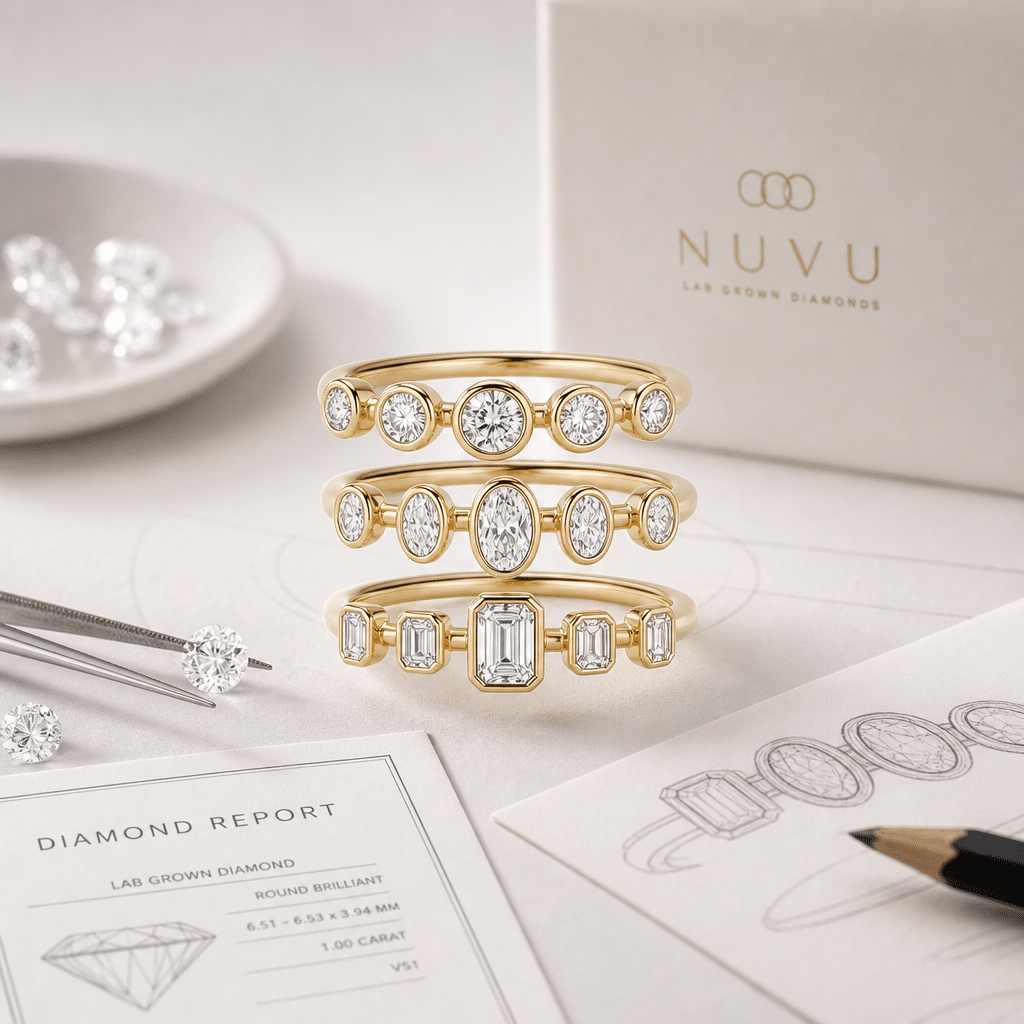
Modular fine jewelry—stacking bands, interchangeable pendants, adjustable earrings—works best when the buyer can add pieces over time without worrying about color or clarity mismatch. Lab-grown diamond consistency solves this problem. Because stones from the same manufacturer tend to fall within tighter visual ranges, a stacking ring purchased today will likely match one purchased two years later.
This also benefits custom design. A buyer can start with a single pendant and add matching earrings or a bracelet later, without needing to hunt for stones that visually align across different sourcing batches.
A practical limitation: While inter-batch consistency is generally higher with lab-grown diamonds than with mined stones, it is not guaranteed across different production runs, years, or manufacturers. If the buyer plans to build a modular set over time, it is worth asking the seller whether the current growth batch will still be available in the future or whether matching stones can be held in reserve. Some sellers will coordinate this as part of a custom order; others may not. Knowing the policy upfront prevents disappointment when adding pieces later.
Buyer Verification Checklist
When buying a larger lab-grown diamond piece (3 carats or more), confirm: (1) the stone’s exact measurements and depth percentage, (2) a 360-degree video from above and below, (3) whether the setting is designed to protect the stone during daily wear, and (4) the return or exchange policy for size or fit adjustments.
What Changes When a Jewelry Piece Has No “Main Stone”
Not every fine jewelry piece hinges on a single center stone. Tennis bracelets, cluster earrings, linear necklaces, and graduated pendants distribute visual weight across multiple diamonds. In these designs, no single stone stands above the rest. Every stone has to pull its weight.
This changes how the piece should be evaluated. The individual carat or grade of any one diamond matters far less than how all the stones work together as a set.
For multi-stone pieces, the question of origin disclosure becomes particularly important. Since these designs rely on consistent appearance across many stones, buyers should confirm whether the seller clearly identifies all stones as laboratory-grown. A piece that mixes lab-grown and natural diamonds without disclosure — or presents lab-grown stones without clear labeling — can create confusion about the product’s actual composition. This is not a hypothetical concern; the Federal Trade Commission’s Jewelry Guides require clear disclosure of laboratory-grown origin, and responsible sellers should provide this information upfront.
Uniformity Requirements for Multi-Stone Fine Jewelry
The most common failure point in multi-stone pieces is visual mismatch. A tennis bracelet with one stone that reads slightly warmer in color, or one that appears duller under direct light, breaks the entire line. The eye catches the inconsistency before it registers the overall design.
This is where lab-grown sourcing offers a structural advantage. Mined diamonds must be curated individually and matched after the fact, which becomes expensive and time-consuming as the stone count increases. Lab-grown manufacturers can produce matched sets from a single growth run, delivering consistent color, clarity, and cut precision across every stone in the piece. For designs with twenty, fifty, or even a hundred stones, that consistency is not a luxury—it is the difference between a coherent piece and a compromised one.
The practical takeaway is straightforward: when buying a multi-stone piece, ask whether all the diamonds come from the same production batch. If the seller cannot confirm this, the risk of visible mismatch goes up.
How to verify batch consistency as a buyer: Sellers who can confirm a single-batch origin should also be able to point to the specific color and clarity range of that batch. It is reasonable to ask for a photograph of the full set of loose stones under natural daylight, not just the finished piece. If the seller hesitates or offers only a studio-lit image, the likelihood of hidden variation increases. For pieces with a high stone count—such as a full tennis bracelet—it is also worth asking about the range of individual stone measurements. Two stones from the same batch with slightly different table sizes or crown depths can produce different light return, which becomes visible in a continuous line.
Cluster and Pavé Layouts Without the Varying-Quality Problem
Cluster and pavé designs rely on smaller stones to create surface coverage and light performance. With mined diamonds, the small stones in these layouts are often treated as filler. Jewelers accept lower clarity grades, slight color variation, or inconsistent cut quality because each individual stone is too small to inspect easily.
Lab-grown production removes that compromise. Even sub-point stones—diamonds under one-tenth of a carat—can be produced to the same near-colorless standard (G-H minimum) as the larger stones in the piece. The result is a cluster or pavé layout where every diamond contributes the same level of brilliance, not a mix of high-quality anchors and weak filler stones.
For the buyer, this means a cluster pendant or pavé band built with lab-grown diamonds will look more uniform and more luminous than a comparable mined-stone piece at the same price point.
A note on tradeoffs: Uniformly high-quality small stones improve the overall brilliance of a pavé or cluster design, but they do not necessarily improve the piece’s durability or wear resistance. The setting still needs to secure each stone properly, especially in high-contact areas like bracelet links or ring bands. Holding the piece and examining the prongs or channel walls is as important as evaluating the stones themselves. A perfectly matched set of diamonds in a weak setting will disappoint faster than a slightly mismatched set in a well-constructed setting.
Stone-to-Setting Fit Check
When evaluating any multi-stone piece, confirm three things with the seller before purchase. First, that all stones come from the same growth batch. Second, that the color variation across the entire set falls within one grade—all G-H, for example, not a mix of G and J. Third, request a photograph taken under natural daylight rather than studio lighting. Artificial light can mask subtle color differences that become obvious in normal wear conditions.
These three checks cost nothing but eliminate the most common disappointment in multi-stone lab-grown diamond jewelry.
Understanding the Terminology Behind Lab-Grown Diamonds
Lab-grown diamonds are sometimes described using industry-specific language that can be confusing to first-time buyers. Under current guidance from the Federal Trade Commission (FTC), terms like “laboratory-grown,” “laboratory-created,” and “cultured” are considered appropriate descriptions, provided they are clear and not misleading.[1] The Gemological Institute of America (GIA) similarly explains that lab-grown diamonds — also referred to as man-made or cultured diamonds — have the same chemical composition, crystal structure, and physical properties as natural diamonds, but are produced in controlled laboratory environments rather than formed naturally in the earth.[2]
For the fashion jewelry buyer, this terminology matters mainly because it distinguishes the product from simulants like cubic zirconia or moissanite, which look similar but have different chemical and physical properties. A lab-grown diamond is a true diamond. Understanding this distinction helps buyers evaluate a piece with the same expectations for hardness, brilliance, and durability that they would apply to any fine jewelry purchase.
Documentation and Traceability in Sourcing
As the lab-grown diamond market matures, documentation around the origin and characteristics of individual stones has become increasingly relevant for buyers of fine jewelry. While a full grading report is not always necessary for a fashion piece, certain documentation can provide useful context for the stone’s quality and the consistency of the manufacturing process.
When a grading report is provided by an independent laboratory such as GIA, IGI, or GCAL, it serves as a third-party record of the stone’s color, clarity, cut, and carat weight. However, a report is most useful when read alongside visual evidence. The report confirms the stone’s specifications; the video or in-person inspection confirms how those specifications translate into actual appearance. A grading report can narrow the comparison, but it should be evaluated with the stone’s proportions, visual footage, and intended jewelry use in mind. No grading report should be treated as a guarantee of beauty, value, or sourcing ethics.
For traceability, buyers may also inquire whether the supplier can provide information about the growth batch from which the stones originated. Batch-level documentation is not a substitute for an individual grading report, but it can be valuable for multi-stone pieces where consistency across the set is the primary concern. Sellers who maintain batch records can often confirm that all stones in a tennis bracelet or cluster pendant were produced in the same growth run, which reduces the risk of color or clarity variation across the piece.
In sourcing or wholesale conversations, documentation, consistency, and communication often matter as much as the headline specification. A seller who can clearly explain the origin of their stones, the range of a given batch, and the limits of any documentation they provide is generally more transparent than one who offers only broad assurances without supporting detail. For the buyer, understanding what documents exist and what they actually confirm—rather than assuming they guarantee the stone’s performance in a specific setting—is the foundation of a confident purchase.
When a grading report is available, buyers should verify the report details through the issuing laboratory’s official report-check tool where available. A report is a useful record of specifications, but visual inspection of the stone in its intended setting remains the final and most reliable evaluation step.
Custom Design Flexibility: Sourcing Unusual Shapes and Layouts
Custom fine jewelry is where lab-grown diamonds show their clearest advantage over mined stones. The reason is not just price. It is availability. When a designer or buyer wants a specific shape, a precise millimeter dimension, or an unusual layout, lab-grown production can deliver it without the sourcing hurdles that make custom mined-diamond projects slow and expensive.
This changes what custom jewelry can look like. It also changes who can afford to commission it.
For custom design, stone measurements and setting compatibility should be confirmed before finalizing a purchase. Unlike standard pieces where the setting is pre-determined, custom work requires the buyer and designer to agree on exact dimensions, orientation, and fit. A grading report or specification sheet provides useful data, but the final check should always include visual confirmation of the stone in relation to the setting design.
Accessing Non-Traditional Diamond Shapes
Round brilliant, princess, and cushion cuts dominate mined diamond inventories because those shapes sell fastest and waste the least rough. Unusual shapes like hexagon, kite, shield, half-moon, baguette, and freeform are harder to source in mined supply and carry a significant premium when found.
Lab-grown manufacturing treats unusual shapes as standard production items, not special requests. A hexagon diamond for a geometric pendant or a set of kite-shaped diamonds for a linear earring design can be ordered directly without paying a shape premium. Custom-cut requests—such as a stone cut to a specific millimeter dimension rather than a standard carat weight—are also more common and significantly less expensive than their mined counterparts.
For a buyer designing a one-of-a-kind piece, this means the shape of the diamond can be driven by the design concept rather than by what is available in the market.
What to check when selecting an unusual shape: Not all fancy shapes are cut with the same precision. A shape that is rarely produced—such as a hexagon or kite—may not benefit from the same cut optimization as a round brilliant. The buyer should request a video of the loose stone rotating under a light source to check for symmetry, facet alignment, and any visible windowing or dark areas. The shape may be visually distinctive, but it must also perform well as an individual stone, especially in a setting with exposed edges or open backing.
Designing Around Specific Measurements, Not Just Carat Weight
Custom settings depend on exact stone dimensions, not approximate carat ranges. A setting designed for a 6mm x 4mm emerald cut will not fit a stone that measures 6.2mm x 4.1mm, even if both diamonds weigh the same. With mined diamonds, designers often have to adjust the setting design to accommodate whatever stone is available within a broad carat range.
Lab-grown diamonds can be ordered to precise millimeter specifications. This simplifies the design process and reduces the risk of a stone not fitting its intended setting. The designer builds the piece around known measurements from the start, rather than leaving room for variation and hoping the final stone lands within tolerance.
For the buyer, the benefit is a cleaner design process and fewer surprises at the final fitting.
Prototyping and Revision for One-of-a-Kind Pieces
Custom design used to be a high-commitment process. Ordering a single mined diamond in an unusual shape meant paying a premium for a custom cut, as detailed in the lab grown diamond jewelry guide, or accepting whatever was available in the secondary market. If the stone did not work visually in the setting, the buyer was stuck with a sunk cost.
Lab-grown sourcing changes that dynamic. Designers can request a single diamond for a wax model or CAD prototype without committing to a full production run. If the stone looks wrong in the layout, it can be replaced with a different shape or size at a relatively low cost. This low-risk approach supports experimentation with bold or unconventional designs that would be too expensive to prototype using mined diamonds.
What This Means in a Real Purchase
If you are working with a designer on a custom piece, follow this process. First, confirm the stone can be ordered to your exact millimeter dimensions, not just a carat weight range. Second, ask for a CAD render with the actual stone measurements overlaid—this confirms the setting will fit before any metal is cut. Third, request a video of the loose stone under natural light before it is set, so you can evaluate its visual performance on its own. Finally, discuss what happens if the setting needs adjustment after the stone is secured. A good custom process accounts for revision before the piece is finished.
An experienced jeweler will walk through these steps as a standard part of the process. If they hesitate or cannot confirm specific measurements, that is a warning sign.
Fit and Verification in Custom Design
For custom design, trust comes from matching the stone to the setting, budget, and wearer’s daily use—not from choosing grades in isolation. A diamond with ideal proportions on paper may still look out of place in a geometric pendant if its facet pattern does not complement the metal lines. The same stone may perform brilliantly in a closed-back bezel but show windowing in an open frame.
This is why prototyping conversations matter. When a designer can show a CAD model with the actual stone measurements, and then follow up with a video of the loose diamond before setting, the buyer gains confidence that the finished piece will match the original intent. If the seller or designer treats documentation, measurement confirmation, and visual evaluation as separate steps rather than one integrated process, the risk of a mismatch at the final stage increases.
For NUVU, the goal is to make diamond comparison easier to understand, especially when buyers are weighing report details, visual performance, setting fit, and budget together. A transparent custom design process treats each of these factors as part of the same conversation, not as independent variables.
How to Evaluate a Lab-Grown Diamond Fashion Jewelry Piece
Evaluating a lab-grown fashion jewelry piece requires a slightly different checklist than evaluating a bridal ring. The priorities shift. What matters most is not the highest possible color grade or a specific lab report, but whether the piece performs well in real wear and whether the setting protects the diamonds properly.
Throughout this evaluation process, it is helpful to remember that a grading report documents key characteristics, but it should not be treated as a guarantee of beauty, value, or sourcing ethics. Environmental and sustainability claims — if any are made by the seller — should be specific, documented, and limited to what can be substantiated. Broad green language is less useful than clear information about production, energy, sourcing, and seller transparency.
Visual Performance Over Certificate Obsession
For fashion jewelry, the certificate can mislead as often as it helps. A stone can carry an excellent cut grade on paper and still show windowing or extinction in an open setting. Another stone with a slightly lower grade can look brilliant in the same design.
The practical fix is simple: evaluate the stone in its setting using video and real-world photos, not just the report. Look for brightness across the entire face of the diamond. Check for dark areas or dead zones in step-cut shapes like emerald and baguette. Compare how the piece looks under direct light versus indirect daylight. A grading report narrows the options, but only visual inspection confirms whether the stone actually works in the design.
This is where a transparent seller matters. If the seller cannot provide clear video showing the piece from multiple angles in natural lighting, it is reasonable to question whether the stone holds up visually.
Setting Quality and Stone Security
Fashion jewelry is often worn more frequently and with less caution than a bridal engagement ring. Stud earrings, tennis bracelets, and everyday pendants take more impact and more incidental contact. The setting must protect the diamonds accordingly.
Check the prong thickness—thin prongs are more likely to bend or break. Confirm the bezel wall height if the piece uses a bezel setting. In channel-set designs, verify that the channel wall is deep enough to hold the stones securely. Most importantly, confirm that the setting protects the diamond’s pavilion—the bottom portion of the stone—from direct impact. A diamond can chip if its pavilion takes a hard hit, regardless of the stone’s quality grades.
Lab-grown diamonds are not softer than mined diamonds. They are equally hard. But they are equally vulnerable to impact damage if the setting fails.
How to factor setting into your evaluation: When examining a piece, consider the wear pattern it will face. A tennis bracelet experiences constant flexing and impact against the wrist, so the setting must secure each stone against movement. Linear pendant necklaces depend on a secure bail or clasp connection. Stud earrings rely on stable posts and friction backs. For each piece, ask the seller about the setting’s metal thickness and whether the stone layout leaves the pavilion exposed. A visual inspection of the setting from the side and underside can reveal weak points that are not obvious from the front view alone.
Return Policy and Warranty Clarity
Fashion jewelry has different wear patterns than bridal pieces. Stones can loosen. Settings can snag. Clasps can wear out. Before purchasing, confirm the seller’s specific policy on stone loss, setting damage, and size adjustments.
A clear written policy matters more than brand reputation or verbal promises. Look for explicit terms covering what happens if a stone falls out within the first year, whether resizing is included, and what after-sales service looks like for non-bridal pieces. If the policy is vague, ask for written clarification before buying.
Buyers should confirm the seller’s return and resizing policies before purchase. Written documentation of these terms provides a clearer basis for any future adjustments than verbal assurances alone.
How to Verify This Before Buying
Before completing a purchase, request four things from the seller. First, a short video of the piece on a hand or wear surface, so you can see how it moves and catches light. Second, written confirmation of the metal weight and setting type—this affects both durability and resizing options. Third, written details on stone measurements and total carat weight, not just a generic description. Fourth, the seller’s specific terms for after-sales service, including stone replacement policy and resizing fees.
These requests are standard in any transparent jewelry transaction. A seller who handles them clearly and promptly is usually a seller worth buying from.
Understanding Growth Methods: HPHT and CVD
Lab-grown diamonds are typically created using one of two primary methods: High Pressure High Temperature (HPHT) or Chemical Vapor Deposition (CVD). GIA explains that both methods produce diamonds with the same physical and chemical properties as natural diamonds, but the conditions under which they grow and the resulting growth structures can differ.[3] HPHT mimics the high-pressure, high-temperature conditions found deep within the earth, while CVD uses a gas-based process to deposit carbon atoms layer by layer onto a diamond seed.
For the fashion jewelry buyer, the distinction between these methods is seldom a deciding factor in a purchase, as both produce real diamonds suitable for fine jewelry. However, understanding the basics can help when reviewing grading reports, as some reports may note the growth method. The important point is that neither method produces a diamond that is inferior in hardness or brilliance to the other, and both are distinct from simulants.
Transparency and Communication in the Buying Process
The most practical trust signal in any diamond jewelry purchase is the seller’s willingness to provide specific, verifiable information before the transaction is completed. This includes stone measurements, batch origin where applicable, video of the loose stones or finished piece, and clear terms for what happens after the sale. Each of these items serves a different purpose: measurements confirm that the stone will fit the setting, batch origin helps predict color consistency, video provides visual confirmation of the stone’s appearance, and written terms clarify the buyer’s options if something goes wrong.
A buyer who receives all of this information before committing to a purchase is in a stronger position than one who relies on reputation or broad assurances. For sellers who offer documentation, it is worth asking whether the grading report or batch records can be shared in advance. For multi-stone pieces, asking for evidence that all stones originated from the same production run is a reasonable step toward confirming the piece’s visual coherence. These checks do not replace the final in-person inspection, but they reduce the risk of disappointment before the piece arrives.
Sustainability claims should be specific and documented. Broad green language is less useful than clear information about production, energy, sourcing, and seller transparency. When a seller offers environmental or ethical claims, the buyer should ask what substantiation exists and whether it applies to the specific stones in the piece, not just to the manufacturer’s general operations.
For a broader look at how lab-grown diamonds fit into modern fine jewelry beyond engagement rings, explore the other sections in this guide. And if you are ready to browse specific loose diamonds or jewelry designs, NUVU’s selection team can help you match the right stones to your preferred layout and setting.
Design Priorities Beyond Bridal Jewelry
For a pendant, earrings, or a stackable ring, consider how lab-grown diamonds expand the design possibilities outside bridal jewelry. Evaluate the layout and wearing style of the piece you want, rather than applying engagement ring priorities by default.
Evaluate Non-Bridal Layouts
Bridal buying involves ring style comparisons, proposal timing, and budget allocation for a single center stone. For fashion jewelry, focus instead on non-bridal layouts, modular jewelry, multi-stone uniformity, and creative shape selection that suits your personal style. If you are shopping for an engagement ring, a dedicated bridal guide covers the factors specific to that purchase.
Use the 4Cs to Evaluate the Design
Apply the 4Cs to the fashion jewelry design you are evaluating. Color matching matters for a tennis bracelet. Cut precision matters for an open setting. For a full breakdown of each grade, laboratory grading scales, and report reading, review a dedicated 4Cs guide, then use those details to assess how the piece is built.
Compare Design Freedom and Cost
Consider how pricing changes design freedom: larger stones become feasible, graduated layouts become affordable, and matched sets cost less to produce. For exact price ranges, per-carat comparisons, or a standalone cost analysis, use pricing guidance to understand what affects diamond prices and compare value across different stones and sellers. Assess both the cost and the layout possibilities for your piece.
[1] Federal Trade Commission, “Guides for the Jewelry, Precious Metals, and Pewter Industries,” 16 CFR Part 23, revised 2018. FTC Jewelry Guides.
[2] Gemological Institute of America, “Lab-Grown Diamonds,” GIA, accessed 2025. GIA Lab-Grown Diamond Education.
[3] Gemological Institute of America, “How Lab-Grown Diamonds Are Made,” GIA, accessed 2025. GIA Gems & Gemology.
Disclosure: This article is for general educational purposes only. Diamond grading, pricing, availability, specifications, and seller policies can change, and readers should verify important details through grading reports, official laboratory tools, seller documentation, or qualified professionals before making a purchase decision. Laboratory-grown diamonds should be clearly distinguished from natural diamonds, and environmental or sourcing claims should be supported by specific documentation.