
Shoppers often debate whether HPHT or CVD lab-grown diamonds offer better quality, assuming the synthesis method dictates long-term performance. In reality, both processes produce chemically identical stones, and the growth method reveals very little about actual brilliance or structural integrity. What truly determines visual appeal and durability is cut precision, transparent post-growth treatments, and accurate grading documentation. Focusing on origin labels easily distracts buyers from the metrics that genuinely impact everyday wear. This guide cuts through common marketing noise to show exactly where your attention should go.
You will learn how to verify certificates independently, assess light behavior under mixed lighting, and identify the proportions and inclusion placements that matter most for your specific setting. The goal is to replace speculation with a clear, verification-based approach so you can evaluate stones on measurable performance rather than synthesis labels.
| Buying Focus | What Actually Matters | Common Mistake to Avoid |
|---|---|---|
| Growth Method (HPHT/CVD) | Origin label only; both yield identical carbon structures | Assuming one method guarantees better durability or sparkle |
| Cut & Proportions | Directly controls light return and face-up brilliance | Prioritizing carat weight over precision angles and symmetry |
| Post-Growth Treatments | Affects color stability and long-term clarity | Buying without disclosed treatment notes on the grading report |
| Grading Verification | Confirms specs match the physical stone | Relying on seller screenshots instead of official lab databases |
| Lighting Assessment | Reveals true color tone and inclusion visibility | Judging stones solely under warm store or filtered studio lighting |
Quick Questions Before You Read
Q: Does HPHT or CVD determine which diamond lasts longer?
No. Both methods create identical diamond crystals. Long-term durability and color stability depend on cut quality and whether the stone received documented post-growth treatments.
Q: Should I pay more for a specific growth method?
Not necessarily. Pricing should reflect cut precision, carat weight, clarity, and color grade rather than synthesis labels. Focus on verified performance metrics and transparent documentation.
Q: How do I ensure a stone looks good in my chosen setting?
Request unedited daylight videos, cross-reference millimeter measurements, and verify inclusion placement to avoid awkward light reflection. Confirm the seller allows independent regrading before purchase.
Why Buyers Focus on Growth Methods and When It Actually Matters
Most shoppers first encounter terms like HPHT or CVD while comparing online listings. You will often see two stones listed with identical 4Cs and nearly the same price, except one notes a different growth method. That single difference triggers a predictable research spiral. Buyers start searching, reading forum threads, and trying to decode whether one process is fundamentally superior to the other. This reaction is less about chemistry and more about risk mitigation. When you are spending real money on a permanent piece, you want a predictable outcome.
The Transparency Trigger in Lab-Grown Diamond Research
Growth method terminology surfaces early because retailers use it to signal transparency. Some highlight it prominently to show they have nothing to hide. Others downplay it entirely, assuming it confuses the average buyer. Neither approach answers the real question underneath the search: will this stone look the same in five years. The terminology itself is just a label for how carbon atoms were arranged into a crystal lattice. It does not dictate light performance, durability, or long-term appearance. Yet because the label is visible, it becomes a convenient filter for buyers who are still learning how to evaluate a stone.

Separating Process Curiosity from Purchase Drivers
Asking about the growth method is usually a proxy for three practical concerns: how durable the stone will be, whether the color and clarity will hold up over time, and whether the price reflects actual quality. Both HPHT and CVD produce real diamonds with identical physical, chemical, and optical properties. The crystal structure is the same. The hardness is the same. The way light bends through the facets follows the same physics. The growth method only explains the starting conditions in the lab, not the final behavior of the cut stone.
What This Means in a Real Purchase
Reframing the initial question changes how you evaluate inventory. Instead of asking which method is better, ask how the stone will perform on your hand and how that performance is documented. For many buyers, this is where initial research can become overly focused on origin. Two stones labeled with the same growth method can behave entirely differently depending on how the rough was oriented, how strain was managed during cutting, and where inclusions end up relative to the table. The growth method provides context for how the crystal formed, but it does not dictate final light performance or setting compatibility. Shifting attention to documented proportions and verified visual media typically yields more reliable results than filtering strictly by synthesis type. Treat the method as origin information, not a quality score, and shift your attention to cut precision, report comments, and visual verification.
HPHT and CVD Explained Without the Jargon
Manufacturers do not choose a growth method based on tradition or preference. They select it based on target carat weight, desired color range, yield efficiency, and the equipment already installed in the facility. Both approaches start with a microscopic diamond seed and add carbon atoms to it, but the environment and the physical behavior of the growing crystal differ in ways that affect early-stage processing.
High Pressure High Temperature Synthesis Logic
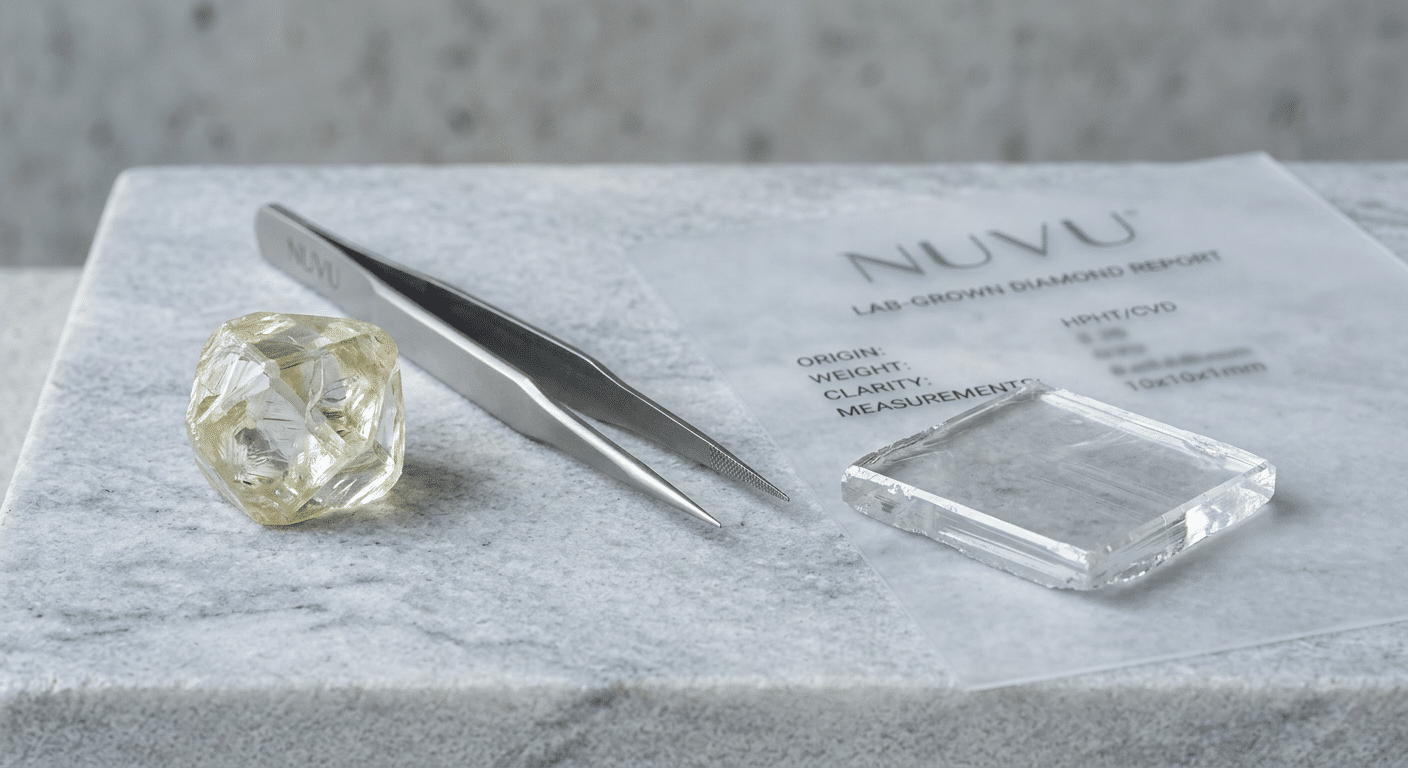
HPHT recreates the intense pressure and heat that form diamonds deep underground. The process uses a massive press to squeeze carbon around a seed crystal while heating it to temperatures that allow the atoms to reorganize into a diamond lattice. Because the pressure is applied from multiple directions, the resulting crystal typically grows in a cuboctahedral shape. HPHT is highly efficient for producing smaller to mid-range stones and excels at generating vivid, saturated fancy colors. The initial clarity distribution is often concentrated near the crystal edges, which means cutters frequently position the table to push inclusions toward the girdle during polishing.
Chemical Vapor Deposition Process Reality
CVD takes a different approach. A diamond seed is placed inside a vacuum chamber filled with carbon-rich gas. The chamber is heated, and the gas breaks down into plasma, allowing carbon atoms to settle onto the seed layer by layer. This produces a flatter, tabular crystal that grows steadily over several weeks. The layering process is highly controlled, which makes CVD well-suited for larger carat weights and consistent color targets. However, the initial growth phase often introduces internal strain and subtle color zoning. These early traits are routine and expected. They are addressed during post-growth refinement and precise cutting, which is why two CVD stones from the same batch can grade differently depending on how the rough was oriented.
Certificate and Visual Review Check
The growth method itself does not appear as a grade, but it leaves recognizable markers in grading reports. HPHT stones may note metallic flux remnants or specific inclusion patterns, while CVD stones often reference growth strain, color zoning, or post-growth treatment in the comments section. A grading report helps document observable characteristics at the time of evaluation, but it does not replace direct visual review. Before committing, request a high-resolution 360-degree video under mixed lighting. Look for uneven color distribution or internal strain clouds that do not appear in the static report photos. A reliable seller will provide media that matches the certificate exactly, allowing you to confirm that the documented traits align with what you actually see.
Market Narratives vs. Actual Diamond Performance
You will encounter strong claims online suggesting that one growth method inherently outperforms the other. These narratives rarely account for how modern facilities actually finish their stones. Once a crystal leaves the growth chamber, it undergoes refinement, precision cutting, and quality grading. At that stage, the synthesis path matters far less than how the rough was stabilized, oriented, and polished. A properly processed HPHT stone and a properly processed CVD stone will sit side by side in a grading lab and receive identical visual grades if their cut, color, and clarity match.
The Post-Growth Treatment Reality
Both methods routinely use controlled heat, pressure, or annealing after the initial growth phase. This is not a defect or a shortcut. It is a standard industry practice that stabilizes color and reduces visible strain or clouding in the crystal lattice. Treatment allows laboratories to produce stones that meet commercial color targets without relying on unpredictable natural variations. Grading labs document this process in the report comments section. The disclosure exists so buyers know exactly what happened after growth, which aligns with regulatory guidance that emphasizes clear and upfront communication regarding origin and treatment for lab-created gemstones.[2] A well-documented treated stone with excellent proportions will outperform an untreated stone with poor symmetry every time.
Stability and Long-Term Color Behavior
Concerns about color shifting over time stem largely from early lab-grown production runs, not current standards. Modern CVD and HPHT diamonds typically undergo stabilization processes that support color consistency under normal wear. Under standard lighting and everyday conditions, properly documented stones generally maintain their appearance over time. If a stone exhibits noticeable color shifts, the cause often traces back to undocumented treatment, inconsistent grading conditions, or insufficient stabilization during the refinement phase. Transparency in the report comments helps buyers verify that standard industry practices were followed, though final verification still relies on observing the stone under the lighting where it will be worn most.

Buyer Verification Checklist
- Confirm the treatment status directly in the comments section of the grading report. If the report is silent and the listing claims otherwise, request clarification in writing.
- Request clear lighting photography and a short video that shows the stone in daylight and indoor settings. Strain clouds or uneven zoning become obvious when the stone is rotated.
- Check for fluorescence notes only if you are highly sensitive to blue glow under UV-rich lighting. Most everyday environments will not trigger a visible reaction.
- Ensure the seller explicitly discloses any post-growth processing and matches the certificate number to the actual stone shipped. Screenshots are not substitutes for verified digital records.
How Grading Reports Document Growth Methods
Grading reports serve as the primary documentation for lab-grown diamonds, but they are often misunderstood as quality scorecards. In reality, they function as verification tools that record measurable attributes at a specific point in time. Understanding how laboratories document growth methods prevents buyers from overinterpreting technical notes and redirects focus toward the data that actually governs visual performance.
Standard Wording on IGI and GIA Reports
Major grading laboratories use consistent but slightly varied terminology to record origin. An IGI report typically states Laboratory-Grown in the header, followed by a specific growth method notation in the comments section, such as “CVD” or “HPHT.” If post-growth processing was applied to improve color or clarity, the report will explicitly note it, often phrased as “Post-growth treatment applied.” GIA certification follows a similar structure, using Laboratory-Grown Diamond as a primary identifier and detailing the synthesis process in the clarity characteristics or additional comments area.[1] GCAL documentation operates with comparable precision, emphasizing traceability and often including spectral data references.
The variation in phrasing across laboratories reflects different internal documentation standards, not a hierarchy of quality. A stone graded by one lab is not inherently superior or more stable simply because the wording differs from another. The growth method notation is strictly factual. It confirms how the carbon lattice formed, but it does not endorse brilliance, durability, or long-term value. Buyers should treat these notes as origin labels rather than performance ratings.
What the Report Cannot Guarantee About Performance
A grading report captures a static snapshot of the stone under controlled laboratory lighting and magnification. It measures proportions, records color and clarity grades, and maps visible inclusions. What it cannot capture is how the diamond interacts with real-world light, how it pairs with a specific ring setting, or how it will hold up under daily wear over a decade. A report will not tell you if a stone exhibits a bow-tie effect in person, whether the polish creates subtle light diffusion, or if the girdle thickness aligns securely with thin prongs.
Relying on paperwork alone creates a false sense of security. Two diamonds with identical report specifications can behave entirely differently on a hand. One may appear crisp and highly reflective, while the other looks muted or unevenly lit, simply due to microscopic facet misalignments that grading scales do not penalize. Additionally, grading reports evaluate stones in isolation. They do not account for how surrounding metal colors, prong coverage, or setting depth will influence perceived tone or brilliance. A high-color diamond set in yellow gold may warm in appearance, while a heavily covered setting can restrict light entry regardless of ideal cut grades. The report documents the stone as a standalone item; evaluating it as part of a complete piece requires checking how the physical measurements and facet geometry interact with your chosen design. The report proves the stone is a genuine lab-grown diamond and documents its baseline attributes. It does not guarantee that the stone will meet your visual expectations in natural daylight or indoor lighting.
How to Verify This Before Buying
Verification requires moving beyond the digital image of a report and confirming that the documented stone matches what you receive. Start by entering the report number directly on the grading laboratory’s official website. Third-party screenshots or retailer-uploaded PDFs can be edited or outdated. Cross-reference the exact millimeter measurements, girdle thickness, and culet size listed on the report with the seller’s listing photos. If the dimensions do not align, the documentation belongs to a different stone.
Request a short, unedited video of the diamond recorded in natural daylight. Controlled studio lighting often masks strain patterns, weak color zoning, or poor light return. A daylight video reveals how the stone performs under real conditions. Finally, ask the seller to confirm in writing that the shipped diamond matches the verified report number exactly. Reputable suppliers will provide this confirmation without hesitation. This step closes the gap between paper documentation and physical reality, ensuring you are evaluating the actual stone rather than an idealized profile.
Why Growth Method Is Not a Quality Proxy
Buyers frequently search for a direct link between growth method and diamond quality, assuming that one synthesis path consistently produces superior stones. This assumption does not align with how modern lab-grown diamonds are manufactured or graded. The physical origin of a diamond establishes its starting material, but it does not dictate how it sparkles, how it wears, or how it performs once set in jewelry. Cut precision, polish execution, and clarity placement govern those outcomes entirely.
Cut Quality Overrides Growth Origin
Brilliance and fire are engineered through proportion accuracy and facet alignment. Regardless of whether a diamond was grown using high pressure or gas-phase deposition, light return depends on how precisely the cutter shapes the crystal. For a round brilliant, common industry benchmarks often point to directional ranges such as a table percentage between 54% and 62%, a depth between 59% and 63%, and a crown angle that harmonizes with the pavilion to create optical symmetry. Deviate from these ranges, and the stone leaks light, appearing flat or glassy regardless of its flawless grades on paper.
A perfectly formed rough crystal can still yield a poorly performing diamond if the cutter prioritizes weight retention over optical precision. Conversely, a crystal with minor initial strain can be cut to exceptional proportions, masking internal traits and delivering maximum brilliance. The growth method explains where the carbon atoms came from. The cut determines what your eye actually sees. When evaluating options, prioritize proportion accuracy and light behavior over synthesis labels.
Clarity Tolerance by Shape and Setting
Not all diamonds hide inclusions the same way, and the shape you choose significantly alters how clarity grades translate to real-world appearance. Round brilliant cuts disperse light across multiple facets, making them highly effective at masking SI1 or even SI2 inclusions that sit near the girdle or are not directly face-up. Elongated shapes like ovals, marquise, and emerald cuts lack that light-scattering complexity. An oval with a visible inclusion near the edge or a pronounced bow-tie effect will show it immediately, often requiring a step up to VS clarity for clean face-up performance.
The intended setting also dictates clarity tolerance. A solitaire setting with an open basket leaves the diamond fully exposed, demanding careful inclusion placement and often justifying a higher clarity grade. A pavé or bezel setting naturally covers portions of the girdle and lower crown, allowing SI clarity stones to perform cleanly without compromising visual appeal. Paying for flawless or VVS grades on a stone set in a fully enclosed design rarely yields visible returns. Match clarity expectations to the shape’s optical behavior and the setting’s coverage, not to an arbitrary grade threshold.
Stone-to-Setting Fit Check
Before finalizing a purchase, verify that the stone’s physical dimensions align with your chosen setting. Diameter and depth measurements determine how the diamond sits in the band. A stone that is too shallow can sit flush with the prong tips, creating a security risk and altering the ring’s profile. A girdle that is too thick or uneven can prevent the stone from seating properly in standard prong or tension settings.
Request a CAD rendering or a setting mock-up that uses the exact millimeter specifications of your selected diamond. This visual confirmation eliminates guesswork and reveals proportion mismatches before the stone is mounted. The growth method has no bearing on how a diamond fits into a setting. Millimeter measurements, girdle geometry, and facet symmetry do. Ensuring these physical parameters align with your design guarantees a secure fit and predictable aesthetic outcome.
When Growth Method Actually Influences Your Decision
For the vast majority of buyers selecting a standard white diamond, growth method remains background context. It does not dictate price tiers, visual performance, or durability. However, specific purchasing goals create scenarios where the synthesis path legitimately affects availability, budget allocation, or design execution. Recognizing these edge cases prevents overcomplication while ensuring you do not overlook genuine logistical considerations.
Fancy Color Diamonds and Method Selection
Fancy color lab-grown diamonds operate on different production logic than white stones. The intensity and hue of colors like vivid blue, intense pink, or fancy yellow are directly tied to trace elements introduced during synthesis and the subsequent crystal structure formation. Blue diamonds typically rely on boron incorporation during HPHT growth, while pink and yellow hues are more efficiently managed through nitrogen manipulation and post-growth annealing in CVD environments. This does not mean one method is universally better for colors, but it does mean certain hues are more readily available or more cost-effective to produce through specific synthesis paths.
When pursuing fancy colors, documentation becomes critical. The grading report must explicitly state whether the color is natural to the growth process or the result of post-growth irradiation and treatment. Saturation stability also varies. A vivid blue grown via HPHT often maintains its hue without additional stabilization, while certain CVD pinks require careful heat management to prevent gradual fading. If color intensity and long-term hue retention are your primary goals, the growth method and its associated treatment notes directly influence which stones align with your expectations. For white diamonds, this dynamic rarely applies.
Budget Allocation and Size vs. Documentation Tradeoffs
Lab-grown diamonds offer flexibility, but that flexibility requires intentional budget distribution. Buyers frequently stretch their carat weight target at the expense of cut precision or certification quality. A realistic evaluation shifts focus toward total project value rather than headline size. Consider a scenario where you must choose between a 1.5-carat F-color diamond with average proportions and standard certification, versus a 1.3-carat E-color stone with ideal cut parameters and a comprehensive grading report. The smaller, precisely cut diamond will consistently outperform the larger stone in brilliance and longevity, while also carrying more reliable documentation for future verification.
Growth method rarely alters pricing tiers for white diamonds in the retail market. Both HPHT and CVD stones compete directly on the basis of cut execution and measurable attributes. Where budget allocation becomes critical is in documentation and verification. Investing in a thoroughly graded report, requesting high-resolution daylight media, and confirming post-growth treatment status often delivers more long-term confidence than chasing a half-carat weight increase. The synthesis method does not change this equation, but transparent sourcing and precise cut evaluation do.
What to Check Before You Decide
If your purchase involves fancy colors, custom sizing constraints, or specific budget boundaries, apply a targeted verification checklist before committing. Confirm that the grading report explicitly addresses color origin and notes any post-growth processing. Compare the stone’s saturation across different lighting environments using unedited video, as certain hues shift noticeably between daylight and indoor bulbs. Calculate the total project cost, factoring in the stone, setting, certification fees, and expected timeline. For custom designs, request written confirmation that the supplier understands any method-specific handling requirements, such as prong alignment for thicker girdles or heat sensitivity during soldering.
For standard white diamonds, these edge-case considerations simplify to a straightforward hierarchy. Verify the report, evaluate cut proportions, match clarity to your setting, and confirm physical dimensions. When your goals align with standard selection, the growth method recedes into background documentation. When your goals involve specialized colors or complex custom parameters, the method and its associated treatment notes become relevant variables in your final decision. Understanding where the boundary lies keeps the buying process focused on measurable outcomes rather than technical speculation.
Supply Chain Transparency and Sourcing Realities
Production Hubs and Method Specialization
The choice between HPHT and CVD at the manufacturing level is rarely about ideology. It is about infrastructure optimization. Facilities invest in large-scale presses or multi-chamber vacuum reactors based on the stone specifications they intend to dominate. Some hubs specialize in high-volume HPHT production because their equipment excels at stabilizing color in smaller carat ranges or achieving specific fancy color targets efficiently. Others allocate capital toward CVD growth lines because the technology scales more predictably for larger, high-clarity stones that require precise post-growth refinement.
This division of labor means that specialization is a stronger indicator of reliability than geographic origin. A mature facility understands the yield curve of its chosen method and structures its quality control around it. Buyers who treat growth method as a regional stereotype often miss the operational reality: consistency comes from disciplined process control, not location. When evaluating sourcing options, the relevant question is whether the supplier runs a focused production line with established grading protocols, not where the equipment was assembled.
Wholesale Communication and Batch Consistency
Transparent sourcing relies on how suppliers translate production outputs into buyer-facing documentation. A professional wholesale operation does not rely on verbal assurances about quality. Instead, it builds workflows that align physical stones with grading reports before inventory is listed. This includes matching lot numbers to certificate batches, verifying that post-growth treatments are recorded on the paperwork, and establishing clear lead times that account for both production cycles and certification turnaround.
Batch consistency is where many sourcing conversations break down. A supplier might quote an excellent price tier for a specific clarity grade, but fail to clarify whether that grade reflects a tight tolerance across multiple stones or a wide acceptance range. Clear communication should explicitly cover measurement tolerances, fluorescence behavior, and how post-growth treatments are documented across the lot. When documentation aligns with the actual inventory, the sourcing process becomes a verification exercise rather than a negotiation of unknowns. For deeper insights into how these workflows operate at scale, a dedicated look at the China lab diamond supply chain outlines the industry standards that separate reliable partners from inconsistent ones.
Buyer Verification Checklist
- Confirm that batch documentation matches the exact stones listed for sale, including matching report numbers and laser-inscribed identifiers.
- Request pre-shipment photography or video under daylight-equivalent lighting to verify clarity placement and color tone before payment clears.
- Clarify return policies, independent verification windows, and appraisal contingencies in writing, ensuring they cover grading discrepancies.
- Ask direct questions about post-growth processing: whether the stones were treated for color or clarity, and how that treatment is disclosed on the grading report.
- Confirm minimum order quantities and lead times are based on current certification queue status, not optimistic production forecasts.
Building a Rational Buying Framework
Prioritizing What Actually Affects Wear and Appearance
When it is time to make a selection, the growth method should sit at the bottom of your evaluation hierarchy. The physical reality of wearing a diamond is dictated by how light moves through the stone, not how carbon was deposited or compressed. Cut precision and proportional alignment determine brilliance and fire. A well-cut stone with standard clarity will consistently outperform a poorly proportioned stone with higher grading scores or a preferred growth method.
Clarity placement matters far more than the absolute clarity grade. A VS2 stone with inclusions hidden near the girdle will face up cleaner than a VVS1 with a central dark inclusion under the table. Certification acts as a baseline anchor, confirming carat weight, color range, and cut grade within standardized parameters. Once those three elements are verified, the growth method becomes background context. If two stones meet identical cut and clarity benchmarks, the choice should default to whichever offers better value or aligns with inventory availability, rather than overpaying for a specific synthesis origin.
Next Steps in Loose Stone Selection and Custom Design
Moving from research to acquisition requires a structured sequence. Begin by pulling the grading report for any shortlisted stone and cross-referencing it against high-resolution media. Look for consistent light return in the video, check for unwanted tension in the facet patterns, and verify that the listed dimensions match the intended setting profile. Budget allocation should account for the complete project: the loose stone, the mounting or setting materials, certification fees, and design timelines.
If you are working toward a custom piece, transition to a CAD mock-up or a bench rendering before finalizing the stone purchase. This step reveals how the chosen measurements interact with prong placement, shank width, and halo dimensions. Ready-made settings offer faster turnaround but require exact millimeter matching to avoid resizing risks. For buyers exploring this path, reviewing the custom design timeline and budget allocation guide helps align expectations with realistic production schedules.
How to Verify This Before Buying
- Cross-check the certificate number on the grading lab’s official database to confirm the report status and exact recorded specifications.
- Request a short video of the stone under natural daylight and standard indoor lighting to assess color accuracy and scintillation behavior.
- Confirm that the girdle thickness and pavilion angle are compatible with your chosen setting to prevent structural weakness or poor light performance.
- Obtain written confirmation of seller policies regarding independent regrading, mismatch disputes, and warranty coverage for future maintenance.
- Retain all original documentation, including purchase receipts and certification copies, for insurance valuation and long-term ownership records.
At NUVU, this kind of comparison is treated as a practical selection question. The report helps narrow the field, but the final decision still depends on how the stone performs visually, how its measurements align with the intended setting, and how the documentation supports long-term verification. Each listing is structured to let you review cut proportions, grading comments, and unedited media side by side, so you can evaluate tradeoffs before committing. The focus remains on transparent documentation and physical compatibility, ensuring the chosen stone meets your design requirements without relying on synthesis labels as a shortcut for quality.
All diamonds discussed in this article with grading reports have been verified against official lab records where applicable.
Independent verification available upon request through GIA’s online report check service.
[1] Gemological Institute of America, “New Descriptive Terminology for Laboratory-Grown Diamonds,” GIA News & Research, 2025, New Terminology for Lab-Grown Diamonds.
[2] Federal Trade Commission, “Advertising Lab-Grown Diamonds,” FTC Business Guidance, Advertising Lab-Grown Diamonds.