- Shop
Diamonds & Jewelry
Loose Lab Diamonds Yellow Lab Diamonds Pink Lab Diamonds Blue Lab Diamonds Engagement Rings Fine Jewelry Shop All Loose lab-grown diamonds10 shapes · IGI, GIA or NGTC reports
- Wholesale
- Custom Design
- Education
- About
Custom Lab-Grown Diamond Ring Design Guide: How to Match the Center Stone, Setting, and Metal
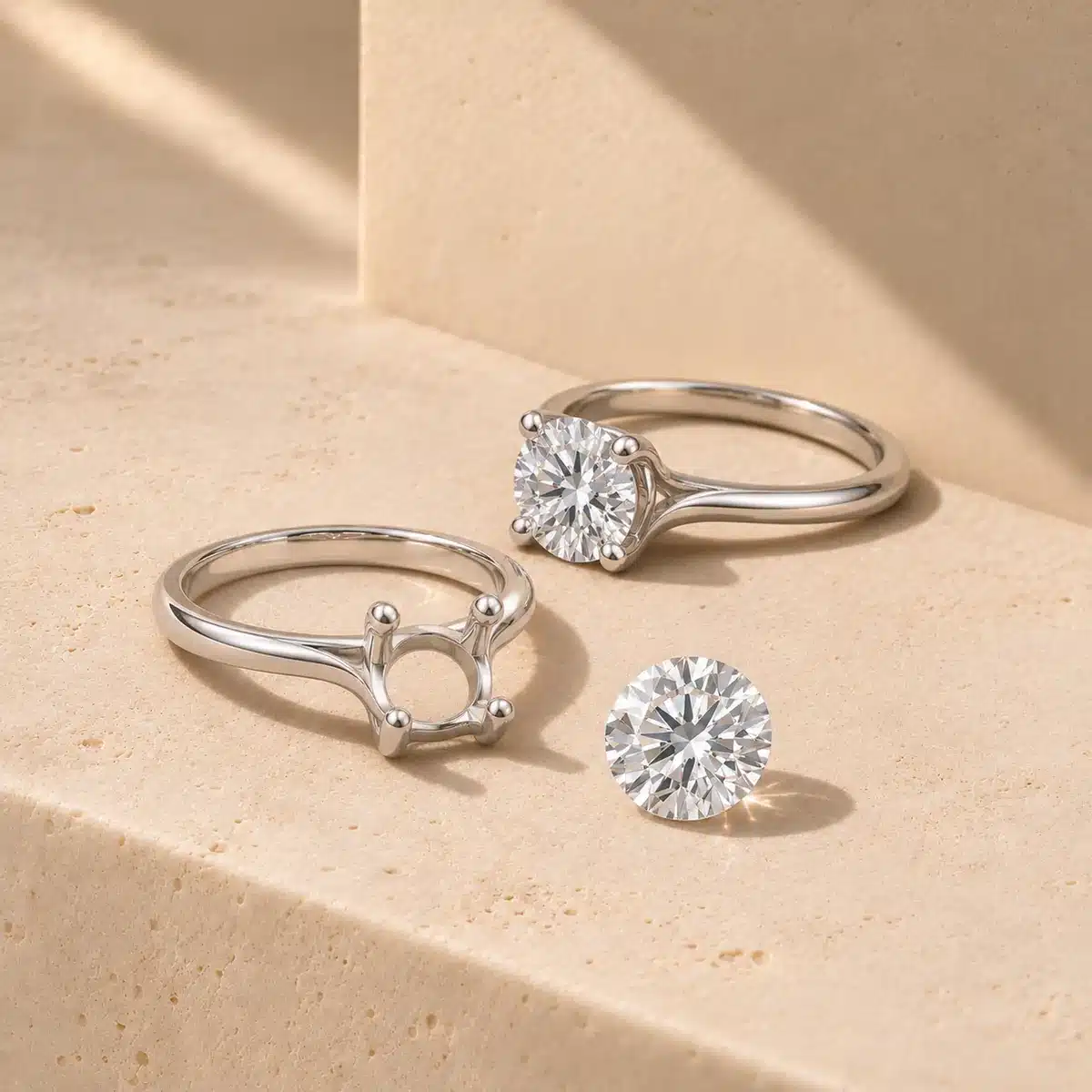
Take a 2.00 ct lab-grown pear, about 11 × 7 mm, set in a delicate four-prong head copied from a photo of a round. The round in the photo had no point to protect. The pear does, and with no prong covering its tip, the tip takes every knock. Now the same pear in a six-prong head with a V-prong at the tip, a 2.2 mm band, and a white gold head on a yellow band. Same stone, same budget, a ring that will last.
A custom ring is three decisions made together: the center stone, the setting that holds it, and the metal around it. Start from the stone’s shape and measurements, choose a setting that protects its weak points and suits how the ring will be worn, then pick the metal for wear, color and comfort.
Shape and setting: what each stone needs
Choose a shape:
Points and sharp corners chip more easily than curved edges, so the setting has to cover them. An east-west setting turns an elongated stone sideways; it sits lower and needs a wider top on the band. See the diamond shapes guide.
The stone’s measurements decide the head
Carat is weight. The length, width and depth on the report decide the size of the head, where the prongs fall and how tall the setting has to be. A deeper stone needs a taller head and sits higher on the finger. Give the designer the measurements from the report, and video if the outline is unusual, rather than “1.5 ct oval”.
How the stone’s grades affect the design:
- Cut: a well-cut stone faces up larger for its weight. Rounds carry a cut grade; for fancy shapes, judge proportions and video.
- Color: GIA notes that stones of H or better look colorless in platinum or white gold, while J–K can look acceptable in yellow or rose gold. A white head on a yellow band keeps the stone looking white.
- Clarity: a prong can cover an inclusion near the edge; a bezel hides the girdle. Step cuts (emerald, Asscher) show inclusions more than brilliant cuts.
Choosing the setting
Swipe the table to see more →
| Setting | How secure | Light and look | Snags | Upkeep |
|---|---|---|---|---|
| 4 prongs | Good | Most of the stone visible | Medium | Check prongs once a year |
| 6 prongs | Better; losing one prong is less serious | Rounder outline | Medium | Check once a year |
| Bezel | Highest; metal around the whole girdle | Less light from the side | Low | Low |
| Halo | Good | Center looks larger | Medium | Small stones to check |
| Hidden halo | Good | Sparkle from the side, clean top view | Medium | Small stones to check |
| Cathedral | Good | Raises the stone | Medium to high | Check height |
| Pavé band | Depends on the work | Sparkle along the band | Low | Small stones can loosen; harder to resize |
Prongs have to be thick enough to hold the stone through years of wear. Very fine prongs look light in a render but wear thin faster. For people who work with their hands, a bezel or a low six-prong head is the safer choice.
Setting height
A high setting shows more of the stone’s side but catches on clothes and gloves, and a straight wedding band may not sit flush beneath it. A low setting is more practical for daily wear. On the CAD, check the height from the finger to the top of the stone. See what to check in a CAD.
Band and stone in proportion
The band should look balanced with the center stone and be strong enough not to bend. Many solitaire bands are around 1.8 to 2.5 mm wide; a larger stone usually needs a wider or thicker shank and stronger prongs. Check the thickness at the thinnest point, usually at the base, as well as the width.
Choosing the metal
Swipe the table to see more →
| Metal | Fine metal content | Wear | Color | Care |
|---|---|---|---|---|
| 14K gold | 58.3% gold | Harder alloy; resists scratches and bending better | Yellow, white, rose | White gold is usually rhodium-plated and needs replating |
| 18K gold | 75% gold | Softer; richer color | Yellow, white, rose | Same |
| Platinum 950 | 95% platinum | Dense; a scratch moves metal rather than removing it | Naturally white | Develops a soft patina; heavier and usually costlier |
In the US, “Platinum” on its own may only be used for metal that is at least 950 parts per thousand platinum. For wearers with nickel allergies, check the white gold alloy: nickel-white gold is common, and in the EU items in prolonged contact with the skin must meet a nickel release limit. Platinum and palladium-white gold avoid the question. See the budget guide for what each metal does to the price.
Mixing metals
A white gold or platinum head on a yellow or rose band is common. It keeps a near-colorless stone looking white while the band carries the warm color.
A matching checklist before the CAD
Ring design questions
Should I choose the diamond or the setting first?
The setting style first, then the stone, then the final setting built to the stone’s measurements.
Which metal is best for a lab-grown diamond ring?
14K gold for daily durability at a lower price, 18K for richer color, platinum for a naturally white, dense metal.
How many prongs should my ring have?
Four shows the most stone, six adds security, and pointed shapes need V-prongs at the points.
Can I mix metals in one ring?
Yes. A white head with a yellow or rose band is a common way to keep the stone looking white.
Design a setting around your stone
Send the stone’s report number, or the shape and size range you want, with the ring size, metal and setting style. NUVU can arrange IGI, GIA or NGTC reports for the center stone. Start your custom design or message us on WhatsApp / WeChat at +86 19118403930.
Sources

11+ years supporting global clients with lab-grown diamond product consultation and market analysis.
About NUVU. NUVU is the international brand of New Perspective Superhard Materials Co., Ltd. in Zhecheng, Henan, China. We grow HPHT lab-grown diamonds in-house and cut, polish and match stones in our own workshop.
Related Guides
Custom jewelry guide
How custom lab-grown diamond jewelry is made: when custom makes sense, the brief, stone selection, CAD approval…
Read more →CustomSetting styles
Solitaire, halo, hidden halo, three-stone and vintage settings compared: look, stone protection, height, wedding…
Read more →CustomDesign your ring
Design your own lab-grown diamond ring: choose the shape, setting, metal and size, send a reference photo, and…
Read more →