
A GIA report for a lab-grown diamond provides an objective baseline for comparing the 4Cs, but it does not tell the full story—IGI vs GIA certification—two diamonds with identical GIA grades can look noticeably different in person—one may sparkle brilliantly while the other appears dull. This matters because relying solely on the report without understanding its limits often leads to a purchase that disappoints visually. This article clarifies what the GIA report actually confirms, what it leaves out, and how to use it alongside visual inspection to make a more confident buying decision.
For the full framework, read Lab-Grown Diamond Certification Guide.
| What GIA Report Confirms | What GIA Report Does Not Show | What You Should Do |
|---|---|---|
| Standardized 4Cs grades (carat, color, clarity, cut) | Actual light performance (brilliance, fire, scintillation) | View high-resolution video or inspect in person before buying |
| Lab-grown origin identification | Visual appearance or “face-up” beauty | Compare multiple stones side-by-side under the same lighting |
| Laser inscription number for verification | Setting compatibility or how it will look when mounted | Verify inscription matches report number using a loupe or online database |
| Cross-check via GIA’s online report check | Pricing or relative value compared to other certified stones | Compare identical GIA grades across different sellers for fair market pricing |
| Consistent cut grade (Excellent is most important) | Whether a lower color or clarity grade is acceptable in your setting | Balance budget: G-J color and SI1-SI2 clarity often look flawless when set |
Quick Questions Before You Read
Q: Does a GIA report guarantee a beautiful diamond?
No. The report confirms standard grades but does not assess visual beauty or sparkle. Two stones with the same GIA grades can look very different in person.
Q: Is a GIA report required for all lab-grown diamonds?
Not required, but recommended. GIA provides the most consistent cut grading. Other labs like IGI offer reliable reports at lower cost, but you should compare stones visually rather than rely solely on the cert.
Q: How do I know a GIA report is real and matches the stone?
Check the laser inscription on the diamond with a jeweler’s loupe and verify the report number on GIA’s online database. A mismatch indicates fraud or a swapped stone.
Q: What matters more—cut grade or color/clarity grade?
Cut grade affects sparkle the most. Prioritize Excellent or Very Good cut before spending more on higher color or clarity that won’t be visible in a typical setting.
What a GIA Lab-Grown Diamond Report Actually Contains
A GIA lab-grown diamond report is a standardized document that records specific measurements and observations about a single stone. It does not rank beauty or assign a dollar value. It records what GIA’s graders can measure and verify under controlled conditions. Understanding what is actually on the report — and what is not — matters more than most buyers expect.
Grading Parameters on a GIA Report for Lab-Grown Diamonds
GIA applies the same 4Cs grading scale to lab-grown diamonds as it does to natural diamonds. Color, clarity, cut, and carat weight are all evaluated in the same grading environment by the same trained graders.[1] The report also includes ratings for polish, symmetry, and fluorescence. These are not optional additions. They are part of GIA’s standard assessment.
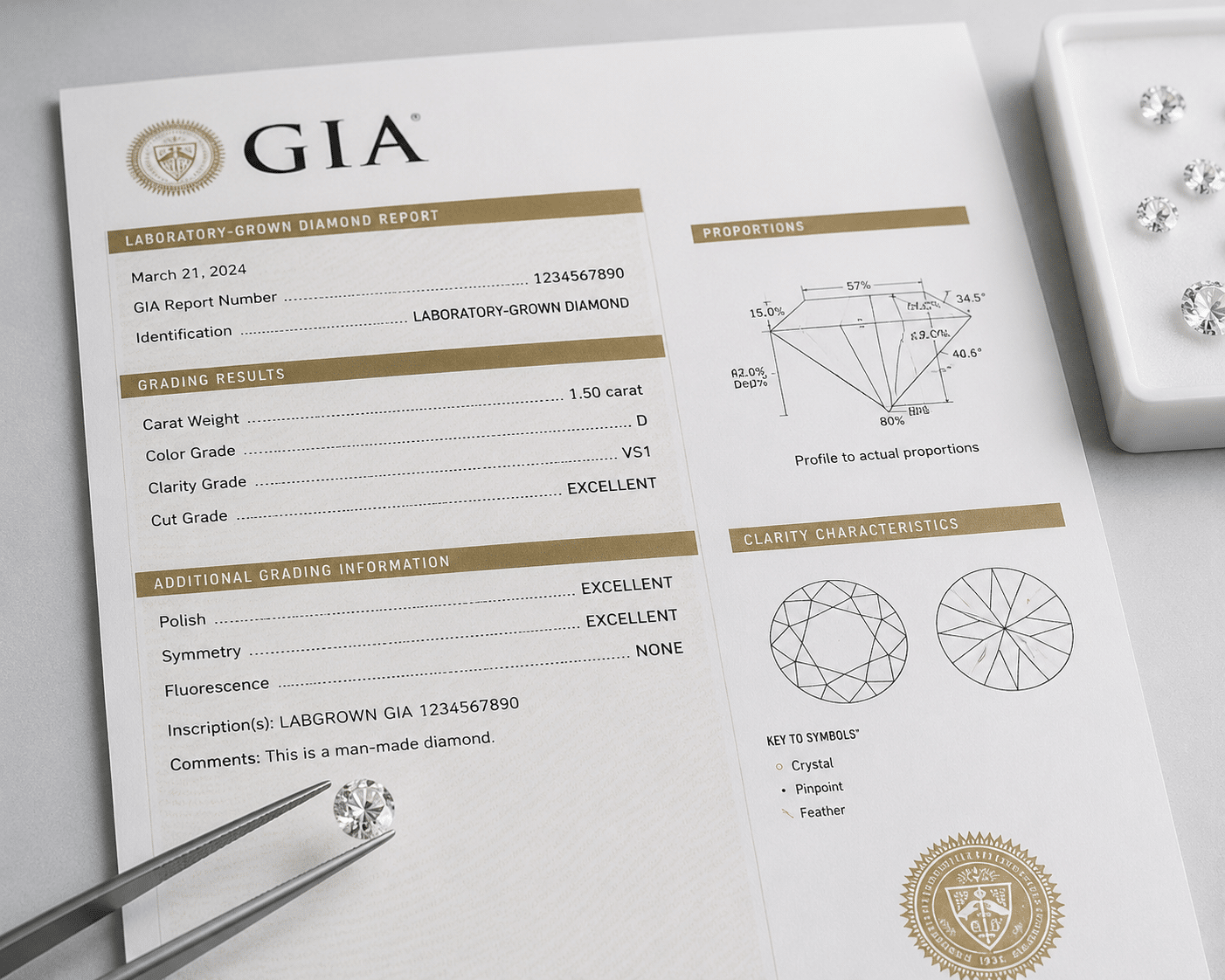
What this means in practice is that a GIA report gives you a controlled, third-party baseline. You can compare a GIA-graded lab-grown diamond sold by one retailer against another GIA-graded stone sold elsewhere and expect the same grading standards to apply. The report does not tell you which stone looks better to your eye, but it does remove the risk of relying on a seller’s own internal grading.
Identification and Inscription Specifics
Every GIA report for a lab-grown diamond includes a clear statement of origin identifying the stone as “Laboratory Grown.” This is not buried in fine print. It appears on the report itself. The diamond typically also receives a laser inscription on the girdle — the outer edge of the stone — that includes the GIA report number and the words “LABORATORY GROWN.”[2]
This inscription is microscopic. You will not see it with the naked eye. It requires a 10x loupe or a jeweler’s microscope to read. That is by design. GIA inscribes the girdle so the identification is permanent but does not interfere with the diamond’s appearance.
What to Check Before You Decide
When reviewing a GIA lab-grown diamond report, start by confirming that the inscription matches the report number listed. A mismatch is a red flag. Ask the seller to provide a clear photo or video of the girdle inscription so you can verify it exists and is legible. Then cross-check the report number on GIA’s free online database.[3] This confirms the report is legitimate and has not been altered or misappropriated.
These checks take a few minutes. Skipping them introduces unnecessary risk.
Why GIA Certification Matters in a Lab-Grown Diamond Purchase
GIA certification is useful because it provides independent, standardized data about a diamond. But the value of the report depends on how you use it. Buyers who treat the report as a complete decision tool tend to overlook things that matter in person.
Report Reliability vs. Visual Appeal
GIA reports provide objective grading data, but objective does not mean comprehensive. Two diamonds with the same GIA grade can look noticeably different. The reasons are subtle but real. Minor variations in faceting precision, crystal transparency, or growth characteristics specific to the lab-grown production method can affect how a stone performs in real light.
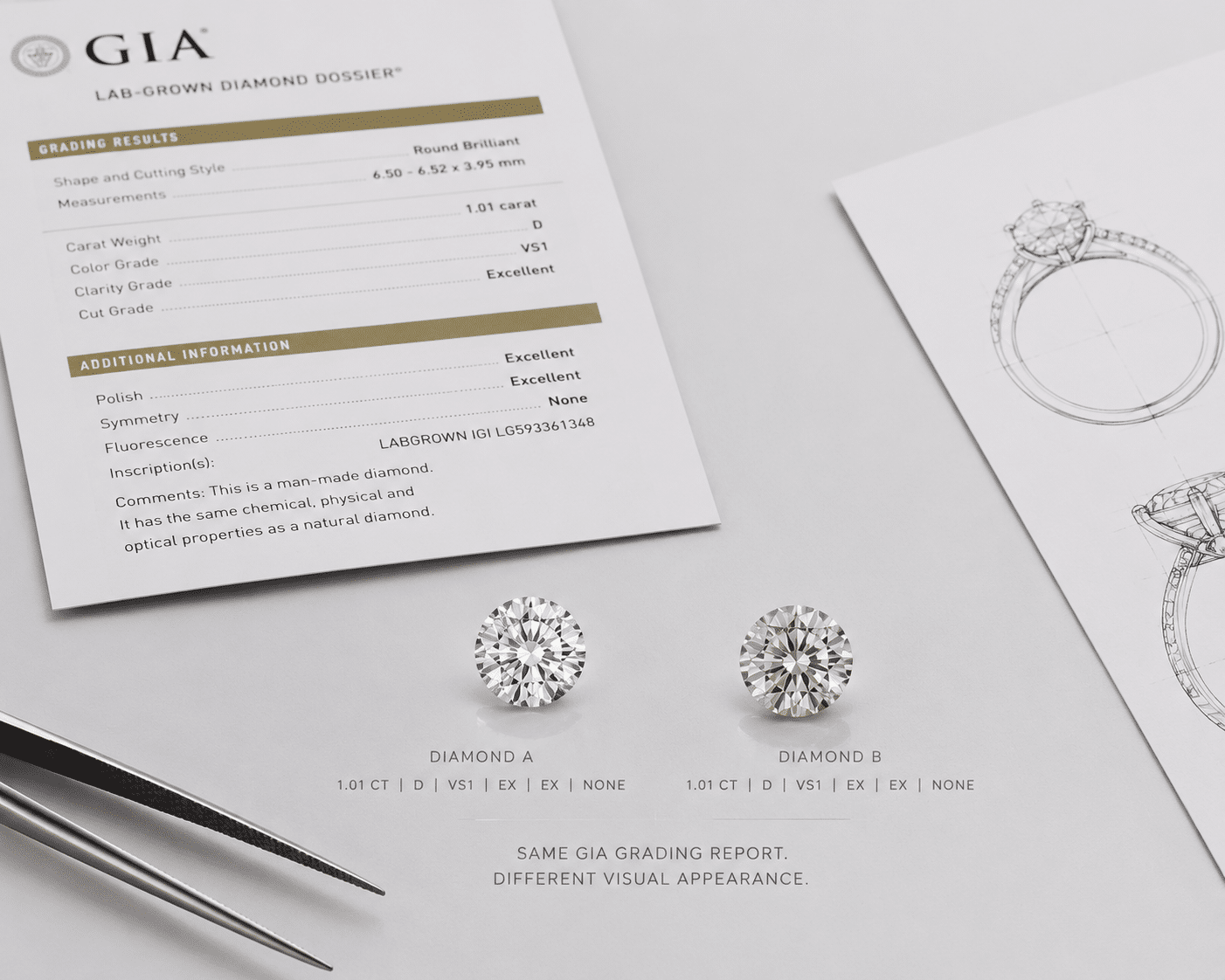
A GIA cut grade of Excellent tells you the proportions fall within a tested range. It does not tell you how that specific diamond interacts with candlelight, overhead LEDs, or indirect daylight. The report is reliable for what it measures. But visual appeal depends on factors the report does not capture.
How GIA Reports Support Buyer Confidence
For U.S. buyers, a GIA report reduces uncertainty in a specific way. It provides an independent, third-party evaluation. This prevents reliance on seller self-reported grades, which can vary widely in consistency. It also gives you a baseline to compare stones across different retailers using the same reference points.
At NUVU, we treat the grading report as the starting point for a comparison, not the conclusion. The report confirms carat weight, cut grade, and clarity. It confirms the stone is lab-grown and that the inscription matches. But the report does not guarantee the diamond is the best value for your specific budget. A GIA-graded diamond can still be overpriced relative to an equivalent stone with a different report, depending on the seller’s markup.
Understanding the Role of Disclosure and Terminology
GIA’s terminology for lab-grown diamonds has evolved alongside industry standards. The Federal Trade Commission (FTC) in the United States has provided guidance on how lab-grown diamonds should be described in advertising and sales materials, emphasizing clear and non-misleading language.[4] GIA’s own report language aligns with this approach by plainly stating the diamond’s laboratory-grown origin. For a buyer, this means the report itself serves as a form of disclosure, spelling out exactly what the stone is and where it came from—no euphemisms, no ambiguity.
Buyer Verification Checklist
Use the report to verify the essential facts in the IGI lab grown diamond certificate guide: carat weight, cut grade, color, clarity, and inscription match. Then request high-resolution photos and 360-degree video to assess actual sparkle and visual performance under different lighting. A GIA report supports decision-making. It does not replace seeing the stone, either in person or through detailed media.
What a GIA Report Does Not Tell You
Buyers frequently assume a GIA report covers more than it actually does. The document is precise, but its scope is limited. Understanding those limits prevents misinterpreting the report as a guarantee of performance or fit.
Visual Performance and Light Behavior Are Not Graded
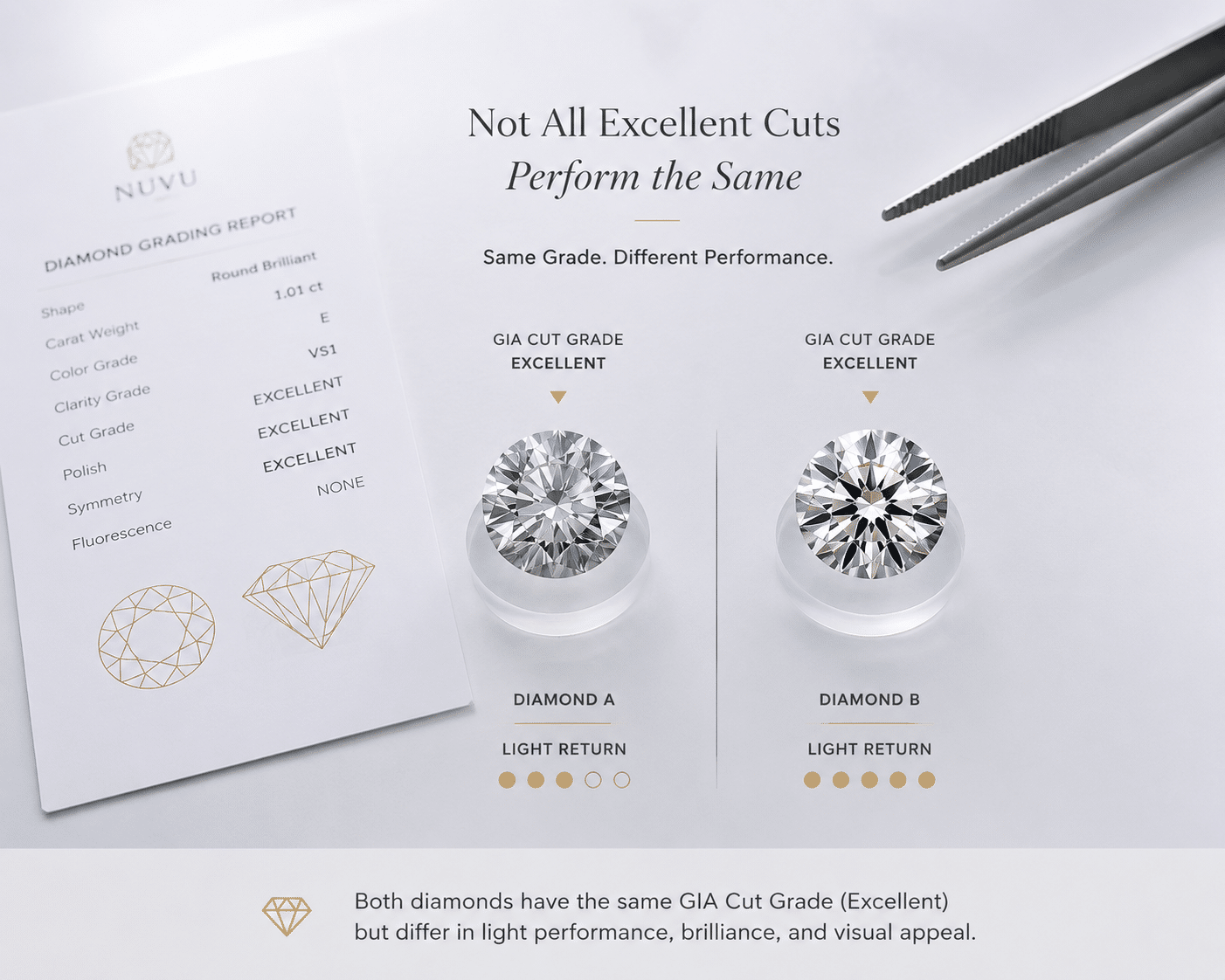
GIA does not issue a light performance score. There is no rating for brilliance, fire, or scintillation on a standard GIA lab-grown diamond report. The cut grade covers proportions and symmetry, which influence light behavior, but it does not quantify how light actually interacts with that specific diamond’s internal structure.
Lab-grown diamonds can have subtle variations in crystal transparency that affect how light travels through the stone. These variations are not captured by the cut grade. Two diamonds both graded Excellent cut can have different real-world brightness because of factors the report does not measure.
Setting Compatibility and Practical Fit
The report includes measurements: table width, depth percentage, crown angle, pavilion angle, and girdle thickness. But it does not evaluate how the diamond fits into a specific ring setting. A diamond with perfectly graded proportions on paper may still sit poorly in a bezel setting, require an unusually tall basket for a halo design, or have a girdle thickness that makes it vulnerable in a tension setting.
These are practical considerations that come up during the design or mounting process. The report is silent on all of them.
Stone-to-Setting Fit Check
Before committing to a setting, share the diamond’s exact measurements with your jeweler. Confirm that the crown height, girdle thickness, and pavilion depth are compatible with your chosen ring design. A report cannot tell you whether the diamond will sit level, require a custom basket, or need height adjustments to accommodate a specific prong style. That is a conversation between you, your jeweler, and the actual stone.
The Report as a Traceability Document in a Broader Sourcing Context
In addition to its grading function, a GIA report serves as a traceability document in a broader sourcing and retail context. For lab-grown diamonds, the report establishes a permanent record that links the stone to a specific grading event, a unique report number, and a physical inscription. This linkage is the foundation of traceability: the buyer can, in principle, retrace the diamond’s identity from the point of sale back to the grading report. However, traceability has limits. The GIA report typically does not include information about the manufacturer, the specific lab facility where the diamond was grown, or the batch from which it originated. A buyer seeking deeper traceability—beyond the facts recorded by GIA—should ask the seller what additional documentation is available. Some sellers maintain records linking a specific GIA report number to their purchase order or production batch. In wholesale or custom design contexts, asking for this documentation before purchase can clarify the chain of custody. The report is a reliable anchor for the diamond’s identity, but its traceability range depends on what the seller records alongside it.
For buyers seeking traceability beyond the GIA report, it is worth asking the seller whether they maintain any additional records linking the report number to sourcing documentation, production batches, or purchase orders. The report itself is a robust starting point for verification, but the completeness of the traceability chain depends on what documentation the seller provides.
How to Compare GIA-Certified Lab-Grown Diamonds
A GIA report gives you a standardized set of numbers for every stone you look at. That makes comparison possible. But the numbers on paper are not equally important, and knowing which ones to prioritize is what separates a confident decision from an overwhelmed one.
Prioritizing Cut Grade Over Other Parameters
Cut grade has the strongest influence on how a diamond actually performs visually. It controls how light enters the stone, bounces off the facets, and returns to the eye. For lab-grown diamonds, GIA assigns cut grades of Excellent, Very Good, Good, Fair, and Poor. The difference between an Excellent cut and a Good cut is not subtle. The Excellent stone will appear noticeably brighter and more lively, even if the other grades are identical.
Buyers should treat cut grade as the non-negotiable starting point. Limit your search to Excellent or Very Good before looking at anything else. A stone with a lower cut grade will look dull regardless of how high its color or clarity grades are.
Balancing Color and Clarity Within Budget
GIA color grades range from D (colorless) to Z (light color). Clarity grades run from Flawless to I3 (included). The natural instinct is to aim high on both, but that is where money gets wasted.
Most people cannot see the difference between a G color and a D color once the diamond is set in a ring. The same is true for SI1 clarity versus VVS1 clarity. Buyers can often save significantly by choosing G-J color and SI1-SI2 clarity grades, because these ranges appear colorless and clean to the unaided eye, especially in mounted jewelry. The savings can then go toward a better cut grade, a larger carat weight, or a better setting.
The Distinction Between HPHT and CVD Growth Methods
Lab-grown diamonds are typically produced through one of two processes: High Pressure High Temperature (HPHT) or Chemical Vapor Deposition (CVD). GIA has published educational resources explaining both methods, noting that HPHT mimics the natural diamond formation environment using high pressure and high temperature, while CVD grows diamonds in a low-pressure chamber from carbon-rich gas.[5] Both methods produce real diamonds with identical chemical composition to mined stones, but the growth conditions can influence characteristics such as color zoning, crystal structure, and trace element inclusions. While the GIA report does not normally specify which growth process was used, buyers aware of the distinction can ask their seller for additional details about the stone’s origin within the lab. Neither method is inherently superior, but knowing which one was used can inform discussions about the stone’s transparency and aesthetic behavior.
What This Means in a Real Purchase
When comparing two GIA-certified stones, start with cut grade first. Eliminate anything below Very Good. Then look at color and clarity within your budget. Do not automatically choose the higher color grade if it means moving to a lower cut grade. The GIA report helps you compare, but the best value is almost always the highest cut grade at the lowest acceptable color and clarity.
Why a GIA Report Does Not Guarantee the Best Price or Value
A GIA report is a grading document, not a price tag. Buyers sometimes assume that a GIA-certified diamond is automatically a good deal, but the certification only tells you what the stone is. It does not tell you whether the price attached to it is fair.
Pricing Variance Across Sellers
Two diamonds with identical GIA grades can carry meaningfully different price tags. The difference comes from each seller’s sourcing cost, inventory turnover rate, and profit margin. A GIA report standardizes grading across the industry, but it does not standardize pricing. A stone priced high at one retailer may be priced reasonably at another, even though the report data is the same.
The only reliable way to know whether you are paying a fair price is to compare the same GIA-graded stone against similar stones from multiple sellers. If the same report number is listed at two different prices, the higher one is simply overpriced.
Tradeoffs Between Report Prestige and Purchase Price
GIA reports carry a premium. The cost of GIA grading is passed to the buyer, and the lab’s reputation adds perceived value. A lab-grown diamond with a GIA report may cost more than an equivalent stone graded by IGI or GCAL. That premium is not inherently wrong, but it is a choice.
At NUVU, we consider GIA grading useful for certain buyers, especially those comparing stones across multiple retailers or building a custom piece where exact specifications matter. But for a buyer on a tighter budget, an IGI-certified stone with the same visual performance may be the smarter option. The report does not change how the diamond looks. It only changes what you pay for the documentation.
What the FTC Says About Lab-Grown Diamond Terminology
The Federal Trade Commission (FTC) has issued guidance relevant to advertising and sales of lab-grown diamonds. According to the FTC’s Jewelry Guides, marketers must clearly disclose that a diamond is laboratory-created, laboratory-grown, or manufactured, using language that is not misleading.[4] This guidance aims to ensure consumers understand exactly what they are purchasing. For a buyer reviewing a GIA report, this means the “Laboratory Grown” designation on the report is not just a technical note—it reflects a broader industry standard for honest communication. When sellers align their descriptions with FTC guidance, the buyer’s ability to make an informed comparison improves. The report, combined with honest marketing, creates a clearer path to a confident purchase.
How Documentation, Consistency, and Communication Shape the Buying Experience
In sourcing or wholesale conversations, documentation, consistency, and communication often matter as much as the headline specification. A GIA report provides a verifiable starting point, but the quality of the buying experience also depends on how well the seller communicates what is documented versus what is left unstated. For instance, a seller who can explain why a particular GIA-graded stone is priced differently from a similar counterpart—perhaps due to growth batch characteristics, inventory age, or inscription legibility—offers more transparency than one who simply lists the report number. For custom design, trust comes from matching the stone to the setting, budget, and wearer’s daily use—not from choosing grades in isolation. A grading report can narrow the comparison, but it should be read alongside the stone’s proportions, visual evidence, and intended jewelry use. When communication is clear, the report becomes a more useful tool in the buyer’s hands.
Certificate and Visual Review Check
Request pricing for the same GIA-graded diamond from at least three different sellers. Compare not only the report grade but also the seller’s return policy, warranty, and after-sales support. A lower price on a GIA-certified diamond, as explained in the lab grown diamond certification guide, may reflect efficient sourcing, or it may reflect limited buyer protections. Price alone is not the full picture.
How to Verify a GIA Report Before Purchase
Fraud and misrepresentation are rare in the lab-grown diamond market, but they do happen. The easiest way to avoid them is to verify the report yourself before you commit to a purchase. The process takes about five minutes and requires no special equipment beyond a basic loupe.
Using the GIA Online Report Check Database
GIA maintains a free online database that lets anyone verify a report number. Enter the number from the report, and the database returns the diamond’s full grading details: carat weight, color, clarity, cut grade, and any additional notes. Cross-reference every field against what the seller has told you.
If the carat weight in the database does not match the seller’s listing, stop. If the clarity grade differs, stop. The database is the authoritative source. If anything conflicts, the stone is not what you were told.
Checking the Laser Inscription with a Loupe
GIA-inscribed diamonds carry a microscopic serial number and the words “LABORATORY GROWN” on the girdle, the thin band around the diamond’s widest point. A standard 10x loupe is enough to read it. A jeweler’s microscope makes it even clearer.
If the inscription is missing, unreadable, or does not match the report number you verified in the database, the diamond you are holding may not be the one described in the report. This is a red flag that should stop the transaction.
Practical Traceability: Understanding the Limits of the GIA Report as a Sourcing Record
While the GIA report provides a verifiable identity for the diamond through its report number and laser inscription, it has inherent limits as a traceability document. The report does not contain information about the specific growth facility, the batch number from the manufacturing process, or the chain of custody between the lab and the retailer. For a buyer, this means the GIA report confirms what the diamond is and its grading characteristics, but it does not automatically prove where it came from beyond the grading laboratory. To build a more complete traceability picture, buyers should ask the seller for any supplementary records they maintain: purchase orders from their lab-grown diamond supplier, batch documentation, or invoices that reference the GIA report number. In wholesale contexts, asking for these records before finalizing a transaction establishes a clearer communication standard and reduces reliance on the report alone. A seller who can provide this documentation demonstrates a higher level of transparency in their sourcing process.
How to Verify This Before Buying
Ask the seller to provide a clear magnified photo of the girdle inscription before purchase. If you are buying in person, bring a 10x loupe and check it yourself. Always cross-reference the report number in the GIA database within 24 hours of receiving the diamond. A small verification step is all it takes to avoid a costly mistake. Additionally, if traceability beyond the report matters to you, ask the seller directly what records they keep linking the GIA report number to their sourcing chain. Their willingness to share this information is itself a signal of their operational transparency.
GIA Reports vs. Other Lab-Grown Diamond Certifications
Consistency and Rigor Across Grading Labs
GIA is widely regarded as the most consistent grader for cut quality, particularly for round brilliant diamonds. The laboratory applies strict proportion tolerances and trains graders to a uniform standard. That consistency matters most when cut precision is your primary concern. But GIA is not the only lab producing reliable reports. IGI issues a high volume of lab-grown diamond certifications and is broadly accepted across the U.S. jewelry trade. GCAL includes light performance data in some of its reports, which can be useful for buyers who want more than the standard 4Cs. AGS also maintains strong proportion-based grading for round brilliants. Each lab uses slightly different tolerance ranges for cut, color, and clarity, so a “Very Good” cut from one lab may not map exactly to the same grade from another. That does not make any of these labs unreliable. It means the report must be read alongside the diamond itself.
The GIA Identification Protocol for Lab-Grown Diamonds
GIA has developed specific protocols for identifying and grading lab-grown diamonds. A GIA report for a lab-grown stone includes the same grading parameters as a report for a natural diamond, but it also features a clear statement of origin and, typically, a laser inscription.[1] This protocol helps ensure that the stone is accurately described at every step. For a buyer comparing a GIA report against a report from another lab, the key question is not which lab is “best,” but whether the report you are reviewing provides the information you need for your specific purchase. A GIA report offers a rigorous baseline, but the most important comparison is always between actual stones.
When a Non-GIA Report May Be a Better Fit
A GIA report carries a premium because of the lab’s reputation and the cost of grading. That premium adds to the final price of the diamond. For lab-grown stones, an IGI-certified diamond with the same visual quality may cost noticeably less. IGI reports are accepted by virtually all jewelers and online retailers, so resale or trade-in concerns are minimal. GCAL reports add light performance verification for buyers who prioritize brilliance as a measurable attribute. If your budget is fixed, choosing a non-GIA report can free up room for a better cut grade or larger carat weight. The report brand matters less than how the stone actually performs in good light.
Certificate and Visual Review Check
If you are comparing a GIA-certified stone with a similarly graded diamond from IGI or GCAL, request images and 360-degree video of both stones under the same lighting conditions. Do not assume the GIA stone is automatically superior. Two diamonds can carry the same color and clarity grade and look meaningfully different in face-up appearance. Compare them directly. Verify both report numbers in the respective lab databases. A well-cut IGI-certified diamond can outperform a GIA-certified stone with the same grades on paper. Let your eyes confirm what the report suggests.
For buyers choosing between reports, a practical question to ask is whether the certificate’s brand is being used as a pricing lever by the seller. In many online listings, a GIA report is accompanied by a higher price that may reflect markup on the report itself rather than a superior stone. Comparing the same physical parameters across report types helps separate the value of the diamond from the cost of its paperwork.
GIA Reports and the Future of Lab-Grown Diamond Buying
Increased Transparency Through Digital Verification
GIA has already begun integrating QR codes and digital links into its reports. Scanning the code directs you to an online record of the diamond’s grading data, which can be checked against the physical report and inscription. This trend will continue. Expect more digital images linked directly to the report, more detailed notes on growth characteristics, and possibly origin documentation that traces the stone through the supply chain. For buyers, this means faster verification and less reliance on paper alone. The digital layer makes it harder for bad actors to alter or misrepresent a report.
The Role of Sustainability Claims in Marketing Lab-Grown Diamonds
As lab-grown diamonds have gained market share, sustainability claims have become a common part of marketing. However, the FTC has advised caution in such communications, noting that environmental or “green” claims require specific substantiation.[4] A GIA report does not certify sustainability or environmental impact—it certifies grading characteristics and origin. For buyers concerned about the environmental footprint of their purchase, a GIA report is useful for verifying the stone’s identity but should not be mistaken for an environmental certification. Buyers are best served by asking sellers for specific, documented claims about energy sources, production practices, and any third-party sustainability audits. The report and the marketing are separate documents. Sustainability claims should be specific and documented. Broad green language is less useful than clear information about production, energy, sourcing, and seller transparency.
What Buyers Should Watch For in the Coming Years
As lab-grown diamond production scales, GIA may introduce grading categories specific to growth method. HPHT and CVD diamonds can have distinct growth patterns, and a system that notes these differences would give buyers more useful information than a generic report currently provides.[5] Performance-specific metrics may also appear, such as light return data or fluorescence behavior tied to the growth process. But even as reports become more detailed, they will remain one tool among many. A more informative report does not replace visual inspection, setting compatibility checks, or pricing comparisons. Buyers who understand both what the report says and what it leaves out will continue to make the strongest decisions.
In the near term, the most reliable shift for buyers is not a new report feature but the habit of treating every certificate as a starting point. Whether the report comes from GIA, IGI, or another lab, the buyer’s own verification — checking the inscription, comparing the stone in video, and confirming measurements against the intended design — remains the single most effective safeguard. A report becomes more valuable when it is used as a tool for verification, not as a shortcut for trust. For NUVU, the goal is to make diamond comparison easier to understand, especially when buyers are weighing report details, visual evidence, design fit, and budget together.
Disclosure: This article is for general educational purposes only. Diamond grading, pricing, availability, specifications, and seller policies can change, and readers should verify important details through grading reports, official laboratory tools, seller documentation, or qualified professionals before making a purchase decision. Laboratory-grown diamonds should be clearly distinguished from natural diamonds, and environmental or sourcing claims should be supported by specific documentation.
[1] GIA, “GIA Lab-Grown Diamond Reports,” Gemological Institute of America, https://www.gia.edu/gia-lab-grown-diamond-report.
[2] GIA, “Lab-Grown Diamonds,” Gemological Institute of America, https://www.gia.edu/lab-grown-diamond.
[3] GIA, “Report Check,” Gemological Institute of America, https://www.gia.edu/report-check.
[4] Federal Trade Commission, “Guides for the Jewelry, Precious Metals, and Pewter Industries,” 16 CFR Part 23, https://www.ftc.gov/legal-library/browse/rules/guides-jewelry-precious-metals-pewter-industries.
[5] GIA, “HPHT and CVD Diamond Growth Processes,” Gemological Institute of America, https://www.gia.edu/HPHT-CVD-diamond-growth.