- Shop
Diamonds & Jewelry
Loose Lab Diamonds Yellow Lab Diamonds Pink Lab Diamonds Blue Lab Diamonds Engagement Rings Fine Jewelry Shop All Loose lab-grown diamonds10 shapes · IGI, GIA or NGTC reports
- Wholesale
- Custom Design
- Education
- About
How to Verify a Lab-Grown Diamond Certificate Online: Report Number, Laser Inscription, and Matching Details
- Step 1: Find the report number
- Step 2: Use the laboratory's own lookup
- Step 3: Compare line by line
- Step 4: Check the laser inscription
- Step 5: Match the record to the actual stone
- What verification proves and what it does not
- Disclosure rules support verification
- Verifying stones in a wholesale delivery
- A simple verification log
- Common verification mistakes
- Verification questions
- Check our stones before you pay
Verifying a lab-grown diamond certificate takes five steps: find the report number, look it up on the laboratory’s own website, compare the online record with the document you were given line by line, read the girdle inscription where there is one, and match everything to the stone itself with its measurements and video. Until you have done this, a certificate is only a picture of a certificate.
1Find the report number
The report number appears at the top of the certificate. It is not the seller’s stock number or SKU. Make sure the same number appears on the listing, the quote and the invoice. Wholesale buyers use report numbers to track stones across orders and to keep similar stones apart.
2Use the laboratory’s own lookup
Go to the laboratory’s website yourself, by typing the address or using a bookmark, not by clicking a link from the seller. A fake lookup page can look exactly like the real one. IGI (igi.org, “Verify your report”), GIA (gia.edu, “Report Check”), GCAL and NGTC all offer online checks. IGI lab-grown numbers start with “LG”. If no record appears, first re-type the number, because a single wrong digit is often the cause. If the record still does not appear, or shows different details, hold payment until the seller explains.
3Compare line by line
Check that the online record matches the document and the listing:
- Laboratory name and report type.
- Issue date.
- Shape and cutting style.
- Carat weight and measurements.
- Color, clarity and finish grades, or GIA’s Premium or Standard tier.
- Comments, including growth method and treatment notes where present.
Small differences, such as a different measurement or a missing comment, still need an explanation. A rounded figure in a listing is harmless; a different weight or a different comments line is not. Keep a simple log of each check (template below).
4Check the laser inscription
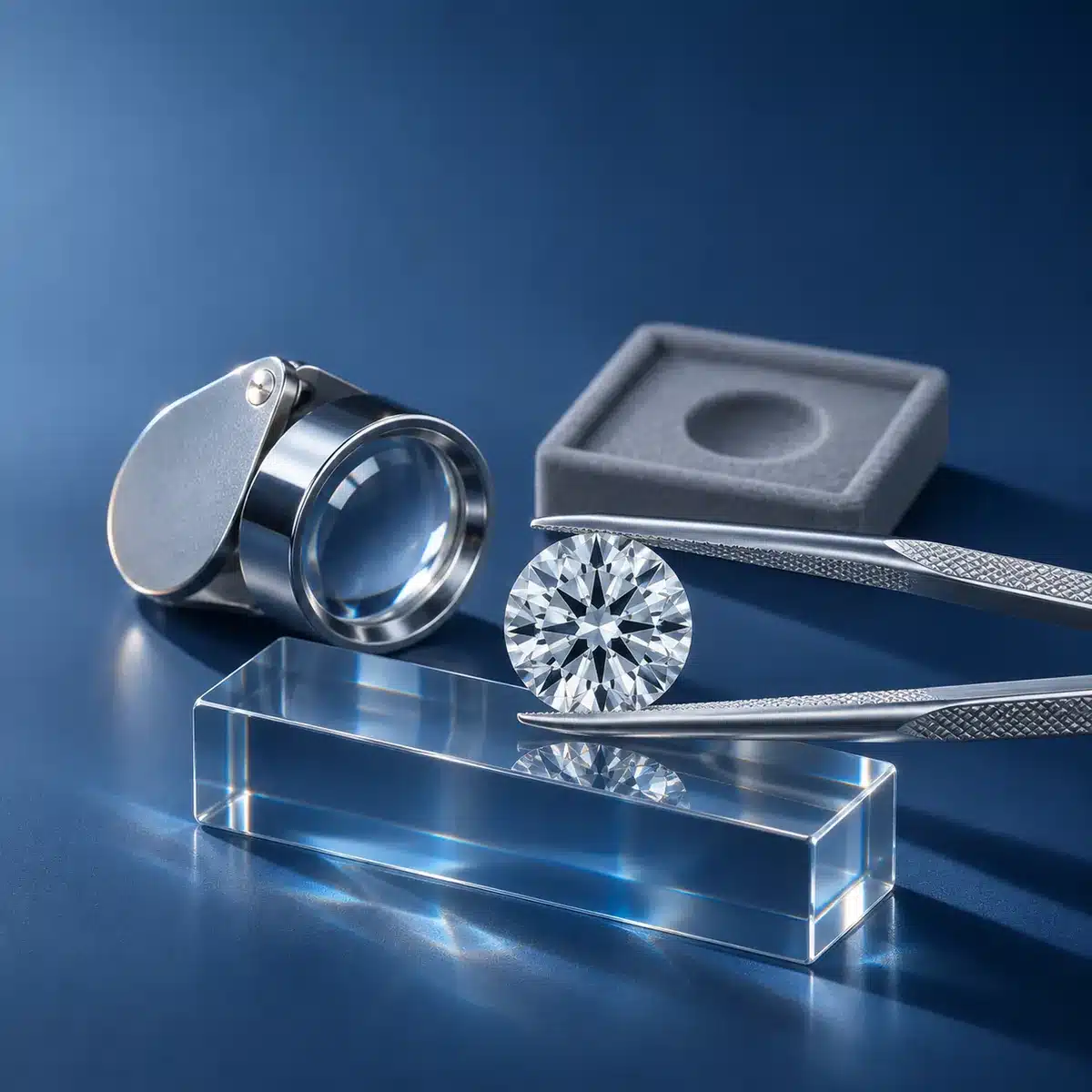
Many lab-grown diamonds carry a microscopic inscription on the girdle, usually the report number. GIA’s lab-grown assessments are inscribed with “Laboratory-Grown” and the assessment number. You need a 10x loupe or a microscope, or a close-up photo of the girdle. An inscription can be missing for innocent reasons, for example after re-polishing, but a missing or different inscription has to be explained before you accept the stone. See laser inscription explained.
5Match the record to the actual stone
The final check is the stone itself. Weigh and measure it, or have your jeweler do it. For online purchases, an unedited video of the stone with the report number or inscription visible links the two. An authentic report attached to a different stone passes every online check, which is why this last step matters.
What verification proves and what it does not
Verification confirms that the report is authentic and that it belongs to the stone in front of you. It does not prove the stone looks good, that the price is fair, or that the seller is reliable. See certificate vs actual appearance.
Disclosure rules support verification
The US Federal Trade Commission’s Jewelry Guides require the word diamond, used for a lab-grown stone, to be qualified straight away with a term such as “laboratory-grown” or “laboratory-created”. When the report, the listing and the invoice all use the same wording, buyer and seller are both covered.
Verifying stones in a wholesale delivery
For parcels of certified stones, build a routine:
- Match the packing list to the invoice: report numbers and quantities.
- Verify every number online for high-value stones; verify a sample for smaller ones.
- Check inscriptions on a sample under magnification.
- Weigh and measure a sample and compare with the records.
- Log the results, and send any differences to the supplier together, with the report numbers.
A simple verification log
Swipe the table to see more →
| Field | Example entry |
|---|---|
| Report number | (number) |
| Laboratory and type | IGI full report |
| Online record checked | Yes, date |
| Inscription | Matches / not present / mismatch |
| Weight and measurements | Match / difference noted |
| Comments | Growth method and treatment noted |
| Checked by | Name |
Common verification mistakes
- Clicking a seller’s link instead of using the laboratory’s own site.
- Checking the number but not the measurements.
- Accepting a screenshot instead of the full record.
- Checking the report but not the stone it belongs to.
Verification questions
How do I check if a lab-grown diamond certificate is real?
Look up the report number on the laboratory’s own website and compare every detail with the document and the stone.
What if the report number does not verify?
Check for typos. If it still does not match, do not pay until the seller explains and provides a verifiable report.
Should I verify every stone in a wholesale order?
Verify every high-value stone and a meaningful sample of smaller ones, and record the results.
Check our stones before you pay
NUVU provides the report numbers of the stones you are considering on request, so you can look each one up yourself on the laboratory’s site. We can arrange IGI, GIA or NGTC reports to your requirement. Send your requirements or message us on WhatsApp / WeChat at +86 19118403930.
Sources

12+ years in lab-grown diamond grading, identification and quality assurance for both HPHT and CVD stones.
About NUVU. NUVU is the international brand of New Perspective Superhard Materials Co., Ltd. in Zhecheng, Henan, China. We grow HPHT lab-grown diamonds in-house and cut, polish and match stones in our own workshop.
Related Guides
How to read a report
Read a lab-grown diamond report step by step: identity, disclosure, measurements, 4Cs, finish, growth and treatment…
Read more →Certificates & gradingDocumentation red flags
Certificate red flags before you pay for a lab-grown diamond: unverifiable numbers, unknown labs, mismatched…
Read more →EducationCertification knowledge
IGI, GIA and NGTC lab-grown diamond reports explained: what each lab grades, GIA’s 2025 Premium/Standard change, ‘As…
Read more →