
Many lab-grown diamond buyers spend hours researching HPHT, as detailed in the HPHT lab-grown diamonds guide, versus CVD growth methods, only to discover that this distinction matters far less than they assumed. The real drivers of diamond beauty and value—cut quality, proportions, documentation, and visual performance—have little to do with which technology formed the crystal. A well-cut diamond from either method will outperform a poorly executed stone from the “preferred” technique, making growth method a secondary filter rather than a primary decision point.
For the full framework, read HPHT vs CVD Lab-Grown Diamonds Guide.
This guide provides a practical evaluation framework that prioritizes what actually affects your diamond’s appearance and value. You’ll learn how to read certificates, assess proportions that impact face-up size, identify supplier transparency red flags, and match your stone to its intended setting. By the end, you’ll have a clear checklist that keeps growth method in its proper place—useful to know, but never the deciding factor.
Before diving into the comparison framework, it is essential to understand what HPHT and CVD actually represent. HPHT (High Pressure High Temperature) and CVD (Chemical Vapor Deposition) are production methods for creating laboratory-grown diamonds. Both produce genuine diamond material with the same chemical composition and crystal structure as natural diamonds. Neither method creates a “fake” or “synthetic” stone in the sense of a simulant like cubic zirconia or moissanite. A laboratory-grown diamond is a diamond—distinct from a mined diamond only in its origin, not in its fundamental material properties. This distinction matters because some buyers conflate lab-grown diamonds with simulants, which are entirely different materials designed to look like diamonds without being diamonds.
| Priority | What to Check | Why It Matters |
|---|---|---|
| 1st | Certificate from GIA, IGI, or GCAL | Verifies specifications and provides buyer protection |
| 2nd | Cut quality and proportions | Determines light performance and face-up size |
| 3rd | Visual appearance in person | Grades don’t always reflect actual beauty |
| 4th | Color and clarity characteristics | Inclusion type and location matter more than grade |
| 5th | Price comparison with equivalent specs | Ensures fair value for same quality level |
| 6th | Supplier transparency and documentation | Protects against misrepresentation |
| Last | HPHT versus CVD growth method | Use only as a tiebreaker after other factors |
Quick Questions Before You Read
Q: Should I prefer HPHT or CVD for better quality?
Neither method guarantees better quality. Cut, proportions, and documentation matter far more than growth technology.
Q: Can two 1-carat diamonds look different in size?
Yes. Cut proportions affect face-up diameter, so a 1-carat stone can measure 6.1mm to 6.5mm—a visible difference.
Q: What certificate should I require?
Insist on GIA, IGI, or GCAL grading reports. Avoid sellers reluctant to provide full documentation.
Q: When does growth method actually matter?
Only as a secondary consideration after certificate, cut, proportions, visual appearance, and price have been evaluated.
Why Growth Method Matters Less Than Most Buyers Think
Online discussions about lab-grown diamonds often fixate on growth method. Buyers encounter passionate debates about whether HPHT or CVD produces superior stones, and the technical details can make the decision feel high-stakes. But this framing gets the priority wrong.
Growth method influences certain characteristics, but it does not determine whether a diamond will look beautiful, wear well, or represent fair value. A well-cut, properly graded diamond from either method will outperform a poorly executed stone from the “preferred” technique. The technology behind the crystal matters far less than what you can actually see, verify, and afford.
This distinction matters because over-focusing on HPHT vs CVD can lead buyers to underweight the factors that genuinely drive satisfaction. A diamond with excellent cut, strong documentation, and appealing visual performance will serve you well regardless of how it formed. Conversely, a diamond with superior growth technology but poor proportions or inadequate certification will disappoint.
For buyers, the practical point is that growth method has become a marketing differentiator as much as a technical distinction. Some sellers emphasize one method over another in their messaging, which can create the impression that the choice carries more weight than it actually does in determining a stone’s appearance or durability.
Understanding the actual difference between HPHT and CVD can help demystify why the debate exists while also revealing its limitations. HPHT (High Pressure High Temperature) mimics the natural diamond formation process by subjecting carbon to extreme pressure and temperature. CVD (Chemical Vapor Deposition) builds diamond crystal layer by layer from a carbon-rich gas. Both methods produce genuine diamond material with identical chemical and physical properties to mined diamonds.[1] The distinction matters to manufacturers and gemologists, but for buyers, the outcome—what you can see and verify—matters far more than the process.
It is also important to distinguish between growth methods and treatments. HPHT and CVD are production techniques used to create laboratory-grown diamonds. In some cases, diamonds—whether natural or laboratory-grown—may undergo post-growth treatments such as HPHT processing to improve color, or irradiation and annealing to alter color. These treatments are separate from the original growth method and should be disclosed in grading reports when applicable. Buyers should not assume that HPHT-grown diamonds have been treated, nor should they conflate growth technology with enhancement procedures. When treatment status is relevant, the grading report or seller documentation should clearly state what, if any, post-growth processes have been applied.
What Actually Determines Diamond Beauty
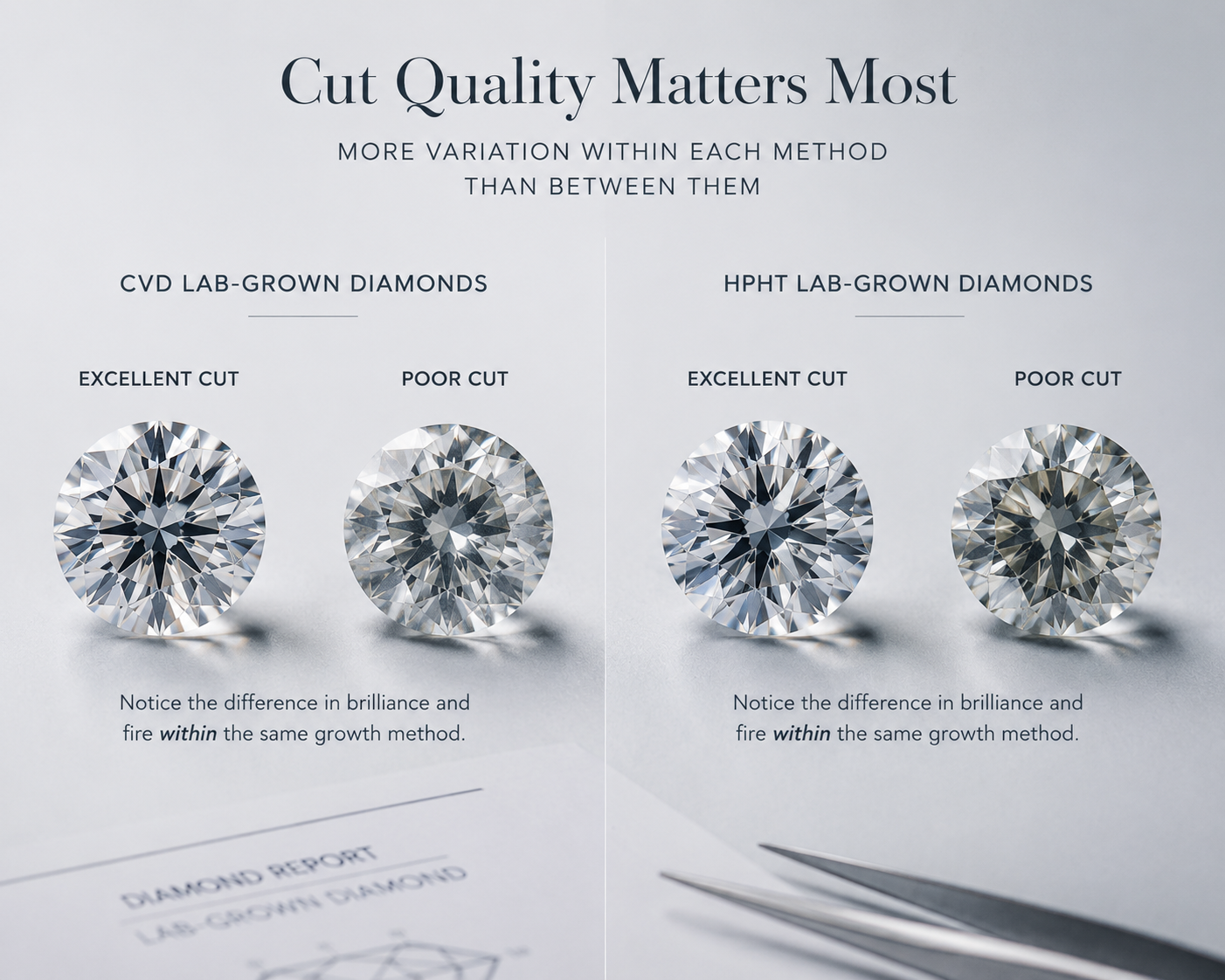
Cut quality, proportions, and light performance drive visual appeal. These factors determine how bright, fiery, and brilliant a diamond appears—not the equipment used to grow the crystal.
A poorly cut HPHT diamond will underperform a well-cut CVD diamond every time. The reverse is equally true. The geometry of the stone—its angles, symmetry, and facet alignment—controls how light enters, reflects, and returns to your eye. Growth method does not override these physics.
This means buyers should prioritize what they can see and verify. Does the diamond show strong brilliance face-up? Does it maintain sparkle as it tilts? Are there dark patches or dull zones? These observable characteristics tell you more about the stone’s beauty than a technical label ever could.
When Growth Method Becomes Relevant
Growth method enters the decision in limited scenarios. HPHT diamonds sometimes show different color tendencies in certain ranges—occasionally displaying faint blue undertones in near-colorless grades. CVD diamonds may occasionally show subtle brown or gray tints in specific ranges. These tendencies are worth knowing, but they represent patterns to check for, not rules to follow blindly.
Clarity characteristics can also differ slightly between methods, and availability may vary by size and quality combination. Price positioning sometimes favors one method over the other depending on market conditions.
But these are secondary filters. They become relevant only after confirming that a diamond passes the primary checks: documented quality, strong cut, acceptable visual appearance, and fair pricing. If a stone fails those fundamentals, its growth method is irrelevant.
In practical buying, this is where many comparisons become misleading. A seller may highlight that a stone is “CVD-grown” or “HPHT-grown” as if that designation alone signals quality, but the same stone could have excellent or poor cut regardless of method. The growth technique tells you about origin, not outcome.
What to Check Before You Decide
Use this priority order:
- Certificate first: Confirm a recognized grading report exists and matches the stone.
- Cut quality second: Verify proportions and cut grade meet acceptable standards.
- Visual review third: Examine photos, videos, and ideally the stone in person.
- Growth method last: Consider HPHT vs CVD only after the first three checks pass.
If a diamond lacks proper documentation, has weak cut quality, or shows visual problems, knowing whether it is HPHT or CVD will not fix those issues. The growth method question is premature until the fundamentals are confirmed.
Start With the Certificate: What the Report Actually Tells You
A grading report from a recognized laboratory provides objective, third-party verified information about a diamond’s characteristics. This documentation matters far more than the growth method label because it confirms what you are actually buying.
Without a certificate, you rely entirely on seller claims. With a certificate, you have an independent assessment of carat weight, color grade, clarity grade, cut quality, measurements, and additional characteristics. This baseline allows meaningful comparison across stones and sellers.
The certificate does not tell you everything—visual appeal still requires personal assessment—but it establishes verified specifications. Two sellers claiming “1 carat, F color, VS1 clarity” may offer completely different stones. The certificate clarifies what those claims actually mean.
A grading report helps narrow the shortlist, but it does not replace visual review. The document tells you what the lab observed under controlled conditions—it does not tell you how the stone will look in your setting, in your lighting, on your hand. Use the certificate to filter and verify, then confirm with your own eyes.
For lab-grown diamonds specifically, proper disclosure on documentation is essential. The Federal Trade Commission has updated its guides to require clear disclosure that a diamond is laboratory-grown, and grading reports from reputable labs will clearly identify whether a stone is natural or laboratory-created.[2] This transparency protects buyers and ensures you know exactly what you are purchasing. A legitimate grading report will never obscure or misrepresent a diamond’s origin.
Laboratory-grown diamonds should be clearly identified as laboratory-grown, and they should not be presented as mined diamonds. This disclosure requirement exists to protect consumers and ensure transparency in the marketplace. A grading report from a reputable laboratory will explicitly state whether a diamond is natural or laboratory-created, and this information should align with how the diamond is marketed and sold. If you encounter any ambiguity about a diamond’s origin—whether in seller descriptions, certificates, or marketing materials—that ambiguity is a warning sign worth investigating.
When a grading report is provided, buyers should verify the report details through the issuing laboratory’s official verification tools where available. GIA, IGI, and GCAL all maintain online databases that allow report confirmation using the certificate number.
Which Labs Provide Reliable Documentation
Established grading laboratories provide consistent, verifiable reports. GIA, IGI, and GCAL are widely recognized in the U.S. market. Each maintains its own standards and grading vocabulary, but all provide a baseline of professional evaluation.
A diamond with a certificate from a recognized lab has passed through trained eyes. The stone exists as documented. The grades represent an independent assessment, not marketing copy.
Less recognized labs or seller-issued documents warrant caution. If you cannot verify the laboratory’s reputation or access their report database, the documentation carries less weight. This does not automatically disqualify a stone, but it should prompt additional scrutiny.
Different labs may apply slightly different thresholds for the same grade categories. An H color from one lab may sit at the higher or lower end of that grade range compared to an H color from another. This is why comparing stones with certificates from the same lab—rather than mixing labs—produces more reliable comparisons. When shopping across labs, focus on the specific characteristics described in the report rather than treating identical grade labels as perfectly equivalent.
A grading report documents key characteristics, but it should not be treated as a guarantee of beauty, value, or sourcing ethics. The report provides an independent assessment of measurable qualities—carat weight, color grade, clarity grade, cut grade, and proportions—but it does not certify that a diamond will appear beautiful to your eye, that it represents a good investment, or that it meets any particular ethical or environmental standard. These judgments require additional information and personal evaluation. Understanding what a certificate does and does not confirm helps buyers use documentation appropriately within a broader decision framework.
How to Read Beyond the Headline Grades
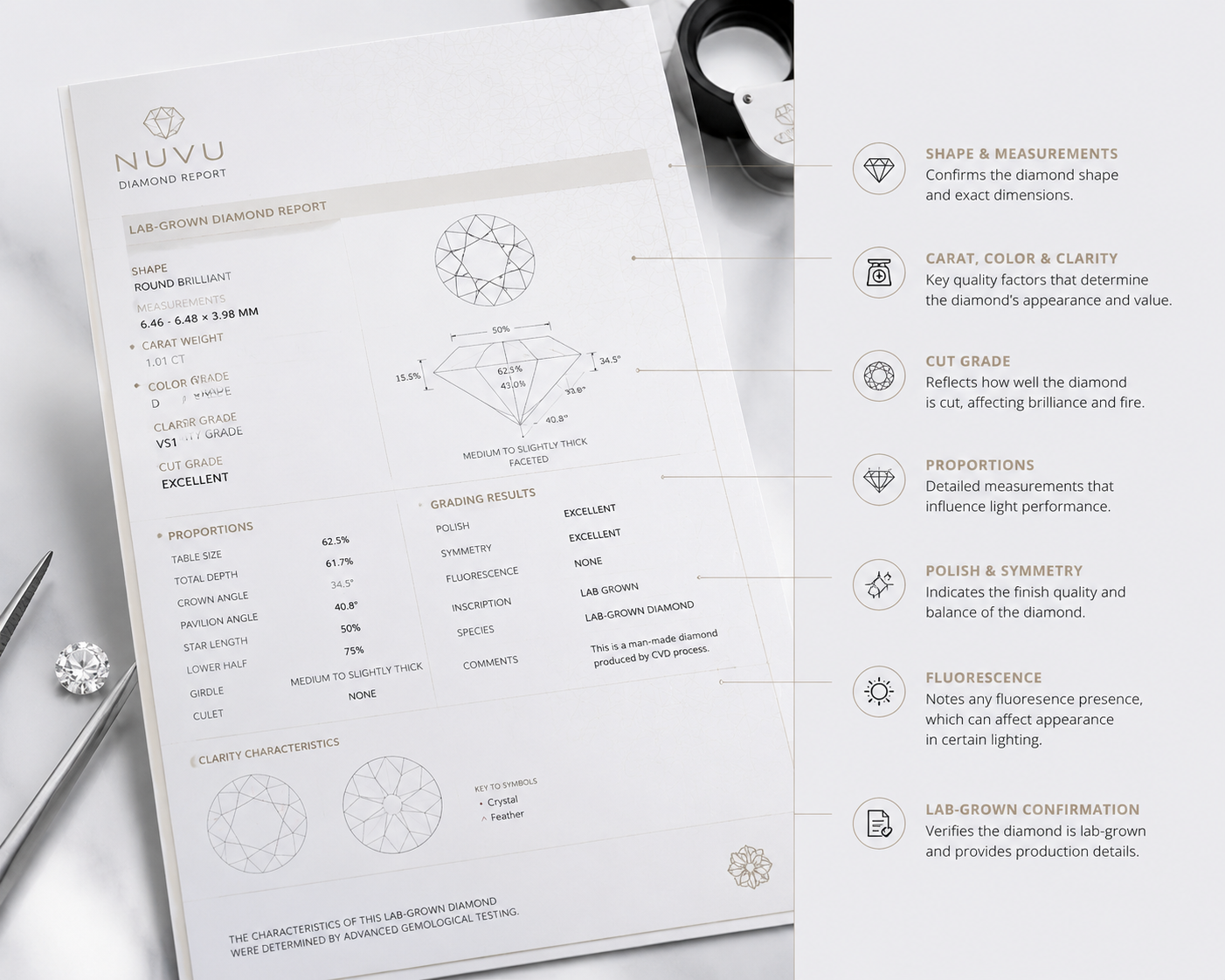
Carat, color, and clarity appear prominently, but they do not tell the full story. Two diamonds with identical headline grades can look completely different based on factors buried deeper in the report.
Cut grade influences brilliance more than any other factor for round brilliants. Measurements reveal actual face-up size—two 1-carat diamonds can differ significantly in millimeter dimensions. Polish and symmetry affect light performance. Fluorescence can alter appearance in certain lighting. Comments may note treatments, laser drilling, or other enhancements.
The growth method label tells you none of this. A CVD diamond with excellent cut and strong proportions will outperform an HPHT diamond with fair cut and poor symmetry, even if both carry identical color and clarity grades. The report contains the details that drive these differences.
Certificate Verification Checklist
Before accepting any certificate at face value, confirm:
- Report number matches the stone: The number on the report should correspond to the diamond, typically laser-inscribed on the girdle.
- Laboratory is legitimate: Verify the lab exists and maintains a report database you can access.
- Measurements align with carat weight: A 1.00-carat round diamond should measure approximately 6.4-6.5mm in diameter. Significant deviations warrant investigation.
- Cut grade is documented: Do not assume cut quality from appearance alone. The report should specify cut grade for shapes where it applies.
- Comments are clear: Any treatments, enhancements, or unusual characteristics should be disclosed in the notes.
If the certificate cannot be verified, does not match the stone, or lacks critical information, the growth method question is irrelevant. Documentation problems disqualify a stone before growth method even enters the conversation.
Cut Quality: The Primary Driver of Visual Performance
Cut determines how a diamond handles light. Brilliance, fire, and scintillation—the qualities that make a diamond sparkle—stem from proportions, angles, and symmetry. Not from growth method.
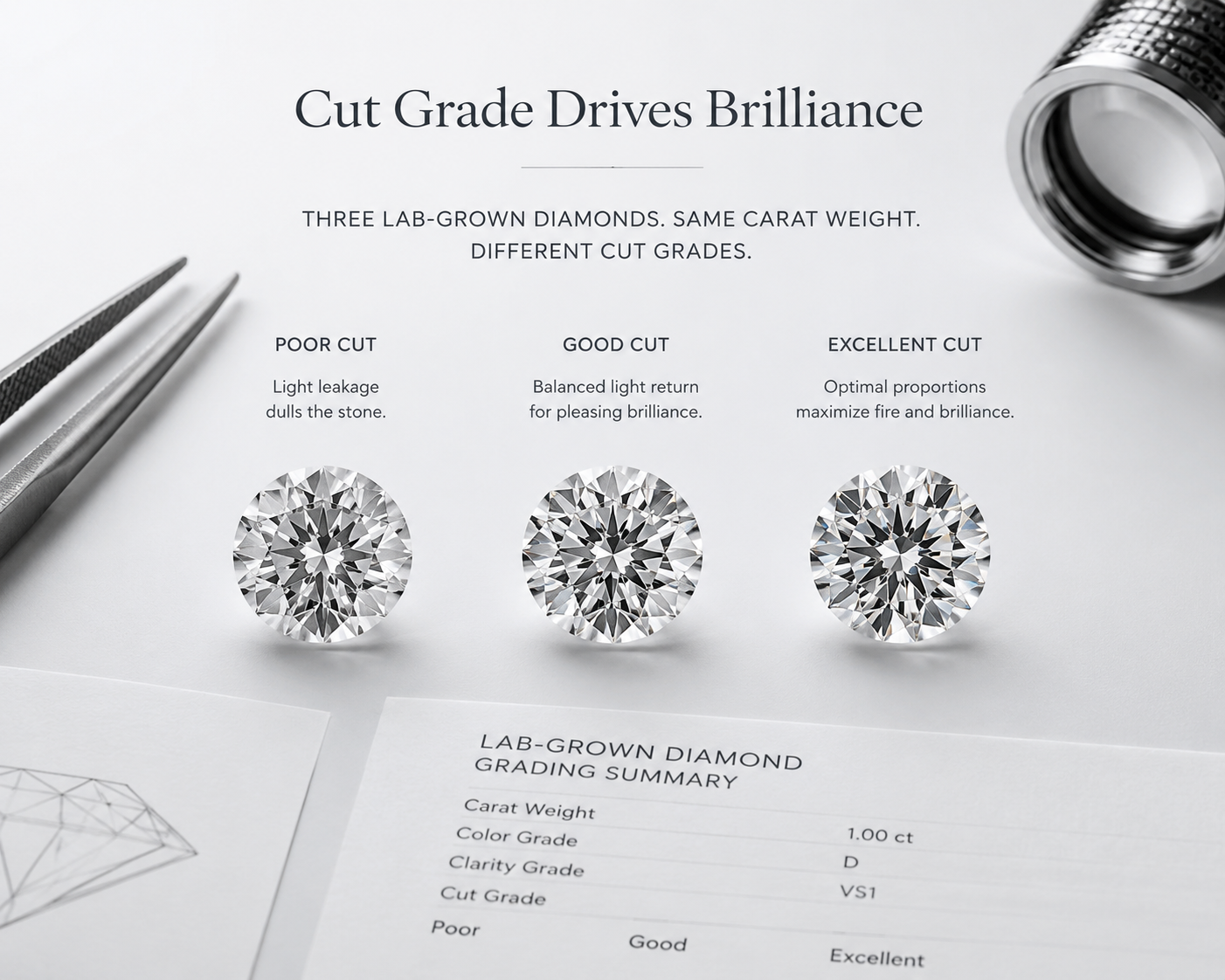
This makes cut the single most important factor in diamond appearance. A well-cut diamond captures incoming light and returns it through the crown, creating the brightness and sparkle buyers expect. A poorly cut diamond leaks light through the pavilion, appearing dull or dark regardless of its other qualities.
Growth method does not override cut. An HPHT diamond with excellent proportions will dramatically outperform a CVD diamond with poor proportions. The reverse is equally true. The technology that created the crystal cannot compensate for bad geometry.
For custom design, the stone cannot be evaluated separately from the setting. A diamond with strong cut performance in isolation may behave differently once set—prongs can block light entry, certain mounting styles can cast shadows, and the metal color affects how warmth or tint is perceived. The cut grade is a starting point, not a guarantee of final appearance.
Why Cut Grade Outweighs Growth Method
Proportions, angles, and symmetry control light behavior. The pavilion depth determines whether light reflects back to the viewer or escapes through the bottom. The table size affects brilliance versus fire. Crown angles influence dispersion. Girdle thickness impacts durability and light return. Symmetry determines whether facets align correctly to direct light as intended.
These factors are measurable and documented on grading reports. They directly predict visual performance. Growth method, by contrast, predicts nothing about how a specific diamond will look.
The common misconception that one growth method inherently produces better-looking stones has no basis in how diamonds actually perform. Within each method, cut quality varies widely. A buyer who selects a poorly cut diamond because it carries the “preferred” growth label has made a mistake that documentation and visual inspection would have prevented.
How to Evaluate Cut Without Advanced Tools
Most buyers lack professional equipment, but cut quality leaves visible evidence:
- Check the certificate cut grade first: For round brilliants, GIA and other labs provide cut ratings from Excellent to Poor. This is your starting point.
- Request 360-degree video or high-resolution photos: Reputable sellers provide visual assets. Use them.
- Look for light return patterns: A well-cut diamond shows even brightness across the crown. Dark centers or heavy rim shadows suggest cut problems.
- Compare face-up appearance across similar stones: Place diamonds of comparable carat weight side by side. The brighter, more lively stone usually has better cut.
You do not need to understand the physics or know the growth technology, such as the HPHT vs CVD diamond myths, to recognize a diamond that sparkles versus one that looks flat.
Visual Performance Check Before Purchase
When reviewing photos and videos, look for:
- Even light distribution across the crown: The stone should show consistent brightness without dark zones.
- No obvious dark patches when viewed face-up: A dark center typically indicates deep pavilion. A dark rim suggests shallow cut.
- Consistent brilliance as the stone moves: Tilt the view if possible. The diamond should maintain sparkle rather than going dark.
- No visible symmetry issues: Misaligned facets or off-center tables indicate poor craftsmanship.
If visual review raises concerns, the growth method question is premature. A diamond that looks dull in video will not improve because you learn it was grown using a particular technology. Confirm visual performance first. Only then does growth method become worth discussing.
Measurements and Proportions: The Numbers That Shape Appearance
Measurements matter because they tell you how a diamond will actually look on your finger. Two stones with identical carat weights can appear dramatically different in size depending on how they are cut. This is visible in the measurement data on any certificate—and it affects your purchase far more than whether the crystal was grown through HPHT or CVD.
Proportions also determine light performance. A diamond cut too deep will look smaller face-up and may appear dark in the center. A diamond cut too shallow will leak light from the sides, reducing brilliance. These outcomes are dictated by the cutter’s decisions, not the growth technology. A poorly proportioned HPHT diamond will underperform a well-proportioned CVD diamond every time, and vice versa.
For wholesale buyers and those selecting multiple stones, consistency often matters as much as individual measurements. A diamond that measures well on paper but deviates from expected proportions can create matching problems for three-stone rings, eternity bands, or any design requiring uniform appearance across multiple stones.
Understanding Table and Depth Percentages
Table and depth percentages are the two most critical numbers for evaluating proportions. The table percentage tells you how large the flat top surface is relative to the diamond’s width. The depth percentage tells you how tall the diamond is from the culet (bottom point) to the table.
For round brilliant diamonds, generally accepted ideal ranges are:
- Table percentage: 53% to 57% is considered ideal for maximum brilliance. Tables above 60% tend to reduce fire, while tables below 50% can make the diamond look smaller.
- Depth percentage: 59% to 62.5% is typically ideal. Depths above 63% often indicate a deep cut that makes the diamond look smaller than its carat weight suggests. Depths below 57% may indicate a shallow cut with light leakage.
These ranges shift for fancy shapes. An emerald cut has different ideal parameters than a cushion or an oval. The key principle remains: measurements outside preferred ranges affect both visual size and light return, regardless of growth method. A 1-carat diamond with 65% depth will look smaller than a 1-carat diamond with 61% depth, even if both have identical color and clarity grades.
How Measurements Affect Face-Up Size
Carat weight measures mass, not diameter. A 1.00-carat round diamond can measure anywhere from approximately 6.1mm to 6.5mm in diameter, depending on cut proportions. That 0.4mm difference is visible—roughly a 13% spread in face-up area.
This is why comparing millimeter measurements matters more than comparing carat weights alone. If you want maximum visual impact within your budget, look for diamonds with larger diameters for their carat weight. A 0.95-carat diamond measuring 6.4mm will look larger than a 1.05-carat diamond measuring 6.2mm, even though the heavier stone costs more.
For fancy shapes, length-to-width ratio adds another dimension. An elongated cushion or radiant can face up larger than a square one of identical carat weight. The measurement data on the certificate lets you compare actual dimensions rather than relying on weight categories.
At NUVU, this kind of comparison is treated as a practical selection question: the report narrows the field, but the final decision still depends on visual performance, measurements, and design fit. Buyers focusing only on carat weight often miss stones that would actually appear larger face-up due to superior proportions.
Proportion Check for Your Specific Diamond
Before worrying about growth method, check the proportions against established ideal ranges for the shape you are considering. If the table or depth falls significantly outside preferred parameters, this is a decision factor that matters more than HPHT versus CVD.
Specific steps:
- Confirm the certificate provides full measurement data, not just carat weight
- Compare the diameter or dimensions against typical ranges for that carat weight
- Check table and depth percentages against ideal ranges for the specific shape
- If proportions are outside preferred ranges, decide whether the price discount compensates for the visual tradeoffs
A diamond with excellent proportions but an unfamiliar growth method is almost always a better choice than a diamond with poor proportions from a preferred method. The proportions are what you will see every day.
Color and Clarity: What You See vs What the Report Says
Color and clarity grades provide a useful shorthand, but they do not tell the complete story. Two diamonds with identical grades can look different depending on the specific characteristics of each stone. This is where visual inspection becomes essential—and where growth method tendencies become relevant only after you have evaluated the individual diamond in front of you.
The certificate gives you the grade. Your eyes tell you whether that grade translates to a stone you actually want to wear.
Color Grade Interpretation for Lab-Grown Diamonds
The standard color scale runs from D (colorless) through Z (light yellow or brown). For most buyers, the practical difference lies in the D-F range (colorless), G-H range (near colorless), and I-J range where faint color may become visible in certain settings.
Lab-grown diamonds follow this same scale, but HPHT and CVD stones can exhibit different undertones in certain color ranges:
- HPHT diamonds in lower color grades may show faint blue undertones due to boron exposure during growth. This can actually make some HPHT stones appear whiter than their grade suggests, though the effect varies by stone.
- CVD diamonds may occasionally show faint brown or gray tints in certain lighting. This is not universal, but it is a characteristic some buyers notice when comparing stones side by side.
These are tendencies, not rules. An HPHT diamond is not automatically better or worse than a CVD diamond in color. What matters is how the specific stone looks to you. If a diamond in the H color range looks clean and bright in the setting you plan to use, the growth method behind it is secondary.
Also consider the metal color of your setting. Yellow and rose gold can mask warmth in lower color grades. Platinum and white gold demand higher color performance. The interaction between diamond color and metal choice often matters more than the growth method.
What buyers often misunderstand is that color grade describes a range, not a precise point. An H color diamond at the high end of the H range may look nearly identical to a G color diamond at the low end of the G range. The grade is a useful category, but visual comparison reveals the actual appearance.
Clarity Characteristics to Examine
Clarity grades range from Flawless (no inclusions visible under 10x magnification) through Included (inclusions visible to the naked eye). For most buyers, the practical range is VS1 through SI1—stones where inclusions are visible under magnification but not obvious to the naked eye.
But clarity grade alone does not tell you what you need to know. The location, type, and visibility of inclusions matter just as much:
- Location: An inclusion near the table (center) is more visible than one near the girdle (edge). A feather under a prong may be hidden by the setting; the same feather in the open table will catch your eye.
- Type: Crystals and needles are often white or transparent and less distracting. Dark crystals or black spots draw the eye. Feathers (internal fractures) can be benign or concerning depending on size and location.
- Structural impact: Large feathers near the girdle may affect durability, especially for active wearers. This is rare, but worth checking.
HPHT diamonds sometimes show different inclusion patterns than CVD diamonds, but this is not a reliable buying guide. A VS1 HPHT diamond and a VS1 CVD diamond both have small inclusions visible under magnification. What matters is whether those specific inclusions bother you when you look at the stone.
Visual Inspection for Color and Clarity
Grades on paper are a starting point. Visual confirmation is the decision point.
Request photos and videos in natural lighting, not just studio lighting that may mask color or inclusions. Look for any visible tints or undertones, particularly in the H-I-J range. Check for eye-visible inclusions—anything you can see without magnification. Compare multiple stones in similar grades to see how much variation exists.
Your personal tolerance matters more than the grade. Some buyers are comfortable with an SI2 stone if the inclusions are well-hidden. Others want VS clarity for peace of mind. Neither choice is wrong, and neither depends on growth method.
If a diamond looks clean and bright to your eyes in realistic lighting, the grade and the growth method become secondary considerations. If something about the appearance bothers you, no certificate grade or growth method preference will fix that after purchase.
Price and Value: Comparing Apples to Apples
Price comparison only works when you are comparing equivalent stones. Two lab-grown diamonds with identical carat, color, and clarity grades can have meaningfully different prices for legitimate reasons—or they can be priced differently because one seller is more expensive than another.
Growth method is rarely the primary price driver. Cut quality, certificate lab, seller positioning, and service levels typically explain more price variation than HPHT versus CVD. Understanding these factors helps you recognize genuine value rather than chasing the lowest number.
Prices can vary because of cut precision, report type, seller channel, size, shape, availability, and documentation. Buyers should compare like-for-like specifications before treating one stone as a better value. A lower price may reflect differences in cut quality, certificate lab, or seller services rather than a genuine bargain. Conversely, a higher price may reflect superior cut, better documentation, or stronger buyer protections—or it may simply reflect seller positioning. Understanding what drives price differences helps buyers make informed comparisons rather than chasing the lowest number or assuming that higher prices automatically mean better quality.
Why Similar Specifications Can Have Different Prices
Several legitimate factors explain price differences between diamonds that look identical on paper:
- Cut quality: Excellent cut diamonds cost more than Good cut diamonds of the same carat, color, and clarity. The difference is visible in performance, even if the certificate headline grades look similar.
- Certificate lab: GIA-graded lab-grown diamonds often command a premium over IGI-graded stones with identical specifications. This reflects lab reputation and market perception, not necessarily quality difference. Both labs are legitimate, but buyers should compare like with like.
- Seller overhead and service: A seller offering high-resolution photos, 360-degree video, generous return policies, and responsive customer service has higher costs than a seller providing minimal information and limited support. Part of what you pay for is the buying experience and risk reduction.
- Market positioning: Some sellers position themselves as premium providers with curated selections. Others compete on volume and price. Neither approach is inherently better, but they produce different price points for similar stones.
Assuming that a lower price for the same growth method represents better value is a mistake. The lower-priced stone may have inferior cut, a less recognized certificate, or a seller providing less service and information. Or it may be a genuine value—price alone does not tell you which.
How to Assess Value Beyond the Sticker Price
Value is what you get for what you pay. To assess it properly, compare stones with identical or near-identical specifications across multiple sellers. Look at:
- Full specifications: Carat, shape, color, clarity, cut grade, polish, symmetry, fluorescence, and measurements. Two stones that look similar on a search results page may have meaningful differences in the details.
- Certificate lab: Compare GIA to GIA, IGI to IGI. Do not assume a GIA stone and an IGI stone with the same grades are equivalent.
- Visual assets: Stones with 360-degree video and high-resolution photos are easier to evaluate than stones with only stock images or no images at all. Better information reduces your risk.
- Return policies: A stone with a 30-day return policy offers more protection than a final-sale stone at a slightly lower price. Factor this into your value assessment.
- Seller transparency: A seller who provides full certificate access, answers questions clearly, and documents specifications in writing offers more value than a seller who is vague or evasive, even if the stone itself is cheaper.
For custom jewelry, also consider whether the seller provides design services, setting expertise, and post-purchase support. A slightly higher stone price may include valuable services that a loose-diamond-only seller cannot provide.
What sellers may oversimplify is the relationship between price and quality. A stone priced 15% below comparable options is not automatically a bargain—it may have a less favorable cut, measurements that affect face-up size, or other characteristics that justify the discount. Price differences reflect multiple factors, and understanding those factors is more valuable than simply finding the lowest number.
Price Fairness Check
Before concluding that a price is good or bad, run this comparison:
- Find at least three stones with similar specifications from different sellers—same shape, carat range, color, clarity, and cut grade
- Confirm all have certificates from recognized labs
- Verify that cut quality is genuinely comparable (not just the same headline grade)
- Note any significant price outliers and investigate why they deviate
If a stone is priced significantly below comparable options, ask why. The answer may be legitimate—a seller running a promotion, lower overhead, or a volume discount. Or the answer may concern you—a less recognized certificate, inferior cut that is not obvious from the headline grades, or a seller providing minimal service.
If a stone is priced significantly above comparable options, the premium should be justified by something you value: superior cut, better documentation, stronger return policy, or service that matters to you. If you cannot identify what the premium pays for, the price is not justified.
Growth method does not belong in this calculation until you have established that the stones are otherwise equivalent. If two diamonds have identical specifications, identical cut quality, identical certificates, and identical visual appearance, then—and only then—does growth method become a potential tiebreaker. In most cases, you will find clear differences in primary factors long before growth method becomes relevant to price.
Supplier Transparency: What to Ask Before You Buy
A diamond with strong specifications means little if the seller cannot or will not provide clear documentation. Growth method debates become irrelevant when the real risk is buying from a source that avoids questions, delays paperwork, or makes verbal promises that never appear in writing. Supplier transparency is not a bonus—it is a prerequisite for making any informed purchase.
Documentation and communication practices often reveal more about a supplier’s reliability than marketing claims. A seller who readily provides complete certificates, answers technical questions with specific information, and puts commitments in writing demonstrates the kind of transparency that protects buyers. Conversely, a seller who deflects detailed questions or relies on general reassurances may be hiding information that would affect your decision.
Questions That Reveal Seller Quality
The way a seller responds to direct questions tells you more than any marketing copy. Before committing, ask for the full grading report and certificate number—not just a summary. Request high-resolution photos from multiple angles, and ask whether 360-degree video is available. A transparent seller will provide these without hesitation.
Ask specific questions about return policies for that particular stone, not just general store policies. Some diamonds may have different return conditions based on customization or special orders. Ask how the seller verifies that the diamond matches the certificate—do they check the report number against the stone, or do they rely on supplier documentation they have never confirmed?
Request written confirmation of the specifications you are buying, including carat weight, measurements, cut grade, color, clarity, and any additional details discussed. If a seller resists putting specifics in writing, that resistance is information.
Sustainability and sourcing claims should be discussed through documentation, not assumptions. A seller may describe their lab-grown diamonds as sustainable or ethical, but these terms have specific meanings that should be verifiable. Energy use, production practices, and supply chain transparency vary by manufacturer. If these factors matter to you, ask for specifics rather than accepting general claims.
When sellers do make environmental or sustainability claims about lab-grown diamonds, buyers should approach these statements with appropriate scrutiny. The Federal Trade Commission has cautioned that broad environmental claims require substantiation, and terms like “eco-friendly” or “sustainable” should be supported by specific evidence about production practices and energy use.[2] Not all lab-grown diamonds are produced with the same environmental footprint, and responsible sellers should be prepared to discuss their sourcing and manufacturing practices in concrete terms.
Environmental and sustainability claims should be specific, documented, and limited to what can be substantiated. A seller who claims their laboratory-grown diamonds are “eco-friendly” or “sustainable” should be able to provide information about energy sources, production practices, water use, or third-party certifications that support those claims. Vague environmental language is less meaningful than concrete details about how a particular producer manages its environmental impact. Buyers for whom sustainability is a priority should ask direct questions about production practices, such as HPHT vs CVD growth methods, and expect specific answers rather than accepting general marketing statements.
Sustainability claims should be specific and documented. Broad environmental language is less useful than clear information about production practices, energy sources, and seller transparency. Buyers should ask for substantiation rather than accepting general green marketing.
Red Flags in Seller Communication
Reluctance to share the full certificate before purchase is a serious warning sign. A legitimate grading report is verification of what you are buying. If a seller claims the certificate will arrive after payment, ask why it is not available now. This is not an unreasonable request—it is standard practice.
Vague answers about specifications should raise concerns. If you ask about fluorescence, proportions, or inclusion locations and receive general reassurances instead of specific information, the seller may not know the answers or may be avoiding details that would affect your decision.
Pressure to decide quickly, inconsistent information across conversations, and unwillingness to put commitments in writing all suggest a seller who prioritizes closing the sale over ensuring you understand what you are buying. A transparent seller expects questions and welcomes the opportunity to provide answers.
Transparency Verification Before Committing
Before finalizing any purchase, confirm you have received the following: the complete grading report from a recognized laboratory, high-resolution photos showing the diamond from multiple angles, 360-degree video if available, written specification confirmation that matches what was discussed, and clear documentation of return and warranty terms.
If any of these items are missing or delayed, pause. The growth method question can wait. The transparency question cannot.
Final Jewelry Use: Matching the Stone to Your Setting
A diamond does not exist in isolation. It will be worn, set in metal, exposed to daily life, and viewed in the context of a specific piece of jewelry. The right diamond depends on the setting design, lifestyle considerations, and long-term wear realities—not on whether it formed through HPHT or CVD. A stone that looks ideal in a grading report may be the wrong choice for a particular ring, pendant, or pair of earrings.
For custom design projects, the relationship between stone and setting becomes even more critical. A diamond that performs beautifully on its own may present challenges once mounted—measurements may not align with the chosen head, the depth may cause the stone to sit awkwardly, or the color may interact unexpectedly with the selected metal. These practical considerations often matter more than theoretical preferences about growth method.
How Setting Choice Affects Diamond Selection
Different settings interact with diamond characteristics in different ways. A halo setting surrounds the center stone with smaller diamonds, which can mask certain clarity issues. If inclusions are near the edge of the stone, the halo may hide them completely. This allows more flexibility on clarity grade without affecting the final appearance.
A solitaire setting offers no such forgiveness. The center stone stands alone, and every aspect of its cut quality, proportions, and visual performance is on full display. For solitaires, cut grade becomes even more critical because there is nowhere to hide poor light return or symmetry issues.
Metal color interacts with diamond color in ways that can either help or hurt the overall look. Yellow gold and rose gold can warm up a diamond with a slight tint, making a lower color grade appear more acceptable. Platinum and white gold provide less camouflage, meaning color tints become more visible. This is not about hiding flaws—it is about understanding how the components work together.
Lifestyle matters as well. An engagement ring worn daily faces more exposure to impacts, chemicals, and wear than a pendant worn occasionally. For active lifestyles, consider mounting styles that protect the stone and prioritize durability over delicate design.
For custom design projects, the stone cannot be evaluated separately from the setting. A diamond with strong specifications on paper may not work with a particular design—measurements may not fit the planned head, proportions may cause the stone to sit too high or too low, or the color may interact unexpectedly with the chosen metal. The best approach is to select stone and setting together, with the final design in mind.
For custom jewelry, stone measurements and setting compatibility should be confirmed before finalizing a purchase. A diamond that appears ideal when viewed in isolation may present challenges when mounted—the depth may require a higher setting than desired, the girdle thickness may affect how securely the stone can be held, or the face-up dimensions may not align with the design proportions. Confirming these technical details before purchase prevents surprises after the piece is complete.
When to Prioritize Different Factors
For an engagement ring worn every day, prioritize cut quality and durability. The stone will be visible in countless lighting conditions and will face regular wear. Cut determines how the diamond performs across all those environments. Clarity matters, but only to the extent that inclusions do not threaten structural integrity or become visible to the naked eye.
For a pendant worn occasionally, color may matter less. The stone will be viewed from a distance, often in social settings where slight tints are difficult to detect. Budget allocation can shift toward size or cut rather than optimizing for color grade.
For earrings, matching between the two stones often becomes more important than individual perfection. If one diamond is visibly different in color or cut from the other, the mismatch will draw attention. A pair of well-matched diamonds with slightly lower individual grades will look better than two mismatched stones with higher individual specifications.
In each scenario, the decision framework depends on the end use. Growth method does not change these priorities.
Stone-to-Setting Fit Check
Before finalizing a choice, confirm that the diamond’s measurements work with the intended setting. A stone that is too deep may sit too high in a low-profile setting. A diamond with a very thin girdle may be more vulnerable in a prong setting that places pressure on the edges.
Verify that the color grade complements the metal choice, that the clarity is appropriate for the setting style—halo settings can accommodate lower clarity; solitaires cannot—and that the overall combination fits both budget and timeline. If the stone does not work with the setting, the growth method question is irrelevant.
For custom work, buyers should confirm measurements, setting compatibility, and design details before finalizing the stone. A diamond that looks ideal in isolation may require adjustments to the setting design, or vice versa. Clear communication with the jeweler about expectations, timeline, and technical constraints helps prevent surprises after the piece is complete.
When Growth Method Actually Enters the Decision
After evaluating certificate, cut, proportions, visual appearance, color, clarity, price, supplier transparency, and final jewelry use, growth method finally becomes relevant—but only as a secondary consideration. This is not because HPHT and CVD are identical. They produce diamonds with different formation histories and sometimes different characteristic tendencies. The point is that those differences rarely matter as much as the primary factors already evaluated.
Situations Where HPHT May Have Advantages
HPHT diamonds sometimes exhibit warmer color tones in certain ranges. For buyers who prefer a slightly warmer appearance—or who plan to set the diamond in yellow or rose gold where warmth blends well—HPHT may align with that preference. In some larger sizes, HPHT availability may be broader, simply because the technology has been in commercial use longer for larger stone production.
HPHT diamonds may also show different clarity profiles depending on the specific growth conditions. Some buyers find that certain HPHT stones have inclusion patterns they prefer, though this is highly individual and must be assessed stone by stone. None of these are guarantees. They are tendencies worth checking if you have narrowed your options to two otherwise equal stones.
Situations Where CVD May Have Advantages
CVD diamonds often show strong color consistency in certain ranges, particularly in the near-colorless grades. For buyers prioritizing color consistency across multiple stones—such as for three-stone rings or earrings—CVD may offer more predictable matching in some cases.
CVD technology has advanced rapidly, and availability in specific size and quality combinations has improved. Some buyers find that CVD diamonds in their target specifications offer more options to compare. Clarity characteristics vary, and some prefer the inclusion patterns typical of CVD growth, but again, this requires individual assessment.
The key is that these are general tendencies, not reliable predictors for any specific stone. A CVD diamond is not automatically better than an HPHT diamond, or vice versa. The only way to know is to evaluate the actual stone in front of you.
Why Growth Method Should Remain Secondary
If two diamonds have identical specifications, identical cut quality, identical visual appearance, equivalent certification from reputable labs, fair pricing relative to market, and transparent sellers, then growth method becomes a reasonable tiebreaker. This scenario is rare. Most buyers will find clear differences in cut, visual performance, documentation quality, or price long before needing to consider whether the stone formed through HPHT or CVD.
Using growth method as a primary filter risks eliminating excellent stones for reasons that do not affect beauty, durability, or value. It also risks prioritizing technical origin over the factors that actually determine whether you will be happy with the diamond years from now.
Final Decision Checklist
Use this priority order when evaluating any lab-grown diamond:
- Certificate verified: Confirm the grading report is from a recognized laboratory and matches the stone.
- Cut quality confirmed: Assess cut grade, proportions, and visual performance through photos, videos, and certificate data.
- Proportions checked: Verify that measurements and proportions fall within acceptable ranges for the shape.
- Visual appearance approved: Review the diamond face-up, in motion if possible, and in different lighting conditions.
- Color and clarity acceptable: Confirm that color grade works for your preferences and setting, and that clarity is appropriate for the setting and your tolerance.
- Price fair relative to market: Compare against similar stones with similar specifications and certification.
- Supplier transparent: Verify that documentation, communication, and policies meet professional standards.
- Growth method noted but not decisive: If all other factors are equal, use growth method as a tiebreaker based on personal preference or specific characteristic tendencies.
This framework keeps the focus where it belongs—on the diamond you will actually wear, not the technology used to create it.
Conclusion: A Practical Framework for Your Decision
The HPHT versus CVD question dominates many online discussions about lab-grown diamonds, but it rarely determines whether a purchase ends well. What actually shapes satisfaction is the diamond in front of you: how it looks, how it performs, how it fits your setting, and whether the documentation and price align with what you are getting.
The buyers who make the best decisions follow a different sequence than most forum advice suggests. They verify the certificate first, confirm cut quality second, check measurements and proportions third, evaluate visual appearance fourth, and only then consider growth method as a secondary factor. This order prevents technical curiosity from overriding practical evaluation.
A well-cut, properly documented, visually appealing CVD diamond will outperform a poorly cut HPHT stone every time. The reverse is equally true. The technology that created the crystal matters far less than what the grading report confirms, what your eyes can see, and whether the stone fits your intended design and budget.
Throughout this decision process, remember that laboratory-grown diamonds and natural diamonds have different origins, and both deserve clear identification in any transaction. A grading report from a reputable laboratory will explicitly state whether a diamond is laboratory-grown or natural, and this disclosure should align with how the diamond is marketed and sold. Confusion between these categories serves no one—transparency about origin protects buyers and ensures that the marketplace operates with integrity. Whether you ultimately choose a laboratory-grown diamond or a natural diamond, the decision should be made with full knowledge of what you are purchasing.
The Final Checklist in Order
Before you make any lab-grown diamond purchase, confirm each item in this sequence:
- Certificate verified: The stone has a grading report from a recognized laboratory, and the report number matches the diamond.
- Cut quality confirmed: The cut grade meets your standards, and visual evidence supports the grade.
- Proportions checked: Table, depth, and measurements fall within acceptable ranges for the shape.
- Visual appearance approved: Photos and video show even light distribution, no obvious dark patches, and consistent brilliance.
- Color and clarity acceptable: The stone shows no visible tints or eye-visible inclusions that bother you personally.
- Price fair relative to market: Comparable stones from other sellers fall within a reasonable price range.
- Supplier transparent: The seller provides full documentation, answers questions clearly, and offers genuine return protection.
- Setting compatibility confirmed: The diamond’s measurements and characteristics work with your intended design.
- Growth method noted but not decisive: You know whether the stone is HPHT or CVD, but it influenced the decision only after all primary factors checked out.
If a diamond fails any of the first seven checks, the growth method becomes irrelevant. A certified, well-cut, visually strong diamond from either method serves you better than a theoretically preferred growth method with weak documentation, poor cut, or unclear visual performance.
Why This Framework Works Better Than Fixating on Method
Most buyers who regret a diamond purchase made one of two mistakes: they prioritized price over quality, or they prioritized a technical specification over what they could actually see. The HPHT versus CVD debate encourages the second mistake by framing growth technology as a primary decision factor.
The framework in this article protects against that error. It keeps your focus on what you can verify: the grading report, the cut quality, the proportions, the visual evidence, the seller’s transparency, and the fit with your design. These factors determine whether you will be happy wearing the ring or looking at the pendant years from now.
Growth method has a place in the decision, but that place comes after the factors that actually affect beauty, value, and wearability. If you follow this sequence, you will make a better decision than buyers who spend hours debating HPHT versus CVD while ignoring cut quality, certificate verification, and visual inspection.
Applying This Checklist With Confidence
The best way to use this framework is to treat it as a filter sequence. Start with certificate verification. If that passes, move to cut quality. If that passes, move to proportions. Continue through the list in order. The first factor that fails becomes your reason to reject the stone or ask more questions. You should rarely need to reach the growth method question because earlier factors will usually reveal whether the diamond is worth buying.
This approach also makes conversations with sellers more productive. Instead of asking whether a stone is HPHT or CVD first, you can request the grading report, ask for video, confirm measurements, and evaluate visual appearance. By the time you ask about growth method, you will already know whether the diamond meets your standards.
For buyers who want to apply this checklist without navigating fragmented seller information, NUVU provides full documentation, high-resolution visuals, and transparent specifications for every lab-grown diamond in the collection. You can compare cut grades, review proportions, inspect video, and confirm certificate details before making any decision. The selection process is designed to support exactly the evaluation sequence this article recommends: verify first, compare thoroughly, and treat growth method as a secondary consideration.
Whether you choose to explore loose diamonds, browse engagement ring settings, or start a custom design project, the principle remains the same. The stone that looks right, documents clearly, fits your budget, and suits your design will serve you better than any theoretically optimal growth method. Trust what you can see and verify. Let the rest fall into place behind the factors that actually matter.
[1] GIA, “Lab-Grown Diamonds,” Gemological Institute of America, accessed 2025.
[2] Federal Trade Commission, “Guides for the Jewelry, Precious Metals, and Pewter Industries,” FTC, 2022.
Disclosure: This article is for general educational purposes only. Diamond grading, pricing, availability, specifications, and seller policies can change, and readers should verify important details through grading reports, official laboratory tools, seller documentation, or qualified professionals before making a purchase decision. Laboratory-grown diamonds should be clearly distinguished from natural diamonds, and environmental or sourcing claims should be supported by specific documentation.
Last updated: January 2025