
Princess cut lab-grown diamonds can look crisp, bright, and architectural, but they are not a shape to buy from carat weight or certificate grades alone. Their square form, brilliant-style faceting—unlike the step-cut priorities explained in an Asscher lab-grown diamond guide—and pointed corners make proportion, face-up spread, visual performance, and setting protection especially important. Two stones with the same carat weight can appear noticeably different if one carries weight in depth or has weaker brightness through the center and corners.
For the full framework, read Lab-Grown Diamond Shapes Guide.
This guide helps you judge whether a princess cut is truly a good fit for your ring, budget, and design style. You’ll learn how to compare length-to-width ratio, table and depth ranges, millimeter measurements, videos, grading reports, and mounting options so you can avoid common mistakes such as choosing a stone that looks small, performs unevenly, or is placed in a setting that does not protect its corners.
Laboratory-grown diamonds should be clearly identified as laboratory-grown, and they should not be presented as mined diamonds. A lab-grown diamond is a diamond with a laboratory origin, while a natural diamond has a mined geological origin. That origin distinction matters for disclosure, comparison, documentation, and buyer expectations, even when two stones may look similar in finished jewelry.
| Buying Check | What to Look For | Why It Matters |
|---|---|---|
| Shape | Length-to-width around 1.00–1.05 | Keeps the classic square princess look |
| Face-up size | Compare millimeter measurements | Reveals hidden depth better than carat weight |
| Cut impression | Bright center, lively corners, balanced motion | Shows real sparkle beyond certificate numbers |
| Proportions | Start near 65–75% table and 68–75% depth | Useful screening range, not an automatic guarantee |
| Setting | V-prongs, bezel, semi-bezel, or protective halo | Helps protect the pointed corners from damage |
| Total value | Include diamond, setting, report, and policies | Prevents judging the purchase by stone price alone |
Quick Questions Before You Read
Q: Is a princess cut lab-grown diamond durable enough for an engagement ring?
Yes, if the corners are properly protected with a suitable setting such as V-prongs, a bezel, or a protective halo.
Q: Should I choose the highest carat weight I can afford?
Not automatically. A smaller diamond with better spread, brightness, and proportions can look better than a deeper, heavier stone.
Q: Can a grading report tell me if the princess cut will sparkle well?
It helps verify details, but images and video are essential for judging brightness, dark zones, and corner performance.
Q: What makes a princess cut different from a cushion or round?
It has a sharper square form and modern geometry, with brilliant sparkle but more vulnerable pointed corners.
Princess Cut Lab-Grown Diamonds: What Makes This Square Shape Different
A princess cut lab-grown diamond is a square or near-square diamond with pointed corners and brilliant-style faceting. It appeals to buyers who want the brightness associated with a brilliant cut, but with a sharper, more geometric outline than a round or cushion shape. The main attraction is easy to understand: it looks clean, modern, and structured from the top.
The same shape that makes a princess cut diamond visually distinctive also creates the first buying caution. The corners are part of the design, not a flaw, but they need to be considered when judging proportions and choosing a setting. A well-chosen princess cut can be a strong engagement ring stone; a poorly matched stone and setting can make the shape less secure or less balanced than it should be.
A princess cut lab-grown diamond should also be evaluated as a finished jewelry component, not only as a loose stone. The way the square outline sits in a mounting, the height of the setting, the prong geometry, and the metal color can all change how the diamond reads on the hand. This is why a practical buying process considers beauty, documentation, and wearability together.
The basic identity: square outline with brilliant-style faceting
If you are asking what is a princess cut lab-grown diamond, the short answer is this: it is a square diamond shape designed to create lively brightness and scintillation rather than the long, mirror-like flashes seen in step cuts. Princess cuts are not the same category as emerald or Asscher cuts, which use step-cut faceting and tend to show broader, more organized reflections.
Most buyers choose a princess cut diamond because of its face-up shape first. The square outline gives the stone a defined presence on the finger, especially in a solitaire or simple band. The faceting then adds the bright, flickering effect that keeps the shape from feeling flat or purely architectural.
The practical takeaway is that you should judge a princess cut as both a shape and a light-performance choice. A stone may have the right square outline but look dull in video, or it may sparkle well but appear slightly rectangular from the top. Both issues matter because the princess cut depends on balance: clean geometry, lively faceting, and corners that look intentional rather than awkward.
For buyers, the report is useful because it documents identity, measurements, color, clarity, and other listed characteristics, but it does not by itself prove that a princess cut has the best face-up life. Fancy shapes often require more visual judgment than a simple grade comparison, so use the certificate to narrow the field and then let consistent images, videos, and setting fit decide whether the stone is actually suitable.
Evidence-minded buying note: when a diamond is described as lab-grown, the description should be clear rather than implied. A buyer should be able to see whether the stone is laboratory-grown, which grading laboratory issued the report, and whether the measurements and grades on the listing match the report. This does not make the report a guarantee of beauty, but it does make the comparison more traceable.
A grading report helps document key characteristics, but it should not be treated as a guarantee of beauty, value, or sourcing ethics. It is strongest when used as one part of a broader review that includes magnified imagery, video, exact measurements, seller communication, and the intended jewelry design.
When a grading report is available, buyers should verify the report details through the issuing laboratory’s official report-check tool where available, then compare those details with the seller’s listing, images, video, and the intended setting.
Why the shape feels more modern than round or cushion cuts
Princess cuts usually feel more modern because they rely on crisp edges, clear symmetry, and a structured square profile. A round diamond has a more classic look and tends to work easily across almost every ring style. A cushion cut softens the outline with rounded corners and often gives a more romantic or vintage impression. The princess cut sits apart from both because it looks sharper and more graphic.
This is not a quality ranking. A round diamond is not automatically better because it is more traditional, and a cushion cut is not automatically softer in a way every buyer will prefer. The better question is whether the shape matches the design language of the ring. If you want a minimal platinum solitaire, a clean three-stone ring, or a band with strong lines, the princess cut may support that design better than a rounded shape.
The less obvious point is that the princess cut’s modern look can become too severe if the setting fights against it. Very ornate vintage detailing, heavy curves, or an overly rounded halo can soften the square shape so much that the stone loses the reason you chose it. If the square outline is the priority, the setting should frame it clearly rather than hide it.
Where princess cuts fit best in engagement rings and fine jewelry
Princess cuts work especially well in designs that benefit from order and symmetry. Solitaires show the square outline clearly. Three-stone rings can look balanced when the side stones are chosen with the center shape in mind. Channel-set princess cut side stones are also popular because their straight edges sit neatly next to one another, creating a clean line of sparkle across a band.
In fine jewelry, princess cuts can work well in anniversary bands, geometric pendants, earrings, and custom designs where the goal is a polished, contemporary look. They are less forgiving in designs that require a soft outline, because the sharp corners and straight sides naturally draw the eye. That can be an advantage in a modern piece and a mismatch in a design meant to feel fluid or organic.
For a princess cut engagement ring, the most important early decision is not just whether you like the shape in isolation. It is whether the stone, setting, and daily-wear needs make sense together. A princess cut can look very clean in contemporary settings, but the design should respect the corners rather than treat the stone like a round brilliant with straight sides.
For custom jewelry, stone measurements and setting compatibility should be confirmed before finalizing a purchase. This is especially important for princess cuts because the pointed corners are not forgiving of a mounting that is too generic, too loose, or planned around carat weight instead of actual millimeter dimensions.
What to Check Before You Decide
Before choosing a princess cut lab-grown diamond, confirm whether the stone is truly square or slightly rectangular. Check the length-to-width ratio, review face-up photos or 360-degree video, and compare the measurements on the grading report. Do not rely on the product title alone, because “princess cut” can describe stones that look classically square as well as stones that lean noticeably rectangular.
A good first filter is simple: if the square outline is the reason you like the shape, make sure the measurements support that look before you evaluate carat weight, color, or clarity in detail.
Princess Cut vs Round vs Cushion: How the Visual Tradeoffs Really Work
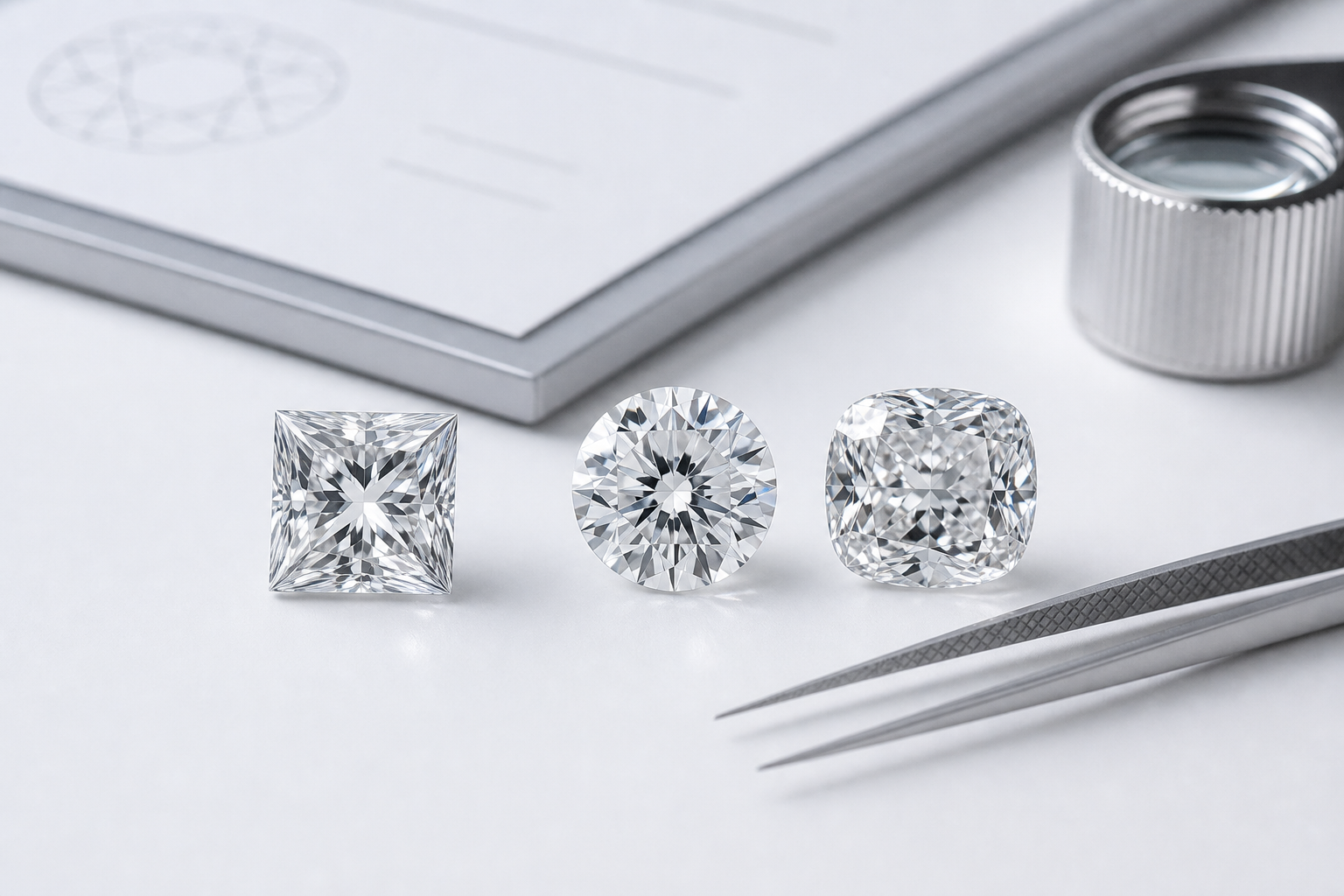
The princess cut vs round diamond decision usually comes down to geometry, sparkle style, and setting personality. The princess cut vs cushion diamond decision is more about sharpness versus softness. All three can be beautiful choices, but they solve different design problems. Treating them as interchangeable because they are all brilliant or brilliant-adjacent shapes leads to weak comparisons.
A round brilliant is usually the safest traditional choice. A cushion cut is often chosen for a softer outline and more romantic feel. A princess cut gives you square brilliance with a cleaner, more architectural look. The right choice depends less on which shape is “best” and more on which tradeoff you actually want to live with.
When comparing shapes, buyers should also separate personal taste from measurable performance. A round diamond may be easier to compare because cut expectations are more standardized, while a princess cut may require more side-by-side visual review. That difference does not make one shape universally better; it simply changes the buying method.
Princess cut vs round: square geometry versus classic maximum brilliance
Round brilliants are often chosen because their light performance is familiar, their cut grading is more standardized, and they work well in nearly every setting style. If a buyer wants the easiest shape to compare across multiple diamonds, the round brilliant has an advantage. It is widely available, widely understood, and generally simpler to evaluate on paper than most fancy shapes.
A princess cut offers a different reward. It gives the buyer a square outline with strong brilliance and a more modern face-up look. It may also offer appealing value compared with a round diamond of similar carat weight, though the exact difference depends on the individual stones and current market pricing. The mistake is assuming that lower cost per carat automatically means better value. A princess cut with weak spread, poor visual performance, or an insecure setting is not a smarter buy just because it costs less.
Do not assume every round diamond will outperform every princess cut. A well-cut princess cut can look bright and lively, while a poorly chosen round can still disappoint. The more useful distinction is this: round diamonds are often easier to evaluate through standardized cut expectations, while princess cuts require more attention to actual images, measurements, proportions, and setting fit.
Prices can change with market conditions, report type, seller channel, and stone-specific details, so exact comparisons should be verified at the time of purchase. If a princess cut appears to be a better value than a round diamond, the buyer should still confirm that the apparent savings do not come from hidden depth, weak video performance, unclear documentation, or a setting cost that was not included in the initial comparison.
Princess cut vs cushion: sharper corners versus softer edges
The princess cut vs cushion diamond comparison is more personal, but it still has practical consequences. Princess cuts have straight sides and pointed corners, giving them a crisp, structured look. Cushion cuts have rounded corners and a pillow-like outline, which usually feels softer on the hand. If the ring design is minimal, angular, or architectural, the princess cut often looks more consistent with the setting. If the design includes curves, vintage details, or a romantic halo, the cushion may feel more natural.
Cushion cuts also vary widely in faceting style. Some have a crushed-ice look, some show broader flashes, and some fall between the two. That means a cushion cut should almost always be reviewed in video rather than judged by shape name alone. Princess cuts vary too, but their square outline creates a more immediately structured visual identity.
The risk with choosing a cushion when you actually want a square diamond is that the softened corners can make the ring feel less sharp than expected. The risk with choosing a princess cut when you actually want softness is the opposite: the ring may feel more angular than the wearer’s style. This is a style decision, but it affects long-term satisfaction more than many buyers expect.
When the princess cut is the better fit
A princess cut is often the better fit for a buyer who wants a square lab-grown diamond, noticeable sparkle, a modern setting, and a strong visual presence without defaulting to a round brilliant. It can be especially compelling when the buyer likes clean lines and wants the diamond shape to feel intentional rather than traditional.
Consider a shopper comparing a 1.50 ct round lab-grown diamond with a 1.70 ct princess cut lab-grown diamond within a similar budget. The princess cut may offer a larger carat weight and a square look that feels more distinctive. But the tradeoff is real: the buyer must pay closer attention to proportions, face-up spread, and corner protection. If they ignore the setting, the apparent value advantage can disappear into a ring that is less practical for daily wear.
The princess cut is not the best choice for someone who wants the simplest possible buying process or a shape that hides in almost any setting. It is a better choice for someone willing to verify the stone’s visual performance and match it to a setting that supports the square shape properly.
This is also where lifestyle matters. Someone who frequently works with tools, lifts weights, gardens, or uses their hands in ways that expose a ring to repeated contact may still choose a princess cut, but they should take setting height and corner coverage seriously. A buyer who mostly wants a low-maintenance silhouette may prefer a design with more protective metal around the stone.
What This Means in a Real Purchase
Maya wants a modern solitaire and is comparing a round, cushion, and princess cut lab-grown diamond. She likes the round diamond’s classic sparkle, but the shape feels too traditional for the minimal platinum ring she has in mind. The cushion cut is attractive, but its softened corners make the design feel warmer and less structured than she wants.
She chooses the princess cut because the square outline works better with the clean platinum setting. Her decision is not based only on carat weight or price. She accepts the tradeoff that the corners need more protection, so she prioritizes V-prongs and a slightly lower-profile mounting instead of choosing the most open setting available.
Square Proportion and Length-to-Width Ratio: The First Princess Cut Filter
Princess cut diamond proportions should be checked before you get attached to carat weight, color, or clarity. The first filter is the length-to-width ratio, because it tells you whether the diamond is likely to look square or slightly rectangular from the top. For a shape whose appeal depends heavily on geometry, this is not a minor detail.
A princess cut can be technically listed as a princess cut while still looking different from what a buyer imagines. Some stones appear like a classic square. Others stretch enough that the outline feels more rectangular, especially once set. If your goal is a clean square diamond, the measurements matter as much as the name.
The ratio is easy to understand: divide the longer measurement by the shorter measurement. A diamond measuring 6.00 mm by 6.00 mm has a 1.00 ratio. A diamond measuring 6.30 mm by 6.00 mm has a 1.05 ratio. This simple calculation helps buyers see whether the diamond’s outline supports the visual style they expect.
Recommended length-to-width range for a square princess cut
For most buyers, the best length-to-width ratio for a princess cut diamond is close to 1.00. A ratio from about 1.00 to 1.05 generally appears square to most viewers, especially once the diamond is set. This range is a practical buying guideline, not a universal grading rule, but it is a useful way to avoid stones that look different from the classic princess cut profile.
From about 1.06 to 1.10, the stone may begin to look slightly rectangular depending on its size, setting, and how sensitive the viewer is to symmetry. This does not automatically make it a bad diamond. Some buyers may like the subtle elongation, and certain ring designs can make a slightly rectangular stone look intentional. The risk is buying it unintentionally because the listing says “princess cut” and the carat weight looks appealing.
Above 1.10, many shoppers will no longer see the diamond as having the classic square princess look. At that point, the stone may still be attractive, but it should be chosen as a more elongated square-style diamond rather than as a traditional princess cut. If the setting was designed around a square center stone, this mismatch can become more obvious after mounting.
Because visual tolerance varies, the ratio should be paired with a face-up image rather than used alone. Some stones at the same ratio may appear different because of facet layout, corner shape, girdle outline, and the way the diamond is photographed. Ratio is a useful first screen, not the full decision.
Why measurements matter more than carat weight alone
Carat weight tells you how much the diamond weighs, not how large or balanced it will look from the top. Two 1.50 ct princess cut diamonds can face up differently if one carries more weight in depth while the other has better visual spread. The deeper stone may weigh the same but appear smaller when viewed in a ring.
This is why millimeter measurements are essential. When comparing princess cuts of similar carat weight, look at the length and width together, not just the total weight. A diamond that looks like a better value by carat may lose that advantage if the face-up dimensions are smaller than expected.
The practical mistake to avoid is paying for hidden weight. If a stone carries too much of its carat below the girdle, you may be buying mass that does not contribute much to the visible size of the diamond. That does not mean the shallowest stone is automatically better, because proportions still need to support brightness. It means carat should be judged alongside dimensions and video, not in isolation.
For example, a buyer comparing two stones with similar listed weight should place the millimeter dimensions side by side. If one diamond is noticeably smaller across the top, the buyer should ask whether the additional depth improves performance or simply hides weight. If the video also shows weaker brightness, the heavier-looking specification may not translate into a stronger finished ring.
How setting design can make a square look sharper or softer
The setting can either emphasize the princess cut’s square geometry or soften it. V-prongs and clean corner-focused prongs tend to preserve the crisp outline. A rounded halo can make the stone appear less angular, while a square halo can reinforce the geometry. A bezel can create a strong modern frame, but it may also make the diamond look more contained and less open.
Band width also changes the visual effect. A thinner band can make the center stone look more prominent and defined. A wider band can make the ring feel more architectural, but it may reduce the contrast between the diamond and the setting if the proportions are not balanced. Neither option is universally better; the right choice depends on whether you want the stone to look delicate, bold, or integrated into the overall design.
This is a visual decision before it becomes a security decision. The setting should not accidentally erase the reason you chose a princess cut. If the square outline is the priority, review the stone and setting together from the top view before approving the final design.
For custom design, the stone cannot be evaluated separately from the mounting. A square outline that looks ideal as a loose diamond may read differently once prongs, halo edges, band width, and height are added. At NUVU, this type of comparison is treated as a practical fit question: the diamond’s measurements help guide the design, but the final choice still needs to make sense visually, physically, and financially as a finished ring.
A transparent custom process should connect each design decision back to the stone’s real dimensions. The buyer should know whether the mounting is being planned around the exact length, width, depth, girdle outline, and corner positions of the diamond, because those details affect both appearance and protection. This is especially important for princess cuts, where a small measurement mismatch can change how evenly the prongs sit over the corners.
NUVU’s buyer-first approach is to make comparison clearer, especially around report details, visual evidence, setting fit, and documentation. That does not replace the buyer’s own review, but it can help organize the decision around the parts of the ring that affect daily wear and long-term satisfaction.
Buyer Verification Checklist
Before selecting a princess cut, check the grading report dimensions, calculate or confirm the length-to-width ratio, and review a face-up image or 360-degree video. Do not rely on the product title alone, because “princess cut” can include stones that are nearly square or visibly rectangular.
A strong first pass is simple: look for a ratio around 1.00 to 1.05 if you want a classic square appearance, compare the millimeter spread against stones of similar carat weight, and make sure the setting design supports the face-up shape you are paying for.
Depth, Table, and Face-Up Size: How Princess Cut Proportions Affect Appearance
Princess cut diamond depth and princess cut diamond table percentage have a direct effect on how the stone looks from above. Two diamonds can have the same carat weight, the same color grade, and the same clarity grade, yet one may look bright and well-sized while the other looks smaller, darker, or heavier than expected. The difference often comes down to how the weight is distributed and how well the proportions support light performance.
For buyers, the main goal is not to memorize every cutting detail. It is to avoid paying for hidden weight that does not improve the look of the diamond. A princess cut should be judged by its face-up size, its visual spread, and how lively it appears in motion, not by carat weight alone.
In practical buying, this is where many comparisons become misleading. A product page may make two stones look equivalent because the carat, color, and clarity match, while the dimensions and video reveal very different outcomes. When the numbers and the visual evidence disagree, give more weight to the finished appearance: a balanced, bright stone with honest spread is usually more useful than a heavier stone that looks smaller or less active.
Depth and table should therefore be used as screening information rather than automatic pass-or-fail rules. They help you decide which diamonds deserve closer attention, but the actual choice should still be based on how the diamond looks and how it fits the intended setting.
Practical depth and table ranges buyers can use
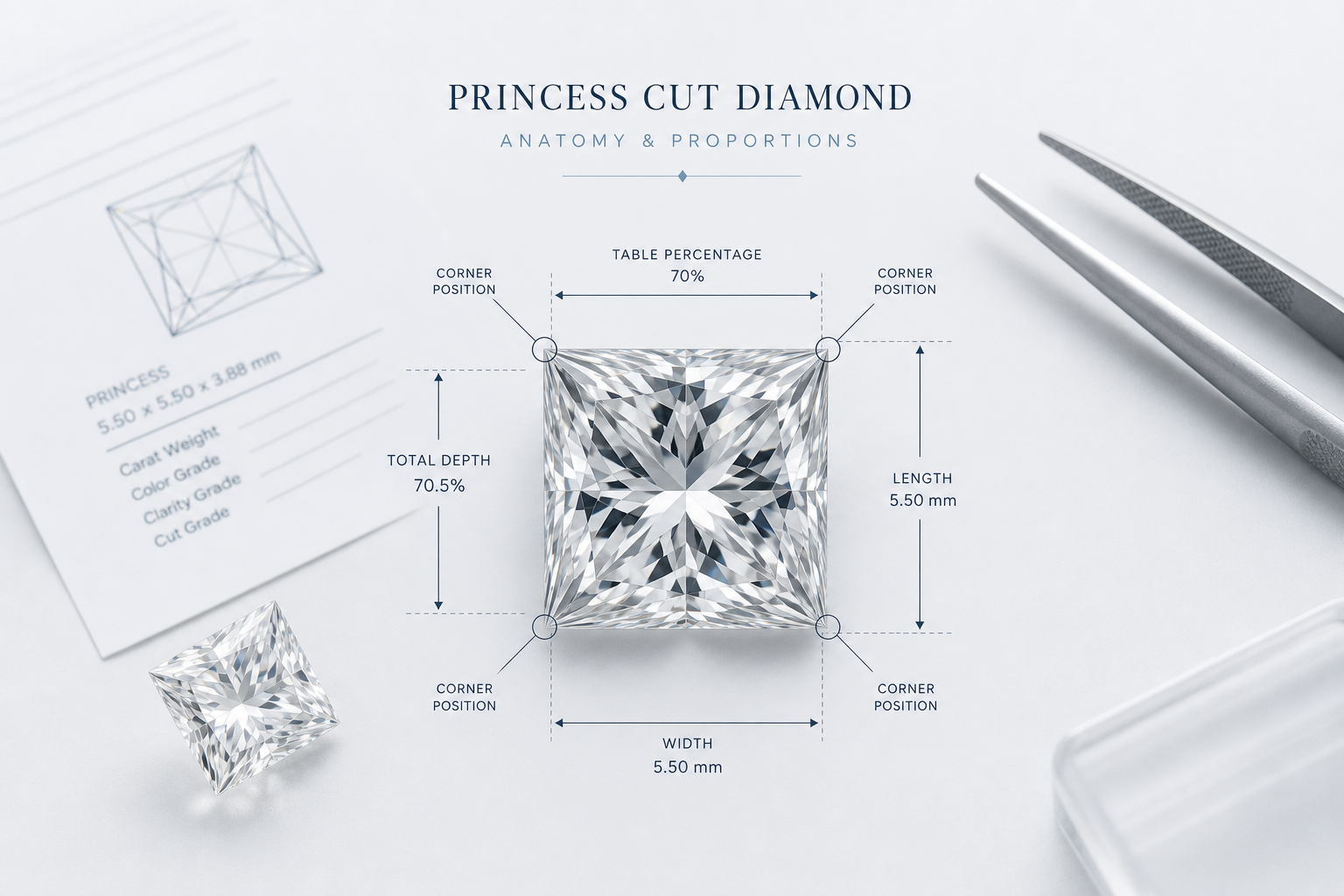
As a buyer-friendly starting point, many attractive princess cuts fall around a table range of approximately 65% to 75%. For total depth, a practical range is often around 68% to 75%. These are not rigid grading rules, and they should not be used as a shortcut for choosing a stone without seeing it. They are screening ranges that help you identify diamonds worth a closer look.
A princess cut with a table or depth slightly outside those ranges can still be appealing if the diamond has strong measurements, balanced brightness, and convincing video. The same caution applies to shape-specific resources such as a marquise lab grown diamond guide, where finger coverage and outline drama still need to be weighed against real optical performance. The mistake is treating the numbers as proof of beauty. A report can tell you that a diamond’s depth is 74%, but it cannot tell you whether the center looks lively, whether the corners go dark, or whether the stone has a pleasing pattern of reflections.
If you are comparing several stones, start by removing obvious outliers, then look at the remaining diamonds through images and video. A stone with balanced proportions and strong face-up dimensions is usually a safer choice than a stone that looks impressive only because the carat weight is higher.
Buyers should also remember that different grading reports may present information in slightly different formats. The key is not to chase a single number, but to make sure the report details, listing details, media, and seller explanations are consistent with one another.
How excessive depth can reduce visible size
Excessive depth is one of the easiest ways for a princess cut to disappoint in real life. A deeper diamond may carry more of its weight below the girdle, where you cannot see it from the top. That means a 1.50 carat princess cut with heavy depth can look smaller face-up than another 1.50 carat stone with better visual spread.
This is why millimeter dimensions matter. If two princess cuts have similar carat weights, compare length and width before deciding which one offers better presence. The diamond with the larger face-up measurements may look more substantial in the ring, even if the carat number is identical. Carat weight tells you how much the diamond weighs; it does not tell you how large it will appear on the hand.
Shallow is not automatically better. A princess cut that is too shallow may lose brightness, show unattractive windowing, or lack visual depth. The better judgment is not “lower depth is always good,” but “avoid paying for depth that does not improve appearance.” If a stone is deep and also looks small or dark in video, that is a warning sign.
A deeper stone may still be worth considering if it has excellent-looking brightness, a pleasing pattern, and dimensions that make sense for the carat weight. The concern is not depth by itself; the concern is depth that works against visible size and light performance.
Why table size affects the look of sparkle
The table is the large flat facet on the top of the diamond, and its size influences how reflections appear across the face of a princess cut. A larger table can create a more open central look, while a smaller or more balanced table may create a different pattern of reflections depending on the rest of the cut. Table percentage alone does not determine sparkle, but it can affect the character of what you see.
The stronger decision is to view table, depth, crown, pavilion, and symmetry as a group. A table that looks acceptable on paper can still produce a flat-looking stone if the rest of the cut does not support good light return. The reverse can also happen: a diamond slightly outside a preferred table range may look bright and balanced because the complete cut works well.
For princess cuts, avoid choosing by a single proportion number. The best depth and table for a princess cut diamond are the ones that support a lively face-up appearance, a good spread for the carat weight, and a sparkle pattern you actually like in motion.
Because buyers often view diamonds under magnification online, it is helpful to step back mentally and ask how the stone will look at normal ring-viewing distance. A table pattern that looks dramatic at high magnification may not matter much in daily wear, while a persistent dull center may still be noticeable after setting.
Certificate and Visual Review Check
Use the grading report to confirm table percentage, total depth, length, width, and overall dimensions. Then compare those numbers with actual imagery. The report can help you understand the structure of the diamond, but it cannot fully show whether the stone looks bright, balanced, or dark as it moves.
Before choosing, review magnified photos and a 360-degree video when available. If you are comparing multiple princess cuts, use the same review method for each stone so one diamond is not being judged under better lighting than another. A visually strong diamond should not need flattering media to hide a weak center, poor spread, or uneven brightness.
Sparkle Pattern: What Princess Cut Brilliance Looks Like in Real Life
Princess cut diamond sparkle has its own personality. A princess cut is designed for brilliance, but it does not sparkle exactly like a round brilliant. The square outline, pointed corners, and facet arrangement create flashes that can look more angular, structured, and patterned. For buyers, the key is not to ask whether it “beats” a round diamond, but whether its brightness and movement fit the look you want.
This distinction matters because many shoppers use round diamonds as the default sparkle standard. That can lead to the wrong comparison. Princess cut brilliance can be strong and eye-catching, but it often feels sharper and more geometric. If you want a modern square stone, that type of scintillation is part of the appeal.
Sparkle should also be evaluated under realistic expectations. Online videos often use controlled lighting, magnification, and rotation that can make every diamond appear more dramatic than it will in casual environments. The better question is whether the diamond remains lively across different views and does not depend on one flattering angle.
Brilliant faceting, but not the same sparkle as a round diamond
Princess cuts use brilliant-style faceting, which means they are cut to create brightness and flashes of light rather than the broad, mirror-like steps seen in emerald or Asscher cuts. Still, the square shape changes how that brilliance appears. Instead of the more circular, evenly distributed sparkle many people associate with a round brilliant, a princess cut may show flashes that move across the stone in more directional patterns.
Different does not mean worse. A well-cut princess diamond can look lively, crisp, and bright, especially in settings that leave enough of the stone visible. The mistake is expecting the same visual rhythm as a round diamond. If your eye prefers a perfectly classic sparkle pattern, a round may feel easier to love. If you want a sharper square shape with strong light movement, a princess cut may be the better match.
Quality still varies by individual stone. A strong princess cut should show brightness across the center and out toward the corners, not only a few flashes at the edges. If the center looks flat or the stone appears dull when it rotates, the brilliance on paper is not translating into real visual performance.
Buyers should be cautious about judging sparkle from a single still image. A still image can capture one bright moment or one dark moment, while video gives a better sense of how the diamond behaves through movement. Even then, the video should be compared with other stones shown in similar conditions.
How chevron patterns can change the visual effect
Some princess cuts have different pavilion facet arrangements, often discussed in terms of chevron patterns. Without getting too technical, these patterns can influence whether the sparkle appears broader and chunkier or finer and more splintery. One style is not automatically better; the better choice depends on what looks pleasing to your eye.
This is an area where terminology can mislead buyers. Knowing the chevron structure may help explain why two princess cuts look different, but it should not replace visual review. A diamond with a description that sounds ideal can still look busy, dark, or uneven in motion. Another stone with less attention-grabbing specifications may have a cleaner, more attractive pattern.
The best test is whether the diamond looks lively to your eye in motion. If you find yourself trying to justify a stone because the specs seem good while the video feels underwhelming, keep comparing.
If a seller provides additional images such as ASET, Ideal-Scope, or other light-performance tools, those can be useful when interpreted carefully. They should still be treated as supporting information rather than as a substitute for normal viewing, because the finished ring will be seen in everyday lighting, not only through technical imagery.
Warning signs in princess cut videos
Video is especially useful for judging princess cut sparkle because it shows how the diamond behaves as it turns. Look for large dark zones that remain dark through the rotation. Temporary contrast is normal and can make a diamond look dynamic, but a dead area that does not wake up is different. Persistent darkness in the center is more concerning than small flashes of contrast near the edges.
Also check whether the sparkle pattern feels reasonably balanced from corner to corner. A princess cut does not need to look perfectly identical in every frame, but one side should not consistently look weaker than the other. A lively center matters, because that is where the eye naturally lands when the diamond is set in a ring.
Compare videos carefully. Lighting, camera angle, magnification, and background can all change how a diamond appears. If one stone is filmed in bright studio lighting and another in a duller format, the comparison may not be fair. Whenever possible, compare diamonds using similar video styles, similar magnification, and similar viewing conditions.
A useful habit is to watch the video more than once. On the first pass, notice your immediate impression. On the second pass, look specifically at the center. On the third pass, check the corners and edges. This helps prevent a few bright flashes from distracting you from a persistent performance issue.
How to Verify This Before Buying
Ask for or review consistent media: magnified still images, a 360-degree video, and the grading report. The report helps confirm the diamond’s identity and measurements, while the media shows whether the princess cut brilliance is actually appealing in motion.
If you are deciding between two stones, do not rely on the stronger-looking video alone until you understand whether the lighting conditions are comparable. A diamond that looks good only in unusually favorable media may not be the better stone. Choose the one that remains bright, balanced, and visually active under the most reliable comparison available.
Color and Clarity in Princess Cut Lab-Grown Diamonds: What to Prioritize
Princess cut lab-grown diamond color and princess cut diamond clarity should be judged through the shape itself, not as abstract grades. A higher grade can be useful, but it is not always the smartest place to spend more. With princess cuts, visual performance, face-up appearance, and setting compatibility usually deserve priority before paying for differences most people will not see.
The practical question is simple: will the diamond look white enough, clean enough, and lively enough in the setting you are choosing? A certificate can narrow the options, but it should not push you into overspending on invisible upgrades while ignoring proportions or corner protection.
Color and clarity are still important, but they work best as part of a balanced decision. A diamond that is technically high in color and clarity can still be disappointing if it is poorly proportioned, visually dull, or placed in a setting that exposes the corners unnecessarily.
Color: when higher grades matter and when they may not
Princess cuts can show color differently depending on size, lighting, setting, and personal sensitivity. In white metals such as platinum or white gold, warmth may be easier to notice, especially in larger stones or side-by-side comparisons. Buyers who want a crisp white look often compare D-F and G-H stones before deciding where the visual difference stops being worth the added cost.
That does not mean every princess cut needs to be colorless. A well-chosen G or H color stone can still look bright and white to many buyers, particularly when the cut is lively and the setting is well matched. Yellow gold and rose gold can be more forgiving because the metal itself adds warmth, making a slight tint in the diamond less visually distracting.
The mistake is choosing color in isolation. If moving from G to E forces you to accept weaker proportions, smaller face-up size, or a less secure setting, the higher color grade may not improve the finished ring as much as expected. Color should support the design, not consume the budget at the expense of the diamond’s overall appearance.
Personal sensitivity also matters. Some buyers easily notice small color differences, while others do not see a meaningful distinction once the stone is mounted. When possible, compare stones against the intended metal color rather than making the decision from grade labels alone.
Clarity: why corner and center visibility matter
Clarity in a princess cut should be judged by visibility and location. An inclusion near the edge may be less noticeable once the diamond is set, while an inclusion under the center table can be much harder to ignore. For many buyers, VS1-VS2 is a comfortable search zone for an eye-clean diamond, while a carefully selected SI1 may work only after close visual review.
Corner inclusions deserve special attention. Some marks near the corners may be hidden or softened by prongs, but inclusions that affect durability or sit near vulnerable pointed areas should be reviewed carefully. This is not because princess cuts are impractical; it is because the corners already need thoughtful protection, and the clarity characteristics should not add avoidable risk.
Lab-grown diamonds vary, just as natural diamonds do. Some are very clean, while others may show growth-related features, clouds, crystals, or strain-like visual effects depending on the stone. Do not assume that lab-grown automatically means flawless-looking. Use the clarity grade as a filter, then inspect the actual photo or video to decide whether the diamond is acceptable to your eye.
It is also worth separating “eye-clean” from “high clarity grade.” Eye-clean is a practical viewing judgment about whether inclusions are visible in normal wear, while clarity grade is a laboratory description under controlled conditions and magnification. A buyer may be perfectly satisfied with a lower clarity grade if the stone looks clean face-up, but should be more cautious if the visible feature sits under the table, near a corner, or in a place that draws attention in video.
When growth method or post-growth treatment is relevant, buyers should look for clear disclosure in the grading report or seller documentation. HPHT and CVD may refer to laboratory diamond growth methods, and any post-growth treatment discussion should be based on documented information rather than assumptions.
How to balance cut, color, clarity, and carat for value
The strongest value in a princess cut usually comes from balance. Prioritize a square, well-proportioned stone with good face-up size, lively sparkle, and an eye-clean appearance before chasing the highest color or clarity grade available. A higher clarity grade does not automatically make a diamond more beautiful if the stone looks small for its weight or lacks brightness in motion.
If your budget requires tradeoffs, protect the factors that affect what people actually see. Visual performance, measurements, and setting security should carry more weight than a clarity upgrade that is invisible without magnification. Color matters when it affects the look of the finished ring, especially in white metal, but it should be compared with real images rather than chosen by grade alone.
At NUVU, we treat the grading report as a starting point, not the final answer, because the report helps identify the diamond but does not show how color, clarity, proportions, and sparkle work together in the finished piece.
A balanced decision also reduces the risk of overpaying for a specification that does not improve the ring in a visible way. The goal is not to buy the highest grade in every category; it is to choose the combination that delivers the intended look, fits the setting, and stays within the buyer’s priorities.
Certificate and Visual Review Check
Use the grading report to confirm color, clarity, measurements, and lab-grown identification. Then use magnified photos or video to confirm whether the clarity grade is visually acceptable and whether the color works with the intended metal.
The certificate supports comparison, but it does not replace seeing the stone. A princess cut with slightly lower grades can be the better choice if it looks clean, bright, well-sized, and properly matched to the setting. A diamond with stronger grades can still be the wrong choice if the visual performance or physical fit is weak.
Corner Durability: Why Princess Cut Diamonds Need Better Setting Protection
Princess cut diamond durability is mostly a corner issue. The shape itself is not unsuitable for an engagement ring, and a well-set princess cut can handle normal daily wear. The important difference is geometry: princess cut diamond corners are pointed, exposed, and more vulnerable to direct impact than the continuous edge of a round diamond.
This risk does not come from the diamond being lab-grown. A lab-grown princess cut and a natural princess cut with the same shape and condition share the same basic corner concern. What matters in practice is how the stone is cut, where any inclusions are located, how the mounting holds the diamond, and whether the wearer’s lifestyle calls for more coverage.
Durability should be understood as a design and maintenance issue rather than a reason to dismiss the shape. Many buyers wear princess cut engagement rings successfully, but the ring should be built and checked with the corners in mind.
Why pointed corners require more attention
The sharp corners are part of what makes a princess cut look crisp and architectural. They create the clean square outline that many buyers want. The tradeoff is that those same corners can take the force of a bump if they are left too exposed, especially on a ring worn every day.
For most buyers, the right conclusion is not “avoid princess cuts.” It is “do not treat the setting as an afterthought.” A princess cut engagement ring should be judged as a stone-and-setting combination, not as a loose diamond decision followed by a generic mounting. A beautiful stone can become a poor practical choice if the corners sit high, open, or unevenly protected.
Corner chipping is more likely when a pointed corner is exposed to impact, when a prong is poorly placed, or when the diamond does not fit the mounting cleanly. Inclusions near the corners should also be reviewed carefully, not because every inclusion creates a problem, but because a vulnerable location deserves more attention than a harmless inclusion hidden away from stress points.
Routine wear habits also matter. Removing the ring for activities that involve hard impacts, chemicals, heavy gripping, or repeated pressure can help preserve both the stone and the mounting. This is practical jewelry care, not a special weakness unique to lab-grown diamonds.
V-prongs and corner coverage
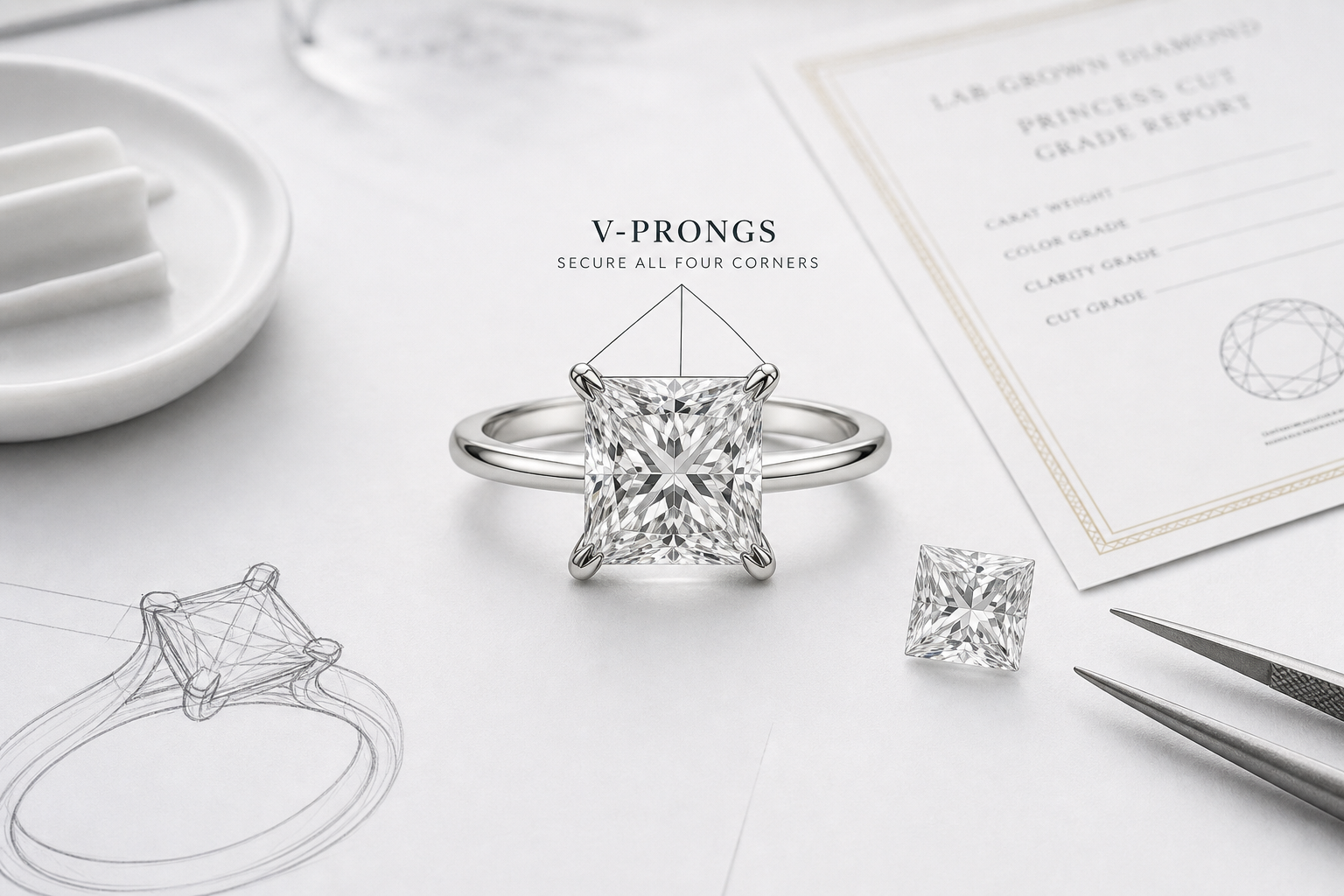
V-prongs are commonly used for princess cut diamonds because they wrap around the corner rather than sitting beside it. A standard round prong may hold the stone, but it does not always shield the corner point as well. With a princess cut, the best prong design is the one that protects the vulnerable geometry while keeping the square outline visually clean.
Prong type alone is not enough. Placement, symmetry, thickness, and craftsmanship matter just as much. A bulky V-prong can make the diamond look heavy or cover too much of the corner, while a thin or poorly aligned prong may not provide enough security. The better setup protects all four corners evenly without making one side look visually crowded.
Buyers should be cautious with settings that look delicate in product photos but leave the corners too exposed in real life. Minimalist settings can work well with princess cuts, but the minimal look should come from clean design, not from underbuilt prongs. If the ring is for someone active with their hands, stronger corner coverage is usually a better priority than the most open possible profile.
After the ring is made, prongs should be checked periodically according to the jeweler’s recommendations or whenever the ring takes a noticeable impact. A secure original setting is important, but long-term wear still requires ordinary inspection and care.
When bezel, semi-bezel, or halo settings may help
A bezel, semi-bezel, or protective halo can reduce corner exposure by adding more metal or surrounding structure around the stone. These designs can be especially useful for buyers who want a princess cut engagement ring with more protection, a lower-profile feel, or a modern geometric look.
The tradeoff is visual openness. A full bezel can make the ring feel sleek and practical, but it may soften the sharp edge contrast that draws many buyers to a princess cut in the first place. A halo can add presence and may help protect the outline, but it also changes the diamond’s visual footprint and can make the center stone feel less stark and architectural.
Semi-bezel settings sit between those two priorities. They can protect parts of the diamond while leaving more of the stone visible. This can be a good compromise when a buyer wants stronger security than a classic prong setting but does not want the fully framed look of a complete bezel.
The best protective setting is the one that fits the specific stone, not only the style category. A bezel that is poorly fitted can still create problems, while a well-made prong setting can be secure. Construction quality matters as much as the name of the setting style.
Stone-to-Setting Fit Check
Before approving a setting, confirm that all four corners are protected, the prongs align symmetrically, and the stone’s exact measurements match the mounting design. For custom rings, ask for confirmation that the setting is built for that specific diamond’s dimensions, not only its carat weight.
This is especially important because two princess cut diamonds with the same carat weight can have different millimeter measurements. A mounting selected by carat weight alone may hold the stone imperfectly, sit unevenly, or expose a corner more than expected. For princess cuts, fit is not a minor detail; it is part of the durability decision.
Best Settings and Metals for Princess Cut Lab-Grown Diamond Rings
The best setting for a princess cut lab-grown diamond depends on how much visual openness, corner protection, and daily-wear practicality the buyer wants. Princess cut diamond settings should do more than hold the stone in place. They should support the square geometry, protect the corners, and match the way the ring will actually be worn.
A princess cut engagement ring usually looks strongest when the setting feels intentional. A very delicate mounting can make the diamond look larger and more exposed, but it may not be the best choice for someone who wants maximum durability. A heavier setting can feel secure and structured, but it may reduce the crisp, floating look that many buyers prefer.
Metal choice, prong shape, setting height, and stone size all interact. A design that works well for a smaller princess cut may not be ideal for a much larger one, and a design that looks elegant in a rendering should still be checked against the stone’s exact measurements.
Solitaire settings: clean, modern, and dependent on strong prongs
A solitaire is one of the clearest ways to show the shape of a princess cut. With no side stones or halo competing for attention, the square outline becomes the main design feature. This works especially well for buyers who want a modern, minimal ring where the diamond’s geometry does most of the visual work.
The weak point of a solitaire is that the center stone is more exposed. V-prongs or secure corner prong designs should be discussed before choosing the final mounting. A solitaire with well-built corner protection can be an excellent choice; a solitaire with overly light prongs may look appealing in photos but be less practical for daily wear.
Band width also changes the effect. A thinner band can make the center diamond appear more prominent, which many buyers like when choosing a princess cut for visual size, especially when comparing proportions in a lab grown diamond shapes guide before finalizing the setting style. A wider band can make the ring feel more architectural and balanced, especially with a larger center stone. Neither is automatically better; the right choice depends on finger coverage, stone size, setting height, and personal style.
Profile view is just as important as top view. A high solitaire may show off the diamond, but it can also increase exposure. A lower-profile solitaire may feel more wearable, but the setting still needs enough structure to hold the diamond securely and allow appropriate cleaning access.
Halo and three-stone settings: more presence, more design complexity
A halo can make a princess cut ring look larger and more finished, especially when the halo follows the square outline cleanly. It may also add some protection around the edges depending on how the setting is built. The risk is that a poorly proportioned halo can blur the center stone’s square shape or make the ring feel busier than intended.
Three-stone designs add another layer of judgment. Side stones need to complement the center diamond without making the ring look unbalanced. Baguettes, tapered baguettes, trapezoids, or smaller princess cuts can all work, but each creates a different visual direction. Straight baguettes feel clean and linear, trapezoids can bridge the center stone into the band, and smaller princess cuts create a stronger geometric repeat.
For custom projects, a CAD or design preview is especially useful because princess cuts are unforgiving when proportions are off. If the side stones sit too high, too low, or too wide, the center diamond can lose its visual authority. The best design is not always the one with the most stones; it is the one where the center diamond, side stones, prongs, and band width look resolved together.
Halo and three-stone settings should also be assessed for maintenance. More stones and more prongs can create more places that need cleaning or inspection. That does not make the design a poor choice, but buyers should understand the practical care requirements before selecting a more complex ring.
Metal choices: platinum, white gold, yellow gold, and rose gold
Metal choice affects both appearance and maintenance. Platinum is a dense, durable option often chosen for engagement rings, especially when the buyer wants a white metal and a substantial feel. It is not automatically the right choice for every budget or design, but it is often worth considering for princess cut settings where prong strength and long-term wear matter.
White gold gives a bright, clean look that pairs naturally with the modern style of a princess cut. Buyers should understand that white gold is commonly rhodium plated, which means the bright white finish may require maintenance over time. If low-maintenance wear is a major priority, this detail should be discussed before purchase rather than discovered later.
Yellow gold and rose gold can soften the sharp geometry of a princess cut. They may also be more forgiving if the diamond has a slight warmth that would be more noticeable in a white metal setting. This does not mean buyers should ignore color grade, but it does mean the metal and diamond should be considered together rather than separately.
Metal selection should also account for the wearer’s preferences around color, weight, budget, maintenance, and skin sensitivity. If a seller offers multiple alloy options, the buyer should ask what is being used and how that choice affects durability and care.
What to Confirm in Writing
Before purchase or custom production, confirm the metal, prong style, stone measurements, setting height, and whether the design protects all four corners. If policies such as resizing, maintenance, or repairs matter, request those details directly from the seller rather than assuming they are included.
For a princess cut ring, written confirmation is not just administrative. It helps prevent the most common mismatch: a diamond chosen for its square brilliance being placed into a setting that does not properly support its corners, proportions, or daily-wear needs.
Value and Pricing Logic: Why Princess Cut Lab-Grown Diamonds Can Be a Strong Buy
Princess cut lab-grown diamond value can be strong because the shape often gives buyers a bright square look at a different price structure than a round brilliant. The advantage is not automatic. A lower princess cut diamond price only matters if the stone has good visual performance, a pleasing square outline, useful face-up size, and a setting that protects the corners properly.
The mistake is shopping princess cuts by carat weight and price alone. A stone can look like a deal online and still lose value in practice if it faces up small, looks dark in motion, has distracting inclusions, or requires a more expensive setting than expected to protect exposed corners.
Value should be understood as the relationship between what is paid and what is actually received: the diamond’s appearance, documented characteristics, setting quality, fit, service terms, and suitability for the wearer. A low price is only useful if the finished ring still meets the buyer’s expectations.
Why princess cuts may cost less than comparable round diamonds
Fancy shapes, including princess cuts, often price differently from round brilliants because demand, cutting yield, and market behavior are different. Round diamonds tend to have broader demand and more standardized cut comparison, which can affect pricing. Princess cuts may give buyers more room to increase size or improve another quality factor within the same budget.
This potential price advantage should be used carefully. If choosing a princess cut allows a buyer to move from a 1.50 ct round to a larger square diamond that still has strong brightness, good measurements, and secure setting compatibility, the tradeoff may make sense. If the lower price comes from excessive depth, poor video performance, or vague documentation, it is not a better buy.
The practical judgment is simple: a princess cut is a strong value only when the savings do not come at the expense of the reasons the shape is attractive in the first place. Square outline, lively brilliance, and clean setting fit should remain the priorities.
Because lab-grown diamond pricing can change quickly, buyers should avoid relying on old comparisons or general claims about what a shape “should” cost. Current pricing should be checked against current availability, report details, seller channel, and finished-ring requirements.
What actually drives value in a princess cut
Value starts with visual performance. A princess cut should look bright and active across the center, not just appealing by grade. Because princess cuts do not have the same standardized cut grading behavior as round brilliants, photos and video carry more weight in the buying process.
The next value driver is shape accuracy. A length-to-width ratio close to square, useful millimeter spread, and balanced depth help determine whether the diamond delivers the look the buyer expects. A higher carat weight is less valuable if the stone hides too much weight in depth and looks smaller from the top.
Color and clarity matter, but they should not consume the budget at the expense of cut appearance or setting quality. An eye-clean stone with an appropriate color grade for the chosen metal can be a better purchase than a higher-clarity diamond that looks no better to the eye but forces a compromise on size, brightness, or mounting security.
Total project cost also belongs in the value calculation. The diamond price, setting, metal, customization, and any confirmed service terms all affect the real purchase. A low-priced loose diamond may not be the lowest-cost finished ring if the setting needs upgrades to protect the corners properly.
Documentation can also affect buyer confidence. A clear grading report, consistent media, and transparent seller communication make it easier to understand what is being purchased. They do not guarantee that the diamond is the right choice, but they reduce confusion and make comparison more reliable.
When a cheaper princess cut is not the better choice
A cheaper princess cut is not the better choice when the discount is tied to a visible problem. Warning signs include an overly deep profile that reduces face-up size, large dark zones in video, a center that looks flat, obvious inclusions in distracting locations, unclear media, or a report that does not provide enough confidence for comparison.
Setting risk is another hidden cost. If the diamond requires a better-built mounting than the buyer planned for, the apparent savings can shrink quickly. This does not mean buyers should avoid lower-priced stones. It means the lower price should survive a side-by-side review of measurements, video, documentation, and setting compatibility.
High price does not guarantee quality either. A more expensive princess cut can still be poorly proportioned or visually underwhelming. The better approach is to compare several stones under the same criteria and let the full picture, not the price tag alone, decide the winner.
Price differences in lab-grown diamonds can reflect many factors, including size, grades, cut appearance, availability, growth method disclosure, documentation, seller service, and the complexity of the finished setting. A lower price should not be treated as suspicious by default, and a higher price should not be treated as proof of superiority. The most reliable comparison is a side-by-side review of what is documented, what is visible, and what the finished ring requires.
Buyers should be especially careful with claims that suggest a diamond is an “investment” or will hold resale value. This guide focuses on appearance, wearability, and purchase comparison, not resale forecasting. If resale value matters, it should be discussed separately with qualified professionals and current market data.
Buyer Comparison Framework
Compare at least three princess cut lab-grown diamonds of similar carat weight before deciding. Review the length-to-width ratio, millimeter spread, depth and table, color and clarity, report availability, video quality, and estimated setting cost. The best value is the stone that balances appearance, documentation, and secure mounting, not automatically the lowest listed price.
If two stones are close in price, choose the one with the stronger face-up appearance and cleaner setting fit rather than the one with a slightly better grade that you cannot see. In a princess cut, practical value comes from the way the diamond performs as a finished ring.
How to Buy a Princess Cut Lab-Grown Diamond Without Missing the Important Details
To buy a princess cut lab-grown diamond well, start with the details that affect the way the stone will actually look and wear. Carat weight matters, but it should not be the first filter. With princess cuts, the better buying path is shape, measurements, visual performance, setting compatibility, and documentation, in that order.
This matters whether you are choosing a loose diamond or a finished princess cut engagement ring. A stone can look attractive on paper and still be the wrong choice if it faces up small, shows a noticeably rectangular outline, has weak video performance, or does not fit securely into the intended setting.
A careful buying process does not need to be complicated. It simply means checking the features that affect the finished ring before committing to a diamond. The more precisely the stone and setting are matched, the easier it is to avoid disappointment after the ring is made.
Step 1: Start with shape and measurements, not only carat
The first question is not “How many carats?” It is “Does this diamond have the square look I want?” For a classic princess cut appearance, many buyers should begin around a 1.00 to 1.05 length-to-width ratio. That range usually keeps the stone looking square to the eye, while slightly higher ratios may begin to look more rectangular depending on size and setting.
Compare the listed length and width in millimeters before becoming attached to a carat weight. Two princess cut diamonds with similar carat weights can look different from the top if one carries more weight in depth. If the goal is a clean square lab-grown diamond for an engagement ring, face-up dimensions often tell you more than carat alone.
If the diamond is being purchased for an existing setting, measurements become even more important. The stone must fit the mounting safely, not just approximately. A buyer should avoid assuming that any princess cut of the same carat weight can be substituted without checking length, width, depth, girdle, and corner position.
After the shape checks out, look at the table, depth, still images, and 360 video together. Numbers help narrow the field, but princess cuts should not be bought by percentages alone. A stone with acceptable proportions can still look flat in the center, uneven from corner to corner, or less lively than another diamond with similar grading details.
The most useful test is motion. In a 360 video, look for brightness across the center, balanced flashes toward the corners, and no large dark areas that stay dark as the diamond rotates. Compare videos under similar presentation styles when possible. A poorly lit video can make a good stone look weak, while overly flattering lighting can hide performance issues.
When possible, compare stones on the same screen and under the same viewing conditions. Switching between devices, brightness settings, or seller media formats can make differences seem larger or smaller than they are. Consistency makes the comparison more useful.
Step 3: Match the diamond to the setting before final approval
A princess cut purchase is not complete until the setting has been considered. The pointed corners are part of the appeal, but they also need proper protection. Before final approval, confirm the prong style, metal, setting height, and how the ring will fit the wearer’s daily routine.
V-prongs or other secure corner-protective designs are usually worth discussing for a princess cut engagement ring. A very high, exposed setting may show the diamond dramatically, but it can also make the corners more vulnerable to everyday knocks. A lower-profile setting, protective halo, bezel, or well-built custom design may be better for someone who uses their hands often or prefers a more practical ring.
For custom engagement rings, review the design around the exact stone measurements, not just the carat weight. If a CAD preview or design rendering is available, use it to check corner coverage, prong symmetry, band proportion, and overall height before production moves forward.
For custom jewelry, stone measurements and setting compatibility should be confirmed before finalizing a purchase. This confirmation should include the diamond’s real dimensions, the intended metal, prong or bezel structure, and any design features that affect corner exposure.
Step 4: Confirm documentation and seller details
Use the grading report to confirm the diamond’s lab-grown identification, measurements, color, clarity, carat weight, and report details. Where report-number verification is available, check it directly rather than relying only on the product page. The report is not the entire decision, but it should support what the seller is presenting.
Also confirm the practical purchase details in writing. Returns, warranty coverage, resizing, shipping, repairs, maintenance, and setting service terms can vary by seller. These policies matter more with a princess cut than some shoppers expect, because the diamond and mounting need to work together over time.
If sustainability or sourcing language matters to your decision, treat it as a documentation question rather than a slogan. Lab-grown diamonds can offer a different sourcing path from mined diamonds, but the strength of any claim depends on what the seller can actually explain or provide about production, supply chain, energy considerations, and disclosure. Clear documentation and modest language are more useful than broad claims that cannot be verified.
Environmental and sustainability claims should be specific, documented, and limited to what can be substantiated. A buyer does not need to reject all sourcing language, but should ask what the statement is based on and whether the seller can provide meaningful context.
Documentation boundaries: what a report can and cannot prove
A grading report can make a princess cut comparison more transparent by documenting the stone’s identity, measurements, carat weight, color, clarity, and other listed characteristics. It can also help you check whether the seller’s listing is internally consistent. However, a report should not be treated as proof that the diamond is the most beautiful option, the best value, or the right fit for a specific setting. Those judgments still require visual review, comparison, and setting evaluation.
Be careful with broad claims that sound reassuring but are not easy to verify. Statements such as “premium cut,” “eco-friendly,” “conflict-free,” or “best certificate” should be supported by clear details, not just marketing language. A stronger buying process asks what is actually documented, what can be visually checked, and what the seller is willing to confirm in writing before purchase.
Traceability in a practical buying sense means being able to follow the diamond information from listing to report to final ring plan. The carat weight, measurements, color, clarity, lab-grown disclosure, and report number should not change from one document or communication to the next. If a seller provides updated photos, setting sketches, invoices, or design notes, those materials should still point back to the same stone and the same measurements so the buyer can understand exactly what is being selected.
If a seller uses the word “certified,” buyers should ask what that means in context. In many jewelry listings, it refers to a grading report issued by a laboratory, not a broad guarantee of beauty, durability, origin ethics, environmental impact, or future value. The report should be read for what it actually documents.
Sustainability and sourcing language should be specific and documented. Broad green claims are less useful than clear information about production disclosure, energy context where available, supply-chain communication, and seller transparency.
Final Pre-Purchase Checklist
- Confirm the diamond has the square appearance you want, ideally around a 1.00 to 1.05 length-to-width ratio for a classic princess cut look.
- Compare face-up millimeter dimensions, not only carat weight.
- Review depth, table, and overall proportions as screening tools, not final proof of beauty.
- Use magnified images and 360 video to check brightness, center life, corner-to-corner balance, and visible inclusions.
- Choose color with the setting metal in mind, especially if using platinum or white gold.
- Confirm that the grading report identifies the diamond as lab-grown and matches the listed measurements and grades.
- Where available, verify report details through the issuing laboratory’s official report-check tool and compare them with the seller’s listing.
- Make sure the setting protects all four corners with appropriate prongs, bezel coverage, halo construction, or a custom design built for the stone.
- Calculate the full project cost, including the diamond, setting, metal choice, customization, and any confirmed service terms.
FAQ: Princess Cut Lab-Grown Diamond Questions Buyers Ask Before Choosing
This princess cut lab-grown diamond FAQ focuses on the decisions buyers most often need to make before choosing a loose stone or engagement ring. The main issues are shape preference, corner protection, sparkle style, setting fit, and whether the stone looks balanced in real life.
The answers below are general buyer guidance. Individual diamonds and settings can vary, so important purchase details should still be confirmed through the report, visual media, seller documentation, and the final mounting plan.
Are princess cut lab-grown diamonds good for engagement rings?
Yes, princess cut lab-grown diamonds can be excellent for engagement rings if the buyer wants a crisp square shape, bright sparkle, and a modern look. The key condition is the setting. A princess cut should be mounted in a design that protects all four corners rather than leaving them overly exposed.
Do princess cut diamonds chip more easily than round diamonds?
Princess cuts have pointed corners, so they need more corner protection than round diamonds. That does not make them unsuitable for daily wear, but it does make the setting more important. Properly placed V-prongs, protective halos, bezels, or other secure designs can reduce the risk of corner damage during normal wear.
Do princess cut diamonds sparkle as much as round diamonds?
Princess cuts can be very brilliant, but they do not sparkle exactly like round brilliants. Their flashes often look more angular and patterned because of the square shape and facet structure. If sparkle is a priority, compare 360 videos instead of assuming that the highest grade or largest carat weight will look best.
What is the best setting for a princess cut diamond?
There is no single best setting for every princess cut diamond. V-prong solitaires work well for buyers who want a clean, modern look with visible corner protection. Halos can add presence and may help protect the outline. Bezels and semi-bezels can be practical for active wearers, though they change the open, crisp look of the stone. For custom designs, the best setting is the one built around the diamond’s actual measurements and the wearer’s lifestyle.
What length-to-width ratio is best for a princess cut?
For a classic square princess cut look, a length-to-width ratio around 1.00 to 1.05 is a practical target. Slightly higher ratios can still be attractive, but they may start to look rectangular. Buyers who specifically want a square diamond should always check the measurements and face-up image rather than relying on the product title alone.
Is a lab-grown princess cut the same as a diamond simulant?
No. A lab-grown diamond is a diamond with a laboratory origin, while a diamond simulant is a different material used to imitate the appearance of diamond. If a listing describes a stone as lab-grown, laboratory-grown, or laboratory-created, the documentation should make that origin clear and should not confuse it with a simulant or a mined natural diamond.
Should I choose a princess cut based on the grading report alone?
No. A grading report is useful for confirming documented characteristics, but it should be read alongside images, video, measurements, and setting information. This is especially important for princess cuts because face-up size, corner brightness, outline, and setting fit can vary significantly between stones with similar grades.
Before You Decide
A princess cut diamond is the strongest fit when you want square geometry, strong brilliance, and a modern engagement ring style. It is the wrong fit if you prefer soft edges, a vintage cushion-like outline, or a setting that leaves sharp corners exposed. The safest decision is to judge the diamond and the setting together, not as separate purchases.
Choose a Princess Cut Lab-Grown Diamond With the Setting in Mind
If you are ready to compare princess cut lab-grown diamonds, focus on the details that change the final ring: measurements, face-up shape, video performance, grading report details, and corner protection. A lower price or higher carat weight is not a better deal if the stone looks small from the top, lacks life in motion, or needs a setting that was not designed for its corners.
NUVU’s buyer-first approach is especially useful with princess cuts because the right choice depends on more than the loose diamond alone. A strong princess cut engagement ring comes from matching the stone, metal, prong design, setting height, and daily wear expectations together.
Use this guide as a final filter before choosing. Compare princess cut loose diamonds by ratio, millimeter spread, 360 video, and setting fit. If you are considering a custom princess cut engagement ring, ask how the design will protect all four corners before approving the final setting.
For buyers comparing loose princess cut lab-grown diamonds, documentation is most useful when it matches the listing, the video, and the intended mounting. A report can confirm identity and measurements, while the setting plan confirms whether the corners will be protected in daily wear. If a GIA, IGI, GCAL, or other grading report is provided, buyers should use the issuing laboratory’s own verification tools where available rather than relying only on a copied report image or product summary.
Before purchase, buyers should also confirm the seller’s current return, resizing, maintenance, shipping, and after-sales terms directly in writing instead of assuming they are included. Those terms vary by seller, and they are separate from the diamond’s grading report. The most practical way to reduce uncertainty is to combine verified report details, consistent visual media, exact stone-to-setting measurements, and clearly documented purchase terms.
A princess cut lab-grown diamond can be a beautiful and practical choice when the buyer respects what makes the shape different. The square outline, brilliant-style sparkle, and modern profile are the appeal; the need for careful proportion review and corner protection is the tradeoff. When both sides of that decision are considered, the finished ring is more likely to match the buyer’s expectations.
Disclosure: This article is for general educational purposes only. Diamond grading, pricing, availability, specifications, and seller policies can change, and readers should verify important details through grading reports, official laboratory tools, seller documentation, or qualified professionals before making a purchase decision. Laboratory-grown diamonds should be clearly distinguished from natural diamonds, and environmental or sourcing claims should be supported by specific documentation.