
Heart-shaped lab-grown diamonds are a strong choice when the shape itself is meant to say something personal. They are more expressive than round, oval, cushion, or pear cuts, and unlike the predictable light return associated with round brilliant sparkle, they are less forgiving if the shape is awkward or the setting hides the detail. A laboratory-grown diamond can make a larger, clearer heart more attainable for some buyers, but price and grading alone do not guarantee a pleasing result.
For the full framework, read Lab-Grown Diamond Shapes Guide.
This article helps you judge when a heart shape works, and when another cut may be the smarter buy. It shows what to check first on the stone itself, how size affects whether the cleft and point read clearly, and why the setting matters as much as the diamond. That makes it easier to choose between a symbolic piece, a daily-wear ring, or a pendant that shows the shape without compromise.
| Buying Check | What to Look For | Why It Matters |
|---|---|---|
| Face-up shape | Defined cleft, balanced lobes, centered point | These details decide whether it reads clearly as a heart |
| Size range | 0.30–0.50 ct for small accents, 0.70 ct+ for clearer centers | Smaller stones may not show the heart shape clearly |
| Measurements | Check millimeters and a roughly 0.90–1.10 length-to-width ratio | Carat weight alone can hide poor proportions |
| Setting choice | Protect the point; avoid covering the cleft | Bad prong placement can weaken the shape visually |
| Best use | Pendants, meaningful gifts, custom pieces, symbolic rings | The shape works best when the wearer wants that message |
| Alternative shapes | Round, oval, cushion, or pear for more everyday versatility | Useful when you want less literal, easier-to-wear jewelry |
Quick Questions Before You Read
Q: Is a heart shape a good everyday choice?
Sometimes, but it is usually better for people who want a more expressive look than for neutral daily wear.
Q: Does a grading report tell me if the heart shape is attractive?
Not by itself. The face-up shape, symmetry, and measurements matter more for this shape.
Q: Are heart diamonds easier to buy as pendants or rings?
Pendants are usually easier because the shape stays visible and protected. Rings need more careful setting design.
Q: Should I choose carat size first?
No. Start with the shape and proportion, then use size to confirm the shape reads clearly.
Why Heart Lab-Grown Diamonds Are Emotional First and Practical Second
A heart lab-grown diamond is best for a buyer who wants the shape itself to say something. It is not the most neutral diamond shape, and it is not the easiest shape to style across every ring or jewelry design. Its strength is meaning: romance, memory, affection, identity, or a personalized message that goes beyond sparkle and carat weight.
That is also why a heart shaped lab-grown diamond needs more honest evaluation than many buyers expect. A round, oval, cushion, or emerald shape can often feel elegant even when the design is fairly simple. A heart diamond is more specific. If the outline is awkward, if the recipient prefers understated jewelry, or if the setting hides the shape, the emotional idea may not translate well in real life.
In practical buying, this is where marketing language can oversimplify the decision. A heart shape is not automatically more romantic for every wearer, and a lab-grown origin does not automatically make the finished piece a better choice. The useful question is whether the symbolism, the visual outline, the setting, and the wearer’s habits all support the same decision.
The Heart Shape Carries a Stronger Message Than Most Diamond Cuts
The heart is one of the few diamond shapes that communicates before the viewer notices anything else. It immediately reads as a romantic diamond shape, which can be a powerful advantage for a heart diamond gift, anniversary piece, custom pendant, or deeply personal engagement ring. The buyer is not only choosing brilliance; they are choosing a symbol.
That strength can become a limitation if the recipient does not like literal symbolism. Some people love jewelry that clearly says what it means. Others prefer a quieter design where the meaning is private rather than built into the silhouette. For those buyers, a cushion, oval, or pear may feel romantic without making the shape itself the entire message.
Why the Shape Is More Niche in Everyday Jewelry
A heart diamond has a defined visual personality. It does not disappear into a setting the way a round or oval diamond can, and it does not adapt as easily to every wardrobe, stacking style, or future redesign. This matters most for a heart diamond engagement ring because the wearer will see it daily, not only on special occasions.
The practical question is not whether the heart shape is beautiful. It can be. The better question is whether the wearer wants that much shape identity every day. A heart outline can feel distinctive and meaningful in the right context, but it can also feel too themed if the person usually wears minimal, classic, or architectural jewelry.
Lab-Grown Makes the Shape More Accessible, but Not Automatically Easier to Choose
Lab-grown diamonds can give buyers more flexibility when considering size, color, or clarity within a planned budget. That flexibility can make a heart shape more approachable, especially for buyers who want a recognizable outline rather than a tiny accent that barely reads as a heart.
Accessibility does not remove the need for judgment. With a heart diamond, a higher carat weight or cleaner clarity grade will not fix an outline that looks uneven, pinched, or unclear. The shape has to work visually first. A buyer asking “should I buy a heart diamond?” should think less about whether the category is practical in general and more about whether this specific stone and this specific jewelry format suit the recipient.
Origin and Terminology Matter Before Comparison
Laboratory-grown diamonds should be clearly identified as laboratory-grown, and they should not be presented as mined diamonds. A lab-grown diamond and a natural diamond are both diamonds, but they have different origins. A natural diamond forms in the earth, while a laboratory-grown diamond is created through controlled growth processes such as CVD or HPHT. These terms describe production routes when used in a lab-grown diamond context; they should not be treated as automatic proof of beauty, value, or durability.
It is also important not to confuse lab-grown diamonds with diamond simulants. Simulants, such as cubic zirconia or moissanite, may resemble diamond visually but are different materials. If a listing describes a heart-shaped stone as “diamond,” “lab diamond,” “created diamond,” or “simulant,” the wording should be clear enough for the buyer to understand what is actually being offered before comparing specifications or settings.
What This Means in a Real Purchase
Before comparing small differences in specs, ask one direct question: “Do I want the diamond shape itself to be part of the message?” If the answer is yes, a heart diamond may be a strong choice. If the goal is maximum timelessness, easy daily wear, or a shape that blends into almost any setting, another cut may be easier to live with long term.
Evidence Boundary for This Shape Decision
For a heart-shaped lab-grown diamond, the most useful evidence is not a single slogan such as “romantic,” “ethical,” “premium,” or “best value.” The stronger buying evidence is practical and visible: the grading report, the stone’s measurements, face-up imagery, video, and a setting plan that shows how the cleft, lobes, wings, and point will remain visible after mounting.
This distinction matters because many of the most important heart-diamond decisions are not fully settled by paperwork. A report can document important characteristics, but it cannot prove that the recipient will like a literal heart shape, that the pendant will hang straight, or that a prong layout will preserve the outline. Treat the report as one part of the evidence set, then confirm the visual and design details before committing.
How to Judge the Heart Outline: Cleft, Lobes, Wings, and Point
A heart shaped diamond succeeds or fails first by its outline. Before focusing on color, clarity, or even carat weight, look at whether the heart diamond outline is immediately recognizable from a normal face-up view. If the stone needs explanation to look like a heart, it is probably not the right stone for a center piece or symbolic gift.
The easiest way to evaluate the shape is to break the heart silhouette into four visible parts: the cleft, the lobes, the wings, and the point. Each part affects whether the diamond looks intentional and balanced or slightly off. This is especially important when learning how to choose a heart diamond online, where angled glamour photos can hide outline problems.
The Cleft Should Be Visible Without Looking Too Deep or Too Flat
The cleft is the inward notch at the top of the heart. It gives the shape its identity. If the cleft is too shallow, the diamond can start to resemble a pear, shield, or rounded triangle rather than a true heart. If it is too deep, the top can look pinched or split in a way that distracts from the rest of the outline.
A good cleft should be clear enough to define the shape without dominating it. The common mistake is assuming a deeper notch always makes the heart better. It does not. The cleft has to work with the lobes and point, not compete with them.
The Lobes Should Look Balanced from Left to Right
The lobes are the two rounded upper halves of the heart. They should look similar in height, volume, and curve. Perfect mathematical symmetry is not the point; visual balance is. If one lobe is noticeably taller or wider, the diamond may look tilted even when it is set straight.
This is where heart diamonds are less forgiving than many buyers realize. In a round diamond, a small asymmetry may not be obvious to the casual eye. In a heart, the viewer expects a mirrored shape, so even modest differences can stand out quickly.
The Wings Should Taper Smoothly Toward the Point
The wings are the curved sides that move from the lobes down toward the lower point. They should taper naturally and evenly. If one wing bulges outward while the other pulls inward, the diamond can look twisted or heavy on one side.
Smooth wings matter because they control the flow of the heart silhouette. A stone can have a visible cleft and a sharp point, but if the sides do not curve cleanly, the shape may still feel awkward. For buyers trying to identify the best heart shaped diamond for a ring or pendant, this side-to-point transition deserves close attention.
The Point Should Be Sharp Enough to Define the Shape
The lower point separates a heart diamond from a soft pear-like outline. It does not need to look dangerously thin, but it should be defined enough to anchor the shape. A rounded or poorly centered point weakens the entire silhouette.
The point is also the most vulnerable area of the shape. That does not mean buyers should avoid heart diamonds, but it does mean the point should be considered from the beginning, especially if the diamond will be used in a ring. A beautiful loose stone can become a poor practical choice if the final setting leaves the point exposed or hides it so much that the heart shape loses definition.
Buyer Verification Checklist
Ask for straight-on face-up images or a 360-degree video, not only soft-lit glamour photos. Check whether the heart outline still looks balanced when viewed directly. The cleft, lobes, wings, and point should be easy to identify without relying on the seller’s description.
If you have to tilt the image, imagine the shape, or excuse one side as “probably just the angle,” slow down. A strong heart diamond should read clearly in ordinary viewing, because that is how the jewelry will be seen when worn.
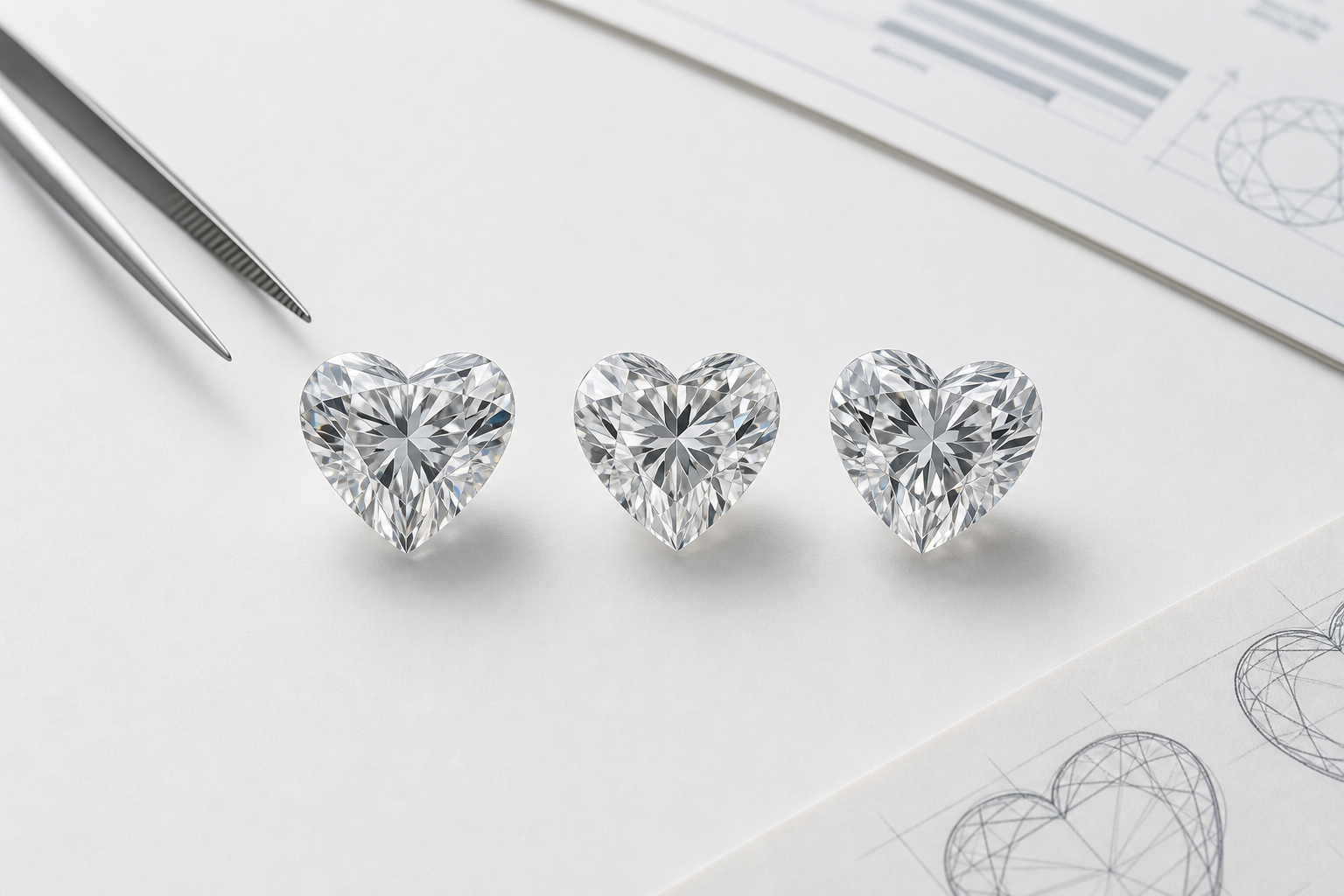
Why Symmetry Matters More in Heart Diamonds Than Many Buyers Expect
Heart diamond symmetry is not a minor technical detail. In a heart shaped lab-grown diamond, symmetry directly affects whether the stone looks deliberate, romantic, and well chosen. The eye reads a heart as a balanced shape, so unevenness is noticed faster than it would be in many other diamond cuts.
This is why buyers should treat symmetry as a visual decision, not only a report detail. A grading report may help screen options, but it cannot fully answer how the diamond looks face-up, whether the lobes feel balanced, or whether the point lines up naturally beneath the cleft.
A useful way to think about symmetry is to separate documentation from appearance. Documentation can describe aspects of workmanship and measurements, while appearance answers the buyer’s real question: does the stone look balanced in the finished piece? For heart diamonds, both matter, but the visible outline carries unusual importance because the shape itself is the design feature.
Report Symmetry and Visual Symmetry Are Not the Same Thing
A grading report can include a symmetry assessment, and that information is useful. It tells you something about the craftsmanship and alignment of the diamond’s facets. But report symmetry does not automatically guarantee a beautiful heart outline.
Visual symmetry is what the wearer and everyone else will actually see. The question is simple: does the diamond look balanced when viewed from the top? For a heart diamond, that face-up appearance carries more weight than many buyers expect because the outline is part of the design, not just the container for the sparkle.
Left-Right Imbalance Can Make the Stone Look Accidental
Common issues include one lobe sitting higher than the other, one side looking wider, a point that leans off-center, or wings that taper at different angles. Any one of these can make the stone look less intentional, even if the diamond has attractive brilliance.
The problem is not that every heart must be flawless under magnification. The problem is that visible imbalance changes the emotional effect. Instead of looking like a chosen symbolic diamond, the stone can look like an unusual pear or a heart that was cut without enough control.
Symmetry Affects Perceived Quality Even Before the 4Cs Do
Many buyers focus first on clarity or color because those grades feel easier to compare. With heart diamonds, that order can lead to the wrong decision. A slightly better clarity grade will not matter much if the outline looks uneven from across the table.
For this shape, outline symmetry should be prioritized early. Once the heart silhouette is strong, the 4Cs can help refine the selection. If the silhouette is weak, better paper specs may only make the buyer pay more for a stone that still does not look right.
Grading Report and Visual Review Check
Use the grading report as a starting point, then compare it against real images or video. Check whether the point aligns with the cleft and whether both lobes look similar in height and volume. The best quick test is to imagine a vertical line running from the cleft through the point; if the shape looks noticeably heavier on one side, the issue is worth taking seriously.
If the stone looks uneven in the seller’s own photos or video, the report will not fix that visual problem. A grading report can support transparency, but the face-up view decides whether the heart shape actually works.
The Best Size Range for a Heart Diamond to Read Clearly
Heart diamond size matters more than many buyers expect because the shape has to be readable before it can feel intentional. A heart lab-grown diamond can have strong sparkle and attractive grades, but if the cleft, lobes, and point are too small to see from normal viewing distance, the stone may register as a rounded triangle, a tiny pear, or simply a decorative accent.
The right size is not only about carat weight. Face-up size, millimeter measurements, outline balance, and setting coverage all affect whether the heart shape is obvious. This is especially important in rings, pavé designs, charms, and small pendants, where metal can cover the very details that make the shape recognizable.
Why Very Small Heart Diamonds Can Lose Their Shape
A heart-shaped diamond depends on contrast. The top cleft has to dip inward enough to separate the two lobes, the lower point has to be defined, and the sides need to taper in a way that reads as deliberate. In very small diamonds, those features are compressed into a limited surface area, so the outline can blur even if the stone is technically well cut.
This is where small heart diamonds can be misleading in product photos. A magnified image may show a clear heart, but the same stone viewed on the hand or neckline may look much less distinct. Once prongs, bezels, or shared-setting metal are added, the cleft or point can become partially hidden. For accent stones under 0.25 carat each, that may be acceptable because the design is usually about sparkle and suggestion rather than a clearly readable heart silhouette.
Practical Size Guidance for Readability
If the buyer is asking what size heart diamond looks best, the answer depends on how the stone will be worn. A small heart can work beautifully in a delicate charm or as part of a symbolic design, but a center stone needs enough visual spread for the outline to be understood without close inspection.
| Use Case | Practical Size Guidance | What the Buyer Should Expect |
|---|---|---|
| Accent stones | Under 0.25 carat each | The heart shape may be subtle and best appreciated up close. |
| Small pendant or charm | About 0.30 to 0.50 carat | The outline may read as a heart if the cleft and point are well defined. |
| Center stone ring or pendant | About 0.70 carat and above | The heart shape usually becomes easier to recognize at normal viewing distance. |
| Statement center stone | 1.00 carat and above | The outline, symmetry, and proportions become more visible, so quality of shape matters even more. |
For many buyers, the practical minimum for a center heart diamond is around 0.70 carat, not because smaller stones cannot be attractive, but because readability improves noticeably once there is enough surface area for the outline to do its job. At 1.00 carat and above, the shape becomes harder to hide, which is both an advantage and a responsibility: uneven lobes, a weak cleft, or an off-center point will be easier to notice.
Why Measurements Matter Alongside Carat Weight
Carat weight tells you how much the diamond weighs, not how large or balanced it looks from above. Two heart diamonds with the same carat weight can face up differently if one carries more weight in depth or has a wider, shorter outline. A buyer comparing heart diamond size should always look at the length and width in millimeters, not just the carat number.
This matters most when choosing between stones that appear similar on paper. A 0.75 carat heart with better face-up spread and a clean outline may look more recognizable than a heavier stone with awkward proportions. The mistake to avoid is paying for weight that does not improve the visible heart shape. For this cut, a slightly lower carat weight with better outline readability can be the smarter purchase.
A Useful Length-to-Width Ratio Starting Point
Many balanced heart diamonds fall near a length-to-width ratio of approximately 0.90 to 1.10, with around 1.00 often giving the most traditional heart appearance. This is only a starting point, but it helps buyers avoid extremes. A noticeably wide heart may look squat or cartoonish, while a longer heart may start to feel closer to a pear shape with a cleft.
The best carat size for a heart diamond is easier to judge once the ratio and actual outline are considered together. A ratio near 1.00 does not guarantee beauty if the lobes are uneven or the cleft is weak. Likewise, a slightly longer or wider stone may still work if the shape looks balanced, the point is centered, and the intended setting supports the outline rather than interrupting it.
Pricing and Value Should Stay Linked to Comparable Details
Prices can change with market conditions, report type, seller channel, availability, and stone-specific details, so exact comparisons should be verified at the time of purchase. A lower listed price does not automatically make one heart diamond the better choice, and a higher price does not automatically mean the outline, symmetry, or setting fit is better. Like-for-like comparison matters: carat weight, measurements, color, clarity, report details, visual media, and setting requirements should be reviewed together.
For heart-shaped stones, value is easy to misread if the buyer focuses only on weight, much as an Asscher lab grown diamond guide would emphasize cut-specific judgment over carat alone. A larger diamond with a weak cleft, uneven lobes, or poor setting compatibility may be less satisfying than a slightly smaller stone with a cleaner silhouette. The practical value question is not “Which one is biggest for the budget?” but “Which one will still look like a balanced heart in the finished jewelry?”
What to Check Before You Decide
Ask for the actual millimeter measurements and compare them with face-up images or video. Do not choose a heart lab-grown diamond by carat weight alone. If the stone is below about 0.50 carat, check whether the heart still reads clearly after accounting for the intended setting, especially if prongs or a bezel will cover part of the cleft or point.
Heart Diamond Rings: Beautiful, Personal, but Setting-Sensitive
A heart diamond ring can be striking, personal, and memorable, but it is not the most forgiving ring choice. A heart shaped lab-grown diamond ring asks more from the setting than a round, oval, or cushion solitaire because the outline itself is the message. If the setting hides the cleft, leaves the point exposed, or makes the stone sit awkwardly on the finger, the ring can lose the very quality that made the shape appealing.
The strongest reason to choose a heart diamond ring is not trend value. It is fit with the wearer. If the person likes expressive jewelry, meaningful shapes, and designs that feel intentionally personal, the heart can work beautifully. If the wearer prefers quiet, neutral, easy-to-style pieces, the same diamond may feel too literal for daily use.
For custom design, the ring should not be treated as a setting chosen after the diamond. The stone’s measurements, point position, lobe shape, prong layout, band height, and wedding-band plans can all change whether the design feels wearable. This is one reason a heart diamond ring benefits from reviewing the stone and mounting together instead of approving each part separately.
When a Heart Diamond Works Well for an Engagement Ring
A heart diamond works best as an engagement ring when the wearer already responds to symbolic or distinctive jewelry. It can be a strong choice for a custom ring, a deeply personal proposal, or a design where the shape connects to a shared story. In that context, the heart is not a novelty; it is the center of the design decision.
The recommendation changes if the buyer is guessing. A heart engagement ring is more taste-specific than many classic shapes, so it carries more risk as a surprise unless the wearer has clearly expressed interest in the shape. The safer path is to choose it when the recipient’s style points toward romantic, expressive, or personalized jewelry rather than simply because the shape seems meaningful to the buyer.
Why the Point Needs Protection
The lower point is the most vulnerable part of a heart-shaped diamond. Unlike rounded edges, the point concentrates risk in one narrow area, especially in a ring that may contact desks, door handles, bags, and everyday surfaces. This does not make the shape unsuitable for rings, but it does mean point protection should be treated as a requirement, not an optional design detail.
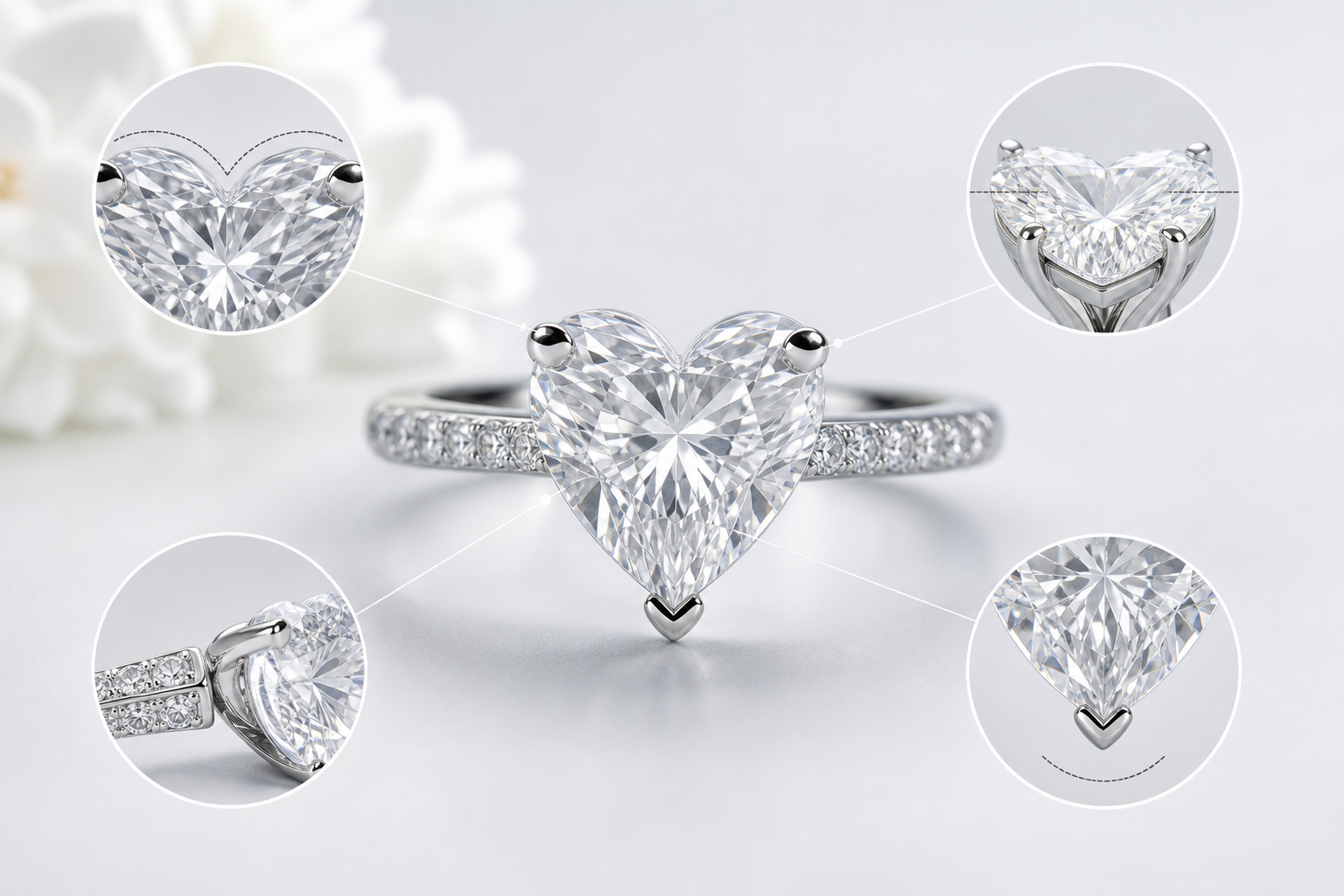
A V-prong is a common solution because it shields the point while preserving the heart outline. A bezel setting can offer more coverage and a cleaner modern look, though it must be designed carefully so the heart does not appear too rounded. Some designs use thoughtful metal placement to protect the point without visually weighing down the stone. The poor choice is a setting that makes the diamond look open and delicate while leaving the point exposed to daily wear.
How Prongs Can Help or Hurt the Heart Outline
Prongs do more than hold the diamond in place. On a heart diamond, they can either preserve or distort the shape. A poorly placed prong near the cleft can make the top of the stone look filled in, while too much metal near the point can soften the lower edge and make the diamond read less clearly as a heart.
The best heart diamond ring setting secures the stone without covering the parts that define it. Prongs should respect the cleft, support the lobes, and protect the point. This is one reason heart diamonds often benefit from a more deliberate setting review than standard solitaire designs. A stone that looks balanced loose can look less successful once metal interrupts the outline.
When a Heart Ring May Not Be the Best Choice
A heart ring may not be the best fit for someone who wants maximum timelessness, easy stacking, or a very understated daily ring. The shape is visually specific, and that specificity can become tiring if the wearer prefers flexible jewelry that adapts to many outfits and occasions. In those cases, a round, oval, cushion, or pear may offer a lower-risk daily style.
Stacking is another practical consideration. The point and curved top can create gaps against wedding bands or other rings unless the design is planned around it. A contoured band can solve that issue, but it makes the overall set more design-dependent. Buyers who want a simple ring stack with minimal planning should think carefully before choosing a heart center stone.
Custom Design Boundaries to Confirm Before Approval
For custom jewelry, stone measurements and setting compatibility should be confirmed before finalizing a purchase. A CAD image, rendering, or setting reference can help, but it should be reviewed for practical fit rather than treated as a promise that the finished piece will look identical under every lighting condition or viewing angle. The buyer should understand where the prongs, bezel, halo, or basket will touch the diamond and whether those elements preserve the cleft, lobes, wings, and point.
Custom design also makes communication more important. If the buyer wants a slim profile, flush wedding-band fit, a specific pendant orientation, or a particular chain attachment, those details should be stated before production decisions are finalized. The design goal should be clear enough that the stone is not selected in isolation from the jewelry that will hold it.
Stone-to-Setting Fit Check
Before committing, confirm how many prongs will be used, where they will sit, and whether the point receives protection. Ask for a rendering, CAD preview, or setting image when possible, especially for custom designs. For a heart shaped lab-grown diamond ring, the stone and setting should be judged together because a beautiful loose diamond can still be the wrong fit for a specific ring design.
Heart Diamond Pendants: Often the Most Natural Use Case
A heart diamond pendant is often the easiest format for this shape because the jewelry supports what the diamond is trying to communicate. The heart faces outward, the outline is visible to the viewer, and the piece does not face the same daily impact as a ring. For buyers considering a heart lab-grown diamond pendant as a gift, this can make the shape feel personal without forcing it into a high-wear setting.
This does not mean a pendant is always better than a ring. It means the pendant reduces several of the heart shape’s practical challenges. The diamond can be symbolic and clear, while the setting can stay relatively simple and secure.
Why Pendants Display the Heart Shape Clearly
A pendant usually keeps the diamond face-up and centered on the neckline, which helps the cleft, lobes, and point remain easy to see. Unlike a ring, which is viewed from many angles throughout the day, a pendant is typically seen from the front. That makes the heart silhouette more direct and easier to appreciate.
This is especially useful for stones in the 0.30 to 0.75 carat range. A smaller heart that might feel too subtle as a ring center stone can still work well as a pendant if the outline is clean and the setting does not cover the defining features. For buyers asking about the best heart diamond necklace, readability and orientation matter more than simply choosing the largest stone within budget.
Why Pendants Reduce Some Durability Concerns
Pendants generally experience less contact and impact than rings. They are not usually exposed to the same level of pressure from typing, lifting, gripping, or accidental knocks against hard surfaces. That makes a heart diamond pendant a practical choice for buyers who like the shape but do not want to manage the same durability concerns that come with daily ring wear.
The point still needs attention. A pendant setting should secure the stone and protect vulnerable edges, especially if the piece will be worn frequently. A delicate design can work, but it should not rely on minimal metal in places where the diamond needs support.
Best Gift Occasions for Heart Diamond Pendants
A heart diamond pendant gift is usually strongest when the occasion already carries personal meaning. Anniversaries, birthdays, Valentine’s Day, milestone celebrations, memorial jewelry, and personalized fine jewelry all give the heart shape a reason to exist beyond decoration. The shape feels more successful when it is connected to a message the recipient will actually value.
The key is to match the emotional weight of the design to the recipient’s style. A clean pendant can feel thoughtful and wearable, while an overly elaborate heart design may feel too specific or too formal for someone who normally wears simple jewelry. For many gifts, the more restrained design is the better decision because the heart shape already carries enough symbolism.
Simple Settings Often Work Better Than Overly Decorative Ones
Because the heart outline is already expressive, a busy setting can compete with it. A clean solitaire pendant, a well-made bezel pendant, or a delicate halo usually lets the shape remain the focus. Extra scrollwork, heavy metal, or crowded side stones can make the design feel less modern and can also interfere with the outline.
A simple setting is not the same as a plain one. The right design should keep the stone straight, protect the point, and avoid covering the cleft. If the pendant twists on the chain or tilts forward, even a well-shaped diamond may not display properly. For this reason, the chain attachment style matters more than many buyers expect.
Buyer Verification Checklist
Check the pendant orientation, chain attachment style, and whether the stone will sit straight when worn. Confirm that the setting does not cover the cleft, flatten the point, or distort the heart outline. If the pendant is meant as a personalized gift, prioritize a clear shape and comfortable wearability over extra decorative elements that may make the piece harder to wear often.
How Heart Diamonds Compare with Pear, Oval, Cushion, and Round Shapes
A heart shaped diamond is not simply another fancy shape with a different outline. It changes the message of the jewelry. Pear, oval, cushion, and round diamonds can all feel romantic depending on the setting, but a heart lab-grown diamond makes the symbolism immediate. That can be its biggest advantage or its biggest limitation.
The practical question is not whether the heart is “better” than these other shapes. It is whether the wearer wants the diamond itself to be expressive. If the goal is a distinctive piece with emotional clarity, the heart shape has a clear role. If the goal is maximum versatility, easy styling, and long-term neutrality, another shape may be the lower-risk choice.
Heart vs Pear: Similar Point, Different Message
In a heart vs pear diamond comparison, both shapes have a pointed end, but they do very different things visually. A pear diamond usually feels more elongated, fluid, and adaptable. It can look elegant in a solitaire engagement ring, a pendant, or a drop-style design without making the entire piece feel theme-driven.
A heart diamond is more literal. The point is part of a recognizable symbol, not just a design feature. This makes the heart stronger for a romantic gift or personalized piece, but less neutral for daily wear. If the wearer likes expressive jewelry, the heart may feel more meaningful. If they prefer graceful shapes that do not announce a specific message, pear is usually easier to live with.
Heart vs Oval: Personality vs Versatility
An oval diamond is one of the easier fancy shapes to style because it gives a soft, elongated look without demanding much from the setting. It works with solitaires, halos, three-stone rings, east-west settings, and many wedding band pairings. For many ring buyers, oval is the safer answer when they want something less traditional than round but still highly wearable.
A heart diamond gives up some of that flexibility in exchange for personality. It does not simply flatter the hand or add visual spread; it communicates a message. That makes it more memorable, but also more taste-specific. If the buyer is asking for the best diamond shape for ring versatility, oval usually has the advantage. If the buyer wants the ring to feel unmistakably personal, the heart deserves consideration.
Heart vs Cushion: Symbolism vs Softness
Cushion diamonds can feel romantic without being obvious. Their rounded corners and softer outline work well for buyers who want warmth, vintage influence, or a less angular look. A cushion can support a sentimental design while still staying relatively understated.
A heart diamond is more direct. It does not suggest romance quietly; it states it visually. That can be exactly right for an anniversary piece, a personalized pendant, or a custom ring for someone who already loves the shape. It can be the wrong move for someone who likes romantic jewelry but not literal symbols. In that case, cushion often gives a better balance of softness and everyday wearability.
Heart vs Round: Distinctive Outline vs Classic Simplicity
A round diamond is easier to buy, compare, and set because the shape is standardized and widely available. Buyers can focus more heavily on cut quality, carat, color, clarity, and overall visual performance. Round diamonds also work in nearly every setting style, from simple solitaires to detailed vintage designs.
A heart diamond requires a more careful visual review. The outline, cleft, lobes, point, and left-right balance matter before the stone ever reaches the setting. A round diamond with strong proportions may look attractive across many designs, but a heart diamond with weak shape definition can lose the very quality that made the buyer choose it. The tradeoff is clear: round is simpler and more universal; heart is more distinctive but less forgiving.
What This Means in a Real Purchase
If the buyer wants a diamond shape that feels personal and unmistakable, a heart lab-grown diamond has a strong advantage. It is especially compelling when the shape connects to a relationship, anniversary, memory, or custom design idea. The stone becomes part of the message, not just the centerpiece.
If the buyer wants a shape that will fit nearly any setting, wardrobe, or long-term style preference, oval, cushion, pear, or round may be safer. The most common mistake is choosing a heart diamond for its symbolism without considering whether the recipient would actually want that symbol in everyday jewelry. For a surprise purchase, that risk matters.
A Realistic Buyer Scenario: Ring or Pendant for a Personalized Gift?
Scenario Setup: Maya Wants a Romantic but Wearable Gift
Maya is shopping for a first-anniversary gift and likes the idea of a heart lab-grown diamond because the shape feels personal without needing an engraved message. She first considers a heart diamond ring because it seems more prominent and permanent. The problem is that her partner usually wears simple jewelry: small hoops, a thin gold chain, and a plain band on most days.
That detail changes the decision. A heart diamond gift should match the recipient’s style, not just the buyer’s intention. A ring would place the heart shape in constant view, which could be meaningful if the wearer loves expressive jewelry. For someone with a quieter daily style, the same ring might feel too literal or difficult to pair with other pieces.
Decision Point: Daily Wear vs Occasional Symbolism
Maya’s real choice is not just heart diamond ring or pendant. It is whether the symbol should be part of daily wear or something the recipient can choose when it fits the moment. A ring has more visibility, but it also asks more of the wearer’s style. It needs to work at the office, at dinner, on casual days, and alongside any rings already worn.
A pendant gives the heart shape more flexibility. It can still feel intimate and personal, but it does not have to function as an everyday ring. It also displays the outline naturally from the front, which is helpful for a shape that depends on a clear cleft, balanced lobes, and a protected point. For this kind of recipient, the pendant is not the less meaningful choice; it is the format that better respects how the jewelry will actually be worn.
Outcome: The More Practical Choice May Still Be the More Emotional One
Maya chooses a heart diamond pendant instead of forcing the shape into a ring. She looks in the approximate 0.50 to 0.75 carat range so the heart outline can read clearly without feeling oversized for her partner’s minimal style. She chooses a clean setting that keeps the cleft visible and protects the point, rather than a busy design that competes with the shape.
The tradeoff is that the pendant will not be seen as constantly as a ring. But that is also why it works. Her partner can wear it on meaningful days, layer it with a simple chain, or keep it as a personal piece rather than a daily statement. In this scenario, the more practical format carries the emotional idea better because it fits the recipient rather than just the occasion.
Buyer Takeaway from the Scenario
The best heart diamond purchase is not always the most prominent one. A larger ring can feel less thoughtful if it does not match the wearer’s habits, while a well-chosen pendant can feel more personal because it is easier to wear comfortably. Before choosing a heart diamond gift, consider how the recipient already uses jewelry: daily or occasional, subtle or expressive, simple or decorative.
What to Check Before Buying a Heart Lab-Grown Diamond
To buy heart lab-grown diamond jewelry well, start with the parts of the stone that affect the shape most. A heart shaped lab-grown diamond should not be judged only by carat weight or a clean-looking grading report. Those details matter, but they do not tell you whether the stone actually looks like a balanced heart when viewed face-up.
The main risk is choosing a stone that seems strong on paper but weak in outline. With this shape, that mistake is easy to make because small visual issues can change the character of the diamond. A slightly uneven lobe, shallow cleft, or off-center point may be more noticeable than a minor clarity difference that is difficult to see without magnification.
For buyers comparing several lab-grown options, it is also worth keeping the diamond growth method in perspective. Terms such as CVD and HPHT describe production routes, not a finished guarantee of beauty, durability, or better shape. The more useful buying evidence is still the grading report, measurements, real media, and how the stone performs visually in the intended design.
Start with the Shape, Not Just the 4Cs
For heart diamonds, shape readability should come before minor differences in color or clarity. The diamond needs a defined cleft, balanced lobes, smooth sides, and a point that lines up naturally with the top of the stone. If those features are weak, a higher clarity grade will not make the heart outline more convincing.
This is where buyers often over-prioritize the wrong factor. A heart diamond with slightly better color but poor symmetry may look less refined than a stone with a more balanced outline and a color grade that still faces up well in the intended setting. The best heart lab-grown diamond for a piece of jewelry is the one that looks right in its actual use, not the one that wins on one isolated grade.
Review the Grading Report, but Do Not Stop There
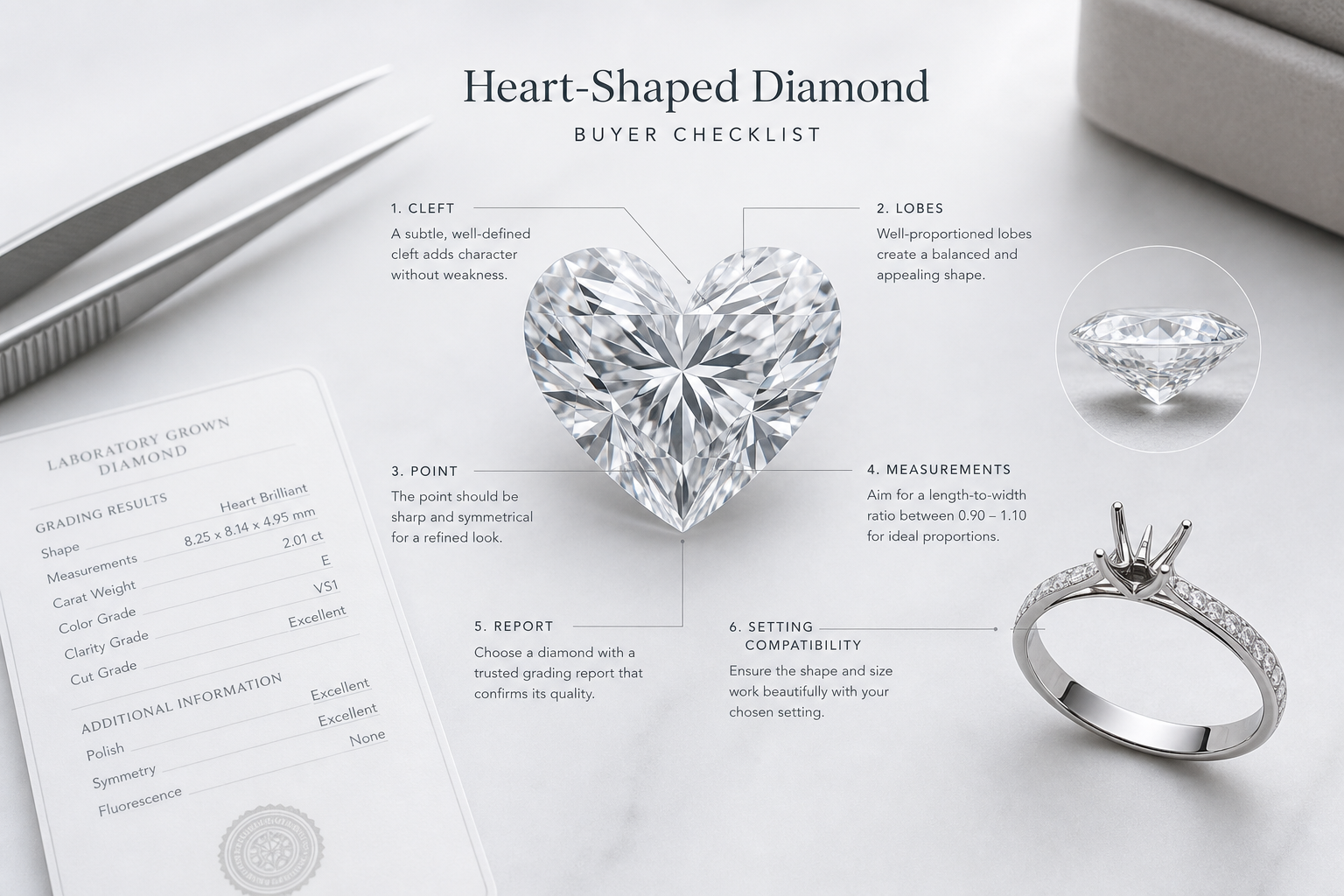
A grading report is still important. It helps confirm the carat weight, measurements, color, clarity, report identifier where provided, and any cut-related information available for the stone. These details support transparency and make it easier to compare one diamond against another.
The report does not replace visual judgment. It will not fully show whether the lobes look even, whether the cleft has the right depth, or whether the point appears centered. At NUVU, the grading report is treated as a starting point for comparison, not the final answer, especially with shapes that depend heavily on face-up appearance.
What a Grading Report Can and Cannot Prove
A grading report helps document key characteristics, but it should not be treated as a guarantee of beauty, value, or sourcing ethics. For a heart-shaped lab-grown diamond, the report may help verify listed characteristics such as origin disclosure, shape, weight, measurements, color, clarity, and other report-specific details. It does not tell the buyer whether the recipient will like the shape, whether the pendant will hang straight, or whether the ring setting will protect the point without hiding the outline.
Different grading laboratories may format reports differently, and not every report includes the same level of detail for every fancy shape. Buyers should avoid treating a lab name as a complete answer. The more dependable approach is to read the report, verify it through the issuing laboratory’s available tools when possible, and compare the report details with actual images, video, seller documentation, and the intended jewelry use.
Check the Report Against the Actual Stone
When a seller provides a report identifier, use it as a verification tool rather than a decorative label. The report details should match the stone being offered, including shape description, carat weight, measurements, color, clarity, and any identifying information included by the grading provider. If the listing, invoice, report, and media do not align, pause before purchase and ask for clarification.
This is especially useful for heart diamonds because a close paper match does not always mean a close visual match. A practical lab grown diamond shapes guide can help explain why two stones can share similar headline grades while looking noticeably different in outline, length-to-width balance, cleft depth, or lobe symmetry. The safest approach is to make the documentation and the visual evidence work together: the report confirms what the stone is, while the images and video help confirm whether the heart shape is attractive enough for the intended jewelry.
Ask for Face-Up Images or Video
Clear photos and 360 video are essential heart diamond buying tips because the face-up view reveals what the report cannot. Look at the stone straight on, not only in angled glamour shots. Angled images can make a weak outline look more dramatic or hide imbalance that becomes obvious from the front.
Check whether the cleft is visible without looking too deep, whether the lobes appear similar in height and volume, and whether the point falls in line with the center of the stone. If the heart shape is only obvious because the listing calls it a heart, the stone may not read clearly once it is set and worn.
Confirm the Setting Before Finalizing the Stone
A heart diamond should be chosen with the final jewelry type in mind. A stone that looks attractive loose may still be a poor fit for a specific ring or pendant if the setting covers the cleft, crowds the lobes, or leaves the point exposed. Setting compatibility is not a finishing detail; it affects whether the shape survives the design.
For a ring, point protection matters more because the jewelry is exposed to more contact. For a pendant, orientation and chain attachment become important because the stone should hang straight and face forward. If the piece is custom, ask for a rendering, CAD preview, or setting reference before committing, especially if the design includes prongs, a bezel, or a halo.
Final Buyer Verification Checklist
Before buying, confirm the grading report details where available, carat weight, actual millimeter measurements, face-up appearance, cleft definition, lobe balance, point alignment, and overall symmetry. Then check whether the intended setting protects the point without hiding the features that make the stone recognizable as a heart.
If buying custom heart diamond jewelry, review the stone and setting together before the diamond is set. The safest purchase is not simply the highest-grade stone in the budget; it is the stone whose outline, size, report details, and setting all support the same finished piece.
Documentation and Verification for Online or Custom Orders
When the stone is being bought online, matched to a setting, or used in a custom design, the paper trail should stay simple and consistent. Save the grading report, the exact measurements, the shape description, clear face-up images or video, and the written setting plan. If the piece is being made for multiple matching gifts or a small coordinated order, keep the naming and measurement notes consistent across every item so later comparison is possible.
Documentation does not make the diamond attractive by itself, but it makes the purchase traceable. That matters with heart-shaped stones because small changes in outline, prong placement, or orientation can materially change how the finished piece looks. If the seller uses broad language about origin or responsible production, ask what that language refers to and what specific documentation supports it. Specific records are more useful than broad reassurance.
When a grading report is available, buyers should verify the report details through the issuing laboratory’s official report-check tool where available, and compare those details with the actual stone, images, and measurements.
Sustainability and Sourcing Claims Need Specific Support
Lab-grown diamonds are often chosen by buyers who prefer an alternative to mined origin, but that preference should not be stretched into broad claims without support. Environmental and sustainability claims should be specific, documented, and limited to what can be substantiated. Useful documentation may relate to production practices, energy information, supplier transparency, or other seller-provided records, but the presence of a lab-grown diamond alone does not prove a general environmental or ethical claim.
The same caution applies when comparing laboratory-grown diamonds with natural diamonds. A buyer can prefer the lab-grown origin for personal reasons, but the seller should still disclose the laboratory-grown origin clearly and avoid implying that a grading report proves responsible sourcing, carbon impact, or ethical performance unless those exact claims are supported by separate documentation.
How to Compare Two Similar Listings
If two heart diamonds appear close in price or grade, compare them by outline first and paperwork second. Ask which stone has the clearer cleft, the more even lobes, the cleaner point alignment, and the better fit for the intended ring or pendant. A slightly lower color or clarity grade can still be the better choice if the shape is stronger and the setting plan preserves the outline.
For NUVU, the comparison is clearest when report details, face-up images, and the intended setting are reviewed together. That helps buyers see whether the stone fits the piece rather than assuming that a larger or higher-graded diamond will automatically be the better choice.
When a Heart Lab-Grown Diamond Is the Right Choice and When It Is Not
A heart lab-grown diamond is worth considering when the shape itself is part of the reason for the purchase. It is not the safest all-purpose diamond shape, and that is exactly why some buyers choose it. The heart outline makes the piece feel personal before anyone notices the carat weight, color grade, or setting style.
The right buyer is not simply asking, “Should I choose a heart diamond?” They are asking whether the recipient would enjoy wearing a shape that openly communicates affection, memory, identity, or a milestone. If that meaning feels welcome rather than too literal, a heart shaped lab-grown diamond can be a strong choice. If the buyer is trying to guess someone’s taste, the shape carries more risk than a round, oval, cushion, or pear.
Choose a Heart Diamond If the Shape Carries Meaning
Heart diamonds work best when the symbolism is intentional. They suit buyers who want the diamond itself to say something specific, whether the piece is for an anniversary, a personalized gift, a memorial design, or a romantic milestone. In these cases, the shape is not a novelty detail. It is the point of the design.
This is also where lab-grown can make practical sense. A heart lab-grown diamond may give buyers more room to prioritize a clear outline, balanced proportions, and a size that reads properly in the finished piece. The mistake is using that flexibility only to chase a larger stone. With heart shapes, a slightly smaller diamond with a cleaner silhouette is usually a better decision than a larger one with a weak cleft, uneven lobes, or a point that disappears into the setting.
Consider Another Shape If You Want Maximum Versatility
A heart diamond is not the easiest choice for buyers who want broad long-term neutrality. If the goal is a low-risk daily engagement ring, easy stacking with wedding bands, or a diamond shape that adapts to nearly every wardrobe and setting style, another shape may be more practical.
Round diamonds are easier to compare and set. Ovals offer a flattering elongated look with more styling flexibility. Cushions feel romantic without being as literal. Pear shapes keep a distinctive point but often feel more wearable in everyday rings. None of these alternatives is automatically better, but they create fewer design constraints and usually require less confidence in the recipient’s exact taste.
Best Overall Uses for Heart Lab-Grown Diamonds
The strongest use cases for heart lab-grown diamonds are pendants, personalized gifts, anniversary jewelry, custom pieces, and engagement rings for someone who specifically loves the shape. Pendants are often the easiest fit because the diamond faces forward, the outline is visible, and the piece is less exposed to daily impact than a ring.
Heart diamond rings can be beautiful, but they should be chosen with more care. The wearer should like expressive jewelry, not just tolerate it. The setting also has to protect the point while keeping the cleft and lobes visible. If the design hides the features that make the diamond a heart, the buyer is paying for a shape the finished jewelry does not clearly show.
Choosing a Heart Diamond With NUVU
For buyers comparing loose heart-shaped lab-grown diamonds, the most useful next step is to look beyond the basic grade summary. Compare the face-up outline, actual millimeter measurements, report details, cleft definition, lobe balance, and setting compatibility together. A strong report can support the decision, but it cannot make an uneven heart look balanced.
Before purchase, buyers should confirm the seller’s documentation, return and resizing terms, and after-sales support in writing.
Decision Framework Before You Commit
A heart lab-grown diamond is a strong choice when three things align: the recipient likes expressive jewelry, the stone has a clear and balanced heart outline, and the setting protects the shape without hiding it. If any one of those is missing, the safer move is to pause and compare alternatives before committing.
If the answer to “is a heart diamond worth it?” depends only on price or carat weight, the decision is not ready. The better question is whether the finished piece will still feel meaningful, wearable, and visually clear after the diamond is set.
Evidence-Supported Buying Questions to Ask the Seller
Before final approval, ask questions that can be answered with documents, images, or design details rather than broad reassurance. Useful questions include: What grading report is available? Do the measurements on the report match the listed stone? Can I see straight-on face-up media? Where will the prongs or bezel contact the diamond? How will the point be protected? These questions help separate a well-supported purchase from a purchase that depends mostly on attractive product language.
Be cautious with claims that sound broad but are not tied to the individual stone or piece. Statements such as “premium heart,” “perfectly romantic,” or “better value” may be marketing language unless the seller can show why that particular diamond has a clear outline, balanced symmetry, reliable documentation, and a setting that preserves the shape. The more emotional the design, the more important it is to verify the practical details.
FAQ
Are heart-shaped lab-grown diamonds good for engagement rings?
Yes, but only when the wearer specifically likes symbolic and distinctive jewelry. A heart-shaped lab-grown diamond engagement ring can feel personal and memorable, but it is less universal than a round, oval, or cushion ring. The setting matters more than many buyers expect because the point needs protection and the cleft should remain visible.
What size heart diamond looks best?
For a center stone, many buyers should start around 0.70 carat and above if they want the heart outline to read clearly at normal viewing distance. Smaller heart diamonds can work as accents or delicate pendant stones, but the cleft, lobes, and point may be harder to see once the stone is set.
What makes a heart diamond look high quality?
The most important signs are a visible cleft, balanced lobes, smooth wings, a centered point, and strong face-up symmetry. These details often affect the look of a heart diamond before small differences in color or clarity become noticeable. A good setting should protect the point without covering the features that define the shape.
Is a heart diamond better for a ring or pendant?
A pendant is often the easier use case because the diamond usually faces forward and experiences less impact than a ring. Rings can work well, especially for engagement or custom designs, but they require more attention to prong placement, point protection, and the wearer’s daily style.
Do heart diamonds look smaller than other shapes?
They can look different from rounds or ovals because visual size depends on length, width, outline, and how much of the shape remains visible after setting. Carat weight alone is not enough. Buyers should compare actual millimeter measurements and face-up images before deciding.
Should I buy a heart diamond online?
Buying online can be reasonable if the seller provides a grading report, actual measurements, clear face-up images or video, and guidance on setting compatibility. Stock photos are not enough for heart diamonds because small differences in cleft depth, lobe balance, and point alignment can change the entire look of the stone.
Choose a Heart Diamond for the Finished Piece
Start With the Heart Outline
Explore heart-shaped lab-grown diamonds by looking beyond carat weight. A larger stone is not automatically the better choice if the cleft is weak, the lobes look uneven, or the point does not align cleanly with the center of the stone. For this shape, the first filter should be whether the diamond reads clearly as a heart from a normal viewing distance.
Compare the outline, face-up symmetry, length and width measurements, grading report details, and real images or video together. Carat weight can help narrow the search, but it should not override shape quality. A smaller heart diamond with a balanced outline may look more intentional than a heavier stone with awkward proportions.
Review the Diamond and Setting Together
If you are planning a pendant or custom ring, review the diamond and setting as one decision. The setting should protect the point without covering it, secure the stone without hiding the cleft, and leave enough of the lobes visible for the heart outline to remain clear.
For custom jewelry, this is where a design conversation can prevent an expensive mismatch. A stone may look strong when viewed loose, but the final piece depends on prong placement, metal coverage, orientation, and how the jewelry will be worn. At NUVU, this kind of comparison is treated as part of the selection process because the best heart diamond is the one that works in the finished design, not just on paper.
Match the Shape to the Recipient
A heart-shaped diamond does not need a dramatic sales pitch. The decision is personal enough already. The most useful guidance is practical: choose the shape if it fits the recipient, verify the outline carefully, and make sure the setting supports the design instead of fighting it.
If the diamond feels meaningful, looks balanced, and suits the jewelry format, it can be a strong choice. If the shape feels forced, too literal, or difficult to wear every day, pausing to compare other shapes is the smarter move.
Final Priorities for a Heart-Shaped Diamond
Start with a recognizable heart outline: a clear cleft, balanced lobes, and an aligned point. Then compare color, clarity, carat weight, measurements, report details, and actual images or video. A larger stone is not a better fit if its outline is unclear.
Consider whether the recipient wants this symbolic shape for daily wear or an occasional piece. Confirm that the setting protects the point without hiding the cleft or lobes. Evaluate the finished ring or pendant, not just the loose diamond.
Keep the value decision tied to the outline, appearance, and design fit you can inspect. Review any environmental or sourcing claim separately against its supporting documentation.
Final Heart Diamond Checklist
Actionable Takeaway
A heart lab-grown diamond is not evaluated well by carat weight alone. The cleft, lobes, wings, point, overall symmetry, face-up size, and setting fit determine whether the stone looks intentional or awkward.
The most useful buying habit is to inspect the diamond as a shape before judging it as a specification sheet. If the heart outline does not read clearly in images or video, better color or clarity will not fix the main visual problem.
Decision Framework
The decision should start with the recipient, not the diamond. If the recipient likes expressive, personal jewelry, a heart shape may feel thoughtful and distinctive. If they prefer understated pieces, easy daily wear, or classic styling, another shape may be a safer long-term choice.
The next decision is format. A pendant often gives the heart shape a natural place to be seen clearly, while a ring can work well when the wearer specifically wants that symbolism on the hand and the setting protects the point. Before buying, verify the stone’s measurements, face-up appearance, symmetry, grading report, and setting compatibility.
Avoid Claims That Ignore Shape Risks
Heart-shaped lab-grown diamonds are not universally better, more romantic, or automatically better value. They are strong only when the emotional message, visual quality, and jewelry format align.
Check for a weak cleft, uneven lobes, a vulnerable point, a setting that hides the shape, or a carat-first decision that ignores readability. Choose a heart diamond that still makes sense after those details are checked, not just the option with the most sentimental appeal.
Disclosure: This article is for general educational purposes only. Diamond grading, pricing, availability, specifications, and seller policies can change, and readers should verify important details through grading reports, official laboratory tools, seller documentation, or qualified professionals before making a purchase decision. Laboratory-grown diamonds should be clearly distinguished from natural diamonds, and environmental or sourcing claims should be supported by specific documentation.