
When you buy a lab-grown diamond, the tiny serial number etched onto its girdle is often presented as proof of its identity. But what does that number actually tell you—and what does it leave out? This article cuts through the marketing to explain how laser inscription works, how to verify it, and where it falls short. When reading a lab grown diamond report, you will learn why a matching number confirms a diamond’s link to its report, but not its quality, cut performance, or visual beauty. The goal is to help you treat inscription as a practical tracking tool rather than a guarantee, so you can avoid costly assumptions and make a more confident purchase.
For the full framework, read Lab-Grown Diamond Traceability, Certification, and Transparency Guide.
Without this clarity, buyers can mistakenly rely on an inscription to confirm a stone’s value or appearance. The sections below cover the engraving process, how to inspect the number before setting, and the real limits of certification that serious buyers should understand.
| What Inscription Tells You | What Inscription Does Not Tell You | How to Protect Yourself |
|---|---|---|
| Confirms the diamond matches its grading report number | Guarantees the grading report is accurate or unbiased | Review the diamond in high-resolution video or in person |
| Provides a simple way to verify identity after purchase | Reveals cut quality, optical performance, or haziness | Compare cut grade and ASET/ideal-scope images |
| Proves the diamond is not a swapped stone during setting | Indicates ethical sourcing, carbon footprint, or origin claim | Ask the seller for a certificate of origin or sustainability report |
| Helps insurance appraisals and resale documentation | Prevents you from overpaying for a stone with poor light return | Check return policy and insist on free returns |
| Visible under 10x loupe but invisible to naked eye | Shows fluorescence or strain that may affect appearance | Request images under multiple lighting conditions |
| Standard on most certified 1-carat+ lab-grown diamonds | Guarantees the stone was not clarity-enhanced after inscription | Confirm no post-growth treatments with the seller |
Quick Questions Before You Read
Q: Can I trust a lab-grown diamond just because it has a laser inscription?
No. Inscription only confirms the diamond matches its grading report. It does not verify the report’s accuracy or the stone’s visual quality. You still need to evaluate cut, clarity, and appearance directly.
Q: What happens if the inscription is missing when the diamond arrives?
Smaller stones (under 0.5 carat) often ship without inscriptions, and that is normal. Larger stones should have one. If your stone is over 1 carat and lacks an inscription, ask the seller why before accepting delivery.
Q: Should I check the inscription before or after the diamond is set into a ring?
Always check the inscription before setting. Once the diamond is mounted, the girdle may be partially or fully hidden by the prongs, making verification difficult.
Q: Does a laser inscription weaken the diamond?
No. The laser engraving is applied only to the surface of the girdle and does not compromise the diamond’s structural integrity or clarity grade.
What Is Laser Inscription on a Lab-Grown Diamond
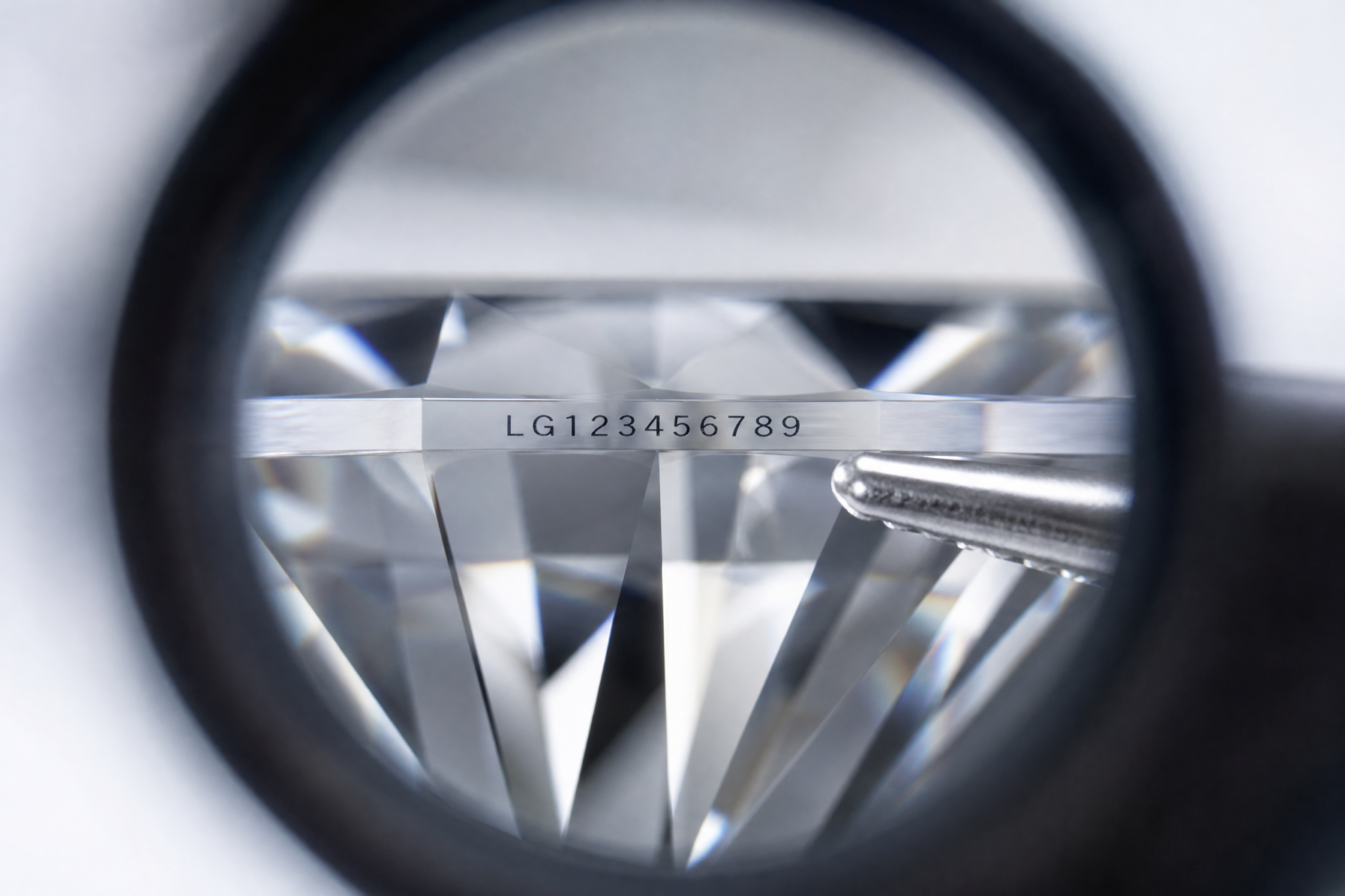
Laser inscription is a small but significant detail that most diamond buyers encounter only after they have already chosen a stone. If you have browsed loose lab-grown diamonds online, you have likely seen a close-up image of a girdle with a string of tiny numbers engraved along the edge. That number is the laser inscription, and it serves one primary purpose: linking the physical diamond you are looking at to the grading report that describes it.
The process itself is straightforward. After a grading laboratory evaluates a diamond and assigns its report, a focused laser beam etches microscopic characters onto the surface of the stone. This is typically done on the girdle, the narrow band that separates the crown from the pavilion. The laser does not remove material or add anything to the diamond. It alters the surface reflectivity just enough to create readable text. Because the marks are so fine, they are invisible to the naked eye and only become legible under magnification.
The Process: How Numbers Are Applied to a Diamond
The timing of the inscription matters. It happens after grading is complete, which means the lab has already measured the stone, photographed it, and recorded its internal characteristics. At that point, the laser is used to apply the report number directly onto the diamond. This sequence is intentional: the stone is graded first, then marked, so the inscription always refers back to a completed evaluation.
No structural change happens to the diamond. The laser beam creates shallow surface-level marks that do not affect how light moves through the stone, how it reflects brilliance, or how it performs in a setting. Some buyers worry that an inscription weakens the diamond or creates a stress point. That concern comes from a misunderstanding. Diamond girdles are routinely subjected to far more contact during cutting and setting than a laser inscription ever produces. The inscription is cosmetic in the strictest sense, and it has no bearing on the stone’s integrity.
Typical Content of an Inscription
Most lab-grown diamonds carry a report number from one of the major grading laboratories, such as IGI, GIA, or GCAL. This number is the primary identifier. Next to it, you will usually see a microscopic “LG” or “Lab-Grown” notation, which distinguishes the stone as laboratory-created rather than mined. Some sellers add internal SKUs, brand identifiers, or custom text, but the core content is almost always the lab report number.
The exact format depends on which lab issued the report and whether the seller requested any additional text. Some inscriptions include only the report number. Others add a logo or a short code. If you are comparing multiple stones, the inscription content is less important than the fact that it exactly matches the report number listed in the product details. A mismatch here usually indicates a process error, not fraud, but it is worth verifying before you commit.
Where the Inscription Appears and Why It Matters
The girdle is the natural home for an inscription because it is the one part of the diamond that does not participate in light return. The crown and pavilion are engineered to bend and reflect light. The girdle sits between them, forming the widest part of the stone. Inscribing the girdle does not interfere with optical performance, and the marks remain accessible under magnification throughout the diamond’s life.
This location matters for practical reasons. When a diamond is loose, the inscription is easy to find and read. Once the stone is set into a ring, the girdle may be partially or fully covered by prongs or a bezel. That is why anyone buying a loose diamond for a custom setting should verify the inscription before mounting. After setting, the number may be hidden, which makes it harder to confirm the identity of the diamond later.
What to Check Before You Decide
Before you finalize a purchase, ask the seller to confirm that the inscription matches the grading report number exactly. A mismatch or missing inscription does not always mean something is wrong, but it does create a paperwork gap that should be explained before you commit. If the seller can provide a close-up image of the inscription or a 360-degree video showing the girdle, review it carefully. This is the most straightforward way to confirm that the stone you are evaluating is the same one described in the certificate.
How Inscription Connects a Diamond to Its Grading Report
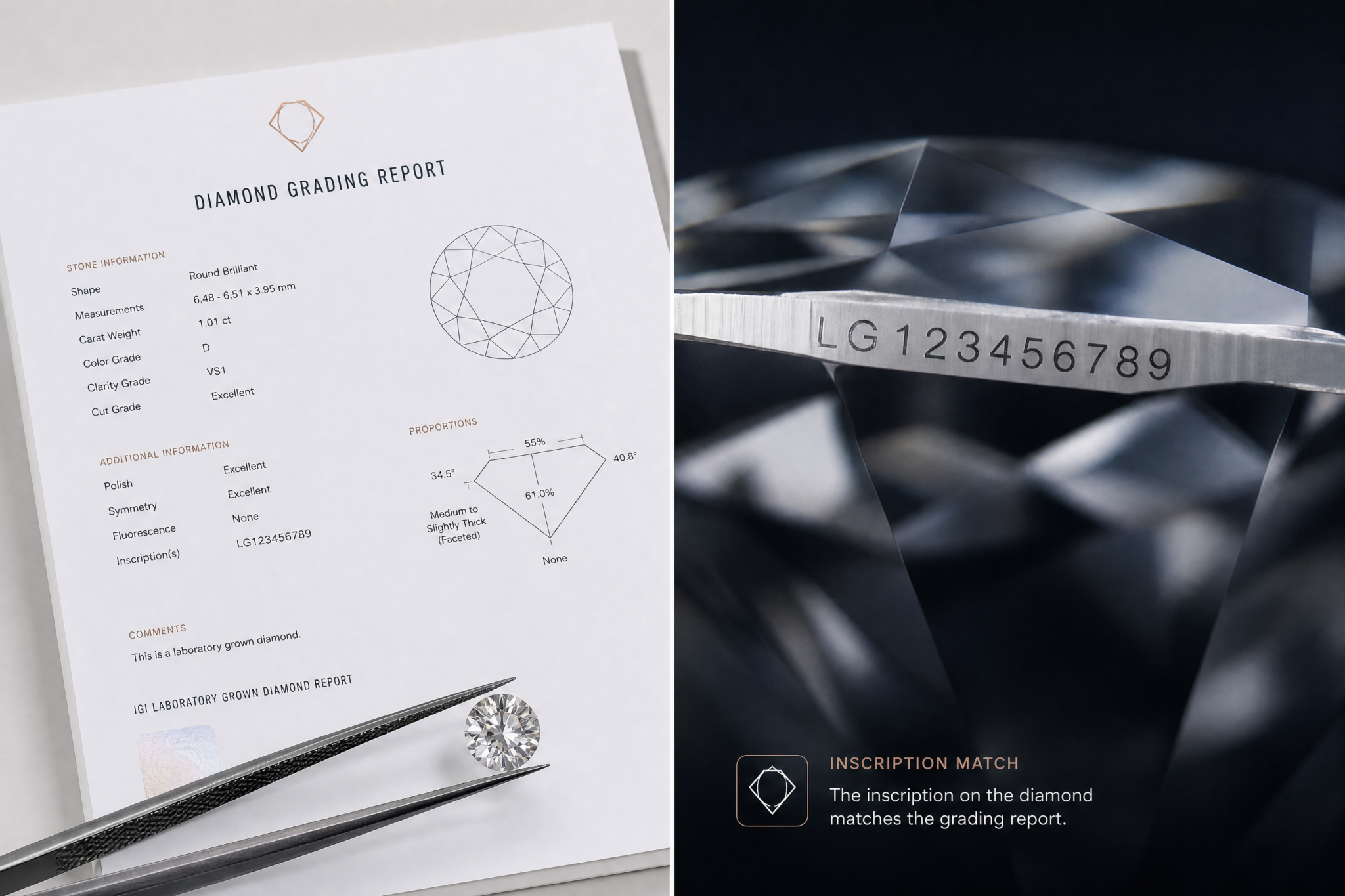
The relationship between a loose diamond and its grading report only exists because of the inscription. Without it, the certificate describes a stone, but there is no reliable way to confirm that the stone in your hand is the one the lab evaluated. The inscription closes that gap by creating a direct physical link between the diamond and the document.
This linkage is the central trust mechanism in loose diamond buying. When you review a grading report online, you are looking at measurements, proportions, and grades that apply to a specific diamond. The inscription number is the thread that ties that data to the physical object. If the numbers match, you can cross-reference weight, color, clarity, cut, and proportions against the certificate with confidence.
The Matching Logic: One Number, One Stone
When a laboratory grades a diamond, it photographs the stone, records its internal characteristics, measures its dimensions, and assigns grades for cut, color, clarity, and carat weight. After that process is complete, the lab laser-inscribes the report number onto the girdle. The logic is simple: the number on the stone should match the number on the report. If they match, the stone you are looking at is the stone that was graded.
This system works because each report number is unique. No two diamonds receive the same number from the same lab. When you check the inscription against the certificate, you are effectively confirming that no substitution or mix-up has occurred. For a buyer purchasing a stone sight-unseen, this verification is the most reliable starting point for trust.
Why This Matters More for Loose Diamonds Than Set Stones
Inscription verification is most useful when the diamond is still loose. Once a stone is mounted in a ring, the girdle is often partially covered by the setting. Prongs, bezels, and channel settings can obscure part or all of the inscription, making it impossible to read without removing the stone. That is not a problem for most buyers after the ring is complete, but it does mean that pre-setting verification is the only opportunity to confirm the match.
If you are buying a loose diamond for a custom ring, verify the inscription before the stone goes to the jeweler. Once it is set, confirming the number becomes much more difficult. Some jewelers will record the inscription number when they receive the stone, which creates a paper trail that can be referenced later. If your jeweler offers this, it is worth asking for a copy.
What Happens When the Number Does Not Match
A mismatch between the inscription and the report number is rare, but it does happen. The most common causes are straightforward: a data entry error when the stone was listed, a diamond that was recut and re-inscribed without updated documentation, or a simple mix-up during handling between the lab and the seller. None of these automatically indicate fraud, but they do mean the stone should not be treated as verified until the discrepancy is resolved.
If you encounter a mismatch, ask the seller to explain it. In most cases, they will send the stone back to the lab for verification or recertification. Do not accept a verbal assurance that the numbers are close enough. A matching number is the only reliable link between a diamond and its report. If the link is broken, the stone should be treated as unverified until a new certificate or corrected inscription is issued.
Certificate and Visual Review Check
When reviewing a loose diamond, start by confirming that the inscription number on the stone matches the report number on the certificate. Then compare the weight and clarity grade against what you see under magnification. A matching number is not a substitute for visual inspection, but it is the first and most reliable check. If the number matches, you know the stone you are holding is the one the lab evaluated. Everything else becomes a matter of whether you agree with the lab’s assessment.
When a grading report is available, buyers should verify the report details through the issuing laboratory’s official report-check tool where available. A matching inscription number does not replace this step—it simply provides the starting point for independent verification.
Inscription Verification: What Buyers Should Ask Sellers to Confirm
Knowing that laser inscription exists is one thing. Knowing what to do with that information during a purchase is another. The practical value of inscription comes down to a small set of specific questions you can ask any seller before you buy. These questions cost nothing to ask and can prevent the kind of mistake that only becomes obvious after the stone is set and the number is hidden.
How Sellers Normally Confirm Inscription
Most reputable online sellers and local jewelers will provide a photo or video of the inscribed girdle upon request. Some include this as a standard part of their product listing, alongside the certificate image and 360-degree video. If a seller cannot or will not show the inscription, that is a red flag. It does not necessarily mean the stone is misrepresented, but it does mean you are being asked to trust the certificate without the physical confirmation that inscription provides.
Sellers who are transparent about inscription are usually transparent about other details as well. If the inscription image is easy to find and clearly legible, it is a good sign that the seller treats documentation seriously. If the image is missing, blurry, or requires multiple follow-ups to obtain, consider whether the friction is worth the stone.
What to Ask Before Buying
The questions worth asking are direct and specific. Does the inscription match the report number exactly? You want a character-for-character confirmation, not a close-enough approximation. Is there any additional text on the girdle, such as a brand name or internal code? Extra text is not a problem, but you should know it exists before the stone arrives.
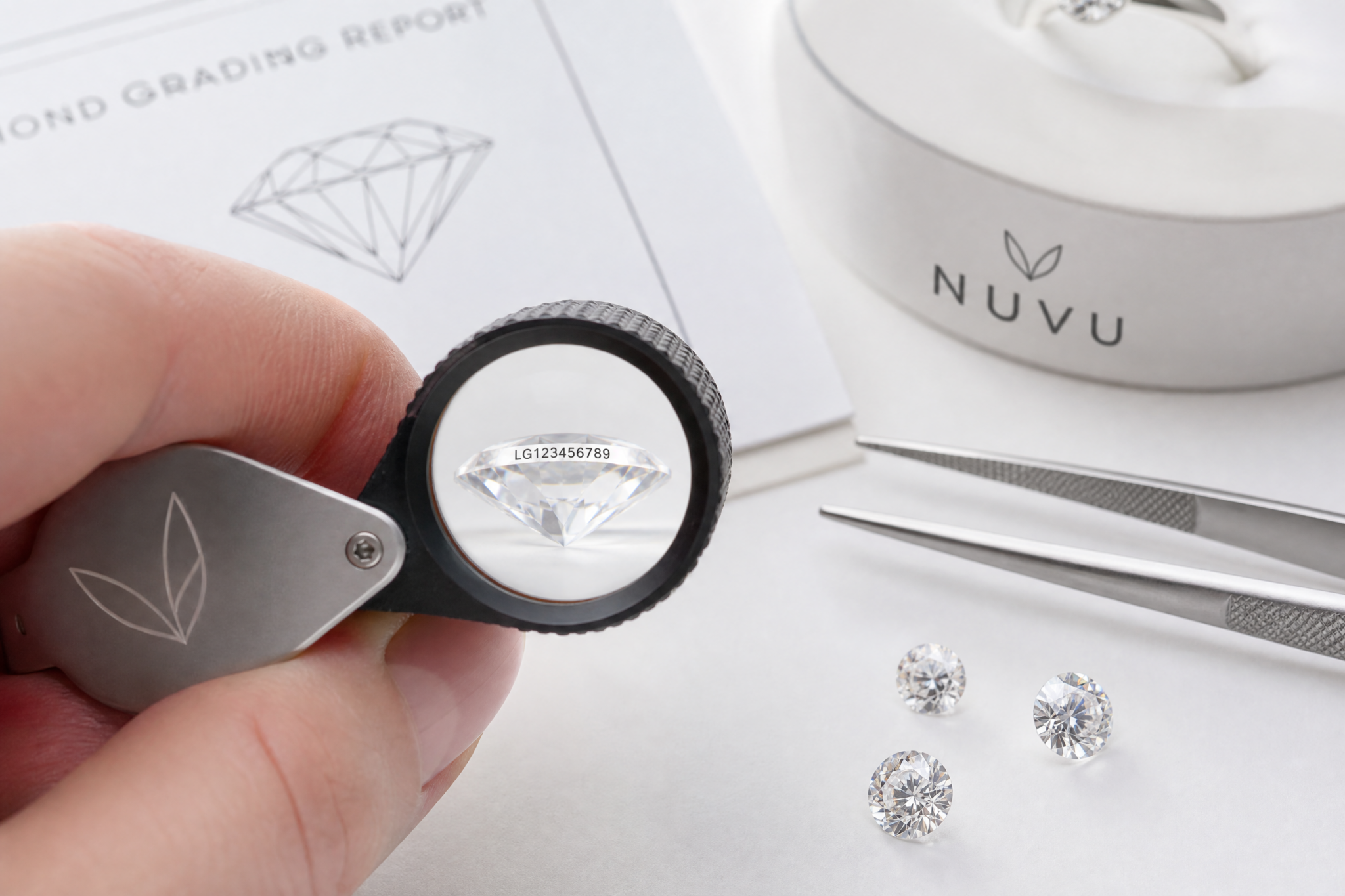
Can the seller provide a close-up image of the inscription before you purchase? If they already include one in the listing, you are set. If not, ask for it. Can you verify the inscription yourself upon delivery? Some sellers include a loupe with the shipment so you can inspect the stone immediately. If not, you can check with your own loupe or ask a local jeweler to confirm. These questions do not require any special knowledge, and they give you a documented record of the diamond’s identity before you finalize the purchase.
Why Inscription Verification Alone Is Not Enough
A matching inscription confirms that the stone you have is the stone that was graded. It does not confirm that the grading was accurate. Some grading laboratories apply stricter standards than others. A diamond graded by one lab may carry a higher color or clarity grade than the same stone would receive from another. The inscription proves identity, not quality.
This distinction matters because it changes how you evaluate a diamond. A matching number should give you confidence that the stone is the one described in the report, but you still need to evaluate whether the report’s grades reflect what you see. Review the stone’s color in natural light. Look at the clarity characteristics under magnification. Compare the cut proportions against ideal ranges for the shape. The inscription tells you the stone matches its paperwork. It does not tell you that the paperwork is right.
For buyers, the practical point is not just what the report says, but how the stone performs visually and fits the intended design. A matching inscription confirms identity, but the final decision still depends on whether the diamond delivers what the grades promise in hand.
Buyer Verification Checklist
Before you finalize a purchase, request a clear image of the inscription and compare it to the report number. Ask about the return policy in case the stone does not match its description, and make sure you understand the timeframe for returns. If you are buying for a custom ring, ask the jeweler to record the inscription number when they receive the stone. That creates a paper trail that protects both you and the jeweler, and it gives you a reference point if you ever need to confirm the diamond’s identity after the ring is complete.
Understanding the Traceability Chain: What Inscription Covers and What It Does Not
Traceability in the diamond trade is not a single check—it is a chain of documentation. A laser inscription connects the physical diamond to its grading report, but traceability beyond that report depends on other records. Buyers should be aware that the inscription number alone does not provide information about the specific growth facility, the energy source used during production, or the batch-level quality checks performed before grading. These details exist in separate documentation, if they exist at all, and must be requested from the seller.
For a buyer seeking a fuller picture of a diamond’s history, the inscription is a starting point. Once you have the report number, you can verify it through the lab’s online system. From there, you may ask whether the seller can provide any additional documentation, such as a production batch certificate or a manufacturer’s statement. The key is to recognize what the inscription itself covers: the link from stone to report. Everything else requires separate verification.
What This Means in a Real Purchase
Do not skip visual inspection or comparative shopping simply because the stone’s inscription matches its certificate. The number match is one data point among many. Build your final decision on cut measurements, proportions, video review, and the seller’s return policy. A matching inscription makes the stone verifiable. It does not make it the right stone for you.
How to Inquiryscription at Home or Through a Jeweler
Verifying a laser inscription does not require special training. With the right tool and a few basic steps, any buyer can confirm that the number on the stone matches the number on the report.
Using a Jeweler’s Loupe or Microscope
A standard 10x jeweler’s loupe is enough to read most girdle inscriptions, provided the stone is clean and well-lit. Hold the diamond girdle-up, angle a small light source across the surface, and look for fine dark or light lines forming characters along the edge. The characters will appear subtle, not bold, because the inscription changes the surface reflectivity without removing material. A microscope offers better magnification and more even lighting, making the characters significantly easier to read, but a loupe will work in most cases.
Requesting Verification Before Mounting
If you are having a custom ring made, ask the jeweler to confirm the inscription before the stone is set. Once mounted, the girdle may be partially or completely covered by prongs or a bezel, making the inscription difficult or impossible to read without removing the stone. Many jewelers will photograph the inscription and share the image as part of their standard quality-control process. This simple step eliminates the risk of discovering a mismatch after the ring is finished.
What to Do If the Inscription Is Missing or Unreadable
A missing inscription does not automatically mean the diamond is ungraded. Some diamonds, particularly smaller stones under half a carat, are intentionally sold without an inscription. If the seller claims the stone was graded but has no inscription, request the original certificate and compare the reported weight, measurements, and clarity characteristics against what you see under magnification. If any detail does not match, return the diamond before having it set. A mismatch found after mounting creates significantly more complication.
Stone-to-Setting Fit Check
If the inscription is important to you for insurance, resale, or personal records, discuss placement with the jeweler before the ring is made. Some setting styles, including full bezels and tight trellis prongs, cover the girdle completely. A simple request to preserve inscription visibility can change the final design. It is much easier to plan for this than to discover the issue after the ring is delivered.
For wholesale buyers, the inscription also serves a practical role in batch verification and inventory documentation. When multiple stones are purchased for a single project or line, a matching inscription on each stone allows for systematic confirmation that the delivered diamonds correspond to the grading reports and purchase orders. In this context, the inscription becomes less about individual emotional buying and more about ensuring consistency and accountability across a larger procurement.
Documentation Expectations for Wholesale and Custom Orders
For wholesale buyers or those commissioning custom jewelry involving multiple stones, the inscription is part of a broader documentation process. In addition to verifying each inscription against its grading report, buyers should discuss with the seller which documentation will accompany the delivery. This may include the grading reports themselves, a packing list that matches inscription numbers to specific stones, and any production records the manufacturer provides. Consistency across these documents matters as much as the inscription itself. A single mismatched number in a batch can complicate inventory tracking or lead to errors during setting.
Buyers should also clarify whether the seller offers the option to add custom inscriptions beyond the lab-assigned number. Some sellers can engrave a custom code, a date, or a short message alongside the standard report number. If custom text is added, it should be clearly distinguishable from the lab’s original marking so there is no confusion about which part of the inscription links to the grading report. For custom orders, the documentation should reflect both the lab-assigned number and any additional identifiers.
For custom design, trust comes from matching the stone to the setting, budget, and wearer’s daily use—not from choosing grades in isolation. The inscription helps verify identity, but final satisfaction depends on how well the stone performs in its intended piece.
The Relationship Between Laser Inscription and Grading Terminology: What the Lab Standards Say
The process of laser inscription and the terminology used to describe lab-grown diamonds are both governed by established industry standards. Understanding these standards helps a buyer interpret the inscription with greater precision and recognize limits in what the engraved number can prove. For example, the Gemological Institute of America (GIA) explains that its system of grading and identification for lab-grown diamonds involves deliberate documentation practices, including the use of distinct language on grading reports to differentiate laboratory-grown stones from natural diamonds.[1] Similarly, GIA notes that laser inscription is one available tool for applying identification markers, but it is the report’s language and the stone’s measurable characteristics that establish the stone’s identity and growth origin.[1]
The Federal Trade Commission (FTC), which provides guidance on jewelry advertising and terminology, has also weighed in on how lab-grown diamonds should be described. The FTC advises that marketers should clearly distinguish lab-grown stones from natural diamonds and avoid misleading environmental or ethical claims without specific substantiation.[2] While the FTC does not directly regulate laser inscription, its stance informs why a seller’s description of an inscribed stone must be precise: an inscription indicating “Lab-Grown” or “LG” is not a blanket ethical guarantee, and buyers should treat the inscribed identification as a claim about growth origin, not about broader sustainability.[2] This regulatory context reinforces the distinction this article has drawn: the inscription confirms the stone matches its report, but the report’s language must be read carefully.
For buyers comparing stones graded by different labs, these standards also matter. GIA’s lab-grown diamond reports, for instance, are designed to provide clear identification, but the presence of an inscription alone does not override the need to examine the stone’s proportions, clarity features, and overall appearance.[1] The inscription is a bridge between the stone and its documentation, not a shortcut to evaluating the stone itself. When a seller presents a laser-inscribed diamond as fully traceable, the buyer should verify what exactly is being traced: the link to the grading report, the growth method, or the production chain. The default inscription usually covers only the first of these.
Understanding the Distinction Between Growth Method and Treatment Disclosure
Within the industry standards referenced above, it is important for buyers to understand how growth methods are described in relation to laser inscription. For lab-grown diamonds, HPHT (high-pressure high-temperature) and CVD (chemical vapor deposition) are growth methods, not post-growth treatments. When a grading report or inscription mentions a growth method, it describes how the diamond was created. However, some lab-grown diamonds may undergo post-growth treatments, such as annealing to modify color, and these treatments should be clearly disclosed in the report or seller documentation. The inscription itself generally does not indicate whether any post-growth treatment occurred. Buyers who want this information should look for it in the grading report’s comments section or ask the seller directly. A matching inscription confirms identity, but the presence or absence of post-growth treatment is a separate detail that needs its own verification.
Safe framing for buyers: when growth method or post-growth treatment is relevant to your decision, look for clear disclosure in the grading report or seller documentation. The inscription alone does not replace that step.
Environmental and Sustainability Claims: What the Inscription Does Not Prove
Another area where inscription is often misunderstood is in the context of environmental and sustainability claims. Some marketing materials may suggest that a laser-inscribed lab-grown diamond carries inherent environmental or ethical advantages. However, the inscription itself only verifies the link between the stone and its grading report. It does not document the energy source used during production, the carbon footprint of the growth process, or the labor practices at the manufacturing facility. Sustainability claims require specific, documented evidence beyond what a report number can provide.
Laboratory-grown diamonds offer a different sourcing path from mined diamonds, but environmental claims should be specific and supported by documentation such as production practices, energy use, and seller transparency. A buyer interested in evaluating environmental impact should ask the seller for specific documentation, such as energy audits or sustainability reports. The inscription is a tool for identity verification, not a substitute for sustainability certification. Ethical and sourcing claims still need clear, separate documentation to be meaningful.
Laser Inscription and Buyers with Budget Constraints: Making Informed Trade-Offs
For buyers working within a specific budget, the role of laser inscription can seem like a minor detail compared to carat weight, color, and clarity. However, understanding what the inscription does and does not provide can help prevent costly mistakes. A lower-priced stone with a matching inscription and an accurate grading report may be a perfectly sound purchase, but only if the buyer also verifies the stone’s appearance and proportions. Conversely, a more expensive stone with a prestigious lab report and matching inscription may still underperform visually if the cut quality is poor or if the stone has visible inclusions that the report does not fully capture.
The inscription confirms identity, but the value of any diamond purchase depends on how well the stone balances its documented characteristics with its real-world performance. Prices can vary because of cut precision, report type, seller channel, size, shape, availability, and documentation. Buyers should compare like-for-like specifications before treating one stone as a better value than another. The matching inscription is a useful verification step, but it should not override a careful comparison of the stone’s actual appearance and proportions.
[1] Gemological Institute of America, “GIA Lab-Grown Diamonds,” GIA.edu, accessed 2025. GIA Lab-Grown Diamonds
[2] Federal Trade Commission, “Jewelry, Precious Metals, and Pewter Industries Guides,” 16 CFR Part 23, FTC.gov, updated 2018. Jewelry Guides (16 CFR Part 23)
Disclosure: This article is for general educational purposes only. Diamond grading, pricing, availability, specifications, and seller policies can change, and readers should verify important details through grading reports, official laboratory tools, seller documentation, or qualified professionals before making a purchase decision. Laboratory-grown diamonds should be clearly distinguished from natural diamonds, and environmental or sourcing claims should be supported by specific documentation. A laser inscription confirms the link between a diamond and its grading report, but it does not guarantee the accuracy of the report, the quality of the stone, or any broader ethical or environmental claim.