
Lab-grown rough does not become a desirable diamond by default. The cutting and polishing stage decides how much of that potential turns into visible beauty, usable size, reliable proportions, and commercial value, while China diamond grading certificates add documented context for quality control and buyer confidence. A stone that looks attractive on paper can still face up small, show weak brightness, carry an awkward shape, or create problems in a setting if too much emphasis was placed on retaining weight.
For the full framework, read Lab-Grown Diamond Manufacturers in China Guide.
This article helps buyers look beyond rough cost, carat thresholds, and certificates alone. It explains how to judge finished lab-grown diamonds by measurements, proportions, polish, symmetry, shape control, visual performance, and repeatability across batches. Whether you are choosing a single center stone, matching pairs, building layouts, or evaluating China-based cutting and polishing partners, the key decision is not simply who offers the lowest price, but who can deliver the finished quality your jewelry actually requires.
Evidence note for buyers: Because finished diamond quality depends on multiple visible and documented factors, the strongest sourcing decisions usually combine report review, measurement comparison, consistent photo or video evidence, and agreed inspection tolerances. A report can help document important characteristics, but it should not be used as the only proof of beauty, matching suitability, or supplier repeatability.
Origin clarity: Laboratory-grown diamonds should be clearly identified as laboratory-grown, and they should not be presented as mined diamonds. This article discusses diamonds with laboratory-grown origin; it does not use “lab-grown diamond” to describe diamond simulants or non-diamond lookalikes.
| Buying Check | What to Verify | Why It Matters |
|---|---|---|
| Carat versus spread | Compare weight with millimeter dimensions | A heavier stone may face up smaller if cut too deep |
| Cut discipline | Review proportions, polish, symmetry, images, and video | Reports list data, but visual performance still needs checking |
| Fancy shape control | Check ratio, shape, bow-tie, windowing, and facet alignment | Skill in rounds does not guarantee strong ovals, cushions, or radiants |
| Matched jewelry use | Set tolerances for size, ratio, color, clarity, and appearance | Small variations can affect pairs, layouts, and setting fit |
| Supplier consistency | Review multiple stones from the same requested range | One strong sample does not prove repeatable production quality |
Quick Questions Before You Read
Q: Is a higher-carat lab-grown diamond always the better buy?
No. A slightly smaller, better-cut diamond can look larger, brighter, and more balanced than a heavier stone with poor proportions.
Q: Does a grading report prove the diamond will look beautiful?
No. It confirms important facts, but images, video, proportions, and face-up performance still need to be reviewed.
Q: Why do fancy shapes need extra scrutiny?
Ovals, cushions, radiants, and step cuts can show bow-tie, windowing, uneven brightness, or shape issues that may not be obvious from grades alone.
Q: What should buyers ask from a cutting and polishing supplier?
Ask for verified reports, comparable visuals, clear tolerances, shape-specific samples, and evidence of consistent delivery across multiple stones.
Why Midstream Cutting and Polishing Determines Finished Lab-Grown Diamond Value
Grown Rough Is Potential, Not the Finished Product
Two 2.00 ct lab-grown rough diamonds can start with similar material value and finish as very different polished stones. One may be planned into a bright, balanced round with strong face-up size and clean symmetry. The other may be cut too deep to preserve weight, show a smaller face-up appearance, carry a heavier girdle, or lose visual energy because the table, crown, and pavilion were not balanced well. The starting rough matters, but it does not decide the finished result by itself.
This is the central issue in China lab-grown diamond cutting and polishing: growth creates the diamond material, while midstream processing determines how much of that material becomes visible beauty, usable size, and commercial value. A rough stone contains options. The cutter decides which option to pursue, and that decision can preserve quality, sacrifice appearance for weight, or create a stone that looks less appealing than its certificate suggests.
For buyers, the mistake is treating low-cost grown rough as if it automatically leads to a strong finished polished diamond. Rough cost is only the entry point. The finished stone is what goes into a ring, a matched layout, a private-label collection, or wholesale inventory. If the cutting quality is inconsistent, the saving at the rough stage can disappear in weaker visual performance, harder matching, more rejections, or stones that are difficult to sell confidently.
For buyers, the practical point is not only whether the stone began as suitable lab-grown rough, but whether the final cutting choices support the intended use. A grading report, a carat target, and a low rough cost can all be useful, but none of them replaces reviewing how the polished diamond actually faces up, how it handles light, and whether its measurements make sense for the setting or assortment.
The Midstream Stage Converts Material Into Beauty, Consistency, and Sellability
Midstream processing is the value-conversion stage between grown rough and the polished diamond a buyer actually evaluates. Planning, orientation, shape choice, depth control, table size, symmetry, and polish all influence whether the final stone looks lively, faces up well, and fits the intended selling or setting purpose. These choices are not cosmetic details. They decide whether a diamond feels well made when viewed in real conditions.
The most important point is that finished diamond value is not created by carat weight alone. A heavier finished stone can be less attractive if the extra weight is hidden in depth or a thick girdle. A slightly lighter stone can be more valuable in practice if it faces up larger, shows stronger brightness, and has cleaner proportions for its shape. Buyers who focus only on retained weight often miss the more practical question: does the finished stone look right for the size, shape, and use?
Consistency matters just as much as individual beauty. One well-cut sample does not prove a supplier can deliver repeatable results across a lot, a matched pair, or a production order. For commercial buyers, polished lab-grown diamonds from China should be reviewed not only as single stones but as finished outcomes that need to perform consistently across shape, measurement, finish, and visual appearance.
Why Low Rough Cost Can Still Lead to Weak Finished Value
Low rough cost becomes risky when it encourages the wrong manufacturing priority. If the cutting plan is built mainly around weight retention, the finished diamond may carry compromises that are visible to the buyer: a deep body, small spread, uneven outline, broad or dark areas, weak symmetry, or a surface finish that does not support buyer confidence. None of these issues is solved simply because the original rough was inexpensive.
This does not mean buyers should ignore rough quality. Better rough gives the cutter a stronger starting point, especially when internal features, color, or growth characteristics affect planning. But rough is still only the starting material. The more practical sourcing question is whether the cutting and polishing partner can turn that material into finished diamonds with the right proportions, appearance, documentation, and consistency for the buyer’s market.
No single metric proves this by itself. A grading report helps, but it may not fully show face-up personality, shape balance, or batch consistency. Carat weight helps, but it does not show spread. Polish and symmetry grades help, but they should be checked against photos, video, and actual measurements. Strong evaluation requires looking at the finished stone from several angles rather than relying on one number or one claim.
Prices can change with market conditions, report type, seller channel, and stone-specific details, so exact comparisons should be verified at the time of purchase. A lower rough or unit quote should be compared against the finished stone’s documented characteristics, visual evidence, and suitability for the intended jewelry use.
What This Means in a Real Purchase
In a real sourcing decision, the better question is not “Who has the cheapest rough?” It is “Which finished stones meet the visual, measurement, and consistency standards required for this order?” A buyer sourcing center stones may care most about face-up beauty and proportions. A jewelry brand ordering repeat inventory may care more about consistency across multiple stones. A custom project may depend on whether the finished diamond physically suits the setting, not just whether the carat weight looks attractive on paper.
The safest approach is to judge finished polished diamonds by outcomes: millimeter dimensions, proportions, symmetry, polish, shape balance, visual performance, and documentation. Low rough cost can be useful only when the midstream execution protects the final result. If the finished stone looks smaller than expected, performs poorly, or varies too much from one order to the next, the low starting cost did not create real value.
From Grown Rough to Polished Diamond: Where Quality Can Be Gained or Lost
Rough Assessment and Shape Planning
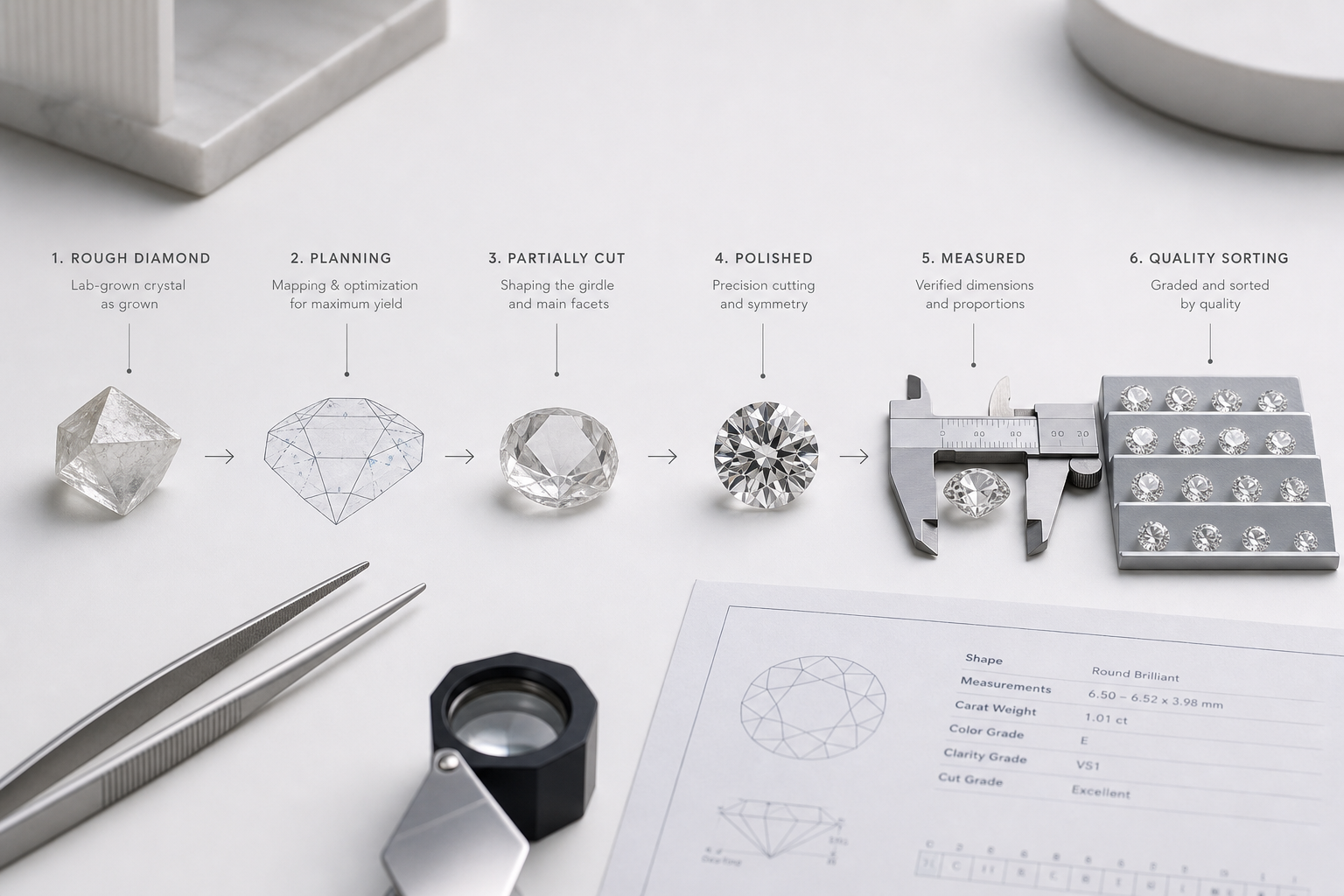
China lab-grown diamond processing begins with assessing the rough before any finished shape is committed. The cutter reviews the material, looks for visible inclusions or growth features, considers orientation, and estimates what shapes and sizes can be produced without creating avoidable problems. This early decision is where much of the finished value is either protected or put at risk.
Rough planning is not simply about getting the largest possible polished diamond. The planner has to decide how the table should be placed, where the crown and pavilion will develop, whether the rough is better suited to a round or fancy shape, and how much yield can be retained without forcing poor proportions. A plan that looks efficient on weight can still produce a stone with a thick girdle, awkward outline, or weak millimeter spread.
The most important judgment at this stage is balance. A good plan respects the material but does not let carat retention overpower the finished appearance. For buyers, this is why two suppliers working from similar rough can deliver stones that feel very different once polished. The difference often begins before sawing, not at the final inspection desk.
Sawing, Bruting, Faceting, and Polishing
Once the plan is set, the rough is divided or shaped through cutting steps such as laser sawing or cutting. For round brilliants, bruting forms the rounded outline before faceting. For fancy shapes, the outline and orientation must support the intended length-to-width ratio, shoulder balance, point alignment, or corner structure. A small mistake in this stage can follow the diamond through the rest of production.
Faceting creates the arrangement of flat surfaces that control how the diamond handles light. Pavilion angle, crown angle, table placement, culet alignment, and facet meet points all matter because they influence both appearance and grading. The work does not need to be described like a factory manual to understand the buyer consequence: if the geometry is off, the finished diamond may look less bright, less balanced, or less refined than its basic specifications suggest.
Polishing is the finishing stage that gives those facets their final surface quality. Poor polishing discipline can leave a stone with a less crisp look, visible surface issues under magnification, or finish grades that reduce buyer confidence. The risk is especially important in commercial sourcing, where a buyer may not be evaluating one stone but dozens or hundreds that need to feel consistent.
Final Sorting Before Stones Enter the Market
After polishing, finished diamonds are measured, reviewed, and sorted before being offered to buyers. This stage may include checking carat weight, millimeter dimensions, proportions, polish, symmetry, shape outline, and general visual appearance. For reported stones, the grading process adds a separate layer of documentation, but sorting still matters because a certificate does not organize a production lot for matching, consistency, or setting fit.
Batch sorting is where practical sourcing discipline becomes visible. Stones may need to be grouped by size, shape, color range, clarity range, measurements, and visual similarity. A supplier that can produce one attractive stone but cannot sort consistently may create problems for jewelry manufacturing, matched pairs, layouts, and repeat orders. The issue is not whether the diamond is lab-grown; the issue is whether the finished goods are controlled well enough for the buyer’s use.
Final inspection should catch problems that earlier stages missed, but it cannot fully undo poor planning or weak cutting. A deep stone remains deep. An uneven outline remains uneven. A mismatched lot remains difficult to use. Buyers should treat final sorting as a quality-control checkpoint, not a substitute for sound midstream execution.
Shape Specialization: Why One Cutting Facility May Not Be Equally Strong in Every Shape
Round Brilliants Require Tight Proportion and Symmetry Control
Round brilliants are often treated as the standard shape, but that does not make them simple to cut well. They depend heavily on controlled proportions, optical symmetry, and consistent facet relationships. Small changes in table size, depth, crown angle, pavilion angle, and lower-half structure can affect how the diamond returns light and how large it appears for its carat weight.
A supplier that cuts strong round brilliants usually needs disciplined process control because buyers often compare rounds closely by cut grade, measurements, and visual brightness. For round lab-grown diamonds, weak cutting is harder to excuse when many alternatives are available. If a round has poor spread, uneven symmetry, or dull visual performance, the buyer has little reason to accept it unless the purchase purpose is highly price-driven.
The practical takeaway is that round cutting rewards repeatability. A China-based cutting facility may be highly capable with rounds if it has strong proportion control and consistent finishing. But that same capability does not automatically transfer to every fancy shape, where the risks are different and often more visible to the naked eye.
Fancy Shapes Depend More on Outline, Ratio, and Facet Pattern
Fancy shape cutting is less standardized than round brilliant cutting, which means supplier specialization becomes more important. Ovals, pears, and marquises need outline balance, pleasing length-to-width ratio, and careful management of dark areas through the center. A moderate bow-tie can be normal in these shapes, but a heavy bow-tie can dominate the stone and make it harder to sell or set confidently.
Consider a U.S. jewelry brand sourcing oval lab-grown diamonds within a defined center-stone size range. A supplier may show consistent round brilliants, yet its ovals may vary widely in length-to-width ratio, shoulder shape, bow-tie visibility, and outline symmetry. That variation creates a real inventory problem. The brand may not be able to present the stones as a coherent selection, even if the carat, color, and clarity ranges look acceptable on paper.
Cushions and radiants bring another layer of variation because facet patterns can create very different face-up styles. Some look crushed-ice, some look more structured, and some show stronger brightness patterns than others. The issue is not that one style is always better. The issue is whether the supplier can produce the style the buyer expects, repeatedly, rather than mixing different looks inside the same order.
Step Cuts Reveal Cutting Discipline Quickly
Emerald cuts and other step cuts leave less room to hide cutting weaknesses. Their broad, open facets make clarity, alignment, windowing, and outline precision easier to notice. A stone that might look acceptable in a more brilliant facet pattern can appear flat, glassy, or uneven in a step cut if the planning and faceting are not controlled well.
For step cuts, the buyer should pay close attention to the relationship between the table, depth, length-to-width ratio, and facet alignment. Windowing is a common failure point: if the stone allows too much see-through area in the center, it can look lifeless even with attractive color and clarity grades. This is one reason an emerald cut should not be judged only by its report data.
A cutting facility that handles step cuts well usually shows discipline in straight lines, even corners, centered tables, and clean parallel facet structure. These details may sound small, but they shape the entire personality of the finished diamond. For private-label or custom jewelry buyers, inconsistent step cuts can be more difficult to use because visual differences are obvious once stones are placed side by side.
Shape-Specific Supplier Check
Supplier evaluation should be shape-specific. A strong question is not simply “Can you supply polished lab-grown diamonds from China?” but “Which shapes do you cut most consistently, and can you show multiple finished examples in the size range I need?” Buyers should ask for photos, videos, reports, and measurements across several stones of the same shape, not just one polished sample.
If the order depends on ovals, review ovals. If the order depends on emerald cuts, review emerald cuts. Round brilliant performance does not prove fancy shape discipline, and fancy shape variety does not prove step-cut precision. The better sourcing decision is to match the supplier’s real cutting strength to the shape requirements of the purchase, rather than assuming one facility is equally strong across every style.
Yield Decisions: The Tradeoff Between Carat Weight and Visual Performance
Why Higher Carat Retention Is Not Always Better
Diamond yield is one of the most important decisions in China lab-grown diamond cutting and polishing because it affects both factory economics and the finished stone a buyer receives. A cutter starts with grown rough that has a certain amount of possible finished weight. The question is how much of that weight should be preserved, and how much should be sacrificed to improve proportions, face-up size, symmetry, and light performance.
Higher carat retention is not automatically a problem. Rough-to-polished yield matters because unnecessary weight loss raises manufacturing cost and can make a stone less commercially viable. The mistake is treating yield as the only goal. A cutter who pushes too hard to keep weight may leave the finished diamond too deep, too thick through the girdle, or poorly balanced in its proportions. The certificate may still show an attractive carat weight, but the diamond can look smaller, darker, or less lively than expected.
This is where buyers need to separate paper value from finished value. A stone that reaches a popular carat threshold but faces up like a smaller diamond because of excess depth may be less appealing than a slightly lighter, better-balanced stone with stronger spread and better visual performance. The larger number may help a listing, but it does not always help the ring, the showcase, or the customer’s reaction.
How Depth, Spread, and Girdle Choices Affect Face-Up Size
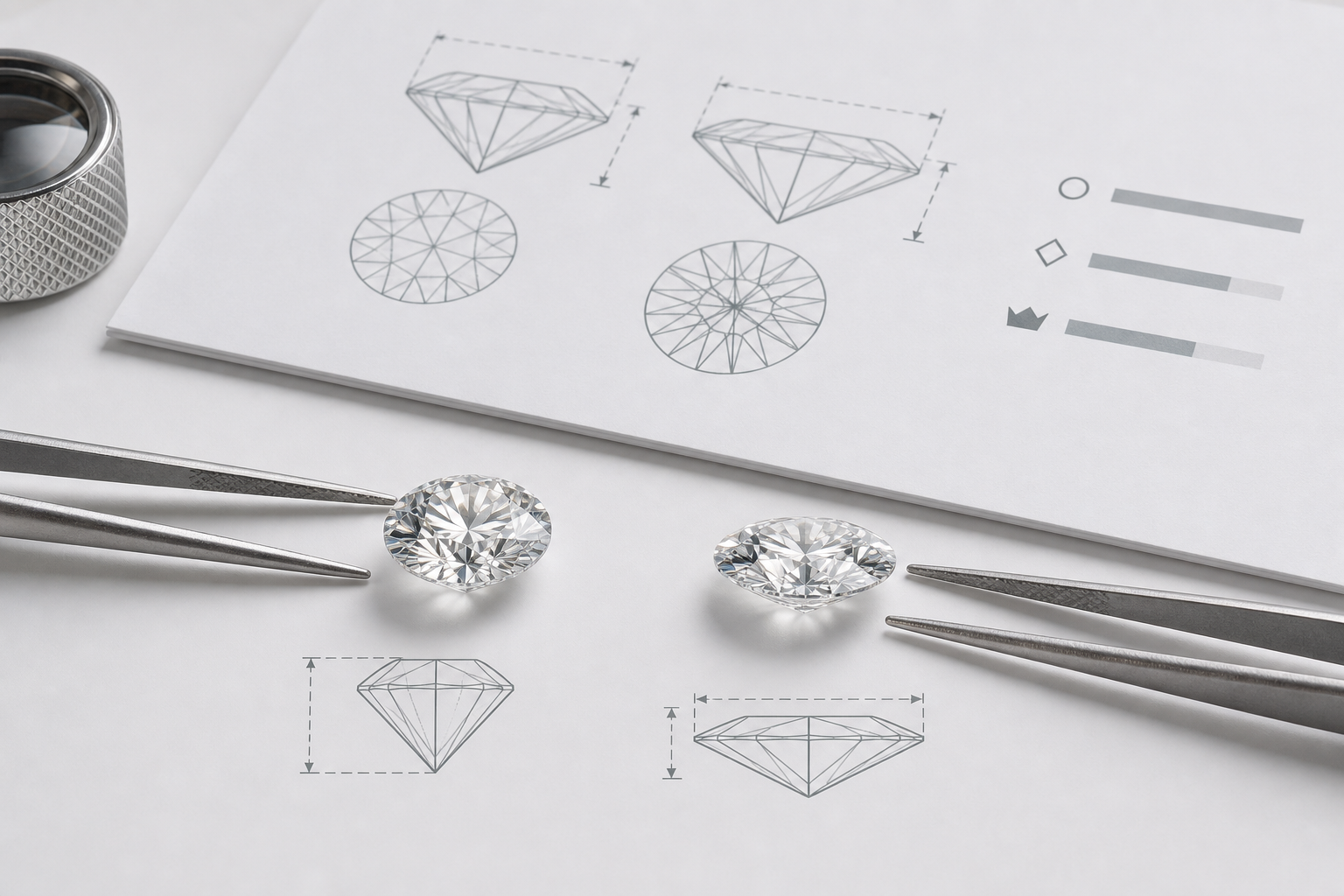
Carat weight measures mass, not visible size. Spread is the face-up presence of the diamond, usually understood through millimeter dimensions. Two lab-grown diamonds with similar carat weights can look noticeably different from above if one carries more weight in the pavilion or girdle instead of across the visible outline.
Depth is one of the first places yield decisions show up. A stone that is cut too deep can retain weight but lose face-up diameter. In round brilliants, excess depth can also interfere with light return, depending on the relationship between crown angle, pavilion angle, table size, and girdle thickness. In fancy shapes, depth and outline work together; an oval or emerald cut can carry weight in a way that changes both the apparent size and the style of the stone.
Girdle choices matter because the girdle is a practical and visual boundary. A very thin girdle may raise durability concerns, especially around vulnerable areas such as points or corners. An extremely thick girdle can hide weight where the buyer does not see it. Neither extreme should be accepted only because the carat weight looks attractive.
When a Smaller Finished Stone May Be the Better Cut
A smaller finished stone may be the better decision when the extra weight creates visible or practical compromises. This is especially true near popular carat thresholds, where the pressure to preserve weight can be strong; in wholesale evaluations, Chinese supplier verification standards can matter because a cutter may be tempted to keep a stone above a familiar selling threshold even if a slight reduction would produce a cleaner outline, better face-up spread, or more balanced proportions.
For a buyer, the decision should depend on use. If the stone is being selected for a solitaire engagement ring, visual performance and face-up size often matter more than keeping every possible point of carat weight. If the stone is part of a production order where matching and certificate thresholds affect the assortment, the yield decision may be more commercial. Neither approach is wrong, but the tradeoff should be visible and intentional.
The weak purchase is the one where the buyer pays for retained weight without recognizing what was sacrificed to keep it. A deeper stone, a heavy girdle, or a poor outline can make the finished diamond harder to sell even if the rough was inexpensive and the carat weight looks competitive.
Useful Proportion Ranges to Review Before Buying
Proportion ranges should be treated as review tools, not automatic proof of beauty. For round brilliant lab-grown diamonds, many buyers start by reviewing table size, total depth, crown and pavilion relationships, and girdle description together rather than relying on one isolated number. Girdle descriptions that avoid extremes are often easier to evaluate for both durability and visual balance.
For fancy shapes, ratio is often more useful than a single table or depth benchmark. Oval, emerald, pear, marquise, cushion, and radiant diamonds can all look different depending on the buyer’s preferred style, the setting design, and the visual character of the cut. Some buyers prefer a softer outline, while others want a longer or more architectural impression.
These numbers narrow the field when a buyer has already defined a preference, but they do not replace visual review. A diamond can fall inside a commonly requested range and still show a distracting bow-tie, uneven brightness, or an outline that looks awkward in the intended setting. The best sourcing decision weighs carat retention against spread, proportions, certificate data, and the way the finished stone actually looks.
Symmetry and Polish: Small Finishing Details That Change Buyer Confidence
What Symmetry Means in a Finished Diamond
Diamond symmetry describes how well the facets, outline, table, culet, and overall shape align with one another. It is not just a technical line on a grading report. Symmetry affects whether the diamond looks balanced, whether light returns evenly, and whether the shape feels intentional rather than slightly distorted.
In a round brilliant, weak symmetry may show as an off-center table, uneven facet alignment, or a culet that does not sit where it should. In fancy shapes, the signs can be more shape-specific: an oval with one shoulder higher than the other, a pear with an unbalanced point, a cushion with an irregular outline, or an emerald cut with step facets that do not line up cleanly. Some issues are subtle and require magnification, but stronger problems can be visible in photos, videos, or side-by-side comparisons.
For buyers, symmetry matters most when the diamond will be seen as a center stone, matched pair, or part of a repeated layout. A small asymmetry in a single stone may be acceptable depending on price and purpose. The same asymmetry becomes harder to defend when stones are supposed to match or when the design draws attention to outline precision.
What Polish Means Beyond a Certificate Grade
Diamond polish refers to the quality of the surface finish after cutting. Good lab-grown diamond polishing quality gives facets a clean, smooth surface so light can move through and reflect without unnecessary interruption. Poor polish may create surface marks, dullness, or hazy areas that weaken the diamond’s appearance, especially under close viewing or bright jewelry lighting.
A grading report may list polish as Excellent, Very Good, or another grade depending on the lab and report type. That grade is useful, but it should not be treated as the whole answer. Buyers should still review high-resolution images or video because surface finish interacts with the stone’s cut, lighting, and intended use. A small polish feature that is not obvious in a pendant stone may matter more in a larger engagement ring center stone.
The practical mistake is assuming polish is decorative. It is a finishing standard. If two suppliers offer similar color, clarity, and carat weight, the one with more consistent polish and cleaner surface finish may be easier to merchandise, photograph, and match across orders.
Why Finish Consistency Matters for Wholesale and Matching Orders
For wholesale lab-grown diamond sourcing, finish consistency is often more important than one impressive sample. A buyer ordering multiple stones needs predictable diamond symmetry, diamond polish, measurements, and visual style across the lot. One strong stone does not prove that the supplier can repeat the same finish standard through a production order.
This matters in matched pairs, earrings, eternity bands, halo layouts, and private-label assortments. If one stone has a crisp outline and another has a wavy girdle or slightly irregular facet pattern, the inconsistency can create extra sorting work, returns, or setting complications. The issue is not always that a stone is unusable. The issue is that inconsistent finishing makes planning less reliable.
Expectations should still match the product category. A high-value center stone usually deserves stricter finish review than small melee. For commercial goods, a Very Good finish may be acceptable when the visual result is clean and the price reflects the grade. The wrong standard is not “anything less than Excellent is bad.” The wrong standard is failing to define what finish level is acceptable before the order is placed.
Certificate and Visual Review Check
Start with the grading report, but do not stop there. Review the listed symmetry and polish grades, then compare them against actual images, 360-degree video, and measurements where available. The report can tell you how the stone was graded; the visual review shows whether the finish supports the way the diamond will be sold, set, or matched.
Look for practical warning signs: an uneven outline, off-center table, misaligned culet, irregular meet points, a thick or wavy girdle, or a surface that looks hazy rather than crisp. Not every buyer can diagnose these issues fully without magnification, and not every minor feature is a dealbreaker. The key is whether the finish issue changes the diamond’s visible balance, consistency, or suitability for the intended order.
Measurements and Tolerances: How Buyers Can Spot Consistency in Finished Stones
Why Carat Weight Does Not Tell the Whole Size Story
Lab-grown diamond measurements often reveal what carat weight hides. A 1.00 ct round diamond does not always face up the same as another 1.00 ct round. One may have a broader diameter and balanced depth, while another carries more weight below the girdle and appears smaller from the top. Both may be accurately described by carat weight, but they will not create the same visual impression in jewelry.
This difference becomes more important when buyers compare finished stones from China-based cutting and polishing partners. Low rough cost can be attractive, but if the finished stones vary widely in millimeter size, depth, or outline, the buying advantage can disappear in sorting, remaking, or customer rejection. Finished stone consistency is not just a quality preference; it affects inventory predictability and setting compatibility.
For center stones, millimeter dimensions should be reviewed alongside carat weight and proportions. A buyer comparing two ovals in the same general carat range, for example, should look at length, width, depth, and ratio before deciding which stone actually delivers the desired face-up look. The better choice is not always the heavier stone. It is the stone that fits the design and looks right for its stated size.
Millimeter Measurements for Center Stones, Pairs, and Layouts
Millimeter size becomes especially important in matched pairs, calibrated diamonds, melee, and layout matching. Earrings need stones that look balanced next to each other. Eternity bands and tennis bracelets need consistent size progression and setting fit. Halo designs can become uneven if small stones vary more than the setting can absorb.
For matched pairs of small to medium stones, buyers should define a narrow and realistic size tolerance based on the design rather than relying on a generic rule. The acceptable difference depends on stone size, shape, setting style, and how visible the difference will be. A small difference may disappear in a prong setting but become obvious in a precise bezel, channel, or shared-prong layout.
Fancy shapes require extra attention because the same millimeter spread can still look different if the outline or ratio changes. Two pears with similar length and width may not match if one has broad shoulders and the other has a sharper, narrower body. Two emerald cuts may share a carat weight but feel different if one is more elongated and the other has a squarer profile. Measurements are essential, but they work best when paired with visual comparison.
How Tolerance Affects Jewelry Manufacturing and Setting Fit
Tolerance is the acceptable amount of variation between the stones ordered and the stones needed for the design. In jewelry manufacturing, tolerance affects whether stones sit securely, align cleanly, and create the intended visual rhythm. A stone that is slightly too large may not seat properly. A stone that is slightly too small may create gaps, uneven prong coverage, or a loose-looking layout.
For custom and production jewelry, the risk increases when the setting is made before final stone measurements are confirmed. This is why stone-to-setting fit should be treated as part of sourcing, not as a problem left for the bench jeweler. A diamond can have strong grades and still be the wrong physical fit for a specific mounting.
For custom jewelry, stone measurements and setting compatibility should be confirmed before finalizing a purchase. This is especially important when the design depends on a precise basket, bezel, halo, channel, or shared-prong structure.
Wholesale buyers should also think in terms of repeatability. If a supplier can deliver one good set of calibrated diamonds but cannot maintain the same tolerance across repeat orders, the buyer may face inconsistent production results. The practical question is not only “Are these stones good?” but “Can this supplier keep delivering stones that fit the same design requirements?”
Stone-to-Setting Fit Check
Before approving finished stones, compare carat weight with actual millimeter measurements, depth, ratio, and outline. For center stones, confirm that the face-up size supports the design goal rather than relying on carat weight alone. For matched pairs and layouts, review the stones together instead of approving them one by one.
For production orders, define acceptable tolerance before the stones are cut, sourced, or sorted. The tighter the setting style, the more important this becomes. A flexible prong design may allow slightly broader variation, while eternity bands, bezels, halos, and channel settings usually need more discipline. The safest sourcing decision is the one where the finished diamond, the measurement data, and the setting requirements agree before manufacturing moves forward.
Visual Performance: Why the Finished Stone Must Be Reviewed, Not Assumed
A lab-grown diamond is real diamond material, but that does not mean every finished stone will look equally bright, balanced, or lively. Visual performance is created by the relationship between proportions, facet alignment, polish quality, and shape planning. Two stones can share the same lab-grown origin, similar color and clarity grades, and comparable carat weight, yet one may look crisp and bright while the other appears dark in the center, glassy through the middle, or uneven from one side to the other.
This is why the finished stone needs to be reviewed as a finished object, not assumed from the rough, the certificate, or the supplier’s general reputation. Certification and measurements help narrow the field, but they do not fully show how light moves through the diamond in real viewing conditions.
In practical buying, visual performance should be treated as evidence rather than a slogan. A seller may describe a stone as brilliant or premium, but the buyer still needs comparable images, video, proportions, and measurements to understand why that description is reasonable. When two stones are filmed under similar conditions, differences in center brightness, contrast pattern, leakage, and outline control become easier to judge without relying only on marketing language.
Presentation quality should also be separated from cut quality. A diamond can look different under spotlighting, diffused lighting, daylight-equivalent lighting, or a dark-field style setup. Buyers comparing suppliers should ask for comparable media conditions where possible, because inconsistent photography can make one stone look better for reasons unrelated to cutting. The goal is not to demand perfect laboratory imaging for every purchase, but to avoid approving stones based on visuals that cannot be compared fairly.
Brilliance, Fire, and Scintillation Depend on Cutting Choices
Brilliance is the white light returned to the eye. Fire is the colored light dispersion. Scintillation is the contrast and sparkle pattern that appears as the diamond or viewer moves. These effects are not created simply because the diamond is lab-grown; they depend heavily on cutting choices made during midstream processing.
A round brilliant with strong proportion control and well-aligned facets can return light in a clean, balanced way. If the same rough is cut too deep, too shallow, or with inconsistent facet relationships, the diamond may lose brightness or show distracting dark zones. In practical buying terms, a slightly better-cut stone can look more impressive than a heavier stone with weaker light return, even when the heavier stone appears more attractive on paper.
The mistake is treating visual performance as a luxury detail. For center stones, it is often one of the main reasons a buyer likes or rejects the diamond after seeing it. For wholesale and private-label orders, it affects whether a group of stones feels consistent enough to support repeat sales, matching projects, or brand-level quality expectations.
Bow-Tie, Windowing, and Uneven Brightness in Fancy Shapes
Fancy shapes need closer visual review because their appearance is less standardized than round brilliants. Ovals, pears, marquises, cushions, radiants, and emerald cuts can vary widely even within the same carat, color, and clarity range. The issue is not whether these shapes are good or bad; the issue is whether the specific stone has been planned and cut well for that shape.
The bow-tie effect is a dark area that often appears across the center of elongated shapes such as ovals, pears, and marquises. A mild bow-tie can be normal and may even add contrast. A heavy bow-tie becomes a problem when it dominates the face-up view or makes the center look dull. Buyers should be cautious when a stone looks bright only around the edges but dark through the middle.
Windowing is different. It happens when parts of the diamond allow the viewer to see through the stone instead of returning light back. This is especially noticeable in step cuts such as emerald cuts and Asscher cuts, where large open facets make weak cutting more obvious. A stone with windowing may look transparent or watery in the center, which can reduce its visual presence even if the color and clarity grades are strong.
Why Photos and 360-Degree Video Matter Before Approval
High-resolution images and 360-degree diamond video are useful because they reveal how the stone behaves from more than one angle. A single face-up photo can hide uneven brightness, a lopsided outline, or a dark area that appears only as the diamond turns. Video does not perfectly recreate in-person viewing, but it gives buyers a better chance of spotting problems before approval.
The most useful review includes a face-up view, a side view, and movement under consistent lighting. For fancy shapes, buyers should look for outline balance, center brightness, bow-tie strength, and whether the ends of the stone go dark or watery. For step cuts, the review should focus on facet alignment, visible windowing, and whether the stone has a clean, orderly hall-of-mirrors effect rather than a flat or empty center.
Lighting matters. A video shot under flattering jewelry-store lighting can make many stones look lively, while harsh or inconsistent lighting can exaggerate problems. The best comparison is between similar stones photographed or filmed under the same conditions. That gives the buyer a clearer sense of whether one stone is genuinely performing better or simply being presented better.
What to Check Before You Decide
- Face-up brightness: Look for balanced light return across the stone, not just sparkle at the edges.
- Dark zones: Moderate contrast is normal, but a dominant dark center can weaken the diamond’s appearance.
- Bow-tie strength: In ovals, pears, and marquises, a slight bow-tie may be acceptable; a heavy one should be treated as a visual drawback.
- Windowing: In emerald cuts and other step cuts, avoid stones that look see-through through the center.
- Motion performance: Review video to see whether sparkle appears lively and balanced as the stone turns.
- Shape-specific behavior: Judge the diamond by the risks of its shape, not by a generic standard that applies to every stone.
Documentation and Sorting: How Reports Support Quality Control Without Replacing Review
Documentation is an important part of lab-grown diamond certification and midstream quality control, but it should be treated as support for review, not a replacement for it. A grading report can confirm core facts about a finished diamond. It cannot fully show whether the stone looks lively, matches another stone well, or fits a production requirement cleanly.
For buyers evaluating polished lab-grown diamonds from China, this distinction matters. Strong documentation can reduce uncertainty, especially when stones are purchased remotely or in quantity. But a report does not prove that a supplier’s full batch is consistent, nor does it guarantee that every stone with similar grades will have the same visual personality.
A careful buyer should also separate origin documentation from broader sourcing or sustainability claims. A report may document that a diamond is laboratory-grown, but it does not automatically prove production energy use, overall environmental impact, labor practices, or the ethics of every business in the supply chain. If these factors matter to the purchase, they should be discussed through specific documentation and supplier transparency rather than assumed from the lab-grown category alone.
A grading report helps document key characteristics, but it should not be treated as a guarantee of beauty, value, or sourcing ethics.
What a Grading Report Can Confirm
A grading report or diamond certificate can usually confirm lab-grown origin, carat weight, color, clarity, measurements, polish, symmetry, and fluorescence if listed. For round brilliants, the report may also include a cut grade, depending on the issuing laboratory and report type. Common grading organizations in the lab-grown market include IGI, GIA, and GCAL, among others, and different labs or report formats may serve different buyer needs.
Report number verification is one of the simplest quality-control steps. Buyers should confirm the report number through the issuing lab’s database when available and check that the listed measurements, carat weight, shape, and identifying details match the stone being offered. This is especially important when stones move through multiple hands before reaching a retailer, designer, or wholesale buyer.
The most useful way to read a report is not to ask whether the document looks impressive. It is to ask whether the report data supports the intended purchase. A stone for a solitaire ring, a matched pair, and a production layout may all require different levels of measurement control, visual review, and documentation consistency.
What a Report Does Not Fully Show
A report does not fully capture batch consistency. Ten stones may all be certified as lab-grown, near the same carat weight, and within a similar color and clarity range, yet still differ in spread, outline, brightness, bow-tie strength, or facet pattern. For a one-stone purchase, that may be manageable. For a matched order or private-label collection, those differences can create production and merchandising problems.
Reports also do not fully show the visual personality of fancy shapes, which is why China supplier evaluation should include visual review beyond paperwork. An oval may have an attractive ratio but a heavy bow-tie. An emerald cut may have strong clarity on paper but show windowing through the center. A radiant may have the right measurements but a crushed or uneven sparkle pattern that does not match the buyer’s preferred style.
Setting suitability is another limitation. A certificate can list length, width, and depth, but it does not tell the whole story about how the stone will sit in a specific ring, earring, pendant, or layout. For custom jewelry and production work, measurements must be interpreted alongside the actual design requirement.
Why Sorting Standards Matter for Repeat Orders
Sorting is where supplier discipline becomes visible. A buyer ordering one attractive sample may not see the issue. A buyer ordering repeated lots will. If stones are sorted loosely, the next shipment may vary in millimeter size, shape outline, color range, clarity appearance, or visual performance, even if the headline specifications appear similar.
For wholesale lab-grown diamonds, repeatability is often more valuable than a one-time low price. A supplier who can sort consistently by shape, measurement, report status, color range, clarity range, and visual character gives the buyer a more predictable foundation for inventory and jewelry production. A supplier who cannot sort well may create hidden costs through remakes, rejected stones, mismatched layouts, and slower approval cycles.
Traceability also depends on disciplined sorting. Buyers should be able to connect each stone or lot to the correct report, measurements, images, and agreed quality criteria. This does not require overcomplicated paperwork, but it does require a process that keeps documentation and physical stones aligned.
Documentation Boundaries Buyers Should Keep Clear
Documentation is strongest when it is tied to a specific stone and a specific claim. A grading report can support statements about the characteristics listed on that report, such as carat weight, measurements, color, clarity, polish, symmetry, and lab-grown origin where included. It should not be stretched into proof of every quality claim a seller might make.
This distinction is especially important for sustainability, responsible sourcing, and “premium” language. Lab-grown origin describes how the diamond material was created; it does not automatically document energy sources, emissions, labor practices, or overall environmental impact. If a buyer or retailer wants to make claims in those areas, the claim should be narrow, specific, and backed by relevant supplier documentation rather than assumed from the diamond category.
The same caution applies to grading-lab comparisons. Buyers should avoid treating one laboratory name as a complete buying decision or assuming that reports from different labs are directly interchangeable in every respect. A better approach is to read what each report actually documents, verify the report through the issuing laboratory when possible, and then compare the physical diamond through measurements, images, video, and intended-use requirements.
How to Build a Stone-Level Traceability Trail
Traceability becomes practical when each finished diamond can be connected to the same identifier across the report, measurements, images, video, and order record. Buyers should ask whether the supplier uses a stone ID or lot code, whether that identifier remains consistent after sorting, and whether media files are labeled clearly enough to prevent mix-ups between similar stones.
This matters most when stones are re-sorted, re-matched, or moved into custom jewelry production. If a stone changes hands or is reclassified during the process, the documentation should make that history visible rather than leaving the buyer to reconstruct it later. In wholesale and private-label work, the value of traceability is not just paperwork volume; it is whether the records are organized well enough to support review, resale, and setting decisions.
When a grading report is available, buyers should verify the report details through the issuing laboratory’s official report-check tool where available, and compare those details with the stone’s measurements and visual evidence.
If the report number, stone ID, or media set do not align cleanly, the buyer should pause and ask for clarification before approval. A consistent paper trail does not guarantee a strong stone, but it does make it easier to confirm that the buyer is reviewing the right item and not a close substitute.
Responsible Sourcing Claims Should Stay Specific
Because lab-grown diamonds are often discussed through a sustainability lens, buyers should ask for specific, limited claims rather than broad language. Helpful details include production location, relevant process documentation, and any information the seller can substantiate about the supply chain. Broad green language is less useful than clear records and precise descriptions.
Sustainability claims should be specific and documented. Broad green language is less useful than clear information about production, energy, sourcing, and seller transparency. This is particularly important when the buyer wants to publish product descriptions, because claims that go beyond the available documentation can weaken credibility later.
Environmental and sustainability claims should be specific, documented, and limited to what can be substantiated.
Buyer Verification Checklist
- Verify the report number: Use the issuing lab’s database where available and confirm that the report details match the offered stone.
- Check what the report actually covers: Confirm whether it includes origin, measurements, polish, symmetry, fluorescence, and cut grade where applicable.
- Compare report data with images or video: Do not assume that similar grades mean similar appearance.
- Ask how stones are sorted: For repeat orders, clarify whether sorting is by individual report, batch range, measurements, shape, or visual matching.
- Confirm matching standards: For pairs, layouts, and production orders, agree on tolerances before approval.
- Keep documentation tied to the stone: Reports, videos, measurements, and order references should stay connected throughout the buying process.
Evaluating China-Based Cutting and Polishing Partners Beyond Price
China plays a major role in lab-grown diamond cutting, polishing, sorting, and jewelry manufacturing integration. Scale can be useful, and many China-based suppliers can respond quickly to different shape, size, and order requirements. But scale alone does not prove that a supplier is the right fit. The real question is whether the cutting and polishing quality is repeatable in the shapes, sizes, and specifications the buyer actually needs.
A low quote for wholesale lab-grown diamonds can look attractive at the start and become expensive later if the stones require heavy rejection, inconsistent matching, unclear documentation, or repeated clarification. Supplier evaluation should focus less on the broad claim of being competitive and more on evidence: samples, grading reports, measurement control, video review, batch consistency, communication, and how problems are handled when stones do not meet expectations.
China-linked supply chains can offer manufacturing depth and scale in some categories, but buyers still need to evaluate consistency, documentation, communication, and quality control. Country of processing should be treated as one sourcing detail, not as automatic proof of lower price, higher quality, or better suitability for every order.
Production Scale Is Useful Only When Quality Is Repeatable
Large cutting capacity can help with availability, assortment, and production scheduling. It does not automatically mean better finished diamonds. A supplier may be strong in standard round brilliants but inconsistent in elongated ovals. Another may be capable with emerald cuts but less reliable with calibrated melee or matched pairs. The buyer’s risk is assuming that general capacity equals shape-specific discipline.
For polished diamond sourcing, repeatability is the practical test. Can the supplier provide the same type of stone again, not just once? Can they hold similar measurements across a lot? Can they keep ratios, depth, table, finish, and visual performance within the agreed range? If the answer is unclear, the buyer is not evaluating a stable supply partner; they are evaluating a one-time opportunity.
Lead time and MOQ also need to be read through the quality lens. A short lead time is useful only if the approval process remains controlled. A low MOQ can help a smaller buyer test a supplier, but the sample should still reflect the quality standard expected in future orders. The weakest approach is approving a carefully selected sample and then accepting a bulk order judged by looser standards.
Questions That Reveal Shape Specialization and QC Discipline
The best supplier questions are specific enough to reveal how the partner actually works. A broad question such as “Do you have good quality?” rarely produces useful information. A better question asks which shapes the supplier cuts most often, what tolerances they can maintain, how stones are inspected, and what review materials are available before shipment.
Useful questions include: Which shapes and size ranges are your strongest categories? Can you provide consistent millimeter measurements for repeat orders? Are stones individually reported, batch sorted, or offered with mixed documentation? What photo and 360-degree diamond video review is available? How are stones rejected or replaced if they fall outside the agreed tolerance? What level of variation should be expected between sample approval and final order?
Communication quality is part of quality control. If a supplier cannot explain tolerances clearly before the order, it will be harder to resolve disagreements after production. For wholesale and private-label buyers, clear communication often matters as much as the quoted price because it affects approval speed, production planning, and the buyer’s ability to maintain consistent product standards.
Why Samples Should Be Judged Like the Final Order
A sample should not be treated as a presentation piece only. It should be reviewed under the same criteria that will apply to the final order: report data, measurements, proportions, images, video, visual performance, matching needs, and setting compatibility. If the sample is exceptional but the final order is allowed to vary widely, the sample has not served its real purpose.
The more production-sensitive the order, the stricter the sample review should be. For a single center stone, the buyer may focus on one diamond’s appearance and documentation. For a matched pair, layout, eternity band, or recurring SKU, the buyer needs evidence that the supplier can repeat the standard across multiple stones. One strong sample does not prove batch discipline.
At NUVU, wholesale conversations are usually strongest when expectations are made visible early: what must match, what variation is acceptable, which documents are required, and how stones will be reviewed before approval. This keeps the discussion focused on finished quality rather than only on unit price.
How to Verify This Before Buying
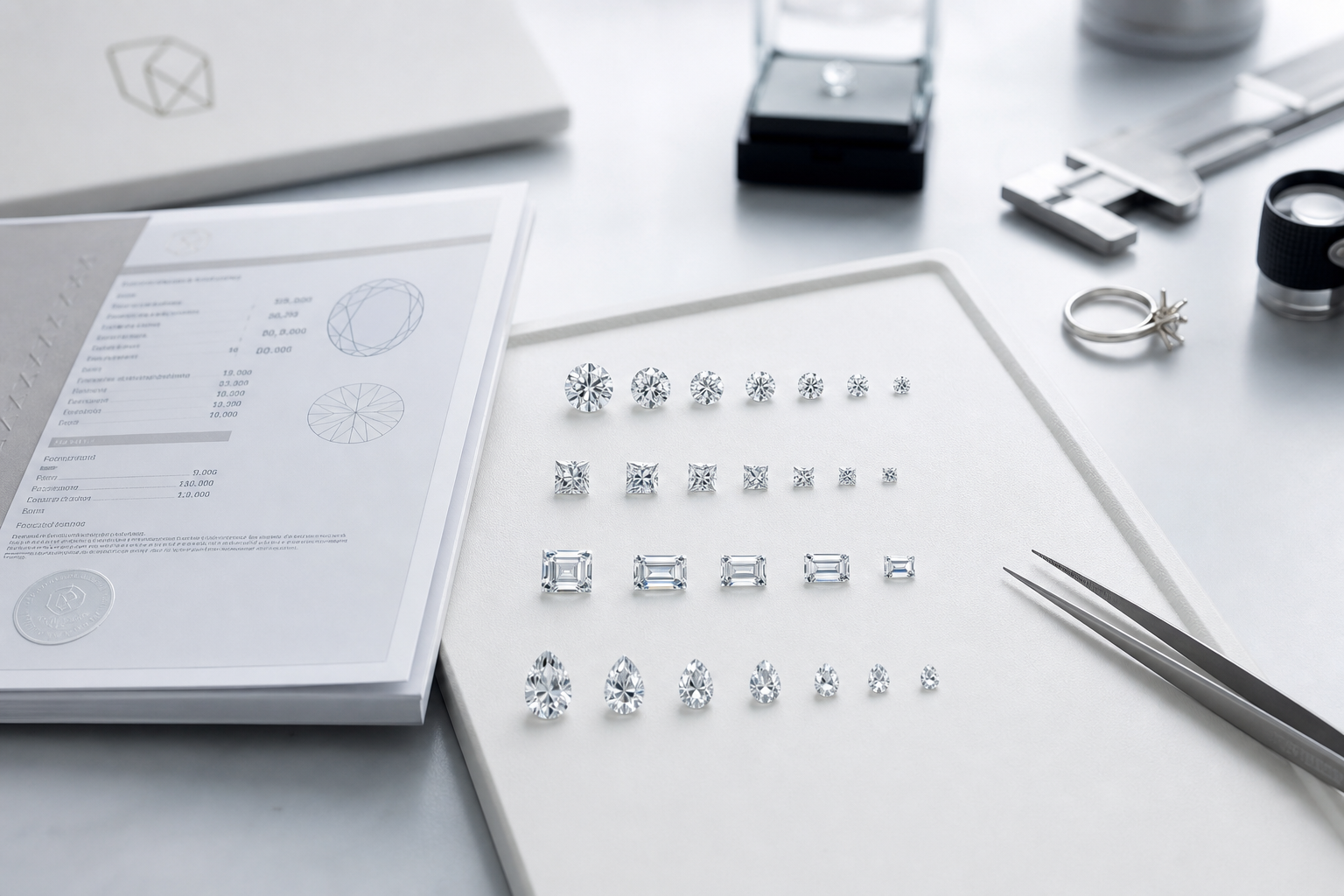
- Request shape-specific samples: Evaluate the exact shape, size range, and quality tier you plan to order.
- Review multiple stones, not one: A small group reveals consistency better than a single polished sample.
- Compare reports with actual measurements: Confirm that documentation, millimeter dimensions, and visual appearance align.
- Ask for photo and video review: Use consistent lighting and comparable viewing angles where possible.
- Agree on tolerances in writing: Define acceptable variation for measurements, ratios, finish grades, report status, and matching needs.
- Clarify rejection handling: Know what happens if stones fall outside the agreed standard before the final order is produced or shipped.
- Evaluate communication speed and clarity: A supplier who communicates well before the sale is more likely to support a controlled quality process after approval.
For buyers comparing China-based cutting and polishing partners, the most useful trust signal is not a broad promise of quality but a transparent review process. A responsible supplier should be able to explain which laboratory reports are available, how report numbers are checked, how stones are matched to their documentation, and what happens when the finished diamond does not align with the agreed tolerance. This is especially important when stones are moving from cutting and polishing into jewelry manufacturing, because a documentation gap can become a production delay or a customer-service issue later.
Buyers should also look for a partner who is comfortable discussing tradeoffs honestly. A supplier that explains why a particular oval has a stronger bow-tie, why a deeper stone retained weight, or why a certain step cut may not suit a bezel setting is often providing more useful support than one that describes every stone in the same flattering language. Trust is built when the selection process makes limitations visible before approval, not after the stone has already entered production.
If a GIA report is provided, the report details can usually be checked through GIA’s official verification tools where available. The same principle applies to other laboratories that provide report-check functions. The goal is not to prefer a document over the diamond itself, but to make sure the document, the measurements, the images, and the physical stone are all referring to the same item. That simple discipline reduces avoidable uncertainty and helps keep remote sourcing decisions grounded in verifiable information.
How to Compare Finished Stone Consistency Before Making a Sourcing Decision
A sourcing decision should be based on finished outcomes, not on rough cost, broad 4Cs descriptions, or a supplier’s strongest sample. The practical question is simple: can the supplier deliver polished diamonds that remain consistent across the actual stones you will receive?
The most reliable diamond review process moves in a clear order. First, confirm the report data. Then compare measurements and proportions. After that, review the actual visual performance through images or video. Finally, test whether the same level of quality appears across multiple stones, not just one carefully selected example.
Start With the Report, Then Move to the Actual Stone
A grading report is the right starting point because it anchors the basic facts: carat weight, color, clarity, measurements, polish, symmetry, and lab-grown origin. For round brilliants, the report may also provide a cut grade that helps narrow the review. This information matters, but it should not be treated as the whole decision.
Once the report data is confirmed, compare it against the actual stone. A diamond that looks acceptable on paper can still be too deep, too small face-up, visually uneven, or poorly suited to the design it is meant to enter. For sourcing teams, this is where many weak purchases happen: the buyer approves the grade combination but does not inspect how that grade combination translated into the finished diamond.
The better approach is to use the report as a filter, not a finish line. If two polished diamonds from China share similar carat, color, and clarity grades, the stronger choice is usually the one with better measurements, cleaner visual balance, and fewer shape-specific risks. The lower-cost option is only better if the finished stone still meets the performance and consistency standard required for the order.
Compare Several Stones From the Same Supplier, Not Just One Strong Sample
One attractive sample proves very little. A supplier may be able to produce or source an excellent individual stone while still delivering uneven results across a full order. Finished lab-grown diamond consistency becomes visible only when several stones are compared under the same review conditions.
For a practical comparison, ask to see multiple stones in the same shape, size range, color range, and clarity range. Review their millimeter dimensions, depth, table, length-to-width ratio where relevant, polish, symmetry, and face-up appearance. The goal is not to find identical stones in every detail. The goal is to see whether the differences are controlled enough for the intended use.
This is especially important for wholesale lab-grown diamond sourcing, matched layouts, bridal inventory, and private-label jewelry programs. If five oval diamonds in the same requested range vary widely in outline, bow-tie visibility, ratio, and face-up spread, the issue is not just individual stone quality. It may signal inconsistent planning or sorting. In that case, a buyer should either tighten the specification, request better pre-selection, or reconsider whether the supplier is the right fit for that shape.
Use Written Tolerances for Repeat Orders and Matching Projects
Verbal quality expectations are easy to misunderstand. Written tolerances make repeat orders more predictable. They give both sides a shared reference for what counts as acceptable variation and what should be rejected before shipment or final approval.
For center stones, tolerances may focus on report range, millimeter spread, total depth, table range, ratio, fluorescence preference, and visual review requirements. For matched pairs, layouts, halo stones, eternity bands, or calibrated jewelry production, the tolerance needs to be tighter because small differences become visible once stones are set next to each other.
A useful tolerance is specific enough to guide sorting, but not so narrow that it becomes unrealistic for the category. For example, matched small to medium stones often need very close size control where the design requires close matching, while larger fancy shapes may need more attention to outline, ratio, and visual balance than a single measurement limit. The right tolerance depends on the design, setting method, and how closely the stones will sit together.
Before committing to a supplier, confirm how exceptions are handled. A strong sourcing process defines what happens if a stone falls outside the agreed range, if the video does not match the approved sample standard, or if a repeat order begins to drift in proportions. This matters more than a small price difference because inconsistency creates downstream costs in sorting, remaking, customer approval, and inventory management.
Turn Evidence Into an Approval Workflow
The strongest sourcing teams do not collect reports, videos, and measurements as separate files that no one compares. They turn those materials into an approval workflow. Each stone or lot should be checked against the original request, the report data, the visual evidence, and the intended jewelry use before a final decision is made.
A simple workflow can prevent many avoidable disputes. The buyer defines the specification, the supplier pre-sorts to that specification, the buyer reviews comparable media and documentation, and both sides confirm what happens when a stone falls outside the agreed range. This turns quality control from a subjective argument into a clearer decision process.
For China lab-grown diamond cutting and polishing, this is where midstream quality becomes commercially visible. A supplier that can show repeatable finished outcomes, maintain documentation discipline, and communicate exceptions clearly is usually more valuable than a supplier that only offers a lower initial quote. The finished stone is the proof, and the approval process should make that proof easy to review.
For NUVU, the buyer-first approach is to make the comparison clearer: what the report shows, what the visuals reveal, and whether the stone fits the intended piece.
NUVU’s buyer-first approach is to make comparison clearer, especially around report details, visual evidence, setting fit, and documentation. This educational perspective should not be read as a guarantee of any particular stone, report outcome, supplier performance, pricing, or production result.
Finished Stone Consistency Checklist
- Verify the report data: Confirm the report number, lab-grown origin, carat weight, color, clarity, measurements, polish, symmetry, and any cut grade where applicable.
- Compare millimeter dimensions: Check face-up size, depth, and spread instead of relying on carat weight alone.
- Review proportions by shape: Look at table, depth, girdle, and length-to-width ratio where relevant, using practical ranges rather than chasing one “perfect” number.
- Inspect actual images or video: Use face-up views, side views, and 360-degree video when available to judge brightness, outline, bow-tie, windowing, and overall balance.
- Compare multiple stones: Review several polished diamonds from the same supplier before assuming one strong sample represents normal production.
- Check shape-specific risks: Rounds need proportion and optical consistency; ovals, pears, and marquises need outline and bow-tie control; step cuts need clean alignment and minimal windowing.
- Define written tolerances: Set acceptable limits for measurements, ratio, report ranges, visual review, and matching before production or repeat ordering.
- Judge repeatability, not promises: The strongest supplier is the one that can deliver the agreed finished standard consistently, not simply the one offering the lowest rough or unit price.
Disclosure: This article is for general educational purposes only. Diamond grading, pricing, availability, specifications, and seller policies can change, and readers should verify important details through grading reports, official laboratory tools, seller documentation, or qualified professionals before making a purchase decision. Laboratory-grown diamonds should be clearly distinguished from natural diamonds, and environmental or sourcing claims should be supported by specific documentation.