
China’s lab-grown diamond industry is not only about growing rough stones. For most buyers, the bigger question is how a diamond moves from rough material into a polished stone, a matched lot, or finished jewelry that meets the intended standard, especially when HPHT vs CVD diamonds influence sourcing decisions, quality control expectations, and final product positioning. Growth method matters, but appearance, measurements, cut precision, matching, documentation, and setting fit often decide whether the final product is commercially successful.
For the full framework, read Lab-Grown Diamond Manufacturers in China Guide.
This article helps you judge the manufacturing process from a practical buying perspective. It explains where value is added, where mistakes can enter, and why grading reports should be read alongside visual checks and production controls. Whether comparing loose stones, matched melee, private label jewelry, or repeat wholesale orders, the goal is to understand what should be specified before production and verified before shipment.
Throughout this guide, “lab-grown diamond” means a laboratory-grown diamond with the same diamond material category as diamond, but with a laboratory-grown origin rather than a natural mined origin. Laboratory-grown diamonds should be clearly identified as laboratory-grown, and they should not be presented as mined diamonds. Diamond simulants, such as non-diamond lookalikes, are a separate category and should not be confused with lab-grown diamonds.
| Buying Situation | What to Check Closely | Common Risk to Avoid |
|---|---|---|
| Loose polished stones | Cut, measurements, color appearance, clarity, report details | Relying on grade alone without visual review |
| Matched pairs or sets | Size tolerance, outline, brightness, color consistency | Accepting stones that match on paper but not by eye |
| Melee or calibrated orders | Sorting rules, repeatability, batch consistency | Setting loose tolerances that create uneven jewelry |
| Custom or private label jewelry | Stone fit, setting design, metal choice, finish quality | Sourcing stones before defining finished product standards |
| Wholesale production runs | Samples, substitution rules, staged quality control | Waiting until final inspection to catch preventable issues |
| Supplier comparison | Documentation, accountability, communication, delivery controls | Choosing by origin or price without checking process fit |
Quick Questions Before You Read
Q: Is CVD or HPHT automatically better?
No. Both can produce quality diamonds. Judge the finished stone by appearance, cut, measurements, clarity, color, and documentation.
Q: Does a grading report guarantee a beautiful diamond?
No. A report documents key specifications, but visual performance, matching, and setting suitability still need review.
Q: Why does rough planning matter to buyers?
Planning affects shape, carat weight, yield, proportions, and final appearance before cutting even begins.
Q: What matters most in China-based jewelry production?
Clear specifications, approved samples, matching tolerances, staged quality control, and accountability throughout production.
China’s Lab-Grown Diamond Manufacturing Ecosystem Starts Before the Stone Is Cut
Growth Is the Starting Point, Not the Finished Product
China lab-grown diamond manufacturing begins with rough diamond growth, but the rough material is not yet a buyer-ready diamond. A stone coming out of a growth environment still needs planning, cutting, polishing, sorting, and often grading preparation before it can be sold as a loose diamond or used in jewelry production.
This distinction matters because many buyers focus too much on where the rough was grown and not enough on what happens after growth. A poorly planned or poorly cut lab-grown diamond can underperform even if the original rough material was promising. A well-managed production path can preserve value, improve consistency, and make the stone more suitable for a specific use, whether that is a documented loose diamond, a matched pair, or a finished ring.
For upstream suppliers, the first practical question is not simply whether the material exists. It is whether that rough can be converted into polished diamonds that meet commercial expectations for size, appearance, shape, and documentation. Growth capacity creates supply, but downstream execution determines whether that supply becomes useful inventory.
How CVD and HPHT Fit Into the Manufacturing Chain
CVD and HPHT are the two main methods used to create lab-grown diamond rough. CVD, or chemical vapor deposition, is generally used to describe a process where diamond material is grown layer by layer in a controlled chamber. HPHT, or high pressure high temperature, is generally used to describe a process that uses very high pressure and temperature conditions to produce diamond material. Both methods can produce diamond material for the jewelry market, and both can lead to polished stones that are graded and sold.
The method matters, but it should not be treated as the only quality signal. A buyer who stops at “CVD or HPHT” is missing the more important manufacturing question: how the rough is selected, planned, and finished. Growth method can influence certain features that cutters and sorters need to consider, but the final diamond’s usefulness depends on a chain of decisions after the rough is produced.
In practical buying terms, CVD versus HPHT is a starting detail, not a shortcut to judgment. A better evaluation looks at the finished stone’s proportions, color appearance, clarity characteristics, measurements, grading documentation if available, and intended setting or order requirement. The growth method can be relevant, but it should not outrank the quality of the finished diamond.
Evidence check for growth-method claims: buyers should treat growth method disclosure as one part of the product record, not as proof of beauty, value, sustainability, or ethical performance by itself. If a seller makes additional claims about lower impact, carbon footprint, origin controls, or production responsibility, those claims should be supported by separate, specific documentation rather than inferred from the words “CVD,” “HPHT,” or “lab-grown.”
When growth method or post-growth treatment is relevant, buyers should look for clear disclosure in the grading report or seller documentation. HPHT and CVD should not be automatically described as treatments in the lab-grown diamond context; they are commonly discussed as growth methods unless the seller or report is specifically addressing a post-growth treatment or enhancement.
Why an Integrated Supply Base Matters for Buyers
China’s role in the lab-grown diamond supply chain is often discussed in terms of volume or price, but the more useful point is coordination. In many manufacturing networks, rough growth, rough planning, cutting, sorting, and jewelry production can be connected through nearby or established production relationships. That does not make every supplier equally capable, but it can reduce friction when the buyer needs more than a single loose stone.
An integrated supply base is most valuable when consistency matters. A one-off buyer may care mainly about one diamond’s visual performance and grading report. A jewelry brand, wholesaler, or custom production buyer may need matched sizes, repeated shapes, stable color ranges, and clear communication across multiple production steps. In those cases, the advantage is not just access to diamonds; it is the ability to coordinate diamonds for a defined purpose.
The risk is assuming integration automatically means better quality. It does not. A connected supply chain can still produce weak results if specifications are vague, if rough is selected only for maximum yield, or if downstream checks are loose. Strong manufacturing setups are the ones that turn upstream capacity into controlled outcomes, not just available inventory.
A practical traceability question is whether each handoff can be described in plain language. Buyers do not need a complicated technical file for every small stone, but they should be able to understand where the rough planning ended, where cutting and polishing occurred, how stones were sorted, what documentation was created, and how finished jewelry was reconciled before packing. Traceability is most useful when it connects decisions to records, not when it appears only as a broad marketing word.
What to Check Before You Decide
Before judging a China lab-grown diamond manufacturing source, ask where its responsibility actually begins and ends. Some suppliers only provide rough or loose polished stones. Others coordinate cutting, grading preparation, jewelry setting, or private label production. The right fit depends on what you are buying.
If you need a single loose diamond, the most important checks are the finished stone’s measurements, visual performance, grading report if available, and whether the diamond matches the intended setting. If you need production jewelry, the bigger issue is whether the supplier can manage consistency across stones, metalwork, design files, and final inspection. Those are different buying problems, and they should not be evaluated with the same questions.
A useful first check is simple: ask for clarity on the production path. If a supplier cannot explain whether the diamond was grown, cut, sorted, graded, or set through its own process or through outside partners, the buyer has less control over accountability. The answer does not need to be vertically integrated in every case, but it should be specific enough to show how quality is managed from one stage to the next.
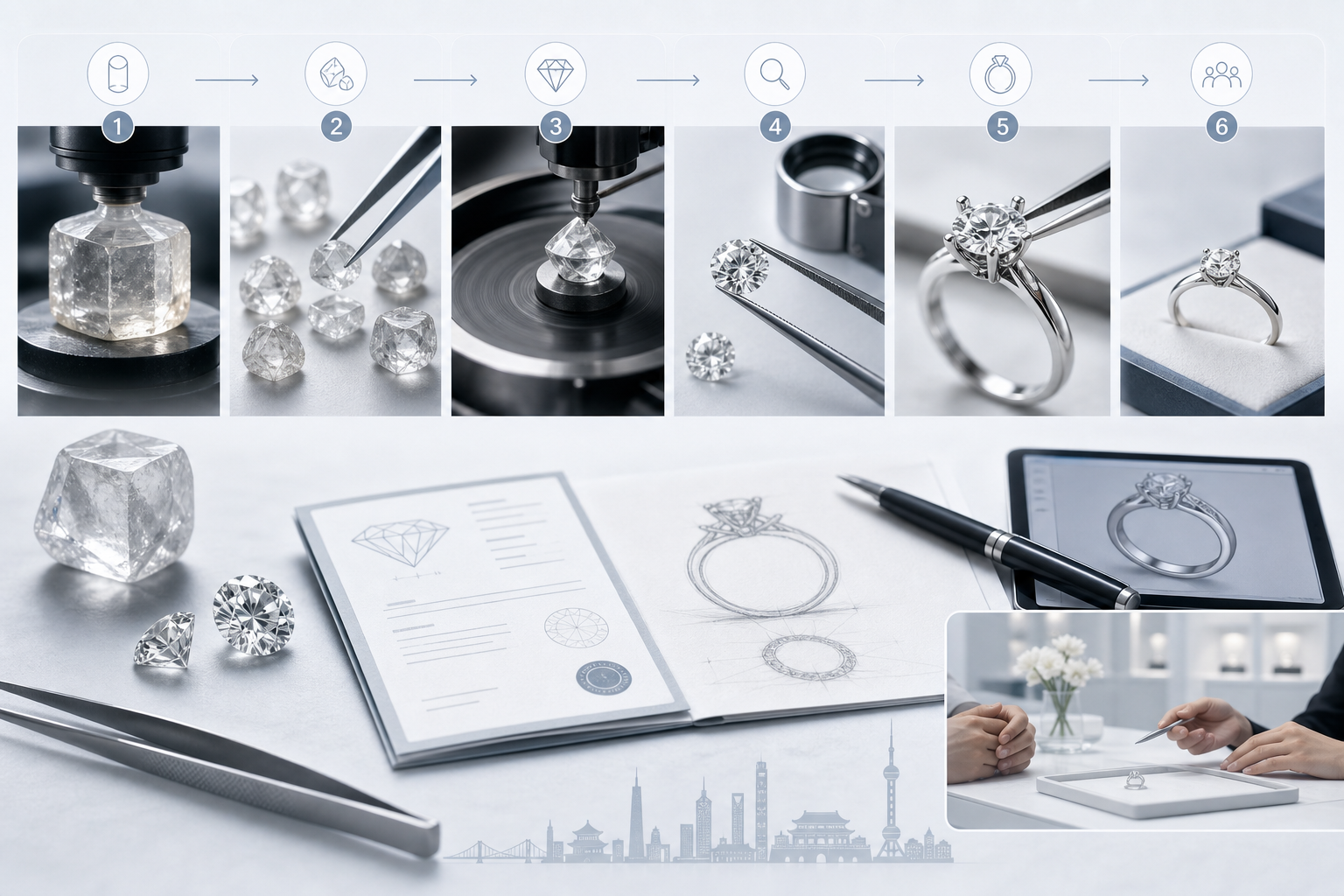
From Rough Diamond to Cutting Plan: Where Value Is First Shaped
How Rough Is Evaluated Before Cutting Begins
Lab-grown diamond rough has to be studied before a cutter decides what it should become. The goal is not simply to cut the largest possible polished diamond. The better question is which outcome will create a practical balance of carat weight, shape, proportions, appearance, and order requirements.
Cutters evaluate the rough for usable area, potential inclusions, growth features, color concentration, shape possibilities, and expected yield. Some pieces of rough are better suited for rounds, while others may make more sense as ovals, cushions, emerald cuts, or smaller calibrated stones. If the planning is weak at this stage, later polishing cannot fully recover the lost potential.
This is where value is first shaped because the cutting plan locks in the basic direction of the finished stone. A rough diamond planned for maximum weight may end up with less attractive proportions. A rough diamond planned for better visual performance may sacrifice some carat weight. Neither choice is automatically wrong, but the buyer should understand which priority is driving the decision.
Yield, Shape, and Visual Performance Tradeoffs
Rough yield refers to how much polished diamond weight can be retained from the original lab-grown rough. Higher yield can be commercially attractive because it preserves weight, but it is not always the most suitable outcome for the finished stone. A heavier polished diamond with awkward proportions may be harder to sell or less appealing in jewelry than a slightly smaller stone with better face-up appearance.
The most common mistake is treating carat weight as the only win. In real purchasing, a diamond that faces up well, has balanced proportions, and fits the intended design may be more useful than one that barely reaches a weight threshold. This is especially true for buyers comparing stones near popular size marks, where a small difference in weight can distract from a more visible difference in cut quality.
Shape also changes the tradeoff. Rounds usually demand more precision in symmetry and light return. Ovals and pears require careful planning to avoid unattractive outlines or overly dark centers. Emerald cuts need cleaner visual structure because their step facets make some characteristics easier to see. A good cutting plan considers how the shape will be judged by the eye, not only how much weight can be retained.
For traceability, the cutting plan is also the first place where a buyer can ask what outcome was intended. A note that a rough stone was planned for a 1.50 carat threshold, a calibrated 6.5 mm round, or a matched side-stone pair explains why later measurements look the way they do. Without that context, a finished stone may seem acceptable on paper while still being poorly aligned with the order’s original purpose.
Why Calibrated Orders Require Different Planning Than One-Off Stones
A one-off loose diamond can be planned around the best outcome for that individual piece of rough. Calibrated orders are different. If a buyer needs repeated sizes for earrings, tennis bracelets, halo rings, or private label jewelry, the planning has to prioritize consistency across many stones rather than the highest possible yield from each individual piece.
This changes the manufacturing logic. A cutter may need to produce stones within a tight measurement range, maintain similar outlines, or keep proportions consistent enough for the stones to sit evenly in the same design. A slightly better yield on one stone is not helpful if it causes the finished piece to look uneven or forces the setting team to adjust every seat by hand.
For wholesale and jewelry production buyers, calibrated planning often matters more than chasing the highest-grade individual stone. The real value is repeatability. If the diamonds are not planned with the finished product in mind, the buyer may save on loose stones but lose time and consistency during setting.
What This Means in a Real Purchase
When reviewing lab-grown diamonds from China or any other manufacturing source, ask what the rough was planned for. Was the priority maximum carat retention, better visual performance, a specific shape, a calibrated size, or a matched production run? The answer tells you more than a generic claim about quality.
For a single engagement ring center stone, it may be worth prioritizing visual performance and proportions over a small increase in carat weight. For a production jewelry order, the better choice may be stones that match reliably, even if each individual diamond is not optimized in isolation. The wrong decision usually happens when the buyer uses a one-stone buying mindset for a multi-stone production problem.
Cutting and Polishing Turn Lab-Grown Rough Into Market-Ready Loose Diamonds
The Main Steps in Cutting and Polishing
Lab-grown diamond cutting and polishing turn planned rough into finished loose lab-grown diamonds. Once the cutting direction is set, the rough may be laser marked, separated or shaped, and gradually brought into its final form through faceting and polishing. Each step removes material, so errors are difficult to reverse.
The process is practical rather than mysterious. The cutter creates the outline, builds the facet structure, refines the angles, and finishes the surface so the diamond can be inspected and measured. For round brilliants, this means controlling a highly standardized facet arrangement. For fancy shapes, it means balancing outline, length-to-width ratio, symmetry, and face-up appearance.
Polishing is not just about making the diamond shiny. It determines whether facet junctions look clean, whether the surface finish supports strong light return, and whether the stone is ready for grading or commercial review. A diamond can have good rough potential and still become an average polished stone if the finishing is rushed or inconsistent.
Why Cut Precision Affects Appearance More Than Many Buyers Expect
Two lab-grown diamonds can share similar carat weight, color, and clarity grades but look noticeably different because of cut precision. This is one of the most important points for buyers to understand. The grade information may narrow the field, but the cut determines much of what the eye actually sees.
Cut precision affects brightness, contrast, pattern, apparent size, and how lively the diamond looks as it moves. A stone with weaker proportions may look duller or smaller than expected for its weight. A stone with better face-up spread and balanced light return may look more appealing even if it is slightly lower in carat weight.
Carat weight is often overvalued because it is easy to compare. Cut quality is harder to judge, but it has a strong effect on the finished appearance. For buyers trying to avoid a disappointing purchase, a careful approach is to compare measurements, proportions, video, and actual visual behavior rather than choosing by weight and grade alone.
Shape-Specific Challenges in Lab-Grown Diamond Cutting
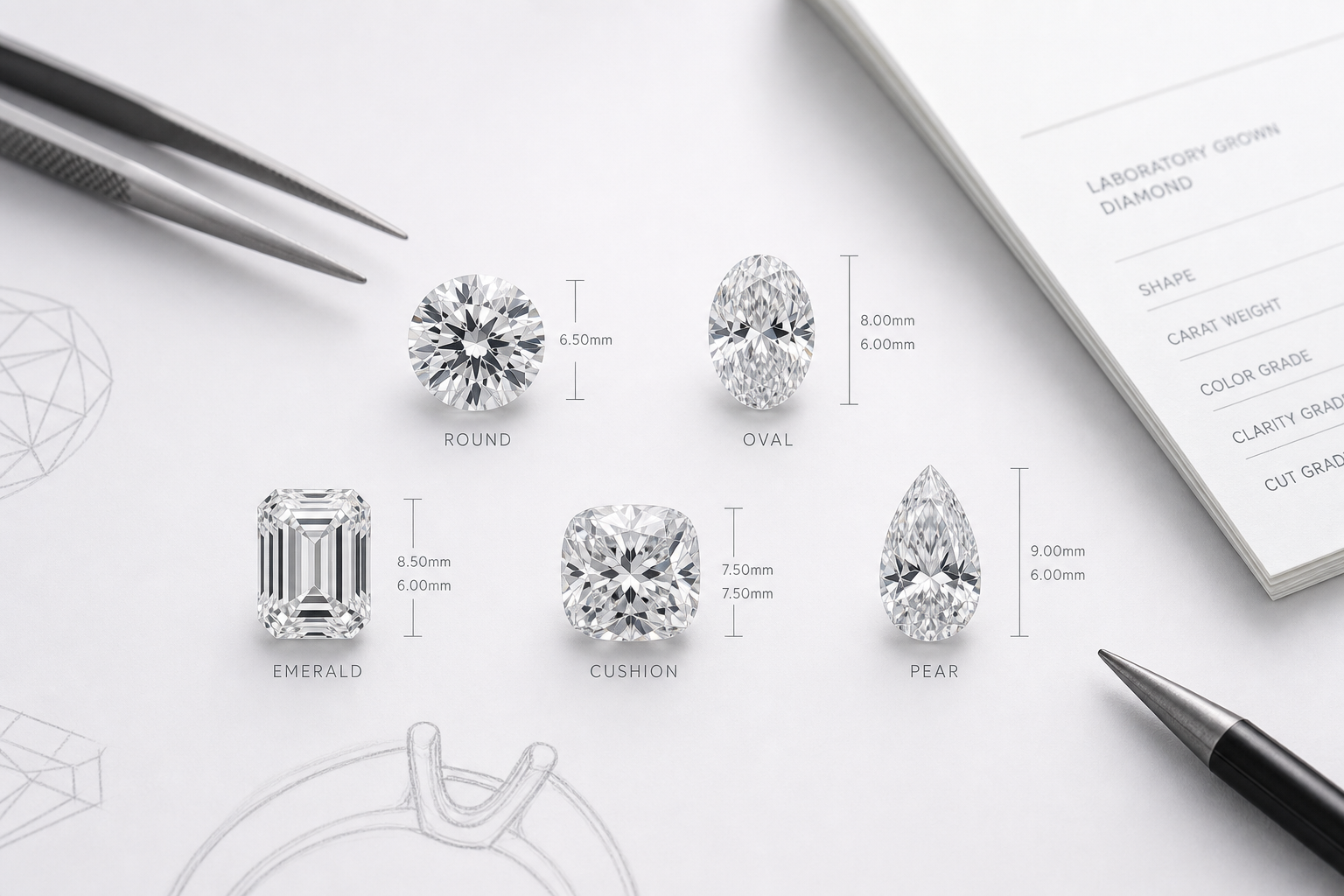
Different shapes create different cutting problems. A round brilliant is usually judged heavily on symmetry, proportions, and light performance. An oval may need a pleasing outline and controlled contrast through the center. A pear shape needs a balanced point, shoulders, and curve. A cushion can vary widely in appearance depending on facet style and outline. An emerald cut depends on clean geometry and attractive step-facet reflections.
This matters because a strong cutting decision for one shape may not apply to another. A buyer choosing an oval should not evaluate it exactly like a round. A buyer choosing an emerald cut should pay closer attention to visual clarity and facet pattern because the broad flashes can make certain characteristics easier to see. Shape changes what “well cut” means in practice.
China lab-grown diamond cutting can support many shapes and production needs, but the buyer still needs to judge the finished result shape by shape. The warning sign is a supplier presenting every stone as equally strong because the color and clarity grades look good. Shape-specific review is where many avoidable mismatches are caught.
Certificate and Visual Review Check
After polishing, a diamond may be prepared for grading and documentation, and awareness of poor supplier red flags can help buyers treat paperwork as only one part of supplier due diligence, but the grading report should not be the only review point. A grading report can help confirm weight, measurements, color, clarity, and other recorded details, but it does not fully show how the stone looks in motion or how well it suits a particular setting.
Before buying, compare the report information with visual evidence. Look at the diamond’s measurements, proportions, shape outline, and video when available. If the stone is intended for a ring or jewelry design, check whether its dimensions fit the setting plan rather than relying only on carat weight.
At NUVU, this is one reason we treat the grading report as a starting point, not the whole decision. Careful buying judgment comes from reading the documentation and then asking whether the polished diamond actually performs well for its intended use.
Sorting, Matching, and Quality Control Decide Whether Stones Are Commercially Usable
Why Sorting Comes After Polishing
Once a lab-grown diamond is polished, the question shifts from whether it is a diamond to whether it is usable for a specific commercial purpose. This is where lab-grown diamond sorting becomes important. A polished stone may be accurately represented, but still be wrong for a matched pair, a calibrated jewelry layout, a wholesale lot, or a private label order if its size, color, shape, or visual character does not fit the requirement.
Sorting happens after polishing because the finished stone’s actual measurements, face-up appearance, polish quality, and usable category are clearer at that stage. Rough planning can estimate the result, but the final stone still needs to be organized by measurable and visible traits. For loose diamonds, sorting may separate stones for individual sale, grading, or inventory. For jewelry production, it determines which stones can be set together without drawing attention for the wrong reason.
The common mistake is treating sorting as a warehouse task. In practice, it is a quality control step. A batch of stones can look acceptable one by one, yet fail when placed side by side in a tennis bracelet, halo ring, pavé band, or matched earring pair. Consistency becomes more important as the stones get smaller and more numerous, because the eye notices unevenness across a layout before it notices the grade of any single melee diamond.
Matching Stones for Pairs, Sets, Melee, and Repeat Orders
Matched lab-grown diamonds require a different standard than single loose stones. A buyer choosing one center stone may care most about cut, proportions, face-up size, and report details. A buyer ordering a pair of studs needs the two stones to look balanced in diameter, color, brightness, and outline. A jewelry brand ordering repeat wholesale lab-grown diamonds needs the next batch to work with the first batch, not just meet a broad product description.
Melee diamonds create the clearest example. Small stones used in halos, pavé bands, side-stone layouts, and fashion jewelry are usually judged as a group. If the stones vary too much in diameter, some seats may look crowded while others leave gaps. If color varies too widely, a section of the jewelry can look uneven under normal lighting. If the cut quality is inconsistent, some stones may go dark while others look bright, even when the size range is technically correct.
Calibrated diamonds also need tighter planning than many first-time buyers expect. A “2.0 mm round” or “3 x 5 mm oval” is not just a label; it is a fit requirement. The tighter the design, the less room there is for variation. This matters in production jewelry because settings may be made before all stones are assigned. If the stone sorting is loose, the setting team is forced to compensate later, which can affect alignment, security, or the finished look.
Practical Tolerance Ranges Buyers Can Discuss
Tolerances should be discussed before an order is confirmed, not after production begins. The right range depends on the design, stone size, setting style, and how visible the stones are to the wearer. A hidden accent stone can usually allow more flexibility than a row of exposed melee across the top of a ring.
For planning conversations, buyers can use ranges like these as starting points rather than universal rules:
- Tightly matched melee layouts: approximately 0.05 to 0.10 mm size tolerance may be appropriate when stones sit close together in a visible row, halo, or pavé surface.
- General accent stones: slightly wider measurement tolerance may be acceptable when stones are less visually connected or the setting design allows more space.
- Visible color matching: keeping stones within a narrow color grade band is usually safer for earrings, side-stone rings, bracelets, and pieces where multiple stones are viewed together.
- Matched pairs: diameter, outline, table appearance, color, and brightness should be reviewed together; carat weight alone is not enough.
- Larger production lots: sampling checks should be agreed in advance, especially when the lot will be divided across multiple SKUs or repeat orders.
The most important point is not the exact number. It is whether the supplier and buyer are using the same definition of “matched.” A loose tolerance may lower sorting pressure, but it can create visible inconsistency later. A very tight tolerance can improve uniformity, but it may increase selection time, reduce available inventory, or change cost expectations. For wholesale lab-grown diamonds, the better decision is usually to define tolerances by the finished product’s visibility, not by a generic grade range.
Buyer Verification Checklist
Before approving sorted stones for inventory, grading, or setting, buyers should confirm that the sorting standard matches the final use. The check should be more specific than asking whether the stones are “good quality.”
- Confirm the required size range in millimeters, not only carat weight.
- Ask how color consistency is controlled for visible sets or layouts.
- Review whether matched pairs are selected by face-up appearance as well as measurements.
- Clarify whether melee diamonds are sorted for layout consistency before setting.
- For repeat orders, confirm whether the next batch will be matched to a sample, previous shipment, or written specification.
- For larger wholesale lots, agree on sampling, photo, video, or inspection checkpoints before shipment.
Sorting prepares polished stones for the next decision point: whether they need third-party grading, internal documentation, direct inventory assignment, or placement into a jewelry production workflow.
Grading Preparation and Certification Add Documentation, but Not the Whole Story
What a Grading Report Can Confirm
After polishing and sorting, some lab-grown diamonds are submitted for grading while others are prepared with internal documentation depending on size, value, buyer requirements, and intended use. Larger center stones are more likely to be sold with a recognized grading report, while small melee diamonds are often handled through batch-level specifications rather than individual reports.
A lab-grown diamond grading report typically confirms basic identifying and grading information such as carat weight, measurements, color, clarity, shape, and lab-grown origin. For round diamonds, cut grade may also be included depending on the grading lab and report type. Reports from labs such as IGI or GIA can also include a report number that allows the buyer to check the document through the issuing lab’s own verification system when available.
The practical value of a grading report is that it narrows uncertainty. It gives the buyer a third-party reference for identity and core grade information, which matters when comparing documented lab-grown diamonds across suppliers. It is especially useful for center stones, higher-value loose diamonds, and orders where documentation must match a retail listing or client approval file.
When a grading report is available, buyers should verify the report details through the issuing laboratory’s official report-check tool where available and compare those details with the stone being offered.
What Certification Does Not Fully Prove
Certification is useful, but it is not a complete buying decision. A grading report does not show every aspect of face-up beauty, every lighting condition, or how the stone will perform in a specific jewelry design. Two stones with similar grades can still differ in spread, contrast, bow-tie visibility, strain appearance, transparency, or overall liveliness.
A report also should not be treated as proof of broad supply-chain claims. It can identify a stone as lab-grown and document grading details, but it does not automatically prove sustainability performance, labor practices, production energy sources, or the full path through cutting and jewelry manufacturing. Those topics require separate documentation and careful supplier communication.
The mistake to avoid is buying the document instead of the diamond. For a single loose stone, the report is an important filter. For jewelry production, it is only one piece of the record. Measurements, matching, setting compatibility, and physical inspection still affect whether the stone works in the final product.
A grading report helps document key characteristics, but it should not be treated as a guarantee of beauty, value, or sourcing ethics. It should be read alongside visual evidence, measurements, seller documentation, and the intended jewelry use.
Why Report Verification and Visual Review Both Matter
Diamond report verification is a basic safeguard. The report number should match the issuing lab’s online database, and the listed details should align with the stone being offered. Buyers should check the report date, measurements, carat weight, shape, and any inscription details when available. A mismatch does not always mean fraud, but it does mean the order should pause until the discrepancy is explained.
Visual review answers a different question: not “what does the report say?” but “does this stone work for this purchase?” Videos, high-quality images, and in-person review where possible help reveal things a document may not make obvious. This is especially important for fancy shapes such as ovals, pears, cushions, emerald cuts, and radiants, where outline, windowing, bow-tie effect, and patterning can strongly affect appearance.
At NUVU, we treat a grading report as the starting point for comparison, not the final answer, because the right diamond still has to fit the buyer’s visual preference, design requirements, and budget together. That distinction matters even more when a stone is being selected for a custom ring or a coordinated production piece.
Documentation Claims Buyers Should Keep Separate
It is helpful to separate three kinds of evidence before approving a stone or jewelry order. A grading report can support identity and grading details for a specific diamond. Production records can support how stones were allocated, matched, and set into finished pieces. Supplier statements about sourcing, environmental claims, or manufacturing responsibility require their own supporting documents and should not be assumed from the grading report alone.
This separation protects both sides of the transaction. The buyer knows which document answers which question, and the supplier avoids overstating what a report or invoice can prove. For example, a report may help confirm that a center stone is lab-grown and matches a listed carat weight, but it does not by itself prove that a batch of rings was produced under a particular energy standard, that all melee came from the same production batch, or that a finished item passed every setting-security check.
How to Verify This Before Buying
- Use the issuing lab’s database to verify the report number and core details.
- Confirm that the carat weight, measurements, shape, and grade information match the offered stone.
- Ask whether the stone has a laser inscription if that matters for the purchase.
- Review clear images or video, especially for fancy shapes and larger center stones.
- Do not rely on grading documentation alone for matching, jewelry fit, or production consistency.
- For wholesale or jewelry orders, confirm how documentation is organized across stones, batches, and finished pieces.
Documentation makes the transaction easier to evaluate, but the stone still has to move into a physical product. Once a diamond is assigned to jewelry, measurements and appearance become part of a larger design and setting decision.
Jewelry Setting Connects Stones, Design, Metalwork, and Wearability
How Loose Stones Become Finished Jewelry
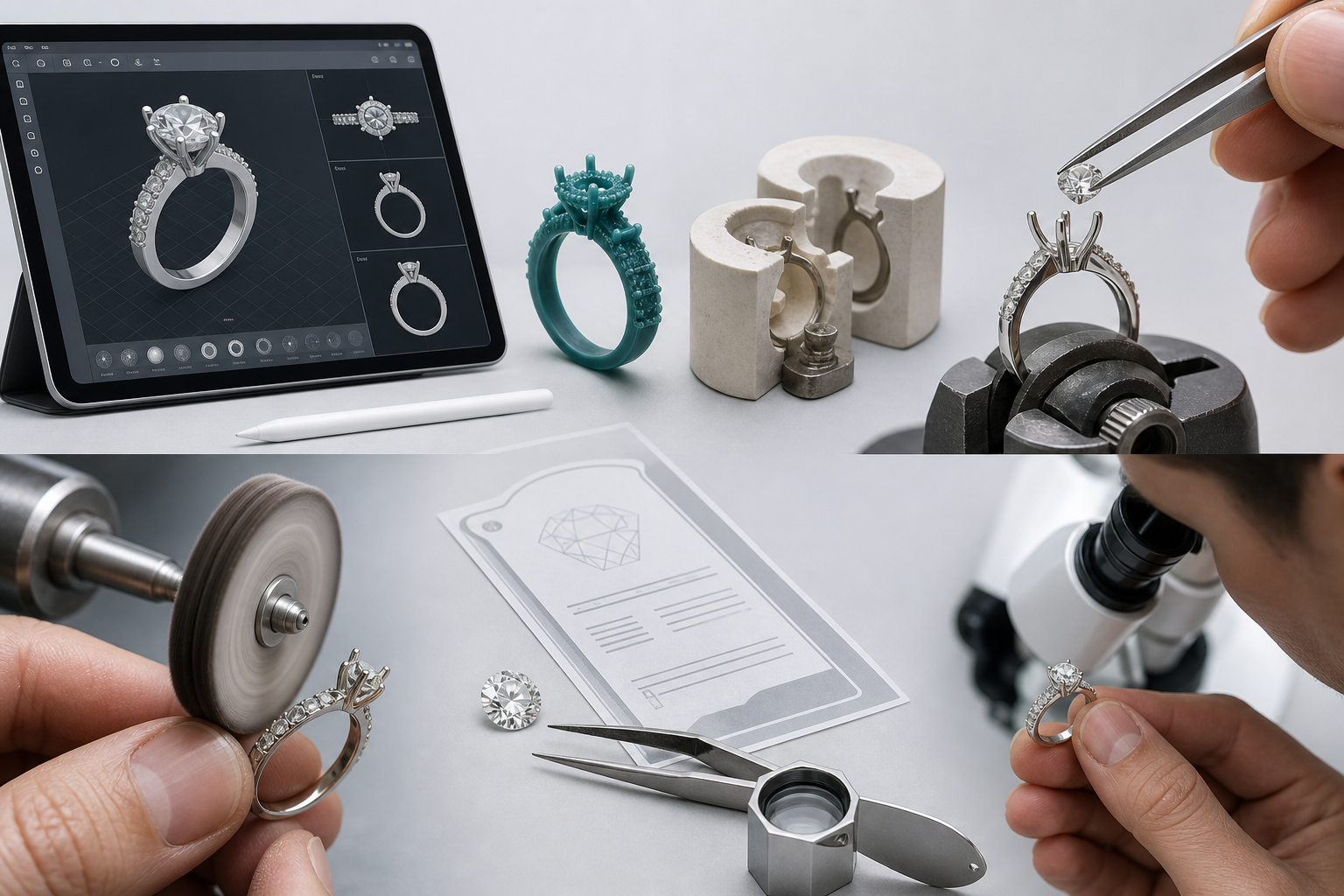
Lab-grown diamond jewelry production begins when a polished stone is connected to a specific design. That shift changes the quality question. A loose diamond can be evaluated by its own measurements, grade, and appearance. Finished jewelry has to be judged by how the stone works with CAD design, casting, metal finishing, stone setting, ring size, balance, and daily wear.
In China diamond jewelry manufacturing, the workflow may include design files, wax or resin models, casting, stone allocation, setting, polishing, inspection, and packaging preparation. Each step can affect the final piece. A strong center stone can still look poorly handled if the prongs are uneven, the halo is misaligned, the shank feels too light for the design, or the finishing around the setting is rough.
The most important difference is that jewelry production introduces fit risk. Loose diamond sourcing asks whether the stone is attractive and accurately represented. Lab-grown diamond setting asks whether that stone can be held securely, sit at the right height, align with surrounding stones, and support the intended look without creating wear problems.
Why Stone Measurements Matter in Setting
Carat weight alone is not enough for setting. A 1.50 carat oval, for example, can vary meaningfully in length, width, and depth. Those measurements affect prong placement, basket proportions, halo spacing, and how the ring looks on the finger. For step cuts, depth and corner shape can affect how the stone sits in the mounting. For pears and marquise shapes, tip protection becomes part of the durability conversation.
Small stones create their own problems. Melee diamonds that are slightly inconsistent may not seem important on a stone list, but they can make a pavé row look uneven once set. If stones are too large for the seats, setting pressure can increase risk. If they are too small, the finished surface can show gaps or weak alignment. This is why calibrated diamonds and matched melee need to be reviewed before production moves too far.
Metal choice also affects setting decisions. Platinum, 14k gold, and 18k gold behave differently during fabrication and wear. Delicate designs may look refined in renderings but require enough metal in the right places to protect the stones. A design that prioritizes minimal metal at all costs can create maintenance problems later, especially for rings worn every day.
For custom design, trust comes from matching the stone to the setting, budget, and wearer’s daily use, not from choosing grades in isolation. A well-documented custom order should connect the selected stone’s actual measurements to the CAD file, setting style, and final inspection notes so the buyer can see how the design decision was made.
Custom Pieces Versus Repeat Production Jewelry
Custom lab-grown diamond jewelry and repeat production jewelry require different controls. A custom engagement ring usually depends on design approval, exact center stone measurements, finger size, lifestyle considerations, and proportion checks before production. A sound decision is not simply choosing the largest stone that fits the budget; it is choosing a stone and setting combination that will look balanced and hold up to wear.
Repeat production jewelry has a different challenge: consistency. A private label ring, pendant, or bracelet must be made again and again with the same visual standard. This requires clear specifications for stone size, color range, setting style, metal weight expectations, finish quality, and packaging requirements. A sample can look right while the production run drifts if tolerances are not documented.
For custom design conversations, our team usually looks at the stone and setting together because a diamond with strong grades can still be the wrong physical fit for a specific mounting. That is where measurement review, CAD approval, and realistic wear expectations matter more than a grade sheet alone.
For custom jewelry, stone measurements and setting compatibility should be confirmed before finalizing a purchase. Buyers should also confirm metal selection, setting style, design approval steps, and any seller-specific policies directly with the seller rather than assuming that a custom project includes particular service terms.
Stone-to-Setting Fit Check
- Confirm the stone’s length, width, depth, and girdle profile before finalizing the setting.
- Check that prongs, bezels, or seats are designed for the actual stone, not just the nominal carat weight.
- Review melee size consistency before setting halos, pavé bands, or multi-stone layouts.
- Make sure the design has enough metal support for the way the piece will be worn.
- Inspect stone security, alignment, prong finish, surface polish, and symmetry after setting.
- For repeat jewelry production, compare finished pieces against the approved sample and written specification.
A finished piece succeeds when the stone, setting, and production standard are aligned. That alignment becomes even more important when the project moves from one custom item to wholesale or private label production.
Wholesale and Private Label Production Depend on Coordination, Not Just Inventory
Why Loose Stone Supply and Jewelry Production Are Different Buying Models
Buying loose lab-grown diamonds and producing finished jewelry are related, but they are not the same commercial problem. A loose stone order is mainly about availability, grading details, measurements, matching, and documentation. A finished jewelry order adds metalwork, setting tolerances, design repeatability, finishing, packaging, and delivery coordination.
This distinction matters most when the buyer needs consistency across multiple pieces. A supplier may have enough polished stones in inventory, but that does not mean those stones are ready for a private label jewelry run. The stones still need to fit the design, match the intended look, and move through production without creating avoidable delays. For wholesale lab-grown diamonds, inventory depth is useful. For private label lab-grown jewelry, coordination is usually the bigger test.
Separate loose stone sourcing can be the better model when a buyer wants tighter control over each center diamond, especially for higher-value pieces where individual stone selection matters. Integrated jewelry production can be more efficient when the priority is repeatability across many units. The tradeoff is clear: separate sourcing gives more inspection control, while one coordinated production workflow reduces handoffs but requires sharper specifications from the beginning.
How Private Label Orders Add Complexity
Private label production turns a diamond order into a system. The buyer is no longer asking only for stones; they are asking for a repeatable product that can be sold under a consistent brand presentation. That may include the same ring profile across several sizes, the same melee appearance across multiple batches, the same center stone options, and consistent documentation for each finished piece.
The complexity increases because each decision affects the next one. A small change in center stone measurements can affect the setting. A slightly different melee size can change the look of a halo or band. A metal weight adjustment can change both cost and durability. A packaging or labeling requirement can slow fulfillment if it is not built into the production plan early.
For OEM lab-grown jewelry, a strong production setup is not simply the one with the largest catalog. It is the one that can keep specifications stable from sample approval to batch production. A beautiful sample is not enough if the second, third, and fourth production runs drift in stone matching, prong work, finish, or documentation.
In sourcing or wholesale conversations, documentation, consistency, and communication often matter as much as the headline specification, especially when evaluating a China lab grown diamond supply chain for repeat production. A buyer should know whether the supplier is working from a written specification, an approved sample, a previous batch reference, or a loose description. The more repeatable the order needs to be, the more important it is to document the reference standard before production begins.
A Realistic Scenario: Coordinating a Small U.S. Jewelry Brand Production Run
Consider a small U.S. jewelry brand preparing a 50-piece private label ring run. The design uses matched 1.5 mm lab-grown diamond melee along the band, with three center stone options: 1.00 carat oval, 1.50 carat round, and 2.00 carat cushion. The brand has two possible production paths.
In the first path, the brand sources loose stones from one supplier, sends them to a separate jewelry manufacturer, and manages documentation, stone allocation, and setting instructions internally. This can give the brand more control over individual center stone selection, especially if each ring is sold at a higher price point and the customer expects detailed stone comparison. The weak point is coordination. If center stone dimensions vary more than expected, settings may need adjustment. If melee parcels do not match well enough, the finished rings may look inconsistent even though each stone is technically usable.
In the second path, the brand works with a lab-grown diamond supplier in China that can coordinate stones, setting, production timing, and batch documentation through one workflow. This may reduce back-and-forth and make the project easier to manage, especially for repeatable SKU production. The tradeoff is that the brand must define requirements more precisely before production starts. Vague instructions such as “good quality melee” or “nice oval centers” are not enough for a controlled private label order.
A practical specification for this kind of run might include center stone size ranges, acceptable color and clarity bands, melee diameter tolerance, metal type, ring sizes, sample approval steps, report requirements, packaging details, and how substitutions are handled. Without those details, the buyer may save time at the start and lose it later during inspection, correction, or customer service.
What This Means in a Real Purchase
For a one-off custom ring, it often makes sense to choose the center diamond first and build the setting around it. For wholesale or private label production, the better approach is usually to define the finished product standard first, then source stones and production around that standard. That shift prevents a common mistake: treating a production order like a collection of individual diamond purchases.
In wholesale conversations, our team pays close attention to consistency and documentation because a low unit price does not help much if matching, communication, or production repeatability becomes unpredictable. Buyers should be especially careful when comparing a loose diamond quote against a finished jewelry quote. The lower-quoted option is not always the better value if it leaves the buyer responsible for coordination that the quote does not include.
When grading reports are used, buyers should verify report details through the issuing laboratory’s official tools where available. For finished jewelry, buyers should also reconcile the report, stone allocation record, and final item details rather than assuming the paperwork alone confirms the full production path.
For buyers comparing manufacturing partners, a useful trust signal is not a dramatic promise but a clear record trail. A reliable workflow should make it possible to connect the approved specification, the selected stones, the grading documents where used, the finished item, and the packing list without confusion. This is especially important when one shipment includes multiple center stone sizes, several ring sizes, or similar SKUs that could easily be mixed during production.
NUVU’s role in this kind of project is most useful when the buyer needs selection support rather than only a price list. That support can include clarifying whether a stone should be individually documented, whether melee can be handled through batch specifications, how tight the matching tolerance should be, and whether the design requires a sample before full production. These practical checkpoints give the buyer more confidence because they reduce ambiguity before money, materials, and production time are committed.
When finished jewelry is involved, trust also depends on communication after selection. Buyers should expect plain explanations when a requested specification is difficult, when a substitute stone changes the visual result, or when a setting needs adjustment to fit the actual measurements. A supplier that explains these limits early is usually easier to work with than one that agrees to every request and leaves the conflict for final inspection.
Pricing, Value, and Quote Comparisons Need Like-for-Like Review
Prices can vary because of cut precision, report type, seller channel, size, shape, availability, metal choice, setting complexity, packaging requirements, and documentation. Buyers should compare like-for-like specifications before treating one stone or finished jewelry quote as a better value. A loose stone quote, for example, may not include design coordination, setting labor, melee sorting, sample approval, reporting, packaging, or final reconciliation.
Prices can change with market conditions, report type, seller channel, and stone-specific details, so exact comparisons should be verified at the time of purchase. For wholesale or private label orders, the useful question is not only “What is the unit price?” but also “What is included in that unit price, what is excluded, and what records will prove that the finished order matches the approved specification?”
Quality Control Has to Happen at Several Points, Not Only at Final Inspection
QC Before and After Cutting
Lab-grown diamond quality control starts before the stone becomes finished jewelry. At the rough and planning stage, the concern is whether the material can realistically produce the intended polished result. After cutting and polishing, the concern changes: the stone must be checked for measurements, shape outline, weight, finish, and whether the final appearance matches the order requirement.
The important judgment here is that final inspection cannot fix a poor earlier decision. If a stone was cut to maximize carat weight at the expense of proportions, later documentation may record the finished result, but it will not make the diamond look better. If measurements are outside the range needed for a specific setting, the problem becomes a production issue, not just a diamond issue.
For loose stones, post-polish QC should confirm details such as actual measurements, shape consistency, girdle condition, polish, symmetry, and visible appearance. For jewelry production, those measurements matter because they determine whether a stone will sit securely and look balanced in the mounting. A diamond can be acceptable as a loose stone and still be inconvenient or unsuitable for a specific production setting.
QC During Sorting and Documentation
Sorting and documentation checks are where many wholesale problems are either prevented or allowed to grow. A parcel of stones may look acceptable at first glance, but batch consistency depends on details: size spread, color range, clarity mix, shape outline, and whether the stones are allocated correctly to the intended pieces.
Documentation also needs to be reconciled before shipment, not after a problem appears. Report numbers should match the correct stones. Stone counts should match the invoice and production order. If documented center stones are included, the buyer should be able to connect each report to the correct finished item or loose stone package. This is especially important when an order includes multiple center stone sizes or several SKUs that look similar on paper.
The most common mistake is treating paperwork as separate from physical inspection. A grading report helps confirm important details for an individual stone, but it does not confirm that the right stone was set into the right ring, that melee was matched correctly, or that the finished order matches the approved sample. Documentation supports QC; it does not replace it.
Traceability Across Production Handoffs
Traceability is strongest when each stage leaves a record that can be connected to the next stage. For a loose documented center stone, that may mean report details, stone measurements, visual files, and allocation notes. For a jewelry order, it may also include CAD approval, stone assignment, setting photos, SKU labels, ring sizes, and packing records. The point is not to create unnecessary paperwork; it is to make sure the buyer can understand which stone or batch went into which finished product.
This matters because many production problems are not caused by one obvious defect. They come from handoff errors: a center stone allocated to the wrong mounting, melee sorted under one tolerance but set under another, or a finished ring packed with the wrong report. A traceable workflow helps identify whether the issue came from sorting, documentation, setting, labeling, or final reconciliation.
QC After Setting and Finishing
Once stones are set, quality control becomes more practical and wear-focused. The question is no longer only whether the diamonds are correctly described. The finished jewelry must be secure, cleanly finished, comfortable to wear, and consistent with the approved design.
Post-setting inspection should look at prong position, stone security, melee alignment, surface finish, ring size, engraving accuracy if applicable, and whether any stones were damaged or loosened during setting. For pavé, halo, and multi-stone designs, alignment problems can be more visible than small grade differences. A ring with well-matched diamonds can still fail commercially if the setting work looks uneven.
Final packaging checks also matter for wholesale and private label orders. The product, report, label, SKU, size, and packaging should match before shipment. If this reconciliation is skipped, the buyer may receive technically finished jewelry that creates avoidable inventory confusion, especially when several similar designs are produced in one batch.
Evidence Records That Make QC Easier to Audit
For larger or repeat orders, buyers should ask what evidence will exist at each checkpoint before production begins. Useful records may include approved CAD files, sample approval photos, stone allocation sheets, size and color range notes, report-number lists for documented stones, pre-setting inspection photos, final product images, and packing lists that connect SKUs to the correct pieces. These records do not need to be complicated, but they should be organized enough that a later issue can be traced to a specific handoff.
The goal is not to create paperwork for its own sake. The goal is to prevent vague disputes. If a pavé band arrives with uneven melee, the buyer and supplier need to know whether the issue came from stone sorting, seat preparation, setting work, or final inspection. If a documented center stone is assigned to the wrong ring, the problem is not the grading report; it is the allocation control. Clear records make correction faster and reduce the chance that the same problem repeats in the next batch.
Buyer Verification Checklist
- Before cutting or sourcing: Confirm the intended shape, size range, quality band, and whether stones are for loose sale or setting.
- After polishing: Check measurements, weight, appearance, finish, and whether the stone fits the intended use.
- Before setting: Confirm melee consistency, center stone allocation, ring size requirements, and approved sample details.
- After setting: Inspect stone security, prong work, alignment, metal finish, and comfort-related details.
- Before shipment: Reconcile reports, invoices, SKUs, packaging, stone counts, and finished item labels.
The strongest QC process is staged because different problems appear at different points. A final inspection is still necessary, but it should be the last confirmation, not the first serious check.
Why Buyers Should Evaluate China Manufacturing by Fit, Not Stereotype
When Integrated Manufacturing Can Be Useful
China lab-grown diamond manufacturing can be useful when the buyer needs coordination across stones, settings, batches, and documentation. This is where an integrated supply base can offer practical advantages: access to polished stones, matching capability, jewelry production, sampling, and repeat orders can be managed within a more connected workflow.
That model is especially relevant for wholesale buyers, private label programs, and brands managing multiple SKUs. If a buyer needs 100 similar rings, matched melee, several center stone options, and consistent packaging, the challenge is not only finding diamonds. The challenge is keeping the product stable from order to order. A manufacturing partner that understands both diamonds and jewelry production may reduce the friction that comes from passing stones between unrelated vendors.
Integrated manufacturing is less important when the buyer wants a single exceptional loose stone and plans to make a highly individualized purchase decision. In that case, stone selection, grading details, visual review, and setting compatibility may matter more than production scale. The right model depends on the job the buyer needs the supplier to perform.
Where Buyers Still Need Caution
China should not be evaluated through a simple “cheap” or “risky” stereotype. Both views are too blunt to be useful. The real issue is whether the supplier’s process matches the buyer’s requirements. A low quote can become expensive if specifications are vague, tolerances are unclear, documentation is inconsistent, or after-sales expectations are not discussed before production.
Communication is often the difference between a workable manufacturing relationship and a frustrating one. Buyers should define quality bands, measurement requirements, substitution rules, sample approval standards, documentation needs, and what happens if a batch does not match the agreed specification. If those points are left informal, both sides may believe they understood the order while expecting different results.
The biggest risk is not that every supplier will produce poor work. The bigger risk is assuming that inventory access equals production reliability. A supplier may be strong in loose stones but weaker in finished jewelry coordination, or strong in standard designs but less suitable for custom engineering. Fit matters more than country-level assumptions.
The Questions That Separate Serious Evaluation From Price Shopping
A serious evaluation starts with the intended use. Is the buyer sourcing documented loose lab-grown diamonds, calibrated melee, custom engagement rings, wholesale jewelry, or private label production? Each model requires different controls. Asking only for the lowest price per carat or per piece skips the details that determine whether the order will actually work.
Better questions focus on process and accountability. Can the supplier maintain the same melee range across repeat orders? How are center stones allocated to finished pieces? What documentation accompanies each item? Are samples approved before full production? What happens if the final batch differs from the approved sample? These questions reveal more about supplier reliability than a polished product photo.
For diamond sourcing from China, a sound decision is not automatically the lowest-cost option or the most vertically integrated option. A sound decision is the one where the supplier’s strengths match the buyer’s actual risk: stone selection, matching, production repeatability, documentation, communication, or finished jewelry inspection.
How to Handle Claims That Need Proof
When comparing suppliers, buyers should pay close attention to claims that sound specific but arrive without support. Statements about exact price advantage, grading superiority, environmental performance, exclusive supply, or guaranteed consistency across future batches should be treated as claims to verify, not as buying facts. A careful supplier should be able to explain what the claim means, what document supports it, and where the limits are.
This is especially important for lab-grown diamond jewelry because several kinds of evidence can be mixed together in the sales process. A grading report supports the identity and grades of a stone, not the quality of metalwork. A product photo shows appearance, not repeatability across a production run. A sample proves that one item can be made, not that every later batch will match unless the specifications and inspection process are controlled. Separating these claims makes the buying decision more defensible.
Sustainability claims should also be handled with the same discipline. Broad green language is less useful than specific information about production context, energy use where disclosed, materials, documentation, and the limits of what a supplier can actually substantiate. A lab-grown origin may be relevant to the conversation, but it should not be treated as proof of every environmental or responsibility claim by itself.
Environmental and sustainability claims should be specific, documented, and limited to what can be substantiated. Lab-grown diamonds may appeal to buyers looking for an alternative to mined origin, but buyers should still ask what a seller can document about production practices, energy use, materials, and sourcing statements before relying on any broad environmental claim.
How to Verify This Before Buying
Before committing to a China lab-grown diamond supplier or manufacturing partner, buyers should compare the supplier’s offer against the complexity of the order. A loose stone purchase may need report verification, videos, measurements, and visual review. A private label order may need sample approval, tolerance sheets, batch documentation, packaging confirmation, and staged inspection.
The practical standard is simple: the more repeatable the order needs to be, the more specific the specifications must become. If a supplier can only discuss price but not matching, documentation, production checkpoints, or how exceptions are handled, the buyer is not yet evaluating a manufacturing system. They are only comparing inventory.
China’s lab-grown diamond supply chain can be a strong fit for buyers who need scale, coordination, and production flexibility. It still requires careful verification. Careful buying decisions come from matching the production model to the purchase type, then confirming that every important handoff is visible before the order moves forward.
For documented loose stones, buyers may request report-number review, stone-detail reconciliation, and documentation checks before shipment where applicable.
For finished jewelry and private label orders, production documentation should be matched to the approved sample, stone allocation record, and final packing list so the buyer can review the order with confidence.
Disclosure: This article is for general educational purposes only. Diamond grading, pricing, availability, specifications, and seller policies can change, and readers should verify important details through grading reports, official laboratory tools, seller documentation, or qualified professionals before making a purchase decision. Laboratory-grown diamonds should be clearly distinguished from natural diamonds, and environmental or sourcing claims should be supported by specific documentation.