
For the full framework, read What Are Lab-Grown Diamonds? A Complete Guide.
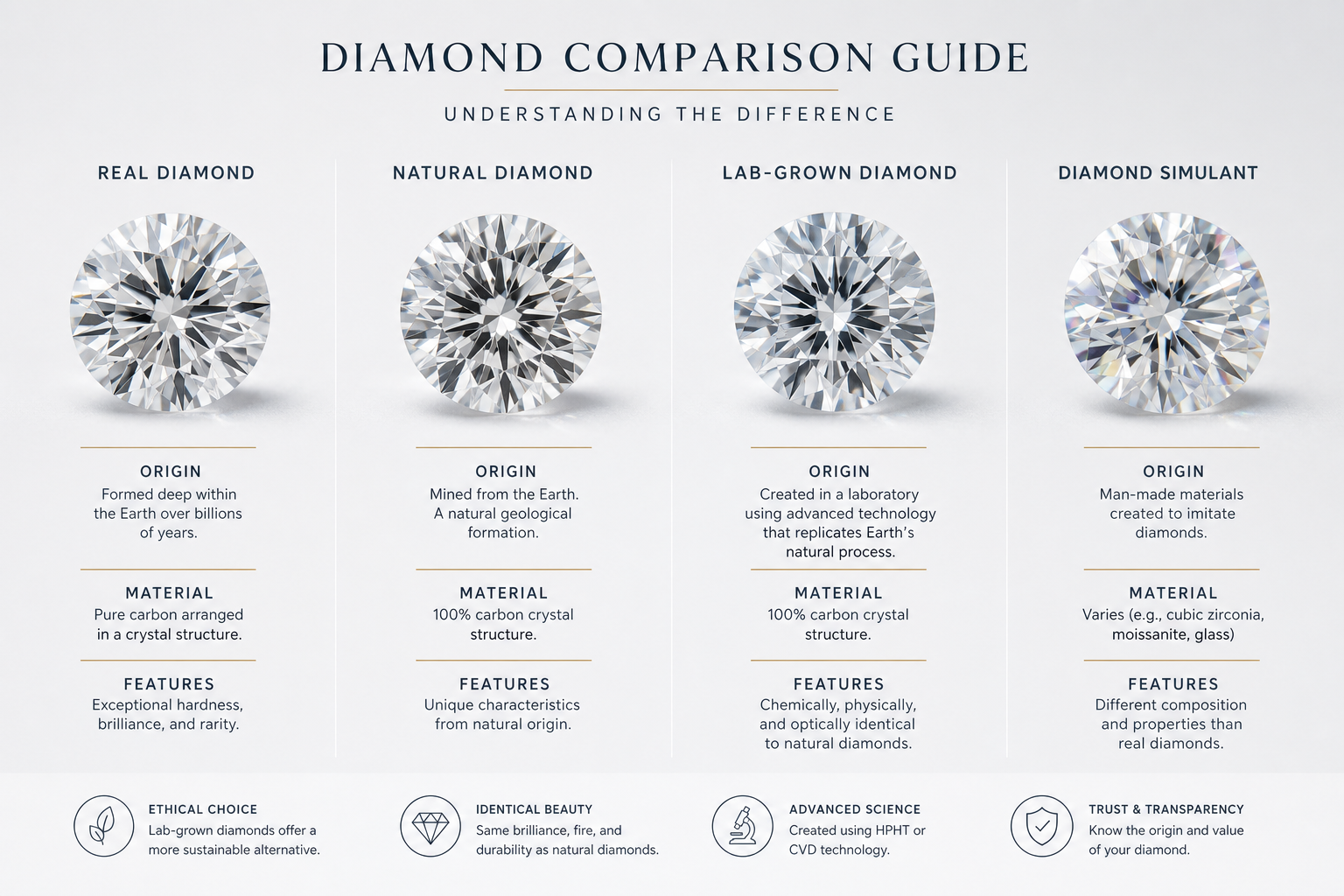
Many buyers get stuck on one confusing question: if a diamond is grown in a lab, is it still a real diamond? The answer depends on separating three ideas that are often mixed together: material, origin, and imitation. A lab-grown diamond is real diamond material, while a natural diamond is real diamond material formed underground. A simulant, such as moissanite or cubic zirconia, may look similar but is not diamond.
This distinction matters because it affects price, documentation, durability, resale expectations, and how confidently you can compare jewelry options. The article helps you judge what a seller is actually offering, how to read terms like “lab-created” or “diamond alternative,” and when to rely on grading reports instead of appearance alone. By the end, the decision is less about whether one category is universally better and more about which origin, budget, look, and level of disclosure fit your purchase.
| Buyer Question | What to Check | Practical Meaning |
|---|---|---|
| Is it real diamond? | Material listed as diamond, not only “diamond-like” | Lab-grown and natural qualify; simulants do not |
| Is it natural or lab-grown? | Origin disclosure on listing and grading report | Origin affects price, tradition, and resale expectations |
| Is it a simulant? | Terms like moissanite, cubic zirconia, or alternative | Can be valid, but should not be priced or sold as diamond |
| Will it wear well daily? | Hardness and material durability | Diamond is highly scratch-resistant; CZ may show wear sooner |
| Can the claim be verified? | Report number, 4Cs, measurements, and stone match | Documentation helps confirm identity and avoid mislabeling |
Quick Questions Before You Read
Q: Are lab-grown diamonds fake?
No. They are real diamonds by material, but their origin is a controlled lab setting rather than the earth.
Q: Is moissanite the same as a lab-grown diamond?
No. Moissanite is a different material and should be treated as a diamond alternative.
Q: Can a diamond tester prove a diamond is natural?
Usually not. A tester may confirm diamond material, but origin should be verified through proper documentation.
Q: Should I choose natural or lab-grown?
Choose based on what matters most: mined origin, size, budget, documentation, long-term expectations, or appearance.
The Short Answer: Lab-Grown Diamonds Are Real Diamonds
Yes, lab-grown diamonds are real diamonds. They are not diamond look-alikes, coated stones, or imitation gems. A lab-grown diamond is diamond material grown in a controlled setting instead of formed underground over geological time.
The confusion usually comes from one word being used in several different ways. In everyday shopping language, people often use “real” to mean natural, expensive, traditional, or emotionally meaningful. In diamond language, the better question is more specific: is the stone actually diamond material, or is it something else made to resemble diamond?
Real Describes the Material, Not the Origin
A real diamond is defined by what it is made of, not where it came from. If a stone has the material structure of diamond, it is a diamond. That can be true whether the diamond formed deep in the earth or was created in a laboratory environment.
This distinction matters because shoppers can otherwise make the wrong comparison. The opposite of “lab-grown” is not “real.” The opposite of lab-grown is natural or mined. The opposite of real diamond is a non-diamond material being represented as diamond, or a diamond alternative that only looks similar.
Lab-Grown Means Created in a Controlled Setting, Not Imitation
“Lab-grown,” “lab-created,” and “laboratory-grown” describe the origin of the stone. They do not mean the stone is fake. A lab-created diamond is grown using conditions designed to produce diamond material, which is why it can be cut, graded, and set in jewelry like a mined diamond.
The most useful buyer takeaway is simple: lab-grown tells you how the diamond was made. It does not automatically tell you whether the stone looks beautiful, whether it is well cut, whether it is fairly priced, or whether it is the right choice for a ring. Those are separate buying questions.
A Documentation-First Way to Use the Word “Real”
When a seller says a stone is a “real diamond,” the claim should be backed by more than reassuring language. The listing should identify the material as diamond, disclose whether the origin is natural or lab-grown, and, for graded stones, connect the stone to a report or other documentation that matches the details being advertised. This does not mean every small piece of jewelry needs a full grading dossier, but the more important the purchase, the more important the evidence becomes.
This is especially helpful online because photos and videos can make different stones look similar. A natural diamond, a lab-grown diamond, and a diamond simulant may all appear bright in a product image, but they are not the same purchase. Clear material language, origin disclosure, and matching documentation reduce the risk that a buyer is relying on appearance alone.
Natural Diamonds and Lab-Grown Diamonds Can Both Be Real
Natural diamonds and lab-grown diamonds can both be real diamonds. The difference is origin. A natural diamond formed underground and was mined from the earth. A lab-grown diamond formed in a controlled production environment and entered the jewelry market through a different supply path.
That origin difference can matter to buyers. Some people value the geological history of a natural diamond. Others prefer the size, clarity, or budget flexibility that a lab-grown diamond may allow. Neither preference changes the basic terminology: natural diamonds are real diamonds, and lab-grown diamonds are real diamonds.
In practical buying, this is where many comparisons become misleading. A seller may emphasize “real,” “natural,” “created,” or “alternative” depending on what they are selling, but those words should not replace the more basic checks: what is the stone made of, how was it formed, and how is that claim documented? Clear answers to those questions are more useful than a broad label that sounds reassuring.
What to Remember Before You Compare Stones
Before comparing prices, reports, or ring styles, separate the language into two questions. First, is the stone actually diamond? Second, if it is diamond, is it natural or lab-grown?
This prevents the most common beginner mistake: treating “lab-grown” and “fake” as the same category. They are not. A lab-grown diamond should be compared with natural diamonds as a different origin of diamond, not grouped with materials that only imitate diamond.
Why the Words Real, Natural, and Fake Get Confused
The words “real,” “natural,” and “fake” get confused because they are often used casually in jewelry ads, social media comments, and everyday conversation. A shopper may hear one person call a lab-grown diamond “real,” another call it “synthetic,” and another call it “not natural,” then assume those statements all mean the same thing. They do not.
Clear diamond terminology makes shopping easier. “Real” is about material identity. “Natural” is about origin. “Fake” usually refers to a non-diamond stone, or to a seller presenting one type of stone as another. Once those meanings are separated, the category becomes much less confusing.
Real Diamond: A Stone Made of Diamond Material
A real diamond is a stone made of diamond material. This includes both natural diamonds and lab-grown diamonds. The practical point for a buyer is that “real diamond” should answer the question of material, not the question of origin.
This is why the phrase “real vs natural diamond” can be misleading. Natural diamonds are real, but they are not the only stones that can be real diamonds. If a product listing says “diamond,” the next useful question is whether it is natural or lab-grown, not whether lab-grown diamonds are real in the first place.
Natural Diamond: A Real Diamond Formed Underground
A natural diamond is a real diamond that formed underground through natural geological processes. It is sometimes called a mined diamond because it must be recovered from the earth before it reaches the jewelry market.
For some buyers, natural origin carries emotional or traditional value. For others, origin matters less than appearance, size, documentation, or budget. The mistake is assuming “natural” means better in every buying situation. Natural tells you where the diamond came from; it does not guarantee stronger sparkle, better cut, or a smarter purchase.
Fake Diamond: Usually a Simulant or a Misrepresented Stone
A fake diamond is usually either a diamond simulant or a misrepresented stone. A simulant is a different material that is made or chosen to resemble diamond, such as moissanite or cubic zirconia. These stones can be attractive and intentional choices, but they are not diamonds.
The word “fake” is most useful when there is confusion or misrepresentation. If a seller clearly labels a stone as moissanite, it is not “fake” in the sense of being dishonest; it is a diamond alternative. The problem begins when a non-diamond stone is described or sold as diamond, or when vague wording makes the buyer believe they are getting something they are not.
A Simple Shopping Language Rule
Use “real” for material, “natural” for origin, and “simulant” for a diamond-like alternative. That one rule prevents most terminology mistakes before they become expensive buying mistakes.
The word “synthetic” can add another layer of confusion. In technical or grading contexts, it may refer to a lab-grown diamond because the diamond was created rather than mined. Many shoppers hear “synthetic” and think “fake,” but that is not the right practical reading. A synthetic or lab-grown diamond can still be diamond material; the key is that it must be disclosed accurately.
Lab-Grown Diamonds vs Natural Diamonds: What Is Actually Different?
The main difference between lab-grown diamonds and natural diamonds is origin. Both can be real diamonds. The question is whether the diamond formed underground and was mined, or whether it was grown in a controlled setting and disclosed as lab-created.
For buyers, this distinction matters because origin can affect price patterns, availability, report language, and personal preference. It does not automatically decide beauty. A poorly cut natural diamond can look dull, and a well-cut lab-grown diamond can look lively. The same is true in reverse. The origin label should start the comparison, not finish it.
The Main Difference Is Origin
A natural diamond has a natural diamond origin: it formed in the earth and entered the market through mining. A lab-grown diamond was created through a controlled growth process and entered the market through a different production and distribution path.
This difference is meaningful, but it should not be exaggerated into a material divide. Lab-grown diamonds are not a separate look-alike category. They are diamonds with a different origin story. If a buyer wants a mined diamond specifically, natural origin is essential. If the buyer mainly wants diamond material, visual size, and strong documentation, lab-grown may fit the goal more directly.
Both Can Be Graded by the 4Cs
Natural and lab-grown diamonds can both be evaluated by the 4Cs: cut, color, clarity, and carat weight. These grades help describe important characteristics, but they do not make every diamond with similar grades look identical. Cut quality, proportions, shape, and visual performance still matter in the final appearance.
This is a common place where beginners over-focus on origin and under-focus on the actual stone. A natural diamond is not automatically beautiful because it is natural. A lab-grown diamond is not automatically a strong buy because it may fit a budget more comfortably. The smarter approach is to compare the origin label alongside the grading details and the way the stone actually looks.
A grading report is useful because it gives shared language for comparison, but it does not show everything a buyer will notice on the hand. Two diamonds with similar color, clarity, and carat weight may face up differently because of proportions, shape, cut precision, or how inclusions are positioned. For buyers, the practical point is not just what the report says, but how the stone performs visually and fits the intended design.
When a grading report is available, buyers should verify the report details through the issuing laboratory’s official report-check tool where available.
What the Report Does Not Decide
A grading report is useful, but it is not a verdict on taste. It cannot tell you whether a stone feels lively in motion, whether the proportions suit a delicate setting, or whether the size will look right on the wearer’s hand. Those judgments still depend on images, video, dimensions, and the piece itself.
That is why careful buyers treat report data as one layer of evidence. The report can narrow the field; the setting design, finish, and intended use decide the final choice. This is especially important for lab-grown diamonds, where high grades can still describe stones that feel very different once mounted.
Why Price and Availability Often Differ
Lab-grown diamonds may be priced differently from comparable natural diamonds, depending on the seller, market conditions, shape, size, quality, and report details. When comparing lab-grown diamond buyer profiles, that price difference is one reason lab-created diamonds are common among shoppers who want a larger center stone or higher color and clarity within a specific budget.
Lower price should not be treated as automatic value. A larger diamond with weak cut quality may be less satisfying than a smaller stone with stronger light performance. Availability can also shape the decision. In some sizes, shapes, and quality ranges, lab-grown diamonds may offer more options quickly, while natural diamonds may appeal more to buyers who prioritize rarity, tradition, or mined origin.
Be Careful With Broad Sustainability Claims
Lab-grown and natural diamonds are sometimes compared through environmental or ethical language, but buyers should be careful with broad claims such as “eco-friendly,” “sustainable,” or “conflict-free” unless the seller explains exactly what is being claimed and how it is supported. A lab-grown origin is a real origin distinction, but it does not automatically prove a specific environmental outcome. A natural origin is also a real origin distinction, but it does not automatically answer every question about sourcing practices.
The more reliable approach is to ask for specific, limited information: how the origin is disclosed, what documentation accompanies the stone, what the seller can substantiate about sourcing or production, and whether any environmental claim is clearly defined. For a buyer, vague virtue language is less useful than transparent documentation and careful wording.
If a seller discusses responsible sourcing or environmental context, ask what is actually documented: production energy, supply-chain disclosure, or the lab-grown versus mined origin distinction. Specific wording is easier to evaluate than broad environmental language.
Why One Is Not Automatically Better for Every Buyer
Neither natural nor lab-grown is automatically better for every buyer. The better choice depends on what the buyer is trying to protect: origin preference, budget, size, documentation clarity, emotional meaning, or long-term expectations.
A natural diamond may be the better fit for someone who specifically wants a mined stone and values geological origin. A lab-grown diamond may be the better fit for someone who wants diamond material and would rather allocate budget toward size, setting design, or a higher grade range. The wrong choice is not choosing one category over the other; it is buying under the wrong assumption.
What This Means in Practice
In a real purchase, ask two questions before comparing individual stones: do you want diamond material, and does mined origin matter to you? If mined origin matters, focus on natural diamonds and verify that the documentation supports that claim. If diamond material matters more than origin, lab-grown diamonds deserve a direct comparison rather than being dismissed as fake.
Once that preference is clear, the practical work becomes easier: compare the stone’s cut, color, clarity, carat weight, report, appearance, and suitability for the jewelry piece. Origin is important, but it is only one part of a diamond decision.
Lab-Grown Diamonds vs Moissanite and Cubic Zirconia
Moissanite Is Not a Lab-Grown Diamond
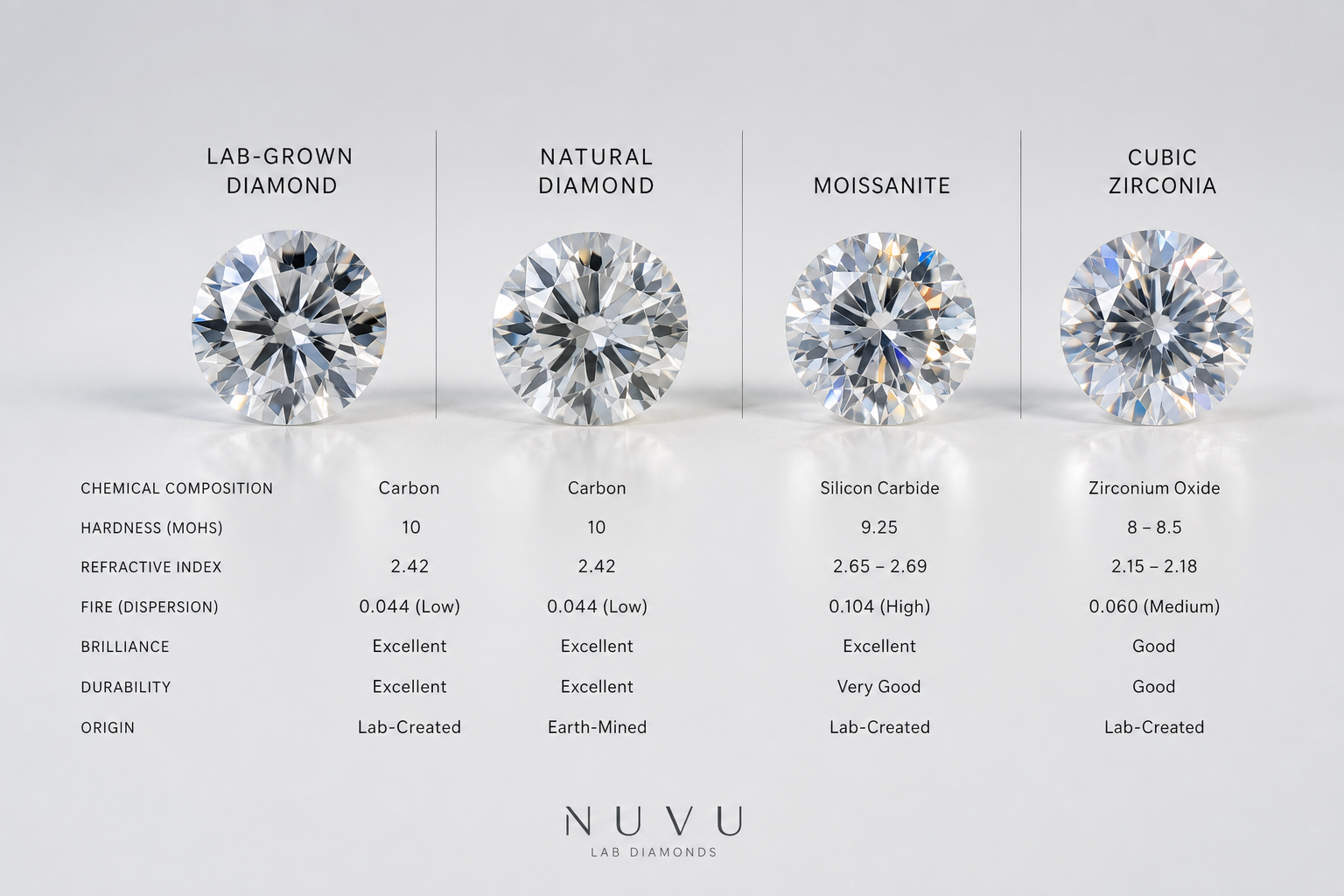
Moissanite is often discussed beside lab-grown diamonds because it can be produced for jewelry and can have a bright, colorless appearance. That does not make it a lab-grown diamond. In a lab-grown diamond vs moissanite comparison, the most important difference is material identity: a lab-grown diamond is diamond, while moissanite is a different gemstone with its own composition and visual behavior.
This distinction matters most when the buyer specifically wants a real diamond engagement ring. Moissanite can be a smart choice for someone who likes its look, wants a durable diamond alternative, or prefers to allocate budget elsewhere. It becomes the wrong choice only when it is presented as diamond or when a buyer assumes “lab-created” automatically means “lab-grown diamond.” Those phrases are not interchangeable unless the listing clearly identifies the stone as diamond.
Cubic Zirconia Is Not a Diamond
Cubic zirconia is another diamond look-alike, but it is not diamond. In a lab-grown diamond vs cubic zirconia comparison, the gap is usually more obvious in long-term wear. Cubic zirconia can look bright at first, especially in fashion jewelry or temporary pieces, but it does not have the same material identity or durability profile as diamond.
That does not make cubic zirconia useless. It can work well for travel rings, costume jewelry, display samples, or low-commitment designs where the goal is appearance at a very low price. It is a poor substitute when the buyer expects the stone to perform like a diamond over years of daily engagement ring wear. The mistake is not choosing cubic zirconia; the mistake is paying diamond-level attention or pricing for something that is clearly a simulant.
Why Simulants Can Look Similar but Are Different Materials
Diamond simulants are materials made or chosen to resemble diamond visually. Moissanite and cubic zirconia are two common examples. They may look similar in a jewelry case, especially under bright store lighting, but they behave differently in everyday wear, sparkle differently, and are described differently on proper documentation.
The visual difference is not always about “better” or “worse.” Moissanite often shows a more colorful, fiery sparkle that some buyers love and others find less diamond-like. Cubic zirconia can appear glassier over time as it picks up wear. A lab-grown diamond will usually be the better fit when the buyer wants diamond material, diamond grading language, and the same category of stone as a mined diamond. A simulant may be better when the buyer wants the look of a center stone without paying for diamond material.
The clearest way to avoid confusion is to separate appearance from identity. A stone can be beautiful and still not be diamond. A stone can be lab-created and still not be a lab-grown diamond. The label should tell you what the stone is, not just what it resembles.
Buyer Verification Checklist
- Ask what the stone is made of. “Is this diamond, moissanite, cubic zirconia, or another material?” is a better question than “Is it real?”
- Check whether the listing says diamond or diamond alternative. A real lab-grown diamond should be identified as diamond, not only as “diamond-like” or “simulated.”
- Look for origin language separately. If it is diamond, ask whether it is lab-grown or natural. If it is not diamond, origin does not turn it into diamond.
- Be cautious with vague terms. Phrases like “lab-created stone,” “diamond simulant,” “diamond alternative,” and “crystal” can refer to very different products.
A seller does not need to dismiss moissanite or cubic zirconia for the information to be honest. The key is disclosure. The buyer should know whether they are choosing a diamond or a diamond alternative before comparing price, setting style, or long-term wear.
How Lab-Grown Diamonds Are Identified and Disclosed
What a Grading Report Can Confirm
A diamond grading report can help confirm whether a stone is lab-grown, natural, or not being represented as a diamond at all. For a lab-grown diamond, the report should clearly disclose its laboratory-grown origin. Reports from established grading laboratories commonly include the diamond’s carat weight, measurements, color grade, clarity grade, cut information when applicable, and identifying details tied to a report number.
The report is most useful when it matches the actual stone being sold. A report number on its own is not enough if the carat weight, measurements, shape, or grade details do not line up with the product listing. The practical risk is simple: a buyer may be shown a legitimate report, but not for the exact stone they are considering. Matching the report to the listing is a basic step, not an advanced gemology exercise.
It is also worth separating what a report can document from what it cannot promise. A report can describe measured characteristics and disclose origin when properly issued, but it does not guarantee that the diamond is the most attractive option for a particular ring, that the price is fair, or that the buyer will prefer its appearance. Certificate-aware buying means using the report to narrow the shortlist, then checking visuals, proportions, and setting compatibility before deciding.
Why Disclosure Matters When a Diamond Is Lab-Grown
Lab-grown origin should not be hidden or treated as a minor detail. A lab-grown diamond is real diamond material, but its origin affects pricing, comparison, and buyer preference. Clear diamond disclosure lets the buyer decide based on accurate information rather than vague language.
This is especially important online, where listings can use terms that sound similar but mean different things. “Lab-grown diamond” and “lab-created diamond” should refer to diamond material grown in a controlled setting. “Simulated diamond,” “diamond alternative,” or “diamond look-alike” usually means the stone is not diamond. If a product page blurs those categories, that is a warning sign. Confusing language is often where bad purchases begin.
Evidence Beats Advertising Tone
When a product page uses strong wording such as “genuine,” “ethical,” “premium,” “certified,” or “ideal,” treat those words as prompts for follow-up rather than proof by themselves. “Genuine” should lead to a clear material answer. “Lab-grown” should lead to clear origin disclosure. “Certified” should lead to a report or document that can be matched to the stone. “Premium” should be supported by the specific qualities that make the stone desirable, such as cut details, visual evidence, or setting craftsmanship.
This protects buyers from two common problems: vague upgrade language and category blending. Vague upgrade language makes a product sound better without explaining why. Category blending makes a simulant sound like diamond, or makes lab-grown origin sound hidden or secondary. A trustworthy listing should not require the buyer to guess what the stone is.
Report Numbers, Measurements, and Inscriptions
Many diamonds with grading reports can be checked through a report number when the issuing laboratory provides an online verification tool. Buyers should compare the online verification details against the seller’s listing, including shape, carat weight, measurements, color, clarity, and cut grade if provided. Small differences in wording may be harmless, but major mismatches should stop the purchase until clarified.
Some lab-grown diamonds also have a microscopic inscription on the girdle that corresponds to the report number or identifies lab-grown origin. This can be helpful, but buyers should not assume every stone will be easy to inspect without magnification or that every listing will show the inscription clearly. The more practical approach is to use the report, listing details, seller disclosure, and visual review together.
Certificate and Visual Review Check
- Confirm the report number. Verify it directly with the grading organization when possible.
- Match the stone details. Carat weight, measurements, shape, color, clarity, and cut information should align with the listing.
- Read the origin language. A lab-grown diamond grading report should clearly disclose that the diamond is laboratory-grown.
- Review the actual appearance. A report can describe grades, but it does not fully show brightness, pattern, eye-clean appearance, or how the diamond looks in a setting.
For NUVU, the goal is to make comparison clearer: what the report shows, what the visuals reveal, and whether the stone fits the intended piece.
When a grading report is available, buyers should verify the report details through the issuing laboratory’s official report-check tool where available.
For buyers, this kind of documentation check is most helpful when a purchase is being made online or without an in-person side-by-side comparison. Matching the report to the actual stone reduces confusion and makes the origin question easier to answer.
If a GIA report is provided, buyers can verify the report details through GIA’s official report verification system where available.
What Diamond Testers and Jewelers Can Tell You
A Basic Diamond Tester May Confirm Diamond Material
Many basic diamond testers are designed to detect properties associated with diamond, such as thermal conductivity. Because lab-grown diamonds are real diamond material, they can test as diamond on many devices. This is why the question “do lab-grown diamonds test as real?” can have a clear answer: often, yes, they test as diamond because they are diamond.
That result does not automatically tell you the diamond’s origin. A basic tester may help separate diamond from some look-alike materials, but it is not a complete identification tool. Relying on a handheld tester alone can create false confidence, especially if the real question is not “Is this diamond?” but “Is this diamond natural or lab-grown?”
Origin Identification Requires More Than a Simple Test
Separating lab-grown from natural diamond usually requires more than a simple consumer-level test. Jewelers may use grading reports, laser inscriptions, supplier records, and specialized equipment to evaluate origin. Some jewelers can identify the stone’s category through documentation and professional tools, but a quick glance across the counter should not be treated as a full origin determination.
This is where buyers should be careful with casual claims. If someone says a tester “proved” a diamond is natural, that is not enough. A tester may have confirmed diamond material, not geological origin. The difference matters because natural and lab-grown diamonds can both be real diamonds while still belonging to different origin categories.
Why Documentation Still Matters
Documentation matters because it records the details a simple test cannot explain. A proper diamond grading report can disclose lab-grown origin, list the stone’s measurements and grades, and connect the diamond to a report number. It gives the buyer something to verify beyond a verbal assurance.
Documentation is not perfect, and it should not replace judgment. The stone still needs to match the report, the seller still needs to disclose the material accurately, and the buyer still needs to understand whether they are buying diamond or a simulant. But for origin questions, paperwork and verification are more dependable than a quick tester result.
How to Verify This Before Buying
- Ask what the tester is confirming. Is it confirming diamond material, or is someone claiming it confirms natural origin?
- Request the grading report when buying a graded diamond. The report should match the exact stone being sold.
- Check the report number and details. Do not rely only on a screenshot or a seller’s summary.
- Ask how lab-grown origin is disclosed. A clear seller should be able to explain this without vague wording.
A diamond tester can be useful, but it should not be the final authority in a purchase. For buyers comparing lab-grown, natural, and diamond alternatives, the safer path is to combine testing, documentation, disclosure, and a careful review of the actual stone.
A Real-Life Shopping Scenario: Same Look, Different Meanings
The Buyer’s Problem: Wanting a Real Diamond Without Confusing Labels
Maya is comparing three rings that look similar at first glance: a lab-grown engagement ring, a natural diamond ring, and a moissanite ring with a similar face-up size. All three can look bright in a jewelry case or online video, but they do not mean the same thing. The confusing part is not the sparkle; it is the language attached to each option.
If Maya says she wants a real diamond engagement ring, the lab-grown diamond and the natural diamond both belong in that conversation. The moissanite ring may be beautiful and durable, but it is a diamond alternative, not a diamond. That distinction matters because a buyer who wants diamond material should not be steered toward a look-alike unless that tradeoff is clearly explained.
The Decision Point: Material, Origin, or Appearance
The first decision is material identity. If Maya wants the ring to contain diamond, she should compare the lab-grown diamond and the natural diamond, then leave moissanite in a separate “diamond alternative” category. If she cares most about natural origin, the natural diamond may fit her priorities better, even if the lab-grown option offers more size for the same general budget range.
If appearance is the main goal, the decision changes. A moissanite ring can deliver a large, bright look, but its sparkle has a different character than diamond, and some buyers notice that difference more in larger stones. This is where shoppers make mistakes: they compare size alone and ignore what the stone actually is.
Setting style can also change the comparison. A larger stone may require different prong placement, a stronger basket, or a different band proportion than a smaller stone, and, as a lab grown diamonds guide explains, some shapes show color or inclusions differently once mounted. For custom design, the stone cannot be evaluated separately from the setting; measurements, shape, and daily-wear practicality all affect whether the final ring feels balanced and secure.
Custom Design Needs Fit Checks
For a custom ring, the buyer should confirm not just the center stone category but the stone’s exact measurements, depth, shape, and how those numbers affect the setting. A lab-grown diamond that looks perfect loose may need a different head height, prong layout, or band width once the full design is mapped out.
That is where communication matters. Ask how the stone sits in the intended mount, whether the proportions leave enough room for daily wear, and whether the design still works if the finger size or band profile changes. A careful custom process is less about chasing the biggest reported grade and more about making sure the finished piece fits the person who will wear it.
The Tradeoff: What Each Choice Actually Means
The lab-grown diamond gives Maya diamond material and may allow a larger visual presence within her preferred budget. The natural diamond gives her diamond material with earth-formed origin, which may carry more emotional or traditional value for some buyers. The moissanite ring gives her a diamond-like look, often with a strong size advantage, but it is not a real diamond.
None of these choices is automatically wrong. The poor choice is the one made under the wrong label. A shopper who knowingly chooses moissanite as a diamond alternative may be perfectly happy; a shopper who buys it believing it is a lab-created diamond has been misled.
What This Means in Practice
Before comparing stones by size or setting style, decide which requirement is non-negotiable. If the ring must contain diamond, focus on lab-grown or natural diamonds and ask for proper disclosure. If natural origin matters more than size, compare natural diamonds within your budget. If the largest look matters most and diamond material is not required, then a moissanite ring can be considered honestly as an alternative rather than treated as a substitute pretending to be the same thing.
Durability and Everyday Wear
Diamond Has Excellent Scratch Resistance
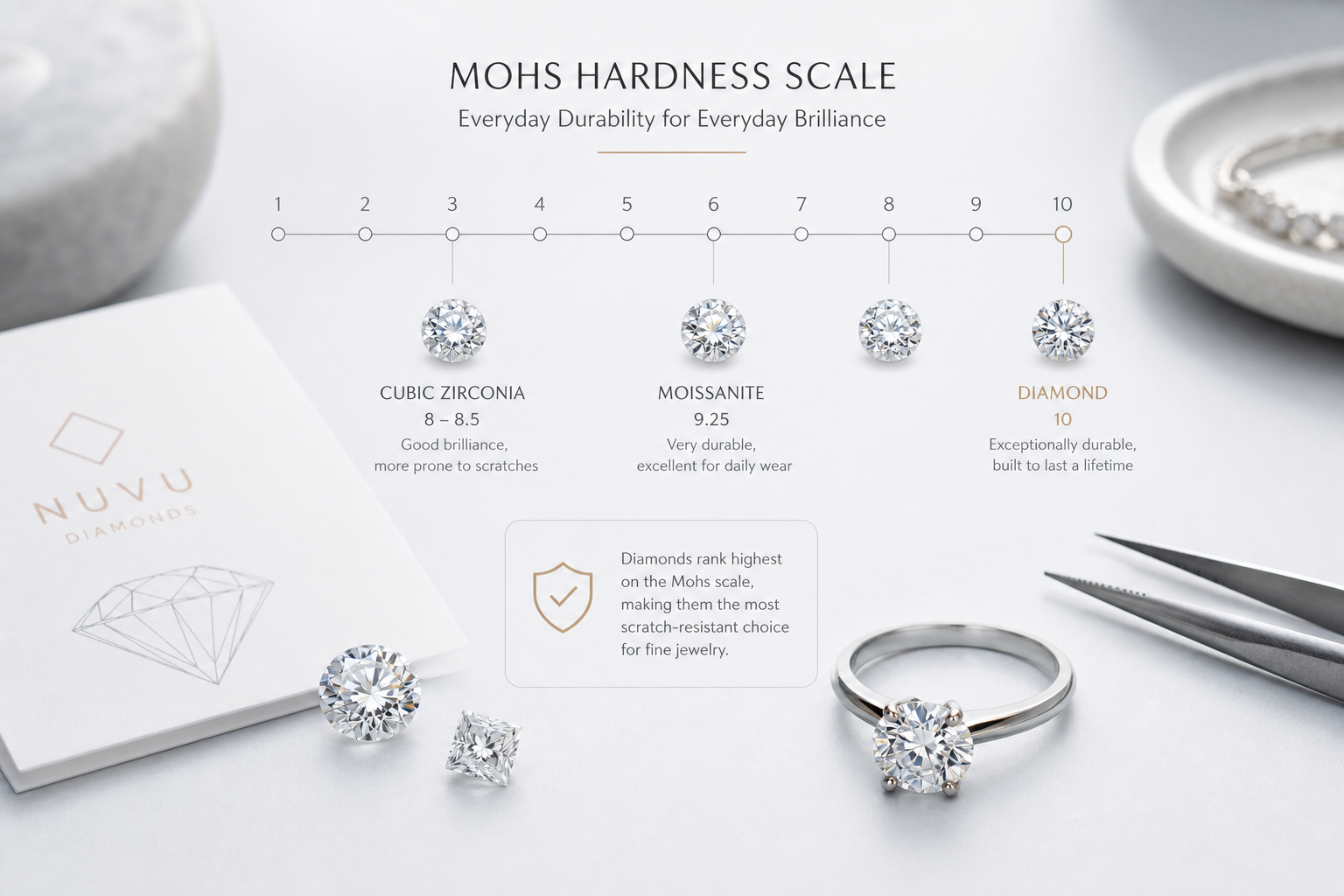
Diamond is known for excellent scratch resistance, and that applies to both natural diamonds and lab-grown diamonds because they are the same diamond material. For engagement ring wear, that matters: a stone worn every day is exposed to desks, door handles, cookware, gym equipment, and other jewelry.
This is one practical reason lab-grown diamond durability belongs in the same category as natural diamond durability. The origin is different, but the material category is not. If a buyer wants a real diamond for daily wear, lab-grown does not require accepting a softer center stone.
Moissanite Is Also a Hard Jewelry Stone
Moissanite is also a hard, wearable gemstone and one reason it is popular in rings. The important distinction is that high hardness does not make it diamond. It means moissanite can resist scratching well compared with many other gemstones, while still being its own material.
For a buyer, the practical question is not whether moissanite is “good enough” in the abstract. It is whether they want a diamond or a diamond alternative. Moissanite can be a sensible choice when the buyer prioritizes size, brightness, and budget over diamond material identity.
Cubic Zirconia Has Different Long-Term Wear Expectations
Cubic zirconia is not soft compared with many materials, but it is generally less scratch-resistant than diamond or moissanite. In daily jewelry, especially rings, that difference can become more noticeable over time as surface wear affects the stone’s appearance.
This is why cubic zirconia is often better suited to fashion jewelry, temporary use, travel jewelry, or situations where long-term wear is not the main goal. It may look diamond-like when new, but durability expectations should be different from those for a real diamond.
Why Hardness Helps, but Does Not Explain Everything
Hardness measures resistance to scratching, not immunity from damage. A diamond can still chip if it is hit at the wrong angle, especially around vulnerable points or exposed edges. Ring setting, stone shape, girdle condition, and daily habits also affect how well a piece holds up over time.
The useful takeaway is simple: diamond is the strongest option here for scratch resistance, moissanite is still highly wearable, and cubic zirconia is more likely to show wear with regular use. For an engagement ring intended for everyday wear over many years, that hierarchy should influence the decision more than sparkle alone.
How to Use Accurate Language When Shopping
Ask Whether the Stone Is Diamond or a Diamond Alternative
The clearest first question is: “Is this stone diamond, moissanite, cubic zirconia, or another diamond simulant?” This avoids the vague language that often causes confusion. Words like “diamond-like,” “created,” “simulated,” and “alternative” can sound similar in a product listing, but they do not describe the same material.
If you are learning how to buy a lab-grown diamond, do not begin by asking only whether a stone is “real.” Ask what the stone actually is. A real lab-grown diamond should be identified as diamond, not as moissanite, cubic zirconia, crystal, white sapphire, or another look-alike material.
Ask Whether the Diamond Is Natural or Lab-Grown
Once you know the stone is diamond, the next question is origin: “Is this a natural diamond or a lab-grown diamond?” This is a better question than “Is it fake?” because it separates material from origin. A lab-created diamond is not fake simply because it was made in a controlled environment, but it should be disclosed as lab-grown.
This wording also helps you avoid unnecessary pressure. A seller may prefer one category over another, but your decision should come down to your priorities: natural origin, size, budget allocation, documentation, and how you feel about the meaning of the stone.
Check That the Listing Matches the Report
Accurate language should be supported by documentation. If a diamond has a grading report, check that the report number, carat weight, measurements, color, clarity, and cut information match the listing. If the diamond is lab-grown, the report should disclose that origin clearly.
This step is not about distrusting every seller. It is about making sure the words, paperwork, and stone details all point to the same product. A listing that uses attractive language but avoids clear diamond disclosure deserves closer review before you commit.
Price differences should be read with the same caution. A lower price may reflect lab-grown origin, different market supply, different cut quality, a less desirable shape, weaker visual performance, or simply a seller’s pricing strategy. A higher price does not automatically prove better quality either. The more reliable comparison is to line up material, origin, report details, measurements, appearance, and setting needs before deciding whether the price makes sense.
When to Ask for More Proof
Not every jewelry purchase requires the same level of documentation. A small fashion piece, a travel ring, and a significant engagement ring do not carry the same risk or decision weight. As the purchase becomes more important, ask for clearer evidence: a grading report when applicable, a listing that matches the report, transparent origin language, and enough visual information to judge the stone beyond its headline grades.
You should also ask for more proof when the wording feels unusually vague. Terms such as “diamond-style,” “created gem,” “premium stone,” or “certified look” may be harmless in context, but they should not replace a direct answer about material and origin. If a seller cannot clearly say whether the stone is diamond, lab-grown diamond, natural diamond, or a simulant, the buyer should pause before purchasing.
What a Good Listing Should Disclose
A clear listing should answer three separate questions: what material is it, how was it formed, and what report or document supports that description. For a diamond, the listing should say whether it is natural or lab-grown. For a simulant, the listing should name the actual material instead of relying on diamond-adjacent wording. For any graded stone, the report details should match the item being sold.
Laboratory-grown diamonds should be clearly identified as laboratory-grown, and they should not be presented as mined diamonds. That distinction is part of honest disclosure, not a fine point for experts only.
When the listing includes environmental, ethical, or sourcing language, treat it as a claim that needs context rather than a free-standing badge of virtue. Ask what is being documented, whether the statement applies to the stone itself or to a broader supply chain, and whether there is enough information to compare one seller’s wording with another’s. Environmental and sustainability claims should be specific, documented, and limited to what can be substantiated.
- Material: diamond, moissanite, cubic zirconia, or another gemstone.
- Origin: natural or lab-grown if the item is diamond.
- Evidence: grading report, measurements, report number, and any relevant seller documentation.
- Limits: what the report does not cover, such as beauty, value, or sourcing claims.
When the description is vague, the safest move is to slow down and ask for the exact wording in writing. A careful seller should be able to explain the stone without switching terms midway through the conversation.
How to Read Price Claims Carefully
Prices can vary with carat weight, cut precision, shape, color, clarity, report type, seller channel, and market timing, so like-for-like comparison matters more than a headline number. A stone that looks cheaper may simply have different specifications, weaker finish, or less complete documentation.
That means price comparisons should be tied to the exact stone, not just the category. Compare report details, measurements, appearance, and setting quality before deciding whether one option is actually a better fit. If the seller uses language such as “value,” “investment,” or “resale,” ask what evidence supports that wording and whether it applies to your situation at all.
Custom Design and Setting Fit
For custom jewelry, the stone’s exact measurements matter as much as its headline grades. A diamond that looks ideal on paper may sit too high, feel too large for the band, or require a different head size once the design is drafted. Confirm the center stone’s dimensions, shape, and depth before the final setting is made.
It also helps to confirm whether the chosen stone works with the intended metal, prong style, and daily-wear habits. Some settings protect the stone better than others, and some shapes show differences in proportion once mounted. If the piece is meant for frequent wear, ask how the design handles snagging risk, stone security, and long-term maintenance. These are design questions, not marketing questions, and they are easier to solve before production begins.
For a custom piece, the buyer should also confirm whether the stone’s measurements leave enough room for any side stones, gallery details, or band curvature in the finished design. A lab-grown diamond, natural diamond, or simulant may all need different setting decisions once the full ring is drawn out. The safest approach is to check fit before the design is finalized, not after the stone is already mounted.
Questions to Ask Before You Decide
- Is this stone diamond, or is it a diamond alternative?
- If it is diamond, is it natural or lab-grown?
- Does the grading report disclose lab-grown origin if applicable?
- Can I verify the report number with the grading laboratory?
- Do the measurements and carat weight on the report match the listing?
- Is the seller using terms like “simulated,” “created,” or “diamond-like” clearly?
The clearest shopping language is specific, not suspicious. Ask what the stone is, how it was formed, and how that information is documented. Once those answers are clear, you can compare the ring on the factors that actually matter to you.
The Bottom Line: Lab-Grown Is Real, Natural Is Origin, Fake Means Something Else
If It Is Diamond Material, It Is a Real Diamond
A lab-grown diamond is real because it is diamond material. It is not a look-alike, a substitute, or a costume-jewelry version of a diamond. The word lab-grown explains how the diamond was created, not whether it belongs in the diamond category.
This is the point that prevents most shopping confusion. If the stone is actually diamond, the better question is not whether it is “real,” but whether it is lab-grown or natural, whether it has the right grades for the piece, and whether its origin is clearly disclosed.
If It Formed Underground, It Is Natural
A natural diamond is also a real diamond, but its defining feature is origin. It formed underground over a long geological period and was mined from the earth. That origin can matter for emotional, traditional, rarity, or resale-related reasons, but it does not make lab-grown diamonds fake by comparison.
The mistake is treating “natural” as a synonym for “real.” Natural is more specific than that. It tells you where the diamond came from, not whether every other diamond is imitation.
If It Only Looks Like Diamond, It Is a Simulant
A diamond simulant is different. Moissanite, cubic zirconia, and other diamond-like stones may be attractive choices, but they are not diamonds. They can be perfectly valid options when they are sold clearly, but they should not be described in a way that makes a buyer think they are purchasing a natural or lab-grown diamond.
This is where the phrase “fake diamond” should be used carefully. A simulant is not automatically dishonest. It becomes a problem when the material is hidden, blurred, or presented as diamond when it is not.
The Clearest Way to Think About Your Choice
Use a three-part framework: material, origin, and disclosure. If the material is diamond, it is a real diamond. If it formed underground, it is natural. If it only resembles diamond, it is a simulant. Once those labels are clear, the buying decision becomes much simpler.
From there, the right choice depends on what matters most to you: diamond material, natural origin, visual size, budget priorities, or the certainty that the stone is being represented accurately. The wrong choice is not lab-grown, natural, or simulant by itself. The wrong choice is buying one while thinking it is another.
Disclosure: This article is for general educational purposes only. Diamond grading, pricing, availability, specifications, and seller policies can change, and readers should verify important details through grading reports, official laboratory tools, seller documentation, or qualified professionals before making a purchase decision. Laboratory-grown diamonds should be clearly distinguished from natural diamonds, and environmental or sourcing claims should be supported by specific documentation.