
Choosing a lab-grown diamond for an engagement ring is not just a question of whether it is “real.” It is a decision about what matters most in the finished ring, and lab grown diamond buyer profiles can help clarify priorities such as size, sparkle, design flexibility, budget, durability, symbolism, and long-term satisfaction. Lab-grown diamonds can make it easier to choose a larger-looking or more customized ring within a set budget, but they are not automatically the right choice for every couple.
For the full framework, read Lab-Grown Diamond Engagement Rings Guide.
This guide helps you judge the full ring rather than focusing only on carat weight or price. You’ll learn how cut, measurements, shape, setting style, metal color, and grading reports affect appearance and value, and how to weigh lab-grown benefits against the meaning some buyers attach to natural origin, rarity, and tradition.
| Buying Priority | Lab-Grown Diamond Fit | What to Check Before Choosing |
|---|---|---|
| Larger-looking center stone | Often stronger value for size | Compare millimeter measurements, not carat alone |
| Traditional or rare origin | May feel less meaningful | Consider whether natural origin matters emotionally |
| Daily durability | Diamond hardness is comparable | Review prongs, band thickness, height, and setting protection |
| Custom design flexibility | Can free budget for shape, setting, or details | Balance stone size with metal, setting, and proportions |
| Quality verification | Still needs careful review | Use grading reports, photos, video, and written specifications |
| Finished ring appearance | Depends on more than the loose stone | Judge cut, face-up look, shape, and setting together |
A grading report helps narrow the shortlist, but it does not prove how the diamond will look in every lighting condition, nor does it replace visual review of the stone in the intended setting.
Quick Questions Before You Read
Q: Are lab-grown diamonds suitable for engagement rings?
Yes, if the priority is a diamond with laboratory-grown origin and more flexibility for size, shape, or design within budget.
Q: Is carat weight the best way to judge size?
No. Face-up size depends on millimeter dimensions, shape, cut, and proportions.
Q: Does a grading report guarantee the best-looking ring?
No. It documents key details, but the ring’s appearance also depends on cut, setting, and overall balance.
Q: When might a natural diamond be the better choice?
When rarity, geological origin, family expectations, or traditional symbolism are central to the ring’s meaning.
The practical answer: when lab-grown diamonds make sense for engagement rings
Yes, lab-grown diamonds can be a strong choice for engagement rings, especially when the goal is a beautiful diamond ring with more room for size, design, or overall value. They are not diamond simulants, so the practical question is not whether they can work in a proposal ring. The better question is whether they match the buyer’s priorities.
For many engagement-ring buyers, lab-grown becomes the stronger option when the budget is fixed but the desired look is ambitious. If someone wants a larger center stone, a specific shape, or a more detailed setting without stretching the total spend, a lab-grown engagement ring often creates more flexibility. That flexibility matters because the finished ring is not just a loose diamond. It is the balance between the stone, the setting, the wearer’s style, and the meaning behind the proposal.
The decision becomes less automatic when rarity, tradition, or natural origin carries emotional weight. Some buyers want the geological history of a natural diamond to be part of the ring’s story. Others care more about appearance, practicality, and choosing a stone that lets them build the ring they actually want. Neither preference is wrong, but confusing those priorities is where buyers usually end up second-guessing themselves.
In practical buying, one of the most common misunderstandings is assuming that “real diamond” settles the whole question. It does not. A lab-grown stone can be fully appropriate for an engagement ring and still be the wrong choice for a particular couple if the symbolic meaning does not line up. The strongest decisions are usually the ones where the stone, the setting, the budget, and the wearer’s expectations all point in the same direction.
Clear origin disclosure matters
Laboratory-grown diamonds and natural diamonds are both discussed as diamonds in the jewelry market, but they have different origins and should be described clearly. A laboratory-grown diamond should be identified as laboratory-grown and should not be presented as a mined or natural diamond. Diamond simulants, such as cubic zirconia or moissanite, are different categories and should not be confused with lab-grown diamonds.
For an engagement ring, this disclosure is not only a technical detail. It affects expectations, symbolism, documentation, and future conversations about the ring. If the diamond is laboratory-grown, the seller description, grading report where available, invoice or order summary, and final ring documentation should use consistent language so the buyer understands exactly what is being purchased.
Why many engagement-ring buyers choose lab-grown
The biggest practical advantage is choice. Lab-grown diamonds often allow buyers to compare more options within the same budget, which can make it easier to choose a center stone with the shape, spread, and overall presence they had in mind. A buyer who originally thought they had to compromise on size may find that lab-grown opens up a ring style that feels more proportionate on the hand.
This does not mean the largest possible diamond is automatically the best choice. A ring can look unbalanced if the center stone overwhelms the setting or does not suit the wearer’s style. The real value of lab-grown is not simply “more carat weight.” It is the ability to make a better overall decision instead of spending most of the budget just to reach a minimum size target.
For example, one couple might compare a smaller natural diamond in a simple setting with a larger lab-grown diamond in a setting that better matches the wearer’s style. If the proposal ring is meant to look a certain way on the hand and be worn daily, the lab-grown option may feel more aligned with the actual goal. Another couple might make the opposite choice because natural origin matters more to them than size or design flexibility.
Where the hesitation usually comes from
The hesitation usually comes from the word “real.” Many buyers worry that choosing lab-grown will make the engagement ring feel less legitimate, even when they understand that a lab-grown diamond is not a simulant like cubic zirconia or moissanite. The concern is less about chemistry and more about meaning.
That distinction matters. If the buyer or their partner believes the emotional value of the ring depends on natural rarity, then a lab-grown diamond may not be the right fit, even if it looks beautiful. If the meaning comes from the proposal, the design, the shared decision, and the ring’s everyday presence, lab-grown can make complete sense.
The mistake is treating this as a debate with one correct answer. A lab-grown diamond is a strong engagement-ring choice when the couple values visual quality, budget efficiency, and design freedom. A natural diamond may be more appropriate when the couple places more importance on origin, tradition, or the idea of geological rarity.
What “good for an engagement ring” actually means
A diamond is good for an engagement ring when it supports the full ring decision, not just one part of it. It should look right in the chosen size and shape, fit the setting, suit the wearer’s lifestyle, and feel acceptable emotionally to the person who will wear it. If any one of those pieces is ignored, even a high-grade stone can become the wrong choice.
For lab-grown diamonds, the strongest use case is clear: buyers who want a diamond center stone and would rather put their budget toward appearance, scale, or design than toward natural origin alone. The weaker use case is also clear: buyers who already know that natural origin is central to the symbolism of the ring.
A good engagement-ring decision should feel stable after the proposal, not just attractive during checkout. If the buyer is choosing lab-grown only because it is cheaper, that is not enough. If they are choosing it because it lets them build the ring that better fits their partner, their budget, and their values, the choice is much more solid.
Evidence-minded buying note
When comparing lab-grown and natural diamonds, separate three kinds of information: what the seller claims, what the grading report documents, and what your eyes confirm in photos, video, or in-person review. A trustworthy purchase does not depend on one impressive phrase. It depends on whether the stone identity, specifications, setting details, and final ring description all agree with each other.
What to Check Before You Decide
- Choose based on the finished ring, not the stone alone. A larger center stone only helps if it looks balanced in the setting and suits the wearer’s hand and style.
- Be honest about symbolism. If natural rarity is emotionally important, do not dismiss that as irrational. If appearance and design matter more, lab-grown may be the better fit.
- Avoid making price the only reason. Better value comes from the combination of quality, proportions, setting fit, and confidence in the purchase.
- Think about the wearer’s expectations. If the ring is a surprise, the safest choice is the one that best matches what the wearer has actually expressed, not what the buyer assumes should matter.
How lab-grown diamonds change your budget and size options
Lab-grown diamonds can change the engagement-ring budget conversation because they often give buyers more visual range for the same total spend. The most common result is a larger center stone, but that is not the only useful outcome. Some buyers use the flexibility to improve the setting, choose a more distinctive shape, or avoid cutting corners on the details that affect how the ring looks in real life.
The important point is that the diamond price is only one part of the ring. A lab-grown diamond engagement ring still includes the setting, metal choice, side stones if used, design complexity, and finishing details. A lower stone cost can be helpful, but it should not lead the buyer to ignore cut quality, documentation, or whether the stone physically fits the ring design.
The cheapest option on the screen is often not the strongest value. A poorly cut diamond can look dull even if the carat weight is impressive. A stone with weak documentation may create uncertainty. A center stone that is too large for the setting can make the ring look top-heavy or less wearable. The better question is not “How big can I go?” but “What size and quality make the whole ring work?”
Price differences among lab-grown diamonds can reflect more than just size. Cut quality, outline, color, clarity, proportions, symmetry, and the level of documentation may all affect the final number, so two stones that look similar at a glance may still sit in different price ranges for practical reasons.
Prices can change with market conditions, report type, seller channel, availability, and stone-specific details, so exact comparisons should be verified at the time of purchase. When comparing lab-grown and natural diamonds, compare like-for-like specifications rather than assuming a fixed savings percentage applies to every shape, size, or quality range.
Why the stone often looks bigger for the same budget
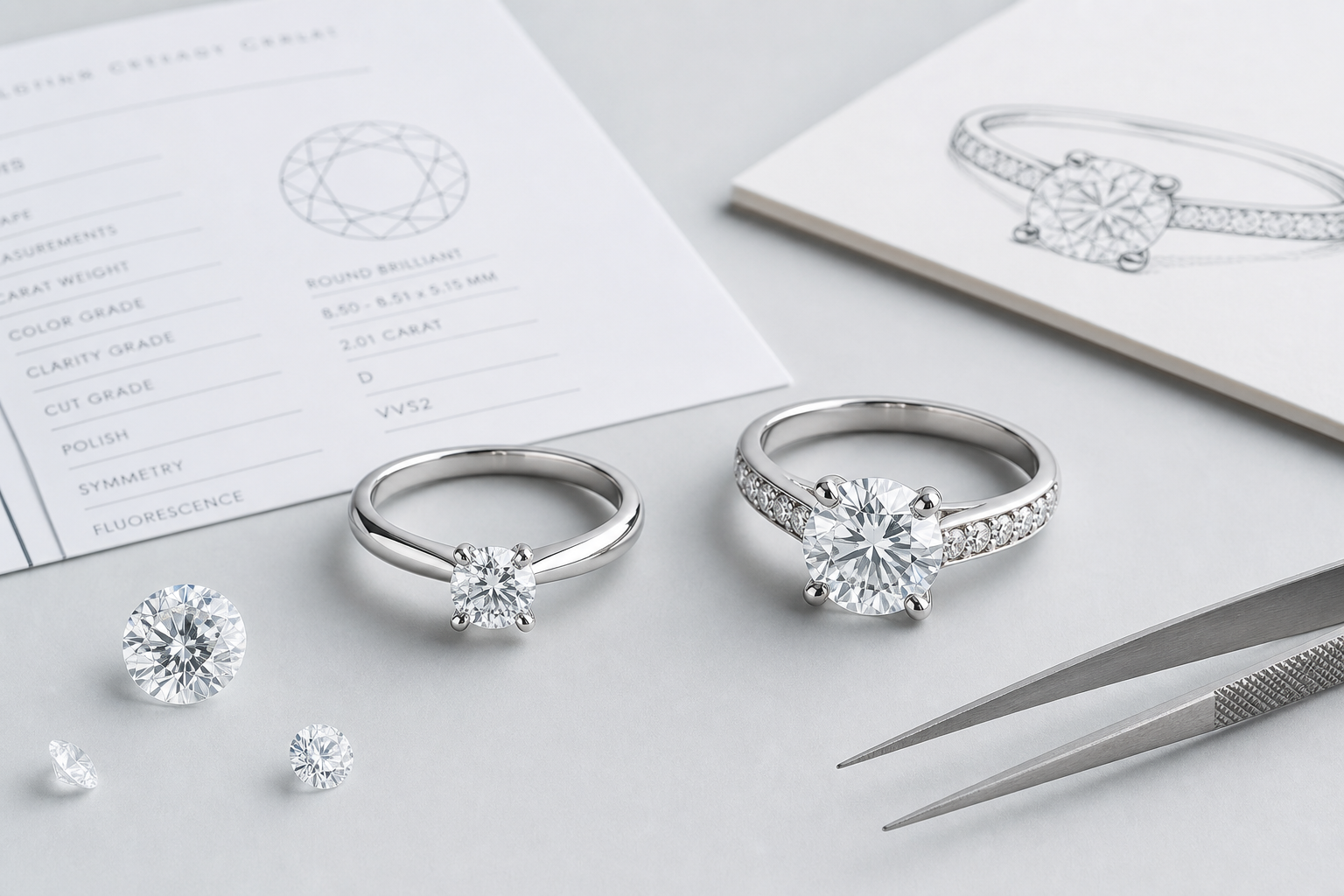
Because lab-grown diamonds are frequently offered at lower prices than comparable natural diamonds, buyers often find they can consider a larger carat weight without changing the total ring budget. The exact difference changes over time and depends on quality, shape, seller channel, and market conditions, so it is better to compare current options than rely on a fixed rule.
Carat weight, however, is not the same as visible size. Two diamonds with the same weight can face up differently depending on shape and proportions. An oval, pear, marquise, or emerald cut may appear larger across the finger than a round diamond of the same carat weight because of its outline. A deep stone may carry weight where the eye does not see it. For an engagement ring, measurements matter as much as the number on the report.
A useful check is to compare millimeter dimensions, not only carat weight. A well-proportioned oval may create more hand presence than a poorly proportioned stone with slightly higher weight. If the goal is a ring that looks elegant rather than simply large, spread, shape, and cut should guide the size decision.
Why total ring cost matters more than stone price alone
The center stone usually drives attention, but the setting determines how the diamond is presented. A buyer who saves on the stone may want to use part of that room for a stronger setting, a better metal choice, or design details that make the ring feel more personal. That can be a smarter use of budget than pushing the diamond size to the edge of what the setting can comfortably support.
Band width is one simple example. A delicate band can make the center stone look more prominent, but it may not be the right choice for every wearer or every diamond size. A slightly stronger band often gives a more grounded look while still feeling refined. These are starting points, not fixed rules, but they show why the ring’s proportions matter alongside the diamond.
Setting complexity also changes the budget. A solitaire usually keeps the focus on the center stone and may leave more room for size. A pavé, halo, hidden halo, or three-stone design can add detail and presence, but it may shift money away from the main diamond. Neither route is automatically better. The right choice depends on whether the buyer wants the diamond itself to carry the look or wants the full design to create the effect.
A realistic comparison between two ring paths
Imagine two buyers working with the same overall engagement-ring budget. The first wants a clean solitaire with maximum center-stone presence. For that buyer, a lab-grown diamond may make it possible to move from a modest center stone to a visibly larger one while keeping the setting simple. The value comes from a stronger face-up impression without adding design complexity.
The second buyer cares less about reaching the largest possible stone and more about the finished ring style. They may choose a slightly smaller lab-grown center stone and put more of the budget toward a three-stone setting, pavé band, or custom details. In that case, lab-grown still helps, but the advantage is design flexibility rather than size alone.
The weaker choice would be buying the largest stone available and pairing it with a setting that feels too thin, too high, or visually out of balance. A big center stone can lose its appeal if the ring looks awkward on the hand. Lab-grown gives buyers more options, but it also makes restraint more important because it is easier to oversize the diamond relative to the design.
Budget Comparison Check
- Set the total ring budget first. Do not evaluate the diamond as if the setting, metal, and design details are separate afterthoughts.
- Compare visible size, not just carat weight. Look at millimeter measurements, shape, and proportions before assuming one stone will look bigger.
- Leave room for a suitable setting. A larger stone needs a setting that supports it visually and structurally.
- Do not reward the lowest price automatically. Weak cut, poor proportions, or unclear documentation can erase the value of a lower-cost stone.
Which quality factors matter most when you are choosing a center stone
For an engagement-ring center stone, the most important quality factors are the ones that change how the diamond looks on the hand. Cut, shape, proportions, and face-up appearance should come before chasing the highest possible grades across every category. A lab-grown diamond can look exceptional, but only if the buyer evaluates the stone as something that will be worn in a ring, not just compared on a grading report.
The most common mistake is treating the 4Cs as equal in practical importance. They are useful comparison categories, but they do not affect the finished ring in the same way. Cut and shape usually have the strongest effect on beauty and presence. Color and clarity matter, but their importance depends on the stone’s size, shape, setting, and how sensitive the wearer is to small differences. A higher grade is not always a better use of budget if the difference is difficult to see once the diamond is set.
Cut and shape: the first thing buyers should compare
Cut should be the first filter because it affects brightness, contrast, and how lively the diamond appears in normal lighting. A diamond with strong cut quality can look crisp and bright even at a slightly lower color or clarity grade. A poorly cut stone can look flat despite impressive numbers elsewhere.
Shape also changes the decision. Round diamonds are often judged heavily on light performance, while fancy shapes such as oval, emerald, pear, cushion, radiant, and marquise require more visual judgment. An oval may have a visible bow-tie effect. An emerald cut may show inclusions or color more easily because of its open facets. A cushion can vary widely in outline and sparkle pattern. These details matter more than simply choosing the shape name.
Measurements help keep the comparison grounded, especially when a diamond grading report lists dimensions that explain why a round diamond and an oval diamond with the same carat weight will not look the same on the hand. Even two stones with the same shape and carat weight can have different length-to-width ratios and face-up size. For a center stone, the better option is usually the one with the strongest visual balance, not the one with the largest weight on paper.
Color and clarity: when they matter and when they do not
Color matters most when the diamond shape, size, or setting makes warmth easier to notice. Step cuts such as emerald and asscher tend to reveal color more than many brilliant cuts. Larger stones can also make subtle color differences more visible. White metals such as platinum or white gold may make warmth easier to detect, while yellow or rose gold can soften the contrast.
Clarity matters when inclusions are visible to the naked eye or affect the stone’s appearance. Many buyers overpay for clarity grades they cannot actually see once the diamond is set. For most engagement rings, an eye-clean diamond is more important than a flawless grade. The practical risk is not choosing a slightly lower clarity grade; the risk is choosing a stone with an inclusion that is distracting in the exact position where the eye goes first.
This is especially relevant with fancy shapes. Inclusions near the center of an emerald cut may be more noticeable than similar inclusions near the edge of a brilliant cut. A clarity grade gives useful information, but it does not tell the whole story of placement, contrast, and visibility.
What the grading report can confirm, and what it cannot
A grading report can confirm important basics such as carat weight, measurements, color, clarity, and identifying details. It gives the buyer a common language for comparison and helps reduce uncertainty. For a lab-grown diamond engagement ring, a report from a recognized grading laboratory can be a meaningful part of the buying process.
What the report cannot fully show is how the diamond performs in motion, how attractive the shape outline is, or how well the stone will suit the intended setting. It also does not replace photos, video, and practical review of the stone’s proportions. At NUVU, we treat the grading report as a starting point rather than the final answer because the ring will be judged by how it looks and wears, not by the report alone.
For buyers comparing multiple options, the most reliable approach is to treat the report as a filter and the visuals as the tie-breaker. Two stones can share similar grades and still feel different once light, proportions, and shape are considered together, which is why a report should support the decision rather than replace it.
The strongest comparison combines documentation with visual evidence. A stone with slightly more modest grades but better cut, cleaner face-up appearance, and stronger proportions can be a better engagement-ring choice than a higher-graded diamond that looks less appealing in real viewing conditions.
A traceable comparison also means checking that the report details match the seller’s listing and the stone being discussed. Shape, measurements, carat weight, color, clarity, and any report number should be consistent across the grading report, product description, invoice or order summary, and final design notes. If those details do not align, the buyer should ask for clarification before approving the ring.
Growth method, treatment notes, and documentation
Some lab-grown diamond reports or seller descriptions may reference the growth method, such as CVD or HPHT. In this context, CVD and HPHT usually refer to methods used to grow laboratory-created diamonds. HPHT can also be discussed as a post-growth treatment in some diamond contexts, but buyers should not assume treatment status unless it is clearly disclosed in the report or seller documentation.
When growth method or post-growth treatment is relevant, buyers should look for clear disclosure in the grading report or seller documentation. These details are separate from beauty, wearability, and setting fit, but they can matter for transparency and for buyers who want the description of the diamond to be complete and consistent.
When a grading report is available, buyers should verify the report details through the issuing laboratory’s official report-check tool where available, then compare those details with the stone’s photos, video, measurements, and intended setting.
Report review note
Do not treat the word “certificate” as a guarantee of beauty, value, or suitability. In practice, a diamond grading report is best used as documentation of listed characteristics, while the buying decision should still include visual review, measurement checks, setting fit, and seller transparency. This is especially important for fancy shapes, where outline, bow-tie visibility, facet pattern, and face-up balance may matter more than a single headline grade.
Certificate and Visual Review Check
- Prioritize cut and face-up appearance first. These usually affect the look of the ring more than small differences in color or clarity.
- Use measurements with carat weight. A diamond’s visible size depends on spread, shape, and proportions, not weight alone.
- Do not overpay for invisible upgrades. Higher color or clarity only adds practical value if the difference can be seen or supports the design.
- Review the actual stone whenever possible. Photos, videos, and proportions reveal issues that a report may not make obvious.
- Match quality choices to the ring plan. A stone for a solitaire, an emerald-cut design, or a detailed setting may need different priorities.
How setting style, shape, and metal affect the finished ring
A diamond does not appear in isolation once it becomes an engagement ring. The setting changes how large the center stone looks, how secure it feels for daily wear, and how the overall ring sits on the hand. This is especially important with a lab-grown diamond ring setting because buyers often have more room in the budget to choose a larger center stone. A larger stone can be beautiful, but it also makes proportion and setting structure more important.
The biggest mistake is choosing the diamond first and treating the setting as decoration. A round brilliant, oval, emerald cut, pear, and radiant can all need different support, different prong placement, and different visual balance. The right setting should make the stone look intentional, not simply mounted.
Because the setting affects both appearance and wearability, it is worth asking whether the ring should be optimized for daily comfort, for maximum sparkle, or for a more formal presentation. Those goals can overlap, but they do not always point to the same setting style.
Why the setting changes the look of the same diamond
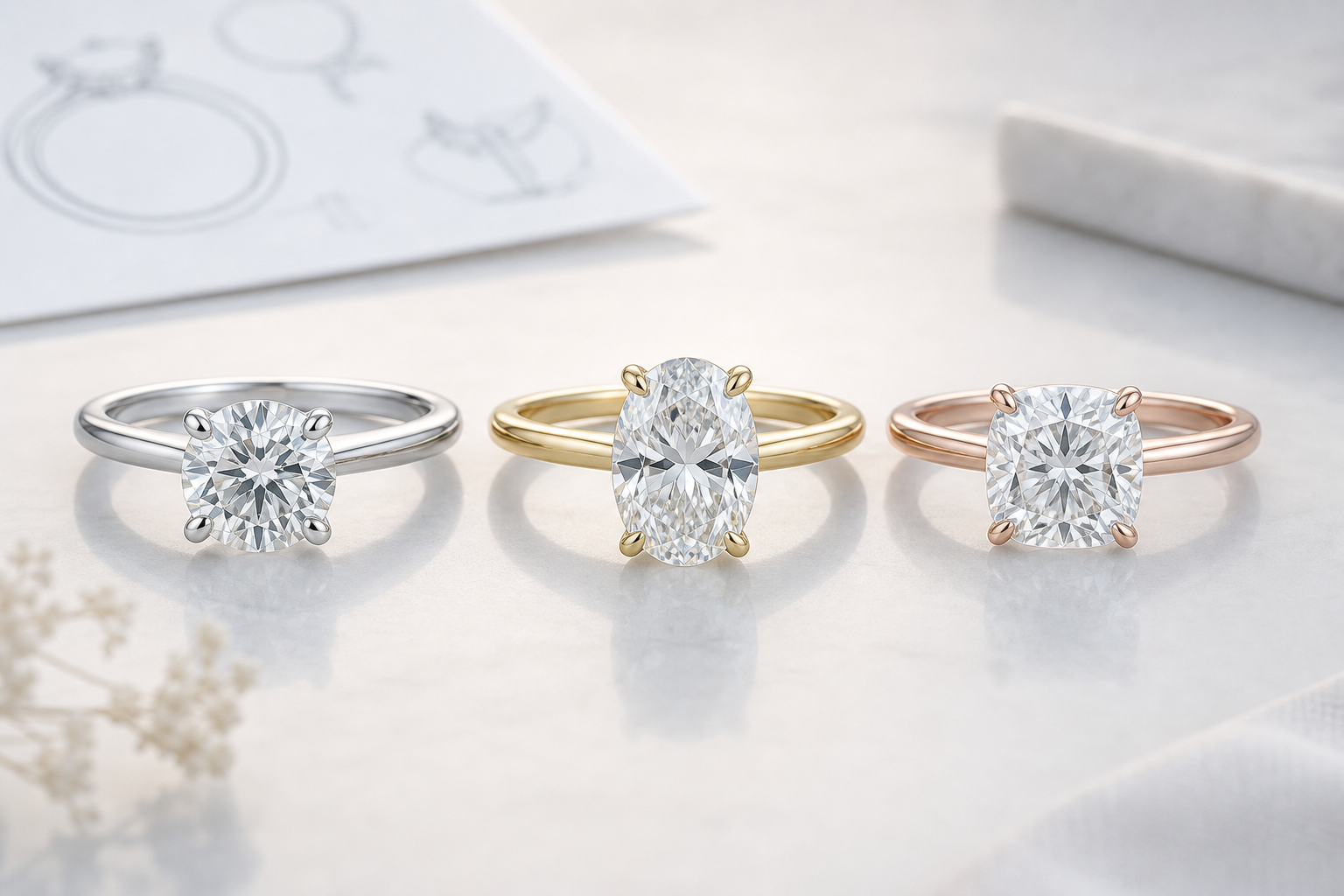
The same center stone can look noticeably different in a solitaire, halo, three-stone, or pavé setting. A solitaire puts the focus on the diamond itself, which works best when the stone has strong cut, pleasing proportions, and enough face-up presence to stand on its own. If the diamond is well chosen, a solitaire often looks cleaner and more timeless than a busier design.
A halo can make the center stone appear larger because the surrounding smaller diamonds extend the visual outline of the ring. That can be useful when the buyer wants more finger coverage without increasing the center stone size. The tradeoff is that halos can make the ring feel more detailed and less minimal, and a poorly proportioned halo can overwhelm the center stone rather than enhance it.
Three-stone settings add width and symbolism, but they also demand better proportion control. If the side stones are too large, they compete with the center. If they are too small, the design can look unbalanced. For many engagement rings, side stones that support the center rather than match it in visual strength create a more refined result.
Band width also changes perception. A very thin band can make the center stone look larger by contrast, but going too delicate can reduce long-term confidence, especially with a larger diamond. Many buyers prefer a slim engagement ring look, while wider bands can feel more substantial and balanced for elongated or higher-carat stones. These are starting points, not rules, because hand shape, stone size, and setting height all affect the final look.
How prong, bezel, and halo styles change protection and appearance
Prong settings show more of the diamond and are common for engagement rings. Four prongs can look lighter and more open, while six prongs can make a round diamond feel more secure and slightly more traditional. For elongated shapes, prong placement matters more than prong count. Pear, marquise, and princess cuts have points or corners that should be protected carefully because those areas are more vulnerable to impact.
A bezel setting wraps metal around the edge of the diamond, creating more protection and a smoother outline. It is a strong option for someone who uses their hands often, dislikes snagging, or wants a lower-maintenance profile. The tradeoff is visual: a bezel can make the ring look more modern and slightly less airy, and it may reduce the exposed sparkle around the stone’s edge compared with prongs.
A halo gives both visual spread and some perimeter presence, but it is not automatically the most durable choice. Small accent stones add more points of construction, and the design depends on how well the halo is built and maintained. If the buyer wants a ring for active daily wear, a clean bezel or sturdy prong setting may be a better choice than a delicate pavé-heavy halo.
Pavé bands add sparkle across the finger, but they should be chosen with lifestyle in mind. Tiny diamonds set along a thin band can look elegant, yet they also create more areas that can catch, wear, or require attention over time. If the wearer wants a ring that can handle everyday use with less fuss, a plain shank or lightly accented band is often the safer direction.
How metal color affects the final visual result
Metal color changes the way the diamond reads on the hand. White gold and platinum create a bright, cool frame that can make a colorless or near-colorless stone look crisp. They are often the most straightforward choice when the buyer wants the diamond to look icy and clean.
Yellow gold creates warmer contrast. This can be flattering and classic, especially for buyers who like a softer look, but it may also make a very white diamond stand out more sharply against the setting. For some designs, that contrast is the point. For others, especially vintage-inspired rings, a slightly warmer diamond can look more harmonious in yellow gold than a higher-color stone chosen only for the grade.
Rose gold adds warmth and a distinct color tone, which can soften the overall feel of the ring. It works well for many oval, cushion, and radiant cuts, but it can visually tint the setting environment around the diamond. That does not mean the stone changes color; it means the finished ring has a warmer impression. Buyers who want a very bright white look may prefer white metal, while buyers who want softness and contrast may prefer rose or yellow gold.
Stone-to-Setting Fit Check
Before committing to a lab-grown diamond ring setting, check the stone’s actual measurements, not only its carat weight. Two diamonds with the same carat weight can have different length, width, depth, and face-up appearance. A setting that fits a standard round stone may not suit an elongated oval, a deep cushion, or a wide emerald cut without adjustment.
The practical test is simple: the setting should support the diamond’s shape, protect vulnerable points or corners, match the ring’s intended style, and feel proportionate on the wearer’s hand. If one of those pieces is off, the finished ring may look less refined even if the center stone is beautiful.
For custom design, trust comes from confirming fit before final approval. The center stone’s measurements should guide the basket, prong placement, halo outline, side-stone proportions, and ring height rather than being treated as a generic size category. A transparent design process should make clear which features are fixed, which can still be adjusted, and how the selected diamond will sit in the finished ring.
For custom jewelry, stone measurements and setting compatibility should be confirmed before finalizing a purchase. This is especially important when the diamond is elongated, unusually deep or shallow, part of a halo layout, or paired with side stones that must be proportioned to the exact center stone.
Are lab-grown diamonds durable enough for everyday engagement ring wear?
Yes, lab-grown diamonds can be durable enough for everyday engagement ring wear when the ring is properly designed and cared for. The more useful question is not whether the diamond itself is hard enough for jewelry use; it is whether the full ring is built for the way the wearer actually lives.
Engagement rings go through more than most people realize. They brush against countertops, car doors, gym equipment, purse hardware, bedding, and clothing. Over time, the setting, prongs, band thickness, and ring height often matter more to day-to-day durability than the lab-grown origin of the diamond.
What everyday wear means in practical terms
Everyday wear does not mean a ring should be treated as indestructible. It means the ring should be able to handle normal routines with reasonable care. Wearing it to work, dinners, errands, and casual daily activities is very different from wearing it during heavy lifting, rock climbing, gardening, or hands-on work with tools.
A buyer who plans to wear the ring constantly should pay close attention to profile height and setting security. A high-set diamond can look elegant and make wedding band pairing easier, but it is more likely to knock against hard surfaces. A lower setting can feel more practical for someone who wants less snagging and a closer fit to the hand.
Band construction also matters. Very thin bands can look delicate and make the center stone appear larger, but they may not be the best choice for someone who is hard on jewelry. A slim band can still look refined while offering more reassurance than an ultra-thin design. Larger stones, active lifestyles, and pavé details may justify a slightly stronger build.
Where damage risk usually comes from
Most engagement ring problems come from impact, snagging, or setting wear rather than the diamond simply failing. A hard knock can bend a prong. A lifted prong can loosen a stone. A delicate pavé band can lose small accent stones if it is frequently hit or twisted. These risks apply to both lab-grown and natural diamond rings.
Shape can also influence vulnerability. Round and oval diamonds have smoother outlines, while princess, pear, marquise, and some emerald or radiant cuts have corners or points that need better protection. This does not make those shapes bad choices. It means the setting needs to account for the shape instead of treating every diamond the same way.
The common mistake is assuming that diamond hardness solves every durability concern. Hardness helps protect against scratches, but it does not eliminate chipping risk at exposed edges, nor does it protect the metal structure holding the stone in place. A well-made ring with a thoughtful setting is a safer long-term choice than a beautiful stone placed in an overly fragile design.
How the setting affects durability more than the stone alone
The setting is the ring’s first line of protection. Prongs keep the diamond visible and bright, but they should be properly placed and checked over time. A bezel provides stronger edge protection and reduces snagging, which makes it a practical option for buyers who prioritize security over maximum openness. Partial bezels and protective prong designs can offer a middle ground for certain shapes.
For a lab-grown engagement ring with a larger center stone, durability becomes more about balance. A bigger diamond creates more surface area and more leverage if the ring is hit from the side. Pairing a larger stone with a very thin band or minimal prongs may look dramatic in photos, but it can be less practical for daily wear.
Buyers should also think about the wedding band early. If the engagement ring setting is very low or has protruding details, it may not sit comfortably with a future band. A design that looks right alone but creates friction or gaps when stacked can become inconvenient later.
Everyday Wear Check
A durable engagement ring is not just a hard diamond. It is a strong match between stone shape, setting style, band construction, and lifestyle. Before buying, ask whether the design protects any points or corners, whether the band feels substantial enough for the stone size, whether the ring sits too high for the wearer’s routine, and whether pavé or delicate details fit the level of daily wear expected.
If the ring is meant to be worn every day with minimal worry, choose structural confidence over the thinnest or most decorative option. If the wearer is comfortable removing the ring during hands-on activities and prefers a more delicate look, a lighter design can still make sense.
The emotional and symbolic questions buyers still need to answer
A lab-grown diamond can be a diamond and still raise real emotional questions. For an engagement ring, the decision is not only about sparkle, composition, or budget efficiency. It is also about what the ring is supposed to represent to the person wearing it.
This is where buyers should avoid pretending there is one universally correct answer. Some couples see lab-grown as a smart, modern choice that lets them prioritize beauty, size, and design, and a lab-grown diamond guide can help frame those priorities without stretching the budget. Others feel more connected to the rarity and tradition of a natural diamond. Neither preference is automatically more rational or more meaningful.
What people usually mean when they ask if it is “real”
When people ask whether a lab-grown diamond is “real,” they may be asking two different questions. The first is physical: is it actually diamond, not a simulant like cubic zirconia or moissanite? Lab-grown diamonds are generally discussed in the jewelry market as diamonds grown through technological processes rather than stones formed naturally in the earth.
The second question is emotional: will it feel real as an engagement ring? That answer depends on expectations. If the wearer cares most about appearance, durability, and using the budget wisely, a lab-grown diamond may feel completely right. If the wearer strongly connects the engagement ring with geological rarity or family tradition, the lab-grown choice may feel incomplete even if the stone looks beautiful.
The mistake is treating the emotional question as if it can be solved with technical facts. Explaining that a lab-grown diamond is physically real may be accurate, but it may not address what someone is actually worried about.
How to talk about the choice with a partner
If there is any uncertainty, the conversation should happen before the purchase, not after the proposal. This does not have to remove the surprise. A buyer can still preserve the proposal moment while learning whether their partner prefers lab-grown, natural, vintage, custom, minimalist, larger, smaller, traditional, or modern.
A useful conversation is not “Do you care if it is lab-grown?” That wording can make the choice feel like a compromise. A better approach is to ask what matters most in the ring: size, shape, setting style, origin, tradition, budget, or the ability to design something more personal. The answer usually reveals whether lab-grown fits naturally or whether natural should stay in consideration.
For example, one partner may care most that the ring feels thoughtful and wearable every day, while the other is trying to make the budget stretch into a larger oval with a custom setting. In that case, lab-grown may be a strong fit if both people value the finished ring more than natural rarity. If one partner has always imagined a natural diamond for personal or family reasons, choosing lab-grown without discussing it can create a problem that the savings do not fix.
Why meaning and appearance do not always point to the same answer
Lab-grown often wins on visual size and design flexibility for a given budget. Natural may carry more symbolic weight for buyers who value rarity, tradition, or the idea of a stone formed over geological time. Those priorities are different, and forcing them into a single “better” answer misses the real decision.
Appearance can also pull a buyer one way while meaning pulls another. A couple may love the look of a larger lab-grown center stone but still feel uncertain about whether it matches their idea of an heirloom. Another couple may prefer a smaller natural diamond because the origin story matters more to them than finger coverage. Both choices can be sound if they match the wearer’s values.
The key is to separate public perception from personal preference. A ring chosen to impress other people can lead to a different decision than a ring chosen around daily wear, shared priorities, and the wearer’s actual taste. Engagement rings are visible, but they are also personal objects worn through ordinary life.
If sustainability is part of the reason for choosing lab-grown, treat that as a documentation question rather than a blanket assumption. Production methods, energy use, and sourcing communication can vary, so it is worth asking what the seller can actually verify instead of relying on a general claim.
Sustainability and ethics wording note
Be cautious with broad claims such as “eco-friendly,” “ethical,” or “sustainable” unless the seller can explain exactly what is being claimed and provide relevant support. Lab-grown origin may answer one sourcing preference, but it does not automatically describe energy use, production practices, labor standards, shipping, packaging, or the full environmental profile of the finished ring.
Environmental and sustainability claims should be specific, documented, and limited to what can be substantiated. A buyer who cares about this issue can ask what information is available about production practices, energy sources, supply-chain transparency, and any third-party documentation, while recognizing that a single claim rarely describes the full environmental footprint of a finished ring.
What This Means in a Real Proposal
A lab-grown diamond is a good engagement ring choice when the wearer will feel proud of the ring, not just when the buyer can justify it logically. If the ring delivers the look, durability, setting style, and meaning the couple wants, lab-grown can make excellent sense.
If there is hesitation around tradition or rarity, do not dismiss it as outdated. Treat it as part of the decision. The safest choice is the one that matches both the practical plan and the emotional expectation behind the proposal.
When lab-grown is the better fit, and when natural may make more sense
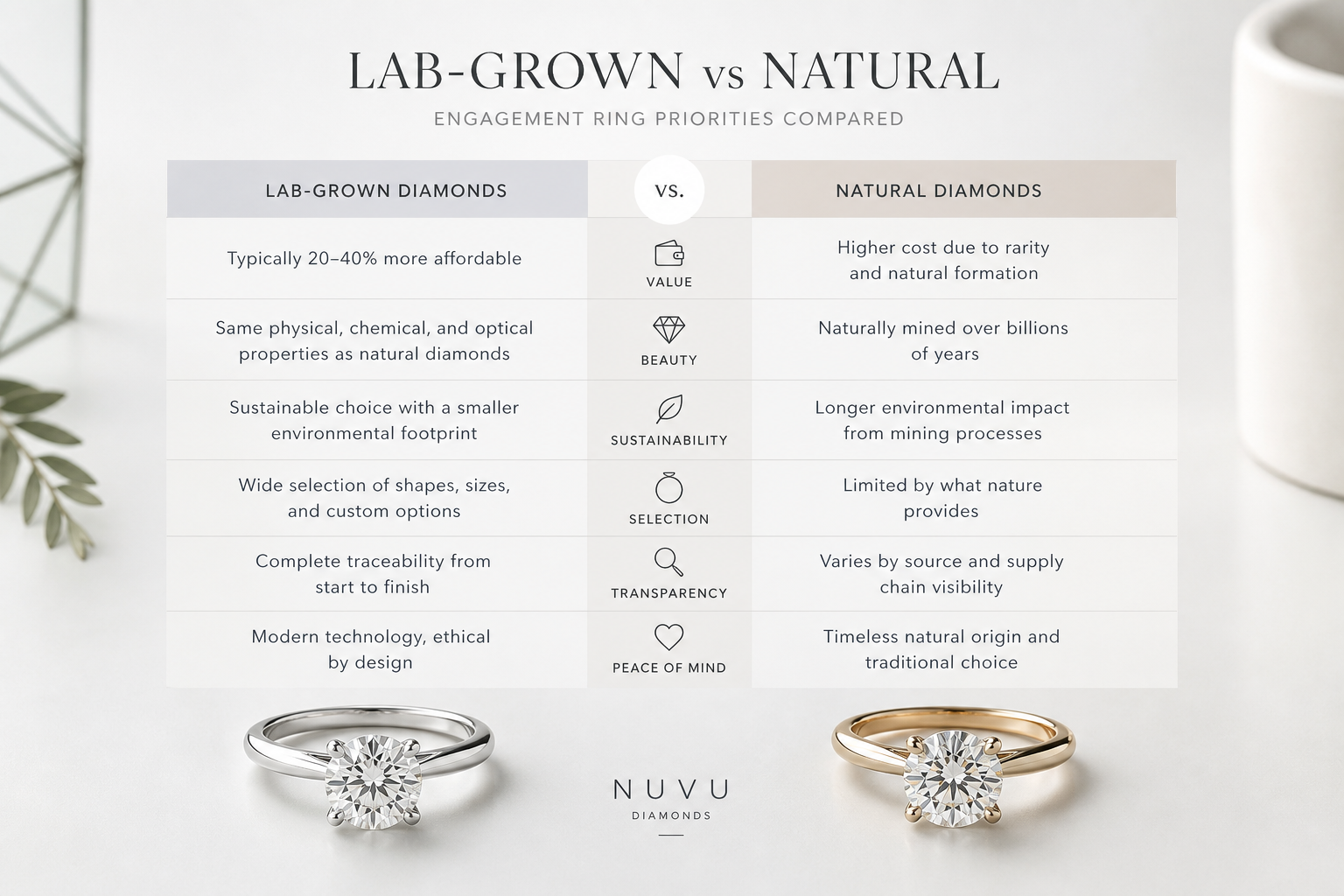
The choice between a lab-grown diamond or natural diamond for an engagement ring is not only a question of price. It is a question of which priority should lead the decision: visible impact, design flexibility, rarity, tradition, or long-term personal meaning.
For many buyers, lab-grown is the stronger practical fit because it allows more of the budget to go toward the parts of the ring they will notice every day: center stone size, shape, setting style, and overall presence on the hand. Natural may make more sense when the emotional value is tied closely to geological rarity, family expectations, or the tradition of giving a mined diamond.
The mistake is treating one option as universally smarter. A lab-grown engagement ring can be an excellent decision when the couple values appearance and budget efficiency most. A natural diamond can be the better decision when the buyer would regret not choosing a stone with natural rarity, even if that means accepting a smaller size or simpler setting.
When lab-grown usually makes the most sense
Lab-grown usually makes the most sense when the buyer wants a larger or more visually impressive ring without stretching the budget. If two stones look similar on the hand but one option leaves more room for a better setting, a preferred shape, or a more comfortable total spend, the lab-grown path often has the clearer everyday value.
This is especially true for buyers who care more about the finished ring than the origin story of the diamond. A couple choosing between a modest natural center stone and a more substantial lab-grown center stone may find that the lab-grown option better matches the ring they actually imagined. That does not make it automatically better; it means the value is being measured by appearance, wearability, and budget control rather than rarity.
Lab-grown is also a strong fit when the ring design matters as much as the stone. If the goal is an oval solitaire with a noticeable spread, a three-stone ring with balanced proportions, or a custom design where the center stone needs to carry the look, lab-grown can give the buyer more room to build the ring around the design instead of compromising every detail around the stone cost.
When natural may be the better fit
Natural may be the better fit when the diamond’s geological origin is part of the emotional value. Some buyers want the engagement ring to represent rarity in the traditional sense: a stone formed naturally over an extremely long period of time. If that idea matters deeply to the wearer, choosing lab-grown only for size or savings can create doubt later.
Natural may also make more sense when family expectations are strong or when the ring is intended to carry a more traditional heirloom identity. This does not mean natural diamonds are always better heirlooms. It means some families and wearers attach meaning to natural origin, and that preference should not be dismissed as irrational.
Resale expectations should be handled carefully. Neither lab-grown nor natural diamonds should be purchased primarily as a guaranteed financial investment in an engagement ring context. Natural diamonds may retain value differently in some resale situations, but resale depends on many factors, including market conditions, stone quality, brand, documentation, and buyer demand. If resale is a major concern, the safer approach is to research that separately rather than assuming the engagement ring will behave like a liquid asset.
How to weigh budget, symbolism, and long-term expectations
Start with the priority that would cause the most regret if ignored. If the wearer would feel disappointed by a smaller center stone every time they look at the ring, lab-grown deserves serious consideration. If they would feel uncomfortable knowing the stone was not natural, then the savings may not be worth it.
A useful test is to separate the decision into three questions: what do you want the ring to look like, what do you want the diamond to mean, and what budget feels responsible? If all three point toward lab-grown, the decision is usually straightforward. If the look and budget point toward lab-grown but the meaning points toward natural, the choice needs a more honest conversation.
Long-term expectations matter because engagement rings are not chosen for a single day. A ring that looks impressive but feels emotionally mismatched can become a compromise. A ring that satisfies tradition but forces the buyer into a size or design they do not like can also feel limiting. The better choice is the one that the wearer can explain without hesitation: “This is why this diamond made sense for us.”
Decision Framework Check
- Choose lab-grown if the priority is more visible size, stronger design flexibility, and a better-looking finished ring within a defined budget.
- Choose natural if rarity, tradition, or natural origin is central to the ring’s meaning and worth the added cost or design tradeoff.
- Pause before buying if one partner is focused on appearance and the other is focused on symbolism. That difference should be resolved before the ring is purchased.
- Do not choose based on price alone. A cheaper ring is not better if the stone, setting, or meaning does not fit the proposal.
How to buy with confidence without overcomplicating the process
Once you have decided that a lab-grown engagement ring fits your priorities, the buying process should become more focused, not more complicated. The goal is to confirm that the diamond, report, setting, and final specifications all match the ring you intend to give.
The most useful approach is to compare in sequence. First, confirm the stone itself. Then check the grading report. Then review photos or video. Then make sure the measurements fit the setting. Finally, confirm the ring details in writing before purchase or production begins. Skipping that order can lead to a common mistake: choosing a diamond that looks good as a loose stone but does not make sense in the finished ring.
If sustainability or sourcing is part of the decision, ask for the same level of clarity you would want for size and grading. Documentation should match the exact stone and the exact ring being sold; broad claims are less useful than specific, verifiable information.
What to compare before you decide
Compare diamonds by how they will appear in the ring, not just by the headline grade. Two lab-grown diamonds with the same carat weight can face up differently because their measurements and proportions are different. A stone that carries weight in depth may look smaller from the top than expected, while another with better spread may create a stronger visual result in the same setting.
Review the grading report, but do not stop there. The report can confirm important facts such as shape, carat weight, color, clarity, measurements, and grading laboratory. It cannot fully show how lively the diamond appears in motion, how the shape looks to your eye, or whether the stone’s proportions suit the ring style.
Photos and video matter because engagement rings are viewed in real light, not on paper. Look for a clear face-up view, side view, and movement if video is available. If the stone looks dark, uneven, cloudy, or visually awkward in multiple views, a stronger grade on paper may not fix the concern.
Which details should be confirmed in writing
Before you buy a lab-grown engagement ring, confirm the exact diamond and ring specifications in writing. This should include the diamond’s report number if provided, shape, carat weight, color, clarity, measurements, metal type, ring size, setting style, prong or bezel details where relevant, and any side stones or accent stones included in the design.
This matters most when two options look similar online. A buyer might compare two oval lab-grown diamonds, choose the one with the larger carat weight, and later realize the slightly smaller stone had better proportions for the setting. Written specifications help prevent confusion between what was viewed, what was selected, and what will be made.
Setting compatibility should also be confirmed before final approval. A center stone’s length, width, and depth affect how it sits in the ring. This is especially important for elongated shapes, halos, three-stone designs, and custom settings, where small measurement differences can change the balance of the finished piece.
For NUVU, the goal is to make diamond comparison easier to understand, especially when buyers are weighing report details, visual performance, setting fit, and budget together. That means the final decision should not depend on one impressive grade or one attractive image, but on whether the documentation, visuals, and design plan describe the same finished ring clearly.
When custom design is worth considering
Custom design is worth considering when the buyer has a specific vision that ready-made rings do not handle well. This may include a particular stone shape, a low-profile setting, a distinctive band style, a balanced three-stone layout, or a design that needs to account for daily wear. Custom can also help when the center stone has proportions that require a more tailored setting.
A ready-made ring is usually the simpler path when the design is classic, the stone is a standard shape and size, and the buyer wants a faster, more straightforward selection process. Custom is not automatically better. It is better when the design decisions need more control than a stock setting can provide.
At NUVU, this is where we usually encourage buyers to think of the diamond and setting as one decision. A beautiful loose diamond still needs the right physical and visual fit for the ring, especially if the buyer is choosing lab-grown to create a more intentional design rather than simply a larger stone.
Verification and buyer safeguards
Before approving a lab-grown engagement ring, it helps to treat documentation as part of the design review rather than a separate administrative step. The report, the measurements, the photos, and the final ring description should all point to the same stone and the same finished piece. When those details line up, buyers can compare options with more confidence and less guesswork.
A grading report helps document key characteristics, but it should not be treated as a guarantee of beauty, value, or sourcing ethics. Buyers should also avoid assuming that any seller policy, service term, resizing option, production timeline, or after-sales support applies unless it is stated clearly in writing by the seller for the specific order.
Before purchase, buyers should confirm the seller’s documentation, return policy, resizing terms, and after-sales support in writing rather than assuming these details from a product listing alone.
Final verification before purchase
Before approving the ring, make sure every important detail can be traced back to a specific stone and a specific design. The report details, seller listing, invoice, rendering or design notes, and final order summary should not conflict with one another. If something is unclear, such as whether the listed diamond is the exact stone being set or whether the setting has been adjusted for the stone’s measurements, ask before production begins.
Buyer Verification Checklist
- Confirm the diamond identity: match the report number to the exact stone being purchased when a report number is provided.
- Review the visuals: use photos or video to judge shape appeal, brightness, and face-up appearance.
- Check the measurements: compare carat weight with length, width, and depth so the stone fits the intended setting.
- Confirm the setting details: metal, ring size, prong style, band style, side stones, and any design changes should be clear before approval.
- Ask practical questions: what happens if the stone does not fit the selected setting, what details are final, and what specifications will appear on the order?
- Choose the ring that fits the whole plan: the right engagement ring is not just the biggest diamond or the highest grade, but the option that best matches the wearer, the design, and the budget together.
Disclosure: This article is for general educational purposes only. Diamond grading, pricing, availability, specifications, and seller policies can change, and readers should verify important details through grading reports, official laboratory tools, seller documentation, or qualified professionals before making a purchase decision. Laboratory-grown diamonds should be clearly distinguished from natural diamonds, and environmental or sourcing claims should be supported by specific documentation.