
A custom diamond bracelet must survive constant wrist movement, impact, and torsion — forces that rings and necklaces rarely face. Many buyers discover this only after a stone loosens, a clasp fails, or a slim design bends out of shape. This article walks through the real engineering decisions behind a lasting bracelet, informed by a custom jewelry budget guide on allocating money between lab grown diamonds, metal, and design work: metal thickness, clasp selection, stone security, and how shape, carat weight, and setting work together under daily wear. It helps you judge not just what looks right, but what will hold up.
For the full framework, read Custom Lab-Grown Diamond Jewelry Guide.
| Design Priority | Best Practice | Common Mistake to Avoid |
|---|---|---|
| Metal rail thickness | At least 1.0 mm between stones | Choosing slim rails that twist or break under stress |
| Clasp type for 5.0+ carats | Box clasp with double latch | Using a magnetic clasp, which can fail on impact |
| Gold alloy choice | 14K gold for daily wear hardness | Selecting 18K gold, which is softer and bends more easily |
| Prong inspection schedule | Inspect every six months; tighten 12–18 months | Waiting until a stone is loose or already lost |
| Cleaning method | Steam for channel-set bracelets | Using ultrasonic cleaners, which can loosen stones |
| Acceptance check | Magnify prong centering; test clasp smoothness | Accepting delivery without checking each stone seat |
Quick Questions Before You Read
Q: Can I get a super thin tennis bracelet that still lasts?
Thin designs often sacrifice metal rail thickness. For lasting durability, look for at least 1.0 mm of metal between each stone — even if that adds a little visual rail.
Q: Is a magnetic clasp safe for a heavy diamond bracelet?
No. Magnetic clasps are the most common failure point for bracelets above 5.0 carats. A box clasp with a double latch is far more secure.
Q: How often do I really need to check the prongs?
Inspect the underside prongs every six months. Professional tightening every 12–18 months is standard to prevent stone loss from wrist impact.
Q: Is platinum or 14K gold better for a bracelet I wear daily?
14K gold is harder and resists bending better. Platinum feels heavier but requires prong re-tipping every 2–4 years due to wear.
Why Custom Bracelets Require a Different Design Approach Than Rings or Necklaces
A diamond bracelet is not a ring stretched into a longer shape. The structural demands are fundamentally different, and many custom projects fail because the design was treated like an extended version of something the jeweler already knew how to build. Rings sit on a relatively stable platform. Necklaces hang with predictable tension. Bracelets twist, flex, knock against surfaces, and absorb compression from the wrist itself. Every design decision — metal thickness, stone setting, clasp type — must be evaluated against those conditions, not against how the bracelet looks in a display case.
How Wrist Movement and Impact Risks Differ from Finger or Neckline Wear
A ring may bump against a table surface now and then. A necklace rarely experiences lateral force. A bracelet, especially a tennis bracelet, moves through multiple planes of rotation every time the wearer reaches, types, carries a bag, or simply swings an arm while walking. The stones on the bottom curve of a tennis bracelet absorb direct compression against surfaces. The clasp endures repeated tension and release. The link points flex thousands of times in a single day.
This changes the priority order for bracelet construction. Metal thickness becomes more important than achieving the slimmest possible profile. Stone security matters more than uninterrupted sparkle. The clasp stops being an afterthought and becomes the most likely failure point. A ring with a slightly thin shank may never break. A bracelet with thin links or a weak clasp will eventually fail.
Why Stone Security and Flexibility Are Non-Negotiable in Bracelet Design
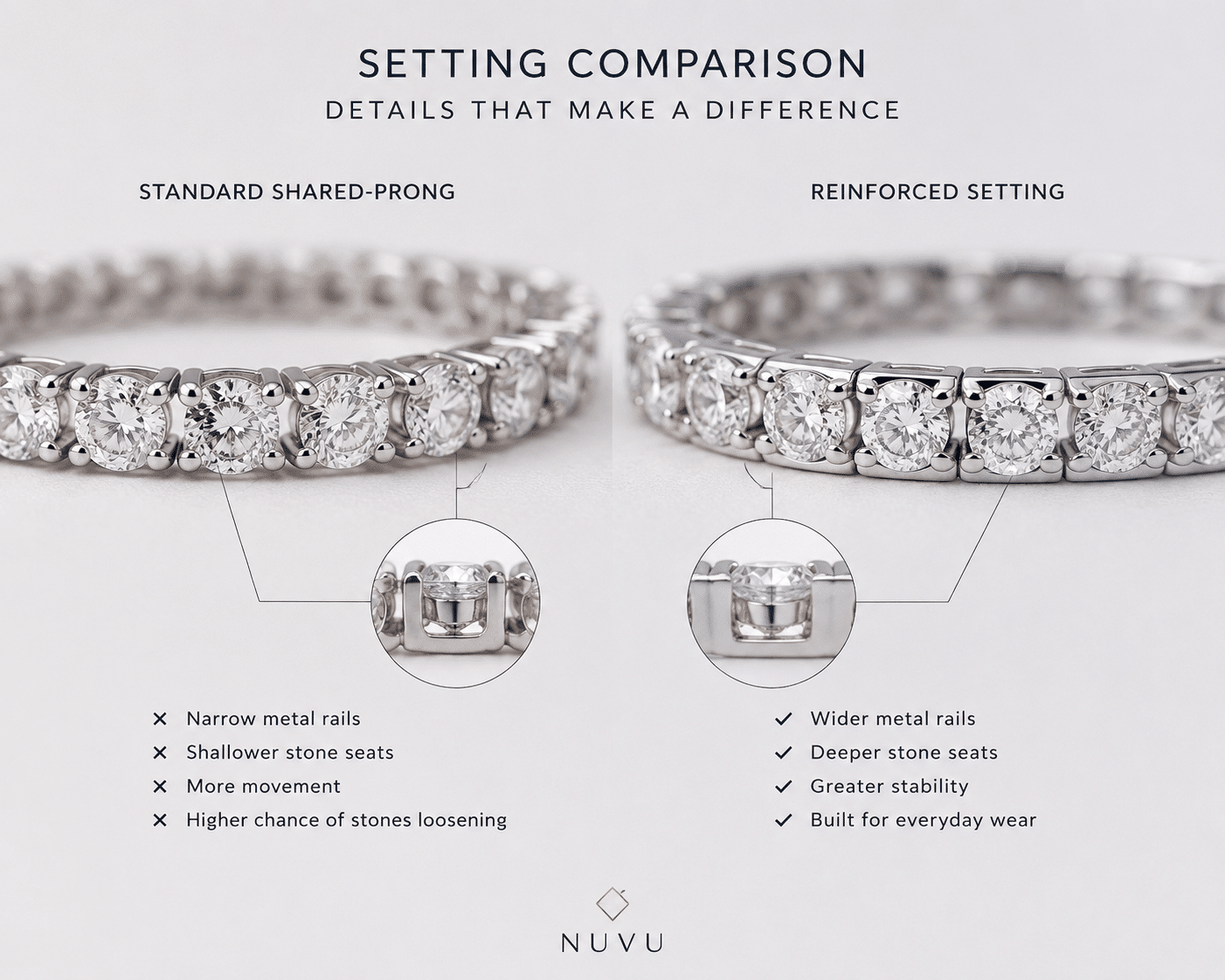
The constant torsion and bending of a bracelet creates a problem that rings and necklaces rarely face: each stone setting must tolerate slight flex without losing grip on the diamond. When a tennis bracelet bends along its length, the distance between adjacent settings changes slightly. A shared-prong setting that works perfectly in a ring may loosen over time on a bracelet because the prongs are asked to hold under recurring movement.
Channel settings face the same issue. The channel walls must be deep enough to prevent stones from tilting under torsion. Stone seat depth — the amount of metal holding each diamond — needs to be greater in a bracelet than in a comparable ring. A seat depth that passes inspection for a ring may allow a stone to shift over months of bracelet wear. The result is a visible gap between stones, or worse, a lost diamond that the wearer never felt fall out.
This structural principle is reinforced by how major gemological institutions describe the importance of setting integrity. The Gemological Institute of America (GIA) notes that the security of a diamond in any mounting depends significantly on the metal’s ability to hold the stone firmly against the forces of daily wear, and that prong or channel settings in pieces subject to more movement — such as bracelets — warrant closer inspection intervals.[1]
The Tradeoff Between Visual Continuity and Practical Durability
The most visually striking tennis bracelet designs push stones close together with minimal visible metal. Edge-to-edge setting, where diamonds appear to touch, creates a continuous line of sparkle. But that look comes at a cost. With no visible metal rail between stones, each shared prong must be thin enough to stay hidden but strong enough to hold under repeated flex.
A bracelet with a slightly thicker metal rail — even 0.3 to 0.5 mm of visible metal between diamonds — will hold its stones longer and require fewer repairs. The difference is noticeable only on close inspection, but the durability gap is real. The same logic applies to prong thickness. Heavier prongs reduce the continuous look slightly but dramatically reduce the risk of stone loss.
This is a genuine tradeoff, not a design flaw. A buyer who prioritizes maximum brilliance and minimal visible metal should know what that choice costs in long-term reliability. A buyer who plans to wear the bracelet daily should lean toward reinforced settings and accept a marginally less seamless appearance.
What to Check Before You Commit to a Bracelet Design
Before finalizing a custom bracelet, confirm the metal thickness at the narrowest point of the setting rail. Ask for the measurement in millimeters — anything under 1.0 mm for a standard tennis bracelet should raise a flag. Verify the number of solder points connecting each link or segment. Fewer solder points mean less structural redundancy if one joint weakens. Test the clasp operation: can you open and close it with one hand without visible strain on the components? If a clasp feels stiff or misaligned in the showroom, it will only get worse with wear.
Distinguishing Laboratory-Grown and Natural Diamonds in the Bracelet Context
When selecting diamonds for a custom bracelet, the distinction between laboratory-grown and natural diamonds is relevant because it affects budget allocation and documentation expectations — but it does not change the structural requirements of the bracelet itself. A well-set bracelet of either type will hold its stones equally well if the metal thickness, prong geometry, and clasp design are sound. However, the buyer should expect that any laboratory-grown diamonds used in the bracelet will be clearly identified as laboratory-grown on the accompanying documentation. A grading report from a recognized laboratory such as GIA or IGI will explicitly state whether the diamond is laboratory-grown or natural, and the report number or laser inscription allows independent verification through the laboratory’s online tools. This disclosure helps the buyer confirm that the stones match the agreed specifications and that no confusion exists about their origin. When comparing stones, the relevant characteristics are the same for both types: cut quality, color, clarity, and carat weight, along with the specific measurements and report details that determine how the stone fits the intended setting.
Clasp Design and Daily Wear Safety: What Most Custom Bracelets Get Wrong
The clasp is the most frequently underestimated component in a custom diamond bracelet, and it is also the most common point of failure. A well-set diamond can last decades, but a clasp that fatigues, bends, or opens unintentionally can turn a single wear session into a lost-stone emergency. This is not a detail to delegate to the end of the design process; custom lab grown diamond earrings guide emphasizes that it needs to be planned before metal is cast.
For the buyer, the distinction between a clasp that merely closes and one that is properly matched to the bracelet’s weight and movement is the difference between a secure daily accessory and a piece that requires constant vigilance. A clasp that is strong enough at purchase can still fail if it is not designed for the specific geometry of the bracelet it is attached to.
Box Clasps, Lobster Clasps, and Safety Latches: Which One Fits Your Bracelet Weight
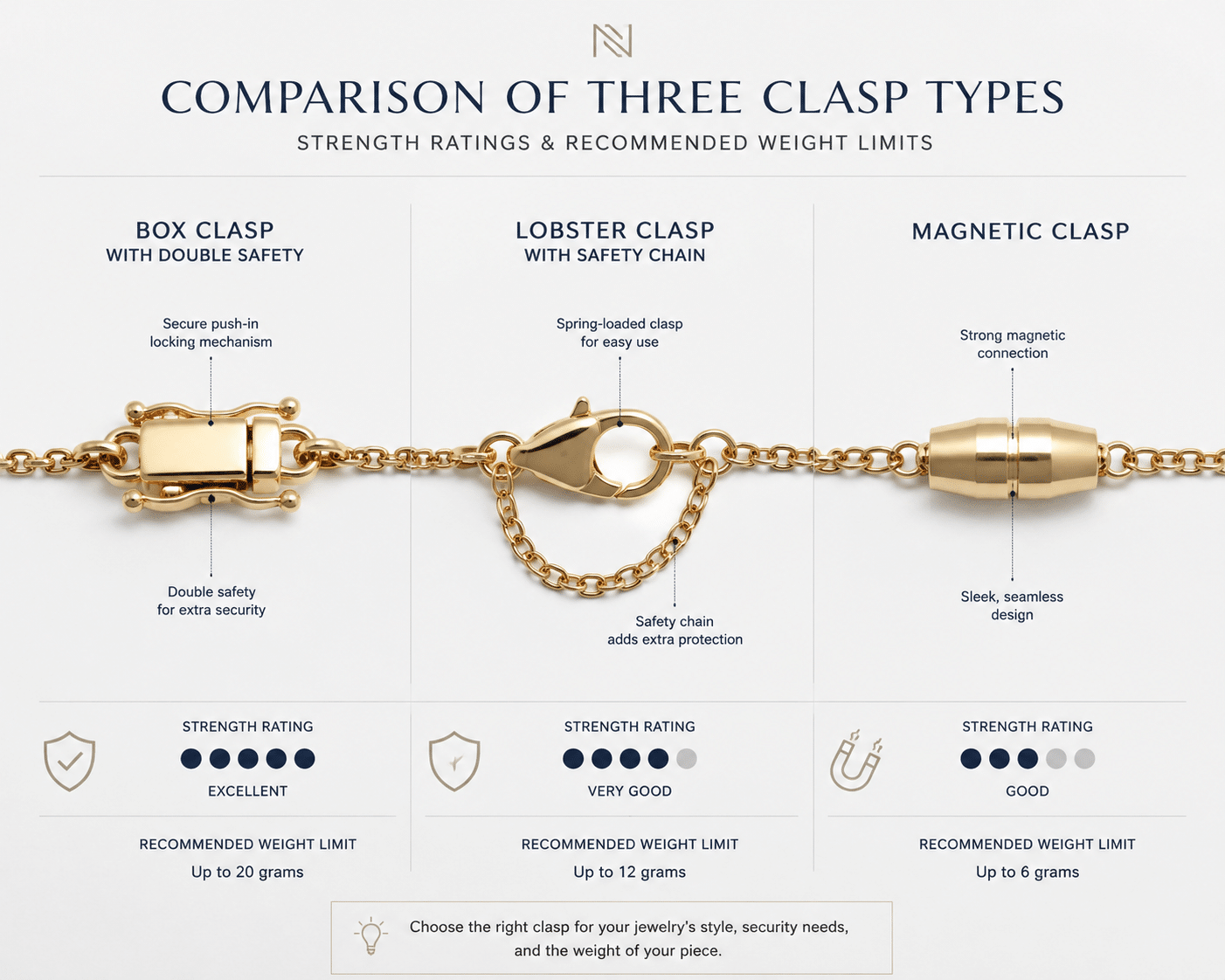
Not every clasp type is suited for every bracelet weight. A box clasp with a double safety latch is the recommended standard for diamond bracelets above 5.0 total carat weight. The double latch provides redundancy: if one side is accidentally caught or bumped, the second latch holds. Lobster clasps are acceptable for lightweight bracelets under 3.0 total carat weight, but they should always include a short safety chain or secondary catch as backup. Magnetic clasps should be avoided for any bracelet where the cost of replacing a lost stone exceeds the cost of replacing the clasp itself. The risk is not that the magnet will fail under normal wear — it is that unexpected contact with a metal surface can separate the clasp instantly, with no audible or tactile warning.
Clasp-to-Bracelet Weight Ratio and Structural Matching
The clasp assembly should account for approximately 10 to 15 percent of the bracelet’s total weight. This is not a decorative ratio. A clasp that is too light for the bracelet creates a structural weak point that strains the connection links where they meet the clasp housing. Over time, that strain can deform the link ends or cause the clasp to bend out of alignment. A clasp that is too heavy pulls the bracelet asymmetrically, shifting its center of gravity and causing it to rotate on the wrist. The visual result is a bracelet that never settles evenly, and the mechanical result is uneven wear on one side of the setting.
How to Test Clasp Security Before Finalizing the Design
Before approving the final design, request a clasp tension test. The bracelet should be shaken vertically and horizontally with the clasp fully closed. It must not open under its own stone weight. For tennis bracelets with two-piece clasps, confirm that both halves engage simultaneously — you should hear a single audible click, not two separate clicks that indicate one side caught before the other. Misaligned engagement is a sign that the clasp halves will wear unevenly, and over time, one side will open under less force than the other.
What This Means in a Real Purchase
Ask the jeweler to specify the clasp model or manufacturer by name, not just “safety clasp.” A generic label tells you nothing about the latch mechanism, the spring tension rating, or whether replacement parts are available. Confirm in writing that the clasp can be replaced separately if damaged, and whether the warranty covers clasp failure from normal wear versus accidental impact. If possible, test the clasp on a sample bracelet of similar weight before the final design is cast — feel matters more than a diagram.
What a Grading Report Documents and What It Does Not Guarantee
A grading report from a laboratory such as GIA or IGI can document key characteristics of each diamond — carat weight, color grade, clarity grade, and cut quality — but it should not be treated as a guarantee of beauty, durability, or value for a particular bracelet design. The report describes the stone’s properties under standardized conditions, but how those properties translate to the finished bracelet depends on the setting, the metal choice, the clasp security, and the wearer’s daily routine. A report also does not verify that a laboratory-grown diamond is “sustainable” or “ethical” in its production — those claims require separate, specific documentation from the grower or seller. For the bracelet buyer, the grading report is a useful reference for confirming stone specifications, but the final assessment of the piece should be based on the completed bracelet: how the stones sit, how the clasp engages, and whether the metalwork holds up under the wrist’s movement and impact.
Metal Choice for Bracelet Durability: Hardness, Weight, and Daily-Wear Resistance
Metal choice is not just a color or budget decision. For a bracelet, it is a structural decision that directly affects stone retention, scratch resistance, and how often the piece needs maintenance. Different metals behave differently under the constant movement and impact that bracelets experience daily.
18K Gold vs 14K Gold: The Practical Tradeoff for Bracelet Structures
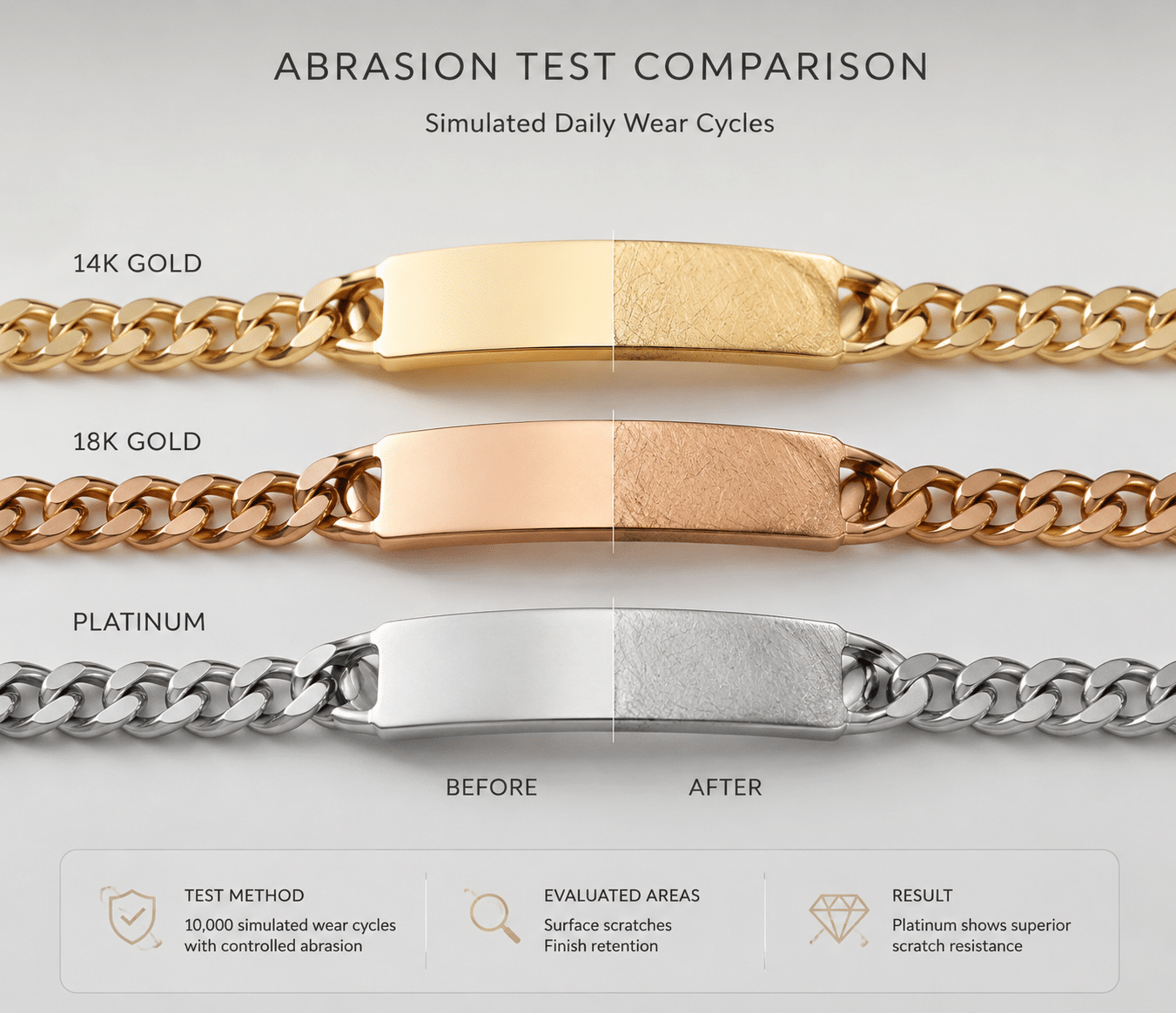
18K gold is softer and more ductile because it contains a higher percentage of pure gold. That softness makes it more likely to bend under wrist impact, and a bent setting rail means loosened prongs. For bracelets, which face far more physical contact than rings or necklaces, the practical tradeoff is clear: 14K gold is harder and more resistant to deformation. It holds stone settings more securely over time. The exception is when the buyer specifically prioritizes the color depth or gold purity of 18K over long-term structural durability. That is a valid preference, but it should be an informed choice, not a default.
It is worth noting that the hardness difference between 14K and 18K gold is not marginal in the context of a bracelet. The repeated micro-bending that a bracelet experiences can gradually deform softer alloys, even if the piece is never struck with significant force. This slow deformation is often the cause of stones that gradually loosen over months without any single traumatic event.
Platinum for Bracelets: Density Advantages and Prong Wear Risks
Platinum is approximately 60 percent denser than 14K gold, which gives a platinum bracelet a substantial weight that many buyers associate with quality. That density also makes the bracelet feel more solid during wear. However, platinum does not spring back into shape as readily as gold. Under constant wrist movement, platinum prongs can wear down faster — not because the metal is soft, but because it compresses rather than flexes. Prong tips on platinum bracelets often need re-tipping after 2 to 4 years of daily wear, depending on setting style and wrist movement patterns. If you choose platinum for a bracelet, plan for that maintenance interval.
Palladium, White Gold, and Rhodium Plating: Maintenance Considerations
Palladium offers natural whiteness without the need for rhodium plating, which makes it a low-maintenance option for buyers who want a white metal that stays white. However, it is less commonly available for custom fabrication, and not every jeweler has experience working with it. White gold bracelets require periodic rhodium re-plating — typically every 12 to 18 months for daily wear — to maintain color consistency between the bracelet body and the prong tips. Rhodium wear is most visible on high-contact areas: clasp edges, hinge joints, and the bottom curve of a tennis bracelet where the metal rests against surfaces. If the white gold loses its rhodium layer, the bracelet will show a yellow tint at those contact points.
Buyer Verification Checklist
Confirm the specific karat and alloy mix with the jeweler. A 14K yellow gold bracelet from one source is structurally the same as from another, but a 14K white gold alloy may contain nickel or be nickel-free, which matters for skin sensitivity. Ask whether the prong tips will be cast as part of the setting or hand-fabricated afterward. Cast prongs are faster and cheaper; hand-fabricated prongs are more precise and easier to re-tip later. Confirm whether the jeweler offers prong re-tipping as a covered service under warranty or as a paid service. Request the finished bracelet weight in grams both before and after stone setting so you can verify the actual metal weight used.
Treatments and Growth Methods: Disclosure Matters in Diamond Selection
When selecting diamonds for a custom bracelet — especially laboratory-grown diamonds — the terms HPHT and CVD may arise in discussions about growth method. These are production methods, not treatments, and a buyer should understand that neither method inherently determines the quality of the finished stone. A well-cut laboratory-grown diamond from either process can perform identically in a bracelet setting. If a post-growth treatment has been applied — such as HPHT annealing to improve color — the grading report or seller documentation should clearly disclose this. For the bracelet buyer, the relevant question is not which growth method was used, but whether the stone’s specifications, including any disclosed treatments, are documented and verifiable. This allows the buyer to compare stones on their documented characteristics rather than on assumptions about the production process.
Custom Design Process for Bracelets: From Concept to Final Casting
The design workflow for a bracelet is not the same as for a ring or a pair of earrings. The differences matter because the bracelet has to fit a moving, flexing part of the body, and it must distribute stone weight evenly across that movement range. Skipping any step in this process increases the risk of a finished piece that looks right in the hand but does not wear right on the wrist.
Wrist Measurement and Fit Allowance: Why a Few Millimeters Matter
A tennis bracelet should fit with approximately 0.5 to 1.0 inch of slack, depending on wrist shape and personal preference. Too tight and the bracelet will not settle; too loose and it will rotate, exposing the bottom of the setting to repeated impact. Bangles require a different measurement entirely. You need wrist circumference plus the widest point of the hand — specifically the thumb knuckle. A bangle that fits the wrist but cannot pass that widest point is unwearable. Do not rely on verbal size reporting. Request a measurement guide or a printable sizing tool. A 2-millimeter error can mean the difference between a comfortable fit and a resizing that risks stone damage.
CAD Modeling for Bracelet Flexibility and Stone Spacing
A CAD model for a bracelet must do more than show the design in a straight line. It must simulate the bending plane of each link or segment. For tennis bracelets, each link should rotate freely within a defined range — typically 30 to 45 degrees — without binding at the stone edges. If a link cannot rotate that far without contact between adjacent stones, the bracelet will stiffen over time or force stones out of alignment during wrist movement. For bangles, the CAD must show the full 360-degree arc with stones seated at equal depths relative to the outer curve. Uneven seat depth on a curved surface causes stones to sit at different angles, creating visible asymmetry under light.
Wax Prototype Casting and Wear Testing
Before any metal is cast, a wax or resin prototype should be produced and test-worn for at least one full day. This test reveals fit issues that the CAD cannot predict: sharp edges on clasp components that rub against the skin, whether the bracelet rotates on the wrist in a way that exposes setting backs to impact, and whether the clasp position feels natural during daily activities. Do not skip this step for any bracelet above 3.0 total carat weight. If a prototype pressuring the case metal cost is the only obstacle, consider what a single lost stone would cost to replace.
Documentation and Traceability During the Design Process
As the bracelet moves from concept to prototype and then to final casting, the documentation trail becomes an important tool for both the buyer and the maker. For lab-grown diamonds, each stone typically carries a unique laser inscription that corresponds to an individual grading report from a laboratory such as GIA or IGI. Asking the jeweler to record the report numbers and cross-reference them with the intended bracelet layout before setting helps confirm that the stones delivered match the specifications agreed upon. This is especially relevant when the bracelet uses multiple stones of similar size and grade, as a mismatch in color or clarity can become apparent only after setting, when replacement is far more disruptive. In sourcing or wholesale conversations, documentation, consistency, and communication often matter as much as the headline specification. Buyers should request that the final invoice or design summary includes a list of the laboratory report numbers or laser inscription codes for the stones used in the bracelet, so that the documentation trail is complete from start to finish.
For custom design, trust comes from matching the stone to the setting, budget, and wearer’s daily use — not from choosing grades in isolation. The documentation trail supports this by providing a verifiable record—custom lab grown diamond jewelry guide—that the stones in the final piece are the same stones that were selected during the design phase.
How to Verify This Before Buying
Ask the jeweler to show you the CAD model with the bracelet in a bent position simulating the wrist curve, not just laid flat. A flat CAD hides how stones interact during flexion. Confirm that the wax prototype will be sent for your approval before any metal is cast. Request a brief video of the prototype being flexed and the clasp being opened and closed. If the jeweler is not willing to produce a prototype, that is a signal that the design may not be fully tested for wear behavior.
When a grading report is available, buyers should verify the report details through the issuing laboratory’s official report verification system. For lab-grown diamonds, GIA and IGI reports include a unique laser inscription that can be confirmed directly through the laboratory’s online tools. This step provides an independent layer of documentation, helping ensure that the stones in your bracelet match the specifications discussed during the design process.
Daily Wear Risks, Maintenance, and Long-Term Care for Diamond Bracelets
Owning a custom diamond bracelet means accepting that it will require more ongoing attention than a ring or pair of earrings. The wrist is a high-impact environment, and the same daily motion that makes a bracelet feel alive also puts its components under constant stress. Understanding the real maintenance demands before you buy prevents surprises later.
Common Failure Points: Prong Snagging, Stone Loosening, and Chain Stretch
The bottom curve of a tennis bracelet is the highest-impact zone. Every time your hand rests on a desk, brushes against a counter, or swings against your hip, the stones at that lowest point absorb compression that the top-facing stones never experience. These bottom stones should be visually inspected every six months for prong wear — especially the outer prongs, which thin faster from repeated contact. On chain-based tennis bracelets, the links themselves are a failure point. Repeated flexing stretches the metal over time, creating visible gaps between stones that become noticeable from arm’s length. A bracelet worn daily will typically require professional inspection and tightening every 12 to 18 months. If you wait until a stone falls out, you are already past the point where routine maintenance would have caught the problem.
It is useful to distinguish between a stone that is loose and one that is merely slightly movable. A truly loose stone will visibly shift when pressed with a finger; a slightly movable stone may only be detectable under magnification or by tapping it gently with a wooden tool. Many buyers assume that any movement is a sign of imminent loss, but a very slight movement can sometimes be normal in a flexible bracelet. The safest approach is to have any movement, no matter how small, checked by the jeweler who made the piece. At NUVU, this kind of assessment is treated as a routine part of bracelet ownership — not a sign of poor workmanship, but a natural consequence of wear that needs periodic attention.
Cleaning Methods That Protect Settings
Ultrasonic cleaning is safe for most diamond bracelets, but only if the settings are tight and the stones are free of significant inclusions. Loose settings or heavily included stones can be damaged by the vibration. Steam cleaning is the safer choice for channel-set bracelets because it cleans without mechanical vibration that can loosen stones over time. One common mistake is leaving a bracelet to soak overnight in ammonia-based jewelry cleaner. Prolonged exposure to ammonia can weaken prong metal, making it more likely to bend or break under normal wear. A quick clean — ultrasonic or steam — followed by a rinse and air dry is sufficient for regular maintenance.
When to Remove a Bracelet to Avoid Damage
Diamond bracelets should come off during weightlifting, gardening, and any cleaning that involves abrasive chemicals. Sleeping with a bracelet on is risky if the clasp has exposed moving parts — rolling onto a box clasp can twist the hinge or snap a safety latch. Swimming is another common source of damage. Chlorine can discolor white gold prongs, and salt water can corrode hinge mechanisms in bangle clasps. A bracelet that is removed before these activities and stored in a padded compartment will last far longer than one worn through everything.
Understanding Environmental and Sourcing Claims Related to Diamond Bracelets
When researching diamonds for a custom bracelet, buyers may encounter claims about environmental impact, sustainability, or ethical sourcing. These claims can apply to both laboratory-grown and natural diamonds, but they should be treated with specific scrutiny rather than accepted at face value. A claim that a laboratory-grown diamond is “sustainable” or “eco-friendly” should be supported by specific documentation about the production facility’s energy sources, carbon offsets, or environmental certifications. Similarly, a claim that a natural diamond is “conflict-free” should be traceable to the country of origin and to a supply chain verification system such as the Kimberley Process. For the bracelet buyer, the safest approach is to treat these claims as separate from the stone’s grading report and to request the specific documentation that supports each claim. If a seller or jeweler cannot provide verification, the claim should be regarded as an unsubstantiated assertion rather than a verified fact. This approach does not diminish the value of either diamond type — it simply ensures that the buyer is making an informed decision based on documented information rather than promotional language.
What This Means in a Real Purchase
Ask the jeweler for a written care schedule before you commit. The schedule should include recommended inspection intervals and clarify whether the warranty covers stone retightening if a stone is lost due to prong wear — many warranties exclude wear-related stone loss. Also confirm whether professional cleaning is included with the purchase or available as a paid service. Do not assume that a diamond bracelet is maintenance-free because the diamonds themselves are hard. The metal holding them is not, and it will wear down with use.
Balancing Visual Luxury with Practical Strength: Final Design Decisions
The hardest decision in a custom diamond bracelet is not which stones to choose. It is how much visual continuity to trade for long-term structural reliability. The most seamless-looking designs are often the most fragile, and the most durable designs require small compromises that affect the bracelet’s optical flow. Knowing where your priorities sit makes this tradeoff easier to navigate.
When More Metal Is Better: Setting Rail Thickness and Stone Spacing
A tennis bracelet with stones set edge-to-edge — no visible metal between diamonds — looks maximally continuous. It also leaves no room for prong reinforcement. When the metal between stones is paper-thin, a single hard knock can bend a shared prong and dislodge two stones at once. A 0.3 to 0.5 mm metal rail between stones, or a slightly thicker shared-prong profile, reduces the risk of stone loss over time while still looking like a nearly uninterrupted line of diamonds. This is not a flaw. It is a design choice that prioritizes durability, and a good jeweler should present it as such rather than hiding the tradeoff.
Stone Size Limits Based on Bracelet Type
Round diamonds above 5.0 mm diameter in a tennis bracelet require proportionally thicker prongs to prevent lateral movement. At that size, the stone mass multiplied by wrist motion creates torque that thinner prongs cannot resist over time. For bangles, the risk shifts to the top half of the circle. Stones above 4.0 mm diameter set on the top curve create leverage that can loosen channel walls — the weight of the stone pulls outward every time the bangle shifts on the wrist. A responsible jeweler will flag the maximum safe stone size for your chosen bracelet style before you begin selecting stones. If they do not, ask.
These size limits are not absolute rules for every bracelet; they depend on the specific metal alloy, the number of stones, and the setting design. However, they serve as useful warning points. A buyer who wants stones larger than these thresholds should expect the jeweler to recommend a reinforced setting or a different bracelet structure, not simply agree to the request without comment. At NUVU, the discussion around stone size limits is framed as a practical constraint of the bracelet form, not a barrier to creativity — understanding why a 5.5 mm stone needs different prong geometry than a 4.0 mm stone is part of evaluating whether the design will hold up under real wear.
The presence of a grading report from GIA, IGI, or another laboratory is often presented as the single most important factor in a diamond’s quality, but for a bracelet, the report is one of several inputs that together determine whether the finished piece will wear well. A report documents the stone’s characteristics under controlled conditions, but it does not evaluate how the stone performs in a specific setting, how securely it is held, or how the overall design handles wrist movement. For the bracelet buyer, the report is best used as a verification tool: confirming that the stone’s color, clarity, and carat weight match the seller’s description, and that the report number matches the laser inscription on the stone. The more important evaluation for a bracelet is how the stones sit in the setting, how the clasp engages, and whether the metal thickness meets the durability thresholds discussed in this guide. A stone with an excellent report rating can still be a weak point in a bracelet if the setting is not designed for the forces it will face. NUVU’s buyer-first approach is to make comparison clearer, especially around report details, visual evidence, setting fit, and design documentation — not to treat the report as the final word on whether the bracelet will last.
How to Review a Completed Bracelet Before Taking It Home
Before accepting delivery, inspect the bracelet under 10x magnification. Prong tips should be centered on the crown facets, not shifted to one side — off-center prongs indicate rushed setting work and increase the risk of stone loss. All stones should sit at the same height relative to the setting rail. Open and close the clasp ten times in a row to confirm smooth engagement. Place the bracelet on a flat surface and check that it lies evenly without twisting. A well-made bracelet will sit flat. A twisted bracelet signals uneven link tension or a misshapen structure that will worsen with wear.
Considering Price Variability and What It Means for Bracelet Budgeting
The cost of a custom diamond bracelet can vary significantly based on the stones, the metal, the complexity of the setting, and the seller’s pricing structure. For the buyer, this means that comparing prices requires comparing like-for-like specifications: the same total carat weight, the same stone color and clarity grades, the same metal type and karat, and the same setting design. A grading report can help establish a baseline for stone value, but the bracelet’s final price will also reflect the metal weight, the clasp mechanism, the labor involved in setting multiple stones, and any custom design fees. Buyers interested in laboratory-grown diamonds often find that the stone cost is lower than for comparable natural diamonds, but the bracelet construction costs — metal, setting, labor — may be similar regardless of stone origin. Prices can change with market conditions, report type, seller channel, and stone-specific details, so exact comparisons should be verified at the time of purchase. Rather than focusing on finding the lowest price, the more useful approach is to confirm that the specifications, documentation, and design details match what was discussed, so that the final price reflects a fair evaluation of the completed piece.
What to Check Before You Decide
Before accepting final delivery, request a written summary of the bracelet’s specifications: total carat weight, individual stone measurements, metal type and karat, clasp model, and recommended service interval. Confirm whether the setting can be upgraded to reinforced prongs or thicker channel walls if you change your mind after wear testing. A good custom bracelet should feel secure the first time you put it on — not weeks later after a stone is lost.
[1] Gemological Institute of America (GIA), “Ring Care and Cleaning,” GIA website. This source provides general guidance on the importance of setting integrity and inspection for pieces that experience movement, which is directly applicable to bracelet wear conditions.
Disclosure: This article is for general educational purposes only. Diamond grading, pricing, availability, specifications, and seller policies can change, and readers should verify important details through grading reports, official laboratory tools, seller documentation, or qualified professionals before making a purchase decision. Laboratory-grown diamonds should be clearly distinguished from natural diamonds, and environmental or sourcing claims should be supported by specific documentation. For custom jewelry, stone measurements and setting compatibility should be confirmed before finalizing a purchase.