
Choosing a lab-grown diamond necklace involves different design logic than selecting a ring. Because a pendant moves, rotates, and is viewed from farther away, factors like cut brilliance, stone orientation, chain length, and setting security, with earring-specific details in the custom lab grown diamond earrings guide, matter more than clarity perfection or color grade. Many buyers overspend on features that don’t improve the necklace’s real-world appearance, while underinvesting in the specifications that actually determine how the stone performs in motion. This guide walks through how to balance stone size, pendant style, chain proportions, and setting type so you end up with a piece that looks beautiful, wears well, and respects your budget.
For the full framework, read Custom Lab-Grown Diamond Jewelry Guide.
Throughout this guide, the emphasis is on practical evaluation: what matters when the stone is worn, not when it is examined under a loupe. The goal is to help buyers distinguish the features that genuinely affect the pendant’s appearance and durability from those that only add cost.
| Design Decision | Recommended Choice | Why It Matters |
|---|---|---|
| Stone clarity & color | VS2–SI1 clarity, G–H color | Higher grades add cost but produce no visible difference in pendant wear |
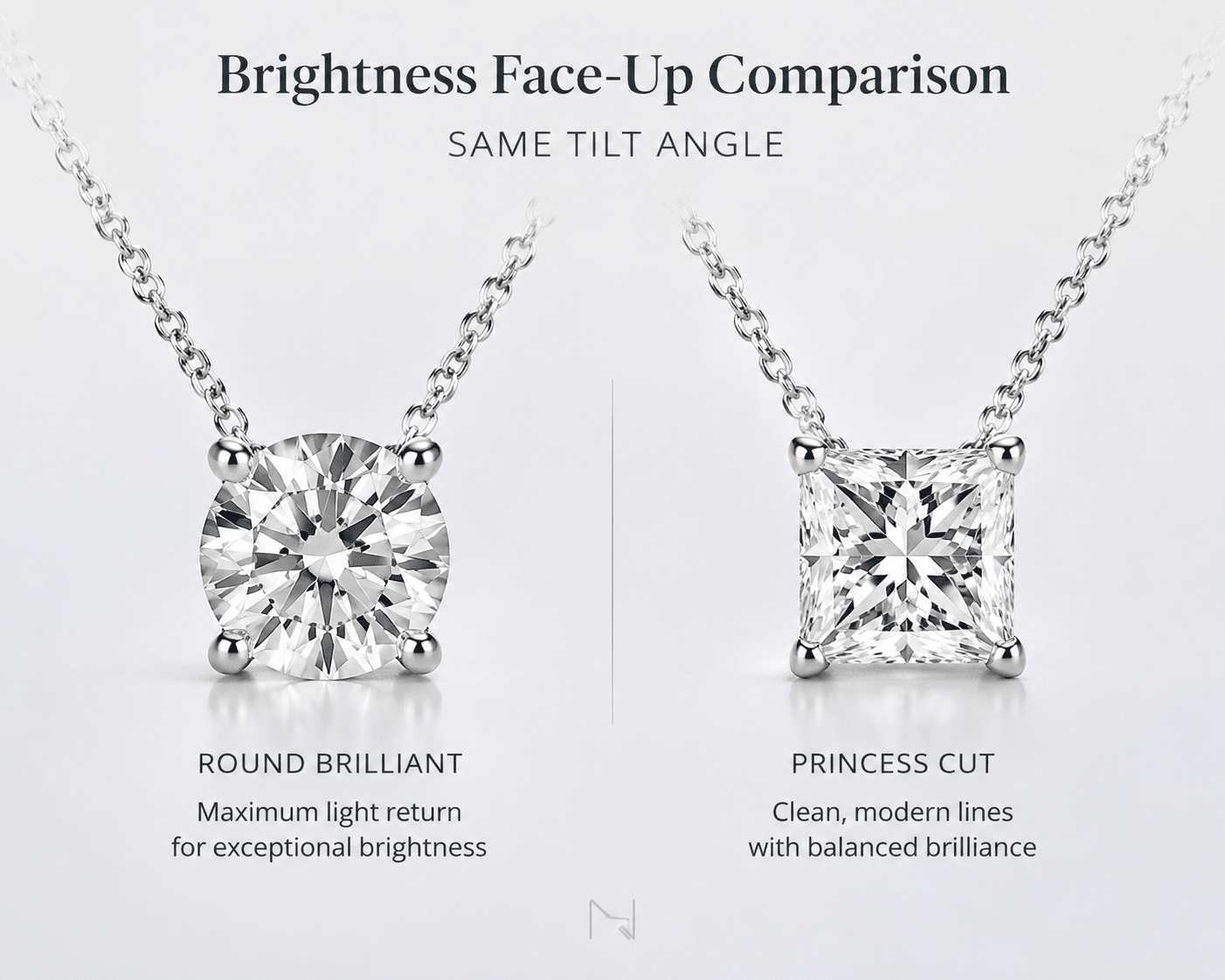
| Stone shape for movement | Round or oval brilliant cut | Princess cuts lose sparkle when the pendant tilts during wear |
| Pendant style for stone size | Solitaire for 0.75 ct+; halo to visually enlarge smaller stones | Halos add 30–60% visual spread but require more cleaning |
| Chain length by carat weight | Under 1 ct: 16–18 in; 1–2 ct: 18–20 in; over 2 ct: 20–22 in | Wrong chain length makes the pendant sit awkwardly on the chest |
| Setting for daily wear | Bezel setting, especially for stones over 2 carats | Bezels protect edges and reduce snagging better than prongs |
| Metal choice | 14k gold | Best balance of durability, weight, and cost for necklace wear |
| Purchasing approach | Custom project (stone + setting + chain as one build) | Mixing separate components often leads to fit or proportion issues |
Quick Questions Before You Read
Q: Do I need the same quality diamond for a necklace as for an engagement ring?
No. For a pendant, VS2–SI1 clarity and G–H color are perfectly fine. The stone is not under direct scrutiny like a ring, and movement actually hides minor inclusions.
Q: Is a halo setting worth it for a lab-grown diamond pendant?
It depends. A halo makes a stone look 30–60% larger, which helps smaller carat weights. But it also catches more lint and requires frequent cleaning. For daily wear, consider the trade-off carefully.
Q: Can I save money buying the diamond and chain separately?
Not usually. The main savings from lab-grown diamonds come from the stone itself—not the setting or chain. Buying everything as a custom project ensures the proportions, bail fit, and chain width are designed for that specific stone.
Q: How important is the chain thickness?
Very. The stone diameter should be 3 to 5 times the chain thickness. A thick chain with a small stone looks heavy, and a thin chain with a large stone wears dangerously. Getting this ratio right changes the entire look.
Why a Lab-Grown Diamond Necklace Requires Different Design Logic Than a Ring
A necklace is not a ring hung from a chain. Gravity pulls the stone away from the body. Movement swings it through different lighting. Viewing distance changes what the eye can actually see. And daily contact — with clothing, zippers, countertops — creates forces that a ring never experiences. These differences change every selection priority.
Visibility Distance Changes Cut and Clarity Priorities
A pendant sits 6 to 12 inches farther from the eye than a ring. At that distance, small inclusions and minor color differences become invisible to the naked eye. For most necklace designs, VS2 to SI1 clarity and G to H color deliver full visual performance. Paying for a D color or VVS clarity grade provides no visible benefit on a pendant. The money is better spent on cut quality or a slightly larger stone, both of which matter more at necklace viewing distance.
What this means in practice: A buyer choosing between a 1-carat D-VVS stone and a 1.10-carat G-VS2 stone at the same total cost will see a real difference from the larger stone’s presence on the chest, but no visible difference from the higher color or clarity on the chain. The second choice is almost always the better value for a pendant.
Gravity Load and Stone Security in Suspended Settings
A necklace stone faces constant movement and occasional snagging, unlike a ring that mainly takes impact from the front. Bezel settings, four-prong baskets with reinforced gallery rails, and cathedral-style pendant heads distribute gravitational stress more evenly than tension or peg settings. For stones over 1 carat, four prongs is the minimum. For stones over 2 carats, six prongs is the safer choice. A suspended stone has no setting base beneath it to catch it if a prong fails.
Light Return at Different Viewing Angles
A ring is viewed from above at close range. A pendant swings at various angles as the wearer moves. Round brilliant and oval cuts maintain consistent light return across a wider range of tilt angles than princess or emerald cuts. A princess-cut pendant that looks bright face-up can go dark when it tilts forward by 15 degrees. Buyers who want maximum sparkle from a moving pendant are better served by brilliant-cut shapes that keep performing through movement.
What to Check Before You Decide
Review the stone’s brilliance and scintillation in 360-degree video, not just a static face-up image. Ask whether the setting allows free movement or tilts the stone toward the body. Confirm that the pendant bail or loop sits centered enough to avoid the stone leaning forward or backward against the chest.
Solitaire Pendant vs. Halo Pendant: When Each Makes Sense
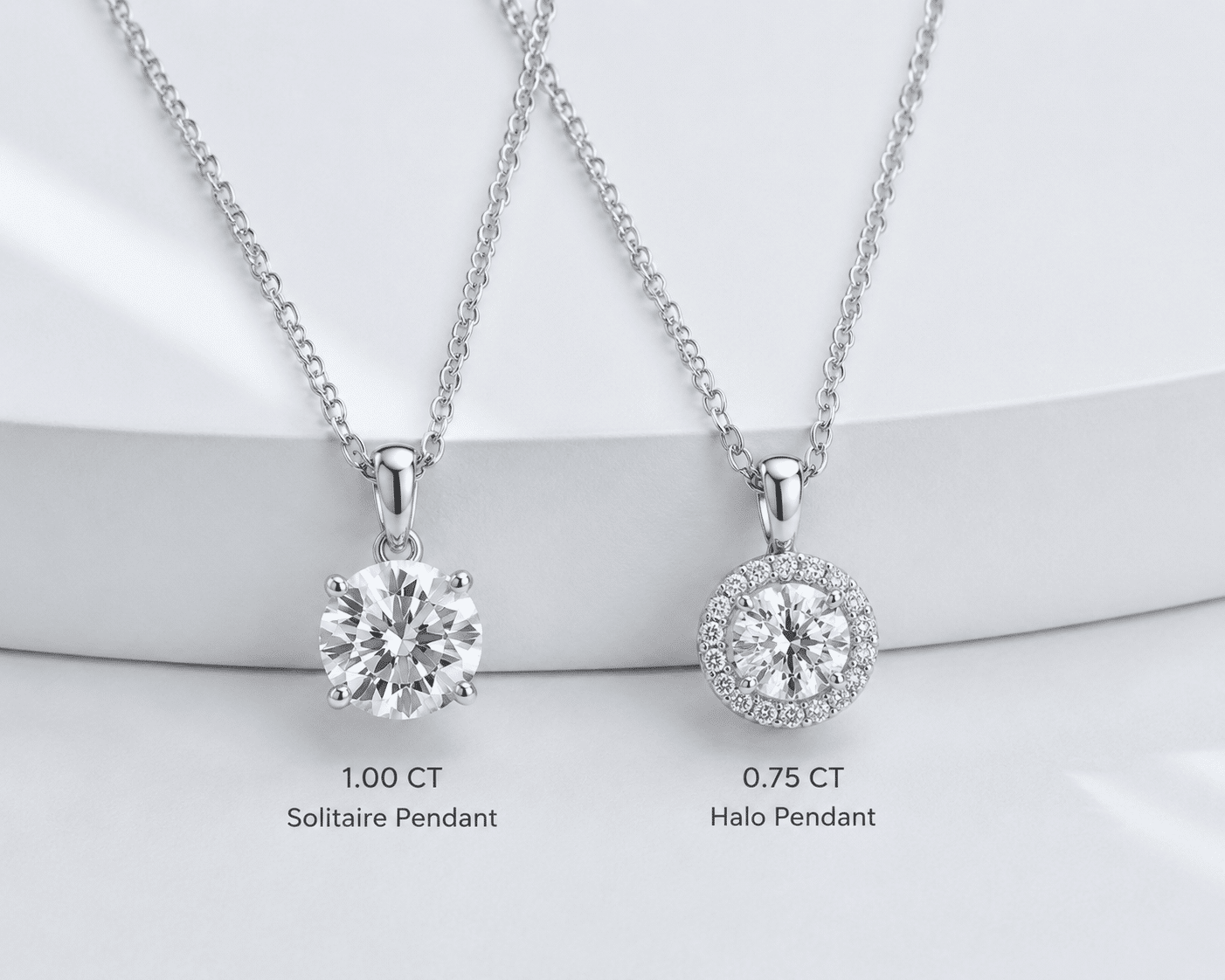
These two pendant types serve different priorities. A solitaire puts all the visual weight on one stone. A halo spreads attention across a center stone and a surrounding ring of smaller diamonds. The right choice depends on stone size, daily wear tolerance, and how much visual presence you need.
Solitaire Pendant and the Single-Stone Focus
A solitaire pendant relies entirely on the diamond’s own visual performance. There is no surrounding halo to mask small color differences or boost perceived size. This design favors round or oval stones with excellent or ideal cut grades, set in a simple four-prong or bezel with a low-profile gallery. The cut grade matters more here than in any other setting because there is nothing else to catch the eye. For a solitaire to have visible presence, the minimum recommended carat weight is 0.50 to 0.75 carats. Below that range, the stone can look small against the chest.
A common mistake is to choose a solitaire based on a high cut grade on the report without verifying the stone’s actual visual behavior. Two diamonds with the same “Excellent” cut grade can differ noticeably in brightness and pattern when viewed at pendant distance. Asking for a short video of the stone in motion — not just a still image — gives a much better sense of how it will look as a suspended pendant.
Halo Pendant and the Perceived Size Advantage
A halo of small lab-grown diamonds, typically 0.05 to 0.10 carats each, increases the pendant’s total visual spread by 30 to 60 percent compared to the center stone alone. The halo also acts as a light-collection ring that helps the center stone appear brighter than it would on its own. This allows a 0.75-carat center stone to read visually as a 1.50-carat pendant at normal viewing distance. The halo also protects the center stone from direct edge contact with clothing and surfaces, which reduces chipping risk.
Wear Comparison for Daily Use
Solitaire pendants catch less lint and resist flipping better than halos because of their simpler silhouette and lower surface area. Halo pendants with melee stones may occasionally trap lint between the halos or around the basket. This is a minor issue but worth noting for buyers who plan to wear their pendant every day. A solitaire requires less weekly maintenance. A halo needs more frequent cleaning to keep the melee stones bright.
Stone-to-Setting Fit Check
For a solitaire, confirm that the prongs or bezel do not cover more than 20 percent of the stone’s crown area. Heavy prongs can block light entering the diamond. For a halo, ask whether the melee stones are matched for color grade — they should be within one grade of the center stone — and whether the halo stones are uniformly sized to avoid a lopsided look.
Initial, Symbolic Shape, and Station Necklace Design
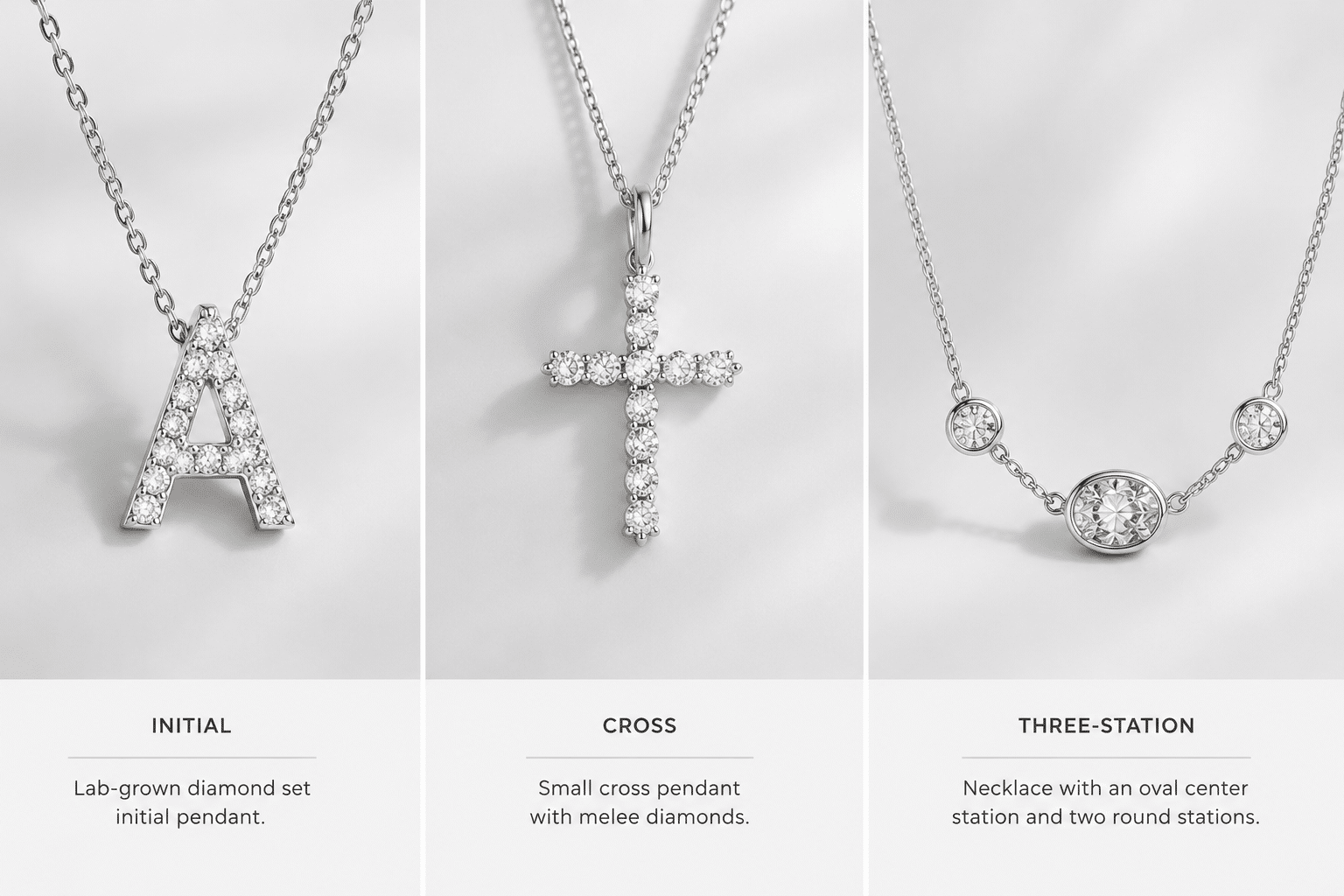
Not every necklace is built around a single center stone. Initial pendants, symbolic shapes, and multi-station designs are popular alternatives, and lab-grown diamonds change the cost equation for all of them. When melee and small stones make up most of the diamond weight, the price difference between lab-grown and natural becomes even more significant.
Initial and Letter Pendants with Lab-Grown Diamond Accents
Script and block-letter initials can be set with lab-grown diamond melee — 0.005 to 0.02 carats per stone — along the letter path or clustered at the letter’s center. Because lab-grown diamonds are priced lower per carat, the melee cost for a fully diamond-set initial pendant is typically 30 to 50 percent lower than a natural-diamond equivalent. This makes fully diamond-set initials accessible at $400 to $800 total project cost, compared to $800 to $1,600 with natural diamonds of equivalent quality. The savings allow buyers to choose a larger or more detailed letter form without exceeding budget.
Symbolic Shape Pendants: Star, Cross, Heart, and Abstract Forms
These pendants can use a single center stone in a custom-shaped setting, a full pavé of small lab-grown diamonds over a metal form, or a bezel-set diamond at the pendant’s focal point. The manufacturing challenge is stone alignment on curved or asymmetrical surfaces. Reputable manufacturers use computer-aided design and computer-aided manufacturing to pre-map each stone position and ensure consistent prong or bead placement. A poorly mapped symbolic pendant can look uneven when the stones drift off the intended path. CAD verification before production prevents this.
For symbolic shape designs, the buyer’s decision is often between a fully diamond-set surface and a sparse accent approach. The fully set version offers maximum sparkle but requires careful matching of melee stones for color consistency across the curve. The accent approach reduces cost and maintenance but relies more on the metal shape itself for the visual impact. Neither choice is inherently better — the right one depends on the wearer’s preference for brightness versus silhouette clarity.
Station Necklace Design and Stone Spacing
A station necklace has diamonds placed at regular intervals along the chain. Each stone is typically 0.10 to 0.30 carats, spaced 1.5 to 3 inches apart. Lab-grown diamonds make multi-station designs affordable at five to eight stations, where a natural-diamond version would be cost-prohibitive. The chain must be sturdy enough to prevent twisting. Cable chains of 1.5 to 2 mm and solid box chains perform better than rope or link chains for station designs, because the stones create uneven weight distribution that lighter chains cannot handle well.
Buyer Verification Checklist
Request a CAD rendering or a 3D model of any custom-shaped pendant before production begins; according to the CAD design approval, confirm that stone placement follows the intended shape, that chain attachment points are reinforced, and that the pendant back is either hollowed for weight reduction or solid for a more substantial feel.
Chain Length, Stone Proportion, and Hanging Position
Chain selection is one of the most overlooked variables in custom pendant design. A well-chosen stone in the right setting still looks wrong if the chain is too thick, too thin, or the wrong length. And if the pendant does not hang correctly, none of the other details matter.
Chain Length Recommendations by Pendant Size
Chain length controls where the pendant rests on the body, and that position changes how the stone is perceived. For pendants under 1 carat, a 16 to 18 inch chain places the stone at or just below the collarbone. This keeps the pendant in an intimate viewing zone where a smaller stone still reads as a deliberate, visible focal point. For pendants between 1 and 2 carats, an 18 to 20 inch chain is a better fit. The stone sits on the upper chest where it has enough room to move without crowding the neckline, and the larger diamond has the visual weight to hold that space. For pendants over 2 carats, 20 to 22 inches prevents the piece from feeling top-heavy. A heavier stone on a short chain tends to bounce against the collarbone and puts extra stress on the clasp over time.
Stone Proportion Relative to Chain Thickness
Chain thickness matters as much as length. A 0.50 carat diamond on a 2.5 mm chain looks undersized because the chain overwhelms the stone visually. A 1.50 carat diamond on a 1.0 mm chain has the opposite problem: the chain looks too fragile for the stone, which is both visually unbalanced and mechanically risky.
A practical rule of thumb is that the stone’s diameter should be roughly 3 to 5 times the chain thickness. For a 7 mm stone, that means a 1.5 to 2.3 mm chain. For smaller pendants, stay at the lower end of that range so the stone stays visible. For larger pendants, use the thicker chain to match the stone’s physical presence and provide adequate load support.
Hanging Angle and Bail Design
The bail is the loop or attachment point that connects the pendant to the chain. It is a small part with a large effect on how the finished piece looks when worn. A poorly proportioned bail tilts the stone forward against the chest or backward into the wearer’s clothing. Either way, the diamond loses face-up visibility and sparkle.
The bail should be positioned at the top of the pendant head and centered on the stone’s vertical axis. It also needs to be wide enough for the chain to slide freely without friction. For heavier pendants, adding a spring-ring or lobster clasp at the bail itself provides an extra layer of security against accidental loss if the main clasp fails.
What This Means in a Real Purchase
When ordering a custom pendant, tell the manufacturer what chain thickness and length you plan to use so the bail is sized correctly. Ask for the pendant head to be balanced so the stone hangs face-forward when worn, not tilted toward the chest. A small adjustment in the bail position can make the difference between a pendant that always looks correct and one that needs constant adjustment.
When a grading report accompanies the stone used in a custom pendant, buyers should verify the report details through the issuing laboratory’s official report-check tool where available. The report number, stone measurements, and weight shown on the document can be compared against the laboratory’s database to confirm consistency. This verification step is separate from any seller guarantee and helps the buyer confirm that the documented specifications match the loose stone before it is set.
How the FTC Defines and Distinguishes Lab-Grown Diamond Terminology
For buyers comparing necklaces, understanding how the industry formally describes lab-grown diamonds adds a helpful layer of clarity. The U.S. Federal Trade Commission (FTC) provides guidance on how these diamonds should be disclosed in advertising and sales. The FTC has stated that lab-grown diamonds are chemically and optically identical to natural diamonds and should not be described using terms like “cultured” or “synthetic” in a way that misleads consumers.[1] The preferred terminology, as reinforced by major gemological laboratories, is “laboratory-grown diamond” or “lab-grown diamond.” This distinction matters because some older or informal descriptions — “cultured diamond,” “man-made diamond,” or “eco-diamond” — create confusion about the product’s nature. A reputable seller will use the standardized term “lab-grown diamond” on invoices, grading reports, and marketing materials.
This terminology guidance directly affects how you should evaluate a custom pendant quote. If a seller uses inconsistent or non-standard terms to describe the diamond, it may indicate a lack of familiarity with official disclosure practices. For the buyer, this is a useful signal: the most reliable sellers follow the FTC’s language standards because they reflect the product’s actual identity — a real diamond produced in a laboratory setting, which performs identically to a mined stone in terms of hardness, brilliance, and durability.[1] When comparing necklaces from different providers, verifying that the diamond is described using FTC-compliant language is a simple but effective starting point for evaluating seller credibility.
Setting Security and Daily Wear Considerations
A necklace moves constantly. It swings when the wearer walks, shifts during the day, and occasionally catches on clothing or seat belts. This makes setting security a higher priority for pendants than for rings, where the main risk is direct impact. The right setting choice reduces the chance of stone loss, snagging, or structural damage over years of daily wear.
Bezel Setting as the Most Secure Pendant Option
A full bezel wraps the diamond in a continuous metal rim. This gives the stone 360 degree edge protection, which makes the bezel the safest setting choice for pendants worn daily. A bezel setting is especially recommended for stones over 2 carats, where exposed prongs are more likely to catch on clothing and create leverage that could loosen the stone.
The tradeoff is that a bezel reduces the visible diameter of the stone by roughly 0.3 to 0.5 mm because the rim covers the outer edge. Buyers who want a specific visible size should slightly increase carat weight to compensate. For most necklace designs, the added security outweighs the small visual reduction.
Prong Security and Check Frequency
For buyers who prefer a prong-set pendant, the design details matter. V-prongs and basket-style heads reduce snagging on sweaters and scarves because the metal contours around the stone instead of projecting outward. A four-prong basket should have prongs that are 1.2 to 1.5 mm thick at the base and taper to 0.8 to 1.0 mm at the tip.
Prong tightness should be checked every three to six months. A simple method is to gently push the stone with a toothpick — if there is any movement, the prongs need to be tightened by a jeweler. Loose prongs are the most common cause of stone loss in pendants, and catching the problem early prevents an expensive replacement.
Metal Selection for Daily Wear
Metal choice affects both durability and comfort. 14k gold is harder and more scratch-resistant than 18k gold, which makes it the better option for a pendant worn against clothing and skin every day. Platinum is denser and heavier, and while it is durable, the extra weight can cause fatigue on thin chains over long wear periods. For a pendant, 14k white gold with rhodium plating offers the best balance of durability, color consistency, and maintenance cost. For buyers who prefer yellow or rose gold, 14k is also the practical choice.
One practical detail that is easy to overlook: the weight of the metal setting itself affects how the pendant hangs. A heavy solid-gold mounting combined with a large stone can cause the pendant to lean forward or pull the chain tight against the back of the neck. For larger pieces, a hollowed-back design reduces overall weight without sacrificing visible metal thickness, which improves wearing comfort over long periods.
Certificate and Visual Review Check
Before accepting final delivery, ask for a finished pendant verification. Confirm that the stone is securely set, the bail is soldered closed rather than glued, and the chain clasp operates smoothly. For pendants with multiple stones, request a final video showing that no stones are visibly tilted or misaligned. A quick visual check at delivery prevents issues that become harder to address later.
Cost Comparison: Lab-Grown vs. Natural Diamond Necklaces
A custom necklace project has three main cost components: the center stone, the setting, and the chain. Understanding how lab-grown diamonds change each category makes it easier to evaluate quotes and avoid overpaying for visual performance that a pendant does not need.
Stone Cost by Carat Weight for Lab-Grown vs. Natural
The price difference between lab-grown and natural diamonds is largest at the carat weights most commonly used in pendants. For a 1 carat round lab-grown diamond, the typical range is $600 to $1,200. An equivalent natural diamond runs $2,500 to $6,000. At 2 carats, lab-grown ranges from $1,800 to $3,500, while natural diamonds typically cost $10,000 to $25,000. The savings are most pronounced at 0.75 to 1.50 carats, where lab-grown offers a 60 to 75 percent cost reduction for equivalent visual quality. Because a pendant is viewed from a greater distance than a ring, buyers can often choose G-H color and VS2-SI1 clarity without any visible difference, which keeps costs near the lower end of these ranges.
It is worth noting that these ranges reflect current pricing trends for documented, graded stones from reputable sources, but actual prices vary by supplier, cut quality, and market conditions. The useful comparison is not just the headline discount, but the total project cost for the specific visual effect the buyer wants to achieve.
Setting Cost Breakdown
Setting costs depend on design complexity, not the stone type. A simple solitaire pendant setting in 14k gold costs $200 to $400. A halo setting with 8 to 12 melee stones adds $150 to $300. A fully diamond-set initial or custom shape with pavé settings can range from $600 to $1,500 depending on the number of stones and the metal weight. Lab-grown melee stones reduce the cost of the individual accent stones, but the labor and metal costs are the same regardless of stone origin. The savings come from the center stone, not the setting.
Chain Cost and Quality Levels
Chain quality is a separate line item that should not be skimped. A 1.5 mm solid cable chain in 14k gold costs $100 to $200. A 2 mm chain costs $200 to $350. A 2.5 mm chain costs $300 to $500. For pendants over 1.5 carats, a 2 mm or thicker chain is recommended, and the chain cost becomes a meaningful part of the total budget. Box chains and solid cable chains are more durable than hollow ropes or delicate link styles. Paying slightly more for a well-made chain at the start avoids replacement costs later.
What to Check Before You Decide
Ask for a total project cost quote that itemizes the center stone price, setting fabrication cost, chain cost, any melee stone charges, and a final quality-check fee. Build a side-by-side comparison with a natural-diamond equivalent using the same setting and chain specifications. This makes the savings visible in a way that a single aggregate price cannot show. The goal is not to minimize the total but to understand exactly where the money goes and what tradeoffs each option involves.
Understanding Grading Reports and What They Document
When choosing a lab-grown diamond for a custom necklace, the grading report is the primary document that verifies the stone’s characteristics. Both the Gemological Institute of America (GIA) and the International Gemological Institute (IGI) issue grading reports specifically for lab-grown diamonds. GIA provides a “Laboratory-Grown Diamond Report” that documents the 4Cs — carat weight, color, clarity, and cut — and specifically identifies the stone as laboratory-grown.[2] IGI issues similar reports that are also widely accepted in the jewelry trade. These reports include a laser-inscription on the stone’s girdle that states “LABORATORY-GROWN” alongside a unique report number. This inscription serves as a permanent identification marker that can be verified independently after the stone is set.
For a custom pendant buyer, the practical value of a grading report extends beyond the grade itself. The report provides the exact measurements of the stone — its diameter, depth, and table size — which are the specifications a custom CAD designer needs to build a properly fitted setting. A report also documents the stone’s symmetry and polish, both of which contribute to how the diamond performs in motion on a chain. Not all lab-grown diamonds come with a grading report from a major lab; some are sold with seller-supplied descriptions. For a custom pendant where the setting is built to the stone’s exact dimensions, a third-party grading report from GIA or IGI adds a layer of assurance that the stone meets documented quality standards and that its measurements are accurate for custom fabrication.[2]
A grading report can help narrow the comparison between two stones, but it should be read alongside the stone’s proportions, visual evidence, and intended jewelry use, as detailed in the custom lab grown diamond jewelry guide, which provides a comprehensive framework from stone selection to final design. Two diamonds with the same reported clarity and cut grade may differ in actual face-up performance, particularly at pendant viewing distance. Asking for a video of the stone in motion alongside the report gives a more complete picture of how the stone will look when suspended.
Next Steps and Custom Design Process
How to Start a Custom Diamond Necklace Project
Begin with three decisions: whether you want a single-stone or multi-stone design, which metal color you prefer, and what stone shape interests you. These three choices narrow the field enough for a designer or manufacturer to provide initial CAD options. The process typically takes three to six weeks from initial sketch to final piece, depending on design complexity. More intricate settings, full-pavé surfaces, or custom-shaped pendants lean toward the longer end of that range.
What to Provide in the Initial Brief
Share reference images — they do not need to be diamond-specific. A shape you like, a pendant silhouette you find appealing, or even a piece of architecture with a line or curve that fits the concept all help the designer translate your idea into a metal-and-stone form. Include your preferred stone size range, desired chain length and thickness, your total project budget including stone, setting, and chain, and any wear constraints. Daily wear for an active lifestyle calls for different setting choices than occasional wear for dress events. The more specific the brief, the fewer revision rounds needed later.
Verification Steps Before Final Approval
Review the CAD rendering carefully for correct proportions, bail placement, and stone alignment. The bail should sit centered above the stone so the pendant hangs face-forward. Ask for a 3D print or resin model if one is available — holding a physical object reveals scale issues a screen cannot. Confirm that the chain fits through the bail and slides freely. Approve the wax or CAD only after verifying every measurement to the 0.1 mm level. After production, request final photos under natural light and bright indoor light, plus a short video showing the pendant hanging freely and rotating. This is the last chance to catch any tilt, misalignment, or proportion problem before delivery.
At NUVU, we treat the final verification pass as the most important step in the custom process. A CAD rendering can look perfect and still produce a pendant that hangs slightly off-center once the chain is threaded through the bail. A 30-second video at the end prevents that disappointment.
What This Means in a Real Purchase
A well-planned custom lab-grown diamond necklace project gives the buyer control over every variable — stone size, setting security, chain proportion, and final cost. The result is a piece that looks intentional, fits the wearer’s lifestyle, and costs 50–70% less than a natural-diamond equivalent with the same visual presence.
HPHT and CVD: How Growth Methods Affect Your Pendant Choice
Lab-grown diamonds are produced through two primary methods: High Pressure-High Temperature (HPHT) and Chemical Vapor Deposition (CVD). Both methods create diamonds with the same physical, chemical, and optical properties as natural diamonds. However, the two processes may produce subtle differences in trace elements and growth patterns that gemological laboratories can identify during grading.[3] HPHT diamonds are grown in a pressurized, high-temperature environment that mimics the conditions under which natural diamonds form, while CVD diamonds are grown in a low-pressure vacuum chamber where carbon-rich gas is broken down and deposited layer by layer onto a diamond seed. Both methods produce Type IIa diamonds, which are the purest chemical type and represent less than 2 percent of natural diamonds.
For a custom pendant buyer, the practical question is not which method is inherently better, but how each method’s characteristics interact with the setting design. HPHT diamonds may sometimes react to strong magnetic fields due to trace metal inclusions, which is relevant if the pendant will be worn in certain industrial or medical environments. CVD diamonds tend to show growth strain patterns under magnification, though these do not affect visible performance. The GIA classifies both HPHT and CVD diamonds as laboratory-grown and provides identification of the growth method on its grading reports.[3] When selecting a stone for a custom pendant, the growth method is a secondary consideration behind cut quality, carat weight, and the reliability of the grading report. What matters most for necklace wear is how the diamond performs visually in motion — and both HPHT and CVD stones deliver identical brilliance when well-cut.
Frequently Asked Questions About Custom Lab-Grown Diamond Necklaces
Can I wear a lab-grown diamond pendant every day without damaging it?
Yes, with the right setting. A bezel-set or well-built four-prong pendant in 14k gold is durable enough for daily wear. The stone itself is a diamond — identical to a natural diamond in hardness and toughness. The risk is not the stone but the setting. Check prong tightness every few months and avoid wearing the pendant during heavy physical activity or sleep if the setting is delicate.
What chain length is best for a pendant with a 1.5-carat center stone?
An 18- to 20-inch chain positions a 1.5-carat pendant on the upper chest where it has room to move without crowding the neckline. Use a chain at least 2 mm thick. Thinner chains look disproportionate with a stone of this size and may wear faster at the clasp due to the pendant weight.
Should I buy the stone and setting separately or as a complete project?
A complete project with a single provider is usually simpler and ensures the setting is built around the actual stone dimensions. Buying the stone separately and having a local jeweler set it can work, but you lose the integrated design process where the setting is matched to the stone’s exact diameter, depth, and girdle thickness.
How do I verify the stone is the same one I chose once it is set?
Request that the manufacturer send a final verification photo of the loose stone next to its grading report before setting. After setting, ask for a video showing the stone’s inscription number through the pavilion. A matching inscription confirms the stone is the same one you selected. GIA offers a free online report check service where you can enter the report number to verify the stone’s documented characteristics.[4]
Can I later upgrade the chain or repurpose the pendant into a different design?
Yes, as long as the bail is large enough to accommodate a different chain thickness. The pendant itself can usually be remounted into a new setting if you decide to change the design later. This is easier with a round or oval stone because finding a compatible setting is simpler.
What savings can I expect when using lab-grown diamonds compared to natural for a 2-carat pendant?
For a 2-carat pendant, a lab-grown diamond typically costs $1,800–$3,500 while a natural diamond of equivalent quality costs $10,000–$25,000. When factoring in the setting and chain at similar costs, the total project with lab-grown usually comes in 60–70% lower than the natural alternative with the same visual presence.
Understanding the Distinction Between Lab-Grown Diamonds and Simulants
When buying a custom necklace, it is important for the buyer to distinguish between laboratory-grown diamonds and diamond simulants. Lab-grown diamonds are real diamonds — they are made of carbon atoms arranged in a diamond cubic crystal structure and share the same chemical composition, hardness, and optical properties as natural diamonds. Simulants, such as cubic zirconia (CZ) or moissanite, are different materials that may look similar to a diamond but do not share its physical properties.
This distinction matters for a custom pendant because the stone’s long-term durability and wear characteristics depend on its actual material. A lab-grown diamond is as hard and durable as a natural diamond, which means it will resist scratching and maintain its polish for the life of the piece. Simulants, while often visually appealing and less expensive, have different levels of hardness and may show wear over time. When reviewing a quote or sales description for a custom necklace, the buyer should confirm that the material is described explicitly — ideally as “laboratory-grown diamond” — and not with terms that could blend the line between a real diamond and a simulant. A grading report from a recognized laboratory provides this clarity by identifying the stone as a laboratory-grown diamond rather than a simulant.
[1] Federal Trade Commission, “FTC Jewelry Guides: 16 CFR Part 23 — Guides for the Jewelry, Precious Metals, and Pewter Industries,” U.S. Federal Trade Commission, current as of 2025 update. FTC Jewelry Guides
[2] Gemological Institute of America, “GIA Lab-Grown Diamond Report,” GIA, accessed 2025. GIA Lab-Grown Diamond Report
[3] Gemological Institute of America, “HPHT and CVD Diamond Growth Processes,” GIA Education, accessed 2025. GIA Lab-Grown Diamond Identification
[4] Gemological Institute of America, “GIA Report Check,” GIA, accessed 2025. GIA Report Check
Disclosure: This article is for general educational purposes only. Diamond grading, pricing, availability, specifications, and seller policies can change, and readers should verify important details through grading reports, official laboratory tools, seller documentation, or qualified professionals before making a purchase decision. Laboratory-grown diamonds should be clearly distinguished from natural diamonds and simulants, and environmental or sourcing claims should be supported by specific documentation. Prices and percentages cited are based on typical market ranges at the time of writing and may not reflect current conditions.
Last updated: December 2025