
Choosing between a lab-grown and a natural diamond is not really a question of whether one is “real” and the other is not. Both are diamonds in material terms, but they differ in origin, pricing, availability, documentation, and the meanings buyers attach to them, so a lab-grown diamond price comparison is relevant because that distinction matters when the same budget can lead to very different choices in size, grade, setting design, and long-term expectations.
For the full framework, read Lab-Grown vs Natural Diamonds Guide.
This article helps separate appearance from origin so you can compare stones more fairly. You’ll see why cut quality, proportions, clarity, color, and verified grading often matter more to what you see on the hand than whether the diamond formed underground or in a controlled growth environment. The practical decision is not which type is universally better, but which one fits your priorities: visual impact, budget, tradition, rarity, disclosure, or design flexibility.
| Buyer Priority | Lab-Grown Diamond Fit | Natural Diamond Fit |
|---|---|---|
| Largest look for budget | Often allows more size or higher specs | Usually requires tradeoffs in size or grade |
| Origin and rarity | Created by CVD or HPHT, not geologic | Valued for geological formation and scarcity |
| Visual comparison | Can look identical when well cut | Also depends mainly on cut and proportions |
| Documentation check | Report should clearly state lab-grown origin | Report should confirm natural origin |
| Resale expectations | Should not be treated as an investment | May carry stronger market perception, but not guaranteed |
| Engagement ring decision | Good for design flexibility within a set budget | Good when tradition or origin is a core priority |
Quick Questions Before You Read
Q: Are lab-grown diamonds actually diamonds?
Yes. They share the same carbon crystal structure and key physical properties as natural diamonds.
Q: Can most people tell the difference by looking?
No. Origin usually cannot be judged by eye; proper testing and grading documentation are needed.
Q: Does a grading report guarantee the better diamond?
No. It verifies key details, but you still need to judge cut, proportions, appearance, and setting fit.
Q: Which option is better for an engagement ring?
Choose lab-grown for more visual size or specs per budget; choose natural if origin, tradition, or rarity matters more.
What to verify before comparing the two
Laboratory-grown diamonds should be clearly identified as laboratory-grown, and they should not be presented as mined diamonds. If a seller uses short-form labels or promotional wording, the buyer should look for the full origin language in the report, product description, and any supporting documentation.
A grading report helps document key characteristics, but it should not be treated as a guarantee of beauty, value, or sourcing ethics. It is a useful reference point, not a substitute for checking appearance, proportions, measurements, and setting compatibility.
Prices can change with market conditions, report type, seller channel, and stone-specific details, so exact comparisons should be verified at the time of purchase.
Are Lab-Grown Diamonds Real Diamonds?
Give the direct answer in one sentence
Yes, lab-grown diamonds are real diamonds in material terms; natural diamonds are also real diamonds, but they formed through geological processes rather than controlled laboratory growth.
Explain what “real” means in gemology versus common consumer language
The confusion usually starts with the word real. In gemology, a diamond is defined by what it is made of and how its atoms are arranged. A lab-grown diamond has the same diamond identity at that level: it is carbon arranged in a diamond crystal structure. That is why the answer to “are lab-grown diamonds real diamonds?” is yes when the question is about the material itself.
But “real” in everyday shopping language often means something different. Many buyers use the word to mean “natural,” “mined,” or “formed in the Earth.” That is where the distinction matters. A lab-grown diamond is genuine diamond, but it is not a natural diamond. Calling it real should not blur its origin, and calling it synthetic diamond should not imply it is a fake or a simulant.
This is the cleanest way to read the lab-grown vs natural diamonds question: both are diamonds, but they are not the same origin category. A natural diamond’s identity includes geological formation. A lab-grown diamond’s identity includes controlled growth in a manufacturing environment. If a seller treats those two origin stories as interchangeable, that is a warning sign, not a detail to overlook.
Show why the question is really about identity, not hype
Most shoppers asking whether lab-created diamonds are genuine are not looking for a chemistry lecture. They want to know whether they are buying a diamond, whether it should be described differently from a mined stone, and whether that difference matters before they commit to a ring or loose stone.
The practical answer is straightforward: you should expect the stone to be disclosed clearly as either lab-grown or natural. The problem is not that lab-grown diamonds are “less real” as diamonds. The problem is when marketing language makes origin feel vague. A buyer should never have to guess whether a diamond was grown in a lab or formed in the Earth.
For buyers, the practical point is not just what the stone is called, but whether the description, report, and sales conversation all use the same origin language. A listing that says “diamond” prominently but hides “lab-grown” in small or unclear wording may technically contain the right term, yet still create confusion. Clear disclosure protects both types of buyers: those who actively want lab-grown and those who specifically want natural.
What to Check Before You Decide
Before treating any listing as clear, confirm three things. First, the stone should be described as a diamond, not as a diamond-like material. Second, the product page should plainly state whether it is lab-grown or natural. Third, the grading report or documentation should match that description. If the listing says lab-grown but the report is missing, unclear, or attached to a different stone, do not rely on wording alone.
The strongest decision starts with accurate identity. Once you know what kind of diamond you are comparing, the rest of the evaluation becomes much cleaner.
What Is the Same at the Material Level?
Match the chemistry to the common diamond properties
At the material level, lab-grown and natural diamonds belong to the same gemstone category because they share the same basic chemical composition and crystal structure. Both are made of carbon atoms bonded in the diamond structure. That structure is what gives diamond its familiar physical properties, not the location where the crystal formed.
The shared properties are not vague marketing claims. Diamond is known for exceptional hardness, strong light performance when cut well, and physical durability that makes it suitable for daily jewelry wear. These properties help explain why both lab-grown and natural diamonds can be cut for brilliance, withstand normal jewelry use better than many softer gems, and respond to light in the way buyers recognize as diamond-like.
This is why a properly grown and cut lab-grown diamond can have the same core diamond properties as a natural diamond. The key judgment for buyers is not whether the lab-grown stone is “diamond enough.” If it is correctly identified as diamond, the more useful question becomes whether its cut, proportions, clarity characteristics, and documentation support the specific purchase.
Explain why both can look the same in normal viewing
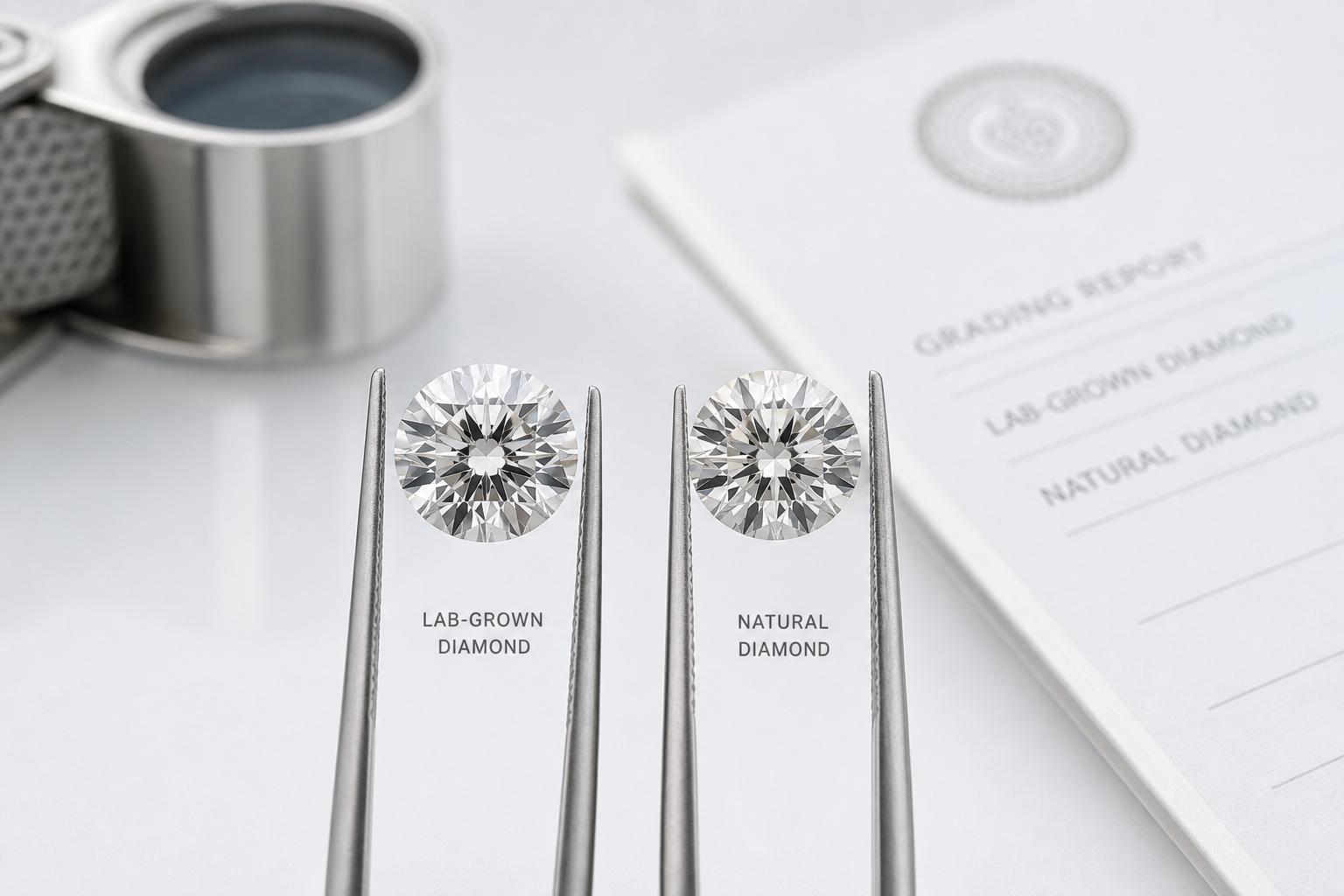
In normal viewing, most buyers cannot reliably tell a lab-grown diamond from a natural diamond by eye alone. The visible performance of a diamond is driven heavily by cut quality, proportions, symmetry, polish, and how the stone handles light. Origin does not automatically make one diamond brighter than the other.
This is a common place where shoppers make the wrong comparison. A well-cut lab-grown diamond can look more lively than a poorly cut natural diamond, and a well-cut natural diamond can outperform a poorly chosen lab-grown stone. If the goal is visible beauty, cut and optical performance should carry more weight than origin in the first visual comparison.
Brilliance, fire, and sparkle are not guaranteed by the label “lab-grown” or “natural.” They come from how the individual stone is cut and how its measurements work together. A buyer who compares only origin may miss the factor that actually controls what the diamond looks like on the hand.
In practical buying, this is where many comparisons become misleading. A report may list the same carat weight for two diamonds, but the face-up size can differ because depth and proportions are different. A stone may also look brighter in one video and darker in another because lighting and camera conditions vary. Use the report to understand the facts, then use comparable images or video to judge how the diamond behaves visually.
Clarify what “same material” does not mean
Same material does not mean every feature is identical. Lab-grown and natural diamonds can differ in growth history, internal growth patterns, trace elements, and inclusions. Those differences may require specialized testing or a grading report to interpret, and they are part of why disclosure matters.
It also does not mean the market treats them the same way. Material identity answers the question of whether the stone is diamond. It does not answer every question about origin, documentation, tradition, or long-term buyer perception. Those are separate issues, and combining them into one simple “same” or “different” answer usually creates more confusion than clarity.
How to keep the material claim accurate
A careful comparison should use two layers of language. The first layer is material identity: both lab-grown and natural diamonds can be diamond. The second layer is origin identity: one is grown in a controlled environment, and the other formed naturally within the Earth. Keeping those layers separate prevents two common mistakes: dismissing lab-grown diamonds as imitation when they are not, or implying that origin is irrelevant when many buyers consider it central to the purchase.
This distinction is especially important when comparing diamonds to simulants. A simulant may imitate the look of diamond while being a different material. A lab-grown diamond is not in that same category when it is correctly identified as diamond. However, the fact that it is diamond does not remove the need for clear lab-grown disclosure. Accurate language should do both jobs at once: confirm the material and identify the origin.
Buyer Verification Checklist
Do not assume appearance tells the whole story. Review the grading report, confirm the exact shape and measurements, and look at available 360-degree video or magnified images. If two stones look similar at first glance, the better choice may still depend on proportions, transparency of documentation, and how the diamond will sit in the intended setting.
The strongest purchase decision is built on the actual stone, not on a label alone.
What Is Different About How Each Diamond Forms?
Describe natural diamond formation in geological terms
A natural diamond forms deep within the Earth under extreme heat and pressure over very long periods of geological time. The crystal is later brought closer to the surface through natural geological processes, where it can eventually be mined, sorted, cut, and graded.
That origin is not just a romantic backstory. It is the defining difference between a natural diamond and a lab-grown diamond. The material may be diamond in both cases, but a natural diamond carries a geological formation history that cannot be reproduced simply by matching the chemistry.
Describe lab-grown formation through CVD and HPHT
A lab-grown diamond forms through controlled crystal growth rather than geological formation. The two main methods are CVD and HPHT. CVD, or chemical vapor deposition, grows diamond from a carbon-containing gas in a chamber, building the crystal layer by layer. HPHT, or high pressure high temperature, uses conditions designed to replicate parts of the pressure-and-heat environment associated with diamond growth.
Both methods can produce real diamond material, but they leave a different growth story behind. A lab-grown diamond is not “assembled” like an imitation stone, and it is not coated to look like diamond. It is grown as diamond crystal. The important distinction is that the growth happened in a controlled setting, not inside the Earth.
For buyers, the growth method itself is usually secondary to disclosure and documentation. CVD and HPHT can both produce desirable diamonds, and neither term alone tells you whether a specific stone is beautiful, well cut, or appropriate for a ring. Treat the growth method as part of the identity record, not as a shortcut for judging the entire diamond.
It is also worth avoiding oversimplified claims about one growth method being automatically superior. Individual stones should still be judged by their appearance, report details, transparency, color impression, clarity characteristics, and suitability for the intended jewelry. The method explains how the diamond was grown; it does not replace stone-by-stone evaluation.
Explain why origin matters even when the gem is still diamond
Origin matters because it changes how the diamond should be described, documented, and understood by the buyer. A lab-grown diamond and a natural diamond can share the same basic material identity, but they do not share the same formation history. That difference is meaningful enough that reputable sellers and grading reports should disclose it clearly.
This is where careful language matters. Saying “both are diamonds” is accurate. Saying “there is no difference” is not. The difference is not that one is diamond and the other is not; the difference is how the diamond came into existence and how that origin affects the purchase context.
Some buyers care most about the physical diamond they can see and wear. Others care deeply about natural geological origin. Neither preference is wrong, but it should be based on a clear understanding of what is being compared.
How to Verify This Before Buying
Before buying, look for the origin disclosure on both the product page and the grading report. The stone should be labeled clearly as lab-grown or natural without vague phrasing. If the report number, stone details, or seller description do not line up, pause before moving forward.
A clear purchase should not require interpretation. The origin category should be stated plainly, and the documentation should support the exact diamond being offered.
Which Differences Actually Matter to Buyers?
The differences that matter most are not about whether one is “real” and the other is not. They are about price difference, buyer perception, resale value, availability, and what the diamond is meant to represent in the purchase. A lab-grown diamond and a natural diamond can be visually comparable, but they do not carry the same market meaning.
For most shoppers, the biggest practical question is not scientific identity. It is whether the tradeoff supports the way they want to spend their budget, which is why a clear lab grown vs natural diamonds comparison can help separate emotional preference from practical value. A buyer choosing an engagement ring may care most about visible size and beauty on the hand. Another may care more about natural origin, long-standing tradition, or the symbolism of geological rarity. Neither priority is automatically more rational; the mistake is pretending they are the same priority.
Compare pricing as a shopping result, not a proof of quality
Price is often the first visible difference between lab-grown and natural diamonds, but it should not be treated as proof that one stone is better made or more beautiful. A lower price for a lab-grown diamond does not make it less diamond. A higher price for a natural diamond does not guarantee stronger sparkle, better cut, or a more attractive face-up appearance.
The price difference exists because the two markets are built differently. Natural diamonds are tied to geological scarcity, mining supply, sorting, distribution, and long-established market perception. Lab-grown diamonds are produced through controlled growth, and supply can respond differently as technology, manufacturing capacity, and competition change. That affects value in a commercial sense, not material identity.
This matters in a real buying situation. If two stones have similar shape, carat weight, color, clarity, and cut quality, the lab-grown option may allow the buyer to choose a larger or higher-spec diamond within the same budget. That can be a strong decision if the goal is visible presence. It becomes a weaker decision if the buyer is mainly paying for natural origin, rarity, or traditional market meaning.
Discuss resale expectations with restraint
Resale value is where buyer perception becomes especially important. Natural diamonds and lab-grown diamonds are not viewed the same way in secondary markets, and buyers should be careful about assuming either one will behave like an investment. Jewelry resale is often less favorable than retail pricing suggests, regardless of origin.
Lab-grown diamonds have generally faced more pressure from expanding supply and changing production costs, which can affect resale expectations. Natural diamonds may retain stronger buyer recognition in some resale contexts, but that does not mean every natural diamond holds value well. Cut quality, desirability, condition, documentation, brand context, and market timing all matter.
The safer judgment is simple: do not buy either type mainly because you expect a predictable future return. If someone asks, “do lab-grown diamonds hold value,” the most useful answer is that they should be purchased for wear, beauty, size, and budget efficiency rather than resale certainty. If resale potential is a serious priority, natural origin may deserve more consideration, but it still requires careful stone selection and realistic expectations.
Address ethics and sustainability without overclaiming
Lab-grown origin changes the ethical and environmental conversation, but it does not automatically settle every question. It removes mining from the formation of that particular stone, which matters to many buyers. At the same time, energy use, production location, disclosure, and business practices still deserve attention.
Natural diamonds also vary widely in sourcing context and documentation. A responsible comparison should not reduce the issue to “lab-grown equals ethical” and “natural equals unethical.” That kind of shortcut may feel convenient, but it is too broad to support a careful purchase. The better question is what the seller can clearly document and how transparent they are about origin, grading, and claims.
For buyers who care about this area, the most useful approach is to ask specific questions rather than rely on broad labels. Where was the stone grown or sourced? What report accompanies it? What claims are being made, and are they supported by documentation? Vague virtue language is less useful than clear disclosure.
Sustainability language should be treated as a claim to verify, not a feeling to accept. A seller may describe a diamond as responsibly sourced, eco-conscious, or sustainable, but those words are only useful when the buyer can understand what they refer to: growth or sourcing route, energy discussion, documentation, traceability, or business practice. If the claim remains broad and unsupported, it should not carry the same weight as the diamond’s report, origin disclosure, and visible quality.
Sustainability claims should be specific and documented. Broad green language is less useful than clear information about production, energy context, sourcing route, and seller transparency, especially when two diamonds appear similar in photos or on a grading report.
Evidence boundaries for ethics and environmental claims
When a diamond listing uses ethical or environmental language, look for the specific evidence behind the wording. A claim that describes a verifiable practice is easier to evaluate than a broad promise. For example, a seller may be able to explain the diamond’s stated origin, the grading documentation, the production disclosure available to the buyer, or the policies behind its sourcing language. Those are narrower, more useful claims than a general statement that a diamond is simply “better for the planet.”
This same caution applies to both categories. Lab-grown origin is not the same thing as a full environmental assessment, and natural origin is not the same thing as proof of responsible sourcing. A buyer does not need to become an auditor, but they should treat unsupported virtue claims as marketing until the seller provides clear documentation or a specific explanation of what the claim means.
What This Means in a Real Purchase
Before choosing between lab-grown and natural, decide what you are optimizing for. If you want the largest, best-looking diamond your budget can reasonably support, lab-grown often gives more flexibility. If natural origin, tradition, or geological rarity is central to the meaning of the purchase, a natural diamond may align better with that goal even if it means choosing a smaller stone or adjusting other specifications.
The key is not to let emotional language replace the actual tradeoff. “Worth it” depends on what the diamond needs to do for you: maximize size, preserve origin preference, fit a strict budget, support a custom design, or carry a particular symbolic meaning. A clear priority will prevent you from paying for one kind of value while expecting another.
How Grading Reports and Testing Help Distinguish Them
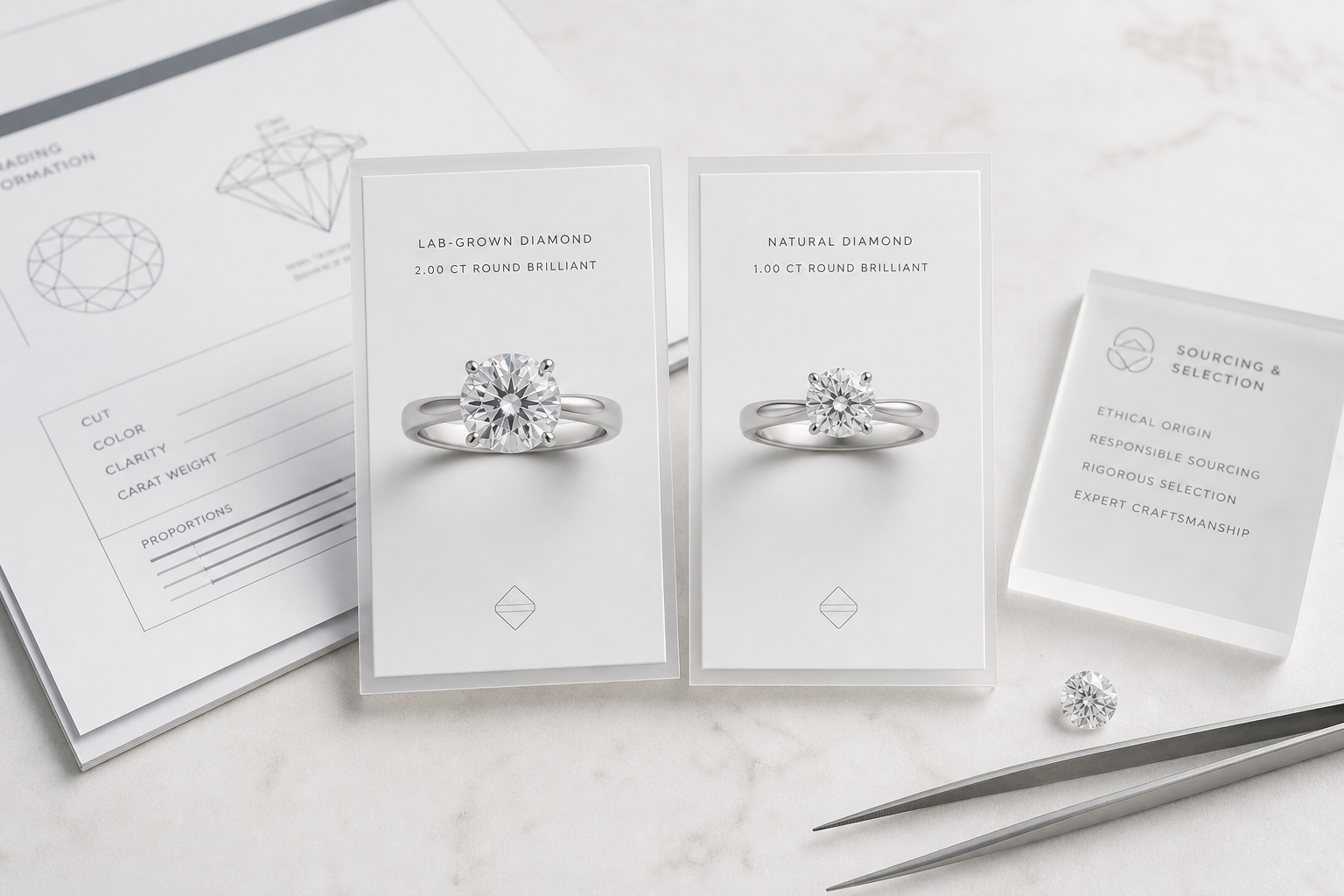
A grading report is one of the most practical tools for separating diamond identity from sales language. It helps answer two different questions at once: what are the stone’s graded characteristics, and is its origin described as lab-grown or natural? For a buyer, that documentation is more reliable than guessing from appearance.
This is especially important because most people cannot tell how to distinguish lab-grown from natural by normal viewing alone. The point of grading documentation and verification is not to make the purchase feel technical. It is to reduce ambiguity before money changes hands.
When a grading report is available, buyers should verify the report details through the issuing laboratory’s official report-check tool where available and compare those details with the stone being offered.
What a grading report can confirm
A grading report can identify the diamond through a report number, describe characteristics such as shape, measurements, carat weight, color, clarity, and proportions, and state whether the diamond is lab-grown or natural when the report is issued for that stone. For lab-grown diamonds, the report should clearly disclose lab-grown origin rather than leaving the buyer to infer it from price or wording.
This is where documentation matters more than casual terminology. A product page may use phrases that sound appealing, but the report should give the buyer a more structured reference point. If the report says the stone is laboratory-grown, that is an origin disclosure, not a downgrade of the material category.
The most useful report is the one that matches the exact stone being offered. Similar grades on another diamond do not verify the diamond in front of you. A report number, matching measurements, and any inscription details help connect the paperwork to the actual stone.
What a report cannot prove by itself
A report does not replace direct review of the diamond. It does not show every lighting condition, every angle, or how the stone will look once set in a ring. It also does not tell you whether the seller’s photos, video, and listing details are complete or whether the stone is the right fit for your design.
This is a common point buyers miss. A report can confirm important facts, but it does not automatically make one diamond the better choice. Two stones can have similar grades and still differ in visual performance, face-up size, patterning, or how well they suit a particular setting.
At NUVU, we treat the grading report as a starting point for comparison, not the whole decision. The report narrows the field, but the buyer still needs to look at the actual diamond, its proportions, and the way it supports the intended piece of jewelry.
A certificate-aware comparison is strongest when the report, stone media, measurements, and intended setting are reviewed together. For NUVU, the goal is to make diamond comparison easier to understand, especially when buyers are weighing report details, visual performance, setting fit, and budget together.
Why visual review still matters
Photos, 360-degree video, magnified images, proportions, and measurements help fill in what the report cannot show. This is where buyers can judge whether the diamond looks lively, balanced, and appropriate for the setting. A technically strong report is less useful if the stone appears dark, poorly proportioned, or awkward in the design.
Visual review is also useful for comparing stones that are close on paper. If two diamonds have the same shape and similar grades, the better choice may come down to spread, facet pattern, contrast, or how the stone handles light. These details are especially important in fancy shapes, where measurements and outline can affect the look as much as the listed carat weight.
The mistake is relying on either paperwork or appearance alone. The report protects against misdescription. Visual review protects against choosing a stone that is technically acceptable but visually disappointing.
A useful way to read a report is to separate facts from judgments. Carat weight, measurements, shape, and origin are identifying facts. Color and clarity grades help describe quality, but they still need context because two stones with the same grades can look different. Cut-related information is especially important because it affects the way the diamond returns light, yet the final visual impression should still be checked through actual stone media whenever possible.
How to use evidence without overreading it
Good documentation should make the buying decision clearer, not broader than the evidence allows. A grading report can support the identity and listed characteristics of a specific diamond, but it should not be stretched into a promise about resale, investment performance, environmental impact, or whether the diamond is the best choice for every buyer. Those are separate questions that require separate judgment.
For a practical comparison, use each piece of evidence for its proper purpose. Use the report to check origin, measurements, carat weight, color, clarity, and other listed characteristics. Use images and video to evaluate visual performance. Use seller policies and claim documentation to understand service, sourcing language, and after-sale expectations. When those sources all point in the same direction, the purchase decision is usually more defensible.
Certificate and Visual Review Check
Before buying, confirm that the report number matches the stone being sold. Check whether there is an inscription if one is listed, and make sure the shape, carat weight, measurements, color, clarity, and proportions line up with the product details.
Then review the actual images or video, not just sample visuals. If a seller cannot clearly connect the documentation to the diamond being offered, that is a warning sign. The strongest comparison uses both the report and the visual evidence together.
How to Compare Lab-Grown and Natural Diamonds Without Confusing Value With Identity
To compare lab-grown and natural diamonds properly, separate what the diamond is from what the market charges for it. Identity answers whether the stone is diamond and whether its origin is lab-grown or natural. Value comparison asks what you receive for the price, what you may give up, and whether that tradeoff fits your reason for buying.
A confusing comparison usually happens when buyers compare a larger lab-grown diamond against a smaller natural diamond and then try to decide which one is “better” in every possible way. That question is too broad. A better question is which stone better supports the purchase: visible impact, origin preference, budget control, setting fit, or future expectations.
Separate the stone from the full jewelry purchase
The diamond and the finished piece are related, but they are not the same decision. A ring price includes the stone, setting, metal, craftsmanship, design complexity, and sometimes brand or service factors. If those costs are blended together too early, it becomes difficult to know whether the price difference comes from the diamond or from the jewelry around it.
This matters most in engagement rings and custom jewelry. A buyer may think they are comparing lab-grown vs natural diamonds, when they are actually comparing two different settings, different metal weights, different design details, or different service levels. The cleaner method is to evaluate the stone first, then evaluate the setting.
A strong diamond choice can still fail if it does not work physically or visually in the jewelry. A wide oval, a deep cushion, and a compact round may all carry similar carat weights but sit very differently in a setting. Carat weight alone does not tell you how the finished piece will look on the hand.
For custom design, trust comes from matching the stone to the setting, budget, and wearer’s daily use, not from choosing grades in isolation. Measurements, prong placement, stone height, and overall proportions should be discussed before the diamond is treated as final for a specific ring design.
Use like-for-like comparison rules
The fairest way to compare lab-grown and natural diamonds side by side is to keep the basic variables as similar as possible. Start with the same shape, then compare similar carat weight, similar cut quality, and a similar color and clarity range. If those factors are not controlled, the comparison becomes noisy.
For example, comparing a 2.00 carat lab-grown oval with a 1.20 carat natural round may be useful for budget planning, but it does not tell you which origin is visually better. It tells you what each market allows at a certain price point. If the goal is appearance, compare stones that would create a similar look in the same setting style.
Cut and proportions should carry more weight than many buyers give them. A higher color or clarity grade may sound impressive, but it is not always the best use of budget if the diamond is poorly proportioned or looks smaller than expected for its carat weight. Origin should not distract from the basic question of whether the stone performs well.
Explain which differences are useful and which are not decisive
Some differences affect the visible result. Shape, measurements, cut quality, spread, and proportions can change how large, bright, or balanced the diamond appears. These should be high-priority comparison points because they affect the jewelry every time it is worn.
Other differences matter more to documentation, preference, and market meaning, and in lab-grown vs natural diamonds comparisons, origin is one of them. It may be deeply important to the buyer, but it does not automatically make a diamond more brilliant or more attractive. A natural diamond with weak cut quality is not visually superior because it is natural, and a lab-grown diamond with strong grades still needs to be checked for real appearance.
The useful judgment is to rank the differences by consequence. If the difference changes how the diamond looks in the setting, it should influence the purchase strongly. If it changes the story, documentation, or future expectations, it still matters, but in a different way. Treating all differences as equal is how buyers end up overpaying for details that do not support their actual goal.
Stone-to-Setting Fit Check
Before choosing based on origin alone, confirm the diamond’s measurements, shape, and setting compatibility. The stone should fit the design structurally and visually, not just meet a preferred carat weight or price point.
Pay close attention to length-to-width ratio in elongated shapes, depth in stones that may sit high, and face-up measurements if size appearance matters. A diamond that looks attractive on paper can still be the wrong choice if it does not suit the setting, the wearer’s style, or the way the piece will be used day to day.
Which Diamond Type Fits Which Buyer Situation?
The better question is not simply “which is better?” It is “which diamond type supports the way I actually want to buy?” A lab-grown diamond and a natural diamond can both be the right choice, but usually for different reasons. The mistake is trying to make one stone satisfy every priority at once: maximum size, lowest spend, traditional origin, future value expectations, and perfect visual performance. Most purchases involve a tradeoff.
Show the buyer who prioritizes visible size and budget efficiency
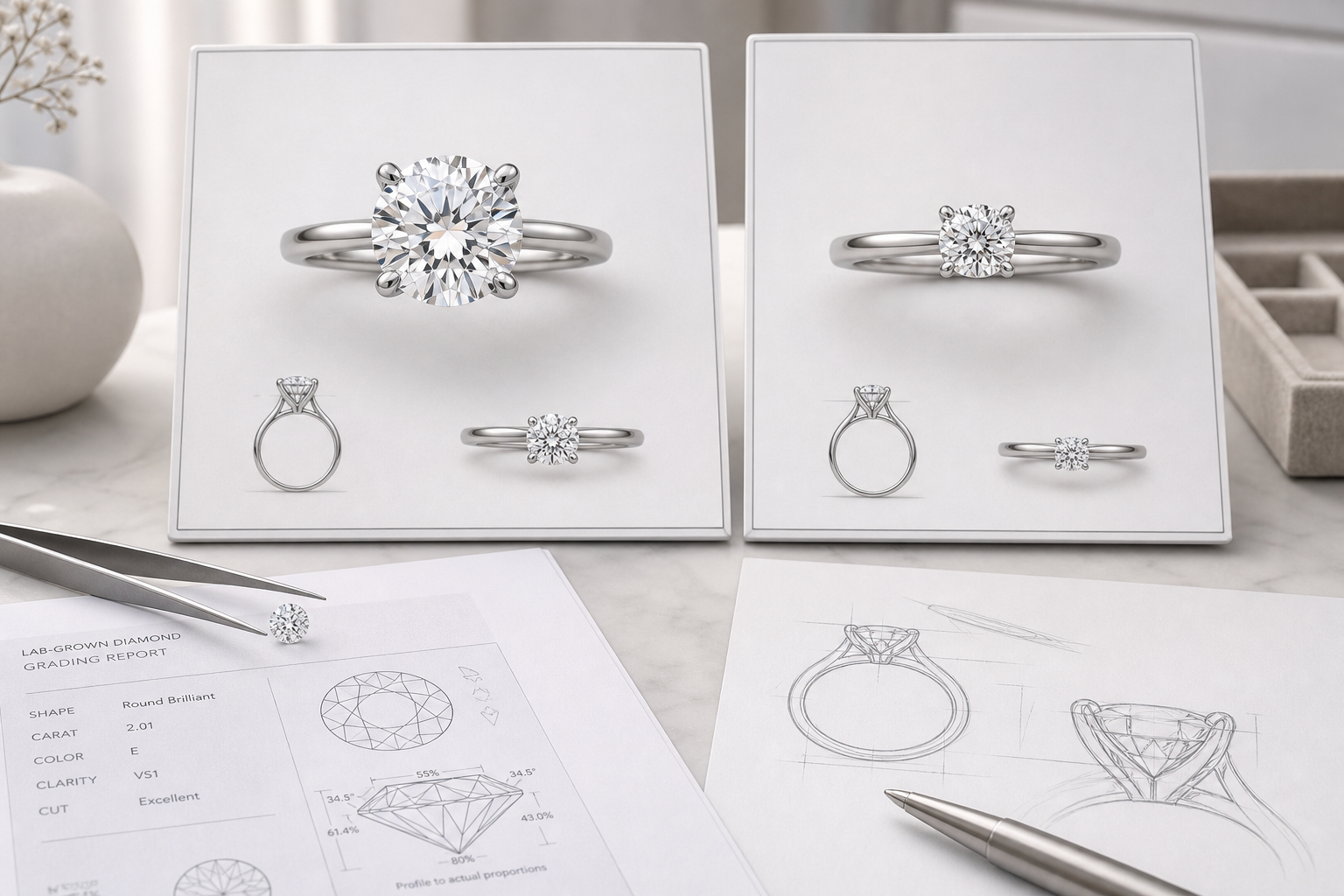
If a couple has a fixed engagement ring budget and wants the most visible presence on the hand, a lab-grown diamond often gives them more flexibility. For example, the same budget might allow a noticeably larger lab-grown center stone while the natural diamond option requires choosing a smaller carat weight, a lower color grade, or a simpler setting.
This does not mean the larger stone is automatically the better purchase. Size only helps if the diamond is well cut, visually balanced, and appropriate for the ring design. A larger stone with weak proportions can look dull, heavy, or awkward in a setting. If the main goal is everyday beauty and finger coverage, choose lab-grown when it lets you improve size without sacrificing cut quality or overall design fit.
The recommendation changes if the buyer would feel disappointed knowing the diamond was not natural, even if it looked larger. In that case, budget efficiency is not the real priority. The right choice is the one the wearer will still feel comfortable explaining and wearing years later.
Show the buyer who values geological origin or tradition
A natural diamond may fit better when origin itself carries meaning for the buyer. Some people value the fact that the stone formed through geological processes over an extremely long period of time. Others prefer natural diamonds because of family expectations, tradition, rarity, or the way they understand symbolic value in an engagement ring.
That preference is valid, but it should be treated as a preference, not as proof that the stone will always look better. A natural diamond with weaker cut quality can perform worse visually than a well-chosen lab-grown diamond. If choosing natural, the priority should still be a strong stone, not just a natural label. Origin adds meaning, but it does not rescue poor proportions, visible inclusions, or a mismatch with the setting.
Choose a natural diamond when the buyer clearly values geological origin enough to accept the likely tradeoff in size, grade, or price. It becomes a poor fit when the buyer only chooses it out of pressure, while privately wanting a larger or cleaner-looking stone within the same budget.
Show the buyer who wants the clearest practical value path
For the buyer who wants the cleanest practical path, start with what will be visible and verifiable. Appearance, report details, shape, measurements, and setting compatibility usually matter more day to day than abstract arguments about which category is superior. A diamond that fits the design, looks balanced on the hand, and has clear documentation is easier to stand behind than one chosen only because it won a category debate.
This is where clarity of choice matters. If the goal is a larger center stone, strong visual impact, and budget control, lab-grown is usually the more direct path. If the goal is natural origin, tradition, and a preference for geological rarity, natural is usually the more coherent choice. Trying to split the difference often leads to compromise in the wrong place, such as buying a natural diamond that is smaller than desired or a lab-grown diamond that the wearer does not emotionally accept.
Future expectations should also be realistic. Neither option should be purchased on the assumption that it will behave like a guaranteed investment. If resale or long-term market perception matters to you, discuss that separately before buying instead of letting it sit in the background as an untested assumption.
For custom design, the stone cannot be evaluated separately from the setting. A lab-grown diamond may make it easier to choose a larger center stone, but the design still needs the right proportions, secure setting style, and balanced side-stone or band relationship. A natural diamond may carry the preferred origin story, but it still needs to work with the wearer’s lifestyle and the physical construction of the piece. At NUVU, this kind of comparison is treated as a practical fit question rather than a single-grade decision.
A Real Buyer Scenario to Keep in Mind
Imagine two rings with the same setting style. One has a larger lab-grown center stone with strong visible presence. The other has a smaller natural diamond chosen for geological origin and tradition. Both can be thoughtful purchases, but they are solving different problems.
Before choosing, name the top priority in plain language: “We want the biggest beautiful stone within budget,” “We care most about natural origin,” “We want the most balanced ring for daily wear,” or “We need the easiest decision to feel confident about.” Once that priority is clear, the diamond type usually becomes easier to choose. If every priority is treated as equal, the decision stays confusing longer than it needs to.
When a grading report is provided, buyers should compare the report details with the stone itself and with the issuing laboratory’s report-check tools where available.
Documentation should be read as a record of the stone’s stated characteristics, not as a promise of beauty, value, or future market outcome.
NUVU’s role in buyer education is to make comparison clearer, especially around grading reports, visual evidence, design fit, and documentation.
Before purchase, buyers should confirm the seller’s documentation, return terms, resizing terms, and after-sales support in writing.
Common Questions and Misconceptions
Most confusion around lab-grown and natural diamonds comes from imprecise language. Words like “real,” “fake,” “synthetic,” and “better” are often used as shortcuts, but they do not all answer the same question. A useful FAQ should separate identity from origin, and appearance from documentation.
Can you tell the difference by eye?
Usually, no. In normal viewing, a well-cut lab-grown diamond and a well-cut natural diamond can look the same to the naked eye. Sparkle, brightness, and fire are driven more by cut quality, proportions, shape, and cleanliness than by whether the diamond formed underground or in a controlled growth environment.
Guessing by appearance is not a reliable buying method. If origin matters, rely on the grading report, product disclosure, inscription if present, and seller documentation. Visual review is still important, but it should be used to judge beauty and performance, not to guess whether the diamond is lab-grown or natural.
Are lab-grown diamonds fake?
No, not when the stone is actually diamond. “Fake” is the wrong category for a lab-grown diamond because it has the material identity of diamond. The more accurate distinction is origin: lab-grown versus natural.
This is different from diamond simulants such as cubic zirconia or moissanite. Those stones can resemble diamonds visually, but they are different materials. A lab-grown diamond may also be called a synthetic diamond in technical language, but “synthetic” in this context refers to how it was created, not to it being imitation jewelry.
Is one type objectively better?
No. One type is not objectively better in every situation because buyers are not optimizing for the same thing. Lab-grown is often the stronger choice for visible size, budget efficiency, and design flexibility. Natural is often the stronger choice for buyers who place real value on geological origin, rarity, or tradition.
The wrong choice is usually the one that solves someone else’s priority instead of yours. A larger lab-grown diamond is not a win if the wearer deeply prefers natural origin. A natural diamond is not a win if the buyer had to give up the appearance, size, or setting they actually wanted just to keep the natural label.
Final Decision Checklist
- Confirm whether the stone is listed as lab-grown or natural.
- Review the grading report and make sure the report details match the diamond being offered.
- Check the shape, carat weight, measurements, proportions, color, and clarity in context.
- Look at photos, video, or magnified views instead of relying only on grades.
- Confirm the diamond physically fits the intended setting and design style.
- Decide your top priority before comparing options: size, origin, budget, tradition, visual performance, or future expectations.
- Ask the seller to clarify any origin, sustainability, return, resizing, or documentation terms that are not already clear in writing.
If you are deciding between two specific stones, compare them as real purchase options rather than abstract categories. The right diamond is the one whose origin, appearance, documentation, and setting fit all support the same decision.
Introduction Direction
Lab-grown diamonds and natural diamonds are both real diamonds in material terms. They share the same basic diamond identity, but they differ in how they form, how their origin is documented, and how buyers may think about value, tradition, and long-term expectations.
The clearest way to compare them is not to ask whether one is “real” and the other is not. The better question is what is actually the same, what is genuinely different, and which differences matter for the ring, loose stone, or piece of jewelry you are buying.
Frequently Asked Questions About Diamond Origin
Can lab-grown diamonds be called real diamonds?
Yes. A lab-grown diamond can be called a real diamond because it has the same fundamental chemical composition and crystal structure as a natural diamond. The important distinction is origin: lab-grown means created in a controlled growth environment, while natural means formed through geological processes inside the Earth.
What is the main difference between lab-grown and natural diamonds?
The main difference is how they form. Natural diamonds form underground over long periods of geological time. Lab-grown diamonds form through methods such as CVD or HPHT in a controlled setting. That origin difference affects documentation, market meaning, and buyer preference, but it does not make a lab-grown diamond a simulant.
Can a jeweler tell lab-grown from natural by eye?
Usually not by normal visual inspection alone. A well-cut lab-grown diamond and a well-cut natural diamond can look essentially the same to the naked eye. Reliable identification depends on proper testing, a grading report, and clear origin disclosure from the seller.
Do lab-grown diamonds have the same physical properties as natural diamonds?
Yes, at the material level, they share the core properties that define diamond: carbon crystal structure, exceptional hardness, and optical behavior associated with diamond. Individual stones still vary in cut, color, clarity, proportions, and overall appearance, so two diamonds should be compared as specific stones rather than as broad categories.
Which one makes more sense for an engagement ring?
A lab-grown diamond often makes more sense if the buyer wants a larger or higher-spec stone within a set budget. A natural diamond may make more sense if geological origin, tradition, or long-standing market perception matters more. The better choice is the one that matches the buyer’s actual priority, not the one that sounds more impressive in isolation.
Compare Appearance, Origin, and Documentation
Compare close-up images of the actual lab-grown and natural diamonds side by side when cut quality is comparable. Similar appearance alone does not establish origin.
Distinguish geological formation from controlled growth, and assess environmental or value claims separately rather than inferring them from origin alone.
Compare the report with the stone details and images. Documentation should match the exact diamond being purchased, not just a similar listing.
Keep Origin, Appearance, and Value Separate
Lab-grown and natural diamonds belong to the same diamond category at the material level, but they differ in origin, documentation, market perception, and buying implications.
A lab-grown diamond is still diamond; natural origin can still carry personal meaning for a buyer. Separate the material properties from that origin preference, then decide which differences matter for the piece you plan to buy.
Lab-grown origin changes the sourcing conversation, but it is not an automatic ethical or environmental guarantee. Natural diamonds may carry different market expectations, but origin does not guarantee future value for either category. Evaluate sustainability claims and resale expectations separately.
Treat price as a buying consideration, not as proof that one diamond type is better or worse. A lower price may create better budget efficiency, while a higher price may reflect origin preference and market structure rather than visible superiority.
Do not let luxury exaggeration, moral pressure, or vague claims decide the purchase. Confirm the origin, compare like-for-like stones, review the report, judge the appearance, and choose based on the priority that matters most to you.
Disclosure: This article is for general educational purposes only. Diamond grading, pricing, availability, specifications, and seller policies can change, and readers should verify important details through grading reports, official laboratory tools, seller documentation, or qualified professionals before making a purchase decision. Laboratory-grown diamonds should be clearly distinguished from natural diamonds, and environmental or sourcing claims should be supported by specific documentation.