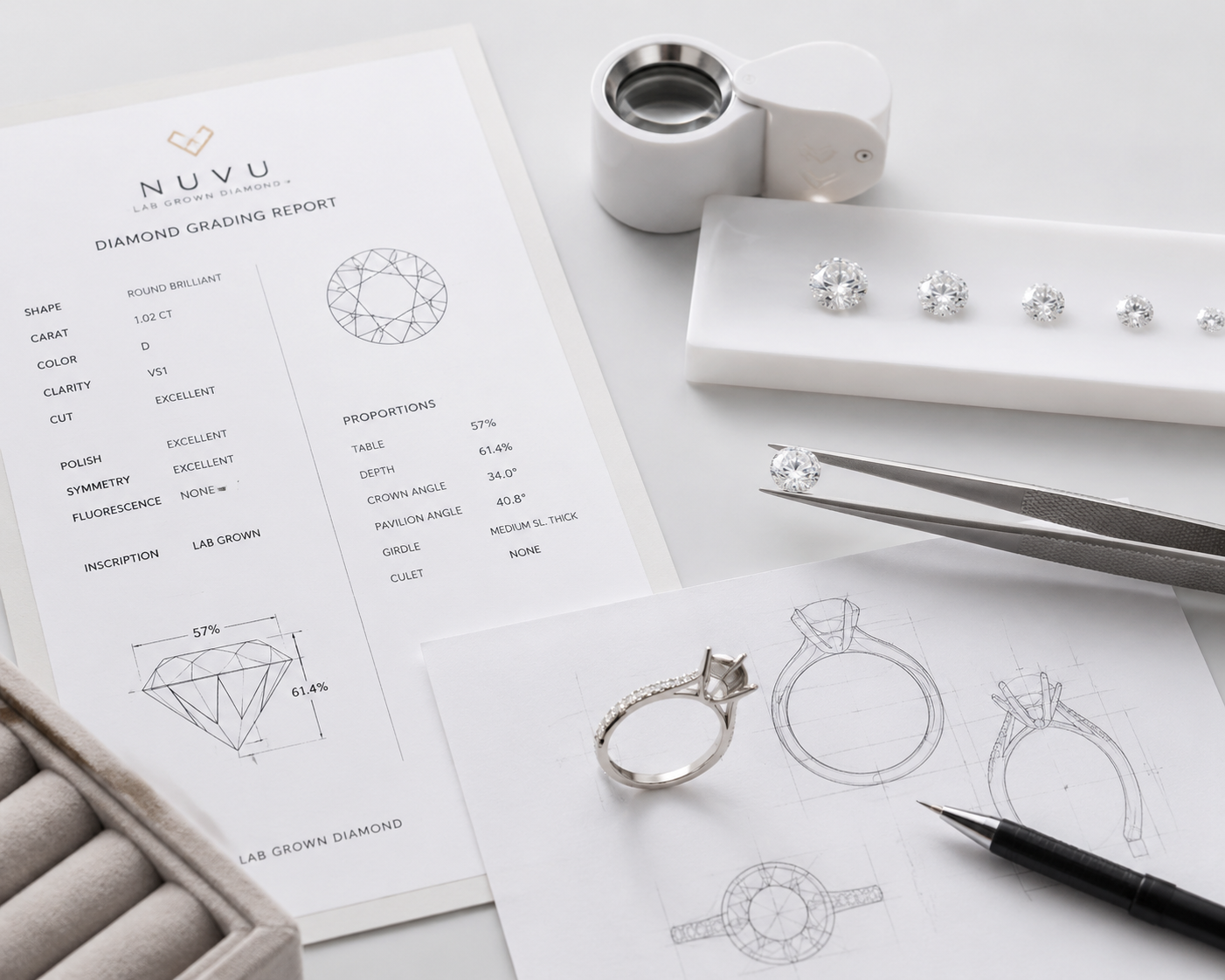
HPHT lab-grown diamonds are real diamonds created under extreme pressure and temperature, with identical physical properties to mined stones. Yet many buyers assume the growth method determines quality—or compare it too directly with the CVD diamond growth process when making buying decisions—or confuse HPHT-grown diamonds with HPHT-treated diamonds. Neither assumption holds up. An HPHT diamond can be exceptional or disappointing depending on cut, clarity, color, and the specific producer’s standards, not the growth technique itself.
For the full framework, read HPHT vs CVD Lab-Grown Diamonds Guide.
This guide clarifies what HPHT actually means, how it differs from CVD, and when the growth method should factor into your buying decision. You’ll learn how to evaluate HPHT diamonds using the same framework as any stone: prioritize cut quality, verify certificate details, and assess visual appeal. The growth method serves as one data point for transparency—not a shortcut to quality judgment.
| Factor | What Buyers Often Assume | What Actually Matters |
|---|---|---|
| Quality Level | HPHT determines if a diamond is better or worse | Individual cut, color, and clarity grades define quality |
| Growth vs. Treatment | HPHT diamonds are treated natural diamonds | HPHT-grown lab diamonds are created from scratch, not treated |
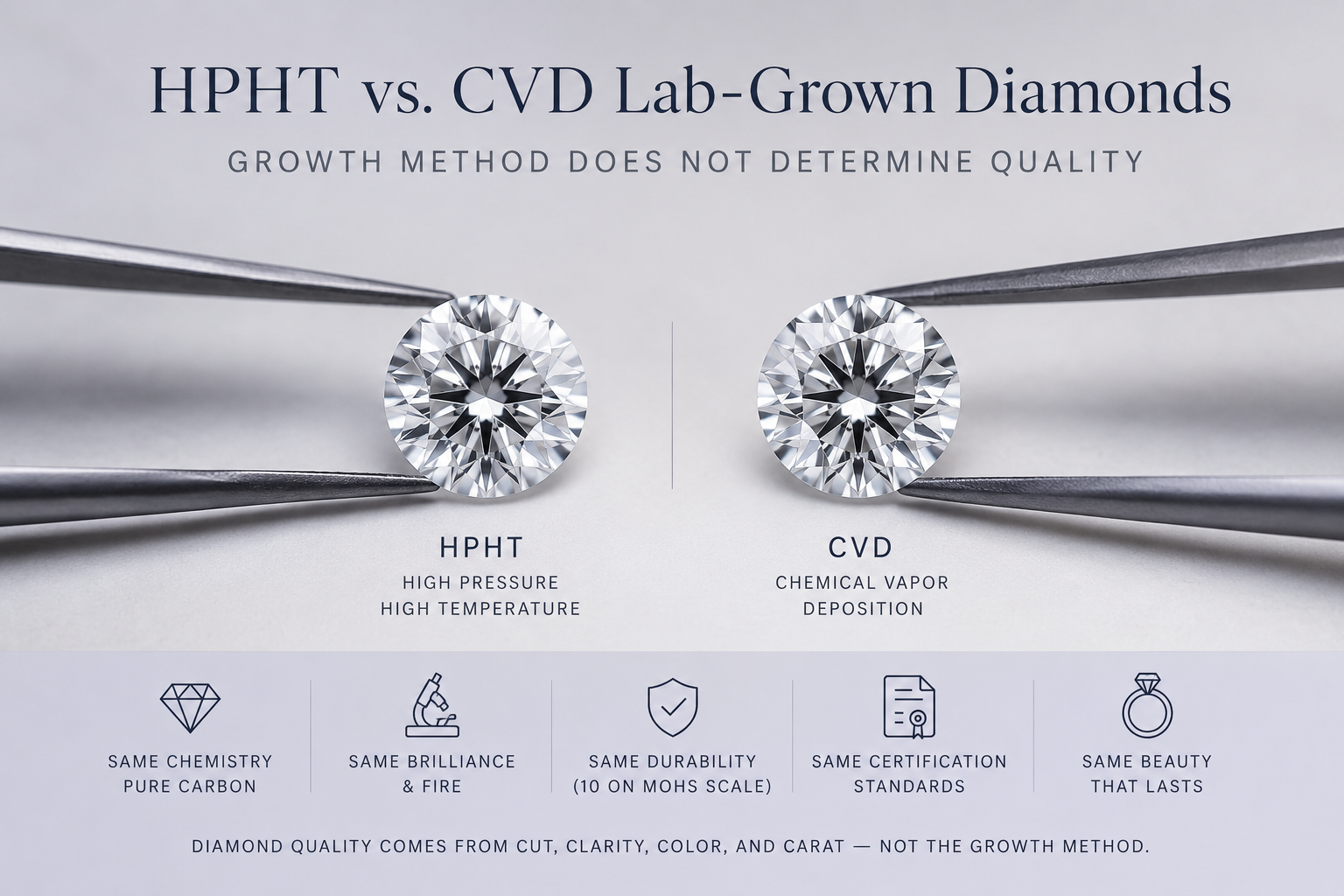
| HPHT vs. CVD | One method produces superior stones | Both create genuine diamonds; evaluate each stone on its own merits |
| Certificate Value | All certificates are equally reliable | Verify growth method disclosure and grading accuracy |
| Buying Priority | Growth method should decide the purchase | Consider growth method alongside 4Cs, price, and visual appeal |
| Durability | Lab-grown diamonds need special care | HPHT diamonds have identical hardness to mined diamonds |
Quick Questions Before You Read
Q: Are HPHT diamonds real diamonds?
Yes. HPHT diamonds have identical physical properties, hardness, and durability to mined diamonds. The growth method creates genuine diamond material.
Q: Should I choose HPHT or CVD?
Compare individual stones based on cut, color, clarity, and price—not growth method. Both produce authentic diamonds with varying quality levels.
Q: Does HPHT mean the diamond was treated?
No. HPHT-grown diamonds are created from scratch. HPHT treatment is a separate process applied to some natural diamonds to improve color.
Q: Do HPHT diamonds require special care?
No. Clean and wear them the same way you would any diamond. Their hardness and durability match natural stones.
What HPHT Actually Means in Simple Terms
HPHT stands for High Pressure High Temperature—a laboratory process that replicates the natural conditions under which diamonds form deep within the Earth. The method was originally developed for industrial applications and later refined for gem-quality diamond production. According to GIA, HPHT-grown diamonds are optically, physically, and chemically identical to natural diamonds, and can only be distinguished from mined stones using specialized gemological equipment that detects microscopic growth features.[1]
This distinction matters for buyers who worry that “lab-grown” means “not real.” A diamond grown by HPHT is not a simulant like cubic zirconia or moissanite. It is carbon atoms arranged in the same crystal lattice structure as a mined diamond. The Federal Trade Commission has clarified that lab-grown diamonds meeting this definition can be marketed as “diamonds” with appropriate disclosure of their laboratory origin, provided sellers do not make unsupported claims about environmental or ethical benefits.[2]
Laboratory-grown diamonds should be clearly identified as laboratory-grown, and they should not be presented as mined diamonds. This disclosure requirement exists to ensure consumers understand what they are purchasing. A lab-grown HPHT diamond is a genuine diamond in terms of its physical and chemical composition, but its origin is different from a natural diamond formed in the Earth. Sellers are expected to provide clear labeling so buyers can make informed decisions based on accurate origin information.
How HPHT Diamonds Are Created: A Buyer-Friendly Overview
The Pressure and Temperature Concept
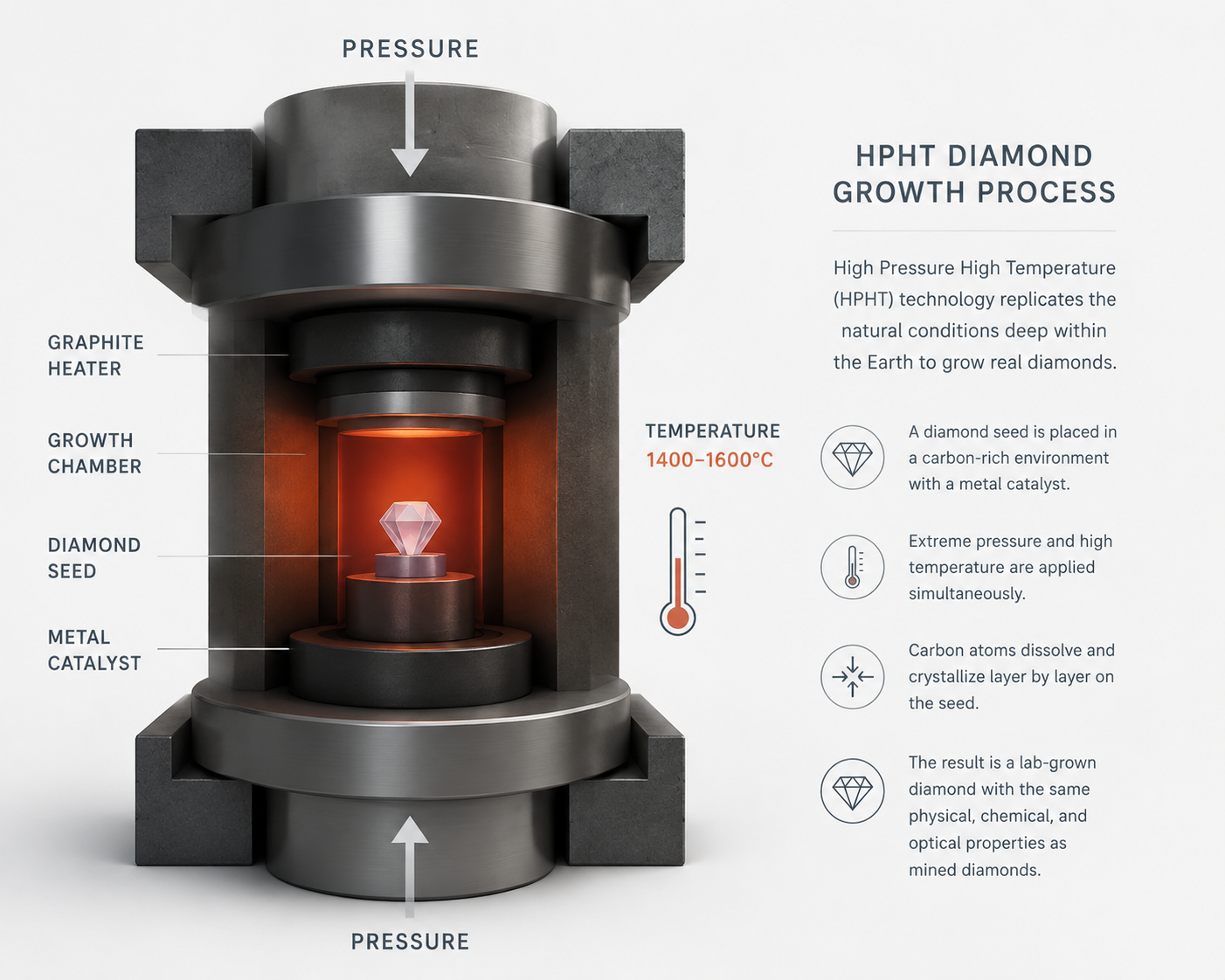
HPHT stands for High Pressure High Temperature, and the name describes the approach fairly directly. A diamond seed — a tiny crystal of diamond — is placed in a press where it is subjected to extreme pressure, roughly 5 to 6 gigapascals, combined with temperatures around 1,300 to 1,600 degrees Celsius. These conditions mirror what happens deep inside the Earth where natural diamonds form over millions of years. In a laboratory, the process is compressed into weeks or months.
Under these conditions, carbon from a source material dissolves and deposits onto the diamond seed, building up layer by layer into a larger crystal. The result is a rough diamond that can then be cut and polished like any other diamond.
The key point for buyers is that the output is a real diamond. It is not a simulant, not a coating, and not a “diamond-like” material. The carbon atoms are arranged in the same crystal structure as a mined diamond, which means the hardness, refractive index, and overall optical behavior are identical.
What the Process Means for the Final Stone
The HPHT process produces a rough diamond crystal. What happens after that — the cutting, polishing, and grading — determines the quality of the finished stone.
Growth method does not control cut quality. A poorly cut HPHT diamond will look dull and lifeless. A well-cut HPHT diamond will perform beautifully. The same is true for clarity. Inclusions can form during the growth process, but their presence, size, and visibility depend on the specific growth run and how the cutter orients the stone. Some HPHT diamonds are clean at VS1 or VVS2. Others have visible inclusions that drop them to SI2 or I1. The method does not predetermine the outcome.
This is why buyers should focus on the actual grades, certificate, and visual appearance of the stone in front of them rather than assuming anything based on how the diamond was grown.
For buyers, the practical point is that a grading report documents what the stone is, but the growth method does not tell you how well the stone was cut or how it will look in person. Two HPHT diamonds with identical certificate grades can look noticeably different depending on proportions, fluorescence, and how the cutter maximized the rough.
Why Growth Time and Conditions Vary
Different producers use different equipment, pressure configurations, and temperature profiles. Some optimize for larger stones. Others prioritize faster cycles. Some growers may target specific color outcomes by adjusting conditions or introducing trace elements.
These production choices can influence the size and shape of the rough crystal, which in turn affects how efficiently a cutter can yield certain polished shapes. But from a buyer’s perspective, these are background details. What reaches the market is a finished diamond with specific proportions, color, clarity, and performance — and that is what should drive the evaluation.
When growth method or post-growth treatment is relevant, buyers should look for clear disclosure in the grading report or seller documentation. This transparency helps ensure that what is stated about the diamond matches what is actually being sold.
Buyer Verification Checklist
If the growth method matters to you, confirm it before you buy. Not all certificates list the method explicitly. Some identify the stone as laboratory-grown without specifying whether HPHT or CVD was used. If you want to know, ask the seller to point out the growth method on the certificate or confirm it in writing.
Keep in mind that the certificate’s main function is to verify the 4Cs — cut, color, clarity, and carat — along with measurements and any treatments. The growth method is a useful disclosure, but it does not replace the actual data on the report.
What Kinds of Diamonds Are Typically Grown by HPHT
Color Ranges Often Seen
HPHT has a reputation for producing diamonds in certain color ranges, but this is a tendency, not a rule. Historically, some HPHT-grown diamonds showed warmer tones, sometimes in the near-colorless or faint color range. This led to a perception that HPHT stones are “more yellow” or “less colorless” than CVD stones. That generalization does not hold up.
Modern HPHT production includes colorless diamonds in the D, E, and F range, as well as stones across G, H, I, and beyond. It also includes fancy colored diamonds in yellow, pink, blue, and other hues. The color outcome depends on growth conditions, any post-growth treatment, and the specific production run.
Buyers should evaluate each stone individually. If a diamond is graded G color with excellent cut, the fact that it was grown by HPHT does not change what that G color means visually.
In practical buying, this is where many comparisons become misleading. A buyer might assume that CVD automatically means “more colorless” and HPHT means “warmer,” but the actual certificate grade tells you what you need to know. A well-cut G-color HPHT diamond will look essentially the same as a well-cut G-color CVD diamond — the color grade, not the growth method, is what affects appearance.
Size and Shape Considerations
HPHT growth tends to produce rough crystals in certain shapes, which can make some polished shapes more efficient to cut from that rough. This is a production consideration, not a quality limitation. HPHT diamonds are available in a wide range of carat weights and shapes, from small melee stones to large center diamonds.
If you are shopping for a specific shape — say, an elongated cushion or an emerald cut — you will find HPHT-grown options. The shape availability has more to do with what the market is cutting and what retailers are stocking than with any inherent limitation of the growth method.
Fancy Color Lab Diamonds and HPHT
HPHT is often used to create fancy colored lab diamonds, particularly in yellow, pink, and blue. The method allows growers to introduce certain elements during growth that can produce specific colors. For buyers interested in fancy colored lab diamonds, HPHT-grown stones are common in this category.
But even here, the growth method is not the whole story. A fancy colored diamond should be evaluated on the actual color — its saturation, tone, evenness, and visual appeal — not just on how it was grown. Two HPHT-grown yellow diamonds can look completely different depending on how the color presents.
What This Means in a Real Purchase
Imagine you are comparing two 1.5-carat lab-grown diamonds. One is labeled HPHT, the other CVD. Both have excellent cut grades, G color, VS2 clarity, and similar prices. Both come with certificates from reputable labs. You look at the 360-degree videos and both stones appear bright, clean, and attractive.
In this scenario, the growth method should not be the deciding factor. The HPHT label does not make one stone better or worse. What matters is that both diamonds meet your standards for cut, color, clarity, visual performance, documentation, and price. If one stone looks better to your eye or is priced more attractively, that is the one to choose — not because of how it was grown, but because of what it actually is.
Common Misconceptions About HPHT Diamonds
Buyers researching lab-grown diamonds often encounter conflicting information about HPHT. Some online sources claim HPHT diamonds are inferior. Others suggest HPHT always produces better color. Both positions are oversimplifications that can lead buyers astray. Understanding what HPHT does and does not tell you about a diamond requires separating the growth method from the actual quality characteristics of each stone.
“HPHT Means Lower Quality”
This misconception likely stems from early lab-grown diamond production, when HPHT stones sometimes showed metallic inclusions or warmer body color. But growth method and quality are separate variables, and HPHT vs CVD pricing depends on far more than the reactor process alone. An HPHT-grown diamond can achieve excellent cut, high color grades (D through F), and clean clarity (VVS1 through VS2). It can also have poor proportions, visible inclusions, or unappealing body color. The same is true for CVD-grown diamonds.
Quality depends on how well the rough crystal was grown and how skillfully it was cut, not on which growth method was used. A poorly executed HPHT process can produce low-quality stones. A well-executed HPHT process can produce exceptional ones. The method describes the production technique, not the outcome. Buyers should evaluate each diamond on its documented grades and visual appearance rather than assuming HPHT indicates any particular quality level.
“HPHT Always Has Better Color”
Another common claim is that HPHT diamonds are always colorless or always have better color than CVD diamonds. This is inaccurate. HPHT can produce colorless diamonds, near-colorless diamonds, and fancy-colored diamonds. The final color depends on growth conditions, the presence of certain elements during growth, and whether any post-growth treatments were applied.
Some HPHT-grown diamonds do show excellent color grades. Others show faint yellow or brown tints. CVD diamonds can achieve equally high color grades. Neither method has an inherent advantage. Color should be evaluated by reading the certificate and examining the stone visually, not by assuming the growth method guarantees any particular result.
“HPHT Is Older and Inferior Technology”
HPHT was the first commercially viable method for producing gem-quality lab-grown diamonds, developed decades before CVD became practical for jewelry use. But “older” does not mean “outdated” or “inferior.” Both methods are actively used today. Both are accepted by major grading laboratories including GIA, IGI, and GCAL. Both can produce high-quality diamonds that meet the same physical, chemical, and optical standards as natural diamonds.
The choice between HPHT and CVD in production often comes down to efficiency, equipment availability, and the specific characteristics a grower wants to achieve. It is a manufacturing decision, not a consumer quality decision. Buyers do not need to prefer one method over the other to get an excellent stone.
How to Verify This Before Buying
If a seller claims that HPHT is “better” or “worse” than CVD, ask for specific evidence related to the diamond you are considering. A vague claim about method superiority should not substitute for documentation. Look at the certificate grades for cut, color, and clarity. Review high-resolution photos and 360-degree video. Compare the price to similar stones with comparable specifications. The proof is in the individual diamond’s documentation and visual appearance, not in the growth method label.
HPHT and Diamond Treatments: Understanding the Difference
One of the most persistent sources of confusion for buyers is the difference between HPHT as a growth method and HPHT as a treatment process. These are two completely different concepts that share the same acronym. Understanding the distinction prevents buyers from misinterpreting what a lab-grown HPHT diamond actually is.
HPHT Growth vs HPHT Treatment
HPHT can refer to two unrelated processes. First, HPHT can describe a method of growing a lab-grown diamond from scratch by applying extreme pressure and temperature to a diamond seed. This is what “HPHT” means in the context of lab-grown diamond listings. Second, HPHT can describe a treatment applied to certain natural diamonds after they are mined to alter or improve their color. This HPHT treatment is a disclosure requirement for natural diamonds that have undergone color enhancement.
When you see “HPHT” on a lab-grown diamond certificate, it almost always refers to the growth method. The diamond was created using high pressure and high temperature. It was not a natural diamond that was later treated. The confusion arises because the same term describes both processes, but they apply to entirely different categories of diamonds.
GIA and other major gemological laboratories distinguish between these processes in their reporting. A natural diamond that has undergone HPHT treatment will be documented with specific comments about the treatment on its grading report, while a lab-grown diamond created through HPHT will be identified as laboratory-grown with HPHT noted as the growth method.[3]
Why This Distinction Matters
A lab-grown HPHT diamond is not a treated natural diamond. It is a diamond grown from a seed under controlled laboratory conditions. The HPHT process created the diamond; it did not modify an existing natural diamond. This matters because some buyers hear “HPHT” and assume it means the diamond has been treated or enhanced in some way that affects value or durability. That assumption is incorrect for lab-grown HPHT diamonds.
In the natural diamond market, HPHT treatment is a specific disclosure that affects how a diamond is valued and marketed. Natural diamonds that have undergone HPHT treatment must be disclosed as treated. Lab-grown diamonds identified as HPHT-grown are simply disclosing their origin method, not a post-growth enhancement.
Disclosure and Certificate Information
Certificates from major grading laboratories clearly identify whether a diamond is natural or laboratory-grown. For lab-grown diamonds, the certificate will typically state “laboratory-grown” or “lab-grown” and may specify the growth method as HPHT or CVD. If any post-growth treatments were applied, those should also be disclosed in the comments section of the certificate.
For most standard HPHT lab-grown diamonds sold in the retail market, the certificate will note the growth method without additional treatment disclosures. The diamond was grown, cut, and graded without further modification. Buyers should still read the full certificate comments to confirm there are no undisclosed treatments.
A grading report helps narrow the field, but it does not replace visual review. The certificate confirms what the stone is on paper; your eyes confirm how it looks in reality. For HPHT-grown diamonds, this means checking that the report matches the stone, verifying no undisclosed treatments appear, and then assessing whether the visual performance matches your expectations for the grades given.
Certificate and Visual Review Check
When reviewing a certificate for a lab-grown diamond, confirm the stone is identified as “laboratory-grown” or “lab-grown.” Check whether the growth method is specified as HPHT or CVD. Look for any comments about additional treatments such as “HPHT processed” (which would indicate post-growth treatment) or “irradiated.” For a standard HPHT-grown lab diamond, you should see the growth method listed without treatment comments. If anything in the certificate is unclear, ask the seller for clarification before purchasing.
When a grading report is provided, buyers should verify the report details through the issuing laboratory’s official report-check tool where available, and compare those details against the stone’s physical characteristics and visual evidence.
Does HPHT Affect Diamond Durability or Appearance Over Time?
Some buyers worry that HPHT diamonds might be less durable, more prone to damage, or more likely to change appearance over time compared to natural diamonds or CVD diamonds. These concerns are understandable but not supported by the physical properties of diamonds. An HPHT lab-grown diamond is still a diamond, with all the characteristics that make diamonds suitable for lifetime wear.
Physical and Chemical Properties
An HPHT lab-grown diamond has the same chemical composition, crystal structure, hardness, thermal conductivity, and optical properties as a natural diamond. The growth method does not create a “softer” material or a “weaker” crystal. Diamond is defined by its atomic structure, not by how it formed. Whether a diamond grew deep in the Earth over millions of years or in a laboratory press over several weeks, the result is the same material.
Durability concerns specific to HPHT-grown diamonds are not recognized in gemology or materials science. An HPHT diamond scores 10 on the Mohs hardness scale, resists scratching the same way natural diamonds do, and withstands normal wear without special vulnerability. The growth method does not compromise these properties.
Visual Stability
HPHT diamonds do not fade, discolor, or degrade under normal wearing conditions. The color and clarity you see when you purchase the diamond will remain stable over time. There is no evidence that HPHT-grown diamonds change appearance after years of wear any differently than natural diamonds or CVD diamonds. A diamond grown by HPHT will look the same in ten or twenty years as it does today, assuming proper care.
Some buyers confuse HPHT growth with HPHT treatment for natural diamonds, where color changes are intentionally induced. That is a different process entirely. An HPHT-grown lab diamond has stable color characteristics established during growth. It does not require special preservation to maintain its appearance.
Normal Diamond Care Applies
Caring for an HPHT lab-grown diamond requires no special procedures. Clean it with mild soap and warm water, or use a jewelry cleaning solution appropriate for diamonds. Avoid wearing diamond jewelry during activities that could cause hard impacts, such as heavy lifting, sports, or manual labor. Remove rings when using harsh chemicals. These care guidelines apply to all diamonds regardless of origin or growth method.
The growth method does not create any unique maintenance requirements. If you already know how to care for diamond jewelry, you know how to care for an HPHT lab-grown diamond.
What to Check Before You Decide
If a seller suggests that HPHT diamonds require special care, have unique durability issues, or need particular maintenance routines, ask for documentation from a recognized gemological laboratory. No such special considerations are recognized by GIA, IGI, AGS, or other major grading organizations. The care routine for an HPHT lab-grown diamond is identical to the care routine for any diamond jewelry. If you are being sold special products or services based on HPHT-specific durability claims, treat those claims with skepticism.
When HPHT Might Matter to a Buyer
For most purchases, the growth method is a secondary consideration at best. But there are specific situations where knowing whether a diamond is HPHT-grown becomes genuinely relevant to the decision.
Personal Preference or Values
Some buyers have strong preferences about how their diamond was created. This might stem from sustainability concerns, curiosity about the technology, or simply a desire to understand the origin story of the piece they will wear every day. If knowing the growth method matters to you for personal reasons, that preference is valid. You should feel comfortable asking for it and factoring it into your choice. A diamond is both a financial and emotional purchase, and feeling confident about its origin is part of that equation.
Environmental and sustainability claims should be specific, documented, and limited to what can be substantiated. Lab-grown diamonds offer a different sourcing path from mined diamonds, but broad claims about environmental superiority require evidence about production practices, energy use, and seller transparency. HPHT production involves significant energy input, as does CVD production. Neither method is automatically more sustainable than the other. If environmental impact is important to your purchase decision, ask producers for specific information about their energy sources, manufacturing locations, and any third-party certifications rather than relying on general claims about lab-grown diamonds being “greener” by default.
Specific Color or Fancy Color Goals
Buyers seeking fancy colored lab diamonds—particularly yellows, pinks, or blues—may encounter more HPHT-grown options in certain color ranges. HPHT has been used effectively for growing colored lab diamonds because the method can incorporate trace elements during the growth process. If you are specifically shopping for a fancy colored stone, the availability of HPHT-grown options in your target color may be worth exploring. That said, evaluate each stone on its actual color saturation, tone, and visual appeal. The growth method gets the diamond into the right color category, but it does not guarantee that a specific stone will have the exact hue you want.
Transparency and Disclosure
Some buyers prioritize full disclosure about origin, growth method, and any treatments applied to a stone. If you fall into this camp, knowing whether a diamond is HPHT or CVD-grown becomes part of the transparency picture. Reputable sellers and grading laboratories will disclose the growth method when it is known. However, disclosure alone does not indicate quality—it simply tells you what the diamond is. A fully disclosed HPHT diamond is not automatically better or worse than a fully disclosed CVD diamond. The disclosure is information, not a verdict.
When HPHT Should Not Be the Deciding Factor
For most buyers, growth method should not override the 4Cs, cut quality, visual appearance, certificate reliability, price, and seller reputation. If two stones are otherwise equivalent in cut, color, clarity, carat, documentation, and price, then personal preference about growth method is a reasonable tiebreaker. But it should not be the primary decision factor. A well-cut, visually appealing, fairly priced diamond with reliable documentation is a strong candidate regardless of whether it was grown by HPHT or CVD.
For custom design, the stone cannot be evaluated separately from the setting. Even when comparing HPHT vs CVD diamonds, the growth method matters far less than whether the diamond’s proportions work with the ring design, whether its color complements the metal choice, and whether its measurements fit the setting requirements. A well-chosen HPHT diamond in a thoughtfully designed setting will always outperform a poorly matched stone regardless of how it was grown.
For custom jewelry projects, stone measurements and setting compatibility should be confirmed before finalizing a purchase. The growth method has no bearing on whether a diamond will fit properly in a specific setting or work well with a particular design.
Buyer Verification Checklist
If growth method matters to you, confirm the HPHT designation on the certificate before purchase. Ask the seller to verify the growth method in writing if it is not clearly listed on the report. For buyers who are indifferent to growth method, focus your evaluation on cut, color, clarity, carat, price, and visual review instead. The growth method is one data point among many—it should not dominate a decision that is better made on the stone’s actual characteristics.
How to Evaluate an HPHT Lab-Grown Diamond for Purchase
Evaluating an HPHT lab-grown diamond requires the same disciplined approach as evaluating any diamond. The growth method does not change the fundamentals of what makes a stone beautiful, valuable, or right for your needs.
Start With the 4Cs and Cut Quality
Assess cut quality first, because this has the greatest impact on visual performance. A poorly cut diamond will look dull regardless of how it was grown. After cut, evaluate color, clarity, and carat in relation to your budget and priorities. The HPHT growth method does not change this framework. An HPHT diamond with excellent cut, good color, and clean clarity will outperform a CVD diamond with mediocre specifications every time—and vice versa.
Review the Certificate
Look for confirmation that the stone is identified as laboratory-grown. Check whether the growth method is specified as HPHT. Review the 4Cs grades, measurements, and any additional comments about treatments. Major grading laboratories such as IGI, GIA, and GCAL provide this information. The certificate is your primary source of objective data about the stone. If the growth method is not listed and this matters to you, ask the seller to confirm it before proceeding.
A grading report helps document key characteristics, but it should not be treated as a guarantee of beauty, value, or sourcing ethics. The report provides useful information about the stone’s measured qualities, but it does not tell you everything about how the diamond will look in person or whether it represents a good value at its asking price. Visual inspection, price comparison, and seller reliability remain essential parts of the evaluation process.
Examine Visuals: Photos, Video, and 360-Degree Views
Visual review is essential regardless of growth method. Look at high-resolution photos and 360-degree video if available. Check for any visible inclusions, color tints, or performance issues such as light leakage or dullness in certain angles. An HPHT diamond with excellent certificates should still be visually reviewed because certificates do not capture everything. Two diamonds with identical grades can look different in person. At NUVU, we encourage buyers to request video and compare stones side by side whenever possible, because the visual impression often reveals what the certificate cannot.
Compare Price and Value
HPHT diamonds are priced based on the same factors as other lab-grown diamonds: carat, cut, color, clarity, shape, certificate quality, and seller pricing strategy. Do not assume HPHT diamonds are inherently cheaper or more expensive. Compare stones with similar specifications across multiple sellers to assess whether a price is fair. If an HPHT diamond is priced significantly higher or lower than comparable CVD stones, ask why. The answer should be rooted in the stone’s actual characteristics—not in the growth method label itself.
Prices can vary because of cut precision, report type, seller channel, size, shape, availability, and documentation. Buyers should compare like-for-like specifications before treating one stone as a better value. A lower price does not automatically mean a better deal if the specifications, documentation, or visual quality are not equivalent. Similarly, a higher price does not guarantee better performance without evidence to support the premium.
Assess Seller Reputation and Policies
Seller reliability, return policies, customer service, and upgrade options matter regardless of growth method. A well-documented HPHT diamond from a reputable seller with a clear return policy is generally a safer purchase than a stone with minimal documentation from an unknown source. The growth method does not protect you from a bad seller. The seller’s policies and track record do.
Before purchase, buyers should confirm documentation, return terms, resizing policies, and after-sales support directly with the seller. These practical considerations often have more impact on purchase satisfaction than the growth method used to create the diamond.
For wholesale buyers, consistency often matters as much as the headline price. If you are sourcing multiple HPHT diamonds for inventory or client projects, evaluate whether the supplier can deliver consistent quality, reliable documentation, and clear communication across orders. A single excellent stone does not guarantee a reliable supply chain.
In wholesale or sourcing conversations, documentation, consistency, and communication often matter as much as the headline specification. Ask about matching standards across multiple stones, certificate reliability, and how the supplier handles variations in quality. A transparent supplier should be able to explain their grading tolerances, provide sample documentation, and clarify what happens if a stone does not meet expectations. These operational details can be more important than the growth method itself when building a reliable supply relationship.
What This Means in a Real Purchase
Consider a buyer who finds a 1.2-carat G-color VS1 excellent-cut HPHT lab-grown diamond with strong documentation and 360-degree video showing a clean, bright stone. The buyer compares it to a similar CVD-grown diamond with the same grades and comparable visual appeal. Both stones have strong documentation and similar pricing. The buyer’s decision should come down to slight differences in price, visual preference, and trust in the seller—not the HPHT versus CVD label. The growth method is a data point, not a verdict. Either stone could be the right choice.
HPHT and CVD: A Brief Comparison for Context
HPHT is one of two primary methods for growing lab diamonds. Understanding the other method—CVD—helps clarify that HPHT is not a unique or isolated technology, but rather one approach among established options.
What CVD Is in Simple Terms
CVD stands for Chemical Vapor Deposition. Unlike HPHT, which uses extreme pressure and temperature, CVD grows diamonds in a vacuum chamber where carbon-rich gas is broken down and deposits layer by layer onto a substrate. Over time, these layers build into a diamond crystal that is then cut and polished. CVD operates at lower pressures than HPHT and has become increasingly common for gem-quality lab diamonds in recent years.
Why Both Methods Exist
HPHT and CVD both produce real diamonds with the same physical, chemical, and optical properties as mined diamonds. Each method has production characteristics that may make it more suitable for certain sizes, colors, or manufacturing scales. HPHT was the first commercially viable method for gem-quality stones and remains widely used. CVD has grown in popularity due to its scalability and efficiency for certain applications. Both methods are accepted by major grading laboratories, and both can produce high-quality gemstones. The existence of two methods reflects production diversity, not a quality hierarchy.
Should Buyers Compare Methods?
For most buyers, the choice between HPHT and CVD is not something you need to control at the production level. What matters is the finished stone’s quality, documentation, visual appeal, and price. If you are choosing between two similar stones—one HPHT, one CVD—the decision should be based on the stones themselves, not the method label. A well-cut, fairly priced, properly documented diamond is a good candidate regardless of how it was grown.
What to Check Before You Decide
If you are curious about the technical differences between HPHT and CVD, a dedicated comparison article can provide deeper detail. For your purchase decision, focus on the specific diamond’s cut, color, clarity, certificate, and visual appeal. Do not let growth method anxiety delay your decision if the stone in front of you meets your criteria and comes from a reputable source. The growth method is worth knowing, but it is not worth overthinking.
Key Takeaways: How to Think About HPHT When Buying
HPHT Is a Method, Not a Quality Grade
HPHT describes how a lab-grown diamond was created. It tells you nothing about whether that diamond is well-cut, visually clean, or fairly priced. An HPHT diamond can be exceptional or disappointing — the growth method does not determine the outcome. What determines quality is how the rough crystal was cut, the natural inclusions that formed during growth, and the decisions made by the producer. A buyer who rejects all HPHT diamonds based on the label alone is ruling out stones that may be outstanding values. A buyer who seeks HPHT assuming it guarantees better color or clarity is equally mistaken. Each diamond must be judged on its own documentation, visual appearance, and price.
Evaluate the Diamond, Not the Label
The factors that actually affect how a diamond looks and performs are cut quality, color, clarity, carat, certificate reliability, and visual review. Growth method is a disclosure point, not a performance metric. When comparing two similar lab-grown diamonds, the one with better cut, cleaner visual appearance, stronger documentation, and fairer price is the better choice — regardless of whether it was grown by HPHT or CVD. The label matters far less than the stone in front of you.
Transparency Is Valuable, But Not Decisive
Knowing a diamond’s growth method is good practice. It supports informed buying and aligns with a preference for full disclosure about origin and production. However, transparency about method does not replace evaluation of the actual stone. A seller who discloses HPHT is being transparent, but that transparency does not automatically mean the diamond is well-cut or fairly priced. Use growth method information as one data point, not a shortcut around the 4Cs, certificate review, and visual inspection.
Ask Questions, Then Decide Based on the Total Picture
If you are curious about growth method, ask the seller to confirm whether a stone is HPHT or CVD and request that the information appear on the certificate. This is a reasonable question, and reputable sellers should provide clear answers. But weigh that answer alongside cut quality, color, clarity, price, documentation, and seller reputation. A well-documented HPHT diamond from a reputable seller with strong visual appeal and fair pricing is a valid and often excellent choice. A poorly documented diamond from an unknown source is a risk regardless of how it was grown.
Sustainability and sourcing claims should be discussed through documentation, energy use, production practices, and seller transparency — not assumed based on growth method alone. HPHT production involves significant energy input, but so does CVD. Neither method is automatically “greener” than the other. If environmental impact matters to you, ask specific questions about the producer’s energy sources, certifications, and sustainability practices rather than assuming one method is inherently more sustainable.
Sustainability claims should be specific and documented. Broad green language is less useful than clear information about production, energy, sourcing, and seller transparency. When environmental impact is a priority, buyers should ask producers for details about energy sources, manufacturing locations, and any third-party verifications. A growth method label alone does not substantiate an environmental claim.
Final Buyer Checklist
Confirm the diamond is identified as laboratory-grown on the certificate. Review the 4Cs grades and check whether the growth method is specified. Examine high-resolution photos and 360-degree video to assess visual performance and any visible inclusions. Compare prices across similar stones with equivalent specifications. Verify the seller’s reputation, return policy, and customer service. Make your decision based on the complete picture — cut, color, clarity, carat, certificate, visual appearance, price, and seller trust — not the HPHT label alone.
For NUVU, the goal is to make diamond comparison easier to understand, especially when buyers are weighing report details, visual performance, setting fit, and budget together. The growth method is one piece of information among many, and it should be treated as such—a useful disclosure that supports transparency, but not a determinant of quality or value.
[1] GIA, “Lab-Grown Diamonds,” Gemological Institute of America, accessed 2025.
[2] Federal Trade Commission, “Jewelry Guides: Guides for the Jewelry, Precious Metals, and Pewter Industries,” FTC, 2018.
[3] GIA, “How to Read a GIA Grading Report for Lab-Grown Diamonds,” Gemological Institute of America, accessed 2025.
Disclosure: This article is for general educational purposes only. Diamond grading, pricing, availability, specifications, and seller policies can change, and readers should verify important details through grading reports, official laboratory tools, seller documentation, or qualified professionals before making a purchase decision. Laboratory-grown diamonds should be clearly distinguished from natural diamonds, and environmental or sourcing claims should be supported by specific documentation.
Last updated: January 2025